OXIDATION OF SOME ALIPHATIC ALDEHYDES BY
QUINOLINIUM CHLOROCHROMATE: A KINETIC AND
MECHANISTIC STUDY
Seema Panwar
[a], Shilpa Pohani
[a], Preeti Swami
[b], Shweta Vyas
[c]and
Pradeep K. Sharma
*[a]Keywords: aliphatic aldehydes, correlation analysis, quinolinium chlorochromate, kinetics, mechanism, oxidation
The oxidation of six aliphatic aldehydes by quinolinium chlorochromate (QCC) in dimethyl sulfoxide (DMSO) leads to the formation of corresponding carboxylic acids. The reaction is first order in QCC. A Michaelis-Menten type of kinetics is observed with respect to the aldehydes. The reaction is catalysed by hydrogen ions, the hydrogen-ion dependence has the form: kobs=a + b[H+]. The oxidation of deuteriated acetaldehyde, MeCDO, exhibited a substantial primary kinetic isotope effect (kH/kD=5.78 at 298 K). The oxidation of acetaldehyde has been studied in nineteen different organic solvents. The solvent effect has been analysed using Taft's and Swain's multiparametric equations. The rate constants correlate well with Taft’s * values; reaction constants being negative. A mechanism involving transfer of hydride ion has been suggested.
Corresponding Authors
E-Mail: [email protected]
[a] Department of Chemistry, J.N.V. University, Jodhpur 342 005, India
[b] Department of Applied Sciences, Global College of Technology, EPIP, Sitapura, Jaipur - India
[c] Department of Chemistry, University of Kota, Kota – India
Introduction
Various halochromates have been used as mild and selective oxidizing reagents in synthetic organic chemistry.1
Quinolinium chlorochromate (QCC) is one such compound used for the oxidation of compounds of industrial importance.2 Oxidation of substituted benzaldehydes with
various oxidants is an intensively studied area as well.3 We
have been interested in the kinetic and mechanistic aspects of the oxidation by complexed Cr(VI) species and several reports on halochromates have already been reported from our laboratory.4-6 There seems to be only a few reports on
the oxidation aspects of QCC are available in literature.7 In
continuation of our earlier work, we report here the kinetics and mechanism of oxidation of six aliphatic aldehydes by QCC in dimethylsulphoxide (DMSO) as solvent. The mechanistic aspects are discussed.
The main aims of the present investigation are to (i) determine kinetic parameters and to evaluate the rate laws, (ii) to study the correlation analysis of effect of structure on rate and (iii) to postulate a suitable mechanism for the oxidation process.
Experimental Section
Materials
QCC was prepared by the reported method2 and its purity
checked by an iodometric determinations. Solutions of formaldehyde were prepared by heating para-formaldehyde
and passing its vapours in DMSO. The amount of HCHO in DMSO was determined by chromotropic acid method8.
Other aldehydes were commercial products and were used as such. p-Toluenesulphonic acid (TsOH) was used as a source of hydrogen ions. Deuteriated acetaldehyde (MeCDO) was obtained from Sigma Chemicals. Solvents were purified by their usual methods.9
Product analysis
The product analysis was carried out under kinetic conditions. In a typical experiment, acetaldehyde (4.4 g, 0.1mol) and QCC (1.88 g, 0.01mol) were dissolved in DMSO (100 ml) and the reaction mixture was allowed to stand for ca. 24 h to ensure completion of the reaction. It was then rendered alkaline with NaOH, filtered and the filtrate was reduced to dryness under pressure. The residue was acidified with perchloric acid and extracted with diethyl ether (5 , 50 ml). The ether extract was dried (MgSO4) and
treated with 10 ml of thionyl chloride. The solvent was allowed to evaporate. Dry methanol (7 ml) was added and the HCl formed was removed in a current of dry air. The residue was dissolved in diethyl ether (200 ml) and the ester content was determined colorimetrically as Fe(III) hydroxymate by the procedure of Hall and Schaefer.10
Several determinations indicated a 1:1 stoichiometry. The oxidation state of chromium in a completely reduced reaction mixture, determined by iodometric titrations was 3.95 0.1.
Kinetic Measurements
monitoring the decrease in [QCC] at 352 nm. The pseudo-first-order rate constant, kobs, was computed from the
linear least-squares plot of log [QCC] versus time. Duplicate runs showed that the rate constants were reproducible to within 3%. The second order rate constant, k2, was
calculated from the relation: k2 = kobs/[aldehyde].
Results
The rate and other experimental data were obtained for all the aldehydes. Since the results are similar, only representative data are reproduced here.
Stoichiometry
The oxidation of aliphatic aldehydes by QCC leads to the formation of corresponding carboxylic acids. The overall reaction may therefore, be written as:
RCHO + CrO2ClOQH+ RCOOH + CrOClOQH+
(1)
QCC undergoes two-electron change. This is in accordance with the earlier observations with structurally similar other halochromates also. It has already been shown that both pyridinium chlorochromate (PCC)11 and pyridinium
fluorochromate (PFC)12 act as two electron oxidants and are
reduced to chromium (IV) species, determining the oxidation state of chromium by magnetic susceptibility, ESR and IR studies.
Rate-laws
The reactions are of first order with respect to QCC. Further, the pseudo-first order rate constant, kobs is
independent of the initial concentration of QCC. The reaction rate increases with increase in the concentration of the aldehydes but not linearly (Table 1).
Table 1. Rate constants for the oxidation of acetaldehyde by QCC at 288 K
103 [QCC]
mol dm-3
[MeCHO] mol dm-3
[TsOH] mol dm-3
104 k obs
s-1
1.00 0.10 0.00 7.79
1.00 0.20 0.00 11.3
1.00 0.40 0.00 14.3
1.00 0.60 0.00 16.2
1.00 0.80 0.00 17.1
1.00 1.00 0.00 17.8
1.00 1.50 0.00 18.6
1.00 3.00 0.00 19.6
2.00 0.40 0.00 15.5
4.00 0.40 0.00 14.6
6.00 0.40 0.00 15.0
8.00 0.40 0.00 14.4
1.00 0.20 0.00 12.6
* contained 0.001 mol dm-3 acrylonitrile
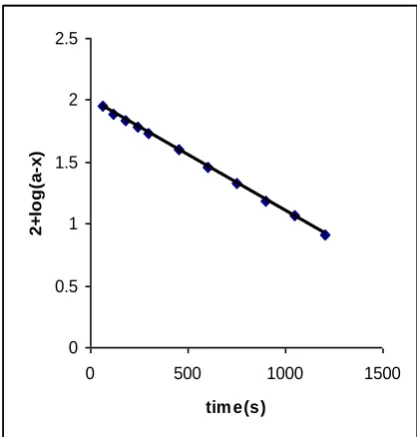
Figure 1. Oxidation of Acetaldehyde by QCC: A typical Kinetic Run
The Fig 1 depicts a typical kinetic run. A plot of 1/kobs
against 1/[aldehyde] is linear (r > 0.995) with an intercept on the rate-ordinate (Fig. 2). Thus, Michaelis-Menten type kinetics is observed with respect to the aldehydes. This leads to the postulation of following overall mechanism (2) and (3) and rate law (4).
Aldehyde + QCC
K
[Complex] (2)[Complex]
k2
Products (3)The dependence of reaction rate on the reductant concentration was studied at different temperatures and the values of K and k2 were evaluated from the double
reciprocal plots. The thermodynamic parameters of the complex formation and activation parameters of the decomposition of the complexes were calculated from the values of K and k2 respectively at different temperatures
(Tables 3 and 4).
Induced polymerization of acrylonitrile/test for free radicals
The oxidation of aldehydes, in an atmosphere of nitrogen, failed to induce polymerisation of acrylonitrile. Further, the addition of acrylonitrile did not affect the rate. This indicates that a one-electron oxidation, giving rise to free radicals, is unlikely in the present reaction (Table 1). To further confirm the absence of free radicals in the reaction pathway, the reaction was carried out in the presence of 0.05 mol dm3 of 2,6-di-t-butyl-4-methylphenol (butylated
hydroxytoluene or BHT). It was observed that BHT was recovered unchanged, almost quantitatively.
Aldehyde QCC 2
Rate (4)
1 Aldehyde
k K
K
0 0.5 1 1.5 2 2.5
0 500 1000 1500
tim e(s)
2
+
lo
g
(a
-x
Table 2. Dependence of the reaction rate on hydrogenion concentration
[Aldehyde]: 0.10 mol dm3 [QCC]: 0.001 mol dm3 Temperature: 298 K
[TsOH]/ mol dm3 0.10 0.20 0.40 0.60 0.80 1.00
104 k
obs/s-1 9.18 10.8 13.5 16.2 18.9 22.5
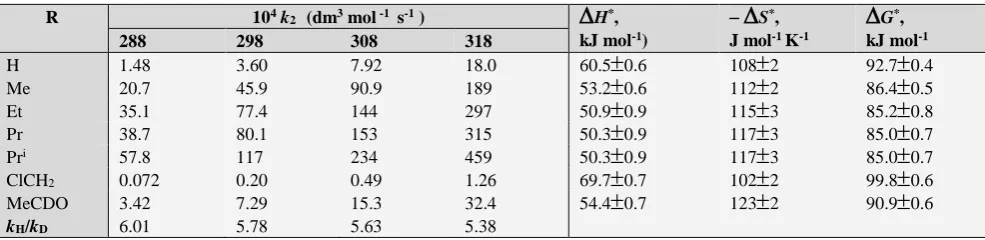
Table 3. Rate constants and activation parameters of the oxidation of aliphatic aldehydes – QCC complexes.
R 104 k
2 (dm3 mol -1 s-1 )
H*,kJ mol-1)
S*,J mol-1 K-1
G*,kJ mol-1
288 298 308 318
H 1.48 3.60 7.92 18.0 60.5
0.6 108
2 92.7
0.4Me 20.7 45.9 90.9 189 53.2
0.6 112
2 86.4
0.5Et 35.1 77.4 144 297 50.9
0.9 115
3 85.2
0.8Pr 38.7 80.1 153 315 50.3
0.9 117
3 85.0
0.7Pri 57.8 117 234 459 50.3
0.9 117
3 85.0
0.7ClCH2 0.072 0.20 0.49 1.26 69.7
0.7 102
2 99.8
0.6 MeCDO 3.42 7.29 15.3 32.4 54.4
0.7 123
2 90.9
0.6kH/kD 6.01 5.78 5.63 5.38
Kinetic isotope effect
To ascertain the importance of the cleavage of the aldehydic CH bond in the rate-determining step, the oxidation of deuteriated acetaldehyde (MeCDO) was studied. The oxidation of deuteriated acetaldehyde exhibited a substantial primary kinetic isotope effect (Table 3).
Effect of acidity
The reaction is catalysed by hydrogen ions (Table 2). The hydrogen- ion dependence has the following form kobs = a +
b[H+]. The values of a and b, for acetaldehyde, are
1.810.46 104 s1 and 3.230.76 104 mol1 dm3 s1
respectively (r2 = 0.9978).
Rate=k2[QCC][Aldehyde]+ k3[QCC][Aldehyde][TsOH]
(5)
Effect of solvents
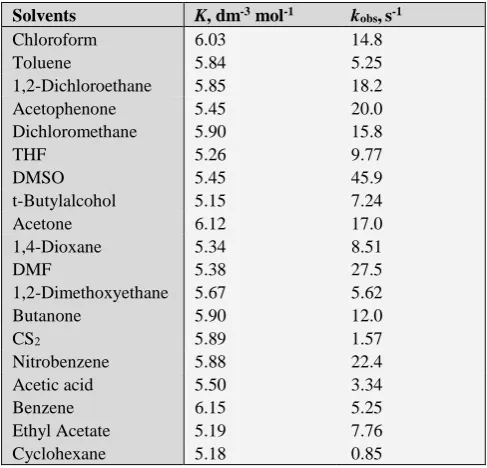
The oxidation of acetaldehyde was studied in 19 different organic solvents. The choice of solvents was limited due to the solubility of QCC and its reaction with primary and secondary alcohols. There was no reaction with the solvents chosen. The kinetics was similar in all the solvents. The values of formation constants K and of decomposition constants of the complex, k2 are recorded in Table 5.
Discussion
There is a fair correlation between the activation enthalpies and entropies of the oxidation of aldehydes (r2 =
0.9782), indicating the operation of a compensation effect13.
A correlation between the calculated values of enthalpies and entropies is often vitiated by the experimental errors associated with them. The reaction, however, exhibited an
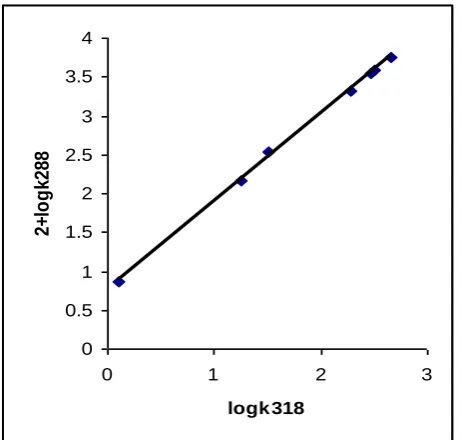
excellent isokinetic relationship, as determined by Exner’s method14. An Exner’s plot between log k
2 at 288 K and at
318 K was linear (r2 = 0.9992) (Figure 3). The value of
isokinetic temperature evaluated from the Exner’s plot is 882±25 K. The linear isokinetic correlation implies that all the aldehydes are oxidized by the same mechanism and the change in the rate of oxidation is governed by changes in both the enthalpy and entropy of the activation.
Solvent effect
The rate constants, k2, in eighteen solvents (CS2 was not
considered, as the complete range of solvent parameters was not available) were correlated in terms of the linear solvation energy relationship (6) of Kamlet et al.15
log k2=A0 + p* + b + a (6)
In this equation, * represents the solvent polarity, the
hydrogen bond acceptor basicities and is the hydrogen bond donor acidity. A0 is the intercept term. It may be
mentioned here that out of the 18 solvents, 12 have a value of zero for . The results of correlation analyses in terms of (6), a biparametric equation involving * and , and
separately with * and are given below as Eqns. 7-10.
log k2 = 3.97 + 1.41(0.17)* + 0.20(0.14) +
0.15 (0.13) (7)
R2 =0.8681; sd=0.16; n=18; =0.39.
log k2 = 4.01 + 1.47(0.17)* + 0.15(0.11) (8)
Figure 2. – Oxidation of Aldehyde by QCC: A double reciprocal plot
Figure 3. Exner’s Isokinetic Relationship in the oxidation of
Aldehydes by QCC
log k2 = 3.98 + 1.51(0.16)* (9)
r2 = 0.8437; sd=0.16; n=18; =0.41
log k2 = 3.15 + 0.42(0.33) (10)
r2=0.0806; sd=0.39; n=18; =0.98
Here n is the number of data points and is the Exner's statistical parameter.16
Kamlet's15 triparametric equation explains ca. 87% of the
effect of solvent on the oxidation. However, by Exner's criterion16 the correlation is not even satisfactory (cf. 7). The
major contribution is of solvent polarity. It alone accounted for ca. 84% of the data. Both and play relatively minor roles.
The data on the solvent effect were analysed in terms of Swain's equation17 of cation- and anion-solvating concept of
the solvents also as equation (11).
log k2=aA + bB + C (11)
Here A represents the anion-solvating power of the solvent and B the cation-solvating power. C is the intercept term. (A+B) is postulated to represent the solvent polarity. The rates in different solvents were analysed in terms of equation (8), separately with A and B and with (A+B).
log k2=0.61(0.09)A + 1.60(0.06)B 4.24 (12)
R2 = 0.9765; sd = 0.07; n = 19; = 0.07
log k2 = 0.39(0.53)A 3.14 (13)
r2 = 0.0298; sd = 0.43; n = 19; = 0.86
log k2 = 1.55 (0.12)B 4.04 (14)
r2 = 0.9091; sd = 0.18; n = 19; = 0.32
log k2 = 1.270.14(A+B) 4.21 (15)
r2 = 0.8369; sd=0.18; n = 19; = 0.41
The rates of oxidation of acetaldehyde in different solvents showed an excellent correlation in Swain's equation [cf. (12)] with the cation-solvating power playing the major role. In fact, the cation-solvation alone accounts for ca. 97% of the data. The correlation with the anion-solvating power was very poor. The solvent polarity, represented by (A + B), also accounted for ca. 83% of the data. In view of the fact that solvent polarity is able to account for ca. 80% of the data, an attempt was made to correlate the rate with the relative permittivity of the solvent. However, a plot of log
k2 against the inverse of the relative permittivity is not linear
(r2 = 0.5253; sd = 0.30; = 0.66).
Correlation analysis of reactivity
The rates of the oxidation of six aldehydes show an excellent correlation with Taft's * substituent constants,18
the reaction constant being negative (Table 6). The negative polar reaction constant indicates an electron-deficient carbon centre in the transition state of the rate-determining step.
0 0.02 0.04 0.06 0.08 0.1 0.12 0.14
0 5 10 15
1/[MeCHO]
1
/k
o
b
s
0 0.5 1 1.5 2 2.5 3 3.5 4
0 1 2 3
logk318
2
+
lo
g
k
2
8
Table 4. Formation constants and thermodynamic parameters of the oxidation of aliphatic aldehydes – QCC complexes.
R 104 k
2 dm3 mol -1s-1
H*,kJ mol-1
S*,J mol-1 K-1
G*,kJ mol-1
288 298 308 3 1 8
H 5.85 5.23 4.57 3.96 12.40.4 201 6.560.3
Me 6.03 5.45 4.79 4.15 12.00.5 180 6.570.4
Et 5.56 4.92 4.33 3.70 12.70.4 221 6.420.3
Pr 5.32 4.72 4.05 3.42 13.70.6 252 6.290.4
Pri 5.94 5.30 4.65 4.05 12.20.3 191 6.600.3
ClCH2 6.12 5.50 4.85 4.32 11.40.2 161 6.690.2
MeCDO 5.67 5.15 4.52 3.85 12.70.5 212 6.520.4
Table 5. Effect of solvents on the oxidation of acetaldehyde-QCC complex at 298 K
Solvents K, dm-3 mol-1 k obs,s-1
Chloroform 6.03 14.8
Toluene 5.84 5.25
1,2-Dichloroethane 5.85 18.2 Acetophenone 5.45 20.0 Dichloromethane 5.90 15.8
THF 5.26 9.77
DMSO 5.45 45.9
t-Butylalcohol 5.15 7.24
Acetone 6.12 17.0
1,4-Dioxane 5.34 8.51
DMF 5.38 27.5
1,2-Dimethoxyethane 5.67 5.62
Butanone 5.90 12.0
CS2 5.89 1.57
Nitrobenzene 5.88 22.4
Acetic acid 5.50 3.34
Benzene 6.15 5.25
Ethyl Acetate 5.19 7.76
Cyclohexane 5.18 0.85
Table 6. Temperature dependence of the reaction constant
Temp. 288 K 298 K 308 K 318 K
* -2.340.01 -2.240.02 -2.150.01 -2.060.05
r2 0.9999 0.9998 0.9999 0.9989
SD 0.003 0.009 0.009 0.006
0.01 0.02 0.01 0.04
Mechanism
The observed hydrogen-ion dependence suggests that the reaction follows the two mechanistic pathways, one is acid-independent and the other is acid dependent. The acid-catalysis may well be attributed to a protonation of QCC to give a stronger oxidant and electrophile (16). Both QCC and QCCH+ are reactive species with the protonated
form being more reactive.
QHOCrO2Cl + H+ QHOCr+(OH)OCl (16)
Formation of a protonated Cr(VI) species has earlier been reported in the reactions of structurally similar halochromates.7-10
In aqueous solutions most aliphatic aldehydes exist predominantly in the hydrate form19 and in many oxidations,
in aqueous solutions, it has been postulated that the hydrate is the reactive species. However, owing to the non-aqueous nature of the solvent in the present reaction, only the free carbonyl form can be the reactive species. The presence of a substantial primary kinetic isotope effect (kH/kD = 5.78 at
298 K), confirms that the aldehydic C-H bond is cleaved in the rate-determining step. The large negative value of the polar reaction constant together with the substantial deuterium isotope effect indicates that the transition state approaches a carbocation in character. Hence, transfer of a hydride ion from the aldehyde to the oxidant is suggested. The hydride ion transfer mechanism is also supported by major role of cation-solvating power of the solvents.
High values of activation indicate that in the rate determining step bond breaking is more important in transition state. Large negative entropy of activation supports a transition state formed from two independent molecules.
Conclusion
The reaction is proposed to proceed through a hydride-ion transfer from aldehyde to the oxidant. The hydride ion
R C
H O
Cr O
O
OQH
Cl
+ Cr
OQH
F
k2
Scheme - 1
R C
H O
O
O
R C+ O + [HOCrOClOQH]
K
transfer mechanism is also supported by major role of cation-solvating power of the solvents. Both deprotonated and protonated forms of QCC are the reactive oxidising species. An aldehydic CH bond is cleaved in the rate-determining step.
References
1Corey, E. J., Suggs, W. J. Tetrahedron Lett., 1975, 2647; Guziec, F. S., Luzio, F. A. Synthesis, 1980, 691; Bhattacharjee, M. N., Choudhuri, M. K., Dasgupta, H. S., Roy, N., Khathing, D. T. Synthesis, 1982, 588; Balasubramanian, K., Prathiba, V.
Indian J. Chem., 1986, 25B, 326; Pandurangan, A., Murugesan, V., Palamichamy, P. J. Indian Chem. Soc., 1995,
72, 479; Sharma., P. D., Panchariya, P., Purohit, P., Sharma, P. K., Eur. Chem. Bull., 2013, 2(10), 816-824; Panchariya, P., Purohit, T., Sharma, D., Malani, N., Kotai, L., Sharma, P. K.,
J. Ind. Chem. Soc., 2012, 89(9), 1203-1207; Daiya, A., Purohit, P., Kumbhat, R., Kotai, L., Sharma, V., Int. J. Chem.,
2012, 1(2), 230-240; Gilla, M., Meena, A., Choudhary, A., Baghmar, M., Sharma, I. K., Kotai, L., Sharma, V., J. Chem. Biol. Phys. Sci., 2011, 1(1), 30-38; Barthora, S., Baghmar, D., Gilla, M., Choudhary, A., Kotai, L., V. Sharma, J. Chem. Biol. Phys. Sci., 2011, 1(1), 7-20; Panchariya, P., Vadera, K., Malani, N., Prasadrao, P., Kotai, L., Sharma, P. K., J. Chem. Asia,2011, 2(4), 225-229.
2Singh, J., Kalsi, P. S., Jawanda, J. S., Chhabra, B. R., Chem. Ind.,
1986, 751.
3Banerji, J., Kotai, L., Sharma, P. K., Banerji, K. K., Eur. Chem.
Bull., 2012, 1(5), 135-140; Ashgar, B. H., Mansoor, S. S., Malik, V. S., Eur. Chem. Bull., 2013, 2(8), 538-544; Purohit, T., Banerji, J., Kotai, L., Sajo, I., Banerji K. K., Sharma, P. K., J. Ind. Chem. Soc., 2012, 89, 1045-1052.
4Vadera, K., Yajurvedi, D., Purohit, P., Mishra, P., Sharma, P. K.,
Prog. React. Kinet. Mech., 2010, 35, 265; Sharma, D., Panchariya, P., Vadera K., Sharma P. K. J. Sulfur Chem.,
2011, 32(4) 315–326; Khatri, J., Choudhary, A., Purohit, P., Kumbhat, R., Sharma, V., Eur. Chem. Bull., 2012, 1, 49-57; 5Sharma, D., Panchariya, P., Vyas, S., Kotai, L., Sharma, P.K. Int.
J. Chem., 2012, 1(1), 29;
6Sharma, D., Panchariya, P., Purohit P., Sharma, P.K. Oxid.
Commun., 2012, 35(4) 821; Panchariya, P.; Purohit, T.; Swami, P.; Malani, N.; Kotai, L.; Prakash, O; Sharma, P. K.
Int. J. Chem. Sci.,2012, 10, 557-567.
7Khatri, J., Sharma, D., Vyas, S., Prakash, O., Sharma, V., Int. J.
Chem., 2012, 1(3), 353; Vyas, N., Sharma, A., Daiya, A., Choudhary, A., Sharma, M., Sharma, V., Eur. Chem. Bull.,
2013, 2(11), 859-865.
8Mitchell J. Jr., Organic analysis, Vol. II, Interscience, New York, ,
1954, 273.
9Perrin, D. D., Armarego, W. L., Perrin, D. R., Purification of
organic compounds, Oxford, Pergamon Press, 1966. 10Hall, R. T., Schaefer, W. E., Organic Analysis, Vol II,
Interscience, New York, 1954, 55.
11Bhattacharjee, M. N., Choudhuri, M. K., Purakayastha S.
Tetrahedron, 1987, 43, 5389.
12 Brown, H. C., Rao, G. C., Kulkarni, S. U., J. Org. Chem., 1979,
44, 2809.
13Liu, L., Guo, W. E. , Chem Rev., 2001, 101, 673. 14Exner, O. Coll. Chem. Czech. Commun., 1977, 38, 411.
15Kamlet, M. J., Abboud, J. L. M., Abraham, M. H., Taft, R. W., J.
Org. Chem., 1983, 48, 2877.
16Exner, O. Coll. Chem. Czech. Commun., 1966, 31, 3222. 17Swain, C. G., Swain, M. S., Powel, A. L., Alunni, S., J. Am.
Chem. Soc., 1983, 105, 502.
18Taft, R. W., Steric effects in organic chemistry, Ed. M. S. Newman, Wiley, New York, 1956, 13.
19Bell, R. P., Adv. Phys. Org. Chem., 1966, 4, 1.