Open access policy
Dr. Mohammad Reza Ghane
Regional Information Center for Science and Technology (RICeST) Assistant Prof. in Library and Information Science
Abstract
Scholarly communication as a social activity needs rethinking since this process is in the monopoly of commercial publishers. Authors and their institutions as well as librarians had been working to achieve unrestricted access to research output. In this regard, many researchers around the world gathered in Budapest on February 2002 to decide on global access to publications free of legal and price barriers. This campaign leads to issuing the declaration Budapest Open Access Initiative. This global and scientific gathering was the starting point for open access movement. This new paradigm in scholarly communication is discussed in this paper from price, legal, and business approaches. In relation to open access policies, “green and gold” routes as well as new licences in terms of Creative Commons are considered. Finally, I concluded that higher education institutes should provide suitable infrastructure to make researchers’ works accessible to others. At the same time, custodians of higher education have to legislate for new policies to mandate their researchers to publish the outputs in institutional and subject-based repositories.
Keywords: open access policy, journal price crisis, journal permission crisis, creative commons, institutional repository, subject-based repository, golden route, green route
Introduction
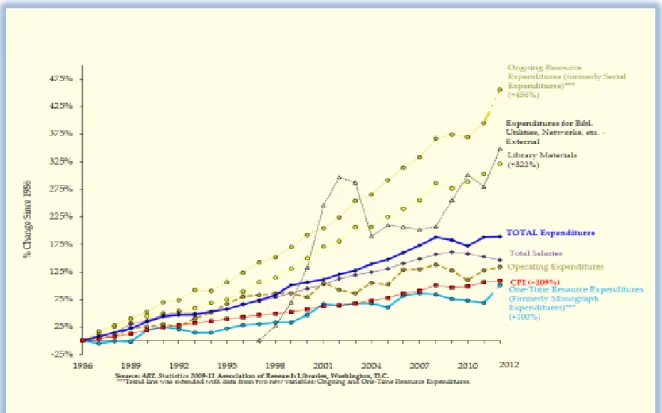
by a few commercial publishers and on the other, insisted on “publish or perish” especially in Europe. The result was inelastic market. This market boosted the spiral increase of journal price and caused a smaller fall in demand. Consequently, there was no control on journal pricing policy. In this situation Libraries cannot afford to purchase all the journals their academicians demanded and resulted hindering researchers to have access to findings of peers and their own, except subscribers. Suber (2012) called this permission and price crisis. Pricing strategy under monopoly conditions caused journal price growth rate increased above inflation (Fig. 1).
Figure 1. Expenditure trends in ARL libraries, 1986-2012
Researches are of global importance. In this regard, universities are responsible to distribute the research findings of their researchers and provide access to knowledge as widely as possible. To this end, information and communication technologies (ICT) play a crucial role. The higher education institutes should provide suitable infrastructure and implement new policies enable the researchers to make their research outputs open access as well as have access to peers’ published works. To achieve this aim, higher education institutes should set out action required. In this regard, they may implement processes and procedures including green and gold routes to open access. In addition to, mandate the academicians to deposit their outputs in an institutional or subject-based repository.
Literature Review
Open Access Definition
The definitions of open access focus on the access to the scientific literature without legal, price and technological barriers. Suber (2012) declared “Open Access (OA) literature is digital, online, free of charge, and free of most copyright and licensing restrictions”. Budapest Open Access Initiatives (BOAI, 2002) defines open access as:
By ‘open access’ to this literature, we mean its free availability on the public internet, permitting any users to read, download, copy, distribute, print, search, or link to the full texts of these articles, crawl them for indexing, pass them as data to software, or use them for any other lawful purpose, without financial, legal, or technical barriers other than those inseparable from gaining access to the internet itself. The only constraint on reproduction and distribution, and the only role for copyright in this domain, should be to give authors control over the integrity of their work and the right to be properly acknowledged and cited. When authors retain all copyrights in her/his work, documents are free of restricted access for everyone based on copyright licenses. Two other choices are share copyright or transfer it. With regard to copyright transfer, there are two options for traditional journals. First, author transfers all intellectual and commercial exploitation rights to the publisher. Second, authors partially keep intellectual rights and transfer commercial rights to publisher (Hoorn & van der Graaf, 2006). Share copyrights on the one hand guarantees the authors’ moral rights, on the other remove permission barrier, and allow readers to use and reuse the works even for commercial purposes. In this sense, i.e. Creative Commons (CC), “all right reserved” is replaced by “some rights reserved”. CC has created several types of licenses and defined the creative work use for open access journals.
Creative Commons Licenses
The Creative Commons copyright licenses permit readers to copy, distribute, edit, remix, and build upon the content of previous works, but within the framework of copyright law. Using CC licenses enables the creator to define usage conditions and let authors to change their copyright terms from “all right reserve” to “some rights reserved” (http://creativecommons.org/about). The interesting point is that CC licenses “are not an alternative to copyright”. The great virtue of using CC licenses, from the creators’ perspective, is its flexibility to have control over the works. In this regard, the author can easily modify his/her copyright terms to meet the needs. The licenses are as follows.
Attribution CC BY
Attribution-NoDerivs CC BY- ND
Attribution-NonCommercial-ShareAlike CC BY-NC-SA
Attribution-ShareAlike CC BY-SA
Attribution-NonCommercial-NoDerivs CC BY-NC-ND
All six licenses have some features in common without infringing copyright. The licenses allow others to copy, reuse, redistribute, build upon, and share the content legally. It is noteworthy that users must acknowledge the author. Three CC licenses, CC BY, CC BY- ND, CC BY-SA, let commercial use of materials. Three others, CC BY-NC-SA, CC BY-NC, and CC BY-NC-ND are for non-commercial purposes. The explanations of some attributions are useful for users. CC Noncommercial (NC) is fair use of content and permit others copy, use, display, and perform the materials for noncommercial purposes only. CC No Derivative Works (ND) means that users are not allowed to adapt the original work. In this regard, they can distribute, display, and perform verbatim copies of the work. The last important attribution is CC Share Alike (SA) that means users are allowed to give out “the derivative works under the same the licence terms that govern the original work”(http://creativecommons.org.au/learn/licences/). The significant point in CC licences is that “CC No Derivative Works” and “CC Share Alike” cannot be considered for inclusion in a licence regarding the two licences description.
Open Access Routes
There are two ways to make research findings open access. These options are gold route and green route. Gold Route recommends a researcher publish in a fully open access journal. Regarding open access journals in addition to fully open access journal, there are Hybrid access journals and Delayed access journals. Historically hybrid open-access journals back to 1996 (walker cited in Björk, 2012). Making his/her content freely available electronically, author is charged by commercial publishers. In this respect, toll – access journals (subscription journals) policy allows making some articles open access known as Article Processing Charge (APC). Delayed open-access journals as another business model in subscription journals put six to twelve months or more embargo length on free access to journal articles after publishing (Laakso, & Björk, 2013). By self-archiving research outputs in an institutional or subject-based repository open access, green route is achieved. The journal publishers’ policies determine which route you choose to publish your manuscript or deposit in a repository. The SHERPA/RoMEO (2006) Services based at the University of Nottingham inform contributors of publishers’ copyright policies. (http://www.sherpa.ac.uk/romeo/).
Lana & Budd, 2013). Fact and figures in relation to repositories are available in Directory of Open Access Repositories - OpenDOAR (http://www.opendoar.org/) and Registry of Open Access Repositories - ROAR (http://roar.eprints.org/).
Discussion
Open access to research outputs as a new paradigm in scholarly communication boosts content availability. Creators’ willingness to free access to their findings with the help of new information and communication technologies speeded up this process. Commercial publishers have overcome scholarly communication and seized control of journal publishing. On the one hand, their absolute monopoly on publishing industry leads to price crisis. On the other hand, transferring authors’ exclusive right to journals to publish his/her research finding is bargaining chip for commercial publishers that gained a market advantage by leveraging their network of publishing industry overwhelming. The price and permission barriers imposed by commercial publishers on researchers and their university libraries forced them to rethinking scholarly communication. The consequence is open access movement and vary route to make their findings available to anyone, anytime and anywhere without bypassing copyright law.
Open access is a new model of scholarly communication that is free of any legal and price barrier. We should bear in mind that open access journals are not an alternative to subscription journals. They also consider business model. One of the differences between open access journals and toll access journals is that readers do not pay for accessing the contents in the former. However, both models need expenses to survive in competitive era. Although researchers’ positive attitudes toward unrestricted access to publications are growing (TBI Communications, 2014; Odell, Dill & Palmer, 2014), they are sensitive about the way others copy, re-use, and build upon their content (van Nordoon, 2013). Regarding the legal approach, CC licences guide authors to determine their control over their outputs.
Conclusion
institutional level is another task of custodians of higher education. Finally, universities need to cooperate and coordinate with other duty holders in relation to scholarly communication to achieve their objectives.
References
Antelman, K. (2004). Do open-access articles have a greater research impact?. College & Research Libraries, 65(5), 372-382.
Bailey, Jr., C. W. (2008). Institutional repositories, tout de suite. Digital Scholarship. Retrieved from http://digital-scholarship.org/ts/irtoutsuite.pdf (accessed 15 September, 2015)
Bernius, S., & Hanauske, M. (2009). Open access to scientific literature: increasing citations as an incentive for authors to make their publications freely accessible. Paper presented at the 42nd Annual Hawaii International Conference on System Sciences, HICSS, January 5, 2009 - January 9, 2009. [Online]. Retrieved from:http://origin-www.computer.org/csdl/proceedings/hicss/2009/3450/00/07-07-09.pdf (accessed September 25, 2015).
Björk, B. c. (2014). Open access subject repositories: An overview. Journal of the American Society for Information Science and Technology, 65(4): 698-706.
Björk, B.C. (2012). The Hybrid Model for Open Access Publication of Scholarly Articles – a Failed Experiment? Journal of the American Society for Information Science and Technology, 63(8): 1496-1504.
Budapest Open Access Initiative – BOAI (2002). Retrieved from http://www.budapestopenaccessinitiative.org/read (accessed 12 June, 2015).
Burns, C. S.; Lana, A. & Budd, J. M. (2013). Institutional Repositories: Exploration of Costs and Value. D-Lib Magazine, 19(1/2). Retrieved from http://www.dlib.org/dlib /january13/burns/01burns.html (accessed 12 September 2015).
Crow, R. (2009). Income models for open access: An overview of current practice. Retrieved from http://sparc.arl.org/sites/default/files/incomemodels_v1.pdf (accessed 3 October, 2015).
Hoorn, E. & van der Graaf, M. (2006). Copyright issues in open access research journals: the authors’ perspective. M-Lib Magazine, 12(2). Retrieved from http://www.dlib.org /dlib/february06/vandergraaf/02vandergraaf.html (accessed 4 September, 2015). Johnson, R. K. (2002). Institutional repositories: Partnering with Faculty to Enhance
Scholarly Communication. D-Lib Magazine, 8(11). Retrieved from http://www.dlib.org /dlib/november02/johnson/11johnson.html (accessed 12 September 2015).
Laakso, M. & Björk, B.C. (2013). Delayed Open Access – an Overlooked High-Impact Category of Openly Available Scientific Literature. Journal of the American Society for Information Science and Technology, 64(7), 1323-1329.
https://scholarworks.iupui.edu/bitstream/handle/1805/5932/facultyOAsurvey-ILF20141119c.pdf?sequence=1&isAllowed=y (accessed 10 September, 2015).
Pappalardo, K. M., Fitzgerald, A. M., Fitzgerald, B. F., Kiel-Chisholm, S. D., O'Brien, D., & Austin, A. (2007). A guide to developing open access through your digital repository. Retrieved from http://eprints.qut.edu.au/9671/1/9671.pdf (accessed 3 October, 2015).
SHERPA/ROMEO (2006). Retrieved from http://www.sherpa.ac.uk/romeo/ (accessed 10 October 2015).
Suber, P. (2012). Open access. MIT :The MIT Press Essential Knowledge series. Retrieved from: http://cyber.law.harvard.edu/hoap/Open_Access_%28the_book%29, (accessed 12 March, 2015).
Swan, A. (2012). Policy guidelines for the development and promotion of open access. UNESCO: France. Retrieved from https://books.google.com/books?hl=en&lr=&id= ptsR-DIXX-AC&oi=fnd&pg=PA4&dq=Policy+Guidelines+for+the+Development + and+Promotion+of+...&ots=4Bi07WQtxu&sig=eQSWWggHFOCsECmU57UHS2-TuN4#v=onepage&q= Policy% 20Guidelines%20for%20the% 20Development%20 and%20Promotion%20of%20...&f=false (accessed 3 October, 2015).
Swan, A, (2010). The open access citation advantage: Studies and results to date. Retrieved from: http://eprints.soton.ac.uk/268516/2/Citation_advantage_paper.pdf (access 22 September, 2015).
TBI Communications (2014). Learned society attitudes towards open access: Report on survey results. Retrieved from http://www.edp-pen.org/images/stories/doc/EDP_ Society_Survey_May_2014_FINAL.pdf (accessed 16 September, 2015)
Van Nordoon, R. (2013). Researchers opt to limit uses of open-access publications. Nature, 6 February. doi:10.1038/nature.2013.12384
Waaijers, L. (2009). A brief overview of international trends in Open Access. Retrieved from http://www.kb.se/docs/about/projects/openaccess/international_trends_oa _leowaaijers.pdf (accessed 30 September, 2015).