HGRID: A Self-con
fi
guring Grid
Resource Discovery
Antonia Gallardo
1, Luis Diaz de Cerio
2and Kana Sanjeevan
11Department of Computer Architecture, Polytechnic University of Catalonia, Barcelona, Spain 2Department of Automation and Computer Science, Public University of Navarre, Pamplona, Spain
Grid Resource Discovery Service is a fundamental prob-lem that has been the focus of research in the recent past. We propose a scheme that presents essential charac-teristics for efficient, self-configuring and fault-tolerant resource discovery able to handle dynamic attributes such as memory capacity. Our approach consists of an over-lay network with a hypercube topology connecting the grid nodes and a scalable, fault-tolerant, self-configuring search algorithm. By design, the algorithm improves the probability of reaching all working nodes in the system, even in the presence of non-alive nodes (inaccessible, crashed or nodes loaded by heavy traffic). We analyze the static resilience of the approach presented, which is the measure of how well the algorithm can discover re-sources without having to update the routing tables. The results show that the presented approach has significantly high static resilience.
Keywords: static resilience, fault-tolerant, grid resource discovery, hypercube, self-configuring protocol
1. Introduction
A Grid is an environment which allows the shar-ing of resources (computers, disk space, mem-ory, bandwidth, data, instruments such as tele-scopes or microtele-scopes etc.) that are connected to a network(e.g. the Internet).
The main objective of a Grid is to enable users to solve problems using the available collec-tive resources. In this way, the Grid resource discovery service plays a fundamental role, al-lowing grid-enabled applications to locate re-sources based on a given set of requirements. Resource search in Peer-to-Peer(P2P)systems offers an attractive approach to deploy fully dis-tributed fault-tolerant Grid discovery service. But for the Grid, we have some extra require-ments such as the existence of dynamic resource
information(e.g. available memory, disk space, etc). In these cases, some of the P2P searching techniques are difficult to apply because they are more suitable for non-dynamic content.
Our architecture is based on an overlay network topology in the form of a hypercube which in-terconnects nodes provided by the Virtual Or-ganizations (VOs). We also present a self-configuring resource discovery algorithm that is able to adapt to complex environments where some nodes might be non-alive(crashed, inac-cessible, experiencing heavy traffic, etc.) when a resource is required.
Resilience in the presence of node failure has different aspects –static resilienceandrouting recovery. As the present work is focused on the resource discovery algorithm we only ad-dress static resilience in this paper – that is, how well our approach can locate required re-sources before routing tables are updated by the routing recovery algorithm in order to remove non-alive nodes in the overlay [4]. The other issue,routing recovery, is not addressed in this paper as this issue is related to the building and maintaining of the overlay topology.
2. The Hypercube Overlay Architecture
In the hypercube overlay network that we present – named HGrid – each VO belonging to the Grid provides available resources(computers, appli-cations, disk space, memory etc.) and makes them accessible through what we call the Grid Information System(GIS) [1].
In HGrid, the interconnections between GISs have the topology of a hypercube. Ann -dimen-sional hypercube (Hn)hasV(Hn) = 2n nodes,
where each one represents a GIS. Each node(or GIS)has an identifier that goes from 0 to 2n−1. Two nodes are said to be directly connected to each other(they are said to be neighbors in the
m-th dimension) if the binary representations of their identifiers differ exactly by them-th bit. Therefore, in a complete hypercube Hn, each
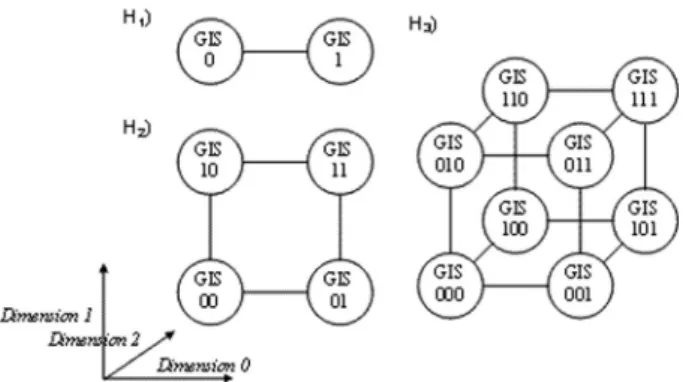
vertex (GIS) has exactly n neighbors. Figure 1 illustrates the architecture for the interaction among 2, 4 and 8 nodes respectively.
Figure 1. H1)The architecture for the interaction among
2 nodes, a one-dimensional hypercube,H2)4 nodes, a
two-dimensional hypercube andH3)8 nodes, a
three-dimensional hypercube.
3. Resource Search Using HGRID
In this section we present a scalable self-confi-guring resource search algorithm(named Algo-rithm-H)that is able to adapt to complex envi-ronments.
It is possible to initiate a search request from any of the live nodes. For reasons of clarity however, the examples used from now on as-sume that node 0 is the start node, without any loss of generality.
3.1. The Search Procedure in anHnUsing
Algorithm-H
The search procedure starts when a consumer wants to discover a Grid service. The consumer connects to one of the GIS nodes of the sys-tem and requests a service(a resource or some resources). The service discovery is tried first inside the requester’s own GIS If there is no provider, then the request is redirected to other GISs. Figure 2 shows the pseudo-code that is performed at each node when a new service re-quest message arrives:
1) When a new service request message is re-ceived by a node the function processRe-quest(message.request) is called. If the re-quest included in the message cannot be sat-isfied, the node sets the value of satisfyRe-questto false and the request is propagated.
Otherwise, satisfyRequestis set to true and no propagation is performed. The message forwarded is composed of the request( mes-sage.request)and two vectors of dimensions
(message.vdandmessage.va).
In case the request cannot be satisfied and the node that receives the message is the start node(startNodeistrue), the listvd
is initialized to vd = {0,1, . . . ,n−1}(the
complete set of dimensions)andvais
initial-ized tova = {}(an empty list). Otherwise,
vdandva are initialized to the lists received
along with the request message. In both cases, the lists represent the set of dimen-sions(neighbors)along which the message must be propagated.
2) The node calls thestatusNeighbors(vd)
func-tion and reorders the listvdin such a way that
the dimensions corresponding to the non-alive neighbors are located at the last po-sitions of the list. For example if vd =
{0,1,2,3} and the neighbor along dimen-sion 1 is not responding, thenvdis reordered
to{0,2,3,1}. ThestatusNeighbors(vd)also
returns two integer valuesnnon−aliveanddalive.
The integer value nnon−alive represents the
number of non-alive nodes in the reordered listvd. The integer valuedaliverepresents the
dimension of the last alive neighbor stored invd. For example, ifvd = {2,1,0,3}and
its neighbors in dimensions 0 and 3 are non-alive nodes,nnon−alive =2 anddalive =1.
3) If the number of non-alive neighbors
(nnon−alive)is more than one, the node calls
theaddToList(va,dalive)function. This
func-tion appends dalive to the end of the list va
and returns the new list(va2).
4) For each position k in the list vd that
rep-resents a live neighbor node, the node calls thecreateList(k,vd) function which creates
a new list composed of all the dimensions located after position k in the ordered list
vd. In other words, if the number of
el-ements in vd (vd.size()) is q, the function
returns{vd[k+1], . . . ,vd[q−1]}. For
ex-ample, if vd = {0,2,3,1} and k = 1, the
call to createList(k,vd) will return {3,1}.
Also, for each alive neighbor, the va list
is initialized. The request, vd, and va are
sent to the corresponding neighbor in the
vd[k] dimension inside a new message by
calling the sendToNeigbor(vd[k],message)
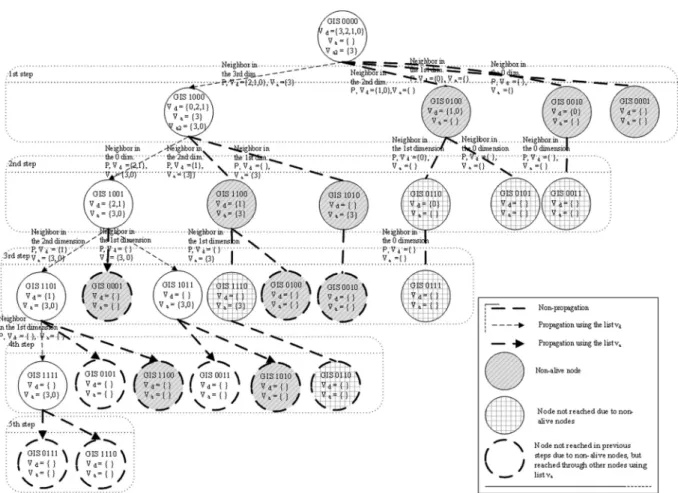
function. See Figure 3 (a complete exam-ple using Algorithm-H)where the start node
(0000) sends vd = {2,1,0} andva = {3}
to its last alive neighbor(the only one in this case).
5) Finally, the node propagates the request to each of the neighbors along va dimensions
only if the corresponding neighbor is not its parent node. The request travels inside a message together with va and vd as empty
lists.
Propagating the requests in this way, the effect of non-alive nodes is reduced. Mak-ing the rearrangement in the vd list,
non-alive nodes would propagate the request to fewer neighbors than alive ones(in case the propagation were tried). Consequently, the algorithm tries to isolate the nodes that are in a non-alive state so that they become leaf nodes (if it is possible). If, under the cir-cumstances, each node has only one non-alive neighbor, then all live nodes can be reached. On the other hand, the nodes that are unreachable because of inaccessible or crashed nodes along a path to them, can be reached eventually via other nodes – using thevalist.
3.2. A Complete Example Using Algorithm-H
Figure 3 illustrates a complete example. We transform the hypercube representation to that of a tree-likefigure in order to illustrate better our search procedure(for example, some ‘child’ nodes could appear more than once during sub-sequent time steps).
A request for servicePstarts at node 0000 in a four-dimensional hypercube. We assume that none of the nodes has the service requested
(note that this is the worst case). In the ex-ample, the value of the listvdat the start node is
{0,1,2,3}and the ordering after calling the sta-tusNeighbors()function is {3,2,1,0}. In this case 2, 1 and 0 are located at the last three po-sitions ofvd = {3,2,1,0}because we assume
that neighbors in dimensions 2(0100), 1(0010) and 0(0001)are non-alive nodes. The neighbor in dimension 3(1000)is the last alive node, so
va2={3}andva={}.
Figure 3.A complete example using Algorithm-H. A request of resourceP
started at node 0000 in a four-dimensional hypercube.
(all except node 0110), even when three out of four of the start node’s neighbors (0100, 0010 and 0001)and two additional nodes(1100 and 1010)are presumed to be non-alive.
4. Related Work
The Globus Toolkit’s Monitoring and Discovery System (MDS) defines and implements mech-anisms for service and resource discovery and monitoring in distributed Grid environments[2]. Motivated by these issues, recently there have been several studies using the P2P model to build a decentralized architecture of VOs. Most of them adopt Distributed Hash Tables(DHTs), and a few of them introduce unstructured P2P topologies. All these studies indicate that some P2P models could help to overcome the chal-lenges posed by the dynamic environment in Grids.
Adriana Iamnitchi and Ian Foster [6]suggest a decentralized architecture similar to the Gnutella
P2P system. This approach is not able to guar-antee that some required information existing in the system can be found, even when the system has no failures(none of the nodes are inaccessi-ble or crashed). Moreover, a peer could be often reached several times by the same request. Our approach assures that nodes are reached only once. In the absence of failures, all nodes in the system are reached and if failures occur almost all the nodes are reached.
In HGrid, changes in the overlay network when a Grid node joins or leaves the system do not cause resource information (data-items) to be remapped, whereas in traditional DHTs, it cau-ses both routing tables and data-items to be remapped.
Recently, an unstructured topology based on hy-percubes has been proposed for use on Data Grids[5]. The nodes in this work contain point-ers to shared data. Data Grids need to im-prove locality among distributed data (which are stored as pointers in the overlay nodes). In order to improve the locality of data, the paper imposes a hypercube topology of GIS (named DGIS). It then proposes a transposition algo-rithm to optimize the overlay network’s topol-ogy according to the access statistics between peers (that is, to improve the data locality). However, the algorithm shown does not address non-alive nodes.
5. Performance Evaluation
Next we present simulations to evaluate if some required information that exists in the system can be found (lookup guarantees) without re-sorting to active recovery algorithms.
For this simulation, we have tested static re-silience [2] with ten thousand, one hundred thousand and one million nodes - using 14, 17 and 20 dimensional hypercube overlays. All nodes have the same probability Pfof failure.
Pf can be seen as the percentage of non-alive
nodes that can be found in the overlay. We run the simulation for values of Pf between 0
and 50% – because we assume that the Grid environment is not extremely transient. Given a Pf, we start a request for service P at node 0, assuming that none of the nodes has the ser-vice requested, and count how many live nodes are not reached by the requestP(failed paths). The simulation is repeated 20 times for eachPf
getting the average number of failed paths. Fi-nally we compare our approach(Algorithm-H) with two other search algorithms for hypercube overlays[5][3].
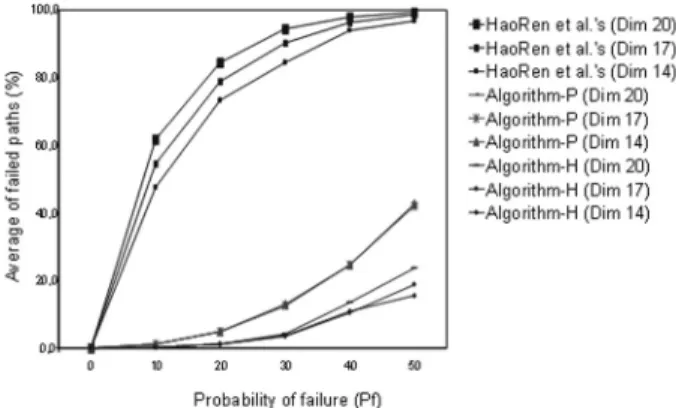
The average percentage of failed paths for vary-ing Pfis shown in Figure 4. Our proposal
of-fers substantially better static resilience than the HaoRen et al.’s algorithm [5]. The HGrid algorithm-H works very well in non-extremely transient environments, where a reduced frac-tion of the nodes are down at any given time
(<50% of failed nodes in the entire Grid). At the same time, Algorithm-H offers better re-silience than Algorithm-P [3] as it can reach more live nodes without using active recovery algorithms.
Algorithm-H is not only scalable in overlay hops (n time steps where nis the dimension-ality), but as seen in Figure 4, it is scalable in the number of nodes(214to 220from Figure 4).
Figure 4.Percentage of average of failed paths for varyingPf across different search algorithms. HaoRen
et al.’s algorithm is a non fault-tolerant algorithm described in[5]. Algorithm-P is a fault-tolerant
algorithm described in[3].
6. Conclusions and Future Work
The proposed algorithm is scalable in terms of time, because it keeps the maximum number of time steps required to resolve a resource re-quest, to a logarithmic scale with respect to the total number of nodes. Moreover, each node has only partial knowledge of the overlay Grid. Nodes do not require having the state informa-tion of the rest of nodes in the overlay, but only of the state of its neighbors. Therefore, our ap-proach is also scalable in terms of data storage. Furthermore, scalability is also maintained by querying each node only once at the most (if possible). This important property(scalability)
also extends to the number of nodes in the Grid – as can be seen clearly in Figure 4.
Unlike traditional approaches based on DHTs, our scheme is suitable for efficiently handling dynamic attributes such as memory capacity, without generating overhead across geographi-cally distributed nodes.
flooding. Additionally, it is self-configuring when there are crashed or heavily loaded nodes. By using the deep multi-dimensional internection of a hypercube, we provide enough con-nectivity so that resource requests can always be propagated in spite of non-alive nodes. This makes our proposed algorithm much more fault-tolerant when it is compared with other topolo-gies such as centralized, hierarchical or trees. In the absence of non-alive nodes, it is able to offer lookup guarantees.
Completing the comparison with DHT-enabled implementations is a goal for future work. There are several interesting areas that have opened up as a result of this work and we are presently working on them: a)Design and evaluation of new request forwarding strategies, b) Incorporation of topology construction and maintenance algorithms and c) Evaluation in terms of response time, scalability etc. by simu-lation.
7. Acknowledgments
This work was supported by the Ministry of Science and Technology of Spain and the Eu-ropean Union under the references TIN2007-68050-C03-01 and TIN2007-68050-C03-02.
References
[1] R. BUYYA ANDM. MURSHED, “GridSim: A Toolkit
for the Modeling and Simulation of Distributed Re-source Management and Scheduling for Grid Com-puting”, Concurrency and Computation: Practice and Experience (CCPE), Volume 14, Issue 13-15,
(2002).
[2] K. CZAJKOWSKI, S. FITZGERALD, I. FOSTER ANDC.
KESSELMAN, “Grid Information Services for
Dis-tributed Resource Sharing”. 10th IEEE International Symposium on High Performance Distributed Com-puting,IEEE Press, 2001.
[3] A. GALLARDO, L. D´IAZ DECERIO, K. SANJEEVAN ANDL. C. E. BONA, “HGRID: A Hypercube-Based Grid Resource Discovery”, submitted to Special Is-sue on Grid Resource Management,IEEE Systems Journal, September 2007.
[4] K. GUMMADI ET.AL, “The Impact of DHT Routing
Geometry on Resilience and Proximity”, inProc. of the 2003 Conference on Applications, Technologies, Architectures, and Protocols for Computer Commu-nications, Karlsruhe, Germany, August 2003, pp. 381 – 394, ISBN:1-58113-735-4.
[5] HAOREN, ZHIYINGWANG, ZHONGLIU, “A
Hyper-cube based P2P Information Service for Data Grid”,
Fifth International Conference on Grid and Coop-erative Computing, 2006, pp. 508-513.
[6] A. IAMNITCHI AND I. FOSTER, “On fully
decen-tralized resource discovery in grid environments”,
Second International Workshop on Grid Computing, pp 51-62, London, UK, 2001. Springer-Verlag.
[7] KADEMLIA: A DESIGN SPECIFICATION,
available-http://xlattice.sourceforge.net/components/
protocol/kademlia/specs.html.
Received:June, 2008
Accepted:September, 2008
Contact addresses:
Antonia Gallardo Departament de Arquitectura de Computadors at the Universitat Polit´ecnica de Catalunya Avda. del Canal Ol´ımpic s/n 08860 Castelldefels Barcelona, Spain e-mail:[email protected]
Luis Diaz de Cerio Dpto. Auotm´atica y Computaci´on Universidad P´ublica de Navarra Campus de Arrosadia Edificio departamental de los Pinos 31006 Pamplona, Spain e-mail:[email protected]
K. Sanjeevan Departament de Arquitectura de Computadors at the Universitat Polit´ecnica de Catalunya Avda. del Canal Ol´ımpic s/n 08860 Castelldefels Barcelona, Spain e-mail:[email protected]
ANTONIAGALLARDOreceived the degree in telecommunications
engi-neering in 2000 from the Universitat Polit`ecnica de Catalunya(UPC) in Barcelona, Spain. Currently, she is a PhD student and assistant professor in the Computer Architecture Department at the Universitat Polit`ecnica de Catalunya. Her research interests focus on distributed computing and grid systems.
LUISM. DIAZ DECERIOreceived the degree in telecommunications
engineering in 1993 and the PhD degree in telecommunications en-gineering in 1998, both from the Universitat Polit`ecnica de Catalunya (UPC)in Barcelona, Spain. He is currently an associate professor in the Automatics and Computing Department at the Universidad P´ublica de Navarra(UPNA). His research interests focus on distributed computing and grid systems.
KANASANJEEVANhas a Bachelors degree from the Indian Institute of