Automatic Support for Veri
fi
cation
of Secure Transactions in Distributed
Environment using Symbolic
Model Checking
E. Di Sciascio, F. M. Donini, M. Mongiello and G. Piscitelli
Dip. Elettrotecnica ed Elettronica, Politecnico di Bari, ItalyElectronic commerce needs the aid of software tools to check the validity of business processes in order to fully automate the exchange of information through the network.
Symbolic model checking has been used to formally verify specifications of secure transactions in a system for business-to-business applications. The fundamental principles behind symbolic model checking are presented along with techniques used to model mutual exclusion of processes and atomic transactions. The computational resources required to check the example process are presented, and the faults are detected through symbolic verification.
Keywords: e-commerce, model checking, secure trans-actions
1. Introduction
Electronic commerce is the ability to perform business transactions involving the exchange of goods and services between two or more par-ties using electronic tools and techniques. In electronic commerce information is conveyed through electronic networks and computer sys-tems and much of the transaction is automated. The kernel of electronic business is the business transaction and issues such as security and trust are the most important challenges in conducting an automated transaction. Electronic commerce applications do not yet provide robust transac-tions, messaging and data access services typi-cal of contemporary client/service applications (Manchala 00).
In this paper we propose to conduct a com-plete search for process faults in the field of business transactions using formal methods for verifying safety and liveness properties of se-cure transactions, in order to improve process integrity. The approach we propose is based on model checking, a powerful formal verifica-tion method that determines whether a system model satisfies certain specifications under all circumstances(Emerson 86). Model checking
can locate subtle but critical flows that conven-tional assurance methods such as testing and simulation often miss. Model checkers, on the other hand, are fully automated tools to verify that a system model satisfies certain properties. Automation makes this formal method particu-larly attractive to business process.
We used a verification tool — Symbolic Model Verifier (SMV) — to formally verify safety
properties of business transactions. To accom-plish this, we used a model checking method: we created finite-state models of the system of interest and also identified and expressed rele-vant properties to verify in a properly defined logical language, CTL (Pnueli 77). We
dis-cuss the modeling of systems for internet-based business and transaction processes. We also show the formulation of specifications and dis-cuss fundamental issues concerning the atomic transactions. With respect to other modeling techniques, such as UML(Conallen 99)or
mod-els based on object-oriented approach (
Man-chala 00), the approach based on model
procedure. Our results from the verification are included to show the current capabilities of the modeling techniques and the model checker.
2. Symbolic Model Checking
The power of the method is that it is automatic and fast. Automatic model checkers have been implemented using algorithms for checking the truth of temporal logic specifications on finite-state models (Katoen 99). The model checker
helps in finding errors in the design of system by producing a counter example that can be used to correct the model. The first model check-ers represented models as graphs, where nodes in the graph represented states of the system and edges denoted possible transitions between states. Models are assumed to be Kripke struc-tures, e.g. triples of the form M = (S R L)
where Sis a set of states, R SS is a
rela-tion which defines legal state transirela-tions(i.e. the
transition relation), andL is a function that
la-bels each state with the atomic propositions that hold true on that state(Clarke 86). It is possible
to algorithmically check such a model for sat-isfaction of temporal logic properties. It is also possible to algorithmically generate counterex-amples when a model does not satisfy a tem-poral logic property. Therefore, given a model
M and temporal logic properties expressed in an appropriate language, model checking pro-cedures can be automated.
The model checking procedure carried out on graphs was efficient, but since the number of states in a finite-state model grows exponen-tially with the number of state variables, only small systems(10
3
;10
6states
)could be
check-ed (Clarke 99). In fact, the main challenge in
model checking is the state explosion problem. That problem occurs because of the many com-ponents that interact in a system or because of the concurrency properties among them. The state explosion problem was addressed by Mc-Millan(1992), who introduced symbolic model
checking.
Symbolic model checking is a variation of model checking where sets of states and the transi-tion relatransi-tion are represented implicitly using Boolean formulas rather than an explicit graph structure (Bryant 86). A set of states may be
represented by Boolean formulas that hold true on those states.
Symbolic model checking reduces the state ex-plosion problem. These Boolean formulas are in turn represented and manipulated in a very efficient manner with Ordered Binary Decision Diagram(Bryant 92). Systems with as many as
10120reachable states have been verified using symbolic model verification techniques.
Transitions may be represented by a Relation
R(v v 0
)wherev is the vector of current
assign-ments to the states components(atomic
propo-sitions)andv
0is the vector of next state
assign-ments. An edge exists in the graph ifRis true for two state vectorsvandv0. If the set of initial
states and the transition relation are given for a model, the reachable state space may be found.
3. Computation Tree Logic (CTL)
Properties to be verified are expressed in a propositional, branching, temporal logic named Computation Tree Logic(CTL). We do not
de-fine here CTL; for an introduction, see(Clarke
99). Any propositional logic formula is a CTL
formula. CTL formulas may also contain path quantifier followed by temporal operators. The path quantifierE specifies some path from the current state while the path quantifierAspecifies all paths from the current state. The temporal operators are X, the next-time operator, U, the until operator, andG, the always operator. Xφ
specifies theφ holds in the next state along the path. φUϕspecifies thatφ holds on every state along the path untilϕ is true. Gφ specifies that
φ holds on every state along the path.
Given the above information, CTL can be de-fined by the following statements:
Every atomic proposition is a CTL formula.
An atomic proposition is the formula true or a state variable assignment.
Ifφ andϕ are formulas, then:φ andφ^ϕ
are formulas
Ifφandϕare formulas, thenEXφ,E(φUϕ)
andEGϕ are formulas
The formulas false, φ ^ ϕ, φ ! ϕ, φ ϕ,
φ $,EFφ, AXφ, AGφ, AFφ, A(φ Uϕ) can
above. Fφmeans thatφwill hold at some future state along the path.
Intuitively, the temporal expressionAGφmeans that the property φ is true in All paths, and Globally(every state), while dually,EFφmeans
that thereExists a path in whichφ will become true(in someFuture state).Xrefers to the neXt
state, with the same meaning forA,E.
The following are some sample CTL formulas with their English explanations.
:EF(φ ^ϕ): There does not exist a future
state on which φ and ϕ are simultaneously true.
EFEG(:φ): Some future state will be on a
path in whichφ is never true.
AGφ :φ holds on every reachable state.
Symbolic Model Checking Implementation
The CTL model checking method has been im-plemented in the package SMV (for symbolic
model verifier) (McMillan 92). SMV has its
own language for defining finite-state concur-rent systems(i.e. the transition relation and the
set of initial states). Once the transition
rela-tion is built, SMV executes the model check-ing procedures for the CTL properties. The SMV input language has provisions for repre-senting systems which are hierarchical, modu-lar and nondeterministic. SMV also provides counterexamples whenever necessary or possi-ble.
SMV uses Ordered Binary Decision Diagrams
(OBDDs) for efficient representation and
ma-nipulation of Boolean formulas. OBDDs are directed, acyclic graphs, which are more com-pact than other currently used representations
(Bryant 86). They are canonicalw.r.t. a fixed
variable ordering, so identical functions are iso-morphic(useful for recognizing fixpoints). The
number of nodes required to represent a func-tion is sensitive to the variable ordering. Any Boolean operation can be applied to OBDDs, and functions may be substituted for variables, which permits the implementation of existential quantification routines(Bryant 92).
SMV has been successfully used to verify elec-trical and computer hardware including syn-chronous protocols for distributed multiproces-sors(SMV).
4. The Proposed Model
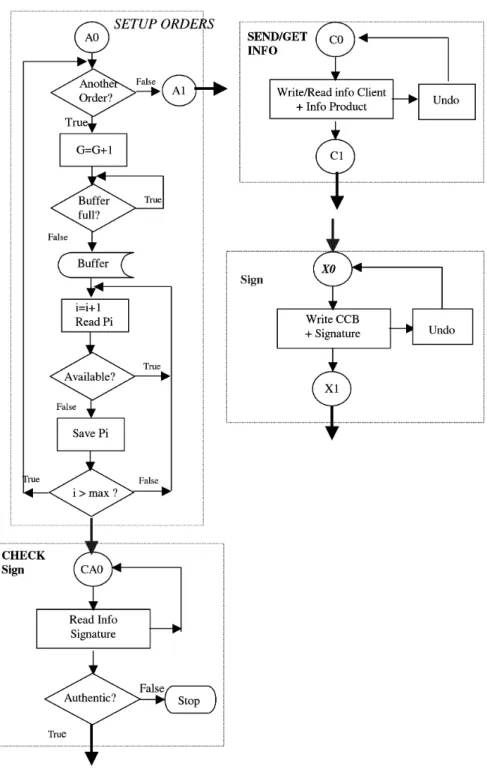
We have developed the finite-state model of an atomic transaction and defined the set of speci-fications expressed in CTL to define the correct behavior of a system for business-to-consumer and business-to-business applications. The ve-rification has been carried out using the SMV tool, to detect undesired events in the system behavior, otherwise hardly detectable, and to properly refine the model. Fig. 1. a)describes
the flow of operation in a generic business-to-consumer transaction; Fig. 1. b)describes
inter-actions for a business-to-business application. In this section we describe the variables, pro-cesses and operating procedures that we use to model a business process.
Mutual Exclusion of Concurrent Processes
We model the system using three concurrent processes: Consumer, Producer and Server. The processes share two resources: Buffer and Database, in accordance with a well-known textbook exercise(Huth 99).
Variables Involved in the System Model
The system behavior is described through the set of variables in the Table 1.
Possible values for variablesBufferandDatabase
are: full, empty or not full. The information concerning the authenticity of the signature —
Infosign— can bevalid,not validorunknown. The kind of information, e.g. TypeInfo, can be
criticalornot critical.
According to the mutual exclusion problem, we model three processesProducer,Consumerand
Server that might be in three different states: critical, trying, and non critical; since there are two resources respectively,BufferandDatabase
we distinguish such states as trying1, trying2
and critical1, critical2 depending on the re-source the processes are waiting for, e.g, try-ing1 and critical1 for the Buffer and trying2
and critical2 for the Database. Moreover we
Fig. 1.(a)Model of a Business-to-Consumer operation;
AddSign true if it is necessary adopt a security mechanism
InfoSign specify the authenticity of the signature
GetSign true if it is necessary to check information referring to the validity of the signature
TypeInfo specify whether the information may be critical
Balance the amount of bank credit available for the purchaser
Request true if a request arrives to the system
Fig. 1.(b)Model of a Business-to-Business operation.
the transaction: BankTransfer, CheckSign,
Get-Req, TransactionandSetupReq. BankTransfer
performs the payment task between the two ac-tors of the transaction; CheckSign checks the authenticity of the signature; GetReq extracts from the Database the requests that arrive to the Server, that should be served by Transac-tion. Transaction is the process that executes the transaction, by means of the other processes
and serves the request. SetupReqsets the infor-mation necessary for the execution of a transac-tion.
The overall model is constructed by asynchro-nous steps (interleaving) among all the other
four processes: Checksign, Transaction,
Se-tupReqandGetReq. The processBankTransfer
Atomic Transactions
In Fig. 2 we show the transition diagram that de-scribes how the system moves through its exe-cution states. The first transition occurs as soon as a request arrives to the system. The Pro-ducerenters its critical region and the request is queued to theBuffer. In the next transition the
Consumerenters the critical region to store the request in theDatabaseand theServer schedu-les the request.
The Transaction procedure performs two
dif-ferent market operations —PurchaseandSell. The system can be in two different states de-pending on the operation. In case ofPurchasea
Start Setup Requestprocedure provides proper information to the supplier according to the re-quest. For a Sell operation the diagram de-scribes the execution states of an atomic trans-action. The transaction goes in arunstate after it starts execution. Process Start Check Sign
checks the digital signature. Once the
tication is obtained,Start Bank Transfercan be executed. If the transaction ends successfully, it goes in thecommit state and then in the up-datestate so that all the changes executed by the transaction will not be undone.
TheTransactionenters theroll-backstate after the error one if anerroroccurred during the
pro-cesses execution. Two recovery states are avail-able when the transaction is unsuccessful:undo
to undo the effects of a transaction andredoto specify that some operations must be redone to ensure that all the operations of a committed transaction have been applied successfully.
5. Tested Specifications
In the following we exemplify how the properties to verify have been expressed in CTL.
Mutual Exclusion
A first set of properties to be verified regards mutual exclusion of concurrent processes, as described in(Huth 99).
Access to Resources
The following set of properties ensures that each process tries to access to the shared resourceiff
resources are available: i.e. theProducercannot access to theBufferif it isfullor theServercannot access to theDatabaseif it isempty.
For any state if process tries to access a resource then it will eventually be available
1. AG((Producer=trying1)!AF((Producer=critical1)^(Buffer=full)))
2. AG((Consumer=trying1)!AF((Consumer=critical1)^(Buffer=empty)))
3. AG((Consumer=trying2)!AF((Consumer=critical2)^(Database=full)))
4. AG((Server=trying2)!AF((Server=critical2)^(Database=empty)))
Correctness of the States
The following properties ensure that each process reaches the correct states: theProducertries to access to theBufferand not to theDatabase:
5. EF(Producer=critical1)
6. EF(Producer=trying1)
7. EF(Server=critical2)
8. EF(Server=trying2)
9. EF(Consumer=critical1_Consumer=critical2)
10.EF(Consumer=trying1_Consumer=trying2)
For any state if the process does not try to access the wrong resource
11.AG:(Producer=critical2)
12.AG:(Producer=trying2)
13.AG:(Server=critical1)
Properties of Transactions
This set of properties specifies the properties that a transaction must satisfy:
For any state if a request arrives to the system then it will be served in some future state
15.AG(:Database=empty!EF(Transaction.state=started))
For any state if an error occurs during the transaction then it will eventually be rolled-back
16.AG((Transaction.state=error)!AF(Transaction.state=roll ;back
))
For any state if the transaction starts then it will be executed in some future state
17.AG((Transaction.state=started)!EF(Transaction.state=run))
For any state if the transaction enters the undo state then in some future state it will be ended or redone
18.AG((Transaction.state=undo)!EF(Transaction.state=ended_Transaction.state=started))
For any state if the transaction is rolled-back then in some future state the operations already done will be undone or redone
19.AG((Transaction.state=roll ;back
)!EF(Transaction.state=undo_Transaction.state=redo))
For any state if the sign is valid and there is money available in some future state the bank transfer will be executed
20.AG((CheckSign.state=success^Balance=available)!EF(BankTransfer=success))
Eventually if the bank transfer starts then it will end in any case
21.AF((BankTransfer=run)!AG(BankTransfer=success_BankTransfer=error))
For any state if the information is critical then it is possible to add the Signature
22.AG((TypeInfo=critical)!EF(AddSign=1))
In some future state there might be not critical information
23.EF(TypeInfo=not
;critical )
For any state, if the transaction is successful then the system will update its resource in some future state
24.AG((Transaction.state=commit)!EF(Transaction.state=update))
For any state if the bank transfer is successful then transaction will end in commit in some future state
25.AG((BankTransfer=success^CheckSign.state=success^GetReq.state=success)!
EF(Transaction.state=commit))
Whatever happens, the bank transfer will not be executed if there is no credit available
26.AG((Balance=not
;available
)!AG:(BankTransfer=success))
Error Management
The following formulas are necessary to prevent errors in the system behavior. The properties require that the specified situations should not occur, in fact they are formulated as the negation of the undesirable event.
27.:EF((GetReq.state=error)^(Transaction.state=commit))
There does not exist a future state in which an error occurs during the transaction and it is successful
28.:EF((Transaction.state=error)^(Transaction.state=commit))
The following two formulas ensure that, if the sign is not authentic, then the transaction will not end in commit
There does not exist a future state in which an error occurs in the sign verification and the transaction ends successfully
29.:EF((CheckSign.state=error)^(Transaction.state=commit))
There does not exist a future state in which the information about the sign state that it is not valid and the transaction ends successfully
30.:EF(InfoSign=not ;valid
^Transaction.state=commit)
The following two formulas ensure that if an error occurs during the bank transfer then the trans-action will not end in commit
There does not exist a future state in which an error occurs in the bank transfer and the transaction ends in commit
31.:EF((BankTransfer=error)^(Transaction.state=commit))
There does not exist a future state in which there is not credit available and transaction arrives in the commit state
32.:EF(Balance=not
;available
^Transaction.state=commit)
6. Refinement and Evaluation of the Model
SMV was used to test the above specifications with respect to the system model that was syn-thesized, which is shown in Fig. 2 as a graph model.
This section discusses the size and variation in the model, the computational resources required to check those variations, and the counterex-amples that were found during the verification process.
In the first-stage test, we modeled the trans-action process as well behaved. As we might expect, we found no counterexamples in this predictable situation. A base-ease model was established and then models containing more details were tested. The level of detail was in-creased incrementally to search for faults that simpler models might not reveal and to observe the effects of model complexity on computa-tional resources. Model complexity was in-creased by either adding more processes to the model or by modeling additional behaviors. The aim was to verify that the system performs the transaction correctly or that the previous
state is recovered when the transaction is un-successful.
To test the model validity we simulated some abnormal behavior during a transaction. In a business transaction, a critical issue is the sig-nature authentication. We found counterexam-ples when we introduced somewhat abnormal behavior in this phase not unusual for b-2-b transactions.
We modeled a process Checksign for the sig-nature authentication to perform the following steps:
send a request to the certification authority
and wait for an acknowledge message
decrypt the document using the same
algo-rithm of the sender.
The following are CTL formulas describing the undesired events that could happen if an error occurs during the two phases:
1. :EF((CheckSign.state=error)^ (Transaction.state=commit))
2. :EF(InfoSign=not ;valid
^
Transaction.state=commit)
sig-nature is not valid and theTransactionreaches the commit state; 2) Checksign process is in
error and the Transaction reaches the commit state.
The model checker returned the three counter examples. This was due to the logical model of the transaction process. In the adopted model the composition of the processes is interleaved: a step represents a step by exactly one com-ponent. For this reason, when SMV runs pro-cesses, it does not consider their concurrent ex-ecution and this might determine some errors. To avoid the previously described undesired events it was necessary to introduce a further test on the state of each process. Once accom-plished that all the conditions are verified, the process will start. This refinement of the model did not reveal incorrect behavior.
We simulated another error condition in the pro-cess performing a bank transfer. The following property verifies that the bank transfer will not be executed if the signature is false:
3. :EF(InfoSign=not ;valid
^ (BankTransfer=run))
Once more we use the negation of the error con-dition to ensure that the undesired event will not ensue.
The following 2 specifications state that if the desirable properties of a transaction are not sat-isfied, the transaction cannot end with a commit state. ACID properties of a transaction state that resources should be in a consistent and durable state after the execution of the transaction. This means that the transaction cannot be in the com-mit state if the transfer was not successful. 4. :EF((BankTransfer=error)^
(Transaction.state=commit))
5. :EF(Balance=not
;available ^
Transaction.state=commit)
6. :EF((Transaction.state=error)^ (Transaction.state=commit))
The last specification ensures that the transac-tion will never be in the commit state if an error occurs.
7. Conclusion
We used model checking for modeling the be-havior of applications for business transactions.
The model created was checked against tem-poral logic specifications, which identify the desired system behavior. Through symbolic model checking, counterexamples for some of these specifications were found. Many of these counterexamples would have been difficult to identify through conventional fault identifica-tion methods, because they were a result of multiple events occurring concurrently or se-quentially. In many cases, a counterexample may point out a flaw in the model, which must be corrected. For this reason, the counterex-amples helped in refining the model by adding further details; the final model ensures a reli-able level of trust, since the model checker tests all patterns which are implicitly defined in the model.
Acknowledgements
This work has been carried out within the POP-EV funded project SFIDA3 (Servizi di Firma
Digitale Applicati ad Aziende e Amministrazioni).
References
1] R. E. BRYANT,(1986), Graph-based algorithms for
Boolean function manipulation, IEEE Trans. on Computers, 35(8), 677–691.
2] R. E. BRYANT,(1992)Symbolic Boolean
manipula-tion with Ordered Binary-Decision Diagrams,ACM Computing Surveys, 24(3), 293–318.
3] E. M. CLARKE, E. A. EMERSON, (1981) Design
and synthesis of synchronization skeletons using branching time temporal logic.
4] E. M. CLARKEE. A. EMERSONA. P. SISTLA,(1986)
Automatic Verification of Finite-State Concurrent System using Temporal Logic Specifications. In
ACM Transaction on Programming Languages and systems, vol. 8, N. 2.
5] E. M. CLARKE, O. GRUMBERG AND D. A. PELED, (1999)Model Checking, The MIT Press.
6] E. M. CLARKE AND J. M. WING, (1996) Formal
Methods: state of the art and future directions,
ACM Computing Surveys, 28(4), 1–22.
7] J. CONALLEN, (1999) Modeling Web Application
8] E. A. EMERSON, (1996) Automated temporal
rea-soning about reactive systems. In G. Goods and J. Hartmanis and J. van Leeuwen, eds., Logic for concurrency: structure versus automata, 41–92. Moller Birtwistle.
9] M. R. A. HUTH, M. D. RYAN, (1999) Logic in
Computer Science. Modeling and reasoning about sytems, Cambridge University Press.
10] D. JUTLA, P. BODORIK, C. HAJNAL, C. DAVIS,(1999)
Making Business Sense of Electronic Commerce,
IEEE Computer, 67–75.
11] J. P. KATOEN, (1999) Concepts, Algorithms and
Tools for Model Checking, Friederik Alexander Universitat Erlangen – N¨urnberg.
12] S. KORPER, J. ELLIS,(2000)The E-commerce Book,
Academic Press.
13] L. LAMPORT, (1975) Proving the correctness of
multiprocess programs. IEEE Trans. Soft Engin., vol. 3, 125–143.
14] D. W. MANCHALA,(2000)E-Commerce Trust
Met-rics and Models, IEEE Internet Computing, vol. 3–4, 36–44.
15] Z. MANNA ANDA. PNUELI,(1981)Verification of
concurrent programs, Part1: the temporal frame-work,Technical report, Stanford University Depart-ment of Computer Science.
16] F. MANOLA,(1999)Technologies for a Web Object
Model,IEEE Internet Computing, vol. 1–2, 38–47.
17] K. L. MCMILLAN,(1992)Symbolic Model
Check-ing — an approach to state explosion problem,
Ph.D. thesis, SCS, Carnegie-Mellon University.
18] A. PNUELI, (1977) The Temporal Logic of
Pro-grams. InProcedings of18thIEEE Symposium on
the Foundations of Computer Science, 46–57.
19] SMV system draft.Available at:
http://www.cs.cmu.edu/ modelc|heck.
Received:June, 2001
Accepted:September, 2001
Contact address:
Eugenio Di Sciascio, Ph.D. Associate Professor Dip. Elettrotecnica ed Elettronica, Politecnico di Bari
Via E. Orabona 4, I-70125 Bari, Italy
Phone:+390805963641
Fax:+390805963410
e-mail:[email protected],[email protected]
Web:http://www-ictserv.poliba.it/disciascio
EUGENIODISCIASCIOreceived the laurea “cum laude” degree in elec-tronic engineering from University of Bari in 1989 and the Ph.D. degree in computer science in 1994 from Technical University of Bari. In 1992 he joined the University of Lecce as an assistant professor. He is currently an associate professor of Information Systems at Technical University of Bari. His research interests include image and video pro-cessing, multimedia information retrieval, knowledge-based systems for E-commerce. In these areas he has published several papers in international journals and conferences.
FRANCESCOM. DONINIgot the Master’s degree in electronics engin-nering from the University of Rome “La Sapienza” in 1988. He got the Ph.D. in computer science from the same university in 1992. From 1991 to 1998 he was researcher/assistant professor at the Department
of Computer and System Science of University of Rome “La Sapienza”. Since 1998 he is associate professor at Technical University of Bari. He is coauthor of many papers in international journals, as well as interna-tional conferences. The paper “Tractable concept languages”, presented at the conference IJCAI-91(1991), received the best paper award. He
is responsible for local university research projects since 1996, and for CNR research projects, too. He is editor of the area “Concept–Based Knowledge Representation” in the journal ETAI — Electronic Trans-actions on Artificial Intelligence — published by the Royal Swedish Academy.
MARINAMONGIELLOreceived the laurea “cum laude” degree in com-puter science from the University of Bari in 1993 and the Ph.D. degree in electronics engineering from the University of Catania in 2001. She is currently a research assistant at Technical University of Bari. Her research interests include multimedia information retrieval, knowledge-based systems for E-commerce and model checking of systems for E-commerce.