Communication Protocols
FATEMEH SHIRAZI
,KU Leuven, ESAT/COSIC and imecMILIVOJ SIMEONOVSKI
,CISPA, Saarland University, Saarland Informatics CampusMUHAMMAD RIZWAN ASGHAR
,Cyber Security Foundry, The University of AucklandMICHAEL BACKES
,CISPA Helmholtz Center i.G., Saarland Informatics CampusCLAUDIA DIAZ
,KU Leuven, ESAT/COSIC and imecThe Internet has undergone dramatic changes in the past 2 decades and now forms a global communication platform that billions of users rely on for their daily activities. While this transformation has brought tremen-dous benefits to society, it has also created new threats to online privacy, such as omnipotent governmental surveillance. As a result, public interest in systems for anonymous communication has drastically increased. In this work, we survey previous research on designing, developing, and deploying systems for anonymous communication. Our taxonomy and comparative assessment provide important insights about the differences between the existing classes of anonymous communication protocols.
CCS Concepts: •Security and privacy→Pseudonymity, anonymity and untraceability;
Additional Key Words and Phrases: Anonymous communication, routing protocols, communication networks ACM Reference format:
Fatemeh Shirazi, Milivoj Simeonovski, Muhammad Rizwan Asghar, Michael Backes, and Claudia Diaz. 2018. A Survey on Routing in Anonymous Communication Protocols.ACM Comput. Surv.51, 3, Article 51 (June 2018), 39 pages.
https://doi.org/10.1145/3182658
1 INTRODUCTION
The Internet has evolved from a mere communication network used by millions of users to a global platform for social networking, communication, education, entertainment, trade, and po-litical activism used by billions of users. In addition to the indisputable societal benefits of this transformation, the mass reach of the Internet has created new powerful threats to online privacy. This work was supported by the Research Council KU Leuven C16/15/058 and through KU Leuven BOF OT/13/070. In addition, it was supported by the European Commission project H2020-DS-2014-653497 PANORAMIX and by Microsoft Research through its Ph.D. Scholarship Programme. Moreover, this work was supported by the German Federal Ministry of Education and Research (BMBF) through funding for the Center for IT-Security, Privacy and Accountability (CISPA) (FKZ: 16KIS0345) and by the European Research Council Synergy Grant imPACT (n. 610150).
Authors’ addresses: F. Shirazi and C. Diaz, KU Leuven ESAT/COSIC, Kasteelpark Arenberg 10 - Bus 2452, B-3001 Leuven-Heverlee, Belgium; emails: {fatemeh.shirazi, claudia.diaz}@esat.kuleuven.be; M. Simeonovski and M. Backes, CISPA, Cam-pus E 9-1, 66123 Saarbruecken, Germany; emails: {milivoj.simeonovski, backes}@cispa.saarland; M. R. Asghar, Building 303S - Room 585, Department of Computer Science, The University of Auckland, Private Bag 92019, Auckland 1142, New Zealand; email: [email protected].
Permission to make digital or hard copies of all or part of this work for personal or classroom use is granted without fee provided that copies are not made or distributed for profit or commercial advantage and that copies bear this notice and the full citation on the first page. Copyrights for components of this work owned by others than ACM must be honored. Abstracting with credit is permitted. To copy otherwise, or republish, to post on servers or to redistribute to lists, requires prior specific permission and/or a fee. Request permissions [email protected].
© 2018 ACM 0360-0300/2018/06-ART51 $15.00 https://doi.org/10.1145/3182658
The widespread dissemination of personal information that we witness today in social media platforms and applications is certainly a source of concern. The disclosure of potentially sensitive data, however, not only happens when people deliberately post content online but also becomes possible inadvertently by merely engaging in any sort of online activities. This inadvertent data disclosure is particularly worrisome because non-expert end-users cannot be expected to under-stand the dimensions of the collection taking place and its corresponding privacy implications.
Widely deployed communication protocols only protect, if at all, the content of conversations, but do not conceal from network observers who is communicating with whom, when, from where, and for how long. Network eavesdroppers can silently monitor users’ online behavior and build up comprehensive profiles based on the aggregation of user communications’ metadata. Today, users are constantly tracked, monitored, and profiled, both with the intent of monetizing their personal information through targeted advertisements and by nearly omnipotent governmental agencies that rely on the mass collection of metadata for conducting dragnet surveillance at a planetary scale.
Anonymous Communication (AC) systems have been proposed as a technical countermeasure to conceal from network observers who is communicating with whom, when, from where, and for how long, mitigating the threats of communications surveillance. The concept of AC systems was introduced by Chaum (1981) in 1981, with his proposal for implementing an anonymous email service that aimed at concealing who sent emails to whom. The further development of this concept in the past 2 decades has seen it applied to a variety of problems and scenarios, such as anonymous voting (Sako and Kilian1995; Jakobsson et al.2002), Private Information Retrieval (PIR) (Dingledine et al.2000), censorship-resistance (Waldman et al.2000; Waldman and Mazières2001), anonymous web browsing (Goldschlag et al.1996), hidden web services (Dingledine et al.2004), and many others.
Public interest in AC systems has strikingly increased in the past few years. This could be ex-plained as a response to recently revealed dragnet surveillance programs, the fact that deployed AC networks seem to become (according to leaked documents1) a major hurdle for communica-tions surveillance, and to somewhat increased public awareness on the threats to privacy posed by modern information and communication technologies.
The literature offers a broad variety of proposals for anonymity network designs. Several of these designs have been implemented, and some are successfully deployed in the wild. Of the deployed systems, the most successful example to date is the Tor network, which is used daily by about two million users (The Tor Project2017).
Existing designs take a variety of approaches to anonymous routing for implementing the AC network. Routing determines how data is sent through the network, and it as such is the core element of the AC design, determining to a large extent both security and performance of the system. State-of-the-art approaches rely on different threat models and sets of assumptions, and they provide different guarantees to their users. Even though survey articles on AC systems ex-ist (Erdin et al.2015; Sampigethaya and Poovendran2006; Conrad and Shirazi2014; AlSabah and Goldberg2015; Ren and Wu2010; Edman and Yener2009; Danezis and Díaz2008; Serjantov2004; Raymond 2000), we still lack a systematic understanding, classification, and comparison of the routing characteristics of the plurality of existing AC approaches.
The purpose of this survey is to provide a detailed overview of the routing characteristics of current AC systems and to discuss how their routing features impact anonymity against different types of adversaries, as well as overall performance. To this end, we firstidentify the routing char-acteristicsthat are relevant for AC protocols and provide ataxonomyfor clustering the systems
with respect to their routing characteristics, deployability, and performance. Then, we apply the taxonomy to the extensive literature on AC systems, in particular including Mixnets, DCnets, Tor-related systems, and Random Walk/Distributed Hash Table (DHT)-based protocols. To select AC protocols for our examination we chose systems that have presentation value in terms of routing. Most of the reviewed protocols are systems designed as overlay networks. We excluded next-generation Internet AC solutions such as Sankey and Wright (2014) and Hsiao et al. (2012). Finally, we discuss the relationship between different routing decisions, and how they affect performance and scalability.
Outline.Section2provides our taxonomy for anonymous routing and describes the various routing features and dimensions that we are considering for our evaluation and discusses the rela-tionship between these routing features. Section3gives a compact tabular overview describing the classification of existing systems in our taxonomy and reviews existing AC systems with respect to their routing characteristics. Section4compares the four main categories of AC protocols in terms of anonymity goals against different types of adversaries, scalability, and their applications. Section5concludes the paper.
2 ANONYMOUS ROUTING PROTOCOL CHARACTERISTICS
In this section, we introduce the routing characteristics, deployability, and performance metrics considered in our taxonomy, and we discuss the relationship between these characteristics. 2.1 Routing Characteristics
Generally, routing in a communication network refers to the selection of nodes for relaying munication through the network. Routing schemes, however, require some essential design com-ponents. For anonymous communication, we consider four building blocks that are relevant to routing in AC networks. These building blocks are node management, transfer/retrieval of node information to/by the routing decision maker, path selection, and forwarding or relaying; where path selection is the main design component of routing schemes for AC protocols.
Several taxonomies and classifications for routing protocols have been proposed in the litera-ture (Bell and Jabbour1986; Feeney1999; Zou et al.2002). However, AC networks aim to conceal the metadata of communications and thus have security requirements that make them fundamen-tally different from other networks.
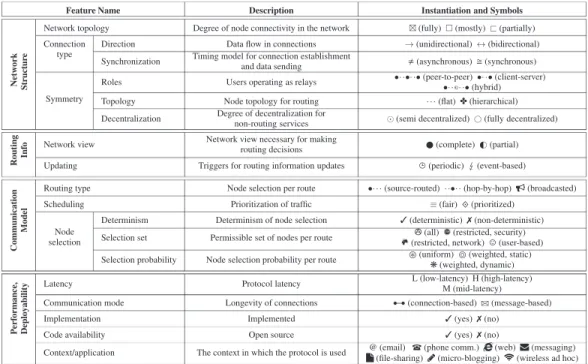
In this section, we present a classification for anonymous routing protocols (see Table1). Our classification (see Tables2and 5) is an adaptation of Feeney’s taxonomy (Feeney1999), which classifies the routing characteristics of mobile ad hoc networks into four categories:
(1) Communication modeldescribes whether the communication is based on a single- or multi-channel.
(2) Structuredescribes whether or not nodes are treated equally.
(3) State informationdescribes where the topology information is maintained.
(4) Schedulingdescribes whether the information about routes is maintained at the source or is instead computed on-demand.
This taxonomy does not address several relevant design features of AC networks, such as prob-abilistic node selection for constructing circuits and security considerations for protecting routing information from different network adversaries. In addition, not all the characteristics identified by Feeney are relevant to AC routing. For example, the distinction between single- and multi-channel features is not relevant to overlay networks, which constitutes a standard design choice for many AC networks.
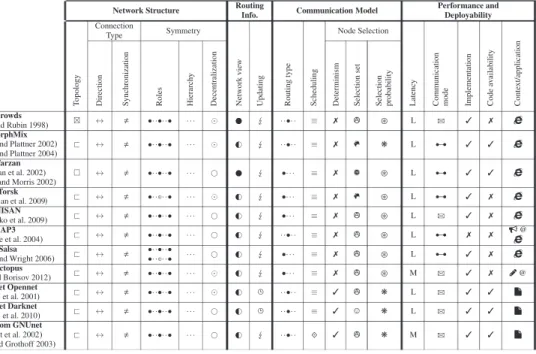
Table 1. Overview of the Protocol Routing Characteristics
We redefine Feeney’s criteria to account for design choices that are relevant to anonymous routing protocols. Nevertheless, we distinguish three groups of features inspired by Feeney’s cat-egories:network structure,routing information, andcommunication model:
(1) Network structuredescribes the characteristics of the anonymous relays, the connections between them, and the underlying network topology.
(2) Routing informationdescribes the network information available to entities deciding on the route of an anonymous connection.
(3) Communication modeldefines the entities that make the routing decisions and describes how these decisions are made.
In what follows, we describe these features in more detail, including their various sub-features and corresponding notation symbols used to denote individual feature instantiations. We refer to Table1for a general overview of the resulting taxonomy.
2.1.1 Network Structure.We consider first the network features that are relevant to anony-mous routing. These are, specifically, features related to: (a) thetopologyof the network, which describes how nodes are connected; (b) theconnection type, describing the characteristics of the connections between nodes; and (c)symmetry, describing whether the entities participating in the network are all similar, or if they can take on different roles and responsibilities for routing data through the network.
(a) Topology.The topology describes the arrangement of various elements of the network, such as routers and communication links between those routers. We only take the logical topology of the network into account, which determines how data flows within it. We note that physical topology characteristics, such as the geographical location of comput-ers, sometimes matters in anonymous routing decisions, for example, when considering
adversaries who control an Autonomous System (AS) (Feamster and Dingledine2004; Edman and Syverson2009).
We consider the network as a graph in which the routers are represented by graph nodes. An edge between two nodes exists if the routing strategy allows both nodes to be directly connected as part of the same anonymous circuit.
The connectivity of nodes varies widely across AC network designs, and the advantages and disadvantages of high and low levels of connectivity have been the subject of debate for over a decade (Böhme et al.2005).
Restricted routing proposals (Danezis 2003a) have shown that for applications that are latency-tolerant, partially connected networks with certain topological characteris-tics (e.g., based on expander graphs) provide optimal anonymity and latency trade-offs and mitigate certain attacks. These results further emphasize the impact of network con-nectivity features for anonymous routing.
We classify anonymity networks into three categories according to their connectivity:
fully connected,mostly connected, andpartially connectednetworks.
• We consider a network to befully connected()2when nodes can potentially connect to most (or all) other nodes. Note that our rule of thumb is that a node on average should be able to connect to at least 95% of the other nodes.
• We call a networkmostly connected() if its nodes can potentially connect to at least half of the nodes.
• Finally, inpartially connected () networks, nodes only connect to a relatively small subset of the whole network.
Higher connectivity in the network topology leads to better resilience (availability) against node failure, such as Denial of Service (DoS) attacks; such resilience might have, in turn, a positive influence on anonymity (Böhme et al.2005). While having a fully connected topology is better than having a very restricted network topology, such as a fixed sequence of relays, calledcascade, Diaz et al. have shown a partially connected network structure— in particular, a stratified topology—can provide better anonymity than a fully connected network structure (Diaz et al.2010). However, eliminating connections that might induce security problems, such as the connection between two nodes from the same IP family that may be easier to control by an adversary, can be beneficial to anonymity. The same holds for eliminating connections that would induce higher latency, which would, in turn, improve the performance of the system.
(b) Connection Type.Here, we consider thedirectionandsynchronizationof connections. As far as the direction is concerned, we consider the following options:
• A connection isunidirectional(→) if the data flow between two entities can only be in one direction.
• A connection between two entities isbidirectional(↔) if data can flow in both directions and the same connection is used for sending back the response to a received message. Typically, interactive applications, such as web browsing, require bidirectional channels, while non-interactive applications, such as email, can just close the connection as soon as the message has been forwarded.
Bidirectional circuits have the advantage that they induce less overhead in terms of cir-cuit construction. Unidirectional connections have the advantage that they are less vulner-able to timing attacks, as a malicious node can only observe data flowing in one direction, which is less informative than bidirectional connections in which patterns of requests
2In parenthesis, we define the symbol or the keyword that is used in the comparative Tables2,3,4, and5to indicate the
and response are visible to all nodes in the path. However, note that in a unidirectional connection, a larger number of nodes are going to be involved in relaying the communi-cation between a sender and a receiver.
Further, we consider whether the anonymity system involves connection synchroniza-tion:
• A connection is asynchronous() if the establishment of connections and relaying of messages is initiated by a user without any timing coordination with other participants.
• Connections are synchronous() if they begin and end at specific timings and mes-sages are also relayed at specific moments in time, based on some timing coordination between network entities.
Asynchronous systems are conceptually simpler as they impose fewer constraints on the activity of network participants. However, the distinct timing of actions leaks information valuable to perform traffic analysis and, for example, reveals long-term communication patterns (Danezis 2003b) or perform end-to-end correlation attacks (Levine et al.2004; Bauer et al.2007; Zhu et al.2010).
Synchronous systems are often more difficult to engineer and come with a performance or usability penalty; moreover, secure and reliable time becomes an additional dependency of the system, and a possible point of failure or vulnerability to attack. However, synchro-nization constitutes a very powerful design feature to offer robust anonymity guarantees in the presence of powerful adversaries, because it disables trivial end-to-end correla-tion attacks based on start and end times of conneccorrela-tions (Murdoch and Zielinski2007), and other timing data that synchronization makes less granular, enabling the aggregation of participants, connections, and events inanonymity sets. Synchronous anonymity sys-tems were proposed in the early 1990s by Pfitzmann et al. to anonymize ISDN telephony calls (Pfitzmann et al.1991). These proposals were both feasible from an engineering per-spective (compatible with the network requirements and introducing a low-efficiency cost) and clearly spelled-out anonymity guarantees as well as full unobservability for local calls. (c) Symmetry.We consider symmetry in the roles of the network entities. An anonymity system is intuitively “more symmetric” when all the participating entities have similar roles and responsibilities and “less symmetric” if there are different roles, capabilities, and trust assumptions among the entities that participate in the routing.
We thus first examine the overlap between therolesof end-users who initiate commu-nications and relaying nodes. We distinguish three types of systems.
• We classify a system aspeer-to-peer(•· · ·•· · ·•) when end-users are expected (often even obliged) to operate as relaying nodes in order to use the AC network.
• At the other end of the spectrum, inclient-server(•· · · •) systems, users are not expected (often even forbidden) to operate as relaying nodes in order to use the system.
• We call a systemhybrid(•· · · ◦· · · •) if it combines characteristics of bothpeer-to-peer
andclient-serversystems, i.e., end-users may or may not operate as relaying nodes. These different levels of symmetry come with advantages and disadvantages (Böhme et al. 2005). Peer-to-peer systems can better scale as the number of users grows, because new users also increase the capacity of the network. Further, peer-to-peer networks are more resilient to node failures and have better availability properties. In client-server architec-tures, however, it is possible to run nodes more reliably and securely (as nodes are not necessarily run by laymen end-users), which in particular helps to handle liability issues with respect to complaints. Having end-users run just client software has a lower cost for end-users in terms of resources and offers opportunities for simpler, and thus often more usable, client software.
Second, we distinguish whether nodes are organized in a flat or a hierarchical structure with respect to the routing. We call the resulting feature thetopology:
• A network has aflat(· · ·) structure if every node has the same importance and rank when making routing decisions.
• A network has ahierarchical(✤) structure if nodes have different capabilities and pri-orities toward the routing algorithm.
Hierarchical structures are often introduced to improve efficiency and performance. How-ever, a non-flat hierarchy can make the network less resilient to attacks, as the failure of a node that is placed high in the hierarchy has a severe impact on the performance of the network.
The third and last dimension of symmetry addresses the degree ofdecentralizationof network services other than (but auxiliary to) the routing itself. Note that we are not consideringcentralizedmodels, because they are a single point of failure for surveillance and insecure by design.
• A network issemi decentralized() if it includes one or a small number of entities per-forming a service critical to routing (e.g., compiling and distributing network directory information). This accounts for the fact that especially high levels of trust are placed on these entities, which constitute more of a point of failure than a simple relay.
• A network isfully decentralized() if the system design does not include entities that have to be especially trusted for the provision of functionalities that enable the routing. Fully decentralized systems have a better distribution of trust.
2.1.2 Routing Information.We now consider the information available to the entity (or entities) that decides on the route of a connection and how that information is made available.
(a) Network View. This determines the completeness of information available to establish a route.
• The routing decision-maker has acomplete view() of the system if routing information about all nodes is available.
• The decision maker has apartial view() of the system if the available routing infor-mation only cover a subset of the nodes that form the AC network.
A complete view allows the decision maker to choose among the full set of nodes. How-ever, a partial view improves the scalability of the network, as the distribution of rout-ing information for the full network may consume significant bandwidth and network resources. There are also some attacks that become possible when the routing decision makers only have a partial view of the network. For example, route fingerprinting attacks (Danezis and Clayton2006; Danezis and Syverson2008) are possible if each user knows different subsets of routers. In these attacks, the initiator of a connection can be identified by the nodes that make up the route, since typically a very small number of users will know a certain combination of network nodes.
(b) Updating. This determines how frequently routing information is updated.
• Routing information is updatedperiodically( ) if it is updated at predefined time inter-vals.
• Routing information is updatedevent-based( ) if the updates are triggered by events in the network other than timeouts.
• No updating mechanism is in place (✗).
2.1.3 Communication Model.We finally consider features that describe the creation of anony-mous routes.
(a) Routing Type.This refers to the selection of nodes to determine a route.
• The routing decision issource-routed(•· · ·) if the initiator of the communication selects the set of nodes that will form the anonymous route.
• The routing decision ishop-by-hop(· · ·•· · ·) (also called “random routing”) if the initiator only selects the first relay node, which in turn picks the second, and so on, until the message reaches its final destination.
• We refer to the routing typebroadcasting( ) when there is no routing decision made explicitly, but rather the data is only forwarded to multiple or all nodes. Flooding refers to broadcasting over more than one hop and when the data is broadcasted without any restriction; gossiping (Haas et al.2006) refers to forwarding the data only to a subset of nodes, which is technically not a broadcast but multicast.
Source-routing enables the initiator to pick nodes it trusts, and prevents adversaries from biasing the node selection towards compromised nodes. A variation of the basic source-routed model is found in some systems that provide receiver anonymity. In these systems, the initiator and the receiver select, respectively, the first and second halves of the route, which are joined in the middle at a rendezvous point. An advantage of hop-by-hop routing is that even if the initiator only knows a subset of nodes, her connections might be routed throughout the whole network, mitigating route fingerprinting attacks (Danezis and Clayton 2006). In literature, other node selection strategies have been proposed, which we have not taken into consideration such as dynamic routing schemes using distance vector routing (i.e., Perkins and Royer (1997)) and link-state routing (i.e., Moy (1998)). In fact, such algorithms are often disregarded for AC networks because of the predictability they offer, which is in conflict with anonymity.
(b) Scheduling.This refers to the way a node serves incoming scheduling requests.
• Fair(≡) scheduling means that all types of connection are treated same.
• Prioritized() scheduling means that certain connections are given priority over others. Prioritized scheduling can improve performance and reduce congestion. However, differ-ential treatment of traffic may undermine anonymity as the traffic of different priorities would be distinguishable and thus not conform a single (larger) anonymity set. An exam-ple of prioritized scheduling is when the scheduling follows an economic model, which might mitigate flooding attacks (Grothoff2003).
(c) Node Selection.This refers to the protocol features that determine which nodes are se-lected to be part of an anonymous route. The number of nodes that are sese-lected to form the anonymous connection can either be fixed (deterministically) or be computed proba-bilistically according to some distribution.
• Node selection can either bedeterministic(✔) or non-deterministic (probabilistic) (✗). To characterize node selection, we consider theselection setthat determines which nodes are eligible for being on the route and the selection (probability) distributionthat de-scribes the likelihood of each of the nodes in the selection set being chosen for a route.
• The selection set may containall nodes( ) of the network.
• It may contain asecurity-restricted subset( ) of all network nodes, i.e., a subset that is selected according to somesecurity-restrictions, for example, establishing that all the nodes in a route must be in different /16 IP subnets.
• It may contain anetwork-restricted subset( ) of all network nodes, e.g., a subset aimed at guaranteeing the quality of the communication by, for example, avoiding congested links and nodes.
• And finally, the selection set may be user-specific, consideringuser preferences and trust assumptions().
We are left to define the selection probability with which individual nodes are chosen.
• The probability distribution that describes how nodes are selected may beuniform().
• The probability distribution isstatically weighted, i.e., weighted based ongeneral, static parameters( ), for example, the bandwidth of the nodes.
• The probability distribution isdynamically weightedbased onstate-specific dependencies
(❋), for example, the nodes’ response time.
Even for general parameters, the weighted selection often requires frequent updates so they reflect the current state of the network. In other words, we consider parameters that are calculated in real-time to bedynamicbiases, and parameters based on routing infor-mation that is unchanged until the next periodic update to bestatic. The uniform selection typically offers better anonymity levels, while the weighted selection often improves per-formance.
2.2 Performance and Deployability
In addition to the routing characteristics identified before, we identify the following list of metrics that can be used to evaluate performance and deployability characteristics of AC protocols.
(1) Latency.In the literature, AC protocols are usually classified into three performance cat-egories:
• Protocols withlow-latency(L) incorporate no latency to the communication and typi-cally support applications that require real-time communication (e.g., web browsing).
• Protocols withhigh-latency(H) do not require real-time communications and support applications that can tolerate a certain delay between requests and responses (e.g., email communication).
• Protocols withmid-latency(M) introduce a random delay and may induce a restricted latency; hence, these protocols support applications that can tolerate a restricted delay between requests and responses (e.g., file-sharing).
(2) Communication Mode.We distinguish two kinds of communication modes, depending on the longevity of individual connections.
• We classify protocols asconnection-based() if routes between senders and receivers are maintained for a certain amount of time and used for exchanging multiple data transfers.
• If routes are created just to send a message and no state is maintained for further ex-changes, then we classify a protocol asmessage-based( ).
(3) Implementation and Code Availability.This indicates whether or not a prototype of the protocol has been implemented and if the code is publicly available. In both cases, the answer is either yes (✔) or no (✗).
(4) Context/application.We specify the context/application in which the protocols are de-signed to be used. We identify several basic context/applications: namely, protocols for anonymous messaging ( ), email communication (@); protocols for real-time commu-nication such as telephony ( ); web communication, such as anonymous browsing ( ) that needs to be low-latency and microblogging ( ) that can tolerate more latency; bul-letin boards, auctions, voting, group messaging ( ); file-sharing ( ); and protocol that are used in the context of a wireless ad hoc networks ( ). If the protocols do not spec-ify explicitly the context in which they are used, then we assign context/application to them mainly based on the latency and the number of intended recipients of the
communication. However, this does not rule out that AC protocols could be used for other contexts/applications as well (in some cases with minor changes). For example, AC sys-tems that are used for often also can also be used for @ and are categorized as in most cases, because they provide low-latency anonymous communication that is not necessary for email applications.
2.3 Correlation Among Routing Features
Next, we address some direct and indirect correlations (i.e., dependencies and conflicts) among the routing features. We have defined the network topology based only on the connectivity of the relaying routers (see Section2.1), where users and administrative entities are not taken into account. Therefore, according to our definition in Section2.1, there is no correlation between topology and the roles feature, and neither between topology and the decentralization feature.
There is an evident correlation between hierarchy and network topology of AC networks. A hi-erarchical AC network does not have a fully connected network structure. Moreover, the network view of the routing decision maker can have an influence on the topology of the AC network. Generally speaking, a partial network view might lead to a partially connected network topology for the AC network, because the routing decision maker might have difficulties accessing routing information of certain nodes. For example, if the topology is partially connected, it might be that the routing decision maker has a partial view.
Another evident correlation exists between the network topology and the selection set. Restric-tions in the selection set lead to reduced connectivity of the network topology.
Although the synchronization feature is not directly correlated to scheduling, depending on the forwarding strategy of the of relays, there can be a correlation. There is also an evident correlation between scheduling and latency, because, in a prioritized scheduling algorithm, some traffic is delayed.
AC networks with a hierarchical structure have a partially connected network structure. By def-inition, hierarchical organization of nodes restricts the selection set. Moreover, a partial network view limits the selection set, because the routing decision maker can only select nodes within its view.
Finally, there is an apparent correlation between latency and communication mode. High la-tency AC networks usually use a message-based communication mode and vice versa. Due to the temporal nature of the message-based communication, where connections are not going to be used further (e.g., replies are not going to be sent in a short time), setting up a circuit is unnecessary.
3 ROUTING CLASSIFICATION OF AC PROTOCOLS
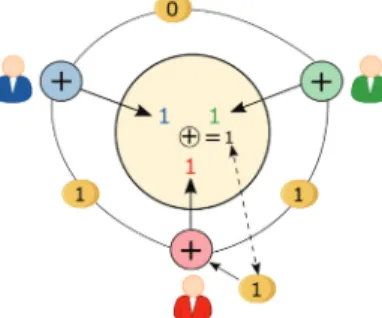
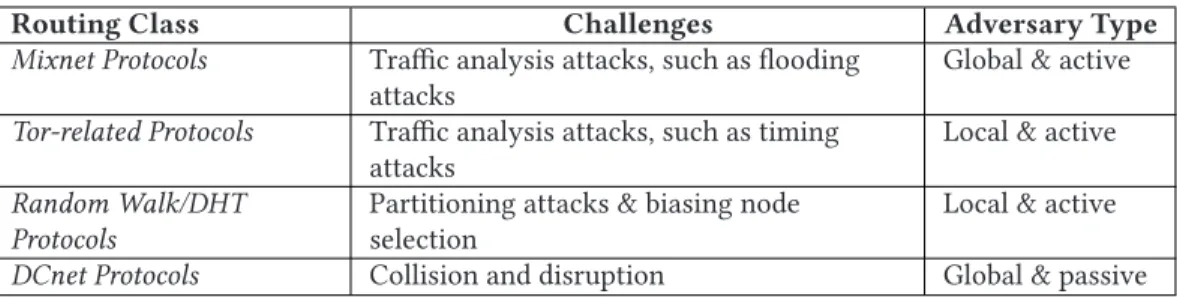
In this section, we present a categorization of AC protocols. We have categorized AC protocols based on their routing type: being source-routed, hop-by-hop routed, or broadcast. Moreover, we classified the protocols into five main families, namely: (1) Mixnet protocols and (2) Tor-related protocols as source-routed protocols, (3) Random Walk and DHT-based protocols as hop-by-hop routed, and (4) DCnet protocols as the broadcast routing type. Finally, (5) Miscellaneous include a few protocols that do not fit into the aforementioned categories. A few protocols are presented in the most representative category, albeit they technically borrow some minor techniques from other categories as well. We summarize our classification of the routing aspects in four comparative tables (namely, Table2, Table3, Table4, and Table5).
Next, we discuss the AC protocols individually, starting with Mixnet protocols (from Section3.1 to Section3.1.3), and then we proceeding with Tor-related protocols (Section3.2), Random Walk
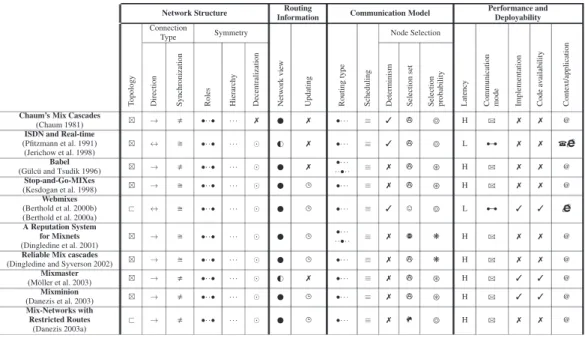
Table 2. Routing Classification of Anonymous Communication Protocols: Mixnet Protocols
and DHT-based protocols (Sections3.3), DCnet protocols (Section 3.4), and finally, the class of miscellaneous protocols (Section3.5).
3.1 Mixnet-Based Protocols
The idea of anonymous communication was originally proposed by Chaum in 1981 (Chaum1981) and initiated a new field of privacy research. The central concept proposed by Chaum is the use of
mix nodes, ormixesfor short. Mix nodes cryptographically transform messages so that they cannot be traced based on their content. Further, mixes shuffle (“mix”) input messages and output them in a reshuffled form. Thereby, they hide the input-output relation between individual messages, such that an adversary is not able to establish a correlation between input and output messages. In Chaumian mixes, the mix node does not output the messages immediately upon arrival but instead collects a certain number of messages (up to a threshold) into a so-calledbatch, which introduces a delay in message transmission. The mix shuffles input messages within a batch and flushes them out, which are ordered lexicographically.
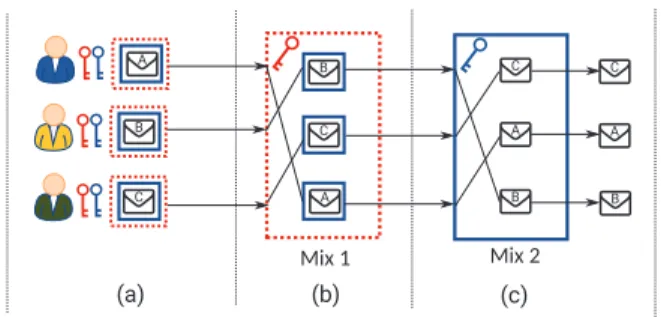
3.1.1 Mix Selection Strategies.To distribute trust, Chaum proposed to relay messages through a fixed sequence of mix nodes3called amix cascade. Chaum proposes a deterministic node selection without specifying how the nodes are selected (node selection strategy) for mix cascades. He only suggests that certain factors such as the networks topology and user’s trust can be used for mix node selection. In a mix cascade, messages are successively encrypted (in a layered fashion) with the public key of each mix in the cascade (see Figure1).
As the message is transferred from one mix to the next, the current mix peels off (decrypts) the corresponding layer (i.e., remove one layer of encryption with its private key), obtains the inner layer together with the corresponding address of the next destination, and sends the
Fig. 1. A mix cascade with two mixes: (a) The users encrypt their message successively with the public key of each mix in the cascade and send it to the first mix (Mix 1). (b) The mix receives the messages, removes one layer of the encryption using its own private key, shuffles the messages, and forwards them to the next mix in the cascade. (c) Finally, once the last mix in the cascade (Mix 2) receives the messages, it decrypts the final layer of the encryption, shuffles the messages, and outputs the original messages in a reshuffled form. Note that the input-output relation between individual messages is hidden.
message to that destination. This procedure is repeated until the last mix delivers the data to its final destination. To receive replies for messages while staying untraceable (to obtain recipi-ent anonymity (Pfitzmann and Köhntopp2000)), return addresses are used. Chaum proposed to encrypt the address of the recipient of replies separately so that the respondent only needs to ap-pend the untraceable return address to its replies. The anonymous replies are also sent similarly in a layered fashion to the respondent. From now on, we refer to the encrypted return address block as the reply block. Note that in the case of the anonymous replies, the recipient of the re-ply is the routing decision maker. An alternative cryptographic model for mix cascades is using re-encryption mixes, where mixes re-encrypt messages instead of decrypting them.
To overcome a single point of failure in availability of mix cascades,free-routemix networks have been proposed (Gülcü and Tsudik1996; Möller et al.2003). In free-route mix networks, the route is not fixed and any sequence of nodes from the network can be used for relaying messages. An important aspect of mix cascades and free-route mix networks design is the node selection strategy. Selecting mixes for a mix cascade or for a path in a free-route mix network may follow different strategies. Namely, a deterministic strategy, a uniformly random selection, or a variation, such as random selection biased by network state or reputation/reliability scores. When multiple mix cascades are available for the users to choose from, node selection has two dimensions: selecting a set of mixes for building the cascades and selecting a particular mix cascade for relaying the messages. Moreover, predefined probability distributions and topological restrictions can also be taken into account for mix selection. Danezis (2003a) proposed therestricted routesmix networks that leverage the mix cascade and free-route mix networks by being less vulnerable to intersection attacks and being secure against global adversaries like mix cascades and being scalable like free-route mix networks. He proposes a mix network topology that is based on constant degree graphs (sparse expander graphs), where each mix only communicates with a few neighboring nodes based on a predefined probability distribution. Next, we review two variants of mix selection, one for free-route mix networks and one for mix cascades.
Mixes that fail lead to further delays in mix networks, thus selecting reliable mix nodes can lead to better performance. Dingledine et al. (2001) developed a method to identify mixes that fail and used a reputation system for mix selection leading to better reliability and efficiency for the mix network. In their proposed system, mixes issue receipts for each received message. After a mix has sent a message to the next mix, if it is not receiving a receipt within a restricted time, then it
asks a set of witnesses to resend the message and receive the receipt and forward it to the original mix. The system establishes routing paths following the free-route node selection strategy, where the mixes are selected based on their past behavior (reputation score). Such a strategy suggests use of a non-deterministic node selection, biased toward mix nodes with high reputation scores. Mixes that have no positive ratings at all are avoided for mix selection. The main weakness of their scheme is that the reliability depends on the witnesses that need to be trusted, or at least a core group of trusted witnesses.
Unlike the previous system, which relies upon trusted global witnesses, Dingledine and Syverson (2002) proposed a mix cascade protocol with distributed trust. To obtain more reliable cascades, they propose to use a reputation mechanism for rearranging mix cascades. The construc-tion of such cascade utilizes communal randomness and reputaconstruc-tion scores provided by all of the mixes; therefore, there is no need of a trusted central authority. To mitigate the weakness of the previous work, mix nodes of a cascade act as witnesses for the reliability of their own cascade. All mixes submit random values to the configuration servers, which order mixes based on their reputation score and pick the top mix nodes to create a pool of mixes. From this pool, the mixes are selected randomly. For each cascade, routing relevant information such as available bandwidth or expected waiting time is published. Based on this information and the reputation score of the mixes, users choose mix cascade for their messages. Note that if the mix network is large, the network view might not be complete for the users.
3.1.2 Variations of Flushing Strategies. Flushing algorithm (or batching strategies) specifies the precise timing at when a batch of collected messages is flushed out of the mix to be simultaneously delivered to the respective recipients. Flushing strategies are analogous to the forwarding com-ponent of the routing and they highly influence the scheduling routing characteristic defined in Section2.1. Recall that Chaumian mixes collect messages until a certain threshold is reached. Such mixes are called threshold mixes. Threshold mixes might induce very high-latency if the traffic load is low. Thereafter, other flushing algorithms have been proposed in the literature.
Mixes that delay messages individually, for example, based on a certain probability distribution, and lead to continuous flushing are called continuous mixes. One example of continuous mixes is theStop-and-Gomixes (SG-mix) (Kesdogan et al.1998) system. The initiator of a message assigns for each mix in the path a randomly selected delay (from an exponential distribution). The inde-pendent random delays that are assigned to each message make the performance and anonymity of each message independent of the other users in the system. However, a drawback of their system is that SG-mixes are vulnerable when incoming traffic is low (Díaz and Preneel2004). Another type of flushing algorithms is pool mixes that only flush out a fraction of messages of a batch at each round and keep the remainder in the memory of the mix (pool) for next flushing rounds. In pool mixes, the number of messages that are forwarded may be determined by deterministic or non-deterministic functions, and the message selection may be uniformly random or weighted based on dynamic conditions (e.g., based on incoming traffic). When the average delay of the messages is equal, pool mixes offer better anonymity, since the anonymity set is bigger. Another advantage of pool mixes is that they are suitable for networks with fluctuating traffic load. Pool mixes, however, still need to specifywhenmessages are flushed out and therefore combined with other flushing techniques such as threshold (described above) or time restrictions. Timed mixes enforce a time restriction for flushing out messages. The anonymity of timed mixes is vulnerable to low traffic, since if only one message arrives before the time restriction is met, the mix provides no anonymity measure for that message. Moreover, a combination of the aforementioned flushing strategies can also be used by mixes (Díaz and Preneel2004; Serjantov2004). For example, the two prominent
dynamic pool mixesas flushing strategies (Serjantov et al.2003), which are a combination of timed and threshold pool flushing techniques, where the parameters depend on the network traffic. The flushing algorithm of Mixmaster has been characterized by generalized mixes (Díaz and Serjantov 2003). We review these remailer protocols in Section3.1.3.
Next, we review some mix protocols in the literature that have been suggested for applications such as ISDN telephone, web browsing, and anonymous emails. To anonymize ISDN telephone communication with its intrinsic requirements on low-latency, Pfitzmann et al. (1991) introduced the concept ofISDN mixes. An important feature of ISDN mixes is to maintain constant traffic in the network to avoid traffic analysis. ISDN mixes are a type of threshold mixes. To obtain sender and receiver anonymity simultaneously, ISDN mixes use two mix cascades that are selected by the sender and receiver, respectively, connected either by a connecting mix or when used in long distance communications by the long distance network operators. Initially, a broadcast takes place to exchange the connecting details and the time where the communication takes place. To achieve constant traffic, a number of ISDN channels, with an equal amount of messages, need to start and end their communication at the same time (in a so-calledtime-slice). However, this is time-consuming and would lead to blocking the connection, which is not suitable, since ISDN mixes use narrow-banded channels and were designed for low-latency communication. In Table2, we disregard the setup broadcast message used for exchanging information for ISDN mixes. The basic design of ISDN mixes was later generalized by Jerichow et al. (1998) to a system that enables low-latency, real-time communication.
A real-world realization built on ISDN mixes areWebmixes(also known as JAP) (Berthold et al. 2000a,2000b) designed for real-time Internet applications, passing the traffic to several available mix cascades. In Webmixes, the mixes transform the messages cryptographically and reshuffle their order before flushing them out. However, messages are not delayed by flushing strategies. Webmixes use an adaptation of the time-slice method introduced by ISDN mixes. Routes in Web-mixes consist ofJAP proxies, which are local software at the users, one (or several) mix cascade(s) consisting of reliable and high capacity mix nodes, and a cache-server. Web requests are sent from the users JAP proxy through the mix cascade and the cache-server and, furthermore, delivered to the destination server. The web replies are sent back through the same route and a copy of the reply is saved at thecache-server. Hourly mix cascade information is published by so-calledinfo servers. Users can choose among the published mix cascades by the info servers. To build mix cas-cades, ISDN mixes, real-time mixes, and Webmixes use deterministic node selection, where nodes selection for the cascades relies on the network state.
3.1.3 Prominent Applications of Mixes: Remailers.The original concept of mixes has an immediate application to high-latency remailer systems for providing anonymous e-mail service.
Babel(Gülcü and Tsudik1996) aims at mitigating traffic analysis attacks by delaying only some messages of the batches. Babel uses independent forward routes and return routes. Forward routes may include a reply block (where the return route mix addresses are encrypted in a layered fashion) that may be used by recipients for anonymous replies. Forward routes are considered to have better anonymity; one of the reasons for this is that reply blocks enable replay attacks on anonymous replies (Danezis et al.2010). Babel introducesintermix detours, where mix nodes choose a random sequence of mixes and relay the message through them before forwarding the message further to the next mix of the original route. In Babel, the flushing algorithm uses time restrictions (intervals) and thresholds for flushing out messages. Another technique Babel proposes to use isprobabilistic deferment, where a number of messages (determined by a biased coin) are delayed at each mix (this is similar to pool mixes). Babel proposes to use of free-route mix networks, where mixes are
chosen uniformly random for each route by the user. However, there were no details given about how routing information could be communicated to users.
Mixmaster(Möller et al.2003) is an anonymous remailer, where mixes transform messages cryp-tographically into uniform sizes by adding random data at the end of each data packet. If a message is too large, then Mixmaster splits up the message to achieve uniform sized packets and sends these packets independently of each other through a series of mixes, which do not necessarily need to be all the same. Only the last mix needs to be the same for all packets of one email message, which has been split up before. Mixmaster adopts a free-route path selection (Danezis et al.2010), where the users choose nodes with a non-deterministic algorithm that uses statistics on the re-liability of mixes bias node selection (Danezis2003a). Although the Mixmaster protocol did not specify details about maintaining mix information, later implementations of Mixmaster adopted an ad hoc scheme for distributing routing information (Danezis et al.2003). One of the main weak-nesses of Mixmaster is that it only guarantees sender anonymity, since reply blocks are not used in Mixmaster.
Mixminion(or Type III remailer) (Danezis et al.2003) are widely considered as the state-of-the-art remailer. To guarantee equal routing information for all senders, Mixminion deploys a group of redundant and a synchronized system ofdirectory servers, which was not considered in the Mixmaster design. Note that we disregard the directory servers synchronization for our classifi-cation in Table2. Like Mixmaster, Mixminion also uses “timed dynamic pool.” Mixminion uses reply blocks. Generally, reply blocks enable replay attacks; hence, Mixminion introducesSingle UseReply Blocks (SURB), where for each reply message, the content of the reply is appended to the SURB and sent through the mix network. In the Mixminion communication model, the routing path is divided into two so-calledlegs, each consisting of half of the mixes in the route. For reply messages, where both sender and receiver anonymity is desirable, in the first leg of the route, the sender of the reply chooses the mixes and appends the SURB for the second leg. When the message is traversing the route, at a crossover point (the last mix in the first leg), the SURB replaces the first leg, and the message is routed further to the intended recipient. In such cases, the route consists of mixes, which are half chosen by the sender and half chosen by the recipient. Thus, Mixminion aims at providing sender anonymity and recipient anonymity for email messages. Moreover, since forward and reply messages are not distinguishable from each other by outsiders and intermediate mix nodes themselves, they share the same anonymity set. The exceptions are the crossover points that have partial knowledge and the exit mix nodes, because they can observe whether the content has been encrypted or is in plain text. Mixminion also suggests choosing nodes from preferably a large pool; however, further details on the node selection strategy have not been specified in Mixminion.
3.1.4 Discussion.Mixnets, as classified in Table2, show very heterogeneous routing designs due to their routing diversity on multiple routing building blocks, which in turn lead to topological differences.
As mentioned earlier, existing routing strategies can be classified intofree-routesmix networks andmix cascades. However, we distinguish whether a connection is potentially allowed between two nodes or not based on routing of the messages. Hence, we marked most of the mix cascade networks as fully connected. The connectivity in restricted route mix networks and Webmixes is restricted due to restrictions in the selection set, which leads to a partially connected network topology.
Generally speaking, mix cascade networks employ rather synchronized connection, because messages are sent in batches and mostly depend on their flushing algorithms on a timely sched-ule. For example, timed mixes lead to synchronized message transmission. Recall that the flushing
algorithm in Mixmaster and Mixminion partially uses time restrictions. However, we consider these two protocols with asynchronous message transmissions due to the possibility that low traf-fic might lead to a threshold restriction instead of a time restriction. As for free-route systems, in SG-mixes, message transmission is also synchronized due to assigned time ranges by the routing initiator. Nevertheless, these timing ranges are not coordinated with other users or mix nodes.
In Mixnets, node management is not always specified in the protocol description. For example, in Chaumian mixes, the view of the routing decision maker is not discussed; however, it can be implicitly deduced that it is complete. The anonymous remailer Mixmaster does not discuss node management either; however, the later implementation uses ad hoc systems, which suggests a partial view (Danezis et al.2003). The remailer Mixminion defines a node management strategy to insure a complete view for the routing decision maker.
Source-routing is one of the inherent routing features of mix cascade protocols, because the routing paths are fixed beforehand. Choosing the mixes for the mix cascade might be either de-terministic, such as in the case of Webmixes, or non-dede-terministic, such as in the case of Reliable mix cascades.
Flushing algorithms do apparently impact scheduling. Note that some of the protocols in Table2 use randomness in the scheduling process (e.g., pool mixes). Consequently, some messages are forwarded later than others. Since individual messages do not have priorities by themselves, we categorized them also as fair. How the set of nodes is derived for node selection has also not been specified precisely for mix networks. The same holds for selection probability, such as for Chaumian mixes. For mix networks, we categorized the selection probability as deterministic, because all mixes are chosen for a single mix cascade. For both mix cascade protocols and free-route mix networks, the selection set varies depending on the application of the AC network and on the potential anonymity properties.
As mentioned in Section3.1, in mix cascades, the selection probability has two dimensions when more than one cascade exists. For instance, Webmixes can provide multiple mix cascades, where mixes are chosen by the network administrator for each mix cascade. Thereafter, the user manually selects one of these mix cascades for routing her messages. Another mix cascade protocol, where mixes are selected deterministic, is ISDN mixes.
All mix cascade protocols are high-latency AC networks and have a message-based commu-nication mode; exceptions are ISDNs, Real-time mixes, and Webmixes, which are designed for low-latency applications, such as web browsing. Note that the latencies might be restricted, for instance in case of SG-mixes, where the delays are randomly selected from a restricted time range. 3.2 Tor-Related Protocols
Tor is based on onion-routing (Goldschlag et al.1996; Reed et al.1998) designed for anonymous communication for applications with low-latency constraints, such as web browsing. An onion-routing network consists of a set of nodes so-calledOnion Routers (ORs). Users choose an or-dered sequence of ORs to establish a bidirectional channel, so-calledcircuit, for relaying their data through the onion-routing network. The communication is encrypted in a layered fashion and the ORs in the circuit each can decrypt their corresponding layer. When the communication is relayed by an OR in the circuit, the OR removes the corresponding layer of encryption and for-wards the data to the next OR in the circuit (see Figure2). The last OR forwards the data to the destination. Each OR only knows their predecessor and successor in the circuit, and the complete sequence is only known to the circuit initiator (the user). Therefore, only the first OR in a cir-cuit is aware of the IP address of the user who has initiated the circir-cuit and only the last OR of a circuit is aware of the destination of the communication, which is relayed through the circuit. The response of the receiver is relayed back to the initiator through the same circuit. Similar to
Fig. 2. The concept of onion-routing: (a) The sender chooses an ordered sequence of onion routers for relay-ing his message. For instance, the sender chooses Router A, B, and C. She then encrypts the message in a layered fashion starting with the key of the last onion router (Router C) along with an instruction that in-dicates the next hop in the sequence. The newly created data structure is called onion. Finally, she forwards the onion to the first onion router in the sequence (Router A), so called entry node. (b) Once the message is delivered to the entry node, the router decrypts one layer of encryption with its corresponding key and for-wards it to the next hop following the instruction within the layer. At this point, the onion router is aware of the identity of the sender and the next hop. (c) Router B receives the onion, removes one layer of encryption, and forwards it to the next hop (Router C). (d) Finally, Router C receives the onion, removes the last layer of the encryption and forwards the message to its final destination. Note that, the exit node (Router C) does not who is the sender, it is only aware of the final destination and its predecessor node.
Webmixes, in onion-routing, the ORs implement First-In First-Out (FIFO)-like forwarding strategy to provide low-latency services. Having no delays at the ORs and due to missing cover traffic onion-routing are susceptible to a number of attacks, such as traffic analysis and timing attacks, where an adversary may identify and correlate traffic patterns at the initiator and receiver (Danezis and Díaz2008; Ren and Wu2010), thus de-anonymizing the connection. Nonetheless, onion-routing is a promising design to provide a low-latency AC network, and many currently used systems can build upon this design.
Onion-routing used in Tor (Dingledine et al.2004) constitutes an extension of the original onion-routing design, with some modifications to achieve better security, efficiency, and deployability. The Tor network, an open-source and a free-to-use framework, consists of a large set of volun-teering routers (at the time of writing, there exist more than 7,000 routers (The Tor Project2017)). The network is mostly connected, because routers can connect to any router from the Tor net-work, except for connections between routers located in the same IP /16 subnet space, which is not possible. Tor’s services are used daily by approximately 2,000,000 users (The Tor Project2017). Each user runs a piece of software called Onion Proxy (OP) that manages all Tor-related processes, e.g., establishing circuits or handling connections from user applications. Tor deploys a group of well-known and trusted authoritative servers that publish on a regular basis (typically, every hour) a list of all active Tor nodes with their characteristics, e.g., estimated bandwidth, IP addresses, and cryptographic keys. This list is called aconsensus. After the user has obtained the consensus, the OP of the user chooses an ordered set of usually three ORs to build a circuit. The first node in a circuit is called theentrynode, the second node is themiddlenode, and the last node in the circuit is theexitnode. The first node that is selected is the exit node, then the entry node of the circuit is selected, and last the middle node of the circuit is selected. After selecting a set of ORs, the OP contacts the entry node and builds a circuit with it. This newly created circuit is used to contact the middle OR to extend the circuit and similarly through the middle node the exit node is contacted to extend the circuit. The established circuit can now be used to anonymously relay data.
In 2002, Wright et al. introduced the predecessor attack (Wright et al.2002) on onion-routing. To defend against this and related attacks, selecting a small set of nodes was introduced for Tor (Wright et al. 2003). Previously, each user maintained a list of three randomly pre-selected (so-calledguard) nodes with high bandwidth and uptime. This list was updated every 30–60 days and the user could choose uniformly random an entry node from this list for each path construc-tion. This has changed recently, because Tor is starting to let each user select only one fixed entry guard node for 9 months (Dingledine et al.2014).
In the early onion-routing design, uniformly random node selection was suggested (Syverson et al.2001). Due to performance considerations, Tor’s routing policy does not select nodes with the same probability, but rather preference is given to high-bandwidth nodes. The likelihood that nodes are chosen for certain positions in a given route depends on the ratios of overall node band-widths and node characteristics such as the IP addresses and whether they can be selected as entry node or as exit node. Moreover, some additional bandwidth weights are used to balance off the node selection. As mentioned before, a further development in the routing policy is to disallow a communication to pass through two nodes within the same /16 subnet IP address. The implica-tions of these changes with respect to structural node corruption have been recently explored by Backes et al. (2013) and Backes et al. (2014).
Next, we review two prominent attacks on Tor’s routing. Murdoch et al. have proposed a traffic-analysis attack using timing information to identify Tor nodes and to infer traffic load to a specific initiator. Their investigation shows a degradation of Tor’s anonymity against such attacks. They furthermore propose some strategies to prevent the risk of such attacks, mainly by increasing communication latency (Murdoch and Danezis2005). Bauer et al. have proposed a traffic analysis
attack aimed at decreasing the anonymity of Tor (Bauer et al.2007). Their attack investigates the load balancing that is performed by Tor, where high-bandwidth nodes are preferred in the node selection strategy. They show that performance optimization impairs the anonymity of Tor against end-to-end traffic analysis attacks.
Since Tor has been proposed, there has been a great deal of research on extending Tor’s routing strategy. The proposed extensions to the Tor routing protocol aim mostly at improving either the achieved anonymity of Tor or the performance that Tor users experience.
Improvements to Tor’s anonymity have been often realized by aiming at an improved node se-lection. For example, improving anonymity by using better weighting at the node selection phase has been proposed in Panchenko et al. (2012) and Backes et al. (2014). Involving AS-level informa-tion in the node selecinforma-tion has been proposed by Edman and Syverson (2009) and Akhoondi et al. (2014). Moreover, offering the user a tune-up option between uniformly random node selection (for high anonymity) and weighted random node selection with a bias toward high-bandwidth nodes (for better performance) has been suggested by Snader and Borisov Snader and Borisov (2011).
Tor’s performance problems have several causes, and hence suggested improvements aim at different aspects of the Tor routing protocol. One cause of Tor performance is high conges-tion (AlSabah and Goldberg2015; Dingledine and Murdoch 2009), often caused by bulk traffic, which induces high-latency for interactive/web traffic. Several solutions to solve the problem of high waiting times for interactive traffic have been proposed. One possible solution is to increase the number of connections between two nodes (Geddes et al.2014; AlSabah and Goldberg2013; Gopal and Heninger2012; AlSabah et al.2013), which can be used to separate interactive and bulk traffic into different connections. Another solution is to prioritize interactive traffic in the sched-uling phase (Tang and Goldberg2010; AlSabah et al.2012). An alternative solution is to improve how Tor’s resources are used by improving node selection with a more realistic estimation of the available bandwidth of nodes (Panchenko et al.2012). Furthermore, another solution to Tor’s con-gestion problem is to enforce avoiding congested nodes at the node selection phase (Wang et al. 2012). Another reason for Tor’s high-latency is circuitous paths (Akhoondi et al.2014). To solve this problem, node selection strategies have been proposed that take the destination between chosen nodes into account (Akhoondi et al.2014; Sherr et al.2009; Panchenko et al.2012).
The scalability of Tor has also been subject to new proposals for the Tor routing protocol in the literature. One proposal to tackle scalability issues is to give the user only the information about the necessary nodes for path construction and to hide the complete view of the system from the user by either managing Tor nodes as a DHT table and using Kademlia for node retrieval (McLachlan et al.2009) or by using private node retrieval (Mittal et al.2011b).
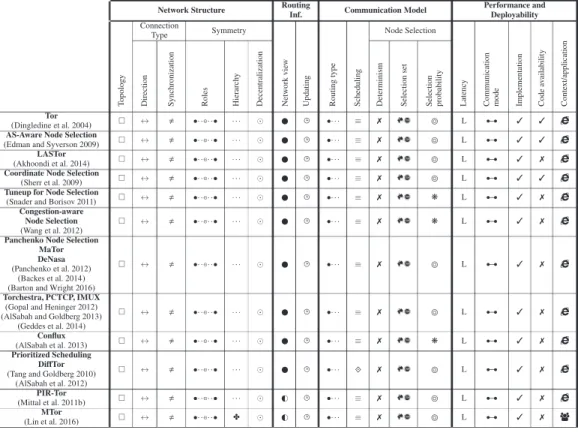
3.2.1 Discussion.On a conceptual level, all Tor-related protocolsare equally characterized by their routing features. However, there are three exceptions that affect this: the completeness of the network view, the fairness of scheduling, and the node selection probability (leaving apart the non-technical question if the code has been made publicly available). Their differences, however, often lie in implementation details, which are not necessarily relevant to routing, such as reducing buffer size (AlSabah et al.2011). In addition, differences in the routing policy, which do not change the routing feature on a conceptual level, such as changing node selection probabilities (Backes et al.2014; Panchenko et al.2012), are equally classified in the table, even though node selection probabilities could be different.
One inherent routing feature of Tor-related protocols, due to preventing additional latency, is to have no synchronization, which makes such protocols sensitive to timing attacks and global adversaries. Another inherent feature is that all Tor-related protocols have a client-server model, which improves their usability and leads to a higher number of users, thus contributing to better
Table 4. Routing Classification of Anonymous Communication Protocols: Random Walks and DHT-Based Protocols
anonymity for Tor-related protocols (Dingledine and Mathewson 2006). They are characterized as complete network view due to a central authority, which distributes the list of Tor routers. One exception is Mittal et al. (2011b), which realizes private node retrieval and thereby constrains the decision maker’s view of the network. A complete view helps against adversary biasing node selection and is preferred in source-routing to prevent the decision maker from choosing from a smaller set of nodes.
Further inherent routing features concerning the communication model include routing type, scheduling, determinism in the node selection, and the selection set. The exceptions here are Tang and Goldberg (2010) and AlSabah et al. (2012), who suggest a prioritization at the scheduling phase in favor of interactive traffic to reduce delays that interactive users might experience.
Node selection in all Tor-related protocols is non-deterministic. This is important, since the Tor network consists of volunteers and is very likely to have a fraction of malicious nodes among them. A non-deterministic node selection reduces the chances of consistently selecting malicious nodes. Given a large number of Tor relays that are spread around the world, and since the adversary is assumed to be local, a non-deterministic node selection makes targeted surveillance harder. Barton and Wright proposed an AS aware node selection for Tor (Barton and Wright2016) to improve Tor’s resilience against adversaries controlling an AS.
Furthermore, the node selection probability is generally weighted using static parameters, ex-cept for a few approaches that dynamically adjust weights, e.g., for balancing security versus per-formance (Snader and Borisov2011) and for avoiding congestion (Wang et al.2012; AlSabah et al. 2013). Tor-related protocols are low-latency and have circuit-based communication mode, which are both inherent routing features of these protocols. Although we classify Tor as a protocol where the routing decision maker has a complete view, it is worth mentioning that the unlisted relays,
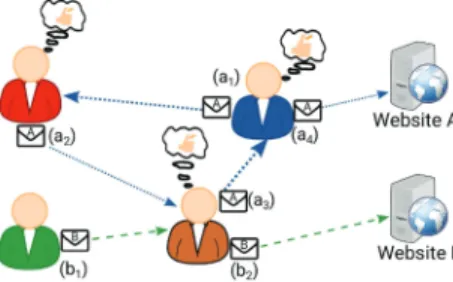
Fig. 3. The basic concept of Crowds: In this simple scenario, two users want to send their messages (message A and message B) to Website A and Website B, respectively. First, they send their message to a randomly selected node (step a1) and (step b1). The receiving node flips a coin to decide whether to send the message to another node or to its final destination. The receiving node of the message A randomly decides to send the message to another node (step a2), while the receiving node of the message B decides to send the message to its final destination (step b2). The receiving node of message A, again by flipping a coin, decides to send the message to another node (step a3). The message goes further until a node decides to send it to the final destination (step a4). Finally, the third receiving node decides to forward the message to its destination (step a4).
known asbridges, are not part of this view. MTor is an extension built on top of Tor to facilitate group communication within Tor (Lin et al.2016), which is designed to be scalable.
3.3 Random Walks, Structured and Unstructured DHT-Based Protocols
In this section, we reviewRandom Walk protocols, where the communication is relayed randomly through the network. We consider a protocol a Random Walk protocol if node selection is hop-by-hop routed and a random selection. Random Walk protocols are often combined with peer-to-peer network structures.
Crowds(Reiter and Rubin1998) is one of the early AC systems designed for anonymous web browsing. The key design feature of Crowds is a random peer selection and a peer-to-peer struc-ture, where all users of the system are nodes themselves. In Crowds, all nodes are grouped into so-calledcrowdsand a so-calledblenderis responsible for managing and administrating nodes; all nodes within a crowd might connect to each other for relaying a communication. To use Crowds, a user randomly selects a node and sends her message (i.e., website request). Upon receiving the re-quest, this node flips a biased coin to decide whether to send the request directly to the receiver or to forward it to another node selected uniform at random. This continues until the message arrives at the destination (see Figure3). The server replies are relayed through the same nodes in reverse order. Wright et al. showed that Crowds is vulnerable to so-called predecessor attacks (Wright et al.2002,2004). In this attack, the attacker tracks an identifiable stream of communications over a number path reformations and logs the nodes that send the message. Eventually, the attacker sees the initiation more often than the other nodes. To prevent such type of attacks, Crowds sug-gests to employ static route (a user keeps the route for a while) such that an attacker does not have multiple routes to link to the same node (Reiter and Rubin1998). However, even keeping routes static for a day is not enough to prevent predecessor attacks (Danezis et al.2010).
MorphMix(Rennhard and Plattner2002,2004) is a dynamic peer-to-peer AC network. Techni-cally, MorphMix establishes circuit-based connections using layered encryption, where the anony-mous route is established iteratively by the nodes on the route. Each node is typically only aware of a set of network nodes, which is not necessarily covering all nodes. To avoid repeated connec-tions with the same set of nodes, a node has to forget about nodes it has not been connected and