International Journal of Research in Engineering & Applied Sciences
Email:- [email protected], http://www.euroasiapub.org
105
Engineering Project Loan Repayment Scheduling by Amortization Process - a
Computer-Aided Method
Onuamah P.N.
Civil Engineering Department,Enugu State University oof Science and Technology, Enugu, Nigeria
Abstract: Often times, the engineering project cost is so capital intensive that the initiator cannot
but rely on loans to execute the project. Varied methods exist for the repayment of the loan amount. Most of them over stretch the borrower with additional percentage interest which requires to be paid en-block. This paper delves into evolving a computer based repayment schedulingarrangement utilizing some rigorously developed model, implemented with some excel functions. The procedure enables the borrower to defray the principal and the accruing interest in regular bits which varies inversely as the loan term.
Keywords: loan term, amortization, installment, residual value, intellectual property.
I. Introduction
Amortization schedule is used for the repayment of loans whose payoff date is known at the time the loan is taken out, such as a mortgage, engineering project, house or car loan. In lending, amortization is the distribution of payment into multiple cash flow installments, as determined by an amortization schedule. Unlike other repayment models, each repayment installment consists of both principal and interest. Amortization is chiefly used in loan repayments and in sinking funds. Payments are divided into equal amounts for the duration of the loan, making it the simplest repayment model. A greater amount of the payment is applied to interest at the beginning of the amortization schedule, while more money is applied to principal at the end. Commonly it is known as Equated Monthly Installment (EMI) [1].
International Journal of Research in Engineering & Applied Sciences
Email:- [email protected], http://www.euroasiapub.org
106
1.1 Amortization of Intangible Assets
In accounting, amortization refers to expensing the acquisition cost minus the residual value of intangible assets (often intellectual property such as patents and trademarks or copyrights) in a systematic manner over their estimated useful economic lives so as to reflect their consumption, expiry, obsolescence or other decline in value as a result of use or the passage of time.
A corresponding concept for tangible assets is depreciation. Methodologies for allocating amortization to each accounting period are generally the same as for depreciation. However, many intangible assets such as goodwill or certain brands may be deemed to have an indefinite useful life and are therefore, not subject to amortization (although goodwill is subjected to an impairment test every year).
Amortization is recorded in the financial statements of an entity as a reduction in the carrying value of the intangible asset in the balance sheet and as an expense in the income statement.
Under International Financial Reporting Standards, guidance on accounting for the amortization of intangible assets is contained in IAS 38 [2]. Under United States generally accepted accounting principles (GAAP), the primary guidance is contained in FAS 142 [3].
While theoretically, amortization is used to account for the decreasing value of an intangible asset over its useful life, in practice, many companies will "amortize" what would otherwise be one-time expenses by listing them as a capital expense on the cash flow statement and paying off the cost through amortization, thereby improving the company's net income in the fiscal year or quarter of the expense [4].
1.2 Intricacies and Management of Loan a Amortization
As already stated the amortization process deals with a method of repaying the a loan at regular intervals over a given period of time, and the more the items of the amortization, the higher the total repayment value. The interest rate (term) for the process may be a given Annual Interest Rate (AIR) or Annual Percentage Rate (APR). When the term of the interest is APR, the monthly interest rate can be obtained by simply dividing the APR by 12.
1.2.1 Amortization Function
If we designate periodic repayment unknown constant as A and the balance after each bit of repayment as P(t) where t is the number of time interval, it follows that
𝑃(𝑡) = 𝑃𝑟 + 𝐼 − 𝐴 . . . . (1)
where r = APR/(12x100) and I= periodic Interest.
International Journal of Research in Engineering & Applied Sciences
Email:- [email protected], http://www.euroasiapub.org
107
P(0)= P(0)- A, where P(0)= P0 is the initial loanprincipal when A = 0 and I=interest.
Hence,
P1= P0r + I1 - A . . . . (2)
P2= P(1)r + I2 - A= P0r2- Ar + A . . . (3)
P3= P2r - A= P0r3 + I3-Ar2 - Ar - A . . . (4)
Generalizing,
𝑃𝑡(1−r) = 𝑃𝑡𝑟𝑡+ 𝑃𝑡r−A𝑟𝑡−1−A𝑟𝑡−2 − … −𝐴0 . . (5)
where It = Ptr.
Hence, generalizing,
𝑃𝑡(1− 𝑟) =P0𝑟𝑡− 𝐴 ∑𝑡−𝑘=10𝑟𝑘 (6)
Applying the geometric progression model,
∑ 𝑏𝑘=1+b+ 𝑏2+ … +
𝑡−1
𝑘=0
𝑏𝑡−1
=b
𝑡 −1
𝑏 −1 (7) Putting Eqn (7) in (6),
P0(1− 𝑟) = 𝑃0𝑟𝑡− 𝐴 ( b𝑡 −1
𝑏 −1) (8) After n payment periods P(0) will be exhausted , i.e,
P(n) = 0 (9)
Solving Eqn (3) and (4), and putting b = 1/(1-r),
𝐴 = P0r(𝑟 +1)
𝑛
International Journal of Research in Engineering & Applied Sciences
Email:- [email protected], http://www.euroasiapub.org
108
II. Amortization Algorithm
The algorithm developed below can be applied to run the scheduling using the excel functions:
INPUT: Initial values P0, R, n
For j = 0, 1, ..., t-1, ..., n r = R/(12*100)
𝐴 =P(𝑟+0r(𝑟+1)𝑛 1)𝑛
−1
Intj = Pj r
PPj = A - Intj
EBj = Pj - PPj
Pj = PPj-1
END
where R stands for interest APR,
Int stands for interest,
PP stands for repayment on the principal
International Journal of Research in Engineering & Applied Sciences
Email:- [email protected], http://www.euroasiapub.org
109
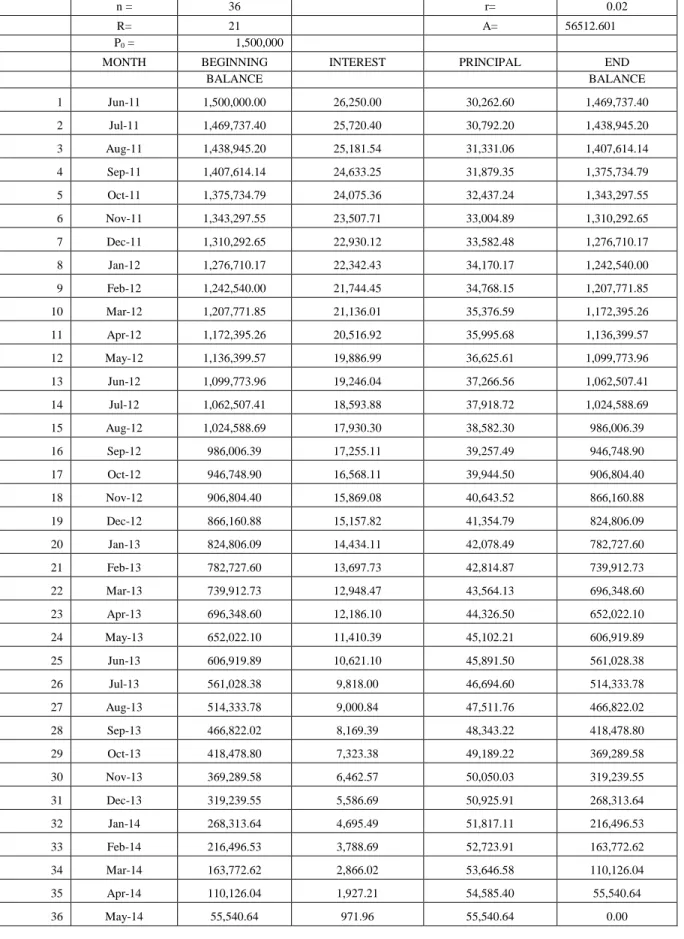
Table 1 Amortization Schedule
n = 36 r= 0.02
R= 21 A= 56512.601
P0 = 1,500,000
MONTH BEGINNING INTEREST PRINCIPAL END
BALANCE BALANCE
1 Jun-11 1,500,000.00 26,250.00 30,262.60 1,469,737.40
2 Jul-11 1,469,737.40 25,720.40 30,792.20 1,438,945.20
3 Aug-11 1,438,945.20 25,181.54 31,331.06 1,407,614.14
4 Sep-11 1,407,614.14 24,633.25 31,879.35 1,375,734.79
5 Oct-11 1,375,734.79 24,075.36 32,437.24 1,343,297.55
6 Nov-11 1,343,297.55 23,507.71 33,004.89 1,310,292.65
7 Dec-11 1,310,292.65 22,930.12 33,582.48 1,276,710.17
8 Jan-12 1,276,710.17 22,342.43 34,170.17 1,242,540.00
9 Feb-12 1,242,540.00 21,744.45 34,768.15 1,207,771.85
10 Mar-12 1,207,771.85 21,136.01 35,376.59 1,172,395.26
11 Apr-12 1,172,395.26 20,516.92 35,995.68 1,136,399.57
12 May-12 1,136,399.57 19,886.99 36,625.61 1,099,773.96
13 Jun-12 1,099,773.96 19,246.04 37,266.56 1,062,507.41
14 Jul-12 1,062,507.41 18,593.88 37,918.72 1,024,588.69
15 Aug-12 1,024,588.69 17,930.30 38,582.30 986,006.39
16 Sep-12 986,006.39 17,255.11 39,257.49 946,748.90
17 Oct-12 946,748.90 16,568.11 39,944.50 906,804.40
18 Nov-12 906,804.40 15,869.08 40,643.52 866,160.88
19 Dec-12 866,160.88 15,157.82 41,354.79 824,806.09
20 Jan-13 824,806.09 14,434.11 42,078.49 782,727.60
21 Feb-13 782,727.60 13,697.73 42,814.87 739,912.73
22 Mar-13 739,912.73 12,948.47 43,564.13 696,348.60
23 Apr-13 696,348.60 12,186.10 44,326.50 652,022.10
24 May-13 652,022.10 11,410.39 45,102.21 606,919.89
25 Jun-13 606,919.89 10,621.10 45,891.50 561,028.38
26 Jul-13 561,028.38 9,818.00 46,694.60 514,333.78
27 Aug-13 514,333.78 9,000.84 47,511.76 466,822.02
28 Sep-13 466,822.02 8,169.39 48,343.22 418,478.80
29 Oct-13 418,478.80 7,323.38 49,189.22 369,289.58
30 Nov-13 369,289.58 6,462.57 50,050.03 319,239.55
31 Dec-13 319,239.55 5,586.69 50,925.91 268,313.64
32 Jan-14 268,313.64 4,695.49 51,817.11 216,496.53
33 Feb-14 216,496.53 3,788.69 52,723.91 163,772.62
34 Mar-14 163,772.62 2,866.02 53,646.58 110,126.04
35 Apr-14 110,126.04 1,927.21 54,585.40 55,540.64
International Journal of Research in Engineering & Applied Sciences
Email:- [email protected], http://www.euroasiapub.org
110
III. Program Run
Table 1shows the program output. In the output, all that needs to be done is to input the values of
P0, R, and n (months) in input cells, where:
P0 is the principal amount borrowed, A is the periodic amortization payment, r is the periodic
interest rate divided by 100 (nominal annual interest rate also divided by 12 in case of monthly
installments), and n is the total number of payments. For a 3-year loan n = 3 × 12 = 36.
Negative amortization (also called deferred interest) occurs if the payments made do not cover the interest due. The remaining interest owed is added to the outstanding loan balance, making it larger than the original loan amount.
If the repayment model for a loan is "fully amortized," then the very last payment (which, if the schedule was calculated correctly, should be equal to all others) pays off all remaining principal and interest on the loan. If the repayment model on a loan is not fully amortized, then the last payment due may be a large balloon payment of all remaining principal and interest. If the borrower lacks the funds or assets to immediately make that payment, or adequate credit to refinance the balance into a new loan, the borrower may end up in default.
IV. Conclusion
The third world countries have benefited immensely from the application of scheduled amortization loan repayment facilities. Hence many poor countries are able to embark on engineering development projects through long term loan agreements by which constant repayment A( obtained in Eqn (10) become manageably low. The computer program component allows for optimization of the plan to obtain fiscally economic loan terms.
V. References
[1] "~What is an EMI ? ~ Equated Monthly Installment". Tech-bie.blogspot.com. 2011-07-15. Retrieved 2012-11-23.
[2] "International Accounting Standard 38, Intangible Assets". Iasb.org. Retrieved 2012-11-
[3] "Statement of Financial Accounting Standards No. 142, Goodwill and Other Intangible Assets". Fasb.org.
Retrieved 2012-11-23.