Welcome to 3.091
Lecture 3
September 14, 2009
1 3 4 11 12 19 20 21 22 23 24 25 26 27 28 29 30 31 32 2 5 6 7 8 9 10 13 14 15 16 17 18 33 34 35 36 39 40 41 42 43 44 45 46 47 48 49 50 51 52 53 54 57 72 73 74 75 76 77 78 79 80 81 82 83 84 85 86 37 38 55 56 87 88 89
Periodic Table Quiz
La Lazy Ce college Pr professors Nd never Pm produce Sm sufficiently Eu educated Gd graduates Tb to Dy dramatically Ho help Er executives Tm trim Yb yearly Lu losses.
La Loony Ce chemistry Pr professor Nd needs Pm partner: Sm seeking Eu educated Gd graduate Tb to Dy develop Ho hazardous Er experiments Tm testing Yb young Lu lab assistants. cannot be referring to 3.091!
must be the “other” chemistry professor
CEase not I to slave, back breaking to tend; PRideless and bootless stoking hearth and fire. No Dream of mine own precious time to spend Pour'ed More to sate your glutt'nous desire. SMelting anew my ten-thousandth hour EUtopia forever I eschew.
Growing Dimmer is my fleeing power To Bid these curs'ed problem sets adieu. DYing away whilst thy hosts are fought HOpeless I come should in lecture I doze. ERgo, like a sad slave, stay and rest nought. Then Must I tool and toil while fatigue grows. Yet, Bloody though I must be, and quite ill Light the Universal abyss I will.
57
138.9055 920 3455 6.146 1.10 5.577 [Xe]5d16s2 Lanthanum 57La
* 3The Structure of the Atom
status report ca. end of the 19th century
* atom is electrically neutral
* -ve charge carried by electrons
* e- has very small mass
bulk of the atom is +ve,
most mass resides in +ve charge Question:
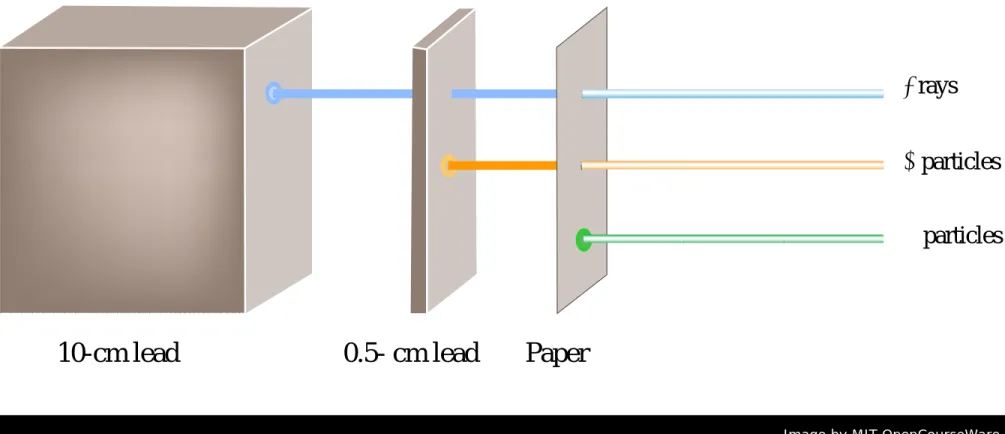
Figure 1.18
Figure 1.19 Paper 0.5- cm lead 10-cm lead γ rays β particles α particles
Rutherford-Geiger-Marsden experiment
b
Marsden's Analysis
Scattering of an α-particle which approaches a heavy nucleus with an impact parameter b.
q
Trajectory of incident
α particle
principles of modern chemistry:
*
recognize patterns
*
develop a quantitative model that
- explains our observations
- makes predictions that can be
tested by experiment
Bohr Postulates for the Hydrogen Atom
1. Rutherford atom is correct
2. Classical EM theory not applicable to orbiting e
3. Newtonian mechanics applicable to orbiting e
4. Eelectron = Ekinetic + Epotential
5. e- energy quantized through its angular momentum:
L = mvr = nh/2π, n = 1, 2, 3,…
6. Planck-Einstein relation applies to e- transitions:
Bohr Postulates for the Hydrogen Atom
1. Rutherford atom is correct
2. Classical EM theory not applicable to orbiting e
3. Newtonian mechanics applicable to orbiting e
4. Eelectron = Ekinetic + Epotential
5. e- energy quantized through its angular momentum:
L = mvr = nh/2π, n = 1, 2, 3,…
6. Planck-Einstein relation applies to e- transitions:
ΔE = Ef - Ei = hν = hc/λ
Bohr Postulates for the Hydrogen Atom
1. Rutherford atom is correct
2. Classical EM theory not applicable to orbiting e
3. Newtonian mechanics applicable to orbiting e
4. Eelectron = Ekinetic + Epotential
5. e- energy quantized through its angular momentum:
L = mvr = nh/2π, n = 1, 2, 3,…
6. Planck-Einstein relation applies to e- transitions:
ΔE = Ef - Ei = hν = hc/λ
Bohr Postulates for the Hydrogen Atom
1. Rutherford atom is correct
2. Classical EM theory not applicable to orbiting e
3. Newtonian mechanics applicable to orbiting e
4. Eelectron = Ekinetic + Epotential
5. e- energy quantized through its angular momentum:
L = mvr = nh/2π, n = 1, 2, 3,…
6. Planck-Einstein relation applies to e- transitions:
0 500 1000 1500 2000 2500 3000 5000 K 4000 K 3000 K Radiation intensity Wavelength (nm) Classical prediction 6000 K
E = h
ν
Planck suggests that light is composed of energy packets or quanta. The elementary unit of e-m radiation is the photon.
Infrared Visible
UV
6000 K
Bohr Postulates for the Hydrogen Atom
1. Rutherford atom is correct
2. Classical EM theory not applicable to orbiting e
3. Newtonian mechanics applicable to orbiting e
4. Eelectron = Ekinetic + Epotential
5. e- energy quantized through its angular momentum:
L = mvr = nh/2π, n = 1, 2, 3,…
6. Planck-Einstein relation applies to e- transitions:
© source unknown. All rights reserved. This image is excluded
© source unknown. All rights reserved. This image is excluded from our Creative Commons license. For more information, see
© source unknown. All rights reserved. This image is excluded from our
Isotopes of Hydrogen
hydrogen
1766 Henry Cavendish, London
deuterium
1931 Harold Urey, Columbia U.
tritium
Dalton proposes the indivisible unit of an
element is the atom.
1803
Thomson discovers electrons, believed to reside within a sphere of uniform positive charge (the "plum pudding"
model).
1904
Rutherford demonstrates the existence of a positively charged
nucleus that contains nearly all the mass of an atom.
1911
Bohr proposes fixed circular orbits around the nucleus
for electrons.
1913
In the current model of the atom, electrons occupy regions
of space (orbitals) around the
J. J. Thomson (1856-1940)
Cathode ray = Charged particle = Electron (1897) charge-to-mass ratio of electron (1897)
J.J Thomson
"Plum pudding" model of atom (1904)
Robert Millikan (1868-1953)
Charge and mass of electron (1909) James Chadwick (1891-1974) Neutron (1932) Ernest Rutherford Proton (1920) Ernest Rutherford
Nuclear model of atom (1911)
Ernest Rutherford (1871-1937)
α and β particles (1898)
Marie and Pierre Curie (1867-1934, 1854-1906)
Radioactive elements
polonium and radium (1898)
Henri Becquerel (1852-1908)
Uranium emits rays that fog photographic film (1869)
MIT OpenCourseWare
http://ocw.mit.edu
3.091SC Introduction to Solid State Chemistry
Fall 2009