Modesto Junior College | Substantive Change Proposal: Distance Education 1
Substantive Change Proposal:
Distance Education
Modesto Junior College
435 College Avenue Modesto, CA 95350
Produced by:
Susan Kincade, Vice President of Instruction and Accreditation Liaison Officer; Dr. Jennifer Hamilton, Faculty Accreditation Co-Chair
Modesto Junior College | Substantive Change Proposal: Distance Education 2
Table of Contents
A concise description of the proposed change and the reasons for it ... 5
Description ...5
Evidence of a clear relationship to the institution’s stated mission ...6
New educational program and description of the program to be offered... 7
Description of the planning process which led to the request for the change... 8
Rationale for change in delivery mode ...8
Evidence that the institution has provided adequate human, administrative, financial, and physical resources and processes to initiate, maintain, and monitor the change and to assure that the activities undertaken are accomplished with acceptable quality ... 9
Student Support ...9
Disabled Student Programs and Services ...10
Library and Learning Center ...10
Faculty Support ...11
Teaching Certification and Course Approval Process ...12
Technology and Infrastructure ...13
Funding ...13
Guidelines ...14
Budget ...16
Evidence that the institution has received all necessary internal or external approvals ... 17
Evidence that each eligibility requirement will still be fulfilled after the change ... 17
Authority ...17
Mission ...17
Governing Board ...18
Chief Executive Officer ...18
Administrative Capacity ...18
Operational Status ...19
Degrees ...19
Educational Programs ...19
Academic Credit ...19
Student Learning Achievement ...20
Modesto Junior College | Substantive Change Proposal: Distance Education 3
Academic Freedom ...21
Faculty ...21
Student Services ...21
Admissions ...22
Information and Learning Resources ...22
Financial Resources ...22
Financial Accountability ...22
Institutional Planning and Education ...23
Public Information ...23
Relations with the Accrediting Commission ...23
Evidence that each Accreditation Standard will still be fulfilled after the change and that all relevant commission policies are addressed ... 24
Standard I: Institutional Mission and Effectiveness ... 24
Standard II: Student Learning Programs and Services ... 25
Instructional Programs ... 25
Student Support Services ... 27
Admissions and Records ... 28
Veterans’ Services ... 28
Assessment Testing ... 28
Orientation and Advising ... 29
Disabled Student Programs and Services (DSPS) ... 29
Career Development and Transfer Center ... 29
Counseling ... 29
Student Financial Services ... 30
Library and Learning Support Services ... 30
Standard III: Resources ... 31
Human Resources... 31
Physical and Technology Resources ... 33
Financial Resources ... 33
Standard IV: Leadership and Governance ... 34
Decision-Making Roles and Processes ... 34
Modesto Junior College | Substantive Change Proposal: Distance Education 4
List of Appendices: ...36
Appendix A: Online Percentage for Programs ...37
Appendix B: How Percentage of DE was Calculated ...38
Appendix C: Fall 2013 Distance Education Enrollments ...42
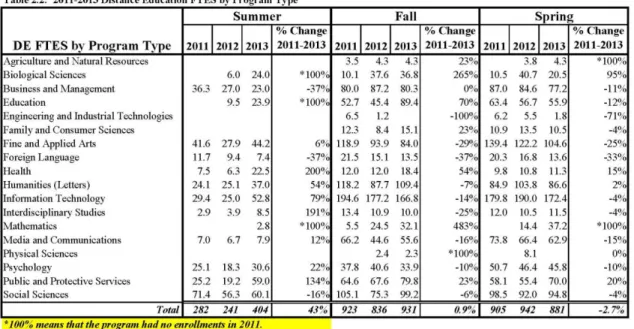
Appendix D: Table 2.2: 2011-2013 Distance Education FTES by Program Type ...43
Appendix E: MJC Online Instruction Program Completers, Summer 2012-Fall 2013 ...44
Appendix F: MJC Certified Online Instructors ...46
Appendix G: Modesto Junior College Distance Education Plan 2012-2017 ...50
Appendix H: Addendum to the Modesto Junior College Distance Education Plan 2012-2017 Progress on Stated Goals as of Spring 2014 ...91
Appendix I: 2011-2013 Distance and Non-Distance Education Demographics ...99
Appendix J: Modesto Junior College and State of California 2011-2013 Distance Education Program Success and Retention Comparison ...102
Modesto Junior College | Substantive Change Proposal: Distance Education 5
A concise description of the proposed change and the reasons for it
Description:In 1998, Modesto Junior College (MJC) offered its first online class, and since that time the distance education (DE) program has grown steadily. As noted in the substantive change report submitted in October 2010: “Prior to that time, DE consisted of a small collection of
commercially produced telecourses coordinated and assessed by faculty, and a small contingent of instructors providing live (or tape-delayed) instruction over a dedicated cable TV channel” (4). The College has developed the Modesto Junior College Distance Education Plan 2012-2017 (hereinafter referred to as Distance Education Plan) and is growing its online offerings
accordingly. This substantive change proposal (covering October 2010 – December 2013) is for approval to offer the following Associate Degrees and Certificates of Achievement through the DE mode of instruction (Appendix A):
Associate Degrees:
Associate of Arts
Anthropology (AAT)
Communication Studies (AAT) English (AAT)
History (AAT) Kinesiology (AAT) Music (AAT) Sociology (AAT) Theatre Arts (AAT) Art History (AAT) Studio Arts (AAT)
Associate of Science
Administration of Justice (AST) Agriculture Business
Agriculture, Sales, Service Agriculture Science Animal Science Autobody Refinishing Automotive Technician
Business Administration (AST)
Computer Information Systems (Pending CCCCO Approval)
Crop Science Dairy Science
UPE, Earth Sciences (Pending at the CCCCO/AA to an AS)
Environmental Horticultural Science Fire Science
Modesto Junior College | Substantive Change Proposal: Distance Education 6
Fruit Science Geology (AST) Industrial Electronics Machine Tool Technology Mathematics (AST) Mechanized Agriculture
Medical Assisting Physics (AST) Poultry Science
Recreational Land Management Soil Science Welding Certificates of Achievement: CSU GE IGETC Associate Teacher Office Support
Many of these new offerings appear in this DE listing not because the major content area of the degree or certificate is fully online, but when combined with online general education
components of the Associate Degree, the degree exceeds the 50% threshold (Appendix B).
The MJC Catalog delineates the requirements for Associate Degrees and Certificates on pages 7-9, defining both the unit requirement for each and the purposes of the awards.
Evidence of a clear relationship to the institution’s stated mission:
As stated in the MJC Mission (BOT approved 11 September 2013):
Modesto Junior College is committed to transforming lives through programs and services informed by the latest scholarship of teaching and learning. We provide a dynamic, innovative educational environment for the ever-changing populations and workforce needs of our regional community. We facilitate lifelong learning through the development of intellect, creativity, character, and abilities that shape students into thoughtful, culturally aware, engaged citizens. The degrees and certificates offered through DE not only support but fulfill the mission by serving student learning needs through “…the latest scholarship of teaching and learning…” and by providing “…a dynamic, innovative educational environment for the ever-changing
populations and workforce needs of our regional community.” The MJC Distance Education vision and mission support the district, college, and technology statements that drive the initiatives of the college (see page 4 of the Distance Education Plan):
Modesto Junior College | Substantive Change Proposal: Distance Education 7
YCCD DISTRICT VISIONS YCCD DISTRICT MISSIONS
YCCD The Yosemite Community College District
will enrich lives through exemplary stewardship and accessible, high-quality education
The Yosemite Community College District is committed to responding to the needs of our diverse community through excellence in teaching, learning and support programs contributing to social, cultural, and economic development and wellness.
MJC As the first choice for educational excellence in our community, Modesto Junior College will enrich lives by challenging all students to become successful, lifelong learners who strengthen their community in a diverse and changing world.
Modesto Junior College provides a comprehensive student-centered learning community for all who can benefit by offering innovative instructional and student support programs that respond to the educational needs of our diverse community.
MJC Technology
To contribute to a culture of academic excellence, lifelong learning, and civic engagement through the acquisition and support of new technology and technology-enabled learning for faculty, staff, and students.
Modesto Junior College provides current and innovative technology, training and support to its faculty, staff and diverse student population to enhance learning and prepare users for a technology-based society.
MJC Distance Ed
MCJ will be a leader in the delivery of distance education by using innovative instructional technologies and online services to help students meet their education and career goals.
MJC uses current best practices to update and deliver challenging, dynamic distance learning opportunities that meet the needs of students in remote locations with diverse home, family and career demands.
These clearly delineated connections between the Distance Education Plan, the College and also the District, ensure that all DE programming at MJC is connected to student service and learning articulated in the college mission.
The college mission also states: “We provide a dynamic, innovative educational environment for the ever-changing populations and workforce needs of our regional community.” Data with regard to online student demographics indicates that indeed our DE program services primarily students in Stanislaus County. Appendix C “Fall 2013 Distance Education Enrollments” indicates the residency of MJC Distance Ed students, and the data reveals that 94% of Distance Ed students reside in Stanislaus and San Joaquin Counties, 85% of total DE students reside in Stanislaus County alone and 43% in the city of Modesto. Such data illustrates the service we offer to our immediate constituents.
New educational program, and description of the program to be offered
All of the courses proposed for distance delivery have already been approved for delivery in the traditional face-to-face modality. Aside from modality of instruction, there are no differences in general education, major or graduation requirements between DE and traditional courses. They share a common Course Outline of Record, Course Learning Outcomes and pass through the same Curriculum Committee approval process. The Distance Education Plan provides clear local definitions for DE that comply with the definitions released in 2008 by the Chancellor’s Office. The chart below indicates the distinctions between delivery modes and a helpful
Modesto Junior College | Substantive Change Proposal: Distance Education 8
description for each, which is intended to clearly communicate with students the type of course in which they are enrolling.
Descriptor MJC Definition Processing Notes
Fully Online Courses in which students work entirely without having to come to any college facility. Arranged proctored tests are available in this modality (students do not have to come to an MJC campus to take tests); orientations and/or face-to-face class meetings are optional.
Synchronous activities are not required but if synchronous events are scheduled, they may be posted as required archives for asynchronous access.
Requires separate Curriculum Committee approval with Technology mediated instruction form (TMI) and follows all quality measures as outlined in the Distance Education Guidelines.
Requires faculty readiness standards are met prior to online teaching. If proctoring is required, it cannot be required that students come to campus. Rather, instructors must arrange for a proctoring location in collaboration with the student.
Hybrid (Blended) Anytime distance education is offered in lieu of face-to-face class time, where planned face-to-face time is formally scheduled. This designation is also given whenever students are required to come to an MJC site for any reason (testing, orientation, etc.).
Requires separate Curriculum Committee approval with Distance Education Addendum TMI form and follows all quality measures as outlined in the Distance Education Guidelines.
If students are required to come to an MJC site for any reason, the course is declared a hybrid course to notify students of this requirement.
Enhanced (face-to-face with web enhancement)
Face-to-face courses that require the student to access the Internet and/or LMS as part of the course work.
Students are expected to be able to access the internet and the LMS infrastructure either at home or from the campus learning resource centers where assistance for using these technologies is available.
Description of the planning process which led to the request for the change
Rationale for change in delivery mode:
As a community college, MJC serves students with particular lifestyle and learning needs. Many MJC students work and face the challenges of childcare, eldercare, and balancing study with other elements of their lives. Analysis of enrollment, FTES, and demographic data shows that while the CCC system was reducing sections offered across the board from Fall 2011 to Fall 2013, thus precipitating a drop in FTES in summer, fall, and spring semesters (Appendix D), participation in DE at MJC actually rose amongst target populations in that same period.
Modesto Junior College | Substantive Change Proposal: Distance Education 9
MJC is a Hispanic Serving Institution, and it is important to note that demographic data reveal that fall 2011-2013, participation of Hispanic students rose from 30-35%; spring 2011-2013, from 28-33%; and summer 2011-2013 from 30-35%. This demographic of student is a close second in participation to white non-Hispanic students, and other demographic data show that 94% of students served by the DE program at MJC reside in Stanislaus and San Joaquin
Counties, with Stanislaus comprising 85%. Of the students participating in DE, 43.5% reside in the City of Modesto (Appendix C).
This data indicates that MJC has increased access and service to students who need the benefit of asynchronous education and the flexibility of online learning. To best serve this community, MJC continues to explore the expansion of online learning according to goals laid out in the Distance Education Plan.
Evidence that the institution has provided adequate human, administrative,
financial, and physical resources and processes to initiate, maintain, and
monitor the change and to assure that the activities undertaken are
accomplished with acceptable quality
The Distance Education Plan, vetted and adopted in all of the participatory governance committees at the institution, describes how MJC is committed to Student Support (12-14), Faculty Support (15-17), and Technology and Infrastructure Support (18). Each of these areas has clear goals with measurable targets aimed at providing the best online programming possible.
Student Support:
There are 8 goals in the Student Support area, and they are as follows:
1.1 Establish online and face-to-face services to assist DE students with instructional and technical support.
1.2 Develop an intuitive web page to provide students with online access to instructional and student support services and technical assistance.
1.3 Develop specific instructional support services students can access online.
1.4 Integrate online Library Services including reference and consultation, document delivery, access to reserve materials, and information competency instruction.
1.5 Expand the number of degrees and certificates that can be completed 100% via distance learning.
1.6 Develop online access to student counseling and advising.
1.7 Provide current on-campus student services through online delivery. 1.8 Provide appropriate online matriculation/orientation services.
Modesto Junior College | Substantive Change Proposal: Distance Education 10
As reflected in previous documents submitted to ACCJC, the college provides appropriate, comprehensive and reliable services to our students on both East and West Campuses and Online. The following services are available to students via the Online Services for Students
page of the college website:
Apply for Admissions Online
College Forms
Blackboard Log in
Helpdesk for Online Classes
Student Email Help
Online Advising/Counseling
Jobs for Students
PiratesNet
Online Classes
Register for Classes (Fall/Spring)
Student Online Classes "Quick Guide" (PDF)
Helpful Documentation (Resources)
Online Learning Help
Computer Technical Requirements
Online Registration
Online Registration Guide
Student Email (Setup Help)
Scholarships
MJC Student Handbook
MJC Catalog
Disabled Student Programs and Services:
MJC provides assistance to disabled students through the office of Disabled Student Programs and Services (DSPS). Students may apply for accommodations online and receive information about the services offered. Assistive Technology has been placed in computer labs throughout the campus to ensure accessibility. There is a full time Alternative Media Specialist available to assist students and faculty in meeting the requirements mandated in the Americans with
Disabilities Act-Section 508c. In addition to these offerings for students, in faculty online training, there is an entire segment of training dedicated to online accessibility and the best practices involved in online teaching of students with disabilities.
Library and Learning Center:
In spring 2014, Modesto Junior College opened a newly renovated Library & Learning Center on its East campus. This new facility brings together tutoring, library services, technology and space for students to meet for study and supplemental instruction. The Library & Learning Center
Modesto Junior College | Substantive Change Proposal: Distance Education 11
webpage offers many online resources to students, including but not limited to the library catalog, eBooks, subscription databases, and research guides. Librarians are available remotely via chat, Twitter, phone, text, and email to support students with research questions. The website also provides information about tutoring, supplemental instruction and the writing center. On the Library & Learning Center homepage, under the Services heading, there is a link specifically for Services for Distance Learners (search tagged with Accreditation Standard IIc). On this page, there are sections for Requesting & Borrowing, Research Help, Technology in the Library & Learning Center, Tutoring & Supplemental Instruction, and Working with a Librarian.
Faculty Support:
There are 5 goals in the Faculty Support area of the Distance Education Plan, and they are as follows:
2.1 Develop and implement an application Process for Online Teaching
2.2 Levels of training certification – Develop a tiered approach to faculty training to better match training with faculty needs. Training may be completed through the MJC program or through a recognized online instruction program (list on p. 15).
2.3 Establish a faculty academy that provides faculty training in the technological and pedagogical best practices for online instruction.
2.4 Develop a Resource Website for Online Instructors 2.5 Provide Instructional Design Support to online faculty.
The institution has offered tremendous support for online instruction by fulfilling many of the goals set forth in the Distance Education Plan. Faculty have been receiving comprehensive online instruction training since summer 2012. The program includes three courses: pedagogy, LMS training, and advanced LMS, the first two of which are required of new online instructors. The program operates on a cohort model and is offered each semester and once in the summer, and has certified 50 online instructors so far, not including the additional twenty faculty in the current, spring 2014, cohort (Appendix E). The college also maintains an updated list of all faculty who teach online and the training they have received (Appendix F). Faculty have been incentivized through either continuing education credit or stipend depending on their situations. In addition, to support the faculty being trained, the institution has invested in a full-time
Distance Education Instructional Design Coordinator whose job is to design training courses for faculty, mentor faculty, and monitor and address needs for faculty and students as they arise. The Yosemite Faculty Association recently negotiated Article 37, ratified by membership December 2013, which defines and describes the various obligations of faculty and
administration with regard to online instruction. An example of the support encoded in the contract has to do with training:
Modesto Junior College | Substantive Change Proposal: Distance Education 12 37.4 Training and Incentives
Prior to teaching online for the first time, faculty shall complete training to teach online as described in the college’s distance education plan.
Any faculty member who completes training to teach online shall receive one of the following incentives:
1) course credit for column advancement on the salary schedule, 2) hours applied towards professional hours obligation (Article 4), 3) hours applied towards Flex obligation, or
4) stipend contingent upon grant funding.
The contract also has negotiated definitions for load, course sizes, online office hours, and course and instructor evaluations.
Online Instruction Training Requirements
The training requirement of new online faculty is specified in the Distance Education Plan. New online faculty become certified “by using the MJC-approved process…or via an equivalent process” (see Area II: Faculty Support, page 14 of Appendix G). The MJC process requires successful completion of the first two of the following three courses:
Introduction to Online Instruction. This course focuses on online pedagogy and has faculty develop a detailed outline of activities for the course they plan to teach. The course also introduces faculty to online teaching best practices, diagnostic surveys, online class community, copyright law, assessment, and accessibility.
Introduction to LMS (Blackboard). This course has faculty use the outline they created in Introduction to Online Instruction to build the first four weeks of the course they plan to teach. Along the way, faculty also complete projects that teach them how to use the content editor, create assessments, tests, surveys, and pools, use Respondus Lockdown Browser and Turnitin to ensure integrity, and how to create and use grading rubrics as well as discussion forums and small groups.
Advanced LMS (Blackboard). This course focuses mainly on Web 2.0 streaming video tools. It shows faculty how to screen capture their lectures via YouTube so they can be streamed into their online courses. Video is also used to provide students with rich
feedback and to create a strong instructor presence in the course. In addition, faculty learn to use blogs, advanced grade center tools, test tools, and the wiki tool. Instructors
participate in an online group activity as the cumulative project for this course.
Each course is completed entirely online. Each course requires at least 40 hours of work (faculty regularly report spending almost double this amount).
Modesto Junior College | Substantive Change Proposal: Distance Education 13 Teaching Certification and Course Approval Process
Faculty who complete the first two courses then become MJC Certified Online Instructors; those who go on to complete the third course become MJC Certified Master Online Instructors. (See section 2.21, page 14 of the Distance Education Plan, Appendix G)
Faculty can also become certified to teach online by going through the @One Project’s online teaching certification program http://www.onefortraining.org/certification or other, similarly rigorous and recognized programs. Once certified, faculty names are added to the list of approved online instructors (see Appendix F).
Once certified, faculty can then submit the first four weeks of their online courses for review by the area dean and Course Design Coordinator, according to the MJC Online Course Review Process (see page 40 of Appendix G). This review uses the Online Course Design Rubric (see page 35 of Appendix G). After the course has been reviewed and approved, it is ready to be added to the schedule.
The design, approval, and implementation of the Distance Education Plan in addition to the negotiated article by the YFA exemplify the support and dedication that MJC has to offering high quality DE programming.
Technology and Infrastructure:
There are 4 goals in the Technology and Infrastructure area of the Distance Education Plan, and they are as follows:
3.1 Integrate face-to-face Distance Ed support into the DE Drop-In Center
3.2 Provide tools (LMS modules/services and others) to enhance student interaction and improve outcomes
3.3 Provide technology that enables students with disabilities to achieve the same level of communication and course-taking experience as students without disabilities
3.4 Provide online access to all necessary processing forms.
Previously cited web pages from the MJC website as well as the Distance Education Plan
exemplify the institution’s commitment to technology and infrastructure. The institution utilizes Blackboard for its LMS. In addition to Blackboard, the Library and Learning Center pages offer evidence of other online resources in which the institution has invested. The budget included below lists the technology programs funded by the Distance Education Plan.
Funding:
The following information with regard to planning, funding and budget comes from the revised and Dec. 2013 approved Distance Education Plan.
Modesto Junior College | Substantive Change Proposal: Distance Education 14 AREA IV: GOVERNANCE, GUIDELINES AND BUDGET
GOAL 4: Establish governance, guideline and budget standards to effectively implement and monitor the college Distance Education Program.
GOVERNANCE/ADMINISTRATION:
4.1 Develop a staffing structure to carry out the activities and support related to a successful DE program.
Dean whose duties include overseeing Distance Education
o Coordinates training and resources for deans in online evaluation measures o Coordinates online faculty certification
o Coordinates online delivery of student services
Instructional Design Coordinator (faculty)
o Provides training and support in online pedagogy and course design o Develops online quality standards and measures
o Helps coordinate MJC Advanced Online Academy
o Assists in developing and approving FLEX activities related to online teaching.
Instructional Technologist (classified)
o Manages Learning Management System (LMS)
o Provides technical training to faculty
o Participates in MJC Online Advanced Academy
o Provides technical assistance to faculty and students
Online Student Services Specialist (classified) o Coordinates Help Desk services o Coordinates online tutoring services
o Assists with online library and Learning Center services Guidelines:
4.2 Work with the District to investigate and recommend formal policies and procedures that address federal and state regulations and ensure the highest level of integrity, access, and assessment for distance learning.
a. Course standards equivalent to on-campus offerings
Online, hybrid, and other distance learning modalities that meet the same objectives and outcomes and are assessed with the same rigor as traditional courses. DE faculty and staff will vigorously pursue knowledge and application of effective technology and pedagogy that support student learning.
b. Authentication Practice for Students
Specific practices for student authentication (Higher Education Act of 2008, Part H):
Secure credentialing/login and password
o Review LMS procedures for login and password verification
Proctored or other authenticated examinations
o Explore programs that include personal identification questions o Explore live or recorded video/audio exams
Modesto Junior College | Substantive Change Proposal: Distance Education 15 c. Academic Integrity Policy for DE
Establish and communicate academic integrity as a fundamental value of teaching, learning and scholarship.
Develop methods that encourage student involvement in personalizing and honoring standards of academic integrity and honesty
Ensure equitable implementation of college and district academic integrity policies d. Minimum qualifications for faculty to teach online
MJC faculty will demonstrate competency in online pedagogy and course design in order to teach online. Multiple training opportunities will be available, including Faculty Academy training and workshops.
MJC faculty teaching online courses are expected to participate annually in at least one continuing education activity that is related to online teaching.
e. Copyright clearance of instructional material f. SLO/PLO Assessment in DE
Develop assessment measures that provide rigorous and meaningful assessment data g. Online course evaluation tools
Identify elements by which online courses can be assessed as recommended in the Higher Education Opportunity Act of 2008 (Sec. 1107, p. 418).
Subject; Interactivity; Course design; Student assessments
Assessment of DE Program success with respect to student achievement
Identification of benefits and limitations of distance education programs including student demographics, including: access, job placement rates, and graduation rates
4.3 Develop regular methods and timeframes in which to evaluate DE delivery and student outcomes and satisfaction.
a) Assess impact of online education on college infrastructure, particularly student services and counseling. Provide effective best practices to address identified needs.
b) Ensure that all online courses are in compliance with requirements of the ADA Section 508 guidelines for accessibility.
c) Ensure that all online courses are delivered in compliance with FERPA. d) Regularly evaluate DE in terms of faculty and student satisfaction.
e) Analyze institutional data relative to distance learning as part of program review.
4.4 Develop standards for test administration at off-campus locations
a) Identify potential agencies and institutions to proctor tests for students in remote locations.
b) Develop written procedures for contacting, acquiring, and verifying proctors and proctored exams.
4.5 Develop regular methods and timeframes in which to evaluate DE delivery and student outcomes and satisfaction.
a) Assess the impact of online education on the college infrastructure, particularly student services and counseling. Provide effective practices from other institutions that address identified needs.
Modesto Junior College | Substantive Change Proposal: Distance Education 16 b) Ensure that all online courses are in compliance with requirements of the ADA Section 508 guidelines for accessibility.
c) Encourage faculty to work with staff to ensure that all online courses are delivered in compliance with FERPA.
d) Regularly evaluate DE in terms of faculty and student satisfaction.
e) Analyze institutional data relative to distance learning as part of program review. Budget:
4.6 Identify minimum budget levels to support an effective DE program.
a. Staffing, operational, technology, professional development budget estimates for an effective DE Office.
The budget outlined below is only a general estimate:
Category Title/Item Description Cost
Personnel 3.5 FTE
Instructional Design Coordinator (Faculty)
Develops and coordinates faculty academy; Course design assistance, design assessment standards
$100,000
Instructional Technologist (classified)
Manages LMS, provides technical training and assistance
$100,000
Online Student Support Services Specialist
Coordinates online delivery of student services
$100,000 Help Desk Responds to general LMS
questions
$50,000
Software Tegrity Lecture Capture System $14,000
ConnectYard Allows Web 2.0 tool integration to Blackboard
$24,000 Respondus Lockdown
Browser License
Provides increased test security within Blackboard
$4,500 Pre-paid Respondus Test
Creation Licenses
$700 SoftChalk Easy-to-Use method to create
structured learning modules in online courses
$15,000
Training Faculty Academy training and support
Includes stipends for faculty mentors
$20,000 Professional Development Conferences Stay Current with Effective
Practices
$10,000
Total $438,500
Current Funds allocated (approximate) – staff, software $160,000
Total New Funding $278,500
Modesto Junior College | Substantive Change Proposal: Distance Education 17
Evidence that the institution has received all necessary internal or external
approvals
The College’s Curriculum Committee, the YCCD Board of Trustees, and the California Community College Chancellor’s Office approve all courses, degrees, and certificates of achievement offered by Modesto Junior College. Courses taught in a DE modality, either as a hybrid or fully online, have been reviewed and approved by the Curriculum Committee using a separate review process in accordance with California administrative code and regulation. The DE fields in CurricUNET reviewed by the Curriculum Committee for its approval of DE courses (by request) and Curriculum Committee minutes are available for review.
Evidence that each Eligibility Requirement will still be fulfilled after the
change
A summary of the eligibility requirements and the impact, if any, of this substantive change on each of the 21 eligibility requirements follows. Documentation either appears in this proposal, referenced, or provided as a link for each requirement.
1. Authority
Modesto Junior College (MJC) is part of the Yosemite Community College District and is fully accredited by the Accreditation Commission for Community and Junior Colleges (ACCJC) of the Western Association of Schools and Colleges. Most recently, full accreditation was reaffirmed in a letter from the Commission dated February 7, 2014. Based on the 2013 Accreditation Follow-Up Report with a visit in November of 2013, the Commission acted to remove MJC from sanction. The college is listed in the directories of the United States Office of Education, American Council on Education, and Western Association of Schools and Colleges and is part of the California Community Colleges system. The University of California and the California State University systems and other public and private universities and colleges grant credit for transfer courses completed at MJC.
2. Mission
The College Mission Statement was revised and approved by the Board of Trustees on 11
September 2013. The statement can be found in the college catalog, on the college webpage, and in the College’s strategic plan (currently under revision). The mission states:
MJC is committed to transforming lives through programs and services informed by the latest scholarship of teaching and learning. We provide a dynamic,
innovative educational environment for the ever-changing populations and workforce needs of our regional community. We facilitate lifelong learning through the development of intellect, creativity, character, and abilities that shape students into thoughtful, culturally aware, engaged citizens.
Modesto Junior College | Substantive Change Proposal: Distance Education 18
This statement is both appropriate and consistent with California Educational Code and the College’s vision and strategic plan.
3. Governing Board
MJC is sister college to Columbia College, and these two institutions comprise the Yosemite Community College District (YCCD). YCCD has a governing board of seven trustees
responsible for the quality, integrity, and financial stability of both institutions and the district. The Board of Trustees also ensures that the mission of the institution and district are carried out. The YCCD Board of Trustees homepage lists board membership and their constituent areas. Also available on this page are agendas and minutes to meetings as well as board policies. Important to note with regard to this substantive change proposal is Board Policy 4020 that deals with program and curriculum development. This policy begins by stating:
The programs and curricula of the District shall be of high quality, relevant to community and student needs, and evaluated regularly to ensure quality and currency.
This pertains to all modalities of instruction, and the District and MJC are committed to delivering high quality education.
4. Chief Executive Officer
MJC has a Board-appointed chief executive officer whose full-time responsibility is to the institution. Board Policy 2430 , Delegation of Authority to the Chancellor, and Policy 2430.1, Delegation of Authority to the Presidents, outlines the responsibilities of the chancellor and president and how those responsibilities connect from the District level to the institutional level. The president of Modesto Junior College is Ms. Jill Stearns, (2012-present).
5. Administrative Capacity
The administrative staff size at Modesto Junior College is adequate in number, experience, and qualification to provide appropriate supervision to the courses and programs offered through DE. The Distance Education Plan offers an organizational chart that illustrates how the Distance Education Committee and the Instructional Design Coordinator fit into the leadership and decision-making schematic (Appendix G, Appendix H). There is sufficient technology support at MJC available both online and face-to-face to facilitate these additional offerings, and when necessary, YCCD Information Technology managers also provide technical support. All support and instructional staff meet or exceed the minimum qualifications for their respective positions in terms of education, training, and experience, and all pertinent supporting materials for each are on file in the Human Resources office at YCCD.
Modesto Junior College | Substantive Change Proposal: Distance Education 19 6. Operational Status
According to the 2013 Student Success Scorecard available through CCCCO, Modesto Junior College served 23,702 (unduplicated headcount) with the equivalent of 14,103.8 FTES. From Spring 2010 to Fall 2013, 4,437 degrees and 1,522 certificates were awarded.
7. Degrees
The degrees and certificates offered at MJC are listed and described in the MJC Catalog
(available in hard-copy and online). Along with the descriptions of the degrees and certificates, program maps and program learning outcomes are listed as well. To assist students in planning their pathways, course requirements, length of study for each program, general education courses and requirements, and rules and policies for transfer are included in the catalog. MJC offers non-degree applicable courses primarily intended to assist students in basic skills development, and some of these offerings are available as Credit/Non-credit.
8. Educational Programs
All educational programs, the required and elective courses that support them, and required and suggested curricular sequencing are found in the College Catalog. Successful completers are awarded Associate of Arts and Science degrees, Certificates of Achievement in career and technical fields, and locally approved 17 or fewer units Skill Recognition Certificates in
vocational areas. All such programs are based on recognized postsecondary education fields of study, of sufficient content and length, and conducted at levels of quality and rigor appropriate to the degree or certificate offered. MJC’s Curriculum Committee, part of the participatory
governance structure, approves courses and programs by its codified processes which adhere to California Education Code and appear on the Curriculum Committee Webpage. Since the last substantive change report in 2010, the institution proposes adding 37 more Associate Degrees and 4 Certificates of Achievement that can be completed 50% or more by enrolling in DE courses. MJC has developed and approved Course Level Outcomes and Program Level
Outcomes for all degrees and certificates and college wide general education learning outcomes.
9. Academic Credit
Modesto Junior College awards college credit based on the Carnegie Standard as defined in Title V of the California Education Code. One unit of academic credit is earned based on one hour of lecture/discussion per week or a minimum of three hours of laboratory per week per term. Typically, 17.5 hours of lecture or 52.5 hours of laboratory produce one unit of credit. This is generally accepted practice in degree-granting institutions of higher education and follows the CCCCO requirement of rewarding academic credit. The college catalog contains policies on awarding and transfer of credit, and this is available both in hard copy and online.
Modesto Junior College | Substantive Change Proposal: Distance Education 20 10.Student Learning and Achievement
The Outcomes Assessment Workgroup (OAW) at MJC has led a transformation of the institution with regard to outcomes assessment and student learning. The OAW site transparently conveys data regarding course level student learning outcomes, and it also offers conclusions drawn from the data. The OAW is comprised of representatives from all academic departments and
divisions, student support areas, and administration.
General education learning outcomes (GELOs) have been crafted and approved through the participatory governance process, and they appear in the College Catalog. The Cycle of Assessment is as follows (found on OAW Webpage):
The Academic Senate recommends a general policy that all regularly offered courses have their respective course learning outcomes (CLOs) assessed twice in a four-year period, followed by program review and curriculum updating.
During the first two years, CLOs for all courses in a department are assessed once. After the first two years, program, general education, and institutional learning outcomes (PLO, GELO, ILO) assessments are completed. The second rotation of CLO assessment for all courses in a department is initiated during the third year and completed at the end of the fourth year.
The second CLO assessment is followed by a one year (two-semester) period that includes a second round of PLO-GELO-ILO assessment, program review, and comprehensive curriculum updating.
The 5-year cycle proposed by the OAW now cleanly dovetails with the curriculum review cycle, thus making processes at the institution more efficient.
11.General Education
All degree programs at MJC must have a substantial component of general education courses designed to ensure breadth of knowledge and promote intellectual inquiry. Many of our degrees have already been through the ADT approval process; therefore, the general education and major portion of the degree are widely accepted across the state. Students are required to complete courses in language and rationality, the natural sciences and mathematics, arts and humanities, the social sciences, and physical activities and health. Students must also complete a course in cultural diversity and demonstrate proficiency in reading. All courses, as a result of the
curriculum review process, are consistent with the levels of quality and rigor appropriate to institutions of higher education and are monitored by the Academic Senate’s Curriculum
Committee. These courses are identified and described in the MJC Catalog. General Education requirements for a number of degrees can be completed in a DE modality.
Modesto Junior College | Substantive Change Proposal: Distance Education 21 12.Academic Freedom
YCCD Board Policy 4030 addresses Academic Freedom and ensures faculty members are free to examine and test all knowledge appropriate to their discipline or area of major study as judged by the academic/educational community in general. Board Policy 5-8081 ensures that students are free to develop the capacity for critical judgment and to engage in a sustained and
independent search for truth. Intellectual freedom and independence are core values of the institution.
13.Faculty
All of the faculty of Modesto Junior College meets or exceeds state-mandated minimum qualifications. The document “Minimum Qualifications for Faculty and Administrators in California Community Colleges” is used to make these determinations, and it is supplied by the California Community College Chancellor’s Office. The MJC Faculty Handbook is available online and it delineates the roles and responsibilities of faculty, and the Yosemite Faculty Association (YFA)/YCCD Contract complements and completes that handbook (both links are available on the Faculty and Staff tab off of the MJC Website). The YFA is the collective bargaining unit representing MJC faculty. Modesto Junior College uses the same standards and processes for hiring and evaluation of all faculty regardless of delivery modality. While right of assignment belongs to the deans, all faculty who wish to teach online must participate in the online training offered by the instructional design coordinator. This file of Online Instruction Completers offers data on the number of completers through the online certification program and the number of faculty currently in the process of training. The MJC Catalog lists faculty degrees and dates of appointment while central services’ human resources office has personnel files for all faculty members containing supporting documentation that verifies the meeting of minimum qualifications. Students may also perform a faculty search on the MJC website and find
information about faculty members, including office hours and contact information.
14.Student Services
MJC provides appropriate student services for all of its students regardless of their learning modality. These services support student learning and development within the context of a California community college, the mission of the college, and the nature of the student population. It is important to note that MJC is designated a Hispanic Serving Institution, and demographic data offered in the Datamart College Profile and DE demographics (Appendix I)
are proportional, evidencing a significant participation rate by Hispanic students. Student
services include the following areas: Career and Transfer Center, International Student Services, Student Development and Campus Life, Testing and Assessment, Evaluation Services,
Matriculation Services, TRIO, Supplemental Instruction, Book Loan Program, CalWORKS, Admission and Records, Counseling, Disabled Students Programs and Services, Extended Opportunity Programs and Services, Financial Aid, Student Health Center, Student Success Center, Tutoring Services, and Veteran Services. Services are listed in the MJC Catalog, the
Modesto Junior College | Substantive Change Proposal: Distance Education 22
online Schedule of Classes, and on the college website. Information for online students is located on the website under the heading “Online Services for Students.” Services available online
include the following: Apply for Admissions Online; College Forms; Blackboard Log in; Helpdesk for Online Classes; Student Email Help; Online Advising/Counseling; Jobs for
Students; PiratesNet; Online Classes; Register for Classes (Fall/Spring); Student Online Classes "Quick Guide"; Helpful Documentation; Online Learning Help; Computer Technical
Requirements; Online Registration; Online Registration Guide; Student Email; Scholarships; MJC Student Handbook; and the on-line help desk. In addition, all faculty members are asked to reference these services in their syllabi and/or in class.
15.Admissions
Consistent with its own mission, the mission of the California Community Colleges, and Title V of the California Education Code, MJC maintains an open admissions policy. Admission policies are published in the College Catalog, the online class schedule and on the College’s website.
16.Information and Learning Resources
MJC provides information and learning resources that support its mission, instructional programs, and students. The Library and Learning Center is the primary repository of books, periodicals, and electronic databases as well as tutoring and supplemental instruction. The college maintains two libraries, one on each campus. The library’s website provides students, staff, and faculty with 24/7 access to support academic and personal research needs, and research librarians are available to assist students through a variety of methods (e.g. twitter, text, chat, phone, and email). Users can search the online catalog and the library’s collection of books (both print and eBooks), videos, and periodicals. After authenticating via a proxy server, students can search multiple periodical databases and utilize other services such as Noodletools to assist with research. Students can access library research guides that provide research assistance, subject guides, and useful resources in both text and video format compiled by MJC librarians.
17.Financial Resources
The YCCD and MJC have a funding base that supports student learning, student services and efforts to improve institutional effectiveness, and the district and college maintain financial stability. The Distance Education Plan (19-21) offers policies for governance, budget and
priorities. Modesto Junior College has a separate budget established to cover staffing, equipment and software programs for DE. As the program grows, more fiscal resources will be allocated as needed through the college’s program review and resource allocation model in accordance with the Distance Education Plan. MJC also receives financial support from the MJC Foundation and multi-year grants.
18.Financial Accountability
An independent audit firm performs annual audits to ensure YCCD’s compliance with all regulations of the California Community College Chancellor’s Office (CCCCO) and the United
Modesto Junior College | Substantive Change Proposal: Distance Education 23
States Department of Education. The Board of Trustees reviews each audit report, and the district responds to any exceptions or findings. The district’s budget reports are generated annually and reviewed by both the YCCD Board of Trustees and the college.
19.Institutional Planning and Evaluation
The http://www.mjc.edu/governance/documents/engagingallvoices_8_26_13.pdf Engaging All Voices Document offers the participatory governance flow-chart that illustrates how institutional planning and evaluation takes place at Modesto Junior College. The Resource Allocation
Council serves as the primary strategic planning and budget committee for the college. The
2008-13 MJC Strategic Plan, under revision,sets forth the strategic goals and objectives for the college in fulfilling the mission. The college has implemented a program review for units: instructional, student services and administrative. The DE program review alongside policies in the Distance Education Plan ensure that resource allocation requests meet the needs of students, work toward the college’s strategic goals, and are supported by evidence gathered by authentic assessments.
20.Public Information
All annual publications by the college are reviewed for accuracy and currency. The MJC Catalog encapsulates all key policies, descriptions, and information to promote student access and
success. The MJC Catalog is available in hard copy throughout the college and community as well as online. MJC uses both online resources and social media to inform the community: MJC website, Facebook and Twitter sites to name a few. MJC also staffs a marketing and public relations officer position. This individual is a key liaison between the college and its external stakeholders.
21.Relations with the Accrediting Commission
YCCD Board Policy 2430 specifically charges the chancellor with the responsibility to
“…ensure that all relevant laws and regulations are complied with, and that required reports are submitted in a timely fashion.” A general statement of accreditation for MJC is in the college catalog and information about institutional/regional accreditation, both recent and current, is found on the college’s webpage. Recent history of MJC’s work to be removed from sanctions and be restored to full accreditation is well documented and available in the MJC Library, the Office of Instruction and online. Specialized/Program accreditations are also listed in the MJC Catalog under applicable program headings. MJC employs a Vice President of Instruction, Ms. Susan Kincade, who accepts the responsibility as its Accreditation Liaison Officer and is in full compliance with the Commission’s requests, directives, decisions and policies. All disclosures by the college are complete, accurate and honest.
Modesto Junior College | Substantive Change Proposal: Distance Education 24
Evidence that each Accreditation Standard will still be fulfilled after the
change and that all relevant commission policies are addressed
Modesto Junior College is fully accredited by ACCJC (see letter from the commission dated February 2014). Modesto Junior College had a comprehensive visit in 2005 which resulted in the reaffirmation of accreditation with a midterm report due in 2007. Following the midterm report, the college was placed on probationary status in January 2008 with special reports due in October 2008. The special and midterm reports were accepted by the commission in January 2009 with full accreditation reaffirmed. The college prepared a self study report and submitted it in October 2011, with the action letter stating “Probation is being imposed at this time for deficiencies addressed by College Recommendations 1, 3, 4, 5, and 8.” After Follow-up Reports with visits in 2012 and 2013, full accreditation has been restored to Modesto Junior College. No accreditation standards are negatively impacted by the proposed changes in online instruction; Modesto Junior College will continue to fulfill all of the accreditation standards with the addition of online courses that constitute 50% or more the affected programs.
Standard I: Institutional Mission and Effectiveness
This proposal is evidence of Modesto Junior College’s commitment to its institutional mission. The college mission, approved by the Board of Trustees on September 11, 2013, is published in the catalog and can be found on the college website. The mission states:
MJC is committed to transforming lives through programs and services informed by the latest scholarship of teaching and learning. We provide a dynamic, innovative
educational environment for the ever-changing populations and workforce needs of our regional community. We facilitate lifelong learning through the development of intellect, creativity, character, and abilities that shape students into thoughtful, culturally aware, engaged citizens.
This mission is appropriate for an institution of higher learning as described in California Educational Code, and consistent with the college vision statement and the YCCD District mission statement. The mission statement is reviewed annually by the various participatory governance councils, and was a topic of the Spring Assessment Retreats in 2009 and 2010. As a result of the deliberations from the retreats and other college dialogue, the mission statement was amended and accepted by the Board in 2013.
All of the DE courses that lead to programs and awards are held to the same rigorous approval and evaluation process as the face-to-face courses leading to programs and awards. The implementation of Course Learning Outcomes (CLOs) in all courses and in many programs fosters a commitment to student learning. CLO measurement is a key part of Program Review that also fosters discussion among faculty and classified staff regarding the effectiveness of programs and services. Program review explicitly references the college's mission statement, and
Modesto Junior College | Substantive Change Proposal: Distance Education 25
all reviewed activities are compared to that mission statement. Resource allocation is tied
intimately to program review, placing the mission statement at the center of budgeting decisions. Administrative units also participate in program review, including the DE program, and measure administrative unit outcomes (AUO). The institution as a whole measures its effectiveness with instruments such as the CCSSE, the Campus Climate Survey, and General Education Learning Outcomes (GELOs). The college’s Student Equity Plan (updated in 2009) will be revisited along with the rest of the Strategic Plan using current data which evaluates the demographics of the student population, compares it to the demographics of the local area, and sets targets for improving the college’s benchmarks. Many special programs exist to assist students from
underrepresented populations, such as Extended Opportunity Programs and Services (EOPS), the Cooperative Agencies Resources for Education (CARE), and TRIO programs. Institutional support of the new Grants and Resource Development Office is evidence of commitment to innovative instructional and student support programs.
Standard II: Student Learning Programs and Services
Instructional Programs:
Modesto Junior College utilizes face-to-face, online, hybrid, telecourse, and web-enhanced delivery methods of instruction to meet the CLOs as approved by departments and the curriculum committee. The variety of delivery modalities enables students to complete their educational goals, whether it is for preparation for transfer to university, degree attainment, job retraining, or personal enrichment.
Traditional “face-to-face” classes start as early as 6:30 AM and end as late as 11:00 PM on weekdays to accommodate the scheduling challenges students face. To promote access to courses, other alternative delivery times are being planned for future semesters (e.g. weekend college). Many students at MJC work in addition to attending classes, and early morning or evening classes are vital for the success of those students.
The college’s mission states “We provide a dynamic, innovative educational environment for the ever-changing populations and workforce needs of our regional community.” Instructional scheduling and best practices support this portion of the mission and allows the college to serve the population of students taking DE.
Modesto Junior College has increased DE offerings to meet student needs and provide students flexibility to meet their educational goals. Many students take DE, including those at MJC, because they are not otherwise able to further their education due to issues relating to schedule conflicts, work and/or family commitments, as well as the inability to physically attend on-campus classes due to physical disabilities or challenges with transportation. Students are able to complete 100% of their local general education requirements online, and Modesto Junior College
Modesto Junior College | Substantive Change Proposal: Distance Education 26
offers 106 programs that have at least 50% of their program unit/course requirements approved with some type of DE modality.
The DE program is designed to increase student access to MJC through the use of alternative delivery modalities. The college endeavors to provide students with the opportunity to participate in DE and to have the same level of student support services as is enjoyed by those students taking courses using more traditional instructional methods.
Modesto Junior College follows good practices in the course approval process and reviews and approves DE proposals separately from the course outline. Faculty must complete the DE fields in CurricUNET for each course proposal requesting any form of DE (online, hybrid, and
telecourse). The departmental curriculum representative, the division dean, technical review committee members carefully scrutinize these fields, and finally by the entire Curriculum Committee to ensure effective instructor/student contact is present and course objectives may be met.
As outlined in the Distance Education Plan, the institution offers extensive training and support to instructors designing and teaching DE courses. The instructional design coordinator provides opportunities for faculty to participate in a “Faculty Online Learning Academy.” The Academy, in addition to the courses offered in the online instruction program, provides faculty interested in learning to teach online with the needed pedagogical knowledge and course-design skills related to teaching an online or a hybrid class. In addition, the coordinator provides training and
technical support to all staff involved in supporting students regardless of the instructional delivery method.
Students may obtain support to aid them in successful completion of the course objectives. The Distance Education Office provides the Online Help Desk services primarily to those students enrolled in online or hybrid courses and who are using the Learning Management System (LMS), Blackboard that has been licensed for use at MJC. In addition, the Online Help Desk is available to help those students whose instructors may be using the LMS to enhance their face-to-face course offerings. The Online Help Desk staff provides answers to a variety of technical questions such as 1) how to login to Blackboard; 2) resetting passwords; 3) answering questions regarding how to use various Blackboard tools; 4) troubleshooting any operating system and/or browser-related problems students may encounter; and 5) general computer-related questions for students using the Blackboard system. The Online Help Desk is staffed for 53.5 hours/week for the first two weeks of each semester and 40 hours/week for the remainder of the semester. At MJC, student learning outcomes and authentic assessments are in place for programs, degrees, and courses. Currently, all courses offered at the college have CLOs developed and recorded for public access. Additionally, course learning outcomes are included on every course’s syllabi and distributed to students in this manner whether in a face-to-face learning environment or online.
Modesto Junior College | Substantive Change Proposal: Distance Education 27
As of fall of 2013, the college has developed Program Level Outcomes and General Education Learning Outcomes. These are available in the 2013-2014 Catalog.
The Outcomes Assessment Workgroup established a 5-year rotation for the assessment of all courses (regardless of delivery mode) offered by the college, and this rotation includes program review and corresponds with the curriculum review cycle. Assessments, outcomes, and analyses are reported on the Outcomes Assessment Workgroup webpage.
The reports generated as a result of the Program Review process—including the assessment of Course Learning Outcomes (CLOs)—are the primary documents used in the allocation of
resources for the improvement of instructional programs and student and administrative services. The Program Review process is designed to ensure that decisions for allocation are driven by the analysis of programmatic strengths and weaknesses in addressing student learning. Progress toward achieving the goals identified in the Strategic Plan and the assessment of course learning outcomes are addressed in each unit’s program review in standardized data elements to facilitate the indication of trends over time.
Modesto Junior College does not offer any of its DE courses, degrees and certificates exclusively online. MJC does report DE program success and retention data to the State data mart and those data are presented in Appendix J. Data in Appendix J reflects courses within disciplines that lead to degrees, certificates, or programs reflected in this report. What can be noted is that MJC has steadily improved its own overall success rates for DE within terms. Modesto Junior College spring 2011-2013 success rates increased from 55% to 60%; summer 2011-2013 success rates increased from 62% to 65%; and fall 2011-2013 success rates increased from 56% to 60%. Comparing MJC DE to the overall state success rates within terms, the MJC overall success rates mirrors trends in state data. MJC noted that there are discrete disciplines ranging higher and lower than the state average across all terms. This information has assisted MJC in determining the discipline faculty in need of first time or enhanced online training through our Faculty Online Academy as described in the Distance Education Plan. Retention rates have fluctuated across the board for MJC due to increased emphasis on roster certification, financial aid requirements, and increased faculty to student contact and expectations by faculty on student participation. In addition, the 2009 through 2012 budget crisis affected some programs as reflected by blank terms where no DE in that discipline was taught (i.e., Physical Sciences-- fall 2011, spring 2011 and 2013; Engineering fall 2013). Again, the overall MJC retention rate data mirrors trends in state data.
Student Support Services:
Modesto Junior College is committed to offering an array of student support services and programs that identify and address the needs of students. The student support services and programs are consistent with the Mission statements of the District and the College. Responding to the diverse needs of the constituent student population, Student Services has increased its
Modesto Junior College | Substantive Change Proposal: Distance Education 28
online student services. The college’s student support services and programs fall within the administrative responsibility of the Vice President of Student Services, Ms. Brenda Thames, and are systematically evaluated using service area outcomes and student learning outcomes, as well as faculty, staff and student input via campus-wide surveys. Each program is also evaluated using the appropriate measures based on respective governing regulations, as some fall under state and/or federal legislative management laws.
The continued evaluation and improvement of all of the college’s student support services and programs are guided by the strategic plan, which is also aligned with MJC’s budget planning process and the program review process. General fund allocation for each student services
department is coordinated with the college’s mission and priorities, which are reviewed annually. The governance document Engaging All Voices delineates the resource allocation process and the respective councils make recommendations to the college president.
Modesto Junior College assures equitable access for students, providing the following services through a range of different methods, including face-to-face interaction on both East and West campuses as well online. Services available online include the following:
Admissions and Records:
The admissions office has locations on both the East and West campus. The records office is located on the East campus. Services provided include processing educational records, such as transcripts and grade reports, enrollment verifications, name and address change, determining residency, processing transcript requests and graduation petitions. Students are able to apply to the college and register for their classes in person or online on the MJC website. All students are provided an e-mail account, allowing another method of communication between staff, faculty and students.
Veteran’s Services:
The MJC Office of Veterans Services provides assistance completing and filing VA claim forms for federal and state education assistance programs and with the MJC application and registration process. MJC awards priority registration to veterans. MJC grants credit to veterans and
reservists for service and training completed in the armed forces. The college offers an online orientation to veteran students. The Office of Veteran’s Services is located on the East Campus.
Assessment Testing:
Assessment services include Math, English and ESL assessment testing. Accommodations are provided for students with disabilities. The Ability-to-Benefit test is offered for those students who require this verification for financial aid purposes. Sample questions are available online for Math, English and Ability-to-Benefit tests.