Cognitive flexibility and performance in children and
adolescents with threshold and sub-threshold bipolar disorder
Daniel P. Dickstein1,13, David Axelson2, Alexandra B. Weissman1, Shirley Yen3, Jeffrey I. Hunt1, Benjamin I. Goldstein4, Tina R. Goldstein5, Fangzi Liao5, Mary Kay Gill5, Heather Hower3, Thomas W. Frazier7, Rasim S. Diler5, Eric A. Youngstrom8, Mary A. Fristad9, L. Eugene Arnold9, Robert L. Findling10, Sarah M. Horwitz11, Robert A. Kowatch2, Neal D. Ryan5, Michael Strober6, Boris Birmaher5, and Martin B. Keller12
1 Department of Psychiatry and Human Behavior, Division of Child-Family Psychiatry, Bradley
Hospital, Alpert Medical School of Brown University, East Providence, RI, USA
2 Department of Psychiatry, Nationwide Children's Hospital, Columbus, OH, USA
3 Department of Psychiatry and Human Behavior/Butler Hospital, Alpert Medical School of Brown
University, Providence, RI, USA
4 Department of Child Psychiatry, Sunnybrook Health Sciences Centre, University of Toronto
Medical Center, Toronto, ON, Canada
5 Department of Psychiatry, Western Psychiatric Institute and Clinic, University of Pittsburgh
Medical Center, Pittsburgh, PA, USA
Daniel P. Dickstein [email protected]. Compliance with ethical standards
Conflict of interest Drs. Dickstein, Axelson, Diler, T. Goldstein, Ryan, Liao, Yen, Horwitz, and Kowatch, as well as Ms. Mary Kay
Gill, Ms. Heather Hower, and Ms. Alexandra Weissman report no biomedical financial interests or potential conflicts of interest. Dr. Birmaher has received royalties from Random House, Inc., and Lippincott Williams & Wilkins. Dr. Frazier has received federal funding or research support from, acted as a consultant to, received travel support from, and/or received a speaker's honorarium from the Simons Foundation, Ingalls Foundation, Forest Laboratories, Ecoeos, IntegraGen, Kugona LLC, Shire Development, Bristol-Myers Squibb, National Institutes of Health, and the Brain and Behavior Research Foundation. Dr. Fristad has received royalties from Guilford Press, American Psychiatric Press, and CFPSI Press. Dr. B. Goldstein is a consultant for BMS, has received research support from Pfizer, and has received speaker's honoraria from Purdue Pharma. Dr. Hunt is a senior editor of Brown Child and Adolescent psychopharmacology update, and receives honoraria from Wiley Publishers. Dr. Keller receives research support from Pfizer, and has received honoraria from Medtronic. Dr. Strober receives support from the Resnick Endowed Chair in Eating Disorders. Dr.
Youngstrom has consulted with Lundbeck and Otsuka. Dr. Arnold has received research funding from Curemark, Forest, Lilly, Neuropharm, Novartis, Noven, and Shire (as well as NIH and Autism Speaks) and has consulted with or been on advisory boards for Gowlings, Neuropharm, Novartis, Noven, Organon, Otsuka, Pfizer, Roche, Seaside Therapeutics, Sigma Tau, Shire, and Tris Pharma and received travel support from Noven. Dr. Findling receives or has received research support, acted as a consultant and/or served on a speaker's bureau for Alexza Pharmaceuticals, American Academy of Child & Adolescent Psychiatry, American Physician Institute, American Psychiatric Press, AstraZeneca, Bracket, Bristol-Myers Squibb, Clinsys, Cognition Group, Coronado Biosciences, Dana Foundation, Forest, GlaxoSmithKline, Guilford Press, Johns Hopkins University Press, Johnson & Johnson, KemPharm, Lilly, Lundbeck, Merck, NIH, Novartis, Noven, Otsuka, Oxford University Press, Pfizer, Physicians Postgraduate Press, Rhodes Pharmaceuticals, Roche, Sage, Seaside Pharmaceuticals, Shire, Stanley Medical Research Institute, Sunovion, Supernus Pharmaceuticals, Transcept Pharmaceuticals, Validus, and WebMD.
Ethical standards This study was reviewed and approved by the institutional review boards of all sites prior to the enrollment of any
participant. This includes the IRBs of: (1) the Course and Outcome of Bipolar Youth (COBY) study (sites: University of Pittsburgh Medical Center, Brown University, and the University of California Los Angeles); (2) the Longitudinal Assessment of Manic Symptoms (LAMS; sites: University of Pittsburgh, Case-Western Reserve University, University of Cincinnati), and (3) Dr. Dickstein's
HHS Public Access
Author manuscript
Eur Child Adolesc Psychiatry
. Author manuscript; available in PMC 2017 June 01. Published in final edited form as:Eur Child Adolesc Psychiatry. 2016 June ; 25(6): 625–638. doi:10.1007/s00787-015-0769-2.
A
uthor Man
uscr
ipt
A
uthor Man
uscr
ipt
A
uthor Man
uscr
ipt
A
uthor Man
uscr
6 Department of Psychiatry and Biobehavioral Sciences, David Geffen School of Medicine,
University of California at Los Angeles, Los Angeles, CA, USA
7 Department of Psychiatry, Center for Autism, Cleveland Clinic, Cleveland, OH, USA
8 Department of Psychology, University of North Carolina at Chapel Hill, Chapel Hill, NC, USA
9 Department of Psychiatry, Division of Child and Adolescent Psychiatry, Ohio State University,
Columbus, OH, USA
10 Department of Psychiatry, Johns Hopkins University, Baltimore, MD, USA
11 Department of Child and Adolescent Psychiatry, New York University School of Medicine, New
York City, NY, USA
12 Butler Hospital, Providence, RI, USA
13 PediMIND Program, Bradley Hospital, 1011 Veterans Memorial Parkway, East Providence, RI
02915, USA
Abstract
Greater understanding of cognitive function in children and adolescents with bipolar disorder (BD) is of critical importance to improve our ability to design targeted treatments to help with real-world impairment, including academic performance. We sought to evaluate cognitive performance among children with either BD type I, II, or “not otherwise specified” (NOS) participating in multi-site Course and Outcome of Bipolar Youth study compared to typically developing controls (TDC) without psycho-pathology. In particular, we sought to test the hypothesis that BD-I and BD-II youths with full threshold episodes of mania or hypomania would have cognitive deficits, including in reversal learning, vs. those BD-NOS participants with sub-threshold episodes and TDCs. N = 175 participants (BD-I = 81, BD-II = 11, BD-NOS = 28, TDC = 55) completed Cambridge Neuropsychological Automated Testing Battery (CANTAB) tasks. A priori analyses of the simple reversal stage of the CANTAB intra-/extra-dimensional shift task showed that
aggregated BD-I/II participants required significantly more trials to complete the task than either BD-NOS participants with sub-syndromal manic/hypomanic symptoms or than TDCs. BD participants across sub-types had impairments in sustained attention and information processing for emotionally valenced words. Our results align with prior findings showing that BD-I/II youths with distinct episodes have specific alterations in reversal learning. More broadly, our study suggests that further work is necessary to see the interaction between neurocognitive performance and longitudinal illness course. Additional work is required to identify the neural underpinnings of these differences as targets for potential novel treatments, such as cognitive remediation.
Keywords
Bipolar disorder; Child; Adolescent; Cognitive performance; Reversal learning
Introduction
Greater understanding of the cognitive function associated with bipolar disorder (BD) in children and adolescents is crucial for two reasons. First and foremost, we need better
A
uthor Man
uscr
ipt
A
uthor Man
uscr
ipt
A
uthor Man
uscr
ipt
A
uthor Man
uscr
understanding of the biological underpinnings of cognitive dysfunction in BD youths, given studies showing associated academic difficulties [1]. Second, from a broader perspective, many of the symptoms of mania and depression reflect cognitive dysfunction, such as distractibility and increased goal-directed activity and pleasure seeking in mania, and also impaired concentration and decision making in depression. Greater biological understanding of these cognitive alterations could be used to develop biological and behavioral markers for BD. In turn, cognitive biobehavioral markers of BD could augment clinical history, resulting in better, more specific, and earlier diagnosis of BD. These markers could result in brain-based treatment approaches for BD in children and adolescents, such as computer-assisted cognitive remediation. This approach of biological markers transforming diagnostic and treatment strategies is akin to the approach which has been so successful in transforming the diagnosis and treatment of childhood leukemia from 100 % mortality to now having a 5-year survival of over 90 % [2].
Moreover, the need for such markers to improve diagnostic specificity is highlighted by studies demonstrating that increasing numbers of youths are being diagnosed with BD. For example, studies have shown that from the mid-1990s to the mid-2000s, rates of children and adolescents in the United States (US) discharged from psychiatric hospitals with a diagnosis of BD grew from less than 10–20 % [3]. This rise was not restricted to child psychiatrists, as during a similar time period, rates of children seen in the US for outpatient visits by providers of all specialties increased 40-fold (not 40 %) [4]. This was not restricted to the US, as another study found a 68.5 % rise in German youths hospitalized for BD that was out of proportion to general trends in mental illness [5]. Without such markers, the field is left with the unanswerable question of whether this represents better diagnosis of a serious problem, over-or misdiagnosis, or both.
Towards that end, studies have shown that youths with BD have impaired neurocognitive performance in several domains, including attention [1], memory [6, 7], emotional face processing [8–10], and reversal learning and cognitive flexibility [11–16]. In particular, cognitive flexibility—defined as the ability to adapt one's thinking and behavior in response to changing rewards—is relevant to BD via its link to functionally impairing irritability [17, 18]. Children with reduced cognitive flexibility may be less able to adapt to social feedback and rewards, such as praise or reprimand from teachers, parents or peers. This may result in frustration—defined as the emotional state occurring when an individual performs an action in the expectation of a reward but does not receive a reward—leading to the observable behavior of irritability [19–23].
Cognitive flexibility can be studied in the lab using reversal learning tasks, whereby participants use trial-and-error learning to determine which of two stimuli is initially rewarded, and then they must adapt when the previously rewarded stimulus is now punished. Children and adolescents meeting Leibenluft et al.'s criteria for “narrow-pheno-type” BD type I or II by virtue of having elevated, expansive mood satisfying DSM-IV-TR's duration criteria manic or hypomanic episodes have impaired reversal learning vs. typically developing controls (TDCs) without psychopathology themselves and in their first-degree relatives. This has been shown on two different reversal learning tasks, including the simple reversal stage of the Cambridge Neuropsychological Testing Automated Battery (CANTAB,
A
uthor Man
uscr
ipt
A
uthor Man
uscr
ipt
A
uthor Man
uscr
ipt
A
uthor Man
uscr
Cambridge, UK) intra-dimensional/extra-dimensional shift task (IDED) and the probabilistic response reversal task (PRR) developed by James Blair, Ph.D. [11–14]. Studies have also shown that narrow-phenotype BD youths have the exact opposite functional magnetic resonance imaging (fMRI) neural activation during reversal learning than TDCs [15]. Moreover, two studies have shown that BD youths had distinct behavioral and neural alterations during reversal learning vs. those with a functionally impairing course of chronic non-episodic irritability meeting Leibenluft's criteria for severe mood dysregulation (SMD) which formed the basis for DSM-5′s “Disruptive Mood Dysregulation Disorder” (DMDD) [13, 16]. Taken as a whole, this suggests that BD youths with distinct episodes of mania/ hypomania may have specific brain/behavior alterations in reversal learning and cognitive flexibility, but this has not been evaluated in sub-threshold BD-NOS participants.
While important, most of these studies focus on children with BD type I (BD-I) or type II (BD-II), without examining neurocognitive function in children with sub-threshold presentations of BD [24]. Addressing BD “Not Otherwise Specified” (BD-NOS) is key because: (a) these conditions are on a continuum with BD-I and -II in terms of severity of mood symptoms, familial loading, and associated clinical features [25, 26]; (b) statistical models indicate that mania, hypomania, and normal behavior fall along a continuum [27]; (c) NOS can be highly impairing; and (d) they appear to be more common than bipolar I or II in both clinical and epidemiological samples [28]. The Course and Outcome of Bipolar Youth (COBY) study is a large, multi-site study that was established to address this unmet need for greater knowledge about how sub-syndromal BD-NOS was the same, or was different, from those with full-duration mania and hypomania (BD-I and BD-II,
respectively). COBY operationalized and validated criteria for BD-NOS to include having a distinct period(s) of abnormally elevated, expansive or irritable mood that did not meet full DSM-IV criteria for mania or hypomania, plus: (1) at least two DSM-IV manic symptoms (three if the mood is irritable only) that were clearly associated with the onset of abnormal mood; (2) clear change in functioning; (3) mood and symptoms present for a significant part of the day (minimum of 4 h); and (4) a minimum of 4 days (not necessarily consecutive) meeting these mood, symptom, duration, and functional change criteria over the participant's lifetime [29, 30]. In distinction to COBY BD-NOS criteria, SMD criteria specified that children could not have “cardinal” features of mania, such as elevated/expansive mood, grandiosity, or episodically decreased need for sleep. Similarly, DMDD criteria specified that children could not have experienced a period longer than 1 day when symptom criteria except for duration for a manic or hypomanic episode were met. COBY publications indicate that with prospective longitudinal follow-up, progressive numbers of BD-NOS participants develop full-duration BD-I and BD-II (up to 45 % at 5 years), and this conversion is most strongly associated with first- and second-degree history of mania or hypomania, but not associated with lifetime inpatient psychiatric hospitalization [31]. However, to date, no studies have examined cognitive performance among BD youths with distinct episodes of mania/hypomania compared to those with a more sub-syndromal presentation, such as those meeting COBY BD-NOS criteria.
To address this gap in knowledge, we present the first known large-scale study of neurocognitive function in children and adolescents with phenotypes of pediatric BD, including BD-I, II, and BD-NOS. These data were collected under the auspices of the
A
uthor Man
uscr
ipt
A
uthor Man
uscr
ipt
A
uthor Man
uscr
ipt
A
uthor Man
uscr
Course and Outcome of Bipolar Youth (COBY) study, a multi-site longitudinal
phenomenology study that began administering CANTAB cognitive performance testing in 2007 during its second 5-year funding period. We sought to test the a priori hypothesis that BD-I and BD-II youths with full threshold episodes of mania or hypomania would have reversal learning deficits compared to those BD-NOS with sub-threshold episodes and also compared to TDC participants on the CANTAB IDED simple reversal stage. Based on data indicating that episodes matter—i.e., behavioral and brain imaging studies showing that youths with distinct episodes of mania/hypomania (BD-I and -II) had reversal learning deficits—we hypothesized that reversal learning deficits would categorically distinguish BD-I/II youths from BD-NOS youths, rather than BD-NOS youths being intermediate but significantly different from both BD-I/II and TDC participants [12, 14–16, 32]. Similar four-group analyses evaluated the specificity of these data to BD-I, II, and NOS participants vs. TDC participants. We also examined broader neuropsychological performance using additional CANTAB tasks of visuospatial memory, working memory, sustained attention, and emotional bias in information processing. On these more general tasks, we hypothesized that BD-I and BD-II youths with full threshold episodes of mania or hypomania would have reversal learning deficits vs. those BD-NOS with sub-threshold episodes and vs. TDC participants [33]. Lastly, we examined the association between neurocognitive performance and mood symptomatology before and during the assessment.
Methods
BD participants and intake procedures
All participants and their parents provided written informed assent and consent, respectively, in the Institutional Review Board approved study at each participating site. As described elsewhere, COBY study sites included Brown University, University of Pittsburgh, and University of California Los Angeles [29, 34]. Children and adolescents ages 7–18 years old with BD-I, BD-II, or BD-NOS were recruited from outpatient clinics (67.6 %), inpatient units (14.3 %), advertisements (13.3 %), and referrals from other mental health professionals (4.8 %) [30].
Inclusion criteria for BD-I and BD-II participants consisted of meeting DSM-IV criteria. Since DSM-IV criteria for BD-NOS were vague, the COBY study operationalized BD-NOS inclusion criteria as failing to meet DSM-IV criteria for BD-I or BD-II but having a distinct period(s) of abnormally elevated, expansive or irritable mood, plus: (1) at least two DSM-IV manic symptoms (three if the mood is irritable only) that were clearly associated with the onset of abnormal mood; (2) clear change in functioning; (3) mood and symptoms present for a significant part of the day (minimum of 4 h); and (4) a minimum of 4 days (not necessarily consecutive) meeting these mood, symptom, duration, and functional change criteria over the participant's lifetime [29, 30].
The age of onset for BD-NOS was defined as when the participant first met DSM-IV criteria for a Major Depressive Episode or COBY criteria for BD-NOS, with a minimum age of onset set at age 4. The requirement of distinct episodes of mood change with associated manic/hypomanic symptoms differs from Leibenluft's SMD criteria, which require chronic, non-episodic irritable mood and symptoms of hyperarousal found in ADHD [20]. COBY
A
uthor Man
uscr
ipt
A
uthor Man
uscr
ipt
A
uthor Man
uscr
ipt
A
uthor Man
uscr
study data demonstrate that BD-NOS youths resemble BD-I and BD-II youths with respect to functional impairment, psychiatric comorbidity, suicidality, and family history, suggesting that COBY BD-NOS criteria identify youths who have a sub-threshold presentation of BD, rather than another illness [29–31, 35–37]. However, this is the first examination of neuropsychological performance data from the COBY study.
As stated in prior COBY publications, participants were also included if they had either a chronologically primary BD with secondary substance abuse disorder or with mild comorbid Asperger's Disorder or Pervasive Developmental Disorder (PDD) NOS as long as their mood symptomatology was clearly episodic and best accounted for by the BD diagnosis, rather than either secondary substance abuse or secondary PDD-spectrum illness [29, 34].
Exclusion criteria for all groups were current or lifetime diagnoses of schizophrenia, mental retardation, autism, and mood disorders secondary to substance abuse, medical conditions, or use of medications. In addition, for the CANTAB analyses reported here, COBY participants were excluded if their IQ was less than 75 to avoid the potential confound of intellectual disability on our results.
Prior to study participation, informed consent and assent was obtained from a parent or guardian and child, respectively. Participants were assessed at intake with a semi-structured interview administered to the youth and a parent/caregiver administered by a trained research clinician.
Mood symptom severity employed the 12-item KSADS depression rating scale (DRS) and the KSADS Mania Rating Scale (MRS) [38] for the most severe week in the month prior to the intake assessment and for the most severe week lifetime [39]. Per the KSADS
instructions, mood symptoms common to other diagnoses (i.e., distractibility) were only rated as present in the mood sections if they intensified with the onset of abnormal mood to avoid double-counting these symptoms. Non-mood psychiatric disorders were assessed using the Schedule for Affective Disorders and Schizophrenia for School-Age Children, Present and Lifetime Version (KSADS-P/L) [40]. KSADS interviews also ascertained current and past history of pharmacological treatments.
Research clinicians with bachelors, masters, or doctoral degrees in mental health related fields conducted all interviews. Interviewers were not blind to participants’ prior diagnoses. Case conferences with one of the principal or co-investigators reviewed all available information before reaching a consensus diagnosis. Reliability was assessed using
audiotapes of randomly selected interviews. The reliability of differentiating BD-NOS from BD-I/II and no BD at the intake assessment was κ = 0.74, based on ratings of 13 different audiotaped interviews by an average of 6 raters per interview (range 5–7).
Intellectual functioning was assessed using the vocabulary and matrix reasoning subtests of the Wechsler Abbreviated Scales of Intelligence (WASI; The Psychological Corporation, 1999).
A
uthor Man
uscr
ipt
A
uthor Man
uscr
ipt
A
uthor Man
uscr
ipt
A
uthor Man
uscr
Longitudinal assessment procedures
Changes in psychiatric symptomatology and treatment occurring proximally to CANTAB testing after intake were assessed: (a) using the MRS and DRS for mania and depression, respectively, 2 days prior to CANTAB testing, (b) gathering information about medication and substance use 24 h prior to CANTAB testing.
Longitudinal changes in psychiatric symptomatology between intake and CANTAB testing were tracked on a week-by-week basis with the Psychiatric Status Rating (PSR) scale of the Longitudinal Interval Follow-up Evaluation (LIFE) [41]. Information about change points in the course of illness during the follow-up period is gathered by interview, and then translated into numerical PSR scores liked to DSM-IV criteria. For mood disorders, the PSR scores are: 1–2 no/minimal symptoms, 3–4 varying levels of clinically relevant sub-threshold symptoms, and 5–6 for full criteria. Manic symptomatology that did not meet full DSM-IV criteria for a Manic or Mixed Episode was rated on the Hypomania PSR line. A consensus score for each PSR line was determined after interviewing participants and parent/caregiver informant, and reviewing available medical records. Duration and number of episodes were recorded using a grid adapted from the Mania/Hypomania/Mixed State duration table of the KSADS-P Mania section.
Kendall's W statistic of the reliability for the LIFE follow-up assessment in euthymic, full threshold, and sub-threshold mood states was ≥0.75. The reliability of the PSR for
diagnosing mood episodes over a follow-up interval was based on ratings from 36 different interviews by an average of 7.6 raters (range 4–10) per interview; κ = 0.62 for diagnosis of a Manic, Mixed, or Hypomanic Episode, and κ = 0.62 for diagnosis of a Major Depressive Episode.
Exposure to psychosocial and pharmacological treatments was also ascertained through the LIFE. Medication data were grouped by class [e.g., lithium, anti-epileptic drug (e.g., valproate, carbamazepine, etc.), or anti-psychotics (e.g., risperidone, quetiapine, etc.)] and weekly exposure was considered a dichotomous variable (yes/no) for each class.
Psychosocial treatments were examined as a dichotomous variable (yes/no) and divided into three categories of intensity for each week: inpatient/residential treatment, intensive services (e.g., in-home, partial hospitalization), and standard outpatient services.
Typically developing control (TDC) participants
Since the COBY study did not involve recruiting a sample of TDC children without DSM psychopathology, to ascertain how CANTAB performance differed among BD sub-types and also from typical development, we utilized CANTAB data collected from TDC participants enrolled in other studies at participating COBY sites. Specifically, we utilized CANTAB data from TDC participants in the Longitudinal Assessment of Manic Symptoms (LAMS) study (total N = 32 including UPMC N = 16, Case-Western N = 11, University of Cincinnati N = 5), which administered the following CANTAB tests:
Intra-Dimensional/Extra-Dimensional Set-shifting task (IDED), Rapid Visual Information Processing (RVP), Affective Go/No Go (AGN) [42]. We also utilized CANTAB data from TDC participants at Bradley Hospital/Brown University's Pediatric Mood, Imaging, and NeuroDevelopment
A
uthor Man
uscr
ipt
A
uthor Man
uscr
ipt
A
uthor Man
uscr
ipt
A
uthor Man
uscr
(PediMIND) Program (N = 23), which administered the following CANTAB tests: IDED, Pattern Recognition Memory (PRM), Spatial Span (SSP), and AGN.
TDC inclusion criteria at Bradley Hospital/Brown University were: age 7–17 years, WASI FSIQ >75; no current or lifetime psychiatric illness or substance abuse/dependence among the TDC child and their first-degree relative as determined by the KSADS-PL administered by graduate level clinicians with established inter-rater reliability (κ >0.85).
TDC inclusion criteria for the LAMS study (University of Pittsburgh, Case-Western Reserve University, University of Cincinnati) were: age 10–16 years, no current or lifetime
psychiatric illness or substance abuse/dependence among the TDC, no history of
developmental delay or learning disability, the TDC's first-degree relatives could not have a mood disorder, and the TDC's second-degree relatives (i.e., grandparents, aunts, uncles, and half-siblings) could not have a history of mania, hypomania, or psychosis [42]. TDC participants were not selected based on task performance.
CANTAB testing
CANTAB testing was administered in an outpatient research setting to BD and TDC participants. CANTAB tasks were not administered to participants evidencing substance intoxication, sedation, or who refused testing. We administered the following CANTAB tests:
Intra-dimensional/extra-dimensional (ID/ED) shift—This set-shifting task mirrors the Wisconsin Card Sorting Task. Stimuli are presented in pairs during 9 stages, each of which requires the participant to successfully complete 6 trials in a maximum of 50 attempts, or else the test is discontinued. Participants use feedback during trial-and-error learning to determine which of two stimuli shapes is rewarded—i.e., purple square rather than purple circle. Stage 2 reverses the stimulus/reward association—i.e., purple circle rather than purple square rewarded. White line designs are added as distracters during stage 3–9. However, during stages 3–7, reinforcement depends only on shape, with line design being irrelevant. Stage 6 is known as the “intra-dimensional shift” because new line/shapes replace the old, but choice of the correct shape continues to determine reinforcement. Stage 8 is the “extra-dimensional” shift because it is the first stage when the previously irrelevant construct —i.e., white line design—is rewarded. Outcome data include stages completed, errors, and trials for each stage, for all trials before the ED shift (i.e., stages 1–7 “pre-ED shift”), and those at and after the ED shift.
Pattern recognition memory (PRM)—Participants first view 12 shapes one at a time, and then, pairs of shapes are presented, one novel and one previously presented. Participants must identify the previously presented, rather than novel, shape within the pair. Outcome data include number and percent correct and mean latency to correct responses.
Spatial memory span (SSP)—This test of working memory is modeled after the Corsi Block Test. Participants watched squares on the screen change colors one at a time from white to a different color. Participants then touched the squares on the screen in the same sequence in which they changed colors. The number of blocks increases from 2 to 9 across
A
uthor Man
uscr
ipt
A
uthor Man
uscr
ipt
A
uthor Man
uscr
ipt
A
uthor Man
uscr
trials. Outcome data include length of memory span, total errors (i.e., number of times the participant selected an incorrect box), and total usage errors (i.e., number of times the participant selected a box not in the sequence being recalled).
Rapid visual information processing (RVP)—This task evaluated sustained attention akin to the continuous performance task. During RVP, a white box appears in the center of the computer screen, inside of which digits from 2 to 9 appear in pseudo-random order at the rate of 100 digits per minute. Participants are asked to press a button whenever they detect a specified target sequence—i.e., press the button when you see 2-4-6). Outcome data include A′ [signal detection theory measure of sensitivity to errors, regardless of error tendency— i.e., how good the participant is at detecting target sequence (range 0.00–1.00)], B′ [signal detection measure of strength of trace required to elicit a response—i.e., tendency to respond regardless of whether target sequence is present or not (range −1.00 to 1.00)], and
probability (i.e., change of making specific response) of hits, misses, false alarms, and rejections.
Affective Go/No Go (AGN)—This test evaluates information processing for positive and negative words. The task consists of several blocks, each of which presents a series of words from two of three affective categories: (1) positive (e.g., joyful), (2) negative (e.g., hopeless), and (3) neutral (e.g., element). Participants press the button whenever they see a word matching a target word category—i.e., press the button if you see positive words. Outcome data include latency, commission errors (incorrect response to a distractor stimulus), and omission errors (incorrect response to a target stimulus).
Analytic strategy
Analyses used Statistical Package for Social Sciences (SPSS) version 17. Our analytic strategy attempted to balance the potential for Type I and Type II errors in this study, the first to use the CANTAB to compare neurocognitive performance in different sub-types of pediatric BD vs. TDCs. All analyses used Bonferroni correction in setting significance threshold to minimize multiple comparisons issues.
Our primary analysis tested our a priori hypotheses about simple reversal learning deficits by evaluating simple reversal learning stage performance between BD-I or BD-II participants grouped together, since they share the phenotype of meeting DSM-defined episodes of mania or hypomania, vs. BD-NOS and TDC participants. Specifically, we conducted an analysis of variance (ANOVA) with the independent variable being group (I/II, BD-NOS, TDC) and two dependent variables from the IDED task stage 2 simple reversal (errors and trials). We also conducted 4-group analyses to evaluate potential differences between BD-I, BD-II, BD-NOS, and TDC participants though recognizing that these may be somewhat underpowered.
Additional analyses evaluated CANTAB tasks tapping other neurocognitive domains, including visuospatial working memory (PRM), working memory (SSP), sustained attention (RVP), and information processing for positive and negative words (AGN). We conducted separate ANOVAs for each CANTAB task, using the participant groupings as above (i.e., BD-I/II, BD-NOS, TDC and also BD-I, BD-II, BD-NOS, and TDC).
A
uthor Man
uscr
ipt
A
uthor Man
uscr
ipt
A
uthor Man
uscr
ipt
A
uthor Man
uscr
Secondary analyses examined potential effects of medication, mood state effects, and psychiatric comorbidity among BD participants, since such analyses were not applicable to TDC participants as they did not have psychopathology or take psychotropic medication. Medication effects at testing were evaluated via MANOVAs, with fixed factors of group (BD-I/II vs. BD-NOS and also separate analyses aggregating all participants) and yes/no currently taking specific medication categories and dependent factors of CANTAB performance. To evaluate mood state, we conducted MANOVAs to test the effect on CANTAB data of having threshold/sub-threshold vs. no symptoms of either mania (KSADS-MRS) or depression (KSADS-DRS) during the 2 days prior to CANTAB testing. We also evaluated Pearson correlations between CANTAB task data and percent weeks with either no/minimal mood symptoms or full threshold mood symptoms at 2, 6, and 12 months prior to CANTAB testing. Psychiatric comorbidity for PDD and ADHD was evaluated via MANOVAs, with fixed factors of group (BD-I/II vs. BD-NOS and also separate analyses aggregating all participants) and yes/no currently affected by PDD or ADHD (analyzed separately) and dependent factors of CANTAB performance.
Results
Participants
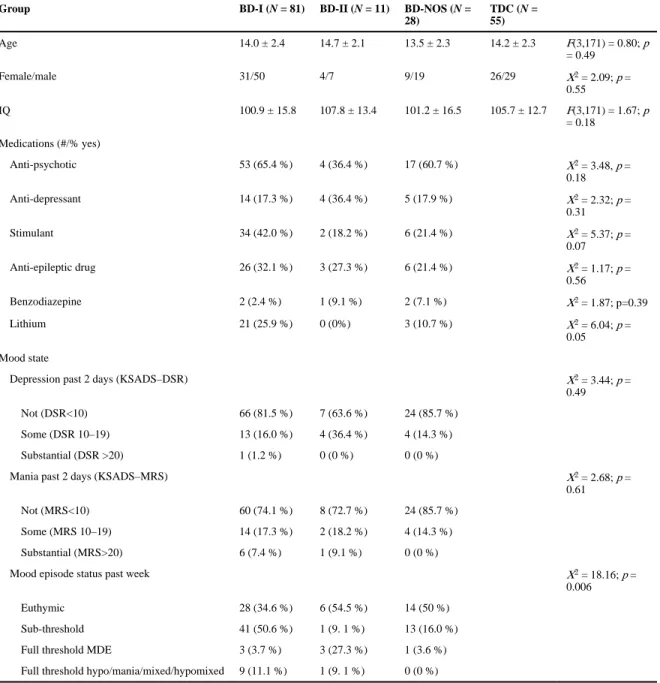
There were no between-group differences among I (N = 81), II (N = 11), and BD-NOS (N = 28), or TDC (N = 55) participants with respect to age, full-scale IQ, or sex even when BD-I and BD-II participants were aggregated. At testing, there was a between-group difference in participants taking lithium, with more BD-I participants (25.9 %) taking lithium than BD-II (0 %) or BD-NOS (10.7 %; χ2 = 6.04, p = 0.05). There were no between-group differences in number of participants taking other medication classes (Table 1).
There were no significant between-group differences in mania (MRS χ2 = 2.68, p = 0.61) or depression (DSR χ2 = 3.44, p = 0.49) ratings 2 days prior to and including the CANTAB testing. There was a between-group difference in mood episode status during the week prior to testing (χ2 = 18.16, p = 0.006), with more BD-I participants rated as being in sub-threshold depression (50.6 %) than other groups and more BD-II participants rated as being euthymic (54.5 %) or full hreshold major depressive episode (27.3 %) than the other groups.
CANTAB results
Primary analysis: reversal learning
First, we tested our a priori hypothesis that BD youths with full threshold DSM-IV episodes of mania and hypomania (i.e., BD-I and BD-II) would have worse performance on the simple reversal stage of the IDED task vs. BD-NOS and TDC participants, we found a significant multivariate effect of group (Wilks’ Lambda F[6,340] = 2.69, p = 0.01) and significant between-subjects effect of group on IDED simple reversal stage total trials (F[3,171] = 3.97, p = 0.009) but not errors (F[3,171] = 1.70, p = 0.17). Post hoc pairwise analyses showed that this was driven by BD-I participants requiring significantly more
A
uthor Man
uscr
ipt
A
uthor Man
uscr
ipt
A
uthor Man
uscr
ipt
A
uthor Man
uscr
IDED simple reversal trials than TDCs (BD-I 9.52 ± 5.12; TDC 7.56 ± 1.54; p = 0.02), but not than BD-NOS (7.46 ± 1.20; p = 0.07) or BD-II (8.45 ± 2.51; p = 1.0).
When BD-I and BD-II participants were aggregated based on both having distinct episodes of mania/hypomania, we found a significant multivariate effect of group (Wilks’ Lambda F[4,342] = 3.83 p = 0.005) and significant between-subjects effect of group on IDED simple reversal stage total trials (F[2,172] = 5.56, p = 0.005) but not errors (F[2,172] = 2.12, p = 0.12). Post hoc pair-wise analyses showed that this was driven by BD-I/II participants requiring significantly more IDED simple reversal trials than BD-NOS (BD-I/II 9.39 ± 4.89; BD-NOS 7.46 ± 1.20; p = 0.05) and also than TDCs (TDC 7.56 ± 1.54; p = 0.01) (Fig. 1).
Neither result was driven by a site effect among TDC participants, as MANOVAs of IDED performance did not show a significant multivariate effect of site.
Primary analysis: additional CANTAB tasks
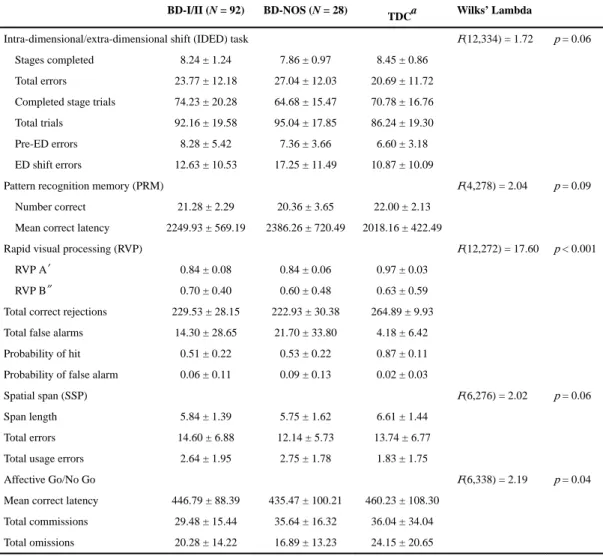
We then tested the effect on different BD phenotypes on neuropsychological performance in the following domains: visuospatial working memory (PRM), working memory (SSP), sustained attention (RVP), and information processing for positive and negative words (AGN). Comparing BD participants with full threshold episodes (i.e., BD-I and BD-II) to those with sub-threshold symptoms (i.e., BD-NOS), there were significant multivariate effects for RVP (F[12,272] = 17.60, p < 0.001) and AGN (F[6,338] = 2.19, p = 0.04), but not for SSP or PRM, or the IDED omnibus measures (Table 2).
On the RVP, we found a significant between-group difference on RVP A′ (F[2,141] = 30.28, p < 0.001), total correct rejections (F[2,141] = 23.12, p < 0.001), and probability of hit (F[2,141] = 32.23, p < 0.001). Post hoc pairwise analyses demonstrated that these were all driven by worse performance among each BD group vs. TDCs, but not compared to one another (all p < 0.001).
On the AGN, there were no between-group differences on total commissions (F[2,171] = 1.70, p = 0.19), total omissions (F[2,171] = 1.97, p = 0.14), or mean correct latency (F[2,171] = 0.66, p = 0.52).
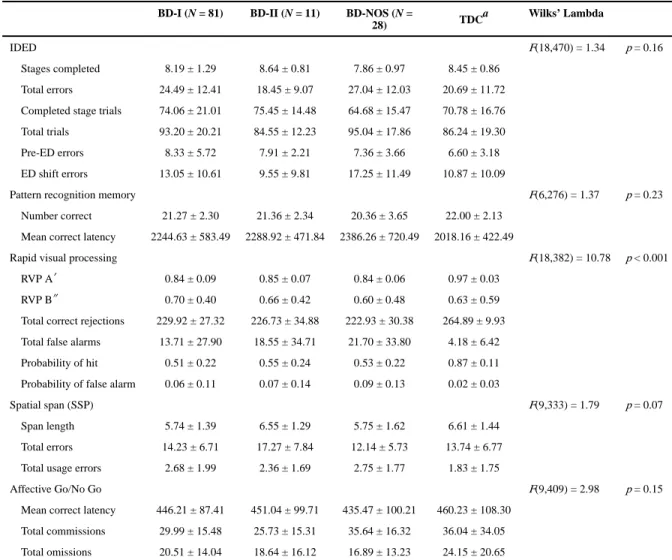
Similarly, analyzing our data as four separate groups (i.e., BD-I, BD-II, BD-NOS and TDC participants), we found significant multivariate effects of group on the RVP (Wilks’ Lambda F[18,382] = 10.78, p < 0.001), but not the AGN, SSP, or PRM tasks, or the IDED omnibus measures (Table 3).
On the RVP, we found a significant between-group difference on RVP A′ (F[3,140] = 20.07, p < 0.001), total correct rejections (F[3,140] = 15.37, p < 0.001), and probability of hit (F[3,140] = 21.50, p < 0.001). Post hoc pair-wise analyses demonstrated that these were all driven by worse performance among each BD group vs. TDCs, but not vs. one another (all p < 0.001).
A
uthor Man
uscr
ipt
A
uthor Man
uscr
ipt
A
uthor Man
uscr
ipt
A
uthor Man
uscr
Secondary analyses: medication effects
We conducted MANOVAs to evaluate potential medication effects on our data, with fixed factors of group and yes/no currently taking specific medication classes, and dependent factors of CANTAB performance on measures previously shown to have between-group differences in our primary analyses (i.e., IDED simple reversal trials; RVP A′, total correct rejections, and probability of hit). However, there were no significant multivariate tests for group × medication interactions for lithium, psychotic, epileptic drug, anti-depressant, ADHD stimulant medications, and benzodiazepines.
Secondary analyses: mood state
To test potential effects of mood status on neuropsychological performance, we first examined potential relationships between IDED simple reversal stage trials and errors from our primary analysis and mood status. We conducted MANOVAs to evaluate potential mood effects, with fixed factors of group and threshold/sub-threshold depression (KSADS-DRS) or mania (KSADS-MRS) for the 2 days prior to CANTAB testing. However, multivariate tests of group × mood status were not significant, whether BD participants were grouped (BD-I/II vs. BD-NOS) or not (BD-I vs. BD-II vs. BD-NOS). Analyses for the RVP (RVP A ′, total correct rejections, and probability of hit) were also not significant.
To further probe the relationship between mood and cognitive performance, we examined Pearson correlations between CANTAB measures where there were between-group performance differences (IDED simple reversal trials; RVP A′, total correct rejections, and probability of hit) and percent weeks with either no/minimal or full threshold mood (including depression and mania) symptoms at 2, 6, and 12 months prior to CANTAB testing. However, no correlation was significant when corrected for multiple comparisons within the BD-I, BD-II, or BD-NOS groups.
Secondary analyses: psychiatric comorbidity
We conducted secondary analyses to probe potential effects of psychiatric comorbidity. With regard to PDD-spectrum illness, excluding 6/81 BD-I, 2/11 BD-II, 0/28 BD-NOS and 0/55 TDCs, all of our between-group CANTAB performance differences from our primary analyses remained significant (IDED simple reversal trials; RVP A′, total correct rejections, and probability of hit). Additionally, we found a between-group difference in IDED simple reversal errors was also significant whether BD-I/II was grouped (F[2,164] = 5.0, p = 0.008) or not (F[2,163] = 3.58, p = 0.02) driven by significant differences between BD-I vs. TDC (p = 0.03) or BD-I/II vs. TDC (p = 0.02). With regard to ADHD, when we restricted our BD participants to those without comorbid ADHD (33/81 BD-I, 9/11 BD-II, 12/28 BD-NOS) and all TDCs, all of our between-group CANTAB performance differences from our primary analyses remained significant (IDED simple reversal trials; RVP A′, total correct rejections, and probability of hit).
Discussion
Our study, the first large-scale study of cognitive performance in children with different sub-types of BD, demonstrates that children and adolescents with distinct full DSM-IV duration
A
uthor Man
uscr
ipt
A
uthor Man
uscr
ipt
A
uthor Man
uscr
ipt
A
uthor Man
uscr
episodes of mania or hypomania have evidence of impairment on measures of cognitive flexibility (IDED simple reversal stage), sustained attention (RVP), and information processing for emotionally valenced words (AGN). Impaired reversal learning among BD youths with distinct episodes of mania/hypomania is an important and independent
replication of some of the prior data showing reversal learning deficits in narrow-phenotype BD-I/II youths from Leibenluft's NIMH sample [11–16]. Moreover, RVP deficits in sustained attention and AGN deficits in information processing of emotionally valenced words overall found among all BD youths regardless of sub-type vs. controls are an
important finding suggesting that on some cognitive domains, these BD youths may be more similar than not. Further study is warranted to determine the neural basis, longitudinal trajectory, and potential improvement via targeted treatment, including medication, psychotherapy, and cognitive remediation.
Our finding supporting our a priori hypothesis that BD-I/II participants required more trials than BD-NOS participants to complete the simple reversal stage is interesting given ongoing work on reversal learning and cognitive flexibility in pediatric BD. Specifically, a line of research has shown that children and adolescents meeting Leibenluft et al.'s research definition for “narrow-phenotype” pediatric BD type I/II via distinct episodes of mania or hypomania requiring euphoria to meet the DSM “A” mood criteria have behavioral deficits on computerized tasks of reversal learning and cognitive flexibility [20]. Narrow-phenotype BD youths make more errors and require more trials to complete the CANTAB IDED simple reversal stage than TDC youths without psychiatric illness [11], and a separate study not only replicated this finding in an expanded sample of BD and control participants, but also showed that BD youths had this deficit compared to a group of SMD youths with chronic non-episodic irritability, persistent negative mood, and ADHD-like symptoms of
hyperactivity [13]. Moreover, narrow-phenotype BD youths have behavioral deficits on the probabilistic response reversal task (PRR) that adds probabilistic feedback, whereby the preferred stimulus is mostly rewarded, but sometimes punished, and then this stimulus/ reward association is reversed. Narrow-phenotype BD youths have been shown to have impaired PRR performance vs. control participants in one study [12], and impaired PRR performance vs. youths with either major depressive disorder, anxiety disorders, SMD, or TDCs in another study [14]. Moreover, two recent event-related fMRI studies suggest that narrow-phenotype BD youths have specific brain alterations mediating this reversal learning deficits, the first vs. TDC participants [15] and the second vs. SMD participants [16]. Our operational definition of bipolar disorders emphasized distinct episodes, consistent with the focus on episodicity in the Leibenluft narrow definition as well as in DSM-5 and the recommendations of the International Society for Bipolar Disorders [43, 44]. Taken as a whole, brain/behavior alterations underlying reversal learning and cognitive flexibility show some promise as a potential future biobehavioral marker of BD youths with distinct episodes of mania, possibly serving as target for future intervention, marker of treatment response, or of the diagnosis itself.
Several studies have evaluated reversal learning in adults with BD. For example, in two separate studies, Clark and colleagues first demonstrated first that BD adults when manic had significantly impaired reversal learning as indexed by the sum of errors made during all reversal stages of the CANTAB IDED task vs. control adults [45]. They then showed in a
A
uthor Man
uscr
ipt
A
uthor Man
uscr
ipt
A
uthor Man
uscr
ipt
A
uthor Man
uscr
separate study similar significant impairments in reversal learning among euthymic BD adults [46]. More recently, Roiser et al. found that unmedicated, depressed BD adults (primarily with BD-II) had reversal learning deficits vs. control adults using a probabilistic reversal learning task designed to increase task difficulty via inconsistent feedback [47]. Although some studies have failed to find between-group differences in reversal learning among BD adults, such as that of Rubinzstein [48], greater understanding of developmental alterations in reversal learning in BD, using longitudinal assessment as BD and control children become adults, seems warranted to determine how BD results in a potential divergence from this developmental trajectory.
Our RVP results showing that BD participants regardless of sub-type have impaired sustained attention align with prior work demonstrating attention impairments in BD. For example, Clark et al. showed that euthymic BD adults had impaired RVP performance vs. control adults even after controlling for mild affective symptoms [46]. Moreover, this deficit was related to the BD participants’ illness progression. In a four-group comparison of adults with BD (depressed, euthymic), unipolar major depressive disorder, or controls without psychopathology, Maalouf et al. showed that groups of euthymic and depressed BD adults made more RVP errors than controls, but did not differ from one another or from those with unipolar major depressive disorder [49]. For clinicians and researchers alike, disentangling whether impaired attention is an integral part of the brain/behavior alterations in BD itself, or whether they reflect comorbid, co-occurring, but distinct pathology related to ADHD, is an important question. This question is worthy of further research because data support both possibilities [50–53], and it has important implications for diagnosis and also for treatment.
More broadly, our work raises two important issues. First, we note that, except for
confirming our a priori hypothesis that reversal learning would differ in BD-I/II vs. BD-NOS participants, our other analyses failed to find differences that were specific and distinguished one BD subgroup from another. While wishing to avoid potential type II error by over-interpreting this lack of difference including fewer BD-II participants, we note that this lack of differences between BD-I, II, and NOS participants aligns with numerous other findings from the COBY study. This includes data indicating similar rates of functional impairment, psychiatric comorbidity, suicidality, and family history between BD-I, II, and NOS participants, suggesting that COBY BD-NOS criteria identify youths who have a sub-threshold presentation of BD rather than that they have a different illness [29–31, 35–37]. Second, we note that while our a priori reversal learning analyses suggest that youths with distinct episodes of mania or hypomania (BD-I or -II) differ from those with sub-threshold symptoms (BD-NOS), that is not to suggest that COBY BD-NOS criteria identify the same youths as those of Leibenluft's SMD criteria. In particular, we note that COBY BD-NOS participants can and do have episodes, although brief, involving euphoria and irritability [37], whereas both distinct episodes and euphoria are exclusionary from SMD and DMDD criteria [20].
Our work has several important limitations, including the lack of a COBY-recruited TDC group, limited number of BD-II participants, ongoing medication use, and mood-state issues. First, as a longitudinal phenomenology study of BD in children and adolescents, COBY did not recruit a cohort of control children and adolescents. While imperfect, given the need to
A
uthor Man
uscr
ipt
A
uthor Man
uscr
ipt
A
uthor Man
uscr
ipt
A
uthor Man
uscr
advance our understanding of cognitive dysfunction in BD youths, we have attempted to use TDC participants completing CANTAB testing at COBY-participating sites in non-COBY studies to control for typical development. Going forward, there is a clear need for a better solution, which would likely involve enrolling BD and TDC participants at every site. Second, we had relatively few BD-II participants compared to those with BD-I or BD-NOS. To address this concern, and based on prior work showing that BD youths with distinct full-duration episodes of mania or hypomania have impaired reversal learning deficits, our primary a priori analyses focus on aggregating BD-I and BD-II participants vs. BD-NOS participants. However, additional study of the neurocognitive performance of BD-II youths is warranted. Last, most of our participants were taking their usual outpatient psychiatric medications when tested. Given that COBY is not a treatment study, it would have been unethical to withdraw them from such medications just for computer testing. Our data demonstrated comparable distribution of psychotropic medications across diagnostic groups making it less likely that our results were biased by a particular type of medication.
Similarly, we did not find significant relationships between mood state and CANTAB performance. Nevertheless, further examining the potential impact of both psychotropic medications and mood state on neurocognitive performance in BD youths is an important area of future study.
Conclusion
In sum, our study begins to shed light on neuropsychological performance in children and adolescents suffering from different sub-types BD. Our study suggests that BD-I and BD-II participants have greater difficulty on reversal learning tasks than BD-NOS and TDC participants, aligning with other studies showing similar impairments in youth with distinct episodes of mania. We also found deficits in sustained attention and information processing for emotionally valenced words across BD sub-types vs. TDC participants. Further work is necessary to see the interaction between neurocognitive performance and longitudinal illness course and development as these COBY BD participants become young adults, and to evaluate neural underpinnings of these differences.
Acknowledgments
We gratefully thank all participants and their families for being part of this study and the National Institutes of Mental Health (NIMH) for supporting this work—including the Course and Outcome of Bipolar Youth (COBY; R01MH059929), Longitudinal Assessment of Manic Symptoms (LAMS; (R01MH073953, R01MH073801, R01MH073967, R01MH073816), and Dr. Dickstein's Pediatric Mood, Imaging, and NeuroDevelopment (PediMIND) Program studies (K22MH074945).
References
1. Pavuluri MN, O'Connor MM, Harral EM, Moss M, Sweeney JA. Impact of neurocognitive function on academic difficul-ties in pediatric bipolar disorder: a clinical translation. Biol Psychiatry. 2006; 60:951–956. [PubMed: 16730333]
2. Pollack LA, Stewart SL, Thompson TD. Trends in childhood cancer mortality-United States, 1990– 2004. MMWR Morb Mortal Wkly Rep. 2007; 56:1257–1261. [PubMed: 18059256]
3. Blader JC, Carlson GA. Increased rates of bipolar disorder diagnoses among U.S. child, adolescent, and adult inpatients, 1996–2004. Biol Psychiatry. 2007; 62:107–114. [PubMed: 17306773]
A
uthor Man
uscr
ipt
A
uthor Man
uscr
ipt
A
uthor Man
uscr
ipt
A
uthor Man
uscr
4. Moreno C, Laje G, Blanco C, Jiang H, Schmidt AB, Olfson M. National trends in the outpatient diagnosis and treatment of bipolar disorder in youth. Arch Gen Psychiatry. 2007; 64:1032–1039. [PubMed: 17768268]
5. Holtmann M, Duketis E, Poustka L, Zepf FD, Poustka F, Bolte S. Bipolar disorder in children and adolescents in Germany: national trends in the rates of inpatients, 2000–2007. Bipolar Disord. 2010; 12:155–163. [PubMed: 20402708]
6. Passarotti AM, Sweeney JA, Pavuluri MN. Emotion processing influences working memory circuits in pediatric bipolar disorder and attention-deficit/hyperactivity disorder. J Am Acad Child Adolesc Psychiatry. 2010; 49:1064–1080. [PubMed: 20855051]
7. Pavuluri MN, Passarotti AM, Mohammed T, Carbray JA, Sweeney JA. Enhanced working and verbal memory after lamotrigine treatment in pediatric bipolar disorder. Bipolar Disord. 2010; 12:213–220. [PubMed: 20402714]
8. Rich BA, Grimley ME, Schmajuk M, Blair KS, Blair RJ, Leibenluft E. Face emotion labeling deficits in children with bipolar disorder and severe mood dysregulation. Dev Psychopathol. 2008; 20:529–546. [PubMed: 18423093]
9. Pavuluri MN, Passarotti AM, Harral EM, Sweeney JA. An fMRI study of the neural correlates of incidental versus directed emotion processing in pediatric bipolar disorder. J Am Acad Child Adolesc Psychiatry. 2009; 48:308–319. [PubMed: 19242292]
10. Brotman MA, Rich BA, Guyer AE, Lunsford JR, Horsey SE, Reising MM, Thomas LA, Fromm SJ, Towbin K, Pine DS, Leibenluft E. Amygdala activation during emotion processing of neutral faces in children with severe mood dysregulation versus ADHD or bipolar disorder. Am J Psychiatry. 2010; 167:61–69. [PubMed: 19917597]
11. Dickstein DP, Treland JE, Snow J, McClure EB, Mehta MS, Towbin KE, Pine DS, Leibenluft E. Neuropsychological performance in pediatric bipolar disorder. Biol Psychiatry. 2004; 55:32–39. [PubMed: 14706422]
12. Gorrindo T, Blair RJ, Budhani S, Dickstein DP, Pine DS, Leibenluft E. Deficits on a probabilistic response-reversal task in patients with pediatric bipolar disorder. Am J Psychiatry. 2005; 162:1975–1977. [PubMed: 16199850]
13. Dickstein DP, Nelson EE, McClure EB, Grimley ME, Knopf L, Brotman MA, Rich BA, Pine DS, Leibenluft E. Cognitive flexibility in phenotypes of pediatric bipolar disorder. J Am Acad Child Adolesc Psychiatry. 2007; 46:341–355. [PubMed: 17314720]
14. Dickstein DP, Finger EC, Brotman MA, Rich BA, Pine DS, Blair JR, Leibenluft E. Impaired probabilistic reversal learning in youths with mood and anxiety disorders. Psychol Med. 2010; 40:1089–1100. [PubMed: 19818204]
15. Dickstein DP, Finger EC, Skup M, Pine DS, Blair JR, Leibenluft E. Altered neural function in pediatric bipolar disorder during reversal learning. Bipolar Disord. 2010; 12:707–719. [PubMed: 21040288]
16. Adleman NE, Kayser R, Dickstein D, Blair RJ, Pine D, Leibenluft E. Neural correlates of reversal learning in severe mood dysregulation and pediatric bipolar disorder. J Am Acad Child Adolesc Psychiatry. 2011; 50:1173–1185. [PubMed: 22024005]
17. Cools R, Clark L, Owen AM, Robbins TW. Defining the neural mechanisms of probabilistic reversal learning using event-related functional magnetic resonance imaging. J Neurosci. 2002; 22:4563–4567. [PubMed: 12040063]
18. Clark L, Cools R, Robbins TW. The neuropsychology of ventral prefrontal cortex: decision-making and reversal learning. Brain Cogn. 2004; 55:41–53. [PubMed: 15134842]
19. Blair RJ, Cipolotti L. Impaired social response reversal. A case of ‘acquired sociopathy’. Brain. 2000; 123(Pt 6):1122–1141. [PubMed: 10825352]
20. Leibenluft E, Charney DS, Towbin KE, Bhangoo RK, Pine DS. Defining clinical phenotypes of juvenile mania. Am J Psychiatry. 2003; 160:430–437. [PubMed: 12611821]
21. Blair RJ. The roles of orbital frontal cortex in the modulation of antisocial behavior. Brain Cogn. 2004; 55:198–208. [PubMed: 15134853]
22. Rich BA, Schmajuk M, Perez-Edgar KE, Fox NA, Pine DS, Leibenluft E. Different
psychophysiological and behavioral responses elicited by frustration in pediatric bipolar disorder and severe mood dysregulation. Am J Psychiatry. 2007; 164:309–317. [PubMed: 17267795]
A
uthor Man
uscr
ipt
A
uthor Man
uscr
ipt
A
uthor Man
uscr
ipt
A
uthor Man
uscr
23. Blair RJ. Psychopathy, frustration, and reactive aggression: the role of ventromedial prefrontal cortex. Br J Psychol. 2010; 101:383–399. [PubMed: 19321035]
24. Horn K, Roessner V, Holtmann M. Neurocognitive performance in children and adolescents with bipolar disorder: a review. Eur Child Adolesc Psychiatry. 2011; 20:433–450. [PubMed: 21904806] 25. Findling RL, Youngstrom EA, McNamara NK, Stansbrey RJ, Demeter CA, Bedoya D, Kahana SY, Calabrese JR. Early symptoms of mania and the role of parental risk. Bipolar Disord. 2005; 7:623– 634. [PubMed: 16403188]
26. Van Meter A, Youngstrom EA, Youngstrom JK, Feeny NC, Findling RL. Examining the validity of cyclothymic disorder in a youth sample. J Affect Disord. 2011; 132:55–63. [PubMed: 21396717] 27. Prisciandaro JJ, Roberts JE. Evidence for the continuous latent structure of mania in the
Epidemiologic Catchment Area from multiple latent structure and construct validation methodologies. Psychol Med. 2011; 41:575–588. [PubMed: 20507671]
28. Van Meter AR, Moreira AL, Youngstrom EA. Meta-analysis of epidemiologic studies of pediatric bipolar disorder. J Clin Psychiatry. 2011; 72(9):1250–1256. [PubMed: 21672501]
29. Axelson D, Birmaher B, Strober M, Gill MK, Valeri S, Chiappetta L, Ryan N, Leonard H, Hunt J, Iyengar S, Bridge J, Keller M. Phenomenology of children and adolescents with bipolar spectrum disorders. Arch Gen Psychiatry. 2006; 63:1139–1148. [PubMed: 17015816]
30. Birmaher B, Axelson D, Goldstein B, Strober M, Gill MK, Hunt J, Houck P, Ha W, Iyengar S, Kim E, Yen S, Hower H, Esposito-Smythers C, Goldstein T, Ryan N, Keller M. Four-year longitudinal course of children and adolescents with bipolar spectrum disorders: the Course And Outcome Of Bipolar Youth (COBY) study. Am J Psychiatry. 2009; 166:795–804. [PubMed: 19448190] 31. Axelson DA, Birmaher B, Strober MA, Goldstein BI, Ha W, Gill MK, Goldstein TR, Yen S, Hower
H, Hunt JI, Liao F, Iyengar S, Dickstein D, Kim E, Ryan ND, Frankel E, Keller MB. Course of subthreshold bipolar disorder in youth: diagnostic progression from bipolar disorder not otherwise specified. J Am Acad Child Adolesc Psychiatry. 2011; 50:1001–1016. [PubMed: 21961775] 32. Dickstein DP, Garvey M, Pradella AG, Greenstein DK, Sharp WS, Castellanos FX, Pine DS,
Leibenluft E. Neurologic examination abnormalities in children with bipolar disorder or attention-deficit/hyperactivity disorder. Biol Psychiatry. 2005; 58:517–524. [PubMed: 16239160]
33. Glahn DC, Bearden CE, Caetano S, Fonseca M, Najt P, Hunter K, Pliszka SR, Olvera RL, Soares JC. Declarative memory impairment in pediatric bipolar disorder. Bipolar Disord. 2005; 7:546– 554. [PubMed: 16403180]
34. Birmaher B, Axelson D, Strober M, Gill MK, Valeri S, Chiappetta L, Ryan N, Leonard H, Hunt J, Iyengar S, Keller M. Clinical course of children and adolescents with bipolar spectrum disorders. Arch Gen Psychiatry. 2006; 63:175–183. [PubMed: 16461861]
35. Goldstein TR, Birmaher B, Axelson D, Goldstein BI, Gill MK, Esposito-Smythers C, Ryan ND, Strober MA, Hunt J, Keller M. Psychosocial functioning among bipolar youth. J Affect Disord. 2009; 114:174–183. [PubMed: 18715651]
36. Sala R, Axelson DA, Castro-Fornieles J, Goldstein TR, Ha W, Liao F, Gill MK, Iyengar S, Strober MA, Goldstein BI, Yen S, Hower H, Hunt J, Ryan ND, Dickstein D, Keller MB, Birmaher B. Comorbid anxiety in children and adolescents with bipolar spectrum disorders: prevalence and clinical correlates. J Clin Psychiatry. 2010; 71:1344–1350. [PubMed: 20868643]
37. Hunt JI, Case BG, Birmaher B, Stout RL, Dickstein DP, Yen S, Goldstein TR, Goldstein BI, Axelson DA, Hower H, Strober M, Ryan N, Swenson L, Topor DR, Gill MK, Weinstock LM, Keller MB. Irritability and elation in a large bipolar youth sample: relative symptom severity and clinical outcomes over 4 years. J Clin Psychiatry. 2013; 74:e110–e117. [PubMed: 23419232] 38. Axelson D, Birmaher BJ, Brent D, Wassick S, Hoover C, Bridge J, Ryan N. A preliminary study of
the Kiddie Schedule for Affective Disorders and Schizophrenia for School-Age Children mania rating scale for children and adolescents. J Child Adolesc Psychopharmacol. 2003; 13:463–470. [PubMed: 14977459]
39. Chambers WJ, Puig-Antich J, Hirsch M, Paez P, Ambrosini PJ, Tabrizi MA, Davies M. The assessment of affective disorders in children and adolescents by semistructured interview. Test-retest reliability of the schedule for affective disorders and schizophrenia for school-age children, present episode version. Arch Gen Psychiatry. 1985; 42:696–702. [PubMed: 4015311]
A
uthor Man
uscr
ipt
A
uthor Man
uscr
ipt
A
uthor Man
uscr
ipt
A
uthor Man
uscr
40. Kaufman J, Birmaher B, Brent D, Rao U, Flynn C, Moreci P, Williamson D, Ryan N. Schedule for Affective Disorders and Schizophrenia for School-Age Children-Present and Lifetime Version (K-SADS-PL): initial reliability and validity data. J Am Acad Child Adolesc Psychiatry. 1997; 36:980–988. [PubMed: 9204677]
41. Keller MB, Lavori PW, Friedman B, Nielsen E, Endicott J, McDonald-Scott P, Andreasen NC. The longitudinal interval follow-up evaluation. A comprehensive method for assessing outcome in prospective longitudinal studies. Arch Gen Psychiatry. 1987; 44:540–548. [PubMed: 3579500] 42. Findling RL, Youngstrom EA, Fristad MA, Birmaher B, Kowatch RA, Arnold LE, Frazier TW, Axelson D, Ryan N, Demeter CA, Gill MK, Fields B, Depew J, Kennedy SM, Marsh L, Rowles BM, Horwitz SM. Characteristics of children with elevated symptoms of mania: the Longitudinal Assessment of Manic Symptoms (LAMS) study. J Clin Psychiatry. 2010; 71:1664–1672. [PubMed: 21034685]
43. Youngstrom EA, Birmaher B, Findling RL. Pediatric bipolar disorder: validity, phenomenology, and recommendations for diagnosis. Bipolar Disord. 2008; 10:194–214. [PubMed: 18199237] 44. American Psychiatric Association. Diagnostic and Statistical Manual of Mental Disorders. 5th
edn.. American Psychiatric Association; Arlington: 2013.
45. Clark L, Iversen SD, Goodwin GM. A neuropsychological investigation of prefrontal cortex involvement in acute mania. Am J Psychiatry. 2001; 158:1605–1611. [PubMed: 11578991] 46. Clark L, Iversen SD, Goodwin GM. Sustained attention deficit in bipolar disorder. Br J Psychiatry.
2002; 180:313–319. [PubMed: 11925353]
47. Roiser JP, Cannon DM, Gandhi SK, Taylor TJ, Erickson K, Wood S, Klaver JM, Clark L, Zarate CA Jr, Sahakian BJ, Drevets WC. Hot and cold cognition in unmedicated depressed subjects with bipolar disorder. Bipolar Disord. 2009; 11:178–189. [PubMed: 19267700]
48. Rubinsztein JS, Michael A, Paykel ES, Sahakian BJ. Cognitive impairment in remission in bipolar affective disorder. Psychol Med. 2000; 30:1025–1036. [PubMed: 12027040]
49. Maalouf FT, Klein C, Clark L, Sahakian BJ, Labarbara EJ, Versace A, Hassel S, Almeida JR, Phillips ML. Impaired sustained attention and executive dysfunction: bipolar disorder versus depression-specific markers of affective disorders. Neuropsychologia. 2010; 48:1862–1868. [PubMed: 20176041]
50. Arnold LE, Mount K, Frazier T, Demeter C, Youngstrom EA, Fristad MA, Birmaher B, Horwitz S, Findling RL, Kowatch R, Axelson D. Pediatric bipolar disorder and ADHD: family history comparison in the LAMS clinical sample. J Affect Disord. 2012; 141:382–389. [PubMed: 22464937]
51. Passarotti AM, Sweeney JA, Pavuluri MN. Neural correlates of response inhibition in pediatric bipolar disorder and attention deficit hyperactivity disorder. Psychiatry Res. 2010; 181:36–43. [PubMed: 19926457]
52. Lopez-Larson M, Michael ES, Terry JE, Breeze JL, Hodge SM, Tang L, Kennedy DN, Moore CM, Makris N, Caviness VS, Frazier JA. Subcortical differences among youths with attention-deficit/ hyperactivity disorder compared to those with bipolar disorder with and without attention-deficit/ hyperactivity disorder. J Child Adolesc Psychopharmacol. 2009; 19:31–39. [PubMed: 19232021] 53. Brotman MA, Rich BA, Guyer AE, Lunsford JR, Horsey SE, Reising MM, Thomas LA, Fromm
SJ, Towbin K, Pine DS, Leibenluft E. amygdala activation during emotion processing of neutral faces in children with severe mood dys-regulation versus ADHD or bipolar disorder. Am J Psychiatry. 2009; 167:61–69. [PubMed: 19917597]
A
uthor Man
uscr
ipt
A
uthor Man
uscr
ipt
A
uthor Man
uscr
ipt
A
uthor Man
uscr
Fig. 1.
Intra-dimensional/extra-dimensional (IDED) shift task simple reversal trials and errors
A
uthor Man
uscr
ipt
A
uthor Man
uscr
ipt
A
uthor Man
uscr
ipt
A
uthor Man
uscr
A
uthor Man
uscr
ipt
A
uthor Man
uscr
ipt
A
uthor Man
uscr
ipt
A
uthor Man
uscr
ipt
Table 1
Demographics by group
Group BD-I (N = 81) BD-II (N = 11) BD-NOS (N =
28)
TDC (N = 55)
Age 14.0 ± 2.4 14.7 ± 2.1 13.5 ± 2.3 14.2 ± 2.3 F(3,171) = 0.80; p
= 0.49
Female/male 31/50 4/7 9/19 26/29 X2 = 2.09; p =
0.55
IQ 100.9 ± 15.8 107.8 ± 13.4 101.2 ± 16.5 105.7 ± 12.7 F(3,171) = 1.67; p
= 0.18
Medications (#/% yes)
Anti-psychotic 53 (65.4 %) 4 (36.4 %) 17 (60.7 %) X2 = 3.48, p =
0.18
Anti-depressant 14 (17.3 %) 4 (36.4 %) 5 (17.9 %) X2 = 2.32; p =
0.31
Stimulant 34 (42.0 %) 2 (18.2 %) 6 (21.4 %) X2 = 5.37; p =
0.07
Anti-epileptic drug 26 (32.1 %) 3 (27.3 %) 6 (21.4 %) X2 = 1.17; p =
0.56
Benzodiazepine 2 (2.4 %) 1 (9.1 %) 2 (7.1 %) X2 = 1.87; p=0.39
Lithium 21 (25.9 %) 0 (0%) 3 (10.7 %) X2 = 6.04; p =
0.05
Mood state
Depression past 2 days (KSADS–DSR) X2 = 3.44; p =
0.49
Not (DSR<10) 66 (81.5 %) 7 (63.6 %) 24 (85.7 %)
Some (DSR 10–19) 13 (16.0 %) 4 (36.4 %) 4 (14.3 %)
Substantial (DSR >20) 1 (1.2 %) 0 (0 %) 0 (0 %)
Mania past 2 days (KSADS–MRS) X2 = 2.68; p =
0.61
Not (MRS<10) 60 (74.1 %) 8 (72.7 %) 24 (85.7 %)
Some (MRS 10–19) 14 (17.3 %) 2 (18.2 %) 4 (14.3 %)
Substantial (MRS>20) 6 (7.4 %) 1 (9.1 %) 0 (0 %)
Mood episode status past week X2 = 18.16; p =
0.006
Euthymic 28 (34.6 %) 6 (54.5 %) 14 (50 %)
Sub-threshold 41 (50.6 %) 1 (9. 1 %) 13 (16.0 %)
Full threshold MDE 3 (3.7 %) 3 (27.3 %) 1 (3.6 %)
Full threshold hypo/mania/mixed/hypomixed 9 (11.1 %) 1 (9. 1 %) 0 (0 %)
A
uthor Man
uscr
ipt
A
uthor Man
uscr
ipt
A
uthor Man
uscr
ipt
A
uthor Man
uscr
ipt
Table 2
CANTAB performance grouped by BD-I /II vs. BD-NOS vs. TDC
BD-I/II (N = 92) BD-NOS (N = 28)
TDCa Wilks’ Lambda
Intra-dimensional/extra-dimensional shift (IDED) task F(12,334) = 1.72 p = 0.06
Stages completed 8.24 ± 1.24 7.86 ± 0.97 8.45 ± 0.86
Total errors 23.77 ± 12.18 27.04 ± 12.03 20.69 ± 11.72
Completed stage trials 74.23 ± 20.28 64.68 ± 15.47 70.78 ± 16.76
Total trials 92.16 ± 19.58 95.04 ± 17.85 86.24 ± 19.30
Pre-ED errors 8.28 ± 5.42 7.36 ± 3.66 6.60 ± 3.18
ED shift errors 12.63 ± 10.53 17.25 ± 11.49 10.87 ± 10.09
Pattern recognition memory (PRM) F(4,278) = 2.04 p = 0.09
Number correct 21.28 ± 2.29 20.36 ± 3.65 22.00 ± 2.13
Mean correct latency 2249.93 ± 569.19 2386.26 ± 720.49 2018.16 ± 422.49
Rapid visual processing (RVP) F(12,272) = 17.60 p < 0.001
RVP A′ 0.84 ± 0.08 0.84 ± 0.06 0.97 ± 0.03
RVP B″ 0.70 ± 0.40 0.60 ± 0.48 0.63 ± 0.59
Total correct rejections 229.53 ± 28.15 222.93 ± 30.38 264.89 ± 9.93
Total false alarms 14.30 ± 28.65 21.70 ± 33.80 4.18 ± 6.42
Probability of hit 0.51 ± 0.22 0.53 ± 0.22 0.87 ± 0.11
Probability of false alarm 0.06 ± 0.11 0.09 ± 0.13 0.02 ± 0.03
Spatial span (SSP) F(6,276) = 2.02 p = 0.06
Span length 5.84 ± 1.39 5.75 ± 1.62 6.61 ± 1.44
Total errors 14.60 ± 6.88 12.14 ± 5.73 13.74 ± 6.77
Total usage errors 2.64 ± 1.95 2.75 ± 1.78 1.83 ± 1.75
Affective Go/No Go F(6,338) = 2.19 p = 0.04
Mean correct latency 446.79 ± 88.39 435.47 ± 100.21 460.23 ± 108.30
Total commissions 29.48 ± 15.44 35.64 ± 16.32 36.04 ± 34.04
Total omissions 20.28 ± 14.22 16.89 ± 13.23 24.15 ± 20.65
Rightmost two columns indicate results of multivariate statistical analyses for each CANTAB test
BD bipolar disorder, NOS not otherwise specified, TDC typically developing controls, ID/ED inter-dimensional/extra-dimensional shift task, PRN pattern recognition memory, RVP rapid visual processing, SSP spatial span, AGN Affective Go/No Go
a