STATISTICAL MACHINE TRANSLATION FOR
INDONESIAN-GERMAN SIGN LANGUAGE
1FRIDY MANDITA, 2TONI ANWAR,
1Research Scholar, Department of Electrical and Software Engineering, The Sirindhorn International Thai
German Graduate of School Engineering (TGGS), King Mongkut’s Technology of North Bangkok
(KMUTNB), Bangkok
2Assoc. Prof., Department of Software Engineering, Universiti Teknologi Malaysia (UTM), Malaysia
E-mail: [email protected], [email protected]
ABSTRACT
In the world of sign language, development has yielded significant results in recent years. Much of the research in the field of sign language has been done. Mostly, the research has designed for signer-independent schema that contains sign language and video corpus of signers. Although there are many studies in the field of sign language, but rarely there is research to translate from sign language to another sign language. This paper, contributes to the research about translating words from Indonesian-German Sign Language. For the translation process a Markov model and the parsing tree method to translate the words are used. Two different methods namely a binary search algorithm and a binary search algorithm with Markov model are used for the process of translating a word which derived from the input. A database that contains the list of words used in daily conversations is prepared. A binary search algorithm and Markov models given a better result when translated single words when are compared with a binary search algorithm. However, binary search algorithm give a good result two or more words are translated.
Keywords: Sign language, Markov model, parsing tree, binary search algorithm.
1. INTRODUCTION
As human being who is awarded with the ability to communicate each other people by using their voice capabilities. Every country in the world has their own spoken language which is important part to talk among them, where each spoken language has their own characteristic. Unfortunately, not all people in the world can use this ability due to lack of proper functioning of the senses that they have, one of the example people who suffer from hearing loss who cannot use their senses to hear the sound. Deafness can caused by; (1) a birth complications (2) infectious diseases, and (3) drugs [9, 14].
In order to deliver conversation around deaf people, sign language used by them, which built from their spoken language and several dictionaries of words which have defined to support the sign language. Sign language is a language that uses the signs via hand gestures or other movements, such as facial expression, body posture, gaze, and lip patterns which used by deaf people to communicate each other [15].
At the moment, there is a lot of sign language which has built e.g. American Sign Language (ASL), German Sign Language (DGS), Indonesian Sign Language (ISL), etc (6). Each sign language has the distinction for each sign and video corpus, but principally has the same meaning of the words. In addition, sign language is the most natural and expressive way for deaf people to communicate with their peers.
Unlike spoken language, which uses the acoustic signal to convey the words, sign language uses visual communications to deliver the words [17]. The device of visual communications can divide into two types: the manual components and the non-manual components. The manual can be built with three components such as; hand shape, motion, and the place of articulation. As for the non-manual components that refer to the information provided by the body such as; facial expression, lip movements, or movements of the shoulders.
bilingual approach as early literacy development for children where deaf people are given the opportunity to learn sign language as the spoken language that is used by deaf community [4, 13]. The training process that focuses on meaning (semantic knowledge), as shown by pictures and sounds, will be very useful for learning new words in sign language.
The tool called I-CHAT and SIGNUM has developed to help people learn sign language based on their spoken language. I-CHAT (I Can Hear and Talk - Indonesian Sign Language Computer Application for the Deaf) is an application that created to assists people, particularly children with hearing loss to master the language of Indonesia [1]. I-CHAT was prepared with a dictionary modules to improve vocabulary in learning sign language and speech readings or pronunciation of a few words in Indonesian language.
SIGNUM Database built with the aim to develop a video corpus based on the basic vocabulary of signs in the language of German [14]. SIGNUM Database is provided 450 isolated video and 780 continuous sentences video, which is performed by 25 native signers of different genders and ages.The signs video is selected based on the words which occur most frequently every day.
Two of them applications have in common that they must ensure highest usability and user-friendliness for users. Both on this tool's have the same performance scenario for signer-independent that contains basic words of signer and video corpus of signers. All the previously applications mentioned earlier does not provide language translation process from one sign language to another sign language and only focus to improve the vocabulary of sign language for signers.
The purpose of this paper is to create statistical machine translation of words or phrases in a sign language to from Indonesian Sign Language (ISL) to German Sign Language (DGS) using a Markov model, parsing tree, and binary search algorithm and to evaluate the tool. The tools will translate a word or phrase of sign language which inputs by users, then also will display sign language video corpus that already exists in the tool as output. The system designed to help hear impaired children to learn their native language of sign language and study another sign language.
2. RELATED WORKS
In the last decade, much research has been done in the field of sign language and machine
translation, which the results can be used by deaf people to communicate each other. A framework for statistical machine translation based on sign language recognition proposed by Bauer et al. [3]. This framework used to translate recognized video based on continuous sign language to spoken language.
In 2004, other works has been done by Huenerfauth which is introducing a rule-based concept of translating English sentences to American Sign Language (ASL) [10]. This rule-based is more suitable than statistical model because the larger corpora is difficult to obtained which argued by Huenerfauth for the conclusion.
U. von Agris et al. published a paper on a rapid signer adaptation for Isolated Sign Language recognition. This paper described the adaptation method could produce a better result for Sign Language recognition. On the other hand, this paper also mentions that the vision based-recognition of sign language can adapt quicker to unknown signers [13].
I-CHAT built to help people with hearing impaired problem to master their spoken language, particularly children [1, 8]. I-CHAT was one of TELKOM Indonesia CSR (Corporate Social Responsibility) programs in 2010. The application brings users how to set up an affirmative sentences with the Indonesian syntax sentences. The sentences are set, then transcribed into video of sign language and speech reading that already exist in the tool. The method is used in this application will guide users to arrange sentences following Indonesian language structure.
In year 2004, Chris Callison-Burch et al., implemented binary search algorithm to arrange alphabetic data [5]. The data are stored as an array of integers where array length equal to the length of the corpus. The complexity of the computation is therefore limited by (2 log (n)), where n is the length of the corpus.
3. MATERIAL AND METHODS
3.1.Binary Search Algorithm
In computer science, a binary search or half-interval search algorithm is a search algorithm that is more efficient than a sequential algorithm [12]. Binary search is more efficient because this algorithm based on divide and conquer strategy, which divided array into two lists and search by comparing an input value to the middle element of an array. The process of binary search shown in figure 1.
[image:3.595.89.291.450.573.2]Figure 1 shows how a binary search algorithm works. The working of binary search algorithm can be described as follows to check the value of middle (approximately) item in the list. If it is not a target search and the value of the target is smaller than the middle item, then the target should be in the first half of the list. If the search of target value is greater than the middle item, then the target should be in the last half of the list. By the way of comparison as mentioned before, it managed to reduce the number of items to check out the half [2]. The search continues by examining the middle item in the remaining half of the list. If it is not target of the search, the search process narrows to half of the remaining part of the target list could on [7].
Figure 1: Binary Search Illustrations (from [7])
3.1.1 Time Complexity
The complexity of this algorithm, the best time complexity is O(1), while the worst time complexity O(log n). The worst time complexity is reached in cases where the record was not found in table. The algorithm performs the division of the table until the size of table reach 1 of the element. The worst can be described as the process of every step of algorithm to compare the elements to the record and is not found, where the process is the base calculation time of the binary algorithm [7].
A binary search algorithm will deal with sign language translation or sentence inputted by users and will translate from Indonesian to German Sign Language. The binary search algorithm will increases the execution time on the translation process for two or more words of sign language.
3.2.Binary Search Algorithm and Markov Model
Markov models are used for pattern recognition approaches by comparing the pattern of the word. Markov chains will process the input word of sign language and give a result the probability value of the words [11]. The result of the transition probability is the order of events or a sequence of letters or characters composing the words entered. Markov model will generate the probability of sentences depending on the current conditions and not on the sequence of events that preceded it. Every word has a value of transition probabilities [18]. Basically, the input character recognition process is divided into three steps:
•Reading a string •Modeling the input
•Character recognition of input
The process of reading a string is done at the beginning of the process that needs to be done by the process is the process of reading of respective character and the process for ordering words. The next step is to model with statistical modeling using a Markov model. From a statistical modeling will get the next parameter that will be used in the search process of sign language or words and to speed up the time execution [11].
Markov chains are a structure consisting of entities called stationary state. Markov chains are essentially finite-state automata machines are weighted. The Markov chain model has a property, where Xi is a state in the Markov chains, and s is a value that state takes can be outlined as follows (1) and (2):
Limited Horizon:
P (Xt+1 = s | X1,… , Xt) = P (Xt+1= s | Xt) (1)
At state t + 1 the value is depends only on the previous state.
Time Invariant:
P (Xt+1 = s |Xt) (2)
is always the same a part of the value of t.
Table 1: Transition matrix for word sequences ‘aku, anjing, and gigit’
Word aku anjing gigit
aku 0.01 0.46 0.53
anjing 0.05 0.15 0.80
gigit 0.77 0.32 0.01
Table 1 shows the transition matrix for sign language or the sequence of words: ‘aku’, ‘anjing’ and ‘gigit’.
Each word has the value of probabilistic for the next state. We calculate the probability for the words P(anjing|aku) = 0.46 and the words P(gigit|anjing) = 0.80 with the initial probability matrix (π) is: aku = 0.6, anjing = 0.3, and gigit = 0.2. The Markov model weighted can be calculated as:
P(aku,anjung,gigit)
= π (aku) * A (anjing*aku) * (gigit*anjing) = 0.6*0.46*0.80
= 0.2208
The combination of binary search and Markov model will be implemented in the sign language translator. Markov models are probabilistic will generate for the next state depends on the current state. The chain of Markov text generator will show you the combination of sentences. One word could be used in another sentence depending on how many words entered by users. The algorithm will give a better execution time to translate single word.
4. RESULTS AND DISCUSSIONS
In order to translate words from Indonesian Sign Language (ISL) to German Sign Language (DGS); a test case was designed to test the translation of words from ISL to DGS. The testing process is divided into three parts including testing for 1 word, 2 words, and 3 words. The tool also provides a video corpus for signer. As mentioned before, 2 different methods: 1) binary search algorithm, 2) Markov model and binary search algorithm are implemented.
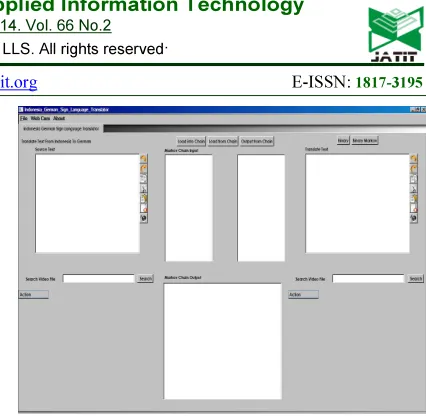
[image:4.595.296.509.74.283.2]Figure 2 shows sign language translator tools. The tools provide 2 methods of translation. The translator tool is used to translate Indonesia Sign Language to German Sign Language.
Figure 2: Sign Language Translator UI
4.1.Binary Search Algorithm
In this study, the implementation of binary search will be used in three different test models. Binary search will be tested to translate single words, two words, and three words. Execution time when translating words or sentences will be analyzed.
4.1.1. The first test case to translate 1 word
This test case is designed to translate single words of sign language. There are 3 different words such as ‘saya’, ‘kamu’, and ‘sayang’ is used to test the performance of the algorithm. The result of the execution time of single words is shown in the table below:
Table 2: Execution time for single word using binary search
No Example Word Testing (ms)
Mean
1 2 3 4 5
1 Saya 59 34 36 6 48 36.6
2 Kamu 50 27 33 29 44 36.6
3 Sayang 18 39 30 25 31 28.6
Table 2 shows the execution time of single words to translate from (Indonesian Sign Language) ISL to DSL (German Sign Language). For the fastest translation is the word ‘sayang’ which gives time for execution is 28.6ms. And for the slowest of the time execution is 36.6ms which translate word ‘saya’ and ‘kamu’.
4.1.2. The second test case to translate 2 words
testing was ‘saya makan’, ‘adik sekolah’, and ‘buah apel’.
Table 3: Execution time for two words using binary search
No Example Word Testing(ms)
Mean
1 2 3 4 5
1 Saya Makan 34 46 23 53 44 40
2 Adik Sekolah 67 17 65 55 53 51.4
3 Buah Apel 61 37 54 46 67 53
From the table 3, the best time of execution to translate sentences when translating sentences 'saya makan' with the execution time was 40ms. The others result of execution time for others sentences are ‘adik sekolah’ gives execution time 51.4ms and the last sentences ‘buah apel’ have results 53ms.
4.1.3. The third test case to translate 3 words
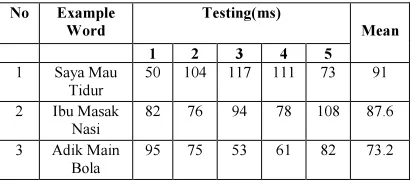
[image:5.595.87.294.424.516.2]The last test for binary search algorithm for the sentences consists of 3 words. The results of execution time of the sentences can show in the table below:
Table 4: Execution time for three words using binary search
No Example
Word
Testing(ms)
Mean
1 2 3 4 5
1 Saya Mau
Tidur
50 104 117 111 73 91
2 Ibu Masak Nasi
82 76 94 78 108 87.6
3 Adik Main Bola
95 75 53 61 82 73.2
In table 4 shows the result of the complete execution time of sample sentences which consists 3 words. The best time execution is 73.2ms when translating sentences ‘adik main bola’and the worst time execution is 91 ms for sentences ‘saya mau tidur’. The sentences ‘ibu masak nasi’ given the execution time is 87.6ms.
4.2. Markov Model and Binary Search
To compare binary search algorithm, this works also implement Markov model and binary search algorithm to translate Indonesian Sign Language (ISL) to German Sign Language (DSL). For the test case is same with a binary search method which is divided into three different test model which consists of single words, two words, and three words. The result of the implementation can show more details below:
4.2.1. The first test case to translate 1 word
This test provides 3 different words such as ‘saya’, ‘kamu’, and ‘sayang’ is used to test the performance of the algorithm and Markov models. The results of time execution of single words showed in table 8.
Table 5: Execution time for single word using Markov model
No Example Word Testing(ms)
Mean
1 2 3 4 5
1 Saya 50 19 25 33 53 36
2 Kamu 38 35 42 30 19 32.8
3 Sayang 28 38 14 18 35 26.6
From table 5 the best time execution when translate ‘sayang’ which has results 26.6ms. The worst time execution 36ms where implementing translation words for ‘saya’. Another word is ‘kamu’ has the execution time 32.8ms.
4.2.2. The second test case to translate 2 words
The next test case is implementing a binary search algorithm and Markov models for two words. In this scenario 3 different sentences are used for test case such as ‘saya makan’, ‘adik sekolah’, and ‘buah apel’.
Table 6: Execution time for two words using Markov model
No Example
Word
Testing(ms)
Mean
1 2 3 4 5
1 Saya Makan 60 57 17 56 40 46
2 Adik Sekolah 53 54 46 51 64 53.6
3 Buah Apel 51 47 47 51 47 48.6
Table 6 shows the results of implementing translation of two words. The fastest execution time is obtained at the sentence ‘saya makan’ with execution is 46ms and the worst execution time was when translated sentences ‘adik sekolah’ with execution time is 53.6ms.
4.2.3. The third test case to translate 3 words
Table 7: Execution time for three words using Markov model
No Example
Word
Testing(ms)
Mean
1 2 3 4 5
1 Saya Mau
Tidur
62 45 162 164 61 98.8
2 Ibu Masak Nasi
129 94 110 120 103 111.2
3 Adik
Main Bola
93 51 98 79 101 84.4
In the table 7 shows a comparison of the time to translate the given sentences consist of three words. The best execution time is 84.4ms for sentences
‘adik main bola’ and the worst is 111.2ms for sentences ‘ibu masak nasi’.
4.3. Comparison Binary Search and Binary Search and Markov Model
As mentioned before the test case for binary search and Markov model and a binary search which is conducted in three steps. The different input of words is performing for the test. There are three test scenarios: single word, two words, and three words. The explanation of each test scenario will be explained in more details below:
4.3.1. First test comparison
Table 8: Comparison execution time for translating one word
Example Word Binary
Search
Markov Model and Binary Search
Saya 36.3 ms 36 ms
Kamu 36.6 ms 32.8 ms
Sayang 28.6 ms 26.6 ms
Table 8 shows the execution time for single words. Implementing Markov model and binary search will give the fastest translation to sign language rather than binary search. Markov model and binary search give better performance than binary search.
Even for the input of different words, Markov model and binary search showed the fastest execution time in translating words. It can be seen from the figure shows above the execution time for each different word. The best execution time is 26ms used Markov model and binary search using word ‘sayang’. In contrast, for the slowest time performance is 36ms which is not much different with binary search for the worst execution time is 36.6ms.
4.3.2. Second test comparison
Table 9: Comparison execution time for translating two words
Example Word Binary
Search
Markov Model and Binary Search
Saya Makan 40 ms 46 ms
Adik Sekolah 51.4 ms 53.6 ms
Buah Apel 53 ms 48.6 ms
Table 9 shows a binary search has better performance when translate sentences that have two words. Markov model and binary search give the slowest execution time to translate sentences that have two words than binary search.
However, binary search has a good performance when translate sentences. Base on the example of the words the best execution time for translation with binary search algorithm is 40ms for the sentences ‘saya makan’. The worst performance of binary search is 53ms when used to translate sentences ‘buah apel’ using binary search.
4.3.3. Third test comparison
Table 10: Comparison execution time for translating three words
Example Word Binary
Search
Markov Model and Binary Search
Saya Mau Tidur 91 98.8
Ibu Masak Nasi 87.6 111.2
Adik Main Bola 73.2 84.4
Table 10 shows the final testing for comparison between binary search and Markov model and binary search. The fastest translation is reached when translate sentences ‘adik main bola’ with execution time is 73.2ms and a Markov model requires execution time 84.4ms with the same sentences.
It can be stated, Markov model and a binary search algorithm shows a good performance when translate single words because this method will generate in a chain to the next probability of words and is not effective when used in sentences. A binary search algorithm has a better performance when implementing for translation of the sentences instead of using a Markov model and binary search when translate two or more words of sign language.
5. CONCLUSION
algorithm and a binary search algorithm with Markov model. The translation process by implementing parsing trees method, Markov model and binary search algorithm. The test model is divided into three parts for 1 word, 2 words, and 3 words.
In the conclusion, the results of implementation sign language translator can be summarized: binary search and Markov model give a good performance to translate single words of sign language. In contrast, binary search algorithm provides a better execution time compared to Markov model and binary search to translate phrase or sentences. In future the performances of translating sign language can more precious if implemented Hidden Markov Model (HMM). The method can be used to increase execution time for the translation. The classification of words and videos could be more precious if applying Hidden Markov Model.
REFRENCES:
[1]. Andreas W. Yanuardi, Samudra Prasetio, and Johannes Adi Purnama P., “Indonesian Sign Language Computer Application for The Deaf”, 2nd International Conferece on
Education Technology and Computer
(ICETC), 2010.
[2]. Asagba P. O, Osaghae E. O. and Ogheneovo, E. E., “Is Binary Search Technique Faster Than Linear Search Technique?”, Scientia Africana, Nigeria, vol. 9, no. 2, pp. 83-92, Faculty of Science, University of Port Harcourt, December 2010.
[3]. B. Bauer, S. Nießen, and H. Hienz, “Towards an automaticas Sign Language translation system”, In Proc. of the Int. Workshop on Physicality and Tangibility in Interaction, Siena, Italy, 1999.
[4]. Chu, C, “New Teaching Methods For Deaf Children”, Amity Newsletter, pp:78(3), 2006. [5]. Chris Callison-Burch, Colin Bannard, and
Josh Schroeder”, Scaling Phrase-Based Statistical Machine Translation to Larger Corpora and Longer Phrases”, 2004.
[6]. D. Rybach, “Appearance-Based Features for Automatic Continuous Sign Language Recognition”, Diplomarbeit im Fach Informatik Rheinisch-Westf¨alische Technische Hochschule Aachen, 2006.
[7]. Dewi Martina Andayani, “Pembuatan Kamus Elektronik Kata-Kata Bahasa Indonesia-Jawa Menggunakan Metode Binary Search Berbasis Perangkat Lunak”, Tugas Akhir D-4, PENS-ITS, Surabaya, 2009.
[8]. “I-CHAT”. Retrieved December 20, 2013, http://app.i-chat.web.id/
[9]. K.S. Savita and A.P. Nur Athirah, “Sign language courseware for hearing impaired children in Malaysia”, World Applied Sciences Journal 12 Special Issue on
Computer Applications and Knowledge
Management, pp. 59-64, 2011.
[10].M. Huenerfauth, “A multi-path architecture for machine translation of English text into American Sign Language animation”, In Proc. Student Workshop at Human Language
Technologies conference HLT-NAACL,
Boston, MA, USA, 2004.
[11].Nur Afifah, “Pembuatan Kamus Elektronik Kalimat Bahasa Indonesia dan Bahasa Jawa Menggunakan Markov “, Tugas Akhir D-4, PENS-ITS, Surabaya, 2012.
[12]. “Princeton”. Retrieved December 20, 2013, https://www.princeton.edu/~achaney/tmve/wi ki100k/docs/Binary_search_algorithm.html [13].Reitsma, P., “Computer-based exercise for
learning to read and spell by deaf people. Journal of Deaf Studies and Deaf Education”, vol 14(2), pp. 178-179, 2009.
[14].“SIGNUM Database”. Retrieved December 20, 2013, http://www.phonetik.uni-muenchen.de/forschung/Bas/SIGNUM/ [15].U. von Agris, D. Schneider, J. Zieren, and
K.-F. Kraiss, “Rapid signer adaptation for isolated sign language recognition”, 24th IEEE International Conference on Computer Vision and Pattern Recognition, June 2006. [16]. “WHO”. Retrieved 27 December, 2013 from
http://www.who.int/topics/deafness/en/ [17].W. Stokoe, D. Casterline, C. Croneberg, “A
Dictionary of American Sign Language on Linguistic Principles”, Gallaudet College Press, Washington D.C., USA, 1965.
[18].Yudi Wibisono, “Penggunaan Hidden Markov Model untuk Kompresi Kalimat”, Skripsi-S1, ITB, Bandung, 2008.
![Figure 1: Binary Search Illustrations (from [7])](https://thumb-us.123doks.com/thumbv2/123dok_us/8912280.959944/3.595.89.291.450.573/figure-binary-search-illustrations-from.webp)