and Fair Secure Multi-Party Computation
Handan Kılın¸c1(B)and Alptekin K¨up¸c¨u2 1 EPFL, Ko¸c University, Istanbul, Turkey
2 Ko¸c University, Istanbul, Turkey
Abstract. Multi-party fair exchange (MFE) and fair secure multi-party computation (fair SMPC) are under-studied fields of research, with prac-tical importance. We examine MFE scenarios where every participant has some item, and at the end of the protocol, either every participant receives every other participant’s item, or no participant receives any-thing. This is a particularly hard scenario, even though it is directly appli-cable to protocols such as fair SMPC or multi-party contract signing. We further generalize our protocol to work for any exchange topology. We analyze the case where a trusted third party (TTP) is optimistically available, although we emphasize that the trust put on the TTP is only regarding thefairness, and our protocols preserve the
privacyof the exchanged items even against a malicious TTP.
We construct anasymptotically optimal (for the complete topology) multi-party fair exchange protocol that requires a constant number of rounds, in comparison to linear, andO(n2) messages, in comparison to cubic, where n is the number of participating parties. We enable the parties to efficiently exchange any item that can be efficiently put into a verifiable escrow (e.g., signatures on a contract). We show how to apply this protocol on top ofany SMPC protocol to achieve a fairness guar-antee with very little overhead, especially if the SMPC protocol works with arithmetic circuits. Our protocol guarantees fairness in its strongest sense: even if all n−1 other participants are malicious and colluding, fairness will hold.
Keywords: Fair exchange
·
Optimistic model·
Secure and fair compu-tation·
Electronic payments1
Introduction
An exchange protocol allows two or more parties to exchange items. It is fair when the exchange guarantees that either all parties receive their desired items or none of them receives any item. Examples of such exchanges include sign-ing electronic contracts, certified e-mail delivery, and fair purchase of electronic goods over the internet. In addition, a fair exchange protocol can be adopted
c
Springer International Publishing Switzerland 2015 K. Nyberg (ed.): CT-RSA 2015, LNCS 9048, pp. 330–349, 2015. DOI: 10.1007/978-3-319-16715-2 18
by secure two- or multi-party computation protocols [7,10,17,26,29,36,45] to achieve fairness [30].
Even in two-party fair exchange scenarios, preventing unfairness completely and efficiently without a trusted third party (TTP) is shown to be impossible [21,41]. The main reason is that one of the parties will be sending the last message of the protocol, regardless of how the protocol looks like, and may choose not to send that message, potentially causing unfairness. In anoptimistic protocol, the TTP is involved in the protocol only when there is a malicious behavior [3,4]. However, it is important not to give a lot of work to the TTP, since this can cause a bottleneck. Furthermore, the TTP is requiredonly forfairness, and should not learn more about the exchange than is required to provide fairness. In particular, in our protocols, we show that the TTP does not learn the items that are exchanged.
Fair exchange with two parties have been extensively studied and efficient solutions [4,9,32–34] have been proposed, but the multi-party case does not have efficient and general solutions. Multi-party fair exchange (MFE) can be described based on exchange topologies. For example, a ring topology describes an MFE scenario where each party receives an item from the previous party in the ring [5,27,38,38]. A common scenario with the ring topology is a customer who wants to buy an item offered by a provider: the provider gives the item to the customer, the customer sends a payment authorization to her bank, the customer’s bank sends the payment to the provider’s bank, and finally the provider’s bank credits the provider’s account.
Ring topology cannot be used in scenarios like contract-signing and secure multi-party computation (SMPC), since in such scenarios the parties want items from all other parties. In particular, in such settings, we want that either every participant receives every other participant’s item, or no par-ticipant receives anything. This corresponds to the contract being signed only if everyone agrees, or the SMPC output to be revealed only when every participant receives it. We call this kind of topology a complete topology. We can think of the parties as nodes in a complete graph and the edges between parties show the exchange links. The complete topology was researched mostly in the contract-signing setting [8,24,25], with one exception [3]. Unfortunately, all these protocols are inefficient compared to ours (see Table1). Since there was no an efficient MFE protocol that achieves the complete topology, the fairness problem in SMPC protocols still could not be completely solved. Existing fair SMPC solutions either work with inefficient gradual release [23], or require the use of bitcoins [1,11].
Our Contributions:We suggest a new optimistic multi-party fair exchange protocol that guarantees fairness in every topology, including the complete topol-ogy, efficiently.
– Our MFE requires onlyO(n2) messages andconstantnumber of rounds for
nparties, being much more efficient than the previous works (see Table1). These are asymptoticallyoptimalfor a complete topology, since each party
Table 1.Efficiency comparison with previous works.nis the total number of parties,t is number of dishonest parties, and MPCS means multi-party contract signing protocol.
Solution for Topology Round Complexity Number of Messages Broadcast [25] MPCS Complete O(n2) O(n3) Yes [8] MPCS Complete O(tn) O(tn2) Yes [40] MPCS Complete O(n) O(n3) Yes [39] MPCS Complete O(n) O(n2) Yes
[3] MFE Any O(1) O(n3) Yes
Ours MFE Any O(1) O(n2) No
should send his item to all the other parties, even in an unfair exchange. Furthermore, our MFE doesnot necessitate abroadcast.
– Our MFEoptimallyguarantees fairness (for honest parties) even whenn−1 out ofnparties are malicious and colluding.
– Our MFE has an easy setup phase, which is employed onlyoncefor exchang-ingmultiplesets of items, thus improving efficiency even further forrepeated exchanges among the same set of participants.
– The TTP for fairness in our MFE is in theoptimistic model [4]. The TTP has a very low workload, since the parties only employ efficient discrete-logarithm-based sigma proofs to show their honesty. More importantly, the TTP doesnot learn any exchanged item, soprivacy against the TTPis preserved.
– We show how to employ our MFE protocol forany exchange topology, with the performance improving as the topology gets sparser.
– We formulate MFE as a secure multi-party computation protocol. We then
provesecurity and fairnessvia ideal-real world simulation [30]. To the best of our knowledge, no multi-party fair exchange protocol was proven as an SMPC protocol before.
– Based on the definition in [30], we provide an ideal world definition for fair SMPC, and prove via simulation that our MFE can be employed on top of any SMPC protocolto obtain a fair SMPC protocol, with the fair-ness extension leaking nothing about the inputs, and without necessitating a payment system.
2
Related Works
Multi-party Fair Exchange:Asokan et al. [3] described a generic optimistic fair exchange with a general topology. The parties are restricted to exchange exchangeable items, requiring the TTP to be able to replace or revoke the items, greatly decreasing the applicability of their protocol. In addition, broadcast is used to send the items, rendering their protocol inefficient.
Ring Topologies:Bao et al. [6] proposed an optimistic multi-party fair exchange protocol based on the ring topology. In their protocol, one of the participants is
Table 2.Efficiency comparison with previous works in the ring topology.nis number of parties. ‘All or None’ represents our fairness definition, where either the whole topology is satisfied, or no exchange occurs.
Number Messages All or None TTP-Party
Dependency TTP Privacy
[6] O(n) No Yes Not Private
[27] O(n2) No Yes Not Private
[38] O(n) No Yes Not Private
Ours O(n2) Yes No Private
the initiator, who starts the first and second phases of the protocol. The initiator is required to contact the TTP to acknowledge the completion of the first phase of the protocol. Thus, firstly, this is not a strictly optimistic protocol, secondly, there is a necessity of trusting the initiator.
Later, Gonzales-Deleito and Markowitch [27] solved the malicious initiator problem of Bao et al. [6]. But, the problem in their protocol is in the recovery protocol: when one of the participants contacts the TTP, the TTP has to contact the previous participant in the ring. This is not preferable because it is not guaranteed that previous participant will be available. The protocol in [38] have also the problem in the recovery protocol.
Understanding Fairness:There is an important difference between our under-standing of fairness, and existing ring-topology protocols’ [6,27,38]. According to their definition, in the end, there will be no party such that he does not receive his desired item from the previous party but sends his item to the next party. It means thatthere can be some parties who received their desired items and some other parties who did not receive or send anything. Whereas, accord-ing to our definition, either the whole topology is satisfied (all the necessary exchanges are complete), or no exchange takes place.
Complete Topologies: Multi-party contract signing indeed corresponds to a complete topology. Garay and Mackenzie [24] proposed the first optimistic multi-party contract signing protocol that requiresO(n2) rounds andO(n3) messages. Because of its inefficiency, Baum-Waidner and Waidner [8] suggested a more effi-cient protocol, whose complexity depends on the number of dishonest parties, and if the number of dishonest parties isn−1, its efficiency is the same as [24]. Mukhamedov and Ryan [40] decreased the round complexity to O(n). Lastly, Mauw et al. [39] gave the lower bound ofO(n2) for the number of messages to achieve fairness. Their protocol requires O(n2) messages, but the round com-plexity is not constant. We achieve both lower bounds (O(n2) messages and constant round) for the first time.
Fair Secure Multi-party Computation: Secure multi-party computation had an important position in the last decades, but its fairness property did not receive a lot of attention. One SMPC protocol that achieves fairness is designed
by Garay et al. [28]. It uses gradual release, which is the drawback of this proto-col, because each party broadcasts its output gradually in each round. At each round the number of messages is O(n3) and there are a lot of rounds due to gradual release.
Another approach is using bitcoin to achieve fairness using a TTP in the opti-mistic model [1,11]. When one of the parties does not receive the output of the computation, he receives a bitcoin instead. This fairness approach was used by Lindell [35] for the two-party computation case, and by K¨up¸c¨u and Lysyanskaya [33] and Belenkiy et al. [9] for peer-to-peer systems. However, this approach is not appropriate for multi-party computation since we do not necessar-ily know how valuable the output will be before evaluation. Finally, reputation-based fairness solutions [2] talk about fairness probabilities.
3
Definitions and Preliminaries
3.1 Preliminaries
Threshold Public Key Encryption:In such schemes, encryption is done with a single public key, generated jointly byndecrypters, but decryption requires at leastk decrypters to cooperate. It consists of the probabilistic polynomial time (PPT) protocolsKey Generation, Verification, Decryptionand a PPT algorithm for Encryption [44]. We describe these via the ElGamal (n, k = n) threshold encryption scheme we will employ, as follows:
– Key Generation:It generates a list of private keysSK={x1, ..., xn}, where xi ∈ Zp, public key P K = (g, h), where g is a generator of a large prime p-order subgroup ofZ∗q with q prime, together with h=gxi, and public verification key V K = {vk1, ..., vkn} = {gx1, ..., gxn}, where n ≥ 1. Note that this can be done in a distributed manner [43].
– Encryption: It computes the ciphertext for plaintext m as E = (a, b) = (gr, mhr) wherer∈Zp.
– Verification:It is between a verifier and a prover. Verifier, usingV K, E,and the given decryption share of the proverdi =grxi, outputsvalid if prover shows that loggvki is equal to logadi. Otherwise, it outputsinvalid. – Decryption: It takes as input n decryption shares {d1, ..., dn}, wheredi =
grxi, V K, and E. Then, it outputs a messagem with the following compu-tation (inZ∗q), b di = mh r grxi = mhr hr =m or⊥if the decryption shares are invalid.
Verifiable Encryption:It is an encryption that enables the recipient to verify, using a public key, that the plaintext satisfies some relation, without perform-ing any decryption [14,15]. A public non-malleable label can be attached to a verifiable encryption [44].
Verifiable Escrow:An escrow is a ciphertext under the public key of the TTP. A verifiable escrow [4,15] is a verifiable encryption under the public key of the TTP. We employElGamal verifiable encryption scheme [13,20].
Notation. The n parties in the protocol are represented by Pi, where i ∈
{1, ..., n}. Ph is to show the honest parties, and Pc is to show the corrupted parties controlled by the adversaryA.
V Ei andV Si is used to show the verifiable encryption and escrow prepared byPi, respectively. The descriptive notation for verifiable encryption and escrow isV(E, pk;l){(v, ξ)∈R}. It denotes the verifiable encryption and escrow for the ciphertextEwherebyξ–whose relationRwith the public valuevcan be verified– is encrypted under the public key pk, and labeled byl. For escrows, pk is the TTP’s public key.
P K(v){(v, ξ)∈ R} denotes a zero-knowledge proof of knowledge of ξ that has a relation R with the public value v. All relations R in our protocols have an honest-verifier zero-knowledge three-move proof of knowledge [18], so can be implemented very efficiently. z shows the numberz in the Figure1.
3.2 Definitions
Optimistic Fair Secure Multi-Party Computation:A group of parties with their private inputswi desire to compute a functionφ[8,26]. This computation issecurewhen the parties do not learn anything beyond what is revealed by the output of the computation. It isfairif either all of the parties learn the output in the end of the computation, or none of them learns the output. For anoptimistic protocol, the TTP is involvedonlywhen there is a dispute about fairness between parties. This is formalized by ideal-real world simulations, defined below.
Ideal World: It consists of an adversary A that corrupts the set Pc of m parties where m ∈ {1, ..., n−1}, the set of remaining honest party(s) Ph, and the universal trusted party U (not the TTP). The ideal protocol is as follows:
1. U receives inputs{wi}{i∈Pc}or the messageabortfromA, and{wj}{j∈Ph} from the honest party(s). If the inputs are invalid or Asends the message abort, thenU sends⊥to all of the parties and halts.
2. Otherwise U computes φ(w1, ..., wn) = (φ1(w1, ..., wn), ..., φn(w1, ..., wn)). Let φi =φi(w1, ..., wn) be the ith output. Then he sends{φi}{i∈Pc} to A and{φj}{j∈Ph} to the corresponding honest party(s).
The outputs of the parties in an ideal execution between the honest party(s) and
A controlling the corrupted parties where U computes φ is denoted
IDEALφ,A(aux)(w1, w2, ...wn, λ), where {wi}1≤i≤n are the respective private inputs of the parties, aux is an auxiliary input of A, and λ is the security parameter.
Real World: There is noU for a real protocolπto compute the functionality φ. There is an adversary A that controls the set Pc of corrupted parties and a TTP involved in the protocol when there is an unfair behavior. The pair of
outputs of the honest party(s) Ph and A in the real execution of the protocol π, possibly employing the TTP, is denoted REALπ,TTP,A(aux)(w1, w2, ...wn, λ), wherew1, w2, ...wn, aux,and λare like above.
Note thatU and TTP are not related to each other. TTP is the part of the real protocol to solve the fairness problem when it is necessary, butU is not real (just an ideal entity).
Definition 1 (Fair Secure Multi-Party Computation). Letπbe a proba-bilistic polynomial time (PPT) protocol and letφbe a PPT multi-party function-ality. We say thatπcomputesφfairly and securely if for every non-uniform PPT real world adversary Aattackingπ, there exists a non-uniform PPT ideal world simulatorSso that for every w1, w2, ..., wn,λ∈ {0,1}∗, the ideal and real world outputs are computationally indistinguishable:
{IDEALφ,S(aux)(w1, w2, ..., wn, λ)} ≡c{REALπ,TTP,A(aux)(w1, w2, ..., wn, λ)} The standard secure multi-party ideal world definition [37] lets the adversary
A to abort after learning his output butbefore the honest party(s) learns her output. Thus, proving protocols secure using the old definition would not meet the fairness requirements. Therefore, we prove our protocols’ security and fair-ness under the modified definition above. Canetti [16] gives general definitions for security for multi-party protocols with the same intuition as the security and fairness definition above. Further realize that since the TTPT does not exist in the ideal world, the simulator should also simulate its behavior.
Optimistic Multi-Party Fair Exchange:The participants areP1, P2, ..., Pn. Each participantPi has an itemfi to exchange, and wants to exchange his own item fi with the other parties’ items {fj}j=i, , where i, j∈ {1, ..., n}. Thus, at the end, every participant obtains {fi}1≤i≤n in a complete topology, or some subset of it defined by some other exchange topology.
Multi-Party fair exchange is also a multi-party computation where the func-tionality φis defined via its parts φi as below (we exemplify using a complete topology):
φi(f1, ..., fn) = (f1, f2, ..., fi−1, fi+1, ..., fn)
The actualφiwould depend on the topology. For example, for the ring topology, it would be defined as φi(f1, ..., fn) =fi−1 ifi= 1, φi(f1, ..., fn) =fn ifi= 1. Therefore we can use Definition 1 as the security definition of the multi-party fair exchange, using theφi representing the desired topology.
Adversarial Model: When there is dispute between the parties, the TTP resolves the conflict atomically. We assume that the adversary cannot prevent the honest party(s) from reaching the TTP before the specified time interval. Secure channels are used to exchange the decryption shares and when contacting the TTP. The adversary may control up ton−1 out ofnparties in the exchange, and is probabilistic polynomial time (PPT).
4
Description of the Protocol
Remember that our aim is to create efficient multi-party fair exchange protocols for every topology. The most important challenges of these kind of protocols are the following:
– Even if there aren−1 colluding parties, the protocol has to guarantee the fairness. Consider a simple protocol for the complete topology: each party first sends the verifiable escrow of the his/her item to the other parties, and after all the verifiable escrows are received, each of them sends the (plaintext) items to each other. If one of the parties comes to the TTP for resolution, the TTP decrypts the verifiable escrow(s) and stores the contacting party’s item for the other parties.
Assume now thatPiandPjare colluding, andPireceives verifiable escrow of the honest partyPh. ThenPi contacts the TTP, receivesfh via the decryp-tion of the verifiable escrow of Ph, and gives his item fi to the TTP. At this moment, if Pi and Pj leave the protocol before Pj sends his verifiable escrow toPh, then fairness is violated becausePhnever gets the item ofPj, whereas, by colluding withPi,Pj also receivedfh.
Thus, it is importantnotto let a party learn some itembefore all the parties are guaranteed that they will get all the items. We used this intuition while designing our protocols. Therefore, we obligeparties to depend on some input from every party in every phase of the protocol. Hence, even if there is only one honest party, the dishonest ones have to contact and provide their correct values to the honest party so that they can continue with the protocol.
– It is desirable and more applicable to use a semi-honest TTP. Hence, privacy against the TTP needs to be satisfied. In the protocol above, the privacy against the TTP is violated since the TTP learns the items of the parties. – The parties do not receive or send any item to some of the other parties in
some topologies (e.g., in the ring topology, P2 receives an item only from P1 and sends an item toP3only). Yet, a multi-party fair exchange protocol must ensure that either the whole topology is satisfied, or no party obtains any item. Previous protocols fail in this regard, and allow, for example P2 to receive the item ofP1 as long as she sends her item to P3, while it may be the case that P4 did not receive the item of P3. The main issue here is that, if a multi-party fair exchange protocol lets the topology to be partially satisfied, we might as well replace that protocol with multiple executions of two-party fair exchange protocols. The main goal of MFE is to ensure that either the whole topology is satisfied, or no exchange happens.
We succeed in overcoming the challenges above with our MFE protocol. We first describe the protocol for the complete topology for the sake of simplic-ity. Then, we show how we can use our MFE protocol for other topologies in Section 5. All zero-knowledge proof of knowledge protocols are executed non-interactively in the random oracle model [12].
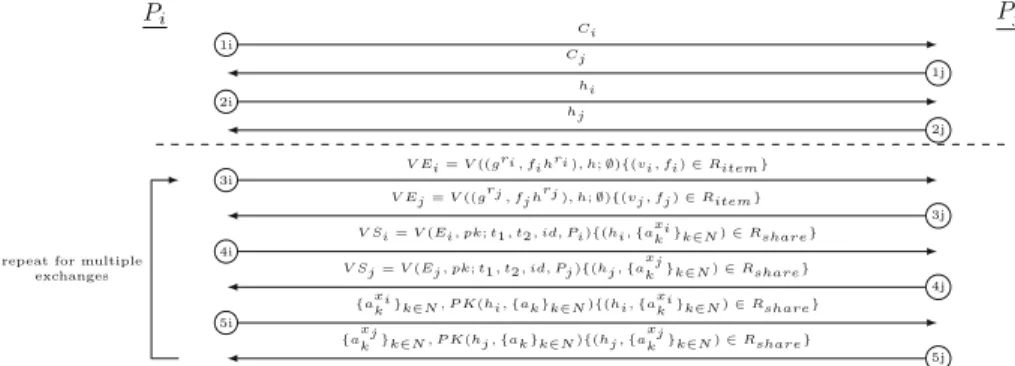
Fig. 1.Our MFE Protocol. Each (i, j) message pair can be performed in any order or in parallel within a step.
4.1 Multi-Party Fair Exchange Protocol (MFE)
There is a trusted third party (TTP) that is involved in the protocol when a dispute happens between the participants about fairness. His public key pk is known to every participant.
Overview:The protocol has three phases. In the first phase, parties jointly gen-erate a public key for the threshold encryption scheme using their private shares. This phase needs to be done only once among the same set of participants. In the second phase, they send to each other the verifiable encryptions of the items that they want to exchange. If anything goes wrong up till here, the protocol is aborted. In the final phase, they exchange decryption shares for each item. If something goes wrong during the final phase, resolutions with the TTP are performed. The details are below (see also Figure1).
Phase 1 (1 and 2 in Figure1):All participants agree on the primep-order subgroup of Z∗q, where q is a large prime, and a generator g of this subgroup. Then eachPi does the following [43]:
– Pi randomly selects his share xi from Zp and computes the verification key hi = gxi. Then he commits to hi and sends the commitment Ci to other parties [43].
– After receiving all commitments from the other parties, Pi opens Ci and obtains all other parties’hj.
Note that this must be done after exchanging all the commitments, since otherwise we cannot claim independence of the shares, and then the threshold encryption scheme’s security argument would fail. But with the two steps above, the security proof for threshold encryption holds here.
– After receiving allhi values successfully,Pi computes the threshold encryp-tion’s public key
h= i hi= i gxi =gixi =gx.
Phase 1 is executed only once. Afterward, the same set of parties can exchange as many items as they want by performing only Phase 2 and Phase 3.
Phase 2 (3 in Figure1):Firstly, parties agree on two time parameterst1and t2, and identificationidof the protocol. (Time parameters can also be agreed in Phase 1.) Each participantPi does the following:
– Pi sends a verifiable encryption of his itemfi as
V Ei=V((gri, fihri), h;∅){(v, fi)∈Ritem}
whereriis randomly selected fromZp. For the notation simplicity, we denote (ai, bi) = (gri, fihri).V Eiincludes the encryption of the itemfi with public keyhand it can be verified that the encrypted itemfi and the public value vi has the relationRitem. Shortly,Piproves he encrypts desired item. (e.g., iffi is a signature on a contract, thenvi contains the signature verification key ofPi together with the contract, and Ritem is the relation thatfi is a valid signature with respect tovi.)
Note that without knowingn decryption shares, no party can decrypt any V Ej and learn the items. Thus, if anything goes wrong up to this point, the parties can locally abort the protocol. After this point, they need to obtain all the decryption shares. This is done in the following phase.
Phase 3 (4 and 5 in Figure 1):No party begins this phase without com-pleting Phase 2 and receiving all verifiable encryptionsV Ej correctly.
– Pisends to other parties a verifiable escrowV Sithat includes the decryption shares for each verifiable encryptionV Ej.V Si is computed as
V Si=V(Ei, pk;t1, t2, id, Pi){(hi,{axki}1≤k≤n)∈Rshare}
whereEi is the encryption of ax1i, a2xi, ..., axni with the TTP’s public keypk. The relationRshareis:
logghi= logaka xi
k for eachk. (1)
Simply, the verifiable escrowV Si includes the encryption of the decryption shares ofPi that will be used to decrypt the encrypted items of all parties. It can be verified that it has the correct decryption shares. In addition, only the TTP can open it. The labelt1, t2, id, Pi contains the public parameters of the protocol, andPi is just a name that the participant chooses. Here, we assume that each party knows the other parties’ names.
Remark:The namePi is necessary to show theV Si belongs him. It is not beneficial to put a wrong name in a verifiable escrow’s label, since a cor-rupted party can convince TTP to decryptV Si by showingPi is dishonest. The other labelsid, t1, t2 are to show the protocol parameters to the TTP. Exchange identifier id is necessary to prevent corrupted parties to induce TTP to decrypt V Sj for another exchange. Consider that some exchange protocol ended unsuccessfully, which means nobody received any item. The corrupted party can go to the TTP as ifV Sj is the verifiable escrow of the
next protocol, and have it decrypted, if we were not using exchange identi-fiers. We will see in our resolution protocols thatcheating in the labels do not provide any advantage to an adversary. Furthermore, the party names can be random and distinct in each exchange, as long as the parties know each others’ names, and so it does not violate the privacy of the parties. – Pi waits for V Sj from eachPj. If anything is wrong with some V Sj (e.g., verification fails or the label is not as expected), orPi does not receive the verifiable escrow from at least one participant, he executesResolve 1before t1. Otherwise,Pi continues with the next step.
– Pi sends his decryption shares (ax1i, a2xi, ..., axni) to each Pj. In addition, he executes the zero-knowledge proof of knowledge showing that these are the correct decryption shares
P K(hi,{ak}k∈N){(hi,{axik }1≤k≤n)∈Rshare}. (2) – Pi waits for (ax1j, a
xj 2 , ..., a
xj
n ) from each Pj, together with the same proof that he does. If one of the values that he receives is not as expected or if he does not receive them from somePj, he performsResolve 2protocol with the TTP, beforet2 and aftert1. Otherwise,Picontinues with the next step. – After receiving all the necessary values,Pican decrypt eachV Eiand get all
the items. The decryption for itemfj is as below: bj/ k axk j =fjhrj/grj kxk =f jhrj/(g kxk)rj =f jhrj/hrj =fj
Resolve 1. The goal of Resolve 1 is torecord the corrupted parties that didnot send their verifiable escrow in 4. Resolve 1 needs to be donebefore t1. Parties do not learn any decryption shares here. They can just complain about other parties to the TTP. The TTP creates a freshcomplaintListfor the protocol with parameters id, t1, t2. ThecomplaintList contains the names of pairs of parties having a dispute because of the missingV S. Thecomplainant is the party that complains, whose name is saved as the first of the pair, and thecomplainee is saved as the second of the pair. The TTP saves alsocomplainee’s verification key given by the complainant; in the case that the complainee contacts the TTP, he will be able to prove that he is the complainee. See Algorithm1.
Algorithm 1.Resolve 1
Pisendsid, t1, t2, Pj, hjto the TTP wherePj is the party that did not sendV Sj toPi. The TTP does the following:
ifcurrenttime > t1then sendmsg“Abort Resolve 1”
else
complaintList= GetComplaintList(id, t1, t2)
if complaintList== NULL then
complaintList = EmptyList(id, t1, t2) // initialize empty list
solvedList = EmptyList(id, t1, t2) // will be used in Resolve 2
end if
complaintList.add(Pi,(Pj, hj))
sendmsg“Come aftert1for Resolve 2”
Resolve 2. Resolve 2 is the resolution protocol where the parties come to the TTP to ask him to decrypt verifiable escrows and the TTP solves the complaint problems recorded in Resolve 1. The TTP doesnot decrypt any verifiable escrow until thecomplaintList isempty.
The party Pi, who comes for Resolve 2between t1 and t2, gives all
veri-fiable escrows that he has already received from the other parties and his own verifiable escrow to the TTP. The TTP uses these verifiable escrows to save the decryption shares required to solve the complaints in the complaintList. If the complaintList is not empty in the end,Pi comes aftert2 for Resolve 3. Other-wise, Pi can perform Resolve 3 immediately and get all the decryption shares that he requests.
Algorithm 2.Resolve 2
Pi gives M, which is the set of verifiable escrows that Pi has. The TTP does the fol-lowing:
complaintList= GetComplaintList(id, t1, t2)
for allV Sj inMdo
if(∗,(Pj, hj))∈complaintListAND CheckCorrectness(V Sj, hj) is truethen
sharesj= Decrypt(sk, V Sj) solvedList.Save(Pj, sharesj)
complaintList.Remove((∗,(Pj, hj)))
end if end for
ifcomplaintListis emptythen sendmsg “Do Resolve 3”
else
sendmsg “Come aftert2for Resolve 3”
end if
CheckCorrectness(V Sj, hj)returnstrueif the TTP can verify the relation in equation (1) using verifiable escrowV Sj andhj. Otherwise it returnsf alse.
Resolve 3. If thecomplaintListstill has parties, even aftert2, the TTP answers each resolving party saying that the protocol is aborted, which means nobody is able to learn any item. If the complaintList is empty, the TTP decrypts any verifiable escrow that is given to him. Besides, if the complainants in the solvedList come, he gives the stored decryption shares. See Algorithm3.
Algorithm 3.Resolve 3
Pi gives C, which is the set of parties that did not perform step 4 or 5 withPi, and
V, which is the set of verifiable escrows that belongs to parties in C who performed step
4. The TTP does the following:
complaintList= GetComplaintList(id, t1, t2) if complaintList.isEmpty() then for allPj inCdo ifV Sj∈ Vthen sendDecrypt(sk, V Sj) else sendsolvedList.GetShares(Pj) end if end for
else if currenttime > t2 then sendmsg “Protocol is aborted”
else
sendmsg “Try aftert2”
4.2 Security
Theorem 1. The MFE protocol above is fair according to Definition1, assum-ing that ElGamal threshold encryption scheme is a secure threshold encryption scheme, the associated verifiable escrow scheme is secure, all commitments are hiding and binding, and the discrete logarithm problem is hard (so that the proofs are sound and zero-knowledge).
Proof Sketch:The proof of Theorem1is in the full version of this paper [31]. Assume the worst-case that adversaryA corruptsn−1 parties. The simulator S simulates the honest party in the real world and the corrupted parties in the ideal world. S also acts as the TTP in the protocol if any resolution protocol occurs, soS publishes a public keypkas the TTP, and knows the corresponding secret key. Let’s assume that S simulates the honest party P1 without loss of generality in real world.
Sbehaves the same as in the real protocol for Phase 1. Then in Phase 2, he encrypts random item ˜f1since he does not know realf1 and sends the verifiable encryption ˜V E1to other parties. While he receives other parties’V Es, he learns the other parties’ items behaving as the extractor of verifiable encryption.
He behaves as in Phase 3. Additionally he learns decryption shares of the parties that send verifiable escrow using the extractor.
If he receives all verifiable escrows of the other parties, it means it is guaran-teed that the real honest party would obtain her desired items, becauseSin the real world is now able to learn all the decryption shares from the corrupted par-ties via resolutions. So he sends the items of the other parpar-ties toU and receives f1. Then he calculates Equation 3 to find the appropriate decryption shared1 such that the other parties can get the itemf1 from a1, b1 using d1. The other decryption shares are calculated as in the real protocol.
d1= b1 f1axi2...a xn i (3) OtherwiseSsimulates the resolve protocols and does not send his decryption shares as in real protocol. In the end of t2, if complaintListis empty, S sends items of corrupted parties to U and receives f1. Then he calculates d1 from Equation 3. In this point, when some parties come for Resolve 3, S can give every share that they want. If complaintList is not empty in the end of t2, S sends message aborttoU.
5
All Topologies for MFE
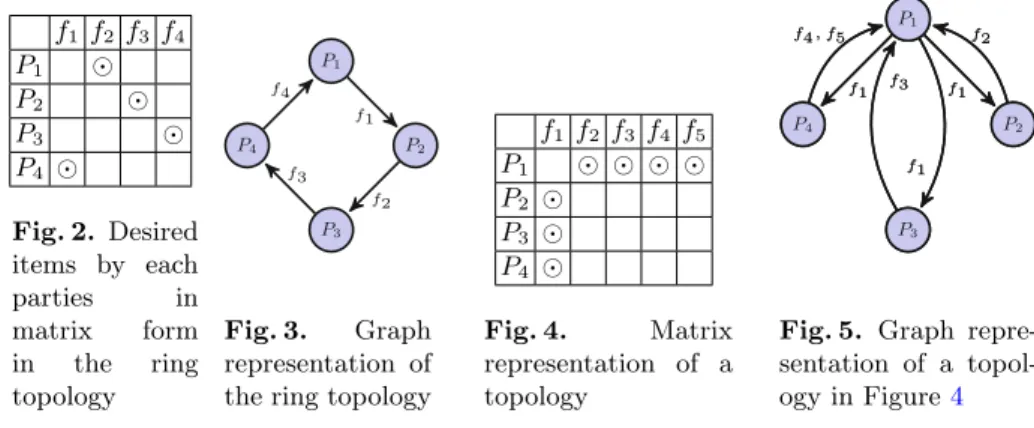
In this section, we adapt our MFE protocol to every topology. Our fairness definition remains the same: either the whole topology is satisfied, or no party learns any item. As an example, consider the ring topology as in Figure3. Parties want an item from only the previous party. For example, P2 only wants P1’s itemf1. However,P2should contact all other parties because of our all-or-none fairness condition. Besides, we are not limited with a topology that follows a
specific pattern such as the number of parties and items being necessarily equal. For example, it is possible to provide fairness in the topology in Figure 5 even thoughP2, P3,andP4 do not have exchange item with each other.
f1 f2 f3 f4 P1 P2 P3 P4 Fig. 2. Desired items by each parties in matrix form in the ring topology Fig. 3. Graph representation of the ring topology
f1 f2 f3 f4 f5 P1 P2 P3 P4 Fig. 4. Matrix representation of a topology
Fig. 5. Graph repre-sentation of a topol-ogy in Figure4
Consider some arbitrary topology described by the matrix in Figure6. If a party desires an item from another party, he should have all the shares of the item as shown in Figure7. In general, we can say that if a partyPi wants the itemft he should receive{axtj}{1≤j≤n} from all the parties{Pj}{1≤j≤n}. Therefore, our
MFE can be applied to any topology with the same fairness condition, which is
all parties will receive all their desired items or none of them receives anythingin the end of the protocol.
f1 f2 f3 f4 f5
P1
P2
P3
P4
Fig. 6. Each party wants the marked items corresponding to his/her row.Pi
hasfi, exceptP4 has bothf4 andf5.
f1 f2 f3 f4 f5
P1 {ax2i} {a3xi} {ax5i}
P2 {ax1i} {ax4i} {ax5i}
P3 {ax1i} {ax3i}
P4 {ax1i} {ax2i} {ax3i} {ax5i} Fig. 7.Necessary shares for each party to get the desired items that are shown in Figure 6. Sets are over i ∈
{1,2, ...,5}
Our strong fairness condition requires that all parties have to depend each other. Even though Pi does not want an item fj from Pj, getting his desired item has to also depend onPj. Therefore we cannot decrease number of messages even in a simpler (e.g., ring) topology.
On the other hand, the size of the verifiable escrow, meaning that the number of shares in the verifiable escrow, decreases in topologies other than the complete one. If we represent the topology in a matrix form as in Figure6, each party Pi
has to add the number ofmany shares corresponding to the row of the party Pjto the verifiable escrow that is sent toPj. We can conclude that the total size of the verifiable escrows that a party sends isO(#) whereis as in Figure6.
6
Efficient Fair Secure Multi-Party Computation
In this section, we show how to adapt the MFE protocol toany secure multi-party computation (SMPC) protocol [7,10,17,26,46] to achieve fairness.
Assume n participants want to compute a function φ(w1, ..., wn) = (φ1(w1, ..., wn), ..., φn(w1, ..., wn)), wherewiis the input andφi =φi(w1, ..., wn) is the output of partyPi.
– Pi randomly chooses a share xi ∈ Zp. Then Pi gives his share andwi to an SMPC protocol that outputs the computation of the functionality ψ where ψi(z1, z2, ..., zn) = (Ei(φi(w1, ..., wn)),{gxj}1≤j≤n) is the output to, andzi= (wi, xi) is the input ofPi. This corresponds to a circuit encrypting the outputs of the original functionφusing the shares provided as input, and also outputting the verification shares of all parties to everyone. Encryption Eiis done with the keyh=g
n
j=1xj as follows: Ei(φi(w1, ..., wn)) = (gri, φihri)
whereri ∈Zp are random numbers chosen by the circuit (or they can also be inputs to the circuit), similar to the original MFE protocol.
It is expected that everyone learns the output ofψ before a fair exchange occurs. If some party did not receive his output at the end of the SMPC protocol, then they do not proceed with the fair exchange, and hence no party will be able to decrypt and learn their output.
– If everyone received their output from the SMPC protocol, then they execute the Phase 3 of the MFE protocol above, using gxi values obtained from the output ofψ as verification shares, and xi values as their secret shares. Furthermore, theai, bi values are obtained fromEi.
Note that each function output is encrypted with all the shares. But, for partyPi, she need not provide her decryption share forfito any other party. Furthermore, instead of providingndecryption shares to each other party as in a complete topology, she needs to provide only one decryption share,axi
j , to eachPj. Therefore, the Phase 3 of MFE here is a more efficient version. Indeed, the verifiable escrows, the decryption shares, and their proofs each need to be only on asingle value instead ofnvalues.
Phases 1 and 2 of the fair exchange protocol have already been done during the modified SMPC protocol, since the parties get the encryption of the output that is encrypted by their shares. Since the SMPC protocol is secure, it is guar-anteed to output the correct ciphertexts, and we do not need further verification. We also do not need to commit toxi values, since the SMPC protocol ensures independence of inputs as well. So, the parties only need to perform Phase 3.
In the end of the exchange, each party can decrypt only their own output, because they do not disclose their own decryption shares. Indeed,
if a symmetric functionality is desired for SMPC, ψ(z1, z2, ..., zn) =
{Ei(φi(w1, ..., wn)), gxi}1≤i≤n may be computed, and sincePi does not give the decryption share offito anyone else, each party will still only be able to decrypt their own output. Hence,a symmetric functionality SMPC protocol may be employed to compute an asymmetric functionality fairly using our modification. Note also that we view the SMPC protocol asblack box.
Our overhead over performing unfair SMPC is minimal. Even though the input and output sizes are extended additionally byO(n) values and the circuit is extended to perform encryptions, these are minimal requirements, especially if the underlying SMPC protocol works overarithmetic circuits (e.g., [7,46]). In such a case, performing ElGamal and creating verification values gxi are very easy. Afterward, we only add two rounds of interaction for the sake of fairness (i.e., Phase 3 of MFE, with smaller messages). Moreover, all the benefits of our MFE protocol apply here as well.
Theorem 2. The SMPC protocol above is fair and secure according to Defi-nition 1 for the functionality φ, assuming that ElGamal threshold encryption scheme is a secure, the discrete logarithm assumption holds, and the underlying SMPC protocol that computes functionalityψ is secure.
Proof Sketch: The proof of Theorem 2 is in the full version of this paper [31]. Assume that A corrupts n−1 parties, which is the worst possible case. The simulatorS simulates the honest party in the real world and the corrupted parties in the ideal world. S uses random input and acts as the simulator of underlying SMPC protocol. The only difference between simulator of SMPC and S is that S does not send inputs of the corrupted parties to U directly after learning inputs of them because he needs to be sure that all parties will receive output before sending inputs toU. The output of the simulated SMPC protocol is encryptions of random outputs. Because of the security of ElGamal encryption, these encryptions are indistinguishable from real ones.
In the end, S behaves as the simulator of MFE protocol for Phase 3 to simulate the exchange. If it is guarantee all parties learn outputs,Ssends inputs of Pc’s to U and receives the output ofPh. Then he calculates each sharedi as in Equation3. Otherwise he sends the messageaborttoU.
Table 3 compares our fair SMPC solution. Our advantage is in terms of
efficiency, havingno requirement for an external payment mechanism, andproving security and fairness together via ideal/real simulation.
7
Performance and Privacy Analysis
MFE: Each party Pi in MFE prepares one verifiable encryption and one ver-ifiable escrow, and sends them to n−1 parties. The verification of them are efficient because the relation they show can be proven using discrete-logarithm-based honest-verifier zero-knowledge three-move proofs of knowledge [18]. In the end,Pisends a message including decryption shares ton−1 parties, again with an efficient proof of knowledge. So, for each party Pi, the number of messages
Table 3. Comparison of our fair SMPC solution with previous works. NFS indicates simulation proof given but not for fairness, FS indicates full simulation proof including fairness, andλis the security parameter.
Solutions Technique TTP Number of Rounds Proof Technique
[23] Gradual Release No O(λ) NFS
[11] Bitcoin Yes Constant NFS
[1] Bitcoin Yes Constant NFS
Ours MFE Yes Constant FS
that he sends is O(n). Since there are nparties, the total message complexity is O(n2). Note that there is no requirement to have these messages broadcast; just ensuring all previous step’s messages are received before moving further is enough for security. Table1 shows the comparison to the previous works, MFE is much more efficient, obtainingoptimal asymptotic efficiency.
When there is a malicious party or a party suffering from network failure, MFE protocol ends at the latest, immediately after t2. In the worst case, n parties contact the TTP, so it is important to reduce his workload. TTP’s duties include checking some list from his records, verifying efficient zero-knowledge proofs of knowledge from some number of parties (depending on the size of the complaintList), and decrypting verifiable escrows. These actions are all efficient. Moreover, the privacy against the TTP is preserved. He just learns some decryption shares, but he cannot decrypt the encryption of exchanged items, since he never gets the encrypted items.
We used ElGamal threshold encryption for presentation simplicity. Instead, any threshold encryption scheme such as the Pailler cryptosystem [42], Franklin and Haber’s cryptosystem [22], or Damgard-Jurik cryptosystem [19] can be used. Finally, our MFE protocol achieves the intuitive fairness definition of ‘either the whole topology is satisfied, or no item is exchanged’ for any topology. Such a strong fairness definition necessitates that the exchanges depend on all parties, necessitating quadratic number of messages.
Fair MPC: The overhead of our fairness solution on top of an existing unfair SMPC protocol is increased input/output size, and additional computa-tion of encrypcomputa-tions and verificacomputa-tion shares. If an arithmetic circuit is used in the underlying SMPC protocol [7,17,46], then there are onlyO(n) additional expo-nentiations required, which does not extend circuit size a lot. If boolean circuits are used, the size of the circuit increases more than arithmetic circuits would have, but it is still tolerable considering in comparison to the related work.
As seen in Table3, [23] uses gradual release for fairness. However, this brings many extra rounds and messages to the protocol. Each round each party releases his item by broadcasting it. Recent, bitcoin-based approaches [1,11] also require broadcasting in the bitcoin network, which increases message complexity. Our only overhead is a constant number of rounds, andO(n2) messages. Remember again that these are asymptotically optimal, since fair SMPC necessitates a complete topology.
Acknowledgments. The authors acknowledge the support of T ¨UB˙ITAK, the Scien-tific and Technological Research Council of Turkey, under project number 111E019, as well as European Union COST Action IC1306.
References
1. Andrychowicz, M., Dziembowski, S., Malinowski, D., Mazurek, V.: Secure mul-tiparty computations on bitcoin. In: IEEE Symposium on Security and Privacy (2014)
2. Asharov, G., Lindell, Y., Zarosim, H.: Fair and efficient secure multiparty compu-tation with repucompu-tation systems. In: Sako, K., Sarkar, P. (eds.) ASIACRYPT 2013, Part II. LNCS, vol. 8270, pp. 201–220. Springer, Heidelberg (2013)
3. Asokan, N., Schunter, M., Waidner, M.: Optimistic protocols for multi-party fair exchange (1996)
4. Asokan, N., Shoup, V., Waidner, M.: Optimistic fair exchange of digital signatures. IEEE Journal on Selected Areas in Communications, 591–610 (2000)
5. Bao, F., Deng, R.H., Mao, W.: Efficient and practical fair exchange protocols with off-line TTP. In: IEEE Symposium on Security and Privacy (1998)
6. Bao, F., Deng, R.H., Nguyen, K.Q., Varadharajan, V.: Multi-party fair exchange with an off-line trusted neutral party. In: DEXA Workshop (1999)
7. Baum, C., Damg˚ard, I., Orlandi, C.: Publicly auditable secure multi-party compu-tation. Cryptology ePrint Archive, Report 2014/075
8. Baum-Waidner, B., Waidner, M.: Round-optimal and abuse-free optimistic multi-party contract signing. In: Welzl, E., Montanari, U., Rolim, J.D.P. (eds.) ICALP 2000. LNCS, vol. 1853, pp. 524–535. Springer, Heidelberg (2000)
9. Belenkiy, M., Chase, M., Erway, C.C., Jannotti, J., K¨up¸c¨u, A., Lysyanskaya, A., Rachlin, E.: Making p2p accountable without losing privacy. In: WPES (2008) 10. Ben-Or, M., Goldwasser, S., Wigderson, A.: Completeness theorems for
non-cryptographic fault-tolerant distributed computation. In: ACM STOC (1988) 11. Bentov, I., Kumaresan, R.: How to use bitcoin to design fair protocols. In: Garay,
J.A., Gennaro, R. (eds.) CRYPTO 2014, Part II. LNCS, vol. 8617, pp. 421–439. Springer, Heidelberg (2014)
12. Blum, M., Feldman, P., Micali, S.: Non-interactive zero-knowledge and its appli-cations. In: ACM STOC (1988)
13. Cachin, C., Camenisch, J.L.: Optimistic fair secure computation. In: Bellare, M. (ed.) CRYPTO 2000. LNCS, vol. 1880, pp. 93–111. Springer, Heidelberg (2000) 14. Camenisch, J., Damg˚ard, I.: Verifiable encryption and applications to group
sig-natures and signature sharing. Technical report (1999)
15. Camenisch, J.L., Shoup, V.: Practical verifiable encryption and decryption of dis-crete logarithms. In: Boneh, D. (ed.) CRYPTO 2003. LNCS, vol. 2729, pp. 126–144. Springer, Heidelberg (2003)
16. Canetti, R.: Security and composition of multiparty cryptographic protocols. Jour-nal of Cryptology, 143–202 (2000)
17. Cramer, R., Damg˚ard, I.B., Nielsen, J.B.: Multiparty computation from threshold homomorphic encryption. In: Pfitzmann, B. (ed.) EUROCRYPT 2001. LNCS, vol. 2045, pp. 280–300. Springer, Heidelberg (2001)
18. Damg˚ard, I.: On sigma protocols.http://www.daimi.au.dk/ivan/Sigma.pdf
19. Damg˚ard, I.B., Jurik, M.J.: A length-flexible threshold cryptosystem withapplica-tions. In: Safavi-Naini, R., Seberry, J. (eds.) ACISP 2003. LNCS, vol. 2727, pp. 350–364. Springer, Heidelberg (2003)
20. ElGamal, T.: A public-key cryptosystem and a signature scheme based on dis-crete logarithms. In: Blakley, G.R., Chaum, D. (eds.) Advances in Cryptology — CRYPTO 1984. LNCS, vol. 196, pp. 10–18. Springer, Heidelberg (1985)
21. Even, S., Yacobi, Y.: Relations among public key signature scheme. Technical report, Department of Computer Science, TechUnion (1980)
22. Franklin, M., Haber, S.: Joint encryption and message-efficient secure computation. In: Stinson, D.R. (ed.) Advances in Cryptology — CRYPTO 1993. LNCS, vol. 773, pp. 266–277. Springer, Heidelberg (1994)
23. Garay, J.A., MacKenzie, P.D., Prabhakaran, M., Yang, K.: Resource fairness and composability of cryptographic protocols. In: Halevi, S., Rabin, T. (eds.) TCC 2006. LNCS, vol. 3876, pp. 404–428. Springer, Heidelberg (2006)
24. Garay, J.A., Jakobsson, M., MacKenzie, P.D.: Abuse-free optimistic contract sign-ing. In: Wiener, M. (ed.) CRYPTO 1999. LNCS, vol. 1666, pp. 449–466. Springer, Heidelberg (1999)
25. Garay, J.A., MacKenzie, P.D.: Abuse-free multi-party contract signing. In: Jayanti, P. (ed.) DISC 1999. LNCS, vol. 1693, pp. 151–166. Springer, Heidelberg (1999) 26. Goldreich, O., Micali, S., Wigderson, A.: How to play any mental game. In: STOC
(1987)
27. Gonz´alez-Deleito, N., Markowitch, O.: An optimistic multi-party fair exchange protocol with reduced trust requirements. In: Kim, K. (ed.) ICISC 2001. LNCS, vol. 2288, pp. 258–267. Springer, Heidelberg (2002)
28. Gordon, S.D., Katz, J.: Complete fairness in multi-party computation without an honest majority. In: Reingold, O. (ed.) TCC 2009. LNCS, vol. 5444, pp. 19–35. Springer, Heidelberg (2009)
29. Hirt, M., Tschudi, D.: Efficient general-adversary multi-party computation. In: Sako, K., Sarkar, P. (eds.) ASIACRYPT 2013, Part II. LNCS, vol. 8270, pp. 181– 200. Springer, Heidelberg (2013)
30. Kılın¸c, H., K¨up¸c¨u, A.: Efficiently making secure two-party computation fair. Cryp-tology ePrint Archive, Report 2014/896
31. Kılın¸c, H., K¨up¸c¨u, A.: Optimally efficient multi-party fair exchance and fair secure multi-party computation. Cryptology ePrint Archive, Report 2015/064
32. K¨up¸c¨u, A., Lysyanskaya, A.: Usable optimistic fair exchange. In: Pieprzyk, J. (ed.) CT-RSA 2010. LNCS, vol. 5985, pp. 252–267. Springer, Heidelberg (2010) 33. K¨up¸c¨u, A., Lysyanskaya, A.: Usable optimistic fair exchange. Computer Networks
(2012)
34. K¨up¸c¨u, A., Lysyanskaya, A.: Optimistic fair exchange with multiple arbiters. In: Gritzalis, D., Preneel, B., Theoharidou, M. (eds.) ESORICS 2010. LNCS, vol. 6345, pp. 488–507. Springer, Heidelberg (2010)
35. Lindell, A.Y.: Legally-enforceable fairness in secure two-party computation. In: Malkin, T. (ed.) CT-RSA 2008. LNCS, vol. 4964, pp. 121–137. Springer, Heidelberg (2008)
36. Lindell, Y., Pinkas, B.: An efficient protocol for secure two-party computation in the presence of malicious adversaries. In: Naor, M. (ed.) EUROCRYPT 2007. LNCS, vol. 4515, pp. 52–78. Springer, Heidelberg (2007)
37. Lindell, Y., Pinkas, B.: Secure multiparty computation for privacy-preserving data mining. Journal of Privacy and Confidentiality (2009)
38. Liu, Y., Hu, H.: An improved protocol for optimistic multi-party fair exchange. In: EMEIT (2011)
39. Mauw, S., Radomirovic, S., Dashti, M.T.: Minimal message complexity of asyn-chronous multi-party contract signing. In: CSF (2009)
40. Mukhamedov, A., Ryan, M.D.: Fair multi-party contract signing using private contract signatures. Inf. Comput., 272–290 (2008)
41. Pagnia, H., G¨artner, F.C.: On the impossibility of fair exchange without a trusted third party. Technical report (1999)
42. Paillier, P.: Public-key cryptosystems based on composite degree residuosity classes. In: Stern, J. (ed.) EUROCRYPT 1999. LNCS, vol. 1592, pp. 223–238. Springer, Heidelberg (1999)
43. Pedersen, T.P.: A threshold cryptosystem without a trusted party. In: Davies, D.W. (ed.) EUROCRYPT 1991. LNCS, vol. 547, pp. 522–526. Springer, Heidelberg (1991)
44. Shoup, V., Gennaro, R.: Securing threshold cryptosystems against chosen cipher-text attack. J. Cryptology, 75–96 (2002)
45. Yao, A.C.: Protocols for secure computations. In: FOCS (1982)
46. Zamani, M., Movahedi, M., Saia, J.: Millions of millionaires: Multiparty computa-tion in large networks