An Analysis of Equity in Athletics Disclosure Act Data at NCAA Division I Institutions that have Discontinued Sports
John Patrick Marsh
A thesis submitted to the faculty of the University of North Carolina at Chapel Hill in partial fulfillment of the requirements for the degree of Master of Arts in the Department of Exercise and Sport Science (Sport Administration).
Chapel Hill 2012
Approved by,
Barbara Osborne, J.D.
Coyte Cooper, PhD.
iii ABSTRACT
JOHN PATRICK MARSH: An Analysis of Equity in Athletics Disclosure Act Data at NCAA Division I Institutions that have Discontinued Sports
(Under the direction of Barbara Osborne, J.D.)
This study examined Equity in Athletic Disclosure Act (EADA) data for Division I institutions having discontinued athletic teams between 2000 and 2009. An internet search was conducted to find articles stating the reasons given by the institutions for the discontinuation of the teams. The articles produced three primary reasons for discontinuing athletic teams (reduce athletics spending, reallocation of resources, and Title IX compliance). Institutions were grouped according to their stated goal(s) for the discontinuation and data from the EADA cutting tool (revenues, expenses, and
iv
TABLE OF CONTENTS
LIST OF TABLES Chapter
I. INTRODUCTION………...…...1
Statement of Purpose……….……..3
Research Questions……….……3
Definition of Terms……….………3
Assumptions……….……...4
Limitations……….…...…..4
Delimitations……….………..4
Significance of study………..4
II. REVIEW OF LITERATURE………..6
Revenues and Expenses in Intercollegiate Athletics Programs………..6
Title IX and Legal Framework………...8
Academic Research and Theoretical Framework……….14
Distributive Justice………...16
III. METHODOLOGY………20
Population……….20
Data Collection……….20
v
Data Analysis………21
IV. RESULTS………..23
Description of the Sample………24
Descriptive Statistics & Comparative Analysis………...25
Research Question 1……….25
Research Question 2……….26
Efforts to Reduce Athletics Spending……….26
Reallocation of Athletics Resources………29
Title IX Compliance………32
Research Question 3……….35
V. DISCUSSION………...………39
Summary………...…………...39
Primary Reasons for the Discontinuation of Athletic Teams………...40
Stated Reasons vs. Actual Results………42
Distributive Justice………...45
Future Research………48
vi
LIST OF TABLES
Table
1 Mean Revenues and Expenses for Institutions Citing
Efforts to Reduce Athletics Spending...………...…29 2 Mean Revenues and Expenses for Institutions Citing
The Reallocation of Athletics Resources……….……...32 3 Mean Revenues and Expenses for Institutions Citing
CHAPTER I Introduction
The American economy continues to struggle and college athletics programs are among the victims. In 2009, only 14 of the 120 NCAA Division I Football Bowl
Subdivision schools reported a profit from athletics as opposed to 25 programs in 2008. Institutions typically plan for future expenses based on projections of revenues several years in advance. Most of these projections did not account for a prolonged economic recession and consequently revenues are coming up short of projections (Associated Press, 2010 & Fulks, 2010).
As revenues continue to struggle, schools must look for ways to contain expenses. Cost cutting measures such as cuts in travel per diems, taking longer bus trips rather than fly, and scheduling opponents closer to home are becoming prevalent in college athletic departments. None of these measures; however, take into account the two largest expenses associated with collegiate athletics, salaries and scholarships (Brady, 2009).
2
For example, in March of 2011, Liberty University announced that they would be reclassifying their wrestling program from varsity to club status. According to Liberty Director of Athletics Jeff Barber, this move was made in an effort obtain compliance with Title IX. However, Liberty added women’s lacrosse in 2009, women’s swimming in 2010, and field hockey in 2011. Whereas the University could have claimed Title IX compliance by displaying a history of program expansion to meet the needs of female students, Liberty instead chose to drop a men’s team to become compliant through proportionality (Libertyflames.com, 2011).
Most recently, in November of 2011, the University of Maryland announced plans to cut eight of the school’s 27 varsity sports teams in a professed effort to combat a multimillion dollar deficit. The school announced that men’s indoor and outdoor track and field, men’s cross country, men’s tennis, men’s and women’s swimming and diving, women’s water polo, and competitive cheer would all be eliminated on July 1, 2012. Supporters of each program have been given the opportunity to raise eight years’ worth of total operating costs to save their program. The costs range from $8 million to $11.6 million. Less than a week after the University of Maryland announced their plans to cut eight varsity sports teams, rumors began to surface that first year head football coach Randy Edsall was in danger of being fired. The buyout of Edsall’s contract would cost the University of Maryland $10 million over the next five years (Feinstein, 2011 & Prisbell, 2011).
3
an athletic team is cut. Are schools actually saving money? Are schools actually achieving Title IX compliance? Or as Donna Lopiano, president of Sports Management Resources suggests, are schools just funneling more money into football and men’s basketball (Watson, 2009)?
Statement of Purpose
The purpose of this study is to compare whether the proffered reasons and goals for discontinuing athletic teams as reported in the news are consistent with the actual measurable consequences observed after the discontinuation of the teams.
Research Questions
1. What are the primary reasons reported by the news media that are given by athletic departments for the discontinuation of athletic teams?
2. Are the stated goals related to the discontinuation of athletic teams being met? 3. Are the post-discontinuation financial resources being distributed based upon
equity, equality, or need?
Definition of Terms
4
Division I - A subdivision of the NCAA consisting of 335 active member institutions. Division I is further sub-divided into three groups: Football Bowl Subdivision (FBS) for schools with football teams that are fully funded with 85 scholarships, must meet
minimum attendance requirements, and compete in traditional bowl games in the post-season; Football Championship Subdivision (FCS) for schools with football teams that have scholarships limited to 63 and compete in a national championship playoff post-season; and institutions that do not sponsor football (NCAA.com, 2011).
Discontinued Team – An intercollegiate varsity athletic team that an institution decides to no longer sponsor for NCAA competition.
Assumptions
1. It is assumed that published reports of reasons given by schools for discontinuing athletic teams are accurate.
2. It is assumed that figures reported in published databases are accurate. Limitations
1. Reasons given for the discontinuation of athletic teams are limited to those reported in school issued press releases and print media outlets.
Delimitations
1. This study will only include NCAA Division I institutions that discontinued at least one athletic team between the academic years 2000-2001 and 2008-2009.
Significance of Study
5
resources. These decisions are very difficult and complex in nature. This study seeks to determine whether athletics administrators are truthful in making public justifications for their decisions to discontinue some of their athletic teams.
CHAPTER II Review of Literature
The decision to discontinue an intercollegiate athletics team is a very complex decision. There are several factors that have a part in the decision making process and it is important to understand these factors when analyzing these decisions. Athletics
administrators must look at the financial state of their department. Athletics expenses are increasing at a higher rate than revenue generated by athletics and fewer programs are reporting net revenues (Fulks, 2010). Athletics administrators must also be sure that they are compliant with Title IX of the Education Amendments of 1972. In 2003, the Office of Civil Rights called the practice of discontinuing men’s athletics teams to achieve Title IX compliance a disfavored practice (ED.gov, 2003), but it is still all too common. Finally, Athletics administrators must determine what they believe is a fair way of determining how the limited resources available to their departments is to be used. The distribution of resources can be based upon equality, equity, or need and the method of distribution used can provide a great deal of insight into the decision making process (Mahony, 2002).
Revenues and Expenses in Intercollegiate Athletics Programs
7
economic recession has affected nearly every industry in our nation. This report provides valuable insight into the changing fiscal environment in which intercollegiate athletics programs operate.
During the 2009 fiscal year, Division I Football Bowl Subdivision (FBS) athletics departments saw an increase in both the median generated revenue and the median total expense. The median generated revenue increased 5.8% from the 2008 fiscal year which is down from the 17.0% increase from the 2007 fiscal year to the 2008 fiscal year. The median total expense increased 10.9% from the 2008 fiscal year which is up from the 5.5% increase from the 2007 fiscal year to the 2008 fiscal year. Only 14 of the 120 FBS schools reported net generated revenues during the 2009 fiscal year which is down from 25 schools during the 2008 fiscal year. Ticket sales and alumni contributions account for over half of the revenue at FBS institutions and salaries and benefits and scholarships account for nearly half of the total expenses (Fulks, 2010).
8
salaries and benefits and scholarships account for over half of the total expenses (Fulks, 2010).
During the 2009 fiscal year, Division I athletics departments without football saw a decrease in the median generated revenue and an increase the median total expense. The median generated revenue decreased 1.2% from the 2008 fiscal year which is down from the 9.3% increase from the 2007 fiscal year to the 2008 fiscal year. The median total expense increased 1.5% from the 2008 fiscal year which is down from the 10.0% increase from the 2007 fiscal year to the 2008 fiscal year. No Division I athletics departments without football has reported net generated revenues since the 2005 fiscal year. Ticket sales, alumni contributions, and NCAA and conference distributions account for nearly two thirds of the revenue at Division I institutions without football and salaries and benefits and scholarships account for 60% of the total expenses (Fulks, 2010).
Title IX and Legal Framework
When athletics administrators decide to eliminate participation opportunities for student-athletes, the legal requirements of Title IX of the Education Amendments of 1972 should be considered. Section 901 (a) of Title IX of the Education Amendments of 1972 states:
No person in the United States shall, on the basis of sex, be excluded from participation in, be denied the benefits of, or be subjected to discrimination under any education program or activity receiving Federal financial assistance.
9
In 1975, the Office of Civil Rights (OCR) released regulations regarding nondiscrimination on the basis of sex in education programs or activities receiving federal financial assistance, with a section devoted solely to athletics. This is the
foundational tool to determine whether schools are meeting their mandate under Title IX to provide opportunities that do not discriminate on the basis of sex. The Regulations required schools to provide equal opportunities in three areas: scholarships (or financial aid), treatment, and participation.
The first area in which an institution must comply with Title IX is athletic financial assistance or scholarships. Institutions must provide reasonable opportunities, in proportion to the number of students of each sex participating in intercollegiate athletics, to receive athletic financial assistance. This does not require institutions to provide equal numbers of scholarships to men and women nor does it require institutions to spend equal dollar amounts on scholarships for men and women. Institutions must provide scholarship aid amounts that are substantially proportionate to the participation rates of each sex and that the distribution of non-grant aid, such as work related aid, are distributed proportionately (Regulations, 1975).
Equal treatment is measured by comparing men’s athletics participation experience with the experience of women in 10 program components:
• Equipment and supplies;
• Scheduling of games and practice times;
• Travel and per diem expenses;
10
• Locker rooms, practice and competitive facilities; • Medical and training services and facilities;
• Housing and dining services and facilities
• Publicity (Regulations, 1975)
• Recruiting (Policy Interpretation, 1979)
Institutions are deemed to be compliant in this area if the comparisons of the above components are equal or equal in effect. Identical benefits, opportunities, and treatment are not required provided that the overall effect of any differences is negligible (Regulations, 1975).
The third area in which an institution must comply with Title IX is effectively accommodating the interests and abilities of its students by providing equal opportunities for men and women to participate. Equal opportunity to participate was more difficult to measure so the Office of Civil Rights provided additional guidance in the form of a Policy Interpretation in 1979 which introduced the Three-part test.
The three-part test offers three different ways for an institution to show that is providing equal opportunities. If an institution is in compliance with any one of the three tests then that institution is deemed to be effectively accommodating the interests and abilities of its student athletes. The three pronged test is as follows:
1. The competitive opportunities are provided in numbers substantially proportionate to the respective enrollment of each sex.
11
3. The institution accommodates the interests and abilities of the
underrepresented sex in the current athletic program (Policy Interpretation, 1979).
The first test focuses on substantial proportionality. To determine substantial proportionality the amount of scholarship money available to each sex is compared to the number of student athletes of each sex which is compared to the number of students of each sex in the student body. If this comparison shows that “substantially equal amounts” of scholarship money is being spent on student athletes of each sex and the ratio of student athletes of each sex is equal to the ratio of students of each sex then the institution is in compliance with Title IX. In other words, if an institution’s students are 60 percent male and 40 percent female, the institution must have at least 40 percent female participation in intercollegiate athletics. Scholarship funding must be allocated proportionately to the percentage of male and female athletes in the current program (Policy Interpretation, 1979).
12
participate but cannot because the institution does not offer additional teams. This leaves proportionality as the only possible prong with which to comply. Although the goal of Title IX was to increase participation opportunities for the underrepresented sex,
institutions can manipulate proportionality numbers by eliminating men’s teams without increasing opportunities for women. By discontinuing men’s teams, the number of male student-athletes is reduced, reducing the ratio of male student-athletes to male students as compared to the ratio of female student-athletes to female students. This manipulation of participation numbers is contrary to the spirit of Title IX, yet it has become common practice, and possibly the preferred practice, in intercollegiate athletics (Carpenter, 2007).
The second test focuses on an institutions current and historical practice of program expansion. The second prong simply states “Whether the institution can demonstrate a history and continued practice of upgrading the competitive opportunities available to the historically disadvantaged sex as warranted by developing abilities among the athletes of that sex (Policy Interpretation, 1979).”
The third option focuses on an institution’s ability to effectively accommodate the interests and abilities of the students. This test requires institutions to show that they are providing equal opportunities to members of both sexes in the selection of sports and the levels of competition available. When assessing compliance with the third test,
13
ability, and be responsive to the expressed interests of members of the underrepresented sex capable of intercollegiate competition. Institutions must then select sports that effectively accommodate the students. The sports selected must include opportunities for the underrepresented sex provided that there is sufficient interest and ability for members of that sex to sustain a team viable of intercollegiate competition (Policy Interpretation, 1979)
There have been numerous lawsuits filed by discontinued sports programs against their universities. In Cohen v. Brown University (1992), Favia v. Indiana University of Pennsylvania (1992), and Roberts v. Colorado State University (1993) female
student-athletes successfully utilized Title IX to prohibit the elimination of women’s programs, which were the underrepresented sex. However, in Gonyo v. Drake University (1993), Kelley v. Board of Trustees (1993) and Chalenor v. The University of North Dakota
(2002) male student-athletes were not successful in reinstating men’s teams that were eliminated. While Title IX is does prohibit sex discrimination, the courts have held that men’s teams that have been discontinued are not protected by Title IX because men have not been historically underrepresented in sport. In essence, the common law has
14
sports to decrease overall expenses and to redistribute funding to other teams (ED.gov, 2003).
While the 1975 Regulations and 1979 Policy Interpretation, and subsequent Clarification letters and guidance offered by OCR have clarified the legal requirements for schools to show compliance with Title IX, it was very difficult to know whether schools were actually complying with the requirements. To address this shortcoming, Congress enacted the Equity in Athletics Disclosure Act (EADA) to require
co-educational institutions of postsecondary education that participate in a Title IV, federal student financial assistance program, and have an intercollegiate athletic program, to prepare an annual report to the Department of Education on athletic participation, staffing, and revenues and expenses, by men's and women's teams (Equity in Athletics Disclosure Act, 1994).
Academic Research and Theoretical Framework
Recent research studies as well as recent press releases regarding the
discontinuation of athletics teams at Division I institutions have revealed some insight into the factors involved in the decision to eliminate teams. Economic and gender
equality implications appear to be the two main factors in the decision to eliminate teams. The economic factors almost always involve saving money during a budget shortage or the reallocation of limited resources.
15
The two most prevalent factors in eliminating sports are both a lack of money resulting in institutions eliminating sports teams in an effort to save money. The third factor found for eliminating athletic teams was Title IX and gender equity implications. Institutions are eliminating sports teams in an effort to become compliant with Title IX. The final factor found for the elimination of sports teams is the financial strain of individual teams. Institutions are eliminating sports teams in order to use the money saved by eliminating these teams to better fund other sports teams at the institution (Skolnick 2011).
At the conclusion of the 2010-2011 NCAA wrestling season, three Division I institutions announced the elimination of their varsity wrestling teams. The reasons given for the discontinuation of the wrestling teams at Cal State Fullerton, Liberty
University, and the University of North Carolina at Greensboro closely follow the factors found in Skolnick’s research.
Cal State Fullerton announced the termination of its wrestling and women’s gymnastics teams as a cost saving measure. The termination of the two teams was considered at the conclusion of the 2009-2010 academic year, but the teams were given a one year opportunity to find funding for their annual operating budgets. Fund-raising efforts came up short and both teams were eliminated (Fullertontitans.com, 2011).
16
field hockey in 2011; however, the addition of the three women’s sports was still not enough for the university to meet proportionality. This led Liberty to “adjust their current NCAA Division I men’s participation opportunities” by reclassifying the wrestling program (Lybertyflames.com, 2011).
Shortly before the 2011 NCAA Division I Wrestling Championships, the University of North Carolina at Greensboro announced that their wrestling program would be eliminated in an effort to reallocate funds to other sports at the university. Athletic Director, Kim Record said that she wants each sport at UNCG to be a Southern Conference championship contender or a top-four finisher. Although the wrestling program won the 2011 Southern Conference championship, the elimination of the team will allow $308,000 out of a $10,300,000 athletic budget to be reallocated to priority sports which include men’s and women’s basketball and men’s and women’s soccer (Witt, 2011).
When an institution decides to eliminate a varsity athletics team the decision almost always involves Title IX compliance, saving money, reallocating money, or some combination of the three. Title IX is a legal obligation that can be complex, but the need to comply is easy to understand. The current economic recession has caused businesses in nearly every industry to reevaluate their spending habits. Lowering costs is an easy way to address budget shortages; however, the reallocation of limited financial resources is more complex.
Distributive Justice
17
constituents, both internal and external, that place varying emphases on different sports teams. The varying emphases of numerous constituents, each with varying degrees of influence in the decision making process, has historically created very different distributions of resources between major and minor sports and between men’s and women’s sports.
The concept of distributive justice is stated as:
“the application of a normative rule to the allocation of resources to recipients. That which is allocated may vary from material goods of all sorts to social goods such as status, as well as social opportunities and conditions. Recipients may be individual persons, but they may also be small groups or social organizations varying in size and complexity.” (Hums, 1994, p. 201)
In other words, the concept of distributive justice is the allocation of limited resources among multiple groups or individuals in a manner that is just (Hums, 1994).
There are three main principles of distributive justice that each differs in the way resources are distributed. The first principle is the principle of equity. When distributing resources using the principle of equity factors such as productivity, effort, and ability are taken into account. This means that the group or team that produces the most, puts forth the most effort and/or has the most ability will receive the largest portion of the available resources.
18
departments, one would expect the principle of equity to be the prevalent model for the distribution of resources at Division I institutions.
The second principle of distributive justice is the principle of equality. When the principle of equality is used to distribute resources, each group or team receives the same allocation regardless of their contributions. There are several different ways in which resources can be distributed equally. Resources can be distributed equally in a given situation, distributed equally over the long term, or each group or team can have equal opportunity to receive the resources. The principle of equality is most commonly used in organizations where cooperation and positive social relations are the primary goal. These are often organizations marked by cohesion and a belief in a “common fate” or common goal (Mahony, 2002). This is in line with the NCAA’s core purpose of integrating intercollegiate athletics into higher education so that the educational experience of the student-athlete is paramount (NCAA, 2011).
19
The allocation of limited resources to multiple recipients in a just manor can be a very difficult task. The ways in which resources are allocated following the elimination of an athletics team can provide insight into the decision makers’ opinions about
CHAPTER III Methodology
The purpose of this study is to compare whether the proffered reasons and goals for discontinuing athletic teams expressed in the news media are consistent with the actual measurable consequences observed after the discontinuation of the teams. The method chosen for this study is a comparison of reasons and goals given for the
discontinuation of athletic teams in publicly released statements and actual participation and financial information.
Population
The population of this study is all NCAA Division I institutions that have
discontinued at least one varsity athletic program between the 2001-2002 and 2008-2009 academic years.
Data Collection
21
used to identify the publicly stated reasons for the respective discontinuations. Using the United States Department of Education Equity in Athletics Data Analysis Cutting Tool, data for the institutions having been identified as having discontinued at least one athletic team and for which a news article was obtained was collected. The collected data
included the male to female ratio of the student body, the male to female ratio of student athletes, the total athletic revenues and expenses, and the total revenues and expenses for football (when applicable), men’s basketball, and women’s basketball teams for the year prior to the discontinuation, the year of the
Variables
Data reported by each institution that discontinued an athletics team(s) was collected for the following variables:
• the male to female ratio of the student body,
• the male to female ratio of student athletes, • the total athletic revenues and expenses,
• and the total revenues and expenses for football (when applicable), men’s
basketball, and women’s basketball teams Data Analysis
Descriptive statistics, primary frequencies, were provided for the proffered reasons for discontinuing teams as reported by the news media.
22
CHAPTER IV Results
A list of discontinued athletic teams was obtained through correspondence with the NCAA. From that list, Division I institutions having discontinued at least one athletic team between the 2001-2002 and 2008-2009 academic years were identified. An
extensive internet search for news articles regarding the discontinuation of the identified athletic teams was conducted. Identified institutions and athletic teams were searched using Google. The searches were conducted using the institution name, the discontinued sports identified, and the keywords: discontinued, eliminated, and cut. The obtained news articles were used to identify the publicly stated reasons for the respective
24
Description of the Sample
125 Division I institutions were identified as having discontinued at least one athletic team between the 2001-2002 and 2008-2009 academic years. Of the 125 institutions, news articles about the discontinuation were obtained for forty-nine of the institutions (39.2%).
Of the forty-nine institutions for which news articles were obtained, three (6.1%) discontinued athletic teams during the 2001-2002 academic year, three (6.1%)
discontinued athletic teams during the 2002-2003 academic year, five (10.2%) discontinued athletic teams during the 2003-2004 academic year, four (8.2%) discontinued athletic teams during the 2004-2005 academic year, six (12.2%) discontinued athletic teams during the 2005-2006 academic year, seven (14.3%) discontinued athletic teams during the 2006-2007 academic year, eight (16.3%) discontinued athletic teams during the 2007-2008 academic year, and thirteen (26.5%) discontinued athletic teams during the 2008-2009 academic year.
Of the forty-nine institutions, twenty-six (53.1%) discontinued one athletic team, fourteen (28.6%) discontinued two athletic teams, five (10.2%) discontinued three athletic teams, two (4.1%) discontinued five athletic teams, one (2.0%) discontinued six athletic teams, and one (2.0%) discontinued ten athletic teams. This accounts for a total of ninety-five athletic teams having been discontinued amongst the forty-nine
25
Descriptive Statistics & Comparative Analysis
Research Question 1
What are the primary reasons reported by the news media that are given by
athletic departments for the discontinuation of athletic teams? Three primary reasons
and five secondary reasons for the discontinuation of athletic teams were identified in the news articles. The three primary reasons identified for the discontinuation of athletic teams were efforts to reduce athletics spending, the reallocation of athletics resources, and Title IX compliance. The five secondary reasons identified for the discontinuation of athletics teams were the lack or loss of a conference to compete in, poor academic
performance of the team, lack of competitiveness of the team, lack of facilities for the team, and poor experiences provided to the team’s student-athletes.
26 Research Question 2
Are the stated goals related to the discontinuation of athletic teams being met?
The institutions for which news articles were obtained stating the reasons for discontinuation were grouped according to the three primary reasons found for the discontinuation: reduce athletics spending, reallocation of athletics resources, and Title IX compliance. Data was collected using the United States Department of Education Equity in Athletics Data Analysis Cutting Tool was then used to collect data for the male to female ratio of the student body, the male to female ratio of student athletes, the total athletic revenues and expenses, and the total revenues and expenses for football (when applicable), men’s basketball, and women’s basketball teams for the year prior to the discontinuation, the year of the discontinuation, and the year following the
discontinuation for each group.
Efforts to Reduce Athletics Spending.
Twenty-two institutions identified efforts to reduce athletics spending as a primary reason for the discontinuation of athletics teams. In the year prior to the discontinuation these institutions had a mean of 44.45% male students and a mean of 58.77% male student athletes. In the year of the discontinuation these institutions had a mean of 44.59% male students and a mean of 58.32% male student athletes. In the year following the discontinuation these institutions had a mean of 44.45% male students and a mean of 55.68% male student athletes.
The mean total revenue of these institutions in the year prior to the discontinuation was $17,021,087.86. The mean total revenue in the year of the
27
the previous year. The mean total revenue in the year following the discontinuation was $19,948,831.82. This is an increase of $1,437,005.91 (7.76%) over the previous year. The mean total expense for these institutions during the year prior to the discontinuation was $17,085,735.68. The mean total expense for the year of the discontinuation was $18,547,070.82. This is an increase of $1,461,335.14 (8.55%) over the previous year. The mean total expense for the year following the discontinuation was $19,101,211.45. This is an increase of $554,140.64 (2.99%) over the previous year.
Seventeen of the twenty-two institutions fielded football programs that were not discontinued. The mean football related revenue of these institutions in the year prior to the discontinuation was $7,201,048.88. The mean football related revenue in the year of the discontinuation was $8,189,070.82. This is an increase of $988,021.94 (13.72%) over the previous year. The mean football related revenue in the year following the
discontinuation was $8,589,761.41. This is an increase of $400,690.59 (4.89%) over the previous year. The mean football related expense for these institutions during the year prior to the discontinuation was $5,503,368.71. The mean football related expense for the year of the discontinuation was $6,186,513.59. This is an increase of $683,144.88 (12.41%) over the previous year. The mean football related expense for the year following the discontinuation was $6,090,360.24. This is a decrease of $96,153.35 (-1.55%) from the previous year.
28
$34,850.05 (1.77%) over the previous year. The mean men’s basketball related revenue in the year following the discontinuation was $2,648,044.86. This is an increase of $652,156.77 (32.68%) over the previous year. The mean men’s basketball related expense for these institutions during the year prior to the discontinuation was $1,637,668.55. The mean men’s basketball related expense for the year of the
discontinuation was $1,638,861.82. This is an increase of $1,193.27 (0.07%) over the previous year. The mean men’s basketball related expense for the year following the discontinuation was $1,762,056.14. This is an increase of $123,194.32 (7.52%) over the previous year.
All of the twenty-two institutions fielded women’s basketball programs that were not discontinued. The mean women’s basketball related revenue of these institutions in the year prior to the discontinuation was $685,315.73. The mean women’s basketball related revenue in the year of the discontinuation was $841,473.36. This is an increase of $156,157.64 (22.79%) over the previous year. The mean women’s basketball related revenue in the year following the discontinuation was $919,914.45. This is an increase of $78,441.09 (9.32%) over the previous year. The mean women’s basketball related
29
citing efforts to reduce athletics spending as a primary reason for the discontinuation of athletic teams.
Table 1: Mean Revenues and Expenses for Institutions Citing Efforts to Reduce Athletics Spending
Year Prior to Discontinuation
Year of the Discontinuation
Year After the Discontinuation Total Revenue $17,021,087.86 $18,511,825.91 $19,948,831.82 Total Expense $17,085,735.68 $18,547,070.82 $19,101,211.45 Football Revenue $7,201,048.88 $8,189,070.82 $8,589,761.41 Football Expense $5,503,368.71 $6,186,513.59 $6,090,360.24 Men’s Basketball Revenue $1,961,083.05 $1,995,888.09 $2,648,044.86 Men’s Basketball Expense $1,637,668.55 $1,638,861.82 $1,762,056.14 Women’s Basketball Revenue $685,315.73 $841,473.36 $919,914.45 Women’s Basketball Expense $1,106,266.73 $1,149,633.86 $1,211,724.82
Reallocation of Athletics Resources.
Twenty-one institutions identified the reallocation of athletics resources as a primary reason for the discontinuation of athletics teams. In the year prior to the discontinuation this group of institutions had a mean of 42.43 % male students and a mean of 58.29% male student athletes. In the year of the discontinuation these institutions had a mean of 42.38% male students and a mean of 58.57% male student athletes. In the year following the discontinuation these institutions had a mean of 42.57% male students and a mean of 55.90% male student athletes.
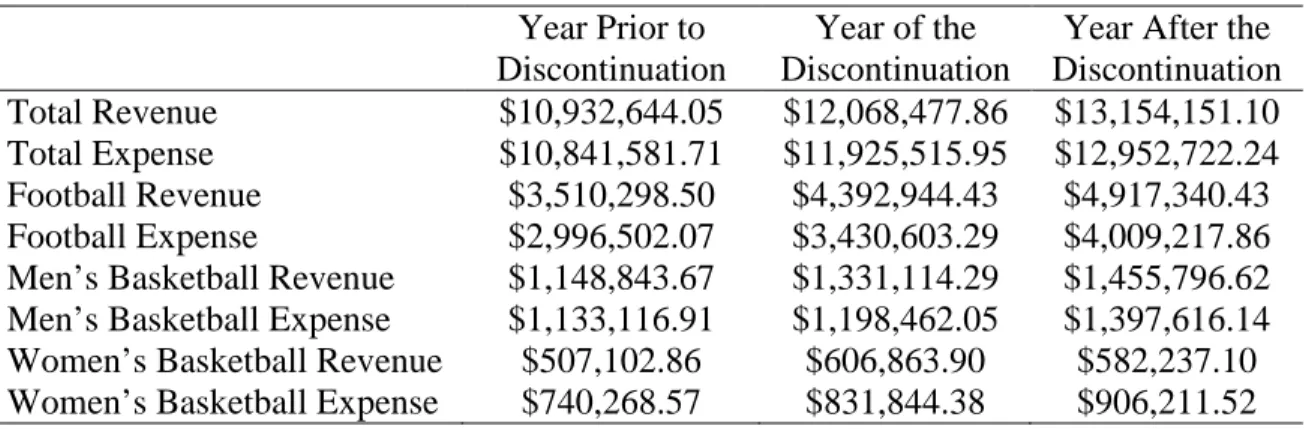
The mean total revenue of these institutions in the year prior to the discontinuation was $10,932,644.05. The mean total revenue in the year of the
30
$13,154,151.10. This is an increase of $1,085,673.24 (9.00%) over the previous year. The mean total expense for these institutions during the year prior to the discontinuation was $10,841,581.71. The mean total expense for the year of the discontinuation was $11,925,515.95. This is an increase of $1,083,934.24 (10.00%) over the previous year. The mean total expense for the year following the discontinuation was $12,952,722.24. This is an increase of $1,027,206.29 (8.61%) over the previous year.
Fourteen of the twenty-one institutions fielded football programs that were not discontinued. The mean football related revenue of these institutions in the year prior to the discontinuation was $3,510,298.50. The mean football related revenue in the year of the discontinuation was $4,392,944.43. This is an increase of $882,645.93 (25.14%) over the previous year. The mean football related revenue in the year following the
discontinuation was $4,917,340.43. This is an increase of $524,396.00 (11.94%) over the previous year. The mean football related expense for these institutions during the year prior to the discontinuation was $2,996,502.07. The mean football related expense for the year of the discontinuation was $3,430,603.29. This is an increase of $434,101.21 (14.49%) over the previous year. The mean football related expense for the year following the discontinuation was $4,009,217.86. This is an increase of $578,614.57 (16.87%) over the previous year.
31
revenue in the year following the discontinuation was $1,455,796.62. This is an increase of $124,682.33 (9.37%) over the previous year. The mean men’s basketball related expense for these institutions during the year prior to the discontinuation was $1,133,116.91. The mean men’s basketball related expense for the year of the
discontinuation was $1,198,462.05. This is an increase of $65,345.14 (5.77%) over the previous year. The mean men’s basketball related expense for the year following the discontinuation was $1,397,616.14. This is an increase of $199,154.10 (16.62%) over the previous year.
All of the twenty-one institutions fielded women’s basketball programs that were not discontinued. The mean women’s basketball related revenue of these institutions in the year prior to the discontinuation was $507,102.86. The mean women’s basketball related revenue in the year of the discontinuation was $606,863.90. This is an increase of $99,761.05 (19.67%) over the previous year. The mean women’s basketball related revenue in the year following the discontinuation was $582,237.10. This is a decrease of $24,626.81 (-4.06%) from the previous year. The mean women’s basketball related expense for these institutions during the year prior to the discontinuation was $740,268.57. The mean women’s basketball related expense for the year of the
32
Table 2: Mean Revenues and Expenses for Institutions Citing the Reallocation of Athletics Resources
Year Prior to Discontinuation
Year of the Discontinuation
Year After the Discontinuation Total Revenue $10,932,644.05 $12,068,477.86 $13,154,151.10 Total Expense $10,841,581.71 $11,925,515.95 $12,952,722.24 Football Revenue $3,510,298.50 $4,392,944.43 $4,917,340.43 Football Expense $2,996,502.07 $3,430,603.29 $4,009,217.86 Men’s Basketball Revenue $1,148,843.67 $1,331,114.29 $1,455,796.62 Men’s Basketball Expense $1,133,116.91 $1,198,462.05 $1,397,616.14 Women’s Basketball Revenue $507,102.86 $606,863.90 $582,237.10 Women’s Basketball Expense $740,268.57 $831,844.38 $906,211.52
Title IX Compliance.
Nine institutions identified Title IX compliance as a primary reason for the discontinuation of athletics teams. In the year prior to the discontinuation these institutions had a mean of 44.67% male students and a mean of 58.22% male student athletes. In the year of the discontinuation these institutions had a mean of 45.00% male students and a mean of 58.11% male student athletes. In the year following the
discontinuation these institutions had a mean of 45.11% male students and a mean of 54.00% male student athletes.
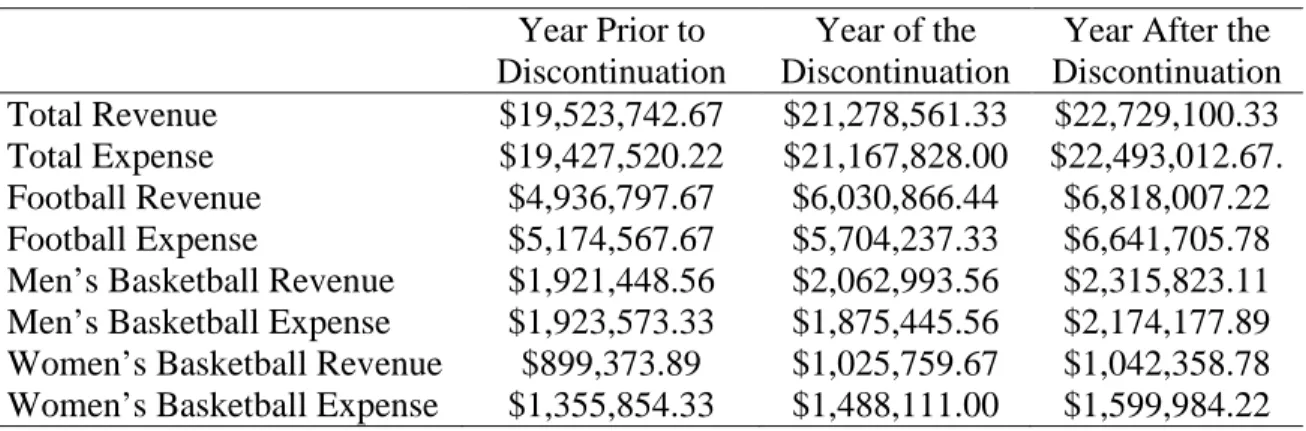
The mean total revenue of these institutions in the year prior to the discontinuation was $19,523,742.67. The mean total revenue in the year of the
33
was $19,427,520.22. The mean total expense for the year of the discontinuation was $21,167,828.00. This is an increase of $1,740,307.78 (8.96%) over the previous year. The mean total expense for the year following the discontinuation was $22,493,012.67. This is an increase of $1,325,184.67 (6.26%) over the previous year.
All of the nine institutions fielded football programs that were not discontinued. The mean football related revenue of these institutions in the year prior to the
discontinuation was $4,936,797.67. The mean football related revenue in the year of the discontinuation was $6,030,866.44. This is an increase of $1,094,068.78 (22.16%) over the previous year. The mean football related revenue in the year following the
discontinuation was $6,818,007.22. This is an increase of $787,140.78 (13.05%) over the previous year. The mean football related expense for these institutions during the year prior to the discontinuation was $5,174,567.67. The mean football related expense for the year of the discontinuation was $5,704,237.33. This is an increase of $529,669.67 (10.24%) over the previous year. The mean football related expense for the year following the discontinuation was $6,641,705.78. This is an increase of $937,468.44 (16.43%) over the previous year.
34
expense for these institutions during the year prior to the discontinuation was $1,923,573.33. The mean men’s basketball related expense for the year of the
discontinuation was $1,875,445.56. This is a decrease of $48,127.78 (-2.50%) from the previous year. The mean men’s basketball related expense for the year following the discontinuation was $2,174,177.89. This is an increase of $298,732.33 (15.93%) over the previous year.
All of the nine institutions fielded women’s basketball programs that were not discontinued. The mean women’s basketball related revenue of these institutions in the year prior to the discontinuation was $899,373.89. The mean women’s basketball related revenue in the year of the discontinuation was $1,025,759.67. This is an increase of $126,385.78 (14.05%) over the previous year. The mean women’s basketball related revenue in the year following the discontinuation was $1,042,358.78. This is an increase of $16,599.11 (1.62%) over the previous year. The mean women’s basketball related expense for these institutions during the year prior to the discontinuation was
$1,355,854.33. The mean women’s basketball related expense for the year of the
35
Table 3: Mean Revenues and Expenses for Institutions Citing Title IX Compliance Year Prior to
Discontinuation
Year of the Discontinuation
Year After the Discontinuation Total Revenue $19,523,742.67 $21,278,561.33 $22,729,100.33 Total Expense $19,427,520.22 $21,167,828.00 $22,493,012.67. Football Revenue $4,936,797.67 $6,030,866.44 $6,818,007.22 Football Expense $5,174,567.67 $5,704,237.33 $6,641,705.78 Men’s Basketball Revenue $1,921,448.56 $2,062,993.56 $2,315,823.11 Men’s Basketball Expense $1,923,573.33 $1,875,445.56 $2,174,177.89 Women’s Basketball Revenue $899,373.89 $1,025,759.67 $1,042,358.78 Women’s Basketball Expense $1,355,854.33 $1,488,111.00 $1,599,984.22
Research Question 3
Are the post-discontinuation financial resources being distributed based upon
equity, equality, or need? The forty-nine institutions for which news articles were
obtained were analyzed as a whole to determine their post-discontinuation financial decisions. The collected data included the total athletic revenues and expenses and the total revenues and expenses for football (when applicable), men’s basketball, and women’s basketball teams for the year prior to the discontinuation, the year of the discontinuation, and the year following the discontinuation.
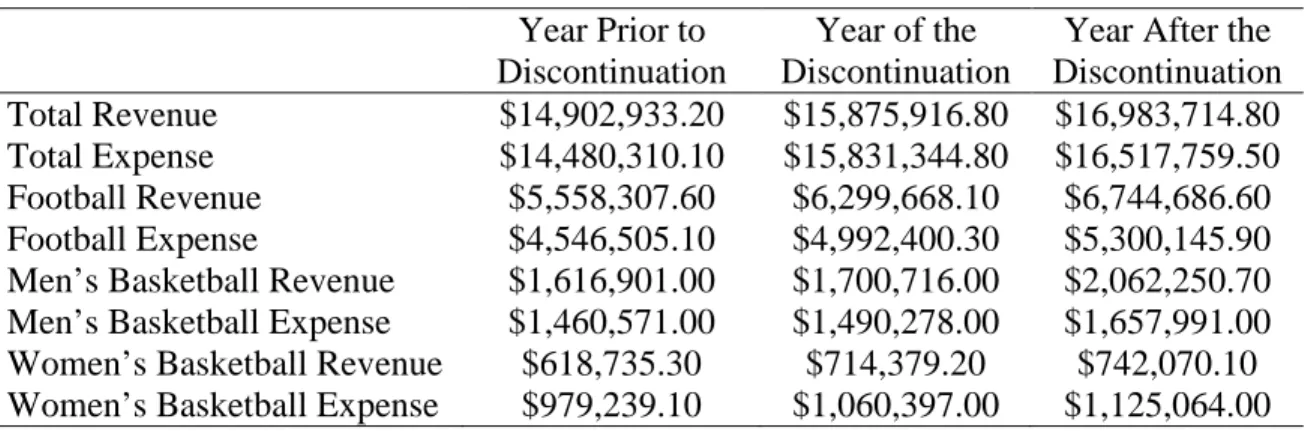
The mean total revenue of these institutions in the year prior to the discontinuation was $14,902,933.20. The mean total revenue in the year of the
36
The mean total expense for the year following the discontinuation was $16,517,759.50. This is an increase of $686,414.80 (4.34%) over the previous year.
Thirty-six of the forty-nine institutions fielded football programs that were not discontinued. The mean football related revenue of these institutions in the year prior to the discontinuation was $5,558,307.60. The mean football related revenue in the year of the discontinuation was $6,299,668.1. This is an increase of $741,360.50 (13.34%) over the previous year. The mean football related revenue in the year following the
discontinuation was $6,744,686.6. This is an increase of $445,018.50 (7.06%) over the previous year. The mean football related expense for these institutions during the year prior to the discontinuation was $4,546,505.10. The mean football related expense for the year of the discontinuation was $4,992,400.30. This is an increase of $445,895.10 (9.81%) over the previous year. The mean football related expense for the year following the discontinuation was $5,300,145.90. This is an increase of $307,745.60 (6.16%) over the previous year.
37
discontinuation was $1,490,278.00. This is an increase of $29,707.00 (2.03%) over the previous year. The mean men’s basketball related expense for the year following the discontinuation was $1,657,991.00. This is an increase of $167,712.00 (11.25%) over the previous year.
All of the forty-nine institutions fielded women’s basketball programs that were not discontinued. The mean women’s basketball related revenue of these institutions in the year prior to the discontinuation was $618,735.30. The mean women’s basketball related revenue in the year of the discontinuation was $714,379.20. This is an increase of $95,643.90 (15.46%) over the previous year. The mean women’s basketball related revenue in the year following the discontinuation was $742,070.10. This is an increase of $27,690.90 (3.88%) over the previous year. The mean women’s basketball related
expense for these institutions during the year prior to the discontinuation was $979,239.10. The mean women’s basketball related expense for the year of the
38
Table 4: Mean Revenues and Expenses for All Institutions Year Prior to
Discontinuation
Year of the Discontinuation
CHAPTER V Discussion
Summary
The American economy continues to struggle and college athletics programs are among the victims. Institutions typically plan for future expenses based on projections of revenues several years in advance. Most of these projections did not account for a
prolonged economic recession and consequently revenues are coming up short of projections (ESPN.com, 2010 & Fulks, 2010). As athletic departments struggle to find ways to make ends meet, many institutions are choosing to discontinue athletics teams as a solution.
Title IX of the Education Act of 1972 is also often referenced as a factor or reason that schools have cut sports. Many people believe that Title IX is causing a
disproportionate number of men’s teams to be cut (Watson, 2009). In 2003, the Office of Civil Rights called the practice of discontinuing men’s athletics teams to achieve Title IX compliance a disfavored practice (ED.gov, 2003), but it is still all too common.
40
identified as having discontinued at least one athletic program between the 2001-2002 and 2008-2009 academic years, for which news articles identifying reasons for the discontinuation could be found.
Primary Reasons for the Discontinuation of Athletic Teams
In a 2011 study, athletics administrators at institutions having eliminated at least three athletic programs were asked about the reasons for the discontinuation of the athletic programs. The four most influential reasons given by these administrators in order of their highest mean results were Athletic Department Budget Shortage,
Institutional Financial Constraints, Title IX/Gender Equity Implications, and Financial Strain of Individual Programs. The two most prevalent answers both involve the reduction of spending (Skolnick, 2011). The primary reasons reported for the
discontinuation of athletic teams in news articles are consistent with the reasons given by athletic administrators.
41
consistent with the athletic administrators citing the financial strain of individual programs found in the Skolnick (2011) study. Having been cited nine (18.4%) times, Title IX compliance was the third most prevalent factor cited in news reports and was cited much less often than efforts to reduce athletic spending and the reallocation of athletics resources.
The most interesting finding in regard to the primary reasons for the discontinuation of athletic teams was the difference in the prevalence of Title IX compliance in the news reports and in the responses from athletic administrators. Title IX compliance and gender equity implications was reported by athletic administrators at very similar rates as athletic department budget shortage, institutional financial
42
Stated Reasons vs. Actual Results
Twenty-two institutions identified efforts to reduce athletics spending as a primary reason for the discontinuation of athletics teams. In his report, Revenues and Expenses: NCAA Division I Intercollegiate Athletics Programs Report, Daniel Fulks of
Transylvania University examined the financial data for all NCAA Division I institutions during the 2004-2009 fiscal years. This report shows that athletics expenses are
increasing at a higher rate than revenue generated by athletics (Fulks, 2010). These twenty-two institutions reported an 8.76% increase in mean athletic revenues from the year prior to the discontinuation to the year of the discontinuation and a 7.76% increase from the year of the discontinuation to the year following the discontinuation. These institutions also reported an 8.55% increase in mean athletic expenses from the year prior to the discontinuation to the year of the discontinuation and a 2.99% increase from the year of the discontinuation to the year following the discontinuation.
While these institutions did not reduce the dollar amount of their athletic spending they were able to substantially reduce the percentage of growth of their expenses. This goes against the national fiscal trends found in Fulks report. Based on these results, institutions seeking to reduce athletics spending through the discontinuation of athletic teams are having moderate success in meeting their goal by slowing the growth of spending, although they are not actually reducing expenses by cutting a team.
43
expenses from the year of the discontinuation to the year following the discontinuation. This makes them the only one of the three groups to show an increase of less than 15%. These results are further evidence of a concerted effort to curb spending within the athletic department.
Twenty-one institutions identified the reallocation of athletics resources as a primary reason for the discontinuation of athletics teams. These institutions reported a 10.39% increase in mean athletic revenues from the year prior to the discontinuation to the year of the discontinuation and a 9.00% increase from the year of the discontinuation to the year following the discontinuation. These institutions also reported a 10.00% increase in mean athletic expenses from the year prior to the discontinuation to the year of the discontinuation and an 8.61% increase from the year of the discontinuation to the year following the discontinuation. This shows that these institutions are continuing to increase their athletic spending at rates close to their gains made in revenue.
These institutions reported increases in football expenses of 12.41%, in men’s basketball expenses of 5.77%, and in women’s basketball expenses of 12.37% from the year prior of the discontinuation to the year of the discontinuation. These institutions then saw increases in football expenses of 16.87%, in men’s basketball expenses of 16.62%, and in women’s basketball expenses of 8.94% from the year of the
44
and that a significant portion of the reallocated resources are going to the football and men’s basketball programs.
Nine institutions identified Title IX compliance as a primary reason for the discontinuation of athletics teams. Title IX became law on July 1, 1972 and forbids sex discrimination in any program or activity conducted by a federally funded educational institution. Because almost all American colleges and universities receive some federal funding they are required to comply with Title IX (Civil Rights Restoration Act, 1988). Although schools have three ways to prove they are in compliance with the effective accommodation requirement, this study focuses on the substantial proportionality test for Title IX compliance. The proportionality test has been described by the courts as a “safe harbor” for compliance (Cohen v. Brown University, 1992). This means that institutions can show mathematically that they are not discriminating between men and women. It is assumed that if the ratio of female student athletes closely mirrors that of the ratio of females in the student body that gender equality in participation opportunities is being met, even if there are significant numbers of women denied participation (Carpenter, 1997). In the year of the discontinuation these nine institutions had a mean of 45.00% male students and a mean of 58.11% male student athletes. In the year following the discontinuation these institutions had a mean of 45.11% male students and a mean of 54.00% male student athletes.
While institutions identifying Title IX compliance as a primary factor for the elimination of athletic programs have made progress in the area of substantial
45
were able to become within 2%. Based on these results, institutions seeking Title IX compliance through the discontinuation of athletic teams are consistently failing to meet their goal. It is also important to note that schools that chose to cut men’s teams but did not satisfy proportionality are also not likely to show Title IX compliance under the second prong for showing a history of program expansion of opportunities for the
underrepresented sex. Although cutting men’s teams helped to reduce the proportionality gap by an average of four percent, nothing about cutting men’s teams actually increases opportunities for women.
It is also of note that institutions identifying Title IX compliance as a primary factor for the discontinuation of athletic teams saw large increases in their football and men’s basketball related expenses. These institutions saw increases of 10.24% in football related expenses and 7.34% in men’s basketball related expenses from the year prior to the discontinuation to the year of the discontinuation. From the year of the
discontinuation to the year following the discontinuation the increases in football related expenses and men’s basketball related expenses were 16.87% and 16.62% respectively. These results closely resemble the results from institutions that identified the reallocation of athletics resources as a primary reason for the discontinuation of athletic teams.
Distributive Justice
46
account. This means that the group or team that produces the most, puts forth the most effort, and/or has the most ability will receive the largest portion of the available resources. The principle of equity is most often used in situations in which the primary goal of the organization is economic productivity. Many scholars believe that “big time” college athletics are a big business and follow a corporate economic model (Mahoney 2002).
The principle of equity is illustrated in the distribution of resources at the
institutions in this study. This is evident by the percentages of total revenues provided by and total expenses allocated to the football, men’s basketball, and women’s basketball programs at the institutions. Football programs accounted for 39.71% of total revenues and 32.09% of total expenses. Men’s basketball programs accounted for 12.14% of total revenues and 10.04% of total expenses. Women’s basketball programs accounted for 4.37% of total revenues and 6.81% of total expenses. This shows that the programs that are the most fiscally productive are rewarded with the most resources.
47
The principle of equality is not being used to distribute resources at the
institutions in this study. This is evident by the great difference in the resources allocated to the football, men’s basketball, and women’s basketball programs as well as the
relationship of the resources allocated to these programs compared to the total resources available. Football programs had mean expenses of $5,300,145.90 in the year following the discontinuation of athletic teams while men’s basketball programs had mean expenses of $2,062,250.70 and women’s basketball programs had mean expenses of
$1,125,064.00. These three sports combined for mean total expenses of $8,083,200.90. This is 48.94% of the mean total expenses for the athletic departments.
The third principle of distributive justice is the principle of need. The principle of need is that the only consideration is that one group or team has less of a given resource and, therefore, is entitled to more of that particular resource. The principle of need is similar to the principle of equality in that it is most commonly used in organizations characterized by cooperation and positive social relations. The difference between the two is that the principle of need is more commonly used when the primary goal of the organization is to foster personal growth and the survival of each group and group member is the most important concern. The principle of need recognizes that some groups or individuals may need more resources because they have different needs in order to grow or possibly will not survive without additional resources (Mahony 2002).
Although need is perhaps the principle most aligned with the mission of intercollegiate athletics in providing an extension of the educational goals of the
48
institutions in this study as the survival and growth of all teams cannot be a priority when teams are being discontinued.
Future Research
Future research should examine the fiscal consequences of the discontinuation of athletic teams by year and by sport. The huge increases of athletic budgets over the past decade create significant differences in the fiscal landscape, from year to year, within which the decision to discontinue athletic teams are being made. By examining the discontinuations by year, researchers would be able to account for these differences. Researchers would also be able to more closely examine the relationship between recent economic recession and the fiscal decisions of athletic departments. By examining the discontinuation of athletic teams by sport, researchers would be able to identify the fiscal impact of eliminating each sport. This would provide administrators with valuable information in the process of deciding which sport(s) to discontinue.
49
WORKS CITED
1975 Implementing Regulations34 C.F.R. Part 106.41 available at http://www2.ed.gov/policy/rights/reg/ocr/edlite-34cfr106.html
A Policy Interpretation: Title IX and Intercollegiate Athletics; Federal Register (1979) Vol. 44, No. 239
Associated Press. (2010). NCAA Report: Economy cuts into sports. Columbia, Missouri. Brady, E. (2009). Recession Forces Colleges to Find Ways to Cut Spending. USA Today.
Retrieved from http://www.usatoday.com/sports/college/2009-02-18-colleges-economy-cover_N.htm
Carpenter, L.J. (2007). Gender Equity: Opportunities to Participate. In D. Cotton & J. Wolohan, Law for Recreation and Sport Managers, (830-839). Dubuque: Kendall/Hunt Publishing Company.
Chalenor et al. v. University of North Dakota, 291 F. 3d 1042 (8th Cir. 2002) Civil Rights Restoration Act (1987). U.S. G.P.O Supt. of Docs. Washington D.C. Cohen v. Brown University, 991 F. 2d 888, 896 (1st Cir. 1993)
Equity in Athletics Disclosure Act (1994). 20 U.S.C. § 1092; 34 C.F.R. §§ 668.41 and 668.47;http://www2.ed.gov/finaid/prof/resources/athletics/eada.html
Favia v. Indiana University of Pennsylvania, 7.F. 3d 332, (3d Cir. 1993)
Feinstein, J. (2011). Randy Edsall Should be Stopped Before He Hurts Maryland Any Worse. The Washington Post. Retrieved from
http://www.washingtonpost.com/sports/colleges/randy-edsall-should-be-stopped-before-he-hurts-maryland-any-worse/2011/11/27/gIQAhnd61N_story.html Fulks, D. (2010). NCAA Revenues & Expenses 2004-2009: NCAA Division I
Intercollegiate Athletics Programs Report. Lexington, KY
Further Clarification of Intercollegiate Athletics Policy Guidance Regarding Title IX Compliance (July 11, 2003).
http://www2.ed.gov/about/offices/list/ocr/title9guidanceFinal.html
Gonyo v. Drake, 837 F. Supp. 989, 994 (S.D. Iowa 1993)
50
Hums, M. A. & Chelladurai, P. (1994). Distributive Justice in Intercollegiate Athletics: The views of NCAA Coaches and Administrators. Journal of Sport Management. s, 200-217.
Kelley v. Board of Trustees of University of Illinois, 832 F. Supp. 237, (C.D. Ill. 1993) Liberty to Reclassify Wrestling Program (2011). Retrieved from
http://www.libertyflames.com/index.cfm?PID=10869&NewsID=6907 Mahoney, D.F., Hums, M. A. & Reimer, H.A. (2002). Distributive Justice in
Intercollegiate Athletics: Perceptions of Athletic Directors and Athletic Board Chairs. Journal of Sport Management. 16, 331-356.
National Collegiate Athletic Association. (2011). Division I Manual 2011-2012.Indianapolis, IN.
Prisbell, E (2011). Maryland Accepts Recommendation, Will Cut Eight Varsity Sports Programs. The Washington Post. Retrieved from
http://www.washingtonpost.com/sports/maryland-accepts-recommendation-will-cut-eight-varsity-sports-programs/2011/11/21/gIQAyn1NjN_story.html
Roberts v. Colorado State University, 814 F. Supp.1507, (D. Colo. 1993)
Skolnick, J. (2011). Trimming Teams: An Examination of Decision Making Processes in Intercollegiate Athletic Departments when Multiple Varsity Sport Programs are Eliminated
Watson, G (2009). Programs in Precarious Position. ESPN. Retrieved from http://espn.go.com/espn/print?id=4313320&type=story
Witt, G (2011). UNCG’s Record Defends Wrestling Decision. News and Record. Retrieved from
http://www.news-record.com/content/2011/03/18/article/uncgaposs_record_defends_wrestling_deci sion
Wrestling, Gymnastics Programs Terminated (2011). Retrieved from