of Tay-Sachs Disease
Subha Karumuthil-Melethil,
1Sahana Nagabhushan Kalburgi,
1Patrick Thompson,
2Michael Tropak,
3Michael D. Kaytor,
4John G. Keimel,
4Brian L. Mark,
5Don Mahuran,
3,6Jagdeep S. Walia,
2and Steven J. Gray
1,7,*
1
Gene Therapy Center, University of North Carolina at Chapel Hill, Chapel Hill, North Carolina;2Medical Genetics/Departments of Pediatrics, Queen’s University, Kingston, Ontario, Canada;3
Genetics and Genome Biology, SickKids, Toronto, Ontario, Canada;4
New Hope Research Foundation, North Oaks, Minnesota;
5
Department of Microbiology, University of Manitoba, Winnipeg, Manitoba, Canada;6Department of Laboratory Medicine and Pathology, University of Toronto, Toronto, Ontario, Canada; and7
Department of Ophthalmology, University of North Carolina at Chapel Hill, Chapel Hill, North Carolina.
GM2gangliosidosis is a family of three genetic neurodegenerative disorders caused by the accumulation of GM2ganglioside (GM2) in neuronal tissue. Two of these are due to the deficiency of the heterodimeric (a–b), ‘‘A’’ isoenzyme of lysosomalb-hexosaminidase (HexA). Mutations in thea-subunit (encoded byHEXA) lead to Tay-Sachs disease (TSD), whereas mutations in the b-subunit (encoded by HEXB) lead to Sandhoff disease (SD). The third form results from a deficiency of the GM2activator protein (GM2AP), a substrate-specific cofactor for HexA. In their infantile, acute forms, these diseases rapidly progress with mental and psychomotor deterioration resulting in death by approximately 4 years of age. After gene transfer that overexpresses one of the deficient subunits, the amount of HexA heterodimer formed would empirically be limited by the availability of the other endogenous Hex subunit. The present study used a new variant of the human HexAa-subunit,l, incorporating critical sequences from theb-subunit that produce a stable homodimer (HexM) and promote functional interactions with the GM2AP– GM2complex. We report the design of a compact adeno-associated viral (AAV) genome using a synthetic promoter–intron combination to allow self-complementary (sc) packaging of theHEXM gene. Also, a previously published capsid mu-tant, AAV9.47, was used to deliver the gene to brain and spinal cord while having restricted biodis-tribution to the liver. The novel capsid and cassette design combination was characterizedin vivoin TSD mice for its ability to efficiently transduce cells in the central nervous system when delivered intrave-nously in both adult and neonatal mice. This study demonstrates that the modified HexM is capable of degrading long-standing GM2 storage in mice, and it further demonstrates the potential of this novel scAAV vector design to facilitate widespread distribution of theHEXMgene or potentially other similar-sized genes to the nervous system.
INTRODUCTION
TAY-SACHS DISEASE (TSD) is one of a group of
three lysosomal storage diseases called GM2 gang-liosidosis, caused by defective catabolism of GM2 ganglioside (GM2). It is an autosomal recessive neurodegenerative disease caused by mutations in the a-subunit of the heterodimeric enzyme b -hexosaminidase A (HexA). Sandhoff disease (SD) is caused by mutations in theb-subunit of HexA. Both subunits can also form functional homo-dimers, HexS (a–a) and HexB (b–b), which in
humans cannot significantly turn over GM2. HexS is unstable and physiologically less significant, whereas HexB is highly stable and can degrade some neutral glycolipids, oligosaccharides, and ar-tificial substrates. The enzyme HexA (a–b) requires a substrate-specific cofactor, called GM2 activator protein (GM2AP), to efficiently degrade GM2. Muta-tions to the gene encoding GM2AP lead to another rare variant of GM2 gangliosidosis, the AB-variant form. The characteristic histopathological feature of these diseases is the presence of swollen neurons
*Correspondence: Dr. Steven J. Gray, UNC Gene Therapy Center, 7119 Thurston Bowles Building, Campus Box 7352, Chapel Hill, NC 27599. E-mail: [email protected]
HUMAN GENE THERAPY, VOLUME 27 NUMBER 7 DOI: 10.1089/hum.2016.013
j
509and neuronal distortion throughout the nervous system caused by accumulated GM2. TSD and SD are clinically variable, with severe forms showing profound mental retardation and death within 2–3 years of birth.1 Heterogeneity of the disease re-garding severity of clinical signs and age of onset can be attributed to the level of residual HexA ac-tivity allowed by different mutations. It has been estimated that only between 10 and 15% of normal HexA activity is needed to prevent GM2 accumula-tion.2 At present, there are no effective treatment options available for these diseases.
To study the disease mechanisms and to test various therapeutic approaches, mouse models have been developed for both these diseases. The mouse model for TSD, developed by the targeted disruption of thehexagene encoding thea-subunit,3–5has no or a mild behavioral phenotype but displays many of the neuropathological features characteristic of TSD, in particular GM2 ganglioside accumulation. The absence of clinical signs in TSD mice is due to the presence of a lysosomal mouse sialidase capable of hydrolyzing GM2 to its neutral asialo derivative, GA2, which then interacts with HexB to be further degraded to glucosylceramide.5,6 This alternative metabolic pathway helps TSD mice to keep GM2 ac-cumulation below an acutely toxic level and thereby escape clinical symptoms. Thehexb–/–mouse model for Sandhoff disease exhibits a severe disease phe-notype as it is deficient in both HexA and HexB and has extensive GM2 accumulation throughout the brain and spinal cord with a humane end point of approximately 16 weeks of age.4,5
Several gene replacement therapies have been tested in the mouse models for these diseases. The heterodimeric nature of HexA, which is the only isoenzyme capable of degrading GM2, makes the treatment for TSD and SD more challenging. Ade-noviral gene therapy of TSD mice, using a vector encodingHEXAalone, when injected intravenously produced only a slight increase in HexA (or possibly HexS mistaken for HexA) activity in the serum, whereas simultaneous injection of vectors encoding bothHEXAandHEXB increased the serum HexA activity to 42% of wild-type levels in these mice.7SD mice injected intracranially with a recombinant adeno-associated viral (rAAV) vector expressing the
b-subunit, or a combination of vectors witha- and
b-subunits, showed reduction in GM2levels and in-creased survival.8However, the effect of the single-subunit vector in this study could be attributed to higher levels of HexB and the mouse sialidase driving the alternative metabolic pathway for hydrolyzing GM2. A single striatal injection of a mixture of vectors expressing theb-hexosaminidase
a- andb-subunits in SD mice prevented the neuronal loss in the brain.9Cachon-Gonzalez and colleagues reported that intracranial coinjection of rAAV vec-tors expressing thea- andb-subunits into 1-month-old SD mice prevented the disease pathology throughout the brain and spinal cord, which helped the mice survive up to 2 years.10In that study, an infusion of an rAAV vector encoding theb-subunit alone resulted in detectable expression of only the HexB isozyme. AAVrh8 vectors encoding feline a -andb-subunits were injected intracranially into SD cats at a 1:1 ratio, and this resulted in a significant reduction in cerebrospinal fluid (CSF) biomarkers of the disease. It ultimately resulted in extension of the life span for the treated cats.11Intracranial stereo-taxic infusion of a mixture of rAAV2/1aand rAAV2/ 1b into 4-week-old SD mice extended the median survival from 131 to 615 days.12
HEXgene in an scAAV vector. Small enhancerless promoters such as UbC, MeCP2, and GUSB could accommodate the size of theHEXgene, but would likely provide inadequate levels of expression. At present, no publication has described an scAAV vector design capable of packaging the approxima-tely 1.6-kbHEXAorHEXBgene to treat TSD or SD. An ideal vector capable of treating TSD and SD would express bothHEXAandHEXBgenes simul-taneously, but this would be beyond the packaging capacity of scAAV, which is needed to achieve effi-cient global CNS gene transfer. Therefore, there is a conceptual advantage to creating an engineered subunit that could be delivered, using a single scAAV vector, and that could form a stable and functional homodimer when delivered in vivo and degrade GM2in a GM2AP-dependent manner. The crystallo-graphic structures of human HexA and HexB have been elucidated in detail.24,25 Matsuoka and col-leagues attempted to design and develop a modified HexB reported to have GM2-degrading activity and GM2AP-binding ability, based on the amino acid ho-mology between the Hexa- andb-subunits.26They purified the modified HexB recombinant enzyme with the altered substrate specificity, that is, the ability to efficiently bind negatively charged sub-strates, and an a-loop sequence for enhancing its interaction with the GM2AP–GM2 complex. They administered the modified HexB by in-tracerebroventricular injection directly to the CNS of 10-week-old SD mice and observed a re-markable reduction in GM2storage in the thalamus, cerebral cortex, and also the liver. Their results indicated that the modified HexB enzyme can
func-tionin vivoif used in enzyme replacement therapy
(ERT). However, Sinici and colleagues27tested this construct and another more extensive hybrid b -subunit construct in cellulo, using Tay-Sachs cells preloaded with a fluorescent GM2 derivative, and found that neither modifiedb-subunit was capable of significant human GM2AP-dependent hydrolysis of GM2. Likely, the encouraging results reported by Matsuoka and colleagues are attributable to resto-ration of HexB-like activity that takes advantage of the alternative sialidase pathway in mice. As an alternative approach to develop a hybrid subunit, Tropak and colleagues28 designed a modified a -subunit incorporating both the unique b-subunit sequences required to form a stable, HexB-like, homodimer and those sequences needed for the homodimer to interact with the GM2AP–GM2 com-plex. The a-active site was retained in order to facilitate the hydrolysis of negatively charged sub-strates, for example, GM2. This modified subunit (l) was confirmed to form a stable dimeric enzyme,
HexM, which could bind to the GM2AP–GM2complex, and degrade GM2 in live human embryonic kidney (HEK) cells rendered HEXA–/– and HEXB–/– by CRISPR (clustered regularly interspaced short pal-indromic repeats) gene editing.In vivoexperiments in this study further demonstrated the ability of HexM to reduce accumulated GM2in Tay-Sachs and Sandhoff mice. Therefore, this homodimer has HexA-like activity and can be expressed from a single gene packageable within an scAAV vector. This construct is discussed further in the present study.
It is important to note that systemic delivery of AAV9 vectors results in substantially higher biodis-tribution to the liver compared with the CNS, which could lead to transgene-specific liver toxicity.15,29 Furthermore, some studies have reported incidence of liver tumors with intravenous delivery of AAV9 into neonates.14,30,31 A liver-detargeted version of AAV9 with comparable levels of brain and spinal cord transduction could be a safer reagent to treat neuro-logical disorders. Pulicherla and colleagues32 re-ported the generation of AAV9-derived vectors displaying selective loss of liver tropism. One AAV9 variant, denoted as AAV9.47 with four point muta-tions (S414N, G453D, K557E, and T582I), showed a significant 110-fold decrease in the liver transduction in mice injected via the tail vein and analyzed 4 weeks postinjection by vector DNA biodistribution and transgene (luciferase) expression. The transduction pattern in the brain did not show any significant drop, which suggests AAV9.47 as a good candidate for glo-bal gene delivery to the CNS via systemic injection.
In the present study, we discuss the functional ability of the new hexosaminidase variant HexM and the design of a novel expression cassette to package it into an scAAV vector forin vivo applica-tions. We show that the novel cassette has the ability to provide ubiquitous transduction throughout the CNS. We provide further characterization of the liver-detargeted AAV9.47 variant to demonstrate its ability to transduce neurons and glia throughout the CNS after intravenous injection into neonatal and adult mice. We demonstrate that the HexM homodimer is capable of degrading GM2in a local-ized manner when injected intracranially into adult TSD mice, and that the scAAV9.47/HEXM
vector can mediate long-term GM2reduction when injected intravenously into neonatal TSD mice.
MATERIALS AND METHODS
Plasmid constructs
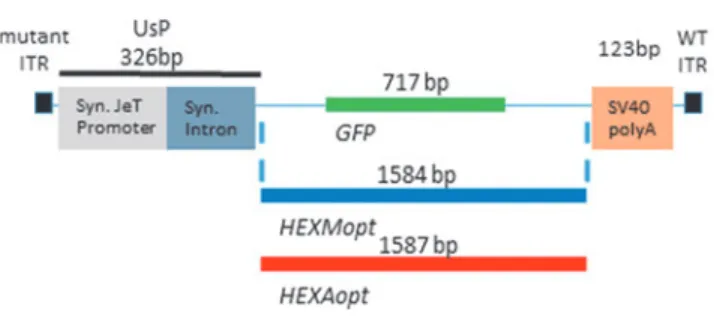
design includes the combination of a short synthetic and ubiquitous promoter derived from the JeT promoter33 and a synthetic intron (UsP, also re-ferred to as the JeTI promoter) along with the sim-ian virus 40 polyadenylation signal [SV40 poly(A)] to drive expression of the encoded gene (Fig. 1). A Kozak consensus sequence was incorporated at the start codon. Pilotin vitrostudies showed that the UsP expression cassette had approximately 15% of the activity when using a CMV promoter (Supple-mentary Fig. S1; supple(Supple-mentary methods and data are available online at www.liebertpub.com/hum). The nucleotide sequence of the synthetic JeT promoter and intron is provided in Supplementary Fig. S2.
The humanHEXAandHEXMgenes were codon-optimized by DNA2.0 (Menlo Park, CA). The con-struct expressing GFP from the CBh promoter22 with the bovine growth hormone (BGH) poly(A) was used as a reference standard for comparative gene expression for the newly designed constructs.
Vector preparation
Recombinant AAV vectors were generated as described,34using proprietary methods developed at the University of North Carolina Gene Therapy Center Vector Core facility (Chapel Hill, NC). The following AAV9 or AAV9.47 vectors were produced and used for this study: AAV9/CBh-GFP, AAV9.47/ CBh-GFP, AAV9/UsP-GFP, AAV9/UsP-HEXA, AAV9/ UsP-HEXM, AAV9.47/UsP-GFP, and
AAV9.47/UsP-HEXM. All of these were scAAV vectors. Peak frac-tions were dialyzed in phosphate-buffered saline (PBS) containing 5% D-sorbitol and 350 mM NaCl.
Viral titers were determined by qPCR as described.35
Mouse studies
All investigations were approved by the Uni-versity of North Carolina–Chapel Hill Institutional
Animal Care and Use Committee. The Tay-Sachs disease mouse model [strain B6;129S-hexa–/–]3and wild-type C57BL/6 mice were purchased from the Jackson Laboratory (Bar Harbor, ME) and bred at the University of North Carolina.
For intravenous delivery into wild-type adult fe-male C57BL/6 mice, 200ll of scAAV9/GFP(2·1011 VG) or AAV9.47/GFP(2·1011VG) was injected and expression/biodistribution was analyzed 3–4 weeks postinjection. Adult TSD knockout mice were in-jected via the tail vein with scAAV9.47/GFP(5·1011 VG) in a volume of 200ll when 4–5 months old and were analyzed 6 months postinjection.
Neonatal facial vein injections into TSD mice were performed on postnatal days 0–2 (P0–P2), us-ing scAAV9.47/UsP-GFP (5·1010 VG) or scAAV9. 47/UsP-HEXM(5·1010VG) in a volume of 20ll. The injections were carried out before the genotypes of the mice were determined and as such included both heterozygous and knockout mice. They were eutha-nized when 15 months old.
Intracranial injections were performed as de-scribed35 into 15-month-old TSD knockout mice, using the following stereotaxic coordinates, relative to bregma: rostral/caudal,+0.5 mm (toward rostral); left/right: left,+3 mm; up/down,-4 mm. These mice received a mixture of AAV9/GFP(1·109 VG) and either AAV9/HEXM (1·109 VG) or AAV9/HEXA
(1·109 VG) in a total volume of 1ll delivered over 10 min. Two mice were injected per vector mix-ture. They were analyzed 4 weeks postinjection. At sacrifice, the mice were transcardially perfused with PBS containing heparin at 1 U/ml (Abraxis, Schaumburg, IL) and samples were collected for downstream analysis.
Immunohistochemistry
After 48 hr of fixation in freshly made PBS con-taining 4% paraformaldehyde, the entire brain and portions of the cervical and lumbar spinal cords were sectioned at 40lm, using a Leica vibrating micro-tome. Every fifth section was processed for immu-nohistochemistry (IHC). Sections were treated with hydrogen peroxide to remove endogenous peroxi-dase activity before blocking. Samples were incu-bated for 1 hr at room temperature in blocking solution (10% goat serum, 0.1% Triton X-100, 1·PBS) and then incubated for 48–72 hr at 4C in primary antibody solution (3% goat serum, 0.1% Triton X-100, 1·PBS, and primary antibody). Pri-mary antibodies were as follows: rabbit anti-GFP (diluted 1:1000; #AB3080, Millipore, Bedford, MA) or the human anti-GM2ganglioside antibody (diluted 1:1000; KM966, gift from Kyowa Hakko Kirin, To-kyo, Japan). After incubating with the appropriate
secondary antibody for 1 hr at room temperature, color development was performed with a VECTAS-TAIN Elite ABC kit (#PK-6100; Vector Laboratories, Burlingame, CA) with 3,3¢-diaminobenzidine tetra-chloride (DAB) (#04008; Polysciences, Warrington, PA) substrate and nickel–cobalt intensification of the reaction product.
DAB-processed brain sections were digitized with a ScanScope slide scanner (Aperio Technologies, Vista, CA). Virtual slides were viewed with the ImageScope software package (version 10.0; Aperio Technologies).
For the data provided in Supplementary Fig. S3B, a region of interest was created in three representative images of an identical cortex area of the brain per vector treatment, and the number of astrocytes and neurons (identified by morphology) were manually counted. The results from two in-dependent counters were averaged. Data are ex-pressed as number of cells per millimeter squared.
Quantitative PCR analysis of vector genomes
Quantitative PCR (qPCR) was used for vector bio-distribution studies. Tissue DNA was purified and quantified as described.18Data are reported as the number of double-stranded GFP or HEXM DNA molecules per two double-stranded copies of the mu-rineLaminB2locus, or in other words, the number of vector DNA copies per diploid mouse genome.
Biochemical detection of GM2gangliosides
Gangliosides were extracted by a modification of a method described earlier.36 Briefly, previously frozen murine mid-brain sections were weighed and sonicated in 0.5 ml of methanol at amplitude 15–20% for 3·10 sec pulses with cooling on ice between pulses (Sonic Dismembrator model 500; Fisher Scientific, Waltham, MA). Samples were centrifuged for 15 min at 10,000 rpm at 4C, and 0.4 ml of supernatant was removed for enzyme ac-tivity studies; the remainder was suspended (in-cluding the pellet) up to a final volume of 1.5 ml of methanol added to 2.5 ml of chloroform. Acidic gan-gliosides were isolated using C18-E columns (Phe-nomenex, Torrance, CA) and eluted sequentially in 2 ml of methanol, and then in 2 ml of a 1:1 methanol– chloroform mixture. The eluate was then evaporated under a stream of nitrogen, and the residue was re-suspended in 1:1 methanol–chloroform and then applied to an HPTLC silica gel 60 plate (Merck, Darmstadt, Germany) by applying 10ll at a time and drying between applications. Plates were de-veloped with running buffer (chloroform–methanol– CaCl2, 0.22% [55:45:10]). After staining with orcinol (Sigma-Aldrich, St. Louis, MO) and baking at 105C
for 10 min, plates were immediately scanned for subsequent spot densitometric analysis (ImageJ software), with a mix of monosialoganglioside standards ( Matreya, Pleasant Gap, PA) alongside. The ganglioside ratios are presented as GM2:total gangliosides.
RESULTS
Liver-detargeted AAV9.47 capsid transduces neural cells after intravenous administration in adult mice
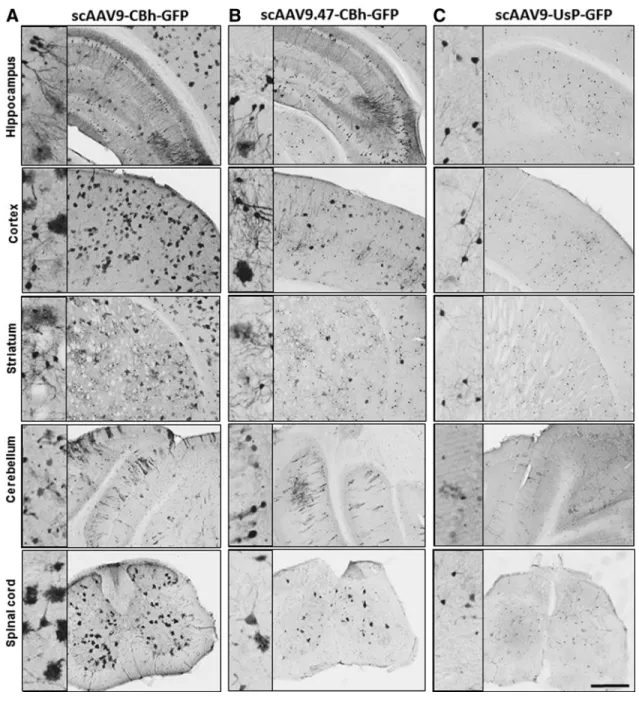
AAV9.47 capsid was engineered as described.32 It was categorized as a liver-detargeted version of the AAV9 capsid, with a significant 110-fold de-crease in liver transduction relative to the natu-rally occurring AAV9 capsid. The level of overall brain transduction was comparable to that of the original AAV9 capsid, making it a good candidate for targeted delivery to brain and other CNS organs via the intravenous route while avoiding the high biodistribution of AAV9 to the liver. The liver-detargeted characteristics of the AAV9.47 vector reported previously were confirmed in our study by a biodistribution study (Supplementary Fig. S3A). However, previous studies did not identify which cell types were transduced by AAV9.47 within the CNS. In our study, we observed that the capsid is able to transduce neural cells, predominantly neurons, when delivered intravenously into adult wild-type mice (Fig. 2B and Supplementary Fig. S4). GFP expression was visible throughout various re-gions of the brain and spinal cord. When compared with the transduction profile of AAV9 capsid pack-aged with the same transgene cassette containing GFP under the control of the CBh promoter and injected into wild-type mice (Fig. 2A), there was an approximately 4-fold reduction in the number of astrocytes transduced by the AAV9.47 capsid and an approximately 50% increase in the number of transduced neurons in the cortex (Supplementary Fig. S3B). Overall, AAV9.47 transduced approxi-mately 20% less cells than AAV9 in the cortex.
Synthetic UsP promoter–intron drives ubiquitous expression in the brain
Previously, our laboratory described the use of a modified b-actin promoter with a shortened MVM (minute virus of mice) intron to drive sus-tained high levels of transgene expression in both neurons and glia throughout the CNS.22 Combined with the BGH poly(A) signal, this scAAV construct can package a transgene of up to approximately 1.2 kb in length. TheHEXAand
provide efficient and ubiquitous expression within the contexts of an scAAV genome. The newly de-signed expression cassette (Fig. 1), using the syn-thetic UsP promoter–intron combination, paired with the SV40 poly(A) signal, is capable of wide-spread expression in the CNS (Fig. 2C and Sup-plementary Fig. S4) after intravenous delivery in wild-type mice. The intensity of GFP expression in astrocytes is noticeably decreased for the UsP-GFP construct, compared with the CBh-GFP construct, when both were packaged in the AAV9 capsid. However, the novel design has the advantage of
being capable of packaging a transgene up to ap-proximately 1.7 kb within an scAAV vector, which will accommodate theHEXAorHEXMtransgene.
AAV9.47 capsid is capable of widespread gene transfer to the brain after intravenous administration in both adult and neonatal Tay-Sachs mice
To assess the ability of the UsP construct to mediate long-term sustained expression in the Tay-Sachs mouse model, we packaged the newly designed UsP-GFP construct within the AAV9.47
Figure 2. CNS transduction pattern of AAV9/CBh-GFP, AAV9.47/CBh-GFP, and AAV9/UsP-GFPafter intravenous administration in type mice. Adult wild-type mice were injected intravenously with 2·1011vector genomes (VG) of scAAV9/CBh-GFP(A), scAAV9.47/CBh-GFP(B), or scAAV9/UsP-GFP(C)and then
capsid and injected it intravenously into adult TSD mice at 4–5 months of age and into neonatal mice, consisting of both TSD and their heterozy-gous littermates, at age P0–P2. These mice were euthanized 6 and 15 months postinjection, re-spectively, and were analyzed for the biodis-tribution of the AAV vector by qPCR and for CNS transduction by IHC against GFP. As previously reported, the vector was significantly detargeted from the liver compared with the biodistribution pattern of AAV9,18,32while retaining biodistribu-tion to the brain and spinal cord (Figs. 3A and 4A). IHC images of the brain clearly showed that the AAV9.47 capsid can deliver the gene to all regions of brain and facilitate expression in neurons and
glia within the CNS of hexa–/– andhexa+/– mice, and that this expression persisted for 15 months (Figs. 3B and 4B).
The hexosaminidase variant, HexM, can clear GM2storage similar to HexA after intracranial
administration into aged Tay-Sachs mice
To directly test the expression of the new hexos-aminidase gene variant, HEXM, to reduce long-standing accumulated GM2in the TSD mouse brain, compared with that of the unmodifiedHEXAgene, these were packaged into scAAV9 vectors and in-jected stereotaxically into 15-month-old TSD mice along with an identical titer of scAAV9/UsP-GFP
vector to track vector spread. Each experimental
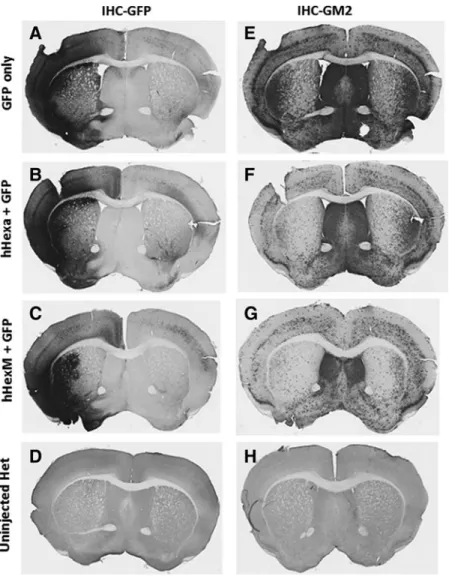
group consisted of two animals receiving the same vector combination. The mice were euthanized 4 weeks postinjection and the brain sections were subjected to IHC analysis against GFP and GM2 si-multaneously. Several paired images of similar brain regions were analyzed. The HexA-like activity was assessed by the clearance of GM2within the injected region, compared with the contralateral brain hemisphere (Fig. 5E–G). The area of AAV transduc-tion was visualized by staining for GFP (Fig. 5A–C). Qualitatively, a marked reduction of GM2 was ap-parent in the areas that overlapped with strong GFP expression. Both b-hexosaminidase vectors were able to degrade GM2in the regions that were injected, but complete clearance of accumulated GM2was not obtained by either vector. IHC analysis was done on
brain sections from age-matched untreated hetero-zygous mice (Fig. 5D and H) for comparison with the GM2 levels in an unaffected brain. From these ex-periments, we conclude that delivery of scAAV9/ UsP-HEXM results in clearance of long-standing GM2 accumulations, at least as well as that after delivery of scAAV9/UsP-HEXA.
Intravenous administration of AAV9.47/ HEXM vector into neonatal Tay-Sachs mice results in long-term CNS reduction
in GM2gangliosides
Injections of AAV9.47/UsP-HEXM (at a dose of 5·1010VG, through the facial vein) into neonatal TSD mice on P0–P2 were done; the mice included both knockout and heterozygous mice and were
euthanized when 15 months old. The pattern of vector genome biodistribution whenHEXMwas the transgene was variable between individual mice but overall similar to the biodistribution pattern when GFP was the transgene (Fig. 6A; compare with Fig. 4A). Biochemical analysis of both rostral and caudal parts of the brain from treated mice showed a reduction in the accumulation of GM2 gangliosides compared with that of control uninjected TSD mice (Fig. 6B). The caudal (hind) brain had a more marked quantitative reduction in GM2storage than the rostral brain (data not shown). This demon-strates the ability of the scAAV9.47/UsP-HEXM
vector to mediate sustained reduction in CNS GM2 gangliosides, the hallmark of TSD pathology.
DISCUSSION
This paper addresses several challenges in cre-ating an ideal gene replacement therapy for the related Tay-Sachs and Sandhoff diseases. Past studies have relied on single-stranded (ss)AAV, herpes simplex virus, or adenoviral vectors ad-ministered intracranially, to deliver a single Hex subunit with one vector or both subunits by a dual-vector approach.7–10,12,14,37–41 One challenge is that the functional HexA enzyme consists of the
a- andb-subunits, which from a gene transfer per-spective complicates a simple gene replacement strategy because overexpression of one subunit will inevitably lead to the other endogenous subunit becoming rate-limiting. The HEXM gene, which
Figure 5. HexM is capable of reducing long-standing GM2 in aged Tay-Sachs mice. Fifteen-month-old TS knockout mice received a single unilateral
intracranial injection of a two-vector mixture containing equal amounts of scAAV9/UsP-GFPand scAAV/UsP-HEXAor scAAV9/UsP-HEXM. They were killed 4 weeks postinjection and coronal sections of the brain were analyzed by IHC for GFP expression to indicate the spread of vector(A–D)and GM2accumulation
to assess the relativeb-hexosaminidase activity(E–H). Sections from the brain of an uninjected heterozygous mouse from the TS mouse colony were used as negative controls for both GFP expression and GM2accumulation. The left side of mice was injected in(A–C)and(E–G). The vector mixtures used are
encodes the modified Hex a-subunit variant, l, overcomes this challenge because the Hexl-subunit can form a stable homodimer, HexM, which func-tionally replaces the HexA heterodimer.28 Over-expression of HexM has been shown to result in its enhanced secretion, and secreted HexM is taken up by other deficient cells through plasma membrane mannose 6-phosphate receptors. In addition, unlike HexA, both active sites in the HexM homodimer can potentially bind the GM2AP–GM2 complex and hy-drolyze GM2. Thus, overexpression of HexM should exert a greater therapeutic benefit through cross-correction than would be possible through over-expression of either thea- orb-subunit alone, which would result predominantly in the secretion of ei-ther HexS or HexB, respectively. Furei-thermore, the
HEXMgene can be packaged within a single scAAV vector, eliminating the need for a relatively ineffi-cient dual-vector approach.
The HEXA and HEXB genes are each approxi-mately 1.6 kb in length. Packaging them both within a single AAV vector is theoretically possible using traditional ssAAV vectors, but impossible within an scAAV vector. Strategies to achieve widespread CNS gene transfer in rodents, pigs, cats, dogs, and non-human primates have been described using AAV9, AAVrh10, and AAVrh8 vectors administered either intravenously or into the CSF, but these strategies rely on the more efficient scAAV.16–19,21,34,42–49The 1.6-kb size of theHEXMgene could potentially allow the HEXM gene to be packaged within an scAAV vector, making such a vector more amenable to these approaches for widespread CNS gene transfer. The selection of small promoters and poly(A) signals to package a 1.6-kb gene within the approximately 2.2-kb packaging constraints of scAAV is quite lim-ited, so we employed a novel synthetic promoter– intron combination (UsP) based on the previously
Figure 6. Intravenous administration of AAV9.47/UsP-HEXMin neonatal Tay-Sachs mice results in long-term reduction in GM2ganglioside levels. Tay-Sachs
mice, both knockout and heterozygous, were injected via the facial vein on P0–P2 with 5·1010 VG of scAAV9.47/UsP-HEXM and analyzed 15 months
postinjection.(A)Vector biodistribution of scAAV9.47/UsP-HEXMin major organs from two KO and three heterozygous TSD mice.(B)The mean GM2-to-total
described synthetic JeT promoter,33 to provide a moderate level of expression when combined with the SV40 poly(A) signal. When driving GFP, the UsP construct displays similar ubiquitous expression throughout the CNS compared with the previously described CBh promoter,22although expression in astrocytes appears diminished somewhat. We con-clude that the UsP promoter–intron, combined with the SV40 poly(A) signal, provides an ideal expres-sion construct forHEXMwithin an scAAV vector.
A potential challenge related to intravenous ad-ministration of AAV vectors (AAV9, AAVrh10, or AAVrh8) targeting the CNS is that the high vector doses required also result in extraordinarily high loads of gene transfer to the liver. This creates the potential for deleterious liver-specific T cell re-sponses,50,51 possible toxicity related to transgene overexpression, and hepatocellular carcinoma when administered to neonates.30,31By using the AAV9.47 capsid, biodistribution to the liver was highly re-duced relative to AAV9, while preserving the ability of AAV9 to cross the blood–brain barrier. An ap-parent reduction in astrocyte transduction with AAV9.47 was noted relative to AAV9, which may necessitate a slightly higher overall dose. However, in diseases that benefit from cross-correction, pri-mary expression in neurons should be sufficient. Regarding the potential for hepatocellular carci-noma, our use of an enhancer-less expression con-struct would be expected to reduce the potential for oncogenesis. Whether as a result of the reduced liver biodistribution or the lack of an enhancer, our co-horts injected intravenously as neonates did not develop tumors up to their planned end point of 15 months old. Although this observation should be examined more carefully, it is encouraging. The time course of infantile TSD and SD in humans is rapid, and the earliest possible age of intervention would be ideal. Although it is unclear whether the risk of he-patocellular carcinoma with AAV vector observed in mice could translate to humans, our vector design potentially reduces that hypothetical risk.
The efficacy of gene therapy in mouse and cat models of GM2gangliosidosis is susceptible to misin-terpretation because of the sialidase metabolic by-pass pathway, which could significantly reduce GM2 storage levels with any increase in hexosaminidase activity (i.e., HexA, HexB, HexS, or HexM). This by-pass pathway does not exist in humans. The studies reported here were conducted in the TSD model, which is not ideal to evaluate treatment efficacy be-cause of the mild phenotype of the mice. This paper provides information on the development of the re-agents, along with evidence supporting the hypothe-sis that this has a likelihood of providing a therapeutic
benefit. A companion article by Osmon and col-leagues,52in this issue ofHuman Gene Therapy(see p. 497), describes the application of this approach and vector design with a mouse model of SD, which does display a severe disease phenotype, and is more ap-propriate for evaluating treatment efficacy.
Several technological advances were combined to generate a reagent to treat Tay-Sachs and Sandhoff diseases. This single scAAV vector design enables delivery approaches for widespread CNS gene transfer. Key to making use of scAAV are the novel hexosaminidase variant, HEXM, and the short synthetic promoter–intron UsP. Finally, by using an enhancerless expression construct and a liver-detargeted capsid, we suggest that the possible risk of hepatocellular carcinoma with this vector design would be greatly diminished. In conclusion, the col-lective body of work presented herein describes a novel vector design that greatly enhances the po-tential success of a gene transfer strategy to treat both Tay-Sachs and Sandhoff diseases. This vector design may also be useful to deliver other genes of similar size to treat CNS disorders.
ACKNOWLEDGMENTS
This research was funded by the New Hope Re-search Foundation (http://newhoperesearch.org; S.G., J.W., D.M., S.K.M, S.N.K., and P.T.) and do-nations from the Uger Estate (M.T. and D.M.). In-direct administrative support for S.G. was provided by Research to Prevent Blindness to the UNC De-partment of Ophthalmology. B.M. is supported by a Manitoba Research Chair (Research Manitoba). The authors thank the Animal Study Core at UNC Cha-pel Hill for help in delivering the intracranial injec-tions into TSD mice. The authors acknowledge Cliff Heindel and Violeta Zaric for technical assistance in immunohistochemistry and biodistribution studies. The authors thank Bentley Midkiff in the UNC Translational Pathology Laboratory (TPL) for expert technical assistance. The UNC Translational Pa-thology Laboratory is supported, in part, by grants from the National Cancer Institute (3P30CA016086) and the UNC University Cancer Research Fund (UCRF). The authors thank Kyowa Hakko Kirin Company for providing the KM966 antibody.
AUTHOR DISCLOSURE
REFERENCES
1. Sandhoff K, and Christomanou H. Biochemistry and genetics of gangliosidoses. Hum Genet 1979; 50:107–143.
2. Leinekugel P, Michel S, Conzelmann E, et al. Quantitative correlation between the residual activity ofb-hexosaminidase A and arylsulfatase A and the severity of the resulting lysosomal storage disease. Hum Genet 1992;88:513–523.
3. Yamanaka S, Johnson MD, Grinberg A, et al. Targeted disruption of theHexagene results in mice with biochemical and pathologic features of Tay-Sachs disease. Proc Natl Acad Sci U S A 1994;91:9975–9979.
4. Sango K, Yamanaka S, Hoffmann A, et al. Mouse models of Tay-Sachs and Sandhoff diseases differ in neurologic phenotype and ganglioside metab-olism. Nat Genet 1996;11:170–176.
5. Phaneuf D, Wakamatsu N, Huang JQ, et al. Dramatically different phenotypes in mouse models of human Tay-Sachs and Sandhoff dis-eases. Hum Mol Genet 1996;5:1–14.
6. Yuziuk JA, Bertoni C, Beccari T, et al. Specificity of mouse GM2 activator protein and b-N
-acetylhexosaminidases A and B: similarities and differences with their human counterparts in the catabolism of GM2. J Biol Chem 1998;273:66–72.
7. Guidotti JE, Mignon A, Hasse G, et al. Adenoviral gene therapy of the Tay-Sachs disease in hex-osaminidase A-deficient knock-out mice. Hum Mol Genet 1999;8:831–838.
8. Cachon-Gonzalez MB, Wang SZ, Lynch A, et al. Effective gene therapy in an authentic model of Tay-Sachs-related diseases. Proc Natl Acad Sci U S A 2006;103:10373–10378.
9. Sargeant TJ, Wang S, Bradley J, et al. Adeno-associated virus-mediated expression of b -hexosaminidase prevents neuronal loss in the Sandhoff mouse brain. Hum Mol Genet 2011;20: 4371–4380.
10. Cachon-Gonzalez MB, Wang SZ, McNair R, et al. Gene transfer corrects acute GM2gangliosidosis—
potential therapeutic contribution of perivascular enzyme flow. Mol Ther 2012;20:1489–1500.
11. Bradbury AM, Gray-Edwards HL, Shirley JL, et al. Biomarkers for disease progression and AAV therapeutic efficacy in feline Sandhoff disease. Exp Neurol 2015;263:102–112.
12. Cachon-Gonzalez MB, Wang SZ, Ziegler R, et al. Reversibility of neuropathology in Tay-Sachs-related diseases. Hum Mol Genet 2014;23:730–748.
13. Weismann CM, Ferreira J, Keeler AM, et al. Systemic AAV9 gene transfer in adult GM1
gangliosidosis mice reduces lysosomal storage in CNS and extends lifespan. Hum Mol Genet 2015; 24:4353–4364.
14. Walia JS, Altaleb N, Bello A, et al. Long-term correction of Sandhoff disease following intrave-nous delivery of rAAV9 to mouse neonates. Mol Ther 2015;23:414–422.
15. Gadalla KK, Bailey ME, Spike RC, et al. Improved survival and reduced phenotypic severity follow-ing AAV9/MECP2gene transfer to neonatal and juvenile male Mecp2knockout mice. Mol Ther 2013;21:18–30.
16. Fu H, Dirosario J, Killedar S, et al. Correction of neurological disease of mucopolysaccharidosis IIIB in adult mice by rAAV9 trans-blood–brain barrier gene delivery. Mol Ther 2011;19:1025– 1033.
17. Ruzo A, Marco S, Garcia M, et al. Correction of pathological accumulation of glycosaminoglycans in central nervous system and peripheral tissues of MPSIIIA mice through systemic AAV9 gene transfer. Hum Gene Ther 2012;23:1237–1246.
18. Gray SJ, Matagne V, Bachaboina L, et al. Pre-clinical differences of intravascular AAV9 delivery to neurons and glia: a comparative study of adult mice and nonhuman primates. Mol Ther 2011; 19:1058–1069.
19. Duque S, Joussemet B, Riviere C, et al. In-travenous administration of self-complementary AAV9 enables transgene delivery to adult motor neurons. Mol Ther 2009;17:1187–1196.
20. Mattar CN, Waddington SN, Biswas A, et al. Systemic delivery of scAAV9 in fetal macaques facilitates neuronal transduction of the central and peripheral nervous systems. Gene Ther 2013;20:69–83.
21. Foust KD, Nurre E, Montgomery CL, et al. In-travascular AAV9 preferentially targets neonatal neurons and adult astrocytes. Nat Biotechnol 2009;27:59–65.
22. Gray SJ, Foti SB, Schwartz JW, et al. Optimizing promoters for recombinant adeno-associated virus-mediated gene expression in the peripheral and central nervous system using self-complementary vectors. Hum Gene Ther 2011;22:1143–1153.
23. Powell SK, Rivera-Soto R, and Gray SJ. Viral ex-pression cassette elements to enhance transgene target specificity and expression in gene therapy. Discov Med 2015;19:49–57.
24. Mark BL, Mahuran DJ, Cherney MM, et al. Crystal structure of humanb-hexosaminidase B: under-standing the molecular basis of Sandhoff and Tay-Sachs disease. J Mol Biol 2003;327:1093–1109.
25. Lemieux MJ, Mark BL, Cherney MM, et al. Crys-tallographic structure of humanb-hexosaminidase A: interpretation of Tay-Sachs mutations and loss of GM2ganglioside hydrolysis. J Mol Biol 2006;
359:913–929.
26. Matsuoka K, Tamura T, Tsuji D, et al. Therapeutic potential of intracerebroventricular replacement of modified humanb-hexosaminidase B for GM2
gangliosidosis. Mol Ther 2011;19:1017–1024.
27. Sinici I, Yonekawa S, Tkachyova I, et al.In cellulo examination of a b–a hybrid construct of b -hexosaminidase A subunits, reported to interact with the GM2activator protein and hydrolyze GM2
ganglioside. PLoS One 2013;8:e57908.
28. Tropak MB, Yonekawa S, Karumuthil-Melethil S, et al. Construction of a hybridb-hexosaminidase subunit capable of forming stable homodimers that hydrolyze GM2gangliosidein vivo. Mol Ther
Methods Clin Dev 2016;3:15057.
29. Zincarelli C, Soltys S, Rengo G, et al. Analysis of AAV serotypes 1–9 mediated gene expression and tropism in mice after systemic injection. Mol Ther 2008;16:1073–1080.
30. Donsante A, Miller DG, Li Y, et al. AAV vector integration sites in mouse hepatocellular carci-noma. Science 2007;317:477.
31. Chandler RJ, LaFave MC, Varshney GK, et al. Vector design influences hepatic genotoxicity af-ter adeno-associated virus gene therapy. J Clin Invest 2015;125:870–880.
32. Pulicherla N, Shen S, Yadav S, et al. Engineering liver-detargeted AAV9 vectors for cardiac and musculoskeletal gene transfer. Mol Ther 2011;19: 1070–1078.
33. Tornøe J, Kusk P, Johansen TE, et al. Generation of a synthetic mammalian promoter library by modification of sequences spacing transcription factor binding sites. Gene 2002;297:21–32.
34. Gray SJ, Nagabhushan Kalburgi S, McCown TJ, et al. Global CNS gene delivery and evasion of anti-AAV-neutralizing antibodies by intrathecal AAV administration in non-human primates. Gene Ther 2013;20:450–459.
35. Gray SJ, Choi VW, Asokan A, et al. Production of recombinant adeno-associated viral vectors and use in in vitroandin vivo administration. Curr Protoc Neurosci 2011;Chapter 4:Unit 4.17.
36. Seyrantepe V, Lema P, Caqueret A, et al. Mice doubly-deficient in lysosomal hexosaminidase A and neuraminidase 4 show epileptic crises and rapid neuronal loss. PLoS Genet 2010;6:e1001118.
37. Martino S, Marconi P, Tancini B, et al. A direct gene transfer strategy via brain internal capsule reverses the biochemical defect in Tay-Sachs disease. Hum Mol Genet 2005;14:2113–2123.
38. Gray-Edwards HL, Brunson BL, Holland M, et al. Mucopolysaccharidosis-like phenotype in feline Sandhoff disease and partial correction after AAV gene therapy. Mol Genet Metab 2015;116:80–87.
39. Rockwell HE, McCurdy VJ, Eaton SC, et al. AAV-mediated gene delivery in a feline model of Sandhoff disease corrects lysosomal storage in the central nervous system. ASN Neuro 2015;7(2).
40. McCurdy VJ, Rockwell HE, Arthur JR, et al. Widespread correction of central nervous system disease after intracranial gene therapy in a feline model of Sandhoff disease. Gene Ther 2015;22: 181–189.
42. Duque SI, Arnold WD, Odermatt P, et al. A large animal model of spinal muscular atrophy and correction of phenotype. Ann Neurol 2015;77: 399–414.
43. Federici T, Taub JS, Baum GR, et al. Robust spinal motor neuron transduction following intrathecal delivery of AAV9 in pigs. Gene Ther 2011;19:852– 859.
44. Meyer K, Ferrsiuolo L, Schmelzer L, et al. Im-proving single injection CSF delivery of AAV9-mediated gene therapy for SMA: a dose–re-sponse study in mice and nonhuman primates. Mol Ther 2015;23:477–487.
45. Passini MA, Bu J, Richards AM, et al. Translational fidelity of intrathecal delivery of self-complementary AAV9-survival motor neuron 1 for spinal muscular atrophy. Hum Gene Ther 2014;25:619–630.
46. Samaranch L, Salegio EA, San Sebastian W, et al. Strong cortical and spinal cord transduction after AAV7 and AAV9 delivery into the cerebrospinal fluid of nonhuman primates. Hum Gene Ther 2013;24:526–532.
47. Samaranch L, Salegio EA, San Sebastian W, et al. Adeno-associated virus serotype 9 transduction in the central nervous system of nonhuman prima-tes. Hum Gene Ther 2012;23:382–389.
48. Haurigot V, Marco S, Ribera A, et al. Whole body correction of mucopolysaccharidosis IIIA by in-tracerebrospinal fluid gene therapy. J Clin Invest 2013;123:3254–3271.
49. Bucher T, Colle MA, Wakeling E, et al. scAAV9 intracisternal delivery results in efficient gene transfer to the central nervous system of a feline model of motor neuron disease. Hum Gene Ther 2013;24:670–682.
50. Nathwani AC, Tuddenham EG, Rangarajan S, et al. Adenovirus-associated virus vector-mediated gene transfer in hemophilia B. N Engl J Med 2011; 365:2357–2365.
51. Mingozzi F, and High KA. Immune responses to AAV in clinical trials. Curr Gene Ther 2007;7:316– 324.
52. Osmon KJ, Woodley E, Thompson P, et al. Sys-temic gene transfer of a hexosaminidase variant using a scAAV9.47 vector corrects GM2
gang-liosidosis in Sandhoff mice. Hum Gene Ther 2016; 27:497–508.
Received for publication January 27, 2016; accepted after revision May 14, 2016.