FROM MEDIA ADVOCACY TO HEALTH BEHAVIORS:
EXAMINING THE RELATIONSHIPS BETWEEN MASS MEDIA MESSAGES, PUBLIC OPINION, AND POINT-OF-SALE TOBACCO CONTROL POLICY IMPLEMENTATION IN
THE UNITED STATES
Allison Elizabeth Myers
A dissertation submitted to the faculty at the University of North Carolina at Chapel Hill in partial fulfillment of the requirements for the degree of Doctor of Philosophy in the
Department of Health Behavior in the Gillings School of Global Public Health.
Chapel Hill 2016
© 2016
ABSTRACT
Allison Elizabeth Myers: From Media Advocacy To Health Behaviors:
Examining The Relationships Between Mass Media Messages, Public Opinion, And Point-Of-Sale Tobacco Control Policy Implementation In The United States
(Under the direction of Leslie A. Lytle)
Policy interventions affecting the point of sale (POS) are an emerging focus within comprehensive tobacco control programming. Whereas mass media may play an important role in advancing policy implementation, these relationships have rarely been studied. The current studies examine the relationships between POS news media content, policy
progression, and public support.
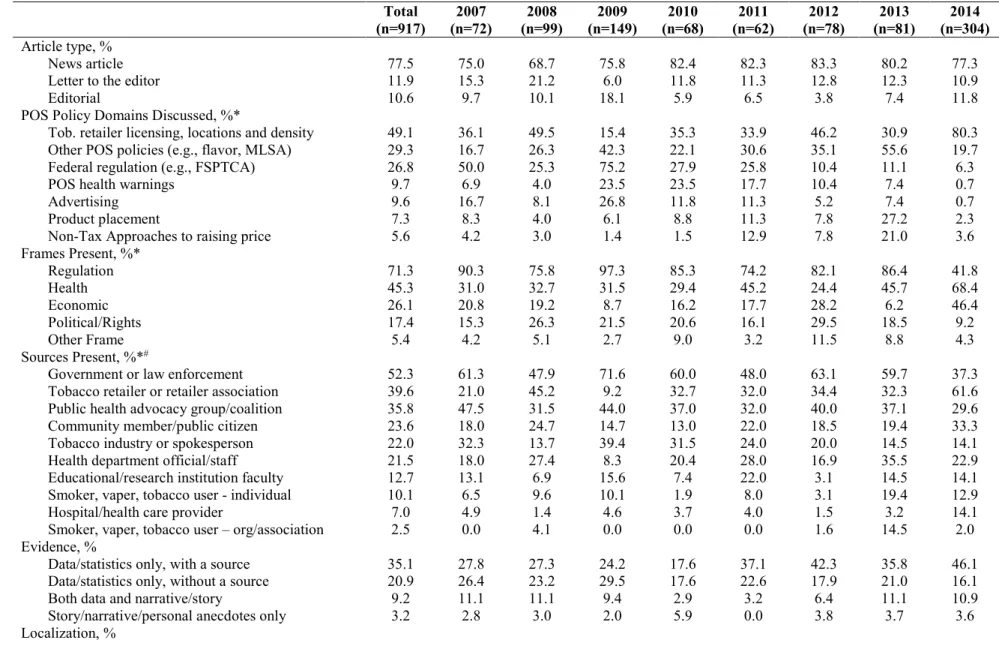
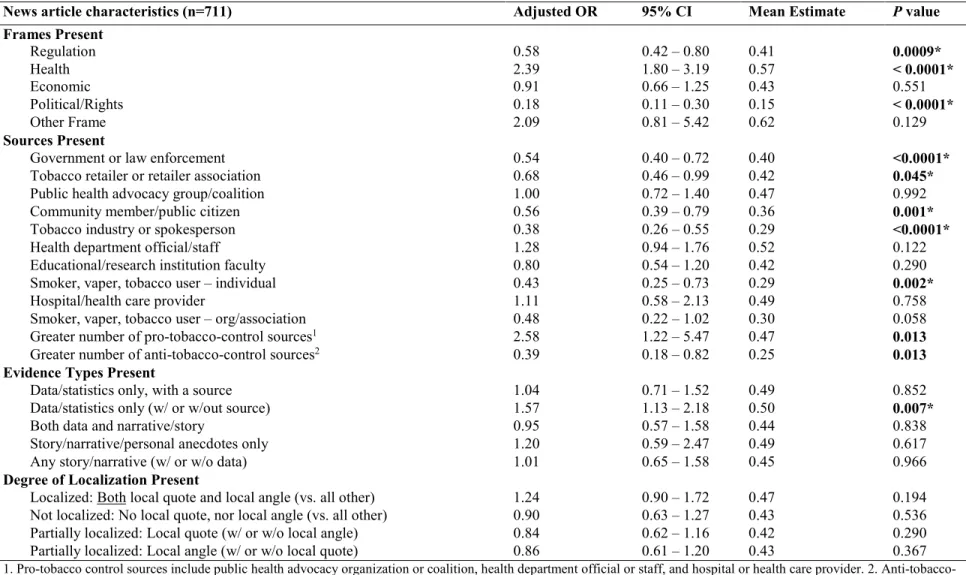
In Manuscript One, we analyzed 917 POS-news articles, published between 01/01/2007 and 12/31/2014, and retrieved from a sample of 273 newspapers. The most common frame present was regulation (71.3%). Government officials (52.3%) and tobacco retailers (39.6%) were the most frequent sources. Articles presenting a health frame, a greater number of pro-tobacco control sources, and statistical evidence were significantly more likely to also have a pro-tobacco control slant.
POS Index. Significant relationships between news content and policy progression did not hold in a multivariate regression model.
In Manuscript Three, we investigated the relationship between news exposure and public support. We randomized an Internet-based convenience sample of 702 voting US adults to one of eight mock POS-related news articles, written to vary on (1) frame and (2) localization, and then measured their level of support for 22 POS policies. The mean POS support score was 12.88 (SD 6.67; Range 0 to 22). No significant main effects of frame or localization were apparent. Rather, we found significant differences in POS support by gender, age, tobacco use status, political affiliation and trust in government.
ACKNOWLEDGMENTS
I’m grateful for the pathways and intersections that brought me to pursue this degree – for the light, and the dark, and the gray. I had the courage to leap, to say yes, and I’m proud of that.
Many people have contributed to this effort.
Eric, you’ve held me up in the moments when my shoulders felt much too narrow to carry this work forward.
Leslie, you see so clearly as a researcher, teacher and friend. Thank you for every edit, every ounce of coaching, and every step of the process.
Kurt, Mike, Brian and Sarah, you are a dream team of ideas, solutions, and mindful guidance.
Counter Tools team, thank you for being my village.
Sister-friends, thank you for wading with me through the joy and muck of life. Myers family, thank you for teaching me to do hard work that matters.
TABLE OF CONTENTS
LIST OF TABLES ... xi
LIST OF FIGURES ... xii
LIST OF ABBREVIATIONS ... xiii
CHAPTER 1 INTRODUCTION, BACKGROUND AND SIGNIFICANCE ... 1
1.1 Introduction ... 1
1.2 Study One Background ... 2
1.3 Study Two Background ... 3
1.4 Study Three Background ... 4
1.5 Significance ... 6
CHAPTER 2 LITERATURE REVIEW ... 8
2.1 The Emergence of Point-of-Sale Policy Solutions for Tobacco Control and Prevention ... 8
2.2 The Policy Change Process: Kingdon’s Multiple Streams Framework and Media Advocacy ... 15
2.3 The Agenda-Setting Function of the Mass Media ... 17
2.4 Measuring the Media Agenda: Content Analysis of Newspaper Coverage of Tobacco Control ... 21
2.5 Analyses of Tobacco-Related Newspaper Content ... 22
2.5.1 Newspaper and Time Sampling ... 23
2.5.2 Study Aims and Designs ... 23
2.5.3 Article Sampling Frame ... 26
2.6 Summary and Gaps in the Tobacco News Content Analysis
Literature ... 31
CHAPTER 3 THEORETICAL/CONCEPTUAL FOUNDATIONS ... 34
3.1 Theoretical and Conceptual Model for the Dissertation ... 34
3.2 Research Aims and Hypotheses... 36
3.2.1 Study One... 36
3.2.2 Study Two ... 42
3.2.3 Study Three ... 49
CHAPTER 4 MANUSCRIPT 1 SETTING THE AGENDA FOR A HEALTHY RETAIL ENVIRONMENT: CONTENT ANALYSIS OF US NEWSPAPER COVERAGE OF TOBACCO CONTROL POLICIES AFFECTING THE POINT OF SALE, 2007-2014 ... 54
4.1 Introduction ... 54
4.2 Methods ... 58
4.2.1 Newspaper Sampling Frame ... 58
4.2.2 Article Search Terms ... 58
4.2.3 Data Collection and Coding Procedures ... 59
4.2.4 Article Inclusion Criteria ... 59
4.2.5 Article Content Measures ... 59
4.2.6 Data Analysis ... 62
4.3 Results... 62
4.3.1 Newspaper Sampling Frame ... 62
4.3.2 Sampled Articles ... 62
4.3.3 Description of POS Content... 63
4.3.4 Relationships between Content Characteristics ... 67
CHAPTER 5 MANUSCRIPT 2 THE ASSOCIATION OF STATE-LEVEL POINT-OF-SALE TOBACCO NEWS COVERAGE AND POLICY
PROGRESSION OVER A TWO-YEAR PERIOD ... 74
5.1 Introduction ... 74
5.2 Methods ... 79
5.2.1 Study Design ... 79
5.2.2 Measures ... 79
5.2.3 Data Analysis ... 81
5.3 Results... 82
5.4 Discussion ... 88
CHAPTER 6 MANUSCRIPT 3 THE PERSISTENCE OF INDIVIDUAL PERSPECTIVES ON HEALTH PROMOTION POLICY V. THE INFLUENCE OF NEWS STORIES: EXPERIMENTAL EVIDENCE ON PUBLIC SUPPORT FOR 22 POINT-OF-SALE TOBACCO CONTROL POLICIES ... 92
6.1 Introduction ... 92
6.2 Methods ... 95
6.2.1 News Article Manipulations ... 95
6.2.2 POS Policy Support Measures ... 97
6.2.3 Individual-level and Household Measures... 98
6.2.4 Reliability and Validity ... 98
6.2.5 Sample... 99
6.2.6 Analyses ... 100
6.3 Results... 100
6.3.1 Respondent Sample ... 100
6.3.2 Policy Support Across Groups ... 102
6.3.3 Policy Support Between Groups ... 104
CHAPTER 7 SYNTHESIS/DISCUSSION ... 110
7.1 Synthesis, Strengths and Limitations ... 112
7.1.1 Study One... 112
7.1.2 Study Two ... 114
7.1.3 Study Three ... 116
7.2 Future Directions ... 118
7.2.1 Implications for Research ... 118
7.2.2 Implications for Practice ... 120
APPENDIX A CONTENT ANALYSES OF TOBACCO-RELATED NEWSPAPER COVERAGE ... 123
APPENDIX B SUMMARY OF ‘FRAME’ MEASURES IN PAST CONTENT ANALYSES ... 136
APPENDIX C CONTENT ANALYSIS CODEBOOK ... 140
APPENDIX D FINAL CONTENT ANALYSIS NEWSPAPER SAMPLE ... 158
APPENDIX E STUDY TWO DATA ANALYSIS TABLES ... 167
APPENDIX F STUDY THREE EXPERIMENTAL QUESTIONNAIRE ... 171
APPENDIX G STUDY THREE EXPERIMENTAL NEWS MESSAGES ... 178
LIST OF TABLES
LIST OF FIGURES
LIST OF ABBREVIATIONS
ASPiRE Advancing Science and Policy in the Retail Environment CIA Clean indoor air, refers to state and local policies
CDC Centers for Disease Control and Prevention EBI Evidence-based intervention
FDA Food and Drug Administration
FSPTCA Family Smoking Prevention and Tobacco Control Act MLSA Minimum Legal Sales Age, for tobacco products NCI National Cancer Institute
NIH National Institutes of Health
POS Point-of-sale (adj.) or point of sale (n.), refers to the retail environment/store SCTC State and Community Tobacco Control initiative
CHAPTER 1 INTRODUCTION, BACKGROUND AND SIGNIFICANCE
1.1 Introduction
Despite 50 years of significant progress, tobacco remains the leading cause of
preventable death and disability in the United States.[1] Every year, 480,000 people lose their lives to tobacco-related diseases. Federal, state, local and organizational-level policies have demonstrated effectiveness in reducing disease risk. Tobacco excise taxes, clean indoor air laws, investments in cessation programs, and hard-hitting media campaigns have contributed to reductions in tobacco initiation and consumption and increased quit attempts over time.[2] Today, the implementation of state- and local-level policies to regulate the sales and
marketing of tobacco in the retail environment represents an emerging category of effort within comprehensive tobacco control programming. This dissertation research brings
together theories of the policy change process, the agenda setting function of the mass media, and media advocacy to identify and recommend a promising communication blueprint to further the implementation of policy-level tobacco prevention and control interventions affecting the retail environment, also called the point of sale (POS).
opportunity to study the relationships between the media agenda, public agenda and policy agenda, according to the agenda setting function of the media and within the context of POS tobacco control policy change.
This dissertation research begins, within the literature review, with a scoping review of published analyses of tobacco-related news media content. Then, three studies extend the current content analysis literature to describe POS-related tobacco news content and
empirically examine the relationships between media content, POS policy implementation, and public opinion towards POS policies.
1.2 Study One Background
Tobacco-related media content remains understudied in that most content analyses are descriptive or cross-sectional studies[7] without identified a priori hypotheses or expected findings[8] or bivariate or advanced statistics to test predicted relationships between aspects of content.[9, 10] Further, despite the theoretical underpinning that news media content is a causal factor of both public opinion and the policy agenda, no studies have reviewed a broad set of content characteristics involved in the policy development process. Finally, no research to date has focused on news media content (newspaper or other channel) related specifically to tobacco prevention and control activities at POS.
structure, and degree of localization), and overall slant of content that can either support or oppose tobacco control efforts. Descriptive findings from this study represent a first step in media advocacy and the policy change processes: identifying the media agenda presented nationally and at the state-level in each of 50 US states. The data to be reviewed go back to a time period (January 1, 2007) that is both accessible via electronic database search and prior to any significant emergence of POS tobacco control as a category of effort. Findings can also offer important lessons for public health advocates as they partner with the media and work independently to generate media coverage that offers support for tobacco control
policies. Practitioners working on POS policy change report a lack of communication tools as a barrier to further progress;[5] this study will assist with communication tool development. 1.3 Study Two Background
The emerging implementation of POS tobacco control policies at the state-level[5] creates a unique opportunity to study the relationships between the volume and
characteristics of tobacco-related news content (the media agenda) and POS policy implementation (the policy agenda). In media effects theory, the agenda setting process suggests that mass media content, reflective of the media agenda, plays an important role in generating political and social change (see Figures 2.2 and 2.3).[4, 7, 11, 12] Media advocacy is a tactic used by many state- and coalition-led tobacco control programs to influence the volume and characteristics of media content, thereby setting the media agenda, generating public awareness and support for an issue, and placing pressure on powerful decision makers to implement policy changes.[7, 13-15]
Descriptive analyses of newspaper content (as in Study One) are a first step in
in tobacco control and prevention is limited: a significant gap remains between scientific research, political discourse and policy implementation that can impact public health. In practice, local and state level practitioners work to generate media coverage that is favorable for public health – an activity that is recommended by national public health leaders[2] and often mandated by funding agreements. Yet, very little empirical support exists for the impact of that earned media coverage on policy outcomes.[14, 18, 19] The purpose of Study Two is to examine the relationship between media content and policy implementation over a two-year period. The findings have important implications for public health practice and the use of media advocacy as a tactic for building community support, and will begin to tease out the unique characteristics of media content that are most associated with policy
implementation.
1.4 Study Three Background
The Agenda Setting Framework establishes a reciprocal, triadic relationship between the media agenda, public agenda and policy agenda,[12, 20] or as operationalized in this trio of dissertation research studies: tobacco-related newspaper content, public opinion, and level of policy implementation. For Study Three, we investigate the public agenda and ask: Can we shape and predict public opinion towards POS policies by manipulating some of the same message variables we have been measuring in earlier work?
to either change or reinforce a public agenda (or, aggregate public opinion) that is supportive for tobacco control policy change solutions.[4, 14] A challenge, however, is that practitioners who are working on POS policy change issues do not have a successful communication blueprint to work from; rather, communication tools are an acknowledged need in the field.[5, 21]
Towards the long-term goal of point of sale tobacco control (POS) policy
implementation, the purpose of Study 3 is to manipulate and identify the message factors within news articles that are most associated with POS support among members of the general public. Tobacco control framing studies are traditionally retrospective content
analyses of newspaper coverage to document the kinds of frames that were used over time by tobacco control advocates versus the tobacco industry.[22, 23] No tobacco control studies have examined the use of frames to prospectively communicate with audiences and Research to test messages that are intended to produce policy change are also extremely limited;[24] this study begins to fill that gap.
Findings from this study may indicate the news message factors (e.g. frame and localization) or levels (e.g. health or economic frame, local or not local) that are associated with the highest levels of POS policy support among the general public. Findings may also indicate the message factors and levels that are associated with lower levels of POS policy support, which also adds value. These novel data take a forward-looking, proactive
1.5 Significance
These studies build on past research and contribute to tobacco control research and practice in important ways. Study One offers the first analysis of newspaper coverage of tobacco prevention and control efforts affecting the retail environment. Rather than measuring only a few variables, it incorporates for the first time a broad set of content measures (e.g. dominant frames, sources present and types, evidence structures presented, degree of localization, overall slant) that are theorized and empirically demonstrated to persuade public opinion and health behavior according to Agenda-Setting and
communication theories. Study One is also one of very few content analyses to set a priori hypotheses, drawn from previous tobacco control research, to predict relationships between content elements. Study Two is the first study to statistically examine the association between newspaper content and POS tobacco policy implementation at the state level over time, while controlling for other relevant factors. Finally, Study Three is a unique
CHAPTER 2LITERATURE REVIEW
2.1 The Emergence of Point-of-Sale Policy Solutions for Tobacco Control and Prevention
Tobacco control advocates from diverse disciplines have worked together to reduce smoking rates in the United States (US) from 43% in 1964 to 18% in 2014,[1] preventing 8 million premature deaths in the process.[25] Still, tobacco use remains the leading cause of preventable death and disability in the US, accounting annually for at least 480,000
premature deaths from cancer and other cardiovascular, metabolic and pulmonary
diseases.[1] Tobacco control advocates must continue to implement effective and promising interventions that further reduce tobacco consumption in order to mitigate this overwhelming disease burden.
tobacco retailers (the number of retailers per 1,000 population) as a mechanism to curb tobacco consumption[26] and CDC best practice recommendations guide states and localities to implement policy and environmental interventions to encourage tobacco-free norms, promote tobacco use cessation, and prevent tobacco use initiation.[2]. POS policies can aid in each of these goals.[27]
In recent years, states and localities have focused increasingly on POS tobacco control. This focused has emerged for several reasons. First, as states achieve high tobacco excise taxes and strong clean indoor air laws, they become ‘ready’ for amplifying tobacco control work in the retail setting [5]: the next step in ratcheting social norms away from tobacco use. The Point-of-Sale Report to the Nation: The Tobacco Retail and Policy
Landscape identified 20 US states as “POS ready”, given their high ‘Smokefree Score’ (>40) as measured by the American Lung Association, and high Cigarette Tax (>~$1.35 per
package).[5] Alternatively, in states where tax or smoke free efforts have stalled, effort towards POS policy change is a mechanism for re-engaging coalitions and bringing public and stakeholder attention back to the unfinished problem of tobacco use, and to the retail environment, where tobacco enters our communities.
sell flavored cigarettes (excluding menthol), (2) sell cigarettes with descriptors indicating reduced harm (e.g. “light” or “mild”), (3) sell loose cigarettes, (4) sell loose pouches of smokeless tobacco, (5) sell branded non-tobacco products, (6) offer non-tobacco gifts with purchase, (7) offer gift catalogs in the store, or (8) promote tobacco brand-name sponsored events. Additional Tobacco Control Act provisions require tobacco retailers to (1) sell cigarettes or smokeless tobacco only in a “clerk-assisted” transaction, rather than self-service, and (2) remove tobacco vending machines except in adult-only facilities.
Importantly, the Tobacco Control Act lifted preemption, thereby legally permitting states and local governments to pass policies affecting the time, place and manner (but not content) of tobacco advertising. Even though several provisions of the Tobacco Control Act have not yet been implemented (e.g. graphic health warnings on cigarette packages), the law has fostered much greater attention to the retail environment as a setting for tobacco prevention and control research and practice.
A third driver of tobacco control advocates’ focus on the retail environment is the growing recognition of the tobacco industry’s focus on the retail setting. Broad successes in tobacco control in the policy areas listed above, and in outdoor, television, and some
magazine advertising bans, have ‘squeezed’ the tobacco industry into the retail environment. In 2011, tobacco companies in the United States spent $7.4 Billion on retail cigarette
advertising, marketing and promotions, and an additional $280 million on smokeless tobacco advertising, marketing and promotions;[29] this amounts to approximately $1 million per hour and is nearly 90% of the industry’s total advertising, marketing and promotional budget. Given that the industry has transitioned their effort to the retail setting, public health
Fourth, a fast emerging and growing empirical evidence base now demonstrates a causal relationship between exposure to tobacco promotion (e.g. sales, displays,
advertisements) in the retail environment and cigarette smoking, and indicators for smoking susceptibility such as pro-smoking attitudes.[7, 30-32] Exposure to retail tobacco promotions prompts smoking initiation among youth,[31, 33] and cues craving[34] and impulse
purchase[35] which can discourage quit attempts. The location and density (number of
retailers per 1,000 population) of retailers also contribute to smoking behaviors. The presence of tobacco retailers near schools puts children and teenagers at particular risk: in school areas with high outlet density, smoking experimentation[36] and prevalence[37] are higher, and students are more likely to report buying their own cigarettes rather than getting them from friends or other sources.[38] Tobacco retailer density is highest in US communities with lower median household income[39-41] or a higher percentage of African American[39, 40] or Latino[39] families, resulting in greater access to tobacco and exposure to a greater number of tobacco product displays and advertisements. With regard to quitting, smokers who live within walking distance (250 meters) of tobacco retailers are less likely to remain abstinent from tobacco over a six-month period.[42] Taken together, we have strong
scientific evidence to demonstrate the toxic effect of tobacco retailing on neighborhood heath status, and the disproportionate burden placed on poorer and minority populations. Frequent exposure to tobacco product displays and marketing, high numbers of tobacco retailers in close proximity to schools, and high retailer density each contribute to problem health behaviors, and yet can be readily mitigated through POS policy solutions.
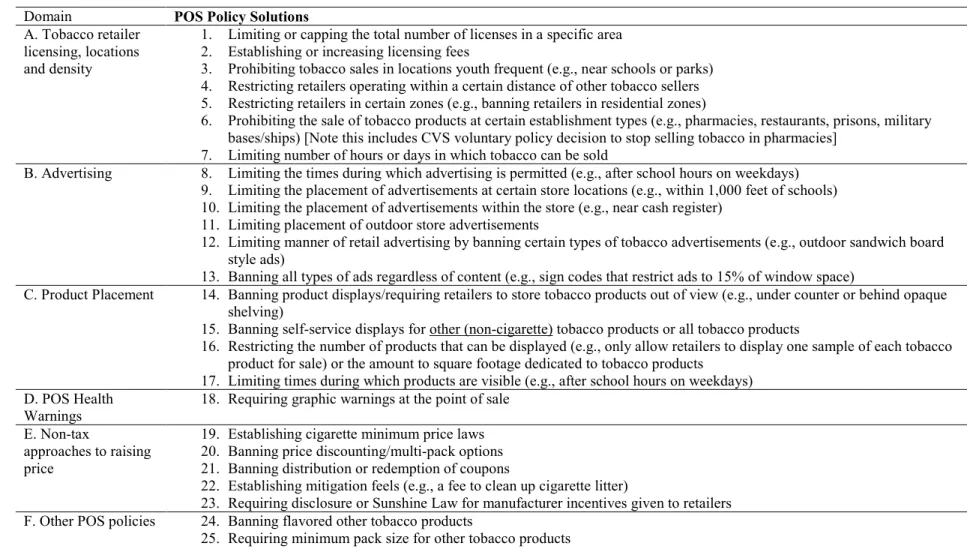
retailing on public health. A broad menu of POS policy solutions is available to tobacco control practitioners. These policy solutions can be categorized into six overarching domains, or activity areas: (1) regulating the density of tobacco retail outlets through restricting the number, type or location of retailers, (2) restricting the time, place or manner of POS advertising, (3) restricting the placement of tobacco products in the store, (4) placing health warnings, prevention or cessation messages in retail outlets, (5) implementing non-tax approaches that raise the price of tobacco products, and (6) pursuing ‘other’ POS policies (e.g. flavor bans, package restrictions).[27] Table 2.1, below, lists 25 unique state-level POS policy solutions, categorized by domain. Researchers have been tracking the state-level implementation of each of the POS policies listed in Table 2.1 as part of Advancing Science and Policy in the Retail Environment (ASPiRE), funded by the National Cancer Institute’s (NCI) State and Community Tobacco Control Initiative (grant number U01-CA154281). ASPiRE is a consortium of researchers from the Center for Public Health Systems Science at Washington University in St. Louis, the Stanford Prevention Research Center, and the University of North Carolina Gillings School of Global Public Health. In 2012 and 2014, telephone interviews were conducted with tobacco control program directors to identify current milestones for each of the 25 policy solutions (e.g. no formal activities,
planning/advocating, policy proposed, policy enacted, or policy implemented) and to compute a POS Implementation Index for each state. Scores range from 0 to 100, with 100 meaning that all 25 policy solutions (in Table 2.1) have been implemented. The
Table 2.1 Point-of-Sale Policy Domains and Solutions.
Domain POS Policy Solutions Tobacco retailer
density
1. ● Limiting or capping the total number of licenses in a specific area 2. ● Establishing or increasing licensing fees
3. ● Prohibiting tobacco sales in locations youth frequent (e.g., near schools or parks)
4. ● Restricting retailers operating within a certain distance of other tobacco sellers
5. ● Restricting retailers in certain zones (e.g., banning retailers in residential zones)
6. ● Prohibiting the sale of tobacco at certain establishment types (e.g., pharmacies restaurants)
7. ● Limiting number of hours or days in which tobacco can be sold
Advertising 8. ● Limiting the times during which advertising is permitted (e.g., after school hours on weekdays)
9. ● Limiting placement of advertisements at certain store locations (e.g., within 1000 ft. of schools)
10. ● Limiting the placement of advertisements within the store (e.g., near cash register)
11. ● Limiting placement of outdoor store advertisements
12. ● Limiting manner of retail advertising by banning certain types of tobacco advertisements (e.g., outdoor sandwich board style ads)
13. ● Banning all types of ads regardless of content (e.g., sign codes that restrict ads to 15% of window space)
Product Placement 14. ● Banning product displays/requiring retailers to store tobacco products out of view (e.g., under counter or behind opaque shelving)
15. ● Banning self-service displays for other (non-cigarette) tobacco products or all tobacco products
16. ● Restricting the number of products that can be displayed (e.g., only allow retailers to display one sample of each tobacco product for sale) or the amount to square footage dedicated to tobacco products
17. ● Limiting times during which products are visible (e.g., after school hours on weekdays)
Health Warnings 18. ● Requiring graphic warnings at the point of sale Non-tax approaches 19. ● Establishing cigarette minimum price laws
20. ● Banning price discounting/multi-pack options 21. ● Banning use of coupons
22. ● Establishing mitigation feels (e.g., a fee to clean up cigarette litter)
23. ● Requiring disclosure or Sunshine Law for manufacturer incentives given to retailers
Other POS Policies 24. ● Banning flavored other tobacco products
2.2 The Policy Change Process: Kingdon’s Multiple Streams Framework and Media Advocacy
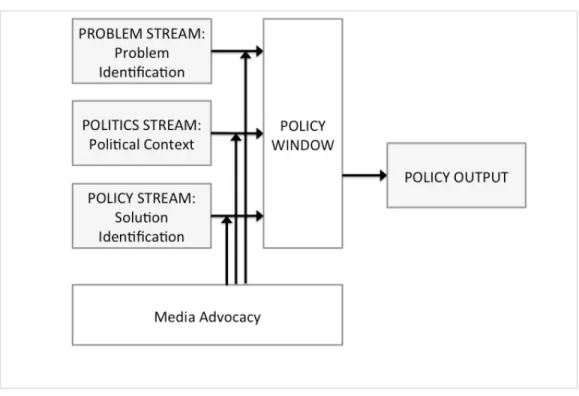
The mission of public health is to create the contextual conditions where people can be healthy –to shape environments (e.g. retail stores, neighborhoods) that promote, rather than detract from health.[13] State- or local-level health policy implementation (e.g. POS tobacco control policy) is a complex process, with multiple stakeholders acting among multiple interactive systems. POS policy interventions require engaged support from public health practitioners, health advocates, policy makers, and the general public, and must mitigate opposition from trade groups such as tobacco retailers or the tobacco industry. Political Scientist John W. Kingdon describes the policy change process as involving three distinct ‘streams’ that can culminate in a ‘window of opportunity’ wherein new policies are adopted and implemented.[43] An adapted model of the Multiple Streams Framework is presented in Figure 2.1.
This policy window is opened when “streams” converge: the problem stream, the politics stream, and the policy stream. The problem stream represents the public awareness and identification of a problem that must be fixed. The politics stream has to do with the political context, opinion or mood: a favorable context among policy makers and pressure groups increases the likelihood of change. The policy stream identifies a list of viable policy solutions and alternatives to the problem, based on research and evidence. In short, when a clear problem, solution, and political support come together at the same time, public health policy is prompted to change.
2.3 The Agenda-Setting Function of the Mass Media
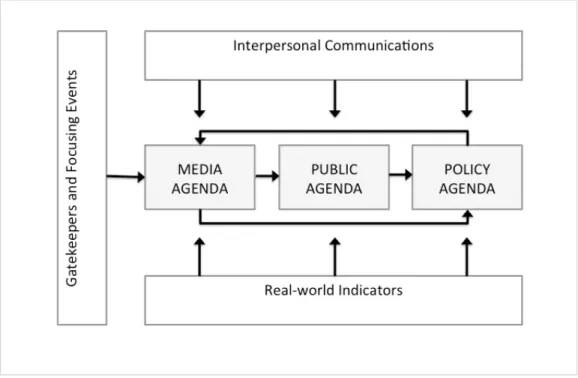
Agenda Setting is a theory of media effects developed by mass communication scholars to explain the process of political and social change as influenced by mass media content. Rogers and Dearing explain agenda setting simply as the process of influence in American democracy; the study of agenda setting is the study of social and political change or stability.[12] Agenda setting tells us that the amount and nature of news media content – generated frequently by media advocacy activities - is a contributor to public attitudes and opinions[44] which also influence the public policy process. More broadly, a media effects framework studies the attitudinal, behavioral and knowledge outcomes of mass media themes, symbols and images.[45] As shown in Figure 2.2, the agenda setting process has three main components: the media agenda, the public agenda and the policy agenda.
The media selects, defines, emphasizes and covers issues (themedia agenda), which then influence public priorities, beliefs and opinions (the public agenda) and, in turn, policy considerations, decision-making, implementation and adoption (the policy agenda). The process is both linear and reciprocal: the media agenda directly influences the public agenda and the policy agenda, the public agenda mediates the relationship between the media agenda and the policy agenda, and the policy agenda influences the media agenda. Within the
agenda-setting system, people are not passive consumers of information but rather active seekers and users of information; a relationship also exists between media audiences – the public, and their agenda - and the media themselves (arrows not shown in model). A seminal agenda-setting study was conducted in Chapel Hill, NC by McCombs and Shaw during the 1968 Presidential election: findings from 100 personal interviews and an analysis of local news media content indicated a strong positive (0.967) correlation between issues covered in the media and the issues the voters said were ‘important’;[46] hundreds of agenda-setting studies have been published since.[12]
Additional factors play a role in the agenda setting process, as shown in Figure 2.3: gatekeepers and focusing events, interpersonal communications, and real-world indicators. Gatekeepers of the media agenda include media leadership, sponsors and editorial staff, each with unique values, routines and cultures that allow or disallow and shape news content.[44] Focusing events also influence the agenda: these are rare events that reveal harm or potential harm to society and may be especially problematic for specific population groups or
advocates) can dictate the salience, or relative importance, of issues and events throughout the agenda-setting process. Among the general population, the process of engaging in interpersonal communication about a topic on the media agenda can make the topic more personally relevant or place it firmly on the public agenda; also, interpersonal
communication among elite people can facilitate the inclusion of topics into the public and policy agendas.[48, 49] Finally, real-world indicators play a role in the development of media, public and policy agendas. Real-world indicators are objective measures of the severity or risk of an agenda issue, event or social problem.[12] For example, in tobacco control, results of population-based studies indicating tobacco consumption rates among children or billions of dollars spent on tobacco-related health care costs annually are a real-world indicators of the problem.
Public health advocates must engage in the agenda setting system, because it has profound potential to impact health policies and behaviors. The mass media play a powerful role in establishing issues or problems as important in the eyes of the public.[45] People and institutions, either for, against, or neutral to health promoting initiatives, shape the media, public and policy agendas by producing focusing events and real-world indicators that identify and define problems, and through prompting conversations and experiences (e.g., agenda-setting events) that increase the salience of issues. In applied practice, public health workers use media advocacy to garner media attention, partner with the media to serve as news sources, work with concerned citizen coalitions to define issues and solutions, and employ persuasive communication strategies such as framing to package issues in
the media agenda are constructed by society and reflect this competition between varying stakeholders.[13, 46] This mass media push-pull, therefore has the power to either advance or detract from the sociopolitical changes needed to improve health.
A series of factors play a role in whether issues that surface on the media agenda are translated to the public and policy agendas. First, stories with higher prominence in the paper are perceived as more important;[46] prominence has to do with the location of the story within the paper, story length, and whether or not the story includes an image or graphic.[50] Second, content framing, meaning the way an issue is described or packaged as it is being communicated[51] provides meaning around an issue and has implications for how the issue is interpreted,[52, 53] the extent to which an issue is supported by the public and decision makers,[52] and the solutions that are implied.[22] Often, public health advocates and the tobacco industry vie for shaping a discussion in hopes that audiences remember the issue, identify with it, and share the view of one side of the argument or the other. Third, an
identify a problem, aid in the development of solutions, and improve knowledge and support from policymakers.[50, 58] Fifth, the extent to which articles are developed with local quotes and local story angles also shapes support from the public and policy makers.[50, 58]
Frames, the presence of sources, the use of narrative and data-driven research evidence, and the degree of localization can also impact the overall slant of an article, either positive or negative for tobacco control efforts.[59, 60] In sum, many characteristics of news coverage (the media agenda) have the potential to contribute to the ultimate success or failure of health policy interventions. Persuasive, impactful media coverage impacts public opinions and policy development: this is the agenda-setting function of the mass media. For public health researchers, then, measuring the media agenda via content analysis is a first step in studying an agenda setting process to promote health.[54]
2.4 Measuring the Media Agenda: Content Analysis of Newspaper Coverage of Tobacco Control
The three studies that comprise this dissertation research are grounded in and extend current empirical research reporting on and analyzing tobacco-related newspaper content. Content analysis is the gold-standard for measuring the media agenda.[54] The content of the news media (or the media agenda) is a prominent source of health information for the general public, including key stakeholders in the policy change process.[7] Beyond simply the
localization, slant).[12] The presence of news media content that is positive towards tobacco control efforts is a powerful force in setting the community agenda to promote public health. Given that tobacco control advocates can effectively partner with the media to shape the media agenda,[14] monitoring the current state of media content is a first step in strategic media advocacy planning.[8]
2.5 Analyses of Tobacco-Related Newspaper Content
This section reviews content analyses of newspaper coverage identified through a search of PubMed and EBSCOHost databases using the search terms ‘tobacco AND
newspaper AND “content analysis.”’ Articles were included for this review if they reported on a structured qualitative or quantitative content analysis that identified the presence, absence or characteristics of discrete elements of news content in a mass media newspaper, or if they report content findings and examined the relationships between newspaper content and other contextual factors such as youth smoking attitudes and behavior or public opinion for a policy. Articles were excluded if they measured content of advertisements, discussed mass media interventions for tobacco cessation or prevention, or were not specifically about tobacco control coverage. The reference sections of each included article were also scanned to identify additional content analysis studies.
A total of 39 content analyses of newspaper coverage of tobacco and smoking issues were identified for this review; the studies are listed and described in Appendix A. For each study included the following characteristics reflecting internal and external validity were recorded: sample location and timeframe; study purpose, stated research questions or
2.5.1 Newspaper and Time Sampling
Analyses of tobacco related newspaper content have been conducted largely in the United States (69%, n=27) and Australia (18%, n=7), with one paper comparing coverage in both countries (3%). Of studies of US content, 16 used a national sampling frame and 11 examined local or state level coverage. One study of tobacco related content has been published each from Ireland, Canada, the Netherlands and China. The time periods analyzed range from several months to 16 years (median, 2 years). The number of newspapers
included in the sampling frame ranged from 1 to 386 (median 12; average 68), though information on the number of newspapers included was not given in 23% of studies (n=9). The number of articles (e.g. letters to the editor or hard news articles) included in each study ranged from 90 to 95,911 (median 709; average 4,095).
2.5.2 Study Aims and Designs
Significant variation exists in the aims and designs of content analysis studies. Study designs (e.g. qualitative, descriptive, cross-sectional, or longitudinal) were categorized based on the stated aims of the paper and the statistical analyses described in the methodology. Of the studies included in this review 8% were qualitative (n=3) and identified themes in
coverage using ethnographic content analysis methods. Two of these studies examined letters to the editor to capture the authors’ reasons for writing and use of persuasive communication in Australia[61] and the US,[62] respectively. The third study analyzed arguments for
allocating tobacco Master Settlement Agreement (MSA) funds to non-tobacco related issues.[63]
determine if the topic is generally newsworthy or, in other words, on the media agenda. Durrant, et al., published a descriptive study of tobacco-related coverage across Australia in 2003[8] and Nelson, et al., developed a national tracking system for US newspaper coverage and described the volume of tobacco-related coverage across the US in a 2007 publication.[6] A subset of seven studies described newspaper coverage of smoke-free policies in
workplaces in Ireland[64] and Missouri,[57] bars in California,[65] casinos in New
Jersey,[66] parks and beaches in Vancouver,[67] pubs in Australia,[68] and a comprehensive statewide law in Michigan;[69] an eighth study described coverage for and against 100% tobacco-free schools policies in North Carolina.[70] A subset of three descriptive studies examined the use of framing strategies in tobacco-related content generally in the US,[22, 23], and within letters to the editor in the US.[71] Finally, one study described coverage of retailer abandonment of tobacco sales.[72] These descriptive studies have identified tobacco as part of the media agenda: in newspapers, articles on tobacco issues have appeared as frequently as daily[6] and demonstrate an orientation that is positive for tobacco control objectives.[8, 17, 73]
Next, 41% of studies were cross-sectional (n=16) defined within this review as having reported on at least one bivariate statistical test for relationships occurring as if at one time point (meaning, the dates of publication or timing of articles were not under study and content was analyzed as if time were not a factor), without regard to whether or not
examined the relationship between community population size, amount of tobacco grown and slant of media coverage towards tobacco control.[75] Nonetheless, in the absence of
Finally, 15% of studies were longitudinal (n=6), defined within this review as having reported on bivariate or multivariate statistics to examine change(s) over time. Three of the six longitudinal studies provided a priori hypotheses that guided their research: Stillman, et al., examined the interaction between the American Stop Smoking Intervention Study
(ASSIST) and time on the outcome of the rate of print media coverage of tobacco issues;[14] Neiderdeppe and colleagues investigated the relationships between tobacco control media advocacy efforts, the extent of media coverage, the passage of local policies, and youth smoking rates in Florida;[19] and Thrasher, et al., assessed relationships between media content characteristics over both failed and successful tobacco tax policy changes in South Carolina.[18] In the absence of identified hypotheses, one study each in Australia[86] and the United States[87] examined general trends in tobacco coverage over time, and a third
Australian study examined specific changes in how smokers were portrayed over time.[88] Bivariate logistic regression analyses are used most commonly to investigate change over time[19, 86-88] however, mixed linear regression models[14] and chi-square tests[18] were also employed.
2.5.3 Article Sampling Frame
nationwide agenda-setting (e.g., the New York Times) or based on circulation rates as indicated by Editor and Publisher,[17] which is a gold standard proxy for population reach.
Given that coding the nature of content is an inherently subjective process, most studies are conducted with trained coders who follow a deductive codebook that is developed before coding begins and refined using a sample of content. Tests for inter-rater reliability (IRR) are conducted using a random sample of minimum 10%[8, 9] to 100% sample[74] of newspaper articles. Cohen’s Kappa,[8] Scott’s Pi[9] and Krippendorff’s Alpha,[81] are typical IRR measures.
2.5.4 Measured Characteristics of Content
Measured variables in the content coding share commonalities across studies [8], given the primary rationale of content analysis, which is to measure the media agenda. Standard article descriptors are newspaper name, publication location, article name, article type and date of publication. Article prominence, theme, event slant and opinion slant are also common coded variables. The prominence of an article, meaning where it is placed in the newspaper (e.g. on the newspaper front page, section front page or other, and whether it is accompanied by an image or cartoon) is commonly collected, particularly when a clipping service is used to gather content. Articles of the highest prominence are published with an accompanying image on the front page of a newspaper, however prominence often cannot be judged from articles retrieved from electronic databases due to database format. The theme variable represents 13 tobacco control topics (e.g. health effects of smoking; secondhand smoke and smoke-free policies; tobacco product consumption; tobacco advertising,
promotion and sponsorship; economics and taxes; farming and trade; product and regulation; addiction; youth access and purchase, possession and use; education, prevention and
cessation programs, products and campaigns; unintended smoking damage; tobacco
slant) offers support for or detracts from tobacco control efforts (e.g. positive, negative, neutral, or mixed toward tobacco control). Prominence, theme and slant are often measured with a verbatim or adapted codebook developed in 2002 by Clegg Smith and colleagues as part of the ImpactTeen research project.[90]
health’) to the casino exemption.[66] Clegg Smith and Wakefield identified 14 dominant framing arguments in a qualitative study of newspaper editorials; some frames focused on portrayals of smokers (‘risky’, ‘socially unacceptable’), others focused on portrayals of tobacco users (‘underdog’, ‘dinosaur’), and still others captured the role of government, business, industry or policy.[71] Finally, a subset of five content analyses have used
simplified coding schemes to characterize the frame as a ‘theme’ or ‘primary approach’ taken to tell either a pro- or anti- tobacco story, for example, discussing tobacco issues from a social, health, economic, or political/cultural/ideological approach.[57, 64, 67, 68, 83] In media advocacy and in policy development, opposing forces compete to shape a discussion on the media agenda. Frames have important meanings, and play a role in both the extent to which an issue is supported[52] and in the solutions that are implied.[22] In order to
disseminate and implement POS policy solutions in the real world, best practice in content analysis research should likely be to measure frames that are readily translatable to media advocacy practice. The simpler measurement approach that characterizes economic, health, or sociopolitical frames, rather than more than a dozen subjective or indiscrete categories, is likely a promising strategy.
Additional important characteristics of news content are the presence or absence of
sources, the use of information or evidence, and the degree oflocalization. A host of studies measure the presence or absence of sources in news content, which are important
determinants of the relevance of issues.[6, 50, 57, 64, 68, 69, 73-77, 79, 88]. A source is a person or organization who gives information to news reporters and who is identified either by quote or paraphrase.[54] Generally, source is measured as a present or absent
or role with regard to the issue (e.g. tobacco industry, health advocate, government). Despite its persuasive nature, the inclusion of information or evidence – whether data- or narrative-driven -- in news content is rarely studied. The earliest study of evidence in tobacco news content was conducted by Kennedy and Bero, who coded the frequency, source, type and conclusions of scientific studies present in news.[74] Caburnay, et al., coded for research, data or specific investigators in news content about physical activity, diet or tobacco use.[50] In a study of news content about Smoke Free Casinos in New Jersey, Wackowski, et al., coded for the types of information used to support arguments for or against the regulations, whether related to scientific studies, personal experiences or stories, or economic-related business information.[66] Lastly, Bach, et al., examined the use of evidence in articles about tobacco during Smoke-Free Workplace ballot campaigns in Missouri, coding either no use of evidence, data without a source, data with a source, presence of an anecdote or narrative, or use of both types of evidence.[57] Finally, only one study has examined the degree of localization present in news content: in the same study mentioned above, Caburnay, et al., coded for the use of local story angles and quotes to make content more relevant for
readers.[50] In sum, whereas many aspects of the nature of news content are studied, none of the studies offer a comprehensive approach to measuring the media agenda for the purpose of planning for practitioner effort in the most persuasive way possible for public health.
2.6 Summary and Gaps in the Tobacco News Content Analysis Literature
cross-studies examine a theory-driven, comprehensive set of content characteristics. Relatively few studies employ bivariate or advanced statistics to test predicted relationships between
variables, as noted by Long, et al. and Clegg Smith, et al.,[9, 10] and very few studies have investigated changes in the volume or nature of content over time.
The studies within this dissertation research begin to address important gaps that remain in the literature, leveraging the emergence of POS policy progress across the US. Study One offers the first content analysis of POS-related newspaper coverage where, for the first time, we measure and test hypothesized relationships between a broad set of content measures related to public opinion and health behavior according to Agenda-Setting and communication theories. Of prime importance to this dissertation research, is that a primary rationale for studying the media agenda (or news content) has always been because of its’ theoretical relationship with public opinion and policy outcomes. Only one study has ever examined the relationship between the media agenda and policy implementation.[19] Study Two is the first to our knowledge to statistically examine the association between POS newspaper content and POS policy progression over time. Finally, only one tobacco control study has ever examined the relationship between the media agenda and public opinion,[11] and no studies have focused on news media content (newspaper or other channel) and how it is related to public opinion on POS tobacco control policy solutions; this gap is addressed in Study Three with a unique communication experiment designed to evaluate the relationship between the characteristics of POS-news messages and public opinion towards POS policies. All of the studies here extend traditionally descriptive content analyses to include key
CHAPTER 3THEORETICAL/CONCEPTUAL FOUNDATIONS 3.1 Theoretical and Conceptual Model for the Dissertation
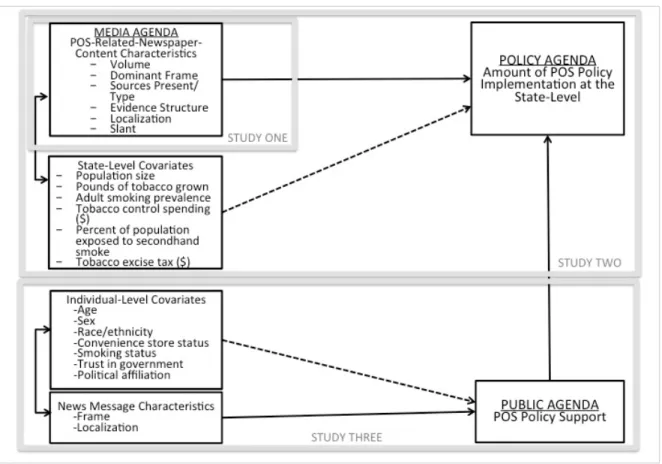
Guided by the policy change process, media advocacy and the agenda setting framework, the ultimate goal of this research is to contribute to a proactive blueprint for strategic communication initiatives that will can support the implementation of POS tobacco control policy initiatives that shape tobacco use behaviors. Figure 3.1 blends these concepts and offers a guiding framework linking media advocacy to health behaviors.
First, in the context of tobacco control, we see media advocacy activities as informing the media agenda: the volume of news content about an issue, topics/themes covered and characteristics of content. The generation of news coverage – reaching the media agenda - is often a measured outcome of state tobacco prevention coalition efforts.[90] The media agenda informs the reciprocal relationships between the public agenda and policy agenda: this is the agenda-setting function of the mass media. Mass media content reaches the general public and policymakers, alike, each stakeholders in the policy change process who rely on the news media for information.[91] Independently and together, the media, policy and public agendas contribute to health behaviors: the health impacts of attitudes and
Figure 3.2. Overarching conceptual model of the dissertation. From Media Advocacy to Health Behaviors: Examining the Relationships between Point-of-Sale Tobacco Control Newspaper Content, Public Opinion, and Point-of-Sale Policy Implementation
3.2 Research Aims and Hypotheses
3.2.1 Study One
The purpose of Study One is to describe POS-related newspaper coverage and to test a series of hypotheses about the relationships between news content characteristics within articles. Descriptive findings from this study represent a first step in media advocacy and the policy change processes: identifying the current media agenda, which is known to impact public opinion and policy development. Each aim is discussed in detail below.
3.2.1.1 Aim 1
slant) of a sample of US print newspaper content related specifically to point of sale (POS) tobacco control programming and policies from January 1, 2007 to December 31, 2014 in national and state level newspapers. In keeping with descriptive research, and towards measurement of important characteristics of content, the following research questions will be examined:
RQ1. What is the volume of content (measured as the number of articles) in each year of the study period and cumulatively, at the national level and within each state?
RQ2. Which article types (e.g. hard news, editorials, letters to the editor) were published, and what is the distribution by category?
RQ3. Which POS themes are covered and with what frequency? RQ4. What frames are present and with what frequency? RQ5. Which sources are present, and with what frequency?
RQ6. To what extent are the media advocacy techniques of varying evidence structure (data/narrative) and localization (local quote/local angle) present in content?
RQ7. How is the content slanted, overall? Is it pro-tobacco control, anti-tobacco control, mixed or neutral, and does this vary by article type?
3.2.1.2 Aim 2
The slant or position of news articles in favor of or against an issue has important implications for general public and policymaker support for issues and policy
development.[85, 92-94] As an illustration, in a community in Missouri where a Smoke Free Workplace ballot initiative failed (in other words, no policy was implemented), the failing community had a higher proportion of anti-tobacco control (slanted) articles, and the successful communities had lower proportions of anti-tobacco control slanted articles. Additionally, the community with the failed Smoke Free initiative had a higher proportion of articles with a ‘rights’ frame, and a higher proportion of articles that used no evidence [57], compared to lower proportions of each in the successful communities. Moshrefzadeh found that only 39.8% of analyzed articles were positively slanted for tobacco control issues,[67] and found associations between article type and slant, such that news articles tended to have a positive or neutral slant, and letters to the editor tended to have a more negative slant. What remains unclear is the relationship between the slant of an article and other characteristics of an article (e.g. frame, presence and type of sources, evidence structure, and degree of
localization). The hypotheses under this aim seek to confirm relationships within POS-related content that are suggested by descriptive findings from past tobacco-related content research.
A relationship between frame and slant has been identified in analyses of content discussing Smoke Free Air policies. (It is important to note that I have conceptually merged variables that are, in essence, ‘frames’ but named differently – e.g. approach or theme.) Moshrefzadeh and colleagues found relationships between frame (‘approach’) and slant such that articles with a health or social approach were positively slanted, articles with an
and slant were associated with one another in small Missouri communities, such that the health framed articles were more likely to be pro-tobacco control, and rights-framed articles were more likely to be anti-tobacco control.[57] Finally, Harris and colleagues noted a higher than expected proportion of articles with a pro-tobacco control slant and a health frame (‘theme’), and a higher than expected proportion of articles with an anti-tobacco control slant and a political frame.[83] Given these relationships, within the POS context, I hypothesize:
H1. Dominant frame is associated with overall slant, such that news articles with dominant health frame are more likely to have a pro-tobacco control slant than an anti-tobacco slant, and news articles with dominant economic or political frame are less likely to have a pro-tobacco control slant than an anti-tobacco control slant.
Relationships have also been suggested between the presence or absence of certain sources and slant; the presence of sources in news media content can shape the discourse and influence public support for the issue.[13, 19, 95]. In the first published tobacco-related content analysis, Chapman (1989) found that the source (‘origin’) of the article was associated with the slant for tobacco control: whereas the majority of articles published in Australia in the late 1980’s were positively slanted for tobacco control (62.3%, n=997), articles originating from doctors, health workers or health agencies were predominately positively slanted where as articles originating from the tobacco industry or advertising were more negatively slanted.[73] Wakefield and colleagues examined the presence of public health advocacy groups as sources in Australian media coverage about tobacco issues,[77] and found that advocacy organizations were mentioned in only about 20% of articles
public health advocacy sources in articles was associated with negative or neutral slant for tobacco control.[77] Given these relationships, within the POS context, I hypothesize:
H2. Presence and type of sources are associated with overall slant, such that news articles with greater amounts of pro-tobacco control sources (health care provider, public health advocacy or nonprofit group, government/health department official) are more likely to have a pro-tobacco control slant than an anti-tobacco control slant, and news articles with greater amounts of anti-tobacco control sources (tobacco retailer/labor/business group, tobacco industry) are less likely to have a pro-tobacco control slant than an anti-tobacco control slant.
Another important relationship is between the structure of information or evidence provided (e.g. anecdote, story or narrative versus data or statistics), and slant. In an analysis of content related to exempting New Jersey casinos from Smoke Free policies, Wackowski and colleagues coded the information structure that was used to support frames for or against the exemption, because narrative stories and personal anecdotes can be more persuasive than statistical evidence.[66] Unfortunately, however, the relationship between information structure and article slant or overall policy success was not examined. A 2012 qualitative examination of letters to the editor (LTEs) about Smoke Free Air laws indicated a
relationship between evidence structure and slant: pro-tobacco control editorials used data and statistics to make an argument, whereas and anti-tobacco control editorials used narrative communication and personal anecdotes to make an argument.[62] Given these relationships, within the context of news articles about POS tobacco control, I hypothesize:
likely to have a pro-tobacco control slant than an anti-tobacco control slant, whereas news articles with no evidence or data without a source are less likely to have a pro-tobacco control slant than an anti-tobacco control slant.
The association between the degree of localization and slant is also important to consider. Caburnay and colleagues[50] analyzed the extent to which local health news coverage in Missouri incorporated local sources or a local story angle, two elements that add to the public health impact of messages, according to an agenda-setting and media advocacy framework. No analyses were conducted, however, to test the association between
localization and slant. Within the context of POS tobacco control, I hypothesize:
H4. Degree of localization is associated with overall slant, such that news articles with both a local quote and a local angle are more likely to have a pro-tobacco control slant than an anti-tobacco control slant, whereas news articles with neither a local quote or local angle are less likely to have a pro-tobacco control slant than an anti-tobacco control slant.
the frame was used), and the ‘protect health’ frame was attributed most frequently to public health representatives (37.5% of the 96 times the frame was used). In the same decade, as part of a thematic analysis of media content attributed to statements made by the Australian Hotels Association (AHA; industry) and public health advocates during the debate for smoke free bars in Australia, Champion and Chapman also found a relationship between source and frame: AHA/industry sources most commonly used economic frames where as health
advocates used health frames.[68] The cultural/ideological frame category was very broad, from ‘legal product’ to individual freedoms/rights, and was used both positively and
negatively by both AHA/industry and public health advocates.[68] These findings show that stakeholder groups or sources may hold tightly to the use of certain frames or ways of positioning the issue. Therefore, within the context of POS, I hypothesize:
H5. Source type is associated with dominant frame, such that news articles with only tobacco industry or tobacco retailer sources are more likely to have political or economic frames than any other frame, and news articles with only public health advocate sources are less likely to have political or economic frames than any other frame.
3.2.2 Study Two
Researchers with Advancing Science and Policy in the Retail Environment (ASPiRE) (grant number U01-CA154281), a project of the National Cancer Institute (NCI), State and Community Tobacco Control (SCTC) initiative, are tracking the implementation of 25 possible state-level POS policies with the Point of Sale Policy Implementation Index (POS PII). POS PII data were collected via telephone interview with state tobacco control program managers in September 2012 and September 2014. The POS PII is a composite continuous score, ranging from 0 to 100 for each state, where 0 means no formal activities and 100 means implementation of all 25 unique POS policy solutions (see Tables 1 and 3). For each specific policy option, states are coded “0” for no formal activities, “1” for
planning/advocating, “2” for policy proposed, “3” for policy enacted, or “4” for policy implemented (see Table 3). This scoring system provides an opportunity to link policy implementation milestones with media content.
3.2.2.1 Aim 1
The work of this aim intends to add support for a longitudinal association between newspaper content and policy change in the context of state-level POS tobacco control. Aim 1 is to determine whether the volume and characteristics (e.g. frame, source presence and type, evidence structure, degree of localization, slant) of state-level POS-tobacco-control-related newspaper content from 2012 to 2014 is significantly POS-tobacco-control-related to the state-level POS Policy Implementation Index in 2014, controlling for the state-level POS Policy
Implementation Index in 2012 and other covariates.
identified. Of the six, four studies were unrelated to policy. One study each in Australia[86] and the United States[87] examined general trends in tobacco coverage over time, a third Australian study examined specific changes in how smokers were portrayed over time,[88] and a fourth study by Stillman, et al., examined the interaction between the American Stop Smoking Intervention Study (ASSIST) and time on the outcome of the rate of print media coverage of tobacco issues,[14] essentially finding that public health practitioners can impact the volume and nature of media content with media advocacy effort.
Only two studies have examined the longitudinal relationship between newspaper content and any policy outcome. Neiderdeppe and colleagues investigated the relationships between tobacco control media advocacy efforts, the extent of media coverage, the passage of local policies, and youth smoking rates in Florida[19] using event history analysis (logistic regression) methods. The Florida study found that news coverage did contribute to the
unsuccessful tax increases, newspaper content contained more of the pro-tobacco control economic arguments “tax will raise general state revenue” and “tax should pay for cessation and prevention programs”, less of the anti-tobacco control economic argument “little
consensus on how money should be spent”, and more of the anti-tobacco control argument “tax will hurt business and tobacco farmers”. The Thrasher, et al., study was the first to statistically examine a characteristic of content (frames present) as it related to policy adoption. Within the work of Aim 1, I offer the following hypothesis:
H1. The POS Policy Implementation Index score in 2014 will be significantly higher than the POS PII score in 2012, and the volume and characteristics of newspaper content will be significantly related to POS PII score in 2014, controlling for the PII score in 2012 and other co-variates.
3.2.2.2 Aim 2
volume, dominant frame, source presence and type, evidence structure, degree of localization, or slant) have the strongest relationship to the Time 2 POS PII score, when controlling for other relevant factors.
more frequently negatively slanted rather than positively slanted), and the highest proportion of anti-tobacco control slanted hard news articles (34.2%). Also, with regard to a failed tobacco tax ballot initiative in Missouri, in the month prior to public voting, anti-tobacco control slanted articles were dominant.[83] Timing was critical in this example given that in the year prior to the vote, most news content had a pro-tobacco control slant (63.8%).[83] Third, frames in content play a role in policy adoption. From a past descriptive content analysis in Missouri, “economic” frames were most prevalent in areas where voters
demonstrated low support for tobacco tax ballot initiative, whereas “health” and “political” frames were most prevalent in areas with high support [83]. In another study, a “rights” frame, which is generally anti-tobacco control, was most common in a community in Missouri with a failed smoke-free workplace policy campaign.[57] Fourth, the presence of sources in news content may contribute to POS policy implementation, especially since health advocates and tobacco industry sources compete for attention and support in the media.[77] Given more or less of one type of source (e.g. public health or tobacco industry), policy implementation could be hastened or stalled completely. Fifth, the presence of
makers alike, and could therefore encourage greater policy implementation. Given these empirical and theorized relationships, I offer the following set of hypotheses:
H2. The volume of articles (measured as the total number of POS-tobacco-related articles of any type in the two-year period) will be positively and significantly related to POS PII score at Time 2 in 2014, controlling for the Time 1 PII score in 2012, other state-level co-variates, and other characteristics of newspaper content.
H3. The number of articles with pro-tobacco control slant (measured as the total number of news articles with a pro-tobacco control slant in the two-year period) will be positively and significantly related to POS PII score at Time 2 in 2014, controlling for the Time 1 PII score in 2012, other state-level co-variates, volume of articles, and other characteristics of newspaper content.
H4. The number of articles with a dominant health frame (measured as the total number of news articles with a dominant health frame in the two-year period) will be positively and significantly related to POS PII score at Time 2 in 2014, controlling for the Time 1 PII score in 2012, other state-level co-variates, volume of articles, and other characteristics of newspaper content.
H5. The number of articles with a one or more health advocate sources (measured as the total number of news articles with one or more public health advocate sources in the two-year period) will be positively and significantly related to POS PII score at Time 2 in 2014, controlling for the Time 1 PII score in 2012, other state-level co-variates, volume of articles, and other characteristics of newspaper content.
significantly related to POS PII score at Time 2 in 2014, controlling for the Time 1 PII score in 2012, other state-level co-variates, volume of articles, and other characteristics of newspaper content.
H7. The number of articles with localized content (measured as the total number of news articles with both a local angle and a local source in the two-year period) will be positively and significantly related to POS PII score at Time 2 in 2014, controlling for the Time 1 PII score in 2012, other state-level co-variates, volume of articles, and other characteristics of newspaper content.
Within the work of Aim 2, I note two additional analyses of interest. Hypotheses 2 through 7 test for positive, significant associations between each characteristic of content and Time 2 POS PII score, while controlling for Time 1 POS PII score, state-level covariates, and other content characteristics. Beyond my hypotheses about associations, I will investigate the proportion of variance in Time 2 POS PII score that is accounted for by news content
characteristics, to answer the more global question, “How important is newspaper content within the work of POS policy implementation?” Also, I will investigate which
characteristics of content are most strongly related to Time 2 POS PII score when holding other variables constant, to determine, for example, whether sources present, dominant frame, or another measured characteristic is most relevant to policy implementation.
3.2.3 Study Three