THE MACHINERY OF MANIPULATION: A COMPARATIVE ANALYSIS OF PRINCIPAL-AGENT DYNAMICS AND ELECTION
MANIPULATION IN RUSSIA, MEXICO, AND UKRAINE
Cole J. Harvey
A dissertation submitted to the faculty at the University of North Carolina at Chapel Hill in partial fulfillment of the requirements for the degree of Doctor of Philosophy in the Department of Political
Science in the College of Arts and Sciences.
Chapel Hill 2019
Approved by: Graeme Robertson Anna Bassi
Liesbet Hooghe
c
2019
ABSTRACT
Cole J. Harvey: The Machinery of Manipulation: A comparative analysis of principal-agent dynamics and election manipulation in Russia, Mexico,
and Ukraine
(Under the direction of Graeme Robertson)
The most common form of authoritarian government in the modern world is one that holds contested elections. Elections in these electoral authoritarian regimes have been shown to have a variety of stabilizing effects for incumbents, even as organized opposition contestation poses some risks. This project investigates how authoritarian leaders attempt to manage these risks through electoral manipulation. In particular, it addresses two interrelated questions: why are some elections manipulated more severely than others, and why do the techniques used to tamper with elections vary across space and over time?
To answer these questions, I investigate principal-agent dynamics between leaders who wish to influence the election result and the individuals who actually stuff the ballot boxes, buy the votes, or forge the results. These low-level actors must bear the direct costs and risks of tampering with the election, while the direct benefits of manipulation accrue to the leader. I find that this principal-agent relationship helps determine the severity and type of election manipulation that political leaders are able to generate.
In particular, two factors interact to shape the principal-agent relationship. First, agents are more likely to manipulate on behalf of a leader who controls the bulk of patronage resources in the society. Second, agents must evaluate the local risk of exposure and punishment for engaging in illegal forms of manipulation, even if their patron wins. Where these risks are high, agents are more likely to adopt harder-to-detect forms of manipulation, like vote-buying. When risks are low, tactics like falsification are more likely.
ACKNOWLEDGEMENTS
This project (along with my own development as a researcher) has been supported in many ways by many people. First, I would like to extend my gratitude to Graeme Robertson, Liesbet Hooghe, Ceci Martínez-Gallardo, and Erik Wibbels, for their intellectual support of this project, their thoughtful questions and comments, and their encouraging me explore these topics in a wide-ranging way. Special thanks are due to Anna Bassi, for joining the committee at a late date, and for offering helpful suggestions on the theory and experimental chapters. I have also had the benefit of developing this project in an intellectually vibrant environment, especially through the department’s Comparative Working Group. Lastly, I am particularly grateful to the late Tom Carsey for his unfailingly generous advice from the beginning stages of this project to the last weeks of his life.
In addition, I have been fortunate to receive several grants in support of this project. Funding from UNC and the European Research Council enabled me to conduct field interviews and a survey experiment in Russia, while support from the Uhlman Fellowship and the Royster Society of Fellows enabled me to think, plan, and write at various stages. I would like to express my thanks to the funders of those grants, as well as the selection committees that endorsed this work.
TABLE OF CONTENTS
List of Figures . . . x
List of Tables . . . xiii
CHAPTER 1: INTRODUCTION . . . 1
1.1 Existing explanations of electoral manipulation, and their limitations . . . 4
1.2 Theory in brief . . . 7
1.3 Case selection and measurement . . . 14
1.4 Contributions of the argument to prior research . . . 18
1.5 Chapter outline . . . 20
CHAPTER 2: CENTRALIZED AND DISPERSED MANIPULATION IN RUSSIA . . . 22
2.1 Principals, agents, and electoral manipulation . . . 25
2.2 Theory and hypotheses . . . 26
2.3 Case selection: local and national political conditions in Russia . . . 33
2.4 Data and measures . . . 34
2.5 Explanatory variables: local political constraints . . . 35
2.5.1 Explanatory variables: national consolidation . . . 36
2.5.2 Control variables . . . 37
2.6 Results and discussion . . . 38
2.7 Conclusion . . . 47
CHAPTER 3: PRINCIPALS, AGENTS, AND PRO-OPPOSITION ELECTORAL MANIPULATION IN MEXICO . . . 49
3.1 Electoral manipulation and principal-agent dynamics in Mexico . . . 50
3.2 Hypotheses, data, and methods . . . 52
3.3.1 Fraud score models . . . 60
3.3.2 Difference-in-differences models . . . 67
3.3.3 Conclusion . . . 72
CHAPTER 4: PATRONAGE CONSOLIDATION AND DEFLATIONARY MANIPULATION IN UKRAINE . . . 74
4.1 Context: Ukrainian politics and elections . . . 76
4.2 Theory: Consolidation and constraint in Ukraine . . . 80
4.2.1 Local constraints in Ukraine . . . 81
4.2.2 Patronage consolidation . . . 82
4.2.3 Hypotheses . . . 85
4.3 Data and methods . . . 86
4.3.1 Dependent variables . . . 87
4.3.2 Explanatory variables . . . 90
4.3.3 Control variables . . . 91
4.4 Results . . . 92
4.5 Discussion and conclusion . . . 98
CHAPTER 5: PUNISHMENT AND PROTEST-SURVEY EXPERIMENTAL EVIDENCE OF THE PRINCIPAL-AGENT PROBLEM, RUSSIA 2016 . . . 102
5.1 Public opinion and electoral manipulation . . . 104
5.2 Theory: Competitiveness, electoral manipulation, and public opinion . . . 107
5.3 Data and methods . . . 110
5.4 Results . . . 114
5.4.1 Legal punishment for election-manipulating agents . . . 114
5.4.2 Support for electoral protest . . . 120
5.5 Discussion . . . 125
5.6 Conclusion . . . 126
APPENDIX A: . . . 128
A.1 Appendix A overview . . . 128
APPENDIX B: . . . 160
B.1 Marginal effects plots . . . 160
B.2 Parallel trends assumption for difference-in-differences models . . . 160
APPENDIX C: . . . 166
C.1 Russian-language version of survey-experimental questions . . . 166
LIST OF FIGURES
1.1 Overview of the theoretical model with regard to severity of manipulation . . . 9
1.2 Overall electoral integrity across three cases . . . 16
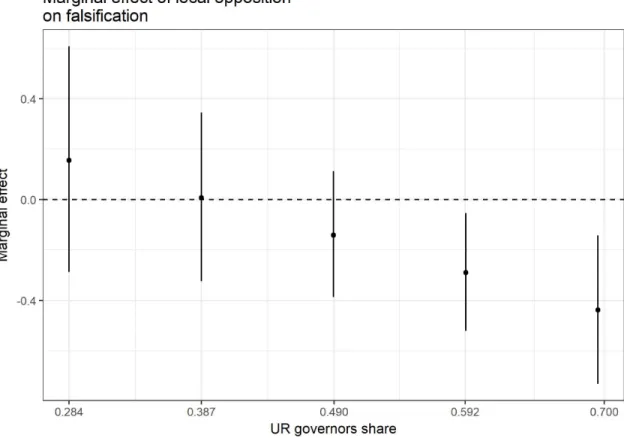
2.1 Marginal effect of local opposition on falsification, by UR governors share . . . 41
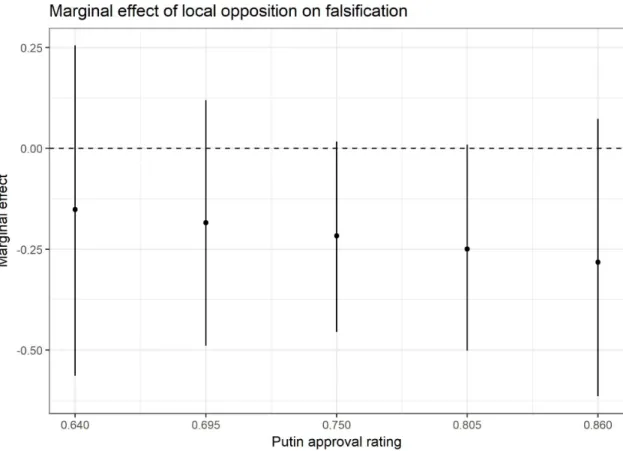
2.2 Marginal effect of local opposition on falsification, by Putin approval . . . 42
2.3 Marginal effect of local opposition on vote-buying / voter pressure, at varying levels of UR governors share . . . 43
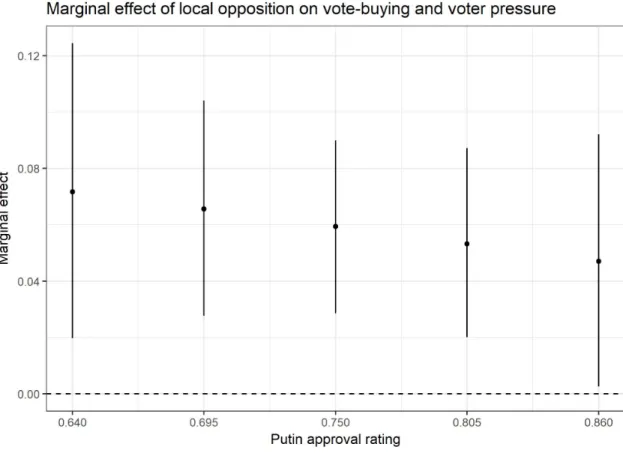
2.4 Marginal effect of local opposition on vote-buying / voter pressure, at varying levels of Putin approval . . . 44
3.1 Marginal effect of non-PRI governors share on PAN fraud . . . 64
3.2 Marginal effect of non-PRI governors share on PAN fraud . . . 64
3.3 Marginal effect of alternation on PAN fraud . . . 65
3.4 Marginal effect of PAN governor on PAN fraud . . . 65
3.5 Predicted probability of falsification of PAN results . . . 66
4.1 Histogram of turnout coefficients for major pro-east parties (2002-2014) . . . 89
4.2 Vote-share density for the Party of Regions . . . 90
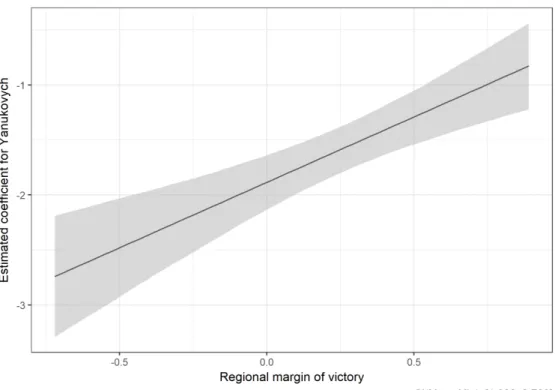
4.3 Marginal effect of Yanukovych on negative turnout coefficients for pro-eastern parties . . . 93
4.4 Marginal effect of post-Maidan on negative turnout coefficients for pro-eastern parties . . . 95
4.5 Marginal effect of Yanukovych on number of suspicious precincts . . . 96
4.6 Marginal effect of Post-maidan on number of suspicious precincts . . . 98
4.7 Predicted number of fraudulent precincts by Yanukovych . . . 99
4.8 Predicted number of suspicious precincts, by post-Maidan . . . 99
5.1 Partisan vote-choice, 2011 election . . . 111
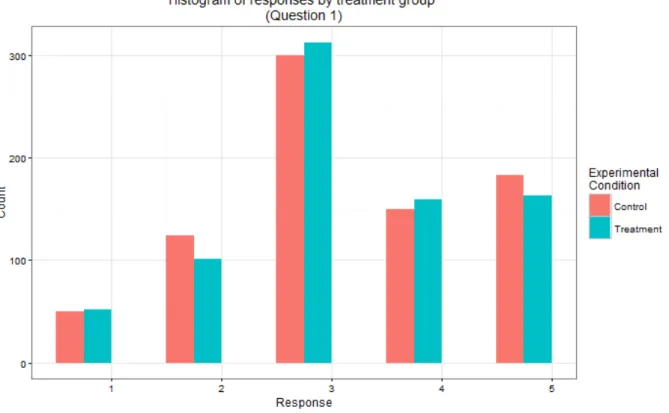
5.2 Histogram of support for punishment of election-manipulating agents by experimental groups . . . 115
5.3 Marginal effect of KPRF support on attitudes toward punishment of election-manipulating agents, by treatment condition . . . 117
5.5 Treatment effects for smaller parties . . . 121
5.6 Treatment effects for United Russia and non-voters . . . 122
5.7 Treatment effects for KPRF and refusals . . . 123
5.8 Estimated proportion of respondents answering the sensitive item in the affirmative by self-reported vote-choice in the 2011 election . . . 124
A.1 Histograms for local opposition (raw and scaled) . . . 129
A.2 Local opposition in 2003 . . . 129
A.3 Local opposition in 2011 . . . 130
A.4 Marginal effects of local opposition on falsification, conditional on executive constraints . . . 131
A.5 Marginal effect of local opposition on vote-buying / voter pressure, conditional on executive constraints . . . 133
A.6 Marginal effect of UR governor share on falsification, conditional on local openness . . . 136
A.7 Marginal effect of national executive constraints on falsification, conditional on local openness . . . 137
A.8 Marginal effect on falsification, using local openness and Putin approval . . . 138
A.9 Interaction of local openness and UR governors share on vote-buying / voter pressure . . . 138
A.10 Interaction of local openness and executive constraints on vote-buying / voter pressure . . . 139
A.11 Marginal effect of local openness on vote-buying / voter pressure at varying levels of Putin approval rating . . . 140
A.12 Marginal effect of Putin approval rating on vote-buying / voter pressure at varying levels of local openness . . . 141
A.13 Marginal effect of ethnic republic status on falsification, conditional on UR governors share . . . 142
A.14 Marginal effect of ethnic republic status on falsification, conditional on executive constraints . . . 145
A.15 Marginal effect of ethnic republic status on falsification, conditional on Putin approval . . . 145
A.16 Marginal effect of ethnic republic status on vote-buying / voter pressure at varying levels of UR governors share . . . 146
A.17 Marginal effect of ethnic republic status on vote-buying / voter pressure at varying levels of executive constraint . . . 147
A.19 Testing the assumptions of a linear interaction of UR governors
share and local opposition on falsification . . . 149
A.20 Testing the assumptions of a linear interaction of UR governors share and local opposition on vote-buying / voter pressure . . . 150
A.21 Marginal effect of local opposition on falsification, conditional on UR governors share, with standard and FDR confidence intervals . . . 151
A.22 Marginal effect of local opposition on vote-buying / voter pressure, conditional on UR governors share, with standard and FDR confidence intervals . . . 152
A.23 Falsification, 2003 . . . 153
A.24 Falsification, 2004 . . . 154
A.25 Falsification, 2007 . . . 154
A.26 Falsification, 2008 . . . 155
A.27 Falsification, 2011 . . . 155
A.28 Falsification, 2012 . . . 156
A.29 Vote-buying / voter pressure, 2003 . . . 156
A.30 Vote-buying / voter pressure, 2004 . . . 157
A.31 Vote-buying / voter pressure, 2007 . . . 157
A.32 Vote-buying / voter pressure, 2008 . . . 158
A.33 Vote-buying / voter pressure, 2011 . . . 158
A.34 Vote-buying / voter pressure, 2012 . . . 159
B.1 Marginal effects of PAN president on PAN fraud . . . 161
B.2 Marginal effects of alternation on PAN fraud . . . 161
B.3 Marginal effects of unified (PRI) government on PAN fraud . . . 162
B.4 Marginal effects of alternation on PAN fraud . . . 162
B.5 Marginal effects of PAN president on PAN fraud . . . 163
B.6 Marginal effects of PAN governor on PAN fraud . . . 163
B.7 Marginal effects of unified (PRI) government on PAN fraud . . . 164
B.8 Marginal effects of PAN governor on PAN fraud . . . 164
B.9 Estimated PAN manipulation in treatment and control cases, 1991-2012 . . . 165
LIST OF TABLES
1.1 Patronage consolidation, local risk, and manipulation type . . . 13
2.1 Logit models of falsification . . . 39
2.2 FGLS models of absentee coefficients (dispersed manipulation) . . . 40
3.1 Logit models of PAN fraud, usingalternation . . . 61
3.2 Logit models of PAN fraud, usingPAN governor . . . 62
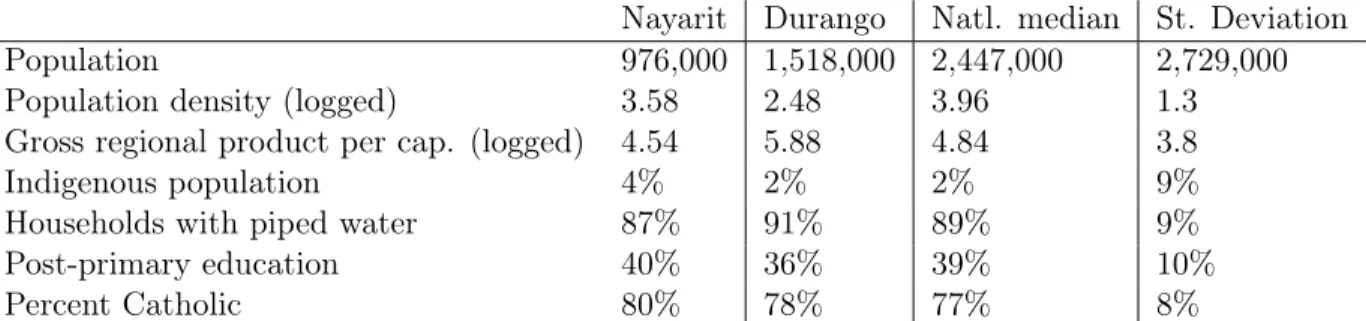
3.3 Socioeconomic conditions in Nayarit and Durango, average values for 1994-2012 . . . 68
3.4 Difference-in-difference model of PRI manipulation . . . 68
3.5 Difference-in-differences results for PRI manipulation in Nayarit and Durango . . . . 69
3.6 Models of PAN manipulation in Nayarit and Durango . . . 69
3.7 Difference-in-differences results for PAN manipulation in Nayarit and Durango . . . . 70
4.1 Logit models of negative turnout test coefficient . . . 94
4.2 Poisson models of suspicious precincts . . . 97
5.1 Distribution of support for punishment of election-manipulation agents . . . 115
5.2 Ordered logit models of Question 1 (punishment for election-manipulating agents) . . 119
5.3 Item count technique regression model of support for protest . . . 121
A.1 Correlation coefficients for explanatory and dependent variables . . . 129
A.2 Descriptive statistics . . . 130
A.3 Models of manipulation using local opposition and executive constraints . . . 132
A.4 Logit models of falsification using local openness . . . 134
A.5 FGLS models of dispersed manipulation using local openness . . . 135
A.6 Logit models of falsification, using ethnic republic status . . . 143
CHAPTER 1 Introduction
When the last vestiges of the Soviet Union finally crumbled in December 1991, the dissipation of the old regime set in motion a process of decentralization within Russia itself: many of the newly-independent country’s regions sought to capture as much sovereignty from the center as they could swallow, to use President Boris Yeltsin’s famous phrase. While many of the old system’s levers of patronage and influence had passed into Yeltsin’s hands, the Communist Party of the Russian Federation (KPRF) remained the only political party in the country that boasted a nationwide network of supporters, activists, and organizational infrastructure. These factors, combined with the economic pain of the transition to a market economy, resulted in the Communists’ victory in Russia’s first regularly scheduled legislative election, in December 1995, six months before Yeltsin himself was up for re-election.
electoral manipulation to win their elections?
Russian political history also provides a representative example of the second puzzle this project seeks to address. In important ways, the 2011 Russian legislative election was a mirror-image of the situation facing Yeltsin in 1996. The economy, while struggling to fully recover from the financial crisis of 2008, was growing. The country’s internal fragmentation had largely been arrested during President Vladimir Putin’s first two terms, in which regional authorities and wealthy oligarchs had both been brought firmly under the Kremlin’s influence. Six months from the election, Putin’s approval rating stood at 69 percent, and the ruling party—United Russia—was dominant in both the national legislature and in regional legislatures across the country. Despite these advantages, the ruling party suffered a significant defeat at the polls, losing 77 seats and its constitutional supermajority in the legislature. Even so, the results were tainted by widespread allegations of election manipulation, prompting a nationwide protest movement (Za Chestnye Vybory—For Fair Elections). The 2011 Russian election is an example of something close to the worst-case scenario for an electoral authoritarian leader: electoral defeat coupled with potentially destabilizing protest. That such a negative outcome occurred despite all of the advantages available to the ruling party represents the second puzzle studied here: how can incumbent leaders with strong states and deep resources sometimes fail to produce enough electoral manipulation to win the election and stave off mass protest?
like an independent and active media (which can investigate and publicize electoral malfeasance), an independent judiciary, and—most importantly—a large and active opposition party presence. These factors are generally not uniform features of a country, but tend to vary by locality. Just as democratic countries may have subnational authoritarian enclaves (Gibson, 2013), non-democratic countries may have pockets of elevated contestation and more active civil society (Gilley, 2010).
When local risks are high, agents are more likely to engage in forms of electoral manipulation that are difficult to observe and trace, in order to avoid exposure and punishment. These include tactics like vote-buying and voter pressure; agents who engage in these sorts of activities are difficult to monitor and track, since they take place at varying times on or before election day, and at places other than the polling station. As a result, I classify these hard-to-attribute methods as dispersed forms of manipulation. By contrast, techniques like falsification and ballot stuffing generally occur in the polling place on election day, making them easier to observe and for perpetrators to be identified. These are centralized tactics.
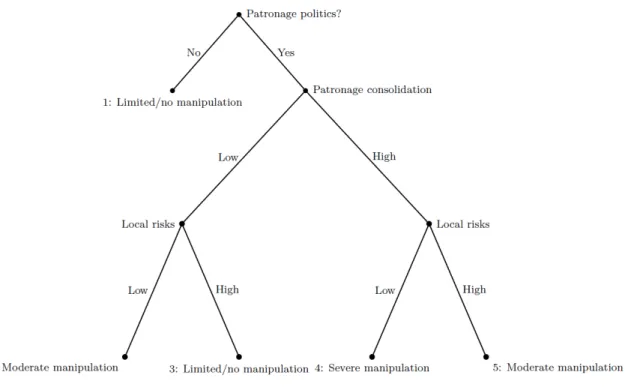
The model makes predictions for both the level and type of manipulation, summarized in Figure 1 and Table 1 below. In brief, when a leader’s control over patronage is low, manipulation on behalf of that party is relatively rare since inducing agents’ cooperation in the patronage network is difficult. It is least likely to occur in places where local risks to agents are high; if the leader controls enough patronage resources to attract election-manipulating agents, she is more likely to be able to do so in places agent risk is low. When leaders control a greater share of patronage resources, electoral manipulation increases in severity by tactic. In areas where opposition parties (in addition to independent media and courts) are weak, agents can engage in centralized manipulation like falsification of results. In high-risk areas agents are less likely to adopt centralized tactics, and more likely to engage in dispersed vote-buying and voter pressure.
1.1 Existing explanations of electoral manipulation, and their limitations Multiparty elections are the hallmark of modern politics the world over. Most single-party communist states collapsed in the late 1980s and early 1990s, and military regimes—largely bereft of their Cold War-era sponsors—have become relatively scarce and short-lived. Multi-party national elections, held in less than fifty percent of countries in 1985, were held in over seventy-five percent by 2005 (Magaloni and Kricheli, 2010). In some cases, multiparty elections have signaled a transition to a more liberal democratic mode of government (Brownlee, 2007; Howard and Roessler, 2006). However, in the bulk of cases, transitions from closed forms of authoritarianism have led to limited electoral democracy, competitive authoritarian regimes, or hegemonic authoritarian systems with one dominant party (Donno, 2013; Levitsky and Way, 2010; Hadenius and Teorell, 2007). In each of these regime types, multiparty elections are held and are conceived of as the only legitimate route to political power, but at the same time are manipulated to varying degrees by governments and political parties.
Due to the prevalence of these elections—unfree and unfair, but still contested and at least somewhat risky for governments—researchers have increasingly worked to understand their function in non-democratic societies. Multiparty elections have been shown to be beneficial for regime longevity on average (Gandhi, 2008; Gandhi and Lust-Okar, 2009; Gandhi and Przeworski, 2007), in part by helping ruling parties distribute spoils (Blaydes, 2011; Lust-Okar, 2006) and commit to power sharing (Magaloni, 2008), co-opt opposition parties (Reuter and Robertson, 2015), and signal dominance to other political actors (Greene, 2007; Magaloni, 2006). Nevertheless, allowing contested elections creates an opportunity for opposition mobilization, international pressure, and the revelation of citizens’ true preferences, and can sometimes be destabilizing as a result (Brownlee, 2009; Bunce and Wolchik, 2010; Little et al., 2015).
primary driver of the theory of electoral manipulation I elaborate below; as a result, I do not consider legalized forms of electoral manipulation (biased electoral rules or gerrymandering, for example) in this project. There are, however, connections between the theory elaborated in this project and the use of such legalized forms of manipulation in more competitive settings, including in consolidated democracies.
As with holding multiparty elections, election manipulation carries its own risks and benefits. The risks are well known: the possibility of mass protest in response to rigged elections figures prominently in formal models of electoral manipulation (Fearon, 2011; Little, 2012; Magaloni and Kricheli, 2010), as well as in more qualitative studies (Bunce and Wolchik, 2009; Tucker, 2007). More recently, researchers have begun to articulate the stabilizing effects of electoral manipulation. In particular, effective electoral manipulation can send a signal about the ruling party’s organizational capacity and staying power to other political actors, like opposition parties, bureaucrats, and voters (Gehlbach and Simpser, 2015; Simpser, 2013). The ruling party’s ability to sway elections can encourage ambitious politicians to join with the ruling party and help prevent elite splits (Magaloni, 2006). Despite these benefits, there is wide variation in the degree to which elections are manipulated (Simpser, 2013).
There have been a number of efforts to understand the causes of variation in the degree to which elections are manipulated, which have yielded a variety of correlates. These include inequalities in wealth and power (Lehoucq and Molina, 2002; Ziblatt, 2009; Frye et al., 2017; Anderson, 2000). Similarly, poverty has been widely found to facilitate various forms of electoral malfeasance, especially vote-buying (Birch, 2011; Nichter, 2008; Stokes, 2005). These findings fit into a long scholarly tradition that sees inequality and deprivation as impediments to the development of democracy (Acemoglu and Robinson, 2006; Moore, 1993; Rueschemeyer et al., 1992).
effects for urbanization on electoral manipulation.
Understanding the socioeconomic predictors of manipulation is important, but by far the most theoretically significant predictor of electoral manipulation is the competitiveness of the election. An older school of thought held that close elections raise the stakes for the participants, thus increasing the marginal value of a manufactured vote and driving increased manipulation (Lehoucq, 2003; Ziblatt, 2009; Argersinger, 1985; Cox and Kousser, 1981). The role of competitiveness can be modified by other features of the political system. The winner-take-all nature of single-member electoral districts makes fraud more common in such systems than in those that use proportional representation (Birch and Van Ham, 2017), and high levels of corruption in a state can make the spoils of victory more attractive (Birch, 2011). Similarly, presidential elections are likely to produce higher levels of manipulation, presumably because the stakes are higher in such contests than in legislative elections (Simpser, 2013).
This classic view has been challenged on two fronts. First, Simpser (2013) convincingly argues that uncompetitive regimes are in fact likely to demonstrate the most severe electoral manipulation, as resource—rich, politically unconstrained ruling parties utilize their manipulative resources to send signals of dominance that can deter anti-regime activity by others. The second competitor to the conventional wisdom is presented in a formal model by Rundlett and Svolik (2016). Their model, which articulates principal-agent and collective-action problems inherent in election manipulation, holds that low-level agents will be reluctant to engage in manipulation when they perceive that their political principal is unlikely to win the election (a judgment they make based on the principal’s popularity in the agent’s district).
These two theories make somewhat competing claims, and leave some empirical outcomes unexplained. The signaling model struggles to account for occasions when strong, unrestrained ruling parties fail to deliver the excessive levels of electoral manipulation that the model predicts.1
Likewise, the information-based model of Rundlett and Svolik fails to account for scenarios in which deeply unpopular incumbents were nevertheless able to induce local agents to engage in electoral
1
manipulation sufficient to remain in office.2 Finally, both models predict uniform changes in electoral manipulation overall. Consequently, they cannot easily account for a growing body of research that many electoral manipulation tactics behave as substitutes, with some techniques increasing in severity even as others decline (Asunka et al., 2017; Harvey, 2016; Kuo and Teorell, 2017; Sjoberg, 2013; Van Ham and Lindberg, 2015).
The framework that I elaborate in this project addresses each of these unresolved questions in the literature on election manipulation. It describes the conditions under which powerful ruling parties might fail to deliver high levels of electoral manipulation—when patronage consolidation begins to break down into rival networks, and/or when local risks to agents become sufficiently widespread to prevent effective manipulation. Similarly, it can account for the success of unpopular incumbents, so long as they can hold their patronage networks together. Finally, by accounting for differential risk levels for agents who engage in dispersed versus centralized manipulation, it explains observed variation in the kinds of manipulation that are observed in different political contexts. 1.2 Theory in brief
In order to reap the benefits of electoral manipulation, political candidates must rely on large, pyramidal networks of agents to affect the results (Auyero, 2007; Hale, 2014), raising the possibility that these agents may not always behave as the boss might prefer (Rundlett and Svolik, 2016). Throughout this project, I consider a principal to be a national-level executive or party leader, while agents are the front-line individuals tasked with directly influencing election results by illegal means—the individuals who stuff the ballot boxes, buy the votes, and forge the results. As a result, I refer to principal-level effects as national, and agent-level effects as local. However, this model can be adapted to different electoral scales (i.e. the principal could be a mayor at the local scale).
Principals and agents care about different things. Agents care about access to patronage resources—jobs, rents, and other resources—that they can gain as a participant in a political leaders’ election-manipulation network. For example, a neighborhood broker who engages in vote-buying gains access to cash or other benefits (meant for distribution to voters) and may also be rewarded with a political position in the local administration through which additional rents can be extracted
2
(Zarazaga, 2014). A schoolteacher pressed into service as an election administrator, as is common in Russian elections, may face pressure to participate in ballot-stuffing in order to preserve her job, salary, or benefits. The greater share of patronage resources that a political leader controls, the more attractive participation in her network is for agents. This increase in control over patronage resources acts as an incentive for agents to engage in electoral manipulation, increasing the likely severity of tampering with the election.
Political principals can benefit directly from electoral manipulation (Greene, 2007; Magaloni, 2006), since it improves their chance of winning close elections (Lehoucq, 2003), and widens the margin of victory (Simpser, 2013; Gehlbach and Simpser, 2015). By contrast, agents perform their assigned tasks in order to remain embedded within a principal’s patronage network. To induce agent cooperation, principals in electoral authoritarian regimes tie access to the state and its associated rents to electoral success (Diaz-Cayeros, 2006; Lust-Okar, 2006; Reuter and Robertson, 2012, 2015). This creates a powerful incentive for local agents to boost the principal’s vote-share by whatever means are available, in order to remain within the privileged network.
However, if the principal appears less likely to control access to patronage due to electoral defeat or intraparty rivalry, her offer of post-election patronage will appear less viable, making it more difficult for principals to credibly commit to rewarding agents (Hale, 2006). Following Hale (2014)’s conception of ‘patronal politics,’ I argue that a principal’s ability to credibly promise post-election patronage is contingent on patronage consolidation: the share of resources controlled by her patronage network, relative to those of potential rivals.3 To clarify, for a patronage network to exist in the context of election manipulation, there must be continuous links between the political candidate (the principal) and the front-line agent in a particular territory; rewards and favors flow down from the candidate through a series of brokers to the individual agent in a particular local context. It is important to be clear about the distinction between the existence of patronage politics in a country generally, and the degree of consolidation of patronage networks. Patronage politics may be pervasive in a given case, but divided among many competing networks. In such a case, this theory predicts that it will be difficult for any one network to systematically mobilize large numbers
3
Figure 1.1: Overview of the theoretical model with regard to severity of manipulation
of agents.
Figure 1.1, a general schematic of the theory, makes this distinction clear. In the absence of patronage politics, incidents of illegal electoral manipulation are likely to be rare and unsystematic. Without a patronage-based reward system to incentivize election tampering, actions like vote-buying or vote tampering are likely to be carried out by isolated overzealous partisans, if at all. This is in line with the broader literature on clientelism, in which the loss of patronage resources (Greene, 2007) or the increasing cost of purchasing citizens’ votes as countries develop (Stokes et al., 2013) leads to greater programmatic competition and reduced vote-buying. The electoral history of the United States, among other developed democracies, is also illustrative.
pressure and strategic concerns, the federal government and the states adopted civil service reforms that constrained the ability of elected leaders to rely on patronage rewards to mobilize agents at election time (Folke et al., 2011; Theriault, 2003). Similar processes occurred in other early modern democracies (Teorell, 2017). Once patronage networks are disrupted, manipulation on a systemic scale becomes very unlikely. Node 1 on the diagram in Figure 1.1 represents this outcome; while not included in this study, most developed democracies would fall under this category.
Given that patronage politics is important in a given case, the nature of the patronage system is the next important theoretical distinction. Put simply, are there multiple competing sources of patronage for agents? Or does one network control access to most patronage jobs, rents, and other resources? When one patronage network predominates, agents have a strong incentive to support that network’s principal: access to rents and resources outside that network is limited, competing offers of patronage by opposition figures are necessarily discounted, and punishment of defectors by exclusion from the network seems assured (Hale, 2014). In a society characterized by multiple patronage networks, by contrast, the credibility of an individual principal’s offer is contingent on the likelihood that the principal will win the election or leadership struggle. As a result, clients ‘hedge their bets or pin their hopes on different networks in an uncoordinated fashion’ (Hale, 2014, p. 72).
The lure of a principal’s patronage network is only half of the equation for agents, however. They must also consider the risk that their electoral misdeeds—falsification, vote-buying, intimidation, and so on—may be met with legal or political penalties. This risk is clearest when incumbents lose the election, as in the Rundlett and Svolik (2016) model. In this scenario, supporters of the outgoing principal are obvious candidates for prosecution and exclusion from patronage resources (Hale, 2014; Levitsky, 2003). A patron going down in defeat is not the only risk agents must consider, though; agents can also find themselves facing punishment even if their principal remains in office. Possible punishments for illegal election manipulation include criminal penalties like fines and even jail time, but also political penalties: job loss, demotion or expulsion from the ruling party, and so on.
opposition party figures are more likely to pursue election-related complaints in regional courts (Popova, 2006) which can sometimes act to redress low-level electoral violations (Popova, 2012). By increasing risks to agents, local constraints affect the relative value of a principal’s offer of patronage; a particular patronage offer may be sufficient to convince an agent to engage in manipulation in a local setting where constraints are low, but insufficient in cases where constraints are higher. As a result, the interaction of patronage and constraints affects the level of manipulation observed.
The nodes at the bottom of the Figure 1 demonstrate the interaction effects predicted by the theory with regard to the severity of manipulation. When patronage consolidation is low—meaning that there are multiple networks competing for agents’ loyalty and for electoral success—and local risks are low, the level of systemic electoral manipulation in that region is expected to be moderate. For some agents, the uncertainty of patronage rewards in such an environment deters them from participating in a manipulation effort, while for others this uncertainty is balanced out by the low risk of exposure and punishment. As a result, substantial but not severe manipulation should be observed. Examples of cases in the corresponding Node 2 include local PRI and PAN strongholds in Mexico after economic and political liberalization broke up the PRI’s hegemonic control of patronage resources.4
Alternatively, when patronage consolidation is low but local risks are high, participation in manipulation efforts becomes a losing proposition for most agents; the risk of exposure outweighs the possible patronage benefits. In these regions, despite the existence of patronage politics, elections are likely to be relatively free of illegal manipulation due to the difficulty of recruiting agents as Node 3 in the diagram indicates. In this study, states in Mexico where opposition parties broke the PRI’s hold on power early in that country’s democratic transition—such as Baja California, Jalisco, or Nayarit—provide examples of the combination of elevated risks for agents and fragmenting patronage networks.
When patronage consolidation is high, the existence of a dominant network creates a powerful incentive for agents to engage in illegal manipulation. The network’s resources and lack of significant rivals helps it overcome a coordination problem; individual agents are likely to expect that other
4
agents will also be working on the dominant network’s behalf, increasing the odds of victory and making their own continued access to patronage resources appear more secure (Rundlett and Svolik, 2016). Still, elevated local risks due to active opposition parties, courts, media outlets, or civil society can moderate this incentive; some agents may find the risk outweighs the expected benefit. Such cases are likely to result in moderate levels of manipulation, as shown at Node 5; the mixed incentive structure mirrors those cases at Node 2 where patronage consolidation and local risks are both low. Examples of this outcome are found in Moscow and other regions of Russia where opposition groups are active, despite the overall dominance of the ruling patronage network reflected by the governing United Russia party. Ukraine’s western regions also shift from Node 3 to Node 5 during the Yanukovych presidency, which in combination with constitutional reforms brought the ‘Donetsk clan’ patronage and its allies to national power.
Finally, when patronage consolidation is high and local risks are low, the most severe incidences of electoral manipulation are too be expected—neither uncertainty about rewards or fear of punishment is likely to deter agents in significant numbers. Russia’s Caucasus republics of Chechnya and Dagestan are examples of such cases, falling under Node 4 in Figure 1.1.
Patronage consolidation low Patronage consolidation high
Local risk high
Limited or no manipulation
Example: Early competitive Mexican states (e.g. Jalisco, Baja California)
Dispersed manipulation (i.e. vote-buying)
Example: Russia, Moscow Oblast’
Local risk low
Centralized manipulation
(i.e. fraud in counting or tabulation)
Example: Western Ukraine, 2005-2010 (Yuschenko period)
Centralized manipulation (i.e. fraud in counting or tabulation)
Example: Russia, Republic of Dagestan
Table 1.1: Patronage consolidation, local risk, and manipulation type
and benefit from either an asymmetrical power relationship (Frye et al., 2014) or a sense of trust (Kramon, 2016)—makes these techniques harder for monitoring organizations to expose.
Table 1.1 presents these expectations with case examples. As the table indicates, local risks are the primary driver of the kind of manipulation agents employ. When risks are high, manipulation is either severely curtailed (when patronage networks are unconsolidated) or takes the form of dispersed tactics like vote-buying and voter pressure. When risks are low, centralized techniques like fraud are the preferred tool of regimes and their agents in most cases due to the cost-effectiveness of those tactics. Principals’ resources are not limitless, and they face a budget constraint on their ability to generate electoral manipulation. Even cheaper dispersed tactics like pressuring voters through their employers still require monitoring efforts and rewards for compliant businesses (Frye et al., 2014, p. 207). Agents and brokers engaged in falsification or other types of manipulation must still be organized and compensated (Langston and Morgenstern, 2009). Vote-buying is especially costly (Lehoucq and Molina, 2002; Wang and Kurzman, 2007), and becomes increasingly so as competitiveness increases (Corstange, 2018). As a result, incumbents are likely to prefer centralized forms of manipulation in low risk areas, due to their cost-effectiveness (Harvey, 2016; Van Ham and Lindberg, 2015). Consequently, if higher local constraints make agents less willing to tamper with elections in administrative ways, principals may find agents both more expensive to hire (as they turn toward vote-buying and similar tactics) and more likely to shirk their duties on election day (as they become harder to monitor). This limits the ability of principals to compensate for higher
1.3 Case selection and measurement
In order to test this theory, I draw on data from three country cases and make use of multiple quantitative and qualitative methods. Several elections are analyzed for each country case, with the time period covered varying according to the availability of precinct-level election data. For Russia, these are the legislative elections of 2003, 2007, and 2011, and the presidential elections of 2004, 2008, and 2012. The Ukrainian case includes legislative elections in 2002, 2006, 2007, 2012 and 2014, along with presidential elections in 20045, 2010, and 2014. Lastly, precinct-level election data
is available for the widest range of elections in Mexico, including the general elections of 1994, 2000, 2006, and 2012, in addition to congressional elections in 1997, 2003, and 2009.
The case countries were selected for their variation in the two explanatory factors discussed above, as well as in the dependent variable—the overall level of electoral manipulation. All three are large, internally diverse countries with subnational variation in the degree to which ruling parties dominate at the local level. For example, in Russia the ruling party faces serious competition in places like Moscow, while maintaining near hegemonic status in many of Russia’s titular ethnic republics. Likewise, (prior to the 2014 crisis) most eastern regions in Ukraine were dominated by political machines allied with a largely pro-Russia and anti-reform party; machine politics was more limited in most western regions, where pro-Europe, pro-reform parties competed for votes. Following economic and political liberalization in Mexico, some regions remain strongholds for the old ruling party, while others are closely contested by two of the three major parties.
Similarly, the three cases present diverging trajectories with regard to the consolidation of patronage resources (and the development of democracy). All three cases began a process of increased multi-party competition in the 1990s, as the Partido Revolucionario Institucional (PRI) lost its decades-long hegemony in Mexico while Ukraine and Russia emerged as multi-party polities from the collapse of the Soviet Union. Mexico is a case of decreasing patronage consolidation, as the PRI gradually lost its dominant access to patronage resources (Greene, 2007). Russia during this time period is a case of generally increasing patronage consolidation, as Vladimir Putin worked to restore the power of the federal center vis-à-vis regional bosses and wealthy oligarchs. Lastly,
5
Ukraine represents a middle (and complicated) case. Patronage consolidation is high for pro-Eastern parties prior to 2005 and after 2010; it is low during the middle period due to constitutional reforms and pro-Western control of the presidency. For pro-Western parties, patronage consolidation is consistently low (due to their geographical base of support and the 2005-2010 constitutional system). This national-level variation across cases, when combined with the widespread local political variation within cases, allows me to test the interactive hypotheses generated by my theory.
Lastly, the overall level of electoral integrity varies both across and within the cases. While elections were highly managed affairs during the period of PRI hegemony in Mexico, major institu-tional changes instituted in the late 1980s and 1990s have led to significant improvements in the electoral environment (Cantú and García-Ponce, 2015; Eisenstadt, 2003; Magaloni, 2006), though irregularities remain (Larreguy et al., 2016, 2017; Benton, 2017). Russia’s experience is in this sense a mirror-image of Mexico’s, as elections have become more tightly controlled, using illegal and legal techniques, during Vladimir Putin’s 18-plus years as the country’s principal leader (Frye et al., 2017; Moser and White, 2013; White, 2011). Electoral integrity in Ukraine has fluctuated dramatically over the last two decades, improving in the aftermath of the 2004 Orange Revolution, but deteriorating again under the presidency of Viktor Yanukovych (Kovalov, 2014). Figure 1.2 shows this general trend from 1990 to 2014, using the ‘electoral component index’ measure from the V-Dem project; higher scores on this index indicate higher levels of electoral integrity.6 In all three cases, the overall trend obscures internal variation: some regions hold relatively fair elections, while other regions experience more widespread tampering. The latter category includes, for example, several of Ukraine’s eastern regions, republics in Russia’s Caucasus, and subnational partisan strongholds scattered throughout Mexico.
There are additional advantages to this research design. All three cases are internally heterogenous on important control variables, like GDP per capita or ethnic makeup of the population. As a result, they are useful cases for the study of the effect of local political conditions on election manipulation. Finally, analyzing patterns of manipulation within countries over time allows me to hold many potential confounding variables constant across elections. These variables include political culture
6
and state-level institutional design, among others.
The identification and measurement of electoral manipulation poses a significant methodological problem: the phenomenon is often clandestine, almost always illegal, and its empirical fingerprints can be hidden among the noise of genuine votes. This challenge has spurred considerable innovation among researchers in recent years, beginning with efforts to systematically code expert evaluations of election quality (Hyde and Marinov, 2012; Coppedge et al., 2017) or election monitors’ reports (Kelley, 2012). Such datasets are very useful for providing baseline prior expectations for overall election manipulation in a country, often have wide geographical coverage, and can give valuable insight into the techniques that are commonly used in particular states. However, they also have drawbacks; expert’s retroactive evaluations can be flawed, and election monitors ability to observe manipulation can be limited by political geography and by ruling-party adaptation (Kelley, 2012; Sjoberg, 2013; Buzin et al., 2016). As such, while they inform some of the work in the following chapters, they are not well suited for the questions at hand here; testing the theory outlined above requires fine-grained estimates of electoral manipulation at the regional (or even local) level.
To achieve this level of detail, I primarily rely on election-forensic analysis of precinct-level election results (each country case contains thousands of precinct-level observations per election year). Election forensics is a growing family of statistical techniques aimed at detecting patterns in electoral data that would be unlikely to occur in the absence of electoral manipulation (Beber and Scacco, 2012; Deckert, 2013; Deckert et al., 2011; Myagkov et al., 2009; Montgomery et al., 2015). I make use of several techniques, including turnout-based tests and digits tests, to identify multiple forms of electoral manipulation. In particular, digits tests are useful for detecting falsification, overall turnout tests can capture general electoral manipulation, and specific subsets of turnout (like absentee voting) can be used to detect techniques like vote-buying depending on the context (Harvey, 2016).
1.4 Contributions of the argument to prior research
The questions considered here are central to the study of regime durability in electoral authori-tarian and unconsolidated democratic states. Where ruling parties can generate enough electoral manipulation to cow potential challengers, elections can be stabilizing. However, when ruling parties are unable to marshal enough resources to manipulate the election overwhelmingly, they run the risk of destabilizing mass protest or outright defeat. This theory goes beyond prior work in explaining why ruling parties sometimes fall unexpectedly short in their ability to manage elections, and why they sometimes do surprisingly well. It points to the importance of factors that are more structural than the competitiveness of the election itself, factors which are difficult to measure but nonetheless explain much of the variation in illegal electoral manipulation. Under what circumstances will parties be less likely to be able to generate electoral manipulation, potentially putting the status quo at risk? This theory says that we should look less toward factors like incumbent approval ratings, and more toward the ability of incumbents to maintain cohesive patronage networks and to isolate and contain local political contestation.
for agents, principals with the resources can turn to dispersed tactics like vote-buying; others must content themselves with legal forms of manipulation or a clean election.
Furthermore, understanding variation in the forms electoral manipulation takes will improve the theory and practice of electoral manipulation, by indicating how and why ruling parties seek to avoid the detection of some kinds of manipulation. In particular, it will be useful to know whether observed shifts in some forms of electoral manipulation away from monitored precincts (Asunka et al., 2017; Sjoberg, 2016) are driven by the risk of protest and instability feared by political leaders—as in the conventional wisdom—or by the risk of exposure and punishment feared by low-level agents, as I argue here. Distinguishing between these two mechanisms will improve our theoretical understanding of why election monitoring succeeds or fails in promoting clean elections (Kelley, 2012), and also has implications for the sorts of policy tools that may effectively deter manipulation. For example, if the agent-based explanation is predominant, it is not necessary to look to large-scale collective action to deter manipulation, but rather to sharpening the difference in the incentive structures of candidates and their agents. In particular, this theory implies that reformers and opposition supporters might emphasize breaking the patronage-based link between political leaders and election-manipulating agents, and enhancing local risks through broad-based local contestation and investments in critical media and independent courts.
group of more consolidated democracies, which numbered 48.7 As such, this project aims to make a significant contribution to our understanding of electoral behavior in a broad class of states, which are reflected in the three cases selected for investigation: democratizing Mexico, more authoritarian Russia, and hybrid Ukraine.
1.5 Chapter outline
The following chapters test this theory under different levels of patronage consolidation, and in different social and political contexts. In Chapter 2, evidence from Russia is presented to show that patronage consolidation and local constraints have an interactive relationship with electoral manipulation, even in a relatively authoritarian setting. As patronage consolidation increases, election-forensic analysis shows that falsification (a centralized tactic) become more likely in low-constraint regions of Russia, but not in high-low-constraint regions. In the latter regions, instead, more dispersed forms of manipulation increase in severity. Qualitative evidence from field interviews is also highlighted.
Chapter 3 presents the results from Mexico. In this chapter, levels of falsification and overall manipulation are estimated, and then analyzed using logit models and a difference-in-difference model, respectively. This chapter shows that falsification benefiting the opposition Partido Acción Nacional (PAN) becomes more likely in regional PAN strongholds, even as falsification becomes more difficult for the declining PRI. This provides a useful test of the theory: deconsolidation of PRI-based patronage allows the PAN to capture some patronage resources, and convert those resources into falsified results in regions where PAN domination makes the risk of local exposure low.
The difference-in-difference model compares overall levels of electoral manipulation across two adjacent states with similar socioeconomic profiles but different political trajectories. In the state of Durango, the PRI has maintained unbroken control of the state government, while in neighboring Nayarit, the PAN and PRI have alternated control. The results of the model indicate that evidence of manipulation is statistically and substantively significantly lower in Nayarit—where opposition contestation creates higher local constraints—than in Durango. The results demonstrate the changes
7
in local competitiveness can drive shifts in manipulation patterns, holding levels of patronage consolidation constant. The next chapter, focused on Ukraine, tests the reverse proposition.
Chapter 4 returns to the post-Soviet space by analyzing patterns of electoral manipulation Ukraine. As in Chapter 3, the Ukraine chapter also examines falsification (using a vote-share test) and evidence of overall manipulation (using a turnout test). The results show that electoral manipulation in Ukraine is unusually deflationary; that is, parties emphasize tactics that reduce their opponents’ vote-shares rather than those that inflate their own totals. The election-forensic evidence in this chapter indicates that Ukraine’s pro-Eastern parties have been victims of such deflationary techniques in regions where risks to opposing agents are low. Ukraine’s crisis-driven political history over the last two decades allows for tests of how this pattern responds to significant shifts in patronage consolidation. When the pro-eastern Party of Regions was able to gain consolidated control of the instruments of patronage, evidence of deflationary manipulation in western regions all but disappears. However, agents appear to have quickly shifted their allegiance to pro-western networks in the aftermath of the Euromaidan revolution and the conflict in Donbass; evidence of deflationary manipulation against pro-eastern candidates increases significantly during that period, especially in pro-eastern regions. This chapter helps demonstrate the contributions of the consolidation and constraint model of electoral manipulation presented here versus the local-information model of Rundlett and Svolik (2016), which makes predictions contrary to these findings.
CHAPTER 2
Centralized and dispersed manipulation in Russia
During the 2011 Russian legislative election campaign, the city manager of Izhevsk, a regional capital, was filmed while speaking to a meeting of local veterans’ groups. In the video, city manager Denis Agashin speaks bluntly about the rewards the veterans can expect if they contribute to the ruling party’s victory in the polls. ‘If the party receives less than fifty percent of the vote in your district,’ Agashin declares, ‘that means nothing will change. . . .If the party receives between 50 and 54 percent, we will fund [the local veterans’ groups] with 500,000 rubles.’ Agashin went on to add rewards for even more specific targets up to 1,000,000 rubles for a 60% vote-share.1 Despite multiple efforts by opposition parties to bring political and criminal penalties against Agashin2, he was largely protected from punishment by the local dominance of the ruling party, United Russia’s. Others have not been so fortunate. For example, in 2009 a district court in Saratov oblast levied a 200,000 ruble fine against the chair of a precinct election commission for falsifying votes in favor of United Russia; still others have received suspended prison sentences.3 Such punitive outcomes are not uncommon even in a relatively closed case like Russia: after the 2016 legislative election, the Russian Central Election Commission reported 32 criminal cases related to electoral manipulation, in addition to approximately 1,000 administrative cases and 300 fines (Tikhonova, 2016).
These anecdotes illustrate the personal risk undertaken by those who actually tamper with elections, an aspect of manipulation that has been largely overlooked by research that emphasizes the costs and risks borne by political leaders (Simpser, 2013; Magaloni, 2010; Ziblatt, 2009; Hyde,
1Seehttp://www.newsru.com/russia/30oct2011/agashin.htmlfor a summary of the event, and the video clip.
2
These included efforts to remove him from office, and pressure on the regional prosecutor to bring criminal charges. Seehttp://www.dayudm.ru/article/51302/(Russian) for details.
3A website for the Honest Elections Public Council, a Kremlin-approved non-governmental agency, maintained a list
2011). A recent principal-agent model of electoral manipulation addresses this gap, by highlighting risks faced by agents if their patron loses the election. However, this emphasis on the risk of electoral defeat does not account for evidence that shows illegal electoral manipulation tactics are often used as substitutes, with one tactic increasing in severity as another declines (Harvey, 2016; Kuo and Teorell, 2017; Sjoberg, 2013). In particular, some forms of manipulation stubbornly persist even as the risk of patron defeat increases along with growing levels of competition and democratization (Asunka et al., 2017; Van Ham and Lindberg, 2015).
The model presented here helps reconcile these findings by arguing electoral defeat for their patron is not the only risk that agents face. Instead, local political conditions—like active opposition parties or independent courts—can make participation in electoral manipulation costlier for agents, even if their patron remains in power, by increasing the local risks of exposure and political or criminal penalties for the perpetrator. However, agents can insulate themselves from local risks by engaging in forms of manipulation that are harder to observe and trace, such as vote-buying and voter pressure, which helps explain the persistence of these tactics even as political competitiveness increases. These hypotheses are supported by election-forensic analysis of two types of electoral manipulation, using electoral data from more than 90,000 precincts in each election year, across Russia’s eighty-plus regions during six national elections from 2003-2012.
This article makes several contributions to existing research. First, it adds to a dynamic literature on the function of democratic institutions in authoritarian contexts. The modal authoritarian regime today is one that has adopted democratic institutions like multi-party elections (Levitsky and Way, 2010; Magaloni and Kricheli, 2010). Researchers have investigated the benefits that elections can provide for incumbents in authoritarian systems, by revealing information (Brownlee, 2007), co-opting the opposition (Gandhi and Przeworski, 2007), distributing spoils (Blaydes, 2011), and testing the competence and loyalty of party subordinates (Reuter and Robertson, 2012). More recent works, including this paper, build on this literature by probing the underlying mechanics of authoritarian elections, and the conditions that make them likely to succeed or fail in propping up incumbents (Donno, 2013; Frye et al., 2014; Reuter and Robertson, 2015).
(Simpser, 2013), as a response to opposition strength (Magaloni, 2010), and as a function of state patronage (Greene, 2007), domestic institutional design (Birch, 2007), or socioeconomic structures (Frye et al., 2014; Nichter, 2008; Stokes, 2005; Ziblatt, 2009). One of the best current explanations for variation in the severity of electoral manipulation is a formal model provided by Rundlett and Svolik (2016), referred to hereafter as the incumbent-popularity model. However, these models generally treat electoral manipulation as a single tool, rather than a family of substitutable techniques as recent empirical work (cited above) has shown. The results presented here demonstrate that the central mechanism of the incumbent-popularity model—local information about incumbent popularity—is incomplete without taking into account incumbent’s broader patronage resources. Furthermore, they show that local conditions do more than convey information about an incumbent’s national popularity, but can actively constrain ruling parties’ options. Contrary to the predictions of the Rundlett and Svolik model, I find no relationship between levels of manipulation and incumbent approval rating, and show that extensive manipulation may still occur in highly contested areas so long as the effort relies on harder-to-detect forms of manipulation. This has three implications for understanding electoral manipulation.
2.1 Principals, agents, and electoral manipulation
Electoral manipulation refers here to illegal efforts to influence the outcome of an election, including activities like vote-buying and tampering with election returns, but excluding legal mechanisms of biasing election results. Electoral manipulation has a variety of benefits for candidates and leaders: it can send a signal about the ruling party’s organizational capacity and staying power to other political actors (Gehlbach and Simpser, 2015; Simpser, 2013), and can induce ambitious politicians to join with the ruling party and help prevent elite splits (Magaloni, 2006), leaving opposition parties to recruit from a pool of relatively extreme ideological activists (Greene, 2007). Despite these benefits, there is wide variation in the severity of electoral manipulation (Simpser, 2013).
Previous research has identified a variety of factors that affect the prevalence of electoral manipulation, including inequality in wealth and power (Lehoucq and Molina, 2002; Ziblatt, 2009), poverty (Nichter, 2008; Simpser, 2013; Stokes, 2005), education levels (Kitschelt and Wilkinson, 2007), and urbanization (Birch, 2011; Domínguez and McCann, 1998; Lehoucq and Molina, 2002). Additionally, dense ethnic networks can make manipulation more appealing, by easing the monitoring of voters and reducing the likelihood that misdeeds will be exposed (Goodnow et al., 2014; Hale, 2007), while population size is negatively correlated with tampering (Lehoucq and Molina, 2002; Nichter, 2008; Simpser, 2013). Corruption levels (Birch, 2011) and electoral system design (Birch, 2007) also influence manipulation.
The competitiveness of the electoral environment has been identified as a central factor in several theories, first a positive driver of manipulation (Argersinger, 1985; Lehoucq, 2003; Lehoucq and Molina, 2002; Ziblatt, 2009). However, Simpser (2013) convincingly argues that ruling parties with few constraints and large resource advantages engage in excessive manipulation in uncompetitive environments as a signal of dominance. While this argument helps explain the puzzle of excessive electoral manipulation, its implications are less clear for cases in which dominant ruling parties fail to deliver excessive manipulation; principal-agent models can offer an explanation.
excessive manipulation and under-production of manipulation by strong governments. However, it has two main limitations, which this paper addresses. First, the model assumes that all forms of electoral manipulation are equally subject to principal-agent problems. However, electoral manipulation tactics are known to shift in response to changes in the local environment. For example, the presence of election monitors has been shown to lead to increases in harder-to-observe tactics such as voter pressure and covert spending to help favored candidates (Simpser and Donno, 2012; Beaulieu and Hyde, 2008), along with increased falsification in unmonitored precincts (Sjoberg, 2013). Likewise, increased local competitiveness is associated with more vote-buying and voter pressure, and less administrative fraud (Harvey, 2016). The incumbent-popularity model does not account for these differences, since it predicts that all types of electoral manipulation should rise and fall with the leader’s popular support.
Second, the assumption that agents’ local political environment serves only as a signal of the principal’s unknown national popularity obscures two important features of electoral authoritarian politics: that an incumbent’s popularity is only one aspect of her overall likelihood of retaining office (Gerschewski, 2013), and that local politics in some regions can be sufficiently open and competitive as to meaningfully constrain the ruling party’s freedom of action (Belokurova and Vorob’ev, 2011). In short, the model advanced by Rundlett and Svolik (2016) is a significant step forward in understanding electoral manipulation, but the underlying mechanisms driving the model cannot account for observed local variation in manipulation tactics. The following theory addresses this puzzle by tying local risks to the type of manipulation employed by agents, and by broadening the conception of the incumbent’s staying power to include patronage resources rather than popularity alone.
2.2 Theory and hypotheses
incentive to participate in electoral manipulation on behalf of the dominant network; however, local factors like high partisan contestation can make engaging in manipulation risky for agents. Agents can reduce their exposure to local risk by shifting to harder-to-trace forms of electoral manipulation like vote-buying or voter pressure, rather than more easily monitored and traced activities like falsification.
In order to reap the benefits of electoral manipulation, political candidates must rely on large networks of agents to affect the results. These networks are usually pyramidal, with actors at each level responsible for overseeing a larger number of actors at the next level down (Auyero, 2007; Hale, 2014). Political candidates’ dependence on agents raises the possibility that agents’ may not always behave as the boss might prefer (Rundlett and Svolik, 2016).
Political principals can benefit directly from electoral manipulation (Greene, 2007; Magaloni, 2006), since it improves their chance of winning close elections (Lehoucq and Molina, 2002), and widens the margin of victory (Simpser, 2013; Gehlbach and Simpser, 2015). By contrast, agents do not directly benefit from each manufactured vote they generate. Instead, agents perform their assigned tasks in order to remain embedded within a principal’s patronage network. For example, Russia’s primary election-monitoring group recorded numerous incidents of voters being pressured to support the ruling party by their employers during the 2011 election. The following example is representative:
At Kindergarten No. 620 [in St. Petersburg], a meeting was held in which employees were compelled to take absentee ballots in order to vote on school grounds. It was said that otherwise the district would be cut off from funding, but that voting by absentee would be rewarded with cash bonuses and time off. . . . It was pointed out that [Duma] Deputy S. Shatunovskii (a member of United Russia) had done a lot for the district and it was necessary to support him (Golos 2011).
Reuter and Robertson, 2012, 2015), and can use the same resources to penalize opponents (McMann, 2006). This creates a powerful incentive for local agents to boost the principal’s vote-share by whatever means are available, including misuse of the election administration apparatus, in order to remain within the privileged network.
However, if the principal appears less likely to control access to patronage due to electoral defeat or intraparty rivalry, her offer of post-election patronage will appear less viable to agents, reducing their incentive to work on her behalf (Hale, 2006). Following Hale’s (2014) conception of ‘patronal politics,’ I argue that a principal’s ability to credibly promise post-election patronage is contingent on the share of resources controlled by her patronage network, relative to those of potential rivals.4 When one patronage network controls a large share of resources, agents have a strong incentive to support the principal: access to rents and resources outside that network is limited, competing offers of patronage by opposition figures are necessarily discounted, and punishment of defectors by exclusion from the network seems assured (Hale, 2014). In a society characterized by multiple patronage networks, by contrast, the credibility of an individual principal’s offer is contingent on the likelihood that the principal will win the election or leadership struggle. As a result, clients ‘hedge their bets or pin their hopes on different networks in an uncoordinated fashion’ (Hale, 2014, p. 72). Consequently, agents are more strongly incentivized to participate in electoral manipulation efforts when patronage networks are more consolidated.
However, conditions at the agent’s level can constrain agents’ ability to engage in manipulation, by increasing the risk of exposure and punishment, even if the principal’s access to patronage appears secure. Local agents are valuable to principals in part because of their deep knowledge of their local environment, which better enables them to monitor voters, distribute clientelistic benefits, or otherwise alter election results (Frye et al., 2014; Zarazaga, 2014). However, this local knowledge also allows agents to make strategic judgments about the level of local risk involved in manipulating an election. In more competitive settings, local agents have an ‘exit option,’ and may stop mobilizing voters or switch parties if the status quo becomes too risky (Stokes et al., 2013, pp. 121-126). A variety of political factors influence local risk. For example, when opposition parties have limited
4
or no representation on election commissions, pro-incumbent manipulation is easier to accomplish and harder to expose (Kovalov, 2014; Bader, 2012; Calingaert, 2006). The presence of election monitors deters election-day forms of electoral manipulation (Hyde, 2011; Sjoberg, 2013), and makes it more likely to be exposed (Kelley, 2012). Monitors are more likely to be present in politically open territories (Buzin et al., 2016), and more likely to be effective in more competitive districts (Asunka et al., 2017). In cases where a dominant party machine exercises control over regional courts, opposition party figures are less likely to pursue complaints in regional courts (Popova, 2006), reducing the risk to agents of engaging in manipulation. Even authoritarian regimes may allow lower courts to remain somewhat independent, in order to reduce corruption, increase investment, and enhance regime legitimacy (Moustafa and Ginsburg, 2008). In turn, these courts sometimes act to redress low-level electoral violations. For example, Popova (2012) finds that district courts in Russia were more likely to hear election-related cases in competitive districts, and that pro-government candidates were not systematically more likely to win than pro-opposition candidates (pp. 94-95). By increasing risks to agents, local constraints affect the relative value of a principal’s offer of patronage; a particular patronage offer may be sufficient to convince an agent to engage in manipulation in a local setting where constraints are low, but insufficient in cases where constraints are higher. As a result, the interaction of patronage and constraints affects the level of manipulation observed.
Qualitative evidence indicates that this effect is not purely driven by leaders’ fear of losing legitimacy. Exposed agents can face punishment, even in relatively uncompetitive regimes in which incumbent leaders retain power. A report on the punishment of election commissioners for violations of the election law from 2009 to 2015 in Russia found that, while most infractions are punished by small fines, significant punishments could be brought in cases with sufficient local political pressure (Golos, 2015). In some cases recorded by the monitoring group, election commissioners were found guilty of criminal offenses and faced stiff penalties, including fines of over half an average annual salary.