Behavioral and Physiological Responses to a Name Call in Young Children with Autism Spectrum Disorders in Comparison with Typically Developing Children
Margaret Lane DeRamus
A thesis submitted to the faculty of the University of North Carolina at Chapel Hill in partial fulfillment of the requirements for the degree of Master of Science in the Department of Speech and Hearing Sciences.
Chapel Hill 2009
Approved by:
©2009
iii
ABSTRACTMARGARET DERAMUS: Behavioral and Physiological Responses to a Name Call in Young Children with Autism Spectrum Disorders in Comparison with Typically
Developing Children
(Under the direction of Dr. Linda Watson)
The current study aimed to determine whether children with autism spectrum disorder (ASD) present differences in 1) behavioral and/or 2)
ACKNOWLEDGMENTS
v
TABLE OF CONTENTS
LIST OF TABLES……….. vii
LIST OF FIGURES……… viii
LIST OF ABBREVIATIONS………. ix
Chapter I. INTRODUCTION………... 1
Background……… 2
Autism Spectrum Disorders and Social Attention……… 2
Autonomic Nervous System, Attention, and Heart Rate……… 3
Autism, Orienting, and Heart Rate………. 4
Current Study………. 6
II. METHODS……… 8
Participants……… 8
Procedures……… 9
Data Analyses………... 13
III. RESULTS………... 14
Behavioral Responses………. 14
Physiological Responses……….… 16
Analyses of Baselines……….. 16
Analyses with a 10 IBI Baseline………. 18
Analyses with a One-second Baseline………. 19
Non-responders to Name Call……… 24
Relationship Between Behavioral and Physiological Responses in ASD Group………... 25
IV. DISCUSSION……… 28
Behavioral Responses to Name Call………. 28
Physiological Responses to Name Call………. 30
Differences in Baselines among Groups……….. 30
Results with the 10 IBI Baseline………. 31
Results with the One-second Baseline………. 32
Relationship Between the Behavioral and Physiological Responses in ASD Group………... 33
Clinical Implications………. 34
Limitations………. 35
Future Directions……….. 36
Conclusions……….. 36
vii
LIST OF TABLES
Table
1. Group Means of Participants Chronological Ages and
Language Ages (PLS-4)………. 9 2. Spearman’s Rho Correlation of Head Turn Response Related
To PLS-4 Auditory Comprehension Age Equivalent Scores……….... 16 3. One-way ANOVA of Baseline Differences in ASD,
CA, and LA groups.………. 17 4. Sheffe Multiple Comparisons of 10 IBI Baseline……….... 18 5. Sheffe Multiple Comparisons of One-second Baselines……….. 18 6. Repeated Measures ANCOVA of ASD and TD Groups
For the 10 IBI Baseline……….. 19 7. Repeated Measures ANOVA of ASD, CA, and LA Groups
For the 10 IBI Baseline……….. 19 8. Repeated Measures ANCOVA of ASD and TD Groups
For the One-second Baseline………... 20 9. Repeated Measures ANOVA of ASD, CA, & LA Groups
LIST OF FIGURES
Figure
1. Percentages of Groups to Respond Behaviorally to Name Call
At Each Trial………. 14
2. Correlation of Receptive Language and Number of
Trials until a Behavioral Response to Head Turn……….. 15 3. Percentage of ASD Group to Respond with Longest and
Shortest IBIs at each of 10 Intervals Following the First
Name Call Trial.……… 22
4. Percentage of ASD Group to Respond with Longest and Shortest IBIs at each of 10 Intervals Following the First
Name Call Trial.……… 23
5. Percentage of ASD, CA, and LA Groups Reaching Longest
Or Shortest IBI in 10 Intervals Post Name Call……….. 23 6. First Time Responders to Name Call Change in IBI from
One-second Baseline………... 24 7. Heart Period Changes of Five Boys with ASD who did not
Respond Behaviorally to Name Call Trials………. 25 8. Correlation of Number of Head Turn Trials and Change in
Heart Period from 10 IBI Baseline……… 26 9. Correlation of Number of Head Turn Trials and Change in
ix
LIST OF ABBREVIATIONS
ANS autonomic nervous system ASD autism spectrum disorder CA chronological age
ECG electrocardiogram IBI inter-beat interval LA language age
CHAPTER 1 INTRODUCTION
Research has shown that children with autism spectrum disorder have decreased orienting responses to social stimuli (Baranek, 1999; Dawson, Meltzoff, Osterling, Rinaldi, & Brown, 1998; Leekam, Lopez, & Moore, 2000; Mosconi, Reznick, Mesibov, Piven, 2008). Orienting behaviorally to a stimulus has been associated with a decrease in heart rate in typically developing children (Richards and Casey, 1991; Casey and Richards, 1991; Lansick and Richards, 1997; Van Hover, 1974; Vila, Guerra, Munoz, Vico, Viedma-del Jesus, Delgado, Perakakis, Kley, Mata, and Rodriguez, 2007). However, currently, there is limited research regarding heart rate changes in response to orienting among children with ASD, and the addition of this information to the literature would allow a fuller understanding of the lessened behavioral responses. This
knowledge may also assist clinicians as they strive to create methods of gaining such orienting responses from children with autism spectrum disorder.
The current study measures the number of trials it takes for children with autism spectrum disorders to respond behaviorally to a name call, compared with children with typical development, and determines the extent to which there is a physiological change in heart rate in response to a social stimulus, specifically a name call, for children in each group. The primary questions answered in this study: when presented with a name call, are there differences in (1) behavioral responses in terms of a head turn toward an examiner and/or, (2) physiological responses in terms of heart rate of a group of children with autism spectrum disorders (ASD) when compared with a group of typically
2
Background
Autism Spectrum Disorders and Social Attention
Autism spectrum disorders are characterized by impairments in communication and social interaction, as well as repetitive behaviors and restricted interests (American Psychiatric Association [DSM-IV-TR], 2000). Because children with ASD tend to have difficulty navigating the social world, it can inhibit their learning and other life
experiences. Therefore, it is crucial to understand the underlying factors that contribute to the lack of social abilities. It has been demonstrated that children with ASD have impairment in orienting to social stimuli (Baranek, 1999; Dawson, et al., 1998; Leekam, et al., 2000; Mosconi, et al. 2008). Specifically, lack of response to name call is one of the early hallmark signs of ASD and indicates impairment in social interaction as described by the Diagnostic and Statistical Manual of Mental Disorders, Fourth
Edition-Text Revision (DSM-IV-TR, 2000). The Autism Diagnostic Observation Schedules
(ADOS), which are designed to assess the criteria of ASD presented in the DSM-IV-TR, includes a name call task in the module for children with limited or no expressive
language to assess whether a child attends to the social stimulus (Lord, Risi, Lambrecht, Cook, Leventhal, DiLavore, Pickles, and Rutter, 2000).
The Social Orienting Continuum and Response Scale (SOC-RC) is a more recently developed tool used to look exclusively at social behaviors during a previously recorded ADOS assessment. This measure also obtains a specific score that is based on the number of trials until a child responds to his name called by an examiner or parent. The research on this measure identifies a diminished response to name call as a core social impairment for children with autism (Mosconi, et al. 2008).
In a prospective longitudinal study of infants at risk for ASD compared to infants with no identified risk (Nadig, Ozonoff, Young, Rozga, Sigman, & Rogers, 2007),
These researchers proposed that orienting to a name call is an intrinsically social
behavior,rather than a receptive language skill. The results suggested that, compared to language level, a better predictor of response to name call was the number of times a child demonstrated joint attention gaze shifts with an experimenter during an attention-shifting task.
On the whole, studies in the literature regarding behavioral responses are in agreement that children with ASD have reduced orienting responses to social stimuli and specifically a name call. These orienting and attention skills are key during a child’s development, because attending to adults and understanding where they are looking or to what they are referring is one way that infants and children gain knowledge and language about the world around them. At times, a child’s name is called when an adult is directing the child’s attention. If the child does not respond to his name, he misses the opportunity for learning. Failure to orient to social stimuli is considered one of the earliest symptoms of ASD (Baranek, 1999; Dawson, et al.1998; Wetherby, Woods, Allen, Cleary, Dickinson, and Lord, 2004) and may be one factor that leads to subsequent language delays.
Autonomic Nervous System, Attention, and Heart Rate
4
2003). Graham and Clifton (1966) reviewed several studies and concluded that orienting responses were generally accompanied by heart rate deceleration and that in the cases of an initial acceleration, the increase could be attributed to a startle reflex.
Porges (1995) suggests that the slowing of heart rate affects perception and the ability to process information regarding the surrounding environment. Accordingly, it has been demonstrated that typically developing infants and young children experience deceleration in heart rate during orienting to stimuli (Richards et al., 1991; Casey et al., 1991; Lansick and Richards, 1997; Van Hover, 1974; Vila, et al., 2007). In addition, Porges (1995) proposed that reduced autonomic adaptivity might indicate “a deficiency in the functional organization of the neural pathways that provide cortical control of the visceral efferents,” a system he claims is the source of communication and social engagement (Porges, 1995; Porges, Doussard-Roosevelt, Portales, & Greenspan, 1996).
Hence, the conclusions emerging from this body of research are first that orienting in a non-threatening situation is associated with a slowing of heart rate, which prepares the individual for more adaptive cognitive processing of the stimulus following the initial orienting; and secondly, in contrast, stimuli eliciting a startle response are associated with heart rate acceleration, which prepares the individual to try to escape or avoid the situation.
Autism, Orienting, and Heart Rate
Chelimsky, and Weese-Mayer, 2006). One study demonstrated that the heart rate of children with ASD did not change in response to an examiner who pretended to hit her knee, but the children with developmental delays did show a response relative to their baseline heart rate (Corona, Dissanayake, Arbelle, Wellington, & Sigman, 1998).
In 1982, Kootz, Marinelli, and Cohen demonstrated that children with autism, especially those who are lower functioning, often respond to novel stimuli with avoidance and increase in heart rate rather than orientation. In a separate study, Kootz and Cohen (1981) proposed that children with autism not only demonstrate a diminished
physiological response but also decreased behavioral responses to tasks.
Goodwin (2006) looked at heart rate responses of children with autism to several potential stressors, and found that this group demonstrated diminished cardiac
responsiveness when compared to typically developing peers. He suggested that this finding might be due in part to their higher baseline heart rate and reduced variance in responsiveness, exhibiting about half the response of the TD group. He also suggested individuals with autism who demonstrate “high basal heart rate are unable to elicit significantly greater increases in cardiovascular reactivity to environmental stimulation.” He considered that this inability to react physiologically might be attributed to the idea that “the group with autism was either overly aroused by the testing situation on the whole… or in a general state of autonomic defensiveness” (Goodwin, 2006).
The only study that addresses responses of children with autism to a social stimulus similar to the current study (“Listen to me, [name]”), showed that the ASD group had a diminished deceleration in heart rate in response to auditory stimuli when
6
autonomic pattern. Conversely, the TD group demonstrated “a sharp deceleration at one second poststimulus onset and a gradual return to baseline over the next 5 seconds” (Palkovitz, 1980).
In brief, the body of research, examining the physiological responses of children with ASD when orienting to stimuli, has generally demonstrated diminished heart rate responses. In some of the studies, children with ASD displayed an increase in heart rate, instead of the expected orienting response of a decrease in heart rate. Some
researchers have attributed this acceleration to either a general state of over-arousal or autonomic defensiveness in the ASD population, while others claim it may be due to an avoidance response. Presently, no research demonstrates whether children with ASD respond physiologically to name call, and so it remains unclear whether reduced physiological responses would accompany a reduced behavioral response.
Current Study
Evidence already indicates that children with ASD have a reduced behavioral response (head turn) to name call (Baranek, 1999; Leekam and Ramsden, 2006; Dawson, Meltzoff, Osterling, Rinaldi, & Brown, 1998; Osterling, Dawson, and Munson, 2002; Wetherby, et al., 2004). The ability to direct attention to social stimuli such as a name call is an important aspect of social communication. Parents, teachers, and other persons involved with a child use name call to orient a child to his surroundings, initiate social interactions, give verbal and non-verbal information, and keep him out of harm’s way. If a child fails to respond to his name, he may miss learning opportunities and social experiences.
Because there is a paucity of literature on the physiological orienting response of children with ASD to social stimuli, results of the present study can contribute to the knowledge base and research about orienting responses of children with ASD. If
children with ASD demonstrate a covert physiological orienting response in absence of a behavioral response, it might indicate that this group is responding auditorily. This covert response to stimuli would indicate that there is indeed an internal orienting response to the stimulus, and the breakdown exists solely in the behavioral response. Conversely, if the children with ASD demonstrate an absent or diminished physiological response to the name call stimulus, it would suggest the deficit may be more involved at the level of the function of the autonomic nervous system.
CHAPTER 2 METHODS
Participants
In the original study, twenty-three boys with autism spectrum disorders ranging in ages 28 to 42 months (M = 35.1, SD = 4.2) were recruited through the
Neurodevelopmental Disorders Research Center Autism Research Registry, which includes individuals diagnosed with ASD throughout North Carolina. Twenty-nine typically developing boys, ranging in ages 6 to 32 months (M = 22.6, SD = 11.3), were recruited for the control group through electronic advertisements and through a
collaborating study. The typically developing boys were matched in either language age (N = 15) or chronological age (N = 14) to the boys with ASD, as seen in Table 1. All participants were screened to exclude any individuals with known metabolic, genetic, and progressive neurological disorders, and physical impairments. All participants were screened for visual and hearing acuity within normal or corrected normal ranges.
For the children in the ASD group, diagnosis was confirmed with the Autism Diagnostic Observation Scale (Lord, et al., 2000), the Autism Diagnostic Interview-Revised (Rutter, Le Couteur, and Lord, 2003), and the Childhood Autism Rating Scale (Schopler, Reichler, & Renner, 1994). For all participants, language age was determined by the Preschool Language Scale - Fourth Edition (PLS-4), (Zimmerman, Steiner, & Pond, 2002). The PLS-4, standardized for children aged birth through 6 years, 11 months, includes two subscales: Auditory Comprehension and Expressive
of Early Learning, a standardized assessment that determines developmental levels of children aged birth through 5 years, 8 months in the following five domains: Gross Motor, Visual Reception, Fine Motor, Expressive Language and Receptive Language. Using all five domains, an Early Learning Composite score was obtained (Mullen, 1995).
Table 1
Group Means of Participants’ Chronological Ages and Language Ages (PLS-4)
Group N CA LA
ASD 23 35.06 m
(4.19)
11.78 m (6.30)
TD_CA 14 32.93 m
(6.12)
42.14 m (10.04)
TD_LA 15 12.87 m
(3.78)
14.40 m (4.07)
Procedures
Following recruitment, consent packets were sent to the families along with practice electrodes to place on the participants’ chest to desensitize the children to the heart rate data collection procedures ahead of time.
10
Surface electrodes, which transmitted cardiac activity data to the Mini-Logger 2000 (Mini Mitter Co., 1994), a radiotelemetry system, were then placed on the child’s anterior chest wall. The electrodes detected electrocardiogram (ECG) waves generated by cardiac activity and sent this signal to the transmitter; in turn, the waves were sent to a receiver placed within three feet of the transmitter.
Once the child was situated and electrodes were detecting cardiac activity, a non-social stimulus, specifically a “Baby Bach” music video, was played for three minutes. The first two minutes allowed a child to become settled before any social stimulus was presented. While the video continued during the third minute, the social stimulus, specifically a name call, was presented by a female examiner, who sat either three feet to the left or right (counterbalanced across participants) of the child.
Simultaneously, the onset of each stimulus trial was clearly marked in the data files using the event marker button provided with the cardiac monitor in order to synchronize the behavior data with the heart rate data. The child’s name was presented every fifteen seconds for up to one minute (up to five trials) until a clear behavioral response, a turn of the head toward the examiner, was observed.
In order to verify that children with autism have reduced behavioral responses to name call, the number of stimulus presentations, or trials, until a clear behavioral
Following the study, to preserve data integrity, the cardiac data were edited by editors trained to high reliability in using the software package, MxEdit (Delta-Biometrics, 1989), which eliminated artifacts in the cardiac data. The registration of the heart rate was successful for 40 children (ASD (N = 17), CA (N = 11), LA (N = 12). Exclusion of participants resulted from inability to gain data due to behavior, loss of data, or greater than 20% of data needing editing of all heart rate data collected over the entire 25 minutes of the experimental trials in the original study. In such cases that the physiological data were lost, the intact behavioral data were still used for analyses.
The physiological unit of measure of heart rate was the inter-beat interval (IBI), which is the duration in milliseconds between two consecutive heartbeats (R-wave), also termed heart period. There is a reciprocal relationship between heart rate and IBI: when the IBI is shorter, the heart rate is faster, and conversely, when the IBI is longer, the heart rate is slower. Because the differences in IBI tend to be more linear in similar age ranges, using IBI is preferred over beats per minute as a measure to analyze
physiological data (Courage, et al. 2006). For the purposes of this paper, the heart rate is referred to interchangeably with heart period.
Change in heart rate was determined initially by calculating the mean difference between the averages of 10 IBIs before and 10 IBIs after each stimulus. Children in the age range included in this study have resting IBIs of approximately 0.5 seconds, and therefore 10 IBIs are equivalent to approximately five seconds. Several researchers who previously have examined change in heart rate used the mean of five-second
12
For the purposes of this study, the available IBI data consisted of approximately 10 seconds prior to the initial name call trial and approximately 20 seconds after a clear behavioral response determined by the examiner during the experimental session. During initial exploration of the data, the researcher became concerned that change scores based on a 10 IBI baseline and 10 IBI orienting period might not be reflective of important parameters in the physiological responses of the children to name call. A further review of the literature related to such measurements revealed concerns by a prior investigator that the mean of IBIs over a period of 10 seconds may eliminate some the essential properties of the data (Graham, 1978). When a mean of heart period is calculated, it biases the results, concealing the expected variability between intervals and within the subset of intervals following stimulus, as each IBI is not expected to be equally weighted following a stimulus. In addition, in the data analyzed for the current study, there were sudden novel tones in the music video that occurred between 5-10 seconds before the first name call, and the data exploration suggested that the children’s physiological response to that novel tone might be affecting the putative baseline data during the 10 IBI prior to the first name call. It has been demonstrated in TD children that heart rate recovery period following a physiological orientation response occurs within approximately 2-5 IBIs after a stimulus (Colombo, 2001; Palkovitz, et al., 1980).
Due to the varying number of trials needed to elicit a behavioral response and the confounding variables, such as habituation, that arise with each subsequent trial, only the physiological data from the first trial were examined.
Data Analyses
For the head turn code, 100% of the videos were double coded by two trained coders. Inter-rater reliability was calculated using point-by-point agreement, and the two coders were shown to be 95.8% reliable for the head turn code. A Mann-Whitney U-test was performed to analyze the behavioral data. Additionally, Spearman rank-order correlation analyses were performed to examine the relationship between the behavioral responses to name call and PLS-4 Auditory Comprehension age equivalent scores in all participants, and each group separately.
One-way analyses of variances (ANOVA) were performed to look for differences in the baselines among groups. When comparing the ASD group with the TD group as a whole (combining the CA and LA groups), physiological data were analyzed using repeated measures analyses of covariance (ANCOVA), with chronological age as a covariate, to examine the within subjects factor of the baseline heart rates and the mean response period of 10 IBI following the initial name call trial. Similarly, repeated
measures ANOVAs were performed to compare the heart rate changes when comparing the ASD group with the CA and LA groups separately. Additional repeated measures ANCOVAs and ANOVAs were run to examine the differences in proportion of change to the longest and shortest IBIs in 10 intervals following the name call stimulus.
CHAPTER 3 RESULTS
Behavioral Responses
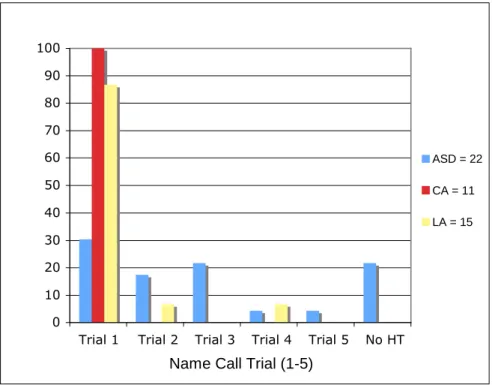
In accordance with the current literature describing a diminished behavioral response to social stimuli and specifically a name call, it was hypothesized that a similar trend would be demonstrated in this study. The behavioral data indicated that children with ASD demonstrated a significant delay in response to a name call stimulus (U = 95.5, N1 = 22, N2 = 26, p = 0.000) when compared with the TD group using a Mann Whitney U-Test. The percentages of groups to respond at each name call trial are presented in Figure 1.
0 10 20 30 40 50 60 70 80 90 100
Trial 1 Trial 2 Trial 3 Trial 4 Trial 5 No HT
Name Call Trial (1-5)
ASD = 22 CA = 11 LA = 15
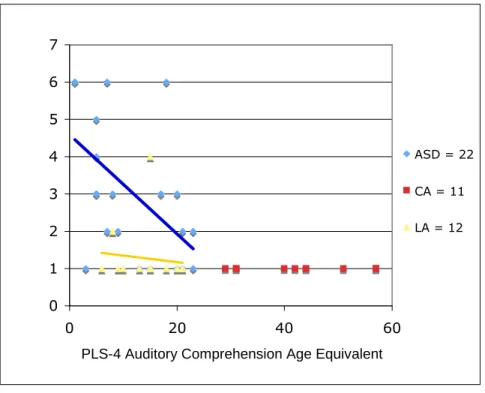
In a bivariate correlation analysis (Table 2), the ASD group showed a significant relationship between the receptive language scores and number of trials until a
behavioral response to name call. In addition, a correlational analysis, examining participants from all groups combined, yielded a significant correlation. In contrast, the correlational analysis of the children in the CA and LA groups individually demonstrated no significant relationship between their receptive language scores and response to name call. These relationships are displayed in Figure 2.
0 1 2 3 4 5 6 7
0 20 40 60
PLS-4 Auditory Comprehension Age Equivalent
ASD = 22
CA = 11
LA = 12
Figure 2: Correlation of Receptive Language and Number of Trials until a Behavioral
16
Table 2Spearman’s Rho Correlation of Head Turn Response Related to PLS-4 Auditory
Comprehension Age Equivalent Scores
Group N Spearman’s rho Sig.
All 48 -0.587 0.000
ASD 22 -0.565 0.003
LA 15 -0.259 0.176
Physiological Responses
A variety of methods were utilized to calculate change of heart rate in response to the name call. As mentioned before, two baseline measures were calculated: a 10 IBI pre-stimlulus mean and a one-second pre-stimulus mean. Using these baselines, three analyses were used to examine change in heart rate in response to the stimulus. Each baseline was compared first with the mean of 10 IBI immediately following the name call; second, with the longest IBI in 10 intervals following the name call; and last, with the shortest IBI in 10 intervals following the name call. In addition, all of these analyses were completed looking at differences (1) between the ASD and the combined TD group and (2) among the ASD, CA, and LA groups separately.
Analyses of Baselines
Because some studies have suggested that children with ASD have a generally higher baseline heart rate due to a general state of over-arousal or autonomic
group comparisons (Table 3) demonstrated a significant difference among the three groups for both baselines; however, that outcome is to be expected, since the LA group is younger, and infants tend to have higher heart rates. As seen in Tables 4 and 5, the multiple comparisons revealed that no significant differences were found between the ASD and CA groups for either baseline.
Table 3
One-way ANOVA of Baseline Differences in ASD, CA, and LA Groups
Baseline Group N M SD F (2,37) Sig.
10 IBI pre-stimulus
ASD CA LA
17 11 12
533.97 553.48 487.25
53.44 61.99 44.67
4.777 0.014*
One-second pre-stimulus
ASD CA LA
17 11 12
536.29 540.04 479.27
62.95 48.30 40.96
18
Table 4Sheffe Multiple Comparisons of 10 IBI Baseline
Groups Mean Difference Std. Error Sig. ASD CA
LA -19.51 46.72 20.72 20.19 0.645 0.082 CA ASD
LA 19.51 66.23 20.72 22.35 0.645 0.019 LA ASD
CA - 46.72 - 66.23 20.19 22.35 0.082 0.019 Table 5
Sheffe Multiple Comparisons of One-second Baselines
Groups Mean Difference Std. Error Sig. ASD CA
LA -3.74 57.03 20.63 20.10 0.984 0.026 CA ASD
LA 3.74 60.77 20.63 22.26 0.984 0.034 LA ASD
CA -57.03 -60.77 20.10 22.26 0.026 0.034
Analyses with a 10 IBI Baseline
were discovered in any of the analyses examining the change to the 10 IBI post-stimulus mean, to the longest IBI, or to the shortest IBI of 10 intervals following the first name call trial when comparing the ASD group with the combined TD group or the CA and LA groups separately.
Table 6
Repeated Measures ANCOVA of ASD and TD Groups for the 10 IBI Baseline
10 IBI baseline Comparison of
ASD and TD groups F (1,37) Sig.
Partial Eta Squared Change to mean of 10 IBI post NC 0.249 0.621 0.007
Change to Longest IBI 0.500 0.484 0.013
Change to Shortest IBI 0.048 0.828 0.001
Table 7
Repeated Measures ANOVA of ASD, CA, and LA Groups for the 10 IBI Baseline
10 IBI baseline Comparisons of
ASD, CA, and LA groups F (2,37) Sig.
Partial Eta Squared Change to mean of 10 IBI post NC 0.395 0.676 0.021
Change to Longest IBI 0.322 0.727 0.017
Change to Shortest IBI 0.190 0.828 0.010
Analyses with a One-second Baseline
20
ASD group was compared with the combined TD group using repeated measures ANCOVAs, entering chronological age as a covariate. In this analysis, the change to the mean of 10 IBI following the name call revealed a significant difference. The analysis of the change to the longest IBI approached significance, but the change to the shortest IBI revealed no significant difference. No significant differences were found for the one-second baseline when examining the ASD, CA, and LA groups separately using repeated measures ANOVAs.
Table 8
Repeated Measures ANCOVA of ASD and TD groups for the One-second Baseline
One-second IBI baseline
Comparisons of 2 Groups F (1,37) Sig.
Partial Eta Squared Change to Mean of 10 IBI post NC 4.445 0.042 0.107
Change to Longest IBI 3.302 0.077 0.082
Change to Shortest IBI 1.191 0.282 0.031
Table 9
Repeated Measures ANOVA of ASD, CA, and LA groups for the One-second Baseline
One-second IBI baseline
Comparisons of 3 Groups F (2,37) Sig.
Partial Eta Squared Change to mean of 10 IBI post NC 2.191 0.126 0.106
Change to Longest IBI 1.167 0.322 0.059
Because a significant difference was discovered when looking at the change from the one-second baseline to the mean of the 10 IBI after the name call for the ASD and TD groups, the direction of change was examined to determine whether the children in the groups demonstrated an overall increase or decrease in heart rate. As seen in Table 10, the children in the ASD group demonstrated an overall decrease in IBI (M = - 22.4), which indicated acceleration in heart rate; however, the TD group showed a slight increase in IBI (M = 4.0), indicating a minimal deceleration in heart rate.
Table 10
Change from One-second Baseline to 10 IBI post Name Call
Group Variables Mean Std. Error
95% Confidence Interval Lower Bound Upper Bound ASD One-second Baseline 520.0 14.429 490.714 549.188
10 IBI post Name Call 497.6 11.938 473.433 521.808 TD One-second Baseline 520.4 12.100 495.893 544.928 10 IBI post Name Call 524.4 10.010 504.090 544.656
22
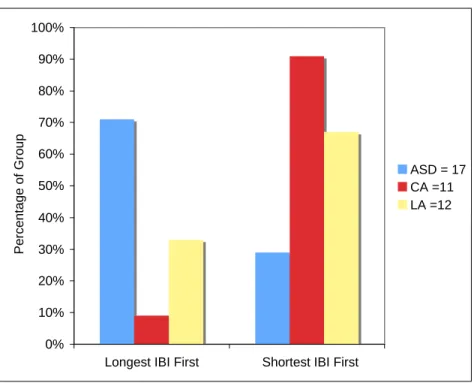
heart rate, at an initial interval and the longest IBI, or slowest heart rate at a later interval. Finally, Figure 5 demonstrates the percentage of groups to reach the longest and shortest IBI in 10 intervals following the name call and reveals a similar pattern. To summarize, in general, the ASD group demonstrates the longest IBI at an earlier interval and the shortest IBI later, demonstrating a trend to accelerate heart rate over the 10 intervals following the name call. On the contrary, the TD group experiences the shortest IBI at an earlier interval and the longest IBI later, which shows a deceleration in heart rate over the 5 seconds following the name call.
0% 5% 10% 15% 20% 25% 30% 35% 40%
1 2 3 4 5 6 7 8 9 10
Intervals
Longest Shortest
Figure 3: Percentage of ASD Group to Respond with Longest and Shortest IBIs at each
0% 5% 10% 15% 20% 25% 30% 35% 40%
1 2 3 4 5 6 7 8 9 10
Intervals
Longest Shortest
Figure 4: Percentage of TD Group to Respond with Longest and Shortest IBIs at each of
10 Intervals following the First Name Call Trial.
0% 10% 20% 30% 40% 50% 60% 70% 80% 90% 100%
Longest IBI First Shortest IBI First
P e rc e n ta g e o f G ro u p
ASD = 17 CA =11 LA =12
Figure 5: Percentage of ASD, CA, and LA Groups Reaching Longest or Shortest IBI First
24
First Trial Responders
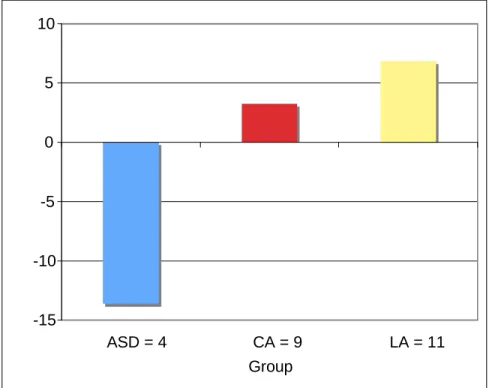
Because there were so few participants in the ASD group who responded to the first name call trial, the data could not be analyzed statistically to compare with the TD groups; however, Figure 6 demonstrates that even those participants in the ASD group who did respond on the first trial demonstrated an overall mean decrease in length of IBI (i.e., an acceleration in heart rate) when compared to the CA and LA groups.
-15 -10 -5 0 5 10
ASD = 4 CA = 9 LA = 11
Groups
Figure 6: First Time Responders to Name Call Change in IBI from One-second Baseline
Non-Responders of ASD group
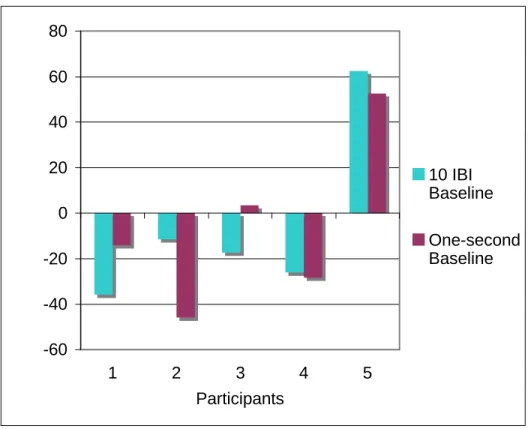
whereas one demonstrated a large increase of 62.6 IBI. When measuring the change in heart period from the one-second baseline, three of the non-responders demonstrated a decrease in IBI (- 14.0, - 45.7, -28.3); one boy demonstrated a minimal increase of 3.4 IBI; however, the same boy in the ASD group who demonstrated an increase with the 10 IBI baseline also had an increase of 52.6 IBI from the one-second baseline.
-60 -40 -20 0 20 40 60 80
1 2 3 4 5
Participants
10 IBI Baseline One-second Baseline
Figure 7: Heart Period Changes of Five Boys with ASD who did not Respond
Behaviorally to Name Call Trials
Relationship of Behavioral and Physiological Responses in ASD Group
26
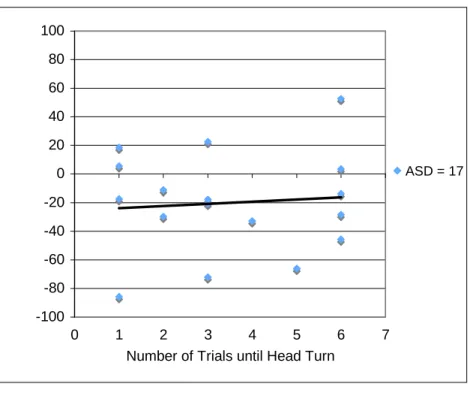
behavioral head turn response or the physiological change in heart rate in response to the first name call trial (Figures 8 and 9).
Table 11
Correlation of Behavioral and Physiological Reponses in ASD group
Baseline Spearman’s rho Sig.
10 IBI Baseline -0.119 0.324
One-second Baseline -0.024 0.464
-100 -80 -60 -40 -20 0 20 40 60 80 100
0 1 2 3 4 5 6 7
Number of Trials until Head Turn
ASD = 17
Figure 8: Correlation of Number of Head Turn Trials and Change in Heart Period from 10
-100 -80 -60 -40 -20 0 20 40 60 80 100
0 1 2 3 4 5 6 7
Number of Trials until Head Turn
ASD = 17
Figure 9: Correlation of Number of Head Turn Trials and Change in Heart Period from
CHAPTER 4 DISCUSSION
In previous studies, children with ASD have demonstrated a diminished
behavioral response to a name call (Baranek, 1999; Leekam, et al., 2006; Osterling et al., 2002; Dawson, et al., 1998; Wetherby, et al., 2004), and in some studies, have shown diminished physiological responses as well (Corona, et al. 1998; Goodwin, 2006). This study has provided insight into the nature of the orienting response of children with ASD. The results of the behavioral response were consistent with previous findings in the literature, but the physiological results provided new information about this
population’s response to a name call.
Behavioral Responses to Name Call
Due to the extensive body of research offering replicated evidence that children with ASD experience a diminished response to name call (Baranek, 1999; Leekam, et al., 2006; Osterling, et. al, 2002; Dawson, et al., 1998; Wetherby, et al., 2004), it was hypothesized that the participants in the ASD group of this study would demonstrate a similar trend. Indeed, the children with ASD in this study required more trials to respond to a name call, consistent with the hypothesis and literature.
Presti,1987). If these were the circumstances in the current study, it is possible that results of the behavioral responses were affected by the children’s inability to disengage from the video. Nevertheless, because there is no research that examines the impact of disengagement on response to a name call, it is difficult to say whether or not the disengagement issue is the underlying cause of the diminished response to the name call. A future study would need to examine responses to name call across a variety of situations to see if the diminished behavioral responses only occur in situations that require the child to disengage before orienting or in all contexts.
As mentioned before, Nadig et al. (2007) observed no correlation between the receptive language scores and response to name call in children with ASD and suggested that orienting to name call is an inherently social behavior. These investigators found that the more frequently a child with ASD demonstrated joint attention shifts in gaze was a more reliable predictor of the ability to orient to one’s name. However, in the current study, lower language age was associated with a
30
Physiological Responses to Name Call
Consistent with the available literature that examines heart rate responses of children with ASD when orienting to stimuli it was hypothesized that the ASD group would show a diminished physiological response to a name call. In this study, change in heart rate was examined using several methods. As initially proposed, the first method used the mean 10 IBI pre-stimulus baseline to examine the difference from the mean of 10 IBI immediately following the name call stimulus. Since Graham (1978) argued that calculating a mean of heart periods following a stimulus obscures the natural variability, change in heart rate was also examined by analyzing the baseline in relation to the longest and shortest IBI in 10 intervals following the name call. This allowed an
inspection of the extent to which each group’s heart rate decelerated or accelerated in response to the name call stimulus.
In addition, because there was concern about novel sounds in the video
occurring within five to eight seconds prior to the initial name call trial, an additional one-second baseline similar to Palkowitz (1980) was calculated to allow for the recovery of heart rate to occur prior to the sampling of the baseline. Each baseline was utilized to look at the amount of change to three variables: the mean, the longest IBI, and the shortest IBI of 10 intervals following the name call stimulus. Furthermore, analyses were performed to examine the ASD group with the combined TD group and with the CA and LA groups separately.
Differences in Baselines Among Groups
baselines of these two groups were similar, which reinforces the decision to use this new baseline. This information suggests that in this study, children with ASD were not in a persistent state of over-arousal or autonomic defensiveness, which would have dampened their ability to orient physiologically like the TD group. Instead, these data suggest that children with ASD were maintaining a similar heart rate to their CA peers during baseline. However, an alternative explanation will be provided later in the discussion as to how the baseline may affect the outcomes in this study.
Results with the 10 IBI Mean Baseline
In order to be thorough and follow through with the original proposed analytic strategy, the 10 IBI baseline was employed to inspect changes in heart rate. It is uncertain whether this baseline was affected by the sounds that occurred in the video prior to the first name call trial, because the available data did not include the IBIs prior to the sound. However, the results using the 10 IBI mean baseline indicated no
differences between the ASD and TD groups, combined or separately, in heart rate responses to the first name call trial.
32
one would expect when orienting to a social stimulus due to a previously established decrease in heart rate.
Results with the One-second Baseline
When examining change in heart rate utilizing the one-second baseline, there were no significant differences found among the ASD, CA, and LA groups in changes in heart rate; however, when the CA and LA groups were combined and chronological age was used as a covariate, the TD group and ASD group demonstrated a significant difference in change from this baseline to the mean of 10 IBI following the name call. Further exploration of the origin of this difference revealed the ASD group exhibited a slightly faster heart rate following name call, whereas the TD group had a slightly slower heart rate. Also, group differences approached significance when examining the
baseline change to the longest IBI in 10 intervals after the name call. Similar to the findings when examining the mean of 10 IBI following name call, this finding suggested that the children with ASD do not slow their heart rate to the extent that their TD peers do, and instead tend to show a faster heart rate. This finding may indicate that the children with ASD had a startle or aversive response to the name call stimulus, as demonstrated in previous studies (Palkowitz, 1982; Kootz, et al., 1982).
the opposite pattern of a deceleration in heart rate with the shortest IBI preceding the longest IBI.
Overall, the TD group did not demonstrate a significant change in heart rate in response to the name call, and again, this may have been due to the already slowed heart rate from their sustained attention to the video. If the participants were
experiencing a slower heart rate before the name call was presented, there may have been a threshold factor prohibiting their heart rates to slow even further, as they would were they not already focused on another stimulus.
Interestingly, when examining the four children in the ASD group who responded to the first name call, it was seen that they showed an overall decrease in IBI, or faster heart rate, whereas the TD group did not. Similarly, when looking at the five boys in the ASD group who did not respond to any of the name call trials, most demonstrated a similar acceleration in heart rate, with the exception of one participant whose heart rate slowed in a covert physiological response. These findings suggested that the majority of the children with ASD demonstrated a faster heart rate whether they were responding behaviorally or not. Yet, these findings also convey the fact that there is variability in these responses and individual exceptions in the ASD group.
Relationship between the Behavioral and Physiological Responses in ASD Group
34
Clinical Implications
It is pertinent to note that on average, the children with ASD in this study demonstrated reflexive physiological responses to the name call. In most cases, there seemed to be a tendency to respond in an aversive or startled response, causing acceleration of heart rate; however, some of the children with ASD did show an appropriate reflexive orienting response with a deceleration of heart rate. Moreover, there were some children who demonstrated minimal response in either direction. Whether this diminished physiological response is due to a lack of a reflex or simply a result of the sustained attention creating a threshold is uncertain.
In the case that a child lacks an autonomic orientation reflex, it would be more difficult to teach a child to respond behaviorally to his name, as the reflex is the foundation of the behavior. It is possible that the reflex can be triggered through the presentation of more salient stimuli or in a more engaging approach. In order to make a name call more salient, a clinician might need to be closer to the child and use maximum prompts, modeling, and reinforcement to elicit a behavioral response.
case, it may be beneficial to start by calling the child’s name in situations where the clinician already has the child’s attention, such as a physical or social game, in order to accustom the child to hearing his name called during a positive experience.
Responding to a name call is a prelinguistic skill typically developed in early infancy and is a building block for joint attention skills. Targeting the head turn in
response to a name call might be an advantageous skill taught in combination with other joint attention goals. Joint attention abilities in early years are crucial to social interaction and language development, and if these skills are targeted in intervention, it could potentially lead to better outcomes in the deficit areas associated with ASD.
Literature regarding joint attention interventions suggest using a child’s interest to engage in attention sharing is typically more successful than directing his attention to something new (Siller & Sigman, 2002; Leekam, et al., 2006). Dawson suggested children with autism are not likely to engage in joint attention activities purely for the shared social experience. Therefore, synchronizing attention with the child through his interest or focus of attention allows a caregiver or therapist to model joint attention and language skills (Dawson, Toth, Abbott, Osterling, Munson, Estes, and Liaw, 2004).
Limitations
36
caused an already decreased heart rate due to sustained attention, it is possible that waiting for this engagement from each participant to begin the trials would have not made a difference in the heart rate responses.
Last, a larger number of subjects would have provided more strength in the results to detect differences between groups. In addition, it would have been beneficial to have more IBI data prior to the name call to gain a mean baseline over a longer period of time, which would even out the variability that occurs in heart rate within shorter durations.
Future Directions
A replication of this study with consideration to some of the limitations would be a valuable contribution to the knowledge base. It would also be interesting to examine the physiological data to compare lag time before each group demonstrates a change in heart rate in response to a name call to see if there are differences in response time. Another study may also investigate the developmental trajectory of responses to name call over time in order to establish whether children with ASD improve in their ability to respond to name call later in life. In addition to resolving limitations already mentioned, a larger number of participants in future studies would allow a more reliable comparison of groups. Furthermore, future research could examine heart rate in orienting response to other stimuli, either a comparison between contexts (non-social and social stimuli) or among sensory modalities (visual, auditory, and tactile stimuli).
Conclusions
or startle physiological response in heart rate when compared with their TD peers. The implications of these findings suggest that in order for young children with ASD to learn to respond to their name, a clinician must assess whether a child would need either a sensitive and unobtrusive approach or a more salient stimulus. All things considered, responding to a name is an imperative fundamental skill in the early years of
development, upon which later language development and other developmental
milestones rely. Therefore, the knowledge attained from this and future studies about the orienting responses of children with ASD is important to our ability to teach these
38
REFERENCES
Althaus, M., Van Roon, A. M., Mulder, L. J., Mulder, G., Aarnoudse, C. C., & Minderaa, R. B. (2004). Autonomic response patterns observed during the performance of an attention-demanding task in two groups of children with autistic-type difficulties in social adjustment. Psychophysiology, 41(6), 893-904.
American Psychiatric Association (Ed.). (2000). Diagnostic and statistical manual of
mental disorders, (DSM-IV) (Fourth ed.). Washington, D.C.: American Psychiatric
Association.
Attention and orienting: Sensory and motivational processes In edited by Lang P. J. and
Simons R. F. (Eds.), Mahwah, N.J.: Lawrence Erlbaum Associates, c1997. Axelrod, F. B., Chelimsky, G. G., & Weese-Mayer, D. E. (2006). Pediatric autonomic
disorders. Pediatrics, 118(1), 309-321.
Baranek, G. T. (1999). Autism during infancy: A retrospective video analysis of sensory-motor and social behaviors at 9-12 months of age. Journal of Autism &
Developmental Disorders, 29(3), 213-224.
Beauchaine, T. (2001). Vagal tone, development, and gray's motivational theory: Toward an integrated model of autonomic nervous system functioning in psychopathology.
Development and Psychopathology, 13(2), 183-214.
Berntson, G. G., Bigger, J. T., Eckberg, D. L., Grossman, P., Kaufmann, P. G., Malik, M., et al. (1997). Heart rate variability: Origins, methods, and interpretive caveats.
Psychophysiology, 34(6), 623-648.
Berntson, G. 0., Bigger, T., Eckberg, D. L., Grossman, P., Kaufmann, P. G., Malik, M., et al. (1997). Heart rate variability: Origins, methods, and interpretive caveats.
Psychophysiology, 34(6), 623-648.
Casey, B. J., & Richards, J. E. (1991). A refractory period for the heart rate response in infant visual attention. Developmental Psychobiology, 24(5), 327-340.
Colombo, J., Richman, W. A., Shaddy, D. J., Greenhoot, A. F., & Maikranz, J. M. (2001). Heart rate-defined phases of attention, look duration, and infant performance in the paired-comparison paradigm. Child Development, 72(6), 1605-1616.
Corona, R., Dissanayake, C., Arbelle, S., Wellington, P., & Sigman, M. (1998). Is affect aversive to young children with autism? Behavioral and cardiac responses to experimenter distress. Child Development, 69(6), 1494-1502.
Courage, M. L., Reynolds, G. D., & Richards, J. E. (2006). Infants' attention to patterned stimuli: Developmental change from 3 to 12 months of age. Child Development,
77(3), 680-695.
autism fail to orient to naturally occurring social stimuli. Journal of Autism &
Developmental Disorders, 28(6), 479-485.
Dawson, G., Toth, K., Abbott, R., Osterling, J., Munson, J., Estes, A., et al. (2004). Early social attention impairments in autism: Social orienting, joint attention, and
attention to distress. Developmental Psychology, 40(2), 271-283.
Fernandez-Duque, D., & Posner, M. I. (1997). Relating the mechanisms of orienting and alerting. Neuropsychologia, 35(4), 477-486.
Goodwin, M. S., Groden, J., Velicer, W. F., Lipsitt, L. P., Baron, M. G., Hofmann, S. G., et al. (2006). Cardiovascular arousal in individuals with autism. Focus on Autism &
Other Developmental Disabilities, 21(2), 100-123.
Graham, F. K. (1978). Constraints on measuring heart rate and period sequentially through real and cardiac time. Psychophysiology, 15(5), 492-495.
Graham, F. K. (1978). Normality of distributions and homogeneity of variance of heart rate and heart period samples. Psychophysiology, 15(5), 487-491.
Graham, F. K., & Clifton, R. K. (1966). Heart-rate change as a component of the orienting response. Psychological Bulletin, 65(5), 305-320.
Harris, N. S. (1999). Neuroanatomic contributions to slowed orienting of attention in children with autism. Brain Research.Cognitive Brain Research, 8(1), 61. Hirstein, W., Iversen, P., & Ramachandran, V. S. (2001). Autonomic responses of
autistic children to people and objects. Proceedings.Biological Sciences / the
Royal Society, 268(1479), 1883-1888.
Hunter, S. K., & Richards, J. E. (2003). Peripheral stimulus localization by 5- to 14-week-old infants during phases of attention. Infancy, 4(1), 1-25.
Kootz, J. P., Marinelli, B., & Cohen, D. J. (1982). Modulation of response to environmental stimulation in autistic children. Journal of Autism and
Developmental Disorders, 12(2), 185-193.
Kootz, J. P., & Cohen, D. J. (1981). Modulation of sensory intake in autistic children: Cardiovascular and behavioral indices. Journal of the American Academy of Child
Psychiatry, 20(4), 692-701.
Kootz, J. P., Marinelli, B., & Cohen, D. J. (1981). Sensory receptor sensitivity in autistic children: Response times to proximal and distal stimulation. Archives of General
Psychiatry, 38(3), 271-273.
Landry, R., & Bryson, S. E. (2004). Impaired disengagement of attention in young children with autism. Journal of Child Psychology and Psychiatry, and Allied
Disciplines, 45(6), 1115-1122.
40
Development, 68(4), 610-620.
Leekam, S. R., Lopez, B., & Moore, C. (2000). Attention and joint attention in preschool children with autism. Developmental Psychology, 36(2), 261.
Leekam, S. R., & Ramsden, C. A. H. (2006). Dyadic orienting and joint attention in preschool children with autism. Journal of Autism and Developmental Disorders,
36(2), 185-197.
Lord, C., Risi, S., Lambrecht, L., Cook, E. H., Leventhal, B. L., DiLavore, P. C., et al. (2000). The Autism Diagnostic Observation Schedule—Generic: A standard measure of social and communication deficits associated with the spectrum of autism. Journal of Autism and Developmental Disorders, 30(3), 205.
Ming, X., Julu, P. O., Brimacombe, M., Connor, S., & Daniels, M. L. (2005). Reduced cardiac parasympathetic activity in children with autism. Brain & Development,
27(7), 509-516.
Osterling, J. A., Dawson, G., & Munson, J. A. (2002). Early recognition of 1-year-old infants with autism spectrum disorder versus mental retardation. Development and
Psychopathology, 14(02)
Osterling, J., & Dawson, G. (1994). Early recognition of children with autism: A study of first birthday home videotapes. Journal of Autism and Developmental Disorders,
24(3), 247-257.
Palkovitz, R. J., & Wiesenfeld, A. R. (1980). Differential autonomic responses of autistic and normal children. Journal of Autism and Developmental Disorders, 10(3), 347-360.
Porges, S. W. (1995). Orienting in a defensive world: Mammalian modifications of our evolutionary heritage. A polyvagal theory. Psychophysiology, 32(4), 301-318. Posner, M. I., & Petersen, S. E. (1990). The attention system of the human brain. Annual
Review of Neuroscience, 13(1), 25-42.
Posner, M. I., Cohen, Y., & Rafal, R. D. (1982). Neural systems control of spatial orienting. Philosophical Transactions of the Royal Society of London. Series B,
Biological Sciences, 298(1089, The Neuropsychology of Cognitive Function),
187-198.
Posner, M. I., & Presti, D. E. (1987). Selective attention and cognitive control. Trends in
Neurosciences, 10(1), 13-17.
Richards, J. E. (1980). The statistical analysis of heart rate: A review emphasizing infancy data. Psychophysiology, 17(2), 153-166.
infant visual attention. Developmental Psychobiology, 40(3), 226-236.
Rutter, M., Le Couteur, A., & Lord, C. (2003). Autism Diagnostic Interview-Revised (ADI-R). (). Los Angeles: Western Psychological Services.
Schoepler, E., Reichler, R. J., & Renner, B. R. (1988). The Childhood Autism Rating
Scale (CARS). Los Angelos: Western Psychological Services.
Sigman, M., Dissanayake, C., Corona, R., & Espinosa, M. (2003). Social and cardiac responses of young children with autism. Autism: The International Journal of
Research and Practice, 7(2), 205-216.
Siller, M., & Sigman, M. (2002). The behaviors of parents of children with autism predict the subsequent development of their children's communication. Journal of Autism
and Developmental Disorders, 32(2), 77-89.
Swettenham, J. J. (1998). The frequency and distribution of spontaneous attention shifts between social and nonsocial stimuli in autistic, typically developing, and
nonautistic developmentally delayed infants. Journal of Child Psychology and
Psychiatry and Allied Disciplines, 39(5), 747-753.
Toichi, M., & Kamio, Y. (2003). Paradoxical autonomic response to mental tasks in autism. Journal of Autism and Developmental Disorders, 33(4), 417-426. van Hover, K. I. (1974). A developmental study of three components of attention.
Developmental Psychology, 3(10), 330-339.
Vila, J., Guerra, P., Muñoz, M. Á, Vico, C., Viedma-del Jesús, M. I., Delgado, L. C., et al. (2007). Cardiac defense: From attention to action. International Journal of
Psychophysiology, 66(3), 169-182.
Wetherby, A. M., Woods, J., Allen, L., Cleary, J., Dickinson, H., & Lord, C. (2004). Early indicators of autism spectrum disorders in the second year of life. Journal of
Autism & Developmental Disorders, 34(5), 473-493.
Zimmerman, I. L., Steiner, V. G., & Pond, R. E. (2002).
Preschool Language Scale (4th ed.). San Antonio, TX: The Psychological