Jeanne Alongi
A dissertation submitted to the faculty of the University of North Carolina at Chapel Hill in partial fulfillment of the requirements for the degree of Doctor of Public Health in the Gillings School of Global Public Health.
Chapel Hill 2013
Approved by:
Rebecca Wells, PhD
Leslie Best, BSW
Leah Devlin, DDS, MPH
Sandra Greene, DrPH
ABSTRACT
JEANNE ALONGI: A case study examination of structure and function in a state health department chronic disease unit
(Under the direction of Rebecca Wells, PhD)
Public health agencies at all levels have struggled to identify the optimum structure
to support administrative and programmatic efficiencies that will maximize public health
impact with the available resources. Although public health effectiveness literature
documents how a state health department should function to achieve the intended impact
on population health, little is known about how organizational structure changes actually
affect function, and ultimately, population health. Focusing on the chronic disease unit of a
state health department, this case study examined attributes (how an organization is
structured) and practices (how an organization operates). Methods for this case study
included document review and key informant interviews of health department staff and
external stakeholders.
Data analysis suggests that the relationship between attributes and practices is
complex and that organizational structure may influence not just practice but also other
attributes such as goal ambiguity and workforce competency. Although the correlation
analysis did not show a significant association between effectiveness and any of the
elements in the conceptual model, qualitative responses indicate a belief that evidence-‐
contributing to each of those elements. Structure was identified as an influence on
collaboration, responsiveness, goal ambiguity, and hierarchical authority. However, the
roles of three other elements -‐-‐ culture, leadership, and physical proximity – were less clear,
and either mitigated the effects of structure, enhanced the effects of structure, or were
amplified by structure.
This study has served both to document a point in time for Montana’s Bureau of
Chronic Disease Prevention and Health Promotion and to explore the elements of the
conceptual model that may facilitate effectiveness for chronic disease units in other states,
other units in within state health departments, and public health agencies at other levels.
The results of the qualitative and quantitative analysis suggest interrelationships between
the elements of the model rather than a simple linear cause and effect pathway. These
findings identify levers around which capacity can be built that may strengthen the
effectiveness of state health department chronic disease units.
and
For all public sector public health practitioners and diligent stewards of the public trust
and
Any mistakes or failures in the work are mine and mine alone but all the good herein is a product of the instruction, assistance, guidance, and inspiration of my teachers,
mentors, colleagues, and loved ones. I submit this work with deep gratitude. Your generosity will stay with me always.
The teachers who challenged me to think critically, argue succinctly, and study with an open heart and an open mind; especially: Ned Brooks, Olaf Ellers, Rick Grosberg, Jude Mohan, Janet Papale, Tom Ricketts, Dante Verme, and Bennett Waters.
The colleagues and mentors who set a high bar of professional excellence, collaboration, and asking the so-‐what questions about public health practice in general and this dissertation topic in particular; especially: Jennifer Alexander, Ross Brownson, Dorothy Cilenti, Ginny Harris, Jeff Harris, Jim Marks, Jerrica Mathis, Maggie Moore, Anita Ruff, Ramona Rusinak, Joe Sneizek, and Fran Wheeler.
The chronic disease prevention and control staff working in and with state health departments who talked through many iterations of this effort, piloted the interview tool, and participated in this research; especially: Denise Cyzman, Ginny Furshong, Dona Goldman, Chuck Gollmar, Sue Grinnell, Tonia Hagaman, Todd Harwell, Jobeth McCarthy-‐Jean, Jane Smiley, Dani Wong-‐Tomiyasu, and the Montana Bureau of Chronic Disease Prevention and Health Promotion.
The members of my committee who helped me grow this from a small kernel into the living, breathing foundation of my life’s work: Leslie Best, Leah Devlin, Sandra Greene, Suzanne Havala Hobbs, and Rebecca Wells.
The members of Cohort 3 who, with nearly endless endurance, have supported me intellectually, dissertationally, spiritually, and emotionally; especially Jill Center, Dianne Dunning, Joanne Pike, Wendy Sarratt, and Rachael Wong.
LIST OF TABLES ... ix
LIST OF FIGURES ...x
CHAPTER 1: INTRODUCTION...2
Purpose...2
Background...2
The Importance of Chronic Disease Prevention and Control ...2
The Role of State Health Departments...3
Current Trends in Public Health Administration...4
Specific Aims:...8
CHAPTER 2: LITERATURE REVIEW AND MODEL DEVELOPMENT ...10
Findings from the Literature Review ...10
Model Development...14
CHAPTER 3: METHODS ...16
Research Question...17
Case Definition ...17
Study Design...17
Case Identification...19
Data Collection and Analysis ...19
Interview Pilot ...22
CHAPTER 4: RESULTS ...31
Document Review ...31
Interviews -‐ Quantitative Findings...37
Interviews -‐ Qualitative Findings ...43
Synthesis...53
Results Summary ...56
CHAPTER 5: PLAN FOR CHANGE ...59
Recommendation #1: Recognize organizational capacity as a key component of public sector public health effectiveness. ...61
Recommendation #2: Nurture unit level capacity development. ...63
Recommendation #3: Reorient partner relationships...65
APPENDIX 1: LITERATURE REVIEW SUMMARY...68
APPENDIX 2: PHFAST ...78
APPENDIX 3: WORKFORCE COMPETENCY TOOL ...86
APPENDIX 4: INTERVIEW GUIDE ...95
APPENDIX 5: INTERVIEW RECORD ...98
APPENDIX 6: DEDOOSE DATA IDENTIFIERS ...101
APPENDIX 7: MONTANA BUREAU OF CHRONIC DISEASE PREVENTION AND HEALTH PROMOTION ORGANIZATIONAL CHART...102
BIBLIOGRAPHY...103
LIST OF TABLES
Table 1: Public Health Framework Assessment Tool Domains...7
Table 2: Literature Review Empirical Findings...10
Table 3: Data Collection Strategy ...20
Table 4: Interview Question Topics ...21
Table 5: Interview Pilot Volunteer Respondents...23
Table 6: Study Participants ...25
Table 7: Code Development ...30
Table 8: PHFAST Opportunities and Follow-‐up Themes ...36
Table 9: Chi-‐Square Analysis of Conceptual Model Elements ...43
LIST OF FIGURES
Figure 1: Conceptual Model – Organizational Attributes and Practices
in State Health Department Chronic Disease Units...15
Figure 2: Iterative Coding Process ...27
Figure 3: Basic Structure of the Bureau of Chronic Disease Prevention and Health Promotion ...32
Figure 4: PHFAST Survey Results ...35
Figure 5: Perception of the Bureau’s Collaborative Ability...38
Figure 6: Confidence in Decision-‐Making ...38
Figure 7: Goal Ambiguity by Organizational Level...39
Figure 8: Internal and External Political Support...40
Figure 9: Educational Background within the Bureau ...41
Figure 10: Confidence in Bureau-‐wide Workforce Competency ...41
Figure 11: Effectiveness by Organizational Level ...42
Figure 12: Goal Ambiguity by Structural Level ...47
Figure 13: Conceptual Model Element Relationships...58
CHAPTER 1: INTRODUCTION
Purpose
Describe organizational structure and function in a state health department chronic
disease prevention and control unit, and explore the possible roles of organizational
attributes and practices in driving performance outcomes.
Background
The Institute of Medicine’s 1988 report “The Future of Public Health” defined public
health as “what we, as a society, do collectively to ensure the conditions for people to be
healthy” and called for changes in practice, professionalism, and infrastructure. It also
included specific recommendations for state health departments to adopt in order to
facilitate these changes.(40) In the years since, the focus of public health practice has shifted
from the prevention of communicable diseases to the mitigation of the impact of chronic
disease. Concurrently, public health practice has expanded to include an emphasis on
ensuring rigorous application of the evidence-‐base in developing and deploying
interventions, as well as a commitment to building a competent public health workforce
and effective infrastructure. In the past decade, public health decision makers have begun
interventions and to preserve fidelity in the practical translation of intervention research.(1, 7,
10, 16, 25, 29, 35, 38, 39, 40, 48, 65, 66, 67, 75, 79, 81, 86, 89)
Although public health evaluators have proposed guidelines for professional and
organizational competencies, the role of the structure of public health agencies in
facilitating effective functioning has not been closely examined. This dissertation examines
the organizational attributes and practices of a state health department, focusing
specifically on the role of the chronic disease prevention and control unit. Findings will
assist the state health department in identifying levers of effectiveness and will inform
future empirical work in this area.
The Importance of Chronic Disease Prevention and Control
Chronic diseases are the leading causes of death in the United States.(59) In 2000, heart disease, cancer, and stroke were responsible for more deaths in the United States than all
other causes combined. The landmark 1993 paper by McGinnis and Foege identified
tobacco use, diet, and activity patterns as responsible for 700,000 deaths in 1990 -‐-‐ more
than all other risk factors combined. Since then, these and other modifiable risk factors
have been the focus of preventing morbidity and mortality from chronic disease, including
secondary disability.
Beginning with the release of “Healthy People 2000” – the first set of national
population health goals(40) – chronic disease prevention and control activities have been a
top priority for the public health system in the U.S. Health indicators in the Healthy People
activity and fitness, nutrition, tobacco use, heart disease and stroke, cancer, arthritis, and
diabetes.
The Role of State Health Departments
State health departments are part of a system of organizations whose mission is to improve the population’s health. This system also includes national agencies such as the
U.S. Department of Health and Human Services, the U.S. Public Health Service, and the
Centers for Disease Control and Prevention (CDC); local agencies such as local health
departments and community-‐based organizations; academic institutions; voluntary and
non-‐profit organizations; and hospitals and other health centers.
According to the Association of State and Territorial Health Officials (ASTHO), state
health departments protect public health by “gathering, analyzing, and disseminating health
information; regulating health threats and potential hazards; preparing for and responding
to disasters and emergencies that threaten public health; providing health care services and
programs; regulating healthcare services and professionals; and paying for healthcare
services to assure access.”(2) At the state level, chronic disease prevention activities are
typically part of a portfolio that incorporates programs related to maternal and child health,
communicable disease response, injury prevention, oral health promotion, reproductive
health promotion, emotional/mental health and substance misuse, emergency
preparedness, WIC, health care facility regulation, and access to primary care services. The
range of activities undertaken in a given state reflect executive and legislative action at the
considerably.(2, 3, 4, 5) Because state health departments vary so much in structure, funding
levels, and political setting, no single state health department could be considered
representative of the whole.
CDC specifically funds state health departments to assume a leadership role in chronic
disease prevention and control activities. This occurs through categorical disease and risk
factor reduction program grants, the Coordinated Chronic Disease Program grant, and the
Preventive Health and Health Services Block Grant. Currently, states, territories, and in
some instances tribes, receive CDC support and technical assistance to both deliver public
health programs and population-‐level health improvement in categorical disease areas, and
to address risk factors. Categorical disease areas include arthritis, breast and cervical
cancer, comprehensive cancer, depression and mental health, epilepsy, heart disease and
stroke, and oral health. Grants to address risk factors include those targeted at physical
activity, obesity, healthy communities, school health, healthy aging, and healthy eating. No
state, territory, or tribe receives support in all of these areas. Support may be in the form
of funding, staff detail, tools and resources, or technical assistance.
Current Trends in Public Health Administration
State-‐level public health agencies and their funders, faced with difficult economic
realities, are increasingly looking for administrative and programmatic efficiencies that will
maximize public health impact with the available resources. Three recent initiatives in
accreditation, the National Prevention Strategy, and Coordinated Chronic Disease funding
from CDC.
State and local level public health department accreditation by the Public Health
Accreditation Board is now underway with more than 100 health departments having
applied for accreditation in 2012. Funded in part by the Robert Wood Johnson Foundation
and the CDC, this effort intends to assure a minimum level of functioning and effectiveness
in public sector public health practice. Although accreditation is currently voluntary,
accreditation status may impact competitiveness for funding in the near future.(12, 28)
The National Prevention, Health Promotion, and Public Health Council released the
National Prevention Strategy in June 2011 (66). This strategy is intended to focus public
health efforts at all levels. Specifically, the National Prevention Strategy calls on all states to
collaborate on policy decisions regarding health, conduct comprehensive health needs
assessments, deliver effective public health interventions, and promote shared data-‐
systems in the areas of tobacco-‐free living, preventing drug and alcohol misuse, healthy
eating, active living, injury and violence prevention, reproductive and sexual health, and
mental and emotional well-‐being. In the future, the strategy will likely be used as a basis for
evaluating state health departments applying for federal grants.
In the summer of 2011, the National Center for Chronic Disease Prevention and
Control released funding for state health departments to implement new structural and
operational interventions to coordinate chronic disease prevention activities across
categorically defined programs. This funding opportunity was preceded by ten years of
departments, and CDC to explore the opportunities for chronic disease program integration
and the possibility that administrative changes to federally-‐funded chronic disease
programs could result in functional and fiscal efficiencies.(64, 65, 79) CDC is currently finalizing
a pilot project in which four select states negotiated their entire chronic disease portfolios
rather than receive separate categorical grants. The evaluation of this integrated funding
model and its impact on public health outcomes is underway.
Public health agencies at all levels have struggled to identify the optimum structure
to support these efficiencies. The pressures of accreditation and coordinated chronic
disease funding have resulted in small and large-‐scale organizational changes. These
changes range from alterations in leadership – in the last 12 months, 64% of state health
officers were new hires – to structural reorganization.(9, 65) In spite of a clear directive from
authorities at all levels to use evidence-‐based decision-‐making in public health issues,(16, 25,
66) and the broad uptake of evidence-‐based interventions for risk factor reduction, the
evidence linking organizational structure and public health outcomes remains undeveloped.
State health departments have had very little evidence to apply in creating highly efficient
public health organizational structures that maximize population health outcomes.(26, 78)
Despite this lack of evidence, the assumption is that an effectively-‐run state health
department that facilitates evidence-‐based decision-‐making by competent professional
staff employing adequate resources will improve population health.(57, 62) Various programs
and tools, such as the Public Health Accreditation Board’s voluntary accreditation process,
the NACDD’s State Technical Assistance Review (STAR) program, and the Public Health
effectiveness. Both STAR and PHFAST are based on a framework for chronic disease
prevention and control published by CDC in 2003.(18) These tools help assess a state health
department’s capacity according to the framework in eight domains as described in Table
1.(64)
Table 1: Public Health Framework Assessment Tool Domains
Domain Definition
Leadership The state chronic disease prevention and control unit is the unifying voice for the prevention and control of chronic diseases. Epidemiology and
Surveillance The state chronic disease prevention and control unit establishes the burden associated with chronic diseases and frames the problem to be addressed.
Partnerships The state chronic disease prevention and control unit establishes strong working relationships with other government agencies and with nongovernmental, lay and professional groups. State Plans The state chronic disease prevention and control unit uses data
and works with partners to develop comprehensive state plans to guide program efforts.
Interventions The state chronic disease prevention and control unit identifies specific targets for change (population segments, organizations, or environments), chooses the best channels through which to effect such changes, and selects appropriate strategies for doing so.
Evaluation The state chronic disease prevention and control unit establishes systematic approaches for determining whether its
comprehensive chronic disease control program is being implemented successfully and whether its objectives are being achieved.
Program
Management and Administration
The state chronic disease prevention and control unit provides the consistent administrative, financial, and staff support necessary to maintain successful programs.
Program
Coordination The state chronic disease unit has strategically aligned chronic disease categorical program resources to increase the effectiveness and efficiency of each program in a partnership without compromising the integrity of categorical program objectives.
Although public health effectiveness literature documents how a state public health
department should function to achieve the intended impact on population health, little is
known about how organizational structure changes actually affect function, and ultimately,
population health. This dissertation will describe, through examination of a case study,
organizational structure as it relates to function in a state health department chronic
disease unit, in order to improve outcomes.
Specific Aims:
1. Describe the organizational attributes and practices of a state health department
chronic disease prevention and control unit.
2. Identify potential influences of a state health department chronic disease prevention
and control unit structure on function related to chronic disease prevention and control.
3. Develop a plan for change that operationalizes findings by leveraging structural
CHAPTER 2: LITERATURE REVIEW AND MODEL DEVELOPMENT
I conducted a formal literature review by initially searching for peer-‐reviewed
literature that addressed organizational effectiveness and structure in state health
departments. I then conducted an Internet search for reports and recommendations from
organizations working to build state health department capacity. I expanded the
assessment to include non-‐profit and private sector organizations as well as other types of
government agencies. I scanned the bibliographies of all relevant documents for potential
additional sources. Finally, I queried experts in the field of state public health practice for
potential sources of information. Findings from the literature review were used to develop
a conceptual model depicting the relationship between organizational attributes and
practices in chronic disease units of state health departments. The conceptual model is
discussed later in this chapter.
Findings from the Literature Review
While measures of organizational effectiveness and functional domains related to
organizational effectiveness were found, no specific investigation of the relationship
disease prevention activities was present in the literature. Few articles reported empirical
studies of effectiveness relevant to this inquiry. Those references that were empirical in
nature reported findings consistent in a few thematic areas. Structural attributes including
staffing levels, stability, resource levels, and organizational change were found to impact
effectiveness.(7, 27, 31, 32, 34, 81) Workforce competency including leadership, experience level,
technical skills, professionalism were linked to effectiveness.(7, 13, 34, 43) Evidence-‐based
decision-‐making, performing essential services, goal clarity, and managing uncertainty were
also linked to effectiveness.(7, 31, 43, 57, 81) Table 2 highlights the findings of empirical studies
(see Appendix 1 for a comprehensive summary table).
Table 2: Literature Review Empirical Findings
Citation Relevant conclusions
Ballew P, Brownson RC, Haire-‐Joshu D, et al. Dissemination of effective physical activity interventions: Are we applying the evidence? Health Education Research. Oxford
University Press. 2010.(7)
Defined effectiveness as using evidence-‐ based public health interventions. Infrastructure stability (budget cuts and newness of staff) and training affected organization's ability to implement
evidence-‐based programs.
Bhandari MW, Scutchfield FD, Charnigo R, et al. New data, same story? Revisiting studies on the relationship of local public health systems characteristics to public health performance. J Public Health Management & Practice. 2010;16(1):110-‐117.(13)
Related system organization to performance at local level. Agency organization not investigated. Correlated workforce competency, including leadership positions, with performance.
Erwin PC, Greene SB, Mays GP, et al. The association of changes in local health
department resources with changes in state-‐ level health outcomes. Am J Public Health. 2011;101(4):609-‐615.(27)
Used changes in state-‐level health outcomes to measure local health department effectiveness.
Increase in full time equivalents correlated with a decrease in cardio vascular disease deaths.
Gist ME, Locke EA, Taylor MS. Organizational behavior: Group structure, process, and effectiveness. J of Management.
1987;23(2):237-‐257.(31)
Citation Relevant conclusions
Greenhalgh. Maintaining organizational effectiveness during organizational
retrenchment. J Applied Behavioral Science. 1982;18(2):155-‐170.(32)
Examined effectiveness in the context of organizational change. Personnel change and turnover can reduce organizational effectiveness.
Hajat A, Cilenti D, Harrison LM, et al. What predicts local public health agency
performance improvement? A pilot study in North Carolina. J Public Health Management & Practice. 2009;15(2):E22-‐E33.(34)
Correlated staffing level and experience, particularly having more non-‐health staff such as IT, to performance improvement.
Kimberly JK, Rottman DB. Environment, organization and effectiveness: A biographical approach. J of Management Studies.
1987;24(6):595-‐597.(43)
Postulated that structure, professionalism and evidence-‐based decision-‐making directly influence effectiveness.
Mays GP, McHugh MC, Shim K, et al.
Institutional and economic determinants of public health system performance. Am J Public Health. 2006;96(3):523-‐531.(57)
Equated essential services with effective outcomes in local health departments.
Stazyck EC, Goerdel HT. The benefits of bureaucracy: Public managers’ perceptions of political support, goal ambiguity, and
organizational effectiveness. J Public Administration Research and Theory. 2010;21:645-‐672.(81)
Emphasized performance over procedure in ability to respond to external environment. Highlighted the importance of managing
uncertainty related to environmental
sources.
Other references in the literature echoed these empirical findings and proposed
additional organizational traits and behaviors that may influence effectiveness. Aspects of
the organization that were related to structure and infrastructure included reporting as well
as collaborative relationships, location of resources, location of authority, and location of
responsibility. Structure and infrastructure were often used interchangeably, though in
some instances a distinction could be inferred; structure referred to a specific and discrete
infrastructure that is both stable (i.e., predictable and reliable) and dynamic (i.e., responsive
to changing needs and resources). Function, operations, and performance were all used to
describe how an organization achieved its goals. The measurement of organizational
effectiveness used most consistently is perceived effectiveness.(31, 36, 46, 81, 57, 81)
Of particular interest was a model of organizational performance proposed and
tested by Stazyk and Gordel.(81) Drawing on resource dependence and contingency theories,
the authors proposed and then showed that hierarchical authority in health and human
services bureaucracies could moderate the negative effects of goal ambiguity and low
political support on organizational performance. Hierarchical authority describes
centralization in decision-‐making. Goal ambiguity describes the extent to which
organizational goals are understood by the staff. Political support describes the level of
endorsement a program receives from decision makers inside the organization as well as
policy makers external to the organization.(81)
Four elements were especially prominent in the literature and relevant to current
performance improvement activities nationwide; they are therefore included in the
conceptual model detailed below. These elements include collaboration, evidence-‐based
decision-‐making, workforce competency, and responsiveness. They are defined as follows:
Collaboration: working internally and externally for the purpose of leveraging
resources to maximize effectiveness and efficiency.(18, 75, 80) Increasingly, expert opinion has
called for better collaboration and coordination in the practice of public health generally(55,
59, 64, 74, 85) and for chronic disease prevention and control specifically.(64, 65, 79) The Public
and control capacity building efforts funded by CDC include measures for internal and
external collaboration.(12, 68) The National Center for Chronic Disease Prevention and Health
Promotion at CDC has created a special grant program to support the development of
collaborative capacity in chronic disease units in state health departments.
Evidence-‐based decision-‐making: the conscientious, explicit, and judicious use of
current best evidence in making decisions about the care of populations.(16) There is little
disagreement that evidence-‐based decision-‐making is critical to effective public health
practice. Factors affecting evidence-‐based decision-‐making in state health department
chronic disease units include awareness, funding, incentives, CDC support, staff competency,
staff motivation, and strong partnerships and collaboration. Some researchers have
suggested that structure may constrain staff influence on collaboration, but this has not
been specifically studied.(1, 7, 16, 18, 33, 45)
Responsiveness: the ability of the organization to react dynamically to changes in
the political environment and address emerging public health needs. Review of the
literature suggests that flexibility, surge capacity or the ability to expand activities as
needed, entrepreneurial strategies, and innovation are key to dynamic effectiveness in state
health departments. These attributes allow the organization to adapt to changing
environments, resource levels, political support, health trends, and intervention science.
While researchers have identified organizational structure as potentially supportive of
responsiveness,(8, 12, 39, 40, 45) this relationship has not been studied empirically.
Workforce competency: the level of skill, professionalism, and knowledge present
health practice in general and identified minimum skill and knowledge sets for chronic
disease practitioners specifically. Researchers have also documented the value of training
to develop, maintain, and even improve competency. Finally, researchers have suggested
that organizational structure impacts specialization, technical complexity, and
professionalism – all components of workforce competency –but again, this relationship has
not been studied. (18, 31, 43, 88)
Model Development
While it is clear that these performance improvement elements contribute to
effectiveness, the specific relationship between these elements and the organizational
structure is not clear. In order to frame the dissertation, I attempted to develop a
conceptual model that would identify attributes and practices that might appropriately
relate the organizational structure of the state health department chronic disease unit to its
effective functioning. The initial model included 10 factors derived both from the literature
and expert opinion sources. With no documented consensus on how these factors might
relate to each other, to structure, and to effectiveness, the initial model was enormously
complicated. Consequently, I reexamined the literature, refined the categories, and
identified the most critical factors. This effort resulted in a model that acknowledges
multiple dimensions of structure and focuses on specific aspects of performance that the
literature suggests may be of primary importance. For the purpose of this study, these
elements are considered in two groups and defined as follows: attributes are elements that
operates. The resulting model includes the attributes of hierarchical authority, goal
ambiguity and political support taken from Stazyk and Goerdel’s model of organizational
performance,(81) and also incorporates evidence-‐based decision-‐making, responsiveness,
and collaboration (Figure 1).
The organizational attributes of goal ambiguity, hierarchical authority, organizational
structure, political support, and workforce competency form the center of the figure.
Organizational practices including evidence-‐based decision-‐making, responsiveness, and
collaboration encircle the attributes. This dissertation will attempt to discern the
connection between these attributes and practices, how they contribute to overall
organizational performance, and ideally, to improved population health.
Figure 1: Conceptual Model – Organizational Attributes and Practices in State Health Department Chronic Disease Units
!
JAlongi!August!2012!c!!
! !!!!!
!
Attributes:* Goal!Ambiguity! Hierarchical!Authority! Organizational!Structure!
Political!Support! Workforce!Competency! Evidence@
based! Decision@
making!
Responsiveness!
! Collaboration!
Organizational! Performance! Practices*
Practic
es*
Pr
act
ices
*
?!
?! ?!
CHAPTER 3: METHODS
This dissertation uses case study methods to describe how the attributes and
practices of one state health department chronic disease prevention and control unit relate
to the conceptual model described in Chapter 2 to drive performance outcomes.
Yin defines a case study as “an empirical inquiry that investigates a contemporary
phenomenon in depth and within its real-‐life context, especially when the boundaries
between phenomenon and context are not clearly evident.”(90) In this study, the
phenomenon described includes organizational practices such as evidence-‐based decision-‐
making, responsiveness, and collaboration. Context would include organizational attributes
such as goal ambiguity, hierarchical authority, structure, political support, and workforce
competency. Case study methods are particularly appropriate to employ when the
complexity of the case requires use of multiple sources of evidence and relies on conceptual
models to bound the investigation. In this study, multiple sources will include interviews
with several different key informants both internal and external to the state health
department chronic disease unit being studied, as well as official administrative and
communication documents from the unit. The conceptual model described in Chapter 2 was
Research Question
Overarching question: How is the organizational structure of state health
departments related to chronic disease unit performance?
Study questions:
1. How is the state health department’s chronic disease prevention and control unit
structured?
2. What are the perceptions of managers, internal stakeholders, and external stakeholders
regarding the effectiveness of the chronic disease unit?
3. What do managers, internal stakeholders, and external stakeholders believe are the
structural factors that influence the unit’s effectiveness?
4. How are these beliefs consistent with the elements included in the conceptual model?
5. How well do both the PHFAST and the NACDD Workforce Capacity Assessment Tool
inform the proposed conceptual model?
Case Definition
The case considered here is the chronic disease prevention and control unit of a
state health department.
Study Design
Due to the complexity of examining the identified issues in one health department,
and the exploratory nature of the study, a single case was used to perform a descriptive
case design are described in more detail below and are consistent with those described by
Yin.(90)
The organizational structure of chronic disease prevention and control units, as well
as state health departments, varies greatly across states. Therefore, creating a sample that
credibly represents all state health departments would require a nearly 100% sample.
Differences across the various states’ chronic disease prevention and control units may
include: placement within state government (e.g., a stand-‐alone public health agency,
housed within a larger agency, co-‐contained with Medicaid or separate from Medicaid);
placement within the public health agency (e.g., a stand-‐alone unit or part of a larger health
promotion unit); scope (e.g., number of federally-‐funded chronic disease programs, number
of state-‐funded chronic disease programs, inclusion of programs such as maternal and child
health, genomics, injury prevention, and oral health); and differences in staffing levels and
models (e.g., state employees, public health institute contract employees, university
contract employees, etc.). Therefore feasibility considerations suggest a single-‐base design
is appropriate. Because the relationship between structure and practice in public health
agencies has not been studied in detail previously, an exploratory single case describing a
state example in depth provides an opportunity to consider how the conceptual model
might be most effectively applied and tested. Additionally, this inquiry will yield insight into
the utility of two assessment models that are currently in use but have not been formally
evaluated – the NACDD Public Health Framework Assessment Tools (PHFAST) (Appendix 2)
and the NACDD Competency Assessment Tool (Appendix 3).
Case Identification
Montana’s state health department chronic disease prevention and control unit has
requested to serve as the case for this study. The case study coincides with an effort they
will be undertaking shortly to examine their organizational structure and operations,
identify opportunities for performance improvement, and develop a performance
evaluation protocol for the unit. The state health department chronic disease unit has
begun an internal process to assess capacity using the PHFAST instrument, which offers the
opportunity to explore the applicability of the conceptual model to the PHFAST framework.
Officials from Montana’s chronic disease unit hope the case study results will
identify opportunities for effective organizational development in the context of the
evidence-‐based decision-‐making and workforce competency work their funders
recommend.
Data Collection and Analysis
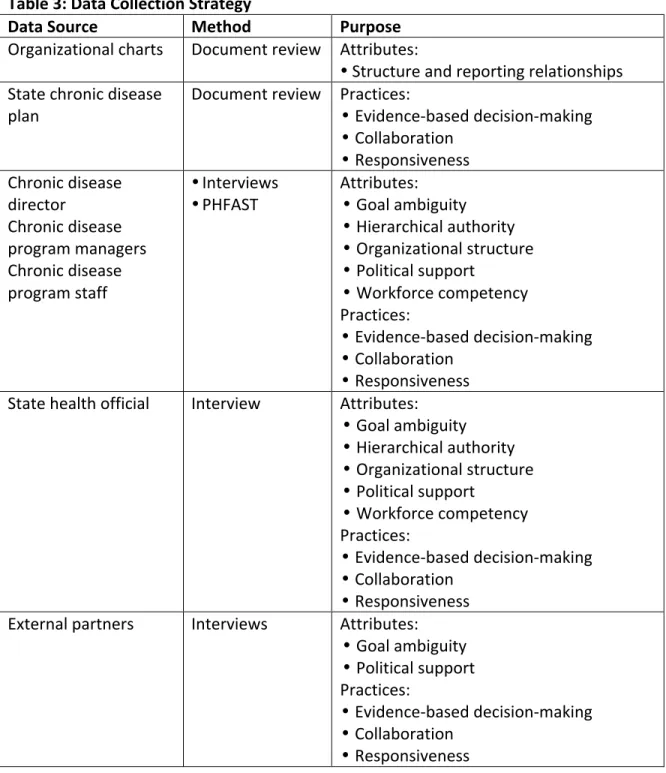
Data were collected through document review and key informant interviews (Table
3). Reviewed documents included the organizational chart for the chronic disease
prevention and control unit, the PFHAST assessment completed by the unit, and the state
coordinated chronic disease plan. These were obtained from key informants within the
chronic disease unit with the permission of the Chronic Disease Director.
Key informants interviewed included managers of programs within the chronic
disease prevention and control unit, the chronic disease director, other senior staff of the
health official, two senior staff members from the state health official’s office, and
representatives of two key partner organizations identified by the chronic disease director.
Table 3: Data Collection Strategy
Data Source Method Purpose
Organizational charts Document review Attributes:
•Structure and reporting relationships
State chronic disease
plan Document review Practices: •Evidence-‐based decision-‐making •Collaboration
•Responsiveness
Chronic disease director
Chronic disease program managers Chronic disease program staff
•Interviews •PHFAST
Attributes:
• Goal ambiguity • Hierarchical authority • Organizational structure • Political support
• Workforce competency
Practices:
•Evidence-‐based decision-‐making •Collaboration
•Responsiveness
State health official Interview Attributes:
• Goal ambiguity • Hierarchical authority • Organizational structure • Political support
• Workforce competency
Practices:
•Evidence-‐based decision-‐making •Collaboration
•Responsiveness
External partners Interviews Attributes:
• Goal ambiguity • Political support
Practices:
•Evidence-‐based decision-‐making •Collaboration
•Responsiveness
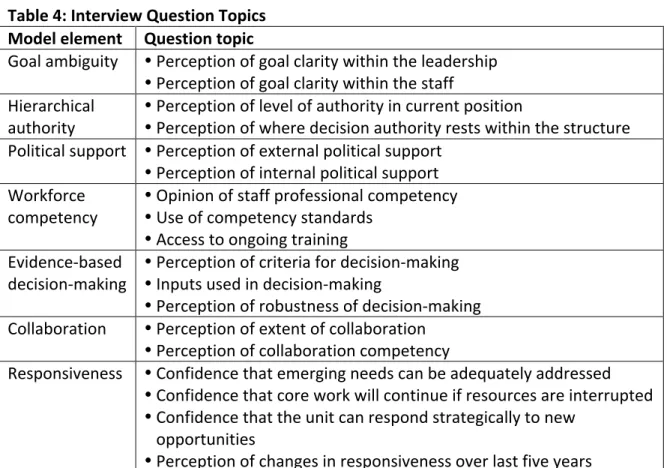
Question topics included those listed in Table 4 below. Assessment tools from
practice and literature informed data collection activities. The NACDD Public Health
Framework Assessment Tool (PHFAST) has been used by several states to examine their
chronic disease prevention and health promotion capacity. NACDD has also developed a
workforce competency assessment tool to identify gaps in capacity. Although the original
study design called for using NACDD workforce competency assessment, this was not done
as Montana is currently preparing to undertake a broader workforce competency
assessment for the entire Division of Public Health and Safety. Detailed field notes were
collected and summarized. Draft summary notes were shared with key informants to
assure accuracy.
Table 4: Interview Question Topics Model element Question topic
Goal ambiguity •Perception of goal clarity within the leadership •Perception of goal clarity within the staff
Hierarchical
authority ••Perception of level of authority in current position Perception of where decision authority rests within the structure
Political support •Perception of external political support •Perception of internal political support
Workforce
competency ••Opinion of staff professional competency Use of competency standards •Access to ongoing training
Evidence-‐based
decision-‐making ••Perception of criteria for decision-‐making Inputs used in decision-‐making •Perception of robustness of decision-‐making
Collaboration •Perception of extent of collaboration •Perception of collaboration competency
Responsiveness •Confidence that emerging needs can be adequately addressed •Confidence that core work will continue if resources are interrupted •Confidence that the unit can respond strategically to new
opportunities
Model element Question topic
Performance •Perception of program effectiveness •Perception of unit effectiveness
•Perception of state health department effectiveness
•Perception of structural elements that facilitate effectiveness •Perception of structural elements that impede effectiveness
•Perception of impact of changes to structure or operating practices •Perception of ideal unit structure
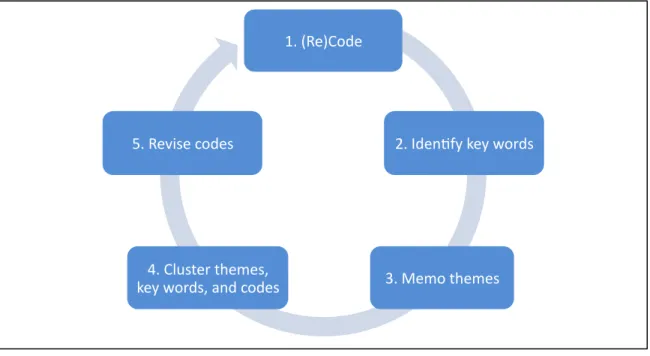
Data from document sources as well as key informant sources were organized by
model element and coded by perspective, process, relationship, and activity and reviewed
for patterns and emerging themes. Identified patterns were explored for all respondents
and for each factor in the conceptual model. Key informants’ opinions regarding causality
between elements of the conceptual model were reported.
Interview Pilot
Per dissertation committee recommendation, the interview tool was piloted and
refined accordingly before data collection began. Per Institutional Review Board
recommendation, a script highlighting key points of the informed consent approval process
was included.
The Institutional Review Board required the inclusion of extra protections because
interview respondents would be asked to speak about organizational structure,
environment, and effectiveness. The Chronic Disease Director provided a letter assuring
contributors that no personnel action could or would be taken against them as a result of
their participation in the study or their responses to the interview questions, and they could
not be identified by name in the analysis and data report, due to organizational size and
relationships between potential participants, it might be possible for readers to infer other
respondents’ identities and match specific comments with specific participants.
Once the consent form was refined per Institutional Review Board specification, the
draft interview tool was piloted with three volunteers (Table 5), each with health
department chronic disease unit experience in a different state. All three worked
extensively with external partners, two were program managers, one was a chronic disease
director, and one had left the state health department and is now working in a state-‐level
voluntary organization.
Table 5: Interview Pilot Volunteer Respondents
Volunteer State
Health Department
Experience
Chronic Disease Director
Chronic Disease Program Manager
Chronic Disease Program
Staff
Voluntary/NGO Experience
A
B
C
Feedback from the pilot volunteers confirmed dissertation committee members’
suggestions that the open-‐ended format of the questions might be improved by adding a
scaled-‐response option. A hybrid solution was chosen as the final format: a scaled response
with an open-‐ended question. The scaled response uses a four point Likert scale to ensure
that middle-‐range answers did not default to or become conflated with “I don’t know” and
“Not applicable” responses. The open-‐ended questions gave an opportunity to probe for
Also in accordance with dissertation committee member input, pilot volunteers
found questions delivered in a conversational language more comfortable and easier to
respond to than the more formal original versions of the questions. The pilot volunteers
also suggested reordering the questions to move workforce competency, a potentially
uncomfortable topic to address, towards the end of the interview. Per the volunteers’
recommendation, prompts were added to the interview script to show both hard copies of
the chronic disease unit’s organizational chart and the conceptual model to participants
along with definitions of each of the conceptual model elements to further clarify the
context and questions. The revised master question list and interview script are included in
the appendix (Appendix 4).
Data Collection
Per the original design of the study, participants were solicited from among the
employees of the Chronic Disease Prevention and Health Promotion Branch of the Division
of Public Health and Safety in the Montana Department of Public Health and Human
Services, the leadership of the Public Health and Safety Division, and representatives of
external partner organizations. Of the 53 positions indicated on the organizational chart
(Appendix 7), two were shared in one full time equivalent (FTE) position, five were vacant,
one was a contractor, one was on maternity leave, and eight either declined, failed to
respond, or were unable to keep their interview appointments. This left a total of 37
respondents. In addition, the State Health Official/Division Administrator, the State Medical
Improvement Coordinator/Accreditation Manager participated from the Public Health and
Safety Division Administrator’s Office. Two representatives of external partner
organizations -‐-‐ a local health department and chronic disease focused advocacy
organization, also participated. A third external partner representative was unable to
participate at the last moment. The total number of interviews completed was 42.
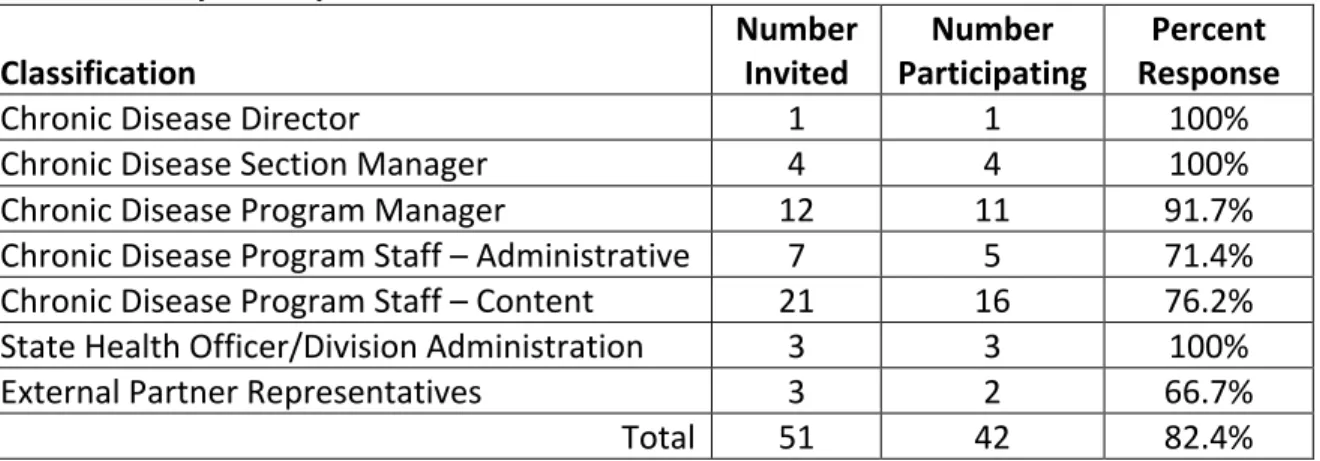
Participants were classified according to organizational level and position per the unit’s
organizational chart (Table 6).
Table 6: Study Participants
Classification Number Invited Participating Number Response Percent
Chronic Disease Director 1 1 100%
Chronic Disease Section Manager 4 4 100%
Chronic Disease Program Manager 12 11 91.7%
Chronic Disease Program Staff – Administrative 7 5 71.4%
Chronic Disease Program Staff – Content 21 16 76.2%
State Health Officer/Division Administration 3 3 100%
External Partner Representatives 3 2 66.7%
Total 51 42 82.4%
Interviews were limited to one hour in length. A longer interview time would have
allowed for deeper probing of responses to open-‐ended questions. Note-‐taking was
conducted via laptop in a specially designed table format (Appendix 5). Draft notes were
shared electronically with each participant; all were given the opportunity to clarify, edit, or
amend the notes. Out of 42 participants, 12 (or 28.5%) submitted edits.
Although an assessment of workforce competency in the chronic disease unit was
originally planned, it was determined that such an assessment would interfere with a larger