THE IMPACT OF EARLY HEAD START ON CHILDREN’S ORAL HEALTH
Jacqueline Marjorie Burgette
A dissertation submitted to the faculty at the University of North Carolina at Chapel Hill in partial fulfillment of the requirements for the degree of Doctor of Philosophy in the Department
of Health Policy and Management in the Gillings School of Global Public Health.
Chapel Hill 2016
Approved by:
R. Gary Rozier
John S. Preisser
Morris Weinberger
Rebecca King
© 2016
ABSTRACT
Jacqueline Marjorie Burgette: The Impact of Early Head Start on Children’s Oral Health (Under the direction of R. Gary Rozier)
Background. Early Head Start (EHS) is a publicly-funded comprehensive education
program for low-income children under three years-old and their families. It is known to
improve physical, cognitive and developmental child outcomes over the life course. While EHS
impacts general health outcomes, little is known about its effect on oral health. This study
assesses the effects of EHS on dental use and oral health-related quality of life (OHRQoL); as well as how the effect of EHS on dental use is modified by parents’ health literacy.
Methods. This study examines oral health outcomes in children enrolled in North
Carolina EHS programs where staff participated in an educational intervention known as Zero
Out Early Childhood Caries (ZOE) and compares these results to Medicaid-matched controls.
Parent interviews were conducted at baseline and 24-month follow-up for 1,178 parent-child
dyads. Propensity score analysis was used to control for selection bias between the EHS and the
control group. Logistic regression, marginalized zero-inflated negative binomial and
marginalized semicontinuous two-part modeling with direct adjustment for propensity scores and
random effects were used to examine the association between EHS and dental outcomes.
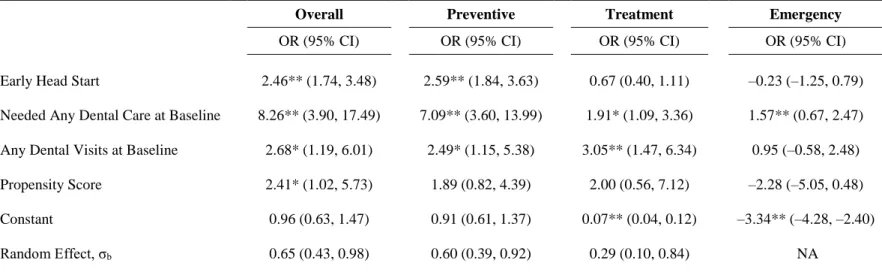
Results. EHS children had increased odds of having any dental visit (aOR=2.5; 95%
CI=1.74-3.48) and any preventive dental visits (aOR=2.6; 95% CI=1.84-3.63) compared to
non-EHS children. Children in non-EHS had 1.3 times (95% CI=1.17-1.55) the adjusted mean number of
any negative impacts to OHRQoL compared to non-EHS children (aOR=0.65; 95% CI=0.48,
0.87). In the adjusted logit models on the effect of EHS on having any dental visits, the interaction effect between EHS and parent’s health literacy was not significant (P>0.05).
Conclusions. This study is the first to demonstrate that EHS provides services that
increase child dental use and improve OHRQoL for disadvantaged young children and their
families. Moreover, our findings provide evidence that EHS results in similar improvements in dental use regardless of parents’ health literacy levels. These results document the effectiveness
of comprehensive early education programs in improving dental use and quality of life for
ACKNOWLEDGEMENTS
I would like to sincerely thank my dissertation committee: Dr. R. Gary Rozier, Dr. John
Preisser, Dr. Morris Weinberger, Dr. Rebecca King and Dr. Jessica Lee. They were generous
with their time, provided valuable guidance, and made the dissertation a wonderfully positive
experience. I am especially appreciative of my advisor, Dr. Rozier, for his unflagging
commitment to students’ success, phenomenal patience, support, and encouragement over the
past six years. He is a great champion and encourager of young researchers, in addition to being
an outstanding researcher himself. He was not only the key to me successfully completing my
dissertation, but also an incredible life advisor who greatly enhanced my love of research and
improved my quality of life. I want to thank Dr. Preisser for his methodological innovation and
creativity. He was available and willing to work together to create solutions for complex
questions, and I would not have been able to execute this project without his good-natured
problem solving. I would like to thank Dr. Weinberger for his valuable advice, teaching and
mentorship, not only in relation to the dissertation and career development, but also the multitude
of life changes that have occurred over the past six years (marriage, pregnancy, job search). Dr.
King’s dedication to my dissertation was particularly moving and I am deeply grateful for her
incredible contribution from community-engagement and data collection to manuscript-writing.
Finally, I want to thank Dr. Lee, who worked in conjunction with Dr. Weinberger, to arrange my
unique combined PhD-pediatric dentistry residency program, thereby teaching me not only how
I want to acknowledge the help and support received from friends and colleagues at UNC
(Ashley Kranz, Bhavna Pahel, Heather Beil, and Kimon Divaris) as well as fellows and faculty at
the Sheps Center for Health Services Research. I would like to thank Valerie A. Smith, who
graciously provided code that we used to fit the marginalized generalized gamma two-part
semicontinuous model and provided support on modeling both of the marginalized models used
in this study.
I also appreciate the support, encouragement, and feedback from family and friends who
have learned more about pediatric dental health than they ever expected, particularly Lane
Burgette, Jennifer Hom and Sarah Lewis. My husband, Lane Burgette, championed my training
as both a clinician and a researcher, telecommuting from North Carolina so that I could finish the
combined residency and PhD, celebrating with me at the completion of each milestone and
supporting me through each challenge. He even provided technical support for the propensity
score analysis. Both the completion of the residency and the PhD have been a joint
accomplishment, and I am incredibly proud of our teamwork and growing family.
I would like to acknowledge the funding sources for this work. This research was
partially supported by a National Research Service Award Post-Doctoral Traineeship from the
Agency for HealthCare Research and Quality sponsored by The Cecil G. Sheps Center for
Health Services Research, University of North Carolina at Chapel Hill, Grant No. T32
HS000032. Funding for the acquisition of the data used in this dissertation was provided by the
grant, Prevention of Dental Caries in Early Head Start Children, Grant No. R01 DE018236 from
PREFACE
This dissertation is organized in a non-traditional format, which includes three
manuscripts. Chapter 1 provides an introduction to the dissertation, specific aims, and a
description of the significance of the research. Chapter 2 provides a literature review and
describes the conceptual framework relevant to this dissertation. Chapter 3 describes the
methodology used for each of the three studies in this dissertation. Chapters 4, 5, and 6 are the
manuscripts for the three studies. These three chapters are intended to stand alone as manuscripts
to be submitted for publication and therefore have some redundancies with the earlier chapters
and in the papers themselves. Chapter 7 presents a summary of the findings, limitations of the
TABLE OF CONTENTS
LIST OF TABLES ... xiii
LIST OF FIGURES ... xv
LIST OF ABBREVIATIONS ... xvi
CHAPTER 1. INTRODUCTION ... 1
1.1 Background ... 1
1.2. Overall Study Purpose and Approach ... 1
1.3 Specific Aims ... 2
1.4. Summary and Significance ... 4
CHAPTER 2. LITERATURE REVIEW ... 7
2.1. Dental Disease is a Major Public Health Problem for Young Children... 7
2.2. Early Head Start and its Potential Contributions to the Oral Health of Young Children... 9
2.3. The Effect of Early Childhood Education Programs on Dental Use ... 11
2.3.1. Importance of Dental Use for Young Children ... 11
2.3.2. Barriers to Dental Use for Young Children in Early Head Start ... 13
2.3.3. Data on Dental Use in Early Head Start and Head Start... 14
2.4. The Effect of Early Childhood Education Programs on Oral Health–Related Quality of Life ... 15
2.6. Conceptual Framework ... 19
2.7. New Contributions ... 20
CHAPTER 3. METHODS ... 25
3.1. Overview of Methods ... 25
3.2. Research Design... 26
3.3. Data Sources ... 26
3.3.1. Zero Out Early Childhood Caries (ZOE) Staff Targeted Education Activities ... 28
3.4. Overview of Data Analysis ... 29
3.4.1. Aim 1: The Impact of Early Head Start on Dental Use for Children Under 3 Years Old... 29
3.4.2. Aim 2: Enrollment in EHS, Pediatric Dental Use, and Oral Health–Related Quality of Life ... 30
3.4.3. Aim 3: The Influence of Health Literacy on the Effectiveness of Early Head Start’s Improving Children’s Dental Use ... 31
3.5. Marginalized Zero-Inflated Negative Binomial Model with Random Effects ... 32
3.6. Marginalized Semicontinuous Two-part Model with Random Effects ... 33
3.7. Causal Mediation Analysis Using the Counterfactual Framework of Causal Inference ... 34
CHAPTER 4. AIM 1: THE IMPACT OF EARLY HEAD START ON DENTAL USE FOR CHILDREN UNDER 3 YEARS OLD ... 38
4.1. Overview ... 38
4.2. Introduction ... 39
4.3. Methods... 40
4.3.1. Study Design and Data Source ... 40
4.3.4. Conceptual Framework ... 42
4.3.5. Measures ... 43
4.3.6. Data Analyses ... 44
4.3.7. Logistic Regression Models of any Visits and by Type ... 45
4.3.8. Count Model for Number of Visits of Any Type ... 46
4.4. Results ... 47
4.5. Discussion ... 49
4.5.1. Limitations ... 52
4.5.2. Public Health Implications ... 53
4.5.3. Conclusion ... 53
CHAPTER 5. AIM 2: ENROLLMENT IN EHS, PEDIATRIC DENTAL USE AND ORAL HEALTH-RELATED QUALITY OF LIFE ... 65
5.1. Overview ... 65
5.2. Introduction ... 66
5.3. Methods... 68
5.3.1. Overview of Study Design and Data Source ... 68
5.3.2. Study Population ... 68
5.3.3. Conceptual Framework ... 69
5.3.4. Variables ... 69
5.3.5. Analytical approach ... 71
5.3.6. Logistic Regression Model for Any Negative Impact to OHRQoL ... 71
5.3.7. Mediation Test for Overall Dental Use ... 72
5.3.8. Two-Part Model for Overall Mean ECOHIS Score ... 73
5.4. Results ... 73
5.4.2. Dental Use as a Mediator of EHS Effect on Any Negative
Impact to OHRQoL... 74
5.4.3. Effect of EHS on ECOHIS Severity ... 75
5.5. Discussion ... 76
5.5.1. Effect of EHS on OHRQoL ... 76
5.5.2. Dental Use as a Mediator of EHS Effect on OHRQoL ... 78
5.5.3. Limitations ... 80
5.5.4. Conclusion ... 81
CHAPTER 6. AIM 3: THE INFLUENCE OF HEALTH LITERACY ON THE EFFECTIVENESS OF EARLY HEAD START’S IMPROVING CHILDREN’S DENTAL USE ... 94
6.1. Overview ... 94
6.2. Introduction ... 95
6.3. Methods... 97
6.3.1. Overview of Study Design and Data Source ... 97
6.3.2. Study Population and Data Collection Procedures ... 97
6.3.3. Conceptual Framework ... 98
6.3.4. Measures ... 98
6.3.5. Analytical Approach ... 99
6.4. Results ... 101
6.4.1. Dental Use ... 101
6.4.2. Prevalence of Low Oral Health Literacy ... 101
6.4.3. Moderating Effect of Oral Health Literacy ... 102
6.4.4. Prevalence of Low General Health Literacy ... 103
6.4.5. Moderating Effect of General Health Literacy ... 103
6.5.1. Parent’s Oral Health Literacy ... 104
6.5.2. Parent’s General Health Literacy ... 105
6.5.3. Absence of Moderation Effect by General Health Literacy and Oral Health Literacy ... 105
6.5.4. Limitations ... 107
6.5.5. Future Research ... 108
6.5.6. Conclusions ... 109
CHAPTER 7. SUMMARY, LIMITATIONS, AND IMPLICATIONS ... 123
7.1. Aim 1: The Impact of Early Head Start on Dental Use for Children under 3 Years Old ... 123
7.2. Aim 2: Enrollment in EHS, Pediatric Dental Use and Oral Health–Related Quality of Life ... 124
7.3. Aim 3: The Influence of Health Literacy on the Effectiveness of Early Head Start’s Improving Children’s Dental Use ... 124
7.4. Limitations ... 125
7.5. Future Research ... 126
7.6. Policy Implications ... 129
APPENDIX 1. TWENTY-FIVE SOCIO-DEMOGRAPHIC VARIABLES INCLUDED IN PROPENSITY SCORE ANALYSES ... 130
APPENDIX 2. TWENTY-TWO EARLY HEAD START (EHS) SELECTION CRITERIA INCLUDED IN PROPENSITY SCORE ANALYSES ... 133
APPENDIX 3. BASELINE CHARACTERISTICS THAT WERE IMBALANCED BETWEEN THE EHS AND NON-EHS GROUPS PRIOR TO PROPENSITY SCORE ANALYSES ... 136
APPENDIX 4. SAS CODE FOR THE MARGINALIZED ZERO-INFLATED NEGATIVE BINOMIAL MODELING WITH RANDOM EFFECTS ... 137
APPENDIX 5. SAS CODE FOR THE MARGINALIZED SEMICONTINUOUS TWO-PART MODEL WITH RANDOM EFFECTS ... 138
LIST OF TABLES
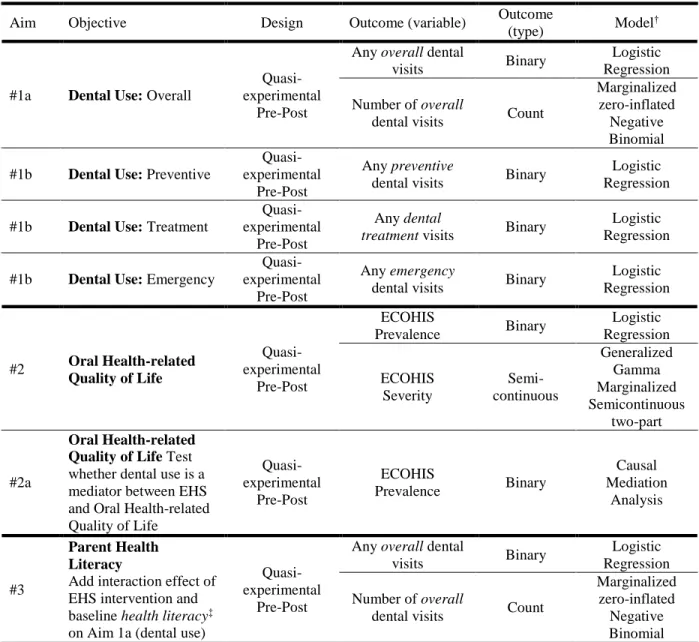
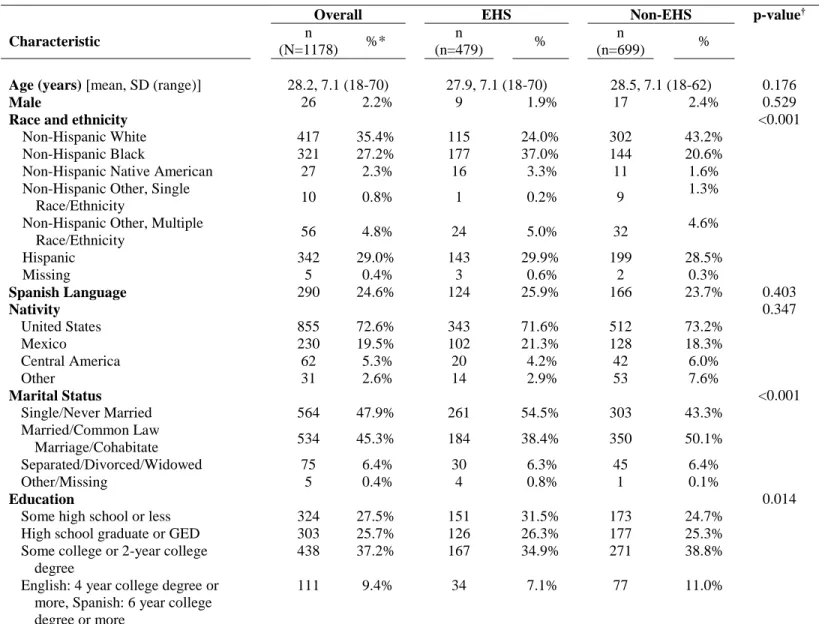
Table 3.1. Summary of Study Design ... 36 Table 4.1. Baseline Child Characteristics of the ZOE Study Population, by
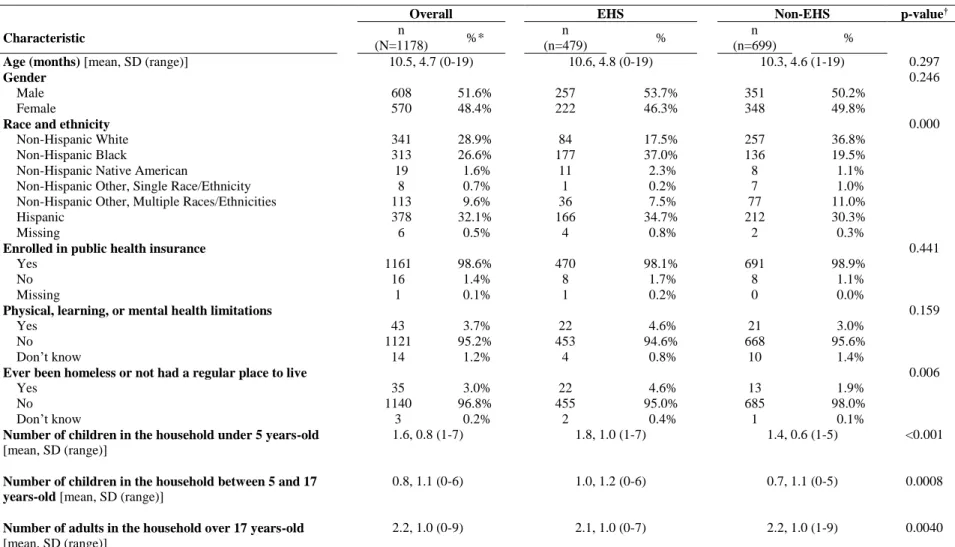
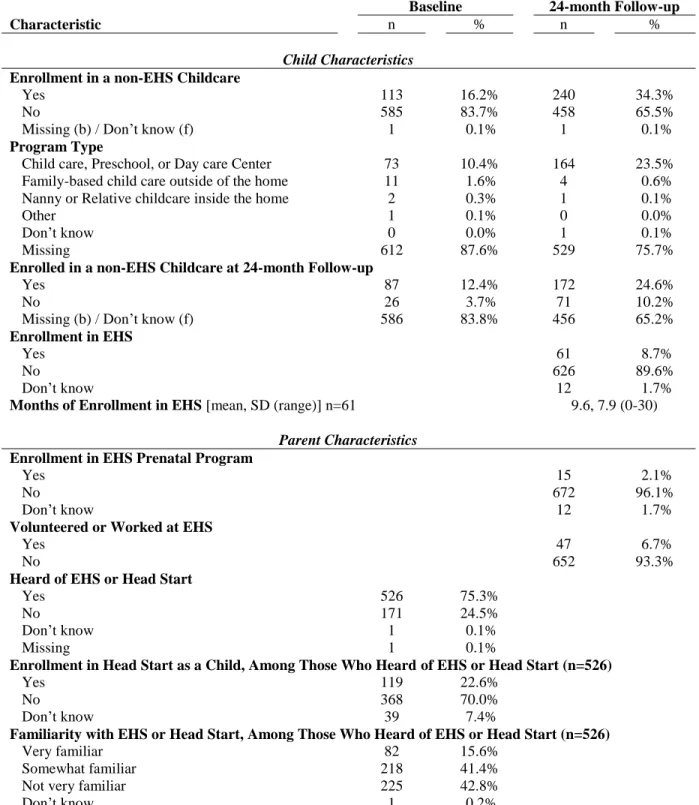
Early Head Start (EHS) and Non–Early Head Start (Non-EHS) Groups ... 55 Table 4.2. Baseline Parent Characteristics of the ZOE Study Population, by
Early Head Start (EHS) and Non–Early Head Start (Non-EHS) Groups ... 56 Table 4.3. Description of Exposure to Early Childhood Programs for the
Non–Early Head Start (Non-EHS) Group in the ZOE Study Population (N=699) ... 58 Table 4.4. Description of Exposure to Early Childhood Programs and Public
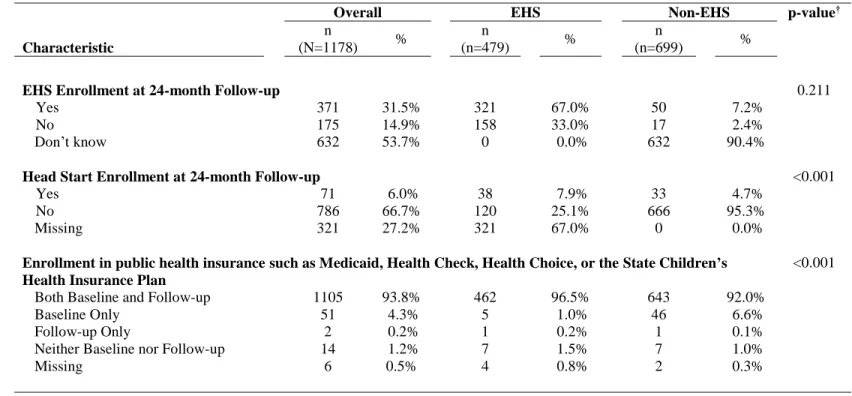
Health Insurance for the ZOE Study Population at 24-month follow-up, by
Early Head Start (EHS) and non–Early Head Start (non-EHS) Groups ... 59 Table 4.5. Unadjusted Analysis on the Impact of Early Head Start (EHS)
Enrollment on Overall, Preventive, Treatment, and Emergency Dental Use
After 24 Months. ... 60 Table 4.6. Logit Models on the Effect of Early Head Start Enrollment on
Having One or More Dental Visit (N=1,178) ... 61 Table 4.7. Marginalized Zero-Inflated Negative Binomial Model on the
Effect of Early Head Start (EHS) on the Mean Increment in Dental
Visits (N=1,178) ... 62 Table 5.1. Baseline Child Characteristics of the ZOE Study Population, by
Early Head Start (EHS) and non–Early Head Start (Non-EHS) Groups ... 83 Table 5.2. Characteristics of the Oral Health–Related Quality of Life Scale,
Early Childhood Oral Health Impact Scale (ECOHIS), for the ZOE Study
Population at Baseline and 24-month Follow-up... 85 Table 5.3. Logit Models on the Effect of Early Head Start Enrollment on
Any Impact to Follow-up Oral Health–Related Quality of Life (ECOHIS†
Score ≥1) (N=1,156) ... 86
Table 5.4. Causal Mediation Analysis for the Mediating Effect of Any Dental Use in the Association between Early Head Start (EHS) Enrollment on Any Impact to Follow-up Oral Health-Related Quality of Life (OHRQoL)†
(N=1,156) ... 87 Table 5.5. Generalized Gamma Marginalized Semicontinuous Two-Part
Model† on the Effect of Early Head Start (EHS) on the Overall Mean Early
Table 5.6. Extent† of the Oral Health–Related Quality of Life Scale, Early Childhood Oral Health Impact Scale (ECOHIS), for the ZOE Study
Population at Baseline and 24-Month Follow-Up ... 89 Table 6.1. Baseline Child Characteristics of the ZOE Study Population,
by Early Head Start (EHS) and non–Early Head Start (Non-EHS) Groups ... 110 Table 6.2. Overall Dental Use at 24-Month Follow-Up in the Zero-Out
Early Childhood Caries Study, by Early Head Start (EHS) and Parent’s
Oral Health Literacy ... 111 Table 6.3. Parent Oral Health Literacy Separated by Quintile, As Measured
Using the Oral Health Literacy Assessment (OHLA) in the Zero-Out Early
Childhood Caries Study, by Early Head Start (EHS) ... 112 Table 6.4. Logit Models on the Effect of Early Head Start Enrollment on
Any Dental Visits With and Without Early Head Start-Oral Health
Literacy Interaction Effect, by English- and Spanish-Speaking Samples ... 113 Table 6.5. Marginalized Zero-Inflated Negative Binomial Model on the
Effect of Early Head Start (EHS) on the Mean Increment in Dental Visits with EHS-Oral Health Literacy Interaction Effect, by English-
and Spanish-Speaking Samples ... 114 Table 6.6. Overall Dental Use at 24-Month Follow-Up in the Zero-Out Early
Childhood Caries Study, by Early Head Start (EHS) and Parent’s General
Health Literacy... 115 Table 6.7. Logit Models on the Effect of Early Head Start Enrollment on Any
Dental Visits With and Without Early Head Start-General Health Literacy
Interaction Effect (N=1,178) ... 116 Table 6.8. Marginalized Zero-Inflated Negative Binomial Model on the
Effect of Early Head Start (EHS) on the Mean Increment in Dental Visits
with EHS-General Health Literacy Interaction Effect (N=1,178) ... 117 Table 6.9. Logit Models on the Effect of Early Head Start Enrollment on Any
Dental Visits With and Without Early Head Start-General Health Literacy
Interaction Effect, by English- and Spanish-Speaking Samples ... 118 Table 6.10. Marginalized Zero-Inflated Negative Binomial Model on the
Effect of Early Head Start (EHS) on the Mean Increment in Dental Visits,
LIST OF FIGURES
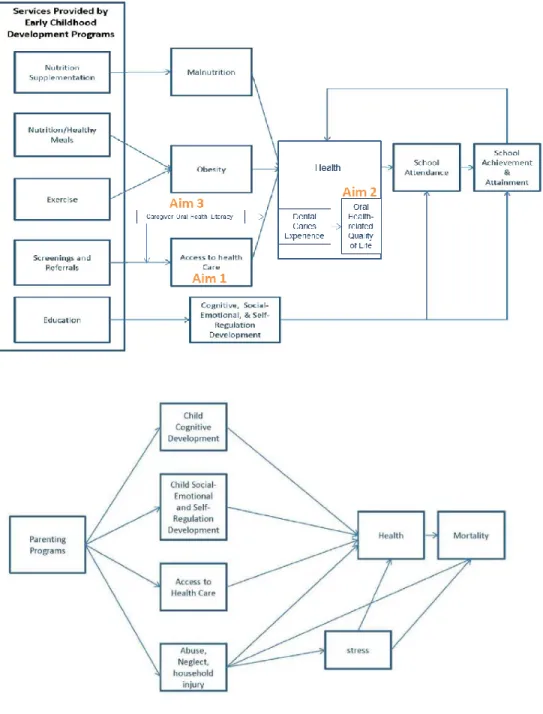
Figure 2.1. Conceptual framework. ... 23 Figure 2.2. Conceptual model on the relationship between Early Head
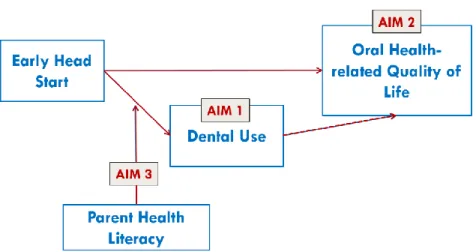
Start, parent-reported dental use, oral health–related quality of life, and
parent health literacy. ... 24 Figure 3.1. County locations of North Carolina Early Head Start Programs
(N=25) in the Zero Out Early Childhood Caries (ZOE) study. ... 37 Figure 4.1. Data collection for the Zero Out Early Childhood Caries study
by EHS group. ... 63 Figure 4.2. Percent distribution of the number of dental visits by EHS group. ... 64 Figure 5.1. Causal mediation analysis using the average causal mediation
effect (ACME), average direct effect (ADE), and total effect. ... 90 Figure 5.2. Figurative depiction of the causal mediation analysis using the
average causal mediation effect (ACME), average direct effect (ADE),
and total effect... 91 Figure 5.3. Proportion of Early Head Start (EHS) and non-EHS with each
Early Childhood Oral Health Impact Scale (ECOHIS) score (N=1,156). ... 92 Figure 5.4. Mediation analysis using the Baron and Kenny’s (1986) Steps
for Mediation.171 ... 93 Figure 6.1. Parent oral health literacy as measured by the Oral Health Literacy
Assessment (OHLA) instrument, by Spanish and English language and by Early Head Start (EHS) and Non–Early Head Start (Non-EHS) groups
(N=1,178). ... 120 Figure 6.2. Percent pediatric dental use by heath literacy level, EHS group,
and language (N=1,178). ... 121 Figure 6.3. Parent General Health Literacy as measured by the Short
Assessment of Health Literacy (SAHL) Instrument, by Spanish and English language and by Early Head Start (EHS) and Non-Early Head Start
LIST OF ABBREVIATIONS
EHS Early Head Start
GHL General Health Literacy
NC North Carolina
OHL Oral Health Literacy
OHRQoL Oral Health-related Quality of Life
CHAPTER 1. INTRODUCTION
1.1 Background
Early Head Start (EHS) is a national comprehensive early education program for
low-income families and children birth to 3 years of age.1 Large-scale randomized controlled trials of
EHS and its predecessor, Head Start, demonstrate that these programs improve short-term health
status and long-term social and cognitive development.2-5 EHS is well-positioned to play an
important role in helping reduce existing large oral health disparities in young children in the
United States by delivering preventive oral health services to those families at greatest risk for
poor oral health.6 These programs enroll the most disadvantaged of families within their
communities and are evaluated against federal performance standards that require that the oral
health needs of young children and their families are met. Among the required activities are daily
tooth-brushing with fluoridated toothpaste, oral health education, and the determination of a
child’s oral health status by a dental professional within 90 days of entry into the program.
Children with treatment needs must be referred to a dentist for care. Many other EHS standards
such as those involving diet can affect oral health.7
1.2. Overall Study Purpose and Approach
Although oral health is an integral part of recommended EHS program activities, little is
known about program effects on oral health outcomes of children or parents other than some
very basic descriptive information on dental use from one national study.5,8-10 The purpose of this
study is to fill this knowledge gap by evaluating the effects of EHS compared to
low-income children in North Carolina. The literature suggests that there is variation in oral health
literacy among low-income parents,11-13 which may affect their child’s oral health status,14,15
dental care expenditures,16 and oral health-related quality of life.17,18 Therefore, this study also
examined the modifying effect of parents’ health literacy on the effect of EHS on dental use.
Longitudinal data collected as part of an initiative known as Zero Out Early Childhood
Caries (ZOE), which was directed toward North Carolina EHS programs, were analyzed to
address study aims.19 Parents of children in EHS (n=479) and community controls (n=699) who
were selected from Medicaid enrollment files and matched on child age, preferred language, and
resident ZIP code were interviewed in the child’s first year of life and approximately 24 months
later at the end of the child’s EHS program enrollment.
1.3 Specific Aims
All three studies examined the impact of EHS on oral health outcomes using data
collected as part of the ZOE study. The specific aims of this study were as follows:
Aim #1: Determine the effectiveness of EHS in increasing parent-reported child use
of dental health services for EHS children. I hypothesized that EHS children would have
greater dental service use compared to Medicaid-matched children. This hypothesis was based
on strong evidence that dental use is increased in older children enrolled in Head Start.20 Dental
use was defined globally as the amount of dental use overall as well as by the treatment type
(preventive, treatment, emergency). Marginalized zero-inflated negative binomial modeling with
cluster-level-specific random effects was used to examine the association between EHS and
amount of dental use. The use of any dental services, a dichotomous outcome, was modeled
using logistic regression. Direct adjustment through specification of generalized boosted model
propensity scores as a covariate was used to control for EHS program selection criteria for
Aim #2: Determine the impact of EHS on oral health-related quality of life for EHS
children and their families. I hypothesized that EHS children would have improved oral
health–related quality of life (OHRQoL) compared to Medicaid-matched control children as a
result of EHS enrollment.21 Marginalized semicontinuous two-part modeling with
cluster-level-specific random effects were used to examine the association between EHS and oral health–
related quality of life for children. Direct adjustment via specification of generalized boosted
model propensity scores as a covariate was used to control for EHS program selection criteria for
family enrollment and socio-demographic characteristics. We also examined whether dental use
mediated the relationship between EHS and OHRQoL.
Aim #3: Determine if parents’ oral and general health literacy modified the
effectiveness of EHS on parent-reported child use of dental health services. Oral health
literacy (OHL) is defined as “the degree to which individuals have the capacity to obtain,
process, and understand basic oral health information and services needed to make appropriate
health decisions and act on them.”22 General health literacy (GHL) similarly is defined as “the
degree to which individuals have the capacity to obtain, process, and understand basic health
information and services needed to make appropriate health decisions.”23 I hypothesized that
parents’ OHL and GHL positively modifies the effect of EHS on the child’s use of dental health
services. This hypothesis is based on previous literature on the effect of parents’ literacy on the
use of their children’s health services for asthma treatment,24,25 the effect of GHL on general
health-related quality of life measures in patients with cancer and chronic disease,26,27 and the
association between parent oral health literacy and child oral health-related quality of life.17,18
We examined whether the inclusion of an interaction effect between EHS and the health literacy
1.4. Summary and Significance
The rationale that underlies the proposed research is that interventions at a young age will
overcome challenges to improving health over the life course, especially for parents with low
health literacy. These interventions can result in decreased cost of oral disease to families, the
health care system, and society. The result of this research will be a better understanding of
whether EHS can effectively increase dental use and improve oral health-related quality of life in
low-income children. These outcomes are a priority according to the National Institute of Dental
and Craniofacial Research’s research objectives and are expected to have an important and
needed impact because an effective EHS intervention might help curb the crisis in dental caries,
the most common chronic disease affecting American children.
EHS has the potential to improve oral health outcomes for thousands of young children
who are high risk for dental caries because it: (1) has access to very young children in
low-income families, (2) is supported by studies that demonstrate positive short- and long-term
impacts in important domains other than oral health, (3) integrates oral health within a
comprehensive child development program, (4) is a two-generational program that focuses on
both the child and the parent, and (5) has existing oral health performance standards that require
effective preventive dental services. Each of these points is considered further in the following
paragraphs in the context of potential contributions of this research.
Children in low-income families are at higher risk of experiencing dental caries and
gaining access to low-resource families with very young children prior to the onset of early
childhood caries is challenging. EHS is a national vehicle to reach children from birth to age
three.28,29 Although it has been shown that Head Start for older children, age 3 to 5, results in
improved use of dental care;20,30 to the author’s knowledge, no studies have evaluated the effect
outcomes. This study is significant because it determines the effectiveness of a childhood
intervention for dental caries targeting children younger than those in previous studies and at an
age when guidelines recommend the establishment of a dental home. The results of this study
call attention to the importance of improving quality of life through the use of early childhood
education programs from age birth to 3 years. This contribution is significant because
intervening through an early childhood education program that enrolls thousands of low-resource
families can be extended into the Head Start preschool program and may greatly improve oral
health.
There is evidence that EHS is associated with positive impacts in areas beyond oral
health. The proposed research is significant because it is the first evaluation of the impact of
EHS on oral health outcomes. EHS is a well-organized and comprehensive program through
which health interventions, such as oral health promotion, can be integrated within a larger
program that includes cognitive, social, and emotional interventions in early childhood. EHS
focuses on providing services for low-resource families to decrease disparities. The proposed
research investigates whether EHS is an effective vehicle to help reduce oral health disparities
through targeted oral health services similar to how it improves cognitive, social, emotional, and
health outcomes for both the child and the parent.2,4
Additionally, EHS is a two-generational program that has the potential to impact ongoing
oral health behaviors in the entire family. EHS can have direct effects on both the child and the
parent and thus improve children’s oral health outcomes. Parents play a pivotal role in children’s
oral health and care.31 Two-generation programs provide stimulating, stable, and caring
Finally, EHS currently integrates oral health performance standards in its comprehensive
strategy to improve children’s development in early childhood. These oral health performance
standards, which include tooth-brushing, oral health education, and dental screening and referral,
are consistent with the spirit of the age 1 dental visit endorsed by the American Academy of
Pediatrics, American Dental Association, Academy of General Dentistry, and American
Academy of Pediatric Dentistry.38-40,40
EHS currently provides oral health services without any scientific evidence of its effect
on oral health outcomes. Currently, it is unknown whether EHS elevates the oral health level of
enrolled children to that of their community peers. With the findings from this study, we will
learn whether oral health is among the outcomes improved as a result of participating in EHS.
The results of this study have implications for policies and programs that target early
childhood. This dissertation research addresses the effectiveness of intervening in early
childhood to improve oral health, which is important for program evaluation and the
development of future policies to improve oral health status and dental use for young children
enrolled in EHS. The increasing prevalence of dental caries in young children makes the study
both timely and relevant to policy. This study is significant because it can provide actionable
evidence to advocate for the inclusion of oral health in new and existing EHS programs for both
CHAPTER 2. LITERATURE REVIEW
2.1. Dental Disease is a Major Public Health Problem for Young Children
Dental caries in early childhood has significant consequences. Not only do untreated
dental caries lead to pain and infection, they affect basic vital functions such as eating, speaking,
and sleeping, which are imperative to healthy growth and development.28 The continued high
prevalence of dental caries in the primary dentition has implications for long-term oral health
because past or current caries experiences are one of the best predictors of future caries among
available risk factors.41,42 Additionally, early childhood caries can affect the immediate and
long-term quality of life of the child and family and can have significant social and economic
consequences beyond the immediate family.43,44 Public media also has brought attention to the
increasing trend of treating preschool children with severe dental caries in the operating room
and the most severe consequence of untreated dental caries: death.45,46
Unfortunately, the prevalence of dental caries is high among young children in the United
States.28 Using the National Health and Nutrition Examination Survey (NHANES), Dye and
colleagues found that the prevalence of dental caries among American children age 2 to 5 years
old significantly increased from 24% in 1988 to 1994 to 28% from 1999 to 2004.47 The most
recent results from NHANES, based on two of the six-year survey cycle, suggest that the caries
rate may have stabilized but the prevalence remains high.48 The prevalence of dental caries in
children age 2 to 5 was 23% in 2011–2012, a 5% decline compared to the 1999–2004 data.48
in 1999–2004, according to NHANES.49 Similarly, the prevalence of dental caries in this age
range, 2 to 8 years old, dropped to 37% in the most recent NHANES data from 2011–2012.48
Even though preliminary NHANES results suggest an improvement in childhood dental
caries, the prevalence remains high and large disparities continue to be evident among population
groups. Among two to four year-olds, untreated primary caries increased from approximately
16% in 1988–1994 to nearly 19% in 1999–2004.47 In 1999–2004, 20% of decayed and filled
teeth of all American children 2 to 5 years of age remained untreated; and the prevalence of
untreated decay in children age 2 to 5 years old decreased to 10% in 2011–2012.47,48,50
Although childhood dental caries are common in all demographic groups, low-income
children both have more dental caries and they are more likely to be left untreated.28,51,52 In
North Carolina, 19% of 2-year-old Medicaid patients attending well-child visits in a large
pediatric group practice had cavitated lesions in teeth.53 The prevalence of untreated decay in
primary and permanent teeth in children age 2 to 11 years old in households at 100% of the
federal poverty level or less is twice as large compared to those with greater than 200% federal
poverty level in both 1988–1994 (37.4% vs. 13.7%, respectively) and 1999–2004 (32.5% vs.
15.1%, respectively).47
Dental caries also disproportionately affect minority children.28,48,52,54 The prevalence of
dental caries in primary teeth among children aged 2 to 8 years old was higher for Hispanic
(46%) and non-Hispanic black children (44%) compared with non-Hispanic white children
(31%).48 Moreover, dental caries were more likely to go untreated in minority children aged 2 to
8 years old with prevalence of untreated decay significantly higher for both non-Hispanic black
Dental caries are a major public health problem for young children and national
initiatives such as Early Head Start have instituted oral health performance activities that attempt
to address this silent epidemic.
2.2. Early Head Start and its Potential Contributions to the Oral Health of Young Children
EHS is a comprehensive, two-generation program that serves high-risk, diverse, and
disadvantaged parents and their infants or toddlers up to age 3.1,4 It is a federally funded and
nationally implemented community-based early childhood education program that began in 1995
as an expansion of the long-standing Head Start program. EHS strives to alter child development
trajectories by intervening with both the child and the parent, providing direct services for the
parent that will indirectly effect the child’s development.55,56 The range of services provided by
EHS includes health education, screenings, and referrals to health services, parenting education,
and social services.
Early childhood intervention literature often views the parent-child relationship and the
family home environment as key agents of change in a young child’s life.56 The health and
well-being of young children are inextricably linked to their parents’ physical, emotional, and social
health, social circumstances, and child-rearing practices.57,58 At an age when the role of the
family is paramount in a child’s health and well-being, it is not surprising that there is evidence
that two-generation programs provide stimulating, stable, and caring environments for children
and can alter the child’s long-term trajectory.2,32-37
The impact of EHS on cognitive, social, and health outcomes has been debated
extensively in the public and scientific press, particularly after the release of the results from a
large-scale, national randomized controlled trial: the Early Head Start Research and Evaluation
Mathematica randomized 3,001 families that met the enrollment criteria to EHS and non-EHS.4
The EHSREP found that 2-year-old children with at least one year of EHS had better cognitive,
language, and socio-emotional development than children who did not participate in EHS.2-4,60
These effects persisted at age 3.4,60 Additionally, parents of children in EHS had better
performance on parenting behaviors such as reading to children, providing language and learning
stimulation, spanking less, and providing emotional support.4,60 Longer-term follow-up of the
EHSREP showed that the only positive outcome for EHS that persisted at fifth grade was the
social-emotional development of the child, such as decreased peer bullying, attention problems,
and delinquency variables.59 With regards to health, 96% of children in EHS had an ongoing
source of medical care and 96% of enrolled children had health insurance at the end of 2010.61
EHS is a social program that has performance standards designed to promote a nurturing
environment that fosters healthy socio-emotional, physical, and cognitive development for
children over the long term.62 Oral performance standards include daily tooth-brushing with
fluoridated toothpaste, oral health education by EHS teachers, and the determination of a child’s
oral health status by a dental professional within 90 days of entry into the program.7
No information is available on the oral health status of EHS children. However, the
literature on the prevalence of dental caries suggests that children who have socio-demographic
characteristics similar to those enrolled in EHS are at higher risks for dental caries experience
and less likely to access dental care.28,29,51,52,54,63-66 Children usually are enrolled in EHS at an age
before the onset of dental caries begins. Thus, EHS is potentially well-suited to promote oral
health through the delivery of preventive services and promotion access to these services. This
study evaluates whether EHS can successfully address oral health needs and reduce oral health
With the high prevalence of dental caries in very young children and its serious
consequences, early intervention is imperative. To summarize this section, EHS is a
comprehensive, early childhood education program that targets both the parent and the child, has
federally mandated oral health performance standards, and has evidence of some long-term
effects on child behavior and access to health services. These facts provide ample justification
for investigating whether oral health may be positively affected by EHS. Combatting dental
caries in early childhood through EHS may reverse the increasing trend in dental caries and
prevent its costly consequences. Currently, little is known about the effects of EHS participation
on oral health outcomes. The next sections review what is known about the effectiveness of
comprehensive early education programs, including EHS, on oral health outcomes to be included
in this study.
2.3. The Effect of Early Childhood Education Programs on Dental Use
2.3.1. Importance of Dental Use for Young Children
The use of preventive dental services such as sealants67-70 and topical fluorides71,72 is
effective at preventing dental caries in young children.64 Key stakeholders have implemented
policies to encourage the use of preventive dental care for young children at risk of dental
disease. State Medicaid programs cover oral health services as part of the Early and Periodic
Screening, Diagnostic, and Treatment (EPSDT) benefit, including the age 1 dental visit.73 Bright
Futures guidelines put forth by the American Academy of Pediatrics recommend oral health
services for children including pediatric oral health risk assessments beginning at 6 months old.40
Primary care providers are reimbursed by Medicaid insurance in most states for providing
preventive oral health services, including fluoride varnish, to children within a medical setting
In addition to being effective at reducing the prevalence of dental caries, preventive
dental care is cost-effective. An analysis of North Carolina Medicaid claims from 1992 to 1997
found that children who received a preventive dental service before age 1 had lower dental costs
over five years compared to children who received their first preventive dental service between
ages 2 and 5.75,76 A more recent analysis of North Carolina Medicaid claims from 1999 to 2006
found that children presumed to be high risk for dental caries (due to dental treatment visits
before 18 months of age) had lower dental treatment costs if they received their first dental
treatment or tertiary preventive visit before 18 months old compared to those with their first
dental visit at 18 to 42 months of age.77,78 With regards to sealants in particular, a third analysis
of North Carolina Medicaid claims from 1985 to 1992 found that sealants placed on the teeth of
children at high risk of dental caries resulted in lower dental costs over a five-year period.79
Recent studies found improvements in dental use for children nationally; however, it is
unclear whether the trends hold for very young children under 3 years old. An analysis of the
Medical Expenditure Panel Survey (MEPS) by the American Dental Association Health Policy
Institute found a statistically significant increase in dental use among children age 1 to 18 years
from 2000 through 2012, with children’s dental use being 47.6% in 2012.80 In another analysis
using children age 1 to 20 who were eligible for EPSDT through Medicaid and Children’s Health
Insurance Program (CHIP), preventive dental services increased from a median of 45% in 2011
to 48% in 2013.81 Conversely, dental treatment services continued below 25%, from a median of
24% in 2011 and 23% in 2013.81 The findings of the proposed study will elucidate current levels
of dental use for very young children that can be compared with the findings from these previous
2.3.2. Barriers to Dental Use for Young Children in Early Head Start
Access to dental care for young children in Early Head Start is challenging due to factors
related to the affordability of dental care and the available dental workforce. The literature
documents that a significant barrier to accessing dental care is the family’s socioeconomic status.
Children in families with higher socioeconomic status have more access to dental care. For
example, children who had private dental insurance or who were from families with higher
income or education were more likely to receive preventive dental services such as topical
fluoride and sealants.82 Conversely, the likelihood of using dental care and receiving preventive
dental care was low in children who were non-Hispanic black or Hispanic, had low family
income, and had low education attainment by the head of household.82 According to the Institute
of Medicine (IOM), “In 2008, 4.6 million children did not obtain needed dental care because
their families could not afford it.”83 As previously mentioned, these sociodemographic factors
are also associated with a higher prevalence of untreated dental caries.28,51,54
Although dental insurance, such as Medicaid, generally has a positive impact on
preventive dental use for children in the United States,84 it is not a panacea for access to dental
care for families with children under 3 years old. Greater than 90% of families enrolled in EHS
are insured by Medicaid.6 EHS families who have children under 3 years old and Medicaid
insurance experience two barriers to accessing dental care due to dental workforce issues: 1) a
limited number of dental providers who accept Medicaid insurance,63-66 and 2) a limited dental
workforce trained to see young children and/or dentists who choose not to treat young children.
With regards to the limited dental workforce trained to see young children, the supply of
pediatric dentists in the United States was 6,618 in 2011.85 According to the IOM,
every 23,000 children age 17 and under (one for every 6,200 children under age 5).”83 In North
Carolina, young children enrolled in Medicaid continue to face barriers to oral health care
because of dental workforce shortages.86 Dentists who are available to treat young children also
may choose not to do so.63-65,83,87,88 Several studies report that both pediatric and general dentists
are reluctant to perform dental examinations or perform treatment on infants before the age of
1.89-91
Therefore, EHS promotes the use of dental services and may improve access to dental
care, but EHS staff face barriers to effectively gaining access to dental care for EHS families.
Accessing dental care will continue to pose challenges for young children, especially those in
low-income families.
2.3.3. Data on Dental Use in Early Head Start and Head Start
Currently, it is unknown whether dental use by children is affected by their enrollment in
EHS. Oral health outcomes were not a focal point of the EHSREP study, but the limited oral
health data from that study showed that EHS did not have a positive effect on dental use
compared to non-EHS children.92 No statistically significant difference was found in the
percentage of EHS children (28.3%) who visited a dentist compared to non-EHS controls
(26.2%) in the EHSREP.60 However, children in EHS were found in a non-experimental analysis
to have increased dental visits over time, “from 4 percent about 7 months after enrollment (when
children were, on average, 10 months old) to 25 percent about 28 months after enrollment (when
children were 32 months old, on average).”92
It is possible that EHS has an effect on dental use akin to that of Head Start, which is a
similar public and comprehensive program for low-income families with the same performance
standards for children age 3 to 5 years old. In the Head Start Impact Study (HSIS),30 a weighted
the first year of enrollment compared to 52% for similar children enrolled in other school
readiness initiatives other than Head Start.20 A similar trend was seen in a weighted analysis of
the 4-year-old cohort, in which 73% of Head Start children received dental care in the previous
year compared to 57% for similar children enrolled in other school readiness initiatives.20
Overall, the HSIS reported that children in Head Start were significantly more likely to have
used dental services compared to the previous year by 16 to 17 percentage points.20 Despite the
increased dental use among Head Start children age 3 to 5, the use of dental services by children
in Head Start was low.54,93,94
A finding similar to the HSIS was reported in a South Carolina Head Start
Medicaid-matched retrospective cohort study. Martin and colleagues (2012) conducted an analysis of
Medicaid claims for 2007 to 2008 and concluded that Head Start children had significantly more
visits to dentists than children not enrolled in Head Start (P<0.001).95 The authors report that
preventive and diagnostic visits may account for this increase in dental use by Head Start
children.
The Office of Head Start reports that “among Head Start preschool-age children, 85%
received preventive dental care and 87% have completed a professional dental examination
during the 2011-2012 program year.”96 From the results of the HSIS and the Office of Head
Start, there is reason to expect that EHS may have an effect on dental use for young children.
Families enrolled in EHS are very diverse, and we might expect some of their characteristics to
affect the ability of EHS programs to improve oral health outcomes.
2.4. The Effect of Early Childhood Education Programs on Oral Health–Related Quality of Life
Dental conditions can greatly impact a person’s quality of life. The United States Surgeon
self-image and self-esteem, discourage normal social interaction, and cause other health problems
and lead to chronic stress and depression as well as incur great financial cost. They may also
interfere with vital functions such as eating, swallowing and speaking, and with activities of
daily living such as work, school, and family interactions.”28,97
The physical and psychological influences of oral conditions may have a particular effect
on children, who need nutrition and sleep for growth and development, are developing speech,
have fewer coping skills for pain and discomfort than adults, and are developing social skills that
may be affected by their appearance. In a retrospective chart review on children with severe early
childhood caries who underwent sedation or general anesthesia from 1987 to 1991 compared to
outpatient surgery patients, 3 year olds with severe early childhood caries weighed
approximately 1 kilogram less than children undergoing outpatient surgery. The authors of the
chart review posit that this finding may be due to the effect of toothache and infection on eating
and sleeping, thereby changing children’s overall dietary intake and metabolic processes.98 The
treatment of extensive dental caries for young children also may be associated with high
treatment costs and distress to the family, resulting in additional physical and psychological
influences on the child.
Oral health–related quality of life (OHRQoL) can be defined as “a multidimensional
construct that reflects (among other things) people’s comfort when eating, sleeping, and
engaging in social interaction; their self-esteem; and their satisfaction with respect to their oral
health.”28 The concept of OHRQoL stems from the definition of health from the World Health
Organization, which emphasizes the promotion of health as well as the absence of disease. It
states, “Health is a state of complete physical, mental and social well-being and not merely the
As an outcome measure, OHRQoL encompasses the presence and absence of disease as
well as the impact of that state of health, or lack of health, from the participants’ self-report.
OHRQoL assesses the impact of oral health problems and related treatment experiences on
children and their families. It is a reflection of oral disease and conditions from the family
perspective. It can be argued that OHRQoL is an important measure because it is a
person-reported outcome that reflects the impact of health or disease on the patient’s life as well as the
patient’s motivation for health-seeking behavior.
A number of OHRQoL instruments have been developed since the 1990s to determine
the impact of dental disease and conditions in children on families. One of the more commonly
used instruments is the Early Childhood Oral Health Impact Scale (ECOHIS), which was
designed to consider impacts that are considered important to parents closely involved in the
health and well-being of preschool-aged children.21 Using the ECOHIS instrument for
preschool-aged children, researchers have found the following: (1) dental treatment under general
anesthesia is associated with improved OHRQoL in Turkey, Lithuania, the Netherlands, and the
United States;100-103 (2) dental caries is associated with worse OHRQoL in Brazil, the United
States, and Hong Kong,104-108 especially untreated caries;107 (3) fluorosis has little impact on
OHRQoL;104 (4) traumatic dental injuries may 105,106,109,110 or may not 105,109 be associated with
worse OHRQoL in Brazil; (5) malocclusions may106 or may not105,110 have an impact on
OHRQoL in Brazil; (6) better socioeconomic status is associated with better OHRQoL;111 and
(7) parents’ OHL is associated with OHRQoL.17 Currently, the effect of EHS and other social
programs on OHRQoL is unknown. Children in EHS may have improved OHRQoL as a result of
daily oral health practices by EHS staff, such as tooth-brushing, oral health education to families,
2.5. The Effect of Parents’ Oral Health Literacy on Children’s Oral Health Outcomes
Low OHL is associated with low dental use for adults.94,112,113 According to the IOM, low
OHL in the United States creates challenges to recognizing the risk for oral diseases as well as
seeking and receiving dental care.83,113,114 Using national data from the 2003 National
Assessment of Health Literacy, only 44% of adults over 16 years of age with less than basic
health literacy skills had a dental visit in the preceding year compared with 77% of those with
proficient health literacy skills.94 Only 12% of adults were found in 2003 to have proficient
health literacy.115 According to Holtzman and colleagues (2014), adults who use fewer sources
of oral health information, a subset of health literacy skills, are more likely to fail to show for an
appointment at a university-based dental clinic.113 There is evidence to the contrary, however,
that the OHL of adults, measured using the Comprehensive Measure of Oral Health Knowledge,
was not associated with dental use.116
It is unknown whether parents with low OHL have the same low dental health–seeking
behavior for their children as they do for themselves. There may be a similar trend of low dental
use for children whose parents have low OHL, which can put their children’s health at risk.
Because low OHL creates obstacles to recognizing the risk for oral diseases as well as seeking
and receiving needed care, it is likely that low use of dental care and preventive dental services
among children at high risk for dental problems, such as those in EHS, is associated with low
OHL.114
The literature suggests that there is variation in oral health literacy among parents.11-13
Evidence is accumulating that levels of OHL among parents can be an important factor in their
children’s oral health. Low OHL in parents is associated with deleterious oral health behaviors.
Therefore, low OHL might pose challenges as a predisposing factor for oral health disparities.117
have low educational attainment, both of which are associated with low health literacy.118 EHS
may not be able to overcome the numerous challenges faced by families with low OHL and
therefore it might have an attenuating effect for EHS among families with low OHL. However,
EHS may have measurable impacts on families with fewer challenges related to OHL,
overcoming the barriers that result from moderate OHL. This study will determine whether there
is a differential effect of EHS on dental use based on the level of parents’ OHL.
2.6. Conceptual Framework
The conceptual framework for this study was adapted from an early education framework
proposed in “Direct Effects of Early Childhood Education Programs on Health” by
Friedman-Krauss and Barnett (2013) (Figure 2.1). This framework theorizes that early education programs,
such as EHS, impact child health outcomes on three levels: direct effects on the child, direct
effects on the parent, and long-term effects on the child. EHS has direct effects on the child’s
health through four pathways: 1) healthy meals and nutrition supplementation, 2) exercise, 3)
health screenings and referrals, and 4) health education.119 EHS has direct effects on the parent
that lead to improvements in the child’s health through child cognitive development, child
social-emotional and self-regulation development, access to health care, and household abuse, injury,
and neglect.119 For example, EHS staff and teachers aid and encourage parents’ access to
healthcare for the child, which may lead to improvements in the receipt of well-child doctor’s
visits, immunizations, and dental visits, resulting in improved child health downstream. In
addition to the direct effects on the child and parent to improve health during childhood, early
childhood educational programs result in long-term health improvements through cognitive and
social benefits that are associated with higher educational attainment, leading to increased
In this dissertation research, we focused on two aspects of the early education framework:
1) access to health care as a result of child screening and referral services provided by EHS; and
2) access to health care as a result of education and support of the parent (Figure 2.1).119 A
simplified version of the conceptual model, reflecting the specific aims, is depicted in Figure 2.2.
EHS activities connect EHS parent-child dyads with dental providers, which increase dental use
in compliance with EHS oral health performance standards (Aim 1). Increased dental knowledge
and motivation are expected to lead to improved oral health behaviors and oral health status,
which can result in an improved OHRQoL (Aim 2). Parent characteristics such as parents’ OHL
or GHL modify the effects of EHS on dental use (Aim 3).
2.7. New Contributions
This research is innovative in several important aspects. This study will be the first to
determine: 1) any improvements in oral health outcomes (dental use and oral health–related
quality of life) resulting from enrollment in EHS from ages birth to 3 years old; and 2) the effects
of parent’s health literacy in EHS families. Further, in the absence of ethical randomization, this
study addresses selection bias by measuring a plethora of known characteristics of families
enrolled in the EHS program during data collection and uses that information in an innovative
way to balance those characteristics between the EHS and non-EHS groups during data analysis.
For these purposes, we used generalized boosted model propensity scores, which are based partly
on information collected during parent interviews on known EHS program selection criteria for
enrollment into the program. Finally, this study employed a novel statistical count data model,
marginalized zero-inflated negative binomial regression, and a novel statistical continuous
model, marginalized semicontinuous two-part modeling; both of which yield overall treatment
effects directly from the model parameters. Each of these innovations is described in more detail
The first innovative aspect of the research proposed is that it evaluated improvements in
oral health outcomes (dental use and OHRQoL) following an early childhood educational
program. Despite the increased dental use among Head Start children age 3 to 5, the overall use
of dental services by children in Head Start was low and gains compared to their peers
disappeared with age.54,93 This present study evaluated whether there was a similar trend in
younger children, from ages birth to 3 years old, enrolled in EHS. This research is innovative, in
our opinion, because it evaluates the oral health outcomes of a national public early childhood
education program, EHS, designed to reduce cognitive, social, and health disparities for which
effects are unknown.
The second innovative aspect of the research undertaken in this dissertation is that it is
the first study to evaluate whether the parent’s baseline OHL or GHL alters dental outcomes in
EHS families. This research determined whether parent’s health literacy modified the effect of
EHS on the child’s dental use. The effect of the EHS intervention may be modified by parent’s
health literacy; therefore, health literacy might need to be taken into account to properly evaluate
the effectiveness of EHS or to fully achieve desired outcomes. Moreover, EHS was evaluated to
determine if it can overcome the challenges of poor health literacy.
Finally, three of the methods used in this dissertation research involved innovative
applications of state-of-the-art, contemporary statistical procedures: 1) generalized boosted
model propensity scores to address selection bias; 2) marginalized zero-inflated negative
binomial modeling with random effects; and 3) marginalized semicontinuous two-part modeling
with random effects.
To address the potential for selection bias in this study, we analyzed the selection criteria
in both groups and thus control for them in the analysis. We balanced the characteristics that
EHS programs use to select families into their programs, which were known causes of selection
bias, using generalized boosted model (GBM) propensity scores.120,121 Although GBM
propensity score analysis has been used in health services research, this will be the first
application in dentistry or early education research. The positive results from our application of
GBM propensity score analysis provides another possible option for researchers who might be
faced with analyzing unbalanced data from non-randomized trials. These options are significant
because lack of randomization is a wide-spread challenge in dental research, particularly
evaluation of public health practice and early childhood education programs. The research in this
study is innovative, in our opinion, because it evaluates the effect of the early childhood
education program, EHS, using modern statistical techniques to address selection bias that are
currently overlooked in dentistry and early education research.
This dissertation employed two recently developed analytical models that are new to
dental research: marginalized zero-inflated negative binomial modeling for count data and
marginalized two-part semicontinuous modeling for continuous data. In particular, this study
presents the first applications of the marginalized zero-inflated negative binomial model with
random effects and the marginalized generalized gamma two-part model for semicontinuous
data. Moreover, marginalized two-part semicontinuous modeling (with or without random
effects) have not hitherto been published in dental research. The research presented in this
dissertation was innovative, in our opinion, because it evaluates the effect of the early childhood
education program, EHS, using modern statistical techniques to determine overall treatment
effects in a manner that is conceptually beneficial to and computationally convenient for
Figure 2.1. Conceptual framework.
CHAPTER 3. METHODS
3.1. Overview of Methods
The goal of this research was to determine the effect of Early Head Start (EHS) on oral
health outcomes among low-income children enrolled in this program. Each of the study aims
analyzed data collected as part of the Zero Out Early Childhood Caries (ZOE) study, a National
Institutes of Health (NIH)–funded EHS research initiative in North Carolina. EHS is a
community-based, statewide network that serves racial and ethnically diverse families with
disadvantaged children age birth to 3 years old in 26 programs in 44 of North Carolina’s 100
counties (Figure 3.1).
To determine the effect of the EHS intervention on oral health, Aim 1 examined the
relationship between EHS enrollment and parent-reported dental use using logit and
marginalized zero-inflated negative binomial regression models with generalized boosted model
propensity scores as a covariate and cluster-level-specific random effects (Table 3.1) (Chapter
3.5). Aim 2 studied the effect of EHS enrollment on early childhood-related OHRQoL using
logit and marginalized semicontinuous two-part models with generalized boosted model
propensity scores as a covariate and cluster-level-specific random effects (Table 3.1) (Chapter
3.6). Aim 3 added an interaction term between EHS and parent oral and general health literacy to
the model developed in Aim 1 because we hypothesize that children of parents with low health
literacy may have smaller gains in dental use by participating in EHS (Table 3.1). In all, we
3.2. Research Design
The primary data source, ZOE, was used to examine the effect of EHS on oral health
outcomes of young children. The ZOE study was quasi-experimental, in which the EHS group
was compared with the matched control group of children not enrolled in EHS. The research
design was a non-randomized, pretest-posttest nested cohort control group cluster trial. The “treatment” for the EHS group included education of EHS staff to bolster their awareness of and
adherence to oral health education, dental screening and referral, and child classroom tooth
brushing, as specified in existing early education and federal EHS performance standards.
Parents of children enrolled in the study and of community control children were
interviewed when children were on average about 9 months of age and at EHS program end
about 24 months after baseline interviews. Primary data collection provided variables specific to
the research questions. Each of the study aims included an analysis of primary data collected as
part of the ZOE study. Almost all aims used a pre-post 24-month longitudinal prospective study
design to determine the effects of EHS (Table 3.1).
3.3. Data Sources
Each of the study aims used data collected as part of the ZOE study. The sampling
strategy for ZOE involved three stages: (1) enroll EHS programs, (2) enroll parent-child dyads
within EHS programs, and (3) enroll community-matched parent-child dyads to serve as
controls. In stage one, all North Carolina EHS programs were invited to participate, and all EHS
programs except one were enrolled into the study. The sample design yielded parent-child dyads
clustered within 25 of the 26 EHS programs in the state and in approximately 50 of the 80 EHS
centers. In stage two, parents of EHS children younger than 19 months of age from all
participating EHS programs were enrolled through direct recruitment by the research team. In
geographic area (ZIP codes) as already enrolled EHS parent-child dyads were recruited as the
control group through direct mailings from the North Carolina Medicaid program.
Because the ZOE intervention involved nearly all North Carolina EHS programs and
many programs did not have excess applications that could be waitlisted, the control group was
selected from a non-EHS population. Families enrolled in EHS were drawn from a low-income
population, of which greater than 90% are insured by Medicaid.6 Because the comparison group
lived in the same locale as the children receiving the EHS intervention, the comparison group
was an appropriate ethical alternative to denying EHS in a randomized experimental design. The
proposed study used community-matched controls based on age, language and residential code to
control for the potential for selection bias resulting from the quasi-experimental design of the
ZOE study.
Parents were interviewed at two time points: 1) baseline, before the child turned 19
months of age, and 2) follow-up, when the child was as close to 36 months of age as possible and
about ready to age out of the EHS program. On average, follow-up interviews took place
approximately 24 months after baseline interviews. The variables of interest, dental use and
OHRQoL, were included within the one-hour, in-person interviews at both baseline and
24-month follow-up. OHL and GHL were measured at baseline.
Baseline English and Spanish questionnaires were administered, as appropriate, to
parents of children in EHS and non-EHS controls from September 2010 to July 2012 (N=1,561).
The total baseline sample consisted of 634 parent-child dyads from EHS programs and 927
non-EHS controls. Follow-up interviews were completed from November 2012 to March 2014
(N=1,178). The total follow-up sample consisted of 479 parent-child dyads from EHS programs
3.3.1. Zero Out Early Childhood Caries (ZOE) Staff Targeted Education Activities
The primary aim of ZOE was to assess the impact of EHS program participation on oral
health outcomes of children after all teachers and other staff in these programs had been trained
in basic oral health strategies required by performance standards and in techniques to effectively
communicate oral health messages to families.
Training in effective communication with families was provided for 176 EHS staff in
every EHS program in North Carolina by two experts in motivational interviewing (MI).
Knowledge of MI was self-assessed before and after training using a 10-point scale. Results
demonstrated improved baseline knowledge scores after introductory training (Pretest= 6.9,
Post-test = 7.8; p<0.001). Application of MI skills was self-assessed before and after training using
written responses to Miller’s Helpful Response Questionnaire (1–5 scale with greater and equal
to three as MI adherent). Participants had improved scores in Miller’s Helpful Response
Questionnaire but lacked adherence to MI (Pretest= 1.2, Post-test = 2.5; p<0.001). As a result,
EHS staff were not always able to demonstrate practical skill application of MI in their daily
routines working with EHS families.
Oral health training was provided for 400 EHS teachers and staff by the Preschool Oral
Health Coordinator for the North Carolina Division of Public Health through a collaboration
with the North Carolina state health department. The curriculum specifically covered the
importance of oral health during pregnancy, the importance of baby teeth, steps for a healthy
smile, establishing a classroom tooth-brushing program, and the importance of oral health
preventive services during well-visits at a medical practice. Assessments completed at the end of
each session showed high levels of knowledge acquisition for participants (89% of staff scored
100%), and in their readiness to make changes in the way they teach oral health to young