M A S T E R’S T H E S I S
JOHAN KULTTI
Secure Text in
SIP Based VoIP
MASTER OF SCIENCE PROGRAMME
Computer Science
Luleå University of Technology
Department of Computer Science and Electrical Engineering Division of Software Engineering
Secure Text in SIP Based VoIP
Master of Science Thesis Luleå, May 2005
Johan Kultti
Luleå University of Technology
Supervisor: Andreas Piirimets Examiner: Peter Parnes
Abstract
Historically, as new technologies evolve and start to become viable business tools there has been a tendency for developers to consider the addition of security features a performance decreasing nuisance. However, with security becoming an increasingly important issue in modern day computer environments, it is becoming vital to consider how to protect a system before incorporating it in daily business operations. Due to the increasing interest in computer based media communication, for example VoIP applications, there exists a need for security solutions which make these technologies reliable enough to carry important information. This thesis examines how to secure a SIP session and associated media streams, in particular considering media streams carrying ‘RTP Payload for Text Conversation’ (RFC 2793) data. The conclusion proposes a layered security where additional features can be developed and added without impacting existing security measures. The project serves as another step in a collaborative effort to promote mainstreaming and functional enhancements towards telecommunications access for all. Earlier efforts have produced a product to provide text conversation in real-time applications, the purpose of which is to provide the hard of hearing with communication opportunities with those not proficient in sign language. Securing this type of application is an important step in making it an attractive means of communication.
Preface
This document was created as a part of the master degree project of Johan Kultti at the Master of Science Programme in Software Engineering at Luleå University of Technology. The work was carried out at Omnitor AB during the fall of 2004 and spring of 2005.
I would like to take the opportunity to express my sincere thanks to:
• My supervisor Andreas Piirimets, and Erik Zetterström of Omnitor AB for their invaluable help and feedback during the course of this project.
• Peter Parnes, Luleå University of Technology, who, despite his many commitments, agreed to take on the role of examiner for this project.
• Gunnar Hellström, Omnitor AB, for his interest and advice.
• My family for the support they have always given me in everything I have ever done. This work was partially funded by the National Institute on Disability and Rehabilitation Research, US Dept of Education under Grant H133E040013 as part of a co-operation between the Telecommunication Access Rehabilitation Engineering Research Center of the University of Wisconsin -Trace Center joint with Gallaudet University, and Omnitor. The goal was to promote mainstreaming and functional enhancements toward telecommunications access for all. The opinions herein are those of the authors and not necessarily those of the funding agencies.
Table of Contents
1 Introduction ... 7
1.1 Project Background ... 7
1.2 Project Objectives ... 7
1.3 Terminology ... 8
I
SIPcon1 Current Practices
11
2 SIPcon1 Software Protocols ... 122.1 Session Establishment ... 12
2.2 Media Negotiation... 12
2.3 Media Transfer ... 12
2.4 Media Content ... 12
3 SIPcon1 Protocols and Standards Descriptions ... 14
3.1 SIP ... 14
3.2 SDP... 16
3.3 RTP... 17
3.4 Media Content – RFC2793 ... 18
II
Security Threats and Goals
20
4 Threat Model for SIP and Real-time Media Transfer... 214.1 Attackers... 21
4.2 Target Resources ... 21
4.2.1 End Systems... 21
4.2.2 Application Users ... 22
4.2.3 SIP Registrar and Registration ... 22
4.2.4 Location Service ... 22
4.2.5 Proxy Servers ... 22
4.2.6 Network Infrastructure ... 23
4.2.7 SIP Messages... 23
4.2.8 Media Transfer ... 23
5 Security Goals... 25
5.1 Registration ... 25
5.1.1 SIP Registration Authentication and Integrity ... 26
5.1.2 SIP Registration Confidentiality ... 27
5.2 SIP Communication ... 27
5.2.1 Session Message Authenticity and Integrity... 27
5.2.2 Session Message Confidentiality ... 28
5.3 Media Transfer ... 29
5.3.1 Media Authenticity and Integrity... 29
III
Security Solutions
31
6 Encryption Protocols... 32
6.1 IPsec: Network Layer Encryption ... 32
6.2 TLS: Transport Layer Encryption ... 33
6.3 SRTP: Application Layer Encryption ... 33
7 Media Encryption... 37
7.1 IPsec: Network Layer Encryption ... 37
7.2 TLS: Transport Layer Encryption ... 39
7.3 SRTP: Application Layer Security... 39
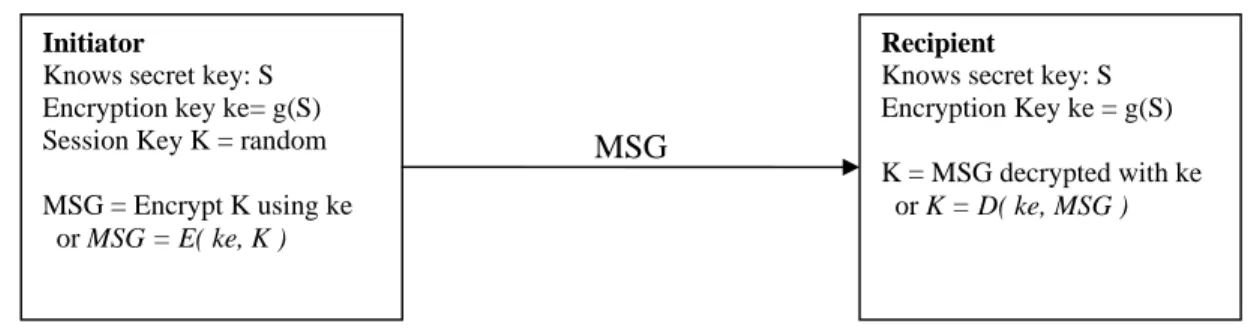
8 Key Agreement ... 40
8.1 Standard Key Agreement protocol ... 40
8.1.1 Pre-Shared Key Agreement ... 40
8.1.2 Public-key Agreement ... 41
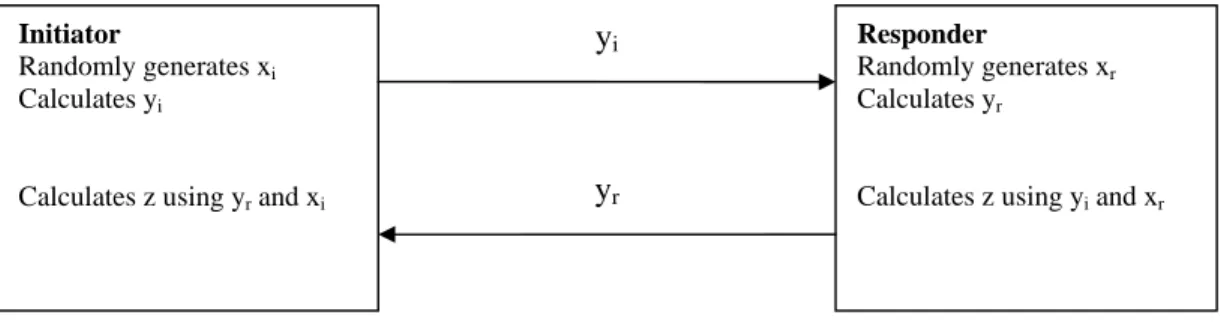
8.1.3 Diffie-Hellman Key Agreement ... 41
8.2 Key Management Protocols ... 43
8.2.1 ISAKMP... 43
8.2.2 IKE ... 43
8.2.3 MIKEY ... 45
9 Media Security Negotiation ... 47
9.1 Independent Key Management... 47
9.2 The SDP Encryption Key Attribute ... 47
9.3 SDP Security Negotiation Protocols ... 47
9.3.1 SDP Security Descriptions for Media Streams ... 48
9.3.2 Key Management Extensions for SDP ... 49
10 SIP Encryption ... 52
10.1 Hop-by-hop Security ... 52
10.1.1 SIPS using TLS ... 52
10.1.2 SIP with IPsec ... 55
10.2 End-to-end Security... 56
10.2.1 S/MIME ... 57
10.2.2 Public Key Infrastructures ... 58
10.2.3 Enhancements for Authenticated Identity Management in SIP... 59
11 SIP Security Negotiation... 60
11.1 Default Session Security ... 60
11.2 Security Mechanism Agreement for SIP... 60
IV
Results and Conclusions
61
12 SRTP Implementation ... 6213 Security Scenarios ... 64
13.1 Light Security ... 65
13.2 Medium Security ... 66
14 Conclusions ... 68 15 References and Bibliography ... 69
1
Introduction
1.1
Project Background
Omnitor is a company dedicated to developing information technology suitable for people with disabilities. Communication being an important part of today’s society, it is vital to make new communication possibilities available to as many people as possible. By providing software and tools that alleviate some of the difficulties associated with a particular disability new technology becomes available for people who would otherwise receive yet another disability by not being able to use the new technology. The telephone is an example of an important technological advance that has not been able to provide equal opportunity all users. The ‘RTP Payload for Text Conversation’ specification [16] has been developed by Gunnar Hellström, Omnitor AB, to provide a standard for payload format in real-time text conversation. The use of this technology enables two participants to communicate using real-time text. By extension, the versatility inherent in computer-based software allows the implementation of this standard to provide text communication without additional devices when used in an IP-telephony context. In other words, without having to use intermediary translation or extra equipment not available to everyone someone without knowledge of sign language can communicate with someone dependent upon it.
Omnitor has created an application called SIPcon1 to demonstrate the use of RFC 2793 [16] based text conversation. Since the standard does not provide specifics on how to provide security mechanisms for the communication all data is sent in plaintext. Because communication between two compatible computer applications with access internet implies the use of a packet switched network any information exchanged should be considered more exposed than information exchanged over a circuit switched network (used in conventional telephony). For this kind of application, security mechanisms to ensure the privacy of the communication should be considered a vital part of making the application attractive to users.
1.2
Project Objectives
RFC 2793 provides no information on how to provide security mechanisms for the text communication. The purpose of this document is to give an overview of, and possible solutions to the problems associated with providing security mechanisms to an application using said format to provide text communication. Since the SIPcon1 reference implementation uses the ‘Session Initiation Protocol’ [37] (SIP) for session initiation, thus providing means for interoperability with SIP compliant applications, the focus herein lies on how to implement security measures for an application using SIP to establish the session. Simplifying the security problem the process of providing security for the communication of data between two arbitrary users consists of two basic problems:
• Media encryption • Secure Key agreement
The method of encryption dictates how encryption, decryption and hashing of the media is to be performed to provide the security features needed by the application. These features provide the most important benefits of adding security mechanisms to the application and are explained in Chapter 5, Security Goals. We seek an encryption method suitable for the transfer of RTP text conversation payload data, as defined in RFC 2793, such that parties without authorized access are unable to participate in or eavesdrop on the communication within a reasonable timeframe.
Perhaps the more complex of the two problems, agreement on encryption parameters is needed because methods of encryption generally rely on common parameters and shared secrets to exclude unauthorized access. The complexity is brought on by the paradoxical need for the secret exchange of these parameters without first sharing a secret to encrypt the exchange with. Because of the complexity of this problem many security implementations rely on ad-hoc solutions, such as pre-shared secrets, which do not scale well to larger scenarios. In this document the process of exchanging the necessary cryptographic information will be referred to as key agreement, even though the process may in fact involve the exchange of more than just keys such as deciding upon method of encryption. The goal for this key agreement is to provide the keying material needed by the method of encryption in a secure manner so that the exchange does not compromise the security of the subsequent encryption. This implies that the process of key agreement itself needs security mechanisms similar to those needed for the encryption of the actual media stream.
In addition to providing methods of encryption and key agreement any suggestions made will be based on additional requirements. The requirements can be based on Quality of Service (QoS) issues, interoperability, extendibility or requirements brought on by the vulnerability of a certain mechanism.
The security goals of an application can vary greatly depending on the use and users of that application. Thus, a text communication tool might need varying degrees of security depending on communication content and the users involved. Considering there are no “one size fits all” security mechanisms the conclusion will reflect this by suggesting different setups for different scenarios.
1.3
Terminology
As with any technical subject the area of encryption involves a number of expressions which might not be familiar to those not knowledgeable in that area. Some expressions used throughout the report will be briefly explained so as to clarify their meaning in the context of this project. Many of these explanations are taken directly from a protocol made obsolete [5] that nevertheless amply explains some of the terminology that will be used.
Authentication
“The property of knowing that the data received is the same as the data that was sent and that the claimed sender is in fact the actual sender” [5].
Confidentiality
“The property of communicating such that the intended recipients know what was being sent but unintended parties cannot determine what was sent” [5].
Decryption
Reversing the effects of encryption.
Denial of Service
An event in which some or all of an application’s functionality is prevented.
Encryption
“A mechanism commonly used to provide confidentiality” [5].
Hashing
Creating a hash, or message digest, substantially smaller than the segment of data used as input in such a way that any other data segment processed in the same way is extremely unlikely to produce the same hash.
Integrity
“The property of ensuring that data is transmitted from source to destination without undetected alteration” [5].
Man-in-the-middle Attack
The process of launching an attack that directs the traffic of two communicating parties through an entity controlled by the attacker.
Message Spoofing
Creating a faked message with the intention of trying to pass it off as a legitimate message.
Perfect Forward Secrecy
The attribute for a key exchange mechanism where an exposed key does not jeopardize future transactions.
Quality of Service
A term used to describe the performance properties of a network service.
Replay Attack
The re-injection of a previously sent, legitimate packet into the network.
Security Association
“The set of security information relating to a given network connection or set of connections” [5].
Social Engineering
A popular term used to describe the manipulation of people for the purpose of attaining information harmful to the security of a system.
Traffic Analysis
“The analysis of network traffic flow for the purpose of deducing information that is useful to an adversary” [5].
User Agent
User Agent Client
A logical entity that creates and sends a new SIP request. The User Agent Client role lasts for the duration of the transaction [37].
User Agent Server
A logical entity that generates a response to a SIP request, either accepting, rejecting or redirecting the request. The User Agent Server role lasts for the duration of the transaction [37].
2
SIPcon1 Software Protocols
Securing the text is important for any SIP based application using real-time text conversation as defined by RFC 2793. To represent this generic application, in many instances, Omnitor’s SIPcon1 application will be used as an example.
SIPcon1 is a Java reference implementation of the IETF ‘RTP Payload for Text Conversation’ standard [16], developed by Omnitor, the purpose of which is to convey knowledge of real-time text transfer. The application uses the ‘Session Initiation Protocol’ [37] (SIP), the ‘Session Description Protocol’ [13] (SDP) and the ‘Real-time Transport Protocol’ [38] (RTP) to achieve the communication similar to the manner in which VoIP calls, conference tool sessions and whiteboard application sessions are initiated and run.
2.1
Session Establishment
Programs such as SIPcon1 need a way to establish a connection to another client if they are to communicate. With different programs wanting to communicate with each other in different ways a common method of establishing these connections is needed. SIPcon1 uses a protocol called the ‘Session Initiation Protocol’ [37] (SIP) to establish a session between two clients. The SIP protocol was conceived for the purpose of creating, modifying and terminating sessions with one or more participants and is used extensively in the establishment of VoIP sessions.
2.2
Media Negotiation
As there are many types of media, and every type of media has several ways of encoding the information, there needs to be a way of negotiating what types of media and what types of encoding are to be used in the session. There also needs to be agreement on what ports to use for the media communication. The ‘Session Description Protocol’ [13] (SDP) provides a way for SIP messaging to negotiate media types, port addresses and encoding by providing a standardised format for session description.
2.3
Media Transfer
Since SIPcon1 is meant to distribute real-time media it needs a transport protocol made for speed. By using an implementation of the ‘Real-time Transport Protocol’ [38] (RTP) this is achieved. RTP is an UDP based transport protocol developed for real-time media streaming and does not provide guaranteed delivery of sent packets.
2.4
Media Content
SIPcon1 is used to send audio, video and textual data from one client to another. Since the purpose of this thesis is to secure the textual data this media form will be the main focus on
which all assumptions are based, although extendibility to other forms of media will be an important consideration wherever appropriate. The text sent in SIPcon1 follows the ‘RTP Payload for Text Conversation’ [16] (RFC 2793) standard. This format has been specifically developed as a format suitable for straightforward real time text conversation and the SIPcon1 software has been constructed to demonstrate the use of this standard. Because of the nature of unreliable delivery protocols such as the User Datagram Protocol (UDP) (which RTP is based on) RTP is not ideally suited for delivery of textual data. The payload format of RFC 2793 is used to make the use of RTP more suited for this purpose by advocating the use of redundancy to counter the effects of packet loss.
3
SIPcon1 Protocols and Standards Descriptions
To demonstrate the use of ‘RTP payloads for text conversation’ [16] the SIPcon1 application uses a number of protocols as explained in the previous chapter. Extending the functionality of such an application to include security mechanisms is done in consideration of the protocols already in use. The protocols described in this chapter are implemented to give the application its current functionality.
3.1
SIP
The ‘Session Initiation Protocol’ [37] (SIP) is an application-layer protocol developed to handle the initiation, modification and termination of sessions. A couple of the problems associated with initiating a media session are locating participants, and negotiating session specific information. SIP defines how to locate and contact a desired participant while carrying session specific information in the “Invite” message body and its corresponding answer message. SIP relies on another protocol (SDP [13]) for the creation and interpretation of the message bodies which carry the media information. By only defining how session negotiation is communicated SIP can be used in a multitude of application environments independently of what type of session is being established or the underlying transport protocols used for the media transfer.
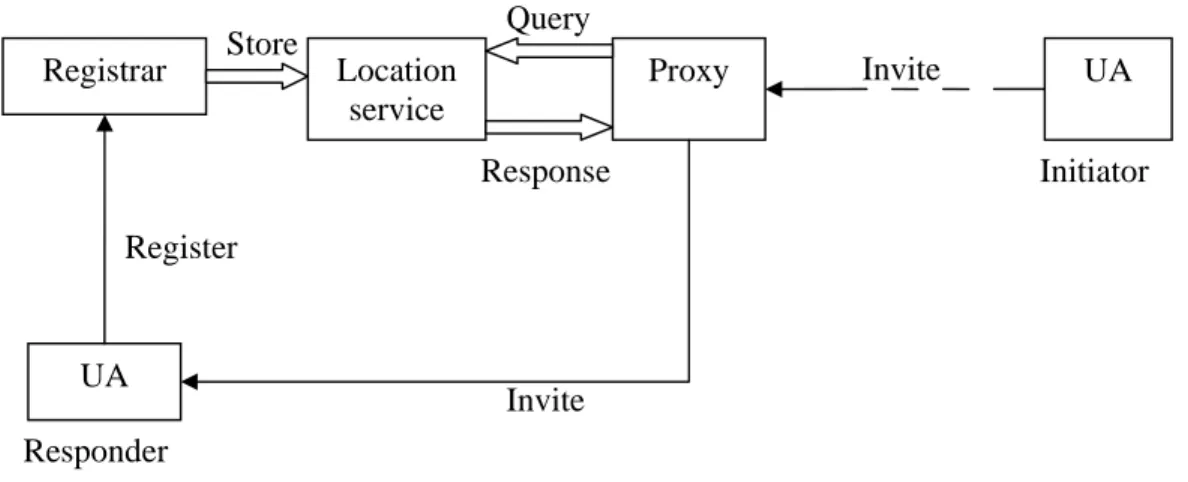
SIP enables the creation of an infrastructure that can relay messages from the call initiator to the call recipient even if the actual location of the recipient is unknown [37]. This is accomplished by having each user agent (an application which can both send a receive data) register its Uniform Resource Identifier (URI), a kind of network address, with a domain registrar entity which stores the user’s location information in a location service. Whenever a user agent sends a SIP message it is directed at a proxy server, which may or may not be the same entity as the registrar, entrusted to convey the message to the next so called hop. The proxy server, part of a network of such servers, directs the message to the next proxy along the intended route unless the intended recipient is registered at the same domain as the proxy in which case the message is forwarded to the recipient. After the initial session parameters have been decided subsequent SIP messages may be sent end-to-end, as the receiver location is now known, or along the same route as the initial messages.
Figure 3.1: Routing of a SIP Invite message
Figure 3.1 shows how an invite message is passed to its intended recipient. The Responder must first have registered with his registrar to provide routing information. The broken line of the initiators invite message indicates that the invite of a user agent outside of the responder’s domain would first have passed through the SIP infrastructure of the initiators domain, querying at the outbound proxy for the address of the recipients inbound proxy. Note that since the registrar, the outbound proxy and inbound proxy are logical roles, not physical, [37] they may or may not be represented by different entities.
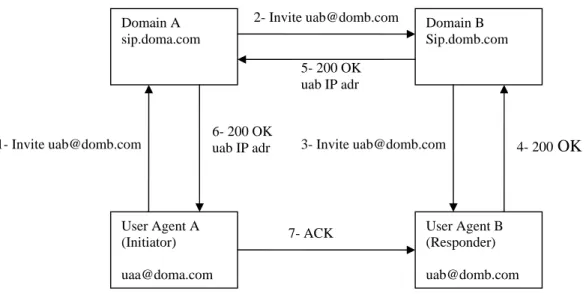
By simplifying the domain infrastructure to a single entity the SIP call establishment process between two registered users on separate domains proceeds as indicated by Figure 3.2, with messages numbered in sequential order. After the call initiation any negotiated media starts flowing directly between the user agents.
UA
Registrar Location service
Proxy UA
Invite Register
Store Query
Response
Invite
Initiator
Figure 3.2: Overview of SIP session establishment
3.2
SDP
The ‘Session Description Protocol’ [13] (SDP) defines syntax and semantics for negotiating media streams or, more generally, session contents. SDP is a textual protocol that allows a session initiator to signal several suggested streams and configurations with the knowledge that the return message from the recipient will contain the first supported configuration. The means with which media is to be sent need to be negotiated before any communication can be initiated. There needs to be agreement on what type of media to send and with what protocol, and to which port, to send them. The service provided by SDP caters to all these requirements.
When two applications exchange media the data has to be compressed and structured in some way. Since compression/decompression algorithms, known as CODECs, that do this compression is not interoperable, SIP session participants need to know what CODECs to use (and at what sample rates) and be sure both systems share the required CODECs. The problem of codec agreement is somewhat similar to that of encryption parameter agreement and, as later solutions will show, this makes an extension to SDP a good option for conveying cryptographic information.
Domain A sip.doma.com
Domain B Sip.domb.com
User Agent A (Initiator) [email protected]
User Agent B (Responder) [email protected] 1- Invite [email protected]
2- Invite [email protected]
3- Invite [email protected] 4- 200 OK
5- 200 OK uab IP adr
6- 200 OK uab IP adr
Example 3.1: A SIPcon1 offer SDP description example
In Example 3.1, demonstrating what a SIPcon1 session SDP description might look like, each m field signifies one media, describing type of media, destination port and transport protocol. The first media field suggests audio communication on port 12000 using RTP and the CODECs mapped to 5, 4, and 3. The media announcement fields below each m line suggest CODECs and sample rates in order of preference. A responder to this message who, of the suggested CODECs in the audio stream media description field, only supported GSM would answer using that media announcement. If that same user does not support a media at all, say for example the text communication, the port in the response is set to 0. The answer would look like that of Example 3.2.
Example 3.2: Possible response to the offer in Example 3.1
3.3
RTP
When SIP and SDP has been used to set up session parameters all that remains, except modifying or ending the session, is the actual encoding and transfer of the media. The SIPcon1 application uses the Java Media Framework (JMF) for the sampling of audio and video feeds because functions to sample and distribute media streams are readily available in JMF. However, the transmission of the sampled data is not handled by JMF but by Omnitor’s
v=0
o=Pontus_WX3 1 1 IN IP4 192.168.1.30 s=Omnitor_SipController
c=IN IP4 192.168.1.30 t=0 0
m=audio 12000 RTP/AVP 5 4 3 a=rtpmap:5 DVI4/8000
a=rtpmap:4 G723/8000 a=rtpmap:3 GSM/8000
m=text 10000 RTP/AVP 99 98 a=rtpmap:98 T140/1000 a=rtpmap:99 RED/1000 a=fmtp:99 98/98
v=0
o=Pontus_WX3 1 1 IN IP4 192.168.1.30 s=Omnitor_SipController
c=IN IP4 192.168.1.30 t=0 0
m=audio 12000 RTP/AVP 3 a=rtpmap:3 GSM/8000 m=text 0 RTP/AVP 99 98
RTP implementation. As the purpose of this thesis is to conceive a way of securing the text media the use of RTP for transmitting text is the main focus of this section.
The ‘Real-time Transport Protocol’ [38] (RTP) is based on the ‘User Datagram Protocol’, UDP, for the transportation of data and hence does not guarantee delivery of sent data. RTP is mainly meant to send large quantities of data, where guaranteed delivery is less important than congestion of the network or where re-sent, and thus late, packets would be of no use (or a combination of both reasons).
Text transmission falls way short of the ideal use of RTP when considering the form in which this media is created and presented. Transmission of text created on the fly by user input does not require enough bandwidth to motivate the choice of RTP, and because missing text packets could cause large discrepancies between receiver interpretation and sender intent text transmission requires that lost packets be recovered.
The use of RTP as a transport protocol for the text, other than as a basis for experimentation, can be motivated by the use of RTP for the transportation of the other media streams. By using the same transport protocol changes or additions made to the application are easily extended to apply to all transmitted media.
3.4
Media Content – RFC2793
Because RTP uses UDP for the transportation of data the overlying application must handle any retransmission, packetization and reassembly. The importance of reliable delivery for the interpretation of text media sets requirements for how text data needs to be handled.
Gunnar Hellström, Omnitor AB, has developed the ‘RTP Payload for Text Conversation’ [16] (RFC 2793) standard in an attempt to standardize real-time text conversation. The SIPcon1 software has been constructed by Omnitor AB as a reference implementation to demonstrate the use of real-time text conversation. Text conversation contents follow the ITU-T T.140 [15] recommendation for textual conversational communication between two participants. Packet loss issues sprung from the use of UDP with textual conversation are solved, or mitigated, using the “RTP Payload for Redundant Audio Data” [32] standard. This standard, originally meant to be used for the distribution of audio data, introduces the use of redundant data to recover lost information. This is possible, providing the number of consecutive packets lost is lower than the number of redundant blocks in each packet, by including the data of some previously sent packets in every new packet. The newest draft of RFC 2793bis [17], meant to eventually replace the current version of RFC 2793, recommends the use of two redundant blocks with every packet ensuring that all text data is delivered as long as one of three consecutive packets arrives at its intended destination. Packet loss of a value of four consecutive packets would in this case entail loss of the data contained within the oldest redundant packet and subsequent lost packets would each create loss of one packet of data until a packet safely reaches its destination. By using redundancy in this way a buffer of sorts is maintained that allows for two consecutive packets to be lost without loss of data at the receiving end.
Since text conversation is not a continuous media transfer, specifically there might be pauses between writing a sentence and waiting for a reply, only sending redundant data with new packets could create noticeable loss of characters at the end of a sentence until the next
sentence is started. RFC 2793 therefore advices that an application should create completely redundant packets, with no new information, whenever it detects no new characters have been sent within a certain time interval.
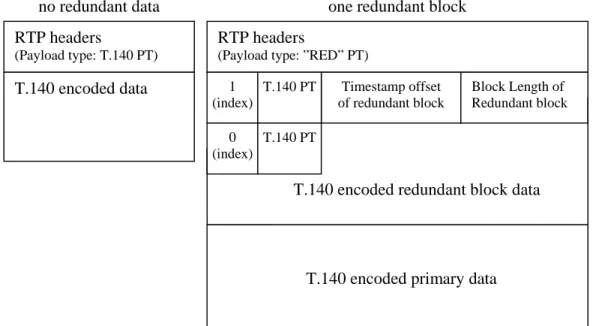
Figure 3.3: T.140 payloads with and without redundant data
Figure 3.3 demonstrates the added fields required for use of redundancy in the T.140 payload. A block index, timestamp offset and block length field as shown in the payload using redundancy is required for every block of redundant data. The block index 0 indicates there are no more redundant blocks in the payload (and hence all remaining data not accounted for by the block length fields must be new primary data).
RTP headers
(Payload type: T.140 PT) T.140 encoded data
RTP headers
(Payload type: ”RED” PT) 1
(index)
Timestamp offset of redundant block
Block Length of Redundant block 0
(index)
T.140 encoded redundant block data
T.140 encoded primary data
no redundant data one redundant block
T.140 PT
4
Threat Model for SIP and Real-time Media Transfer
One important factor when deciding upon a security mechanism is the threat model [7]. Getting a good understanding of the types of threats that exist against a particular application is essential to creating or selecting security mechanisms suitable for that application. The threat model usually takes into account any specific sources of attack, the expected target of attack and the means with which such an attack is carried out.
4.1
Attackers
A diverse application such as a teleconferencing system can be subjected to attack by many sources. As such an application is only a means of communication between two parties, any goal an attacker might have depends greatly on who the users are and what information they are transmitting.
A company using a multimedia application for transmission of audio and video data (and possibly other data types such as text, whiteboard data, etc.) might depend on the application for communication between company employees and for online conferencing. An attacker involved in industrial espionage could obtain company secrets, alter information and interrupt daily operation if the application is left vulnerable to attack. An attacker with no interest in company information could still make secret information known to the general public or sabotage the company’s ability to communicate effectively.
A person, be it a company employee or someone else, might use the application for purely private communication. An attacker eavesdropping on a private conversation might still get access to insurance information, security codes, medical information or other sensitive information. Even if this is not the case (the user might be aware of the fact that the application is not “safe”) the ability for someone to eavesdrop on a private conversation could be considered such a violation of personal integrity that the user would simply not use the application.
4.2
Target Resources
Identifying resources which might be targeted by an attacker allows the deployment of security mechanisms which counter threats on those particular resources. It is important to note that not all targets of malicious attack are possible to protect using software measures and good security policies are needed to reduce the risks of these attacks.
4.2.1 End Systems
Making sure the end system of a user is inaccessible to unauthorised access might seem rather obvious, but in practice this is one of the security aspects most commonly forgotten. Many times companies implement strong security mechanisms for their systems and, in feeling their systems are already safe, fail to consider the human aspect of computer security. There is no way to implement safety against a user that leaves passwords in the open, allows access to his
or her system, or otherwise compromises the security of the application. It is also important to protect against any form of remote access by using a sound security policy.
The difficulty in ensuring secure end systems is increased by using a “softphone” system, such as the SIPcon1 application, which implements VoIP or similar services on an ordinary PC. The added security risks originate from the multipurpose abilities of a modern day computer, and the widespread existence of worms, viruses and other malicious software. Since other computer interactions might introduce these malicious programs without interference from the VoIP application no amount of VoIP application security can protect against these threats. Because of these external risks, a computer system requiring secure SIP communication needs to use good security measures to protect against those risks using antivirus software. It would be well to realise however that antivirus software is in no way a guarantee that a system is uninfected since even the best antivirus software can not protect against viruses so recently conceived that their existence is unknown.
4.2.2 Application Users
One rather effective tool in hacking security systems today is what is known as “social engineering” which is basically the practice of conning people into giving you information sensitive to the security of a computer system. The fact that this method is so widely used is proof enough that no matter how secure an application is it is still no stronger than its weakest link, in this case that would be the user. Since no software can protect against this kind of attack it is important to remember to keep your users well informed on how to handle system sensitive information.
4.2.3 SIP Registrar and Registration
The SIP registrar, as described earlier, is the entity that registers a SIP UA to its domain. The registrar usually requires the user agent to authenticate itself, otherwise it would be easy for an attacker to register, impersonating any legitimate user [37]. An attacker with the ability to register as any legitimate user can receive session requests intended for that user and may initiate requests to other users posing as the user of the hi-jacked account.
4.2.4 Location Service
The location service, in whatever form provided, must remain inaccessible to unauthorized access. No amount of registration security would be sufficient if an attacker can modify registration data at the source. Since the location service most likely consists of a lookup on a database maintained by the registrar this simply means the database maintained by the registrar should remain inaccessible to unauthorized access.
4.2.5 Proxy Servers
Because proxy servers are depended upon to deliver SIP messages these might become a popular target for attackers. Denial of service attacks by superfluous messaging can lock up proxy server resources and thereby prevent desirable traffic from reaching its destination [37]. A more serious security flaw would be for a legitimate proxy to become compromised in a way that allows an attacker direct access to the traffic routed through the proxy. This would allow the attacker to gain information on the contents of any message, even information
protected with hop-by-hop security, without alerting the users. If no end-to-end security is applied this would be the equivalent to being able to eavesdrop on all messages. Worse yet, if any cryptographic keys and parameters are piggybacked in the SDP message the entire media communication would become exposed.
Although a flawless security mechanism might ensure all messages come from an authenticated user at a specific domain it might be that the domain from which a message originates does not have a strict security policy on distributing licenses. This would mean that an attacker could register a legitimate user at one domain then proceed with flooding users of other domains with traffic spam, either for the purpose of performing DoS attacks or for the distribution of advertisement.
4.2.6 Network Infrastructure
Since any application using the internet to transfer information is vulnerable to attacks on the network infrastructure feasible steps to make the infrastructure less vulnerable should be taken. For example, proxy servers use a Domain Name Server (DNS) to route calls and are thus dependent on having a functioning DNS [37]. Though describing the particulars of these threats is out of scope of this document, thought should be given to how these threats can be countered.
4.2.7 SIP Messages
Sending unprotected SIP messages allows an attacker to eavesdrop on the communication learning everything about the upcoming session. SIP messages sent without any integrity protection could easily be modified by an attacker. It would also be possible to insert spoofed packets, modifying, ending an existing session or creating a new one.
The SIP protocol allows for the bye message of a session to be sent directly to the recipient as the location of the user, thanks to previously routed messages, is known. If hop-by-hop security is provided, it is highly recommended this traffic is sent the same way as the initial traffic since any bye-message sent unencrypted could just as easily have been created by an attacker. By inserting bye-messages to implementations susceptible to this form of session termination an attacker can easily perform a DoS attack, shutting down any session at any time by inserting a spoofed bye-message.
4.2.8 Media Transfer
When media stream has been successfully set up between two systems the stream of packets is vulnerable to a number of different attacks. The most notable security flaw of an unencrypted media stream is the lack of confidentiality. Anyone with access to the flow of information has the same access to the information as the intended recipient. With no integrity protection an attacker can choose to modify a packet, or send a faked packet with data chosen by the attacker, without the recipient being able to differentiate these packets from non-compromised traffic. For an experienced attacker it is trivial to insert faked packets into the network in a way that makes the receiver unable to distinguish real packets from faked ones when no check for authenticity is made.
Even in cases where confidentiality, authenticity and integrity is ensured it might be possible for an attacker to re-insert a previously sent packet in what is known as a replay attack so that the receiving application interprets it as a new, authentic packet.
The actual transfer of media is done with protocols and parameters decided in the SIP message exchange. The protocol used dictates what weaknesses the media stream might have. The SIPcon1 application, currently using RTP for the transfer of media, is susceptible to all the attacks described above.
5
Security Goals
To counter the threats recognised in the construction of the threat model several security mechanisms need to be employed. Threats targeting non-application specific resources, such as end systems containing a security configuration allowing legitimate access to a SIP account, can most often not be affected with implementation measures. Although the user SIP password might be left out of a configuration, introducing user supplied passwords, this would still mean the user could leave the application running on an unguarded system, leave a note with the password lying around or give it to an attacker exercising social engineering. These types of threats can ordinarily only be countered by using good security policies and educating application users.
Some non-application specific threats, specifically DoS attacks targeting infrastructure resources, such as proxy servers, can be mitigated by a good network infrastructure and using strict policies on accepting SIP requests coming from certain sources. For example, a proxy knowing that some traffic originates from callers associated with a domain using lax registration policies might disallow that traffic. Although good security practices can serve to reduce the effects of DoS attacks [7] it is difficult, or impossible rather, to be completely safe from such attacks.
There are a few common goals attainable by securing any transfer of information requiring some form of protection by using encryption:
• Message authenticity • Message confidentiality • Message integrity
In addition to these goals it is important to prevent any legitimate message reinserted into the network from being accepted as a new message. This feature is called replay protection. To provide the necessary features to both the SIP communication and media streams each of these features needs to be implemented by some form of encryption protocol. For each of these encryption protocols there needs to be some means of negotiating keys for that encryption. Thus the problem consists of providing:
• Authentication of users so exchange of encryption information (key agreement) can be guaranteed to take place between intended participants of the session only.
• Key agreement for every security protocol which requires it.
• Security protocols to provide required features using the acquired key agreement data. While this chapter only describes common security features and the motivation for their importance later chapters will provide information on protocols which will make the realization of these features possible.
The first communication that needs to be secured in a SIP based application is the registration of the client to its registrar. This is the foundation on which all other security measures depend. If the registration process is insecure there can never be any guarantee that a session participant is who he or she claims to be. An attacker registering his own device/system as the contact of a legitimate URI is performing what is known as registration hijacking. In this case all other security measures would be compromised. If registration hijacking can be performed on one URI it can be performed on two as well. In a session where two users have access to a registrar without secure registration it might be possible for an attacker to re-register both legitimate user systems as the correct contacts for two other URIs and register his or her own system as the appropriate contact for those users. This way the attacker could route all traffic between the two users through his system allowing total, man-in-the-middle access to the SIP information.
5.1.1 SIP Registration Authentication and Integrity
When connecting to a registrar the user needs to be able to ascertain the true identity of the reached entity. In other words that the entity reached is indeed the intended registrar. Likewise the registrar needs to be certain the register request is being sent by the correct user. If a registrar does not require authentication from a user client, or if the authentication required is too weak, the entity is subject to a number of attacks. First of all an attacker could register as any legitimate user, de-registering existing contacts for that URI, registering their own devices as a contact address. This way they could hijack all SIP traffic intended to go from or to the legitimate user.
Having a weak or non-existing authentication of the registrar also presents additional security issues as it would allow an attacker with access to the UAC-to-registrar traffic (a man-in-the-middle access) to impersonate the registrar. An attacker faking a registrar could respond with a 301 (Moved Permanently) message to make all future requests go to an address chosen by the attacker. A client allowing authentication negotiation could find itself facing a downgrading attack where the attacker, posing as the registrar, tries to offer an authentication mechanism that either exposes secret credentials (password) or is easily broken.
The current implementation of SIPcon1 only uses the predefined HTTP digest authentication [12, 37], where a user password is used with MD5, to authenticate the client to the server. A unique nonce and a nounce counter are used to prevent replay attacks where an attacker could otherwise have re-sent previous authentication data in a new request. Digest authentication allows authentication without exposing secret credentials in the SIP communication and because of the way the authentication process is performed allows the registrar to authenticate a UA using a hashed value, without having to store the password explicitly. This way an attacker gaining access to the registrar database would not learn the passwords with which to create spoofed registrations. Note that the current implementation of digest authentication in SIPcon1 only authenticates the client to the server, not the other way around.
It is desirable to protect messages in such a way that a message can not be altered without detection, preserving message integrity. A registration procedure that does not guarantee message integrity runs the risk of having message values altered. While digest authentication has no explicit integrity protection some of the information in the register request is implicitly protected due to the simple fact that it is used as input in computing the hash. For message
tampering to be detected on registration messages an implementation needs to provide some form of additional integrity protection.
5.1.2 SIP Registration Confidentiality
Allowing registration in plaintext allows an attacker to gain all information about the requests and responses sent. Although, in the case where http digest authentication is being used during registration, this might seem like a minor problem it still allows an attacker to monitor SIP traffic. A packet recorded in this manner could be used to launch a replay attack later on, should the registration procedure not include a mechanism for preventing such attacks. Fortunately, as previously mentioned, digest authentication provides mechanisms preventing replay attacks. For SIP registration to ensure confidentiality the current registration process would need to be replaced or carried out over an encrypted connection.
5.2
SIP Communication
There are several aspects to be considered when trying to provide security mechanisms for session establishment and configuration. There needs to be mechanisms in place to ensure a secure session can be successfully set up without an attacker being able to eavesdrop on the communication, modify messages or create spoofed messages. As with the SIP registration process the three main goals of adding security to the communication is to ensure message authenticity, integrity and confidentiality. The main difference between SIP registration and other traffic is that SIP registration only needs to deal with local, known users and their certificates while other requests often have to travel through proxies not of the same domain.
5.2.1 Session Message Authenticity and Integrity
It is important to ensure all SIP traffic originates at the expected source and that it has not been altered. Although secure SIP registration ensures that calls received by an inbound proxy, intended for the registered recipient, reaches the right destination, registration alone provides no insurance of the traffic origin. In other words, an outbound proxy that requires no authentication of origin on invite messages sent from its domain allows attackers to create spoofed requests by sending messages to that proxy posing as a legitimate user. An attacker could feed such a proxy falsified requests and thereby use that proxy to launch attacks that would seem to originate from one of the domain URIs. An end user will also need to authenticate received messages as an attacker could spoof a message so that it appears to have been delivered through the proxy. An inbound proxy not authenticating incoming messages would present the same threat to the users of that domain because any incoming messages, thought to originate from another legitimate user or proxy, could in fact be spoofed request sent by an attacker posing as another domains proxy.
To make sure this threat is neutralized there needs to be a mechanism that ensures message authenticity either using a mechanism similar to the one used in the registration process [12] returning a challenge for every message or by sending messages over a previously established secure connection or association [37]. There is also the possibility of adding end-to-end authenticity to the message, requiring both participants to authenticate themselves to each other.
Authentication between proxies needs to be considered a slightly different problem than user to proxy authentication. A process similar to that of the currently implemented user-proxy authentication is not viable between proxies because that solution depends on the proxy being a central authority (maintaining passwords) and does not scale well. Instead, proxy servers need to make use of some type of certificate authority to authenticate each other. Another method would be for each proxy pair to sign each others certificates, but while negating the need for a trusted external CA this method does not scale well.
By computing a hash, based on some secret credentials and session message content, the content used in the hash becomes integrity protected as any modification would alter the result of hashing at the receiving end. This means that if the receiver of a message positively authenticates the sender, provides mechanisms that ensure no replayed messages are considered valid, and computes a hash over the message using some secret credentials shared with the sender, any SIP message received where an included hash result matches the computed hash of the message will be an authentic, unaltered message.
If any entity along the SIP route should need to change information in the SDP body of the message, possibly to disallow certain types of media streams or for any other reason, end-to-end authentication of the SIP message would prevent this as any tampering would lead to the receiver interpreting it as an invalid message. The only way in which tampering would be possible would be if an entity part of a hop-by-hop security, where no end-to-end authenticity is applied, changed the contents of the message. Although this would promote interoperability with certain types of firewalls, one of the main concerns with using exclusively hop-by-hop security is precisely that security is only maintained if it can be ensured no intermediate proxies are compromised or malicious. The primary motivation for using end-to-end authentication is that any such tampering would be detected at the end destination.
Authenticating call origin is pivotal, in the same way as secure registration, because anything else would make not only the compromised domain vulnerable, but indeed the entire SIP infrastructure. Domains that are unable to guarantee message origin, or unable to ensure secure registration, are likely to have messages routed through them ignored by other domains because vulnerabilities in one trusted domain compromises one’s own domain. Such flaws would thus not only compromise the local SIP functionality but would also prevent communication with other domains.
5.2.2 Session Message Confidentiality
Confidentiality of the SIP messages is needed to prevent an attacker from learning session specific information. An attacker will be able to monitor participants of SIP sessions, the time during which they communicate with each other, what types of media they communicate with, what ports and transport protocols are used for the transmission and any other session specific information. Because the SDP message body can be used to convey cryptographic information regarding the media transfer when the media encryption protocol itself does not provide these services (as is the case with SRTP), the protection of the SIP content under these circumstances becomes crucial to ensure the security of the media streams is maintained. Tunnelling (piggybacking) this information in the SIP message body is a convenient way to perform key agreement, but these schemes also make the media security totally reliant upon SIP message security to maintain their usefulness. This is an example of yet another process where another weak link in the cryptographic chain could compromise the entire cryptographic process. As in the process of ensuring message authenticity, solely
relying on hop-by-hop security could constitute a security risk depending on how safe involved proxies (or other SIP entities) are rated. This is why it might be prudent to apply end-to-end encryption in some security models. Some of the SIP header fields are unsuitable to encrypt end-to-end as their content is needed by intermediate proxies for routing purposes, which is why end-to-end encryption of SIP messages should either encrypt the SDP body or the body including header fields not required for routing. While there are certain entities today which require access to the SDP information when routing a session message they are generally rare and the benefits of adding end-to-end encryption in some cases overshadow this disadvantage.
5.3
Media Transfer
Securing the actual transfer of media is a problem in many ways unrelated to securing the SIP messages. The SIP message security and media transfer security share one important common link in the need for negotiation. Since the purpose of the SIPcon1 application security mechanisms is to be made compatible with other SIP/SDP based applications, and since there are no “one size fits all” standards to cryptography, negotiation of keys, transport mechanisms and cryptographic suites would allow for maximum compatibility. The SDP body of a SIP message is the perfect medium for such negotiation and it is therefore expected solutions catering to the need for interoperability will probably make use of the SDP body in negotiating parameters for the media encryption. An unavoidable problem with this approach is that for this negotiation to work both parties must have implemented the protocol required for this negotiation. Since information on encryption parameters leaked to an attacker would render the encryption useless any scheme using the SDP information for that purpose is dependant on the SIP security. Also, since the security protocol using these parameters will need to be negotiated tampering with this part of the SDP information could mean the security mechanism becomes compromised as an attacker could launch a downgrade attack where a less secure, or totally insecure, transport protocol offered as a secondary alternative is left as the only offered protocol.
Ordinarily, securing the media for a VoIP application would set high QoS requirements for the encryption since user perception of audio and video media is sensitive to QoS issues. The focus herein lies on the transfer of text media, not at all as sensitive to these issues as audio and video, but to allow for future extensions to the encryption considerations to QoS issues will still be prioritized.
5.3.1 Media Authenticity and Integrity
A protocol relying on UDP for the delivery of packets takes a packet arriving at the expected port and processes it. An attacker could insert faked packets into the network appearing to belong to the media session to force a receiver application to process data created by the attacker. Using this method an attacker can easily degrade the QoS to such an extent that communication becomes impossible. A more subtle attack on a media stream without authentication and integrity would be to intercept and modify media packets in such a way that the meaning of a voiced sentence, transmitted video or text changes completely.
Providing the session initiation was secure participants of the session have had an opportunity to exchange cryptographic keys and parameters known only by them. Using these credentials to create a hash over the media in need of protection and including the result in the packet
data would not only prove to a recipient the message originated from the expected sender, but it would also prove any packet information needed to create the hash has been left untouched. An attacker faced with a confidential, authentication and integrity protected message could still cause damage to some applications. If no mechanism is implemented to prevent the re-use of old packets an attacker could record packets and resend them as though they were legitimate packets. This attack is called a replay attack and any transport protocol concerned about security should provide mechanisms to prevent this attack.
5.3.2 Media Confidentiality
Once the media transport protocol and required parameters have been negotiated the actual media stream needs to be made confidential. By encrypting the media with secret cryptographic parameters shared with the recipient any eavesdropping would produce nothing but seemingly random data.
As the quality of real-time transferred media at the receiving end is degraded by the effects of packet latency, jitter and packet loss steps must be taken to reduce these QoS issues as much as possible. Packet loss is possible since the time constraints on real-time media make it unsuitable for reliable transport protocols to be used, but no encryption mechanisms add to the problem of packet loss except perhaps to increase the chance a packet arrives to late for proper processing. Latency and jitter of packets are two of the QoS aspects affected by encryption. The computational time needed to encrypt and decrypt a packet of media data is added to packet latency, and because the time needed for this process may vary depending on the current performance of the system the jitter effect is also increased.
The importance of media stream confidentiality and QoS sensitivity suggests encryption needs to be both fast and difficult to break. The possibility of packet loss in UDP based network delivery, for example RTP, requires the encryption to be stateless since any encryption based on previously transmitted data would become out of synch as soon as a packet was lost.
6
Encryption Protocols
One encryption protocol can be used in different contexts for slightly different purposes. This chapter describes some of the more common encryption protocols for encryption at different layers. The utilization of these protocols to solve certain encryption problems will be discussed in chapters, which handle encryption in a particular context.
6.1
IPsec: Network Layer Encryption
The IP Security Protocol suite, known as IPsec [24], consist of a number of documents, interrelationships explained in [39], that provide security at the IP level (in the network layer). The preferred form of VPN tunnelling across the internet [27], IPsec defines two basic protocols which provide connectionless integrity, source authentication, confidentiality and replay protection: Encapsulating Security Payload (ESP) [23] and Authentication Header [22] (AH). Given that IPsec used in tunnelling mode can provide these services to an entire IP packet, including the header, it is able to provide better security than encryption at other levels. IPsec is most commonly used where domains or hosts have an existing trust relationship with each other [37]. It can be used regardless of the transport protocol being used and provides authentication, integrity and confidentiality for transmitted data.
The SIP protocol RFC does not specify a framework for the use of IPsec and no key management is suggested. The most common use of IPsec in this scenario is to use it in collaboration with the IKE protocol [14]. Based on the ISAKMP [28] framework IKE uses the Oakley Key Determination Protocol [31] and SKEME (Secure Key Exchange Mechanism for the Internet) [25] to provide automated cryptographic key exchange and management mechanisms.
Two protocols ESP (Encapsulating Security Payload) and AH (Authentication Header) can be used in either transport mode or tunnel mode [27]. Transport mode is used to encrypt the payload data leaving the IP header and the new IPsec header in the clear. While being the faster of the two methods this mode of delivery leaves an attacker the opportunity for rudimentary traffic analysis. Tunnel mode not only encrypts the payload, but the entire IP datagram and places the encrypted data in a new IP Packet. This way only the entity currently sending the Packet and the next endpoint in the tunnel are made known to any eavesdroppers, making the true origin and final destination unknown to an attacker. The cost for this added security is in the added latency of encrypting and decrypting the original IP header and the added size of the transmission due to the extra IP header.
The SIP specification states that “IPsec is usually implemented at operating system level in a host, or on a security gateway that provides confidentiality and integrity for all traffic it receives from a particular interface” [37]. Because operating systems are trusted to implement IPsec and because existing trust relationships should be present IPsec is not suited for deployment in all network environments. IPsec also has known issues with NAT traversal that vastly increases the difficulty of deploying a working IPsec security mechanism. Thus an application relying on IPsec to secure its communication is also more suitable for deployment
on a local, known network basis. The NAT traversal issues are derived from the need for a NAT to translate between inner and outer addresses on a packet with encrypted headers. Although suitable for file transfer scenarios the overhead to packet size and computational time of IPsec is rather hefty in terms of real-time transmission. Applications that require minimal delay and jitter will in many cases find the time required for IPsec encryption unacceptable.
6.2
TLS: Transport Layer Encryption
Transport Layer Security (TLS) [9] is a security protocol which provides encryption at the transport layer. The protocol specifically requires a connection oriented, reliable delivery transmission protocol which means it will not work with protocols using UDP transmission. TLS provides integrity protection, authenticity and confidentiality of sent data without needing additional key management.
TLS is comprised of two layers; the TLS Record Protocol and the TLS Handshake Protocol. The Handshake Protocol is used to authenticate the participants and negotiate security parameters while the Record Protocol provides confidentiality and integrity to the actual data transfer [9].
Although commonly used for http security (using the https URI) TLS is application independent, meaning it can be used with a variety of applications using connection oriented, reliable data transmission. How applications or protocols are supposed to use TLS handshaking, authentication and so forth is left to the protocols which run on top of TLS [9]. Because TLS is application independent, self-sufficient and widely used it is a good alternative to consider for any situation where TCP based traffic needs encryption. By having a certificate for the entities involved in the communication TLS provides its own key management and authentication using the handshake protocol before proceeding with the encryption (using the record protocol).
A draft is being worked on to create version 1.1 of the TLS protocol [10]. The specifics of this document have not been considered in the creation of this thesis, but the completion of the protocol could very well introduce some interesting possibilities in the future.
6.3
SRTP: Application Layer Encryption
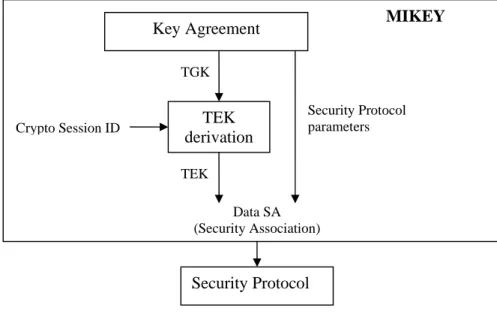
The Secure Real-time Transport Protocol (SRTP) [6] can offer confidentiality, authenticity, integrity and replay protection for RTP and RTCP packets, providing all the important elements to secure a media stream. The RTP packets are used to carry the session contents while the control packets, RTCP, are used for session statistics and control. A secure session key derivation function is used to produce pseudo-random session keys using only a master key and an optional (highly recommended) master salt.
The key derivation function in SRTP enables session keys to be created using a master key and, to protect against pre-computation attacks, a master salt. This function is used to create a session encryption key, session authentication key and session salt to use when processing
packets. In fact, both the SRTCP and SRTP stream can be provided with session keys using only the master key and salt. This function also enables the definition of the optional key derivation rate in the SRTP protocol which specifies how often new keys are to be generated. This is useful because an application sending data for a long period of time might wish to use several session keys so that one leaked or cryptographically broken key will only compromise part of the packet stream. This is then easily done by defining a key derivation rate higher than zero.
The construction of an SRTP implementation has been constructed in this project since it proved to be a very effective encryption method for the encryption of real-time media. Because of this a slightly more through examination of the protocol is warranted.
SRTP uses the fast and strong Advanced Encryption Standard (AES) [30] (based on the Rijndael cipher) in counter mode as the default algorithm for encryption and proposes AES in f8-mode as an option for UMTS (Universal Mobile Telecommunications System) applications. The counter mode of the AES cipher works by using an initialization vector, computed with the source identifier, packet index and the salt. This IV is then used to create a keystream for the first “blocksize” number of bits of the packet. Any further keystream needed for that packet is created by applying AES to the IV plus a counter incremented for each block. The keystream produced is XORed with the plaintext datastream to produce the encrypted stream and vice versa for decryption.
The authentication mechanism provided supports both message authentication and message integrity using the default HMAC-SHA-1 (HMAC [26], SHA-1 [29] transform. The authentication mechanism is also what paves the way for the use of the replay protection mechanism and is required for replay protection to work.
The SRTP protocol leaves a small footprint by requiring a small code size and little memory and as the packet expansion is small bandwidth is preserved. By conserving the headers of the RTP packets any header compression used with RTP can also be used with SRTP.
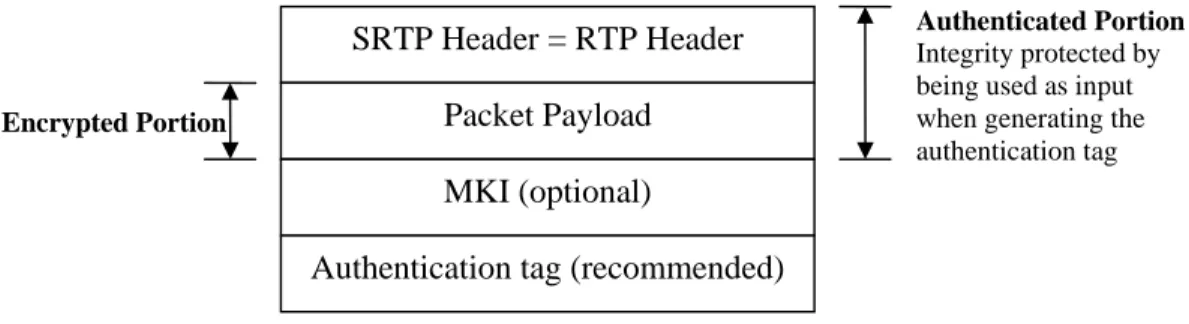
Figure 6.1: SRTP packet composition
The SRTP header, on the top in Figure 6.1, is identical to that of an RTP header. The difference between the SRTP and RTP packet is that the payload of the original packet is encrypted and that two optional fields may be added.
SRTP Header = RTP Header Packet Payload MKI (optional)
Authentication tag (recommended)
Encrypted Portion
Authenticated Portion
Integrity protected by being used as input when generating the authentication tag
The intended purpose for the optional MKI (Master Key Identifier) field is to identify which master key has been used to derive the session keys to encrypt the packet. This field is defined, signalled and used by key management. The purpose of changing a master key might be because the master key can no longer be trusted. There might be a suspicion that the master key in some way has been compromised in which a re-key would have to be made. There is also a limit to how many packets can be encrypted with the same master key. As a new master key is negotiated in every new SIP request the first use of the MKI should not be needed. The packet limitation on the master key requires a time period of several months of intense communication to be transgressed and should pose no problem to an application used for short conversations.
The Authentication tag for an RTP packet is used to provide authentication, integrity and the basis for replay protection. Even though the tag is optional its inclusion is highly recommended by the SRTP specification. All applications whishing secure communication using SRTP should make use of the authentication feature, otherwise only confidentiality can be guaranteed. The tag is computed using the session authentication key and, with the default algorithms, the HMAC-SHA-1 transform over the original RTP header and its encrypted payload. This way the receiver can compute the tag of a received packet and compare it to the appended tag. If the tags are a match the packet has been sent from a party with the correct cryptographic context, without any of the integrity protected content being manipulated.
Figure 6.2: SRTCP Packet composition
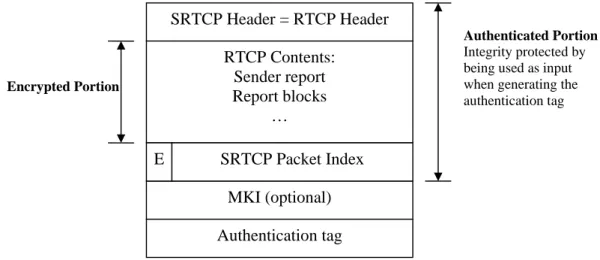
The SRTCP packet, shown in Figure 6.2, introduces some new fields much like the SRTP packet does. The difference here is that that an explicit packet index and encryption bit (the E in Figure 6.2) is added, and that the authentication tag is mandatory.
SRTCP Header = RTCP Header RTCP Contents:
Sender report Report blocks
…
MKI (optional) Authentication tag
Encrypted Portion
Authenticated Portion
Integrity protected by being used as input when generating the authentication tag
SRTCP Packet Index E
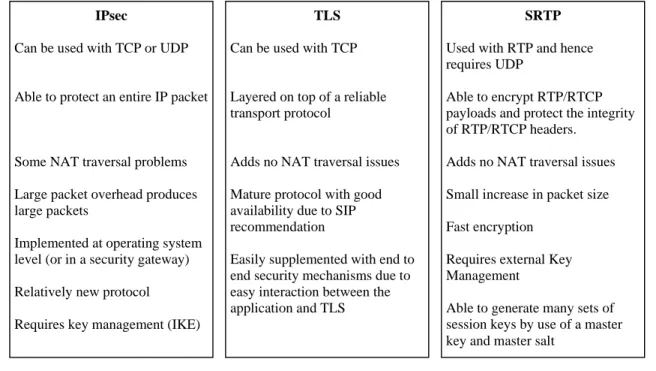
Figure 6.3: Overview of some basic Security Protocol traits
IPsec
Can be used with TCP or UDP
Able to protect an entire IP packet
Some NAT traversal problems Large packet overhead produces large packets
Implemented at operating system level (or in a security gateway) Relatively new protocol Requires key management (IKE)
TLS
Can be used with TCP
Layered on top of a reliable transport protocol
Adds no NAT traversal issues Mature protocol with good availability due to SIP recommendation
Easily supplemented with end to end security mechanisms due to easy interaction between the application and TLS
SRTP
Used with RTP and hence requires UDP
Able to encrypt RTP/RTCP payloads and protect the integrity of RTP/RTCP headers.
Adds no NAT traversal issues Small increase in packet size Fast encryption
Requires external Key Management
Able to generate many sets of session keys by use of a master key and master salt