The Study on Logistics Management Patterns based on Fuzzy
Comprehensive Evaluation Method
Liu Hui Chen YiZeng
School of Management Shanghai University, Shanghai Baoshan 200072
School of Foreign Yiwu Industrial & Commercial of College, Zhejiang Yiwu 322000
[email protected]
Abstract
With the intense market competition, automobile manufacturing enterprises must grasp the operation of their own logistics management system comprehensively and timely, in order to adapt to the internal and external changes. The processes of using the methods of analytic hierarchy process and fuzzy comprehensive evaluation to assess the effects of logistics management pattern in auto manufacturing enterprises are illustrated exactly in this paper. The weakness and potential deficiency of coordination in logistics management can be found based on result of assessment. Based on the research, we can help the auto manufacturing enterprises to grasp the effects of the logistics management pattern comprehensively. And through the evaluated results the auto manufacturing firms can find out the weakness and the hidden deficiencies.
Keywords
: Automobile Manufacturing Enterprises, Fuzzy Comprehensive Evaluation, Logistics Management Pattern, Logistics System of Manufacturing Enterprises.1. Introduction
The continual changes and quick adjustment are essential for a manufacturing firm to be successful in the new world of hyper-competition [1]. Traditional assessment of logistics management pattern focuses only on the process of supply, producing, sales and reverses logistics separately. It ignores the integration of the logistics administration pattern system and this may results in the lack of competition abilities. It is understood that traditional index system fails to reflect the effects of logistics management pattern completely and it is of most practical value to grope for an innovating index system. In order to solve this problem, a new index system was constructed in this paper which provides the auto manufacturing firms an effective way to recognize the operation of their own logistics administration pattern both in separate process and integration system.
In the research area of logistics management, Mentzer , Konrad , Stewart, Yu-kui SHENG and Wan-lian LAN assessed the effects of logistics service with the fuzzy comprehensive evaluation method[2,3,4]. Kee-hung Lai and Nagi constructed an evaluation system of logistics performance [5, 6]. Yin ZU, Zhi-yong MENG, Shu-yu KAN, Yidan BAO, Yanping WU, Yong HE, Xiaofeng GE, Jing-jing WEN Li-fang FAN and Hao-bin JIANG introduced the processes of using AHP (Analytic Hierarchy Process) method to calculate the weights of indices [7-10]. Ning M, Kai-chao XU, Chang-qiong WANG, Sheng ZENG, Wei YU and Juan CHEN introduced the processes of fuzzy comprehensive evaluation method [11-14]. Yu-lan LU, Gen-ping MA introduced the logistics management patterns in their paper [15, 16]. De-chen WEN and Gao-shan WANG established an evaluation system to the logistics system’s quality and used the fuzzy comprehensive evaluation method to assess it [17]. Chang-li FENG and Li-li XIE constructed an eval uation indices system of the operating mode selection in reverse logistics of manufacturing enterprises [18]. Ying-ai GAN, Feng Tian and Wei-zheng LI introduced analytic hierarchy process in detail [19].
2. The logistics system of manufacturing enterprises
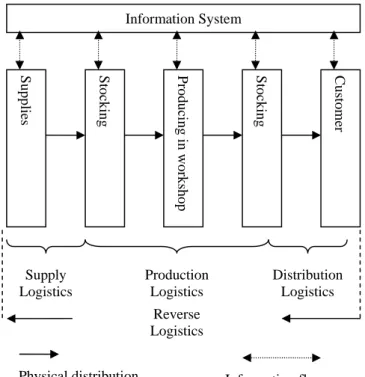
The logistics system of manufacturing enterprises consists of information system, supply logistics system, production logistics system, distribution logistics system and reverse logistics system. The relationship among all above systems is clearly shown in the figure 1.
The logistics management system of manufacturing firms is a big system with the characteristics of dynamic state, large span, complexity and multi-objectives. The targets of this system are considered as “5S-Goal” which means Service, Save, Speed, Scale Optimization and Stock Control [20]. These targets respond to the demands of logistics service in manufacturing enterprises which are considered as the affecting factors to the evaluation. In the automobile manufacturing enterprises, the logistics management system is constructed by three parts. The first part is function factors, the core of the system, which contain packing, transportation, and stock, logistics information, carrying, machining and loading. The second part is supporting factors. The details of this part involve the politics and law of government, enterprise’s regulations, and standardization. The last one is physical foundations such as logistics infrastructure, equipments, information technology and information network, logistics management.
Therefore, it has been realized that the constitution of logistics system in the auto manufacturing enterprises is a foundation of the evaluation we will discuss in the rest of the paper.
Fig 1. Logistics system of manufacturing enterprises
3. The types of logistics management pattern and integrated logistics
management pattern
In this section, three major operation patterns of logistics management will be introduced and the integrated logistics pattern will be analyzed.
3.1 self-operating pattern
Self-operating logistics management pattern stands for that enterprises receive the logistics service from their own logistics departments or companies. The advantages of this pattern are as follows: Firstly, the enterprises can control their logistics process directly. Secondly, this management pattern enables the enterprises to obtain good reputation by giving favorable logistics service to other firms. But using this logistics management pattern will increase the risk of enterprise operation.
Information System Custo m er S tocki n g P rod ucing in w orkshop S tocki n g Su ppl ies Supply Logistics Physical distribution Production Logistics Distribution Logistics Reverse Logistics Information flow
3.2 Outsourcing management pattern
Outsourcing management pattern of logistics means that the enterprises receive the professional logistics services from the third-party logistics company. The enterprises will receive certain benefits from using this pattern. First of all, this management pattern will help enterprises make a reasonable allocation of capitals and resources which enable enterprises to have more power to operate their core business successfully. Otherwise, this management pattern will also help enterprises reduce the risk and cost of logistics management. But some deficiencies exist in this management pattern because outsourcing management of logistics lack the development and innovation of logistics technology. Secondly, enterprises can not receive the information from suppliers and customers directly because they control their logistics management process indirectly.
3.3. Strategic alliance pattern of logistics management
This pattern means that enterprises can set up a logistics alliance department with other companies who have the same demands of logistics services and lack of abilities to establish a logistics department by themselves. The advantages of this logistics management pattern are as follows: firstly, in the alliance the information can be delivered rapidly to avoid the distortion of information. Secondly, alliance can help the enterprises enhance the abilities of logistics management and increase the power of competition. But, At the same time, this logistics management pattern owns some disadvantages, such as high cost of operation and complex relationships among the partners.
3.4. Integrated logistics management pattern
The logistics system in enterprises can be divided into four subsystems as followed: supply logistics system, production logistics system, distribution logistics system and reverse logistics system. Different subsystems of logistics system have different tasks and contact with internal and external environment in different levels, which cause the demands of logistics services to be distinct. So in different subsystems, enterprises always choose logistics management pattern separately.
The integrated logistics management pattern is a complex system in which the four logistics subsystems interact one another to reach a effective corresponding state. It reflects the coordination of the whole logistics management patterns. It focuses not only on the effects of the separate logistics subsystems, but also on the coordination of the four logistics subsystems.
4. The selection of main indices used to evaluate the effects of logistics
management patterns for automobile manufacturing enterprises
Logistics management pattern in auto manufacturing firms is a complex system in which exist many factors affecting the choice of its management pattern. It is necessary to analyze the main factors in the system exactly. To select the key factors acting the main roles in management pattern is the core task for constructing the index system of evaluation.
In generally, enterprises select the logistics management pattern in terms of some internal factors of company. Such as products, commercial strength, logistics cost and logistics service abilities.
In automobile manufacturing enterprises, the components of the vehicle, which are indispensable to the production, are supported by the factories from different countries. So it is difficult to manage and control the supply logistics. High-speed, timely and accurate logistics services are especially important in this process.
Production logistics in the auto manufacturing enterprise need the flexible logistics services which can be quickly changed to adapt the technology innovation.
Flexibility is the demand of the distribution logistics service as well. The distribution logistics is the link between enterprises and customers, so service quality and promptness of logistics are obviously important in this process.
In the reverse logistics process, rapid reflection to customer’s satisfaction and low cost principle are the main factors, when the scrap and the low quality products sold to the customers should be delivered
back to the enterprises. It is necessary for auto manufacturing enterprises to compensate the mistakes through logistics service with rapid speed.
Based on the above discussion, five main indices are selected as the latent variables. They are logistics cost, integrated coordination, service quality, flexibility and long-term strategy. These latent variables will be analyzed in detail by thirteen manifest variables directly.
4.1 Logistics Cost (B
1)
In auto manufacturing enterprises, logistics cost is divided into direct cost of logistics operation (C1)and indirect cost of logistics operation( C2).
The direct cost of logistics operation contains cost of transportation, stock, packing, loading, carrying, infrastructures and equipments in the auto manufacturing enterprises.
The indirect cost of logistics operation contains cost of management and information for auto logistics and cost of services for customers and maintenance of logistics equipment and infrastructure.
4.2 Integrated Coordination (B
2)
Two manifest variables are selected to reflect this latent variable. These manifest variables are the accurate ratio of hand-over plans realization (C3) and interface satisfaction degree (C4) [21].
3
The amount of the accurate realization of hand over plan in report period
100%
The total amount of the hand over plans in report period
C
C3 is used to reflect the fluency of the hand-over work process and the coordination of the integrated logistics management pattern in auto manufacturing enterprises.
C4 is fixed by taking advices from staff through questionnaire.
4.3 Service Quality ( B
3)
The service quality of logistics management pattern in auto manufacturing enterprises will be analyzed from three aspects. Accurate realization rat e of supply orders (C5), rate of delivery on time (C6) and short-supply ratio ( C7).
5
The amount of the accurate realization of supply orders in report period
100%
The total amount of supply orders in report period
C
C5 is used to reflect the accurate service quality of the logistics management pattern which has been working in auto manufacturing enterprises.
6
The amount of the rders delivery on time in report period
100%
The total amount of orders in report period in report period
C
C6 reflects the timely service quality of the logistics management pattern which has been working in auto manufacturing enterprises.
7
The amount of orders in short supply in report period
100%
The total amount of orders in report period
C
C7 reflects the stable service quality of the logistics management pattern which has been working in auto manufacturing enterprises.
4.4 Flexibility (B
4)
Three manifest variables are selected to analyze the flexibility of the logistics management pattern in auto manufacturing enterprises. The effectiveness rate of the accidents processing (C8), ability of anti-risk ( C9) and the effectiveness rate of correction ( C10).
8
The amount of solved accident of logistics management in report period
100%
The total amount of the accident of logistics management in report period
C
C8 reflects the ability of compensating and saving the accident loss of the logistics management pattern which has been working in auto manufacturing enterprises.
C9 reflects the sensitivity of the logistics management pattern which has been working in auto manufacturing enterprises. It can be fixed by questionnaire from the managers and customers.
10
The amount of the corrected errors in orders in report period
100%
The total amount of the errors in orders in report period
C
C10 reflects the ability of rapid correction of the logistics management pattern which has been working in auto manufacturing enterprises.
4.5 Long-term strategy
This latent variable contains three manifest variables: Ability of Tech-innovation (C11), level of environment-friendly (C12) and level of informatization (C13). All these manifest variables can be fixed by questionnaire from experts. And the long-term competition can be reflected from these manifest variables.
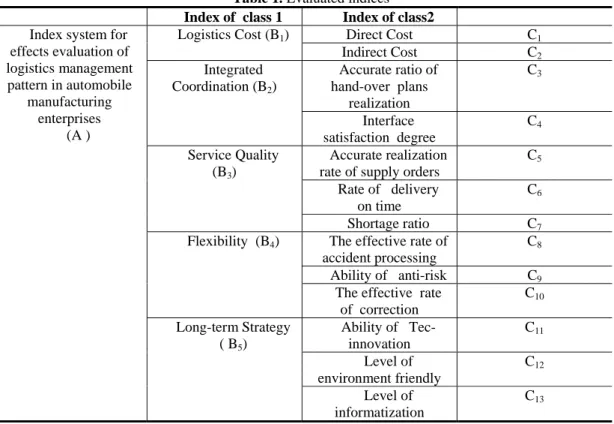
The index system for effects evaluation of logistics management pattern in automobile manufacturing enterprises is shown in table 1.
Table 1. Evaluated indices Index of class 1 Index of class2 Index system for
effects evaluation of logistics management pattern in automobile manufacturing enterprises (A )
Logistics Cost (B1) Direct Cost C1 Indirect Cost C2 Integrated Coordination (B2) Accurate ratio of hand-over plans realization C3 Interface satisfaction degree C4 Service Quality (B3) Accurate realization rate of supply orders
C5 Rate of delivery
on time
C6 Shortage ratio C7 Flexibility (B4) The effective rate of
accident processing
C8 Ability of anti-risk C9
The effective rate of correction C10 Long-term Strategy ( B5) Ability of Tec-innovation C11 Level of environment friendly C12 Level of C13
5. The effects evaluation of logistics management pattern in the automobile
manufacturing enterprises by using fuzzy comprehensive evaluation method
The effects evaluation of logistics management patterns in the automobile manufacturing enterprises is taken in five steps.
5.1 Establishing the hierarchy structure
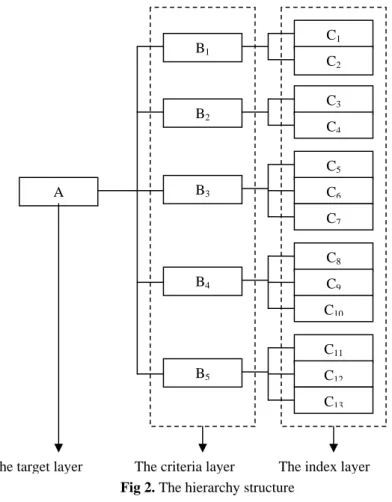
To establish the hierarchy structure concerning the evaluation target bases on the index system for effects evaluation of logistics management pattern in automobile manufacturing enterprises. The hierarchy structure of effects evaluation is shown in figure 2.
Fig 2. The hierarchy structure
Here we use the indices in the index layer to make the evaluation for the indices in the criteria layer, and use the indices in the criteria layer to make an assessment for the index in the target layer.
5.2 Calculating the weight of index by using AHP method
5.2.1 Setting the scale method.
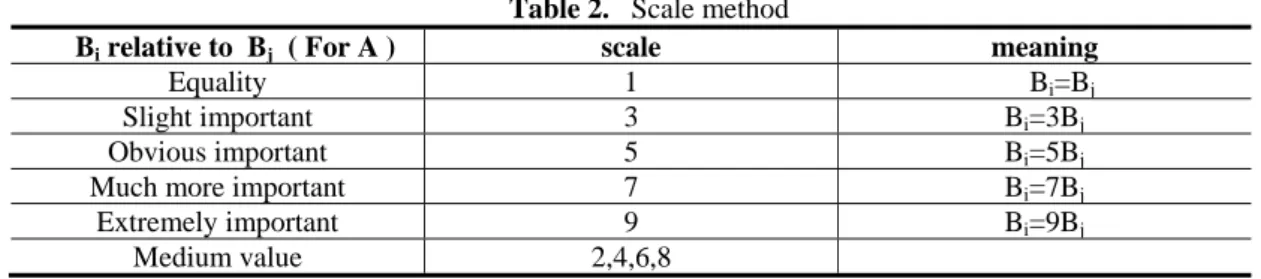
Nine scales judgment method is shown in table 2.
C1 C2 C3 C4 C5 C6 C7 C8 C9 C10 C11 C12 C13 B1 B2 B3 B4 B5 A
Table 2. Scale method
Bi relative to Bj ( For A ) scale meaning
Equality 1 Bi=Bj
Slight important 3 Bi=3Bj
Obvious important 5 Bi=5Bj
Much more important 7 Bi=7Bj
Extremely important 9 Bi=9Bj
Medium value 2,4,6,8
5.2.2 To construct the judgment matrix on the basis of scale method.
Making a set of pair-wise comparison is between the indices in the same layer and under the same superior index with scale method by the experts. Table 3 shows the judgment matrix established.
Table 3. Judgment matrix
Ak B1 B2 … Bn
B1 R11 R12 … R1n
B2 R21 R22 … R2n
… … …
Bn Rn1 Rn2 … Rnn
Where Rij is the scale that means the important degree of Bi compared to Bj for Ak. 5.2.3 To calculating the index weight by using the judgment matrix.
The formula is as follows:
1 2 1 2 1 n j j nj i n n j j nj j
R R
R
R R
R
(1)Where n is the judgment matrix size.
Setting the weight matrix of indices
1,
2,
3
n
5.2.4 To calculate the consistency.Calculating the max flag value,
maxas follows:
max 11
n i i iA
n
(2)Where n is the judgment matrix size.
Calculating the max flag value index, CI as follows:
max
1
n
CI
n
(3)Where n is the judgment matrix size.
Judgment consistency can be checked through calculating the consistency ratio, CR as follows:
CI
CR
RI
Table 4. Value of average stochastic consistency target RI
Size 1 2 3 4 5
RI 0 0 0.58 0.90 1.12
Size 6 7 8 9 10
RI 1.24 1.32 1.41 1.45 1.49 If CR doesn’t exceed 0.1, the judgment matrix is consistent. Oppositely, if CR exceeds 0.1, the judgment matrix is inconsistent.
6. Acknowledgement
This paper is the one of results for the Higher Vocational Education construction project “International Economy and Trade” of Zhejiang Province in 2009(Code: TZZ09084) and the one of results for the Industrial Science and Technology Correspondent Project "Yiwu freight forwarding warehousing industry information basic platform's design and application " in Yiwu at 2011 (ID:06).
7. Conclusion
How to calculate the weight of index with AHP method and assess the effects of the logistics management pattern in automobile manufacturing enterprises by using the fuzzy comprehensive evaluation method are detailed in this paper. And adding the index of integrated coordination in the evaluation system enables it to reflect the effects of logistics management pattern completely.
8. References
[1] Michael A.Hitt, R.Duane Ireland, Robert E. Hoskisson. Strategic management: Competitiveness and globalization [M]. South-West College Publishing, 2001: 3-4.
[2] Mentzer J, Konrad B P. An efficiency approach to logistics performance analysis [J]. Journal of Business Logistics, 1991 (1):33-62.
[3] Stewart G. Supply chain performance benchmarking study reveals keys to supply chain excellence [J]. Logistics Information Management, 1995 (2): 38-44.
[4] Yu-kui SHENG, Wan-lian LAN. Application of fuzzy comprehensive evaluation method in logistics service quality evaluation[C] International conference on intelligent human-machine systems and cybernetics, 2009: 296-299.
[5] Kee-hung Lai, Ngai E W T, Cheng T E C. Measure for evaluating supply chain performance in transport logistics[J]. Transportation Research Part E, 2002 (38):439-456.
[6] Yan YE, Jian-sha LU, Yong CHEN. A study on establishing the performance evaluation system of third-party logistics[J]. Statistics and management, 2007(1):62-63. (in Chinese).
[7] Yin ZU, Zhi-yong MENG, Shu-yu KAN. Calculating the weight of index with AHP method [J]. Journal of Northern Jiao-tong University, 1999(2):119-122. (in Chinese).
[8] Yi-dan BAO, Yan-ping WU, Yong HE and Xiao-feng GE. An improved AHP method in performance assessment[C] Proceedings of the firth world congress on intelligent control and automation, 2004: 177-180.
[9] Jing-jing WEN. Research on site selection of logistics park based on fuzzy comprehensive evaluation method[C] Second international conference on computer engineering and applications, 2010: 44-47.
[10]Li-fang FAN, Hao-bin JIANG and Kun-shan CHEN. Fuzzy-analytic hierarchy process based distribution center location selection research [J]. Journal of transportation systems engineering and information technology, 2006(6):107-110.
[11]Ning MU, Kai-chao XU. Study on the service ability evaluation of the third-party logistics in manufacturing enterprises [J]. Project of mordent manufacture, 2010(2): 32-35. (in Chinese). [12]Yu-lan LU. Research on enterprises’ logistics mode and its selection of manufacturing industry
[13]Sheng ZENG, Wei YU. Evaluation and research on green strength of reverse logistics system[C]// IEEE international conference on e-Business Engineering, 2009: 451-453.
[14]Juan CHEN. A flexible fuzzy comprehensive evaluation method[C] Third international symposium on intelligent information rechnology and security informatics, 2010: 502-506. [15]Chang-qiong WANG. Systems engineering of logistics [M]. High education press, 2007: 271-274.
(in Chinese).
[16]Gen-ping MA. Research on related problems about the selection of manufacturing enterprises logistics management mode [D] Northern Jiao-tong university press, 2007. (in Chinese).
[17]De-cheng WEN, Gao-shan WANG. Quality evaluation on manufacturing enterprise’s logistics system[C]// Proceeding of the IEEE international conference on automation and logistics, 2007: 1818-1823.
[18]Chang-li FENG and Li-li XIE. A study on the operating mode decision-making in reverse logistics of manufacturing enterprise[C] International conference on wireless communications, networking and mobile compting, 2008: 1-6.
[19]Ying-ai GAN, Feng Tian and Wei-zheng LI. Operational research [M]. Tsinghua University Press, 2007:455-460. (in Chinese).
[20]Song-qing LI. Logistics [M]. Tsinghua University Press, 2008: 42-50. (in Chinese).
[21]Qin-zhi WANG, Jian ZHANG. An empirical study on the logistics service performance evaluation of the EXPO 2010 Shanghai Chia[J]. Industry Project and management, 2010 (1): 108-115. (in Chinese).
[22]Xiaomei YI, Peng WU, Dan DAI, Lijuan LIU, Xiong HE, "Intrusion Detection Using BP Optimized by PSO", IJACT: International Journal of Advancements in Computing Technology, Vol. 4, No. 2, pp. 268-274, 2012
[23]Shangbo Zhou, Peng Hu, Kun Li, ,Yujiong Liu, "A New Target Tracking Scheme Based on Improved Mean Shift and Adaptive Kalman Filter", IJACT: International Journal of Advancements in Computing Technology, Vol. 4, No. 2, pp. 290-301, 2012