in the population sciences published by the Max Planck Institute for Demographic Research Konrad-Zuse Str. 1, D-18057 Rostock · GERMANY www.demographic-research.org
DEMOGRAPHIC RESEARCH
VOLUME 12, ARTICLE 2, PAGES 29-50
PUBLISHED 01 MARCH 2005
www.demographic-research.org/Volumes/Vol12/2
DOI: 10.4054/DemRes.2005.12.2
Research Article
Women’s sexual control within conjugal
union:
Implications for HIV/AIDS infection
and control in a metropolitan city
Peter O. Ogunjuyigbe
Ezekiel O. Adeyemi
1 Introduction 30
2 Methodology 33
3 Results 35
3.1 Socio-economic characteristics of respondents 35 3.2 Women’s sexual control 37 3.3 Reproductive decision-making 38 3.4 Knowledge of STDs and condom use 39 3.5 Can women reject sex? 41
4 Multivariate analysis 43
5 Discussion and conclusion 45
Women’s sexual control within conjugal union:
Implications for HIV/AIDS infection
and control in a metropolitan city
Peter O. Ogunjuyigbe 1
Ezekiel O. Adeyemi 2
Abstract
This study attempts to examine the extent to which women have control over their sexuality within marriage and its implication for the spread of HIV/AIDS. The survey was carried out in metropolitan Lagos. The study shows that women have some control over their sexuality especially during certain occasions such as during menstruation, breastfeeding, pregnancy and when they are sick. However, only few women could negotiate with their husbands especially by insisting on safe sexual practices. The study therefore shows that women need to be educated on the need for safer sex practices, especially in this era of HIV/AIDS. They should also be economically empowered so as to practice safer sex. Again, men should be educated on the safer sex practices in other to control the spread of HIV/AIDS.
1. Introduction
Ever since AIDS was first identified, a great deal has been learned about the genetic structure of the virus, the route of HIV transmission and the course of the disease. Yet it remains a major medical problem and a challenge to communicable disease control programme. UNAIDS (2001) reported that globally the pandemic has worsened in the last few years; at the end of 2001, an estimated 40m million people globally were living with HIV. In many parts of the world, the majority of new infections occur in young adults, with young women most vulnerable. This has negative implications for the future of the family.
Sexuality and the family are therefore crucial issues if the many problems women in African countries face due to inequitable sexual relations are to be taken seriously. That the greatest risk of sexually transmitted diseases (STDS) to women in Africa is provided by their husbands and other unstable partners has long been established (Frank 1983). This is evidently different from infection through homosexual transmission characteristic of the developed countries. The issue of concern and control of the AIDS epidemic in Africa must therefore focus on behavioural patterns between men and women in conjugal or other such intimate relationships. A major social and health concern in sub-Saharan Africa should therefore focus on the extent to which women are able to control their sexuality by way of negotiating sex in high–risk circumstances and insisting on safe sexual practices by their husbands and other partners.
Hausa societies are also gaining access to formal education and work-for-pay outside the home, their authority within the home remains almost unchanged because of the Islamic religious tenets (Kritz and Makinwa-Adebusoye, 1998).
Circumstances under which women in southwest Nigeria may and are indeed expected to refuse sexual intercourse with their partners include the period before marriage, during menstruation, during the postpartum period (when breast feeding), on becoming a grandmother and on reaching menopause. Traditionally women in much of sub-Saharan African societies practised long periods of postpartum abstinence, typically more than one year (Schoenmaeckers et al., 1981) and three or more years in southwest Nigeria (Caldwell and Caldwell, 1977; 1981). South western Nigerian women had a societally backed right to refuse a husband sexual relations in a range of circumstances, but his philandering, though sometimes a cause of bitterness and individual action by a wife, was not one of these (Orubuloye, Caldwell and Caldwell, 1993; Orubuloye, 1994). The existence of prescribed periods of sexual abstinence reveal that culturally women have sexual rights which they are in fact expected and encouraged to exercise. Generally, women are assisted by societal approval and sanctions to comply with maintaining these periods and exercising their rights. Outside these special circumstances, however, it is generally assumed among the Yoruba of southwest Nigeria that women do not have personal choices to make when it comes to sexuality (Harcourt, 1993). This assumption makes it difficult for women to face the reality of lack of decision making power within the family. Isiugo-Abanihe (1994a) study also confirms the generally held view among major ethnic groups in Nigeria (Yoruba, Igbo and Hausa) that as husbands and household heads, men control the sexuality of their wives. Wives are bound to comply with their husband’s sexual demands as refusal is a major source of strife, the taking of other wives or the keeping of “outside wives” (Karanja, 1987).
the “machine for producing children”; the transfer of ownership is effected through the payment of the bride price. Isiugo-Abanihe (1994b) suggested as much when he wrote that “among the Igbo, for whom bride wealth payments are high, a woman comes under the authority of her husband and takes instructions from him as the head of the family by virtue of this payment”. The finding of Jewkes et al. (1999) in Eastern Cape Province of South Africa was similar. Here, it is culturally accepted that if a man pays the labola (bride wealth) for his wife, it means that he owns her. This undoubtedly influences women’s perception of their persons as a man’s property and invariably compromises their power in decision-making. Whereas husbands maintain the right to control their spouses’ desires for extramarital sexual activity, most wives do not try to exercise such control over their spouses (Caldwell and Caldwell, 1981; Orubuloye, Caldwell and Caldwell, 1992).
The irony of their situation and position is that southwest Nigerian women, unlike in East Africa, are known to have a relatively high social status derived from a high level of economic independence whereby they can on their own engage in paid job or engage in trading activities and earn income. The ability to keep and control the income that accrues from their trading activities (Karanja, 1983), and the fact that they can obtain a divorce and return to their family of origin after, are important issues that give women in the region some leverage over their African sisters elsewhere. The question then is to what extent is this power transferred to the area of control of their sexuality when men pursue a high-risk sexual lifestyle like having multiple partners and engaging in casual sex, and non-use of condom, especially in an urban setting? How then can an understanding of this influence AIDS control strategies in Nigeria? Answers to these questions would help us to understand the particular conditions of gender equity under which wives can refuse their husbands sex and avoid infection of STDs or HIV.
2. Methodology
The survey was carried out in metropolitan Lagos, the most heterogeneous city, the most industrialised and the economic nerve centre of the country. Apart from the major ethnic group, which is Yoruba, it consists of representatives of all known ethnic groups in the country with diverse social, economic, political and cultural characteristics. The characteristic of her inhabitants and the long exposure to influences of education, foreign culture and modernisation qualify it as a place where institutional and attitudinal changes may be observed and measured.
was used to select the appropriate respondent. In all 224 questionnaires were correctly filled and were used in our analysis. The information sought covered a wide area of respondents’ essential socio-economic and demographic characteristics, reproductive health matters and sexual behaviour. The questionnaires were administered by trained and carefully selected research assistants.
While structured interview could usually be employed in tapping information for the major thrust of the research objectives, focus group discussions were held among currently married women within the study community to strengthen the interview on the traditional expectations regarding periodic sexual abstinence and the extent to which women control their sexuality. Six focus group discussions were conducted; two in each of the zones. Focus group participants were selected on the basis of their current age and place of residence. This approach was adopted to accommodate the heterogeneous structure of the women populace and to be able to obtain a representative pattern of social interaction.
Returned questionnaires were subjected to thorough screening, checking for consistency and finally edited. The precoded nature of the questionnaire facilitated easy entry of the data and statistical analysis. The data collected were subjected to basic demographic analytical techniques. In the statistical analysis of the data, a combination of univariate, bivariate, and multivariate analysis were employed. At the univariate level, an examination of the distribution of the respondents according to each of the selected characteristics was carried out. Frequency distribution was adopted. Bivariate analysis was carried out to discover existence of relationship between the dependent and independent variables. Information from focus group discussions were transcribed and organized under broad headings that depict different aspects of the discussions. The transcribed information were analyzed descriptively (qualitatively) and used to explain results of quantitative analysis where and when necessary.
3. Results
3.1 Socio-economic characteristics of respondents
Table 1 shows the socio-economic composition of the respondents. It is observed that the bulk of the population are relatively young. Fifty-eight percent of the respondents are in the age group 15-34 years, while relatively few are above 45 years of age. Just like we have in the Demographic and Health Survey, 2003 (NPC, 2004), the modal group is aged 25-34 years. The table shows that more than half of the population had secondary or lower levels of education. About 48 percent have post-secondary education. This favourably compared with the outcome of the 2003 DHS, where it was reported that about 70 percent of population in South-west has a minimum of primary education (NPC, 2004). Three out of every five respondents are Muslims probably because majority of the Hausas and significant proportion of the Yorubas are adherent of this religion. None of the respondents indicated African religion; this could be as a result of recent proliferation of churches and mosques, in addition to the effect of urbanisation and modernisation in the study area. Three out of every five respondents interviewed were married as at the time of the survey while 16.5 percent and 15.2 percent were divorced and separated respectively.
Lagos, although clearly the Nigerian melting pot, still remains primarily a Yoruba city. The ethnic composition shows a high representation of the Yoruba people (57.1 percent). The Igbo constitute the second largest ethnic group representing about 29 percent of the total respondents. Their comparatively large representation is connected with their dominant occupation, which is trading. The observed proportion of Hausas who are of northern origin may not accurately reflect their real percentage in the city. Their cultural and religious inclinations may perhaps explain such variation. These are predominantly Muslims, with stronger Islamic persuasion in certain respects than their southern Muslim counterparts. Their relatively high conservatism coupled with a low affinity with western education meant that they were not very co-operative when discussing issues related to sex. This also explains the very low level of access to the women.
her extended family. Perhaps this might explain why only 9.4 percent of the respondents reported that they are housewife. Four out of every ten respondents earn less than N10,000 ($80) which formed the highest proportion. This is closely followed by those earning between N31,000 ($240) - N40,000 ($310) (16.8 percent).
Table 1: Percentage distribution of respondents by socio-economic characteristics
Characteristics Number Percentage
Age
15-24 59 26.3
25-34 70 31.3
35- 44 48 21.4
45 and above 47 21.0
Ethnic Group
Yoruba 128 57.1
Ibo 42 28.6
Hausa 22 9.8
Others 32 14.3
Religion
Christianity 96 42.9
Islam 128 57.1
Occupation
Trading 128 58.5
Housewife 21 9.4
Clerical 36 16.1
Professionals 36 16.1
Marital Status
Married 153 68.3
Divorced 37 16.5
Separated 34 15.2
Level of Education
Primary 64 28.6
Secondary 96 42.9
Post-secondary 64 48.6
Income
Less than 10,000 93 41.5
11,000 - 20,000 32 14.2
21,000 - 30,000 31 13.8
31,000 - 40,000 36 16.0
41,000 & above 32 14.3
3.2 Women’s sexual control
From table 2 it was observed that 65.6 percent of the respondents believed that a woman has a right to refuse sex with a partner, while 34.4 percent believed that woman does not have such right. These two positions were supported by participants in the focus group discussions. For instance, a 35 year old married female discussant expressed her concern on whether woman can reject sexual intercourse from her husband or not. She said:
“A woman has right to reject sex from her husband if she does not want to have it. Women are not log of wood that men can just mount at will”.
Another 43 years old religious woman opined that:
“It is not the will of God for a woman to reject sex or deny her husband sexual approach. Our husbands are the owners of our bodies”.
Respondents were further asked to indicate whether they had ever had a cause to refuse sex with their partners. Three quarters reported that they had done so on at least one occasion. The circumstances under which a woman can reject her husband as reported by these women include “when the woman is breastfeeding” (29.5 percent), “menstruating” (28.6 percent), “when sick” (27.7 percent) and on some other occasions such as a punishment for husband’s bad behaviour or when the woman is not happy (14.3 percent). However, a 32 year old woman participant in a focus group discussion indicated that:
“I can only reject sex from my husband when I am menstruating. Even if I am sick I will still allow him to have sex with me“.
This clearly shows the extent to which women are free to refuse sexual advances from their husbands. On whether women can demand for sex from their husbands, three out of every five respondents interviewed agreed that women could demand for sex if they are in mood to do so. A little over 53.4 percent believed it is natural, while the rest thought it is right to demand for sex when another child is needed (46.6 percent). A 27 year old participant in one of the focus group discussions, however, pointed out that “often times, women are not courageous enough to ask for sex for fear of being accused
of promiscuity”. Only 43 percent agreed that they could decide the number of children
with the impact of urbanisation and modernisation which are now noticed to be positively impacting on the status of women among the various ethnic groups residing in the city.
Table 2: Percentage distribution of women’s sexual control
Characteristics Number Percentage
Can women reject sexual intercourse?
Yes 77 34.4
No 147 65.6
Under what conditions?
During breastfeeding 66 29.5
During menstruation 64 28.6
When ill 32 27.7
Others 32 14.3
Can woman demand for sex?
Yes 161 71.6
No 63 28.4
If yes why?
It is natural 64 53.4
When another child is need 60 46.6
Can woman decide no of children?
Yes 97 43.3
No 127 56.7
Can woman determine family planning usage?
Yes 159 71.0
No 65 29.0
3.3 Reproductive decision-making
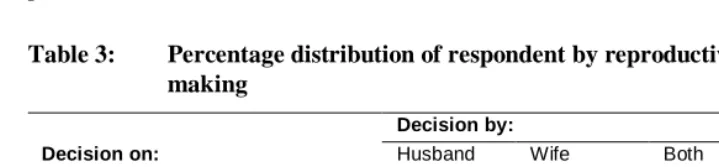
affected this belief. Forty-two percent of the respondents indicated that their husband would determine when to have sex compared with only 28.6 percent who opined that the decision rests with women. Majority of the women (72.8 percent) reported that they play major role in the decision to use contraceptives. This role was however qualified in the focus group discussion when participants said “we can take decision to use
contraceptive but the permission of our husbands would be sought first before we can adopt contraception”. It was also revealed that men more than women had the final say
concerning the number of children (43.8 percent) and when to have the children (44.2 percent).
Table 3: Percentage distribution of respondent by reproductive decision-making
Decision by:
Decision on: Husband Wife Both Total When to have sex 45.1 (101) 28.6 (64) 26.3 (59) 100.0 When to use contraceptives 14.3 (32) 72.8 (163) 12.9 (29) 100.0 Family planning method(s) to use 28.6 (64) 42.9 (96) 28.6 (64) 100.0 When to have more children 43.8 (98) 14.3 (32) 42.0 (94) 100.0 Desired family size 44.2 (99) 13.8 (31) 42.0 (94) 100.0
3.4 Knowledge of STDs and condom use
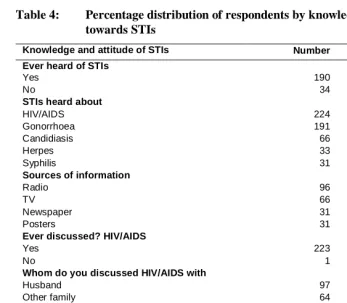
It is considered important that knowledge of STDs including HIV/AIDS epidemic amongst the respondents should be ascertained. It is believed that this knowledge of STDs will influence sexual behaviour and the kind of sexual control exercised by women within the conjugal union. Questions posed include whether the respondents have heard of STDs and the kind of STDs heard about, whether they ever discussed HIV/AIDS with their spouses, friends or family, as well as their knowledge about the mode of transmission and risk reduction behaviour.
HIV/AIDS indicates that they were quite aware of the proper mode of transmission. Major sources of contacting HIV/AIDS indicated by the respondents include sexual intercourse (71.0 percent), unsterilised needles (28.6percent), and blood transfusion (29.5%). However, some believed that the disease could be transmitted by shaking of hands (13.8%); thus introducing some level of misconception into their knowledge.
Table 4: Percentage distribution of respondents by knowledge and attitude towards STIs
Knowledge and attitude of STIs Number Percentage
Ever heard of STIs
Yes 190 83.9
No 34 16.1
STIs heard about
HIV/AIDS 224 100.0
Gonorrhoea 191 85.3
Candidiasis 66 9.5
Herpes 33 14.7
Syphilis 31 13.8
Sources of information
Radio 96 42.9
TV 66 29.5
Newspaper 31 13.8
Posters 31 13.8
Ever discussed? HIV/AIDS
Yes 223 99.6
No 1 0.4
Whom do you discussed HIV/AIDS with
Husband 97 43.3
Other family 64 28.6
Friends of the same sex 63 28.1
Mode of transmission
Sexual intercourse 159 71.0
Shaking of hands 31 13.8
Unsterilised needles 64 28.6
Blood Transfusions 66 29.5
Ever contacted STIs 65 29.0
Heard of condom 161 71.8
Ever used condom 70 31.4
even when the husband is not faithful will have a great implication on the transmission of HIV/AIDS.
A good majority of the women (72 percent) knew of condoms but just a third (31 percent) had ever used them. Only 6 percent always used condoms in the last three months and another 15 percent used it occasionally. For those who used condoms, the main reason was to prevent STDs. Just about 4 percent mentioned HIV/AIDS specifically. Another 10 percent said they used condoms to prevent pregnancy. The main reason for not using condoms was that they “just didn’t like it” (27 percent). Another 9 percent felt that condom did not give any protection. About 33 percent did not use condoms because they had faith in their partners and few others said they wanted babies (19 percent).
3.5 Can women reject sex?
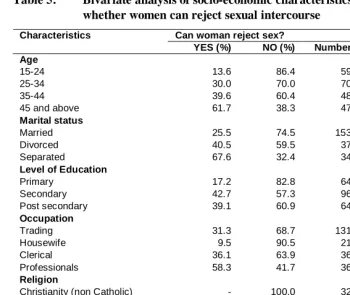
As illustrated in Table 2, only 34.4 percent of the women gave an indication that they can reject sexual intercourse from their husbands if and when they so desire, while the remaining majority (65.6 percent) believed it is impossible for a woman to reject sexual advances from her husband. It is considered paramount to examine the background characteristics of women in these categories and. The results are as presented in Table 5. The table reveals that only 13.6 percent of the respondents within age group 15-24 years agreed that women cannot say ‘no sex’ to their husband. The reason may be due to the fact that this age group are still young in their matrimonial home. The fear of being divorced is another factor that may be responsible. Older women however believed that they could reject their husbands’ sexual advances if they are not willing or are not favourably disposed. Traditionally and as indicated above, women have some control over their sexuality on certain occasions especially during pregnancy, breastfeeding, and menstruation, after menopause, and when they perceive that their husbands have contacted STDs. However, most women lack the knowledge or the opportunity to identify infection in their husbands. Table 4 further shows that ethnicity plays dominant role in the perceptions on whether women can reject sex or not. For instance, 42.9 percent of women from the Yorubaland believed that women can say no to sex while 26.2 percent and 27.3 percent of Ibo and Hausa respectively agreed that they can reject sex from their husband. This variation could be due to the varied effect of socialisation and modernisation among the three major ethnic groups.
discussions also supported this tenet. However the emphasis laid upon was in the Holy Quoran that “woman must be submissive to her husband”. This position was also supported by the Bible (Ephesians: 5:22). To them submission must be total including their body, even when the woman is aware of the infidelity of her husband.
Occupational status of a woman is also shown to influence her ability to reject sex from her husband. About 58 percent of women in professional jobs indicated that they could say no, followed by those in clerical works (36.1 percent), trading (31.3 percent), and housewife (9.5 percent) in that order (Table 5). The assumption is that those who are engaged in good job will have the financial ability to challenge their husband, as they may not entirely depend on their husband for their needs. Also, the situation where husbands are happy that their wives are working, there is tendency for wives to react strongly against decisions made without consulting them. Findings from focus group discussions also confirmed that economic power of women will determine their extent of insisting on safer sex during risk period. A situation where majority of the women are found to depend on their husband for their social and financial needs, they are unable to say no even when they know that they are at risk. This position was supported by participants in focus group discussion. For instance a 27 year old full-time housewife remarks,
“There is no way I can say no to my husband. Anytime I said so, he will not give me money for food. He will go and meet his extramarital partners”.
This clearly implies that it is those women who are economically empowered that can fight for their reproductive rights.
Marital status is another variable that will influence women’s sexual control. From the above table, four out of every five women who are either divorced or separated indicated that they can say no to sex to their husband compared with three out of every five for those that are currently married. The reason that could be adduced for this is that those who are divorced or separated cannot be controlled my men. Hence the reason why our society does not give respect to a woman who is not married to a man. Also some of the women believed that women should not to be subjugated. From the focus interview, it was gathered that such women believed that they should be able to determine when they want sex.
Table 5: Bivariate analysis of socio-economic characteristics of respondents by whether women can reject sexual intercourse
Can woman reject sex? Characteristics
YES (%) NO (%) Number P Age
15-24 13.6 86.4 59
25-34 30.0 70.0 70
35-44 39.6 60.4 48
45 and above 61.7 38.3 47 0.000
Marital status
Married 25.5 74.5 153
Divorced 40.5 59.5 37
Separated 67.6 32.4 34 0.089
Level of Education
Primary 17.2 82.8 64
Secondary 42.7 57.3 96
Post secondary 39.1 60.9 64 0.007
Occupation
Trading 31.3 68.7 131
Housewife 9.5 90.5 21
Clerical 36.1 63.9 36
Professionals 58.3 41.7 36 0.602
Religion
Christianity (non Catholic) - 100.0 32
Christianity (Catholic) 53.1 46.9 64
Islam 8.6 91.4 128 0.024
Ethnic group
Yoruba 42.9 57.1 128
Ibo 26.2 73.8 42
Hausa 27.3 72.7 22
Others 15.6 84.4 32 0.989
4. Multivariate analysis
Application of the logistic model to the analysis helps to identify the most relevant variables which in combination, model the incidence of women’s sexual control as reflected by the data. It also helps in assessing the relevance of each factor considered in conjunction with all other selected factors in the model. It is therefore a higher-order analysis than the initial dichotomised response patterns analysed above.
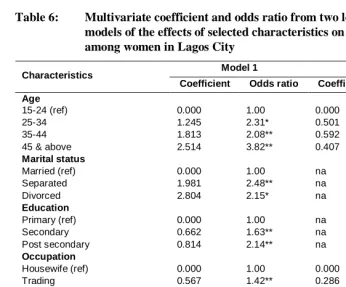
sexual control increase with levels of education. Women with post secondary education are about 2 times more as likely as their counterparts in primary school (RC) to reject sex. The probability of sexual control is higher among professionals and traders than among housewives, among Christians than Muslims and among those that are separated or divorced than among those that are currently in marital union. Ethnicity, though not significant, but is a predictor of sexual control with rejection of sex among the Yoruba being about twice the level among the Hausas (RC).
Table 6: Multivariate coefficient and odds ratio from two logistic regression models of the effects of selected characteristics on sexual control among women in Lagos City
Model 1 Model 2 Characteristics
Coefficient Odds ratio Coefficient Odds ratio
Age
15-24 (ref) 0.000 1.00 0.000 1.00
25-34 1.245 2.31* 0.501 1.65
35-44 1.813 2.08** 0.592 1.81
45 & above 2.514 3.82** 0.407 1.50
Marital status
Married (ref) 0.000 1.00 na na
Separated 1.981 2.48** na na
Divorced 2.804 2.15* na na
Education
Primary (ref) 0.000 1.00 na na
Secondary 0.662 1.63** na na
Post secondary 0.814 2.14** na na
Occupation
Housewife (ref) 0.000 1.00 0.000 1.00
Trading 0.567 1.42** 0.286 1.33
Clerical 0.158 1.86 0.602 1.82
Professional 1.433 1.53* 0.527 1.69
Religion
Christianity 2.244 5.27** 0.527 1.22**
Islam (ref) 0.000 1.00 0.000 1.00
Ethnicity
Yoruba 0.809 2.25 0.825 2.28
Ibo 0.149 0.88 0.337 0.26
Hausa (ref) 0.000 1.00 0.000 1.00
Because of the strong effects of education and marital status, their effects are taken into account in model 2, to see which other factors exert a significant effect on sexual control. Once the effects of education and marital status were controlled, age and occupation were no longer statistically significant. In other words, the rate of rejection of sexual intercourse was higher among older and better educated women because they are more likely to be more experienced and tactical with the way they relate with their husbands. Older women can present more argument such as being grandmothers or show signs of menopause. However, religion remained significant.
5. Discussion and conclusion
The objective of this paper is to examine the extent to which women have control over their sexuality within marriage and its implication for the spread and control of HIV/AIDS. From the qualitative and quantitative data, it is discovered that a significant proportion of women have some control over their sexuality especially during certain occasions such as during menstruation, breastfeeding, pregnancy, and when they are sick. Just about a quarter of the women could negotiate with their husbands especially by insisting on safe sexual practices. Some of the women that reported ever contracted STDs claimed to have been infected by their husbands. This is confirmed in the focus group discussions. In one of the focus group discussion session, one of the participants said:
“When I first notice the sign of STDs I contacted the medical doctor and I was told that I have gonorrhoea. Since I did not have any other man except my husband, I know that I contacted the disease from my husband. When I rejected his sexual demand after the visitation I was beaten up”.
The study shows that women with improved socio-economic status tend to exhibit some sort of control within their union. For instance, it is discovered that women with higher education are likely to exercise their reproductive rights than their counterpart with lower education. Occupation and religion are other important variables that can influence women sexual control and reproductive rights. Women’s economic participation, even in low skilled, low salary positions, confers a sense of worth to women themselves and to their own families. Through this, women will obtain greater negotiating power within their homes and ultimately re-define gender roles.
interviewed indicated that they have multiple partners, which have a great implication for HIV/AIDS transmission. This may be one of the reasons why a 7 percent HIV prevalence rate recorded for Lagos State is higher than the national average of 5.8 percent (Federal Ministry of Health, 2003).
Findings from several studies have shown a low prevalence of condom use (Kapiga et al., 1995; Mbizvo et al, 1994; Pattulo et al., 1994; Kim, Marangwanda and Kols, 1996; Ezeh and Mboup, 1997). With the exemption of those with a high self-perceived HIV-positive risk, who are likely to be most knowledgeable of HIV transmission, women in focus group discussions lamented that “men have not changed their sexual attitude and are very reluctant to use condom”. In a society where men paid bride wealth, and regarded wives as acquired possessions, they demanded of women at least the appearance of bridal virginity and marital faithfulness (Orubuloye, Caldwell and Caldwell, 2000). The society also assumed that male sexuality was biologically uncontrollable and hence inevitable. In this respect, women have a big task to convince their spouses to adopt the use of condom when it is essentially necessary, especially when couple are not expecting another pregnancy and when the wife is in doubt about her husband sexual activities. In a sense, condom use may be a creative, modern means to escape an unattractive traditional imperative. This may be a way to circumvent the traditionally prescribed postpartum abstinence periods, which often encourages and promotes risky sexual behaviour.
Many men and women are reporting that they have changed their sexual behaviour in response to AIDS. At the same time, many others who are at risk do not protect themselves and their partners (Population Information Project, 1999). To avoid AIDS, sexually active people who are not mutually monogamous must know about AIDS, know about condoms, know that condoms prevent AIDS, know how to get condoms, and know how to use them correctly. The use of condom is one of the major strategies for combating STDs, including HIV. However, the argument that condoms curtail fertility and save lives has been pitted against condoms as a symbol of immorality and women’s uncontrolled sexuality. This discourse reflects genuine conflicts faced by individuals when considering whether to negotiate condom use in each sexual encounter (Bond and Dover, 1997).
References
Adegbola, O. and O. Babalola (1999): “Premarital and extramarital sex in Lagos, Nigeria” pp.19-44 in The Continuing HIV/AIDS Epidemic in Africa: Responses
and Copying Strategies I.O. Orubuloye; J.C. Caldwell and J.P.M. Ntozi (eds.).
Canberra: The Australian National University.
Bond, V. and P. Dover (1997): “Men, women and the trouble with Condoms: Condom Use”, Health Transition Review Vol.7.
Caldwell, J.C. and P. Caldwell (1977): “The role of marital sexual abstinence in determining fertility: A study of the Yoruba in Nigeria”, Population Studies, 31:193-217.
Caldwell, J.C. and P. Caldwell (1981): “Cause and sequence in the reduction in postnatal abstinence in Ibadan City, Nigeria”, pp. 181-199 in Child-Spacing in
Tropical Africa: Traditions and Change H.J Page and R. Lesthaeghe (eds.).
Academic Press, London.
Ezeh, A. and G. Mboup (1997): “Estimates and explanations of gender differentials in contraceptive prevalence rates”, Studies in Family Planning, 28(2):104-121.
Frank O. (1983): “Infertility in sub-Saharan African: Estimates and Implications”,
Population and Development Review, 9:137-144.
Harcourt, W. (1993): “Women, Sexuality and the Family”, Development (SID),4
Hosmer, D.W. and S. Lemeshow (1989): Applied Logistic Regression, New York: John Wiley.
Imoagene, O. (1990): The Hausa and Fulani of Northern Nigeria, Nigeria. Ibadan, Nigeria: New-Era Publishers, Know Your Country Series, Handbooks of Nigeria’s Major Culture Areas, Vol.1.
Isiugo-Abanihe, U.C. (1994a) “Reproductive Motivation and Family Size Preferences Among Nigerian Men”, Studies in Family Planning 25(3): 149-261.
Isiugo-Abanihe, U.C. (1994b): “Extramarital relations and perception of HIV/AIDS in Nigeria”, Health Transition Review 4, 2:111-126.
Kapiga, S.H.; G.K. Lwihula; J.F. Shao and D.J. Hunter (1995): “Predictors of AIDS knowledge, condom use and high risk sexual behaviour among women in Dar-es-Salaam, Tanzania”, International Journal of STD and AIDS 6(3):175-183.
Karanja, W.A. (1983): “Conjugal decision-making: some data from Lagos” in C. Oppong (ed.) Female and Male in West Africa. Unwin: 236-241
Karanja, W (1987): “Outside Wives” and “Inside Wives” in Nigeria: A study of
changing perception of marriage.
Kim, V.A.; C. Marangwanda and A. Kols (1996): Involving men in family planning:
The Zimbabwe Male Motivation and Family Planning Method Expansion Project, 1993-94, IEC Field Report Series, No.3, Baltimore MD, USA: Johns
Hopkins School of Public Health.
Kritz, M.M. and P. Makinwa-Adebusoye (1995): “Women’s control over resources and demand for children in Nigeria: The Hausa and Yoruba cases” in P. Makinwa-Adebusoye and A. Jensen (eds.) Women and Demographic Change in
sub-Saharan Africa, Liege, Belgium: International Union for the Scientific Study of
Population.
Kritz, M.M. and P. Makinwa-Adebusoye (1998): “Determinants of Women’s Decision-making Authority in Nigeria: The Ethnic Dimension”. Forthcoming in
Sociological Forum, Special Issue on Critical Demography.
Mbizvo, M.T.; S. Ray; M. Basset; W. McFarland; R. Machekano and D. Katzenstein (1994): “Condom use and risk of HIV infection: who is being protected?”,
Central African Journal of Medicine 4(11): 294-299.
National Population Commission (NPC) (2004): Nigeria Demographic and Health
Survey, 2003. Calverton, MARYLAND: National Population Commission and
ORC Macro.
Orubuloye, I.O. (1994): “Male sexual behaviour and its cultural, social and attitudinal context: report on a pilot survey in a Nigerian urban population”, Health
Transition Centre: Australian National University Mimeograph.
Orubuloye, I.O; J.C. Caldwell and P. Caldwell (2000): “Perceived male sexual needs and male sexual behaviour in southwest Nigeria”, in J.C. Caldwell, P. Caldwell, I.O. Orubuloye, J.P.M. Ntozi, K. Awusabo-Asare, J. Anarfi, B. Caldwell, C. Varga, J. Malungo, B. Missingham, W. Cosford and E. Hollings (eds.) Towards
the Containment of the AIDS Epidemic, Australian National University,
Orubuloye, I.O.; J.C. Caldwell and P. Caldwell (1992): “Diffusion and focus in sexual networking: Identifying partners and partners’ partners”, Studies in Family
Planning, 23:343-351.
Orubuloye, I.O.; J.C. Caldwell and P. Caldwell (1993): “African women’s control over their sexuality in an era of AIDS”, Social Science and Medicine, 37:859-872.
Pattulo, A.L.; M. Malonza; G.G. Kimani et al. (1994): “Survey of knowledge, behaviour and attitudes relating to HIV infection and AIDS among Kenyan secondary school students”, AIDS CARE 6(2):173-181.
Population Information Project (1999): “Sexual Behaviour and Condoms”, Population
Report, Vol.XXVIII, No.1, p.11, The John Hopkins University Maryland, USA.
Ransome-Kuti, Olikoye (1992): Reports to the meetings of the National AIDS Committee and Media Executives, Lagos.
Renne, E.P. (1993): “Gender ideology and fertility strategies in an Ekiti Yoruba village”, Studies in Family Planning 24(6):343-353.
Schoenmackers, R.; I. H. Shah; R.Lesthaeghe and O. Tambashe (1981): “The Child-spacing tradition and the postpartum taboos in Tropical Africa: Anthropological evidence”, pp.26-39 in Child-Spacing in Tropical Africa: Traditions and Change H.J Page and R. Lesthaeghe (eds.) , Academic Press, London.
Federal Ministry of Health (2003): National Policy on HIV/AIDS, Abuja.