in the population sciences published by the Max Planck Institute for Demographic Research Konrad-Zuse Str. 1, D-18057 Rostock · GERMANY www.demographic-research.org
DEMOGRAPHIC RESEARCH
VOLUME 19, ARTICLE 45, PAGES 1603-1634
PUBLISHED 12 SEPTEMBER 2008
http://www.demographic-research.org/Volumes/Vol19/45/ DOI: 10.4054/DemRes.2008.19.45
Research Article
Children’s school participation and HIV/AIDS
in rural Malawi:
The role of parental knowledge and perceptions
Monica J. Grant
This publication is part of the proposed Special Collection “HIV/AIDS in sub-Saharan Africa”, edited by Susan Watkins, Jere Behrman, Hans-Peter Kohler, and Simona Bignami-Van Assche.
© 2008 Grant.
1 Introduction 1604
2 Literature review 1606
3 Data and methods 1609
3.1 Quantitative data and methods 1609
3.1.1 Dependent variable 1610
3.1.2 Household and child characteristics 1612
3.1.3 Parental perceptions of the HIV epidemic 1612
3.1.4 Model specification 1618
3.2 Qualitative data and methods 1619
4 Results 1619
5 Discussion 1627
6 Acknowledgements 1629
Children’s school participation and HIV/AIDS in rural Malawi:
The role of parental knowledge and perceptions
Monica J. Grant1
Abstract
Studies of the relationship between HIV/AIDS and children’s educational attainment largely focus on the direct impacts of parental illness and death, overlooking the potential indirect impact that parental knowledge and perceptions of their HIV status may have on children’s school enrollment. Drawing on both quantitative and qualitative evidence from Malawi, this paper finds that women’s real and perceived anticipation of future health shocks has a positive impact on their children’s educational attainment. Interventions that target health uncertainty, such as HIV testing programs, may make a significant contribution to maintaining children’s educational attainment in communities affected by HIV/AIDS.
1
1. Introduction
The well-being of children orphaned by the HIV/AIDS epidemic receives considerable attention. Recent studies using longitudinal data note that children’s school dropout may occur prior to the death of a parent in addition to the period immediately following it (Ainsworth, Beegle and Koda, 2005; Evans and Miguel 2007). This finding is attributed to shifts in household labor demands, reduced income, and higher expenditures brought on by the period of illness preceding a parent’s death. However, this focus on the direct impacts of the HIV epidemic—parental illness and death— overlooks the possibly equally important indirect impact that parents’ knowledge and perceptions of their HIV status may have on children’s school enrollment. Parents’ perceptions of their own health and survival prospects may play an important role in decisions about their children’s schooling. If health and survival are becoming more uncertain in the context of HIV, parents may be less inclined to invest in a child’s schooling if they do not expect to live—or expect their child to live—to see the returns on their child’s education (Montgomery 2000; Cohen and Montgomery 1998). Recent cross-national analyses of Demographic and Health Survey data appear to support this hypothesis, finding that children and adolescents living in areas with higher HIV prevalence have lower levels of educational attainment and slower progress through school relative to communities without HIV (Fortson 2008). This paper will test more specifically whether parental uncertainty about their risk of HIV infection is associated with investments in children’s schooling.
The demographic literature posits that as life expectancy increases, parents have greater certainty that their children will survive to adulthood, leading to smaller families and greater investments in the quality of children, in particular through increased educational attainment. Given that the HIV/AIDS epidemic has reversed some health advances in Sub-Saharan Africa (Timaeus and Jasseh 2004), it is plausible that the emergence of the epidemic has led to increasing health uncertainty in affected areas although the social consequences of these health reversals remain under-examined. If parents have inaccurate or uncertain health and survival expectations, the time horizon in which they make decisions may shift from the long term to the more immediate future, leading to declines in human capital investment (Montgomery 2000).
who are able to avoid infection (Young 2006), which might also encourage greater investment in the education of children who are perceived to be likely to avoid future infection.
Malawi is a good context for examining the association between parents’ health uncertainty and their children’s schooling because of its moderately high HIV prevalence rates and the pervasiveness of misperceptions about the epidemic. Although HIV prevalence rates are estimated to be around 12 per cent nationally (Macro 2005), survey respondents place prevalence closer to 40 per cent (Anglewicz 2007). Evidence suggests that the majority of survey respondents express a high level of correct knowledge about HIV transmission modes and prevention strategies (Watkins 2004), but overestimate the likelihood of HIV transmission per sexual act. When individuals evaluate their own and others’ sexual histories, they overestimate their risk of being HIV positive (Anglewicz 2007). While nationally representative studies have found HIV prevalence to be higher among wealthier individuals in Malawi (Mishra et al. 2007), Anglewicz (2007) did not find a relationship between individual wealth and the estimation of personal risk of being infected. Whether these misperceptions of the epidemic have an impact on household decision-making and social outcomes has not received much attention in the literature. The consequence of parents’ knowledge and perceptions of their HIV status for their children’s school enrollment is of particular interest.
Beginning in 1994, the government of Malawi removed school fees at the primary level, which ends at grade eight. Since that time, school participation has increased significantly. Data from the Malawi Demographic and Health Surveys indicate that the mean educational attainment for 15-19 year old females in Malawi has increased from 3.4 grades in 1992 to 6.0 grades in 2004 (Macro 1993, 2005). Although there are no school fees through the end of eighth grade, families are still responsible for the cost of uniforms and school supplies. Furthermore, families must consider the opportunity cost of children’s school enrollment, since children could be participating in wage or household labor or offsetting the labor demands created by ill household members (Kadzamira and Rose 2003). Misperceptions of health and survival probabilities may lead to stagnation or decline in school participation rates and educational attainment, as parents use partial or incorrect information about potential health shocks to make decisions about their children’s education.
parents make decisions about their children’s education. The analysis takes advantage of the survey’s longitudinal design to explore the association between learning one’s HIV status and subsequent children’s school participation. Considered together, the multivariate analysis and qualitative data provide a nuanced description of whether women’s health expectations are associated with children’s educational attainment and the factors considered during the decision making process. In particular, the analysis will test the hypothesis that knowing one’s HIV status is associated with higher rates of children’s school participation. In learning one’s infection status, an individual gains concrete information about the likelihood of certain health shocks, thereby reducing uncertainty about the future. I also hypothesize that greater levels of uncertainty in an individual’s perception of HIV infection are associated with lower levels of school participation Even if a woman learned that she was HIV negative in 2004, investments in the education of her children may still be negatively affected if she believes herself to be at high risk of future infection or distrusts the test result that she received in 2004.
2. Literature review
absence of HIV. Although her country-level estimates for Malawi are non-significant, when the data are pooled across the 16 countries with available HIV testing data her findings are robust.
Soares (2005) considers the impact of more general changes in both child mortality and adult longevity on human capital investment. While child mortality affects only the benefits of having a large family, improving adult longevity increases the time horizon over which the benefits of investment—human capital or otherwise—can be enjoyed. Greater adult survival also increases the returns on education which encourages greater investment in educational attainment. Although his model uses data from developed countries with improving health conditions, it is easy to envision a situation where increasing adult mortality would have the opposite effect, shortening the time horizon of investment. If parents invest in their children’s education as a way to improve the quality of intergenerational transfers from the children when the parents are elderly, then the parent’s lowered likelihood of survival to older ages would lower the motivation to invest in children’s education. Likewise, if children are not expected to live long enough into adulthood to realize the returns on their education, parents may decrease human capital investments independent of family size.
However, children’s education may be more resistant to the negative effects of real and perceived health reversals than these models predict. Throughout southern Africa, education is highly valued, a pattern reflected in the relatively high levels of school enrollment in countries in the region (NRC-IOM 2005). Qualitative interviews with parents in Malawi consistently stress the importance that parents place on education and the intention for children to proceed as far as possible through school (van Blerk and Ansell 2006) and interviews with HIV-positive mothers in South Africa document the efforts that these women made to insure their children’s continued school enrollment (De Lannoy 2005). Others have found concern about the outcomes of children to be a significant motivation for married couples in Malawi to initiate conversations about managing their risk of HIV infection (Zulu and Chepngeno 2003). These findings suggest that a model of parental altruism towards children may be more applicable in Malawi. If parents derive utility from their children’s well-being (Becker 1981), then it is plausible that families may react to the HIV epidemic by reaffirming their commitment to their children’s education, particularly if the family perceives itself to be of high risk of experiencing an AIDS-related shock in the future. In this model, perceptions of one’s risk of HIV infection may invoke parental concern for children’s future well-being, leading parents to make decisions in the present that will protect their children in the event of future parental sickness or death.
perceptions of mortality risk. In particular, the majority of literature on the effect of HIV on children’s education is restricted to the outcomes of orphans. Recent research utilizing longitudinal data and fixed effects models finds that parental death has a significant effect on educational attainment (Case and Ardington 2006; Case, Paxton and Abledinger 2004; Yamano, Shimamura and Sserunkuuma 2006), although effects are most commonly found for older children. Furthermore, longitudinal studies in Tanzania and Kenya found that school dropout often occurred prior to the death of the parent (Ainsworth, Beegle, and Koda 2005; Evans and Miguel 2007), most likely due to changes in the household income, increased expenditures on health, and shifts in labor demands following the onset of the parent’s illness. Young (2005) notes that in South Africa school enrollment among 7 to 15 year olds remained constant throughout the 1990s, despite the rise of the epidemic. From his models, he concludes that increased mortality due to HIV/AIDS leads to a scarcity of adult labor, which may increase the wages of those who survive the epidemic. Therefore, lower educational attainment of orphaned children will be offset at the population level by economic conditions that encourage investments in child quality. While the evidence shows that parental deaths have a significant effect on educational outcomes, all of these studies focus on a comparison of orphans and non-orphans. None of these studies empirically evaluate whether variations in parents’ perceptions of the epidemic may be associated with differences in educational outcomes among the population of non-orphaned children, even though some of these studies (e.g. Ainsworth, Beegle, and Koda 2005) acknowledge that such a relationship may exist.
Malawi. In particular, longitudinal data about women’s knowledge and perceptions of their HIV status are coupled with qualitative interviews in order to illustrate the strategies that parents use to plan for the future.
3. Data and methods
This paper will draw from two sources of data: the 2004 and 2006 survey rounds of the Malawi Diffusion and Ideational Change Project (MDICP) and qualitative interviews collected by the author in Mchinji district, Malawi, during the summer of 2006.
3.1 Quantitative data and methods
The MDICP is a longitudinal survey, collecting data in three rural districts in Malawi: Rumphi in the north, Mchinji in the central part of the country, and Balaka in the south. The sample includes approximately 1,500 women and their husbands who have been followed since the first survey round in 1998, although this analysis focuses exclusively on data collected from the 962 women who were interviewed in both 2004 and 2006 and who reported either a biological or co-resident child aged 6 to 16 years old in 2006. In 2006, 85 percent of the women interviewed in 2004 were re-interviewed, with sample attrition higher among women with higher levels of education, less likely among women who lived in households that had a pit latrine, and more likely among Catholics relative to Protestants (Anglewicz et al. 2006). Data from men is omitted from the present analysis in order to simplify the analysis and because men are less likely than women to be co-resident with their children, which may make their reporting less reliable (Grant and Yeatman 2008). Cases are also omitted when the respondent, or spouse of the respondent, is age 18 or younger. Although children, especially older adolescents, are likely to exert significant agency in decisions about when to leave school, this analysis focuses on the role of women’s perceptions of the HIV epidemic (For a detailed examination of adolescent agency and educational decision-making in Malawi, see Poulin 2006.).
Many secondary schools in Malawi have boarding facilities where students stay during the academic year or during examination periods. There is also a pattern of child fostering in sub-Saharan Africa related to sending children to stay with distant relatives in order to take advantage of better educational opportunities or because families are unable to cope with school-related expenses (Ansell and van Blerk 2004; Lloyd and Blanc 1996). However, it is also possible that child migration is a strategy that households use to cope with the financial and emotional stresses brought about by HIV/AIDS related illnesses and death (Ansell and van Blerk 2004). Therefore, the family roster collected in 2006 provides an opportunity to examine the school participation of a wider sample of school aged children than is traditionally possible.
3.1.1 Dependent variable
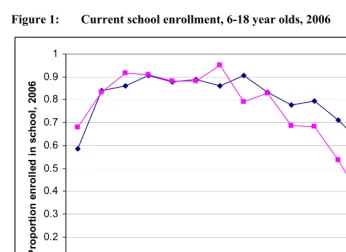
Logistic regression models examine the factors associated with whether or not a child was enrolled in school at the time of the survey in 2006. School participation in the MDICP sample does not differ substantially for boys and girls through age 14, at which point more boys than girls remain enrolled in school (Figure 1). However, from age 8 through age 16, girls have a higher mean number of grades completed than do boys at almost every age [data not shown], indicating that to a large part the gender pattern of school enrollment observed in Figure 1 may be an artifact of girls’ more rapid and successful progression through school. Delayed school entry is common, and a substantial number of children do not begin their education until age eight or nine. School participation is relatively high throughout adolescence, such that 85 per cent of 14 year olds were enrolled in school at the time of the survey. However, measurements of current school enrollment may not accurately reflect children’s exposure to education. Irregular school attendance is pervasive in Malawi, and a large proportion of adolescents in Malawi are substantially behind the proper grade for age (Davidson and Kanyuka 1992; Hewett 2006).
Figure 1: Current school enrollment, 6-18 year olds, 2006
0 0.1 0.2 0.3 0.4 0.5 0.6 0.7 0.8 0.9 1
6 7 8 9 10 11 12 13 14 15 16 17 18
Age
P
ropor
ti
on e
n
ro
ll
ed i
n
s
chool
, 2
00
6
Boys Girls
Source: Malawi Diffusion and Ideational Change Project
3.1.2 Household and child characteristics
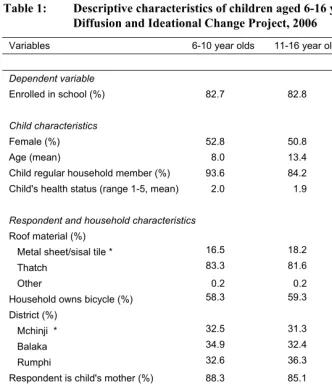
The multivariate analysis controls for household and child characteristics measured in 2006 that might influence school participation [see Table 1]. The age, squared age, and sex of each child are included in each of the regressions. The models also measure whether or not the child is a regular household member and whether or not the respondent is the child’s mother. Child’s health status at the time of the survey was included as a continuous variable ranging from 1, excellent health, to 5, very poor health. Household socio-economic status was controlled by three variables—roof construction material, whether or not the household owns a bicycle, and the respondent’s level of education—that reflect the quality of living arrangements and livelihoods that may influence school attendance. These variables were also chosen following the example of prior analyses of HIV attitudes and risk perceptions in rural Malawi (e.g. Anglewicz 2007; Gerland 2006). Finally, the models also control for the district in which the respondent lives.
3.1.3 Parental perceptions of the HIV epidemic
Table 1: Descriptive characteristics of children aged 6-16 years old, Malawi Diffusion and Ideational Change Project, 2006
Variables 6-10 year olds 11-16 year olds Total sample
Dependent variable
Enrolled in school (%) 82.7 82.8 82.8
Child characteristics
Female (%) 52.8 50.8 51.8
Age (mean) 8.0 13.4 10.7
Child regular household member (%) 93.6 84.2 88.9 Child's health status (range 1-5, mean) 2.0 1.9 2.0
Respondent and household characteristics
Roof material (%)
Metal sheet/sisal tile * 16.5 18.2 17.3
Thatch 83.3 81.6 82.5
Other 0.2 0.2 0.2
Household owns bicycle (%) 58.3 59.3 58.8
District (%)
Mchinji * 32.5 31.3 31.9
Balaka 34.9 32.4 33.7
Rumphi 32.6 36.3 34.5
Respondent is child's mother (%) 88.3 85.1 86.7 Respondent’s education (%)
None * 34.9 37.0 35.9
Primary 59.9 59.0 59.5
Secondary 5.0 4.0 4.5
Higher 0.2 0.1 0.2
N 1,112 1,196 2,308
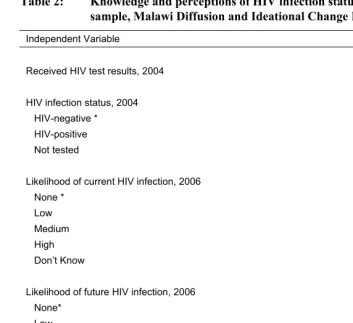
Table 2: Knowledge and perceptions of HIV infection status, women, analytic sample, Malawi Diffusion and Ideational Change Project
Independent Variable Per cent
Received HIV test results, 2004 64.5
HIV infection status, 2004
HIV-negative * 79.6
HIV-positive 6.4
Not tested 13.9
Likelihood of current HIV infection, 2006
None * 65.9
Low 22.8
Medium 6.1
High 4.5
Don’t Know 0.7
Likelihood of future HIV infection, 2006
None* 39.8
Low 33.3
Medium 13.2
High 8.4
Don’t Know 5.3
N 962
* Indicates omitted variable in multivariate analysis
The key independent variable records whether or not the respondent learned her HIV infection status in 2004. Following the survey, all respondents were given the opportunity to take a saliva-based HIV test. Results were made available several weeks later at temporary counseling centers distributed across the sample communities.2 In
2 To overcome the endogeneity of result-seeking behavior, the location of counseling centers was randomized
the analytic sample of women with a child aged 6-16 years old, 65 percent received their HIV test results. The regressions also control for the HIV infection status of each respondent, regardless of whether she received her HIV test result. Eighty percent of women were HIV-negative, six percent were HIV-positive, and the remaining women did not take an HIV test in 2004. Although there were efforts to randomize the conditions under which HIV tests were administered and the test results dispensed [see footnote 1], it is possible that women who learned their HIV status were selectively different from women who did not learn their status. Table 3 explores the distribution of respondent’s characteristics by whether or not they received their HIV test results. In general, women who learned their HIV status were of lower socio-economic status than women who did not learn their HIV status. Respondents who received their HIV test results were significantly less likely to live in households that had a metal roof, and significantly more likely to have never attended school, relative to women in the analytic sample who did not receive their HIV test results. There was also significant regional variation in whether or not a woman learned her HIV status, given that the sample of women itself is evenly distributed across the three regions. Despite these socio-economic differences, there was no significant difference between women who did and did not receive their HIV test results in their perception of their risk of being infected with HIV in either 2004 or 2006. Although the likelihood of returning to the testing centers to receive one’s HIV status is probably selective on values and attitudes that are unobserved in this analysis, it is encouraging that there was no significant difference in result-seeking behavior according to the respondent’s perception of her HIV risk in this analytic sample at the time of testing in 2004. According to my first hypothesis, one would expect school enrolment rates to be higher among the children of women who learned their HIV status in 2004. However, Table 3 shows that women who learned their HIV status were actually selective by factors that are empirically associated with lower school enrollment rates.
In each survey round, women are asked to estimate the likelihood that they are currently infected with HIV. There is no significant difference in this measure in 2006 between those respondents who learned their HIV status in 2004 and those who did not (Table 3), despite the fact that those who received their HIV test results are able to estimate their likelihood of infection using actual knowledge of their status. To some extent this may be because those women who learned that they were HIV-negative may be evaluating their sexual behavior during the intervening two years. However, it is also the case that more than half of the women who learned that they were HIV-positive report themselves to be at no or low likelihood of being currently infected in 2006, although these respondents only amount to four percent of the entire sample. Earlier
analyses of the 2004 data suggested that social desirability bias led a significant number of HIV-positive individuals to underreport their risk of infection, either due to unwillingness to divulge their status to the interviewer or from fear of stigma associated with infection (Bignami-Van Assche 2007). Longitudinal fixed effects analysis of this data found that there was a time trend for women to report a lower current likelihood of infection in 2006 relative to 2004, although this was not associated with learning one’s HIV status (Anglewicz 2007). In the analytic sample, 66 per cent of all respondents believed that they had no risk of being infected, whereas only five per cent of respondents believed that they were at high risk of being HIV positive and one per cent were unable to estimate their likelihood of infection (see Table 2). According to my hypotheses, uncertainty of one’s risk of infection may be associated with lower school participation rates, regardless of the respondent’s actual health or infection status.
Table 3: Distribution of respondent’s characteristics, by whether or not the respondent received her HIV test results in 2004, women, analytic sample, Malawi Diffusion and Ideological Change Project, 2006
Received HIV test results, 2004
Respondent and Household Variables No Yes
Household has metal roof (%) 18.6 13.3 *
Household owns bicycle (%) 58.5 56.1
Respondent’s education (%)a
None 29.5 38.9 ***
Primary 64.0 56.8 ***
Secondary 6.2 4.2
Higher 0.3 0.2
District (%)a
Mchinji 35.3 26.2 ***
Balaka 27.7 41.1 ***
Table 3: (continued)
Received HIV test results, 2004
Respondent and Household Variables No Yes
Likelihood of current HIV infection, 2004 (%)a
None 47.95 51.61
Low 21.05 17.26
Medium 7.31 7.10
High 10.82 9.68
Don’t Know 12.87 14.35
Likelihood of current HIV infection, 2006 (%)a
None 62.57 67.74
Low 25.73 21.13
Medium 6.43 5.97
High 4.39 4.52
Don’t Know 0.88 0.65
Likelihood of future HIV infection, 2006 (%)a
None 40.06 39.68
Low 34.8 32.42
Medium 13.45 13.06
High 7.31 9.03
Don’t Know 4.39 5.81
N 342 620
* p<0.05 ** p<0.01 *** p<0.001
a Significance determined by Chi-squared test; all other significance determined by t-tests.
that there was a high likelihood that they would become infected and five percent who were unable to estimate their future risk. Furthermore, longitudinal fixed effects analysis found no time trend in reports of future likelihood of infection and no association with learning one’s HIV status (Anglewicz 2007). Pessimistic attitudes about the future of the epidemic have been associated with greater sexual risk behavior than would have occurred in the absence of a negative outlook (Auld 2003). It is possible that negative or fatalistic impressions about future risk of infection might influence decisions about children’s school enrollment, particularly if parents or caregivers believe that their children might be at risk of future infection, potentially reducing the returns on current schooling.
Both the current and future likelihood of infection were measured in the main 2006 MDICP women’s survey. Although these questions were asked two years after HIV test results were made available to the respondents, there were no significant differences in the distributions of these two variables according to whether or not the respondent learned her HIV status [see Table 3]. Although these variables were also collected in the 2004 survey, I elect to use these variables as they were reported in the 2006. In 2004, HIV testing was conducted shortly after the questionnaire was completed. Even though there is no significant change in risk perceptions over time, to the extent that women did revise their perceptions in light of learning their HIV status one would expect these more recent health perceptions to have a greater influence on children’s current school participation. Finally, neither measure of perceived likelihood of infection is correlated with women’s reported health3 in 2006, indicating that women’s
estimations of HIV risk are independent of actual health experiences.
3.1.4 Model specification
The multivariate analysis focuses on whether adult perceptions of the HIV epidemic are associated with current school participation. Nested logistic regression models (Tables 4 and 5) evaluate the association between children’s school participation and women’s knowledge and perceptions of the HIV epidemic, controlling for household and child characteristics. These models take advantage of the full sample, with standard errors adjusted for household clusters of children. As discussed earlier, the results are presented separately by child’s age, with the results for 6-10 year olds presented in Table 4 and the results for 11-16 year olds presented in Table 5.
3.2 Qualitative data and methods
Findings from the multivariate analysis are supplemented by qualitative interviews collected in Mchinji district from a sub-sample of MDICP respondents in 2006. Qualitative interviews were collected from 60 adults aged 25-50 who were the parent of at least one child aged 6 to 18 years old at the time of the 2006 MDICP. The respondents were randomly sampled from MDICP respondents who had completed the 2006 survey until a sufficient number of eligible respondents had been identified. All interviews were collected in Chichewa, the local language, by trained interviewers who also translated and transcribed the interviews in the field. The average interview lasted for 40 minutes. Interviewers were instructed to ask parents about (1) the educational history for each child in the household (e.g. current school enrollment status, age at school entry, grade progression, age and grade at school exit), (2) how they decided the amount of education each child should receive, (3) their own health expectations, and (4) the health expectations that they had for their families. These topics were framed as open-ended questions and the interviews vary in the extent to which each of these themes was explored. In order to avoid the possibility of leading questions, the interviewers were not told that I was interested in whether risk perceptions of HIV/AIDS were considered by parents as part of the education decision-making process. However, a substantial number of respondents made the connection spontaneously during the course of the interview. The interviews were read closely by the author as they were collected and subsequently coded as themes emerged from the data (Glaser and Strauss 1967). The qualitative data are used to cast light on how parents think about the HIV epidemic and future health uncertainty. They provide insight into how uncertainty about the future and perceptions about risk may factor in to the statistical associations found in the models discussed above. Furthermore, they help us understand the value that parents place on education in rural Malawi.
4. Results
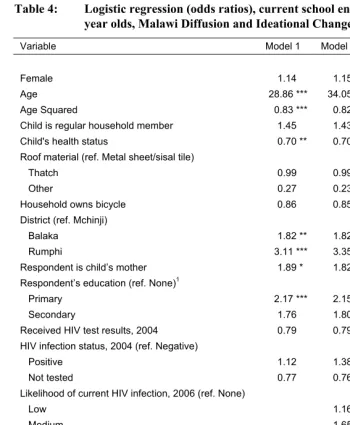
with a woman who attended primary were more than two times greater than the odds of being enrolled for children who live with a woman who had never attended school. There is also a positive association between school enrollment and being the child of the respondent. Amongst children who are not the child of the respondent, the most common relationship is to be the respondent’s grandchild. Unfortunately, the family roster does not allow us to tease out whether a child’s mother lives in the household or is alive elsewhere if the respondent is not the child’s mother. Therefore, it is impossible to know whether we are observing a schooling disadvantage among orphaned or foster children, whether there are confounding effects of living in an extended family household, or whether there is reporting bias among respondents who are not the child’s mother. The child’s health status also had a significant effect, such that the likelihood of being enrolled declined with deteriorating health.4 Finally, children in the reference
district, Mchinji, were significantly less likely to be enrolled in school than children in the other sample districts. This is consistent with the qualitative data collected in Mchinji, where parents frequently stated that children don’t need to be enrolled in school until age 10. These findings are consistent across all three models.
In addition to the household and child variables, each model also includes the respondent’s HIV testing and infection status. This variable is not significantly associated with the school enrollment of 6-10 year old children. The interaction of receiving HIV test results and HIV infection status is also not significant [results not shown]. Model 2 introduces the respondent’s estimation of the likelihood that she is currently infected with HIV. Women who claim a high likelihood of being infected or who are unable to express their likelihood of infection—either because they do not know their likelihood of infection or are unwilling to tell the interviewer—have children with significantly lower odds of being enrolled in school as compared to the children of women who think they are at no risk of being infected. Although I expected that uncertainty about one’s infection status would be associated with lower levels of school enrollment, I hypothesized that learning one’s HIV infection status would remove the effect of this uncertainty on subsequent children’s schooling. The finding to the contrary suggests a need to contextualize health knowledge within ongoing understandings of risk. If individuals base their likelihood of infection on an appraisal of their or their spouse’s behavior, this variable may reflect an ongoing concern, even if the respondent learned that she was HIV negative in 2004. One case from the qualitative data illustrates this relationship:
4 An alternate set of models [results not shown] also included a control for mother’s health in 2006. However,
I: What is giving you worry?
R: What is giving me worry is that we’re two, and you can’t know how your husband is moving [i.e. sexual behavior] and your group of Let’s Chat5 comes with counselors. So when they came to test us, my [husband] refuses. I only go for testing myself, so I have worry, why does he refuse, it means he has such ways. It’s where I get worried…This worry will come to an end if I will go for testing for almost three or four times, being not found as one of the victims then I can’t have worry, but now am worried a lot; I have big worry, because I have just gone for testing, maybe I am in the window period. (Female, 29 years old, 2 children)
It is possible that households where adults have greater uncertainty about their current HIV infection status may be more hesitant to send children to school at younger ages. If the age of school entry is seen as being somewhat flexible, families who are uncertain about the immediate future may want to postpone the expenses associated with school, such as textbooks and uniforms, as long as possible or until a point where they have more information about future conditions. Model 3 adds a measure of the respondent’s perception of her future risk of HIV infection. Whereas high likelihoods of current HIV infection were associated with lower levels of school participation, women who reported a medium or high likelihood of future infection had children with higher odds of being currently enrolled in school as compared to the children of women who reported no chance of future infection. This finding may indicate that women who anticipate future health shocks act in the present to protect their children’s well-being.
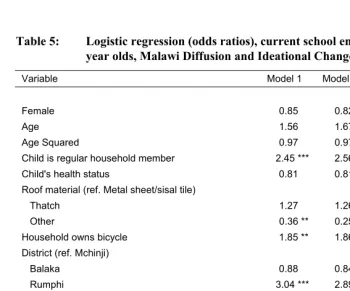
Table 5 presents the multivariate models of the likelihood of current school enrollment among 11-16 year olds. Although it is possible that these models are capturing periods of temporary withdrawal from school, for the most part they can be read as models of school dropout. Other than living in Rumphi district as compared to Mchinji, the largest positive association with school enrollment among older children is being a household member. This indicates that the biological children of the respondent who live elsewhere are less likely to be enrolled in school than children currently living within the household. Although many children do migrate for education, these data indicate that living away from home leads to lower school participation for adolescents and youth. As with the models for younger children, poorer child health is also associated with a lower likelihood of school enrollment. Finally, two of the proxies of household socio-economic status—owning a bicycle and roof construction material— are both significantly associated with the school enrollment of older children in the expected ways. It is not surprising that these variables were not significant for younger
5 During data collection in Malawi, “Let’s Chat” is the informal name used to identify the MDICP research
children; given that there are no school fees at the primary level, one would not expect socioeconomic status to be a barrier to school entry, whereas it may influence the duration of schooling among older children for whom productive or paid labor is an alternative to school participation.
In these models, respondents who received their HIV test results in 2004 had children who were significantly more likely to be enrolled in school, controlling for HIV infection status.6 Surprisingly, the interaction term for receiving HIV test results
and HIV infection status is not significant [results not shown], meaning that there is no difference in school participation between the children of women who learned they were HIV-negative and the children of women who learned they were HIV-positive. If anything, the children of women who learned they are HIV-positive are actually more
likely to be enrolled in school, given the positive, but non-significant, odds ratio in Table 5. Due to the rural nature of the sample, HIV prevalence as measured by the MDICP is slightly lower than national estimates, and amongst the respondents in this analytic sample who took an HIV test, prevalence is 7.5 per cent. Therefore, the majority of respondents who received their HIV test results learned that they were HIV-negative. Many scholars believe that knowing that one is HIV-negative will lead to changes in sexual behavior because individuals will want to act in order to remain negative (Boozer and Philipson 2000; Coates et al. 2000). Knowing that one is HIV-negative also provides a sense of security about the future and may encourage individuals to consider more long term investments, such as extending the duration of children’s school enrollment. In contrast, knowing that one is HIV-positive provides concrete information about future health shocks; the multivariate results indicate that this is an equally powerful motivation for maintaining the school enrollment of older children.
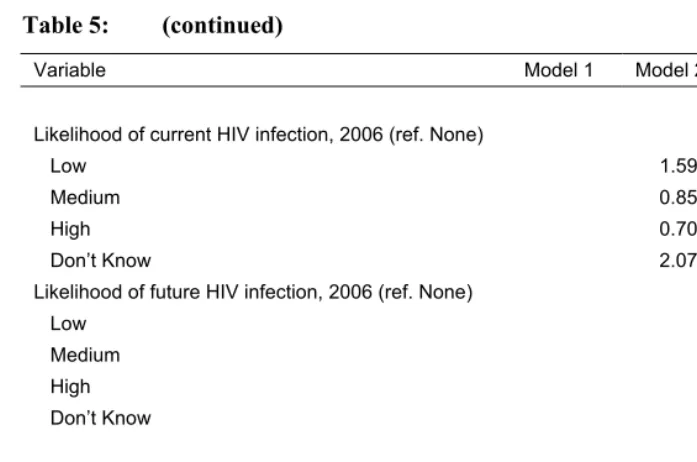
Model 2 introduces the indicator of the respondent’s likelihood of being currently infected with HIV. However, this variable is not significant. Model 3 adds the indicator of the respondent’s likelihood of future HIV infection. Although this variable is also non-significant, the positive odds ratios for women reporting medium and high likelihoods of infection echo the significant findings for younger children, reinforcing the hypothesis that women who worry about future health shocks use education to protect their children’s future well-being.
The multivariate analyses for both younger and older children suggest that women are motivated to invest in their children’s education when they anticipate future AIDS-related poor health, a finding that was echoed in my qualitative interviews with parents. In particular, education was cited by parents as the most common strategy for protecting
6 An alternate model [results not shown] omitted the children of women who did not take an HIV test in 2004.
the well-being of their children. Approximately 72 percent of the qualitative respondents mentioned the role of education in helping children become self-sufficient in the event that either parent should die.7
If a child is educated we say she has found her parents there, her mother, her father, are there…Even if you die, you don’t even worry. (Female, 35 years old, 4 children)
I saw it is wise for this child to start school so that s/he should not meet the problems that I have met myself. I want this child to get educated…while I am still healthy and also when I am still finding money so that this child should not face difficulties but should finish well in school. (Male, 39 years old, 3 children)
If a person is attacked by this disease, HIV, and you have children who are still at school, you have to encourage them to continue with their schooling, so that in the future if their father is dead, they have to stand on their own (Female, 40 years old, 8 children)
Prior research has shown that parents in Malawi place a high value on education (e.g. van Blerk and Ansell 2006). Respondents frequently emphasized this point, invoking education as the one inheritance that they could guarantee for their children. Education was seen as the one pathway leading out of poverty and towards salaried employment, and therefore the only means by which children could become self-sufficient. In addition to the child’s well-being, parents often mentioned the possibility that an educated child could find paid employment and therefore be able to provide more resources for an ailing parent.
This [father] has HIV/AIDS, his sons should finish school so that they can help their father who is sick and help themselves in their own life…They will find a job after finishing school and they will send money to their father who is sick, and they will also be able to buy things for their own daily life. (Female, 40 years old, 8 children)
There is no point for children to not continue with school because their parents have got HIV and also the parents are still alive and maybe the children will drop
7 This theme arose spontaneously in the interviews. It most frequently followed an open-ended question that
out of school when the parents are all dead, they will drop out because of lack of support; but if the parents are alive and although they are sick there is need for the children to continue with school because if the parents die they will leave the children and not that the children will die with them (Female, 40 years old, 4 children)
I: Don’t you think that this child will be a little bit disrupted in his education just because his father is HIV positive?
R: Yes, uh, but not that much, because the father will put much effort on his child now that he is near to die, uh, and that child, he will make sure that he goes up to form four, uh, so that in the future he stands on his own after his father is dead, uh, and if his father is still alive then he will help him in buying food and other things for him…the father has AIDS, uh, and when he dies he will leave his son behind, maybe to his relative who will not treat him well. So he must finish school and be able to stand on his own. (Female, 32 years old, 3 children)
Table 4: Logistic regression (odds ratios), current school enrollment, 6-10 year olds, Malawi Diffusion and Ideational Change Project, 2006
Variable Model 1 Model 2 Model 3
Female 1.14 1.15 1.18
Age 28.86 *** 34.05 *** 39.29 ***
Age Squared 0.83 *** 0.82 *** 0.82 ***
Child is regular household member 1.45 1.43 1.52 Child's health status 0.70 ** 0.70 ** 0.71 ** Roof material (ref. Metal sheet/sisal tile)
Thatch 0.99 0.99 0.99
Other 0.27 0.23 0.29
Household owns bicycle 0.86 0.85 0.84 District (ref. Mchinji)
Balaka 1.82 ** 1.82 ** 1.91 **
Rumphi 3.11 *** 3.35 *** 4.05 ***
Respondent is child’s mother 1.89 * 1.82 * 1.82 * Respondent’s education (ref. None)1
Primary 2.17 *** 2.15 *** 2.00 **
Secondary 1.76 1.80 1.64
Received HIV test results, 2004 0.79 0.79 0.74 HIV infection status, 2004 (ref. Negative)
Positive 1.12 1.38 1.44
Not tested 0.77 0.76 0.78
Likelihood of current HIV infection, 2006 (ref. None)
Low 1.16 0.79
Medium 1.65 0.74
High 0.30 ** 0.08 ***
Don’t Know 0.20 * 0.24
Likelihood of future HIV infection, 2006 (ref. None)
Low 1.30
Medium 2.46 *
High 4.20 *
Table 4: (continued)
Variable Model 1 Model 2 Model 3
Log likelihood -430.9 -421.7 -416.7
Chi 2 102.2 111.71 115.49
R2 0.14 0.16 0.17
N 1112 1112 1112
* p<0.05 ** p<0.01 *** p<0.001
1The category “Respondent’s education-higher” predicts failure perfectly and is dropped from the model.
Note: Standard errors are adjusted for 737 household clusters of children.
Table 5: Logistic regression (odds ratios), current school enrollment, 11-16 year olds, Malawi Diffusion and Ideational Change Project, 2006
Variable Model 1 Model 2 Model 3
Female 0.85 0.82 0.81
Age 1.56 1.67 1.71
Age Squared 0.97 0.97 0.97
Child is regular household member 2.45 *** 2.56 *** 2.44 ***
Child's health status 0.81 0.81 0.80
Roof material (ref. Metal sheet/sisal tile)
Thatch 1.27 1.26 1.25
Other 0.36 ** 0.25 ** 0.30 **
Household owns bicycle 1.85 ** 1.86 ** 1.89 ** District (ref. Mchinji)
Balaka 0.88 0.84 0.91
Rumphi 3.04 *** 2.89 ** 3.17 ***
Respondent is child’s mother 1.59 1.54 1.52 Respondent’s education (ref. None)1
Primary 1.33 1.40 1.27
Secondary 1.29 1.27 1.12
Received HIV test results, 2004 1.73 * 1.74 * 1.71 * HIV infection status, 2004 (ref. Negative)
Positive 1.27 1.42 1.38
Table 5: (continued)
Variable Model 1 Model 2 Model 3
Likelihood of current HIV infection, 2006 (ref. None)
Low 1.59 1.45
Medium 0.85 0.60
High 0.70 0.36
Don’t Know 2.07 3.62
Likelihood of future HIV infection, 2006 (ref. None)
Low 0.93
Medium 1.23
High 1.99
Don’t Know 0.49
Log likelihood -457.7 -454.2 -451.2
Chi 2 115.0 119.9 124.9
Pseudo R2 0.13 0.14 0.15
N 1196 1196 1196
* p<0.05 ** p<0.01 *** p<0.001
1The category “Female respondent’s education-higher” predicts failure perfectly and is dropped from the model.
Note: Standard errors are adjusted for 711 household clusters of children.
5. Discussion
These findings suggest that when parents and caregivers have concrete information about the future or anticipate future health shocks, they act altruistically towards their children. HIV testing removes a considerable amount of health uncertainty from people’s lives, and for women who received their HIV test results in 2004, it was significantly associated with a greater likelihood that older children were enrolled in school. The fact that there was no significant association between HIV testing and school participation among younger children suggests that learning about one’s HIV infection status may have a more important role in determining the duration of schooling, rather than the timing of school entry.
of a medium to high likelihood of future HIV infection. This indicates that an ability to interpret one’s HIV risk profile may have important implications for making decisions about education and other investments with significantly delayed returns. Research by others using this data found that perceptions of future likelihood of infection were unaffected by learning one’s current HIV status (Anglewicz 2007), indicating that this measure may reflect individuals’ perceptions of their future vulnerability regardless of their current or past sexual behavior. This internalization of knowledge about how HIV is transmitted and the acceptance of and worry about personal vulnerability may be empowering women to invest in their children’s education in the present, when they are healthy and able to control the circumstances of their children’s well-being. The association found here indicates the potential impact that public health education campaigns that promote the internalization of HIV risk may have on children’s schooling in other settings.
The qualitative data support the multivariate conclusions, indicating that women who could anticipate future health shocks had rational motivations for insuring that their children attended school for as long as possible. Although the qualitative data consistently point to parents using education as a form of insurance for themselves and their families, the parents and caregivers of older children who do not have concrete information about their own future health prospects may not have the incentive to make this investment. When parents learn that they are HIV negative, they know that their investment in their children’s education is secure, whereas parents who learn that they are HIV positive are motivated by concern for their children’s future well-being. Parents and caregivers who did not learn their HIV status have neither the perceived security of receiving the returns on their children’s education nor the sense of immediacy motivated by knowledge that they may soon become incapacitated by AIDS.
Despite these caveats, this analysis has important implications for HIV policy and prevention strategies. These findings support recent policy discourse that encourages HIV testing as a prevention strategy. Although testing is normally encouraged because of assumptions that individuals will modify their sexual behavior in order to preserve their HIV-negative status or to protect their sexual partners if they are HIV-positive, this analysis points to other social consequences of knowing one’s HIV status. In countries affected by the epidemic, campaigns that promote HIV testing may have implications for school participation rates. This is particularly salient, given recent international objectives to achieve universal primary school enrollment.
Furthermore, this analysis indicates an important indirect effect of the HIV epidemic on children’s school participation. Analyses that focus exclusively on the educational outcomes of orphans will misestimate the true consequences of the epidemic. Given that school participation rates were positively associated with knowledge of one’s HIV status and with higher perceived likelihoods of future infection, school enrollment may also be enhanced by public education programs that reinforce knowledge of HIV transmission modes and prevention strategies. Exposure to public health campaigns may help individuals understand their own risk profile, providing better information on which to make decisions about the future.
6. Acknowledgements
References
Ainsworth, M., K. Beegle, and G. Koda (2005). The impact of adult mortality and parental deaths on primary schooling in northwestern Tanzania. Journal of Development Studies 41: 412-439.
Alderman, Harold, Jere R. Behrman, Victor Lavy, and Rekha Menon (2001). Child Health and School Enrollment: A Longitudinal Analysis. Journal of Human Resources 36(1): 185-205.
Anglewicz, Philip, jimi adams, Francis Obare-Onyango, Hans-Peter Kohler, and Susan Watkins (2006) The Malawi Diffusion and Ideational Change Project 2004-06: Data Collection, Data Quality, and Analysis of Attrition. SNP Working Paper No. 12. Philadelphia: University of Pennsylvania.
Anglewicz, Philip (2007). Migration, risk perception, and HIV infection in Malawi. PhD dissertation. University of Pennsylvania. Philadelphia, PA.
Ansell, Nicola and Lorraine van Blerk (2004). Children’s Migration as a Household/Family Strategy: Coping with AIDS in Lesotho and Malawi. Journal of Southern African Studies 30(3): 673-690.
Auld, M. Christopher (2003). Choices, beliefs, and infectious disease dynamics.
Journal of Health Economics 22: 361-277.
Barnett, Tony and Alan Whiteside (2002). AIDS in the Twenty-First Century. New York: Palgrave Macmillan.
Becker, Gary S. (1981). A Treatise on the Family. Cambridge, MA: Harvard University Press.
Bignami-Van Assche, Simona, Li-Wei Chao, Philip Anglewicz, David Chilongozi, and Agatha Bula (2007). The Validity of Self-Reported Likelihood of HIV Infection Among the General Population in Rural Malawi. Sexually Transmitted Infections
83:35-40.
Boozer, M. and T. Philipson (2000). The impact of public testing for human immunodeficiency virus. Journal of Human Resources 35(3): 419-446.
Case, Anne and Cally Ardington (2006). The Impact of Parental Death on School Outcomes: Longitudinal Evidence from South Africa. Demography 43(3). Case, Anne, Christine Paxton, and Joseph Ableidinger (2004). Orphans in Africa:
Cohen, Barney and Mark R. Montgomery (1998). Introduction. In: From Birth to Death: Mortality Decline and Reproductive Change. Washington, D.C.: National Academies Press.
Coates, T.J., O.A. Grinstead, S.E. Gregorich, D.C. Heilbron, W.P. Wolf, K.H. Choi, J. Schachter, P. Scheirer, A. van der Straten, M.C. Kamenga, M.D. Sweat, I. De Zoysa, G. Dallabetta, K.R. O’Reilly, E. van Praag, D. Miller, M. Ruiz, S. Kalibala, B. Nkowane, D. Balmer, F. Kihuho, S. Moses, F. Plummer, G. Sangiwa, M. Hogan, J. Killewo, D. Mwakigile, and C. Furlonge (2000). Efficacy of voluntary HIV-1 counseling and testing in individuals and couples in Kenya, Tanzania, and Trinidad: A randomized trial. Lancet 356(9224): 103-112.
Davidson, Jean and Martin Kanyuka (1992). Girls’ participation in basic education in southern Malawi. Comparative Education Review 36(4): 446-466.
De Lannoy, Ariane (2005). “There is no other way out”: Educational decision-making in an era of AIDS: How do HIV-positive mothers value education? Centre for Social Science Research Working Paper No. 137. University of Cape Town. Evans, David K. and Edward Miguel (2007). Orphans and Schooling in Africa: A
Longitudinal Analysis. Demography 44(1): 35-57.
Fortson, Jane (2008). Mortality Risk and Human Capital Investment: The Impact of HIV/AIDS in Sub-Saharan Africa. Working Paper. Chicago: University of Chicago.
Gerland, Patrick (2006). Effects of social interactions on individual AIDS prevention attitudes and behaviors in rural Malawi. Ph.D. dissertation, Princeton University.
Glaser, B.G. and A. Strauss (1967). The discovery of grounded theory: Strategies for qualitative research. New York: Aldine.
Grant, Monica J. and Sara Yeatman (2008). Children’s Living Arrangments and Gender Differences in Parental Support. Paper presented at the Annual Meeting of the Population Association of America, April 17-19, New Orleans, LA.
Gregson, Simon, Basia Zaba, and Susan-Catherine Hunter (2003). The Impact of HIV-1 on Fertility in sub-Saharan Africa: Causes and Consequences. UN Population Bulletin, special issue on “Completing the fertility transition.”
Helleringer, S. and H.P. Kohler (2005). Social Networks, Risk Perceptions, and Changing Attitudes Towards HIV/AIDS: New Evidence from a Longitudinal Study Using Fixed-Effects Estimation. Population Studies 59(3): 265-282. Hewett, Paul (2006). Malawi School Survey Preparatory Report. New York: Population
Council.
Kadzamira, Esme and Pauline Rose (2003). Can free primary education meet the needs of the poor? Evidence from Malawi. International Journal of Educational Development 23(5): 501-516.
Kalemli-Ozcan, S. (2006). AIDS, Reversal of the Demographic Transition, and Economic Development: Evidence from Africa. NBER Working Paper No. W12181.
Kaler, A. (2004). AIDS-talk in Everyday Life: The Presence of HIV/AIDS in Men’s Informal Conversation in Southern Malawi. Social Science and Medicine 59: 285-297.
Kohler, H.P, J.R. Behrman, and S.C. Watkins (2007). Social Networks and HIV/AIDS Risk Perceptions. Demography 44(1): 1-33.
Lloyd, Cynthia B. and Ann K. Blanc (1996). Children’s Schooling in Sub-Saharan Africa: The Role of Fathers, Mothers and Others. Population and Development Review 22(2):265-298.
Macro International (2005). Malawi Demographic and Health Survey 2004. Calverton, MD: Macro International.
Macro International (1993). Malawi Demographic and Health Survey 1992. Calverton, MD: Macro International.
Mishra, Vinod, Simona Bignami, Robert Greener, Martin Vaessen, Rathavuth Hong, Peter Ghys, Ties Boerma, Ari Van Assche, Shane Khan, and Shea Rutstein (2007). A study of the association of HIV infection with wealth in sub-Saharan Africa. DHS Working Paper No. 31. Calverton, MD: Macro International. Montgomery, Mark (2000). Perceiving Mortality Decline. Population and Development
Review 26(4): 795-819.
Montgomery, Mark R. and John B. Casterline (1996). Social Influence, Social Learning, and New Models of Fertlity. Population and Development Review
National Research Council-Institute of Medicine (NRC-IOM) (2005). Growing Up Global: The Transition to Adulthood in Less Developed Countries. Cynthia Lloyd (ed.). Washington, DC: National Academies Press.
Poullin, Michelle (2006). The Sexual and Social Relations of Youth in Rural Malawi: Strategies for AIDS Prevention. Unpublished Ph.D. Dissertation. Department of Sociology. Boston University.
Rutenberg, Naomi, Ann E. Biddlecom, and Frederick A.D. Kaona (2000). Reproductive Decision-Making in the Context of HIV and AIDS: A Qualitative Study in Ndola, Zambia. International Family Planning Perspectives 26(3): 124-130. Setel, Philip (1995). The effects of HIV and AIDS on fertility in East and Central
Africa. Health Transition Review 5(Suppl.): 179-189.
Smith, K.P. and S.C. Watkins (2005). Perceptions of Risk and Strategies for Prevention: Responses to HIV/AIDS in Rural Malawi. Social Science and Medicine 60: 649-660.
Soares, R. (2005). Mortality Reductions, Educational Attainment, and Fertility Choice.
American Economic Review 95(3): 580-601.
Thornton, Rebecca (2005). The Demand for and Impact of Learning HIV Status: Evidence from a Field Experiment. Unpublished manuscript.
Timaeus, Ian M. and Mamadou Jasseh (2004). Adult Mortality in Sub-Saharan Africa.
Demography 41(4): 757-772.
van Blerk, Lorraine and Nicola Ansell (2006). Children’s experiences of migration: moving the wake of AIDS in southern Africa. Environment and Planning D: Society and Space 24: 449-471.
Watkins, S.C. (2004). Navigating the AIDS Epidemic in Rural Malawi. Population and Development Review 30(4): 673-705.
Yamano, T., Y. Shimamura, and D. Sserunkuuma (2006). Living Arrangements and Schooling of Orphaned Children and Adolescents in Uganda. Economic Development and Cultural Change. 54: 833-856.
Yeatman, Sara (2007). Fertility in Times of Crisis: The Case of the AIDS Epidemic. Paper presented at the Population Association of America Annual Meeting, New York, NY, March 29-31, 2007.