DEMOGRAPHIC RESEARCH
VOLUME 30, ARTICLE 26, PAGES 753
794
PUBLISHED 13 MARCH 2014
http://www.demographic-research.org/Volumes/Vol30/26/ DOI: 10.4054/DemRes.2014.30.26
Research Article
Education, elderly health, and differential
population aging in South Korea: A demographic
approach
Bongoh Kye
Erika Arenas
Graciela Teruel
Luis Rubalcava
©2014 Kye, Arenas, Teruel & Rubalcava.
This open-access work is published under the terms of the Creative Commons Attribution NonCommercial License 2.0 Germany, which permits use, reproduction & distribution in any medium for non-commercial purposes, provided the original author(s) and source are given credit.
1 Introduction: Alternative ways to measure population aging 754
2 Education and elderly health: Demographic pathways 755
3 Research questions 758
4 Population aging and socioeconomic development in South Korea 758
5 Data 759
6 Methods: A recursive demographic model for education and elderly
health
761
6.1 Basic model 761
6.2 Simulation 763
6.3 Exogeneity of education and age structure of population 765
6.4 Differential mortality 766
7 Results 767
7.1 Descriptive results 767
7.2 Regression analyses 770
7.3 Simulation: Changes in the proportion of healthy elderly 772
7.4 Simulation: Changes in the generational support ratios 774
7.5 Projections of generational support ratios 777
8 Summary and discussion 779
9 Acknowledgements 782
References 783
Education, elderly health, and differential population aging in South
Korea: A demographic approach
Bongoh Kye1
Erika Arenas2
Graciela Teruel3
Luis Rubalcava4
Abstract
BACKGROUND
Population aging proceeds with other socioeconomic developments, including educational expansion. Improvements in educational attainment lead to changes in demographic behaviors such as assortative mating, fertility, and the intergenerational transmission of education, which change the health of the elderly and the education of their offspring generation.
OBJECTIVE
We examine such a jointly-changing process in South Korea.
METHODS
We apply a recursive demographic model (Mare and Maralani 2006) by using the Korean Longitudinal Study of Ageing (KLoSA).
RESULTS
First, improvements in education lead to improvements in health among the elderly. Intermediate demographic factors make positive contributions to this improvement. Second, improvements in education lead to a decline in the ratios of offspring to the elderly because better-educated people have fewer children. However, this decrease is not substantial. Third, improvements in education increase the ratio of college-educated offspring to the unhealthy elderly because of improvements in both offspring‘s education and elderly health.
1 Kookmin University, South Korea. E-Mail: [email protected].
2 University of California, Los Angeles, U.S.A.
3
Universidad Iberoamericana Ciudad de México, Mexico.
CONCLUSION
The results suggest that improvements in education change configurations of the elderly and their offspring‘s generations, mitigating the negative consequences of population aging, such as increasing burdens of elderly support.
1. Introduction: Alternative ways to measure population aging
Population aging is a worldwide phenomenon, with the median age of the world population forecast to rise to 38.1 years in 2050 from 26.7 years in 2000 (Goldstein 2009). Population aging has important socioeconomic consequences because the age structure of a population determines the ratio of net producers to net consumers in a population. Hence, most industrialized countries are concerned about negative consequences of population aging and have attempted to develop pronatal policies that balance the population‘s age structure (Kalwij 2010; McDonald 2002). Population aging, however, also occurs in tandem with other socioeconomic changes such as educational expansion and improvements in health, which may mitigate the consequences of rising dependency ratios. Skirbekk, Loichinger, and Weber (2012) proposed a new measure of population aging—the cognition-adjusted dependency ratio (CADR)—and showed that the ranking for degree of population aging depends upon the measures: whereas India has fewer elderly people per working-aging individual than the U.S., the U.S. has fewer cognitively-limited elderly people per working-age individual than India. There is also evidence that increasing human capital per capita may offset the loss of total economic product due to fertility decline in a population level (Lee and Mason 2010) and the cost of supporting an elderly population may be reduced as the health of the elderly has continued to improve over decades (Martin, Schoeni, and Andreski 2010). In other words, ―population aging is intrinsic to the processes that bring us a highly-educated population and comfortable standards of living‖ (Lee and Mason 2010: 179). In this study, we examine changing joint configuration of the elderly and their offspring in terms of health and educational attainment by applying a demographic model.
Thorslund 2009; Batljan and Thorslund 2009; Joung et al. 2000; Lutz 2009). These studies have examined how the expected change in the educational composition among the elderly may affect the size of the elderly population and the prevalence of serious illness among them. Although these studies provide better estimates of the size and the composition of the elderly population than do conventional projection models based on age and sex, they do not account for the fact that changes in the educational composition in one generation also lead to changes in educational attainment of the next generation, who will provide the elderly with the support. Extending Mare and Maralani‘s (2006) recursive demographic model, the current study proposes a new model that examines the implications of education for population aging by accounting for jointly-changing configurations of elderly health and educational attainment of the offspring generation.
2. Education and elderly health: Demographic pathways
lead to better health among the elderly, mitigating the socioeconomic pressure of population aging to some extent.
We should be cautious, however, in interpreting the implications of improvements in education on population aging. Whereas improvements in education lead to better health among the elderly, they also lead to changes in intervening demographic processes. First, educational expansion will lead to fertility decline, given the negative relationship between education and fertility (Bongaarts 2003; Jejeebhoy 1995; Skirbekk 2008).5 Hence, educational expansion may accelerate population aging by further unbalancing the age structure of the population. However, improvements in education and the subsequent reduction in fertility are likely to lead to better educational outcomes among offspring. This positive intergenerational association in educational attainment has been found consistently (e.g., Mare 1981; Shavit and Blossfeld 1993). Recent studies have documented that the relationship between mother‘s education and children‘s education is indeed causal in the United States by using the variations in school-leaving ages as an instrument (Oreopoulos, Page, and Stevens 2006). The higher levels of education in the offspring‘s generation may also lessen the negative socioeconomic consequences of population aging. Second, studies on educational assortative mating consistently found a strong association between husband‘s and wife‘s education in the United States (Mare 1991; Schwartz and Mare 2005) and in other countries (Park and Smits 2005). This strong pattern of educational assortative mating suggests that improvements in educational attainment also lead to changes in spousal educational attainment, which, in turn, affect the level of fertility and offspring‘s educational outcomes.
These intervening demographic variables, such as spousal education, level of fertility, and children‘s education, are also associated with health and mortality. First, spouse‘s education is positively associated with an individual‘s self-reported health (Huijts, Monden, and Kraaykamp 2010; Monden et al. 2003) and survival chances (Bosma et al. 1995) in various European countries: having a better-educated spouse enhances one‘s own health. Second, children‘s education is positively associated with the health and survival chances of the elderly because better-educated children provide their parents with more support than do their less-educated counterparts (Friedman and Mare 2010; Zimmer, Hermalin, and Lin 2002).
5 The causality of this relationship remains controversial. For example, Monstad, Propper, and Savanes (2008)
Third, family size is also associated with health in later life, although this relationship is complicated. On one hand, evolutionary biology suggests a negative association between family size and health because of the trade-off between investment of resources in somatic maintenance and reproduction (Westendorp and Kirkwood 1998). In other words, if a woman produces too many children, this excessive reproduction may harm her health. Similarly, having and raising a child may lead to economic strain, role overload, and stress, leading to worse health (Hank 2010). On the other hand, parenthood can also improve health due to more involvement in community activities and support from children in later life (Hank 2010). In this sense, the association between family size and health depends on the relative importance of these competing biological and social factors. There is mixed empirical evidence. Among women born in the early twentieth century in England and Wales, childless women and women with more than five children had higher mortality rates than the others, suggesting a non-monotonic relationship (Grundy and Tomassini 2005). Engeleman et al. (2010) also found a positive association between family size and difficulty with activities of daily living (ADLs) in Egypt. Further, the relationship between family size and health also depends on the socio-economic context. There is positive association between family size and self-rated health among the West German women age 50+, but because of differences in labor market participation this relationship is reversed in East Germany (Hank 2010). In sum, multiple demographic factors, including assortative mating, differential fertility, and the intergenerational transmission of education contribute to the relationship between education and elderly health.
3. Research questions
We examine how changes in educational attainment lead to changes in the distribution of elderly health and the distribution of the offspring generation‘s educational attainment in South Korea by focusing on demographic processes. Specifically, we examine the following research questions:
1. How do changes in the distribution of educational attainment lead to changes in the distribution of health among the elderly in South Korea?
2. How do assortative mating, differential fertility, and the intergenerational transmission of education mediate the relationship between education and elderly health in South Korea?
3. How do changes in the distribution of educational attainment affect the joint distribution of the elderly health and the offspring generation‘s education in South Korea?
4. Population aging and socioeconomic development in South Korea
South Korea is one of the most rapidly aging countries in the world (Organisation for Economic Co-operation and Development [OECD] 2011). The elderly support ratio in South Korea—defined as the number of people of working age (20-64) per person 65 and older—was 6.3 in 2009, above the OECD average of 4.2. South Korea‘s elderly support ratio, however, is projected to be 1.5 in 2050, lower than the OECD average of 2.1. Rapid increases in life expectancy and decreases in the fertility rate are responsible for this rapid population aging. In South Korea, life expectancy at birth was 77.9 years in 2008, a 12.5 year increase from 1983 (OECD 2011), and the total fertility rate decreased from 6.0 to 1.2 in less than 50 years since 1960 (Jun 2004). South Korea has not yet developed old-age pension programs to cope with this rapidly aging population. For example, the percentage of gross domestic product (GDP) spent on publicly funded old-age survivor benefits in South Korea is the lowest among the OECD countries (Kapteyn 2010). This lack of public support for the elderly, combined with the increasing prevalence of the nuclear family that may reduce the total amount of familial support for the elderly on average (De Vos and Lee 1993), raises concerns about the deterioration of quality of life in old age.
from 6.4 years in 1970 to 11.7 years in 2010. The level and the rate of change are higher than most other rapidly developing Asian countries (Lee and Francisco 2012). Strong parental educational investment and export-driven economic development fostered the exceptional educational expansion, and was conducive to rapid economic development in turn (Lee 2008; Lee and Francisco 2012). Such a dramatic increase in educational attainment leads to rapid accumulation of human capital, which has important implications for population aging. Rapid educational expansion should contribute to improvements in elderly health given strong educational gradients in health. Khang et al. (2004) showed persistent educational differentials in elderly health and mortality in South Korea. At the same time, educational expansion also makes the population older due to subsequent reductions in fertility and improved survival chances, as noted above.
The rapid socioeconomic and demographic changes make South Korea well-suited to examine the implications of improvement of education for population aging. Population aging and educational expansion are worldwide phenomena, but the pace of changes in South Korea is exceptionally fast. Chang (2010) characterized this rapid socioeconomic and demographic transformation as ―compressed modernization‖. While industrialization and demographic transition took more than a century in Western countries, South Korea have completed both in less than a half century. This compressed process accompanied unexpected and undesirable consequences, including overly rapid population aging. The policies that promoted development, ironically, also contributed to furthering population aging in South Korea. Strong implementations of family planning program contributed to fertility decline (Choe and Park 2006).6 The rapid educational expansion also would have been impossible if there had been no policy effort to promote more schooling. The very family and education policies, which promoted economic development, accelerated population aging in turn. These policy interventions succeeded in achieving the intended goals, but furthered population aging. These policies, however, affected the composition of educational attainment and health as well as age structure of population. Therefore, it is interesting to examine the implications of changing educational attainment on population aging in South Korea.
5. Data
We use the Korean Longitudinal Study of Ageing (KLoSA), a biannual longitudinal survey of the non-institutionalized Korean population, age 45 and older. The KLoSA collected data on socio-demographic characteristics, income, assets, family
6
composition, health, employment, and life satisfaction. The household and individual response rates at the baseline year survey are 81.5 and 75.4 percent respectively, which is comparable with panel surveys in the U.S., such as the Health and Retirement Survey 1992 (Korea Labor Institute 2007). The KLoSA is a stratified multi-stage probability sample. First, it stratified 15 cities and provinces. Each city and province is first stratified by type of area (urban and rural), and then by type of housing (apartment complex and single family homes). There are 60 possible strata (15×2×2). Eight of the cities do not have rural areas, however, resulting in 52 strata. Out of 52 strata, 1000 enumeration districts were selected, and between 1 and 12 households were interviewed in each enumeration district. We take this sampling design into account in our analysis.
The analytic samples are based on currently or previously married women who were 60 years or older in 2006, the baseline survey year. For each selected woman, we assemble information on her education, husband‘s education, number of children, the schooling level of each living child (aged 20+), self-reported health, and two measures of functional limitations in everyday life. We classify educational attainment of women and their husbands into four categories: no schooling, elementary education (one to six years of schooling), secondary and some high school (seven to 11 years), and high school graduates and above (12+ years). The educational attainment of their offspring also has four categories, but captures a possible higher educational attainment for the offspring‘s generation: no schooling or elementary school (zero to six years), junior high school (seven to nine years), high school (10 to 12 years) and some college and above (13+ years). The survey collected information on the total number of surviving children only rather than the number of total births. Because child mortality is negatively associated with maternal education in South Korea (Choe 1987; Kim 1988), using the number of surviving children would underestimate the educational differentials in fertility and sibship size. However, mortality rates among children and young adults are fairly low in South Korea (Kim 2004), suggesting that this data limitation will not seriously bias our results.
money, making a telephone call, and taking medicine. We classify respondents as ―functionally limited in IADLs‖ if they report a limitation in any of these ten items. These two measures of functional limitations complement self-reported health in that they measure different aspects of independent living among the elderly (Wiener et al. 1990).7
We construct two analytic samples: a marriage/fertility/health sample and a transmission sample. The marriage/fertility/health sample is used to estimate the equations for assortative mating, fertility, and health outcomes. The unit of analysis in this sample is an elderly woman age 60 and older. The transmission sample is used to estimate the equation for children‘s education. The unit of analysis in this sample is offspring of the marriage/fertility/health sample aged 20 and older.
6. Methods: A recursive demographic model for education and
elderly health
6.1 Basic model
We extend Mare and Maralani‘s (2006) model to examine health disparity by education. In this model, the elderly women‘s health is jointly determined by educational attainment, assortative mating, differential fertility, and children‘s education. Formally, we can express the demographic processes that generate health disparity by education as follows:
𝑀 × × 𝑂 × 𝑃 (1)
where i: woman‘s education (i=1…4), k: husband‘s education (k=1…4), j: children‘s
education (j=1…4), s: the number of sibling, and l: health outcomes (l=0,1).
The represents the rates at which women at given level of education i marry
men with education level k, and have elderly health status l. Right-hand terms in equation (1) also account for the number and educational attainment of children. The term 𝑀 represents the probability that a woman in education category i marries a
husband with educational attainment k. The is the expected number of children born
to couples with woman‘s education i and husband‘s education k. The 𝑂 is the
7 ADLs and IADLs are also subject to respondents‘ subjective evaluation of their conditions. Because the
probability that an offspring has educational attainment j, conditional on the woman‘s education i, husband‘s education k, and the number of siblings s for children of these couples. Here, the number of sibling (s) is the number of children of couple (r) minus 1. Finally, the 𝑃 is the probability that a woman with education category i, who married a husband with education category k, has the number children r and distribution of children‘s education , has health outcome l. We estimate the four equations separately: ordinal logistic regression models for husband‘s education ( 𝑀) and
offspring‘s education ( 𝑂 ), Poisson regression for the number of children ( ), and
binary logistic regression for the health outcomes ( 𝑃 ). This model is recursive. We assume the followings; woman‘s education determines husband‘s education; woman‘s and husband‘s education determines the number of children; woman‘s education, husband‘s education, and the number of siblings determines children‘s education; and woman‘s health is determined by all forgoing variables. We use the transmission sample for offspring‘s education ( 𝑂 ), and the marriage/fertility/health
sample for other equations.
Using estimated parameters in each regression model, we estimate conditional probability of each component ( 𝑀, , 𝑂 , and 𝑃 ) in equation (1), which
yields estimated . Using the estimated and observed marginal distribution of
women‘s educational attainment ( ), the marginal distribution of elderly women‘s health outcomes is estimated in the following way:
∑ ∑ × (2)
where is the distribution of expected elderly health and denotes women‘s educational attainment respectively.
adjustment‖ method in handling missing data.8 This choice does not affect the
coefficients of children‘s educational attainment, and assumes a linear relationship between the number of children and the logit of being healthy.
6.2 Simulation
Using the parameters estimated from the equation (1), we simulate how the distribution of elderly health responds to changes in distribution of education. We present the results from two different simulations: a five percent change in women‘s schooling 1) from zero to 12+ years and 2) from 7-11 to 12+ years.9 The purpose of simulation is to illustrate how demographic variables intermediate the relationship between education and elderly health, leading to changes in joint configuration of elderly health and offspring‘s education.10 Changes in educational attainment will change health outcomes in later life in multiple ways as described in a previous section (2. Education and elderly health: Demographic pathways). First, improvements in education will enhance health independently of subsequent changes in demographic behaviors because education improves economic conditions, provides more social-psychological resources, and encourages a healthier lifestyle (e.g., Ross and Wu 1995). But demographic elements also affect changes in elderly health. Increases in education will affect the choice of spouse11, as well as the quantity of children and their education level. By conducting simulations in which each element changes or is held constant according to changes in education, we can quantify the contribution of each element to the health in later life. In Appendix A1, we present how simulations work in detail.
8
Suppose that some data are missing on a variable X. Then, we create a dummy indicator for missing (D) and a new variable (X*) that equals values of X if data are not missing and that equals to any constant (c) if data are missing. Then, the coefficients of X* capture the expected changes in an outcome variable associated with one unit change in X when data are not missing regardless of the choice of c and the coefficient of D captures the expected difference in outcome between the missing cases and the non-missing cases that have value of c in X (Allison 2001: 9-11).
9 We examined six different scenarios: five percent of women change their education; from zero to 12+ years,
from zero to 1-6 years, from zero to 7-11 years, from 1-6 to 12+ years, from 1-6 to 7-11 years, and from 7-11 to 12+ years. Among them, we presented two extreme scenarios.
10 A five percent change is chosen to illustrate how the model works instead of predicting realistic trends. This
choice is somewhat arbitrary, and magnitude of changes might be larger or smaller. To complement this weakness, we present projection results using expected changes in Korean women‘s educational attainment.
11 This study assumes that husband‘s education is determined by wife‘s education. Hence, upgrading of
After simulations, we compute two different ratios. First, we compute the ratios of the simulated proportion healthy (or functionally not limited) to the baseline (observed) proportion healthy. If the ratios are greater than one, this means that improvements in educational attainment lead to improvements of health among the elderly. These ratios, computed in various conditions in which intervening demographic mechanisms are present or absent, show the proportional changes in the share of the healthy elderly and the contribution of demographic elements to such changes.
Second, we compute the generational support ratios. The measure proposed here is the ratio of the number of offspring to the number of the female elderly over age 60. This measure captures how many people in the offspring‘s generation will be available to support an elderly woman in the parental generation.12 By computing the ratios of simulated generational support ratios to baseline generational support ratios, we can assess the relationship between education and generational support ratios. We also compute this measure by elderly health status and offspring‘s educational attainment. By comparing the joint distributions of elderly health and children‘s education before and after the simulations, we can see how changes in educational attainment in one generation lead to changes in the generational support structure in the population by accounting for heterogeneity in elderly health and the offspring generation‘s education. Here, we focus on the ratios of college-educated offspring to the unhealthy elderly. This can be an alternative measure of population aging similar to cognition-adjusted dependency ratio (CADR) (Skirbekk, Loichinger, and Weber 2012). An advantage of our measure is to account for changing configuration of offspring‘s generation as well as elderly health.
Because our sample only includes female respondents, the results may not be generalized to the entire population including males. First, improvements in elderly health among men due to upgrading education may differ from women. Second, the simulated changes in women‘s education may lead to changes in the sex ratios among the elderly. For these reasons, our results may not be able to be generalized for the entire population. Nonetheless, we restrict our analyses to women for simplicity. In the final section, we discuss the implications for this simplification.
Because key measures in our simulation analyses are based on the parameter estimates from four different regression analyses, it is difficult to assess sampling variability analytically. Hence, we use a bootstrapping method to compute standard errors (Efron and Tibshirani 1993). We account for the KLoSA‘s stratified multi-stage sample design in computing bootstrap standard errors (Lee and Forthofer 2006). First, we resample 1,000 bootstrap samples with replacements from the original data set
12 This generational support ratio is different from the typical support ratio, which refers to the ratio of the
because 1,000 replications are sufficient to compute a reliable confidence interval (Efron and Tibshirani 1993). Each bootstrap sample is composed of strata that include the same number of primary sampling units as the original data. Second, we compute 1) the ratios of simulated-proportion healthy to baseline-proportion healthy and 2) measures of generational support ratios described above for each bootstrap sample. Finally, we estimate standard errors of estimates by computing the standard deviations of these ratios.
6.3 Exogeneity of education and age structure of population
On the individual level, we assume that education is exogenous to all other variables in the model. In other words, husband‘s education, the number of children, offspring‘s educational attainment, and women‘s health status are assumed to be determined endogenously. This strong assumption may not reflect the reality for several reasons. First, the relationship between women‘s and their husbands‘ education is reciprocal rather than causal (Logan et al. 2008). Second, the statistical association between women‘s education and level of fertility may not be causal, either. Studies relying on natural experiments also suggest that unobserved confounders could seriously bias the estimate of effect (Monstad, Propper, and Salvanes 2008; Skirbekk, Kohler, and Prskawetz 2004). Finally, there is evidence that education is causally linked to children‘s education (Oreopoulos, Page, and Stevens 2006) and a person‘s own health and mortality (Arendt 2005; Lleras-Muney 2005; Oreopoulos 2007; Spasojevic 2011). Such causal effects apply to sub-populations who comply with policy interventions or institutional changes. However, they may not be generalized to the entire population (Angrist and Pischke 2009). Not everybody changes educational attainment by responding to such institutional changes. For example, most college-educated individuals may not be affected by changes in compulsory schooling because they would progress further than compulsory schooling in any case. Due to the lack of causal estimates in the population level, we cannot determine whether or not each relationship is causal. Nevertheless, our analysis proceeds as if education is exogenous to all other variables to illustrate demographic pathways through which education differentials are accrued throughout the life course while avoiding overly complicated data analysis.
per child (Lee and Mason 2010: 178).13 Life cycle wealth, which affects investment on children‘s education, is assumed to respond to population aging. In this sense, changes in age structure of population may affect the distribution of educational attainment in population level. Nevertheless, the simulation analysis in this study assumes the exogeneity of education in the population level. In other words, we examine how changes in the distribution of educational attainment lead to changes in (education- and health status-specific) support ratios in population. The purpose of this paper is not to establish causality between education and the age structure of a population. Instead, we aim to describe how differential demographic behaviors intersect educational expansion and population aging.
6.4 Differential mortality
There are substantial educational differentials in survival chances (Elo and Preston 1996; Lleras-Muney 2005). We also have evidence for educational differentials in adult mortality and maternal educational differentials in child mortality in South Korea (Choe 1987; Kim 1988; Kim 2004). Hence, improvements in educational attainment should increase the number of survivors in old age and the number of surviving offspring. Because child mortality in South Korea is fairly low, we expect that educational differentials in adult mortality will matter more than maternal educational differentials in child mortality. In other words, educational upgrading makes the population older as well as healthier. Increasing longevity eventually increases the number of less healthy or vulnerable people in the population. To fully account for the implications of changing survival chances, we need information on the joint distribution of survival probability, health status, own and spousal education, and the number and educational attainment of offspring. Unfortunately, such data do not exist for South Korea. Instead, we address the implications of differential mortality by using information available from period life tables by education. In Appendix A2, we present a supplementary analysis to assess the implications of differential mortality by using bivariate relationships between education and mortality on the aggregate level. Based on this analysis, we assume that the simulated changes in women‘s education lead to a 1 percent increase in elderly population. Please see Appendix A2 for more detailed discussion.
13 Life cycle wealth is defined as ―a desire for claims on future output to support consumption in old age‖
7. Results
7.1 Descriptive results
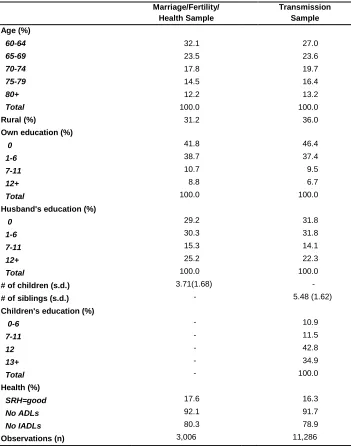
Table 1 shows summary statistics for variables of interest. In addition to health outcomes and key covariates, we present the distribution of two control variables: age and rural residence. Age is an important confounder given the educational expansion, fertility decline, improvements in health conditions over time, and the deterioration of health conditions as individuals age. If we do not control for age, we might mistakenly attribute changes due to age and birth cohort to education. Rural residence is also an important confounder due to the long-standing rural-urban inequality in various socioeconomic outcomes in South Korea.14 Of course, there would be more confounding variables that we cannot control for because of data limitations. Subsequent results are subject to biases due to this omission.
Several patterns are noteworthy. First, husbands‘ educational attainment is higher than their wives, reflecting a gender gap in educational opportunity in the past. Second, whereas only 17.6 percent of elderly women report that their health conditions are ―good‖ or ―very good‖, a majority of women report no functional limitations in ADLs and IADLs. In particular, more than 90 percent of women have no problem in ADLs. Compared with studies in Canada and the United States (Menec, Shooshtari, and Lambert 2007; Glymour et al. 2010), the discrepancy between the self-reported and more objective measures of health is more substantial in South Korea. This discrepancy may reflect cross-national differences in reporting health-related measures, a subject for future research. Finally, offspring‘s educational attainment is much higher than their parents. In addition, Table 1 shows that the distributions of variables for mothers of the transmission sample (which consists of the elderly women‘s offspring) are different than those in the marriage/fertility/health sample (which consists of the elderly women). The elderly women with more surviving children are represented in greater numbers in the transmission sample, making the distributions different. The mothers of the transmission sample on average are slightly older, more likely to live in rural areas, less educated, more likely to have less-educated husbands, and less healthy than those in the marriage/fertility/health sample.
14 Previous studies have documented rural-urban differences in sex ratios among individuals in their 20s (Kim
Table 1: Descriptive statistics
Marriage/Fertility/ Health Sample
Transmission Sample
Age (%)
60-64 32.1 27.0
65-69 23.5 23.6
70-74 17.8 19.7
75-79 14.5 16.4
80+ 12.2 13.2
Total 100.0 100.0
Rural (%) 31.2 36.0
Own education (%)
0 41.8 46.4
1-6 38.7 37.4
7-11 10.7 9.5
12+ 8.8 6.7
Total 100.0 100.0
Husband's education (%)
0 29.2 31.8
1-6 30.3 31.8
7-11 15.3 14.1
12+ 25.2 22.3
Total 100.0 100.0
# of children (s.d.) 3.71(1.68) -
# of siblings (s.d.) - 5.48 (1.62)
Children's education (%)
0-6 - 10.9
7-11 - 11.5
12 - 42.8
13+ - 34.9
Total - 100.0
Health (%)
SRH=good 17.6 16.3
No ADLs 92.1 91.7
No IADLs 80.3 78.9
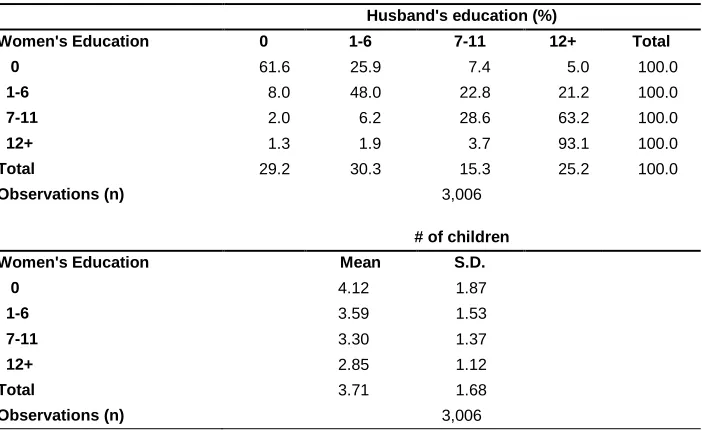
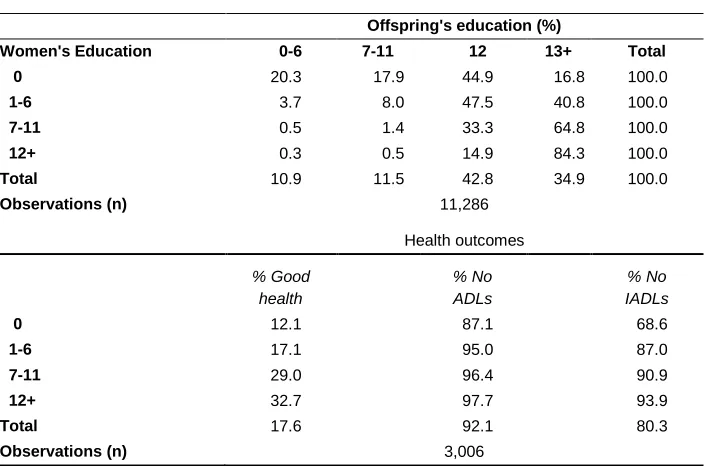
Table 2 presents the bivariate relationships between women‘s education and other variables. First, educational homogamy is strong, particularly for highly educated women. Ninety-three percent of women with high school diplomas married husbands in the same category. Second, women tend to marry ―up‖. This is particularly the case for women with some secondary schooling: 63 percent of women in this category married husbands with a high school diploma. Third, women‘s education is negatively associated with the level of fertility: whereas women with no formal schooling have 4.1 surviving children on average, this number is 2.9 among women with a high school diploma. Fourth, we can see strong upward intergenerational mobility. Sixty percent of offspring whose mothers had no schooling completed at least high school, and almost all offspring of women with a junior high school education or above earned a high school diploma. Finally, the last panel of Table 2 shows the relationship between education and health outcomes. We can see educational gradients in self-reported health and IADLs. Whereas twelve percent of women with no schooling reported ―good‖ health conditions and 69 percent of such women reported no functional limitations in IADLs, the corresponding figures are 33 percent and 94 percent among women with a high school diploma. By contrast, there is no such association between education and ADLs.
Table 2: Distribution of outcomes by women’s educational attainment
Husband's education (%)
Women's Education 0 1-6 7-11 12+ Total
0 61.6 25.9 7.4 5.0 100.0
1-6 8.0 48.0 22.8 21.2 100.0
7-11 2.0 6.2 28.6 63.2 100.0
12+ 1.3 1.9 3.7 93.1 100.0
Total 29.2 30.3 15.3 25.2 100.0
Observations (n) 3,006
# of children
Women's Education Mean S.D.
0 4.12 1.87
1-6 3.59 1.53
7-11 3.30 1.37
12+ 2.85 1.12
Total 3.71 1.68
Table 2: (Continued)
Offspring's education (%)
Women's Education 0-6 7-11 12 13+ Total
0 20.3 17.9 44.9 16.8 100.0
1-6 3.7 8.0 47.5 40.8 100.0
7-11 0.5 1.4 33.3 64.8 100.0
12+ 0.3 0.5 14.9 84.3 100.0
Total 10.9 11.5 42.8 34.9 100.0
Observations (n) 11,286
Health outcomes
% Good health
% No ADLs
% No IADLs
0 12.1 87.1 68.6
1-6 17.1 95.0 87.0
7-11 29.0 96.4 90.9
12+ 32.7 97.7 93.9
Total 17.6 92.1 80.3
Observations (n) 3,006
7.2 Regression analyses
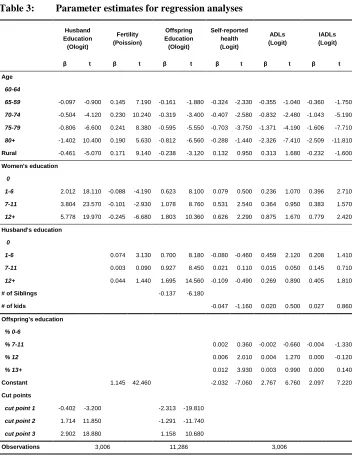
Table 3 presents the estimates of regression analyses for husband‘s education, fertility, offspring‘s education, and three health outcomes. Coefficients along with t-ratios are reported. These estimates are obtained using STATA 11‘s survey estimation commands that account for the complex survey design of the KLoSA. We interpret that the coefficients are significantly different from zero if the t-ratios are greater than 2.
The results show that older women are more likely to marry less-educated husbands, have more children, have less-educated children, and be less healthy. Rural residents tend to marry educated husbands, have more children, and have less-educated children. Rural residence, however, is not significantly associated with subjective and objective health conditions.
Table 3: Parameter estimates for regression analyses
Husband Education (Ologit)
Fertility (Poission)
Offspring Education (Ologit)
Self-reported health (Logit)
ADLs (Logit)
IADLs (Logit)
β t β t β t β t β t β t
Age
60-64
65-59 -0.097 -0.900 0.145 7.190 -0.161 -1.880 -0.324 -2.330 -0.355 -1.040 -0.360 -1.750
70-74 -0.504 -4.120 0.230 10.240 -0.319 -3.400 -0.407 -2.580 -0.832 -2.480 -1.043 -5.190
75-79 -0.806 -6.600 0.241 8.380 -0.595 -5.550 -0.703 -3.750 -1.371 -4.190 -1.606 -7.710
80+ -1.402 10.400 0.190 5.630 -0.812 -6.560 -0.288 -1.440 -2.326 -7.410 -2.509 -11.810
Rural -0.461 -5.070 0.171 9.140 -0.238 -3.120 0.132 0.950 0.313 1.680 -0.232 -1.600
Women's education
0
1-6 2.012 18.110 -0.088 -4.190 0.623 8.100 0.079 0.500 0.236 1.070 0.396 2.710
7-11 3.804 23.570 -0.101 -2.930 1.078 8.760 0.531 2.540 0.364 0.950 0.383 1.570
12+ 5.778 19.970 -0.245 -6.680 1.803 10.360 0.626 2.290 0.875 1.670 0.779 2.420
Husband's education
0
1-6 0.074 3.130 0.700 8.180 -0.080 -0.460 0.459 2.120 0.208 1.410
7-11 0.003 0.090 0.927 8.450 0.021 0.110 0.015 0.050 0.145 0.710
12+ 0.044 1.440 1.695 14.560 -0.109 -0.490 0.269 0.890 0.405 1.810
# of Siblings -0.137 -6.180
# of kids -0.047 -1.160 0.020 0.500 0.027 0.860
Offspring's education
% 0-6
% 7-11 0.002 0.360 -0.002 -0.660 -0.004 -1.330
% 12 0.006 2.010 0.004 1.270 0.000 -0.120
% 13+ 0.012 3.930 0.003 0.990 0.000 0.140
Constant 1.145 42.460 -2.032 -7.060 2.767 6.760 2.097 7.220
Cut points
cut point 1 -0.402 -3.200 -2.313 -19.810
cut point 2 1.714 11.850 -1.291 -11.740
cut point 3 2.902 18.880 1.158 10.680
Observations 3,006 11,286 3,006
Second, there is a negative relationship between education and the level of fertility. Husbands‘ education has a non-monotonic relationship with the level of fertility. Men with some secondary schooling have the same indistinguishable level of fertility as those with no schooling. Men with a high school diploma have higher level of fertility than men with no schooling, but this difference is not statistically significant.
Third, offspring‘s educational attainment is strongly associated with parental education. The influence of mother‘s education on offspring‘s education is about the same as father‘s education. The number of siblings is negatively associated with children‘s educational attainment. Finally, the relationship between health and other covariates depends on the measures of health outcomes. Women‘s education is significantly associated with self-reported health and IADLs but not with ADLs. Offspring‘s education is significantly associated with only self-reported health. This relationship, however, between children‘s education and health of the elderly depends on the measures of health outcomes. The current study shows no association between offspring‘s education and ADLs and IADLs. Other covariates have no significant association with any of the health outcomes used in the current study.
7.3 Simulation: Changes in the proportion of healthy elderly
As discussed above, we adjust for educational differentials in mortality in the following simulation analyses. In other words, we assume that simulated changes in educational attainment that lead to the one percent increase in the elderly population and health status of these ―additional survivors‖ is the same as the original sample. Because women‘s education is not significantly associated with the ADLs, we conduct simulation analyses for self-reported health and the IADLs. In simulation analyses, the distributions of age and rural residence are fixed to mirror the sample distributions shown in Table 1.
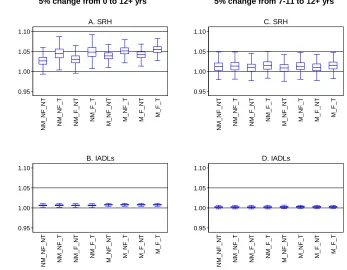
proportion of healthy individuals in terms of self-reported health or IADLs. Box plots are presented to show the point estimates along with sampling variability, which is estimated by a bootstrap method. The box plots show the medians (lines in the middle), the lower quartile (25th percentiles) and the upper quartile (75th percentiles) (boxes), and adjacent values (outer lines). Adjacent values are equal to 1.5 times the interquartile range above the upper quartile or below the lower quartile if there are values greater than these (outliers). Otherwise, they are equal to maximum or minimum. In the following discussion, we define the proportional changes as statistically significant if the ranges between two adjacent values do not include one.
Figure 1: Ratios of the simulated proportion of healthy individuals to baseline proportion healthy
5% change from 0 to 12+ yrs 5% change from 7-11 to 12+ yrs
Not surprisingly, more drastic changes in the distribution of women‘s educational attainment lead to greater improvements in elderly health. For example, in the M_F_T
simulation, the proportion reporting good health increases by 5.4 percent in Figure 1-A (where the five percent change occurs from zero to 12 + years), but the increase is just 1.4 percent in Figure 1-C (where change occurs from 7-11 to 12 + years). The adjacent values in Figure 1-C include one. This means that five percent change of women from 7-11 to 12 + years of schooling does not significantly improve elderly health.
The results also show that the intermediating demographic variables contribute to the improvement of self-reported health. For simplicity, let us focus on the first scenario for self-reported health, where five percent of women are moved from zero to 12+ years of schooling. The difference between M_F_T and NM_NF_NT is 2.7 percentage points. Given that a 5.4 percent increase in proportion reporting good health is expected in
M_F_T simulation, this means that about a half of such improvement comes from changes in subsequent demographic behaviors. In other words, changes in the proportion reporting good health would be halved without subsequent changes in demographic behaviors. Children‘s education appears to be the most important factor. If changes in women‘s education do not lead to changes in offspring‘s education, then improvement in elderly health would be substantially reduced (See M_F_NT). Assortative marriage and differential fertility also make some positive contributions, but the magnitude appears much smaller than intergenerational transmission of education (See NM_F_T and M_NF_T).
For the IADLs, there is little contribution of the demographic elements. In both scenarios, changes in the proportion not functionally limited in the IADLs are almost identical for all simulations. In other words, the absence or presence of the relationship between women‘s education and demographic behaviors does not make any difference in the proportion healthy in terms of IADLs. This is the case because intermediate demographic variables are not significantly associated with the IADLs, as shown in Table 3. The magnitudes of changes driven by changes in education are also much smaller than those in the self-reported health. For example, a change of five percent of women from no schooling to 12 + years leads to a less than one percent change in the percentage not functionally limited in the IADLs for all simulations, although these are statistically significant.
7.4 Simulation: Changes in the generational support ratios
a) simulated all offspring/all elderly baseline all offspring/all elderly
b) simulated college-educated offspring/unhealthy elderly baseline college-educated offspring/unhealthy elderly
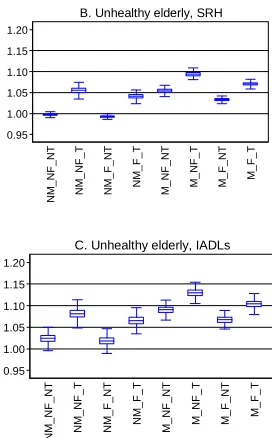
Figure 2: Ratios of simulated generational support ratios to baseline generational support ratios (5% change from 0 to 12+ yrs)
All offspring per elderly
Offspring (13+yrs) per unhealthy elderly
*N: No effect, M: Assortative Marriage, F: Differential Fertility, T: Intergenerational Transmission
0.95 1.00 1.05 1.10 1.15 1.20 S imu la te d /B a s e lin e N M _ N F _ N T N M _ N F _ T N M _ F _ N T N M _ F _ T M _ N F _ N T M _ N F _ T M _ F _ N T M _ F _ T
A. All elderly
0.95 1.00 1.05 1.10 1.15 1.20 S imu la te d /B a s e lin e N M _ N F _ N T N M _ N F _ T N M _ F _ N T N M _ F _ T M _ N F _ N T M _ N F _ T M _ F _ N T M _ F _ T
B. Unhealthy elderly, SRH
0.95 1.00 1.05 1.10 1.15 1.20 S imu la te d /B a s e lin e N M _ N F _ N T N M _ N F _ T N M _ F _ N T N M _ F _ T M _ N F _ N T M _ N F _ T M _ F _ N T M _ F _ T
These ratios represent the proportional changes in generational support ratios induced by educational upgrading. If the ratios are greater than 1, it indicates that the simulated changes in the distribution of educational attainment lead to an improvement in support ratios (i.e., more offspring per elderly). The graphs in Figure 2 show the proportional changes in overall generational support ratios (A) and the proportional changes in the support ratios for college-educated offspring to the unhealthy elderly (B and C).15
First, upgrading women‘s education slightly worsens the overall generational support ratios when education affects fertility (Figure 2-A). When fertility does not respond to changes in educational attainment, the overall support ratios change slightly. Even when this relationship exists, the magnitude of change is not great. The simulated change in the M_F_T simulation reduces the number of offspring per elderly by 1.2 percent. This analysis shows that the influences of educational differentials in fertility are not large enough to worsen the generational support ratios substantially.
Second, upgrading women‘s education leads to a substantial increase in the number of college-educated offspring per unhealthy elderly. This is the case for both health outcomes. We can expect an eight percent increase in the number of college-educated offspring per unhealthy elderly in terms of self-reported health in the M_F_T
simulation (Figure 2-B). Interestingly, we can see that demographic elements are important in such a substantial change. Without subsequent changes in demographic behaviors, the increase of this support ratio is just 0.7 percent (NM_NF_NT simulation). Assortative mating and intergenerational transmission help boost the support ratio, whereas differential fertility works in the opposite direction. The absence of an intergenerational transmission of education (M_F_NT) leads to a 3.8 percentage point reduction in the improvement of this support ratio. This is the case because women‘s education is positively associated with children‘s education and children‘s education is in turn positively associated with women‘s self-reported health. The simulation with no assortative mating (NM_F_T) yields a slightly smaller reduction (3.0 percentage points). Because husband‘s education is not significantly associated with women‘s self-reported health, this positive contribution is due to the positive relationship between father‘s education and children‘s education. Differential fertility negatively affects this support ratio. Without differential fertility, the improvement of the support ratio would be substantially larger, 10.4 percent (M_NF_T simulation). This is the case because differential fertility reduces the size of the offspring‘s generation; the reduced family size, however, does not improve self-reported healthy. This also implies that benefits
15 In supplementary analyses (not shown), we also examined the ratios of all offspring to unhealthy elderly.
from reduced family size for children‘s education are not large enough to fully offset the impact of an overall reduction in the size of the offspring‘s generation. For the IADLs, we can see similar but larger changes (Figure 2-C). In the M_F_ T simulation, an 11.4 percent change in the support ratio is expected when we use the IADLs as a health outcome. Such a substantial improvement is also largely driven by changes in demographic behaviors, without which the improvement is just 3.3 percent (e.g.,
NM_NF_NT simulation). Because the IADLs are not significantly associated with any intermediate demographic variables, such findings exemplify the importance of accounting for changes in the configuration of the offspring‘s generation as well as the elderly. Assortative mating, differential fertility, and intergenerational transmission of education do matter for the elderly support structure even if they are not associated with elderly health because they influence the configurations of the offspring‘s generation.
7.5 Projections of generational support ratios
The analyses presented so far examined the implications of hypothetical changes in educational attainment for the joint distribution of elderly health and offspring‘s education. The magnitude of redistribution, five percent change, is chosen to illustrate how this model works. It represents an arbitrary unit, analogous to focusing on the effect of a ―one unit‖ change in a typical regression model. The simulations show the implications of differential demographic behaviors for joint configuration of elderly health and offspring‘s education. These simulations, however, do not provide information about what the joint configurations look like in the future. In this section, we present such projections.
see that educational attainment among the Korean elderly women is likely to increase rapidly over time.
Figure 3: Projected GSRs under M_F_T model
Next, we assume that the relationships among the variables of interest, shown in Table 3, remain constant in the future. Obviously, this assumption is not realistic either. For example, the intergenerational association of education became weaker in South Korea as educational opportunity expanded (e.g., Park 2003, 2007). Nonetheless, this assumption is useful to see the implications of distributional changes in educational attainment holding constant the relationship among the variables. In projections, we also assume that changes in women‘s education lead to subsequent changes in husband‘s education, number of children, children‘s education, and health. This is equivalent to the M_F_T simulation presented previously. Hence, the projection predicts the joint configurations of elderly health and offspring‘s education in the future perfectly if these two assumptions are true. This is very unlikely to be the case. While
0 20 40 60 80 P e rc e n t
2010 2020 2030 2040
Year
None 1-6 yrs 7-11 yrs 12+ yrs
A. Hypothetical elderly education
.85 .9 .95 1 R a ti o r e la ti v e t o 2 0 0 5
2010 2020 2030 2040
Year
Median 95% CI
B. Offspring per elderly
1 1.5 2 2.5 3 3.5 4 4.5 R a ti o r e la ti v e t o 2 0 0 5
2010 2020 2030 2040
Year
Median 95% CI
C. 13+ yrs offspring per unhealthy elderly, SRH
1 1.5 2 2.5 3 3.5 4 4.5 R a ti o r e la ti v e t o 2 0 0 5
2010 2020 2030 2040
Year
Median 95% CI
imperfect, this projection provides useful information about the joint configurations, particularly as compared to model-based abstract simulations presented in the previous sections.
Figures 3-B, 3-C, and 3-D show the projected generational support ratios relative to those of 2005. If the ratio is greater than one, there is improvement in the generational support ratios; a ratio smaller than 1 means the opposite. As before, we rely on the bootstrap method to assess sampling variability. The solid lines are medians, and the dotted lines represent 95 percent confidence intervals. First, Figure 3-B shows changes in the ratio of all offspring to all elderly if we change elderly women‘s educational attainment according to Figure 3-A using the relationships among the variables shown in Table 3. This graph clearly shows that the overall generational support structure will become worse. For example, there would be a 13.0 percent decrease of the number of offspring per elderly in 2040 as compared with 2005. This is a substantial decrease that would be cause for concern. However, as we emphasized before, such changes come along with improvements in elderly health and offspring‘s education. This is illustrated well in Figure 3-C and Figure 3-D. From these graphs, we can clearly see that the ratios of college-educated offspring to the unhealthy elderly would improve in terms of both self-reported health and IADLs. These ratios would more than double in terms of self-reported health and more than triple in terms of IADLs. Hence, such joint changes should substantially mitigate the burden of population aging.
8. Summary and discussion
This study examines how changes in educational attainment in one generation lead to changes in the joint distribution of elderly health and education of the offspring generation, which has important implications for population aging. The elderly population‘s health, which is heterogeneous, determines the amount of support they need to maintain an adequate quality of life. The offspring generation is also heterogeneous in their capacity to support the parental generation. Educational attainment is strongly associated with both elderly health and offspring‘s education, so it is important to examine the implications of changes in education for the support of the elderly. Because education is also closely related with intermediate demographic variables such as marriage, fertility, and the intergenerational transmission of education, we applied a demographic model to account for these demographic elements. The primary findings are as follows.
intergenerational transmission of education make positive contributions to this improvement. If the relationship between education and demographic variables were completely spurious, then improvements of health associated with educational upgrading would be substantially reduced. Second, educational upgrading leads to declines in the ratios of offspring to the elderly due to the negative association between education and fertility. This decrease, however, is small. For example, a five percent change of women‘s education from no schooling to high school graduate and above would lead to a 1.2 percent decrease in the ratio of offspring to the elderly when all intermediate demographic variables change according to changes in educational attainment (M_F_T simulation in Figure 2-A). In other words, educational upgrading may make the population only slightly older. Third, educational upgrading increases the ratio of the college-educated offspring to all elderly and unhealthy elderly because of improvements in both offspring‘s education and elderly health. This may mitigate the negative consequences of population aging to some extent.
There are several limitations in the current study. First, we restrict our sample to women for the sake of simplicity. There has been a persistent gender difference in life expectancy and healthy life expectancy in South Korea (Salomon et al. 2012), and a decreasing gender wage gap in emerging economic sectors (e.g., knowledge-intensive industry) may reinforce this trend because earnings are strongly correlated with health and mortality (Ural, Horrace, and Jung 2009). This suggests that the patterns reported here may not be able to be generalized to the entire population. However, huge gender differences in the improvement of health and survival chances due to education are not likely either. Hence, our results may not substantially deviate from the patterns that would be observed in the entire population.
Second, we may have exaggerated the role of education on population aging. First, there will be little variation in educational attainment in the near future, and consequently educational differentials in demographic behaviors and health may not be important as most people will be highly educated. Projection results shown in Figure 3, in particular, may overestimate the implications of educational expansion on population aging. Second, our analyses assume that education is exogenous to demographic behaviors and elderly health although we do not use estimates of causal effects of education on them. Hence, our results are a stylized description of the implication of education on population aging instead of predicting the future trends or evaluating causal effect of education on differential population aging. In addition, there will be factors improving elderly health other than education including medical technology and (possibly) decreasing population density due to population aging.16. Hence, we should be cautious in interpreting our results.
16
Despite these limitations, these findings advance research in population aging by accounting for population heterogeneity by education and health. On one hand, improvements in education lead to fertility decline, unbalancing the age structure of the population. Such an impact, however, is just modest in South Korea. On the other hand, educational upgrading leads to changes in joint configuration of elderly health and offspring‘s education: improvements in elderly health and offspring‘s education. These changes may mitigate the problem of population aging because they should improve socioeconomic capacity of the offspring‘s generation and reduce the cost for supporting the elderly. In this sense, projection models based solely on gender and age are likely to exaggerate the negative consequences of population aging because population aging progresses in tandem with other socioeconomic development such as educational upgrading (Lee and Mason 2010). Previous projection models that account for educational upgrading in the population (Batljan, Lagergren, and Thorslund 2009; Batljan and Thorslund 2009; Joung et al. 2000; Lutz 2009) may not fix such problems completely because these models do not account for changes in configurations of the offspring‘s generation. The present study suggests that educational upgrading may mitigate the problems of population aging more than previous studies have suggested. More importantly, population aging proceeds in tandem with socioeconomic development including educational expansion. Consequently, bleak description about population aging may be misleading, and we need to be more cautious in discussing the implications of population aging for society.
Family size is another important issue, with different implications for the population as a whole and as an individual family. A smaller family size, on average, makes the population older. It is well-known that this population aging leads to reduced productivity and increased burden to support the elderly in population level. Many policies have been proposed and implemented to handle this issue (Uhlenberg 1992; van de Kaa 2006; Gauthier 2007). However, smaller family size is beneficial for individual families because it allows for more investment in the children. The negative association between family size and children‘s socioeconomic outcomes, shown in the current and previous studies (e.g., Guo and VanWey 1999), suggests strong incentives on the individual level to having a small family. Because of strong parental interest in children‘s success, boosting fertility should be very difficult without changing the relationship between family size and children‘s educational outcomes. The current study, however, also shows that the reduction in fertility following educational upgrading worsens all generational support ratios considered. For example, absence of differential fertility (M_NF_T simulation) leads to a 10.4 percent increase in
educated offspring per unhealthy elderly (with self-reported health as the outcome). This is 2.3 percentage points larger than the expected change in the M_F_T simulation. This difference shows the benefits on the population level of maintaining a large family. However, given the strong incentive to reduce family size on the individual level, it should be very challenging to effectively encourage individual families to increase family size. This challenge also emphasizes the importance of accounting for population heterogeneity by education and health in coping with population aging.
9. Acknowledgements
References
Allison, P. (2001). Missing data. Thousand Oaks: Sage Publications.
Angrist, J.D. and Pischke, J.S. (2009). Mostly harmless econometrics: An empiricist’s companion. Princeton: Princeton University Press.
Arendt, J.N. (2005). Does education cause better health? A panel data analysis using school reforms for identification. Economics of Education Review 24(2): 149160. doi:10.1016/j.econedurev.2004.04.008.
Batljan, I., Lagergren, M., and Thorslund, M. (2009). Population ageing in Sweden: The effect of change in educational composition on the future number of older people suffering severe ill-health. European Journal of Ageing 6(3): 201211. doi:10.1007/s10433-009-0120-1.
Batljan, I. and Thorslund, M. (2009). The effect of change in educational composition on population ageing. European Journal of Ageing 6(3): 191200. doi:10.1007/s10433-009-0120-1.
Ben-Shlomo, Y. and Kuh, D. (2002). A life course approach to chronic disease epidemiology: Conceptual models, empirical challenges and interdisciplinary perspectives. International Journal of Epidemiology 31(2): 285293. doi:10.1093/ije/31.2.285.
Bongaarts, J. (2003). Completing the fertility transition in the developing world: The role of educational differences and fertility preferences. Population Studies
57(3): 321335. doi:10.1080/0032472032000137835.
Bosma, H., Appels, A., Sturmans, F., Grabauskas, V., and Gostauta, A. (1995). Educational level of spouses and risk of mortality: The WHO Kaunas-Rotterdam intervention study (KRIS). International Journal of Epidemiology 24(1): 119126. doi:10.1093/ije/24.1.119.
Calhoun, J.B. (1962). Population density and social pathology. Scientific American
206(2): 139150.
Chandola, T., Clarke, P., Morris, J.N., and Blane, D. (2006). Pathways between education and health: A causal modelling approach. Journal of Royal Statistical Society A 169(2): 337359. doi:10.1111/j.1467-985X.2006.00411.x.