DEMOGRAPHIC RESEARCH
VOLUME 31, ARTICLE 39, PAGES 1199
−
1228
PUBLISHED 14 NOVEMBER 2014
http://www.demographic-research.org/Volumes/Vol31/39/ DOI: 10.4054/DemRes.2014.31.39
Research Article
Mortality selection in the first three months of
life and survival in the following thirty-three
months in rural Veneto (North-East Italy) from
1816 to 1835
Leonardo Piccione
Gianpiero Dalla-Zuanna
Alessandra Minello
©2014 Piccione, Dalla-Zuanna & Minello.
This open-access work is published under the terms of the Creative Commons Attribution NonCommercial License 2.0 Germany, which permits use, reproduction & distribution in any medium for non-commercial purposes, provided the original author(s) and source are given credit.
1 Introduction 1200
2 Theoretical background and previous results 1202
3 Data 1205
4 Preliminary results and methodological choices 1211
5 Results 1218
6 Conclusions 1221
Mortality selection in the first three months of life and survival in
the following thirty-three months in rural Veneto (North-East Italy)
from 1816 to 1835
Leonardo Piccione1
Gianpiero Dalla-Zuanna2
Alessandra Minello3
Abstract
BACKGROUND
A number of studies have examined the influence of life conditions in infancy (and pregnancy) on mortality risks in adulthood or old age. For those individuals who survived difficult life conditions, some scholars have found a prevalence of positive selection (relatively low mortality within the population), while others have observed the prevalence of a so-called scar-effect (relatively high mortality within the population).
OBJECTIVE
Using micro-data characterized by broad internal mortality differences before the demographic transition (seven parishes within the region of Veneto, North-East Italy, 1816–35), we aim to understand whether children who survived high mortality risks during the first three months of life (early infant mortality) had a higher or a lower probability of surviving during the following 33 months (late infant mortality).
METHODS
Using a Cox regression, we model the risk of dying during the period of 3–35 months of age, considering mortality level survived at age 0–2 months of age as the main explanatory variable.
RESULTS
We show that positive selection prevailed. For cohorts who survived very severe early mortality selection (q0–2>400‰, where the subscripts are months of age), mortality
1 University of Padua, Italy. E-Mail: [email protected]. 2
University of Padua, Italy.
hazard of death during the following 33 months was 20%–30% lower compared to the cohorts where early mortality selection was relatively small (q0–2<200‰).
CONCLUSIONS
This result points to a homeostatic mechanism: mortality variability among the cohorts is, for q0–35, half that of the mortality variability for both q0–2 and q3–35.
1. Introduction
The issue examined in this paper can broadly be described as follows:
Many period-specific influences during life may affect mortality at a later stage, although it is often unclear which direction the resulting influence will take. For example, epidemic experiences or conditions of famine early in life may so debilitate a cohort that it subsequently experiences higher death rates relative to earlier or later cohorts. Others, however, argue that high mortality experienced in early life selects out the frail members of the cohort, resulting in reduced subsequent mortality (Hobcraft and Gilks 1984, p. 264, quoted in Billari and Rosina 2000, p. 2015).
While the two effects may coexist within the same situation, we can only measure the final balance within a population (Preston, Sill, and Drevenstedt 1998; Quaranta 2013). A number of papers attribute the influence of life conditions in infancy (and pregnancy) on mortality risks during adulthood or old age: while some authors find a prevalence of insult accumulation, others observe positive selection.4 If the events experienced in utero and during the first years of life influence mortality risks many years later, the same dynamic could be present, and perhaps even stronger, between contiguous periods. We study the effect of mortality selection during the first three months of life (from here on „early infant mortality‟) on mortality in the 33 months that followed (from here on „late infant mortality‟). We aim to understand whether children who survived strong mortality risk during the first three months of life were „positively selected‟ (i.e., they had a higher probability of surviving during the following 33
4 See e.g., Caselli and Capocaccia 1989; Kannisto, Christensen, and Vaupel 1997; Preston, Sill, and
months) or if rather they experienced a so-called scar-effect, i.e., a process of insult accumulation prevailed such that they had a lower probability of surviving during the following 33 months.5
We consider children born in Veneto (North-East Italy), using micro-data from the archives of seven parishes for the period 1816–1835, before the decline in mortality which characterized the demographic transition. The old demographic regime in Veneto provides an excellent context for studying this issue in that, as we will see below, there were considerable differences in early infant mortality, both across different areas of the region and especially across seasons. This intense variability makes it possible to identify, in detail, the possible influence of early infant mortality on mortality during the following 33 months.
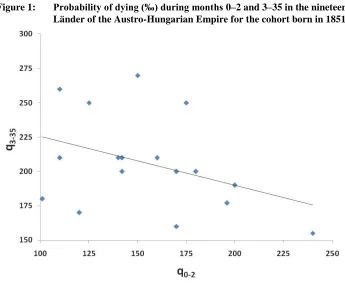
The idea of examining the connections between early and late infant mortality builds on our previous research. Dalla-Zuanna and Rossi (2010), using aggregate data on the mortality of children within the 19 regions of the Austro-Hungarian Empire for the cohort born in 1851, show that in the Länder where mortality was high in the first three months of life there was relatively low mortality in the successive periods. Up until the 36th month of life the association between q0–2 and q3–35 (where the subscripts
are months, as elsewhere in this article) was negative, albeit moderate (r = –0.35, see Figure 1). In the Habsburg Empire of the mid-1800s there was a kind of compensation between early infant mortality and mortality in the following months, what we describe as the prevalence of positive selection. In this work we are going to similarly assess whether such an effect exists within a smaller territory, studied with a much greater degree of detail thanks to the availability of individual data.
5 In this paper we define early infant mortality as mortality risk during the first 3 months of life (age 0–2
months), and late infant mortality as mortality risk from the 4th to the 36th month of life (age 3–35 months).
The idea is to focus on two age intervals that differ with regard to the causes of death: mortality after the 3rd
month of life should only be slightly affected by birth shocks or endogenous weakness, and mainly by exogenous causes (Bourgeois-Pichat 1951). Data on causes of death written in the death registers of our database (even if rough, see footnote 9) partially support the choice of using the end of the 3rd month as a breakpoint between early and late infant mortality: during the 4th month of life, two causes of death strongly
related to birth („spasm‟ and „asthenia‟) drop to 39% of deaths compared to 62% for children who died during the 1st month, 64% in the 2nd month, and 59% in the 3rd month. We do not consider children who died over the
Figure 1: Probability of dying (‰) during months 0–2 and 3–35 in the nineteen Länder of the Austro-Hungarian Empire for the cohort born in 1851
Source: Dalla-Zuanna and Rossi 2010.
2. Theoretical background and previous results
The issue of selection has already attracted the attention of scholars from various fields of study. When thinking about selection it is impossible not to refer to Charles Darwin and his theory of evolution. In Darwin‟s theory, natural selection certainly plays a fundamental role. Yet a further reading of Darwin suggests that his idea of natural selection also included more than mortality. Mortality selection is indeed a specific case of natural selection; it is a directional positive selection that favours “the fittest” (Endler 1986), i.e., people with the strongest probability of surviving. The selectionist argument, according to Peters (1991), is a logical truth and not a scientific theory per se.
(1997) aimed to demonstrate the broad relevance of actuarial studies on Mediterranean fruit flies (medflies) to issues pertaining to humans. In turn, a number of researchers have used demographic selection arguments, with contrasting results, to explain the levelling-off of medfly mortality (Carey, Liedo, and Vaupel1995).
In population studies the notion of selection is often evoked to explain the demographic behaviour of migrant populations. For example, it has been suggested that low levels of mortality among migrants are the result of individuals who migrate being healthier and stronger compared to both those who did not emigrate and natives (the so-called „healthy migrant effect‟, see e.g., McDonald and Kennedy 2004; Kennedy, McDonald, and Biddle 2006). A similar selection effect has been used to explain the marital and reproductive behaviour of immigrant couples and women (Goldstein and Goldstein 1983; Chattopadhyay, White, and Debpuur 2006).
With regard to mortality analyses, however, things are quite different, in that selection is not determined by an external event, as with migration, but by the same processes of elimination that apply to death. Demographers most often employ a selectionist approach to theories on ageing. As a population ages it simply becomes increasingly positively „selected‟, as individuals with higher risk of death die sooner. The result is a population formed mostly by individuals with relatively low death rates (Carey and Liedo 1995a; Vaupel and Carey 1993; Vaupel, Manton, and Stallard 1979). When focusing on the older age groups, this concept helps to explain deviation of the human mortality trajectory from the well-known Gompertz function (Manton and Stallard 1996). Due to positive selection, the increase in mortality rates at older ages is slower than the 8%–10% per year observed in middle age.
before the plagues) relaxed Malthusian pressure, thanks to a higher ratio between resources and population. The lack of data, specifically on population during the centuries of plague in Europe, hinders further unravelling of the issue.
3. Data
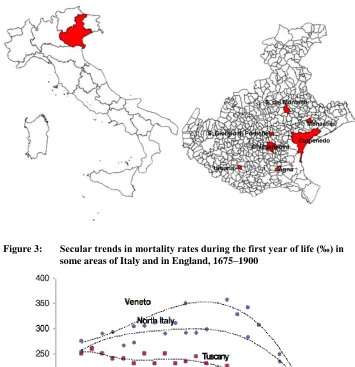
We use unpublished nominal data drawn from 19th century parish archives which form part of the IMAV project (Infant Mortality in Asburgical Veneto) based at the University of Padua‟s Department of Statistical Sciences. The aim of the project is to collect historical data that will aid in disentangling the main dynamics of the very high infant mortality that characterized the Veneto region during the Austrian Empire (1816– 1866) (Derosas 2009; Dalla-Zuanna and Rosina 2011). During the 19th century, Veneto was divided into about 50 districts. In order to have a reliable statistical sample of each economic, social, and territorial context, the IMAV project is in the process of collecting data from at least one parish in each district of the Provinces of Venice, Padua, Treviso, Verona, and Vicenza: the dataset will be completed in 2014. The data used in this paper come from the parochial archives of Agna, San Giorgio delle Pertiche, Chiesanuova and Urbana (Province of Padua), Carpenedo (Province of Venice), and Selva del Montello and Monastier (Province of Treviso) – see Figure 2. These seven parishes represent an extensive picture of the Veneto rural environment during the 19th century. In the period of 1816–1866, approximately 24,000 children were born in these seven parishes, 10,000 of whom died at ages 0–5 years during the period 1816–1870 (the role of parish priests as civil servants in filling out birth and death records continued during the years that followed the annexation of Veneto to the Kingdom of Italy in 1866 up until 1870).
From 1750–1840 the mortality of children in Veneto was extremely high, mainly due to mortality during the first month of life for children born during the winter6. During the eighty years that followed, mortality during the first year of life, and especially winter mortality during the first month, quickly declined (Dalla-Zuanna and Rosina 2011, see also Figures 3 and 4). While scholars have examined the demographic history of Veneto between the last stages of the ancien régime and the demographic transition (Pozzi 1991; Derosas 2002; Rosina and Zannini 2004), the patterns of high mortality during the first month of life remain far from explained. That said, there are clear indications that the influence of cold external temperatures was decisive (Derosas
6 Levels of infant mortality equal to 350‰, such as those recorded in the Veneto region in the century of 1750
2009; Dalla-Zuanna and Rosina 2011).7 The records employed here include birth and death registers filled out by the priests of each parish. These were then added to the „traditional‟ registers of baptisms and burials as, during the Austrian Empire, priests were remunerated as civil servants, responsible for vital statistics.8 Records from the birth registers include the following information:
date of birth
given name of the child
given and family name of the mother and father
jobs of the mother and the father
date of wedding
date of the child‟s baptism.
Records from the death registers include:
date of death
given name of the child
given and family name of the mother and father
jobs of the deceased (or father for young children)
place of birth
age at death
cause of death.
7 According to regression models fitted by Dalla-Zuanna and Rosina (2011), a decrease of 1°C in the
minimum external temperature during the winter corresponded to a 5% increase in the daily risk of death during the first month of life. The daily risk of death during the third and fourth days of life varied from 80‰ to 130‰ to 220‰ if the minimum external temperature varied respectively from +5°C to 0°C to –5°C.
8 Church registers of baptisms from the mid-17th century on are widely available in the Catholic parishes of
Veneto, while many burial registers can be found from the 18th century on, although in many parishes these
Figure 2: Location of the seven Veneto parishes considered in this study
Figure 3: Secular trends in mortality rates during the first year of life (‰) in some areas of Italy and in England, 1675–1900
These registers were frequently checked by civil authorities (which was not the case for traditional ecclesiastic baptism and burial registers). They are very easy to use for demographic purposes as they are pre-printed and completed in a standardized way. We have linked birth certificates to death certificates for children born in the same parish who died at age 5 or younger, using as linkage keys name and surname of the child, name of the father, and name and surname of the mother. The linkage was facilitated by the availability of information on the children‟s age at death, as registered by priests; exact age was, however, ultimately calculated by matching the age at birth and death using Day Century Coding, or counting the number of days since January 1st, 1800 (Willekens 2013).
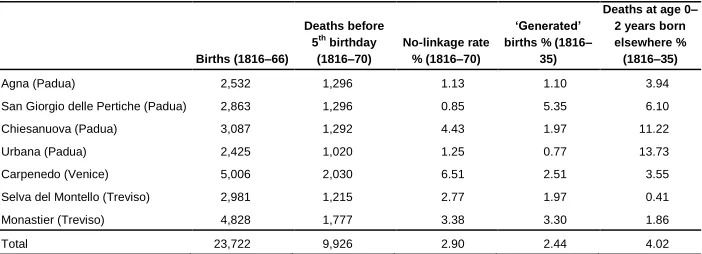
Pooling the seven parishes, more than 97% of children born in the same parish who died at age 5 or younger were linked to their birth certificate (Table 1).9 The linkage performance is even greater for children who died before their third birthday. When it was not possible to find the corresponding birth certificates for death certificates of children believed not to have been born in the parish after 1816, we „generated‟ a birth record. More specifically, we indicated the date of birth starting from the age at death indicated by the priest on the death certificate. Using this system, we face a source of underestimation of mortality. The generated birth records make-up 2.44% of the total number of births, with some differences among parishes (see Table 1).10
9 The no-linkage rate – which, as shown in Table 1, varies across the seven parishes – may depend on several
factors: the accuracy of the parish priests in recording the events and the writing of the pastors themselves, but also the level of migratory exchanges of each parish. In fact, while our linkage procedure refers only to the deaths of babies born in the same parish, migration may have triggered more intense errors and potentially additional omissions (see the last column of Table 1 and the final part of this section).
10 This procedure is similar to that used by Schofield and Wrigley (1979, p. 80, note 14) in reconstructing
mortality in England during the 16th and 17th centuries through linking baptism and burial records. To avoid
Table 1: Number of birth and death records under age 5 in the seven parishes, and some indices of linkage performance
Births (1816–66)
Deaths before 5th birthday
(1816–70)
No-linkage rate % (1816–70)
‘Generated’ births % (1816–
35)
Deaths at age 0– 2 years born elsewhere % (1816–35)
Agna (Padua) 2,532 1,296 1.13 1.10 3.94
San Giorgio delle Pertiche (Padua) 2,863 1,296 0.85 5.35 6.10 Chiesanuova (Padua) 3,087 1,292 4.43 1.97 11.22 Urbana (Padua) 2,425 1,020 1.25 0.77 13.73 Carpenedo (Venice) 5,006 2,030 6.51 2.51 3.55
Selva del Montello (Treviso) 2,981 1,215 2.77 1.97 0.41 Monastier (Treviso) 4,828 1,777 3.38 3.30 1.86
Total 23,722 9,926 2.90 2.44 4.02
the Veneto region in the early 19th century. However, it seems difficult to imagine dramatic underreporting in our data.11
Finally our measures of mortality, which refer to the cohort12 born within a parish, could be underestimated due to emigration, as some of the children born in the parishes considered here could have died (at age 0–2 years) in other parishes, following the emigration of their parents. To better understand the extent of this underestimation we calculated the proportion of deaths at age 0–2 years, born in a parish other than the one studied (see the last column of Table 1). On average, this proportion for the seven parishes is around 4%. If, for families with very young children, emigrations were similar in number to immigrations, it is possible that our measures of mortality are underestimated, and that these underestimations are greater where exchanges were more intense (as in Urbana and Chiesanuova) or lower where exchanges were less intense (as in Selva del Montello or Monastier). This issue should not, however, greatly affect our research goals in that the said underestimation should be similar, in relative terms, when and where early infant mortality was higher or lower.
11 In the days following the first day of life, mortality in 1816–1835 in the 7 parishes under observation was
very high (second day= 21‰, third day= 21‰; fourth day=23‰; fifth day=20‰; sixth day=19‰; seventh day=16‰): the probability of dying between the 2nd and 7th day of life was 114‰, four times higher than that
observed in the aforementioned sample of English parishes (28‰) – Dalla-Zuanna and Rosina 2011. Neonatal mortality was even much higher than that observed at the end of the 20th century in the poorest countries of
the world, where the probability of dying in the first week of life (including the first day) was never higher than 45‰ (Hill and Choi 2006), not far from that observed in some Indian contexts around 1970, but only for children with a weight at birth of 1500–2000 grams (Visaria 1988, p. 104). However, levels similar to that of Veneto were found in other European pre-transitional contexts. For example, in the above cited family reconstruction of several Bavarian villages (note 3), Knodel (1988, p. 48) finds that neonatal mortality (during the first month) ranged between 67‰ and 190‰; Goubert (1968) finds the level of neonatal mortality to be nearly 150‰ in some 18th century French rural villages, 50% higher than that observed in the white
population of Quebec during 1621–1729 (Lalou 1997, p. 205). For additional reviews and comparisons see also Oris, Derosas, and Breschi 2004; Pozzi and Barona 2012. These high levels of mortality at ages 1–6 days might suggest an underestimation of mortality in the first day of life. However, since the „discrepancy‟ between the first day and the following is observed only in the winter, and because – as illustrated in Figure 4 – the said „discrepancy‟ is observed only for the period of 1750 to 1850, our data could very well portray the true situation, i.e., 'abnormal' levels of mortality during the first week of life for children born during the cold season, with the exception of the first day. Finally, Dalla-Zuanna and Rossi (2010) – comparing the mortality of children in the 19 regions of the Austro-Hungarian Empire for the newborns of 1851 – show that in the (now) Italian and Austrian regions the under-registration of early deaths in birth and death registers (if present) was clearly at a much lower level than in Hungary and the Slavic Länder.
12 The word „cohort‟ is commonly used in demography to identify people who experienced the same
Figure 4: Probability of death (‰) during the first month of life by season of birth in the parish of Adria (in the province of Rovigo) in 1650–1900
Source: Dalla-Zuanna and Rosina 2011.
4. Preliminary results and methodological choices
Figure 5 shows that the death probabilities q0–2, q3–35, and q0–35 in the pool of seven
parishes are relatively constant until 1840 and then decline in the years that follow. As our aim is to study selection before the decline in mortality we include only the 8,809 children born during 1816–1835 in our analysis.13
13 In what follows we provide some additional information on data quality for the 8,809 children born in the
Figure 5: Annual probability of death at ages 0–2, 3–35, and 0–35 months (‰). Children born in seven rural parishes in the region of Veneto in 1816–68, and those dead in 1816–70
Table 2: Data on early and late infant mortality, according to select covariates. Children born in seven rural parishes in the region of Veneto during 1816–35
Months 0–2 Months 3–35 Probability of death (per
thousand)
Birth Dead Exposed Dead q0–2 q3–35
a b c=a–b d b/a d/c
Season at birth
Winter 1,968 861 1,107 190 438 172
Spring 2,854 740 2,114 397 259 185
Summer 2,137 393 1,744 360 184 206
Autumn 1,850 556 1,294 222 301 172
Early infant mortality (calculated)
Low (<200‰) 2,849 443 2,406 502 155 209 Medium (200–300‰) 3,001 757 2,244 416 252 185 High (300–400‰) 1,626 586 1,040 162 360 156 Very high (>400‰) 1,333 765 568 89 573 157
Early infant mortality (estimated)
Low (<200‰) 3,000 466 2,534 515 155 203 Medium (200–300‰) 2,003 461 1,542 297 230 193 High (300–400‰) 1,947 593 1,354 238 305 176 Very high (>400‰) 1,859 1,031 828 119 555 144
Sex
Female 4,381 1,252 3,129 587 286 188
Male 4,428 1,299 3,129 582 294 186
Period
1816–20 1,902 581 1,321 256 305 194
1821–25 2,437 679 1,758 319 279 181
1826–30 2,284 640 1,644 311 280 189
1831–35 2,186 651 1,535 283 298 184
Parish
San Giorgio delle Pertiche (PD) 1,049 277 772 187 265 242 Chiesanuova (PD) 1,159 295 864 197 254 228
Agna (PD) 1,585 689 896 148 435 165
Urbana (PD) 800 316 484 67 395 138
Carpenedo (VE) 1,559 307 1,252 280 197 224 Selva del Montello (TV) 1,028 321 707 92 312 130 Monastier (TV) 1,629 346 1,283 198 212 154
Figure 6: Early and late infant mortality (‰) by season of birth. Children born in seven rural parishes in the region of Veneto during 1816–35
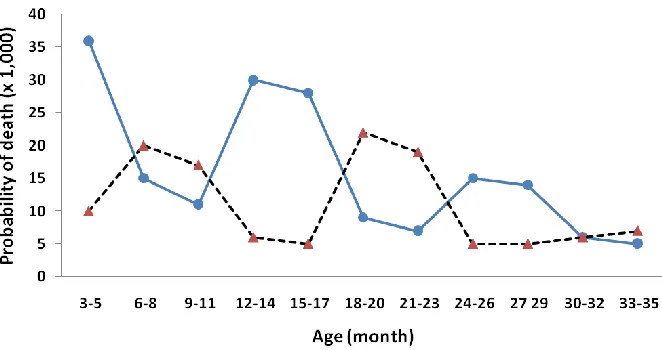
Figure 7: The probability of death within successive 3-month age groups for those aged 3–35 months. Children who survived the first three months of life, born during winter (Dec, Jan, Feb) and summer (Jun, Jul, Aug) in seven rural parishes in the region Veneto during 1816–35
4 increasing levels of early infant mortality, and Figure 9 shows a clear bivariate inverse association between early and late infant mortality.
Figure 8: Early and late infant mortality for 112 cohorts provided by the combination of 4 seasons at birth, 4 groups of five-year cohorts at birth, and 7 parishes of birth. Children born in seven rural parishes of the region of Veneto during 1816–35
Using five-year intervals, parish and season may not be a precise enough measure to identify the specific environment a child experienced during his/her first three months of life. Early infant mortality could, for any number of reasons, vary from year to year or month to month, especially due to climate micro-oscillation. However, the number of children born in each year/season/parish is not large enough to calculate a stable measure of early infant mortality for smaller cohorts. To overcome this problem we estimated the 1,680 early infant mortality probabilities (12 months at birth, 20 years at birth, 7 parishes of birth) using the following logit regression model:
q0-2
where feb and dec are months, 1817 and 1835 are years, SGdP and Monast are the two parishes of San Giorgio delle Pertiche and Monastier; and the month of January, the year 1816, and the parish of Agna are the baseline.
Figure 9: Early and late infant mortality (‰). 112 cohorts (7 parishes × 4 time periods × 4 seasons) pooled according to the level of early infant mortality. Children born in seven rural parishes of the region of Veneto during 1816–35
The results range from 734‰ (cohort of children born in December of 1818 in the parish of Agna) to 64‰ (cohort of children born in May of 1830 in the parish of Carpenedo) and potentially provide a more detailed and complete picture compared to using only a „rough‟ measure of early infant mortality for a five-year interval.
between the sexes in terms of late infant mortality. We similarly do not expect to see considerable differences in late infant mortality in the five-year intervals from 1816– 1820 to 1831–1835, as the downward trend in late infant mortality had yet to begin (see Figure 5). We expect, however, late infant mortality to vary according to parish of birth. Moreover, we expect late infant mortality to be higher during the summer, as suggested in Figure 6.
Our aim is to verify whether children who survived a context of high early infant mortality had lower or higher mortality in the following 33 months. As children who died during the months 3–35 are censored, one way to assess this question is a semi-parametric Cox regression, which provides the monthly risk of death as a response variable, controlling for the elimination process (see e.g., Bruckner, Catalano, and Smith 2013; Ekamper et al. 2013). We model the risk of death between the 4th and the 36th months of life for individuals still surviving at the end of their 3rd month, using the above-described covariates as explanatory variables. Our explanatory variables do not vary over time, with the exception of month of life, which has instead been taken into consideration by transforming our database into a person-period format.14
5. Results
The covariates included in the first five models are simply indices of early infant mortality (see Table 3): season at birth (Model 1), calculated early infant mortality (Model 2), early infant mortality estimated by logit regression model (Model 3), season at birth and calculated early infant mortality (Model 4), and season at birth and estimated early infant mortality (Model 5). In Models 4 and 5 – when early infant mortality is included – the association between season at birth and late infant mortality disappears. In addition, as season at birth and early infant mortality are strongly interrelated, the latter prevails in these two models. The „goodness of fit‟ for Models 2 and 3 is better than the „goodness of fit‟ for Model 1 (where season of birth is the only covariate). In light of these results, in the following models the „season at birth‟ variable is not included and we perform two parallel analyses using calculated early infant
14 Each individual now has a number of rows which correspond to the number of months lived. The last row
mortality and estimated early infant mortality as separate measures of selection during the first three months of life.
In order to determine whether selection during months 0–2 provides additional explanation of mortality at ages 3–35 months, we measure whether the statistical performance of a „basic‟ model (including only parish, time period, and sex) improves when early infant mortality is included as an explanatory variable.
Table 3: The risk of dying between the 4th and the 36th months of life by season at birth and early infant mortality, calculated or estimated. Cox model for children born in seven rural parishes of the region of Veneto during 1816–35
Model 1 Model 2 Model 3 Model 4 Model 5
HR* p-value HR p-value HR p-value HR p-value HR p-value
Season at birth
Winter 1 — 1 — 1 —
Spring 1.11 0.244 0.97 0.765 0.95 0.612
Summer 1.23 0.023 1.02 0.887 1.01 0.939
Autumn 0.99 0.922 0.93 0.460 0.88 0.226
Early infant mortality level (calculated)
Low (<200‰) 1 — 1 —
Medium (200–300‰) 0.87 0.037 0.88 0.078 High (300–400‰) 0.72 0.000 0.74 0.004 Very high (>400‰) 0.72 0.005 0.73 0.014
Early infant mortality level (estimated)
Low (<200‰) 1 — 1 —
Medium (200–300‰) 0.93 0.353 0.95 0.496
High (300–400‰) 0.84 0.030 0.85 0.062
Very high (>400‰) 0.68 0.000 0.69 0.001
LL -10,098 -10,093 -10,095 -10,093 -10,093
LR 8.41 18.24 16.85 19.39 19.70
Prob>Chi2 0.038 0.000
0.001 0.003 0.003
*HR: Hazard Ratio.
In the basic model the risk of death between the 4th and the 36th months of life is strongly related to parish, whereas sex and period do not influence the risk (Table 4, Model 6). When early infant mortality is added the performance of the model improves: including the calculated early infant mortality (Model 7) sees the „goodness of fit‟ (log-likelihood) rise by 8 (Chi2=16, d.o.f.=3, p=0.001); including the estimated early infant mortality (Model 8) sees the „goodness of fit‟ (log-likelihood) rise by 5 (Chi2
Table 4: Covariates of the risk of dying between the 4th and the 36th months of life for children who survived the third month of life. Two complete models with early infant mortality calculated or estimated (7 and 8); one model with a time-varying covariate (9). Cox model for children born in seven rural parishes of the region of Veneto during 1816–35
Model 6 Model 7 Model 8 Model 9
HR p-value HR p-value HR p-value HR p-value
Early infant mortality level (calculated)
Low (<200‰) 1 — 1 —
Medium (200–300‰) 0.88 0.074 0.85 0.025
High (300–400‰) 0.69 0.000 0.68 0.000
Very high (>400‰) 0.80 0.112 0.79 0.087
Early infant mortality level (estimated)
Low (<200‰) 1 —
Medium (200–300‰) 1.00 0.950
High (300–400‰) 0.88 0.114
Very high (>400‰) 0.74 0.008
Sex
Female 1 — 1 — 1 — 1 —
Male 0.98 0.765 0.98 0.754 0.98 0.739 0.99 0.815
Period
1816–20 1 — 1 — 1 — 1 —
1821–25 0.92 0.304 0.89 0.162 0.90 0.231 0.89 0.154 1826–30 0.96 0.589 0.94 0.435 0.95 0.506 0.93 0.427 1831–35 0.93 0.388 0.91 0.271 0.93 0.408 0.89 0.197
Parish
Agna (PD) 1 — 1 — 1 — 1 —
S. Giorgio delle Pertiche (PD) 1.55 0.000 1.43 0.002 1.43 0.002 1.45 0.001 Chiesanuova (PD) 1.44 0.001 1.31 0.022 1.32 0.015 1.31 0.023 Urbana (PD) 0.83 0.218 0.81 0.144 0.80 0.136 0.83 0.195 Carpenedo (VE) 1.43 0.000 1.20 0.130 1.26 0.038 1.20 0.116 Selva del Montello (TV) 0.78 0.055 0.70 0.009 0.72 0.015 0.70 0.011 Monastier (TV) 0.94 0.551 0.80 0.071 0.84 0.130 0.81 0.076
Transition between seasons (time-varying)
Winter 1 —
Spring 1.01 0.117
Summer 1.07 0.000
Autumn 1.03 0.000
LL -10,066 -10,058 -10,061 -9,932
LR 73.67 88.09 83.23 348.38
Prob>Chi2 0.000 0.000 0.000 0.000
*HR: Hazard Ratio.
results of Figures 6, 7, and 9. This result is likely the outcome of the greater impact of gastro-enteric diseases during summer and autumn.15
6. Conclusions
The key result of this paper is that mortality selection during months 0–2 may have played a significant role in determining differences in mortality during months 3–35 among cohorts born in seven rural Veneto parishes in the period 1816–1835, i.e., before the start of the mortality decline which formed part of the demographic transition. For children that survived a severe early infant mortality selection (q0–2>400‰, born mainly
during winter), the hazard ratio of surviving the following 33 months was 20%–30% higher than that of children with relatively small early mortality selection (q0–2<200‰,
born mainly during summer). This result suggests a sort of homeostatic mechanism, as mortality differences among the cohorts are lower for q0–35 than for both q0–2 and q3–35:
in considering the 112 cohorts obtained by crossing 4 seasons at birth, 4 five-year groupings at birth, and 7 parishes of birth, we observe that the variation coefficient (σ/µ) is 0.53 for q0–2, 0.54 for q3–35, but only 0.31 for q0–35.
These results are limited to the context of our study (Veneto in the early decades of the 19th century), characterized by very strong mortality during the first week/month of life (excluding the first day), mainly for children born during the cold season. As we mentioned at the beginning of this article, while a scar-effect could coexist with positive selection, one predominates in different contexts and/or at different stages of life (even within the same cohort, as shown by Quaranta (2013) for Sweden). More generally, our results indicate the possibility that differences between cohorts in mortality during a given interval of age could also be due to differences in selection for death, for the same cohorts, during the age interval which immediately preceded.
This work provides several novel elements for the interpretation of differences in late infant mortality before the demographic transition. Many questions, however, remain unanswered, some of which could be addressed through our database. First
,
it would be interesting to find a more refined model for considering the selection process. Given that the predominating causes of death during the first few days of life were clearly quite different from those more common in the weeks that followed
15 Cause of death is not always reported and is often confused with symptoms (see also footnote 8). However,
References
Alfani, G. (2010). Il Grand Tour dei Cavalieri dell’Apocalisse: L’Italia del «lungo Cinquecento» (1494–1629). Venice, Italy: Marsilio.
Bengtsson, T. and Lindström, M. (2000). Childhood misery and disease in later life: The effects on mortality in old age of hazards experienced in early life, southern Sweden, 1760–1894. Population Studies 54(3): 263–277. doi:10.1080/71377
9096.
Bengtsson, T. and Lindström, M. (2003). Airborne infectious diseases during infancy and mortality in later life in southern Sweden, 1766–1894. International Journal of Epidemiology 32(2): 286–294. doi:10.1093/ije/dyg061.
Billari, F.C. and Rosina, A. (1998). Does cohort matter in pre-transitional mortality? An analysis of adult mortality using event history approach: the case of Chioggia in 17th century. Genus 54(3–4): 327–347.
Billari, F.C. and Rosina, A. (2000). Analisi della mortalità alle età adulte e anziane: effetti di età, periodo e coorte. In: Rosina, A. and Rossi F. (eds.). Il sistema demografico alla fine delle grandi epidemie. Padua, Italy: CLEUP: 213–230. Biraben, J.-N. (1975–76). Les hommes et la peste en France et dans les pays européens
et méditerranéens. Paris, France: Mouton.
Bourgeois-Pichat, J. (1951). La mesure de la mortalité infantile. I. Principes et méthodes. Population 6(2): 233–248. doi:10.2307/1524151.
Breschi, M., Derosas, R., and Manfredini, M. (2000). Infant mortality in nineteenth-century Italy: interactions between ecology and society. In: Bengtsson, T. and Saito, O. (eds.). Population and Economy. From Hunger to Modern Economic Growth. Oxford, UK: Oxford University Press: 457–489.
Bruckner, T.-A., Catalano, R., and Smith, K. (2013). Ambient temperature in utero and cold-related adult mortality in a Swedish cohort, 1915 to 2002. Paper presented at the 27th IUSSP International Population Conference, Busan, South Korea, August 26–31 2013.
Carey, J.R. (1997). What demographers can learn from fruit fly actuarial models and biology. Demography 34(1): 17–30. doi:10.2307/2061657.
Carey, J.R., Liedo, P., and Vaupel, J.W. (1995). Mortality dynamics of density in the Mediterranean fruit fly. Experimental gerontology 30(6): 605–629. doi:10.1016/
Carey, J.R. and Liedo, P. (1995a). Sex mortality differentials and selective survival in med y cohorts: implications for human sex mortality differentials. Gerontologist
35(5): 588–596. doi:10.1093/geront/35.5.588.
Caselli, G. and Capocaccia, R. (1989). Age, period, cohort and early mortality: an analysis of adult mortality in Italy. Population Studies 43(1): 133–153.
doi:10.1080/0032472031000143886.
Caselli, G. (1990). The influence of cohort effects on differentials and trends in mortality. In: Vallin, J., D‟Souza, S., and Palloni, A. (eds.). Measurement and analysis of mortality. New approaches. Oxford, UK: Clarendon Press: 229–249. Chattopadhyay, A., White, M.J., and Debpuur, C. (2006). Migrant fertility in Ghana:
selection versus adaptation and disruption as causal mechanisms. Population Studies 60(2): 1–15. doi:10.1080/00324720600646287.
Dalla-Zuanna, G. and Rosina, A. (2011). An analysis of extremely high nineteenth-century winter neonatal mortality in a local context of Northeastern Italy.
European Journal of Population 27(1): 33–55. doi:10.1007/s10680-010-9219-5. Dalla-Zuanna, G. and Rossi, F. (2010). Comparisons of infant mortality in the Austrian
Empire Länder using the Tafeln (1851–54). Demographic Research 22(26): 813–862. doi:10.4054/DemRes.2010.22.26.
Dalla-Zuanna, G., D‟Angelo, S., and Rosina, A. (2003). Massimo risultato con il minimo sforzo. Ricostruzione nominativa semi-automatica della sopravvivenza infantile e analisi del regime demografico di Alì (Messina) nel XVIII secolo. In: Breschi, M., Derosas, R., and Viazzo, P.P. (eds.). Piccolo è bello. Udine, Italy: Forum: 67–92.
Davenport, R. (2010). The relationship between stillbirth and early neonatal mortality: evidence from eighteenth century London. Paper presented at the 2010 BSPS Annual Conference, University of Exeter, UK, September 13–15 2010.
Del Panta, L. (1980). Le epidemie nella storia demografica italiana. Bologna, Italy: Loescher.
Derosas, R. (2009). The joint effect of maternal malnutrition and cold weather on neonatal mortality in nineteenth-century Venice: An assessment of the hypothermia hypothesis. Population Studies 63(3): 233–251. doi:10.1080/00324
720903165449.
Doblhammer G. (2004). The late life legacy of very early life. Berlin, Germany: Springer. doi:10.1007/978-3-662-10349-4.
Ekamper, P., van Poppel, F., Stein. A.D., and Lumey, L.H. (2013). Independent and additive association of prenatal famine exposure and intermediary life conditions with adult mortality age 18–63 years. Social Science and Medicine 119: 232–239. doi:10.1016/j.socscimed.2013.10.027.
Endler, J.A. (1986). Natural selection in the wild. Princeton, NJ: Princeton University Press.
Goldstein, S. and Goldstein, A. (1983). Migration and fertility in peninsular Malaysia: an analysis using life history data. Santa Monica, CA: RAND Corporation. Goubert, P. (1968). Legitimate fecundity and infant mortality in France during the 18th
century: a comparison. Daedalus 97(2): 593–603.
Helgertz, J. and Bengtsson, T. (2013). Lasting effects of the Spanish flu on income and health in later life. The case of Southern Sweden. Paper presented at the 27th IUSSP International Population Conference, Busan, South Korea, August 26–31, 2013.
Hill, K. and Choi, Y. (2006). Neonatal mortality in the developing world. Demographic Research 14(18): 429–452. doi:10.4054/DemRes.2006.14.18.
Hobcraft, J. and Gilks, W. (1984). Age, period and cohort analysis in mortality studies. In: Vallin, J., Pollard, J.-H., and Heligman, L. (eds.). Méthodologies for the collection and analysis of mortality data. Liege, Belgium: Ordina Éditions: 245–264.
Kannisto V., Christensen, K., and Vaupel, J.W. (1997). No increased mortality in later life for cohorts born during famine. American Journal of Epidemiology 145(11): 987–994. doi:10.1093/oxfordjournals.aje.a009067.
Kennedy, S., McDonald, J.T., and Biddle N. (2006). The healthy immigrant effect and immigrant selection: evidence from four countries. SEDAP Research paper 164. Knodel, J. (1968). Infant mortality and fertility in three Bavarian villages: an analysis of
family histories from the 19th century. Population Studies 22(3): 297–318.
Knodel, J. (1970). Two and a Half Centuries of Demographic History in a Bavarian Village. Population Studies 24(3): 353–376. doi:10.1080/00324728.1970.10406 134.
Knodel, J. (1988). Demographic behavior in the past. A study of fourteen German village population in the 18th and 19th centuries. Cambridge, UK: Cambridge University Press. doi:10.1017/CBO9780511523403.
Lalou, R. (1997). Endogenous mortality in New France. At the crossroads of natural and social selection. In: Bideau, A., Desjardins, B., and Brignoli, H. (eds.).
Infant and child mortality in the past. Oxford, UK: Clarendon Press: 203–215. Manton, K.G. and Stallard, E. (1996). Longevity in the United States: Age and
sex-specific evidence on life span limits from mortality patterns 1960–1990. The Journals of Gerontology Series A: Biological Sciences and Medical Sciences
51A(5): B362–B375. doi:10.1093/gerona/51A.5.B362.
McDonald, J.T. and Kennedy S. (2004). Insights into the „healthy immigrant effect‟: health status and health service use of immigrants to Canada. Social Science and Medicine 59(8): 1613–1627. doi:10.1016/j.socscimed.2004.02.004.
Oris, M., Derosas, R., and Breschi, M. (2004). Infant and Child Mortality. In: Bengtsson, T., Campbell, C., and Lee, J. (eds.). Life Under Pressure: Mortality and Living Standards in Europe and Asia, 1700–1900. Cambridge, Massachusset: MIT Press: 359–398.
Peters, R. (1991). A critique for ecology. Cambridge, UK: Cambridge University Press. Pozzi, L. (1991). Evoluzione della mortalità e transizione sanitaria nelle province
venete dall‟unità agli anni Trenta. In: Rossi, F. (ed.). La transizione demografica del Veneto. Alcuni spunti di ricerca. Venice, Italy: Fondazione Corazzin Editrice: 151–181.
Pozzi, L. and Barona, J. (2012). Vulnerable babies. Late foetal, neonatal and infant mortality in Europe (18th–20th centuries). Annales de démographie historique
123: 11–24.
Preston, S.H., Hill, M.E., and Drevenstedt, G.L. (1998). Childhood conditions that predict survival to advanced ages among African-Americans. Social Science and Medicine 47(9): 1231–1246. doi:10.1016/S0277-9536(98)00180-4.
Rosina, A. and Zannini, A. (2004). Mortalità infantile. In: Dalla-Zuanna, G., Rossi, F., and Rosina, A. (eds.). Il Veneto. Storia della popolazione dalla caduta di Venezia a oggi. Venice, Italy: Marsilio: 177–194.
Schofield, R.S. and Wrigley, E.A. (1979). Infant and child mortality in England in the late Tudor and early Stuart period. In: Webster, C. (ed.). Health medicine and mortality in the sixteenth century. Cambridge, UK: Cambridge University Press: 61–96.
Shen, K. and Zeng, Y. (2013). The direct and total effects of childhood conditions on current health in oldest-old are stronger than that in young-old. Paper presented at the 27th IUSSP International Population Conference, Busan, South Korea, August 26–31 2013.
Shkolnikov, V. (2012). Health crises and cohort mortality. In: Meslé, F. and Vallin, J. (eds.). Mortality and causes of death in 20th-century Ukraine. Dordrecht: Springer: 109–177. doi:10.1007/978-94-007-2433-4.
Vaupel, J.W. and Carey, J.R. (1993). Compositional interpretations of medfly mortality.
Science 260(5114): 1666–1667. doi:10.1126/science.8503016.
Vaupel, J.W., Manton, K.G., and Stallard, E. (1979). The impact of heterogeneity in individual frailty on the dynamics of mortality. Demography 16(3): 439–454.
doi:10.2307/2061224.
Visaria, L. (1988). Levels, trends and determinants of infant mortality in India. In: Anrudh, A.K. and Visaria, P. (eds.). Infant mortality in India. Differentials and determinants. New Delhi, India: Sage Publications: 67–126.
Willekens, F.J. (2013). Chronological objects in demographic research. Demographic Research 28(23): 649–680. doi:10.4054/DemRes.2013.28.23.
Woods, R. (2009). Death before birth: foetal health and mortality in historical perspective: Oxford, UK: Oxford University Press. doi:10.1093/acprof:oso/9780
199542758.001.0001.