RESEARCH ARTICLE
Inter-list equivalency and reliability of the Persian randomized
dichotic digits test
Jafar Aghazadeh1,Mohammad Ebrahim Mahdavi1,2*,Ali Akbar Tahaei2,Seyyed Mehdi Tabatabaee3
1
- Department of Audiology, School of Rehabilitation, Shahid Beheshti University of Medical Sciences, Tehran, Iran
2
- Department of Audiology, School of Rehabilitation Sciences, Iran University of Medical Sciences, Tehran, Iran
3- Department of Basic Sciences in Rehabilitation, School of Rehabilitation, Shahid Beheshti University of Medical Sciences, Tehran,
Iran
Received: 1 Oct 2014, Revised: 16 Dec 2014, Accepted: 27 Dec 2014, Published: 25 Mar 2015
Abstract
Background and Aim: Dichotic listening evaluation is one of the most common behavioral procedures for assessing the cerebral dominance of language and is considered as the main component of the auditory processing test battery in children and adults. The randomized dichotic digits test (RDDT) has two lists of randomly distributed one-, two-, and three-digit items. This research was performed for studying the inter-list equivalency and test-retest reliability of Persian RDDT.
Methods: Persian RDDT was administered at 50 dBHL on 62 right-handed individuals (equal sex ratio) with normal hearing sensitivity in the age range of 12-45 years. The interval between the test sessions was 30 days and each session had two test rounds with an interval of 20 minutes. In each session, list 1 of the Persian RDDT was performed for the first round and list 2 performed for the second round.
Results: Results demonstrated that mean right and left ear score and ear advantage of Persian RDDT list 1 and list 2 had no statistically significant difference (right ear p=0.25, left ear
p=0.56, ear advantage: p=0.6). Intra-class correlation coefficient of scores in the first and the third test rounds (list 1) for the right and left ears were 0.71 and 0.68, and for the second and the fourth test rounds (list 2) were 0.69 and 0.80, respectively.
Conclusion: Based on the results of this study, it would seem that the two lists of Persian RDDT are equivalent and the mean scores have good to excellent test-retest reliability.
Keywords: Randomized dichotic digits test; Persian; list equivalency; reliability
Introduction
Dichotic listening tests are among the most common central behavioral tests that are used to
assess the functioning of the cerebral
hemispheres, the inter-hemispheric transmission of information, the central auditory nervous
system maturation, and central auditory
processing disorders (CAPD) in adults and children. Various stimuli are used in dichotic tests, including non-sense consonant-vowel syllables, digits, words and sentences. Dichotic listening was first introduced in 1954 by Broadbent and then used in 1961 by Kimura as a tool for identifying the cerebral hemisphere responsible for language functions. The dichotic digits test (DDT) can be used for children, *
Corresponding author: Department of Audiology,
adults and the elderly with normal hearing or with mild to moderate hearing loss and for patients with intracranial lesions or with cochlear hearing loss [1-4]. Performing the DDT is quick and simple for the examiner and easily comprehensible for the patient. DDT results are relatively resistant to peripheral hearing loss up to moderate level and have high test-retest reliability in adults and the elderly [2]. Compared to other stimuli used in dichotic tests, digits have a lower linguistic loading, and since the test is close-set, it is considered suitable for a broad age range of patients. When the speech stimulus is presented dichotically for people with normal hearing, the right ear has a slight advantage over the left ear [3]. This phenomenon is known as the right ear advantage (REA) and suggests the dominance of the left hemisphere for language and speech comprehension [4].
The English randomized dichotic digits test (RDDT) is currently available in two equivalent lists of randomly distributed dichotic digits of one, two and three pairs. Performing this test on English speaking children and adults has shown that RDDT can help identify children and adults with inter-aural asymmetry, then refer them for rehabilitation and treatment [5]. Considering that there are many different dialects and languages in Iran, it is essential to have tests with minimal linguistic loading. The Persian RDDT has recently been developed by Mahdavi et al. in two lists 1 and 2 [6]. In the current Persian version of this test, there are 500 ms intervals between the digits and 4 to 8 second intervals between the items, so that 8 seconds are given to the test subjects to repeat the digits after the three-pair items, 6 seconds after the two-pair items and 4 seconds after the one-pair items. As in its English counterpart, each list in the Persian RDDT contains 54 items that are equally divided into the one, two and three-pair items (18 items for each). Items are randomly distributed in each list. Each ear gets 108 scores in case of receiving the full raw score in each list. Apart from the amount of time taken for learning, practicing and possible interruption, the test takes 7 minutes and 12 seconds for list 1
and 7 minutes and 4 seconds for list 2 to be completed [6,7]. The present study was conducted to assess the equivalency of lists 1 and 2 of the Persian RDDT and its test-retest reliability.
Methods
The present cross-sectional study was conducted on eligible people using the simple sampling method. Study inclusion criteria consisted of having normal peripheral hearing and normal word recognition score (i.e. above 90%) using
the AC33 audiometer (Interacoustics,
Denmark), a threshold asymmetry less than 15 dB, normal tympanometry and ipsilateral and contralateral reflexes (using the Interacoustics AT235 tympanometer, Denmark) and right-handedness (assessed through Chapman and Chapman Handedness Scale) [18], as well as having no history of ear or nerve diseases, head injury, neurosurgery and neurological drugs use. Exclusion criteria consisted of an unwillingness to take part in later stages of the test and the violation of any one of the inclusion criteria. The study was conducted on 62 participants (1:1gender ratio) in the age range of 12-45 at three levels of education; primary, secondary and tertiary were selected according to the inclusion criteria. The mean age was 29.8 years (SD=7.4) in men and 26.2 (SD=10.5) in women, and the overall mean age was 28.02 (SD=9.4). The Philips HSN 6500-headphone output (Japan) connected to an HP computer (Probook 4540, China) was first calibrated using a 1000 Hz calibration tone for a 50 dBHL intensity (70
dBSPL). The headphone's technical
order as in the 1st session (rounds 3 and 4 of the 2nd session). List 1 was thus presented in the first and third rounds and list 2 in the second and fourth rounds. The right and left ear raw scores for each stage of the test were converted to percent correct. Ear advantage (EA) was calculated as the different between the left ear score and the right ear score. Ear advantage was categorized in three groups; right ear advantage (positive ear advantage), left ear advantage (negative ear advantage) and no ear advantage (zero ear advantage).
The mean scores in the 1st and 3rd rounds were taken as the overall score for list 1, and the mean scores in the 2nd and 4th rounds as the overall score for list 2. The Kolmogorov-Smirnov test was used for comparing the data distribution against the normal distribution. Data were analyzed in SPSS-21 at the significance level of 0.05. Mann-Whitney U test was used to compare the REA between the two age groups and to assess the effect of gender on ear advantage results. The effect of the education level was determined using the Kruskal-Wallis test. Friedman test was used to compare the REA between the three digit pairs, the right and left ear scores and the REA in the quadruple rounds. Comparison of the mean REA in the one, two and three-pair items between the two lists was performed using the Wilcoxon test. McNemar test was used to compare the consistency of ear advantage between the two lists. To assess the test-retest reliability of the mean score difference, the Pearson or Spearman correlation coefficient was
used, depending on whether the data distribution was normal or not, and the Intraclass correlation coefficient (ICC) was used to calculate the
reliability coefficient. To determine the
equivalency of lists 1 and 2 of the Persian RDDT, the mean right and left ear scores and ear advantage were compared between the two lists. In addition, the reliability and correlation coefficients of the Persian RDDT were calculated for both lists. All variables are presented in tables with a standard deviation and in figures with a standard error of the mean.
Results
Table 1 presents the subjects' mean right and left ear scores in the 1st and 2nd sessions by each RDDT list number. As presented in Table 1, the right and left ear scores are very similar in terms of their mean and distribution in the two sessions with a one-month interval in between. This similarity is further demonstrated in the section on the reliability and equivalency of the Persian RDDT lists, which uses statistical tests to analyze right and left ear scores and the degree of REA in terms of repeatability. First, the effects of age, gender and education level on ear advantage results were examined. The subjects' education levels varied from primary education to post-secondary education; 15 subjects (24.2%) had less than 9th grade, 20 subjects (32.3%) were 9th to 12th grade and 27 subjects (43.5%) had university education. 33 of the subjects were in the 12-29 age group and 29 were in the 30-45 age group.
Statistical analyses revealed equal REA in each
Table 1. Mean (standard deviation) the right and left ear scores and the right ear advantage for lists 1 and 2 in the 1st and 2nd sessions with a 30-day interval (n=62)
List 1 List 2
1st
Round
3rd
Round
Reliability Coefficient
Correlation Coefficient (p)
2nd
Round
4th
Round
Reliability Coefficient
Correlation Coefficient (p)
Right ear 98.8 (1.2) 99.1 (1) 0.71 0.62 (0.000) 99.1 (1.1) 99.2 (0.9) 0.69 0.42 (0.000)
Left ear 97.5 (1.4) 98.1 (1.5) 0.68 0.50 (0.000) 98 (1.8) 98 (1.5) 0.80 0.65 (0.000)
Right ear
test round and in both 12-29 and 30-45 age groups and showed that, in this age range, aging had no effect on the degree of REA (p=0.59 for round 1, p=0.68 for round 2, p=0.99 for round 3, and p=0.79 for round 4). Gender was also found to have no effect on ear advantage results (p=0.97 for round 1, p=0.46 for round 2, p=0.79 for round 3 and p=0.37 for round 4). Similarly, education level was also found to have no effect on REA results in any of the 4 rounds (p=0.14 for round 1, p=0.06 for round 2, p=0.10 for round 3, p=0.09 for round 4).
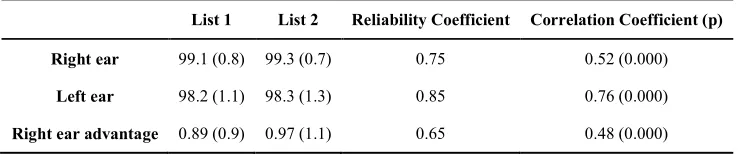
To determine the equivalency of lists 1 and 2 of the Persian RDDT, the mean and correlation between the right and left ear scores and the REA were compared in the two lists. Lists 1 and 2 of the RDDT were statistically analyzed in terms of the difference in the mean scores of the one, two, and three-pair items. The mean overall scores of the right and left ears and the REA were found to be 99.1, 98.2 and 0.89 percent for list 1, and 99.3, 98.3 and 0.97 percent for list 2. The comparison of these parameters showed no significant difference between list 1 and list 2 (p=0.25 for the right ear, p=0.6 for the left ear and p=0.56 for the REA). For the right ear scores, the correlation coefficient was 0.52 in
lists 1 and 2 (p=0.000), and for the left ear scores and for the REA degree, the correlation coefficient was 0.76 (p=0.000) and 0.48 (p=0.000) in lists 1 and 2, respectively (Table 2). Comparing the REA in the one, two, and three-pair items showed the degree of REA to increase with the increase in the number of pairs both in list 1 (p=0.000) and in list 2 (p=0.000) (Fig. 1).
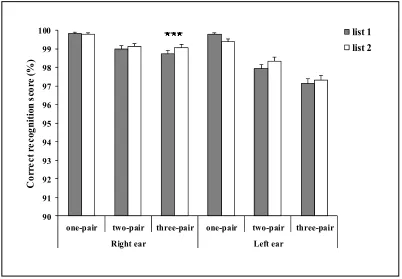
Fig. 2 presents a comparison of the subjects' mean right and left ear scores by the one, two, and three-pair items for lists 1 and 2. A significant difference was observed between lists 1 and 2 in the mean right ear scores for the 3-pair items (p=0.013).
Comparison of the mean REA of the one, two, and three-pair items between the two lists revealed no significant differences between lists 1 and 2 in terms of the mean ear advantage for the one-pair items (p=0.06), the two-pair items (p=0.25) and the three-pair items (p=0.67) (Fig. 1).
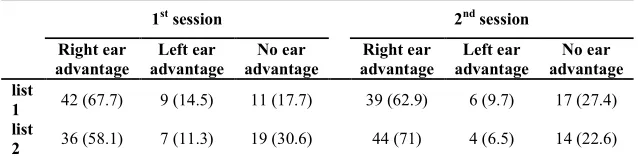
Table 2 contains the ear advantage frequency for lists 1 and 2 in the 1st and 2nd sessions. The ear advantage results remained consistent in 35 subjects (56.5%) by the repeat performance of list 1 and for 41 (66.1%) subjects by the repeat
Fig. 1. Mean ear advantage in percent (±SEM) by lists and number of digit pairs (n=62). -0.5
0.0 0.5 1.0 1.5 2.0
one-pair two-pair three-pair total
M
e
a
n
e
a
r
a
d
v
a
n
ta
g
e
list 1
performance of list 2 of the Persian RDDT. Statistical analyses showed that whether ear advantage remains consistent in the subjects or not is not affected by the test list number (p=0.33). In other words, lists 1 and 2 of the Persian RDDT are similar in terms of maintaining or not maintaining ear advantage at the retest.
The right ear mean scores were not significantly different from the left ear mean scores in the 4 rounds (p=0.13 for the right ear and p=0.06 for the left ear). In the first through the fourth rounds, the degree of REA was 1.3% (SD=1.5), 1% (SD=1.3), 1% (SD=1.6) and 1.1% (SD=1.3),
which showed no significant statistical
difference (p=0.44). The correlation coefficient between the sessions for the right and left ear scores and the degree of REA was 0.62 (p=0.000), 0.50 (p=0.000) and 0.41 (p=0.03) for list 1 and 0.42 (p=0.000), 0.65 (p=0.000) and 0.4 (p=0.000) for list 2 (Table 1). As shown in Table 1, a significant reliability coefficient
was found for the Persian RDDT for list 1 (the 1st and 3rd rounds) and list 2 (the 2nd and 4th rounds) in the right and left ears, ranging from 0.68 to 0.80, indicating an acceptable or better than acceptable reliability coefficient (p=0.000). The mean and standard deviation of the overall score for list 1 (mean 1st and 3rd round scores) and for list 2 (mean 2nd and 4th rounds) and the degree of REA for each list are presented in Table 3. The reliability coefficient for lists 1 and 2 was 0.75 in the right ear, 0.85 in the left ear and 0.65 for the REA, which suggests a very high repeatability of mean results between the two lists. Nevertheless, the REA reliability coefficient was 0.47 and 0.61 for lists 1 and 2, which are lower than the figures obtained for the reliability coefficients of the right and left ear results in lists 1 and 2 (Table 1). The correlation coefficient between the two lists was 0.52 and 0.76 for the mean overall right and left ear scores and 0.48 for the REA (Table 3).
Fig. 2. Mean percent correct (+SEM) of the Persian randomized dichotic digit test by lists and number of digit pairs (n=62).
90 91 92 93 94 95 96 97 98 99 100
one-pair two-pair three-pair one-pair two-pair three-pair
Right ear Left ear
C
o
rr
e
c
t
re
c
o
g
n
it
io
n
s
co
re
(
%
)
Discussion
An important aspect of the reliability of multi-list tests is their inter-multi-list equivalency [9]. The present study was conducted to assess the test-retest reliability of the Persian RDDT and the equivalency of lists 1 and 2 in people with normal hearing. Different authors have obtained different results on the effect of gender on dichotic listening. According to Hugdahl, the results of dichotic listening tests with the consonant-vowel sound stimulus are not affected by gender [10]. Yet, a meta-analysis conducted by Voyer on studies dating from 1994 to 2011 suggests that men's dichotic listening is slightly more biased toward their dominant ear than is women's. The same result was reported by Moncrieff in the assessment of 5-12 year-old children with RDDT and dichotic words test [2,11]. In the present study, gender had no effect on the Persian RDDT results; otherwise, the reliability of the test and the equivalency of the lists would also have to be assessed by gender. No studies have addressed the direct effect of education level on dichotic listening to date. In a study conducted by Meyers et al. on dichotic words in 16-79 year-old people, a weak (r=0.11) but significant correlation was found between the left ear score and education level that still has no clinical value according to the researchers [13]. In the present study, despite the diverse range of education levels covered, from primary school to university, this variable was found to have no significant effect on the REA. Given that the subjects of the present study were at an age range that is safe from the effects of nervous system maturation and old age on dichotic
listening [1], the lack of an effect exerted by age on the results of the Persian RDDT appears justified.
The results obtained in the present study from the right and left ear scores and the ear advantage are largely consistent with the results obtained by Strouse and Wilson and Moncrief and Wilson [5,7,14]. As shown by the statistical analysis, there were no significant differences between the right and left ear scores in lists 1 and 2 in the two sessions with a one-month interval in between, and the reliability coefficient of the scores was above 0.6 for both ears. Studies conducted on the reliability of dichotic listening results in other languages have used the mean difference between the two sessions and the correlation coefficient as indicators of reliability; however, in the present study, in addition to comparing the mean right and left ear scores between the two sessions and the correlation coefficients, the ICC was also used. Some researchers have also only used the mean difference between the two sessions of the test to assess reliability. Nowadays, researchers are not willing to use the Pearson correlation coefficient to determine a test's reliability, which is mainly, but not solely, due to the inability of this indicator to detect systematic errors [15]. Strouse and Hall used the two-pair English DDT to find the test-retest reliability of the test in patients with Alzheimer's disease and used the Pearson correlation coefficient to assess the reliability of results in the two sessions with a one-month interval in between and found the retest correlation coefficient for the right and left ears to be 0.82 and 0.97 in patients with Alzheimer's disease and 0.79 and
Table 2. Frequency (Percent) of ear advantage for list 1 and 2 in the 1st and 2nd sessions with a 30-day interval (n=62)
1st session 2nd session
Right ear advantage
Left ear advantage
No ear advantage
Right ear advantage
Left ear advantage
No ear advantage list
1 42 (67.7) 9 (14.5) 11 (17.7) 39 (62.9) 6 (9.7) 17 (27.4) list
0.85 in the control group. Bakker et al. reported the correlation coefficient between the two sessions to be between 0.69 and 0.76 for the two, three and four-pair DDTs in children [16]. Results found in these studies are better than the correlation coefficient found in the present study between the two sessions for the mean right and left ear scores for each list (Table 1). Despite the right-handedness of all the study subjects, a left ear advantage was produced by 6.5%-14.5% of the cases depending on the test list and session, which is not unexpected according to Strouse and Wilson, as some right-handed individuals show a left ear advantage [14]. The test-retest reliability of the test is associated with its consistency. The consistency of results means that the test subjects should maintain the ear advantage they had in their first session until the second session, except when this advantage is small. In the present study, 56.5% of the subjects of list 1 and 66.1% of the subjects of list 2 maintained their ear advantage until session 2. These results are poorer compared to the results obtained by Strouse and Wilson, who reported that 80% of the right-handed subjects below the age of 30 maintained their ear advantage throughout all the stages of performing the DDT. In their study, variation in ear advantage was observed at retest in both right-handed and left-handed subjects [14]. The variation in ear advantage in dichotic listening has been reported by various researchers. Blumstein et al. found the variation in ear advantage to exist in 29% of the test subjects at retest with the consonants-vowels items, despite the high correlation of 0.74 between the results of the two test sessions [17], which perhaps
explains the lower reliability coefficient of the REA compared to the reliability of the right and left ear scores. Another reason might be that the
right ear advantage is considered a
computational parameter (obtained by
subtracting the left ear score from the right ear score) that is affected by the variance in the two ear scores and will therefore have a greater variability. However, there are also studies such as the ones conducted by Ryan and McNeil that show significant consistency in ear advantage and its degree in repeated dichotic listening tests with the consonant-vowel stimulus [14,18].
Dichotic listening scores obtained are
nevertheless affected by the subjects' memory, concentration, and motivation, which might not be consistent throughout the two sessions [1].The mean right ear scores in the three-pair items was 1.9% higher for list 2 than for list 1. This significant difference may stem from the manner of carrying out the test rounds for lists 1 and 2, since in this study, list 1 was always performed in the 1st and 3rd rounds, and practice with list 1 may have affected and improved results in list 2. The effect of practice and learning might have been minimized if the test rounds had been systematically reversed for the lists (so that, 1st subject: list 1 in the 1st and 3rd rounds and list 2 in the 2nd and 4th rounds, and subject 2: list 2 in the 1st and 3rd rounds and list 1 in the 2nd and 4th rounds). However, the mean scores obtained for the two lists were not significantly different.
A reliability coefficient of 0.7 and above is often considered an acceptable indicator of the repeatability of results in a test [19]. The reliability coefficient of the right and left ear
Table 3. Overall mean (standard deviation) the right and left ear scores and right ear advantage for list 1 and 2 of Persian randomized dichotic digit test (n=62)
List 1 List 2 Reliability Coefficient Correlation Coefficient (p)
Right ear 99.1 (0.8) 99.3 (0.7) 0.75 0.52 (0.000)
Left ear 98.2 (1.1) 98.3 (1.3) 0.85 0.76 (0.000)
scores was 0.68-0.80 in this study, which is rated as good to excellent according to the ICC classification by Cicchetti [20]. According to the results obtained, the Persian RDDT appears to have an inter-list equivalency for lists 1 and 2 just as in the English version, which is not unexpected, since the number of the one, two, and three-pair items were the same in the two lists, and the only difference between them was in the random arrangement of the items. Considering the equivalency of lists 1 and 2 of the RDDT, this test can potentially be used for before and after CAPD management.
Given the maturation asymmetry in the right and left ear scores in 6-11 year-old children, it is recommended for the reliability of the Persian RDDT to be investigated in right-handed and left-handed school children in order to further facilitate the clinical application of this test.
Conclusion
In both lists 1 and 2 of the Persian RDDT, the mean REA increases with the increase in the difficulty of the dichotic task from the one to the three-pair items. There were no significant differences in the mean right and left ear scores between the two lists, and existence or not existence of the ear advantage was similar in the two lists, as consistent with the English version.
Furthermore, given the high reliability
coefficient of the overall right and left ear scores in lists 1 and 2 and also in the two sessions with the 30-day interval, there seems to be an inter-list equivalency between lists 1 and 2 of the Persian RDDT and the test score appears to have an acceptable test-retest reliability.
Acknowledgment
Development of Persian randomized dichotic digit test was performed by the corresponding author -ME. Mahdavi -as a subtest of test battery for his PhD Dissertation in School of Rehabilitation Sciences, Iran University of Medical Sciences.
REFERENCES
1. Keith RW, Anderson J. Dichotic listening tests. In: Museik FE, Chermak GD, editors. Handbook of
(central) Auditory Processing Disorder: Auditory neuroscience and diagnosis, Volume 1. 1st ed. San
Diego: Plural Publishing Inc; 2007. p. 207-30.
2. Musiek FE. Assessment of central auditory dysfunction: the dichotic digit test revisited. Ear Hear. 1983 Mar-Apr;4(2):79-83.
3. Gootjes L, Van Strien JW, Bouma A. Age effects in identifying and localising dichotic stimuli: a corpus callosum deficit? J Clin Exp Neuropsychol. 2004;26(6):826-37.
4. Mukari SZ, Keith RW, Tharpe AM, Johnson CD. Development and standardization of single and double dichotic digit test in the Malay language. Int J Audiol. 2006;45(6):344-52.
5. Moncrieff DW, Wilson RH. Recognition of randomly presented one-, two-, and three-pair dichotic digits by children and young adults. J Am Acad Audiol. 2009;20(1):58-70.
6. Mahdavi ME, Aghazadeh J, Tahaei SAA, Heiran F, Akbarzadeh Baghban A. Persian randomized dichotic digits test: Development and dichotic listening performance in young adults. Audiol. 2015;23(6):99-113. Persian.
7. Strouse A, Wilson RH. recognition of one-, two-, and three-pair dichotic digits under free and directed recall.. J Am Acad Audiol. 1999 ;10(10):557-71.
8. Alipour A. The reliability and validity of chapman's handedness inventory in junior high school students. Journal of Iranian Psychologists. 2006;2(7):197-205. Persian.
9. Stockley KB, Green WB. Interlist equivalency of the Northwestern University Auditory Test No. 6 in quiet and noise with adult hearing-impaired individuals. J Am Acad Audiol. 2000;11(2):91-6.
10. Hugdahl K. Dichotic listening in the study of auditory laterality. In: Hugdahl K, Davidson RJ, editors. The asymmetrical brain. 2nd ed. London: MIT Press; 2004. p. 441-75.
11. Voyer D. Sex differences in dichotic listening. Brain Cogn. 2011;76(2):245-55.
12. Moncrieff DW. Dichotic listening in children: age-related changes in direction and magnitude of ear advantage. Brain Cogn. 2011;76(2):316-22.
13. Meyers JE, Roberts RJ, Bayless JD, Volkert K, Evitts PE. Dichotic listening: Expanded norms and clinical application. Arch Clin Neuropsychol. 2002 Jan;17(1):79-90.
14. Strouse A, Wilson RH. Stimulus length uncertainty with dichotic digit recognition. J Am Acad Audiol. 1999;10(4):219-29.
15. Weir JP. Quantifying test-retest reliability using the intraclass correlation coefficient and the SEM. J Strength Cond Res. 2005;19(1):231-40.
16. Bakker DJ, Van der Vlugt H, Claushuis M. The reliability of dichotic ear asymmetry in normal children. Neuropsychologia. 1978;16(6):753-7.
17. Blumstein S, Goodglass H, Tartter V. The reliability of ear advantage in dichotic listening. Brain Lang. 1975 Apr;2(2):226-36.
18. Ryan WJ, McNeil M. Letter: Letter: Listener reliability for a dichotic task. J Acoust Soc Am. 1974;56(6):1922-3.
commentary. 3rd ed. New York: Oxford University Press; 2006.
20. Cicchetti DV. Guidelines, criteria, and rules of thumb