R E V I E W
Open Access
Polycomb repressive complex
’
s
evolutionary conserved function: the role of
EZH2 status and cellular background
Koraljka Gall Tro
š
elj
1*, Renata Novak Kujundzic
1and Djurdjica Ugarkovic
2Abstract
When assembled in multiprotein polycomb repressive complexes (PRCs), highly evolutionary conserved polycomb group (PcG) proteins epigenetically control gene activity. Although the composition of PRCs may vary considerably, it is well established that the embryonic ectoderm development (EED) 1, suppressor of zeste (SUZ) 12, and methyltransferase enhancer of zeste (EZH2)-containing complex, PRC2, which is abundant in highly proliferative cells (including cancer cells), establishes a repressive methylation mark on histone 3 (H3K27me3). From the perspective of molecular cancer
pathogenesis, this effect, when directed towards a promoter of tumor suppressor genes, represents pro-tumorigenic effect. This mode of action was shown in several cancer models. However, EZH2 function extends beyond this scenario. The highly specific cellular background, related to the origin of cell and numerous external stimuli during a given time-window, may be the trigger for EZH2 interaction with other proteins, not necessarily histones. This is particularly relevant for cancer.
This review provides a critical overview of the evolutional importance of PRC and discusses several important aspects of EZH2 functioning within PRC. The review also deals with mutational studies on EZH2. Due to the existence of several protein (and messenger RNA (mRNA)) isoforms, these mutations were stratified, using the protein sequence which is considered canonical. This approach showed that there is an urgent need for the uniformed positioning of currently known EZH2 mutations (somatic—in tumors, as well as germline mutations in the Weaver’s syndrome).
Finally, we discuss EZH2 function with respect to amount of trimethylated H3K27, in a specific cellular milieu, through presenting the most recent data related to EZH2-H3K27m3 relationship in cancer. All these points are significant in considering EZH2 as a therapeutic target.
Keywords:EZH2, Polycomb repressive complexes 1–4, Evolution, Mutation, Cancer, H3K27me3
Background
Post-translational modifications (PTMs) of histone poly-peptides contribute to the regulation of gene activity through establishing a specific epigenetic regulatory network [1]. Partly due to PTMs of histones, poly-comb group (PcG) proteins can control gene silencing in a considerable part of the genome but only when assembled in multiprotein polycomb repressive com-plexes (PRCs)—polycomb (Pc)-containing complexes (PRC1) and the enhancer of zeste-containing com-plexes (PRC2/PRC3/PRC4) [2, 3]. These comcom-plexes
are responsible for the epigenetic memory of gene expression states and play a crucial role in the main-tenance and reprogramming of cell types during normal development and during pathophysiological processes (reviewed in [4]).
Enhancer of zeste-containing complexes during evolution
Originally identified in the fruit flyDrosophila melanogaster
as crucial factors in maintaining the repressed state of developmental regulators such as homeboxHOXgenes [5], the Pc-group proteins were shown to be highly evolutionary conserved [6]. For example, PRC2 is detected even in uni-cellular eukaryotes, alga Chlamydomonas [7] and yeast
Cryptococcus neoformans[8].
* Correspondence:[email protected]
1Division of Molecular Medicine, Laboratory for Epigenomics, Rudjer Boskovic
Institute, Bijenicka cesta 54, 10 000 Zagreb, Croatia
Full list of author information is available at the end of the article
The widespread presence of PRC2, from unicellular or-ganisms to humans, points out its significance for pre-serving a specific module(s) of gene repression. Evolutionary processes have offered unique ways of PRC2 composing (Table 1): (1)Drosophilacontains four core proteins: enhancer of zeste E(Z); suppressor of zeste 12 SU(Z)12; extra sex combs (ESC) and the histone binding protein p55. The E(Z) protein contains a SET domain which exerts histone lysine methyltransferase activity (KMT), able to catalytically add up to three me-thyl groups at the target lysine residue K27 of histone 3 (H3). The E(Z) possesses the SANT domains involved in histone binding and a C5 domain required for interact-ing with SU(Z)12 [9]; (2) YeastCryptococcus neoformans
PRC2 has no homolog of SU(Z)12 but contains two add-itional proteins, Bnd1 and Cc1, specific for this species [8]; (3) In nematodeCaenorhabditis elegans, only homo-logs of E(Z) and ESC are found, MES-2 and MES6, re-spectively. These two proteins make a PRC2 together with a MES-3 protein which has no homolog in any other model organism, and such complex is involved in X-chromosome repression [10]; (4) Plants such as Arabidopsis thaliana, due to gene duplications, have three homologs of E(Z): CLF, MEA, SWN; three homologs of SU(Z)12: FIS, VRN2, EMF2; and five homologs of p55: MSI1-5, while only one homolog of ESC is present (reviewed in [11]). The combi-nations of these proteins make at least three distinct PRC2 which are involved in different developmental processes. FIS-PRC2 is similar to its mammalian counterpart and reg-ulates expression of imprinted genes and cell proliferation. EMP-PRC2 acts likeDrosophilaand mammalian PRC2 in maintaining the repressed state of homeotic genes and, to-gether with the third complex, VNR-PRC2, regulates flower time [11] .
The duplication of E(Z) gene resulted in two mammalian E(Z) proteins, EZH1 and EZH2 (Table 1), as well as two PRC2 complexes, each containing one of these two
EZH-proteins. Accordingly, mammalian PRC2 is composed of four core subunits: EZH1/EZH2, SUZ12, embryonic ecto-derm development (EED), and retinoblastoma(Rb)-associ-ated protein 46/48 (RbAp46/48).
Although present in similar PRC2 complexes and con-trolling an overlapping set of genes, EZH1 and EZH2 are considerably different. PRC2-EZH2, abundant in highly proliferative cells, establishes a repressive H3K27me3 mark on PRC2 target genes. PRC2-EZH1, which is abun-dant in non-dividing cells, likely restores this repressive mark, either as a result of its disappearance due to de-methylation or by histone exchange [12].
PRC composition is flexible and cell-type specific
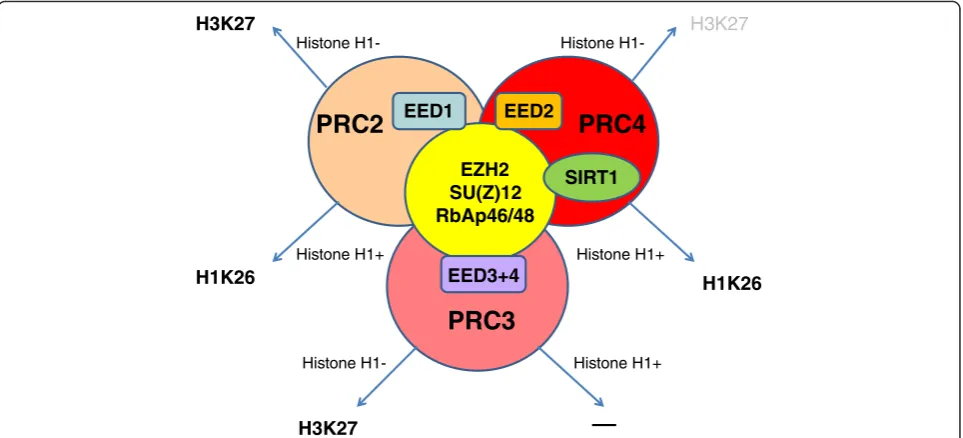
H3K27 is not the only histone-related substrate for EZH2, as the PRC-partners may direct the EZH2 to other substrates. For example, an EED isoform 2 (Eed2) and NAD-dependent histone deacetylase Sirt1 specific-ally associate within the PRC4 which is needed for methylating linker histone H1 (H1K26) [13]. This modifi-cation is specific for cancer and undifferentiated embry-onic stem (ES) cells.
There is a whole spectrum of variations relating to the dynamic exchange of protein partners (AEBP2, Pcl1/2/3 (PHF1/MTF2/Pcl3t), Jarid2) which may be temporary members of PRC2. This“exchange phenomenon”should not be surprising, as the specific biological effect medi-ated by PRCs—broad control of gene activity must be achieved very precisely, in a cell-type specific manner and during a controlled time-window (Fig. 1) [14]. For example, Jarid2—a member of Jumonji family of histone demethylases without enzymatic activity—was identified as a part of PRC2, in interaction with Ezh2. Jarid2 binds DNA with a slight preference for GC rich sequences [15] and recruits PcG proteins to target genes [16].
Although there are several possibilities related to flexible ways of composing the content of PRC2 (as discussed), it
Table 1PRC2 core proteins in model organisms [4, 8] YeastCrytococcus
neoformans
Nematode Caenorhabditis elegans
PlantArabidopsis thaliana
FlyDrosophila melanogaster
Mouse and human Mus musculusand Homo sapiens
Bnd1, Cc1
MES-3
EED1 MES-6 FIE ESC EED
EZH2 MES-2 CLF E(Z) EZH1
MEA EZH2
SWN
FIS2 SU(Z)12 SU(Z)12
VRN2
EMF2
is known that the minimum components required for methyltransferase activity of the PRC2/EED-EZH2 com-plex are EED, EZH2, and SUZ12. The coordinated activity of these proteins is essential for establishing di- and tri-methylated H3K27 (H3K27me2/me3) marks which are as-sociated with facultative heterochromatin. These marks present the hallmark histone modification produced by Ezh1 and Ezh2 activity within the PRC2. However, the precise mechanism that governs PRC2 recruitment to chromatin in mammals still needs to be defined.
Recognizing PRC2 functioning as a holoenzyme whose components act together to establish interaction with chromatin in a stepwise manner, Margueron and Rein-berg [17] have proposed the following several-steps model: (a) interaction of Jarid2 and AEBP2 with DNA [18, 19]; (b) interaction of RbAp46/48 with histones H3 and H4 [20]; (c) interaction of Eed with H3K27me3 [21]; (d) interaction of Plcs with an unknown histone mark; and (e) interaction of PRC2 subunits with long non-coding RNA (lnc RNA).
These molecular events are highly conserved. In mam-mals (reviewed in [22]) are well documented through the interaction of lnc RNA X inactive-specific transcript (Xist) with EZH2 and the consequential recruitment of PRC2 to the X-chromosome leading to its inactivation. In plants, cold induced lnc RNA COLDAIR interacts with plant E(Z) homolog CLF [23] and recruits PRC2 to the target locus in a way similar to the Xist in mammals. In malignant neoplasms, as shown in gastric cancer,
overexpressed lnc RNA 00152 needs to bind to EZH2 in order to exert oncogenic potential through recruiting the PRC2 to promoters of tumor suppressor (TS) genes p15 and p21 [24].
Learning about the evolutional significance of PRC2 in the control of cellular proliferation and differentiation is very important for understanding some basic patho-physiological processes. For example, plants with double mutation of two out of three E(Z) homologs, clf and swn, undergo normal seed development, but produce a mass of proliferating, undifferentiated tissue resembling cancer, instead of a differentiated shoot after germin-ation [25].
Several aspects of aberrant EZH2 function in cancer
In humans, the EZH2 mutation may occur in a germline, resulting in clinical features known as the Weaver syn-drome, originally described in 1974 [26]. In 2011, muta-tional analysis of EZH2 in 48 Weaver syndrome patients revealed 44 missense and four truncated mu-tations. All but two SET domain mutations (R684C and S652C), which were present in five and two unrelated individuals, respectively, were distributed throughout the gene, without specific clustering [27]. Only two germline EZH2 mutation-positive individ-uals developed hematological malignancies: E745K (a lymphoma diagnosed at the age of 13) and an A682T mutation (acute lymphoblastic leukemia (ALL) and neuroblastoma developed at 13 months).
PRC3
PRC3
EZH2 SU(Z)12 RbAp46/48
EED2 EED1
PRC2
PRC4
EED3+4
SIRT1
Histone H1- Histone
H1-Histone H1+ Histone H1+
Histone H1+ Histone
H1-H3K27
H1K26
H3K27
H1K26 H3K27
In 1996, EZH2 was first discovered as a binding part-ner of Vav oncoprotein in hematological malignancies [28]. These neoplasms were, in addition to breast and prostate cancer, pioneering models for investigating the function and role of EZH2. Its overexpression was first associated with amplification at 7q35 (more than four EZH2 copies per cell) in approximately 15 % of the 225 analyzed breast cancers (BCs) [29]. In 2010, EZH2 point mutation (Y641) in SET domain was first found in 7 % of large follicular lymphomas and 22 % of diffuse B cell lymphomas [30]. It was also found in approximately 3 % of melanomas [31]. The discovery of two additional SET domain mutations (A677G and A687V) followed [32, 33].
These“gain of (methyltransferase) function”mutations are responsible for the oncogenic mode of EZH2 action. Contrary to wild-type (WT) EZH2, which loses activity when progressively more methyl groups are incorporated into H3K27, all tested Y641 mutant enzymes (Y641F/N/ S/H/C) displayed the opposite trend (H3K27me0:-me1:me2 kcat/Km ratio: 13:4:1 (WT) vs 1:2:22 (Y641) [34]. Since one cell possesses both wild- and mutant types of the EZH2 allele, there appears to be dependency on the coordinated activity of both alleles.
Aberrant activity of PRC2 can result from aberrant EZH2 expression, without chromosomal amplification, as a consequence of diverse aberrations which are present in cancer cells. For example, comprehensive ana-lyses of transcriptome and epigenome data obtained from adult T cell leukemia (ATL) cell lines, normal CD4 +
T cells, human T-lymphotropic virus type 1 (HTLV-1)-immortalized and transformed T cells show the import-ance of increased, NF-κB dependent expression of EZH2 (both RelA and RelB were shown to be bound to EZH2 promoter) which further activates NF-κB through silen-cing of microRNA (miR)-31. Of interest for this model, H3K27me3 was enriched in the promoter of tran-scriptionally downregulated H3K27me3 demethylase KDM6B (JMJD3), which also may compromise the balance between epigenetic “writers” and “erasers.” It was shown that HTLV-1 protein Tax binds to EZH2, without affecting the PRC2 composition. As a result, the pattern of H3K27me3 accumulation significantly overlaps in ATL- and HTLV-1-immortalized cells. Since HTLV-1 infected cells are sensitive to EZH2 in-hibition, this research data may be a ground for introducing EZH2 inhibitors for treating asymptom-atic, HTLV-1 infected individuals [35].
Hepatitis B virus (HBV)-associated hepatocellular can-cer (HCC) represents another interesting model for studying the abberant expression of tumor suppresive miRs in respect to PRC2 activity in a setting of pro-longed viral infection. In the HBV-HCC model, co-expression of transcription factor (TF) YY1 and EZH2
are associated with silencing several, multiple YY1 bind-ing sites-containbind-ing suppressive miRs and relate to short disease-free survival [36]. YY1 can interact with both EZH2 and SUZ12 [37] and recruits the PRC2 complex to chromatin. The discovery of this oncogenic mechan-ism, which was responsible for silencing of five highly NF-κB suppresive miRs, pointed out the importance of coordinated action of YY1 and EZH2 for focal reshaping of chromatin.
The already mentioned tumor suppressor miR-31 was shown to be silenced in prostate cancer cells through presence of H3K27me3 on its promoter [38]. The ab-sence of miR-31 in t(4;14) positive multiple myeloma (MM) patients (15–20 %) allows for pro-oncogenic ac-tivity of its target—multiple myeloma set domain meth-yltransferase (MMSET), which establishes histone mark H3K36me2 and induces a global reduction H3K27me3 [39]. However, in this scenario, specific loci exhibit en-hanced recruitment of EZH2, leading to misregulation of specific polycomb target genes.
It was recently shown that H3K27me3 enriched genes in experimental models of MM significantly overlap with underexpressed genes in MM patients with poor survival [40]. Of interest, although applying EZH2 inhibitor, E7438 induces reproducible re-expression of crucial epithelial tumor suppressor genes (including CDH1) in 13 tested MM cell lines, there are many questions aris-ing from a high variability in E7438 sensitivity in the proliferation assays [41].
All these examples show that there are many factors that may influence EZH2 and are influenced by EZH2. Accordingly, EZH2 pharmacological inhibition may have various effects.
EZH2 function, in both physiological process and in various pathogenic events, must be studied in a broad context, keeping in mind that its binding partners contrib-ute to specificity of its functioning, in a particular cellular setting.
Which mutation is“the right one”?
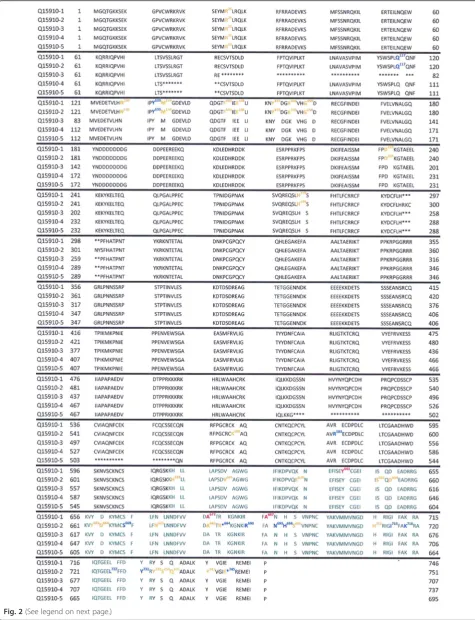
The problem that occurs when comparing the results of EZH2 mutational analyses coming from different sources relates to amino acids positioning in the EZH2 sequence. For example,“gain of function”mutations are listed according to the protein sequence that is consid-ered“canonical”(UniProtBD/Swiss-Prot Q 15910–1; 746 amino acids (AA)) [30, 32, 33]. On the other hand,“loss of function” [34], and germline mutations [27], were po-sitioned according to the longest protein isoform of EZH2 (UniProtBD/Swiss- Prot Q 15910-2; 751 AA). The absence of uniformity may be confusing. For example, the already mentioned inherited mutation discovered in the Weaver syndrome patient suffering from ALL (A682T) [27] corresponds to alanine 677 mutation (A677G) in B cell lymphoma [30]. Similarly, a rare EZH2 breast cancer mutation described as A692V [44] corresponds to B cell lymphoma mutation at position 687 [33]. The difference of five amino acids corresponds to the difference between Q15910-1 and Q15910-2 iso-forms (HP→HRKCNYS), which are identical in the first 297 amino acids (Fig. 2). The basic data on currently known EZH2 protein isoforms and their coding messen-ger RNAs (mRNAs) are presented in Table 2. The hope is that future presentations of EZH2 isoforms and the positions of mutated codons will be done in a more uni-form manner.
Stratified presentation of mutations published in previ-ous studies [27, 30–34, 44] reveals identical type/pos-ition of three germline (G) and three somatic (S) mutations. One mutation was reported as oncogenic (lymphoma; S&G:A677T), and two other ones were re-ported as suppressive (S:E741fs→G:E741K; S:R679C/ P→G:R679C/H) (Fig. 2; UniProtBD/Swiss- Prot Q 15910-1). It remains to be seen whether any of these EZH2 mutations act as a “Janus” mutation in the RET protooncogene (germline mutation that acts simultan-eously as both a gain-of-function and a loss-of-function mutation) [45].
Data related to the functional differences of EZH2 splice variants is scarce. The expression level of EZH2 transcript variants 1 and 3 was shown to be similar in 22 tested human tissue samples. Forced expression of cor-responding protein isoforms (Q 15910-2 and Q 15910-3; Table 2) in pancreatic cancer cells revealed that each protein isoform has an affinity for a preferential gene cluster (36.3 and 47.6 % genes were repressed by EZH2β (Q 15910-3) and EZH2α(Q 15910-2), respectively, while
repression of remaining 16.1 % genes needed the pres-ence of both isoforms) [46]. The data indicates that the different EZH2 cell-specific mRNAs, and protein iso-forms may have functional importance, including for the clinic, as already shown for some other genes [47, 48].
Specific cellular background and multiple roles of EZH2
EZH2 binding affinity for both histones and non-histone substrates may partially explain why targeted silencing of EZH2 leads to bidirectional change of gene expres-sion, in a specific cellular context-dependent manner [49]. Some examples are: (1) EZH2 binds to RelA/RelB in BC cells and regulates the NF-κB target genes in a posi-tive (IL-6,TNF) or negative way, depending on estrogen receptor (ER) status rather than the EZH2 histone methyl-transferase activity. In ER+ BC cells, ER recruits PRC2 for enforcing a repressive chromatin modification at NF-κB target genes. (2) In squamous cell carcinomas (SCC), EZH2, through repressing IκB kinaseα(IKK1) promoter, leads to IKK1 silencing [50]. In any other types of tumor, this would be a suppressive effect. However, it is onco-genic in SCCs because IκB kinaseαhas a tumor suppres-sive role in these tumors [51]. 3. Finally, it seems that EZH2 catalytical activity does not have the most signifi-cant role for an increased rate of growth in some SWI/ SNF-mutant cancers [52]. Instead, the stabilization of PRC2, dependent on EZH2 threonine 487 (T487) phosphorylation (Prot Q 15910-1), seems to be essen-tial, at least in this particular scenario [53]. However, this phenomenon may be abrogated by presence of mutant K-ras.
In non-small cell lung cancer (NSCLC), the type of substitution at 12th codon of K-ras determines activa-tion of a specific pro-proliferative signaling pathway. Cells with K-RASG12D/+or K-RASG12C/+have primarily activated PI3/AKT and MEK/ERK signaling pathways, respectively [54]. Accordingly, activation of EZH2, which was shown to be dependent on K-ras mutants, may be inhibited by specific inhibitors of mutation-type dependent downstream signals. This is important be-cause one of significant pro-oncogenic activities of EZH2 depends on activated AKT which, through EZH2, phosphorylates and activates oncogenic STAT3 [55] .
KrasG12D/+;Eedfl/fl mice developed NSCLs which were, although smaller than KrasG12D/+ /Ezh2LSL tumors, characterized by life incompatible inflammation in alvelo-lar spaces. In vitro, the inhibition of EZH2, achieved through the prolonged exposure of human K-RAS-mutant NSCLC cells to an inhibitor of EZH2 catalytic activity (GSK126), resulted in a strong increase of inflammatory genes (i.e., IL-6) associated with microenvironment-regulated tumor progression. Based on these and many more results coming from the cited study [56], it was suggested that PRC2 can hold oppos-ing functions, dependoppos-ing on the stage of tumor development and the genetic make-up of the tumors (as presented here), with respect to p53 status. Accord-ingly, this and other studies clearly show a rationale for the combined application of PRC2 inhibitors and anti-inflammatory drugs. In the model of hematopoietic stem cells, EZH2 loss was recently shown to result in the expression of fetal gene signature, including upreg-ulation of fetal-specific Lin28b which encodes RNA-binding protein that prevents maturation of miR-let-7 which is specific for adult HSCs. Activation of fetal gene signature in EZH2-deficient adult bone marrow HSCs was shown to result in fetal-like high self-renewal capacity and increased propensity to undergo malignant transformation [57]. Enforced expression of Lin28b has been reported to impair T cell development in vivo, leading to developing an aggressive peripheral T cell lymphoma, accompanied by a decrease in let-7 expres-sion, surge of IL-6, activation of NF-κB, and infiltration
of B cells leading to an inflammatory microenviron-ment [58].
The proper anti-tumor function of T cells depends on the differentiation of naive and memory T cells into ef-fector cells. Metabolic switch from oxidative phosphoryl-ation to aerobic glycolysis is mandatory for T cell activation. Highly glycolytic ovarian cancer cells were re-cently shown to impose glucose restriction on tumor-infiltrating T cells, thereby inhibiting this metabolic switch. Low glucose availability results in upregulation of EZH2-targeting miR-26a and miR-101 with subse-quent EZH2 downregulation. This is consesubse-quential for T cell effector function, since EZH2 activates the Notch pathway that stimulates T cell polyfunctional cytokine expression and their survival, which was shown to be impaired in many tumors. These results point to the dif-ferent effects that systemic inhibition of EZH2 may have on tumor cells and T cells, warranting special caution when considering such epigenetic intervention [59].
H3K27me3 as a measure of EZH2 activity
There are many EZH2-related scenarios and none of them is simple. When analyzed in five well-defined sub-types of BC, the highest EZH2 expression, joined with a very low level of H3K27me3, was found in basal-like, triple negative BC [60], known for its distinctly aggres-sive nature [61]. This inverted pattern (EZH2↑, H3K27me3↓), further confirmed in a basal-like BC cell lines, represents the negative prognostic marker in BC patients [60, 62]. There are a few studies in which a
Table 2Human EZH2: five proteins and corresponding mRNA splice variants are currently deposited. Although mutational analyses of EZH2 refer to the ordinal number of mutated amino acids, they rarely identify the isoform which is the basis for numbering them
UniProtBD/ Swiss-Prot
Transcript variants (TV)
mRNA NCBI mRNA
length (nt)
Coding region cDNA l ength (nt)
Protein size (AA)
15910-1 TV3 NM_001203247.1 2708 194-2434 2241 746
15910-2 TV1 NM_004456.4 2723 194-2449 2256 751
15910-3 TV2 NM_152998.2 2591 194-2317 2124 707
15910-4 TV4 NM_001203248.1 2681 194-2407 2214 737
15910-5 TV5 NM_001203249.1 2682 321-2408 2088 695
(See figure on previous page.)
decreased level of H3K27me3 was associated with a poor outcome in different malignant tumors (breast, ovary, pancreas, lung) [63, 64]. These results, together with those showing that solid tumors (prostate, breast) can develop even in the absence of Ezh2 [44], challenge the strength of EZH2 as the epigenetic driver of oncogenesis [65], at least in the stated tumor types. This data, supported by a broad analysis of human transcriptome data sets (131 prostate cancers (plus 19 metastases), 146 BCs) indicates that EZH2 expression “follows” the rate of cellular division, is under control of proliferation cues, and“passively”correlates with proliferation and proliferation markers (primarily Ki-67), in order to maintain the cellular level of H3K27me3.
It was suggested that EZH2 overexpression should be considered from two perspectives: (a) through coupling its expression to proliferation and (b) coupling it to proliferation-independent, amplification-related, copy number-driven, expression [44].
However, this approach should be considered in a spe-cific cellular milieu and should not be applied non-selectively, to all types of malignant tumors:
In many systems, EZH2 supports stem cell mainten-ance by repressing differentiation. But, in neural crest stem cells (NCSCs), which are the source of melano-cytes, it specifically promotes the acquisition of a mesen-chymal fate [66]. EZH2 is essential for melanoma initiation and growth, during which EZH2 and Ki-67 positive cells significantly correlate, just like in the BC model. Increased expression of EZH2 in melanoma strongly correlates with shorter overall survival (OS) and earlier development of distant metastases [67, 68]. EZH2-mediated repression of the tumor suppressor ade-nosylmethionine decarboxylase 1 (AMD1) appears to be of the greatest importance for these processes. The role of this gene, as well as its repressor, EZH2, needs to be further investigated and validated.
Conclusions
The function of any biomolecule must be considered in a specific cellular setting. Accordingly, cell-type specific signals which constantly change during adaptive responses to various stimuli are the basis of an epigenomic dynamic network, reflecting both—the type of the cell and the type of the stimulus in a given time-window. Understanding the exact role of EZH2 in such a complex system is not an easy task. There is convincing mechanicistic data con-firming the oncogenic function of EZH2 related to PRC2 functioning (repression of tumor suppressor genes through H3K27me3) in several biological models. Numerous studies, however, interpret an increased EZH2 immunore-activity score as an unquestionable oncogenic event. The fact that the score does not necessarily reflect the presence of a functional PRC2 and/or its increased recruitment to chromatin seems to be all too often neglected.
When considering EZH2 as a therapeutic agent, one must take into account these parameters, together with an understanding of the functional consequences of EZH2 mutations and the cancer patient’s specific cellular oncome-tabolome with respect to systemic inflammatory reactions.
While the targeted inhibition of EZH2 catalytic activity emerges as a promising therapeutic intervention, it still has many other cellular-specific functions which must be carefully evaluated to avoid broad side effects. These is-sues are further discussed in a broader context elsewhere in this issue of Clinical Epigenetics [69].
Abbreviations
AA:amino acid; ALL: acute lymphoblastic leukemia;
AMD1: adenosylmethionine decarboxylase 1; ATL: adult T cell leukemia; BM: bone marrow; BC: breast cancer; E(Z): enhancer of zeste; EED: embryonic ectoderm development; ER: estrogen receptor; ES cells: embryonic stem cells; ESC: extra sex combs; EZH2: enhancer of zeste homolog 2; G: germline; H3K27: lysine 27 of histone 3; HBV: hepatitis B virus; HOX: homebox; HSC: hematopoietic stem cell; HTLV-1: human T-lymphotropic virus type 1;
IKK1: IκB kinaseα;IL-6: interleukin-6; KMT: lysine methyltransferase; lnc RNA: long non-coding RNA; MDS: myelodisplastic syndrome; miR: microRNA; MM: multiple myeloma; MMSET: multiple myeloma set domain
methyltransferase; MPN: myeloproliferative neoplasms; NCSCs: neural crest stem cells; NSCLC: non-small cell lung cancer; OS: overall survival; PcG: polycomb group; PRCs: polycomb repressive complexes; PTMs: post-translational modifications; RbAp46/48: retinoblastoma(Rb)-associated protein 46/48; S: somatic; SCC: squamous cell carcinoma; SU(Z)12: suppressor of zeste 12; TF: transcription factor; TS: tumor suppressor; UPD: unipaternal disomy; WT: wild-type; Xist: X inactive-specific transcript.
Competing interests
The authors declare that they have no competing interests.
Authors’contributions
All authors contributed to writing the paper: DU—EZH2 and evolution; RNK—EZH2 and its complexing within various PRCs; KGT—disease-related aspects of EZH2 and mutational analysis of presented data, in addition to composing the text. All authors share full responsibility for the text and illustrations in this review. All authors read and approved the final version of this manuscript.
Acknowledgements
This work was supported by COST Action CM1406—Epigenetic Chemical Biology (EPICHEM) and Croatian Science Foundation Project IP-2014-09-3733 (PI: DU). Our special note of gratitude goes to Mr. Aaron Etra who helped us with language issues.
Author details
1Division of Molecular Medicine, Laboratory for Epigenomics, Rudjer Boskovic
Institute, Bijenicka cesta 54, 10 000 Zagreb, Croatia.2Division of Molecular Biology, Laboratory for Evolutionary Genetics, Rudjer Boskovic Institute, Bijenicka cesta 54, 10 000 Zagreb, Croatia.
Received: 29 December 2015 Accepted: 4 May 2016
References
1. Sims RJ, Reinberg D. Is there a code embedded in proteins that is based on post translational modifications? Nat Rev Mol Cell Biol. 2008;9:815. 2. Sarma K, Margueron R, Ivanov A, Pirrotta V, Reinberg D. Ezh2 requires PHF1 to
efficiently catalyze H3 lysine 27 trimethylation in vivo. Mol Cell Biol. 2008;28:2718. 3. Prezioso C, Orlando V. Polycomb proteins in mammalian cell differentiation
and plasticity. FEBS Lett. 2011;585:2067.
4. Grossniklaus U, Paro R. Transcriptional silencing byPolycomb-Group proteins. Cold Spring Harb Perspect Biol. 2014;6:a019331.
6. Whitcomb SJ, Basu A, Allis CD, Bernstein E. Polycomb group proteins: An evolutionary perspective. Trends Genet. 2007;23:494.
7. Shaver S, Casas-Mollano JA, Cerny RL, Cerutti H. Origin of the polycomb repressive complex 2 and gene silencing by an E(z) homolog in the unicellular algaChlamydomonas. Epigenetics. 2010;5:301.
8. Dumesic PA, Homer CM, Moresco JJ, Pack LR, Shanle EK, Coyle SM, et al. Product binding enforces the genomic specificity of a yeast polycomb repressive complex. Cell. 2015;160:204.
9. Tschiersch B, Hofmann A, Krauss V, Dorn R, Korge G, Reuter G. The protein encoded by theDrosophilaposition-effect variegation suppressor gene Su(var)3-9 combines domains of antagonistic regulators of homeotic gene complexes. EMBO J. 1994;13:3822.
10. Strome S, Kelly WG, Ercan S, Lieb JD. Regulation of the X chromosomes in
C. elegans. Cold Spring Harb Perspect Biol. 2014;6:a018366.
11. Baulcombe DC, Dean C. Epigenetic regulation in plant responses to the environment. Cold Spring Harb Perspect Biol. 2014;6:a019471.
12. Deb G, Singh AK, Gupta S. EZH2: not EZHY (easy) to deal. Mol Cancer Res. 2014;12:639.
13. Kuzmichev A, Jenuwein T, Tempst P, Reinberg D. Different EZH2-containing complexes target methylation of histone H1 or nucleosomal histone H3. Mol Cell. 2004;14:183.
14. Kuzmichev A, Margueron R, Vaquero A, Preissner TS, Scher M, Kirmizis A, et al. Composition and histone substrates of polycomb repressive group complexes change during cellular differentiation. Proc Natl Acad Sci U S A. 2005;102:1859. 15. Landeira D, Sauer S, Poot R, Dvorkina M, Mazzarella L, Jørgensen HF, et al.
Jarid2 is a PRC2 component in embryonic stem cells required for multi-lineage differentiation and recruitment of PRC1 and RNA Polymerase II to developmental regulators. Nat Cell Biol. 2010;12:618.
16. Pasini D, Malatesta M, Jung HR, Walfridsson J, Willer A, Olsson L, et al. Characterization of an antagonistic switch between histone H3 lysine 27 methylation and acetylation in the transcriptional regulation of Polycomb group target genes. Nucleic Acids Res. 2010;38:4958.
17. Margueron R, Reinberg D. The Polycomb complex PRC2 and its mark in life. Nature. 2011;469:343.
18. Kim H, Kang K, Kim J. AEBP2 as a potential targeting protein for Polycomb Repression Complex PRC2. Nucleic Acids Res. 2009;37:2940.
19. Li G, Margueron R, Ku M, Chambon P, Bernstein BE, Reinberg D. Jarid2 and PRC2, partners in regulating gene expression. Genes Dev. 2010;24:368. 20. Song J-J, Garlick JD, Kingston RE. Structural basis of histone H4 recognition
by p55. Genes Dev. 2008;22:1313.
21. Margueron R, Justin N, Ohno K, Sharpe ML, Son J, Drury WJ, et al. Role of the polycomb protein EED in the propagation of repressive histone marks. Nature. 2009;461:762.
22. Brockdorff N, Turner B. Dosage compensation in mammals. Cold Spring Harb Perspect Biol. 2015;7:a019406.
23. Swiezewski S, Liu F, Magusin A, Dean C. Cold-induced silencing by long antisense transcripts of an Arabidopsis Polycomb target. Nature. 2009;462:799. 24. Chen WM, Huang MD, Sun DP, Kong R, Xu TP, Xia R, et al. Long intergenic
non-coding RNA 00152 promotes tumor cell cycle progression by binding to EZH2 and repressing p15 and p21 in gastric cancer. Oncotarget. 2016. doi:10.18632/oncotarget.6949.
25. Chanvivattana Y, Bishopp A, Schubert D, Stock C, Moon YH, Sung ZR, et al. Interaction of Polycomb-group proteins controlling flowering in Arabidopsis. Development. 2004;131:5263.
26. Weaver DD, Graham CB, Thomas IT, Smith DW. A new overgrowth syndrome with accelerated skeletal maturation, unusual facies, and camptodactyly. J Pediatr. 1974;84:547.
27. Tatton-Brown K, Murray A, Hanks S, Douglas J, Armstrong R, Banka S, et al. Weaver syndrome and EZH2 mutations: Clarifying the clinical phenotype. Am J Med Genet A. 2013;161A:2972.
28. Hobert O, Jallal B, Ullrich A. Interaction of Vav with ENX-1, a putative transcriptional regulator of homeobox gene expression. Mol Cell Biol. 1996;16:3066.
29. Bracken AP, Pasini D, Capra M, Prosperini E, Colli E, Helin K. EZH2 is downstream of the pRB-E2F pathway, essential for proliferation and amplified in cancer. EMBO J. 2003;22:5323.
30. Morin RD, Johnson NA, Severson TM, Mungall AJ, An J, Goya R, et al. Somatic mutations altering EZH2 (Tyr641) in follicular and diffuse large B-cell lymphomas of germinal-center origin. Nat Genet. 2010;42:181. 31. Hodis E, Watson IR, Kryukov GV, Arold ST, Imielinski M, Theurillat JP, et al. A
landscape of driver mutations in melanoma. Cell. 2012;150:251.
32. McCabe MT, Graves AP, Ganji G, Diaz E, Halsey WS, Jiang Y, et al. Mutation of A677 in histone methyltransferase EZH2 in human B-cell lymphoma promotes hypertrimethylation of histone H3 on lysine 27 (H3K27). Proc Natl Acad Sci U S A. 2012;109:2989.
33. Majer CR, Jin L, Scott MP, Knutson SK, Kuntz KW, Keilhack H, et al. A687V EZH2 is a gain-of-function mutation found in lymphoma patients. FEBS Lett. 2012;586:3448.
34. Sneeringer CJ, Scott MP, Kuntz KW, Knutson SK, Pollock RM, Richon VM, et al. Coordinated activities of wild-type plus mutant EZH2 drive tumor-associated hypertrimethylation of lysine 27 on histone H3 (H3K27) in human B-cell lymphomas. Proc Natl Acad Sci U S A. 2010;107:20980. 35. Fujikawa D, Nakagawa S, Hori M, Kurokawa N, Soejima A, Nakano K, et al:
Polycomb-dependent epigenetic landscape in adult T-cell leukemia. Blood. 2016, doi:10.1182/blood-2015-08-662593.
36. Tsang DP, Wu WK, Kang W, Lee YY, Wu F, Yu Z, et al: Yin Yang 1-mediated epigenetic silencing of tumour-suppressive microRNAs activates nuclear factor-κB in hepatocellular carcinoma. J Pathol. 2016, doi:10.1002/path.4688. 37. Pan X, Papasani M, Hao Y, Calamito M, Wei F, Quinn Iii WJ, et al. YY1
controls Igκrepertoire and B cell development, and localizes with condensin on the Igκlocus. EMBO J. 2013;32:1168.
38. Zhang Q, Padi SK, Tindall DJ, Guo B. Polycomb protein EZH2 suppresses apoptosis by silencing the proapoptotic miR-31. Cell Death Dis. 2014;5:e1486.
39. Popovic R, Martinez-Garcia E, Giannopoulou EG, Zhang Q, Zhang Q, Ezponda T, et al. Histone methyltransferase MMSET/NSD2 alters EZH2 binding and reprograms the myeloma epigenome through global and focal changes in H3K36 and H3K27 methylation. PLoS Genet. 2014;10:e1004566. 40. Agarwal P, Alzrigat M, Párraga AA, Enroth S, Singh U, Ungerstedt J, et al.
Genome-wide profiling of histone H3 lysine 27 and lysine 4 trimethylation in multiple myeloma reveals the importance of Polycomb gene targeting and highlights EZH2 as a potential therapeutic target. Oncotarget. 2016. doi: 10.18632/oncotarget.6843.
41. Hernando H, Gelato KA, Lesche R, Beckmann G, Koehr S, Otto S, et al. EZH2 inhibition blocks multiple myeloma cell growth through upregulation of epithelial tumor suppressor genes. Mol Cancer Ther. 2016;15:287. 42. Khan SN, Jankowska AM, Mahfouz R, Dunbar AJ, Sugimoto Y, Hosono N,
et al. Multiple mechanisms deregulate EZH2 and histone H3 lysine 27 epigenetic changes in myeloid malignancies. Leukemia. 2013;27:1301. 43. Mochizuki-Kashio M, Aoyama K, Sashida G, Oshima M, Tomioka T, Muto
T, et al. Ezh2 loss in hematopoietic stem cells predisposes mice to develop heterogeneous malignancies in an Ezh1-dependent manner. Blood. 2015;126:1172.
44. Wassef M, Rodilla V, Teissandier A, Zeitouni B, Gruel N, Sadacca B, et al: Impaired PRC2 activity promotes transcriptional instability and favors breast tumorigenesis. Genes Dev. 2015 (in press, doi: 10.1101/gad.269522.115). 45. Coyle D, Friedmacher F, Puri P. The association between Hirschsprung’s disease and multiple endocrine neoplasia type 2a: a systematic review. Pediatr Surg Int. 2014;30:751.
46. Grzenda A, Lomberk G, Svingen P, Mathison A, Calvo E, Iovanna J, et al. Functional characterization of EZH2βreveals the increased complexity of EZH2 isoforms involved in the regulation of mammalian gene expression. Epigenetics Chromatin. 2013;6:3.
47. Wojtuszkiewicz A, Assaraf YG, Maas MJ, Kaspers GJ, Jansen G, Cloos J. Pre-mRNA splicing in cancer: the relevance in oncogenesis, treatment and drug resistance. Expert Opin Drug Metab Toxicol. 2015;11:673.
48. Novak KujundžićR, Grbeša I, IvkićM, Krušlin B, Konjevoda P, Gall Trošelj K. Possible prognostic value of BORIS transcript variants ratio in laryngeal squamous cell carcinomas - a pilot study. Pathol Oncol Res. 2014;20:687. 49. Lee ST, Li Z, Wu Z, Aau M, Guan P, Karuturi RK, et al. Context-specific
regulation of NF-κB target gene expression by EZH2 in breast cancers. Mol Cell. 2011;43:798.
50. Yan M, Zhang Y, He B, Xiang J, Wang ZF, Zheng FM, et al. IKKαrestoration via EZH2 suppression induces nasopharyngeal carcinoma differentiation. Nat Commun. 2014;5:3661.
51. Xin Y, Lu Q, Li Q. IKK1 control of epidermal differentiation is modulated by notch signaling. Am J Pathol. 2011;178:1568.
52. Kim KH, Kim W, Howard TP, Vazquez F, Tsherniak A, Wu JN, et al. SWI/SNF-mutant cancers depend on catalytic and non-catalytic activity of EZH2. Nat Med. 2015;21:1491.
osteogenic differentiation of human mesenchymal stem cells. Nat Cell Biol. 2011;13:87.
54. Riquelme E, Behrens C, Lin HY, Simon G, Papadimitrakopoulou V, Izzo J, et al. Modulation of EZH2 expression by MEK-ERK or PI3K-AKT signaling in lung cancer is dictated by different KRAS oncogene mutations. Cancer Res. 2016;76:675.
55. Kim E, Kim M, Woo DH, Shin Y, Shin J, Chang N, et al. Phosphorylation of EZH2 activates STAT3 signaling via STAT3 methylation and promotes tumorigenicity of glioblastoma stem-like cells. Cancer Cell. 2013;23:839. 56. Serresi M, Gargiulo G, Proost N, Siteur B, Cesaroni M, Koppens M, et al.
Polycomb Repressive Complex 2 is a barrier to KRAS-driven inflammation and Epithelial-Mesenchymal transition in non-small-cell lung cancer. Cancer Cell. 2016;29:17.
57. Oshima M, Hasegawa N, Mochizuki-Kashio M, Muto T, Miyagi S, Koide S, et al. Ezh2 regulates the Lin28/let-7 pathway to restrict activation of fetal gene signature in adult hematopoietic stem cells. Exp Hematol. 2016. doi: 10.1016/j.exphem.2015.12.009.
58. Beachy SH, Onozawa M, Chung YJ, Slape C, Bilke S, Francis P, et al. Enforced expression of Lin28b leads to impaired T-cell development, release of inflammatory cytokines, and peripheral T-cell lymphoma. Blood. 2012;120:1048.
59. Zhao E, Maj T, Kryczek I, Li W, Wu K, Zhao L, et al. Cancer mediates effector T cell dysfunction by targeting microRNAs and EZH2 via glycolysis restriction. Nat Immunol. 2016;17:95.
60. Holm K, Grabau D, Lövgren K, Aradottir S, Gruvberger-Saal S, Howlin J, et al. Global H3K27 trimethylation and EZH2 abundance in breast tumor subtypes. Mol Oncol. 2012;6:494.
61. Palma G, Frasci G, Chirico A, Esposito E, Siani C, Saturnino C, et al. Triple negative breast cancer: looking for the missing link between biology and treatments. Oncotarget. 2015;6:26560.
62. Bae WK, Yoo KH, Lee JS, Kim Y, Chung IJ, Park MH, et al. The
methyltransferase EZH2 is not required for mammary cancer development, although high EZH2 and low H3K27me3 correlate with poor prognosis of ER-positive breast cancers. Mol Carcinog. 2015;54:1172.
63. Wei Y, Xia W, Zhang Z, Liu J, Wang H, Adsay NV, et al. Loss of trimethylation at lysine 27 of histone H3 is a predictor of poor outcome in breast, ovarian, and pancreatic cancers. Mol Carcinog. 2008;47:701e706.
64. Chen X, Song N, Matsumoto K, Nanashima A, Nagayasu T, Hayashi T, et al. High expression of trimethylated histone H3 at lysine 27 predicts better prognosis in non-small cell lung cancer. Int J Oncol. 2013;43:1467. 65. Yang YA, Yu J. EZH2, an epigenetic driver of prostate cancer. Protein
Cell. 2013;4:331.
66. Shakhova O. Neural crest stem cells in melanoma development. Curr Opin Oncol. 2014;26:215.
67. Bachmann IM, Halvorsen OJ, Collett K, Stefansson IM, Straume O, Haukaas SA, et al. EZH2 expression is associated with high proliferation rate and aggressive tumor subgroups in cutaneous melanoma and cancers of the endometrium, prostate, and breast. J Clin Oncol. 2006;24:268.
68. Zingg D, Debbache J, Schaefer SM, Tuncer E, Frommel SC, Cheng PL, et al. The epigenetic modifier EZH2 controls melanoma growth and metastasis through silencing of distinct tumour suppressors. Nat Commun. 2015;6:6051.
69. Morera L, Lübbert M, Jung M. Targeting histone methyltransferases and demethylases in clinical trials for cancer therapy. Clin Epig, Review Series "Epigenetic drugs- from chemistry via biology to medicine and back" (in press).
• We accept pre-submission inquiries
• Our selector tool helps you to find the most relevant journal
• We provide round the clock customer support
• Convenient online submission
• Thorough peer review
• Inclusion in PubMed and all major indexing services
• Maximum visibility for your research
Submit your manuscript at www.biomedcentral.com/submit
![Table 1 PRC2 core proteins in model organisms [4, 8]](https://thumb-us.123doks.com/thumbv2/123dok_us/8995419.1892534/2.595.58.539.558.732/table-prc-core-proteins-in-model-organisms.webp)