VOLUME 36, ARTICLE 39, PAGES 1149
−
1184
PUBLISHED 11 APRIL 2017
http://www.demographic-research.org/Volumes/Vol36/39/ DOI: 10.4054/DemRes.2017.36.39
Research Article
Depressed fertility among descendants of
immigrants in Sweden
Gunnar Andersson
Lotta Persson
Ognjen Obu
ć
ina
This publication is part of the Special Collection on “Childbearing among the Descendants of Immigrants in Europe,” organized by Guest Editors Hill Kulu and Tina Hannemann.
©2017 Gunnar Andersson, Lotta Persson & Ognjen Obućina. This open-access work is published under the terms of the Creative Commons Attribution NonCommercial License 2.0 Germany, which permits use, reproduction & distribution in any medium for non-commercial purposes, provided the original author(s) and source are given credit.
1 Introduction 1150
2 Fertility in Sweden 1151
3 Descendants of immigrants in Sweden 1152
4 Childbearing of descendants of immigrants: Theory and evidence 1155
5 Empirical evidence from previous research on the fertility of descendants of immigrants
1157
6 Data and methods 1158
7 Results 1160
7.1 First-birth fertility 1161
7.2 Second-birth fertility 1165
7.3 Third-birth fertility 1167
8 Discussion and conclusions 1169
9 Acknowledgments 1173
References 1174
Depressed fertility among descendants of immigrants in Sweden
Gunnar Andersson1
Lotta Persson2
Ognjen Obućina3
Abstract
BACKGROUND
Previous research shows evidence of an interrelation between family formation and the migration of immigrants in Europe. Less research has been conducted on the fertility and family behavior of the descendants of immigrants.
OBJECTIVES
Our study provides analyses of the childbearing behavior of daughters of immigrants in Sweden. The context is that of a country with near-replacement-level fertility and social policies oriented towards social equality.
METHODS
The study is based on register data covering 1998–2012, which allows for highly detailed analyses of the childbearing behavior of 20 country origin groups of second-generation women. By means of event history techniques, we analyze the transition to any first, second, and third births.
RESULTS
Our analyses show that most groups of descendants of immigrants have lower fertility than those with a full Swedish background. The risk of having a first child is particularly depressed, and the risk of having a second child is also lower for daughters of immigrants than for women with two Swedish-born parents. In contrast, many groups of immigrant-descendant two-child mothers display elevated third-birth risks. CONCLUSIONS
Our findings demonstrate the necessity to account for parity-specific differences in fertility when studying the fertility of descendants of migrants.
1
Stockholm University Demography Unit, Sweden. E-Mail:[email protected].
2
Statistics Sweden’s Forecast Institute, Sweden.
CONTRIBUTION
Our study is based on data large enough to allow for a disaggregated analysis by birth order and parental country background. It shows that, on average, the fertility of women in the so-called second generation in Sweden is lower than that of women with a full Swedish background.
1. Introduction
In recent years, immigrant fertility has emerged as an increasingly prominent topic in demographic research with a focus on developed countries that receive immigrants (e.g., Abbasi-Shavazi and McDonald 2000; Milewski 2010a; Parrado 2011; see also Sobotka 2008). This also holds true for Sweden (e.g., Andersson and Scott 2005, 2007; Persson and Hoem 2014). The focus is often on immigrants from high-fertility countries to those with lower fertility, with research focusing on the interdependencies of migration and childbearing trajectories (Kulu and Milewski 2007) and the fertility adaptation of migrants in different settings in Europe and North America (e.g., Kahn 1988; Ford 1990; Andersson 2004; Kulu 2005). There is much less research on the childbearing of the descendants of immigrants in developed countries. This field has long been dominated by research on second-generation Mexicans and Hispanics in the United States (e.g., Stephen and Bean 1992; Parrado and Morgan 2008). Immigration to many countries in Europe is a more recent phenomenon than that of migration to the United States; it is only in recent years that there have been enough women of childbearing age with parents born abroad to allow for any in-depth research on their childbearing patterns. Consequently, in Europe this field of research is still relatively young (cf. de Valk and Milewski 2011). In this line of research, the descendants of immigrants are typically treated as distinct population subgroups. The focus is often to find evidence of sociodemographic integration with the majority population of the country where they live and where they were born. In terms of data and demographic analysis, the processes involved may be somewhat less complex than in research on first-generation immigrants. Because the descendants of migrants are not migrants themselves, there are no temporal interdependencies between a person’s own migration and his or her other life course histories to account for.
Sweden by Scott and Stanfors (2010, 2011). In our study, we compare the childbearing patterns of women who were born in Sweden and have one or two foreign-born parents to those of Swedish-born women with two Swedish-born parents. We refer to the latter as women with a full Swedish background. The purpose is to study the extent to which migration to Sweden contributes to any long-lasting high- or low-fertility behavior among the many new population subgroups in the country, and how women with different parental backgrounds may differ from or resemble the ‘native’ population in their fertility behavior. Our study is based on analyses of longitudinal register data that covers the entire resident population of Sweden during 1998–2012, which allows us to carry out a highly detailed analysis of the childbearing behavior of widely different groups of descendants of immigrants. This allows us to provide accurate evidence of any new diversity in childbearing patterns in Sweden in the wake of international migration. We present parity-specific analyses of the transition to a first, second, and third childbirth in Sweden. The purpose is to study the extent to which differences and similarities in behavior are produced and maintained across the fertility careers of women in Sweden. We also demonstrate how childbearing patterns and any differences in parity-specific fertility are modified by the influence of women’s socioeconomic characteristics.
2. Fertility in Sweden
Andersson 2012). During our study period, Sweden witnessed an improved economy and increasing fertility overall. At the onset in 1998‒1999 it had the lowest fertility ever recorded in the country, with a total fertility rate (TFR) of only 1.5 children per woman. Subsequently, the TFR increased continuously until 2010, when it reached 1.98 children per woman. This peak was followed by another moderate decline.
Previous research on period trends in the childbearing behavior of foreign-born women in Sweden shows that developments over time have been remarkably similar for Swedish- and foreign-born people, but that there are sometimes differences in levels of childbearing intensities between women from different countries of origin (Andersson 2004). First-birth rates of immigrants tend to be elevated: the differences in crude rates are often spurious and related to the fact that migration and childbearing are often interrelated events, and that childbearing more likely follows migration than the other way around (Andersson 2004; Toulemon and Mazuy 2004). However, second-birth rates of immigrants in Sweden are generally lower than those of the Swedish-born (Andersson 2004). To a large extent, this stems from the fact that immigrants did not react particularly strongly to the ‘speed-premium’ incentives that were introduced in the Swedish parental-leave system during the 1980s and that caused much shorter birth intervals for Swedish-born mothers (Andersson, Hoem, and Duvander 2006). Research further reveals that the socioeconomic characteristics of immigrants and native Swedes relate to their fertility in a strikingly similar manner (Andersson and Scott 2005, 2007; Lundström and Andersson 2012). In particular, women and men who are not established in the labor market with regular employment display very low first-birth rates. In the next sections, we turn to research on the descendants of immigrants and their childbearing behavior.
3. Descendants of immigrants in Sweden
with two foreign-born parents and 7% with one foreign-born and one Swedish-born parent (www.scb.se).
In our study, we present analyses of the childbearing behavior of 20 groups of female descendants of immigrants in Sweden. Our definition of a descendant is a person born in Sweden with one or both parents born abroad – we present combined analyses for descendants of either one or two foreign-born parents. Descendants are classified by their parents’ country of birth: If a person has only one foreign-born parent, she is classified according to that parent’s country of birth. If she has two foreign-born parents from two different countries, she is assigned to her mother’s country of origin.
The overall distribution of descendants across groups reflects migration patterns as they appeared a few decades ago. Descendants of immigrants with a background in Finland are by far the largest group in our study – more than a third of the descendants have one or both parents from Finland (Table 1). Finland is the classical immigration country for Sweden. Migration from Finland was very high during the 1950s and 1960s, when Sweden had a much stronger economy than its neighboring country. The movement was facilitated by the existence of a free Nordic labor market. The same holds for the second largest group, other Nordic countries, comprising descendants of parents born in Denmark, Norway, and less often, Iceland.
The third largest group contains those with at least one parent born in Western Europe, with Germany as the most common country. This group is followed by the descendants of migrants from the former Yugoslavia, many of whom arrived during the 1960s as labor migrants (later arrivals of refugee migrants have not yet produced much childbearing offspring). Descendants of immigrants from Southern Europe mainly have parents from Greece or Italy, which are two other countries that contributed labor migrants to Sweden during the 1960s. Descendants of immigrants from Poland are also well represented. Some of their parents arrived as refugees from the old communist regime; others came as tied movers, in many cases as spouses to Swedish men. Other descendants of immigrants from Eastern Europe include those whose parents left the region during the communist era, most of them from Hungary. Those with parents from the Baltic countries mainly have one or both parents from Estonia. The ‘post-Soviet states’ category mostly comprises people with parents born in the Soviet Union.
Ethiopia, respectively. The descendants of parents born in the Arab Middle East often have a background in Lebanon or Syria. Descendants of immigrants from Iran mostly have parents who came to Sweden as refugees during the 1980s, while the descendants of migrants from Turkey mainly have parents who arrived as labor migrants during the 1960s. Our last categories comprise women with parents born in East Asia, such as the descendants of immigrants from Japan or China; women with parents born in Southeast Asia, who mainly have links to Thailand or the Philippines; and those with one or both parents born in South Asia, mainly India or Pakistan.
Table 1: Descendants of immigrants in Sweden, by country background, women aged 17‒45 in 1998, 2003, 2008, and 2012.
Percentage distribution
1998 2003 2008 2012
Finland 41 40 37 32
Other Nordic 16 14 12 10
Former Yugoslavia 5 6 7 8
Poland 2 3 4 4
Western Europe 15 13 11 9
Southern Europe 4 5 5 4
Baltic 3 2 1 1
Eastern Europe 4 4 3 3
US/Aus/NZ/Can 2 2 2 2
Central/South America 1 2 3 4
Horn of Africa 0 0 1 1
Sub-Saharan Africa 1 1 1 1
North Africa 1 1 2 2
Arab Middle East 1 1 3 5
Iran 0 1 1 2
Turkey 2 3 4 4
East Asia 0 1 1 1
Southeast Asia 0 1 1 2
South Asia 0 1 1 1
Post-Soviet States 1 1 1 1
Total 100 100 100 100
Source: Swedish register data, authors’ own calculations
and 2012, respectively, by the country-background categories we apply in our study. To facilitate comparison, the countries are sorted in the same order as in a related study on marriage and divorce of immigrants and the descendants of immigrants in Sweden (Andersson, Obućina, and Scott 2015). In 1998, 57% of descendant women of childbearing age had one or both parents born in Finland or another Nordic country. Another 15% had at least one parent born in another Western European country, and relatively few, only 9%, had at least one parent born outside Europe. In 2012, the share with a Nordic background (Finland or another Nordic country) had decreased to 42%, the share of women with links to Western Europe had decreased to 9%, and the share of descendants of immigrants from countries outside Europe had increased to 28%. Clearly, the descendants of immigrants are still dominated by those with links to Sweden’s neighboring countries, but the changes in composition over time motivate a relatively disaggregated approach to the study of these descendants.
4. Childbearing of descendants of immigrants: Theory and evidence
Differences in fertility between immigrants, natives, and persons of foreign background are driven by a wide range of mechanisms (e.g., Sobotka 2008). Arguably, the interplay of these mechanisms is somewhat more complex among foreign-born migrants than among their children who are born in the country of migration destination. For instance, the very event of migration can affect the occurrence and timing of childbearing (Andersson 2004). Preparing to migrate and settling down in a new country can take years, which can result in the postponement of childbearing plans. Many methodological issues arise when studying demographic processes that take place across different geographical contexts when available data is measured in only one context (see Hoem and Nedoluzhko 2016; Andersson and Drefahl 2016). In contrast, second-generation individuals do not have the experience of international migration themselves, and their childbearing behavior should not be directly affected by the migration event. Their demographic behavior is measured in one context only.
between natives and children of immigrants, especially those living in ethnically segregated neighborhoods. Although the childbearing behavior of children of immigrants should not be directly affected by the migration event, cross-group differences in fertility may be shaped by the nature of the migration process in the parental generation. In particular, any selection processes into migration in the parental generation may determine the extent to which child socialization characteristics will resemble those in the country of origin and the country of destination. Further, it is plausible that the minority status hypothesis may help explain the childbearing behavior of the descendants of immigrants. Similar to their parents, children of immigrants may sometimes perceive themselves as disadvantaged in society and therefore limit their fertility in order to achieve upward social mobility (Halli 1989; Forste and Tienda 1996). Finally, as the vast majority of children are born to couples, the characteristics of marriage and partnering markets also have a role to play in shaping differences in fertility between natives and women with a foreign background, usually in such a way that fertility may be depressed in the latter group. To illustrate, due to limited opportunity structures, second-generation women with a strong preference for endogamy and originating from a small immigrant group may have difficulty finding a suitable partner in the process of family formation (Kalmijn 1998). At the same time, second-generation women from some immigrant groups may have limited access to the native marriage market (Wiik and Holland 2016; see also Dribe and Lundh 2008, 2011).
Although the discussion so far has mainly focused on the factors responsible for the emergence of fertility differentials between natives on the one hand and immigrants and their children on the other, it should be noted that many social forces also contribute to the convergence of fertility levels across groups of individuals as defined by their ethnic or geographic origin. The adaptation hypothesis (Kulu and Gonzalez-Ferrer 2014) stresses the importance of exposure to norms as well as the institutional context in the host society, and argues that processes associated with adaptation make the fertility patterns of migrants and persons with a foreign background increasingly similar over time to those of natives. Considering that exposure to the host society is more persuasive among children of immigrants than among their parents, one should expect that adaptation and related socialization processes would make fertility levels of the second generation position themselves somewhere between those of natives and immigrants (Kulu et al. 2017).
may stem from variation in the success of getting established in the Swedish labor market as well as in the marriage market. For second births, we may regard differentials in fertility rates as evidence of how different population subgroups adjust to the Swedish two-child norm, but also to the Swedish pattern of close spacing between the first and second births. The ‘speed premium’ of the Swedish parental-leave system matters more for those who are well established in the labor market; the subtleties of its regulations may be more efficiently communicated among some groups of mothers than others. For third births, we may detect true evidence of low- or high-fertility behavior. This is the first parity progression with real variation in the quantum of fertility; only about half of Swedish two-child mothers progress to have a third child (Statistics Sweden 2011).
5. Empirical evidence from previous research on the fertility of
descendants of immigrants
To a large extent, research on the fertility of descendants of immigrants has been confined to classical immigration countries such as the United States, Canada, and Australia, which are countries that were built by migration. Most studies suggest that the fertility of the descendants of migrants from high- to low-fertility countries is lower than that of their parents; some studies suggest that it is even lower than that of the majority population in the countries where they live. For example, Bélanger and Gilbert (2003) find evidence of depressed fertility among descendants of immigrants in Canada. Compared to women with a Canadian background, the descendants of immigrants were less likely to have a child aged 0‒4. Those with one foreign-born parent had 7% lower odds of having a young child, while those with two foreign-born parents had 17% lower odds. Similar results have been found for Australia (Khoo and McDonald 2003). Research on descendants of immigrants in the United States gives another picture (e.g., Stephen and Bean 1992; Blau et al. 2008; for a critical discussion see Parrado and Morgan 2008). On average, second-generation women in the United States have higher fertility rates than native US women. These patterns are mainly driven by the behavior of second-generation Hispanics in the United States. Frank and Heuveline (2005) highlight the role of elevated teenage fertility in producing high fertility among the descendants of Mexican immigrants in the United States. They ascribe these patterns to the segmented assimilation and racial stratification of second-generation Mexicans in the United States, rather than reflecting any Mexican pro-natalist values.
descendants of immigrants have adapted their behavior to the low-fertility regime of that country. In another study, she analyzes the childbearing behavior of Turkish second-generation migrants in six countries in Western Europe (Milewski 2011). Also in this case, she finds evidence of fertility adaptation towards the different fertility regimes in the countries where the descendants live. Garssen and Nicolaas (2008) find that second-generation women in the Netherlands are much closer to native than to first-generation migrant women in terms of their fertility behavior. A recent study by Kulu et al. (2017) looks at the fertility patterns of descendants of immigrants in six European countries. The main conclusion of their study is that, in general, the childbearing behavior of the second generation in these countries falls somewhere between the fertility patterns of their migrant parents and those of natives. Yet Kulu and Hannemann (2016) highlight that some groups of ethnic-minority women in the United Kingdom maintain a pronounced high-fertility behavior in the second generation as well. Some previous evidence also exists for the country of our study. Scott and Stanfors (2010, 2011) analyze how the socioeconomic characteristics of descendants of immigrants in Sweden influence their first-birth fertility. They show that the positive relationship between a strong labor market attachment and entry into parenthood that has been observed for the majority population in Sweden also applies to the descendants of immigrants. A study by Statistics Sweden (2010a) shows that women and men who are descendants of immigrants from other Nordic countries have very similar fertility patterns to those observed for women and men with a full Swedish background. The study also reveals that the descendants of immigrants from other EU countries and from countries outside Europe with medium-level development (medium HDI) have lower fertility than native Swedes.
The contribution of our study to the literature on the childbearing behavior of descendants of immigrants is at least twofold. Firstly, this is the first Swedish study to adopt a full-fledged parity-specific approach and look beyond the first childbirth in the Swedish fertility regime. Secondly, acknowledging the fact that Sweden today is much more diverse than before, we include as many as 20 groups of descendants of immigrants. By doing this, we will seek to determine whether the increasingly multicultural character of Swedish society is also reflected in the fertility behavior of the children of immigrants.
6. Data and methods
vital events of every de jure resident in Sweden (Statistics Sweden 2006). Data on individuals’ parents and their country of birth is derived from the Multi-Generation Register (Statistics Sweden 2010b). Information on parents and their country of birth is available for almost all individuals born in Sweden since 1950. Almost 100% of these cohort members have information on their mother, and 98% have information on their father. We are also able to link data on various sociodemographic characteristics from different administrative registers, facilitated by Sweden’s system of personal identification numbers. Our analyses are based on data for all individuals born in Sweden who lived in the country at any time during 1998–2012.
In our study, all Swedish-born women with one or two foreign-born parents are defined as descendants of immigrants. We leave it to future research to produce separate analyses for women (and men) with one and two foreign-born parents. As specified earlier, daughters of immigrants are classified into 20 groups depending on their parents’ country of birth (Table 1). We present event-history analyses of their transition from being childless to having a first child; from having one child to having a second child; and from having two children to having a third child. We present relative risks of childbirth by country background and other control variables. These are estimated by means of Cox proportional hazard regressions in the PROC PHREG procedure of SAS. The main independent variable of interest is the country category of a woman’s background, i.e., her parents’ country of birth; the classification was presented in the section on the descendants of immigrants in Sweden. As mentioned, women born to one Swedish-born and one foreign-born parent are classified as a descendant of the immigrant parent. Women with foreign-born parents from two different countries are classified by their mother’s country of birth. In our basic models we control for the role of a woman’s age group and the time since any last previous birth. Age is categorized as follows: 24 years or younger; 25‒29 years (reference category); 30‒34 years; 35‒39 years; 40‒45 years. In the strongly fluctuating period fertility of Sweden, it is also essential to control for calendar year, with a dummy variable for each year included in our study. In our extended models we further control for a woman’s socioeconomic status, i.e., her educational attainment and labor market status. Educational level is depicted in the following categories: compulsory education; secondary education; post-secondary education of less than three years; post-secondary education of at least three years (reference category); unknown education. Labor market status is categorized as follows: employed (reference category); student; unemployed; social allowance recipient; other. The socioeconomic status during a given calendar year is treated as a determinant of the conditional probability of having a(nother) child during the subsequent year.
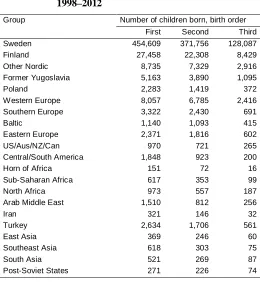
whichever comes first. Those who had twins in their first or second delivery are excluded from the analysis of the subsequent parity progression. Appendix Tables A-1 and A-2 provide an overview of the number of woman-years under observation (Table A1) and the number of children born at the different birth orders (Table A-2), by country group of origin. Appendix Tables A-3 through A-5 show the distribution of descendants of immigrants over age groups (Table A-3), categories of educational attainment (Table A-4), and labor market status (Table A-5).
7. Results
As an introduction to our analysis, we present period total fertility rates for each year during 1970‒2012 for the aggregate populations of Swedish-born women with at least one foreign-born parent and Swedish-born women with two Swedish-born parents, respectively (Figure 1). These aggregate measures of fertility can be calculated for a more extended period than we cover in our subsequent analyses. The presentation is intriguing. It shows that during the entire period, total fertility was slightly lower for the descendants of immigrants in Sweden than for women with a full Swedish background. This speaks against the hypothesis that the fertility of the descendants of immigrants should fall somewhere between the somewhat elevated fertility of immigrants to Sweden (Statistics Sweden 2014) and that of the population with a full native-Swedish background. Instead, the descendants of immigrants seem to deviate with a clear low-fertility behavior.
Figure 1: Total fertility rate by background in Sweden, 1970‒2012
Source: Swedish population registers, authors’ own calculations
7.1 First-birth fertility
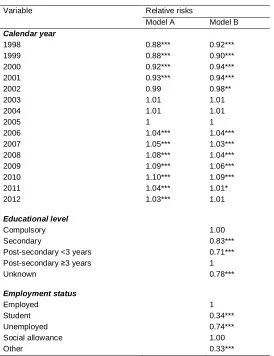
In the next step we extend our model in order to discern how much of the difference in first-birth risks can be explained by differences across country groups in socioeconomic characteristics (Model B). Table A-4 of the appendix shows that most groups of descendants of immigrants have lower educational attainment than those with a full Swedish background. Table A-5 shows that they are also employed to a lower extent than women with two Swedish-born parents (see also Statistics Sweden 2010a). There are exceptions to this, though: Daughters of parents born in the Baltic states stand out with high educational attainment and high levels of employment. Women with parents from Western Europe, Eastern Europe, or East Asia also have relatively high educational attainment. On the other end, women with a parental background in the Horn of Africa, the Arab Middle East, Iran, or Southeast Asia have much lower levels of education than women with a full Swedish background (Table A-4). Many women in these groups are still students (Table A-5). To a large extent, this is related to the fact that the descendants of the most recent groups of immigrants are still relatively young (Table A-3). In our multivariate analyses, we control for such differences in age composition.
Table 2: Relative risk of having a first child in Sweden, childless women aged 17–45, 1998–2012. Swedish-born women by their parents’ country of birth
Variable Relative risks
Model A Model B Background
Sweden 1 1
Finland 0.97*** 0.99**
Other Nordic 1.02** 1.04***
Former Yugoslavia 0.91*** 0.94***
Poland 0.69*** 0.75***
Western Europe 0.84*** 0.88*** Southern Europe 0.78*** 0.84***
Baltic 0.88*** 0.89***
Eastern Europe 0.80*** 0.84*** US/Aus/NZ/Can 0.70*** 0.78*** Central/South America 0.85*** 0.92*** Horn of Africa 0.43*** 0.49*** Sub-Saharan Africa 0.73*** 0.79***
North Africa 0.77*** 0.82***
Middle East 0.96 1.02
Iran 0.43*** 0.48***
Turkey 1.06*** 1.10***
East Asia 0.58*** 0.63***
Southeast Asia 0.71*** 0.76***
South Asia 0.60*** 0.66***
Post-Soviet States 0.65*** 0.70***
Age group
≤19 years 0.07*** 0.12***
20‒24 years 0.35*** 0.40***
25‒29 years 1 1
Table 2: (Continued)
Variable Relative risks
Model A Model B Calendar year
1998 0.88*** 0.92***
1999 0.88*** 0.90***
2000 0.92*** 0.94***
2001 0.93*** 0.94***
2002 0.99 0.98**
2003 1.01 1.01
2004 1.01 1.01
2005 1 1
2006 1.04*** 1.04***
2007 1.05*** 1.03***
2008 1.08*** 1.04***
2009 1.09*** 1.06***
2010 1.10*** 1.09***
2011 1.04*** 1.01*
2012 1.03*** 1.01
Educational level
Compulsory 1.00
Secondary 0.83***
Post-secondary <3 years 0.71*** Post-secondary≥3 years 1
Unknown 0.78***
Employment status
Employed 1
Student 0.34***
Unemployed 0.74***
Social allowance 1.00
Other 0.33***
7.2 Second-birth fertility
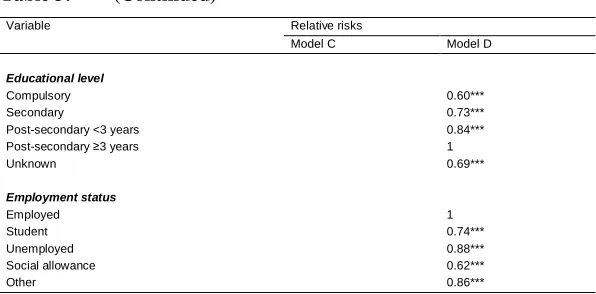
The relative risks of one-child mothers having a second child are presented in Table 3. These results show that practically all groups of descendants of immigrants also have lower second-birth fertility than women with a full Swedish background. The only exceptions are women of East Asian origin, for whom the second-birth risk is equal to that of native Swedes, and women of Baltic and Arab Middle East parental origin, who are slightly more likely to have a second child than women with a full Swedish background – although this difference is statistically significant only for the latter group. As for women of (non-Baltic) European origin, second-birth fertility is depressed by 4% to 14%, with even lower levels observed for women with a parental background from the former Soviet Union. Turning to daughters of immigrants from non-European countries, the depressed relative risks of second birth are most pronounced among women with parents from the Horn of Africa and South Asia, with risks comparable to those of women with parents from the former non-Baltic Soviet republics. Still, we note that the second-birth risks of most categories of descendants of immigrants (Table 3) appear somewhat less depressed than their corresponding first-birth fertility (Table 2). For example, for women with East Asian and Iranian parental background, we observe substantially depressed risks of becoming a mother while there is no statistically significant difference between them and native women in their second-birth fertility.
Table 3: Relative risk of having a second child for one-child mothers aged 17– 45, 1998–2012. Swedish-born women by their parents’ country of birth
Variable Relative risks
Model C Model D
Background
Sweden 1 1
Finland 0.88*** 0.93***
Other Nordic 0.89*** 0.94***
Former Yugoslavia 0.88*** 0.93***
Poland 0.88*** 0.91***
Western Europe 0.96*** 0.96***
Southern Europe 0.86*** 0.90***
Baltic 1.05 1.02
Eastern Europe 0.93*** 0.94***
US/Aus/NZ/Can 0.94 0.94
Central/South America 0.82*** 0.88***
Horn of Africa 0.73*** 0.74**
Sub-Saharan Africa 0.83*** 0.87***
North Africa 0.83*** 0.89***
Middle East 1.08** 1.15***
Iran 0.92 0.93
Turkey 0.94** 1.02
East Asia 1.00 0.97
Southeast Asia 0.84*** 0.90*
South Asia 0.75*** 0.75***
Post-Soviet States 0.76*** 0.78***
Age group
≤19 years 0.21*** 0.32***
20‒24 years 0.67*** 0.81***
25‒29 years 1 1
30‒34 years 1.15*** 1.06***
35‒39 years 0.73*** 0.70***
40‒45 years 0.12*** 0.12***
Calendar year
1998 0.88*** 0.95***
1999 0.88*** 0.94***
2000 0.87*** 0.92***
2001 0.87*** 0.91***
2002 0.92*** 0.94***
2003 0.95*** 0.96***
2004 0.98** 0.99
2005 1 1
2006 1.04*** 1.03***
2007 1.03*** 1.01*
2008 1.03*** 1.00
2009 1.06*** 1.02**
2010 1.10*** 1.06***
2011 1.06*** 1.02**
Table 3: (Continued)
Variable Relative risks
Model C Model D
Educational level
Compulsory 0.60***
Secondary 0.73***
Post-secondary <3 years 0.84***
Post-secondary ≥3 years 1
Unknown 0.69***
Employment status
Employed 1
Student 0.74***
Unemployed 0.88***
Social allowance 0.62***
Other 0.86***
Source: Swedish register data, authors’ own calculations *** = significant at the 1% level, ** = 5% level, * = 10% level.
7.3 Third-birth fertility
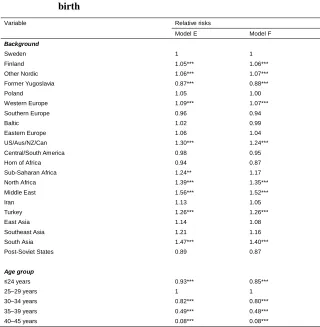
vis-à-vis women with a full Swedish background that is statistically significant is for women of Yugoslav parental origin.
The particularity of third-birth behavior also manifests itself in the association of labor market characteristics with third-birth fertility. Whereas tertiary education is associated with elevated third-birth fertility, we note that employed women are less likely to have a third child as compared to those who are unemployed, inactive, or receiving social allowance. Yet the group-specific patterns of third-birth risk remain very little affected by the inclusion of socioeconomic characteristics in our model.
Table 4: Relative risk of having a third child for two-child mothers aged 17– 45, 1998–2012. Swedish-born women by their parents’ country of birth
Variable Relative risks
Model E Model F
Background
Sweden 1 1
Finland 1.05*** 1.06***
Other Nordic 1.06*** 1.07***
Former Yugoslavia 0.87*** 0.88***
Poland 1.05 1.00
Western Europe 1.09*** 1.07***
Southern Europe 0.96 0.94
Baltic 1.02 0.99
Eastern Europe 1.06 1.04
US/Aus/NZ/Can 1.30*** 1.24***
Central/South America 0.98 0.95
Horn of Africa 0.94 0.87
Sub-Saharan Africa 1.24** 1.17
North Africa 1.39*** 1.35***
Middle East 1.56*** 1.52***
Iran 1.13 1.05
Turkey 1.26*** 1.26***
East Asia 1.14 1.08
Southeast Asia 1.21 1.16
South Asia 1.47*** 1.40***
Post-Soviet States 0.89 0.87
Age group
≤24 years 0.93*** 0.85***
25‒29 years 1 1
30‒34 years 0.82*** 0.80***
35‒39 years 0.49*** 0.48***
Table 4: (Continued)
Variable Relative risks
Model E Model F
Calendar year
1998 0.85*** 0.87***
1999 0.87*** 0.90***
2000 0.91*** 0.93***
2001 0.91*** 0.93***
2002 0.93*** 0.95***
2003 0.99 1.01
2004 1.00 1.00
2005 1 1
2006 1.08*** 1.06***
2007 1.11*** 1.09***
2008 1.11*** 1.08***
2009 1.11*** 1.07***
2010 1.17*** 1.11***
2011 1.11*** 1.06***
2012 1.12*** 1.06***
Educational level
Compulsory 0.82***
Secondary 0.66***
Post-secondary <3 years 0.74***
Post-secondary ≥3 years 1
Unknown 1.05
Employment status
Employed 1
Student 0.95***
Unemployed 1.25***
Social allowance 1.39***
Other 1.23***
Source: Swedish register data, authors’ own calculations *** = significant at the 1% level, ** = 5% level, * = 10% level.
8. Discussion and conclusions
Intriguingly, total fertility appears somewhat lower for the so-called second generation than for women with a full Swedish background.
In our subsequent analyses, we proceeded to break down this data into fertility measures that are specific to each parity progression, and into relative risks that represent the huge diversity in parental backgrounds among the descendants of immigrants in Sweden. This serves to demonstrate that once we break down the second generation population, parental geographic origin appears to be an important predictor of childbearing risks. Our analysis thus demonstrates that the new heterogeneity in Swedish society following international migration also manifests itself in terms of considerable diversity in the underlying patterns of fertility behavior among women born in Sweden. Our study shows that many groups of second-generation women in Sweden indeed have lower fertility than women with full Swedish background: the first- and second-birth risks are depressed for almost all country groups of daughters of immigrants. For many groups, the birth risks are depressed to a very large extent. Socioeconomic characteristics such as educational attainment and labor market attachment explain only a small fraction of the observed differences in fertility. Our analyses show that differences between women of Swedish and immigrant parental backgrounds are somewhat more pronounced for first-birth fertility than for second-birth risks. Moreover, many groups of descendants of immigrants have higher third-birth risks than native women. This suggests that different factors come into play at different parity progressions; it demonstrates that a parity-specific approach is essential for a proper understanding of processes related to the fertility behavior of immigrants and their children.
2011), which implies that the share of second-generation women with one Swedish parent is higher in European second-generation groups.
The depressed first-birth fertility of descendants of immigrants suggests that their family formation and entry into adult life run slower than for women with two Swedish-born parents. There are reasons to believe that marriage and partnering market characteristics are responsible for at least part of the observed cross-group variation in first-birth risks. For most women, finding a partner is a conditionsine qua non for the first childbirth. Therefore, the timing of the first childbirth may, to different extents, be associated with the timing of partnering. At the same time, children of immigrants from outside Europe may often have preferences for endogamous unions (Statistics Sweden 2010a), which may reduce the scope of partnering markets and delay family formation. The type of living arrangement may also matter for the entry into parenthood. In particular, the acceptance of cohabitation and non-marital childbearing is higher among natives than among persons of foreign background in Sweden (Dribe and Lundh 2012). Given that marriage is considered a more committed union that requires more resources than non-marital cohabitation (Wiik, Bernhardt, and Noack 2009; Thomson and Bernhardt 2010), we may find that children of immigrants from countries with a low prevalence of non-marital childbearing postpone childbearing until they can enter a formal marriage. In their recent study on marriage formation among immigrants and their children in Sweden, Andersson, Obućina, and Scott (2015) find that women with parents from Iran and the Horn of Africa, two groups with the lowest first-birth risks in our study, are also among the women with the lowest risk of marriage formation. This corroborates our view that partnering and marriage play an important role in shaping cross-group differences in first-birth behavior. Another explanation of our results is in line with the minority hypothesis: it is possible that the depressed first-birth risks may emerge because many children of immigrants need to invest more in a job and career than those with a full Swedish background do in order to achieve the same status and sense of security. In such a situation, family formation may be delayed. It could also be the case that with access to networks in more than one country, second-generation women simply have more opportunities to pursue many other activities than settling down early to form a family. Finally, it may be that some of the observed differences in first-birth rates stem from the bias created by unregistered emigration of descendants of immigrants. As a robustness check, we have re-estimated fertility rates based only on women with clear evidence of registered activity in Sweden. This procedure produces rates that are very similar to those presented here.
what extent this norm is a source of difference in the childbearing behaviors of women with Swedish and foreign backgrounds. The two-child norm also prevails in many other countries of origin that are relevant for our study populations (Sobotka and Beaujouan 2014), whereas in some other countries of parental origin women typically have more than two children. Differentials in the risks of having a second child may rather be due to lower responsiveness to the ‘speed premium’ policy of the Swedish parental-leave system (Andersson, Hoem, and Duvander 2006). Evidently, the Swedish pattern of rapid progression to second childbearing is not universally shared by all subgroups in society. Yet we also note that the differences between second-generation women and those with a full Swedish background are generally less pronounced in second- than first-birth fertility. Evidently, differences in behavior that stem from the influence of factors related to partnering markets and family formation play a less prominent role for the second childbirth, at least among women who do not experience union dissolution.
In contrast to the first two parity progressions, we find at least some evidence of high-fertility behavior when it comes to the third-birth fertility of the descendants of immigrants. With the exception of Swedish-born women with a parental background in overseas Anglo-Saxon countries, the second-generation groups with substantially elevated third-birth risks all have family roots in regions with fertility rates that are higher than those in Sweden. Thus, many of these patterns likely stem from the transmission of high-fertility behavior from the parental generation to their children (Knudsen and Murphy 2002; Kolk 2014).
9. Acknowledgments
References
Abbasi-Shavazi, M.J. and McDonald, P. (2000). Fertility and multiculturalism: Immigrant fertility in Australia, 1977‒1991. International Migration Review
34(1): 215–242.doi:10.2307/2676018.
Adserà, A. and Ferrer, A. (2014). Immigrants and demography: Marriage, divorce, and fertility. IZA Discussion Paper 7982.
Andersson, G. (1999). Childbearing trends in Sweden, 1961‒1997. European Journal
of Population 15(1): 1–24.doi:10.1023/A:1006145610780.
Andersson, G. (2000). The impact of labor-force participation on childbearing behavior: Pro-cyclical fertility in Sweden during the 1980s and the 1990s. European
Journal of Population16(4): 293–333.doi:10.1023/A:1006454909642.
Andersson, G. (2004). Childbearing after migration: Fertility patterns of foreign-born women in Sweden. International Migration Review38(2): 747–775.doi:10.111 1/j.1747-7379.2004.tb00216.x.
Andersson, G. and Drefahl, S. (2016). Long-distance migration and mortality in Sweden: Testing the salmon bias and healthy migrant hypotheses. Population, Space and Place: online first.doi:10.1002/psp.2032.
Andersson, G., Hoem, J.M., and Duvander, A.-Z. (2006). Social differentials in speed-premium effects in childbearing in Sweden. Demographic Research14(4): 51– 70.doi:10.4054/DemRes.2006.14.4.
Andersson, G. and Kolk, M. (2015). Trends in childbearing, marriage and divorce in Sweden: An update with data up to 2012. Finnish Yearbook of Population
Research 50: 21–30.
Andersson, G., Obućina, O., and Scott, K. (2015). Marriage and divorce of immigrants and descendants to immigrants in Sweden.Demographic Research 33(2): 31–64.
doi:10.4054/DemRes.2015.33.2.
Andersson, G. and Scott, K. (2005). Labour-market status and first-time parenthood: The experience of immigrant women in Sweden, 1981–97. Population Studies
59(1): 21–38.doi:10.1080/0032472052000332683.
Bélanger, A. and Gilbert, S. (2003). The fertility of immigrant women and their Canadian-born daughters. Report on the Demographic Situation in Canada 2002.
Ottawa: Statistics Canada.
Bernhardt, E. (1993). Fertility and employment. European Sociological Review9(1): 25–42.doi:10.1093/oxfordjournals.esr.a036659.
Bernhardt, E., Goldscheider, C., Goldscheider, F., and Bjerén, G. (2007).Immigration,
gender and family transition to adulthood in Sweden. Lanham: University Press
of America.
Blau, F., Kahn, L., Yung-Hsu Liu, A., and Papps, K. (2008). The transmission of women’s fertility, human capital and work orientation across immigrant generations. NBER Working Paper 14388. Cambridge: NBER. doi:10.3386/ w14388.
de Valk, H. and Milewski, N. (2011). Family life transitions among children of immigrants: An introduction.Advances in Life Course Research 16(4): 145–151.
doi:10.1016/j.alcr.2011.10.001.
Dribe, M. and Lundh, C. (2008). Intermarriage and immigrant integration in Sweden: An exploratory analysis.Acta Sociologica51(4): 329–354. doi:10.1177/0001 699308097377.
Dribe, M. and Lundh, C. (2011). Cultural dissimilarity and intermarriage: A longitudinal study of immigrants in Sweden 1990–2005.International Migration
Review 45(2): 297–324.doi:10.1111/j.1747-7379.2011.00849.x.
Dribe, M. and Lundh, C. (2012). Intermarriage, value context and union dissolution: Sweden 1990–2005.European Journal of Population 28(2): 139–158.
doi:10.1007/s10680-011-9253-y.
Duvander, A.-Z. and Olsson, S. (2001). När har vi råd att skaffa barn? [When can we afford to have children?]. RFV Analyserar 2001:8. Stockholm: National Social Insurance Agency.
Ford, K. (1990). Duration of residence in the United States and the fertility of US immigrants. International Migration Review 24(1): 34–68. doi:10.2307/ 2546671.
Forste, R. and Tienda, M. (1996). What’s behind racial and ethnic fertility differentials?
Population and Development Review 22 (Supplement): 109–133. doi:10.2307/
Frank, R. and Heuveline, P. (2005). A crossover in Mexican and Mexican-American fertility rates: evidence and explanations for an emerging paradox.Demographic
Research 12(4): 77–104.doi:10.4054/DemRes.2005.12.4.
Garssen, J. and Nicolaas, H. (2008). Fertility of Turkish and Moroccan women in the Netherlands: Adjustment to native level within one generation. Demographic
Research19(33): 1249–1280.doi:10.4054/DemRes.2008.19.33.
Goldscheider, F., Bernhardt, E., and Lappegård, T. (2015). The gender revolution: A framework for understanding changing family and demographic behavior.
Population and Development Review 41(2): 207–239.
doi:10.1111/j.1728-4457.2015.00045.x.
Halli, S.S. (1989). Toward a re-conceptualization of minority group status and fertility hypothesis: The case of Orientals in Canada. Journal of Comparative Family Studies 20(1): 21–46.
Hoem, B. (2000). Entry into motherhood in Sweden: The influence of economic factors on the rise and fall in fertility, 1986–1997. Demographic Research 2(4).
doi:10.4054/DemRes.2000.2.4.
Hoem, B. and Hoem, J.M. (1996). Sweden’s family policies and roller-coaster fertility.
Jinko Mondai Kenkyu (Journal of Population Problems) 52: 1–22.
Hoem, J.M. (1993). Public policy as the fuel of fertility: effects of a policy reform on the pace of childbearing in Sweden in the 1980s.Acta Sociologica 36(1): 19–31.
doi:10.1177/000169939303600102.
Hoem, J.M. and Nedoluzhko, L. (2016). The dangers of using ‘negative durations’ to estimate pre- and post-migration fertility. Population Studies 70(3): 359–363.
doi:10.1080/00324728.2016.1221442.
Jalovaara, M., Neyer, G., Andersson, G., Dahlberg, J., Dommermuth, L., Fallesen P., and Lappegård, T. (2017). Gender, education and cohort fertility in the Nordic countries. Stockholm Research Reports in Demography 2017: 6.
Kahn, J. (1988). Immigrant selectivity and fertility adaptation in the United States.
Social Forces 67(1): 108–128.doi:10.2307/2579102.
Kalmijn, M. (1998). Intermarriage and homogamy: Causes, patterns, trends.Annual Review of Sociology 24: 395–421.doi:10.1146/annurev.soc.24.1.395.
Khoo, S.-E. and McDonald, P. (2003). The transformation of Australia’s population
Knudsen, L. and Murphy, M. (2002). The intergenerational transmission of fertility in contemporary Denmark: The effects of number of siblings (full and half), birth order, and whether male or female. Population Studies 56(3): 235–248.
doi:10.1080/00324720215937.
Kolk, M. (2014). Multigenerational transmission of family size in contemporary Sweden. Population Studies 68(1): 111–129. doi:10.1080/00324728.2013. 819112.
Kulu, H. (2005). Migration and fertility: Competing hypotheses re-examined.European
Journal of Population 21(1): 51–87.doi:10.1007/s10680-005-3581-8.
Kulu, H. and González-Ferrer, A. (2014). Family dynamics among immigrants and their descendants in Europe: Current research and opportunities.European Journal of
Population 30(4): 411–435.doi:10.1007/s10680-014-9322-0.
Kulu, H. and Hannemann, T. (2016). Why does fertility remain high among certain UK-born ethnic minority women? Demographic Research 35(49): 1441–1488.
doi:10.4054/DemRes.2016.35.49.
Kulu, H., Hannemann, T., Pailhé, A., Neels, K., Krapf, S., González-Ferrer, A., and Andersson, G. (2017). Fertility by birth order among the descendants of immigrants in selected European countries.Population and Development Review
43(1): 31‒60.doi:10.1111/padr.12037.
Kulu, H. and Milewski, N. (2007). Family change and migration in the life course: An introduction. Demographic Research 17(19): 567–590. doi:10.4054/DemRes. 2007.17.19.
Lundström, K. and Andersson, G. (2012). Labor market status, migrant status and first childbearing in Sweden.Demographic Research27(25): 719–742. doi:10.4054/ DemRes.2012.27.25.
Milewski, N. (2007). First child of immigrant workers and their descendants in West Germany: interrelations of events, disruption, or adaptation? Demographic
Research 17(29): 859–896.doi:10.4054/DemRes.2007.17.29.
Milewski, N. (2010a). Fertility of immigrants: A two-generational approach in
Germany. Demographic Research Monographs. Heidelberg: Springer.
doi:10.1007/978-3-642-03705-4.
Milewski, N. (2010b). Immigrant fertility in West Germany: Is there a socialization effect in transitions to second and third births?European Journal of Population
Milewski, N. (2011). Transition to a first birth among Turkish second-generation migrants in Western Europe.Advances in Life Course Research 16(4): 178–189.
doi:10.1016/j.alcr.2011.09.002.
Parrado, E. (2011). How high is Hispanic/Mexican fertility in the United States? Immigration and tempo considerations. Demography 48(3): 1059–1080.
doi:10.1007/s13524-011-0045-0.
Parrado, E. and Morgan, P. (2008). Intergenerational fertility among Hispanic women: New evidence of immigrant assimilation. Demography 45(3): 651–671.
doi:10.1353/dem.0.0023.
Persson, L. and Hoem, J.M. (2014). Immigrant fertility in Sweden, 2000‒2011: A descriptive note. Demographic Research 30(30): 887–898. doi:10.4054/ DemRes.2014.30.30.
Scott, K. and Stanfors, M. (2010). Second generation mothers: Do the children of immigrants adjust their fertility to host country norms? In: Salzmann, T., Edmonston, B., and Raymer, J. (eds.). Demographic aspects of migration. Wiesbaden: VS Verlag.doi:10.1007/978-3-531-92563-9_5.
Scott, K. and Stanfors, M. (2011). The transition to parenthood among the second generation: Evidence from Sweden, 1990–2005. Advances in Life Course Research16(4): 190–204.doi:10.1016/j.alcr.2011.09.003.
Sobotka, T. (2008). The rising importance of migrants for childbearing in Europe.
Demographic Research 19(9): 225–248.doi:10.4054/DemRes.2008.19.9.
Sobotka, T. and Beaujouan, É. (2014). Two is best? The persistence of a two-child family ideal in Europe. Population and Development Review 40(3): 391–419.
doi:10.1111/j.1728-4457.2014.00691.x.
Statistics Sweden (2004). Efterkrigstidens invandring och utvandring [Immigration and emigration during the postwar period]. Demografiska rapporter 2004: 5.
Statistics Sweden (2006). Historic Population Register. Background Facts on Population and Welfare Statistics 2006: 3.
Statistics Sweden (2010a). Födda i Sverige – ändå olika? [Born in Sweden – yet different?] Demografiska rapporter 2010: 2.
Statistics Sweden (2011). Tredje barnet – en ny trend? [The third child – a new trend?] Demografiska rapporter 2011: 1.
Statistics Sweden (2014). Utrikes föddas barnafödande – före och efter invandring [Childbearing of the foreign-born – before and after migration]. Demografiska rapporter 2014: 4.
Statistics Sweden (2016). Från Finland till Afghanistan – invandring och utvandring för födda i olika länder sedan 1970 [From Finland to Afghanistan – immigration and emigration since 1970 for people born in different countries]. Demografiska rapporter 2016: 1.
Stephen, E. and Bean, F. (1992). Assimilation, disruption, and the fertility of Mexican American women in the United States. International Migration Review 26(1): 67–88.doi:10.2307/2546937.
Thomson, E. and Bernhardt, E. (2010). Education, values, and cohabitation in Sweden.
Marriage and Family Review46(1‒2): 1–21.doi:10.1080/01494921003648431.
Toulemon, L. and Mazuy, M. (2004). Comment prendre en compte l’âge à l’arrivée et la durée de séjour en France dans la mesure de la fécondité des immigrants? Documents de travail 120, 2004. Paris: INED.
Wiik, K.A. and Holland, J. (2016). Partner choice and timing of first marriage among the children of immigrants in Norway and Sweden. Stockholm Research Reports in Demography 2016: 15.
Wiik, K.A., Bernhardt, E., and Noack, T. (2009). A study of commitment and relationship quality in Sweden and Norway. Journal of Marriage and Family
Appendix
Table A-1: Woman years in Sweden, by country background, 1998–2012
Group Woman years as:
Childless Parity 1 Parity 2 Sweden 8,852,048 2,774,740 4,717,810
Finland 535,018 185,801 277,433
Other Nordic 171,429 64,718 106,844 Former Yugoslavia 112,206 29,127 35,114
Poland 70,383 10,886 10,479
Western Europe 169,730 56,702 92,023 Southern Europe 76,916 19,550 22,800
Baltic 18,555 9,647 20,210
Eastern Europe 53,679 14,771 21,662 US/Aus/NZ/Can 30,271 6,134 9,396 Central/South America 59,637 7,608 5,141
Horn of Africa 12,592 604 457
Sub-Saharan Africa 20,445 2,739 2,262
North Africa 28,440 4,465 3,516
Arab Middle East 53,868 5,302 3,751
Iran 25,730 1,108 752
Turkey 63,945 11,746 9,427
East Asia 14,041 1,748 1,793
Southeast Asia 27,213 2,396 1,514
South Asia 21,677 2,254 1,793
Post-Soviet States 8,738 2,580 4,181
Table A-2: Number of children born, by country background in Sweden, 1998–2012
Group Number of children born, birth order First Second Third
Sweden 454,609 371,756 128,087
Finland 27,458 22,308 8,429
Other Nordic 8,735 7,329 2,916
Former Yugoslavia 5,163 3,890 1,095
Poland 2,283 1,419 372
Western Europe 8,057 6,785 2,416
Southern Europe 3,322 2,430 691
Baltic 1,140 1,093 415
Eastern Europe 2,371 1,816 602
US/Aus/NZ/Can 970 721 265
Central/South America 1,848 923 200
Horn of Africa 151 72 16
Sub-Saharan Africa 617 353 99
North Africa 973 557 187
Arab Middle East 1,510 812 256
Iran 321 146 32
Turkey 2,634 1,706 561
East Asia 369 246 60
Southeast Asia 618 303 75
South Asia 521 269 87
Post-Soviet States 271 226 74
Table A-3: Woman years in Sweden, by country background and age, 1998–2012. Percentage distribution by age (time-varying)
Group Woman years Total
≤19 20‒24 25‒29 30‒34 35‒39 40‒45
Sweden 11 18 19 19 16 17 100
Finland 11 19 19 19 17 16 100
Other Nordic 11 17 17 17 17 21 100
Former Yugoslavia 17 22 22 20 13 6 100
Poland 20 31 23 14 7 5 100
Western Europe 9 15 17 19 19 21 100
Southern Europe 12 22 23 20 14 9 100
Baltic 2 4 11 21 27 36 100
Eastern Europe 12 18 19 19 17 16 100
US/Aus/NZ/Can 18 23 16 13 12 17 100
Central/South America 31 36 19 9 4 2 100
Horn of Africa 45 33 12 5 3 1 100
Sub-Saharan Africa 27 31 20 12 6 3 100
North Africa 24 31 21 14 7 3 100
Arab Middle East 40 36 15 6 2 1 100
Iran 42 38 12 5 2 1 100
Turkey 25 36 24 11 3 1 100
East Asia 24 27 19 14 9 7 100
Southeast Asia 37 36 17 6 2 1 100
South Asia 28 34 20 10 5 3 100
Post-Soviet States 14 15 13 14 18 27 100
Table A-4: Woman years in Sweden, by country background and educational level, 1998–2012. Percentage distribution by educational level (time-varying)
Group Woman years Total
Primary Secondary Post-sec <3 years Post-sec≥3 years Unknown
Sweden 18 46 16 20 1 100
Finland 21 49 14 15 1 100
Other Nordic 22 49 13 15 1 100
Former Yugoslavia 25 47 13 14 1 100
Poland 28 38 16 17 2 100
Western Europe 16 44 17 22 1 100
Southern Europe 22 45 14 17 2 100
Baltic 7 43 20 29 0 100
Eastern Europe 19 42 16 21 1 100
US/Aus/NZ/Can 24 38 17 19 2 100
Central/South America 40 36 12 10 3 100
Horn of Africa 49 29 10 9 3 100
Sub-Saharan Africa 35 35 13 15 2 100
North Africa 32 38 13 13 3 100
Arab Middle East 46 33 10 8 3 100
Iran 46 30 13 9 2 100
Turkey 36 43 10 9 2 100
East Asia 28 30 18 23 1 100
Southeast Asia 44 34 11 10 2 100
South Asia 32 33 16 16 2 100
Post-Soviet States 22 40 18 19 1 100
Source: Swedish register data, authors’ own calculations
Table A-5: Woman years in Sweden, by country background and labor market status, 1998–2012. Percentage distribution by labor market status (time-varying)
Group Woman years Total
Employed Student Unemployed Allowance Other
Sweden 70 19 4 1 6 100
Finland 67 19 5 3 7 100
Other Nordic 67 18 5 2 7 100
Former Yugoslavia 59 24 6 3 8 100
Poland 50 34 4 3 9 100
Western Europe 69 18 4 2 8 100
Southern Europe 60 22 5 2 12 100
Baltic 81 8 4 1 6 100
Eastern Europe 64 22 5 2 8 100
US/Aus/NZ/Can 57 28 4 2 10 100
Central/South America 43 41 4 4 9 100
Horn of Africa 29 57 3 3 9 100
Sub-Saharan Africa 45 38 4 3 9 100
North Africa 47 34 4 5 10 100
Arab Middle East 35 47 5 5 8 100
Iran 32 55 3 3 7 100
Turkey 47 33 7 3 9 100
East Asia 50 38 3 1 8 100
Southeast Asia 39 47 4 3 7 100
South Asia 42 44 3 2 8 100
Post-Soviet States 63 23 4 2 8 100
Source: Swedish register data, authors’ own calculations
Notes: Employed: The data is originally derived from labor-force statistics from administrative sources. Based on a number of conditions, the person is defined as either working or not working. To be counted as employed, the person should have worked at least one hour a week in November of a given year.
Student: The data is originally derived from the Register of Education. To be counted as a student, the person has to be registered as a student in the fall semester of the current year.
Unemployed: If the person is counted as neither a student nor employed, and has been registered at the employment office more than 75 days in a calendar year, the person is classified as unemployed. Information on registration at the employment office is derived from the AMS register of the Swedish Employment Board.
Allowance: If the person has received income support for more than five months of the current year, the person is included in this category.