Matthew B. Hastings1, 2 1
Station Q, Microsoft Research, Santa Barbara, CA 93106-6105, USA
2Quantum Architectures and Computation Group, Microsoft Research, Redmond, WA 98052, USA
We give a quantum algorithm to exactly solve certain problems in combinatorial optimization, including weighted MAX-2-SAT as well as problems where the objective function is a weighted sum of products of Ising variables, all terms of the same degreeD; this problem is called weighted MAX-ED-LIN2. We require that the optimal solution be unique for odd D and doubly degenerate for evenD; however, we expect that the algorithm still works without this condition and we show how to reduce to the case without this assumption at the cost of an additional overhead. While the time required is still exponential, the algorithm provably outperforms Grover’s algorithm assuming a mild condition on the number of low energy states of the target Hamiltonian. The detailed analysis of the runtime depends on a tradeoff between the number of such states and algorithm speed: having fewer such states allows a greater speedup. This leads to a natural hybrid algorithm that finds either an exact or approximate solution.
I. INTRODUCTION
While quantum algorithms are useful for many problems involving linear algebra (for example, finding eigenvalues18, solving linear equations15, and performing Hadamard transforms1), there are few proven speedups for combinatorial optimization problems. The most basic such speedup is Grover’s algorithm14, which gives a quadratic speedup over a brute-force search. For a problem such as finding the ground state of an Ising model onN spins, this can lead to a speedup from a brute force time O∗(2N) (whereO∗(·) is big-O notation up to polylogarithmic factors, in this case
polynomials in N) to O∗(2N/2). In the black box setting, Grover’s algorithm is optimal4, but for problems with a structure one might try to find a further speedup.
One attempt to find a speedup is the adiabatic algorithm10. Here, let H
Z be a Hamiltonian which is diagonal in the computational basis, such as
HZ =
X
i,j
Ji,jZiZj, (1)
whereilabels different qubits and Zi is the PauliZ matrix on thei-th qubit. Then, consider the Hamiltonian
Hs=−(1−s)X+sHZ, (2)
where
X=X i
Xi (3)
andXiis the PauliX matrix on thei-th qubit. Ats= 0, the ground state of this Hamiltonian can be easily prepared. Ats= 1, the ground state is the ground state ofHZ. If the spectral gap ofHsbetween the ground and first excited state is only polynomially small fors∈[0,1], then one may adiabatically evolve the ground state froms= 0 tos= 1 in polynomial time.
Unfortunately, the gap may become superpolynomially small. Indeed, it was argued using ideas from Anderson localization2 that the gap may become as small asN−const.×N so that the time required for adiabatic evolution is of order Nconst.×N which is much slower than even classical brute force search. While the actual behavior for random instances may be more complicated than this20, specific examples33 can show this behavior.
This is perhaps not surprising. The problem of finding the ground state ofHZ is extremely hard, even if we restrict Jij ∈ {−1,0,1} for all i, j. While some speedups are known for bounded degree (here, we consider the graph with spins as vertices and an edge between vertices if the corresponding element ofJ is nonzero, and degree refers to the degree of this graph)11,12,16,31, if we only allow polynomial space then the fastest classical algorithms for arbitrary J take a time O∗(2N). If we allow exponential space then it is possible to reduce this time to O∗(2ωN/3), where ω is the matrix multiplication exponent34. However, not only does that algorithm require exponential space, but it is not known how to give a Grover speedup of this algorithm, so that no quantum algorithm is known taking time O∗(2cN/2) for any c <1. Finally, this algorithm is specific to constraint satisfaction problems where each constraint only involves a pair of variables, rather than a triple or more.
Here we present a quantum algorithm to find the ground state of HZ which improves on Grover’s algorithm in many cases. In the next subsection we give the problem definition and define whichHZ we consider.
A. Problem Definition
The problem is to find the ground state of HZ (i.e., eigenstate of HZ with minimum eigenvalue; eigenvalues of HZ, Hswill often be called “energies”) assuming that the ground state energyE0is known. We impose the following conditions onHZ. LetN be the number of qubits. We letHZ be any Hamiltonian that is a weighted sum of products of Pauli Z operators, with each product containing exactly D such operators on distinct qubits for some given D. That is, the caseD= 2 is the Ising model, the caseD= 4 is a sum of termsZiZjZkZl fori, j, k, lall distinct, and so on. We takeD=O(1). We emphasize that all products must have the sameDso that we do not allow for example HZ =Z1Z2+Z1Z2Z3; this is for a reason explained later.
Each product has a weight that is an integer. We define Jtot to be the sum of the absolute values of the weights. We require thatJtot=O(poly(N)). That is, we fix someβ >0 and requireJtot=O(Nβ). (If all weights are chosen from{−1,+1}we have Jtot=O(N2).)
We require that HZ has a unique ground state for D odd while for D even we require that HZ has a doubly degenerate ground state. For evenD, the operatorQ
iXi commutes with the Hamiltonian, flipping all spins, so that every eigenvalue has an even degeneracy. We call this assumption the “degeneracy assumption”. We will analyze the performance of the algorithm without this assumption in future work. In an Appendix we show how to reduce to the case without this assumption at the cost of an additional time overhead.
We give two theorems 1,2 which describe the performance of the algorithm; the different theorems correspond to different choices of the parameters in the algorithm. Both theorems show, roughly, that at least one of two things holds: the algorithm finds the ground state in a certain expected time orHZ has a large number of low energy states, i.e., eigenstates with eigenvalue close toE0.
These theorems can be applied in one of two ways. One way is to define a promise problem, in which we are promised that HZ doesnot have such a large number of low energy states as well as promised the degeneracy assumption on H0. Then, the algorithm solves this promise problem. For this promise problem, while the algorithm is givenE0, it is not necessary to knowE0 in advance since one can try all possibleE0 with only polynomial overhead.
Alternatively, we can considerHZ without such a promise on the number of low energy states but still including the promise on the degeneracy assumption. Then, we give a hybrid algorithm which tries both running the quantum algorithm here to find the exact ground state as well as random sampling (or a Grover search) to find an approximate ground state. This hybrid algorithm will be explained after theorem 1.
The problem of minimizingHZ is also known as MAX-ED-LIN2, as we assume that each term is exactly of degree D, rather than having degree at mostD; of course, there is an overall sign difference also, as we try to minimizeHZ rather than maximizing. Due to the uniqueness conditions onHZ, we call this problem UNIQUE-MAX-ED-LIN2.
However, we can reduce any instance of MAX-2-LIN2 with a unique solution to UNIQUE-MAX-E2-LIN2, where MAX-2-LIN2 allows terms to have degree 1 or 2. Up to a sign difference, MAX-2-LIN2 with a unique solution means that we considerHZ =Pi,jJi,jZiZj+hiZi, with integerJi,j, hi andPi,j|Jij|+Pi|hi|=Jtot, withHZ required to have a unique ground state. We can find the ground state of this problem by finding one of the two ground states of a problem onN+ 1 spins defined byHZ =Pi,jJi,jZiZj+PihiZ0Zi, where 0 is the added spin.
B. Main Results
We now give the main results. The parameters B, K enter into the definition of the algorithm, given later; the algorithm makes use of a family of HamiltoniansHs=HZ−sB(X/N)K so that B sets the strength of a term that is proportional to a power (set byK) of the transverse field. In each theorem, the statement about the number of low energy states ofHZ is first expressed as a statement about probability distributions with high entropy and low energy which then implies the statement about the number of low energy states.
We give two distinct theorems. The first theorem considers the case thatK=Clog(N) forC >0 a fixed constant. The second theorem is more general, and allowsK to be an arbitrary odd integer with K ≥3; K may depend on N and the first theorem follows from the second. The first theorem is simply given as a way to explain some of the results in the particular case of a logarithmically growingK, when some of the results simplify; the second theorem gives stronger results but they are more complicated. Even in the case of a logarithmically growing K, the second theorem is stronger.
FixedK, compared to logarithmically growing K, leads to a larger speedup but requires a stronger promise. In an abuse of notation, when we write K = Clog(N), we mean thatK is taken to be the smallest odd integer larger than Clog(N). We explicitly write the dependence on these constants in the equations, not hiding them in big-O notation. The quantityb is a real number, 0< b <1. We takeb <1 else the second possibility (item 2 in the list) is trivially true and does not imply any interesting constraint on the density of states.
All entropies are measured in bits rather than nats. All logarithms are to base 2 unless otherwise specified. Theorem 1. Assume thatHZ obeys the degeneracy assumption. Suppose thatB=−bE0 andK=Clog(N). Then,
at least one of the following holds:
1. The algorithm finds the ground state in expected time
O∗2N/2exph− b 2CD
N log(N)
i
.
2. There is some probability distribution p(u) on computational basis states with entropy at least
S(comp)≥N·(1− O(1)/C)
and with expected value of HZ at most(1−b)E0+O(1)·JNtot2C2D2log(N)2. Further, for anyη >0, for some
E≤E0+ (1 +η)
b|E0|+O(1)·Jtot N2C
2D2log(N)2,
we have
log(W(E))≥N·(1− O(1)1 +η η
1 C)−
1 +η
η O(log(N)).
Theorem 1 implies the following corollary about a hybrid algorithm:
Corollary 1. There is an algorithm that, given HZ and E0, either outputs “approximate” or “exact”. If it outputs
“approximate”, it returns also a state with energy at most Eapprox ≡E0+ (1.01)
b|E0|+O(1)· Jtot
N2C
2D2log(N)2
and takes time at most O∗(2O(1)N/C). If it outputs “exact”, it outputs an exact ground state of H
Z. The expected
run time of the algorithm (averaged over both approximate and exact outputs, rather than conditioned on an output)
isO∗2N/2exph− b 2CD
N log(N)
i .
Proof. Takeη = 0.01.
Run the following algorithm. First, try repeated random sampling of states to find a state with energy at most Eapprox. Take a total of nsamp samples. If any sample succeeds, terminate the algorithm, returning “approximate” and the given state. If item 2 of the theorem holds, each sample succeeds in finding such a state with probability at least 2−O(1)N/C−O(log(N))= 2−O(1)N/C/poly(N), so one can choosen
samp=O∗(2O(1)N/C) such samples and succeed with probability at least 1−2−N.
If no sample succeeds, then run the quantum algorithm of this paper in parallel with a brute force search, until one of them finds an exact ground state, returning “exact” and the state found.
The run time bound on the approximate output holds by construction. We now show the expected run time bounds. If item 1 holds, then the algorithm of this paper succeeds in expected time O∗2N/2exph− b
2CD N log(N)
i
so the expected run time bound holds. If item 2 holds and the repeated random sampling fails to find an approximate state then the brute force search will find the ground state in timeO∗(2N); since the probability that the repeated random sampling fails is≤2−N, this adds a negligible amount to the expected time of the algorithm.
Remark: the repeated random sampling can be quadratically improved with Grover search but this only improves constants which are hidden in the big-O notation.
We now give the case of arbitraryK. The function τ(·) in theorem 2 is a continuous increasing function, taking [0,1] to [0,1]. It is defined in lemma 11. It is differentiable on this interval, except at zero; for small σ,
τ(σ) = Θ(
r σ
−log(σ)). (4)
In Fig. 1 we plotτ(·).
Theorem 2. Assume that HZ obeys the degeneracy assumption. Suppose thatB =−bE0 with 0 ≤b <1. Suppose
FIG. 1: A plot ofτ(·).
1. The algorithm finds the ground state in expected time
O∗2N/2exph− b 2DKN
i
.
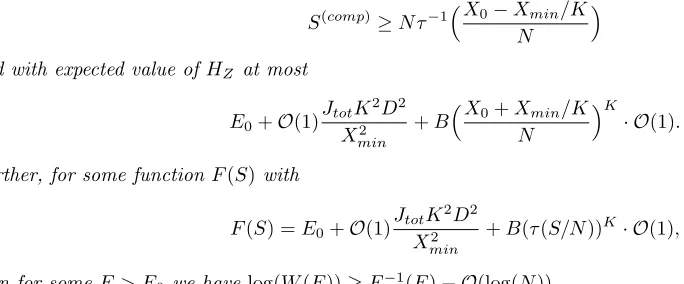
2. For someX0≥Xmin=N·(4B)−1/K, there is some probability distributionp(u)on computational basis states
with entropy in bits at least
S(comp)≥N τ−1X0−Xmin/K N
and with expected value of HZ at most
E0+O(1)
JtotK2D2 X2
min
+BX0+Xmin/K N
K
· O(1).
Further, for some function F(S) with
F(S) =E0+O(1)
JtotK2D2 X2
min
+B(τ(S/N))K· O(1), (5)
then for some E > E0 we havelog(W(E))≥F−1(E)− O(log(N)).
There are two parameters b, K that can be adjusted in this algorithm, so the implications of this theorem take some unpacking. We now argue, however, that for most problems for many choices ofb, Kthe conditions of items 2. of the theorem will not be satisfied and hence a nontrivial speedup will occur from item 1. The next paragraph will deliberately be more heuristic, and will draw on some physics intuition, since the goal is not to prove a result but rather to argue that certain conditions do not occur in most examples.
Let us consider a simple example, K = 99, b = 1/99. Then, either the algorithm gives a speedup over a Grover search, taking expected time O∗(2cN/2) for a c slightly less than 1, or there are a large number of computational basis states with low energy for HZ. Let us see whether we can satisfy log(W(E))≥F−1(E) for any E > E0. For E near 0, we have log(W(E)) close to N since a typical state has energyE near 0. If we had takenb= 1, we could then satisfyN ≥F−1(0). However, the functionF(S) is bounded atE
0+O(1)JtotK
2D2
X2
min
+BO(1), and the constant hidden in the big-O notation O(1) is such that forb = 1/99 we have F(S) bounded away from zero. Indeed, F(S) will be upper bounded by roughly (1−bO(1))E0. Let us, for clarity in explanation pretend that the constant hidden in the O(1) is equal to 1. Then, we could have a problem if F−1(98
99E0) ≈ N. However, this means an enormous (entropy almost equal toN) number of states have energy which is 98/99 times the ground state energy. Now let us instead ask whether the conditions of item 2. can be satisfied forX0 close to 0. Indeed, for an example such as the Sherrington-Kirkpatrick spin glass17, the entropy log(W(E)) has a power law dependence onE−E
0, with the scaling behavior well-understood9,25 from the Parisi solution26,27 giving log(W(E))∼N ·((E−E0)/|E0|)2/3. By choosing K large, from studying the limiting behavior of c we find that we might satisfy the condition at small E−E0 if log(W(E))∼N·((E−E0)/|E0|)2/99up to some polylogs in energy. So, again, we would not expect to obey item 2. at smallX0since 2/99<2/3. Note also that forK= 99, sinceB≤ O(N2) we haveXmin = Ω(N1−2/99) = Ω(N97/99) so thatXmin cannot be too small.
Even in the caseK=Clog(N), theorem 2 gives tighter bounds than theorem 1. The entropy in theorem 1 is the entropy forX0=Xmin, i.e., it is the minimum possible, while the energy given in theorem 1 is the largest possible that can occur from theorem 2 for K =Clog(N) and this value of energy would not occur for X0 =Xmin. Thus, theorem 2 gives stronger results involving a functional relationship between entropy and energy.
C. Outline
The algorithm has three distinct ideas. First we use a short path evolution, where the initial state is not a ground state of the initial Hamiltonian. That is, rather than trying to follow the full evolution from a transverse field Hamiltonian that is diagonal in the X basis to HZ which is diagonal in theZ basis, we instead follow only a “short path”, keeping a term proportional toHZ in the Hamiltonian fixed and varying a transverse field-like term from a small value to zero. We called this term “transverse field-like” rather than a transverse field, because we add a more complicated term −B(X/N)K that is proportional to a power of the transverse field. This is the second idea and plays a key role in avoiding small spectral gaps. The third idea uses measurements to obtain adiabatic evolution with exponentially small error; similar ideas are in Ref. 28,32.
We will show that either the algorithm succeeds in giving a nontrivial speedup or a certain spectral gap becomes small. However, for such a gap to become small, there must be some state with a large expectation value for −B(X/N)K and with a small expectation value forH
Z. Roughly, the idea then is that for a large K, this imposes strong constraints on the expectation value of X. For example, if the state is an eigenstate of X, then we would have hX/Ni = h(X/N)Ki1/K, and so for large K, even a small expectation value of (X/N)K would give a large expectation value for X/N. Technically, the implementation is more complicated than this because there may be large fluctuations in X in the state. Ignoring these technical details for the moment, the next idea is that given a large expectation value of X, we use log-Sobolev estimates on entropy to relate the expectation value of X to the entropy in the computational basis. This is then used to show that there must be many eigenstates of HZ with low energy.
Other technical tools used include a Brillouin-Wigner perturbation theory to compute overlaps and a method of localizing wavefunctions inX; this method is used to deal with the problem of large fluctuations inX.
In sections II,III we give the algorithm. In section IV we explain the Brillouin-Wigner perturbation theory. We then consider two cases, depending on the the spectrum of the HamiltonianQHsQ, whereQprojects onto the states ofHZ with energy greater thanE0. Theorem 3 in section V assumes the first case and gives bounds on the spectral gap of Hs and shows the speedup of the algorithm. Theorem 4 in section VI assumes the second case and shows the existence of probability distributions over computational basis states with high entropy and low energy. Putting these results together, theorems 1,2 follow as shown in section VII; there, we use the high entropy and low energy probability distributions to lower boundW(E). In section VIII, we briefly discuss some other results and also remark on a hybrid algorithm.
Section VI will use the ground state degeneracy assumption for convenience, but we will show how to remove this assumption for the results of this section. Section V will rely more heavily on the ground state degeneracy assumption; we will remove this assumption in future work using a modified perturbation theory.
II. THE SHORT PATH ALGORITHM
The algorithm that we use is based on applying amplitude amplification8to another algorithm. This latter algorithm is Algorithm 1. Remark: The case K = 1, B =cN corresponds to a transverse magnetic field of strength c. Also, note the direction of evolution froms= 1 tos= 0.
To analyze this algorithm for evenD we need a definition. ForD even, we define the “even subspace” to be the eigenspace ofQ
iXiwith eigenvalue +1 and define the “odd subspace” to be the eigenspace ofQiXi with eigenvalue −1. The HamiltonianHs commutes with QiXi and ψ+ is in the even subspace; the measurement algorithm will be chosen to preserve the eigenvalue of Q
iXi. When we analyze the algorithm for even D, all references for the remainder of the paper to the Hamiltonian will refer to the Hamiltonian projected into the even subspace and all vectors will be in the even subspace. We will remark on this as needed.
Algorithm 1Short-Path (unamplified version)
1. Prepare the wavefunction in the stateψ+=|+i⊗N.
2. Use the measurement algorithm of section III to evolve under the HamiltonianHsfroms= 1 tos= 0. where
Hs=HZ−sB(X/N)K, (6)
where
X=X
i
Xi. (7)
whereK is a positive odd integer andB is a scalar chosen later.
When we refer to a HamiltonianHs, it will be assumed thats∈[0,1] unless explicitly stated otherwise. We pickB >0
so thatHshas all off-diagonal entries non-positive in the computational basis.
3. Measure the state in the computational basis and compute the value ofHZafter measuring. If this value is equal toE0
then declare success and output the computational basis state.
We will compute the squared overlap
Pov≡ |hψ+|ψ0,1i|2. (8)
later. All state vectors that we write will be assumed to be normalized to have unit norm, except where explicitly stated otherwise later.
Suppose that the gap remains Ω(1/poly(N)) along the path. Indeed, later we will give conditions under which the gap is Ω(1). Then, for any Psucc <1, >0 we can use the measurement algorithm explained in section III to produce, with probability at least PovPsucc, a state equal to ψ0,0 up to some error . This algorithm takes a time that is O(poly(N,(1−Psucc)−1),log(1/)). This measurement algorithm has the advantage, compared to adiabatic evolution, that we can achieve a better scaling with the error.
Thus, the quantum algorithm described above succeeds with probability at leastPovPsucc−in finding the ground state ofHZ. We take= 2−N so that the erroris negligible compared toPovcomputed later. We choosePsucc= 1/2. Hence, applying the method of amplitude amplification to the evolution, one obtains an algorithm which succeeds in producing the ground state ofHZ in expected timeO(P−
1/2 ov P−
1/2
succ poly(N,log(1/)).
III. MEASUREMENT ALGORITHM FOR ADIABATIC EVOLUTION WITH SMALLER ERROR
We now explain how to do step2. of algorithm 1. We explain the method in a general setting and then show that in the particular case here, it can be reduced to a single measurement.
Suppose that we have a path of Hamiltonians Hs, for s∈ [0,1]. Suppose further that all of these Hamiltonians have a unique ground stateψ0,s, separated from the rest of the spectrum by a gap at least ∆ = Ω(1/poly(N)) and suppose thatk∂sHsk=O(poly(N)). Suppose that for anys, we can simulate time evolution underHsfor timet up to error δin a time that isO(poly(N, t,log(1/δ))). This holds for the Hamiltonians Hs considered above so long as B=O(poly(N)) using any of several different algorithms in the literature which achieve this time5–7,22,23.
We seek a quantum algorithm that, taking a state ψ as input with overlap Pov =|hψ|ψ0,1i|2, will succeed, with probability at least PovPsucc forPsucc close to 1, in giving an output state which is equal toψ0,0 up to some error , with exponentially small. A natural way to do this is to follow adiabatic evolution of the Hamiltonians, i.e., to simulate a time-dependent Hamiltonian which slowly changes fromH1 toH0, takingψas input to the evolution and
˜
ψas output. Unfortunately, this method has two problems, one minor and one major. We will explain these problems before giving a different approach using measurements that avoids these problems.
The minor problem is that we must then simulate time-dependent evolution of a Hamiltonian; this problem is not too serious as for example the Taylor series approach7can simulate this evolution in a time that isO(poly(N, t,log(1/δ))) even for slowly varying Hamiltonians. The major problem is that there may be diabatic transitions from the ground stateψ0,sto some excited state along the path. While there is some controversy about the exact error estimates in the adiabatic theorem3,29, even the best estimates give an error that is super-polynomially small but not exponentially small in the evolution time. Hence, even taking these estimates, in order to obtain an error δthat is exponentially small inN as we will need, we need a super-polynomial evolution time.
Instead we use the following algorithm 2. Later we will show that for the specific Hs considered in this paper, it suffices to use the simpler algorithm 3 given later. We present algorithm 2 here because it also works for more general paths of HamiltoniansHs, so long as a spectral gap is present and the adiabatic evolution can be simulated.
Algorithm 2Measurement Algorithm
1. Letψbe the input state.
2. Phase estimate ψusingH1. If the energy estimate is larger thanE0,1+ ∆/2, then terminate the algorithm and return
failure. Else continue.
3. Adiabatically evolveψfromH1 toH0.
4. Phase estimate ψusingH1. If the energy estimate is larger thanE0,1+ ∆/2, then terminate the algorithm and return
failure. Else declare success and returnψ.
One can also replace the adiabatic evolution of step3. with a sequence of measurements as in Ref. 28. This has the advantage that one does not need to simulate a time dependent evolution.
In algorithm 2, we use the initial phase estimation to approximately project onto ψ0,1. Then we adiabatically evolve. Finally we repeat with another phase estimation to project ontoψ0,0. We now consider the error in the phase estimation. We consider the phase estimation scheme of Ref. 19 though others are possible. There are two ways to quantify the error. One is the probability of error and the other is the precision. For us, it suffices to have a precision that is smaller than ∆/2 so that one distinguishes the energy of the ground and first excited states. We take the probability of error in any step to be so that the total probability of error isO(). If controlled time evolution can be implemented exactly, the phase estimation has an overhead that is only logarithmic in the error. For constantK, we can use any of the time evolution algorithms above or use28to implement the controlled time evolution with error O() for a timet∼∆−1 with a cost that isO(poly(∆−1, N,log(1/)).
For K = Clog(N), implementing the controlled time evolution is slightly more difficult. The Hamiltonian is no longer sparse when expressed in the computational basis. However, we can still use the approach of Ref. 23 or the related approach in Ref. 28 using a sequence of measurements to implement time evolution as follows. The term −sB(X/N)K can be expressed as a sum of terms, each of which is proportional to a projector onto an eigenspace of X, with eigenvalues−N,−N+ 2, . . . , N so that there areN+ 1 such terms. We can measure each such term using polynomially many gates by applying a Hadamard to all qubits, use an adder to compute to totalX, then uncomputing the addition and undoing the Hadamard. A similar approach might also work for the Taylor series approach7. Even without this way of decomposing −sB(X/N)K, the overhead due to the non-sparsity of the Hamiltonian would be quasi-polynomial and would be negligible compared to the improvements in theorems 1,2.
We choose the adiabatic evolution so that for input stateψ=ψ0,1, the output state has squared overlap withψ0,0 equal to 1−Pdiab for somePdiabclose to 0. From the adiabatic theorems quoted above, the adiabatic evolution time required is only polynomial in Pdiab−1 . A similar estimate comes from using the repeated measurements of Ref. 28. Hence,
Lemma 1. For anyψ, andPdiab>0, >0, the algorithm succeeds with probability at least|hψ0,1|ψi|2(1−Pdiab)−O().
It takes a timeO(poly(N,log(1/), Pdiab−1). Assuming success, the output state has squared overlap at least 1−with
ψ0,0.
ChoosingPdiab andsmall we obtain the desiredPsucc close to 1.
In fact, for the HamiltonianHsfrom section II, we will show later that (under a spectral gap assumption and under some assumptions onB, K that we give later that)
|hψ0,1|ψ0,0i|2= Ω(1). (9)
Hence, for this problem, we can use a single measurement, phase estimatingH0,1, and not use any adiabatic evolution. There is no need for the final phase estimation onH0since this measurement in the computational basis projects into an eigenstate ofHZ whose energy can then be computed classically.
This leads to the following simple algorithm Algorithm 3 which replaces Algorithm 1.
As a technical remark, the above algorithm assumes that we know E0,1. However, in the application that we consider, we do have good estimates onE0,1, given later.
Algorithm 3Simplified Short-Path (unamplified version)
1. Letψ=ψ+ be the input state.
2. Phase estimateψusing HamiltonianH1. If the energy estimate is greater thanE0,s+ ∆/2, then terminate the algorithm
and return failure.
3. Measure the state in the computational basis and compute the value ofHZafter measuring. If this value is equal toE0
then declare success and output the computational basis state.
IV. BRILLOUIN-WIGNER PERTURBATION THEORY
We use Brillouin-Wigner perturbation theory to compute the ground state ofHsas a function ofs. In the case that H0 has a unique ground state (as we consider here), Brillouin-Wigner perturbation theory gives a particularly simple result for the ground state of Hs, given in Eq. (13). There are many references for Brillouin-Wigner perturbation theory; a useful reference is Ref. 21, which also gives some convergence results. We will however derive the needed results below.
For evenD, we work in the even subspace throughout this section. We remark on the appropriate choice of basis states later.
A. Introduction
We begin with some general results on Brillouin-Wigner perturbation theory. The results in this subsection do not use any properties of the specific choice ofHs above, except that we assume thatH0has a unique ground state (one great feature of this perturbation theory, however, is that it becomes only slightly more complicated when the ground state is degenerate, while Rayleigh-Schrodinger perturbation theory becomes much more complicated). We consider a HamiltonianHs=H0+sV in this subsection withH0, V arbitrary, later takingV =−B(X/N)K.
Let|0ibe the ground state ofH0. LetQ= 1− |0ih0|. Letφ0,s be the ground state ofHs. To define the Brillouin-Wigner perturbation theory, it is convenient to normalize the states differently, rather than normalizing them to have unit norm. We will use the normalization that
hφ0,s|0i= 1. (10)
so that
ψ0,s= φ0,s |φ0,s|
. (11)
LetE0,s denote the energy ofψ0,s for HamiltonianHs. Let
G0(ω) = (Q(ω−H0)Q)−1, (12)
whereω is a scalar and where the inverse is computed in the subspace which is the range of Qand let (1−Q)G0 = G0(1−Q) = 0. That is, G0(ω) is a Moore-Penrose pseudo-inverse of Q(ω −H0))Q, so that G0(ω)(ω −H0) = (ω−H0)G0(ω) =Q.
Then Brillouin-Wigner perturbation theory gives
φ0,s = |0i+
X
k≥1
sG0(E0,s)V
k
|0i. (13)
Note that by definitionG0(ω)V =G0(ω)QV.
Note that E0,s appears in the power series ofφ0,s. Thus, in applications of this perturbation theory to compute eigenvectors or eigenvalues, it is necessary to self-consistently computeE0,s, using
E0,s=E0+s
X
k≥0
h0|VsG0(E0,s)V
k
|0i (14)
We will give bounds onE0,s later.
B. Overlap
Now consider the specific choices of H0 =HZ and V = −B(X/N)K using Eq. (6) We will compute the overlap hψ+|φ0,1i, assuming convergence of the series (13) and assuming a bound onE0−E0,1. Note thatE0,1< E0.
For oddD, let us use|ui,|vi, . . .to denote basis states in the computational basis. For evenD, we use|uito denote the equal amplitude superposition of a pair of basis states in the computational basis, with the two basis states related by flipping all the spins. Eachulabels a bit string of lengthN; letudenote the bit string with all bits flipped. Then, |uiand |uidenote the same basis state for evenD.
LetEu, Ev, . . .denote the corresponding eigenvalues for these states for HamiltonianH0. Then,
hψ+|φ0,1i = hψ+|0i (15)
+BX
u6=0 hψ+|ui
hu|(X/N)K|0i Eu−E0,1
+B2X u6=0
X
v6=0
hψ+|uihu|(X/N) K|vi
Eu−E0,1
hv|(X/N)K|0i Ev−E0,1 +. . .
For anyu, we havehψ+|ui= 2−N/2.
Before continuing, we need two technical lemmas. First, the following lemma which estimatesh0|(X/N)L|0i. Lemma 2. For0< L < N even,h0|(X/N)L|0i ≤L!!/NL≤(L/N)L/2 where(L−1)!! = (L−1)·(L−3)·. . ..
ForLodd,h0|(X/N)L|0i= 0.
For L, L0 both even with 0 < L < L0 we have h0|(X/N)L|0i > h0|(X/N)L0|0i, hence for L > N/2 we have
h0|(X/N)L|0i ≤2−N/4.
Proof. We have h0|(X/N)L|0i=N−LP
i1,...,iLh0|Xi1. . . XiL|0i.
First consider odd D. The expectation value vanishes unless for all j, there are an even number of a such that ia =j. In that case, the expectation value is equal to 1. Thus, there must be somea > 1 such thatia =i1. There areN possible choices of i1andL−1 possible choices ofa >1. Hence,h0|(X/N)L|0i ≤((L−1)/N)h(X/N)L−2. So, h0|(X/N)L|0i ≤L!!/NL≤(L/N)L/2, whereL!! = (L−1)(L−3). . ..
For evenD, forL≥N, there are additional terms in the expectation where for allj, there are anoddnumber ofa such thatia =j. However, since we have chosenL < N, such terms do not occur.
The monotonic decrease with increasingLis immediate when working in theX basis since (X/N)L>(X/N)L0. Second we need the following inequality
Lemma 3. Let x1, . . . , xk be positive random variables. The variables need not be independent of each other. Then E[Qki=1x
−1 i ]≥
Qk
i=1(E[xi])−1.
Proof. We haveE[Qk
i=1x
−1
i ] =E[exp(−
Pk
i=1ln(xi))]≥exp(−E[Pki=1ln(xi)]), where the inequality is by convexity of the exponential. However,−E[ln(xi)]≥ −ln(E[xi]), again by convexity. So,E[Qki=1x
−1
i ]≥exp(−
Pk
i=1ln(E[xi])) =
Qk
i=1(E[xi])
−1. We now show that
Lemma 4. Assume thatE0,1≥E0−1 and assume that series (15) is convergent. Let B=O(poly(N)). Then,
hψ+|φ0,1i ≥2−N/2
exph BN
(2DK+O(1/N3))|E0|
i
−o(1) 1
poly(N). (16)
Proof. Note that all terms in Eq. (15) are non-negative. We re-express the series in terms of a random walk on the basis states|uias follows. The random walk starts in state|0iat time 0. If the random walk is in some state|utiat timet, then the state of the random walk at timet+ 1 is given by repeatingKtimes the process of picking a random spin and flipping that spin. Note that we can flip the same spin more than once in a single step of the random walk (indeed, it may be flipped up toKtimes) although this is unlikely for K <<√N. That is, each step of the random walk we consider here isKsteps of a random walk on the Boolean hypercube.
LetPnr(t) denote the probability that the random walk does not return by timet. LetEnr,t denote an expectation value conditioned on the random walk not returning by timet. Then, we have
hψ+|φ0,1i = 2−N/2
∞
X
t=0
BtEnr,t
hYt
m=1 1 Eum−E0,1
i
Pnr,t. (17)
where the random walk has a sequence of statesu1, . . . , ut. We can estimatePnr,tfrom lemma 2. We have
Pnr,t≤
X
0<s≤t
h0|(X/N)Ks|0i,
where h0|(X/N)Ks|0i is the probability that it returns at times. By lemma 2, fort =O(poly(N)) and K ≥3, we havePnr,t=O(1/N3).
Eq. (17) requires computing the expectation value ofQt
m=1 1
Eum−E0,1. Applying lemma 3 to this expectation value
we have
Enr,t
hYt
m=1 1 Eum−E0,1
i ≥ t Y m=1 1
Enr,t[Eum−E0,1]
. (18)
Suppose the state of the random walk at timet is given and has some energy Eut. Then, if we pick a single spin
at random and flip it, the expectation value of the energy of the resulting state is equal to
1−2D N
Eut.
To see this, consider any term in H0 which is a product of D spins; the probability that we flip one of these spins, changing the sign of this term, isD/N. Remark: this is the point at which we use that all terms inHZ have the same degreeD; otherwise, the dependence of the average energy onmmay be more complicated.
RepeatingmK times, we find that the expectation value of the energy at timem+ 1, for givenum, is equal to
E[Eum] =
1−2D N
mK
E0 (19)
≤ 1−2DmK N
E0.
SinceEum ≥E0for allum, we have fort=O(poly(N)),
E[Eum]≥(1−Pnr,t)E0+Pnr,tEnr,t[Eum]. (20)
So, fort=O(poly(N) wherePnr,t=O(1/N3) we have
Enr,t[Eum]≤
1−2DmK
N − O(1/N 3)E
0. (21)
So, by Eqs. (18,21) we have
Enr,t
hYt
m=1 1 Eum−E0,1
i
(22)
≥ 1
1 + (2DKN +O(1/N3))|E 0|
· 1
1 + (4DKN +O(1/N3))|E 0|
. . . 1
1 + (2tDKN +O(1/N3))|E 0|
≥ 1
(2DKN +O(1/N3))|E0|
t
· 1 t!·
1
1 + 1
(2DK
N +O(1/N3))|E0|
· 1
1 + 2
(2DK
N +O(1/N3))|E0|
·. . . 1 1 +(2DK t
N +O(1/N3))|E0|
≥ 1
(2DKN +O(1/N3))|E0|
t
· 1 t!·exp
− log(t) + 1
1 + 1
(2DK
N +O(1/N3))|E0|
We may assume that|E0|= Ω(N) as otherwise the ground state is degenerate. So, fortonly polynomially large, the quantity exp−1+ log(t)+11
( 2DK
N +O(1/N3 ))|E0|
is only polynomially small; indeed for|E0|=ω(Nlog(N)), this quantity is Ω(1). So, the sum in Eq. (15) obeys
hψ+|φ0,1i ≥ 2−N/2
O(poly(N))
X
t=0
BtPnr,t
N
(2DK+O(1/N3))|E0|
t1
t! 1
poly(N) (23)
= 2−N/2exph BN
(2DK+O(1/N3))|E0|
i
−o(1) 1 poly(N). Here, we have used the fact that the power series expansion of exp(α) is given by P
t≥0α
t/t! and the fact that
P
t≥sα
t/t! is negligible fors >> α. Indeed,P
t≥sα
t/t! is exponentially small in αfor fixed ratios/αwiths/α > e. Hence, we can choose the polynomial in the limits on the first line of Eq. (23) to be large compared to(2DK+OBN(1/N3))|E0|
and then the sum of remaining terms (i.e., the terms in the series expansion of the exponential which arenotincluded in the first line of Eq. (23)) iso(1).
V. CONVERGENCE PROPERTIES, ENERGY SHIFT, AND NORM
In this subsection, we consider convergence of the series (15), we bound the shift on energyE0−E0,1and we bound the norm |φ0,1|, and we consider the gap of Hs. Most of the results will be based on considering the spectrum of QHsQ. Again we takeH0=HZ andV =−B(X/N)K.
We first show the following three results. Eq. (27) below implies that Eq. (9) holds.
Lemma 5. 1. The series (15) always converges, assuming that the value of E0,1 in the series indeed is equal to
the ground state energy ofH1.
2. Consider the Hamiltonian QHsQ. Let E0,sQ be the smallest eigenvalue of this Hamiltonian in the subspace
spanned by the range ofQ. Then,∂sEQ0,s≤0.
3. Finally, assume thatE0,1Q ≥E0+ 1/2. Then,
E0,1≥E0−Bh0|(X/N)K|0i −2B2h0|(X/N)2K|0i. (24)
and
|φ0,1|2 ≤ 1 + 4B2
Q(X/N)
K|0i
2
(25) ≤ 1 + 4B2h0|(X/N)2K|0i.
ForK odd withh0|B2(X/N)2K|0i ≤1/2, we have that
E0,1≥E0−1, (26)
and
|φ0,1| ≤2. (27)
Proof. Defining
Gs(ω) =
Q(ω−Hs)Q
−1
, (28)
where again the inverse is a Moore-Penrose inverse, the power series (13) is a series expansion of
First, we will show that the singularities are simple poles at values ofswhereQHsQhas an eigenvector in the range of Qwith eigenvalue equal toω. Let g= (Q(ω−H0)Q)−1/2 and let v =QV Q, where the exponent −1/2 means a square-root of the Moore-Penrose inverse. Forωsmaller than all eigenvalues ofH0(which holds for our problem since E0,1< E0), this inverse is well-defined and the square-root can be taken pure imaginary so thatg is anti-Hermitian. We choose the sign of the square-root arbitrarily. Then,
Gs(ω) =g(1−sgvg)−1g. (30)
To see Eq. (30), we have Q(ω−H0−sV)Qg(1−sgvg)−1g =Q(g−1−sV g)(1−sgvg)−1g =Qg−1(1−sgV g)(1− sgvg)−1g=Q, where all inverses are Moore-Penrose inverses. The matrixgvgis Hermitian and so can be diagonalized. Thus, the singularities of Gs(ω) are simple poles at values of s equal to eigenvalues of (gvg)−1. Note that while elsewhere in the paper we assume that s ∈ [0,1], here we allow s to be an arbitrary complex number. Let ζ be an eigenvector of gvg with eigenvalue s−1, so that (1−sgvg)ζ = 0. Hence, 0 =g(g−1−svg)ζ =g(g−2−sv)gζ = g(ω−Hs)gζ so thatgζ is an eigenvector of QHsQwith eigenvalue ω, as claimed.
The above results about singularities hold for arbitrary H0, V, ω. Now to show convergence, we consider H0 = HZ, V = −B(X/N)K, ω = E0,1 ≤ E0. Suppose some matrix element of Gs(E0,1) in the computational basis has radius of convergencer. Every matrix element ofGs(E0,1) in the computational basis has a series expansion with all coefficients the same sign. So, by Pringsheim’s theorem, there must be a singularity for s=r, i.e., there must be a singularity on the positive real axis. So, the series forG1(E0,1) converges unlessE
Q
0,t=E0,1 for somet∈[0,1]. Since all off-diagonal terms ofQHsQandQV Qare negative, we have∂sE0,sQ ≤0 by Perron-Frobenius, thus proving item 2. Hence, the series fors= 1 is convergent ifEQ0,1> E0,1. However,E0,1Q > E0,1 also by Perron-Frobenius, thus proving item 1.
With this definition ofGs, we have
E0,s=E0+sh0|V|0i+s2h0|V Gs(E0,s)V|0i. (31) Let H0 = HZ, V = −B(X/N)K. Assume that E0,1Q ≥ E0+ 1/2. Since E0,1 ≤ E0, G1(E0,1) has operator norm bounded by 2. So,
E0,1≥E0−Bh0|(X/N)K|0i −2B2h0|(X/N)2K|0i. (32) Also, ifG1(E0,1) has operator norm bounded by 2, we have
|φ0,1|2 ≤ 1 + 4B2
Q(X/N)
K|0i
2
(33) ≤ 1 + 4B2h0|(X/N)2K|0i.
This proves Eqs. (24,25). Eqs. (26,27) are immediate. We now consider the gap ofHs:
Lemma 6. The Hamiltonian Hs has a gap between ground and first excited states that is greater than or equal to E0,sQ −E0. Since∂sE0,sQ ≤0, the gap of Hs is greater than or equal toE0,1Q −E0.
Proof. This is a special case of a general result. Consider a Hamiltonian
H =E0|0ih0|+
X
a6=0
Ea|aiha|+
X
a6=0 va
|aih0|+ h.c., (34)
whereva is an arbitrary vector. We will show that for anyEa, va, E0, the spectral gap of this Hamiltonian is greater than or equal to mina6=0(Ea−E0). Then, to apply this result to the spectral gap of Hs, we take the states |ai in Eq. (34) to be eigenstates ofQHsQand take va to be matrix elements of sV between|0iand those eigenstates.
Define the Green’s functionG(ω) = (ω−H)−1. We have
h0|G|0i = ω−E0−Σ(ω)
−1
, (35)
where
Σ(ω) =X a6=0
Forω <mina6=0Ea, we have Σ(ω)<0. Hence,h0|G|0idoes not have any poles in the intervalE0< ω <mina6=0Ea. Hence, if H has an eigenvalue in this interval, then the corresponding eigenvector has vanishing amplitude on |0i; however, any such eigenvector has eigenvalue equal toEa for somea, so no such eigenvector exists.
Thus, all eigenvalues ofH, for anyvare contained in (−∞, E0]∪[mina(Ea),∞). Ifva= 0 for alla, there is exactly one eigenvalue in the interval (−∞, E0] and so this cannot change asva changes.
Hence it follows that:
Theorem 3. Consider the HamiltonianQHsQ. LetE0,sQ be the smallest eigenvalue of this Hamiltonian in the subspace
spanned by the range ofQ. Assume that E0,1Q ≥E0+ 1/2 and assume thath0|B2(X/N)2K|0i ≤1/2. Then
1. The HamiltonianHshas gap at least 1/2between the ground and first excited state.
2. We have
hψ+|ψ0,1i ≥ 1 22
−N/2exph BN
(2DK+O(1/N3))|E0|
i
−o(1) 1
poly(N). (37)
Remark: for B = −bE0, Jtot =O(Nβ), K ≥ β, the condition h0|B2(X/N)2K|0i ≤ 1/2 holds for all sufficiently largeN.
VI. GAP ASSUMPTION AND ENTROPY
In this section we assume thatE0,1Q < E0+ 1/2 and prove some consequences of that. In subsection VI A we show how to construct states with large expectation value forX. In subsection VI B, we show entropic consequences of this using a log-Sobolev inequality. In subsection VI C, we put these results together.
For technical convenience later, it is easier to work with an eigenvector ofH1. So we show:
Lemma 7. Assume E0,1Q < E0+ 1/2. Then, there is an eigenvectorΨof H1 with eigenvalue at mostE0+ 1/2 such
that hΨ|B(X/N)K|Ψi ≥1/4.
Proof. H1 has at least two eigenvalues with energy at mostE0+ 1/2. This is because the ground state of QH1Qin the subspace spanned byQand the state|0ispan a two dimensional space. Further, the average of energy over the corresponding eigenvectors is at mostE0+ 1/4 since the ground state energy ofH1 is≤E0. On the other hand, the average ofHZ over these eigenvectors is at leastE0+ 1/2. Hence, the average of B(X/N)K over these eigenvectors is at least 1/4. So, at least one such Ψ exists.
Remark: the above lemma is the only place in this section in which the degeneracy ofHZ is used. We used the degeneracy to show that the average of HZ over these eigenvectors is at leastE0+ 1/2. However, it is not hard to remove the degeneracy assumption here, at the cost of slightly worse constants. We sketch this in the discussion.
A. Localizing in X
In this section, we show how given an eigenvector with a large expectation value forB(X/N)K we can construct a wavefunction with a large expectation value forX and whose expectation value forHZ is only slightly changed. This will be necessary to apply log-Sobolev bounds in the next section.
We begin with a lemma that considers states of a Hamiltonian describing a single particle hopping in one-dimension: Lemma 8. Let h be a real Hermitian tridiagonal matrix. Label rows and columns of h by an integer x, so that
hx,y= 0 if |x−y|>1. Letψ be a real eigenvector of hwith eigenvalue E. Letψ(x)denote the x-th entry of ψ. Let hoddenote the off-diagonal part ofh, i.e, hod has the same entries ashoff the main diagonal and is zero on the main
diagonal. Then,
1. For any integer` >0, for anyy, there is a stateξ with|ξ|= 1 such that
hξ|h|ξi ≤E+O(1/`2)khodk, (38)
2. For small >0, the state ψ defined byψ(x) = exp(x)ψ(x)obeys hψ|h|ψi
|ψ|2 ≤E+O( 2)kh
odk. (39)
3. If the state ψ defined above has
X
x≥z
ψ(x)2≥ 1 2
X
x
ψ(x)2 (40)
for somez, then there is a stateξ with|ξ|= 1 such that
hξ|h|ξi ≤E+O(1/`2+2)khodk (41)
and such that either ξ(x)is non-vanishing only for y−` < x < y+`for somey≥z.
Proof. Assume without loss of generality that E = 0 (otherwise add a scalar to hso that E = 0). Assume without loss of generality thatψ(x) is real. Letf(x) be any function. Let ˆf be the diagonal matrix with entries given byf(·). We compute
hf ψˆ |h|f ψˆ i (42)
= X
x
f(x)2hx,xψ(x)2+f(x)f(x+ 1)hx,x+1ψ(x)ψ(x+ 1) +f(x)f(x−1)hx,x−1ψ(x)ψ(x−1)
= X
x
f(x)2ψ(x)hx,xψ(x) +hx,x−1ψ(x−1) +hx,x+1ψ(x+ 1)
+X
x
h
f(x)(f(x+ 1)−f(x))hx,x+1ψ(x)ψ(x+ 1) +f(x)(f(x−1)−f(x))hx,x−1ψ(x)ψ(x−1)
i
= X
x
h
f(x)(f(x+ 1)−f(x))hx,x+1ψ(x)ψ(x+ 1) +f(x)(f(x−1)−f(x))hx,x−1ψ(x)ψ(x−1)
i
= X
x
h
f(x)(f(x+ 1)−f(x))hx,x+1ψ(x)ψ(x+ 1) +f(x+ 1)(f(x)−f(x+ 1))hx+1,xψ(x+ 1)ψ(x)
i
= −X
x
(f(x)−f(x+ 1))2hx,x+1ψ(x)ψ(x+ 1),
where the third equality follows from the fact that hx,xψ(x) +hx,x−1ψ(x−1) +hx,x+1ψ(x+ 1) = 0 since ψ is an eigenvector with eigenvalue 0 and the fourth equality follows by shifting the variable in the summation by 1.
To prove the first claim, let ρ< =P
y−`<x≤yψ(x)
2 and let ρ> =P
y≤x<y+`ψ(x)
2. Assumeρ< > ρ>. Choosing f(x) =`forx≤yandf(x) =`−(x−y) fory < x < y+`andf(x) = 0 forx≥y+`, we find thathf ψˆ |h|f ψˆ i ≤ khodkρ> and|f ψˆ |2≥`2ρ<, so that forξ= ˆf ψ/|f ψˆ |, Eq. (38) is satisfied andξ(x) is nonvanishing only forx < y+`. If instead ρ<≤ρ>, choose insteadf(x) =` forx≥y and f(x) =`− |x−y| fory−` < x < y andf(x) = 0 for x≤y−`and forξ= ˆf ψ/|f ψˆ |, Eq. (38) is satisfied and ξ(x) is nonvanishing only forx > y−`.
To prove the second claim, choose f(x) = exp(x), so that we have hf ψˆ ||h|f ψˆ i = −P
xψ(x)ψ(x + 1)hx,x+1O(2) exp(2x)≤ O(2)khodk · |f ψˆ |2.
To prove the third claim, define ρy = P|x−y|≤`/2exp(2x)ψ(x)
2. If the assumption (40) holds, then there must be somey > z such that ρy ≥(1/2)ρy−`; to see this, suppose no such y exists, then ρz+`/2 <(1/2)ρ(z−`/2) and ρ(z+ 3`/2)<(1/4)ρ(z+`/2) and so on, soP
x≥zψ(x)2<Px<zψ(x)2.
So, there must be some y > z such that ρy ≥ (1/2)ρy−` and such that ρy ≥ (1/2)ρy+`. To see this, find the largest y > z such thatρy ≥(1/2)ρy−`; by the above paragraph at least one such y must exist. This y must have ρy≥(1/2)ρy+` as otherwise it would not be the largest.
Choosef(x) = exp(x)`for|y−x| ≤`, choosef(x) = exp(x)(2`− |y−x|) for`≤ |y−x| ≤2`and choosef(x) = 0 otherwise.
Then, the HamiltonianH1, projected into the space spanned by PxΨ/|PxΨ| obeys the conditions of lemma 8 with khodk ≤ kHZkand withψ(x) =
p
hPxΨ|Ψi.
We now show how to attain a wavefunction with a large expectation value forX. We do this in two slightly different ways depending on how largeK is. The lemma will involve the constantC >0; the constants hidden inside the big-O notation donotdepend uponC.
Lemma 9. Assume thatE0,1Q < E0+ 1/2.
1. Assume that K=Clog(N). LetB =−bE0 withb≤1. Then, there is a stateΞ, with|Ξ|= 1such that
hΞ|X/N|Ξi ≥1− O(1)/C (43)
and such that
hΞ|HZ|Ξi ≤E0+ 1/2 +O(1)· Jtot
N2C
2D2log(N)2+B. (44)
2. Consider arbitraryK. LetB=−bE0 with b≤1. Let Xmin=N·(4B)−1/K. (Remark: forX < Xmin we have B(X/N)K≤1/4.)
Then, there is a state Ξwith |Ξ|= 1such that Ξis supported on an eigenspace of X with eigenvalues in some interval [X0−Xmin/K, X0+Xmin/K]forX0≥Xmin and such that
hΞ|HZ−B(X/N)K|Ξi ≤E0+ 1/2 +O(1)
JtotK2D2 X2
min
, (45)
so that
hΞ|HZ|Ξi ≤ E0+ 1/2 +O(1)
JtotK2D2 X2
min
+BX0+Xmin/K N
K
(46)
≤ E0+ 1/2 +O(1)
JtotK2D2 X2
min
+eB(X0/N)K.
Proof. The proof of both cases is the same. By lemma 7, there is an eigenstate Ψ of H1 withhΨ|H1|Ψi ≤E0+ 1/2 and hΨ|B(X/N)K|Ψi ≥1/4. Throughout, the stateψ will be an eigenvector of hconstructed from Ψ as explained above by projecting into the space spanned byPxΨ/|PxΨ|.
LetXmin=N·(4B)−1/K. ForX < Xmin we haveB(X/N)K<1/4.
Recall thatK is chosen odd. So exp(K(X−Xmin)/Xmin)≥4B(X/N)K, and so
exp(KX/Xmin)≥4 exp(K)B(X/N)K. (47)
Hence, sincehΨ|B(X/N)K|Ψi ≥1/4, we have
hΨ|exp(KX/Xmin)|Ψi ≥exp(K). (48)
Recall thatq(y) =by/Dc. Construct the stateψ of lemma 8 using=KD/2Xmin. Then, |ψ|2≥ hΨ|exp(KDq(X)/X
min)|Ψi ≥exp(−2)hΨ|exp(KX/Xmin)|Ψi ≥exp(−2) exp(K), using Eq. (48). At the same time, P
x<q(Xmin−ln(2)Xmin/K)|ψ(x)|
2 ≤ (1/2) exp(K−2). So, the state ψ obeys Eq. (40) forz=q(Xmin−ln(2)Xmin/K). Then construct stateξusing item3of lemma 8 choosing`= const.×−1, usingkhodk ≤Jtot.
From stateξ, construct state Ξ =P
xξ(x)PxΨ/|PxΨ|. We have chosen`= const.×
B. Log-Sobolev Inequality
Given a quantum stateψ, let S(comp)(ψ) be the entropy of the probability distribution of measurement outcomes when measuring the state in the computational basis. That is, ifψ=P
uψ(u)|ui, with
P
u|ψ(u)|
2= 1, then
S(comp)(ψ) =−X u
|ψ(u)|2log(|ψ(u)|2). (49)
Here we measure entropy using bits, i.e., taking logs to base 2, rather than nats. This will lead to some various ln(2) differences between our definitions and definitions in the log-Sobolev literature.
In this subsection, we relate the entropy S(comp)(ψ) tohψ|X|ψi. It is clear that if hψ|X|ψi=N, then ψ=ψ + up to an overall phase, and soS(comp)(ψ) =N. Roughly, we will show that ifhψ|X|ψiis extensive (i.e., equal toN times some nonzero constant), thenS(comp)(ψ) is also extensive.
One such result uses the log-Sobolev inequality. This lemma 10 is not tight: it only gives a nontrivial bound on S(comp)(ψ) ifhψ|X|ψi>(1−ln(2))N. In lemma 11 we give a tight bound and give a precise statement of that rough extensivity claim above.
Lemma 10. Let ψ(u)be real. Then,
S(comp)(ψ)≥1− 1 ln(2)
N+ 1
ln(2)hψ|X|ψi. (50)
Proof. This follows from the log-Sobolev inequality13,24. Define for any functionf(u),
Ent(f) =E[flog( f E[f]
)], (51)
where the expectation is taken for a random choice ofuin the domain off. We haveE[ψ2] = 2−NPuψ(u)2= 2−N. Here we abuse notation to useψto represent both a quantum state and a functionψ(u). So,
Ent(ψ2) = 2−NX u
ψ(u)2N+ log(ψ(u)2) (52)
= 2−NN−S(comp)(ψ). The log-Sobolev inequality states that
Ent(ψ2)≤2−NN− hψ|X|ψi
ln(2) . (53)
Hence Eq. (50) follows.
Remark: the log-Sobolev literature usually expresses the inequality in terms of gradients of a function on the Boolean hypercube; however, since this gradient is defined in terms of bit flips andX induces a single bit flip, after a little algebra one may see that Eq. (53) is equivalent to the results in the literature.
A tighter bound onS(comp) follows from the log-Sobolev inequality of Ref. 30. We have
Lemma 11. Let S(x) =−xlog(x)−(1−x) log(1−x) be the binary entropy function (we use S rather than H to avoid confusion with the HamiltonianH). Let
τ(σ) = 2
r
S−1(σ)1−S−1(σ). (54)
(The inverse of S may be chosen arbitrarily so long as the same inverse is chosen in both locations.) Then,
τS
(comp)(ψ) N
≥ hψ|X|ψi
N . (55)
The functionτ(·) is a continuous increasing function, taking[0,1]to[0,1]. For smallσ,
τ(σ) = Θ(
r σ
and for small hψ|X|ψi/N,
S(comp)(ψ)
N = Θ((X/N)
2log(N/X)). (57)
Proof. This follows from theorem 1.2 of Ref. 30. That theorem is expressed in terms of Ent(ψ2), up to multiplicative factors of ln(2) since natural logs are used in that paper. Use Eq. (52) to re-express this in terms ofS(comp)(ψ) and then Eq. (55) follows after some algebraic manipulations.
The functionτ(·) has a simple interpretation. Consider the single qubit state
p
S−1(σ)|0i+p1−S−1(σ)|1i.
A product state of N qubits, all in this single qubit state, has entropy N σ and expectation value of X equal to 2NpS−1(σ)(1−S−1(σ)). The result is that this product state minimizes entropy for the given expectation value of X.
Remark: in fact, while we have only considered the case of pure states, it is possible to show a generalization of Eq. (55) to mixed states. We do not need this generalization here, but it is interesting to note that it exists. Letρ be a density matrix. LetS(comp)(ρ) be the entropy of the mixed state obtained by measuringρin the computational basis. Then, we have
τS
(comp)(ρ) N
≥tr(Xρ)
N . (58)
This can be proven similarly to the proof of the pure state case: one establishes it for a single qubit, and then one uses convexity ofc and conditional entropy to show it for an arbitrary number of qubits.
C. Number of Low Energy Eigenstates
Theorem 4. Assume thatE0,1Q < E0+ 1/2.
1. Assume that K = Clog(N). Let B = −bE0 with b ≤ 1. Let C = Θ(1). Then, there is some probability
distributionp(u)on computational basis states with entropy at least
S(comp)≥N·(1− O(1)/C)
and with expected value of HZ at most(1−b)E0+O(1)·JNtot2C
2D2log(N)2.
2. Consider arbitrary K. Let B =−bE0 with b ≤1. Then, for some X0 ≥Xmin=N·(4B)−1/K, there is some
probability distributionp(u)on computational basis states with entropy at least
S(comp)≥N τ−1((X0−Xmin/K)/N)
and with expected value of HZ at most
E0+O(1)
JtotK2D2 X2
min
+BX0+Xmin/K N
K
· O(1),
where the function τ(·) is defined in lemma 11. IfX0<< N, then
2N τ−1(X0/N)= 2Ω((X0/N)2log(N/X0))N
.
VII. PROOF OF THEOREMS 1,2
We now prove the main theorem. EitherE0,1Q ≥E0+ 1/2, in which case theorem 3 applies orE0,1Q < E0+ 1/2 in which case theorem 4 applies. As noted, forB =−bE0, forK ≥3 and K > β, the condition B(X/N)K ≤ 1/2 in theorem 3 holds for all sufficiently largeN.
Theorem 4 shows the existence of a probability distribution with large entropy and small expectation value forHZ. To turn this into a statement about W(E) as in theorems 1,2 we need the following lemma. Remark: the factor of O(log(N)) in the statement of the lemma can be interpreted, for physicists, as an entropy difference arising when passing from a canonical to a microcanonical ensemble, and the need for two energiesE1, E2 can be interpreted as a Maxwell construction.
Lemma 12. Let p(u)be a probability distribution over basis states|uisuch that
X
u
p(u)Eu=E. (59)
Then, there are two energies,E1, E2withE1≤E≤E2such that for some probabilityP ∈[0,1]we haveP E1+ (1− P)E2=E andPlog(W(E1)) + (1−P) log(W(E2))≥S− O(log(N)), whereW(E) is the number of computational
basis states with expectation valueE forHZ.
Proof. Let
P(E) = X
u:Eu=E
p(u). (60)
IfP(E)>0, then forusuch thatEu=E, letp(u|E) =p(u)/P(E) and let S(E) =− X
u:Eu=E
p(u|E) log(p(u|E)). (61)
Then,
S =−X E
P(E) log(P(E)) +X E
P(E)S(E). (62)
Since there are onlyO(Jtot) possible values ofE for which P(E)6= 0, we have−PEP(E) log(P(E)) =O(log(N)). Hence, P
EP(E)S(E) ≥ S − O(log(N)). Also,
P
EP(E)E = E. We have S(E) ≤ log(W(E)). Hence,
P
EP(E) log(W(E))≥S− O(log(N)). Now maximize P
EP(E) log(W(E)) subject to the linear constraints
P
EP(E)E = E and
P
EP(E) = 1, with 0≤P(E)≤1 for allE. Introducing Lagrange multipliersλ1, λ2corresponding to these constraints, one finds that for allEwe have eitherP(E) = 0 orP(E) = 1 (and hence only one choice ofEhasP(E)>0) or log(W(E)) =λ1E+λ2. LetT be the set of E such that log(W(E)) =λ1E+λ2. Since this constraint is linear, for any choice ofP(E) such that P(E) = 0 forE 6∈T and P
EP(E) = 1 and
P
P(E)E =E we have the same
P
EP(E) log(W(E)). Hence, to maximizeP
EP(E) log(W(E)) it suffices to consider the case thatP(E) is nonvanishing for at most 2 choices ofE. Let these choices beE1, E2 withE1< E2andE1≤E≤E2.
Remark: In the lemma above we used the fact that HZ has integer eigenvalues to bound the entropy −P
EP(E) log(P(E)). For more generalHZ, whereJij are chosen more generally, we could bin energies into poly-nomially many bins and obtain a similar result.
Using this lemma, now consider the first case of theorem 4, whereK=Clog(N). Theorem 4 shows the existence of a probability distributionp(u) on computational basis states with entropy at leastS=S(comp)≥N·(1− O(1)/C) and with expected value of HZ at most E = (1−b)E0+ 1/2 +O(1)· JNtot2C2D2log(N)2. By lemma 12, there are
two energies, E1, E2 with E1 ≤E ≤ E2 such that for some probability P ∈[0,1] we have P E1+ (1−P)E2 =E andPlog(W(E1)) + (1−P) log(W(E2)) =S− O(log(N)). If log(W(E1))≥S− O(log(N)), the conclusion follows. Otherwise, we must have log(W(E2)) ≥ S− O(log(N)). If E2 −E0 ≥ (1 +η)(E−E0), then P2 ≤ 1/(1 +η) since E1−E0 ≥ 0. Since log(W(E2)) ≤ N, we have P1log(W(E1)) +P2N ≥ S − O(log(N)) so log(W(E1)) ≥ N·(1− O(1)1+ηη C1)−1+ηη O(log(N)).
This completes the proof of theorem 1.
least S =S(comp) ≥N τ−1((X
0−Xmin/K)/N) and with expected value of HZ at mostE =E0+O(1)JtotK
2D2
X2
min
+ B(X0+Xmin/K
N )
K· O(1).ShiftingX
0byXmin/K, we find that for someX0≥(1−1/K)N·(4B)−1/K, there is some probability distribution p(u) on computational basis states with entropy at least S = S(comp) ≥N τ−1(X0/N) and with expected value ofHZ at mostE=E0+O(1)JtotK
2D2
X2
min
+B(X0+2Xmin/K
N )
K· O(1).However, for the given range ofX0, we have (
X0+2Xmin/K
N ) K≤(X
0/N)KO(1), soE≤E0+O(1)JtotK
2D2
X2
min
+B(X0/N)K· O(1).Now removing the restriction on the range ofX0 allowing 0≤X0≤N and definingmx=X0/N we find that for somemx∈[0,1] there is a probability distribution with entropyS≥N τ−1(m
x) and with expected value ofHZ at most
E0+O(1)
JtotK2D2 X2
min
+B(mx)K· O(1) (63)
≤ E0+O(1)
JtotK2D2 X2
min
+B(τ(S/N))K· O(1) ≡ F(S).
By lemma 12, there are two energies, E1, E2 withE1 ≤E≤E2 such that for some probability P ∈[0,1] we have P E1+ (1−P)E2 =E ≤F(S) and Plog(W(E1)) + (1−P) log(W(E2)) =S− O(log(N)). The functionF(S) is a convex function, so eitherE1≤F(log(W(E1)) +O(log(N)))) orE2≤F(log(W(E2)) +O(log(N)))). This completes the proof of theorem 2.
VIII. DISCUSSION
We have given a quantum algorithm for exact optimization. This algorithm leads to a nontrivial speedup, assuming a bound on the number of computational basis states with low energy for HZ. This naturally leads to a hybrid algorithm: if the bound is obeyed, we run the exact algorithm here while if the bound is not obeyed, one can find a low energy state (i.e., an approximate solution of the optimization problem) by repeated random sampling or by Grover search.
We have only considered problems where all terms inHZ have the same degree. Eq. (19) is the point at which we used this assumption. For problems such as MAX-3-SAT, the energy dependence may be more complicated so it is not clear how well this algorithm works there. It would be interesting to study this using numerical simulation. Also we emphasize that the mere presence of a large number of low energy states of HZ is not, on its own, sufficient to make the algorithm fail; rather, one needs to have a low energy eigenstate of QH1Q, which requires some structure to how those states are arranged on the hypercube. That is, if a large number of low energy states are distributed in some fairly random way on the hypercube it is possible that one might not have a smallE0,1Q . Numerical simulation may also be useful here.
Lemma 7 is the only place in section VI where we used the assumption on the degeneracy ofHZ. However, it is not hard to remove this assumption here. AssumeE0,1Q < E0+ 1/2. Then consider the HamiltonianHZ−(5/2)B(X/N)K. This must have an eigenvalue ≤E0−1/4. Hence there must be some eigenvector Ψ ofHZ−(5/2)B(X/N)K with hΨ|B(X/N)K|Ψi ≥1/4. Then one could use this Ψ in the rest of section VI; the cost is that in some cases factors of B in this section get replaced by (5/2)B, in particular in theorem 4. One can equivalently understand this as follows: one instead assumes thatE0,2/5Q < E0+ 1/2. If this holds, thenE
Q
0,1< E0−1/4. If this assumption fails, then section 3 implies a nontrivial speedup for the algorithm using Hamiltonian HZ −(2/5)B(X/N)K. In fact, there is nothing special about our assumption that E0,1Q < E0+ 1/2. The analysis of section V would work under the assumption thatE0,1Q ≥E0+cfor any constantc >0. Further, there is nothing special about our assumption in the lemma that hΨ|B(X/N)K|Ψi ≥ 1/4; the analysis above would go through up to some changes in constants if we assumed that hΨ|B(X/N)K|Ψi ≥c0 for anyc0 >0. So, it would suffice to considerH
Z−c00B(X/N)K forc00= (1 +c0)/(1−c) which can be made arbitrarily close to 1. In future work, we will address the degeneracy assumption in section V.
Acknowledgments—I thank J. Haah, R. Kothari, and D. Wecker for useful comments.
1 Scott Aaronson and Andris Ambainis. Forrelation: A problem that optimally separates quantum from classical