VOLUME 41, ARTICLE 26, PAGES 753
-
780
PUBLISHED 12 SEPTEMBER 2019
https://www.demographic-research.org/Volumes/Vol41/26/ DOI: 10.4054/DemRes.2019.41.26
Research Article
Childlessness, sex composition of children, and
divorce risks in China
Li Ma
Ester Rizzi
Jani Turunen
© 2019 Li Ma, Ester Rizzi & Jani Turunen.
This open-access work is published under the terms of the Creative Commons Attribution 3.0 Germany (CC BY 3.0 DE), which permits use, reproduction, and distribution in any medium, provided the original author(s) and source are given credit.
1 Introduction 754
2 Theoretical and research framework 755
3 The value of children in China 756
4 Children and divorce in China 758
4.1 Divorce trend: Rural‒urban differences 758
4.2 Children and divorce 759
4.3 Hypotheses 760
5 Data and methods 760
5.1 Methods 761
5.2 Variables 761
6 Results 763
6.1 Results from the main effects models 763
6.2 Childlessness and divorce over time 766
6.3 Sex composition of children and divorce over time 767
6.3.1 One-child parents 767
6.3.2 Two-child parents 769
7 Concluding discussion 769
8 Acknowledgements 772
References 773
Childlessness, sex composition of children, and divorce risks in
China
Li Ma1,2
Ester Rizzi2
Jani Turunen1,3
Abstract
BACKGROUND
Studies on children and divorce in China find a negative association between the number of children and divorce and a protective effect of having a son. Nonetheless, we have little knowledge of how these associations have developed over time.
OBJECTIVE
This study explored the association of the number and sex composition of children with divorce risks in China over the period 1980–2012.
METHODS
We conducted an event history analysis of longitudinal data from the China Family Panel Studies.
RESULTS
Childless couples had an increasingly higher divorce risk than couples with children over our observation period. In the 2000s, the divorce risk of childless couples in both urban and rural areas was approximately five times that of one-child parents. The role of the child’s gender differs for urban and rural one-child parents, with no significant effect on the divorce risk of urban parents and different effects over time for rural parents.
CONCLUSIONS
Our findings show that ending a marriage when having no children has become an increasingly pronounced trend. Furthermore, partially due to the rapid socioeconomic
1 Centre for Research on Child and Adolescent Mental Health, Karlstad University, Karlstad, Sweden.
Email:[email protected].
and demographic progress and the rise of girls’ empowerment, the child’s gender has lost importance for the divorce risk of urban parents.
CONTRIBUTION
This study enriches our knowledge about the association between children and divorce risks in a rapidly developing society. Indirectly, the study also informs us about the evolution of son preference in China.
1. Introduction
The link between children and the risk of divorce has been well studied in the Western context, but less so in other settings. Existing studies on the associations between children and divorce in China find a negative association between the number of children and divorce and a protective effect on marriage stability of having a son (Xu, Yu, and Qiu 2015; Zeng et al. 2002). Nonetheless, we have little knowledge of how these associations may have changed over time.
Since the 1980s, a series of socioeconomic, institutional, and demographic changes have occurred in China. A population control policy was introduced in 1980, with different implementation policies for rural and urban areas (Gu et al. 2007). In addition, the empowerment of women and the value of gender equality developed quickly after the country’s economic reform and opening-up policies from the late 1970s (Burnett 2010).
Family behavior changes at the individual level often interact with changes at the macro level (Ma and Rizzi 2017). The shrinkage of family size, the empowerment of girls, and the development of gender equality occurring along with changes at the societal level raise questions about how the associations between children and divorce may have varied across time.
2. Theoretical and research framework
Parenthood provides an important basis for the stability of marital unions (Morgan, Lye, and Condran 1988). According to the new household economics theory, children are investments in marital capital (Becker, Landes, and Michael 1977). More marital-specific capital increases the attractiveness of the union and the cost of divorcing and living as a single. From a sociological perspective, children hold families together by increasing organic solidarity (Durkheim 1984). Belonging to the partnership instead of individuals, children hold a unique position in the marital relationship (Waite and Lillard 1991). Their presence in the household increases parents’ sense of obligation, which strengthens the tie between parents and the bond between parents and children (Morgan, Lye, and Condran 1988).
Opposing mechanisms exist. Under certain circumstances, rather than benefitting parental marriage stability, children may increase the likelihood of marital disruption (Waite and Lillard 1991). For example, when children are born early in a marriage, parents do not have sufficient time to establish and strengthen their relationship before entering their new role as parents (Coombs et al. 1970; Freedman and Thornton 1979). Furthermore, the presence of children may interfere with parents’ leisure time spent together and shared leisure activities, reducing couples’ opportunities to consolidate their intimate relationship (Hill 1988).
Nonetheless, empirical findings, mostly for developed societies, frequently and consistently show that childless couples are more likely to divorce than couples with children (Andersson 1997; Jennings 2016; Odimegwu, Akinyemi, and De Wet 2017; Toulemon 1995; Waite and Lillard 1991). Evidence from Sweden shows that compared to the divorce risk of women with one child, the divorce risk of childless women is more than double, whereas the risk for women with two children is approximately 50% lower (Andersson 1997). Similarly, childless couples in France have a substantially higher likelihood of breaking up than couples with children. Two-child couples are significantly less likely to divorce than those with one child (Toulemon 1995). The protective effect of children on marriage stability is also observed in developing societies. In Nepal, for example, with each additional child, couples’ likelihood of divorce decreases by approximately 50% (Jennings 2016).
participation of fathers in rearing sons may boost family solidarity while reducing the risk of marital disruption (Durkheim 1984).
The empirical evidence regarding the association between children’s gender and divorce is inconclusive and likely context-specific. Studies in the US context show that a marriage is less likely to end in divorce if a boy is present in the household (Morgan, Lye, and Condran 1988; Mott 1994). The authors argue that fathers in families with boys are more engaged in family life because they have a stronger sense of attachment and obligation and are more likely to be present at home, which increases their likelihood of staying in the marriage. In Sweden, where the values of gender egalitarianism prevail, Andersson and Woldemicael (2001) find no effect of a child’s gender on the divorce risk of one-child mothers, but an increased divorce risk for mothers with two children of the same sex compared to those with one child of each sex. A different pattern is observed in some Asian societies where the culture of son preference prevails. In India, for example, having at least one boy protects couples’ marital stability (Bose and South 2003).
Notably, the association between the sex composition of children and divorce may change over time. A study in the US context by Morgan and Pollard (2002) shows that prior to the 1980s, couples with daughters experienced higher rates of divorce than those with sons. After the 1980s the positive association between having a girl and divorce disappeared. The authors attribute this phenomenon to the increasing prevalence of gender-egalitarian values.
3. The value of children in China
Traditionally, China is a patriarchal and patrilineal society in which older parents enjoy great filial piety from children (Xu and Chi 2018; Yilmaz and Zeng 2016). The family system values family ties traced through men in a continuous ‘descent line’ linking a man with his ancestors and offspring (Pimentel 2000). The welfare of a family depends on the family members. Large numbers of children, especially sons, are desired for their economic contribution to the household, their function of carrying on the family line, and the social security that they provide as parents age (Arnold and Liu 1986; Das Gupta et al. 2003; Li and Cooney 1993; Moore 1998; Murphy, Tao, and Lu 2011). Relative to girls, boys receive greater investment from parents. They receive better education and accordingly better occupational opportunities (Moore 1998).
number of children, especially sons (Das Gupta et al. 2003; Handwerker 1998). Failure to produce children is considered a disgrace to one’s ancestors (Handwerker 1998). Infertility threatens harmony in the marital relationship and family life (Yao, Chan, and Chan 2018).
China’s remarkable social, economic, and cultural transformation since the late 1970s and the introduction of the one-child policy brought substantial changes to Chinese society. The one-child policy, which was introduced in 1980 to curtail population growth in order to facilitate economic growth (Gu et al. 2007; Wang, Cai, and Gu 2013), met with strong resistance in rural areas where public support for medical and old age care was limited, and where the value of children for economic security, old age security, and continuation of the family line strongly persisted (Wang 2005; Ye 1998). Policymakers re-evaluated their decision and re-adjusted the policy. From 1984, rural couples were allowed to have a second child if they met certain criteria ‒ most often if they had had a girl initially or if they lived in a poor area (see Gu et al. 2007 for the various categories of exception to the fertility policy). Most rural couples had a second child, with some even having a third child (Feeney and Yuan 1994; Wang 2005).
In urban areas, however, the ‘one-child-per-couple’ rule was upheld from 1980 to 2015 (Gu et al. 2007; Wang, Gu, and Cai 2016). Compared to rural residents, urban residents had less desire for more children (Arnold and Liu 1986) for at least three possible reasons. First, urban residents were required to adhere to the rule.4 An unauthorized birth would put a couple at risk of losing jobs or other welfare resources (Wang 2005). Second, the increasing cost of raising children may have reduced their desire for more children. Third, the pension coverage of most urbanites may have weakened their dependence on children for economic security and financial support (Fong 2002; Whyte 2005; Zheng et al. 2009). Consequently, most urban couples were satisfied with having only one child, including many who met the exception criteria for having a second child (see Gu et al. 2007; Feng 2010; Zheng et al. 2009 for exception criteria).
The negative impacts of the population control policy on daily life are well documented in the literature, including averted childbirth (Goodkind 2017), increased sex-selective abortion, especially in rural areas (Chu 2001), the consequent emergence of the highly imbalanced sex ratio at birth (Zeng et al. 1993), and the difficulties of low-educated men in poor areas in the marriage market (Li et al. 2010).
4 The one-child policy for urban residents could be relaxed in certain situations. For example, a second child
The positive impacts of the population control policy are also well supported. Partially due to the one-child policy, the empowerment of urban girls has substantially increased (Tsui and Rich 2002). Girls living in one-child families in urban areas prosper: As the single child in the household, they do not have to compete with brothers for family resources. Their parents invest heavily in their upbringing, education, and success. They have equally high educational aspirations and similar school performance as boys (Fong 2002; Tsui and Rich 2002). Furthermore, living with daughters after retirement has become a trend among elderly people in urban areas. Daughters are reported to have warmer relationships with parents than sons and are as important as sons in providing elderly support (Xie and Zhu 2009; Whyte 2005).
Dramatic socioeconomic progress and large-scale education expansion have also played important roles in promoting girls’ empowerment and gender equality in Chinese society (Burnett 2010). In addition, China’s economic reform and opening-up policies have increased China’s contact with Western societies. The state economic program has exposed urban China to the influence of Western culture and values, including feminist thought (Hu and Scott 2016). Better education and greater exposure to Western values lead to a more liberal attitude towards marriage and family life (Yeung and Hu 2016).
4. Children and divorce in China
4.1 Divorce trend: Rural‒urban differences
Empirical research based on individual-level data shows that divorce was less common in China during the 1960s and the 1970s than in later decades (Ma, Turunen, and Rizzi 2018; Zeng et al. 2002). The divorce trend increased noticeably during the 1980s, was elevated during the 1990s, and then shifted to a plateau during the 2000s (Ma, Turunen, and Rizzi 2018). Urbanites have been at the forefront of divorce over time. In the 2000s when the trend plateaued for urbanites, the rising trend for rural residents continued, and the rural‒urban gap in divorce risk narrowed (Ma, Turunen, and Rizzi 2018).
Second, families used to consider divorce as shameful and a social stigma that negatively influenced social reputation (Diamant 2000; Xu et al. 2007). However, industrialization and modernization in Chinese society have been accompanied by the influence of Western ideology and lifestyle. Exposed to the Western notions of freedom, love, and individualism, urbanites are more likely to hold a liberal and tolerant attitude towards divorce (Diamant 2000; Xu et al. 2007). The shame of divorce has weakened, and divorce has gradually become more acceptable, especially among young people (Diamant 2000). By contrast, economic development in rural areas, especially the inland rural areas, is not as rapid as in urban areas. Rural residents are often less tolerant of divorce, a family behavior that challenges the traditional family values.
4.2 Children and divorce
According to Chinese regulations, upon divorce, child custody is ordinarily awarded to the mother if the child is less than two years old. For older children, custody is based on agreement between the couple. If a child is ten years or above, the wishes of the child are considered (Palmer 2007). Although the noncustodial parent generally has the right to visit the children and is obligated to pay monthly child support to the custodial parent based on an agreement, the negotiation process for visiting children is often frustrating, and delays or termination of payments often occur (Palmer 2007). These features of the child custody system could hinder the desire to divorce of couples with children.
Existing studies on children and divorce in China show that having more children corresponds to a lower likelihood of divorce. Additionally, couples with only girls are more likely to divorce than couples with boys (Xu, Yu, and Qiu 2015; Zeng et al. 2002). Furthermore, the association between children and divorce risk varies between urban and rural areas. The protective effect of children, especially boys, is stronger in rural than in urban areas (Xu, Yu, and Qiu 2015).
4.3 Hypotheses
According to the household economics theory and the classical sociological theory, children as an investment in marital capital and as a bond to increase family solidarity should reduce couples’ likelihood of divorce. Without a child strengthening the family tie, childless couples may exit marriage more easily. Additionally, in the Chinese context, producing children has been an important part of marriage and filial responsibility. Having at least one child has been a persistent norm for both rural and urban residents. Failure to produce a child threatens a couple’s relationship.
Therefore, we hypothesize that childless couples, regardless of whether they are rural or urban residents, have a higher risk of divorce than couples with children over our observation period (Hypothesis 1).
Existing research shows that in contexts where sons are more valued than girls, couples with a son have a lower divorce risk than couples with only daughters. In contexts where the values of gender equality prevail, the role of children’s gender in divorce is obscure. Traditionally, China is a society with a strong son preference culture. Since the 1980s, partially due to rapid socioeconomic progress, educational expansion, and the one-child policy, girls’ empowerment has risen, and the value of gender equality has gained prevalence in urban areas. In rural areas, however, the value of sons as economic contributors, to carry on the family line, and for old age security has persisted.
Therefore, we hypothesize that during our observation period the divorce gap across children’s gender will remain for rural residents, whereas the gap will shrink among urbanites (Hypothesis 2).
5. Data and methods
5.1 Methods
We conducted an event history analysis (piece-wise constant hazard regression models) to explore the association between children and divorce. The advantage of applying hazard regression models is that we can manage covariates that change values during our observation period, allowing a dynamic analysis.
We begin observing our individual respondents at the month of their first marriage. The observation stops at the month of divorce. If divorce does not occur, then the observation censors at the death of the spouse, 25 years after marriage formation, or the last interview, whichever occurs first. Our observation covers the period from 1980 to 2012. Altogether, 31,354 ever-married respondents (16,147 women and 15,207 men) were involved in the analysis. Within our observation time, 881 divorces occurred, accounting for 3% of total first marriages.
5.2 Variables
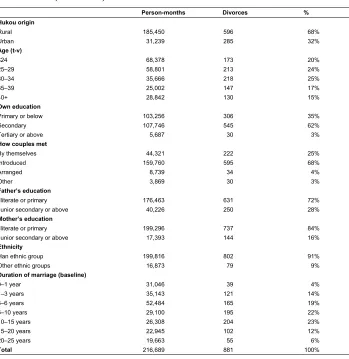
Descriptive statistics for the variables used in the analysis are presented in Table 1. The two core variables in this study are parity and the sex composition of children, both of which are time varying. Parity is specified as ‘Childless,’ ‘1 child,’ ‘2 children,’ and ‘3+ children.’ Descriptive statistics show that 28% of the divorces occurred when our respondents had no children, and 56% of divorces occurred when they had one child.
Table 1: Descriptive statistics for the variables used in the study
Person-months Divorces %
Parity (t-v)
Childless 40,236 247 28%
1 child 96,723 489 56%
2 children 55,439 118 13%
3+ children 24,291 27 3%
Sex composition of children (t-v)
Childless 40,236 247 28%
1 child – girl 42,943 231 26%
1 child – boy 53,718 258 29%
2 children – girls 12,203 38 4%
2 children – girl and boy 30,673 58 7%
2 children – boys 12,623 22 2%
3+ children 24,291 27 3%
Calendar periods (t-v)
1980s 56,746 74 8%
1990s 65,365 299 34%
Table 1: (Continued)
Person-months Divorces %
Hukou origin
Rural 185,450 596 68%
Urban 31,239 285 32%
Age (t-v)
≤24 68,378 173 20%
25–29 58,801 213 24%
30–34 35,666 218 25%
35–39 25,002 147 17%
40+ 28,842 130 15%
Own education
Primary or below 103,256 306 35%
Secondary 107,746 545 62%
Tertiary or above 5,687 30 3%
How couples met
By themselves 44,321 222 25%
Introduced 159,760 595 68%
Arranged 8,739 34 4%
Other 3,869 30 3%
Father’s education
Illiterate or primary 176,463 631 72%
Junior secondary or above 40,226 250 28%
Mother’s education
Illiterate or primary 199,296 737 84%
Junior secondary or above 17,393 144 16%
Ethnicity
Han ethnic group 199,816 802 91%
Other ethnic groups 16,873 79 9%
Duration of marriage (baseline)
0–1 year 31,046 39 4%
1–3 years 35,143 121 14%
3–6 years 52,484 165 19%
6–10 years 29,100 195 22%
10–15 years 26,308 204 23%
15–20 years 22,945 102 12%
20–25 years 19,663 55 6%
Total 216,689 881 100%
Note: ‘t-v’ refers to time-varying.
Source:Authors’ calculation based on the CFPS (waves 2010–2012).
Calendar periods, time varying, help us capture how the divorce trends vary over time by children’s characteristics. Calendar periods were grouped into three periods, namely the 1980s (1980–1989), 1990s (1990–1999), and 2000s (2000–2012). Divorces that occurred before 1980 were left truncated due to the small number of observations. Marriages that occurred before 1980 entered our observation for divorce from 1980, controlled for the duration of marriage. Descriptive statistics show that the majority of divorces occurred in the 1990s and the 2000s. Only 8% of divorces occurred in the 1980s.
Based on China’s household registration (hukou) system, the population is divided into agricultural (or rural) and non-agricultural (or urban) households. Social welfare services such as education and health care are tightly bound to one’s hukou status (Wu and Treiman 2004). Accordingly, notable rural‒urban disparities exist in various aspects of social life. Given that our data do not provide any changes in hukou status prior to or close to divorce, we used our respondents’ hukou status at age 12 as a proxy to indicate their rural/urban origin, namely, the place where they grew up. Respondents who grew up in urban areas are considered urban residents; respondents who grew up in rural areas are considered rural residents.
Our analyses include a number of control variables. Age, which is time-variant, is categorized into five groups: ≤ 24 years, 25–29 years, 30–34 years, 35–39 years, and 40 years or older. Respondents’ own educational level at the time of first marriage is grouped into primary or below, secondary, and tertiary or above. We also controlled for ‘How couples met’ (grouped into: knowing each other independently, via introduction by friends and relatives, via arrangement by a marriage agency or parents, and other), parents’ education (grouped into: illiterate or primary and junior secondary or above), and ethnicity (Han Chinese, other ethnic groups). The duration of marriage is the basic time factor of this study. A large share of the divorces occurred from 3 to 15 years into married life.
6. Results
6.1 Results from the main effects models
effectual protective factor against divorce: Having more children corresponds to a lower likelihood that a marriage will end in divorce.
Table 2: Relative risk of divorce estimated from the main effects hazard regression model, China (1980–2012)
Model 1 Model 2
Haz. Ratio P>z [95% C.I.] Haz. Ratio P>z [95% C.I.] Parity (t-v)
Childless 4.06 *** [3.42–4.82]
1 child 1
2 children 0.38 *** [0.31–0.47]
3+ children 0.20 *** [0.13–0.29]
Sex composition of children (t-v)
Childless 4.40 *** [3.64–5.33]
1 child – girl 1.19 ** [1.00–1.43]
1 child – boy 1
2 children – girls 0.65 *** [0.46–0.91]
2 children – girl and boy 0.35 *** [0.26–0.47]
2 children – boys 0.33 *** [0.21–0.51]
3+ children 0.21 *** [0.14–0.31]
Calendar periods (t-v)
1980s 1 1
1990s 3.82 *** [2.95–4.94] 3.81 *** [2.94–4.93]
2000s 4.22 *** [3.27–5.45] 4.20 *** [3.25–5.42]
Hukou origin
Rural 1 1
Urban 1.52 *** [1.28–1.80] 1.51 *** [1.28–1.79]
Age (t-v)
≤24 1 1
25–29 0.86 [0.69–1.07] 0.85 [0.68–1.07]
30–34 1.35 *** [1.09–1.68] 1.35 *** [1.09–1.68]
35–39 1.52 *** [1.15–2.00] 1.51 *** [1.15–1.98]
40+ 1.40 ** [1.04–1.88] 1.38 ** [1.02–1.88]
Own education
Primary or below 0.87 * [0.74–1.02] 0.87 * [0.74–1.02]
Secondary 1 1
Tertiary or above 0.58 *** [0.40–0.85] 0.59 *** [0.40–0.85]
How couples met
By themselves 1 1
Introduced 0.90 [0.77–1.06] 0.91 [0.77–1.06]
Arranged 1.17 [0.81–1.70] 1.19 [0.82–1.72]
Others 1.53 ** [1.04–2.24] 1.52 ** [1.04–2.23]
Father’s education
Illiterate or primary 1 1
Junior secondary or above 1.29 *** [1.09–1.53] 1.29 *** [1.09–1.53] Mother’s education
Illiterate or primary 1 1
Table 2: (Continued)
Model 1 Model 2
Haz. Ratio P>z [95% C.I.] Haz. Ratio P>z [95% C.I.] Ethnicity
Han ethnic group 1 1
Other ethnic groups 1.35 *** [1.07–1.71] 1.34 ** [1.06–1.70]
Duration of marriage (baseline)
0–1 year 0.37 *** [0.26–0.53] 0.37 *** [0.26–0.53]
1–3 years 1 1
3–6 years 1.39 *** [1.09–1.77] 1.39 *** [1.09–1.77]
6–10 years 1.37 ** [1.06–1.79] 1.38 ** [1.06–1.79]
10–15 years 1.12 [0.83–1.51] 1.14 [0.83–1.51]
15–20 years 0.63 *** [0.44–0.90] 0.65 ** [0.44–0.90]
20–25 years 0.43 *** [0.28–0.66] 0.45 *** [0.28–0.66]
No. of subjects 31,354
No. of divorces 881
Time at risk 6956614
Log likelihood –4344.96 –4338.25
Prob > chi2 0.00 0.00
Note: Statistical significance: ***p<0.01; ** 0.01<p<0.05; and * 0.05<p<0.10.
Source: Authors’ calculation based on the CFPS (waves 2010–2012).
To explore the association between children’s gender and divorce, in Model 2 we replaced the time-varying variable of parity with the time-varying sex composition of children. The estimation from Model 2 shows that among one-child couples, those with a girl have a 19% higher risk of divorce than those with a boy. Among two-child couples, those with two girls have a noticeably higher risk of divorce than those with at least one boy. The divorce risk of couples with a girl and a boy does not differ significantly from the risk of couples with two boys, suggesting that the number of boys does not significantly affect the divorce risk for couples with at least one boy.
Our estimates for the calendar periods in our models show that divorce was less common during the 1980s than in later decades. The divorce trend increased substantially during the 1990s and then shifted towards a plateau in the 2000s. Our estimates for hukou origin show that urbanites have a nearly 50% higher likelihood of ending a marriage than couples of rural origin.
have a low risk of divorce within the first year of marriage. The risk of divorce increases steadily with marriage duration. After reaching a peak approximately 10 to 15 years into marriage, the trend shifts to a decline.
6.2 Childlessness and divorce over time
To explore how the association between the number of children and divorce varies over time for rural and urban residents, we estimated the three-way interaction term of parity, calendar period, and hukou origin based on Model 1 while controlling for other covariates. The estimated results for other covariates resemble those presented in Model 1 and thus are not shown.
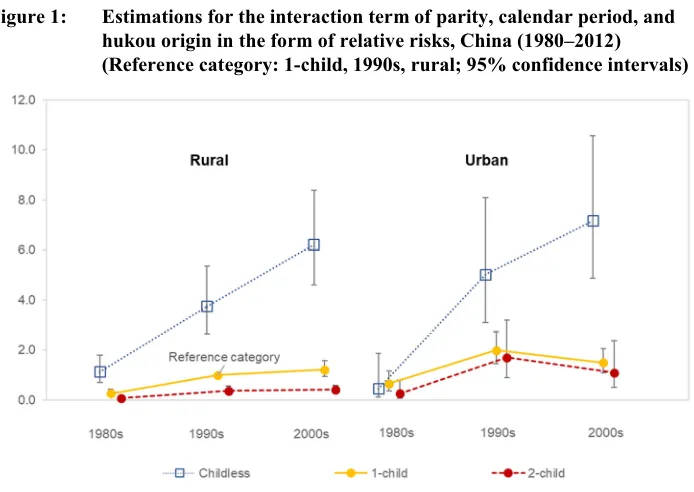
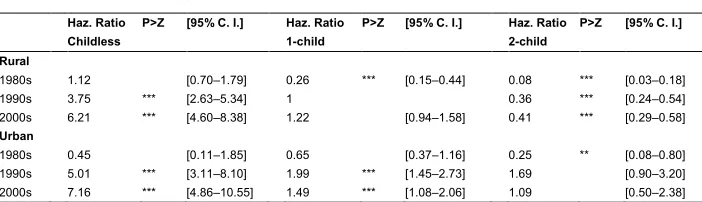
Figure 1 (see also Appendix 1) demonstrates that both rural and urban childless couples had substantially higher divorce risks than couples with children during most of the observation periods. The gap was small during the 1980s but grew significantly during the 1990s and 2000s. Notably, as early as the 1980s, when divorce was less common relative to later decades, in rural areas childless couples had a significantly higher divorce risk than couples with children. Arguably, this finding suggests that in a context where the value of children for economic security, old age security, and continuation of family line strongly persists, infertility threatens marriage stability.
From the 1990s to the 2000s, when a divorce plateau occurred for couples with children, for the childless the divorce trend continued to increase significantly, independent of their rural or urban hukou origin. During the 2000s the divorce risk of the childless was approximately five times that of one-child parents (Rural: 6.21/1.22 ᵙ
5.01; Urban: 7.16/1.49 ᵙ 4.79).
Figure 1: Estimations for the interaction term of parity, calendar period, and hukou origin in the form of relative risks, China (1980–2012)
(Reference category: 1-child, 1990s, rural; 95% confidence intervals)
Note: Estimations for 3-child parents are not shown due to the limited number of cases.
Source: Authors’ calculation based on the CFPS (waves 2010–2012).
6.3 Sex composition of children and divorce over time
To test our second hypothesis, we estimated the interaction term of the sex composition of children and calendar period based on Model 2 for one-child parents and two-child parents while controlling for other covariates. The estimations for other covariates resemble those in Model 2 and thus are not presented.
6.3.1 One-child parents
Figure 2: Estimations for the interaction term of child’s gender, calendar period, and hukou origin for one-child parents in the form of relative risks, China (1980–2012) (Reference category: 1 boy, 2000s, rural; 95% confidence intervals)
Note:Statistical significance: ***p<0.01; ** 0.01<p<0.05; and * 0.05<p<0.10.
Source:Authors’ calculation based on the CFPS (waves 2010–2012).
Among urban parents with one child, although the gap in divorce by child’s gender seems to have shrunk over our observation period, statistically and over time the divorce risk of those with a girl did not differ significantly from the divorce risk of those with a boy. These results imply that the role of a child’s gender has been insignificant for parental divorce in urban areas.
For rural parents, a two-stage variation is clear. During the 1980s and the 1990s a child’s gender was not significant for parental divorce. During the 2000s, however, as the divorce trend for one-boy couples plateaued, the trend for one-girl couples increased significantly. One-girl couples had a 43% higher risk of divorce than one-boy couples, with their divorce level reaching that of their urban counterparts.
6.3.2 Two-child parents
The estimations for the interaction term of sex composition of children and calendar period for two-child parents (see Appendix 3) represent the divorce patterns and trends for rural parents only, because the couples with two children were mainly rural residents. Our estimation for the 1980s does not show a significantly higher divorce risk for couples with only girls than for couples with at least one boy. In the 1990s, when divorce spread at great speed, parents with two girls had a significantly higher divorce risk than parents with at least one boy. When the divorce trend plateaued in the 2000s the role of the children’s gender became vague. These results should be interpreted with caution, as our divorce sample for two-child parents is small, especially for the 1980s.
7. Concluding discussion
This study explored how the number and sex composition of children were associated with divorce in China between 1980 and 2012, a period that saw dramatic socioeconomic, institutional, and demographic changes. We conducted an event history analysis using individual-level longitudinal data from the CFPS. Based on existing theory, empirical research, and the specific contexts of rural and urban China, we hypothesized that (1) childless couples have a higher divorce risk than couples with children over the observation period, and (2) the divorce differentials across children’s gender shrink among urbanites but remain among rural residents during our observation period.
Our estimations more or less support Hypothesis 1. Both rural and urban childless couples had significantly higher risks of divorce than couples with children during most of our observation period. During the 1990s and 2000s, when the general divorce trend plateaued, the divorce risk of childless couples continued to increase significantly, irrespective of hukou origin. During the 2000s the divorce risk of the childless was approximately five times that of one-child parents. It is worth noting that during the 1980s, when divorce was less common than in later decades, childless couples in rural areas had a significantly higher divorce risk than couples with children. In comparison, such a pattern was not found among urbanites.
shrunk. The findings suggest that the role of a child’s gender in divorce was not significant for urbanites.
An opposite scenario was observed for rural one-child parents. As opposed to our expectation (that the divorce differential by children’s gender remains unchanged among rural parents over time), our results show that during the 1980s and the 1990s, having a girl or a boy played no role in divorce. The importance of a child’s gender became apparent in the 2000s, when couples with a girl were more likely to divorce than couples with a boy.
Our estimations for two-child parents mainly represent the divorce pattern and trend of rural parents. During the 1980s, when divorce was less common, the role of children’s gender is unclear. During the 1990s, when divorce spread quickly, parents with two girls had a relatively higher risk of divorce than those with at least one boy. During the 2000s, when the divorce trend for parents plateaued, the role of children’s gender becomes unclear once more. Our findings for two-child parents, especially for the 1980s, should be interpreted with caution due to the small number of cases under study.
Our findings regarding the divorce pattern and trend of the childless compared to that of parents have important implications. First, the lower divorce risk of couples with children versus the increasingly higher divorce risk of the childless couples is in line with Becker’s household economics theory and Durkheim’s sociological theory. Specifically, children, as couples’ joint marital capital, increase the attractiveness of the union and hold families together. Our findings for Chinese society show that children add value to marriage. Without a child to strengthen the marital relationship and without child-related issues to consider in the process of filing for a divorce, the childless exit marriage more easily.
Second, the substantially increasing divorce risks of childless couples over our observation period, in contrast to the rise-to-plateau divorce pattern of parents, suggest that in contemporary Chinese society, childless couples are forerunners in exercising divorce. Ending a marriage when having no children has become a pronounced trend.
Third, the significantly higher divorce risk of rural childless couples compared to couples with children as early as the 1980s reflects that in a context where children are highly valued for their function of providing economic and old age security as well as carrying on the family line, infertility severely challenges the sustainability of the security system. Failure to produce a child threatens marriage stability.
urban counterparts. The traditional shame of divorce has weakened among the childless and no longer represents a hindrance to childless couples.
Our findings regarding the role of children’s sex composition in parental divorce have implications for the evolution of the son preference in Chinese society. In urban China, where couples mostly have one child, having a girl or a boy did not matter for parental divorce during our observation period. This can be largely attributed to the socioeconomic changes since the late 1970s such as the opening-up policies, educational expansion, exposure to Western norms and values, the one-child policy, and the spread of gender equality. As single children, girls enjoy their family’s support and investment in education and subsequent career success. They care for their aging parents, which historically was the son’s duty. With girls’ empowerment and the value of gender equality substantially increasing, the importance of a child’s gender for divorce disappeared in urban areas during our observation period.
In rural areas, however, especially the inland rural areas, the economic development and modernization process is slower than in urban areas. Most families have two or more children, which increases the probability of having a boy in the household. During the 1980s and 1990s, having a girl at first birth was not necessarily associated with an increased divorce risk. Despite their strong son preference, couples would not easily file for divorce after having a girl at first birth. After all, they could potentially have a son at a second or third birth. The higher divorce risk of rural one-child parents with a girl during the 2000s deserves more attention. Rural parents are more conservative than urban parents: They are less exposed to Western norms and values, more likely to hold traditional family values and have son preference, and less tolerant towards divorce. In the 2000s, when divorce spread to this conservative group, it was couples with a girl that became the most likely to divorce. The findings imply that in the rural context where the son preference culture prevails, the son preference mechanism starts functioning when family stability confronts the risk of disruption. Those with a girl became more likely to exit a marriage than those with a boy.
Caution should be exercised in interpreting some of our results. Many other factors that we could not control for can be important for divorce. For example, we do not have data concerning couples’ communication problems or relationship quality. Couples in bad relationships are less likely to have children, which may upward bias our results for childless couples. Furthermore, our estimations are based on our respondents’ actual number of live births. We cannot determine whether our respondents underwent sex-selective abortions to achieve the desired sex of their children. These endogenous limitations restrict our capability of directly addressing any causal effects of the number and sex composition of children on divorce.
an increasing number of urban families are having or considering having a second child. Future research should investigate whether the insignificant role of a child’s gender in the divorce risk of urban couples, which we observed in this study, remains insignificant in the future, when a considerable number of urban families have two children.
8. Acknowledgements
References
Andersson, G. (1997). The impact of children on divorce risks of Swedish women.
European Journal of Population 13(2): 109–145. doi:10.1023/A:10058030
01129.
Andersson, G. and Woldemicael, G. (2001). Sex composition of children as a determinant of marriage disruption and marriage formation: Evidence from Swedish register data. Journal of Population Research 18(2): 143–153.
doi:10.1007/BF03031886.
Arnold, F. and Liu, Z. (1986). Sex preference, fertility and family planning in China.
Population and Development Review 12(2): 221–246.doi:10.2307/1973109.
Becker, G.S., Landes, E.M., and Michael, R.T. (1977). An economic analysis of marital instability. Journal of Political Economy 85(6): 1141–1187. doi:10.1086/260 631.
Bose, S. and South, S. (2003). Sex composition of children and marital disruption in India. Journal of Marriage and Family 65(4): 996–1006. doi:10.1111/j.1741-3737.2003.00996.x.
Burnett, J. (2010). Women’s employment rights in China: Creating harmony for women in the workforce. Indiana Journal of Global Legal Studies 17(2): 289–318.
doi:10.2979/gls.2010.17.2.289.
Chu, J. (2001). Prenatal sex determination and sex-selective abortion in rural central China. Population and Development Review 27(2): 259–281. doi:10.1111/j. 1728-4457.2001.00259.x.
Coombs, L.C., Freedman, R., Friedman, J., and Pratt, W.F. (1970). Premarital pregnancy and status before and after marriage.American Journal of Sociology
75(5): 800–820.doi:10.1086/224823.
Das Gupta, M., Jiang, Z., Li, B., Xie, Z., Chung, W., and Bae, H.-O. (2003). Why is son preference so persistent in East and South Asia? A cross-country study of China, India and the Republic of Korea. The Journal of Development Studies 40(2): 153–187.doi:10.1080/00220380412331293807.
Diamant, N.J. (2000).Revolutionizing the family: Politics, love and divorce in urban and rural China, 1949–1968. Berkeley: University of California Press.
doi:10.1525/california/9780520217201.001.0001.
Feeney, G. and Yuan, J. (1994). Below replacement fertility in China? A close look at recent evidence. Population Studies 48(3): 381–394. doi:10.1080/00324720 31000147926.
Feng, X. (2010).风笑天 (2010). 生育二胎:“双独夫妇”的意愿及相关因素分析. 社
会科学5: 58–66.
Fong, V.L. (2002). China’s one-child policy and the empowerment of urban daughters.
American Anthropologist 104(4): 1098–1109.doi:10.1525/aa.2002.104.4.1098.
Freedman, D.S. and Thornton, A. (1979). The long-term impact of pregnancy at marriage on the family’s economic circumstances.Family Planning Perspectives
11(1): 6–20.doi:10.2307/2134477.
Goodkind, D. (2017). The astonishing population averted by China’s birth restrictions: Estimates, nightmares, and reprogrammed ambitions.Demography54(4): 1375– 1400.doi:10.1007/s13524-017-0595-x.
Gu, B., Wang, F., Guo, Z., and Zhang, E. (2007). China’s local and national fertility policies at the end of the twentieth century.Population and Development Review
33(1): 129–147.doi:10.1111/j.1728-4457.2007.00161.x.
Handwerker, L. (1998). The consequences of modernity for childless women in China: medicalization and resistance. In: Lock, M. and Kaufert, P.A. (eds.).Pragmatic women and body politics. Cambridge: Cambridge University Press: 178–205. Hill, M. (1988). Marital stability and spouses’ shared time. Journal of Family Issues
9(4): 427–451.doi:10.1177/019251388009004001.
Hu, J. and Scott, J. (2016). Family and gender values in China: Generational, geographic, and gender differences.Journal of Family Issues 37(9): 1267–1293.
doi:10.1177/0192513X14528710.
Jennings, E.A. (2016). Predictors of marital dissolution during a period of rapid social change: Evidence from South Asia. Demography 53(5): 1351–1375.
doi:10.1007/s13524-016-0504-8.
Li, J. and Cooney, R.S. (1993). Son preference and the one child policy in China: 1979– 1988. Population Research and Policy Review 12(3): 277–296. doi:10.1007/ BF01074389.
Li, S., Zhang, Q., Yang, X., and Attané, I. (2010). Male singlehood, poverty and sexuality in rural China: An exploratory survey. Population 65(4): 679–693.
Ma, L. and Rizzi, E. (2017). Entry into first marriage in China.Demographic Research
37(36): 1231–1244.doi:10.4054/DemRes.2017.37.36.
Ma, L., Turunen, J., and Rizzi, E. (2018). Divorce Chinese style.Journal of Marriage and Family 80(5): 1287–1297.doi:10.1111/jomf.12484.
Moore, T.W. (1998). Fertility in China 1982–1990: Gender equality as a complement to wealth flows theory. Population Research and Policy Review 17(2): 197–222.
doi:10.1023/A:1006054310021.
Morgan, S.P. and Pollard, M.S. (2002).Do parents of girls really have a higher risk of divorce? Paper presented at the 2002 Annual Meeting of the Population Association of America, Atlanta, USA, May 8–10, 2002.
Morgan, S.P., Lye, D.N., and Condran, G.A. (1988). Sons, daughters, and the risk of marital disruption.American Journal of Sociology 94(1): 110–129.doi:10.1086/ 228953.
Mott, F.L. (1994). Sons, daughters, and fathers’ absence: Differentials in father-leaving probabilities and home environments. Journal of Family Issues 15(1): 97–128.
doi:10.1177/019251394015001005.
Murphy, R., Tao, R., and Lu, X. (2011). Son preference in rural China: Patrilineal families and socioeconomic change.Population and Development Review37(4): 665–690.doi:10.1111/j.1728-4457.2011.00452.x.
Odimegwu, C., Akinyemi, J.O., and De Wet, N. (2017). Premarital birth, children’s sex composition and marital instability among women in sub-Saharan Africa.
Journal of Population Research 34(4): 327–346.
doi:10.1007/s12546-017-9193-4.
Palmer, M. (2007). Transforming family law in post-Deng China: Marriage, divorce and reproduction. The China Quarterly 191: 675–695. doi:10.1017/S0305741 007001658.
Pimentel, E.E. (2000). Just how do I love thee? Marital relations in urban China.
Journal of Marriage and the Family 62(1): 32–47. doi:10.1111/j.1741-3737. 2000.00032.x.
Toulemon, L. (1995). The place of children in the history of couples. Population 7: 163–186.
Waite, L.J. and Lillard, L.A. (1991). Children and marital disruption.American Journal of Sociology 96(4): 930–953.doi:10.1086/229613.
Wang, F. (2005). Can China afford to continue its one-child policy? Honolulu: East-West Center (Asia Pacific Issues 77). https://www.eastwestcenter.org/system/ tdf/private/api077.pdf?file=1&type=node&id=32050.
Wang, F., Cai, Y., and Gu, B. (2013). Population, policy and politics: How will history judge China’s one-child policy? Population and Development Review 38(S1): 115–129.doi:10.1111/j.1728-4457.2013.00555.x.
Wang, F., Gu, B., and Cai, Y. (2016). The end of China’s one-child policy.Studies in Family Planning 47(1): 83–86.doi:10.1111/j.1728-4465.2016.00052.x.
Whyte, M.K. (2005). Continuity and change in urban Chinese family life. The China Journal 53: 9–33.doi:10.2307/20065990.
Wu, X. and Treiman, D.J. (2004). The household registration system and social stratification in China: 1955–1996. Demography 41(2): 363–384. doi:10.1353/ dem.2004.0010.
Xie, Y. and Zhu, H. (2009). Do sons or daughters give more money to parents in urban China? Journal of Marriage and Family 71(1): 174–186. doi:10.1111/j.1741-3737.2008.00588.x.
Xu, A., Xie, X., Liu, W., and Liu, D. (2007). Chinese family strengths and resiliency.
Marriage and Family Review 41(1–2): 143–164.doi:10.1300/J002v41n01_08.
Xu, L. and Chi, I. (2018). Determinants of support exchange between grandparents and grandchildren in rural China: The roles of grandparent caregiving, patrilineal heritage, and emotional bonds. Journal of Family Issues 39(3): 579–601.
doi:10.1177/0192513X16662102.
Xu, Q., Yu, J., and Qiu, Z. (2015). The impact of children on divorce risk.The Journal of Chinese Sociology 2(1): 1–20.doi:10.1186/s40711-015-0003-0.
Yao, H., Chan, C.H.-Y., and Chan, C.L.-W. (2018). Childbearing importance: A qualitative study of women with infertility in China. Research in Nursing and Health 41(1): 69–77.doi:10.1002/nur.21846.
Yeung, W.-J.J. and Hu, S. (2016). Paradox in marriage values and behavior in contemporary China. Chinese Journal of Sociology 2(3): 447–476.doi:10.1177/ 2057150X16659019.
Yilmaz, O. and Zeng, Y. (2016). Older parents enjoy better filial piety and care from daughters than sons in China.American Journal of Medical Research 3(1): 244– 272.doi:10.22381/AJMR3120169.
Zeng, Y., Schultz, T.P., Wang, D.D., and Gu, D. (2002). Association of divorce with socio-demographic covariates in China: 1955–1985: Event history analysis based on data collected in Shanghai, Hebei, and Shaanxi. Demographic
Research7(11): 407–432.doi:10.4054/DemRes.2002.7.11.
Zeng, Y., Tu, P., Gu, B., Xu, Y., Li, B., and Li, Y. (1993). Causes and implications of the recent increase in the reported sex ratio at birth in China. Population and
Development Review 19(2): 283–302.doi:10.2307/2938438.
Zheng, Z., Cai, Y., Wang, F., and Gu, B. (2009). Below-replacement fertility and childbearing intention in Jiangsu Province, China. Asian Population Studies
Appendix
Table A-1: Estimations for the interaction term of parity, calendar period, and hukou origin in the form of relative risks, China (1980–2012) (Reference category: 1-child, the 1990s, rural; 95% confidence intervals)
Haz. Ratio P>Z [95% C. I.] Haz. Ratio P>Z [95% C. I.] Haz. Ratio P>Z [95% C. I.]
Childless 1-child 2-child
Rural
1980s 1.12 [0.70–1.79] 0.26 *** [0.15–0.44] 0.08 *** [0.03–0.18]
1990s 3.75 *** [2.63–5.34] 1 0.36 *** [0.24–0.54]
2000s 6.21 *** [4.60–8.38] 1.22 [0.94–1.58] 0.41 *** [0.29–0.58]
Urban
1980s 0.45 [0.11–1.85] 0.65 [0.37–1.16] 0.25 ** [0.08–0.80]
1990s 5.01 *** [3.11–8.10] 1.99 *** [1.45–2.73] 1.69 [0.90–3.20]
2000s 7.16 *** [4.86–10.55] 1.49 *** [1.08–2.06] 1.09 [0.50–2.38]
Note: Estimations for 3-child parents are not shown due to small number of cases. Statistical significance: ***p<0.01; ** 0.01<p<0.05; and * 0.05<p<0.10.
Source: Authors’ calculation based on the CFPS (waves 2010–2012).
Table A-2: Estimations for the interaction term of child’s gender, calendar period, and hukou origin for one-child parents in the form of relative risks, China (1980–2012) (Reference category: 1 boy, the 2000s, rural; 95% confidence intervals)
Haz. Ratio P>Z [95% C. I.] Haz. Ratio P>Z [95% C. I.]
Rural _ girl Rural _ boy
1980s 0.30 *** [0.14–0.65] 0.22 *** [0.11–0.43]
1990s 0.98 [0.66–1.45] 0.96 [0.68–1.36]
2000s 1.43 *** [1.08–1.89] 1
Urban _ girl Urban _ boy
1980s 0.84 [0.41–1.74] 0.48 * [0.21–1.09]
1990s 2.06 *** [1.42–3.00] 1.82 *** [1.27–2.61]
2000s 1.39 * [0.96–2.01] 1.49 ** [1.06–2.11]
Note: Statistical significance: ***p<0.01; ** 0.01<p<0.05; and * 0.05<p<0.10.
Table A-3: Estimations for the interaction term of sex composition of children and calendar period for two-child parents in the form of relative risks, China (1980–2012) (Reference category: girl & boy, the 1990s, 95% confidence intervals)
Haz. Ratio P>z [95% C.I.] Haz. Ratio P>z [95% C.I.] Haz. Ratio P>z [95% C.I.]
2 girls Girl & boy 2 boys
1980s 0.60 [0.17–2.05] 0.54 [0.22–1.32] 0.42 [0.12–1.45]
1990s 3.21 *** [1.65–6.25] 1 1.18 [0.52–2.68]
2000s 1.93 * [0.98–3.79] 1.34 [0.74–2.42] 1.21 [0.56–2.61]
Note: Statistical significance: ***p<0.01; ** 0.01<p<0.05; and * 0.05<p<0.10.