Volume 3, Issue 5, 2016
71 Available online at www.ijiere.com
International Journal of Innovative and Emerging
Research in Engineering
e-ISSN: 2394 – 3343 p-ISSN: 2394 - 5494
Using energy calculation A Group Based Control Flooding
Routing Algorithm for Delay Tolerant Network
Ridhdhi Desai
a, and Assistant Prof. Nimit Modi
ba Gujarat Technical University,39 Sai Kunj, Amalsad-396310 and INDIA b Gujarat Technical University, Vadodara, Vadodara and INDIA
ABSTRACT:
The Delay-Tolerant Networks (DTNs) are the type of an emerging networks characterized by very long delay paths and frequent network partitions. For the distinct characteristics of DTNs, routing becoming one of the most challenging open source problems. Recently years numerous approach has been presented for addressing routing issues in DTNs. In this paper mainly surveys of DTN routing strategies and gives the comparison of them with respect to different performance metrics. In this Specially, we summarize the cardinal mobility models and DTN simulators which are the significantly important to evaluate the performance of the DTN routing protocols.
Keywords: Delay-Tolerant Networks, Routing in DTN, Simulator, Mobility model.
I. INTRODUCTION
Delay Tolerant Networks (DTN) where we are referred Intermittently Connected Mobile Networks or Disruptions Tolerant Networks, are wireless networks in which at any given the time instance, the probability that there is an end-to-end path from a source to the destination is low. Since most of the nodes in a DTN are mobile, the connectivity of the network is maintained by node movement only when they come into the transmission ranges of each other. If a node has a message copy but it is not connected to another node, it stores the message until an appropriate communication opportunity arises, after connecting with other node, node will check for duplication of message in connected nodes buffer and then it will send message to connected node [1].
DTNs are alternative structures to traditional networks facilitating connectivity of systems and network regions with sporadic or unstable communication links. In networks with such circumstances mobile relay nodes are used to carry and forwarding messages and make communications possible among other nodes. Depending on DTNs types communication opportunities could be either scheduled over time or completely random [2].
Volume 3, Issue 5, 2016
72
II. THEORETICAL BACKGROUND
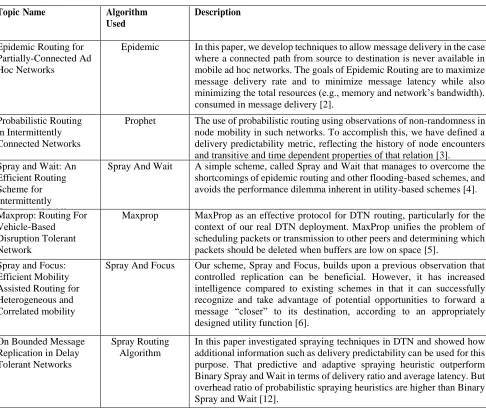
Table 1. Comparison of Routing Algorithm
Topic Name Algorithm
Used
Description
Epidemic Routing for Partially-Connected Ad Hoc Networks
Epidemic In this paper, we develop techniques to allow message delivery in the case where a connected path from source to destination is never available in mobile ad hoc networks. The goals of Epidemic Routing are to maximize message delivery rate and to minimize message latency while also minimizing the total resources (e.g., memory and network’s bandwidth). consumed in message delivery [2].
Probabilistic Routing in Intermittently Connected Networks
Prophet The use of probabilistic routing using observations of non-randomness in node mobility in such networks. To accomplish this, we have defined a delivery predictability metric, reflecting the history of node encounters and transitive and time dependent properties of that relation [3].
Spray and Wait: An Efficient Routing Scheme for Intermittently Connected Mobile Networks
Spray And Wait A simple scheme, called Spray and Wait that manages to overcome the shortcomings of epidemic routing and other flooding-based schemes, and avoids the performance dilemma inherent in utility-based schemes [4].
Maxprop: Routing For Vehicle-Based Disruption Tolerant Network
Maxprop MaxProp as an effective protocol for DTN routing, particularly for the context of our real DTN deployment. MaxProp unifies the problem of scheduling packets or transmission to other peers and determining which packets should be deleted when buffers are low on space [5].
Spray and Focus: Efficient Mobility Assisted Routing for Heterogeneous and Correlated mobility
Spray And Focus Our scheme, Spray and Focus, builds upon a previous observation that controlled replication can be beneficial. However, it has increased intelligence compared to existing schemes in that it can successfully recognize and take advantage of potential opportunities to forward a message “closer” to its destination, according to an appropriately designed utility function [6].
On Bounded Message Replication in Delay Tolerant Networks
Spray Routing Algorithm
In this paper investigated spraying techniques in DTN and showed how additional information such as delivery predictability can be used for this purpose. That predictive and adaptive spraying heuristic outperform Binary Spray and Wait in terms of delivery ratio and average latency. But overhead ratio of probabilistic spraying heuristics are higher than Binary Spray and Wait [12].
III. IMPLIMENTATION
PROPOSED ALGORITHMS AND WORKING Design of proposed routing algorithm.
GROUP BASED CONTROLLED FLOODING WITHOUT ENERGY CALCULATION:
Algorithm INPUT:
S - Source node D - Destination node i - Message
OUTPUT:
A message is routed from source node to the destination node. Msgttl (i) = n.
1. Create N nodes
Volume 3, Issue 5, 2016
73 Scan destination address of the message i;
5. Generate hop count;
6. Find hop count of a message i;
If hop count is grater then 2 then set mgsttl to 0; 7. for each message i in M's buffer
For each mobile node that comes in contact with another mobile node Increase hop count ++;
8. If destination address and encountered mobile node address are in same group Send message i to encountered mobile node;
Else
Do nothing; END
In Controlled Flooding suppose there are 5 groups of mobile nodes, each group contains 20 nodes, so there are total 100 mobile nodes. Suppose there are 5 groups A, B, C, D, E, suppose any mobile node from group A wants to send a message to a mobile node in group B, then source node will send that message to group B members only, it will not send that message to any other group member. Hop count of message will also be calculated in this algorithm, hop count means number of nodes through which message has passed. If hop count is greater than 1 then msgttl (message time to live) will be set to 0, so message will be discarded soon.
GROUP BASED CONTROLLED FLOODING WITH ENERGY CALCULATION:
Algorithm:
Step-1: Create N nodes
Step-2: Divide n mobile nodes into m groups; Step-3: Each node has their own buffer size: Step-4: for each message i in S’s buffer
Scan destination address of the message i; Step-5: Generate hop_count;
Step-6: Find hop_count of a message i;
if hop_count is grater then 2 then set mgsttl to 0; Step-7: Determine energy En with the following formula
En = (packet(hop_count) ∗ delay) + (x ∗ packet_size) + const Packet− > energy = En
Step-8: If (packet−> path does not contain node) Add node to packet− >path
Send copy packets to node Get next node from packet− >path}
Hop[i]= least hop count from the collected data Energy[i]= least energy loss from the accumulated data i=i+1
Pick another node from the set as destination node} Step-9: for each message i in M's buffer
for each mobile node that comes in contact with another mobile node increase hop_count ++; Step-10: If destination address and encountered mobile node address are in same group
Send message i to encountered mobile node; else
do nothing ; END
In Controlled Flooding suppose there are 5 groups of mobile nodes, each group contains 20 nodes, so there are total 100 mobile nodes. Suppose there are 5 groups A, B, C, D, E, suppose any mobile node from group A wants to send a message to a mobile node in group B, then source node will send that message to group B members only, it will not send that message to any other group member. Hop count of message will also be calculated in this algorithm, hop count means number of nodes through which message has passed. If hop count is greater than 1 then msgttl (message time to live) will be set to 0, when using energy calculation by using formula then if path does not exist check the path then transfer packet or data to that node so message will be discarded soon.
IV. EXPERIMENTAL RESULTS
Volume 3, Issue 5, 2016
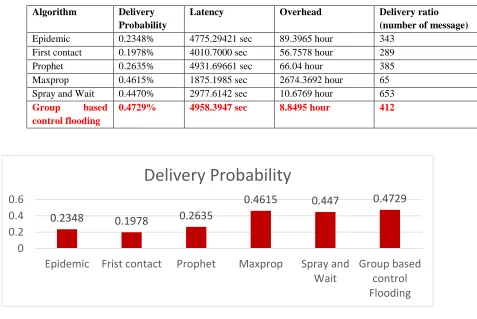
74 In this scenario I compare the other routing algorithm with the group based control flooding algorithm created 100 nodes and divided in to 6 groups and also see the different type of parameter like delivery probability, latency, overhead, number of message delivered. In this we can see the screen short of group based control flooding routing algorithm with 100 nodes and 6 groups and see the results scanario time, message delivered, delivery probability, overhead and latency.
Table 2. Comparison With Other Routing Algorithm By Creating six Groups
Algorithm Delivery
Probability
Latency Overhead Delivery ratio
(number of message)
Epidemic 0.2348% 4775.29421 sec 89.3965 hour 343
First contact 0.1978% 4010.7000 sec 56.7578 hour 289
Prophet 0.2635% 4931.69661 sec 66.04 hour 385
Maxprop 0.4615% 1875.1985 sec 2674.3692 hour 65
Spray and Wait 0.4470% 2977.6142 sec 10.6769 hour 653 Group based
control flooding
0.4729% 4958.3947 sec 8.8495 hour 412
Figure 2 Graph for Delivery Probability scanario
Figure 3 Graph for Latency scanario
0.2348
0.1978
0.2635
0.4615
0.447
0.4729
0
0.2
0.4
0.6
Epidemic
Frist contact
Prophet
Maxprop
Spray and
Wait
Group based
control
Flooding
Delivery Probability
4775.29421
4010.7
4931.69661
1875.19
2977.6142
4958.3947
0
2000
4000
6000
Epidemic Frist contact
Prophet
Maxprop
Spray and
Wait
Volume 3, Issue 5, 2016
75 Figure 4 Graph for Latency scanario
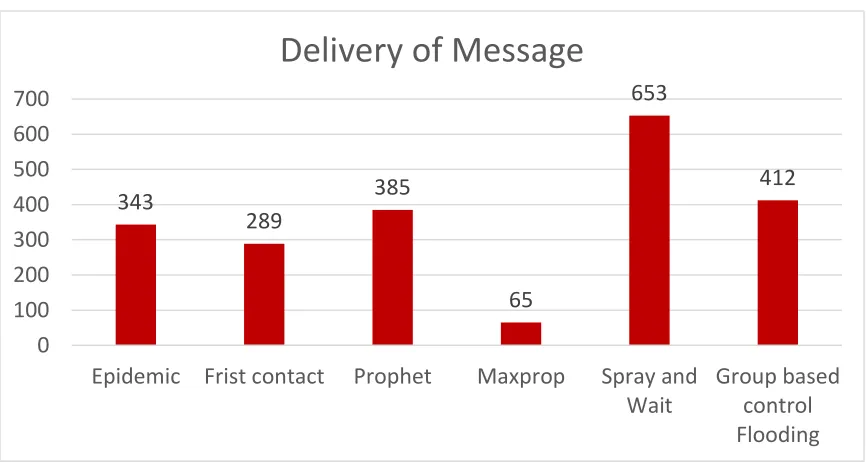
Figure 5 Graph for Delivery of Messages scanario
In this graph we can see the delivery of message of the group based control flooding algorithm with different other routing algorithms the spray and wait algorithm give a good value of delivery of message.
SUMMARY OF SCANARIO-1:
As compare to all the other routing protocol the delivery probability, Latency, overhead and delivery ratio of the group based control flooding is higher than the Epidemic algorithm, first contact algorithm, prophet algorithm, maxprop algorithm and spray and wait algorithm but the delivery ratio of group based control flooding is less than the spray and wait algorithm.
Scanario-2
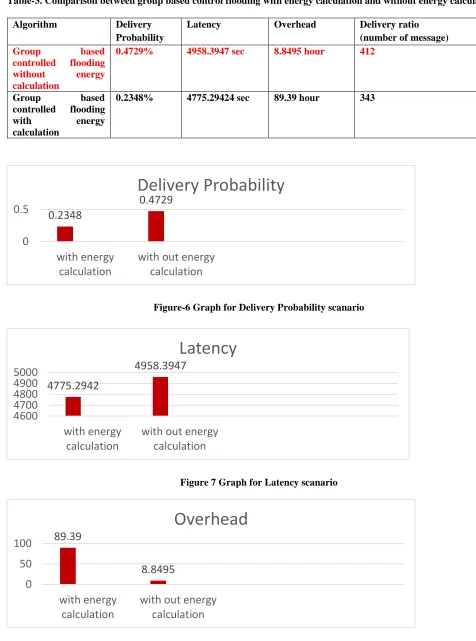
In this scenario I compare the group based routing algorithm by using the energy calculation with the group based control flooding algorithm without energy calculation and also see the different type of parameter like delivery probability, latency, overhead, number of message delivered.
89.39
56.75
66.04
267.36
10.67
8.8495
0
50
100
150
200
250
300
Epidemic Frist contact
Prophet
Maxprop
Spray and
Wait
Group based
control
Flooding
Overhead
343
289
385
65
653
412
0
100
200
300
400
500
600
700
Epidemic Frist contact
Prophet
Maxprop
Spray and
Wait
Volume 3, Issue 5, 2016
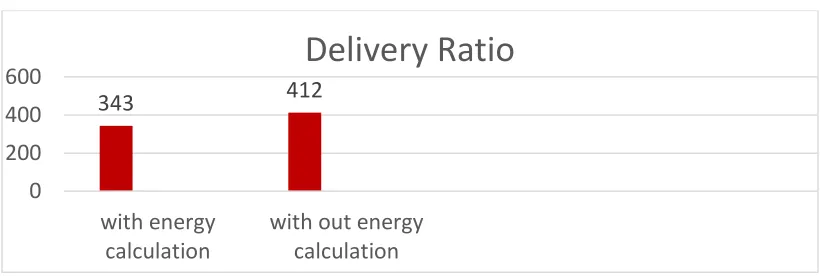
76 Table-3. Comparison between group based control flooding with energy calculation and without energy calculation
Algorithm Delivery
Probability
Latency Overhead Delivery ratio
(number of message) Group based
controlled flooding without energy calculation
0.4729% 4958.3947 sec 8.8495 hour 412
Group based
controlled flooding
with energy
calculation
0.2348% 4775.29424 sec 89.39 hour 343
Figure-6 Graph for Delivery Probability scanario
Figure 7 Graph for Latency scanario
0.2348
0.4729
0
0.5
with energy
calculation
with out energy
calculation
Delivery Probability
4775.2942
4958.3947
4600
4700
4800
4900
5000
with energy
calculation
with out energy
calculation
Latency
89.39
8.8495
0
50
100
with energy
calculation
with out energy
calculation
Volume 3, Issue 5, 2016
77 Figure 8 Graph for Latency scanario
Figure 9 Graph for Delivery of Messages scanario
SUMMARY OF SCANARIO-2:
As compare to above the delivery probability, Latency, overhead and delivery ratio of the group based control flooding algorithm without energy calculation is higher than the group based control flooding algorithm with energy calculation.
V. CONCLUSION AND FUTURE WORK
With using DTN we can connect rural areas as well as disconnected areas where no connectivity with internet is available. By using DTN we can multicast packets to the members which are resides in other networks by using suitable multicasting strategy and with using semantic models we can easily define the members of that group. Delay tolerant networking (DTN) is a network where no end-to-end connectivity from source to destination exists. Delay tolerant networking (DTN) is a timely topic that addresses communication in challenged network environments. I have presented a survey of the most promising protocols. By using group based Controlled flooding algorithm had been performed to minimize overhead with increased delivery probability and the latency.
Create improved Epidemic Routing Algorithm and improve the delivery ratio of group based control flooding algorithm than the spray and wait algorithm. Also calculate the energy and give the better output than the group based control flooding algorithm.
References
[1] Kevin Fall, "A Delay-Tolerant Network Architecture for Challenged Internets" SIGCOMM’03, August 25-29, 2003.
[2] Amin Vahdat and David Becker,"Epidemic Routing for Partially-Connected Ad Hoc Networks", Department of Computer Science Duke University.
[3] Anders Lindgren, Avri Doria, and Olov Schelen “Probabilistic Routing in Intermittently Connected Networks”, lulea University of technology.SE-97197 luleasweden, 2003.
[4] Thrasyvoulos Spyropoulos, Konstantinos Psounis, Cauligi S. Raghavendra "Spray and Wait: An Efficient Routing Scheme for Intermittently Connected Mobile Networks", SIGCOMM’05 Workshops, August 22–26, 2005, Philadelphia, PA, USA.
[5] John burgess, Brian Gallagher, David Jensen, Brian Neil Levine “Maxprop: Routing For Vehicle-Based Disruption Tolerant Network”, USA 01003 Workshop, 2006.
[6] Thrasyvoulos Spyropolos “Spray and Focus: Efficient Mobility Assisted Routing for Heterogeneous and Correlated mobility”, IEEE 2007.
[7] Ze Li and Haiying Shen “Utility Based Distributed Routing in Intermittently Connected Network”, IEEE 2008. [8] Choongho Lee,Dukhyun Chang,Yoonbo Shim, Nakjung Choi, “Regional Token Based Routing for DTNS”,
School Of Korea, 2009.
[9] Samuel ,Mehedi and Robin, “Encounter Based Routing in DTNs”, IEEE 2009.
[10] Samir and Toufik, “Orion Routing Protocol for Delay Tolerant Networks”, IEEE 2011.
[11] Kyoung Hak, Jung,Wan seon,Jae Pil and Young Joo,”A Link Contact Duration Based Routing Protocol In Delay Tolerant Network “, Springer Science 2013
[12] Nazmus Sadat,Muhammad Tasnim and Yusuf Sarwar,”On Bounded Message Replication in Delay Tolerant Networks”, IEEE 2015.
[13] Padma Mundur, Matthew Seligman, "Delay Tolerant Network Routing: Beyond Epidemic Routing"IEEE 2008. [14] Vijay Erramilli, Mark Crovella, "Forwarding in Opportunistic Networks with Resource Constraints",
CHANTS’08, September 15, 2008, San Francisco, California, USA.
![Figure 1 Interplanetary Network [6].](https://thumb-us.123doks.com/thumbv2/123dok_us/8874999.1816323/1.612.126.505.534.694/figure-interplanetary-network.webp)