Advanced Ceramics Progress
J o u r n a l H o m e p a g e : w w w . a c e r p . i r
The Effect of Binder Components and Powder to Binder Ratio on Rheological
Properties of Mg-SiC Feed-stocks
M. Alizadeha*, M. Alimadadi, E. Ghasemi
a Department of ceramic, materials and energy research center, 14155-4777, Karaj, Iran b Institute for color science and technology (ICST), 1668814811 Tehran, Iran
P A P E R I N F O
Paper history: Received17 June 2015
Accepted in revised form16February 2016
Keywords:
Rheological chracteristics Injection molding Magnesium SiC powder Electrical properties
A B S T R A C T
Rheological characteristics of powder injection molding feedstocks play an important role in final properties of manufactured metal matrix composites. In this study, six formulations composed of magnesium and SiC powder (99:1 wt.%) and a specific binder were prepared to investigate the influence of binder composition, powder to binder ratio, time and temperature on rheological properties of the feedstock. The binder system contained Paraffin wax, Bees wax, and Stearic acid. Flow chracteristics of the compounds were investigated versus shera rate, time and temperature via rheological studies using a rotary rheometer. Finally, a heat treatment schedule was determined to effectively remove the binder from feedstocks. The resaults show that, Viscosity versus shear rate exhibited three different parts with different slopes for all of the studied feedstocks. The component including 2% stearic acid yielded newtonian behavior and increasing the amount of stearic acid up to 6 wt % contributed to the pseudoplastic behavior which is favorable from the view point of manufacturing intricate shapes. Addition of more than 6 wt % stearic acid to the feedstock increased the flow behavior index n and devastated rheological behavior of the feedstocks.
1. INTRODUCTION1
Owing to their high strength to weight ratio, metal matrix composites (MMCs) have become an attractive and practical proposition in a wide range of applications in automotive and aerospace industry [1-2]. Light metals such as aluminum, titanium, copper, nickel and magnesium are majorly used as the metal matrix while alumina, silicon carbide and titanium carbide are often used as ceramic reinforcements. Discontinuously reinforced magnesium matrix composites (DRMMCs) have been actively used in bicycle frames, computer hardware, portable electronic equipments [3] and degradable implants in medicine [4]. DRMMCs exhibit high mechanical properties especially when reinforced by nanoparticle compared to microsized particles [5].
There are several methods for producing metal matrix nano-composites including mechanical alloying, vertex process, spray deposition and powder injection molding
1*Corresponding Author’s Email:[email protected]
[5]. Injection molding of materials which contain binder that supply flow-ability during process has become a fantastic method for engineering products [6].
Powder injection molding (PIM) is a promising method in manufacturing high density product with intricate shapes, high mechanical properties, and desirable surface finish [7-10].
The most important problem in preparing and processing MMCs whether in PIM method or other methods is the agglomeration of the nanoparticles within the liquid metal is because of intermolecular vander Waals forces. To hinder this problem, different methods have so far been used such as mechanical rotation of the fluid prior to casting and using ultrasonic waves [5]. Other parameters which determine the efficacy of PIM in fabricating MMCs include powder characteristics, formulations of binders, rheological behavior and proper filling of the mould [11].
In powder injection molding process, the rheological properties of feed-stocks are the key features which have a significant influence on physical and mechanical
Research
properties of final products. In other words, undesirable rheological properties of feed-stocks result in the formation of structural defects within the injected product [12].
The present work focuses on optimizing rheological properties of Mg-SiC powder prior to injection molding to guaranty a homogeneous flow of the feed-stocks and avoid powder-binder separation. In this way the effect of binder composition, powder to binder ratio, time and temperature on rheological properties were studied.
2. MATERIALS AND METHOD
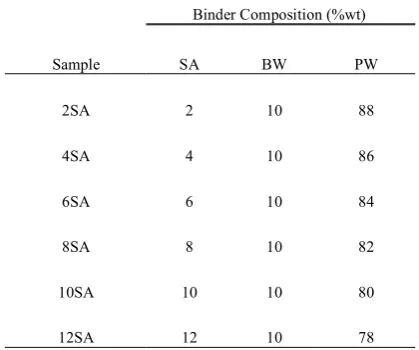
Six formulations composed of Mg – SiC (99: 1 wt.%) powder and a specific binder were prepared to investigate the influence of binder composition, powder to binder ratio, time and temperature on rheological properties of the feedstock. The characteristics of the binder components and the studied binder compositions are listed in tables 1 and 2, respectively. The amount of stearic acid used in the binder ranged from 2 to 12 wt % in 2 point increments and the amount of the two other components was identical in all 6 binder compositions.
Table 1. Characteristics of the binder components ) C o ( Melting Point ) 3 desity (g/cm Components 75 0.896
Paraffin Wax (PW) 63 0.960 ) BW ( Bees Wax 71 0.941 ) SA ( Stearic Acid
Table 2. Binder compositions and powder to binder ratio
Binder Composition (%wt)
Sample
SA BW PW
88 10 2 2SA 86 10 4 4SA 84 10 6 6SA 82 10 8 8SA 80 10 10 10SA 78 10 12 12SA
The magnesium was in commercial grade with 96% purity and particle size of d50 = 53 µm and for the SiC powder d50=8 µm.
SEM micrograph of magnesium and SiC powders were shown in Figure 1 and Figure 2, respectively. Morphology of the powders was analyzed using
Cambridge scanning electron microscope operating at 25 kV.
Figure 1. SEM micrograph of magnesium powder
Figure 2. SEM micrograph of SiC powder
The binder consisted of paraffin wax (PW) from Behran Oil Industry, refined beeswax (BW) from a locally chemicals vendor and granulated stearic acid (SA) from Merck.
Rheological investigations were conducted using an Anton-Paar MCR301 Rheometer. For each of the samples in table 1, binder components were mixed in a planetary mill at a rotational speed of 20 rpm at 75C for 15 mints. Mg-SiC powder was subsequently added to the molten binder. The addition of the powder to the binder was performed at a rotating speed of 200 rpm under argon atmosphere and took 1 h. Mg and SiC powder was dried in an oven at 110 °C for 1 h prior to addition.
The viscosity of the formulations was measured using a rotary rheometer (Physica MCR 301) after each mixing process. Generally in PIM, the shear rate varies in the range of 100 to 1000 s−1 [13], thus for uniformity shear
rate of 1000 s−1 was applied for all feed-stocks for 30
suitable flow rate requires a viscosity of less than 1000 Pa.s during injection molding [13].
Upon studying the effect of binder composition on rheological properties, one of the binder compositions was chosen as the optimum formulation. In order to optimize powder to binder ratio, 5 g of the optimum binder was melted in a blender at 90 °C and the Mg-SiC powder was added to the molten binder. Based on changes in viscosity due to the addition of Mg-SiC powder to the binder, a powder to binder ratio was chosen as the optimum ratio.
Time and temperature dependency of viscosity was also investigated for further evaluation of rheological properties of the studied feed-stocks.
A heat treatment schedule was extracted for effective removal of the binder from the feed-stocks according to differential thermal and thermal gravimetric analysis of the binder using PL-STA-1640 model.
3. RESULT AND DISCUSSION
3.1. Rheological study
Figure 3 shows viscosity versus shear rate in feed-stocks with different stearic acid contents. In all diagrams, viscosity decreases upon gradual increment of shear rate forming three separate regions with different slopes. In the first region from 0 to approximately 10 S-1 of shear
rate, viscosity decreases with a higher slope compared to the other two regions and the slope of curve decreases with increasing of shear rate. In the second region (10-100 S-1), viscosity remains constant with shear rate
increment in all studied samples. Ultimately, in the third region (100-1000 S-1), a descending trend is observed in
the viscosity with shear rate increment. It is also seen that by increasing the amount of stearic acid in feed-stocks from 2 to 12 the viscosity will decreases.
Figure 3. Viscosity versus shear rate of feedstocks with 2, 4, 6, 8, 10 and 12 wt. % stearic acid.
Three regions in the viscosity versus shear rate reveals that rheological behavior of the studied feed-stocks depends on the shear rate. In the first region, the applied shear stress is used to break secondary and weak bonds. Since the bonds between binder and powder atoms are majorly as of weak bonds, the reduction in viscosity occurs intensively at low shear rates.
In the second region, all weak bonds are broken. However, the shear rate is not sufficient to break strong bonds between particles. Thus viscosity remains constant by increasing the shear rate up to 100 S-1. In the third
region viscosity in all feed-stocks excluding 2SA begins to reduce upon shear rate increment. This means that the shear stress at higher rates than 100 S-1 is sufficient to
break strong bonds between particles. A similar behavior is also reported for Al/SiC MMCs in the literature [5]. In PIM method the shear rate ranges generally from 100 to 1000 S-1. Thus studies are often performed in this range
[14].
Continuous reduction in viscosity by increasing the shear rate is a characteristic of pseudoplastic fluids and is due to the orientation of the particles [15]. Viscosity in 2SA is significantly higher than other samples and contrary to other feedstocks, remains almost constant in the shear rate range of 10-1000 S-1. 2SA exhibits Newtonian
behavior which can be attributed to the lower content of SA as a surfactant in this sample. Similar results were obtained in repeated experiments.
Non-Newtonian fluids equations were used to depict rheological properties of the studied feedstocks. It is possible to relate shear stress to shear rate in a specific shear rate range using Ostwald- De Waele equation [3]:
n
K
(1)sensitivity of a fluid and like viscosity is considered as a practical characteristic of the fluid. The lower is the n which has more viscosity dependency on the shear rate [16]. This dependency of viscosity on shear rate contributes to shaping delicate and complicated products
[17] but hinders a successful processing of the feedstocks by causing powder-binder separation.
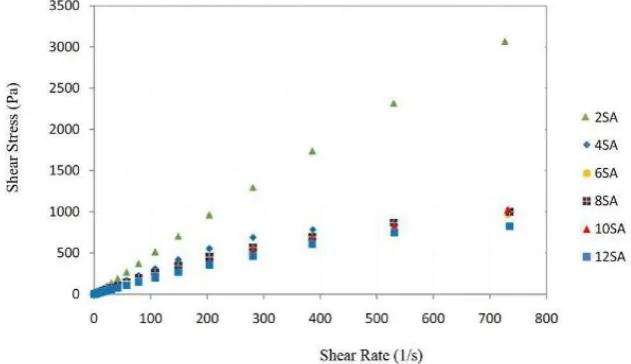
Figure 4 shows shear stress vs shear rate at 75ºC. Eq. 1 was applied to each sample in this figure and the values of n were obtained.
Figure 4. Shear stress versus shear rate of feedstocks with 2, 4, 6, 8, 10 and 12 wt. % stearic acid.
Figure 5 compares the n values of the studied feedstocks. It is seen that by increasing the SA content to 6 wt. %, the flow behavior index (n) decreases and by further increment of SA content from 6 wt % to 12 wt %, n increases. Thus addition of SA up to 6 wt. % contributed to the pseudoplastic behavior of the feedstock as a result of an increase in the attraction forces in between particles
due to the surfactant role of stearic acid. Another observation from Figure 5 is that 2SA exhibited Newtonian fluid behavior while other five samples can be classified as pseudoplastic fluids. Pseudoplastic fluids are more preferable from the view point of shaping complex geometries.
The following equation is another expression of Eq. (1) in the logarithmic form in which n is the slope of a straight line.
log
log
log
K
n
(2)Figure 6 shows a schematic of applying Eq. (2) on different fluids. For Newtonian fluids n = 1, for dilatants fluids n>1 and for pseudoplastic fluids n<1 [18].
Fluids which exhibit a curve rather than a straight line in this diagram do not follow the power law equation. Yet they might be classified as pseudoplastic or dilatants fluids with a relatively complicated behavior.
Figure 6. The concept of n in the logarithmic equation[18].
As it is shown in Figure 5 n values of all feedstocks are less than 1 and it means that all feedstocks have pseudoplastic behavior and viscosity decreases at high shear rates which are favorable in fabricating of complicated shapes. However, this induces a larger shear rate gradient which results in powder-binder separation [19].
Efficient dispersion of the powder within the binder helps increase powder to binder ratio without exceeding the maximum required viscosity for PIM. Addition of a suitable surfactant improves powder dispersion.
Fatty acids are among effective surfactants with a wide range of industrial applications in dispersing a ceramic powder within a paraffin binder. Carboxylic functional-group in Stearic acid attaches to the surface of the powder leading to a better dispersion because of its long chain containing 18 carbon atoms [20].
Van der waals forces cause intermolecular attraction between dispersed particles in a liquid phase and electrostatic and steric interaction act as repulsion forces. For better dispersion of the powder and reducing the viscosity, intermolecular attraction should be decreased and the repulsion forces should be increased instead. In a nonpolar liquid phase, addition of a steric dispersant contributes to this aim [21]. In the present work, different contents of stearic acid were included in the binder in order to achieve a stable feedstock with suitable
rheological behaviors. Separations of powder from the binder were observed when the rotation of the feedstock was stopped or in the injection cylinder where the feedstock was subjected to a high shear stress. The intermolecular attraction between stearic acid atoms and Mg atoms is majorly as of hydrogen bonds, although covalent bond is also reported. Relatively small size of stearic acid atoms (2.4 nm) prevents it to make a stable feedstock. Although it reduces the van der waals attraction stearic acid cannot convert the overall intermolecular forces to repulsion [1]. Thus it is essential to blend the feedstock continuously before injection which is performed accurately within the injection apparatus.
3.2. Optimum powder to binder ratio
An optimum powder to binder ratio is required the PIM feedstocks to minimize structural defects. This value should be as large as possible without yielding a large viscosity.
Changes in the rotating rate occur intensively at or above a specific powder to binder ratio which is called the critical ratio. To avoid sudden changes in rheological behavior of feedstocks 2 percent less than the critical value was considered as the optimized powder to binder ratio. Thus, the optimum powder to binder ratio was found to be 67:33 wt. %.
3.3. Time and temperature dependency of
viscosity
Needless to say, the viscosity of most fluids changes by passing time. To investigate the dependency of viscosity on time, each feedstock sample was subjected to the shear rate of 100 s-1 for 180 seconds and meanwhile underwent
the viscosity measurements. The results are shown in Figure 7.
Figure 7. Variation of feedstock viscosity versus time studied feedstocks.
As it can be seen, viscosity in all samples excluding 2SA and 4SA are independent of time. By increasing the stearic acid content, the intermolecular attraction decreases to an approximately constant value because of the increasing of stearic acid amount between particles. Another equally important consideration in processing of feedstocks is temperature dependency of viscosity which should be reduced to a minimum value to guarantee a desirable PIM product.
With a good approximation, Arrhenius equation can be utilized to describe the relation between viscosity and temperature [3]:
) ( exp
RT E
o
(2)Where η0 is the reference viscosity, E is the flow
activation energy, R is the gas constant and T is the absolute temperature.
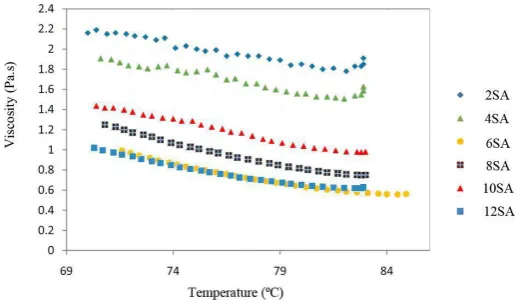
Figure8 shows the variation of the viscosity of feedstock versus temperature.
As it is shown, the viscosity of feedstocks increasesby decreasing of temperature. Flow activation energy E indicates temperature dependency of viscosity, i.e. the lower the E value is, the smaller fluctuations occur in the viscosity due to the temperature gradient between the hot injection cylinder and the cold mold.
This in turn hinders stress concentration in different parts of the molded material.
Table 3 lists flow activation energy (E) and flow behavior index (n) for Mg feedstocks with different stearic acid contents.
Table 3. Flow activation energy (E) and flow behavior index (n) for Mg feedstocks with different stearic acid contents.
Unlike n, flow activation energy E decreases continually upon increasing the content of stearic acid. 6SA yielded a relatively high value of E which indicates a relatively high dependency of viscosity on temperature. Yet it can be considered as a suitable feedstock owing to its previously studied rheological behaviors such as n and viscosity vs shear rate; furthermore, to minimize the effect of temperature dependency of 6SA, we can preheat the injection mold.
3.4. Binder Removal and Sintering Process
In order to optimize binder removal and sintering process different parameters such as furnace atmosphere, gas flow rate, heating rate, pressure control and furnace substrate should be determined according to feedstock characteristics. Melting point (Tm) of the metal contained
in the feedstock is used to calculate the sintering temperature (0.8 Tm). Vapor pressure diagram of the
applied metal is another important consideration in scheduling an appropriate heat treatment. Magnesium is converted from solid to the gas phase at above 10-4 kPa of vapor pressure and temperature 400 ºC. Regarding thermal behavior of the binder is also useful.
Figure 9 shows TGA/DTA curves conducted on Mg - SiC feedstock with 67:33 powders to binder ratio. An endothermic peak at 60 ºC represents melting of the binder. It is seen that no weight changes occur up to 200 ºC. The exothermic peak at about 210 ºC is attributed to decomposition of stearic acid and paraffin wax. With increasing the temperature from 210 ºC to 310 ºC, samples reduce in mass at a rapid rate.
Accordingly, feedstock samples underwent binder removal and sintering process either in a vacuum furnace or a typical furnace. Rapid removal of the binder components from the samples led to their fracture in the vacuum furnace because the rate of removing binder
from sample in vacuum furnace is higher than typical furnace. As mentioned above, the binder removal process was down based on the exact heat treatment which is shown in Figure 10.
Figure 9. TGA/DTA curves conducted on Mg - SiC feedstock with 67:33 powders to binder ratio.
Figure 10. Schedule of heat treatment for binder removing
4. CONCLUSION
Six formulations composed of magnesium and SiC powder (99:1 wt.%) and a binder composed of paraffin wax, bees wax, and stearic acid were prepared to optimize the binder composition according to the rheological properties.
Viscosity versus shear rate exhibited three different parts with different slopes for all studied feedstocks. 2SA yielded Newtonian behavior and increasing the amount of stearic acid up to 6 wt % contributed to the pseudoplastic behavior which is favorable from the view point of manufacturing intricate shapes. Adding more than 6 wt % stearic acid to the feedstock increased the flow behavior index n and devastated rheological behavior of the feedstocks. However, higher content of stearic acid decreased temperature dependency of viscosity. Taken as a whole, 6SA feedstock exhibits the best rheological properties among the six materials
(Wt %)SA 2
4 6 8 10 12
E(kj/mol) 15.3
18.8 46.6 44.1 33.8 40.9
n 0.95 0.86 0.78 0.8
examined. An optimum powder to binder ratio of 67:33 was chosen for 6SA feedstock after studying the flow behavior of the sample as a function of powder to binder ratio.
A heat treatment schedule was determined according to thermal behavior of the binder in order to effectively remove the binder from feedstocks.
ACKNOWLEDGEMENT
This work was part of the Master of science project "effect of powder cheractrization, binder components and binder/powder ratio on rheological behaviore of Mg /nano SiC feedstocks in injection molding process", supported by the Materials and Energy Research Center.
REFERENCES
1. Ma, Tiejun, Hideki Yamaura, Donald A. Koss, Robert C. Voigt, “Dry sliding wear behavior of cast SiC-reinforced Al MMCs”, Materials Science and Engineering A Vol. 360, (2003), 116-125.
2. M. İzciler, M. Muratoglu, “Wear behavior of SiC reinforced 2124 Al alloy composite in RWAT system” Journal of Materials Processing Technology , Vol. 132, (2003), 67-72.
3. Krauss, V.A., Pires, E.N., Klein, A.N., Fredel, M.C., “Rheological properties of alumina injection feedstocks” Mat. Res. Vol. 8 (2005), 187-189.
4. Huang, B., Liang, S., Qu, X., “The rheology of metal injection molding” Journal of Materials Processing Technology.vol. 137 (2003), 132–137.
5. Padhi, Payodhar and Kar, Sachikanta, “A Novel route for development of Bulk Al/SiC Metal Matrix Nano Composites”,
Journal of Nanotechnology, Vol.9 (2011), 413-512.
6. Wei-Wen Yang, Kai-Yun and Hon, Min-Hsiung, “Effects of PEG molecular weights on rheological behavior of alumina injection molding feedstock”, Materials Chemistry and Physics, Vol.78, (2002), 416-424.
7. Sotomayor, M.E., Várez, A., Levenfeld, B., “Influence of powder particle size distribution on rheological properties of 316 L powder injection moulding feedstocks”, Powder Technology.vol. 200 (2010)30–36.
8. Shubin Ren, Xinbo He, Xuanhui Qu, Islam S. Humail and Yanping Wei “Influence of binder composition on the rheological behavior of injection molded microsized SiC suspensions”, Journal of University of Science and Technology Beijing, Vol.15, (2008), 297.
9. Yimin Li, Shaojun Liu, Xuanhui Qu, Baiyun Huang, “Thermal debinding processing of 316L stainless steel powder injection molding compacts”, Journal of Materials Processing Technology, Vol.137, (2003), 65-69.
10. M.T. Zaky, “Influence of paraffin wax characteristics on the formulation of wax-based binders and their debinding from green molded parts using two comparative techniques”, Journal of Materials Processing Technology, Vol.209, (2009), 5981-5989. 11. P.Thomas-Vielma, “Production of alumina parts by powder injection molding with a binder system based on high density polyethylene”,Journal of the European Society, Vol.28, (2008), 763-771.
12. M. Khakbiz, A. Simchi, R. Bagheri, “Analysis of the Rheological behavior and stability of 316L stainless steel-TiC powder injection molding feedstock”, J. Materials Science and Engineering A, Vol. 407, (2005), 105-113..
13. Luo, A. “Magnesium: Current and potential automotive applications”,J. Min.Met. & Mat. Soc.,vol 54,(2005), 42-48. 14. Li, Duxin, HaitaoHou, Zhaoqiang Tan, Kun Lee, “Metal
injection molding of pure molybdenum”, advanced powder technology, Vol. 20, (2009), 480-487.
15. el-Eshkandarany, M. S. et al., “Solid state synthesizing and characterizations of consolidated nano-composite Mg- SiC”, J. Engineering and applied science, Vol. 50, (2003), 1212-1229. 16. Chan, T.Y. and Lin, S.T., “Effects of stearic acid on injection
molding of alumina”, J. of American Ceramic Society, Vol. 78, (1995), 2746-2752.
17. Li, Y., Liujin, Li., Khalil, K.A., “Effect of powder loading on metal injection molding stainless steel”, Materials Processing Technology, Vol. 183, (2007) 432-439.
18. Mutsuddy, Beebhas C. and Ford, Renée G., Ceramic injection molding. First Edition. London : Chapman & Hall, 1995. 0412538105.
19. Hort, N. and Wolff, Martin, “Looking to the future: Magnesium powder injection moulding”, Powder Injection Moulding International, vol.2, (2008), 63-65.
20. Martin A. and Liorca J., “Mechanical behavior and failure mechnisms of a binary Mg-6%Zn alloy reinforced with SiC particulates”, Materials Science and Engineering A, Vol. 201, (1995), 77-87.

![Figure 6 shows a schematic of applying Eq. (2) on different fluids. For Newtonian fluids n = 1, for dilatants fluids n>1 and for pseudoplastic fluids n<1 [18]](https://thumb-us.123doks.com/thumbv2/123dok_us/8894327.1826981/5.595.196.399.190.392/figure-schematic-applying-different-newtonian-dilatants-pseudoplastic-fluids.webp)