A GENETIC ALGORITHM APPROACH FOR UTILITY MANAGEMENT
SYSTEM WORKFLOW SCHEDULING
Nemanja Nedi
ć
, Sr
đ
an Vukmirovi
ć
, Aleksandar Erdeljan,
Lendak Imre, Darko
Č
apko
Faculty of Technical Sciences, University of Novi Sad Novi Sad, Serbia
e-mail: [email protected], {srdjanvu, ftn_erdeljan, lendak, dcapko}@uns.ac.rs
Abstract. In this paper, we present a scheduler for distributing workflows in Utility Management System (UMS). The system executes a large number of workflows, which have very high resource requirements. The workflows have different computational requirements and thus the optimization of resource utilization must be performed in a way that is different from the standard approach of scheduling workflows. We developed a strategy for allocating workflows, which is based on a genetic algorithm. The proposed architecture executes a scheduling algorithm by using a feedback from the execution monitor. We also report on an experimental study, which shows that a significant improvement of overall execution time can be achieved by using the genetic algorithm. The algorithm is used for designing effective Grid schedulers that optimize makespan. The study further shows that the overall system (UMS) performance is significantly improved; this finding indicates that there can be reduction in hardware investment.
1. Introduction
Utility Management Systems (UMS) is a term used to refer to various systems, such as power / gas or wa-ter distribution systems. The UMS are becoming in-creasingly resource demanding because their scopes are becoming increasingly wider. The systems have some exceptional requirements such as: communica-tion with end devices (sensors and actuators) and storage of huge time-series data volumes about vari-able values.
A workflow is loosely defined as an automation of a coordination process: coordinating people, data and tasks. A lot of research on business wokflows as well as their use have been done over the past few decades [7].
Foster and Kesselman described the Grid as an infrastructure that connects computers, databases, in-struments, and people into a seamless web of advan-ced capabilities [1]. With the development of large-scale high-speed networks, the Grid has become an attractive computational platform for high-perfor-mance parallel and distributed applications, such as UMS.
Workflow scheduling is a decision process that as-signs application components to available resources in order to optimize various performance metrics [20]. The Grid workload management and scheduling sub-systems enable the efficient distribution of tasks and
allow their transparent execution by hiding the comp-lexity of the Grid infrastructure.
At present, in many modern Grid infrastructures, scheduling relies only on static properties and pre-determined states of resources. We argue that resource utilization can be enhanced by adding the run time information. Also, it can be enhanced by predicting the system performance based on the current system information. For this reason, we propose an architec-ture for the Workflow Scheduler system that primarily uses the data of the current state of the Grid.
We achieve the enhancement of resource utiliza-tion performance in the Workflow Scheduler by carrying out workflow manipulation. The Workflow Scheduler can adopt various optimization criteria which it uses in order to choose the optimal workflow. Some possible criteria include the ones that rely on static information knowledge (e.g., type of workflow and pre-defined order of execution, etc.) and the ones that rely on dynamic information (e.g., database per-formance, processor statuses, communication with end device, etc.).
Artificial intelligence represents a modern concept of solving problems in engineering practice [19]. We chose a set of UMS workflows to analyze the feasi-bility and usafeasi-bility of applying genetic algorithm to this field. We used the accommodation of the genetic algorithm to solve the workflow scheduling. The ex-perimetal study that we ran confirmed the usefulness of the genetic algorithm based scheduler when the makespan is optimized. The implementation of the genetic algorithm is extensively tested and the compa-rison with the previously provided solutions of similar problems shows that this scheduling system allocates workflows efficiently and more effectively; conse-quently, the performance improves.
2. Related Work
Grid computing is a new approach in scientific applications. Recent advances in grid infrastructure and middleware development have enabled various types of applications in science and engineering to be deployed on the Grid. The applications include those for climate modeling, computational chemistry, bioin-formatics and computational genomics, remote control of instruments, and distributed databases [8].
The Grid infrastructure is used both to share ex-pensive and centralized resources among many scien-tists, as well as to integrate experimental data sources with the simulation codes necessary to analyze them [9].
The Grid connects computers, databases and inst-ruments in a seamless web, supporting rich computa-tion applicacomputa-tion concepts such as distributed super-computing, smart instruments, data-mining and com-plicated algorithm calculations [18]. However, its use has been limited to specialists, primarily because of the lack of usability [10].
Supervisory Control and Data Acquisition (SCADA) systems are becoming more and more re-source demanding because their scope has become wider. This trend is especially visible in distribution systems for utilities – UMS, the systems that are an extension of the SCADA systems. SCADA systems went a long way from simple visualization of pro-cesses observed. Distributed SCADA systems are thoroughly described in a scientific paper [4]. The process industry data found their way to the Internet [5] and even cell phones [6].
An upcoming need for the Grid approach could be envisioned by observing the volumes of data that need to be stored and processed. This is especially apparent in the UMS; for instance, the number of process vari-ables exceeds tens of thousands in Distribution Mana-gement Systems (DMS) [11].
Artificial intelligence slowly finds its purpose in distribution systems for utilities. It will surely be the key feature for the resources manipulation in the Grid enviroment.
The genetic algorithm, as an evolutionary tech-nique for large space search, proved to be a powerful tool for solving various problems [21,22]. Faced with a variety of situations, an intelligent Grid environment requires complex algorithms which will help manage the execution of different kinds of workflows. Several works [15] [16] [17] address the problems of Grid scheduling that adopt the genetic algorithm method for workflow manipulation in order to improve per-formance. The hybridization of the genetic algorithm with other heuristics (TS, SA) for dynamic workflow scheduling is presented in [14].
3. UMS Workflows
We found four types of grid nodes by analyzing the architecture and requirements for large scale distri-buted UMS systems. These are:
Processing node (PRN): its task is business cal-culation and data pre-processing, mainly for provi-ding reports and an offline analysis of the system.
Objects database node (ODN): it is used for storing the static data gained from the distributed UMS system. It usually hosts a relational database for better search performances.
Time-series node (TSN): this node hosts data about fast changing values of process variables.
Communication node (CON): this node is res-ponsible for communication with end devices. The workflows used for testing, which are reported in this paper, are chosen from the real UMS use cases. The following conditions are implied:
1. All workflows are independent of each other. 2. All workflows have the same priority.
3. Every node processes only one workflow at a time. 4. Every workflow is processed at one node at a time. 5. A workflow of the same type has the same
execution time at each specified node.
We implemented five workflows that use different types of Grid nodes:
1. Direct Command: it sends commands to actua-tors. When executing, it will send commands to ac-tuators through CON, and write command results to time series database in TSN.
2. Command with pre-processing: this type of com-mand needs pre-processing of data prior to sending commands. The commands could be used when business logic has to be applied before actuator could be used. In this workflow, PRN first prepa-res the data, and after that, CON sends commands to actuators.
3. Read Variable values: in this scenario Variables are read from cache (previously read from de-vices). Workflows execution of this type starts in
ODN in order to filter end devices that should be read. After that, the execution is transferred to
4. Read Variable values From Device: workflows of this type, contrary to the type 3 workflow, have to read values from sensors on demand. When exe-cuting, this workflow is transferred to ODN in order to filter end devices that should be read. After that, CON sends an on demand reading command to sensors.
5. Reporting Inquiry: this workflow covers various types of data processing. During the execution, this workflow is transferred to ODN in order to re-trieve data needed for calculation. After that, it is transferred to PRN, which is responsible for calcu-lation.
Figure 1 presents the execution plan of workflow migration for a set of previously defined UMS work-flows. Optimization goal in this paper is to rearrange incoming workflows in order to get maximum usage of all nodes.
Processing node
Objects database node
Time-series node
Communication node
Reporting Inquiry
Direct Command
Command with preprocessing Read Variable values Collecting status information
Time Executing
workflow
Figure 1. Workflow execution migration between nodes
3. Proposed Architecture
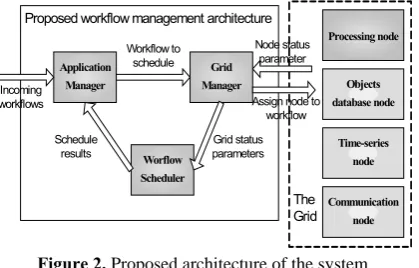
The proposed architecture takes into account the dynamic nature of a real-world UMS and uses the Grid environment approach for detecting and responding to the environmental change in the UMS. The developed framework is presented in Figure 2. It provides required support for the feedback from the scheduling process.
Proposed workflow management architecture
The Grid
Time-series node Application
Manager
Grid Manager
Worflow Scheduler
Processing node
Objects database node Incoming
workflows
Communication node Grid status
parameters Schedule
results
Node status parameter Workflow to
schedule
Assign node to workflow
Figure 2. Proposed architecture of the system
The framework consists of three components: the Grid Manager, the Workflow Scheduler, and the Ap-plication Manager. The function of the Grid Manager
is to monitor the status of the control variables and to send workflows to the nodes for execution. The
Workflow Scheduler is responsible for resource se-lection and for mapping the workflows to the re-sources. This component is of the most interest for our research, since decision-making takes place in it. The
Application Manager receives workflows in run time, queues them and works with Workflow Sche-duler to determine the right time to send a workflow to execution in the Grid.
4. Model representation in Genethic Algorithm
Genetic algorithms (GA) are stochastic, evolution-based, search and optimization algorithms. A potential solution of the optimization problem is encoded in an artificial creation, which is called chromosome (indi-vidual). The population of chromosomes evolves into a better solution in each iteration of the algorithm. The fittest individuals survive and are able to exchange their genetic material. Thus in every new generation, a set of chromosomes is created by exploiting the infor-mation from the past generation.
A. Chromosome encoding
A chromosome consists of a series of genes. The solution proposed in this paper presents an optimized workflow sequence, which is sent to the Grid for the execution. Each gene thus represents a workflow type. All of the workflow types are described in section 3 (1 – Direct Command, 2 – Command with pre-proces-sing, 3 – Read Variable values, 4 – Read Variable va-lues From Device, 5 – Reporting Inquiry). A gene is an integer value in the interval from 1 to 5.
B. The fitness fuction
The essence of the GA is the following: it searches for and eventually finds an optimal solution to a prob-lem by creating new generations and evaluating the individuals. It is necessary to define the principle of the individual assessment. The fitness function [2] provides the mechanism to evaluate each individual in the problem domain.
The problem that we offer a solution for in this pa-per is to maximize the throughput of the Grid by ba-lancing the load among the nodes in an intelligent way. The fundamental optimization criterion in solv-ing this kind of the problem is the minimization of the makespan, i.e. the time when the latest workflow is finished. This criteria, for an individual with n work-flows, is represented in the following way:
} max{Wfti
makespan= , (1)
} min{
Sequneces s
s makespan n
makespanMi
∈
= . (2)
i
Wft represents time when the th
A conclusion is then, that the time when the last workflow ends corresponds to the time of the comple-tion of the last node. So, the time when the last node finishes its work is the makespan.
If we definenodeStartTimekas a time point when a
node k k, ∈{1..numberOfNodes} is ready to start exe-cuting assigned work, and nodeWorkTimek as
requi-red time to get the work done, then the prequi-redicted completion time of a node is:
.
k k
k
nodeEndTime nodeStartTime nodeWorkTime
= +
+ (3)
The workflows described in this paper consist of two tasks, and each of these tasks executes at an ap-propriate node. In order to formulate the predicted time for a node to complete its work (nodeWorkTime), we need to estimate the execution time of the tasks. A computational load of tasks and computing capacity of nodes are required. The estimation is easily determi-ned in practice; it is easy to know a computing capa-city of a resource (node) by knowing its characteristics and, the workload of each task can be evaluated from the history data. The task execution time is calculated by dividing the workload of the task (in millions of instructions – mips) with the computing capacity of the node (in mips). Calculation of the workload of tasks is presented in the Cornell Theory Center [12].
A workflow can be defined as a set of two tasks (primary and secondary). The execution time for each task is:
, Tp
i k – execution time for the primary task of a
workflow i which is executed on the node k,
, Ts
i k – execution time for the secondary task of a
workflow i which is executed on the node k. Predicted time for a node to complete its work is defined as:
, , , ,
.
k k
i j i j i j k i j k
nodeEndTime nodeStartTime
Tp Ts
= =
= +
+
∑
+∑
(4)The makespan is determined as:
max{ k},
makspan= nodeEndTime (5)
{1.. }
k∈ numberOfNodes .
In the proposed implementation of the genetic al-gorithm, the fittest individuals have the highest numerical values for the fitness function, defined as:
makespan
ff = 1 (6)
C. Algorithm
The approach used in this paper generates a set of initial individuals (sequences, schedules of work-flows), estimates the fitness gain, selects the most appropriate individuals and combines them using the
operators (crossover and mutation) in order to form new solutions.
A selection mechanism guarantees the survival of the fittest individuals. A part of the existing population is selected to breed; it is highly likely that fitter in-dividuals survive and receive a higher number of des-cendents. A roulette wheel mechanism [2] is used to construct a proportional selection. This mechanism selects a small part of the less fit individuals and thus keeps the diversity of the population; this prevents a premature convergence towards a poor solution.
A crossover operator is the most important ingre-dient of the genetic algorithm. It produces new indivi-duals by interchanging parents’ genetic material. Its aim is to obtain better quality descendents and to ex-plore new parts of the solutions space that have not been considered so far.
Many types of the crossover operators are demon-strated in literature: one-point, k-point, uniform cross-over [2], etc. We decided to use the k-point crosscross-over. This operator provides a thorough study of the solu-tions space; however, it increases the possibility of de-stroying the parents’ structure. In order to preserve the genetic material of the parents, we decided that the two fittest individuals among parents and descendants join the next generation after the crossover is per-formed.
Since the crossover operator is dominant in the ge-netic algorithm, the crossover rate (a probability that the two chosen parent individuals will be crossed) needs to be set to a high value. An experimental study showed that best results are obtained with the crossover rate of 0.85.
Mutation, an operator that changes the individual's gene to another allowed value, is randomly applied with a low probability. It is used to ensure genetic diversity of the population and to recover good genetic material that may be lost during the crossover and the selection.
The mutation operator is used in the following manner: after the crossover is performed and the two individuals are chosen to join the next generation, the mutation operator is applied with the probability of 0.05 (mutation rate). The operator is implemented to a randomly selected individual's gene. The value of the gene is replaced with a random value taken from the set of the possible gene values.
The strategy of creating the next generation that allows the entry of the fittest individuals from the previous generation is known as elitism. This variant of the genetic algorithm can be very successful. At the same time, the elitism should be carefully used since there is a possibility that the algorithm gets stuck in a local extreme. We reduced the elitism in our research to 5%.
begin initialization:
Generate initial population of s individuals
while(count of generation is less then specified) {
Evaluate fitness function for individuals Create empty next generation
elitism: specified percents of fittest individuals
Choose m fittest individuals → ind1, ind2,..., indm
Add to next generation (ind1, ind2,..., indm)
for ( 1 .. s - m) {
selection: roulette wheel mechanism
Choose two parents from current generation
→
→
parent1, parent2crossover: crossover rate
Crossover(parent1, parent2)
→
child1, child2Choose the fittest two from
(parent1, parent2 ,child1, child2)
→
res1, res2mutation: mutation rate
Mutation(res1)
Mutation(res2)
Add to next generation (res1, res2) }
current generation
→
next generation}
return Best individuals from current generation
end
Listing 1. Genetic algorithm implementation pseudo code
6. GA accommodation for Workflow Schedular
Since the workflows arrive continuously and the set of those to be executed on the Grid is not known in advance, all pieces of information regarding the Grid tasks are not entirely known before the execution time. Therefore, scheduling decisions must be made on the fly, and a dynamic scheduling algorithm is necessary.
One of the main disadvantages of the genetic algo-rithms is that they need a significantly longer period of time to generate a solution; whereas some other concepts of artificial intelligence (e.g. neural net-works) do it in a much shorter period. This time period is a consequence of the iterative process of creating individual generations. It is impractical and unviable for the dynamic scheduler to calculate the fittest individual for any decision on a future workflow. We propose the following:
A. Dinamic schedular algorithm
At startup, the dynamic workflow scheduler uses the genetic algorithm (described in Section 5) to generate an optimal sequence of n workflows (an individual with n genes). After the first workflow is sent to the Grid, the sequence contains n–1 workflows. The dynamic workflow scheduler uses the following steps to add a new workflow at the end of the se-quence so that a sese-quence remains optimal (Figure 3): 1. reads the remaining types of workflows from
the workflows queue,
2. creates an n-dimensional sequence by adding a workflow at the end of the sequence for each type of the remaining workflows,
3. calculates a fitness function for every resulting sequence,
4. keeps the sequence with the highest fitness function as a new optimal sequence.
Figure 3.n – sequence optimization
B. Calculation of fitnes fuction during dinamic schedular algorithm
The dynamic workflow scheduler obtains informa-tion related to the current Grid load after the first workflow from the optimal sequence is sent to execu-tion. The time periods predicted for the nodes to complete their work are collected and they are used as nodeStartTime for fitness function calculation of the processed sequence; it signals when the nodes are ready to start executing assigned work (Section 5). The workflows in the processed sequence are defined and the execution times of their primary and secon-dary tasks are calculated. All information regarding the fitness function for the processed sequence is available and the fitness function can be calculated.
7. Results and discussion
Proposed workflow management
architecture (Grid Manager)
Processing node Objects database node
Communication
node Time-series node
Network Infrastructure
Node status parameter Task to
execute Node status
parameter Task to
execute
Node status parameter
Task to execute Node status
parameter
Task to execute
Figure 4. Deployment diagram for test environment
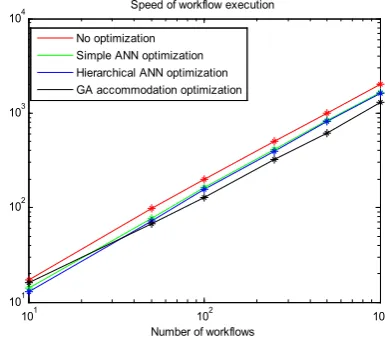
In this experiment we used a benchmark of queues of the five UMS workflows types defined in Section 3. We did this in order to study the performance of the dynamic GA workflow scheduler presented. We com-pared the quality of the results produced by the sche-duler with the results reported in the literature [13]. The research presented in the literature [13] describes the following scheduling logic: No optimization – workflows are scheduled in the order in which they arrive in the input queue; Simple ANN optimization – the output of the simple ANN presents the workflow that is sent to the Grid; Hierarchical ANN optimization – the output of the hierarchical ANN network selects the workflow that is scheduled in the next step.
We tested the dynamic workflow scheduler based on GA with parameters given in Table 1.
Table 1. Values of parameters used in GA scheduler population size 100
number of evolution steps 3000 chromosome size 6
selection roulette wheel mechanism crossover operator k-point crossover crossover rate 0.85
mutation rate 0.05
elitism 5 %
Table 2 summarizes the results of scheduling com-parison. We used between ten and a thousand work-flows in the tests.
Table 2. Speed of workflows execution Numb
er of work-flows
Time of execution – no
opti-mization [s]
Time of execution – simple ANN optimization
[s]
Time of execution – Hierarchical
ANN optimization
[s]
Time of execution – GA
accom-modation optimization
[s]
10 17 14 13 16
50 99 77 72 67
100 199 163 156 128
250 501 412 391 324
500 1007 827 809 618
1000 2018 1671 1625 1297
The experimental study shows that the GA based scheduler outperforms the existing solutions based on
the neural networks (Figure 5). The performance (spe-cifically, the speed) of the system improves with the increasing number of the scheduled workflows. The scheduling brings more benefits if there are more workflows to rearrange.
101 102 103
101 102 103
104 Speed of workflow execution
Number of workflows No optimization
Simple ANN optimization Hierarchical ANN optimization GA accommodation optimization
Figure 5. Speed of workflow execution
By introducing the dynamic GA scheduler in a workflow scheduling process for large scale UMS system, we provide the substantial improvement of the computational resources exploitation. The result is better performance of the entire system.
8. Conclusion
The specific features of the large scale UMS make the proposed architecture different from the standard Grid scheduling systems. The architecture based on feedback provides optimal scheduling (execution time optimization) of the workflows.
We demonstrated the usefulness of the genetic al-gorithm in forming the efficient workflow Grid sche-duler. The aim of the experimental study was to reveal the effectiveness of the GA based scheduling when the makespan is optimized.
The GA scheduler works fast because of the GA Accommodation algorithm; hence the scheduler dyna-mically chooses the optimal scheduling strategy for the workflows that arrive at the Grid.
We also presented an experimental study. The per-formance analysis shows that this approach signifi-cantly boosts the performance of the whole system and reduces the total execution time. Since the same results can be achieved by using less Grid nodes, the hardware investments can be substantially decreased.
References
[1] I. Foster, C. Kesselman, S. Tuecke. The anatomy of the grid: enabling scalable virtual organization.
Inter-national Journal of Supercomputer Applications,
2001, 15(3), 200–222.
[3] Y. Zhang, C. Koelbel and K. Cooper. Hybrid Re-Scheduling Mechanisms for Workflow Applications on Multi-cluster Grid. 9th IEEE/ACM International
Symposium on Cluster Computing and the Grid, 2009,
116–123.
[4] R. K. Agrawal, B. Merh, P. Fatnani, R. Yadav,
S. Gangopadhyay. Scada functionality for control
operations of Indus-2. 10th ICALEPCS Int. Conf. on Accelerator & Large Expt. Physics Control Systems.
Geneva, 10–14, Oct. 2005, PO1.098-8.
[5] B. Qiu H. B. Gooi. Web-Based SCADA Display
Systems (WSDS) for Access via Internet. IEEE
Trans-actions on Power Systems, 2000, Vol.15, 681–686.
[6] E. Ozdemir, M. Karacor. Mobile phone based
SCADA for industrial automation. ISA Transactions, 2006, Vol.45, 67–75.
[7] A. Rygg, S. Mann, P. Roe, O. Wong. Bio-Workflows with BizTalk: Using a Commercial Workflow Engine for eScience. Proceedings of the First International
Conference on e-Science and Grid (e-Science’05),
2005, 116–123.
[8] D. Abramson, A. Lynch, H. Takemiya, Y. Tanimu-ra et. al. Deploying scientific applications to the PRAGMA grid testbed: Strategies and lessons. In Pro-ceedings of the Sixth IEEE International Symposium
on Cluster Computing and the Grid (CCGRID’06),
Washington, DC, USA, 2006, IEEE Computer Society, 241–248.
[9] G. Allen, D. Angulo, T. Goodale, T. Kielmann, A. Merzky, J. Nabrzyski, J. Pukacki, M. Russell, T.
Radke, E. Seidel, J. Shalf, I. Taylor. GridLab:
Enabling applications on the Grid. In GRID’02:
Proceedings of the Third International Workshop on
Grid Computing, London, UK, 2002, Springer-Verlag,
39–45.
[10] F. Berman, H. Casanova, A. Chien, K. Cooper et. al. New grid scheduling and rescheduling methods in the grADS project. Int. J. Parallel Program, 2005, 33(2–3), 209–229.
[11] A. Erdeljan, N. Trninić, D. Čapko. An OPC data ac-cess server designed for large number of items. 6th International Symposium Interdisciplinary Regional Research (Hungary, Romania, Yugoslavia) ISIRR
2002, Novi Sad, 2002.
[12] S. Hotovy. Workload evolution on the Cornell theory center IBM SP2. In Job Scheduling Strategies for
Parallel Processing Workshop, 1996, 27–40.
[13] S. Vukmirovic, A. Erdeljan, I. Lendak, N. Nedic.
Hierarchical neural model for workflow scheduling in Utility Management Systems, 2010.
[14] A. Abraham, R. Buyya, and B. Nath. Nature’s
heuristics for scheduling jobs on computational grids.
In The 8th IEEE International Conference on
Advan-ced Computing and Communications (ADCOM 2000),
India, 2000, 45–52.
[15] V. Di Martino, M. Mililotti. Sub optimal scheduling in a grid using genetic algorithms. ParallelComputing, 2004, 30, 553–565.
[16] M. Aggarwal, R.D. Kent, A. Ngom. Genetic
Algo-rithm Based Scheduler for Computational Grids.
Pro-ceeding of the 19th Annual International Symposium
on High Performance Computing Systems and
Applications, 2005, 209–215.
[17] U. Fissgus. Scheduling Using Genetic Algorithms.
20th IEEE International Conference on Distributed
Computing Systems (ICDCS’00), 2000, 662–699.
[18] A. Kačeniauskas, R. Pacevič, A. Bugajev, T. Katke-vičius. Effective visualization by using Paraview soft-ware on Balticgrid. Information Technology and Cont-rol, 2010, Vol.39, No.2, 108–115.
[19] G. Narvydas, R. Simutis, V. Raudonis. Autonomous mobile robot control using If-Then rules and genetic algorithm. Information Technology and Control, 2008,
Vol.37, No.3, 193–197.
[20] A. Kuczapski, M. V. Micea, L. A. Maniu, V. I. Cretu. Efficient generation of near optimal initial po-pulations to enhance genetic algorithms for job-shop scheduling. Information Technology and Control, 2010, Vol.39, No.1, 32–37.
[21] A. Misevičius, D. Rubliauskas. Enhanced improve-ment of individuals in genetic algorithm. Information
Technology and Control, 2008, Vol.37, No.3, 179–
186.
[22] A. Misevičius, D. Rubliauskas, V. Barkauskas.
Some further experiments with the genetic algorithm for the quadratic assignment problem. Information
Technology and Control, 2009, Vol.38, No.4, 325–
332.