Volume 01, No.8, August, 2015
P
age
1
Drying: An Excellent Method for Food Preservation
Yashwant Kumar*, Soumitra Tiwari** and Seema A. Belorkar***
*Assistant Professor, Department of Food Processing & Technology, Bilaspur University, Bilaspur-495001, Chhattisgarh, India
**Assistant Professor, Department of Microbiology and Bio-informatics, Bilaspur University, Bilaspur-495001, Chhattisgarh, India
ABSTRACT:
Drying is an ancient technique of food preservation & for extension of shelf-life of foods; and it also minimizes the transportation cost as well as the storage cost per unit product weight. Sun drying is the most common method to preserve the foods in rural area whereas in industries mechanical drying is in practice. Preservation of fruits and vegetables, meat, fish and food plants by drying in the sun or in the naturally dry air of the deserts and mountains has been practiced and is still a vital operation in the life of many rural communities. For the faster drying (i.e. time saving) and more versatility in commercial scale mechanical drying is the common technique to preserve the food stuffs.
Key-words: Food drying, food preservation, shelf-life extension, food dehydration and hot
air treatment.
INTRODUCTION
Drying or dehydration is, by definition, the heat and mass transfer process for removal of water by application of heat, from a solid or liquid food, with the purpose of obtaining a solid product sufficiently low in water content. Where removal of water takes place by virtue of a difference in osmotic pressure and not by evaporation. The main objectives of food dehydration are: Preservation as a result of lowering of water activity; low transport and storage cost as a reduction in weight and volume; Transformation of a food to a form more convenient to store, package, transport and use, e.g. transformation of liquids such as milk or coffee extract, to a drypowder that can be reconstituted to the original form by addition of water (instant products).
METHOD OF DRYING
Mainly, there are two types of drying which are given below-
Volume 01, No.8, August, 2015
P
age
2
1.Natural Drying
Natural drying is the method of drying, in which we are using the natural source (viz. Sun) for drying of food products. It is also known as sun/solar drying. It has been used to dry fish, meat, cloth, grains and has proved to generate food stuffs of high quality and low spoilage though solar drying is cheap easy and popular method, its application is restricted by the long drying time and need for favorable weather. Tulsidas (1994) showed that 6 - 9 weeks were required to dry grapes to a water content of 25–30 % and further steps were required to dry them completely. Sun drying is cheaper method due to natural source of drying. While it is slow process, very prone to contaminants as well as weather dependent. That is why it is not most common in commercial scale.
2. Mechanical Drying
Mechanical drying is the method of drying of foods by means of mechanical systems. Hot air is produced by the system which is used for the drying of food material. Several mechanical dryers are developed by the researcher in the field of food technology. Various types of mechanical drying system available in the market which are hot air convective drying, freeze drying, vacuum drying, fluidized bed drying, spray drying, microwave drying, vacuum assisted microwave drying, microwave assisted fluidized bed drying. Some of them are discussed in this review paper are given below-
i. Hot air convective drying
The principle of hot air convective drying is based on conventional heat transfer from heated air to the material being dried. Hot air is forced through the material and does the moisture diffusion process that result in the drying. This method has been widely used in industries. Different types of dryers have been developed and employed in commercial production (Jayarama and Gupta, 1995). Heated air is blown through the material by cross flow or by fan generated flow. As compared to solar drying, hot air convective drying can greatly shorten the drying time from several weeks to several days. However same studies have been reported that the taste, color and overall quality of dried berries could be improved by using alternative methods, such as microwave drying (Tulsidas, 1994).
ii. Freeze drying
Volume 01, No.8, August, 2015
P
age
3
iii. Vacuum drying
The basic principle of vacuum drying is to remove the water by means of vacuum. There are four essential elements in a vacuum drying system: a vacuum chamber, vacuum generating device, system for collecting water vapor and means for supplying heat required for vaporization of water (Brown and VanArsdel, 1964). For reasons similar to freeze-drying vacuum drying is also an expensive drying method. It is used only for costly products.
iv. Fluidized bed drying
Fluidized bed drying is the drying technique in which fluidization is take place. Fluidization provide better surface area of heat and mass transfer. Fluidized bed dryer are found throughout all industries, from heavy mining through food, fine chemicals and pharmaceuticals. They provide an effective method of drying relatively free flowing particles with a reasonable narrow particles size distribution. The feed may take the form of powders, granules, crystals, seed, pre-forms and non-friable agglomerates. Fluidized bed dryers can process a wide variation of feed rates from pounds to several hundred tons per hour. Three principle types of fluidized bed dryers exist. The first type is referred to as a static fluid bed because the dryer remains stationary during operation. Static fluidized bed dryer can be continuous or batch operation and may be round or rectangular. The second type of fluidized bed dryers is a vibrating fluidized bed dryer where the body of the dryer vibrates or oscillates, assisting the movement of material through the unit. Vibrating fluidized bed dryers are almost exclusively rectangular in shape. Fluidized bed dryers are extensively used in particular solids drying because of their high rates of heat and mass transfer and the reduced drying times.
When a fluid is passed upwards through a bed of particles the pressure loss in the fluid due to frictional resistance increase with increasing fluid flow. A point is reached when the upward drag force exerted by the fluid on the particle in the bed. At this point the particles are lifted by the fluids separation of the particle increases and bed becomes fluidized therefore the fluidization is the operation by which fine particles are transformed in to a fluid like state through gas or liquid.
The superficial gas velocity at which the packed bed becomes a fluidized bed is known as minimum fluidization velocity Umf. This is also sometimes referred to as the velocity at incipient fluidization (incipient means about to begin). The effect of operation conditions in fluidized bed dryers is complex to estimate because of the interactions between them and also the intrinsic properties of the drying solids. In the description of these types of dryer mathematical models based in two phase’s fluidization theory (bubble and dense phase) has been presented. These types of models allow predicting the effect of the operation condition of the coupled processes of heat and mass transfer. The important parameter is the velocity of drying air in fluidized bed dryers, which differs from a fixed bed in bin dryer.
v. Microwave drying
Volume 01, No.8, August, 2015
P
age
4
convective dryers. The products dried by these methods are often poor in colour, flavour (taste and aroma), texture and rehydration qualities. Case hardening (the formation of hard outer shell) and shrinkage are also two major problems with conventional drying processes. In recent years, improvement of quality retention by dried products (rehydrability etc.) by altering process conditions and/or pretreatments, has been a major research goal (Cohen and Yang, 1995).
Water molecules are polar, which means that they can rotate under the influence of an alternating electrical field. Foodstuffs usually contain 52 to 99 % water, and hence are very well suited for heating and drying with microwave energy. Now a day's microwave drying is used mainly for drying of pasta and post baking of biscuits. Microwave drying of fruits and vegetables is hardly carried out at an industrial scale.
Carrots and onion were dried by microwave radiation after pretreatment with hot air blast and the products were compared to those of traditional drying process i.e. freeze drying, hot air blast and vacuum drying. Test panel assessments of onion showed that freeze-dried product became softer than microwave dried one. There were few differences in colours between different drying methods for carrots. Textural studies of dried product examined by scanning electron microscopy have relevated a greater degree of shrinkage in the microwave-dried sample of both the vegetables. The advantages of using microwave energy in the drying of carrots and onion have been described by Torringa et al. (1993).
Wang et al. (2010) reported that a rotary device was built in a home microwave oven, where wet soybean was dried in a dynamic moving state to improve the microwave drying uniformity. Experiments were conducted to investigate the relative water removal ratio which was defined to characterize the electromagnetic field distribution in microwave oven, and to compare the drying characteristics between static and rotary microwave drying. It is concluded that the kernel cracking ratio is lower when microwave drying of soybean was carried out in rotary state. MW ovens, commercialized applications of MW/RF heating include blanching, tempering,pasteurization, sterilization, drying, rapid extraction, enhanced reaction kinetics, selective heating, disinfestations, etc.
Dehydration characteristics of carrot cubes were evaluated in a domestic microwave oven (600 W) modified to allow passage of air at constant flow rate and a given air temperature. The parameters included inlet air at two temperatures (45 and 60 °C), and microwave oven operation at two power levels. Conventional air drying with microwave off served as the control. Microwave drying resulted in a substantial decrease (25–90 %) in the drying time and the product quality was better when dried at the lower power level (Prabhanjan et al., 1995).
Walde et al. (2004) observed that wheat samples of approximately 20 g each were dried in a domestic microwave oven for different time periods ranging from 15 to 150 s with different moisture contents ranging from 0.11 to 0.23 kg of water/kg of dry weight of solids. The microwave-dried samples for 120 s were crisp and consumed less energy for grinding compared to the control samples. The interior temperature of dried microwave-heated food is higher than the surface temperature and moisture is transferred to the surface more dynamically than during convective drying (Ohlsson, 1990; Torringa et al., 2001).
Volume 01, No.8, August, 2015
P
age
5
by using air temperature higher than 40 ºC. Medeni Maskan (2000) reported that Banana samples (4.3±0.177, 7.4±0.251 and 14±0.492 mm thick) were dried using the following drying regimes; convection (60 °C at 1.45 m/s); microwave (350, 490 and 700 W power) and convection followed by microwave (at 350 W, 4.3 mm thick sample) finish drying. The drying of banana slices took place in the falling rate-drying period with convection drying taking the longest time. Microwave finish dried banana was lighter in colour and had the highest rehydration value.
Prefry drying of onion slices using microwaves reduces the oil uptake during subsequent frying (Hansen, 1998). Chemical pretreatment decreased skin resistance to diffusion and microwave pre-drying created a partial puffing of the structure, thereby enhancing the internal moisture diffusion during sun drying (Tulsidas et al., 1996).
Microwave drying of mushrooms at low power density in combination with heated air resulted in improve moisture diffusivity, better rehydration properties and improved flavor retention. Agaricus bisporus mushrooms were dried by hot air and combined hot air microwave treatment at different hot air temperatures of 35, 45, 60 and 75 ºC. Quality was assessed by checking rehydration and flavour retention. Results showed that combined pretreatment shortened the process time, yielding a good final quality product without pretreatment when using microwaves the water release rate though the sample surface was quicker. Layer rehydration of dried mushrooms depended on drying temperature and was slightly better and samples dried with combined treatment. Retention of characteristics aroma compound and its oxidation product was positively affected by microwave drying (Riva et al., 1991). Microwave-vacuum drying of basil resulted in higher retention of volatiles, better colour and higher rehydration rates in comparison to the conventional hot air method (Yousif, et al., 1999).
Kar (2001) observed that microwave assisted convective dehydration of sliced banana resulted in an increase in the energy use efficiency by a factor of 19 and 90 % reduction in drying time as compared to that using convective dehydration alone.
Microwave vacuum dehydration of Thompson seedless grapes was conducted by Clary and Clary and Ostrom (1995). They concluded that dehydrated grapes of excellent integrity, puffed character and colour of fresh grape (without any chemical pre-treatment) could be obtained using an optimum total specific energy of 0.84 to 0.88 W-h/g for 70 to 75 min (microwave drying reduced drying time) in an infrared temperature range of 70 to 80 ºC.
Volume 01, No.8, August, 2015
P
age
6
Kim et al. (1997) suggested microwave-vacuum drying of yoghurt at low temperature as a useful alternative to freeze-drying and spray drying in terms of survival of starters and cost.
Prasad et al. (2004) reported that microwaves when used for drying, reducing time and bacterial contamination, thus resulting in improved appearance in the product quality without influencing the chemicals composition of dried products. The process of drying also gets accelerated by the use of microwave in fruits as observed in case of plums’ dehydration.
Strawberries were microwave dried after a pretreatment; is dipping in a 2 % ethyle oleate solution in 0.5 % NaOH and then microwave power applied at 0-2 g/W. The product obtained was comparable to freeze dried product in terms of color, texture and rehydration characteristics. Dipping in ethyl oleate alters the skin coating (Prasad et al., 2004).
Rao et al. (1998) reported heavy loss of volatile oil during the drying of Rosemary using microwaves. Microwave heating was found to contribute to appreciable loss (approximately 30-40 %) of vitamin B12 in food like raw beef, pork and milk.
Hussain et al. (2010) observed to establish optimum conditions for microwave drying of ginger in terms of aroma quality. The lowest drying temperature (40 ºC) did not result in best product quality. Most of the aroma was lost at low drying temperature due to a long drying time. The longer drying times also made the process energy consuming. On the other hand, high-temperature drying (70 ºC), though more energy efficient and less time consuming, rendered the dried product unacceptable due to the charring of the product and high loss of aroma. From the analysis of aroma profiles and the results of quality assessment (rehydration ratio, surface color) it can be concluded that the best product quality was achieved by drying at 60 ºC.
Microwave Drying is not only faster but also requires less energy consumption than conventional drying (Tulsidas, 1994). In the drying of osmotically pre-treated strawberries or blueberries, it has been showed that microwave drying required shorter drying time than freeze drying, while maintaining the same final product quality (Venkatachalapathy, 1998). Also it has been reported that the use of microwaves in freeze-drying could substantially increase drying rate and consequently, decrease drying time (Sanga et al., 2000). It has been compared hot air-drying, freeze-drying, vacuum drying and a combination of hot air and microwave drying of cranberries (Beaudry, 2001). It was concluded that microwave-assisted hot air drying resulted in the shortest drying time and acceptable color, taste and texture.
It has been dried flowers with microwave energy in conjunction with a color- protecting treatment, which offered a number of advantages over conventional methods (Liang et al., 2003). It was observed that in microwave drying of wood strands with proper selections of power input, weight of drying material, and drying time, microwave drying could increase the drying rate, save up to 50 % of energy consumption, and decrease volatile organic compound (VOC) emissions when compared with the conventional drying method (Guanben et al., 2005).
Volume 01, No.8, August, 2015
P
age
7
growth, chemical/biochemical reaction rates and physical properties based on water activity (www.asabe.org).
Majumdar (2000) observed that much invention has been accomplished over the past two decades as far as understanding and development of drying technologies are concerned for food and agro-products.
According to Askari et al. (2006) microwave treatment, even at a low microwave power and short time, can have major effect on the quality of dried apple slices. The type of coating material has been a significant effect on textural quality such as texture strength. Starch (in suspension form) and pectin with CaCl2 had the best quality characteristics (more porosity, less apparent density and more rehydration capacity).
Bouraoui et al. (2007) reported that potato slices were dried using microwave drying, combined microwave and convective drying, and convective drying. Rehydration kinetics was also studied. Drying rates of the different drying methods were determined and microwave drying was compared with convective drying. Microwave drying has a potential for producing better quality dried products while considerably reducing drying duration (i.e. 10 min vs 10 h). Effective moisture diffusivity profiles were calculated using Fick's diffusion model in one dimension.
Microwave (MW)-related combination drying is a rapid dehydration technique that can be applied to specific foods, particularly to fruits and vegetables. Increasing concerns over product quality and production costs have motivated the researchers to investigate and the industry to adopt combination-drying technologies. The advantages of MW-related combination drying include the following: shorter drying time, improved product quality, and flexibility in producing a wide variety of dried products. MW-related combination drying takes advantages of conventional drying methods and microwave heating, leading to better processes than MW drying alone.
Another major drawback is the penetration depth of the MW field into the products. Although MW power at 915 MHz penetrates to a greater depth than does at 2450 MHz, in large-scale drying applications (Wang et al., 2003).
It was also noticed that products with an acceptance rate higher than 7 were obtained with a drying air flow rate within the range from 1.10 to 1.65 m3/min and drying air temperatures higher than 30 °C. It was concluded that it is possible to dry bananas with the assistance of microwave energy by using drying air within pre established temperature and flow rate limits (5 °C and 0.8-1.8 m3/min, respectively).
Sousa et al. (2004) observed that increasing microwave power during the final drying of banana slices increases the drying rate and consequently decreases drying time. However, higher microwave power also causes a rapid rise in product temperature (temperature runaway) and consequently charring of the dried product. Thus, it is necessary to control the microwave power during the final drying phase in order to avoid temperature runaway and quality deterioration of the product. Air temperature and air velocity also have a positive effect on drying time, although the reductions with higher temperatures and velocities are not as great as those associated with microwave power.
Volume 01, No.8, August, 2015
P
age
8
(50 g in each experiment) at four moisture levels (12, 15, 18, and 21 % wet basis) were subjected to microwave treatment at five power levels (100, 200, 300, 400, and 500 W) and two exposure times (28 and 56 s) in a laboratory scale, continuous type, industrial microwave dryer (2450 MHz). After microwave treatment, the germination percentage was near zero at 300 W for the samples collected from the hot spot, when the exposure time was increased to 56 s and the initial moisture content was 18 and 21 %. At 400 and 500 W power and 56 s exposure, the germination percentage was almost zero for samples collected from both normal and hot-spot regions.
Heating takes place volumetrically and water is heated, vaporized within the whole volume of the food product. The rapidly formed water vapor creates a large pressure gradient, which is drying force in microwave drying (Dorin Bolder, 2003).
The colour, re-hydration capacity and macaroni cooking quality, related to cooked weight, cooking loss and firmness of drying of short-cut macaroni were evaluated. The textural properties of uncooked and cooked macaroni samples were measured using a texture analyzer. Protein denaturation of dried samples increased significantly with microwave power level. Firmness of samples increased while cooking loss decreased generally with microwaveapplication after hot air drying i.e., hot air/microwavecombination shortened the drying time and improved many of thephysical, textural and cooking properties ofmacaroni samples (Alibas et al., 2004).
According to Dar et al. (2010) microwave is new technologies in food processing. This requires special equipment to generate and control their energy. The electromagnetic spectrum between frequencies of 300 MHz is represented by microwaves (Decareau, 1995). Microwave can pass through materials like glass, paper, plastic and ceramic and be absorbed by metals. Once microwave energy absorbed, polar molecules and ions inside the food will rotate or collide according to the alternating electromagnetic field and heat is subsequently generated for cooking. Dielectric properties i.e. dielectric constant and loss factor, of food materials play a critical role in determining the interaction between the electric field and foods (Buffler, 1993). Microwave heating is quicker than conventional heating and there is better nutrients retention (Felton et al., 1994).
Preliminary studies were made to develop pilot scale microwave processing equipment to produce-detoxified soybean, which could be used for cottage level processing. Among the heat labile anti-nutrients trypsin inhibitor activity is required to be reduce below 10 %. The urease activity, which is also one of the anti-nutrients of soybean, is required to be reduced to 0.05. The microwave heating experiment was conducted using 17 liters capacity rotating platform domestic microwave oven. The average time required at 100, 200 and 200 g/cm2 spreading density were 7.3, 9.3 and 14 min respectively (Saxena et al., 2006).
Volume 01, No.8, August, 2015
P
age
9
vi. Vacuum assisted microwave drying
Microwave drying assisted with vacuum gives better drying in terms of sensory qualities as well as the drying time and rehydration quality of the dried products. Chauhan and Srivastava (2009) dried green peas in a vacuum-assisted microwave drying system. The effects of microwave power levels (100–300 W) and system vacuum (50–400 mmHg) on drying parameters (viz. drying efficiency and drying time) and some quality attributes (viz. linear shrinkage, apparent density, green color, rehydration, and sensory attributes) of dehydrated peas were analyzed by means of response surface methodology. They used face-centered central composite design to develop models for the responses. Analysis of variance showed that a second-order polynomial model predicted well the experimental data. The system microwave power level strongly affected quality attributes of dehydrated peas and drying parameters. A higher vacuum during drying resulted in a better quality product. They found Microwave power of 237.31 W and a 360.22 mmHg vacuum to be optimum drying conditions for vacuum assisted microwave drying of green peas.
Microwave vacuum drying of banana slices was investigated experimentally. This type of drying procedure is preferable to conventional drying techniques in order to avoid product degradation due to high temperatures encountered in convective drying. The drying process was examined by introducing pulse generated microwave power in banana samples. The material temperature was monitored. Temperature peaks in the last stages of drying indicated that drying could be favored if temperature was maintained below a maximum level, so that the final product should not be burned by hot spots during microwave drying. This procedure produced dehydrated products of excellent quality as examined by taste, aroma, smell and rehydration tests (Drouzos and Schubert, 1996).
Changrue and Orsat (2009) reported that the combination of osmotic and microwave vacuum drying was investigated. The advantage of microwave vacuum drying is that it provides faster drying times with a low-temperature process. Since solid gain from osmotic agents might cause a decrease in diffusivity of the osmotically dehydrated product and lower qualities of dried product, it is important to know the effects of osmotic treatment prior to microwave vacuum drying. Two levels of microwave input power (1 and 1.5 W/g) and three power modes (continuous, 45 s on/15 s off and 30 s on/30 s off) were studied at an absolute pressure of 8 kPa for the microwave vacuum drying of carrots. Drying kinetics, energy consumption, and quality in terms of water activity, shrinkage, rehydration capacity, color characteristics, and sensory evaluation were studied.
Chili is a heat sensitive material and conventional hot air drying generally produces poor quality of dried chili with unattractive colour. To improve the product quality, microwave assisted vacuum drying was studied. Results indicated that the chili pretreated with 0.5 % citric acid solution and dried at 160 mmHg pressure and 1,120 W microwave powers for 60 min yielded dried chili containing similar colour to fresh chili. Increasing the microwave power to 1,600 W and reducing drying time to 40 min tended to reduce redness, yellowness and lightness of dried chili (Tontand and Therdthai, 2009).
Volume 01, No.8, August, 2015
P
age
10
order to maximize the benefits pulsed, microwave-vacuum drying both cycle power-on time and pulsing ratio should be optimized for a given product and microwave properties.
vii. Microwave assisted fluidized bed drying
Fluidized bed drying assisted with the microwave system for enhancing the efficiency of the drying system. Fluidized bed and microwave drying compensate some of the drawbacks of each other. Combination of two methods can give rise to several desired results; the uniformity of the temperature among the particles can be provided by well mixing due to fluidization (Feng and Tang, 1998) and the drying times can be reduced by the utilization of microwave energy (Jumah and Raghavan, 2001; Wang et al., 2002).
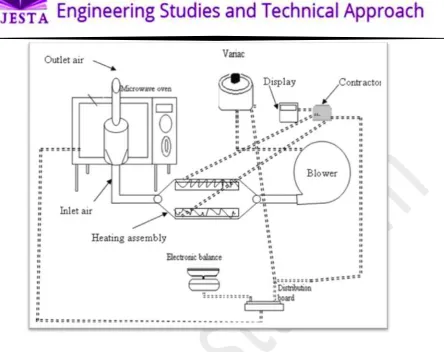
At the first stage of the microwave assisted fluidized bed drying, liquid water transports from the interior to the exterior of the particle by Darcy’s flow. As the temperature inside the material approaches to the boiling of water, pressure development occurs pushing the moisture toward the surface. As the time proceeds, the liquid water supply cannot maintain the evaporation rate at the surface. Afterwards, the water starts to evaporate inside the particle. Darcy’s flow and the vapor diffusion are the major mechanisms for the moisture transport in the particle. As the drying progresses, the moisture content near the surface decreases below critical moisture content. Darcy’s flow disappears so that liquid water has to be evaporated and then transported to the particle surface by vapor diffusion (Chen et al., 2001). Kumar et al. (2014) reported that the fluidized bed drying assisted with microwave to dry beetroots. After assisted the microwave in fluidized bed dryer, drying time is reduced by two to three times. Microwave assisted fluidized bed drying system are given in figure 1.
Other drying
Many drying methods can be assisted together for best result. Some of the assisted techniques are discussed here. Due to growing demand for minimally processed foods based on microwave blanched which is associated with inactivation of above enzymes and is used primary to retain sensory and nutritional characteristics of foods (Ramaswamy and Fakhouri, 1998). The microwave blanching procedure has recently gained some recognition as enzyme inactivation my microwave heating may offer the advantage that heat sensitive nutrients and flavour compounds are preserved due to its rapid heating potential and possible non-thermal effect of enzyme activation (Knutson et al., 1987 and Sahni et al., 1997).
Volume 01, No.8, August, 2015
P
age
11
Fig. 1: Microwave assisted fluidized bed drying system (Kumar et al., 2014)
Osmotic dehydration is a water removal process involving soaking foods, mostly fruits and vegetables, in a hypertonic solution such as concentrated sugar syrup (Madamba, 2003). Osmotic dehydration is used as a pretreatment for many processes used to improve nutritional, sensorial and functional properties of food without changing its integrity (Torrengiani, 1993). It generally precedes process such as freezing, freeze-drying, vacuum drying or air-drying. It also increases sugar to acid ratio, and improves texture and stability of pigments during dehydration and storage (Raoult-Wack, 1994). It is effective around ambient temperatures, so heat damage to texture, colour and flavour can be minimized (Torrengiani, 1993). The other major application is to reduce the water activity of food materials so that microbial growth will be inhibited. Since most food materials contain large amount of water, they are cost intensive to ship, pack and store (Biswal and Maguer, 1989). Osmotic dehydration is acknowledged to be an energy efficient method of partial dehydration, since there is no need for a phase change. There are numerous studies on osmotic dehydration of vegetables (Mudahar et al., 1989).
Volume 01, No.8, August, 2015
P
age
12
suspended in an air stream and heated with microwaves. The internal temperature distribution has been analyzed in each case. The rate of drying is also presented and discussed for every case tested.
Freeze drying and fluidized bed drying are the advanced techniques for preservation of such products. However, the process of freeze-drying suffers from high cost of processing and packaging. Fluidized bed drying, besides providing high quality product reducing drying time also. The time required to dry green peas by this technique was one-fourth of that for conventional tray drying (Gangopadhyay and Chaudhary, 1979).
CONCLUSION
Drying or dehydration is the most efficient method of food preservation, in which food is preserve the lowering down the moisture content in food. Low water content indicates the lower water activities in dried food that check the growth of microorganism, that means prevention of food- spoilage due to microorganism. This review shows that the mechanical drying is much better in respect to drying time & sensory attributes of final product as compare to conventional drying .
REFERENCES
i. Alibas Ozkan, Altan A. and Maskan M., 2004. Microwave Assisted Drying of Short-Cut Macaroni: Cooking Process and Textural Properties, Food Science and Technology International, 10(3), 187-196.
ii. Araszkiewicz Michal; Koziol Antoni; Lupinska Anita and Lupinski Michal. 2007. Microwave drying of various shape particles suspended in an air stream. Transport in Porous Media. 66(1-2), pp.173-186.
iii. Askari G. R., Emam-Djomeh Z. and Mousavi S. M., 2006. Effect of combined coating and microwave assisted hot-air drying on the texture, microstructure and rehydration characteristics of apple slices, Food Sci Tech, 12(1), pp. 39-46.
iv. Barbosa-Canovas, G. V. Vega-Mercado. “Dehydration of foods”. New-York, N.Y: International Thomson publishing, 1996.
v. Beaudry C “Evaluation of drying methods on osmotically dehydrated cranberries”. MS Thesis. Montreal QC: McGill University, Department of Agriculture and Biosystem Engineering. 2001.
vi. Biswal R. N., and Maguer M. Le, 1989. “Mass transfer in plant material in contact with aqueous solution of ethanol and sodium chloride: equilibrium data”, Journal of Food Process Engineering, vol. 11, pp. 159-176.
Volume 01, No.8, August, 2015
P
age
13
viii. Brown, A. H., W. B. VanArsdel, E. Lowe “Drying methods and driers”. In food Dehydration, Vol-II. Edited by W.B.V. Arsdel, M. J. Copley. Westport, Connecticut: The AVI Publishing company, INC, 1964.
ix. Buffler, C.R. 1993. Prediction of dielectric properties in solid foods of high moisture content at ultra high and microwave frequencies. J. Food. Proc. Presev. 13, pp. 119-151.
x. Changrue, V. and V. Orsat. 2009. Osmotically dehydrated microwave vacuum drying of carrots. Canadian Biosystemes Engineering/Le ge´nie des biosyste`mes au Canada. 51: 3.11-3.19.
xi. Chauhan, A. K. S. and Srivastava, A. K., 2009. Optimizing Drying Conditions for Vacuum Assisted Microwave Drying of Green Peas (Pisum sativum L.), Drying Technology, 27(6), pp.761-769.
xii. Chen, G., Wang. W., and Mujumdar. A. S., 2001. Theoretical study of microwave heating patterns on batch fluidized bed drying of porous material. Chemical Engineering Science, 56:6823-6835.
xiii. Clary, carter D. and Ostrom, Gwynn A. sawyer 1995. Use of microwave vacuum for Dehydration of Thompson seedless grapes. California Agriculture Technology Institite Publication #950405.
xiv. Cohen, J.S. and Yang, T.C.S. 1995. Progress in Food Dehydration. Trends Food Sci. Technol., 6, pp. 20-25.
xv. Dar B. N., Ahsan Hafiza, Wani S. M., Kaur D. and kaur S., (2010). Microwave heating in food processing: A review, Beverage & Food World, p. 36.
xvi. Decareau, R. V. 1995. The microwave sterilization process. Microwave world 16(2), pp.12-15.
xvii. Dorin Bolder, Temperature control of the continuous peanut drying process using Microwave Technology, Ph.D. Thesis-2003.
xviii. Drouzos, A.E. and Schubert, H. 1996. Microwave Application of Vacuum drying of Fruits. J. Food Engng., 28, pp. 203-209.
xix. Feng, H. and Tang, J., 1998. Microwave finish drying of diced apple slices in a spouted bed. Journal of Food Science, 63(4):679-683.
xx. Gangopadhyay H and Chaudhary DR., 1979. Comparative studies on dehydration of peas in fluidized bed and tray dryer. Food Sci Technol (India). 16(5), p. 206.
Volume 01, No.8, August, 2015
P
age
14
xxii. Hansen, S.L.1998. Effect of prefry drying methods on the quality of deep fat fried onion slices. J Food Quality, 21(5), pp. 433-433.
xxiii. Hussain A.; Li Z.; Ramanah D. R.; Niamnuy C.; and Raghavan G. S. V. 2010. Microwave Drying of Ginger by Online Aroma Monitoring. Drying Technology, 28, pp. 42–48.
xxiv. Jayarama, K. S. and D.K.D. Gupta. “Drying of fruits and vegetables”. Handbook of Industrial drying, 2nd edition Vol.1. Edited by A. S. Mujumdar, chapter 21, 1995.
xxv. Jumah, R. Y. and Raghavan, G. S. V., 2001. Analysis of heat and mass transfer during combined microwave-convective spouted-bed drying. Drying Technology, 19(3&4):485-506.
xxvi. Kar Abhijit 2001. Studies on Microwave Assisted Convective dehydration of Banana. Unpublished Ph. D. Thesis submitted to the Indian Agricultural research Institute, New Delhi, India.
xxvii. Kar Abhijit, Rao K. H., Chandra Pitam and Dash Sanjaya K., 2007. Microwave: A potential applied technology for food preservation, Agricultural Engineering Today 31(1), pp. 25-36.
xxviii. Kim, S.S., Shin, S.G., Chang, K.S., Kim, S.Y., Noh, B. S. and Bhowmik, S. R. 1997. Survival of lactic acid bacteria during microwave vacuum-drying of plain yoghurt. Lebensmittel Wissenschaft Technologie, 30(6), pp. 573-577.
xxix. Knutson KM, Marth EM and Wagner MK (1987). Microwave heating, Food Sci. Tech., 20(3), p.101.
xxx. Kumar Yashwant, Khan Mohammad Ali and Patel Krishna Kumar (2014) Effect of Microwave on Fluidized Bed Drying of Beetroot (Beta vulgaris L.). American Journal of Engineering Research 3: 267-273.
xxxi. Liang L., Z.Mao, Y. Cheng, “Study on the Application of freeze-drying and microwave drying to flowers.” ASAE paper No. 036075 St. Joseph, Mich.: ASAE, 2003.
xxxii. Madamba P. S., 2003. “Thin layer drying models for osmotically pre-dried young coconut, Drying Technology, vol.21, pp. 1759-1780.
xxxiii. Majumdar A.S. (2000). Drying technology in agricultural and food science. Plymouth, UK: science Publishers, Inc., pp. 61-98, 253-286.
Volume 01, No.8, August, 2015
P
age
15
xxxv. Medeni Maskan, 2000. Microwave/air and microwave finish drying of banana, Journal of Food Engineering 44(2), pp. 71-78.
xxxvi. Mudahar G. S., Toledo R. T., Floros J. D., and Jen J. J., 1989. “Optimization of carrot dehydration process using response surface methodology”, Journal of Food Science, vol.54, pp. 714-719.
xxxvii. Ohlsson, T. (1990). Microwave processing in the food industry. European Food and Drink Review, 7, pp. 7–11.
xxxviii. Prabhanjan D. G.; Ramaswamy H. S. and Raghavan G. S. V., 1995. Microwave-assisted convective air drying of thin layer carrots, Journal of Food Engineering, 25(2), pp. 283-293.
xxxix. Prasad K, Pratibha, Singh S. K. and Prasad K. 2004. Technological aspects of microwave applications in Fruits and Vegetables Processing. Processed Food Industry, June, pp. 18-24.
xl. Ramaswamy HS and Fakhouti MO (1998). Microwave blanching. Effect of Peroxidase activity, textyre and quality of frozen vegetables. J. Food Sci. Technol., 35(3), p.216.
xli. Rao, L.J., Singh, M., Raghvan, B. and Abraham, K.O.1998. Rosemary (Rosemarinus officinalis L.): impact on drying on its flavour quality. J Food Quality, 21(2), pp. 107-115.
xlii. Raoult-Wack A. L., 1994. “Advances in osmotic dehydration”, Trends in Food Science Technology, vol.5, pp. 255–260.
xliii. Riva, M., Schiraldi, A. and Di Cesare, L.F. 1991. drying of Agaricus bisporus mushrooms by microwave-hot air combination. Lebensm. Wiss. U-Technol, 24, pp. 479-483.
xliv. Sahni CK, Khurdiya DS, Dalal MA and Maini SB (1997). Microwave processing of foods Potentialities and prospects. Ind Fd Packer, 51(5), p.32.
xlv. Sanga, E., A. S. Mujamdar and G. S. V. Raghavan, “Principals and application of Microwave Drying”. In: Drying technology in agriculture and food sciences. Edited by A. S. Mujumdar. Enfiled N. H.: Science publishers. Inc. 2000.
xlvi. Saxena Alok; Chaturvedi Brijesh; Patil R. T. and Singh L. K (2006). Impact of Microwave Heating on Detoxification of Soybean. Beverage & Food World, pp. 58-61.
Volume 01, No.8, August, 2015
P
age
16
xlviii. Sousa, W. A., Marsaioli Jr, A. & Rodrigues, M.I. 2004. Optimizing a microwave assisted banana drying process. In: Silva, M.A. & Rocha, S.C.S. (Eds.), Proceedings of the 14th International Drying Symposium. Sa˜o Paulo, Brazil, Vol. C, 1938–1945.
xlix. St. Joseph, Michigan, 2008. Microwave Drying - A promising alternative for the herb processing industry, American Society of Agricultural and Biological Engineers.
l. Sundaram Gunasekaran, 1999. Pulsed microwave-vacuum drying of food materials. Drying Technology, 17(3), pp. 395-412.
li. Tontand Sankrit and Therdthai Nantawan, 2009. Preliminary study of chili drying using microwave assisted vacuum drying technology, As. J. Food Ag-Ind., 2(02), pp. 80-86.
lii. Torrengiani D., 1993. “Osmotic dehydration in fruits and vegetable processing”, Food Research International, vol. 26, pp. 59 – 68.
liii. Torringa, E., Esveld, E., Scheewe, I., van den Berg, R., & Bartels, P. (2001). Osmotic dehydration as a pre-treatment before combined microwave-hot-air drying of mushrooms. Journal of Food Engineering, 49(2–3), pp. 185–191.
liv. Torringa, H.M., Nijhuis, H.H., Van Remmen, H.H.J. and Bartels, P.V. 1993. IN: Proceedings of the 4th International Congress on Food Industry, Cesme, turkey, (Seygin E, Mucuncun M and Gowenc M eds), pp. 331-344.
lv. Tulsidas, T. N. “Combined convective and microwave drying of grapes. Ph.D. thesis, Montreal QC: McGill University: Departmental of Agriculture Engineering. 1994.
lvi. Tulsidas, T.N., raghavan, G.S.V. and Norris, E.R. 1996. Effects of dipping and washing pretreatments on microwave drying of grapes. J Food Process Engng., 19, pp. 15-25.
lvii. Tuncer, I.K., Zeren, Y., Yildiz, M.T., Ozcan, E. and Guzel, A. 1990. Characterization and drying of vegetables by hot air and microwave energy. International Congress on Mechanization and Energy in Agriculture. Proceedings of a conference held in Adana, turkey, 1-4 october. pp. 472 480.
lviii. Venkatachalapathy, K “Combined osmotic and microwave drying of strawberries and bluebarries”. Ph.D. Thesis. Montreal, QC: McGill University Department Agriculture and Biosystems Engineering. 1998.
lix. Walde Wander A. Sousa, Antonio Marsaioli Jr. and Maria I. Rodrigues. Optimising A Microwave Assisted Banana Drying Process, Drying 2004 – Proceedings of the 14th International Drying Symposium (IDS 2004).
Volume 01, No.8, August, 2015
P
age
17
lxi. Wang, S., Tang, J., Johnson, J. A., Mitcham, E., Hansen, J. D., Hallman, G., et al. (2003). Dielectric properties of fruits and insect pests as related to radio frequency and microwave treatments. Biosystems Engineering, 85, pp. 201-212.
lxii. Wang, W., Bhraskar, N. T., Chen, G., and Mujumdar, A. S., 2002. Simulation of fluidized-bed drying of carrot with microwave heating. Drying Technology, 20(9):1855-1867.
lxiii. www.asabe.org
lxiv. Yongswatdigul, J. and Gunasekaran, S. 1996. Microwave-vacuum drying of Cranberries: Part II. Quality Evaluation. J Food Proc. Preserv., 20, pp. 121-156.