S H O R T G E N O M E R E P O R T
Open Access
Draft genome sequence of
Halomonas lutea
strain
YIM 91125
T
(DSM 23508
T
) isolated from the
alkaline Lake Ebinur in Northwest China
Xiao-Yang Gao
1,11, Xiao-Yang Zhi
2, Hong-Wei Li
2,9, Yu Zhou
10, Alla Lapidus
3,4, James Han
5, Matthew Haynes
5,
Elizabeth Lobos
5, Marcel Huntemann
5, Amrita Pati
5, Natalia N Ivanova
5, Konstantinos Mavromatis
5, Brian J Tindall
7,
Victor Markowitz
6, Tanja Woyke
5, Hans-Peter Klenk
7,12, Nikos C Kyrpides
5,8and Wen-Jun Li
1,2*Abstract
Species of the genusHalomonasare halophilic and their flexible adaption to changes of salinity and temperature brings considerable potential biotechnology applications, such as degradation of organic pollutants and enzyme production. The type strainHalomonas luteaYIM 91125Twas isolated from a hypersaline lake in China. The genome of strain YIM 91125Tbecomes the twelfth species sequenced inHalomonas, and the thirteenth species sequenced inHalomonadaceae.We described the features ofH. luteaYIM 91125T, together with the high quality draft genome sequence and annotation of its type strain. The 4,533,090 bp long genome of strain YIM 91125Twith its 4,284 protein-coding and 84 RNA genes is a part of Genomic Encyclopedia of Type Strains, Phase I: the one thousand microbial genomes (KMG-I) project. From the viewpoint of comparative genomics,H. luteahas a larger genome size and more specific genes, which indicated acquisition of function bringing better adaption to its environment. DDH analysis demonstrated thatH. luteais a distinctive species, and halophilic features and nitrogen metabolism related genes were discovered in its genome.
Keywords:Halomonas lutea, Aerobic, Gram-negative, Chemoorganotrophic, Moderately halophilic, Lake Ebinur
Introduction
Strain YIM 91125T (= DSM 23508T = KCTC 12847T = CCTCC AB 206093T) is the type strain of Halomonas lutea[1]. Currently, there are 83 validly named species in the genusHalomonason the basis of most recent released from LPSN [2] and EzTaxon-e [3]. Halomonadaceae
comprises the largest number of halophilic and haloto-lerant bacteria described to date, andHalomonasis the largest genus in this family. However, most of the taxa inHalomonadaceaehave been reclassified in the past due to their heterogeneous features [4-7]. In Halomonas, a small group of species has been formally re-located to
Chromohalobacter, Cobetia and Kushneria by further taxonomic studies. Members of the genus Halomonas
were usually isolated from saline environments [8-12]. Strain YIM 91125Twas originally isolated from soil sam-ple of Ebinur Lake, which has been a long-term target for the studies of element cycling and microbial biota under extremely high-saline conditions in Xinjiang, Northwest China. As a type strain, it’s the original isolate used in spe-cies description, which exhibits the relevant phenotypic and genotypic properties cited in the original published taxonomic circumscriptions [13]. This organism grows well across a wide range of salinity and temperature and also participates in nitrogen reduction. In this context, strain YIM 91125T has been sequenced as a halophilic representative, and becomes a part of Genomic Encylope-dia of Type Strains, Phase I: the one thousand microbial genomes project.
Here, we present a summary classification and a set of features forH. luteastrain YIM 91125T, together with the description of the genomic sequencing and annotation, * Correspondence:[email protected]
1Key Laboratory of Biogeography and Bioresource in Arid Land, Xinjiang
Institute of Ecology and Geography, Chinese Academy of Sciences, Urumqi, China
2
Key Laboratory of Microbial Diversity in Southwest China, Ministry of Education and the Laboratory for Conservation and Utilization of Bio-Resources, Yunnan Institute of Microbiology, Yunnan University, Kunming, China
Full list of author information is available at the end of the article
Classification and features
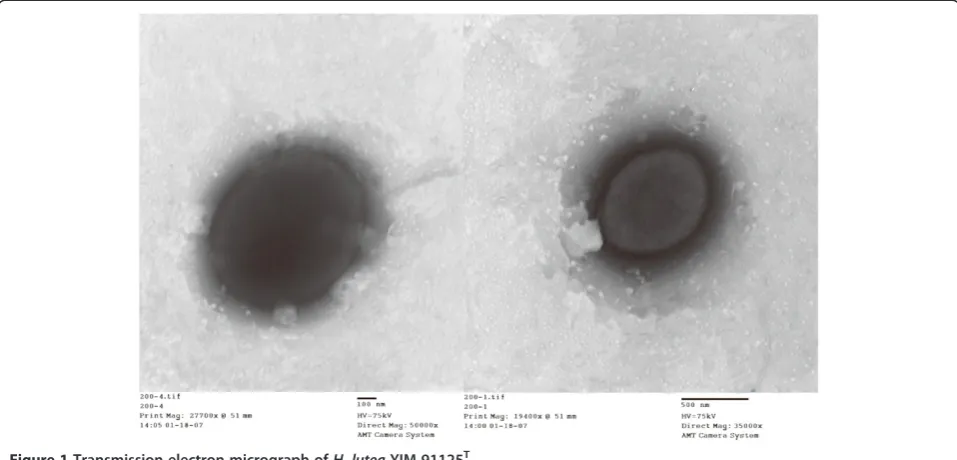
H. luteaYIM 91125Tis a Gram-negative-staining, motile, aerobic and moderately halophilic bacterium, which can reduce nitrate (Table 1). Cells of the strain are short rods, 0.4 to 0.7μm in diameter and 0.6 to 1.0μm in length (Figure 1). They are motile by means of single polar flagellum and their colonies are orange, flat, opaque and mucoid with slightly irregular edges (Figure 1). The predominant respiratory quinone found in H. lutea YIM 91125T is Q-9, similar to other members of the genus
Halomonas. The predominant fatty acids are C18:1 ω7c (25.1%), C16:0(17.0%), C19:0cycloω8c(13.6%), C12:03-OH (10.7%), C12:0(7.9%), C10:0(6.0%) and C17:0cyclo (4.6%) [1]. The profile of major fatty acids in strain YIM 91125Tis also similar to other members of the genusHalomonas[14-17].
16S rRNA gene sequence of strain YIM 91125T was compared with the newly released database from the Greengenes [26], using NCBI BLAST [27,28] under default settings (e.g., considering only HSPs from the best 250 hits) and the relative frequencies of taxa were determined, weighted by BLAST scores. The most frequently occurring genera were Halomonas (71.4%),
Chromohalobacter(17.8%),Bacillus(3.6%), Haererehalo-bacter (3.6%) and Modicisalibacter (3.6%) (228 hits in total). Regarding 186 hits to sequences from members of the genus Halomonas, the average identity within HSPs was 95.5%, whereas the average coverage by HSPs was 98.3%. Among all other species, the one yielding the highest score wasHalomonas xinjiangensis, which corre-sponded to identity of 99.9% and HSP coverage of 98.0%. (Note that the Greengenes database uses the INSDC (=EMBL/NCBI/DDBJ) annotation, which is not an authoritative source for nomenclature or classifica-tion.) The highest scoring environmental sequences were EF157249 and EF157230 (Greengenes short name ‘tar pits clone 101–11 k’ and ‘tar pits clone 101–120 k’), which showed identity of 96.3% and an HSP coverage of 99.6%. The most frequently occurring keywords within the labels of all environmental samples which yielded hits were soil like ‘soil’,‘seafloor’,‘drilling deep-earth’; water like‘groundwater’,‘aquatic’,‘lake’,‘marine’; oil and plant. Environmental samples yielded hits of a higher score than the highest scoring species were not found.
Phylogenetic analyses were carried out with two different algorithms, i.e., neighbor-joining (NJ) and maximum-likelihood (ML). The phylogenetic tree was shown in Figure 2 and Additional file 1: Figure S1, which provides an interesting insight into the nomenclature and classi-fication of members of the genus Halomonas, and also indicates the phylogenetic neighborhood of H. lutea. The phylogenetic relationships indicate that H. lutea
YIM 91125Tis most closely toH. xianhensis A-1T with 99% similarity and the sequence of the sole 16S rRNA gene in the genome differs by 10 nucleotides from the previously published 16S rRNA sequence (EF674852).
GenusHalomonas TAS [24]
SpeciesHalomonas lutea TAS [1]
Type strain YIM 91125T TAS [1]
Gram stain negative TAS [1]
Cell shape short rods TAS [1]
Motility motile TAS [1]
Sporulation non-sporulating TAS [1]
Temperature range 4-45°C TAS [1]
Optimum temperature
37°C TAS [1]
pH range; Optimum 5.0-9.0 TAS [1]
Carbon source mono- and polysaccarides TAS [1]
MIGS-6 Habitat aquatic, fresh water, lake, salinewater
TAS [1]
MIGS-6.3 Salinity 1-20% NaCl (w/v) TAS [1]
MIGS-22 Oxygen requirement aerobe TAS [1]
MIGS-15 Biotic relationship free living TAS [1]
MIGS-14 Pathogenicity none NAS
MIGS-4 Geographic location Ebinur Lake (China) TAS [1]
MIGS-5 Sample collection 2008 or before NAS
MIGS-4.1 Latitude 45.05 TAS [1]
MIGS-4.2 Longitude 82.977 TAS [1]
MIGS-4.4 Altitude not reported
a
Figure 1Transmission electron micrograph ofH. luteaYIM 91125T.
Figure 2Phylogenetic tree highlighting the position ofH. lutearelative to the type strains of the other species withinHalomonas.
coverage of key reference microbial genomes. The genome project is deposited in the Genomes OnLine Database (GOLD), and the high quality draft genome sequence is deposited in GenBank. Sequencing, finishing and annota-tion were performed by the DOE JGI using state of the art sequencing technology [39]. A summary of the project information is shown in Table 2. It presents the project information and in compliance with MIGS version 2.0 compliance [18].
Growth conditions and DNA isolation
H. luteastrain YIM 91125T(DSM 23508T), was grown in DSMZ medium 514b (Medium 514 plus additional salt) at 37°C [40]. DNA was isolated from 0.5-1.0 g of cell pasted using Jetflex Genomic DNA Purification Kit (Qiagen, Hilden, Germany), following the standard protocol as recommended by the manufacturer, but with an additional incubation (60 min, 37°C) with 50 μl proteinase K and finally adding 200 μl protein precipitation buffer (PPT). DNA is available through the DNA Bank Network [41].
facts. The following steps were then performed for assem-bly: (1) filtered Illumina reads were assembled using Velvet version 1.1.04 [43]; (2) 1–3 Kb simulated paired end reads were created from Velvet contigs using Wgsim [44]; (3) Illumina reads were assembled with simulated read pairs using Allpaths-LG [45]. The final draft assembly contained 49 contigs in 42 scaffolds. The total size of the genome is 4.5 Mbp and the final assembly is based on 538.9 Mbp of Illumina data, which provides an average 119.0 × coverage of the genome.
Genome annotation
Genes were identified using Prodigal [46] as part of the DOE JGI genome annotation pipeline [47], following by a round of manual curation using the JGI GenePRIMP pipeline [48]. The predicted CDSs were translated and used to search the NCBI non-redundant database, UniProt, TIGR-Fam, Pfam, PRIAM, KEGG, COG, and InterPro database. These data sources were combined to assert a product description for each predicted protein. Additional gene prediction analysis and functional annota-tion were performed within the Integrated Microbial Genomes-Expert Review (IMG-ER) platform [49].
Genome properties
The assembly of the draft genome sequence consists of 42 scaffolds (Figure 3) amounting to 4,533,090 bp, and G+C content is 59.1%. The majority of the protein-coding genes (83.0%) were assigned a putative function while the remaining ones were annotated as hypothetical proteins. 3,325 protein coding genes belong to 422 paralogous fam-ilies in this genome. The properties and the statistics of the genome are summarized in Table 3. The distribution of genes into COGs functional categories is presented in Table 4.
Insights from the genome sequence
The genomic sequences of twelve Halomonas species are available, including H. lutea YIM 91125T. Genome properties of those Halomonas species are shown in Table 5, but only H. elongateand H. campaniensishave complete genome sequences. TheseHalomonas genome sequences exhibit dramatic interspecies variations in size, ranging from 5.34 Mb (H. titanicae) to 2.85 Mb Table 2 Project information
MIGS ID Property Term
MIGS-31 Finishing quality Improved-High-Quality Draft
MIGS-28 Libraries used Illumina standard shotgun library
MIGS-29 Sequencing platforms Illumina HiSeq 2000
MIGS-31.2 Fold coverage 119 ×
MIGS-30 Assemblers Velvet v. 1.1.04; ALLPATHS v. r41043
MIGS-32 Gene calling method Prodigal 1.4
Locus Tag NZ_ARKK01000000
Genbank ID ARKK00000000
Genbank Date of Release
April 23, 2013
GOLD ID Gi11553
BIOPROJECT PRJNA199405
Project relevance Genomic Encyclopedia of Type Strains, Phase I: the one thousand microbial genomes (KMG-I) project
MIGS-13 Source Material Identifier
(H. jeotgali); and the size of H. luteais larger than the average size, suggesting acquisition of functions may allow better adaption to its environment, e.g., genes coding for tripartite ATP-independent periplasmic (TRAP) trans-porters for substrate uptake or nitrate degradation [50]. Also, GC contents of those species vary from 52.65% (H. campaniensis) to 67.86% (H. smyrnensis), and of H. lutea(59.05%) is around the average GC content, close to H. anticariensis (58.54%). In addition, the distribution of genes into COG categories was not entirely similar in all twelve compared genomes (Figure 4). AndH. luteahas more specific genes, since proteins with COG only account for 71.18% which is lower than other members. Compared with otherHalomonasspecies, the proportions of genes with signal peptide and transmembrane helices of
H. lutea are respectively 7.46% and 23.65%, close to the corresponding averages. The abundance of transmembrane
Figure 3Graphical map of the largest scaffold inHalomonas luteaYIM 91125T.From bottom to the top: Genes on forward strand (colored
by COG categories), Genes on reverse strand (colored by COG catergories), RNA genes (tRNA green, rRNA red, other RNAs black), GC content, GC skew (purpele/olive).
Table 3 Genome statistics
Attribute Value
Genome size (bp) 4,533,090
DNA coding (bp) 3.982.279
DNA G + C (bp) 2.676.712
DNA scaffolds 42
Total genes 4,368
Protein-coding genes 4,284
RNA genes 84
Pseudo genes 51
Genes in internal clusters 3,325
Genes with function prediction 3,625
Genes assigned to COGs 3,497
Genes with Pfam domains 3,674
Genes with signal peptides 326
Genes with transmembrane helices 1,033
CRISPR repeats 1
Table 4 Number of genes associated with general COG functional categories
Code Value % age Description
J 183 4.66 Translation, ribosomal structure and biogenesis
A 1 0.03 RNA processing and modification
K 278 7.08 Transcription
L 168 4.28 Replication, recombination and repair
B 6 0.15 Chromatin structure and dynamics
D 37 0.94 Cell cycle control, Cell division, chromosome partitioning
V 36 0.92 Defense mechanisms
T 208 5.30 Signal transduction mechanisms
M 210 5.35 Cell wall/membrane biogenesis
N 92 2.34 Cell motility
U 80 2.04 Intracellular trafficking and secretion
O 158 4.02 Posttranslational modification, protein turnover, chaperones
C 291 7.41 Energy production and conversion
G 273 6.95 Carbohydrate transport and metabolism
E 352 8.96 Amino acid transport and metabolism
F 85 2.16 Nucleotide transport and metabolism
H 186 4.74 Coenzyme transport and metabolism
I 133 3.39 Lipid transport and metabolism
P 218 5.55 Inorganic ion transport and metabolism
Q 126 3.21 Secondary metabolites biosynthesis, transport and catabolism
R 467 11.89 General function prediction only
S 339 8.63 Function unknown
- 871 19.94 Not in COGs
inter-genome distances under formula 2 betweenH. lutea
and H. anticariensis, H. boliviensi, H. campaniensis, H. elongata,H. halocynthiae,H. halodenitrificans,H. jeotgali,
H. smyrnensis, H. stevensii,H. titanicae andH. zhanjian-gensis are about 0.22, the corresponding DDH estimates below the 70% threshold under formula 2 are: 19.5% (± 2.29), 20.2% (± 2.31), 21.1% (± 2.33), 20.1% (± 2.31), 19.2% (± 2.29), 19.4% (± 2.29), 19.9% (± 2.30), 20.3% (± 2.32), 20.4% (± 2.32), 20.5% (± 2.32), 18.9% (± 2.28), respectively. The standard deviations indicate the H. halodenitrificans
DSM 735T
3.47 63.95 3256
H. jeotgaliHwaT 2.85 62.92 2636
H. luteaYIM 91125T 4.53 59.05 4368
H. smyrnensisAAD6T 3.56 67.86 3326
H. stevensissS18214T 3.69 60.25 3523
H. titanicaeBH1T 5.34 54.58 2908
H. zhanjiangensisDSM 21076T 4.06 54.48 3739
inherent uncertainty in estimating DDH values from intergenomic distances based on models derived from empirical test data sets. Given that the low degree of DNA-DNA similarity among Halomonas species, it appears justified to assume that these strains represent different species. For better understanding of the relation-ships between H. lutea and other Halomonas members, availability of more genome sequences of representatives are needed to implement phylogenomic inference.
As a halophilic bacterium, the genome of H. lutea
also shows properties related to solute and ion transport, 203 genes related ion transport and metablism, 60 genes related TRAP-type C4-dicarboxylate transport system which is a crucial family of solute transporters. Moreover, nitrate reduction was tested using API 20NE system and 57 genes were predicted to participate in the nitrogen metabolism. PTS IIA-like nitrogen-regulatory protein, nitrate and sulfonate transport systems related genes were also detected in its genome.
Conclusions
The genome sequence and annotation of H. luteaYIM 91125Twere presented. The genome comprises 42 scaffolds which together represent the organism of approximately 4.53 Mb. It encodes for key genes and pathways involved in the compatible solutes production and nitrogen degrad-ation. This provides clues to discover novel genes and functions, and leads to an improved understanding of halophilic microbial evolution and function in the extremely salty conditions. YIM 91125T participates in nitrogen cycling, although the process of reducing nitro-gen needs further studies to fully understand the related pathways. The genome sequencing of H. lutea marks an
important step toward a comprehensive genomic catalog and the metabolic diversity of halophilic bacteria. It may contribute to further studies on important process forHalomonas, such as quorum-sensing regulatory and osmoadaption. Combining with genomes of other members inHalomonas, will make an important advance in under-standing of the ecological roles thatHalomonasspecies play in those hypersaline environments and their relationships with other halophilic and nonhalophilic microorganisms.
Additional file
Additional file 1: Figure S1.Phylogenetic tree of the genusHalomonas.
Abbreviations
DDH:DNA-DNA hybridization; HSP: High-scoring segment pair.
Competing interests
The authors declare that they have no competing interests.
Authors’contributions
WJL and HPK conducted the study. XYG performed the data analyses, genome comparison, and wrote the manuscript. XYZ, HWL, YZ, AL, HPK,NCK and WJL participated in writing the manuscript. JH, MH, EL, MH, AP, NNI, KM, BJT, VM and TW performed genome sequencing, assembly and annotation. All authors read and approved the final manuscript.
Acknowledgements
Susanne Schneider is gratefully acknowledged the assistance for growing H. luteacultures. We also thank Evelyne-Marie Brambilla for DNA extraction and quality control (both at the DSMZ). This work was performed under the auspices of the US Department of Energy's Office of Science, Biological and Environmental Research Program, and by the University of California, Lawrence Berkeley National Laboratory under Contract No. DE-AC02-05CH11231, Lawrence Livermore National Laboratory under Contract No. DE-AC52-07NA27344. A. L. was supported in part by Russian Ministry of Science Mega-grant no. 11. G34.31.0068 (Dr. Stephen J O'Brien Principal Investigator). W.-J. Li was supported by‘Hundred Talents Program’of the Chinese Academy of Sciences.
Author details
1Key Laboratory of Biogeography and Bioresource in Arid Land, Xinjiang
Institute of Ecology and Geography, Chinese Academy of Sciences, Urumqi, China.2Key Laboratory of Microbial Diversity in Southwest China,
Ministry of Education and the Laboratory for Conservation and Utilization of Bio-Resources, Yunnan Institute of Microbiology, Yunnan University, Kunming, China.3Theodosius Dobzhansky Center for Genome Bionformatics, St. Petersburg State University, St. Petersburg, Russia.4Algorithmic Biology
Lab, St. Petersburg Academic University, St. Petersburg, Russia.5DOE Joint Genome Institute, Walnut Creek, California, USA.6Biological Data
Management and Technology Center, Lawrence Berkeley National Laboratory, Berkeley, California, USA.7Leibniz-Institute DSMZ - German
Collection of Microorganisms and Cell Cultures, Braunschweig, Germany.
8Department of Biological Sciences, King Abdulaziz University, Jeddah, Saudi
Arabia.9The First Hospital of Qujing City, Qujing Affiliated Hospital of Kunming Medical University, Qujing, China.10State Key Laboratory Breeding
Base for Zhejiang Sustainable Plant Pest Control, Institute of Quality and Standard for Agro-products, Zhejiang Academy of Agricultural Sciences, Hangzhou, Zhejiang, China.11University of Chinese Academy of Sciences, Beijing, China.12School of Biology, Newcastle University, Newcastle upon
Tyne, UK.
Received: 28 July 2014 Accepted: 6 November 2014 Published: 20 January 2015
Table 6 Digital DDH similarities betweenH. luteaDSM 23529Tand the otherHalomonas species
Reference species Formula 1 Formula 2 Formula 3
H. anticariensis 14.9 ± 3.14 19.5 ± 2.29 15.0 ± 2.67
H. boliviensis 13.0 ± 2.99 20.2 ± 2.31 13.4 ± 2.56
H. campaniensis 13.0 ± 2.99 21.1 ± 2.33 13.3 ± 2.56
H. elongata 15.6 ± 3.19 20.1 ± 2.31 15.6 ± 2.70
H. halocynthiae 13.0 ± 2.99 19.2 ± 2.29 13.3 ± 2.56
H. halodenitrificans 14.5 ± 3.11 19.4 ± 2.29 14.6 ± 2.65
H. jeotgali 13.5 ± 3.03 19.9 ± 2.30 13.8 ± 2.59
H. smyrnensis 15.5 ± 3.18 20.3 ± 2.32 15.5 ± 2.70
H. stevensiss 13.5 ± 3.04 20.4 ± 2.32 13.8 ± 2.59
H. titanicae 13.0 ± 2.99 20.5 ± 2.32 13.3 ± 2.56
H. zhanjiangensis 13.2 ± 3.01 18.9 ± 2.28 13.5 ± 2.57
GenBank accession numbers for the reference genomes:H. anticariensis
(NZ_ASTJ00000000),H. boliviensi(NZ_AGQZ00000000),H. campaniensis
(CP007757),H. elongata(NC_014532),H. halocynthiae(AUDZ00000000),
H. halodenitrificans(JHVH00000000),H. jeotgali(NZ_AMQY00000000),
H. smyrnensis(NZ_AJKS00000000),H. stevensii(NZ_AJTS00000000),
5. Anzai Y, Kim H, Park JY, Wakabayashi H, Oyaizu H.Phylogenetic affiliation of the pseudomonads based on 16S rRNA sequence.Int J Syst Evol Microbiol.2000;50:1563–89.
6. Arahal DR, Ludwig W, Schleifer KH, Ventosa A.Phylogeny of the family
Halomonadaceaebased on 23S and 165 rDNA sequence analyses.Int J Syst Evol Microbiol.2002;52:241–49.
7. Mellado E, Moore ERB, Nieto JJ, Ventosa A.Phylogenetic Inferences and Taxonomic Consequences of 16S Ribosomal DNA Sequence Comparison ofChromohalobacter marismortui,Volcaniella eurihalina, andDeleya salinaand Reclassification ofV. eurihalinaasHalomonas eurihalinacomb. nov.Int J Syst Evol Microbiol.1995;45:712–16.
8. Cabrera A, Aguilera M, Fuentes S, Incerti C, Russell NJ, Ramos-Cormenzana A, Monteoliva-Sánchez M.Halomonas indalininasp. nov., a moderately halophilic bacterium isolated from a solar saltern in Cabo de Gata, Almería, southern Spain.Int J Syst Evol Microbiol.2007;57:376–80.
9. Kim KK, Jin L, Yang HC, Lee ST.Halomonas gomseomensissp. nov.,
Halomonas janggokensissp. nov.,Halomonas salariasp. nov. and
Halomonas denitrificanssp. nov., moderately halophilic bacteria isolated from saline water.Int J Syst Evol Microbiol.2007;57:675–81.
10. Soto-Ramírez N, Sánchez-Porro C, Rosas S, González W, Quiñones M, Ventosa A, Montalvo-Rodríguez R.Halomonas avicenniaesp. nov., isolated from the salty leaves of the black mangrove Avicennia germinans in Puerto Rico.Int J Syst Evol Microbiol.2007;57:900–05.
11. Ventosa JJ, Nieto JJ, Oren A.Biology of moderately halophilic aerobic bacteria.Microbiol Mol Biol Rev.1998;62:504–44.
12. Wang YN, Cai H, Chi CQ, Lu AH, Lin XG, Jiang ZF, Wu XL.Halomonas shengliensissp. nov., a moderately halophilic, denitrifying, crude-oil-utilizing bacterium.Int J Syst Evol Microbiol.2007;57:1222–26. 13. Kyrpides NC, Hugenholtz P, Eisen JA, Woyke T, Goker M, Parker CT, Amann R,
Beck BJ, Chain PS, Chun J, Colwell RR, Danchin A, Dawyndt P, Dedeurwaerdere T, DeLong EF, Detter JC, De Vos P, Donohue TJ, Dong XZ, Ehrlich DS, Fraser C, Gibbs R, Gilbert J, Gilna P, Glockner FO, Jansson JK, Keasling JD, Knight R, Labeda D, Lapidus A, et al.Genomic encyclopedia of bacteria and archaea: sequencing a myriad of type strains.PLoS Biol.2014;12:e1001920. 14. Berendes F, Gottschalk G, Heine-Dobbernack E, Moore ERB, Tindall BJ.
Halomonas desideratasp. nov, a new alkaliphilic, halotolerant and denitrifying bacterium isolated from a municipal sewage works. Syst Appl Microbiol.1996;19:158–67.
15. Romano I, Gottschalk G, Heine-Dobbernack E, Moore ERB, Tindall BJ. Characterization of a haloalkalophilic strictly aerobic bacterium, isolated from Pantelleria island.Syst Appl Microbiol.1996;19:326–33.
16. Heyrman J, Balcaen A, De Vos P, Swings J.Halomonas muralissp. nov., isolated from microbial biofilms colonizing the walls and murals of the Saint-Catherine chapel (Castle Herberstein, Austria).Int J Syst Evol Microbiol.2002;52:2049–54.
17. Jeon CO, Lim JM, Lee JR, Lee GS, Park DJ, Lee JC, Oh HW, Kim CJ.Halomonas kribbensissp. nov., a novel moderately halophilic bacterium isolated from a solar saltern in Korea.Int J Syst Evol Microbiol.2007;57:2194–98.
18. Field D, Garrity G, Gray T, Morrison N, Selengut J, Sterk P, Tatusova T, Thomson N, Allen MJ, Angiuoli SV, Ashburner M, Axelrod N, Baldauf S, Ballard S, Boore J, Cochrane G, Cole J, Dawyndt P, De Vos P, DePamphilis C, Edwards R, Faruque N, Feldman R, Gilbert J, Gilna P, Glöckner FO, Goldstein P, Guralnick R, Haft D, Hancock D, et al.The minimum information about a genome sequence (MIGS) specification. Nat Biotechnol.2008;26:541–47.
19. Woese CR, Kandler O, Wheelis ML.Towards a natural system of organisms: proposal for the domains Archaea, Bacteria, and Eucarya.Proc Natl Acad Sci U S A.1990;87:4576–79.
genus and species of extremely salt-tolerant bacteria.Int J Syst Evol Microbiol.1980;30:485–95.
25. Ashburner M, Ball CA, Blake JA, Botstein D, Butler H, Cherry JM, Davis AP, Dolinski K, Dwight SS, Eppig JT, Harris MA, Hill DP, Issel-Tarver L, Kasarskis A, Lewis S, Matese JC, Richardson JE, Ringwald M, Rubin GM, Sherlock G.Gene ontology: tool for the unification of biology.Nat Genet.2000;25:25–9. 26. DeSantis TZ, Hugenholtz P, Larsen N, Rojas M, Brodie EL, Keller K, Huber T,
Dalevi D, Hu P, Andersen GL.Greengenes, a chimera-checked 16S rRNA gene database and workbench compatible with ARB.Appl Environ Microbiol.2006;72:5069–72.
27. Altschul SF, Gish W, Miller W, Myers EW, Lipman DJ.Basic local alignment search tool.J Mol Biol.1990;215:403–10.
28. Korf I, Yandell M, Bedell J.BLAST. Sebastopol, CA: O'Reilly Press; 2003. 29. Lee C, Grasso C, Sharlow MF.Multiple sequence alignment using partial
order graphs.Bioinformatics.2002;18:452–64.
30. Saitou N, Nei M.The neighbor-joining method: a new method for reconstructing phylogenetic trees.Mol Biol Evol.1987;4:406–25. 31. Strimmer K, von Haeseler A.Quartet puzzling: a quartet
maximum-likelihood method for reconstructing tree topologies.Mol Biol Evol.1996; 13:964–69.
32. Tamura K, Peterson D, Peterson N, Stecher G, Nei M, Kumar S.MEGA5: molecular evolutionary genetics analysis using maximum likelihood, evolutionary distance, and maximum parsimony methods.Mol Biol Evol. 2011;28:2731–39.
33. Pattengale ND, Alipour M, Bininda-Emonds OR, Moret BM, Stamatakis A.How many bootstrap replicates are necessary?J Comput Biol.2010;17:337–54. 34. Pagani I, Liolios K, Jansson J, Chen IM, Smirnova T, Nosrat B, Markowitz VM,
Kyrpides NC.The Genomes OnLine Database (GOLD) v. 4: status of genomic and metagenomic projects and their associated metadata. Nucleic Acids Res.2012;40:D571–79.
35. Göker M, Klenk HP.Phylogeny-driven target selection for genome-sequencing (and other) projects.Standards in Genomic Sci.2013;8:360–74.
36. Klenk HP, Göker M.En route to a genome-based classification of Archaea and Bacteria?Syst Appl Microbiol.2010;33:175–82.
37. Kyrpides NC, Woyke T, Eisen JA, Garrity G, Lilburn TG, Beck BJ, Whitman WB, Hugenholz P, Klenk HP.Genomic Encyclopedia of Type Strains, Phase I: the one thousand microbial genomes (KMG-I) project.Stand Genomic Sci. 2013;9:628–34.
38. Wu D, Hugenholtz P, Mavromatis K, Pukall R, Dalin E, Ivanova NN, Kunin V, Goodwin L, Wu M, Tindall BJ, Hooper SD, Pati A, Lykidis A, Spring S, Anderson IJ, D'haeseleer P, Zemla A, Singer M, Lapidus A, Nolan M, Copeland A, Han C, Chen F, Cheng JF, Lucas S, Kerfeld C, Lang E, Gronow S, Chain P, Bruce D, et al.A phylogeny-driven genomic encyclopaedia of Bacteria and Archaea.Nature.2009;462:1056–60.
39. Mavromatis K, Land ML, Brettin TS, Quest DJ, Copeland A, Clum A, Goodwin L, Woyke T, Lapidus A, Klenk HP, Cottingham RW, Kyrpides NC.The fast changing landscape of sequencing technologies and their impact on microbial genome assemblies and annotation.PLOS ONE.2012;7:e48837. 40. List of growth media used at DSMZ[http://www.dsmz.de/catalogues/
catalogue-microorganisms/culture-technology/list-of-media-for-micro organisms.html]
41. Gemeinholzer B, Dröge G, Zetzsche H, Haszprunar G, Klenk HP, Güntsch A, Berendsohn WG, Wägele JW.The DNA Bank Network: the start from a German initiative.Biopreserv Biobank.2011;9:51–5.
42. Bennett S.Solexa Ltd.Pharmacogenomics.2004;5:433–38.
43. Zerbino D, Birney E.Velvet: algorithms for de novo short read assembly using de Bruijn graphs.Genome Res.2008;18:821–29.
45. Gnerre S, MacCallum I.High-quality draft assemblies of mammalian genomes from massively parallel sequence data.Proc Natl Acad Sci U S A. 2011;108:1513–18.
46. Hyatt D, Chen GL, LoCascio PF, Land ML, Larimer FW, Hauser LJ. Prodigal: prokaryotic gene recognition and translation initiati on site identification.BMC Bioinformatics.2010;11:119.
47. Mavromatis K, Ivanova NN, Chen IM, Szeto E, Markowitz VM, Kyrpides NC. The DOE-JGI Standard operating procedure for the annotations of microbial genomes.Stand Genomic Sci.2009;1:63–7.
48. Pati A, Ivanova NN, Mikhailova N, Ovchinnikova G, Hooper SD, Lykidis A, Kyrpides NC.GenePRIMP: a gene prediction improvement pipeline for prokaryotic genomes.Nat Methods.2010;7:455–57.
49. Markowitz VM, Ivanova NN, Chen IMA, Chu K, Kyrpides NC.IMG ER: a system for microbial genome annotation expert review and curation. Bioinformatics.2009;25:2271–78.
50. Koechler S, Plewniak F, Barbe V, Battaglia-Brunet F, Jost B, Joulian C, Philipps M, Vicaire S, Vincent S, Ye T, Bertin PN.Genome Sequence ofHalomonas
sp. Strain A3H3, Isolated from Arsenic-Rich Marine Sediments.Genome Announc.2013;1:e00819–13.
51. Richter M, Rosselló-Móra R.Shifting the genomic gold standard for the prokaryotic species definition.Proc Natl Acad Sci U S A.2009;106:19126–31. 52. Auch AF, von Jan M, Klenk HP, Göker M.Digital DNA-DNA hybridization
for microbial species delineation by means of genome-to-genome sequence comparison.Stand Genomic Sci.2010;2:117–34.
53. Auch AF, Klenk HP, Göker M.Standard operating procedure for calculating genome-to-genome distances based on high-scoring segment pairs. Stand Genomic Sci.2010;2:142–48.
doi:10.1186/1944-3277-10-1
Cite this article as:Gaoet al.:Draft genome sequence ofHalomonas luteastrain YIM 91125T(DSM 23508T) isolated from the alkaline Lake
Ebinur in Northwest China.Standards in Genomic Sciences201510:1.
Submit your next manuscript to BioMed Central and take full advantage of:
• Convenient online submission
• Thorough peer review
• No space constraints or color figure charges
• Immediate publication on acceptance
• Inclusion in PubMed, CAS, Scopus and Google Scholar
• Research which is freely available for redistribution
![Table 1 Classification and general features of H. luteaYIM 91125T [18]](https://thumb-us.123doks.com/thumbv2/123dok_us/687766.2067012/2.595.304.539.108.527/table-classification-general-features-h-luteayim-t.webp)