The Thirty-Third AAAI Conference on Artificial Intelligence (AAAI-19)
I Know the Relationships: Zero-Shot Action Recognition via
Two-Stream Graph Convolutional Networks and Knowledge Graphs
Junyu Gao, Tianzhu Zhang, Changsheng Xu
National Lab of Pattern Recognition, Institute of Automation, Chinese Academy of Sciences University of Chinese Academy of Sciences
[email protected], [email protected], [email protected]
Abstract
Recently, with the ever-growing action categories, zero-shot action recognition (ZSAR) has been achieved by automat-ically mining the underlying concepts (e.g., actions, at-tributes) in videos. However, most existing methods only ex-ploit the visual cues of these concepts but ignore external knowledge information for modeling explicit relationships between them. In fact, humans have remarkable ability to transfer knowledge learned from familiar classes to recognize unfamiliar classes. To narrow the knowledge gap between ex-isting methods and humans, we propose an end-to-end ZSAR framework based on a structured knowledge graph, which can jointly model the relationships between action-attribute, action-action, and attribute-attribute. To effectively leverage the knowledge graph, we design a novel Two-Stream Graph Convolutional Network (TS-GCN) consisting of a classifier branch and an instance branch. Specifically, the classifier branch takes the semantic-embedding vectors of all the con-cepts as input, then generates the classifiers for action cate-gories. The instance branch maps the attribute embeddings and scores of each video instance into an attribute-feature space. Finally, the generated classifiers are evaluated on the attribute features of each video, and a classification loss is adopted for optimizing the whole network. In addition, a self-attention module is utilized to model the temporal in-formation of videos. Extensive experimental results on three realistic action benchmarks Olympic Sports, HMDB51 and UCF101 demonstrate the favorable performance of our pro-posed framework.
Introduction
Recent studies on supervised action recognition have ad-vanced rapidly because of the development of deep learn-ing techniques and large-scale labeled datasets. How-ever, with the growing number of action categories, tradi-tional approaches suffer from the scalability problem (Xu, Hospedales, and Gong 2016). These methods require large numbers of costly and laboriously annotated videos per ac-tion class, making them not generalized for unseen cate-gories. To overcome such an issue, Zero-Shot Action Recog-nition (ZSAR) has recently drawn considerable attention since it provides an alternative methodology that does not
Copyright c2019, Association for the Advancement of Artificial Intelligence (www.aaai.org). All rights reserved.
Attributes: Indoor related? Outdoor related? Translation motion? Having stick-like tool?
Action-Attribute Action-Action(Implicit) Word Embedding:
Action-Attribute Attribute-Attribute
Action-Action KG +GCN
Biking Skiing Action: Attributes
(Objects):
Ski Bike Biking Skiing
Action:
(a)
Biking Skiing Action:
(b) (c)
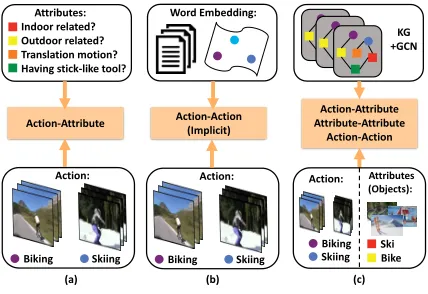
Figure 1: Three ZASR frameworks. (a) Attribute-based framework only considers the action-attribute relationships. (b) Word embedding-based framework which implicitly models the action-action relationships. (c) Our framework can directly and collectively consider all the three types of relationships.
require any positive exemplars for classifying novel cate-gories (Liu, Kuipers, and Savarese 2011; Xu, Hospedales, and Gong 2016; Qin et al. 2017; Zhu et al. 2018).
perfor-mance, where pre-trained object classifiers are used to find objects in an action video. Nevertheless, they only consider the action-object relationship based on the fixed similarity scores of word embedding vectors, which cannot get benefit from an end-to-end training.
In addition to the aforementioned issues, most of the above methods only focus on the visual cues in videos but ignore external knowledge information to improve the generalization capability of zero-shot approaches. Actu-ally, humans have remarkable ability to recognize large-scale concepts by using semantic knowledge of the world learned through experience. Therefore, it is a natural way to use structured knowledge information to model relation-ships among concepts (e.g., actions and attributes), and this research direction is able to transfer learned edge from seen categories to unseen ones. Recently, knowl-edge graphs (KGs) have been successfully used in various computer vision tasks such as object detection (Fang et al. 2017), multi-label image classification (Marino, Salakhutdi-nov, and Gupta 2017), zero-shot image recognition (Wang, Ye, and Gupta 2018; Lee et al. 2018), etc. By incorpo-rating KGs in these methods, the performance is signifi-cantly improved, showing KGs do have remarkable ability to bridge the knowledge gap in existing state-of-the-art ap-proaches. Therefore, great potential is excepted to exploit knowledge graphs for ZSAR. Moreover, current methods usually ignore temporal modeling of videos, such as sim-ply performing average pooling across video frames (Jain et al. 2015) or extracting a hand-crafted feature vector of the whole video (Qin et al. 2017). However, significant ad-vantages of exploiting temporal information for video un-derstanding have been shown recently (Niebles, Chen, and Fei-Fei 2010). Temporal modeling in a video sequence can help understand its dynamic patterns and further boost the ZSAR performance.
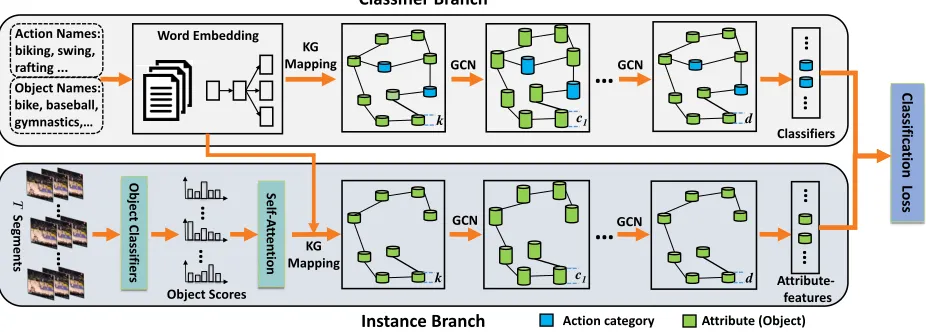
Motivated by the above observations, as shown in Fig-ure 1 (c), we propose a novel ZSAR framework to directly and collectively model all the three types of relationships be-tween action-attribute, action-action, and attribute-attribute by incorporating a knowledge graph in an end-to-end man-ner. In fact, all these relationships can contribute to the ZSAR task either in an explicit or implicit way. Here, to avoid cumbersome attribute-annotation, we adopt objects as attributes as it in (Mettes and Snoek 2017). To effec-tively leverage the knowledge information in a knowledge graph, we use Graph Convolutional Network (GCN) (Kipf and Welling 2016) to model the dependencies and prop-agate messages between different concepts in the knowl-edge graph. Specifically, we propose a Two-Stream GCN (TS-GCN) consisting of a classifier branch and an instance branch, where KGs are incorporated into both branches to model the three types of relationships, as shown in Figure 2. The classifier branch aims to generate classifiers for different action categories, which takes as input a set of concepts and their corresponding word-embedding vectors. The instance branch is designed to produce attribute-feature of a video instance by leveraging the object scores obtained from the video. We finally optimize the whole framework via a classi-fication loss, using the generated classifiers and the attribute
features of training videos. In addition, to perform tempo-ral modeling of videos, we incorporate a self-attention mod-ule (Zhang et al. 2018) into the instance branch to model the dynamically changing object scores over time. During training, the classifiers for seen categories are learned in a supervised fashion. At test phase, the trained model is used to predict the classifiers of unseen categories and conduct classification on the attribute features of test videos.
The main contributions are highlighted as follows: • We propose a novel two-stream GCN framework that
can effectively leverage knowledge graphs to model the relationships between action-attribute, action-action, and attribute-attribute. To the best of our knowledge, our method is among the first to advance knowledge graphs and two-stream GCN for ZSAR.
• By designing both classifier branch and instance branch in a sharing knowledge space, the generated action classi-fiers and instance features can co-adapt and cooperate to achieve the classification objective in an end-to-end fash-ion. In addition, a self-attention module is embedded to the framework for temporal modeling.
• The proposed framework performs favorably against the state-of-the-art methods on three standard ZSAR datasets, which verifies its effectiveness.
Related Work
Zero-shot Action Recognition.With the explosive growth
semantic relationships of concepts such as inter-class rela-tionship (Gan et al. 2015) and pairwise relarela-tionship (Gan et al. 2016a). Gan et al. (Gan et al. 2016b) use knowledge information to build an analogy pool according to an ex-ternal ontology for zero-shot action recognition. Neverthe-less, these methods are not end-to-end trainable. Different from these methods, we incorporate knowledge graphs into a novel two-stream ZSAR framework via GCNs, which can explicitly model the relationships among object and action categories in an end-to-end manner.
Knowledge Distillation Using Graph Neural Networks.
Generalization of neural networks for arbitrarily struc-tured graphs (such as knowledge graphs) has drawn great attention in recent years. For knowledge distilla-tion, Marino et al. (Marino, Salakhutdinov, and Gupta 2017) introduce a graph search neural network (GSNN), which can exploit large knowledge graphs into an end-to-end frame-work for image classification. Gao et al. (Gao, Zhang, and Xu 2018) adopt a graph convLSTM to model the dynamic knowledge evolution for video classification. Lee et al. (Lee et al. 2018) utilize a graph gated neural network to model knowledge graphs for describing the relationships between multiple labels. Although this method achieves favorable performance, it simply learns a single classifier for all classes and does not incorporate unseen class labels in the training stage, which might loss discriminative ability. Given a knowledge graph, Wang et al. (Wang, Ye, and Gupta 2018) design a zero-shot recognition model by taking as input se-mantic embeddings for each node in a graph convolution network. The objective function of this model is a mean-square error between the predicted and ground truth classi-fiers of known classes. This might limit its generalization ability since the ground truth classifiers are fixed. Moreover, this method is deficient since it only considers label-label relationships without attributes. To distill knowledge infor-mation from actions and objects (attributes), we design both classifier branch and instance branch based on GCNs (Kipf and Welling 2016). By leveraging the knowledge relation-ships among actions and objects, the proposed method can directly adopt classification loss and jointly learn different classifiers for each action, which results in favorable gener-alization ability.
Our Approach
In ZSAR, suppose we have Ns labeled videos Ds = {Vs,Ys}from a source dataset withSseen categoriesYs,
where each videoVs∈ Vsis associated with an action label
ys∈ Ys. Similarly, there is a target datasetDt={Vt,Yt}
consisting ofNtvideos from U unseen action classesYu.
Here,Ys∪ Yu = Y,Ys∩ Yu = ∅. In addition, we have
an object set O withO objects, which serve as attributes for describing the actions. The goal is to learn an objective functionminL(Ds,O)that can generalize toDt.
Different from existing zero-shot methods which do not explicitly consider the relationships among concepts with structured knowledge graphs (Xu, Hospedales, and Gong 2016; Zhu et al. 2018) or only model label-label relation-ships (Wang, Ye, and Gupta 2018), we design an end-to-end framework consisting of two GCN branches: classifier
branch and instance branch, as shown in Figure 2. In the fol-lowing of this section, we illustrate our proposed approach for ZSAR in details. We first introduce the preliminaries of our main building block, graph convolutional network (Kipf and Welling 2016), which enables us to generalize CNN to graphs. Then, we present the whole model including the classifier branch and instance branch. Finally, the implemen-tation details of our framework are demonstrated.
Graph Convolutional Networks
Graph convolutional networks aim to efficiently learn layer-wise propagation operations that can be applied directly on graphs. To keep this paper self-contained, we briefly intro-duce GCNs proposed in (Kipf and Welling 2016) as follows. Given an undirected graph withmnodes, a set of edges between nodes, an adjacency matrixA∈Rm×m, and a de-gree matrix Dii = PjAij. We consider a linear
formu-lation of graph convolution as the multiplication of a graph signalX∈Rk×m(the column vectorXi∈Rkis the feature
representation at theithnode) with a filterW∈Rk×c
:
Z=Dˆ−12A ˆˆD− 1
2X>W, (1) whereAˆ =A+I,Iis the identity matrix.Dˆii =PjAˆij.
As a result, the input to a graph convolutional layer isk× m, and the output is ac×m matrixZ. Note that a GCN can be built by stacking multiple graph convolutional layers of the form of Eq. (1), each layer followed by a non-linear operation (such as ReLU). Readers can refer to (Kipf and Welling 2016) for more details and an in-depth discussion.
Two-stream GCN for ZSAR
To effectively use the explicit relationships among all the concepts, we incorporate a knowledge graph into our pro-posed method. Since we haveS+U+Oconcepts (seen ac-tion, unseen acac-tion, objects) associated with all the videos, we build the knowledge graph with the same number of nodes corresponding to these concepts. We use the term con-ceptandnodeinterchangeably hereafter. The graph structure is represented as an adjacency matrix,A. Figure 2 shows the proposed two-stream GCN architecture consisting of both classifier branch and instance branch.
Classifier Branch. This branch is anL-layer GCN where
each layerltakes as input the feature matrix (Zcls
l−1)
gener-ated from the previous layer and produces a feature matrix
Zcls
l . The input to this branch is ak×(S+U+O)matrix
Xcls which is the word-embedding vectors of all the
con-cepts. Here,kis the dimensionality of the word-embedding vector. The output of the final layer is ad×(S+U +O) matrix Wcls where d is the dimensionality of the
classi-fiers. Specifically, S classifiers Wcls
1:S are corresponding to
the seen action categories Ys, which are optimized using
the training data. During the training phase, anotherU un-seen classifiers can be generalized from these un-seen ones via GCN. Note that the remainingOobject classifiers serve as a bridge between seen and unseen action categories, which will not be explicitly used in the training/inference phase.
Instance Branch.The branch aims to produce the
informa-Word Embedding
Object Names: bike, baseball, gymnastics,… Action Names: biking, swing, rafting ...
Objec
t
Class
ifie
rs
Self
-A
tten
tio
n
…
…
…
…
…
…
Classific
ation
Loss
Action category Attribute (Object)
Classifier Branch
Instance Branch
…
…
Object Scores
GCN GCN
GCN GCN
Classifiers
Attribute-features
…
…
T
Segmen
ts
k
k d
d KG
Mapping KG Mapping
c1 c1
Figure 2: Our TS-GCN framework consists of both classifier branch and instance branch. We adopt a classification loss to optimize the whole framework. KG mapping means organizing concept representations as nodes in the knowledge graph.
tion plays an essential role in video understanding (Tran et al. 2015), this branch firstly conducts video temporal model-ing via a self-attention module. Specifically, for a videoV, we first segment it intoT equal-length segments{Vt}
T t=1.
The number of segments is fixed for all videos in order to perform sequential parallelization in our framework. To get the object scores of each segment, we follow (Mettes and Snoek 2017) to employ a GoogLeNet model (Szegedy et al. 2015), trained on a 12,988-category shuffle (Mettes, Koelma, and Snoek 2016). Similar to (Jain et al. 2015), the top K most relevant objects are selected for each action, which results inOobjects from the initial 12,988 categories. For the frames in a segment, we average the object probabil-ities at the softmax layer of this model. Therefore, the video
Vis represented as anO×T matrix. To employ the tem-poral information in this video, a self-attention operator is performed onVas follows:
αs,t=
exp(f(Vt)>g(Vs))
PT
t=1exp(f(Vt)>g(Vs))
ˆ
Vs=γ T
X
t=1
αs,th(Vt) +Vs
(2)
whereVtandVsare the object scores of segmenttands.
f(·), g(·), h(·)are three1×1convolutional layers withO filters.αs,tis the attention weight which indicates the
con-tribution of segmenttto the representation of segments. We finally multiply the output of the attended representation by a scale parameterγand add back the input representation. γis initialized as0. After the self-attention operator, we get the representation of the videoVˆ, which is the same size asV.Vˆ and the word-embedding vectors of the object cate-gories are used to generate the input to the followingLgraph convolutional layers,Xins ∈Rk×O
. Here, theothcolumn of
Xinsis calculated as:
Xinso =
T
X
t=1
ˆ
Vt,oso, (3)
where so is the word-embedding vector of the oth object.
Note that there are only O nodes in the instance branch, which means this branch focuses on robust attribute-feature generation of video instances. For the final-layer, the output feature-matrix isZins
L ∈R
O×d.dis the same as the
dimen-sionality of classifiers produced by the classifier branch.
Loss-function. For theS seen categories, we evaluate the
cross-entropy loss over all the labeled examples:
L=− 1 Ns
Ns
X
n=1
S
X
i=1
yinlog(pin), (4)
whereyi
nis the ground-truth label (0or1) of thenthtraining
video with respect to theithseen action.pi
nis the predicted
score with a softmax operation via the two branches:
pin= exp(q
i n)
PS
i=1exp(qni)
,whereqin= (Wcls i )
> X
o∈N(i)
ZinsL,n,o,
(5) whereWcls
i is thei
thaction classifier produced by the
clas-sifier branch. And Zins
L,n,o is the final feature vector
gener-ated from the instance branch, which indicates theoth
object-feature (in layerL) of thenthvideo.N(i)denotes the
one-hop object neighbors of the ith action in the knowledge
graph, which means we focus on strongly-related objects for classifying a specific action. Empirically, we find that using neighbors leads to faster convergence and higher per-formance than using all the object features. In fact, with the message-passing of GCNs, the useful information is prop-agated and augmented toN(i)via the optimization of the framework. Moreover, using only neighbors can avoid some distraction in action classification.
Generalization to the Unseen actions.During training, we
Discussion. The proposed two-stream framework is suit-able for zero-shot learning problem with attributes. We uti-lize GCNs to transfer information between different con-cepts. Concretely, both branches jointly model the relation-ships between action-attribute, action-action, and attribute-attribute in a knowledge space via knowledge graphs. As a result, the learned classifiers (classifier branch) can ef-fectively evaluate the generated attribute features (instance branch) of each video in an end-to-end fashion. Because of the joint learning with a single objective function, both branches can co-adapt and cooperate. Here, a better classi-fier can make the learned features more robust, and a better feature can make the learned classifiers more accurate. In this work, we utilize objects as attributes, which avoids the cumbersome annotation. Note that other information such as the visual representations of videos can also be added into the framework, which is left for our future work.
Implementation Details
Knowledge Graph Building.We use the off-the-shelf
Con-ceptNet 5.5 (Speer, Chin, and Havasi 2017) to build our knowledge graph, which connects words and phrases of nat-ural language edges. Its knowledge is collected from many sources including WordNet (Bond and Foster 2013), DBpe-dia (Auer et al. 2007) et al. Following previous work (Fang et al. 2017), we only employ its English subgraph with about 1.5million nodes. We adopt string matching to map the cepts to the nodes in ConceptNet. Since some names of con-cepts have no corresponding nodes due to its rare appear-ance, we replace these terms with common words that can be found in ConceptNet. For instance, “skijet” is replaced by “jetski” without losing the main semantic information. The most important thing for building the knowledge graph is to determine the relationships (edges,Aij) among these
nodes. Specifically, if both nodes can be found in Concept-Net with one edge being connected, we use the weight cor-responding to this edge asAij. While a knowledge graph
may have multiple types of edges, we follow some pre-vious methods (Marino, Salakhutdinov, and Gupta 2017; Fang et al. 2017) to simplify it as a single matrix (adja-cency matrix) to effectively represent the semantic consis-tency and propagate information between nodes. Although we can fine-tune the adjacency matrix A during training like (Lee et al. 2018), we choose to fix it following (Marino, Salakhutdinov, and Gupta 2017). The reasons are two-fold: (1) fixing A is more computationally efficient than fine-tuning it. (2) Fine-fine-tuningAwill change the intrinsic knowl-edge structures in it, resulting in losing generalization abil-ity. For each action, we selectK = 100 objects with the highest weights.
Word Embedding.Following (Mettes and Snoek 2017), we
utilize the skip-gram network of word2vec trained on the metadata of the images and videos from the YFCC100M dataset (Thomee et al. 2016). The trained model produces a500-dimensional representation for each word. To repre-sent each concept in a fixed length, we simply average all the word vectors (Mettes and Snoek 2017).
Model Details.Both GCNs in the two streams are composed
of3graph convolutional layers with output channel
dimen-sionality of2048,1024,512, respectively. Note that for the classifier stream, all the concepts are considered which re-sults in an(S+U+O)×(S+U+O)adjacency matrix
Acls, while onlyO object concepts are employed for
con-structing the knowledge graphAins∈RO×Oin the instance
stream. Following (Wang, Ye, and Gupta 2018), we apply the LeakyReLU as the activation function after each graph convolutional layer. We also perform L2-Normalization on the produced classifiers to regularize them into similar mag-nitudes. For the self-attention module, the number of seg-ments T is set to 16 by grid search over {8,16,32}. To train our whole model, we use the ADAM (Kingma and Ba 2014) optimizer with learning rate 0.0001 and weight decay 0.0005. The model is trained for 5 epochs with a batch size of48. We implement our framework by Tensor-flow (Abadi et al. 2016). The code for our framework can be found in https://github.com/junyuGao/Zero-Shot-Action-Recognition-with-Two-Stream-GCN.
Experiments
In this section, we evaluate the performance of the pro-posed Two-Stream GCN (TS-GCN) method on three widely-used video datasets: Olympic Sports (Niebles, Chen, and Fei-Fei 2010), HMDB51 (Kuehne et al. 2011) and UCF101 (Soomro, Zamir, and Shah 2012). The extensive re-sults demonstrate the effectiveness of our method for large-scale video classification. Finally, we conduct detailed com-ponent analysis of our framework.
Experimental Setup
Datasets and Splits. The three popular datasets Olympic
Sports, HMDB51 and UCF101 contain783,6766and13320 videos with 16, 51, and 101 categories, respectively. To compare our method with the state-of-the-arts, we follow the 50/50 data splits proposed by (Xu, Hospedales, and Gong 2017), i.e., videos of 50% categories are used for model training and the other50%categories are held unseen for testing. We adopt the 50 independent splits generated by (Xu, Hospedales, and Gong 2017) and report the aver-age accuracy and standard deviation for experimental evalu-ation.
Zero-shot Settings. Typically, there are two zero-shot
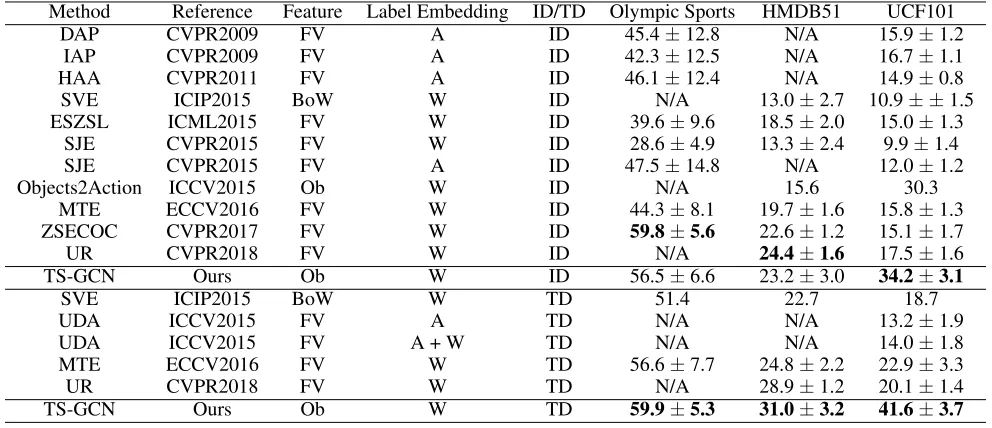
Table 1: ZSAR accuracies on the three benchmarks compared with state-of-the-art methods. Feature: Fisher Vectors (FV) or Bag of Words (BoW) or Object scores(Ob); Label Embedding: Attribute (A) or Word Embeddings(W);ID: Inductive setting;TD: Transductive setting. The average%accuracy±standard deviation is reported. Note that some methods such as Objects2Action, ZSECOC, and UR adopt less than 50 splits for evaluation.
Method Reference Feature Label Embedding ID/TD Olympic Sports HMDB51 UCF101
DAP CVPR2009 FV A ID 45.4±12.8 N/A 15.9±1.2
IAP CVPR2009 FV A ID 42.3±12.5 N/A 16.7±1.1
HAA CVPR2011 FV A ID 46.1±12.4 N/A 14.9±0.8
SVE ICIP2015 BoW W ID N/A 13.0±2.7 10.9± ±1.5
ESZSL ICML2015 FV W ID 39.6±9.6 18.5±2.0 15.0±1.3
SJE CVPR2015 FV W ID 28.6±4.9 13.3±2.4 9.9±1.4
SJE CVPR2015 FV A ID 47.5±14.8 N/A 12.0±1.2
Objects2Action ICCV2015 Ob W ID N/A 15.6 30.3
MTE ECCV2016 FV W ID 44.3±8.1 19.7±1.6 15.8±1.3
ZSECOC CVPR2017 FV W ID 59.8±5.6 22.6±1.2 15.1±1.7
UR CVPR2018 FV W ID N/A 24.4±1.6 17.5±1.6
TS-GCN Ours Ob W ID 56.5±6.6 23.2±3.0 34.2±3.1
SVE ICIP2015 BoW W TD 51.4 22.7 18.7
UDA ICCV2015 FV A TD N/A N/A 13.2±1.9
UDA ICCV2015 FV A + W TD N/A N/A 14.0±1.8
MTE ECCV2016 FV W TD 56.6±7.7 24.8±2.2 22.9±3.3
UR CVPR2018 FV W TD N/A 28.9±1.2 20.1±1.4
TS-GCN Ours Ob W TD 59.9±5.3 31.0±3.2 41.6±3.7
Table 2: Results on the generalized zero-shot setting.
Method Olympic HMDB51 UCF101
SJE 32.5±6.7 10.5±2.4 8.9±2.2 ConSE 37.6±9.9 15.4±2.8 12.7±2.2
GA 42.2±10.2 20.1±2.1 17.5±2.2
Objects2Action N/A N/A 30.3
Ours 50.2±6.8 21.9±3.7 33.4±3.4
Comparison with State-of-the-Art Methods
Compared methods.We compare our method with
state-of-the-art methods. (1) Direct/Indirect Attribute Prediction method (DAP, IAP) (Lampert, Nickisch, and Harmeling 2009). (2) Human Actions by Attributes (HAA) model (Liu, Kuipers, and Savarese 2011), which is implemented by (Xu, Hospedales, and Gong 2016). (3) Self-training method with SVM and semantic Embedding (SVE) (Xu, Hospedales, and Gong 2015). (4) Embarrassingly Simple Zero-Shot Learning (ESZSL) (Romera-Paredes and Torr 2015). (5) Structured Joint Embedding (SJE) (Akata et al. 2015). (6) Unsuper-vised Domain Adaptation (UDA) (Kodirov et al. 2015). (7) Multi-Task Embedding (MTE) (Xu, Hospedales, and Gong 2016). (8) Objects2Action (Jain et al. 2015), which also uti-lize objects as attributes for ZSAR. (9) Zero-Shot with Error-Correcting Output Codes (ZSECOC) (Qin et al. 2017). (10) Universal Representation (UR) model (Zhu et al. 2018) in inductive and transductive settings.
Inductive setting. The comparison results are illustrated
in Table 1. Overall, our proposed method performs favor-ably against state-of-the-art methods. Compared with the re-cent methods MTE, ZSECOC, and UR, the proposed TS-GCN achieves an absolute gain of (18.4%,19.1%,16.7%)
on UCF101 dataset. We also get comparable results on HMDB51 and Olympic Sports benchmark. Compared with another method, Objects2Action,which also adopts objects with semantic embeddings for ZSAR, the proposed TS-GCN outperforms it by (3.9%,7.6%) on UCF101 and HMDB51, respectively. Note that the results of TS-GCN and Objects2Action on HMDB51 are worse than those on UCF101 while other methods (e.g., MTE and UR) have the inverse results. This is because many action categories in HMDB51 are not sensitive to objects, such as the actions
run, walk, sit, and stand. The results can be further im-proved by adding low-level or deep visual features in our framework. To verify this point, we design a baseline TS-GCN+FV, which concatenates the final feature vector gener-ated from the instance branch with the FV feature of a video instance. By doing this, the classifiers are learned from both attribute feature (the feature used in our proposed TS-GCN method) and the visual feature (FV). Compared with the pro-posed TS-GCN method, TS-GCN+FV gets an absolute gain of2.1%on UCF101 thanks to the additional visual features.
Transductive setting.Since this setting allows methods to
access the unlabeled data of unseen categories, the results are better than those in the inductive setting, as shown in Ta-ble 1. In this setting, we first select the most frequent ob-jects in all videos, which help us remove rare and unreliable objects in building knowledge graph. Among all the com-petitors, the proposed TS-GCN gets better or comparable re-sults. Specifically, compared with MTE and UR, our method outperforms them by (18.7%,6.2%) and (21.5%,2.1%) on the UCF101 and HMDB51 benchmarks, respectively. We also perform the best on Olympic Sports.
0 0.1 0.2 0.3 0.4 0.5 0.6 0.7
Olympic HMDB51 UCF101
Accuracy
2-layer 3-layer 4-layer
0.358 0.519
0.602 0.614
0.591
0.154
0.308 0.292
0.281 0.282
0.241
0.415 0.428 0.426 0.41
0.1 0.2 0.3 0.4 0.5 0.6 0.7
30 50 100 150 200
Accuracy
Olympic HMDB51 UCF101
(a) The effect of K (b) Different number of layers
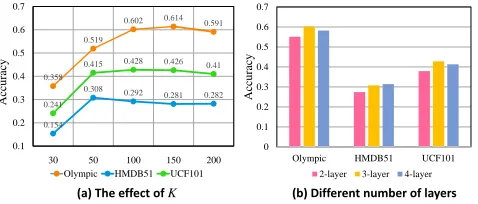
Figure 3: Comparison results among (a) different number of selected objects. (b) different number of GCN layers.
2018) adopts a large-scale dataset ActivityNet as auxiliary training data. CD-UR gets the mean accuracy of42.5%on UCF101, while our TS-GCN achieves comparable results without using external training data. In addition, we out-perform its non cross-domain version in both inductive and transductive setting as shown in Table 1. Compared with an-other recent method (Mettes and Snoek 2017) which de-signs spatial-aware object embedding for ZSAR and gets 40.4%accuracy on UCF101, our method outperforms it by 1.2%with transductive setting. Note that this method em-ploys an object detector to leverage the spatial information of objects which can also improve the performance of our method.
Generalized ZSAR.We follow (Mishra et al. 2018) to use
20%data from the seen classes for testing and the remain-ing data for trainremain-ing. Since most methods do not report their results in this setting, we adopt other two methods for com-parison: Convex Semantic Embeddings (ConSE) (Norouzi et al. 2013) and Generative Approach (GA) (Mishra et al. 2018). Table 2 presents the favorable performance of our TS-GCN method against the state-of-the-arts, which achieves the accuracy of (50.2%,21.9%,33.4%) on the three datasets. In addition, the recent spatial-aware object embed-ding method (Mettes and Snoek 2017) gets32.8%accuracy on UCF101 dataset, which is lower than the proposed TS-GCN. The results clearly show that TS-GCN has remarkable generalization ability.
Further Remarks
To evaluate the effectiveness of our method, we perform an in-depth analysis in this section. The experiments are con-ducted in the transductive setting with10random splits.
How many objects should we use? The number of the
selected objects per action category controls the size of the built knowledge graph. A largerK can make the built knowledge graph more comprehensive since it uses more objects to describe an action. However, too largeKwill re-sult in high computational burden and may bring noisy to the knowledge graph. As shown in Figure 3 (a), a moder-ate value ofKachieves the best performance. In addition, we find that UCF101 and Olympic Sports need more objects while HMDB51 achieves the best performance withK = 50. This is because some action categories in HMDB51 are not object-sensitive.
The deeper, the better?We explore the importance of the
Table 3: Comparison results of different baseline methods.
Olympic HMDB51 UCF101 TS-GCN-GoogleNews 60.5 29.3 40.5 TS-GCN-w/o SelfAttention 57.1 27.2 39.6
OS-GCN 40.9 17.1 25.2
TS-GCN 59.2 30.8 42.8
depth of GCN in our framework. The performance of using different numbers of layers on three benchmarks are shown in Figure 3 (b). The 2-layer model has the output channel numbers of512and512. And we set the numbers as2048, 1024,1024, and 512 for the 4-layer model. Theoretically, the deeper network will enhance the message propagation between nodes thus improve the performance. However, we observe that adding more layers above the 3-layer model does not boost the accuracy of our framework significantly. One potential reason might be that the number of the train-ing data is not large-scale (from ∼700videos in Olympic Sports to∼10,000videos in UCF101), which brings over-fitting problem in the deeper networks.
How important is temporal modeling?We consider the
in-teraction among different video segments via a self-attention mechanism. To show its effectiveness, we design a base-line TS-GCN-w/o SelfAttention, which removes the self-attention layer and simply averages the object scores of all segments. Table 3 demonstrates that our proposed method consistently outperforms the baseline.
Different Word Embeddings. To analyze the sensitivity
of our framework to different word embedding methods, we test the performance on another Word2Vec embedding method (Mikolov et al. 2013) trained on GoogleNews. Ta-ble 3 shows the comparison between the proposed method and the baseline TS-GCN-GoogleNews. Generally, the word embedding trained on YFCC100M (Thomee et al. 2016) achieves higher performance on two datasets. One potential reason might be that using visual metadata is more suitable for ZSAR tasks than training on Wikipedia or GoogleNews data (Jain et al. 2015). Moreover, the performance gap be-tween both methods is not very significant, which shows that our framework is not sensitive to word embedding methods.
Is the Two-stream network redundant?We use the
two-stream framework to jointly model the relationships be-tween action-attribute, action-action, and attribute-attribute. To verify its necessity, we design a baseline One-Stream GCN (OS-GCN) which only uses one branch of GCN to model the relationships between all concepts. The input to OS-GCN is the word embedding of all action categories and the weighted attribute representation of each video instance calculated from Eq. (3). Table 3 shows the effectiveness of the two-stream design. The proposed TS-GCN outperforms OS-GCN by (18.3%,13.7%,17.6%) on the three bench-marks. Without the co-adaptation and co-operation between the two branches, it is difficult to explicitly learn meaningful classifiers and attribute features, which will result in training dilemma and performance degradation.
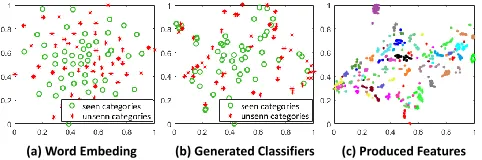
Visualization of the Learned Classifiers and Features.We
(b) Generated Classifiers (c) Produced Features (a) Word Embeding
Figure 4: t-SNE visualizations for (a) word embedding of action categories. (b) classifiers generated by our TS-GCN method (from classifier branch). (c) object features (pro-duced by the instance branch) of 500 randomly chosen videos from 20 unseen actions. Different categories are shown in different colors. The experiment is conducted on a random split of UCF101.
UCF101 experiments to show some characteristics of our proposed TS-GCN. Figure 4 (a) and (b) plot both the word embeddings and the classifiers (generated by the classifier branch) of the seen and unseen action categories. It can be seen that the word embeddings and the classifiers distributes very differently , which indicates the proposed method can leverage the relationships among concepts rather than only implicit word embeddings. Moreover, the seen and unseen classifiers are located more dispersedly than their word em-beddings, which shows the good generalization ability of our TS-GCN. To verify the discriminative power of the learned object features from the instance branch, we randomly se-lect 500 test videos from 25 unseen categories. Figure 4 (c) shows the distribution of the produced object features with different color. We can find that the learned features are effective since most samples in the same category are dispersed in a close region.
Conclusions
In this paper, we propose an end-to-end ZSAR framework with knowledge graphs to automatically generate classifiers for new categories. By designing a two-stream GCN model with a classifier branch and an instance branch, our method is able to effectively model the relationships between action-attribute, attribute-action-attribute, and action-action. In addition, a self-attention mechanism is adopted to model the tempo-ral information across video segments. Comprehensive per-formance studies have been conducted by comparing our framework with state-of-the-art methods over three bench-mark datasets. The effectiveness of our method is evidenced by its favorable performances compared with others. In the future, we will consider richer knowledge information in our framework such as the types of edges. We will also test other types of methods for modeling the knowledge information in ZSAR, such as GSNN and knowledge graph embedding. Be-sides, motivated by the favorable performance of our frame-work in video classification, we intend to apply this method to other related tasks, such as zero-shot event detection and multi-modality domain adaptation.
Acknowledgments
This work is supported in part by the National Natu-ral Science Foundation of China under Grants 61432019, 61572498, 61532009, 61728210, 61721004, 61751211, 61772244, 61472379, 61720106006 and U1705262, and the Key Research Program of Frontier Sciences, CAS, Grant NO.QYZDJ-SSW-JSC039, the Beijing Natural Sci-ence Foundation 4172062.
References
Abadi, M.; Barham, P.; Chen, J.; Chen, Z.; Davis, A.; Dean, J.; Devin, M.; Ghemawat, S.; Irving, G.; Isard, M.; et al. 2016. Tensorflow: a system for large-scale machine learn-ing. InOSDI.
Akata, Z.; Reed, S.; Walter, D.; Lee, H.; and Schiele, B. 2015. Evaluation of output embeddings for fine-grained im-age classification. InCVPR.
Auer, S.; Bizer, C.; Kobilarov, G.; Lehmann, J.; Cyganiak, R.; and Ives, Z. 2007. Dbpedia: A nucleus for a web of open data. InThe Semantic Web. Springer. 722–735.
Bond, F., and Foster, R. 2013. Linking and extending an open multilingual wordnet. InProceedings of the 51st An-nual Meeting of the Association for Computational
Linguis-tics (Volume 1: Long Papers), volume 1, 1352–1362.
Fang, Y.; Kuan, K.; Lin, J.; Tan, C.; and Chandrasekhar, V. 2017. Object detection meets knowledge graphs. InIJCAI. Gan, C.; Lin, M.; Yang, Y.; Zhuang, Y.; and Hauptmann, A. G. 2015. Exploring semantic interclass relationships (sir) for zero-shot action recognition. InAAAI.
Gan, C.; Lin, M.; Yang, Y.; de Melo, G.; and Hauptmann, A. G. 2016a. Concepts not alone: Exploring pairwise rela-tionships for zero-shot video activity recognition. InAAAI. Gan, C.; Yang, Y.; Zhu, L.; Zhao, D.; and Zhuang, Y. 2016b. Recognizing an action using its name: A knowledge-based approach. International Journal of Computer Vision
120(1):61–77.
Gan, C.; Yang, T.; and Gong, B. 2016. Learning attributes equals multi-source domain generalization. InProceedings of the IEEE Conference on Computer Vision and Pattern Recognition, 87–97.
Gao, J.; Zhang, T.; Yang, X.; and Xu, C. 2017. Deep relative tracking. IEEE Transactions on Image Processing
26(4):1845–1858.
Gao, J.; Zhang, T.; Yang, X.; and Xu, C. 2018. P2t: Part-to-target tracking via deep regression learning. IEEE
Transac-tions on Image Processing27(6):3074–3086.
Gao, J.; Zhang, T.; and Xu, C. 2017. A unified person-alized video recommendation via dynamic recurrent neural networks. InACM MM, 127–135.
Gao, J.; Zhang, T.; and Xu, C. 2018. Watch, think and attend: End-to-end video classification via dynamic knowl-edge evolution modeling. In2018 ACM Multimedia
Confer-ence on Multimedia ConferConfer-ence, 690–699. ACM.
category-specific object detection: a survey. IEEE Signal Processing
Magazine35(1):84–100.
Jain, M.; van Gemert, J. C.; Mensink, T.; and Snoek, C. G. 2015. Objects2action: Classifying and localizing actions without any video example. InICCV.
Kingma, D. P., and Ba, J. 2014. Adam: A method for stochastic optimization.arXiv preprint arXiv:1412.6980. Kipf, T. N., and Welling, M. 2016. Semi-supervised classi-fication with graph convolutional networks. InICLR. Kodirov, E.; Xiang, T.; Fu, Z.; and Gong, S. 2015. Unsuper-vised domain adaptation for zero-shot learning. InICCV. Kuehne, H.; Jhuang, H.; Garrote, E.; Poggio, T.; and Serre, T. 2011. HMDB: a large video database for human motion recognition. InICCV.
Lampert, C. H.; Nickisch, H.; and Harmeling, S. 2009. Learning to detect unseen object classes by between-class attribute transfer. InCVPR.
Lee, C.-W.; Fang, W.; Yeh, C.-K.; and Wang, Y.-C. F. 2018. Multi-label zero-shot learning with structured knowledge graphs. InCVPR.
Liu, J.; Kuipers, B.; and Savarese, S. 2011. Recognizing human actions by attributes. InCVPR.
Maaten, L. v. d., and Hinton, G. 2008. Visualizing data using t-sne. Journal of machine learning research9(Nov):2579– 2605.
Marino, K.; Salakhutdinov, R.; and Gupta, A. 2017. The more you know: Using knowledge graphs for image classi-fication. InCVPR.
Mettes, P., and Snoek, C. G. 2017. Spatial-aware object embeddings for zero-shot localization and classification of actions. InICCV.
Mettes, P.; Koelma, D. C.; and Snoek, C. G. 2016. The imagenet shuffle: Reorganized pre-training for video event detection. InICMR.
Mikolov, T.; Chen, K.; Corrado, G.; and Dean, J. 2013. Ef-ficient estimation of word representations in vector space.
arXiv preprint arXiv:1301.3781.
Mishra, A.; Verma, V. K.; Reddy, M.; Rai, P.; Mittal, A.; et al. 2018. A generative approach to zero-shot and few-shot action recognition.arXiv preprint arXiv:1801.09086. Niebles, J. C.; Chen, C.-W.; and Fei-Fei, L. 2010. Mod-eling temporal structure of decomposable motion segments for activity classification. InECCV.
Norouzi, M.; Mikolov, T.; Bengio, S.; Singer, Y.; Shlens, J.; Frome, A.; Corrado, G. S.; and Dean, J. 2013. Zero-shot learning by convex combination of semantic embeddings.
arXiv preprint arXiv:1312.5650.
Qin, J.; Liu, L.; Shao, L.; Shen, F.; Ni, B.; Chen, J.; and Wang, Y. 2017. Zero-shot action recognition with error-correcting output codes. InCVPR.
Romera-Paredes, B., and Torr, P. 2015. An embarrassingly simple approach to zero-shot learning. InICML.
Song, J.; Shen, C.; Yang, Y.; Liu, Y.; and Song, M. 2018. Transductive unbiased embedding for zero-shot learning. In
CVPR.
Soomro, K.; Zamir, A. R.; and Shah, M. 2012. Ucf101: A dataset of 101 human actions classes from videos in the wild. arXiv preprint arXiv:1212.0402.
Speer, R.; Chin, J.; and Havasi, C. 2017. Conceptnet 5.5: An open multilingual graph of general knowledge. InAAAI. Szegedy, C.; Liu, W.; Jia, Y.; Sermanet, P.; Reed, S.; Anguelov, D.; Erhan, D.; Vanhoucke, V.; and Rabinovich, A. 2015. Going deeper with convolutions. InCVPR. Thomee, B.; Shamma, D. A.; Friedland, G.; Elizalde, B.; Ni, K.; Poland, D.; Borth, D.; and Li, L.-J. 2016. Yfcc100m: The new data in multimedia research. Communications of
the ACM59(2):64–73.
Tran, D.; Bourdev, L.; Fergus, R.; Torresani, L.; and Paluri, M. 2015. Learning spatiotemporal features with 3d convo-lutional networks. InICCV.
Wang, X.; Ye, Y.; and Gupta, A. 2018. Zero-shot recognition via semantic embeddings and knowledge graphs. InCVPR. Xu, X.; Hospedales, T.; and Gong, S. 2015. Semantic em-bedding space for zero-shot action recognition. InIEEE In-ternational Conference on Image Processing (ICIP), 63–67. IEEE.
Xu, X.; Hospedales, T. M.; and Gong, S. 2016. Multi-task zero-shot action recognition with prioritised data augmenta-tion. InECCV.
Xu, X.; Hospedales, T.; and Gong, S. 2017. Transductive zero-shot action recognition by word-vector embedding.
In-ternational Journal of Computer Vision123(3):309–333.
Zhang, T.; Xu, C.; Zhu, G.; Liu, S.; and Lu, H. 2010. A generic framework for event detection in various video do-mains. InMM, 103–112.
Zhang, T.; Xu, C.; Zhu, G.; Liu, S.; and Lu, H. 2012a. A generic framework for video annotation via semi-supervised learning. IEEE Transactions on Multimedia 14(4):1206– 1219.
Zhang, T.; Ghanem, B.; Liu, S.; and Ahuja, N. 2012b. Ro-bust visual tracking via multi-task sparse learning. InCVPR. Zhang, H.; Goodfellow, I.; Metaxas, D.; and Odena, A. 2018. Self-attention generative adversarial networks. arXiv preprint arXiv:1805.08318.
Zhang, T.; Xu, C.; and Yang, M.-H. 2017. Multi-task cor-relation particle filter for robust object tracking. InCVPR, 1–9.
Zhang, T.; Xu, C.; and Yang, M.-H. 2018a. Learning multi-task correlation particle filters for visual tracking. IEEE Transactions on Pattern Analysis and Machine Intelligence. Zhang, T.; Xu, C.; and Yang, M.-H. 2018b. Robust structural sparse tracking.IEEE Transactions on Pattern Analysis and Machine Intelligence.
Zheng, Y.; Jeon, B.; Sun, L.; Zhang, J.; and Zhang, H. 2017. Student’s t-hidden markov model for unsupervised learning using localized feature selection.IEEE Transactions on Cir-cuits and Systems for Video Technology.