145 Copyright © 2011-15. Vandana Publications. All Rights Reserved.
Volume-5, Issue-1, February-2015
International Journal of Engineering and Management Research
Page Number: 145-151
Steam Dryer using a Mixture of Charcoal and Solid Biomass as a Fuel
Jerry Vasanth P1, Ganesh Karthikeyan M2, Jayasingh T3
1
Final Year PG Student, Department of Mechanical Engineering, TRP Engineering College (SRM Group), Irungalur, Trichy, INDIA
2,3
Assistant Professor, Department of Mechanical Engineering, TRP Engineering College (SRM Group), Irungalur, Trichy, INDIA
ABSTRACT
The aim of this project is to scrutinize the effect of blend solid fuels consisting of charcoal, arecanut leaf and husk on calorific value. While arecanut leaf and husk are processed from natural plants. A significant increase in calorific value obtained when charcoal, arecanut leaf and husk with a proper ratio of mixing. To increase the availability of charcoal by using the solid bio waste like arecanut leaf and husk. It is easily available and the cost of this waste should be low compared to other fuel. It has high calorific value than other bio solid waste. It needs some preparation process before the combustion, which is mainly done for proper combustion. That fuels initially have the various size in nature, it is not effective for complete combustion so it will size before the combustion process. The ash content of the charcoal should higher than other fuel so the combination of these two fuel should give low ash and also cost. It is used in the application of steam dryer for drying cardamom and tea leaf.
Keywords--- Arecanut Leaf, Blending, Calorific value, Ash.
I. INTRODUCTION
Due to scarcity of petroleum and coal it threatens supply of fuel throughout the world also problem of their combustion leads to research in different corners to get access the new sources of energy, like renewable energy resources. Solar energy, wind energy, different thermal and hydro sources of energy, biogas are all renewable energy resources. But, biogas is distinct from other renewable energies because of its characteristics of using, controlling and collecting organic wastes and at the same time producing fertilizer and water for use in agricultural irrigation. Biogas does not have any geographical limitations nor does it require advanced technology for producing energy, also it is very simple to use and apply.
A. Alternative fuels
Alternative fuels, known as non-conventional or advanced be used as
Conventional fuels include well as nuclear materials such as as well as artificia nuclear reactors, and store their energy.
Some well-known alternative fuels chemically stored electricity(Batteries a fossil othe
Alternative fuels are derived from resources other than petroleum. Some are produced domestically, reducing our dependence on imported oil, and some are derived from renewable sources. Often, they produce less pollution than gasoline or diesel.
Bio fuel: Bio fuels are also considered a renewable
source. Although renewable energy is used mostly to generate electricity, it is often assumed that some form of renewable energy or a percentage is used to create alternative fuels.
Biomass: Biomass in the energy production industry is
living and recently deadwhich can be used as fuel or for industrial production.
Biogas: Biogas typically refers to a gas produced by the
biological breakdown of organic matter in the absence of oxygen. Organic waste such as dead plant, animal waste and kitchen waste can be converted into a gaseous fuel called biogas.
Biogas originates from biogenic material and is a type of bio fuel; biogas is produced by the anaerobic digestion or fermentation of biodegradable materials such as biomass, manure, sewage, municipal waste, green waste, plant material, and crops. Biogas comprises primarily methane (CH4) and carbon dioxide (CO2) and
may have small amounts of hydrogen sulphide (H2
It can also be used in anaerobic digesters where it is typically used in a gas engine to convert the energy in S), moisture and siloxanes.
146 Copyright © 2011-15. Vandana Publications. All Rights Reserved. the gas into electricity and heat. Biogas can be
compressed, much like natural gas, and used to power motor vehicles. In the UK, for example, biogas is estimated to have the potential to replace around 17% of vehicle fuel.
Biogas is a renewable fuel, so it qualifies for renewable energy subsidies in some parts of the world. Biogas can also be cleaned and upgraded to natural gas standards when it becomes bio methane.
Bio mass: Biomass energy, or “bio energy”, is energy
produced from recently living organisms. There are three forms of bio energy available with today’s technology: heat, fuels, and electrical power. Farmers are potentially in a good position to utilize bio energy because they are already knowledgeable and well equipped for the production of biomass, including that which can produce energy.
As consumers of energy, farmers can produce and utilize bio energy at the same location. Bio energy, primarily in the form of heat, has been produced for thousands of years, providing a good precedent to build upon in planning for its use in agriculture.
This burning of the biomass or products from it is known as direct combustion. Direct combustion is a comparatively efficient means of using bio energy, due to its minimal processing needs, the diversity of feedstock that can be used, relatively simple equipment needs, and a relatively high rate of energy recovery. For most operations, direct combustion is the only practical means of harnessing bio energy.
For some select types of farming operations, anaerobic digestion and gasification of biomass are also practical bio energy technologies for on-farm use. On-farm production of biodiesel from oil crops is also possible. This fact sheet will therefore focus primarily on direct combustion and secondarily on anaerobic digestion, gasification, and biodiesel production.
Globally, 140 billion metric tons of biomass is generated every year from agriculture. This volume of biomass can be converted to an enormous amount of energy and raw materials. Equivalent to approximately 50 billion tons of oil, agricultural biomass waste converted to energy can substantially displace fossil fuel, reduce emissions of greenhouse gases and provide renewable energy to some 1.6 billion people in developing countries, which still lack access to electricity.
As raw materials, biomass wastes have attractive potentials for large-scale industries and community-level enterprises. Biomass takes the form of residual stalks, straw, leaves, roots, husk, nut or seed shells, waste wood and animal husbandry waste
Widely available, renewable, and virtually free, waste biomass is an important resource. With the global campaign to combat climate change, countries are now looking for alternative sources of energy to minimize green house gas (GHG) emissions. Aside from being carbon neutral, the use of biomass for energy, reduces dependency on the consumption of fossil fuel; hence, contributing to energy security and climate change mitigation.
Although there is an emerging trend on the utilization of biomass conversion technologies -- from combustion of rice husk and sugarcane bagasse to gasification of other agricultural residues -- biomass is still largely underutilized and left to rot or openly burned in the fields, especially in developing countries that do not have strong regulatory instruments to control such pollutive practices.
As a common practice, direct combustion of agricultural residue results in air pollution thereby posing risk to human and ecological health. Biomass is a renewable resource that causes problems when not used. So we convert the biomass as a resource for energy and other productive uses.
There are advantages in the use of biomass. Biomass is a renewable resource that has a steady and abundant supply. especially those biomass resources that are by-products of agricultural activity. Its use is carbon neutral, can displace fossil fuels, and helps reduce GHG emissions while closing the carbon cycle loop. As the debate on food versus fuel intensifies, biomass can provide added income to farmers without compromising the production of main food and even non-food crops B. Types of fuel used
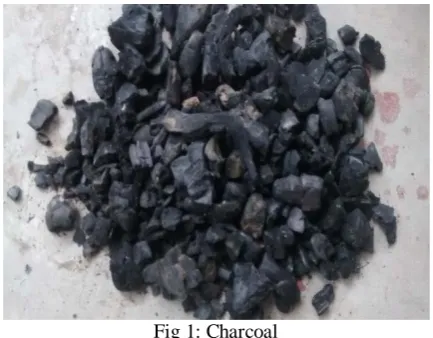
Charcoal: Charcoal is produced by heating wood in
airtight ovens or retorts, in chambers with various gases, or in kilns supplied with limited and controlled amounts of air. High-temperature heating by all methods breaks down the wood into gases, a watery tar mixture, and the familiar solid carbon material commonly known as charcoal.
Fig 1: Charcoal
Carbonizing ovens of plants designed for recovery of products other than charcoal are heated externally, and the wood is not in direct contact with the heat source. In another type, the only heat source derives from utilization of reaction heat for continuous chip conversion. Upright chambers have been developed that convert fines continuously or chunks in batches by forced circulation of hot gases through the wood, but liquid by-products are not recovered.
147 Copyright © 2011-15. Vandana Publications. All Rights Reserved. directly and itself largely furnishes the heat needed for
combustion.
Its object is to aid producers in more efficiently converting large quantities of low-quality wood in to a product that is enjoying an encouraging resurgence in popularity as a cooking fuel for use in homes, recreational areas, restaurants, and other establishments.
Charcoal-making from alternative non-wood feed stocks usually involves a carbonisation and a briquetting step using a binder. Four main categories of small-scale and semi-industrial charcoal kilns can be identified: earthen kilns, brick kilns, metal kilns, and semi-industrial retorts. Within each category kilns of different models and capacities are available. Kiln capacities vary from a single drum (200 litres) to several hundred m
Fig 2: Husk
Husk contains 17%-20% silica in complex form and RHA contains 85%-95% amorphous silica. RHA is a great environment threat causing damage to the land and the surrounding area in which it is dumped.
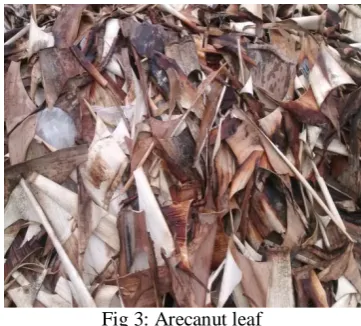
Arecanut leaf: The chemical composition, phenolic
constituents and contents, antioxidant activities of areca seeds and leafs are examined. High contents of phenolics and flavonoids contributed to strong antioxidant activity. Areca seeds contain considerably high amounts of phenolics, in which a large proportion is flavonoids.
3
Portable metal kilns are particularly practical when biomass has to be collected from a wide area, such as e.g. cotton stalks. Brick kilns have a longer lifetime and allow better process control. The Adam retort, a recent development, tries to combine these advantages. The highest and most consistent carbonization efficiencies can be achieved using (semi)industrial retorts but due to their high
Investment costs these are often not affordable in the context. The morphology of the biomass can also limit the suitability of a certain type of carbonisation kiln. To achieve higher conversion efficiencies and improved environmental performance the implementation of chimneys and of tar and methane recovery facilities is worth investigating.
Briquetting technologies are available in a wide capacity range, from very small to very large and with varying degrees of mechanization and automation. Main categories identified are manual techniques, small-scale electrical techniques and medium-scale electrical techniques. Agglomeration is the main technology used for producing charcoal briquettes from cotton stalks, as they give high quality briquettes, require a relatively low investment, and are therefore suitable for small industrial applications. Since charcoal is a material totally lacking plasticity it needs addition of a sticking or agglomerating material to enable a briquette to be formed. The binder should preferably be combustible. Clay is often used as binder in small-scale applications; starch, molasses and gum Arabic in semi-industrial applications.
Husk: Rice husk, an agro waste material, contains about
20% ash which can be retrieved as amorphous, chemically reactive silica. This silica finds wide applications as filler, catalyst support, adsorbent and a source for synthesizing high performance silicon and its compounds. Various metal ions and unburned carbon influence the purity and colour of the ash. Controlled burning of the husk after removing these ions can produce white silica of high purity.
India produces around 25million tons of rice husks (widely available waste). 78% of weight as rice, broken rice and bran, rest 22% of weight of paddy as husk. 75% of organic volatile matter and 25% of weight is converted as Rice Husk Ash(RHA) during firing process.
Fig 3: Arecanut leaf
Two phenolic compounds, syringic acid and epicatechin were identified from the extract by HPLC and their structures are confirmed by electrospray ionization-mass spectroscopy.
Antioxidant properties of areca seeds extracts appear to be dependent upon the contents of phenolics. In addition, as rich for the contents of phenolic and flavonoids and high antioxidant activity, areca seeds may be a good resource to the antioxidant status and disease chemoprevention of people in future.
C. Properties of fuel
Name of the fuel Density(kg/cm3) Carbon content (%)
Charcoal 1.3 50- 95
Husk 1.3 35.9-36.6
148 Copyright © 2011-15. Vandana Publications. All Rights Reserved. D. Bio briquetting
Bio-briquettes are a type of solid fuel, prepared by blending coal with 10-25% biomass, such as wood, bagasse (fibrous reside of processed sugar cane stalks), straw, and corn stalks.
A desulphurizing agent, Ca(OH)2, is also added in an amount corresponding to the sulphur content of the coal. Owing to the high pressure briquetting (1-3 t/cm2), the coal particles and the fibrous biomass material in the bio-briquette strongly intertwine and adhere to each other.
As a result, they do not separate from each other during combustion and the low ignition temperature biomass simultaneously combusts with the coal. The combined combustion gives favourable ignition and fuel properties, emits little dust and soot, and generates sandy combustion ash, leaving no clinker. Furthermore, since the desulfurizing agent also adheres to the coal particles, the agent effectively reacts with the sulphur in the coal to fix about 60-80% of the sulphur into the ash.
Many coal ranks can be used, including bituminous coal, sub- bituminous coal, and brown coal. In particular, the bio-briquettes produced with low grade coal containing large amounts of ash and having low calorific value combust cleanly, thus the bio- briquette technology is an effective technology to produce clean fuel for household heaters and small industrial boilers.
E. Bio-briquette production process
The raw materials, coal and biomass, are pulverized to a size of approximately 3 mm or smaller, and then dried. The dried mixture is further blended with a desulfurizing agent, Ca(OH)2. The mixture is formed by compression moulding in a high-pressure briquetting machine. Powder coal may be utilized without being pulverized. A small amount of binder may be added to some coal ranks.
The production process does not involve high temperatures, and is centred on a dry, high-pressure briquetting machine. The process has a simple flow, which is safe and which does not require skilled operating technique. Owing to the high- pressure briquetting process, the coal particles and the biomass strongly intertwine and adhere to each other, thus the process produces rigid formed coal, which does not separate during combustion.
II. PROPOSED WORK PROCESS
A. Collection of data
Collecting the data from the following source
Journal
Internet
Text book
B. Fuel preparation based on properties
Density: In order to classify and identify materials of a
wide variety, scientists use numbers called physical constants (e.g. density, melting point, boiling point, index of refraction) which are characteristic of the material in question. These constants do not vary with the amount or shape of the material, and are therefore
useful in positively identifying unknown materials. Standard reference works have been complied containing lists of data for a wide variety of substances. The chemist makes use of this in determining the identity of an unknown substance, by measuring the appropriate physical constants in the laboratory, consulting the scientific literature, and then comparing the measured physical constants with the values for known materials.
This experiment illustrates several approaches to the measurement of the density of liquids and solids.
Density is a measure of the “compactness” of matter within a substance and is defined by the equation: Density = mass/volume
The standard metric units in use for mass and volume respectively are grams and millilitres or cubic centimetres. Thus, density has the unit grams/millilitres (g/ml) or grams/cubic centimetres (g/cc). The literature values are usually given in this unit. Density may be calculated from a separate mass and volume measurement, or, in the case of liquids, may be determined directly by the use of an instrument called hydrometer.
Volume measurements for liquids or gases are made using graduated containers, for example, a graduated cylinder. For solids, the volume can be obtained either from the measurement of the dimensions of the solid or by displacement. The first method can be applied to solids with regular geometric shapes for which the mathematical formulas can be used to calculate the volume of the solid from the dimensions of the solid. Alternatively, the volume of any solid object, irregular or regularly shaped, can be measured by displacement. The solid is submerged in a liquid in which it is not soluble, and the volume of liquid displaced measured.
The hydrometer measures density directly. An object that is less dense than a liquid will float in that liquid density to a depth such that the mass of the object submerged equals the mass of the of the liquid displaced (Archimedes' Principle). Since mass equals density X volume (see equation 1), an object floated in liquids of different densities will displace different volumes of liquid. A hydrometer is a tube of constant mass that has been calibrated to measure density by floating the hydrometer in liquids of known densities and recording on a scale the fraction of the hydrometer submerged. Any hydrometer can be used over a limited range of densities because the hydrometer must float in the liquid being studied and the hydrometer level must be sufficiently submerged to obtain an on scale reading. Hydrometers may be calibrated in g/ml or some other unit of density.
In the following experiment, the identities of three colourless liquids will be determined by measuring the densities of the liquids by two methods and then comparing the density of the liquid to literature (reference) values for the three liquids. The identity of an unknown metal will be established in a similar manner.
Calorific value: The calorific value of peat from the
149 Copyright © 2011-15. Vandana Publications. All Rights Reserved. absolutely dry sample is no index as to the effective
heating value of the manufactured peat fuel, since the moisture content of the commercial fuel may be anything from a few percent up to 60%.
It is usual, for power purposes, to deliver the peat to the power plant with a moisture content of from 25 to 30%, and all effective heating values are calculated on this moisture content. In all the calculations and the curves plotted from them, the calorific value of the absolutely dry sample of peat has been assumed.
Moisture: Moisture in the fuel has following effects are
directly used as a fuel. It absorbs a part of heat liberated in the combustion process. In this method biomass such as wood or process. As a result net useful heat available from fuel other first cut into small pieces and latter these pieces are reduces, furnace temperature reduces and heat loss from crushed in a machine to get fine powder. If stack temperature is below 150°C used as a fuel for furnace. As the cost of heating with the chances of vapour condensation are higher.
If the fuel natural gas and fuel oils continues to rise business is contains Sulfur then the risk of H2SO4corrosion of heat being pushed towards the use of
biomass fuels for heat recovery unit, ID fan, ducting and chimney is higher.
Ash: Ash is the incombustible solid mineral matter in
the main factors which have an impact on the risk of bed fuel. It mainly contains silica (SiO2), Alumina (Al2O3),
Iron agglomeration in fluidized bed boilers and on the rate of oxides (FeO, Fe2O3
Crusher
), CaO and MgO etc. At higher boiler fouling, deposit formation, slagging and temperature, the ash fuses/soften and forms clinker super heater corrosion. Significant differences in that entraps combustible matters and prevents proper combustion properties of biomass is observed on the air distribution. This lowers combustion efficiency. C. Drying and sizing
The drying of materials whether solids, liquids or slurries to improve storage life or reduce transportation costs is one of the oldest and most commonly used unit operations. Drying of fruit, meat and various building and craft materials date back before the discovery of fire. The physical laws governing drying remain the same, even though the machinery to accomplish it has improved considerably. Today, dryers are in operation in most manufacturing industries including chemical, pharmaceutical, process and food. Products that are dried range from organic pigments to proteins, as well as minerals to dairy products. Because of the spectrum of duties required, there is a great variety of dryers available.
The correct choice depends on the properties of the feed material and the desired characteristics of the final product. Since drying is energy intensive operation, this handbook also provides information on techniques to improve efficiency.
Sizing is the process of size the fuel particle to the required process or application by using following equipment:
Bowl mill
III. EXPERIMENTAL SETUP
In that steam dryer experimental setup have four major components they are
1. Fuel burner 2. Boiler
3. Steam flow pipe 4. Drying plate A. Fuel burner
It is place to burn the fuel. It has two major ports for feeding of fuel and the removal of ash from the burner, the size of the burner is a cylindrical shape. The air flow for fuel burning from the bottom side to top side of the cylinder.
B. Boiler
Boiler is a mechanical device which produces the steam from the water, in that setup boiler get the heat from the fuel burning region and convert water into the steam.
C. Steam flow pipe
Produced steam in the boiler should be flow through the drying plate by the help of steam flow pipes, in that pipe the steam temperature is decrease due to atmosphere condition due that insulation to be need for steam flow pipe.
D. Drying plate
The steam flow pipe have two end one end is connect to the boiler and another one is connected to the drying plate , in that drying plate having small size of holes. From that holes the steam flows, the drying matters should be placed above the drying plate
Fig 4: 3D model of steam dryer
Component specification
Parameters involved in steam dryer 1. Diameter
150 Copyright © 2011-15. Vandana Publications. All Rights Reserved.
Components Material Dimension
( in mm )
Burning region Mild steel
650mm dia 600mm ht
boiler Mild steel
600mm dia 500mm ht
Steam pipe Mild steel
50mm dia 800mm length
Drying plate Mild steel 600*600 mm
Table 2: Component specification of steam dryer
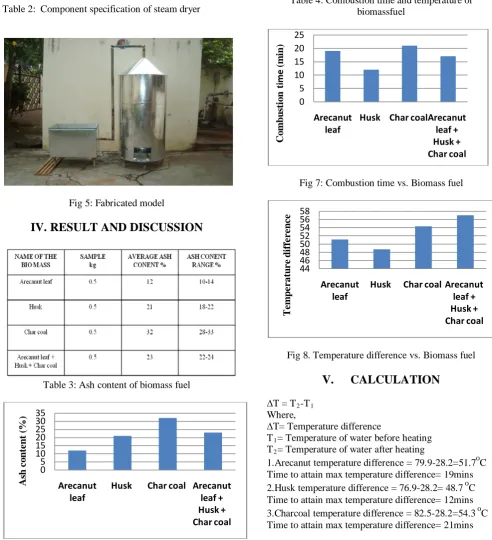
Fig 5: Fabricated model
IV. RESULT AND DISCUSSION
Table 3: Ash content of biomass fuel
Fig 6: Ash content vs. Biomass fuel
Table 4: Combustion time and temperature of biomassfuel
Fig 7: Combustion time vs. Biomass fuel
Fig 8. Temperature difference vs. Biomass fuel
V.
CALCULATION
∆T = T2-T1
Where,
∆T= Temperature difference
T1= Temperature of water before heating
T2= Temperature of water after heating
1.Arecanut temperature difference = 79.9-28.2=51.7oC Time to attain max temperature difference= 19mins 2.Husk temperature difference = 76.9-28.2= 48.7 oC Time to attain max temperature difference= 12mins 3.Charcoal temperature difference = 82.5-28.2=54.3 oC Time to attain max temperature difference= 21mins 0
5 10 15 20 25 30 35
Arecanut
leaf Husk Char coal Arecanut leaf + Husk + Char coal
Ash c
o
nt
e
nt
(
%
)
0 5 10 15 20 25
Arecanut
leaf Husk Char coal Arecanut leaf + Husk + Char coal
Co
m
bu
st
io
n
t
im
e
(m
in
)
44 46 48 50 52 54 56 58
Arecanut
leaf Husk Char coal Arecanut leaf + Husk + Char coal
T
e
m
p
e
r
at
u
r
e
d
if
fe
r
e
n
c
151 Copyright © 2011-15. Vandana Publications. All Rights Reserved. 4.Arecanut+Husk+Charcoal (30%+30%+40%)
temperature difference = 85.2-28.2=57 oC Time to attain max temperature difference= 17mins
VI. CONCLUSION
From the above result, we conclude that the mixture of arecanut, husk and charcoal which gives max temperature differnce with minimum time and also ash content is lower.
ACKNOWLEDGEMENT
The authors are very much thankful to the management of TRP Engineering College (SRM Group), Irungalur, Trichy – 621 105 for granting permission to do their field study in the college hostel mess and also for the approval for the modification in the existing biogas plant.
REFERENCE
[1] Feniel Philippe, Marc Culot. Household solid waste generation and characteristics in Cape Haitian city, Republic of Haiti.Resources, Conservation and Recycling. 54 (2009) 73-78.
[2] Jiancai Pi. Environmental Protection and Economic Development under Chinese-style separation of powers.Research on Financial and Economic Issues. 6 (2010) 10-14.
[3] Bolton, P., M. Dewatripont, Contract Theory. Cambridge: Massachusetts, MIT Press, 1997.
[4] Dasgupta, S., Hamilton, K., Pandey, K. D., Wheeler, D. Environment During Growth: Accounting for Governance and Vulnerability. World Development. 34 (2006) 1597-1611.
[5] Margaret, M. Is Growth a Dirty Word? Pollution, Abatement and Endogenous Growth.Journal of Development Economics. 54 (1997) 261-284.
[6] Toman, M., Withagen, C. Accumulative Pollution, ‘Clean Technology’, and Policy Design. Resource and Energy Economics. 22 (2000) 367-384.
[7] Reis, A. Endogenous Growth and the Possibility of Eliminating Pollution. Journal of Environmental Economics and Management.42 (2001) 360 -373.
[8] Chen Guangqing. Environmental protection and economic development in new situation.Exploration and Free Views.20 (2009) 95.
[9] Hefa Cheng, Yuanan Hu. Municipal solid waste (MSW) as a renewable source of energy: Current and future practices in China. Bioresource Technology. 101 (2010) 3816-3824.