The Thirty-Third AAAI Conference on Artificial Intelligence (AAAI-19)
Complex Moment-Based Supervised Eigenmap for Dimensionality Reduction
Akira Imakura, Momo Matsuda, Xiucai Ye, Tetsuya Sakurai
University of Tsukuba1-1-1 Tennodai, Tsukuba, Ibaraki 305-8573, Japan
Abstract
Dimensionality reduction methods that project high-dimensional data to a low-high-dimensional space by matrix trace optimization are widely used for clustering and classification. The matrix trace optimization problem leads to an eigenvalue problem for a low-dimensional subspace construction, preserving certain properties of the original data. However, most of the existing methods use only a few eigenvectors to construct the low-dimensional space, which may lead to a loss of useful information for achieving successful classification. Herein, to overcome the deficiency of the information loss, we propose a novel complex moment-based supervised eigenmap including multiple eigenvectors for dimensionality reduction. Furthermore, the proposed method provides a general formulation for matrix trace optimization methods to incorporate with ridge regression, which models the linear dependency between covariate variables and univariate labels. To reduce the computational complexity, we also propose an efficient and parallel implementation of the proposed method. Numerical experiments indicate that the proposed method is competitive compared with the existing dimensionality reduction methods for the recognition performance. Additionally, the proposed method exhibits high parallel efficiency.
Introduction
Dimensionality reduction is an efficient technique for data analysis which maps high-dimensional data to a low dimen-sional space. Dimendimen-sionality reduction methods that utilize matrix trace optimization are widely used for clustering and classification.
The matrix trace optimization problem leads to an eigen-value problem for low-dimensional space construction, pre-serving certain properties of the original data. Principal component analysis (PCA) (Pearson 1901; Jolliffe 1986) and locality preserving projections (LPP) (He and Niyogi 2004) are two of the typical unsupervised dimensionality re-duction methods. PCA aims to maximize the variance of the projected vectors, while LPP devotes to preserve the local similarity of the original data. Discriminant analy-sis is the typical supervised method which maximizes the between-class scatter and reduce the within-class scatter. Copyright c2019, Association for the Advancement of Artificial Intelligence (www.aaai.org). All rights reserved.
A family of discriminant analysis methods are proposed for dimensionality reduction, including Fisher discriminant analysis (FDA) (Fisher 1936; Fukunaga 2013), local FDA (LFDA) (Sugiyama 2007), semi-supervised LFDA (SELF) (Sugiyama et al. 2010) and locality adaptive discriminant analysis (LADA) (Li et al. 2017).
However, most of the existing dimensionality reduction methods use only ` eigenvectors to construct the low-dimensional space with ` dimensions, which may lead to a loss of useful information for achieving successful clas-sification. Herein, to overcome the deficiency of informa-tion loss, we propose a novel complex moment-based super-vised eigenmap for dimensionality reduction. The proposed method allows us to achieve better recognition performance by using a complex moment-based subspace that includes
d > `eigenvectors, wheredcan be set independently of`. The proposed method is inspired by complex moment-based parallel eigensolvers (Sakurai and Sugiura 2003; Imakura, Du, and Sakurai 2016) that are one of the hottest parallel eigensolvers for computing multiple eigenpairs of large and sparse eigenvalue problems. Since a subspace in-cluding a large number of eigenvectors is expected to have rich information, the usage of complex moment-based sub-space can help to achieve a good recognition performance.
Furthermore, we incorporate ridge regression (or called as the Tikhonov regularization) (Saunders, Gammerman, and Vovk 1998) to matrix trace optimization in the objective function of the proposed method. Ridge regression aims to find a linear function that models the dependencies between covariate variables and univariate labels. By the corporation, the proposed method can find the subspace that most com-pactly expresses the target and rejects other possible but less compact candidates. As far as our knowledge, no existing method combines a matrix trace and ridge regression.
parallel eigensolvers (Sakurai and Sugiura 2003; Imakura, Du, and Sakurai 2016).
The main aspects of the proposed method to achieve high recognition performance are
• The usage of a complex moment-based subspace includ-ing multiple eigenvectors to preserve more data properties than the existing methods.
• Providing a general formulation for matrix trace optimiza-tion methods to incorporate with ridge regression, which models the linear dependency between covariate variables and univariate labels in addition to the existing methods. • Proposing an efficient and parallel implementation based
on techniques used for the complex moment-based paral-lel eigensolvers to reduce the computational complexity. Numerical results are demonstrated to evaluate how much effect the aspects of the proposed method make it possible to have competitive advantages over existing dimensionality reduction methods.
Throughout the manuscript, the following notation is used. We define the range space of a matrix V = [v1,v2, . . . ,vL] by R(V) := span{v1,v2, . . . ,vL}. We
also use MATLAB notations.
Related methods
Dimensionality reduction methods
Letmandnbe the dimension of the features and the num-ber of samples for training, and letX= [x1,x2, . . . ,xn]∈
Rm×nbe the training dataset. We consider linear and
non-linear dimensionality reduction methods that construct low-dimensional dataY = [y1,y2, . . . ,yn]∈ R`×n, which
re-tain some of the properties of the original data.
Linear dimensionality reduction methods reduce the orig-inal data X to the low-dimensional data Y using a linear mapB ∈Rm×`, i.e.
Y =BTX.
Let a symmetric matrixA1∈Rm×mand a symmetric
posi-tive definite matrixA2∈Rm×mbe defined, respectively, in
each dimensionality reduction method. Then, the linear map
B is formulated by the minimization or maximization of a matrix trace:
min
B∈Rm×`
Tr BTA1B or max B∈Rm×`
Tr BTA1B
s.t. BTA2B=I
and is computed as`eigenvectors of the corresponding gen-eralized eigenvalue problem:
A1ti=λiA2ti. (1)
Here, we haveB= [t1,t2, . . . ,t`].
Nonlinear dimensionality reduction methods, which use a nonlinear map and the kernel trick (Sch¨olkopf, Smola, and M¨uller 1998), are widely used as improvements over linear dimensionality reduction methods. Nonlinear dimen-sionality reduction methods transform the original dataXto
φ(X) = [φ(x1), φ(x2), . . . , φ(xn)]with a nonlinear kernel
function, and reduce the dimension ofφ(X)using a nonlin-ear mapBesuch thatY =BeTφ(X). With appropriate non-linear functions, nonnon-linear dimensionality reduction meth-ods are expected to improve the recognition performance.
In general, we setBe =φ(X)BbwithBb ∈Rn×`and di-rectly set the Gram matrixK=φ(X)Tφ(X)∈
Rn×n
with-out computingφ(X)to reduce the computational costs. The Gaussian kernel, polynomial kernel and sigmoid kernel are commonly used as the kernel functions.
Ridge regression
Linear ridge regression is a classical statistical algorithm which computes a linear functionB ∈Rm×`such that
min-imizes the squared error with the ground truth data Z ∈
R`×n:
min
B∈Rm×`
kZ−BTXk2F+λkBk 2 F,
whereλis a regularization parameter. The kernel version of the ridge regression is also used for improving recognition performance.
Complex moment-based parallel eigensolvers
Complex moment-based eigensolvers were first proposed by (Sakurai and Sugiura 2003) for solving interior generalized eigenvalue problems of the form:Axi=λiBxi,
A, B∈Cn×n, xi∈Cn\ {0}, λi ∈Ω⊂C,
wherezB−A is non-singular in a boundaryΓof the tar-get regionΩ. This method is based on Cauchy’s integral for-mula and constructs certain complex moment matrices using a contour integral.
LetL, M ∈ N+ be the input parameters andV ∈ Cn×L
be an input matrix. We define S = [S0, S1, . . . , SM−1] ∈
Cn×LMandSk ∈Cn×Las
Sk :=
1 2πi
I
Γ
zk(zB−A)−1BVdz. (2)
Complex moment-based eigensolvers are mathematically designed on the basis of the properties of the matricesSkand
S. Then, practical algorithms are derived by approximating the contour integral (2) using the numerical integration rule:
b
Sk:= N
X
j=1
ωjzkj(zjB−A)−1BV,
wherezj is a quadrature point andωj is its corresponding
weight.
2010; Ikegami and Sakurai 2010; Imakura, Du, and Sakurai 2014; 2016; Imakura and Sakurai 2017; Imakura, Futamura, and Sakurai 2017), the FEAST eigensolver developed by (Polizzi 2009) and its improvements (Tang and Polizzi 2014; G¨uttel et al. 2015; Kestyn et al. 2016).
For details of these methods and the relationship among typical methods, refer to the study by (Imakura, Du, and Sakurai 2016) and the references therein.
A complex moment-based supervised
eigenmap for dimensionality reduction
In this section, to achieve high recognition performance, we propose a novel complex moment-based supervised eigen-map for dimensionality reduction. The proposed method minimizes a novel objective function that combines a ma-trix trace and a squared error with the ground truth dataZ ∈R`×n. The proposed method also uses a complex
moment-based subspace from complex moment-moment-based eigensolvers that includes multiple eigenvectors.
Basic concepts of the proposed method
LetA1andA2be the matrices used in a given
dimension-ality reduction method such as LPP or LFDA. We also let SΩbe a complex moment-based subspace with respect to a
given real intervalΩ = [a, b]⊂Rdefined by
SΩ=R(S), S= [S0, S1, . . . , SM−1],
Sk :=
1 2πi
I
Γ
zk(zA2−A1)−1A2Vdz, (3)
whereL, M ∈ N+, V ∈ Rm×L andΓis a positively
ori-ented Jordan curve around Ω. Here, we assume that there are only the target eigenvalues in the Jordan curveΓ. Then, to obtain the linear mapB ∈ Rm×`, we introduce the
fol-lowing minimization problem:
min
B=[b1,b2,...,b`],bi∈SΩ
E(B) s.t. BTA2B=I, E(B) = (1−µ)Tr BTf(A1)B
+µkZ−BTXk2 F, (4)
whose objective functionE(B)combines a matrix trace de-rived from dimensionality reduction methods and a squared error straightforwardly using the ground truth dataZlike the ridge regression.
The column vectors of the linear mapB are constrained by A2-orthonormal bases of the complex moment-based
subspaceSΩ. Here,µ∈[0,1]is a weight parameter for both
terms andf(·)is a (meromorphic) weight function of each eigenvector for minimization.
In a trace minimization, solutions contain rich eigenvec-tors with a small weight. Iff(λ) = 1, then each eigenvec-tor is not scaled, and if f(λ) = λ, then each eigenvector is scaled by the corresponding eigenvalue. If A1 and A2
are from a trace minimization-type method like LPP, since eigenvectors associated with small eigenvalues have rich in-formation, we set f(λ) such that the eigenvectors associ-ated with small eigenvalues in Ω have small weights. In contrast, ifA1 andA2are from a trace maximization-type
method like LFDA, since eigenvectors associated with large
eigenvalues have rich information, we set f(λ) such that the eigenvectors associated with large eigenvalues inΩhave small weights. Note that, for a diagonalizable matrix A =
XDX−1withD= diag(d
1, d2, . . . , dn), we havef(A) =
Xf(D)X−1 withf(D) = diag(f(d
1), f(d2), . . . , f(dn))
(Higham 2008).
For the meaning of the complex moment-based subspace SΩ, we have the following theorem; see e.g., (Imakura, Du,
and Sakurai 2016).
Theorem 1. The complex moment-based subspace is equiv-alent to an invariant subspace with respect to the multiple eigenvectors corresponding to the eigenvalues in a given
real intervalΩ = [a, b]⊂R, that is,
SΩ=TΩ:= span{ti|λi∈Ω},
if and only ifrank(S) =d.
The basic concepts of the proposed method for high recognition performance are summarized as follows: • Use the complex moment-based subspace SΩ, which is
equivalent to the invariant subspace TΩ with respect to
the multiple eigenvectors to solve the novel minimization problem (4).
• Use the novel minimization problem (4) that combines the matrix trace derived from the dimensionality reduc-tion methods and the squared error straightforwardly us-ing the ground truth data.
Derivation of a practical algorithm
Here, we propose a practical algorithm for the pro-posed method based on some techniques of complex moment-based eigensolvers. Let U ∈ Rm×d and U⊥ ∈ Rm×(m−d)be A2-orthogonal matrices whose columns are A2-orthonormal bases of the complex moment-based
sub-space SΩ and of its A2-orthogonal complement,
respec-tively, i.e.,
U = [u1,u2, . . . ,ud], uk ∈ SΩ,
UTA2U =I, UTA2U⊥=O, (5)
whered= |{λi|λi ∈ Ω}|is the number of eigenvalues of
(1) inΩ = [a, b]. Then, the linear mapBis given by
B=U C, CTC=I, C∈Rd×`.
Using (5) and the relationTr(ATA) =kAk2
F, we have
Tr BTf(A1)B
= Tr (CTUT)(A2[U, U⊥])f [U, U⊥]TA1[U, U⊥]
·([U, U⊥]TA2)(U C)
= Tr CTf(UTA1U)C
=kf(T)1/2Ck2F,
whereT =UTA
1U. Also, we have
kZ−BTXk2
F=kZ−C
From the relationkAk2 F+kBk
2
F=k[A;B]k 2
F, the objective
functionE(B)in (4) can be written as
E(B) = (1−µ)kf(T)1/2Ck2
F+µkZ−C
TUTXk2 F =
µ1/2ZT O
−
µ1/2XTU
(1−µ)1/2f(T)1/2
C 2 F .
Therefore, the minimization problem (4) becomes
min
C∈Rd×`
µ1/2ZT O
−
µ1/2XTU
(1−µ)1/2f(T)1/2
C 2 F
s.t. CTC=I. (6)
A minimization problem with an orthogonal constraint (6) is called an unbalanced orthogonal Procrustes (UOP) problem, which is solved using an iterative method (Eld´en and Park 1999; Park 1991).
In practice, the contour integral (3) is approximated by a numerical integration rule such as theN-point trapezoidal rule, as follows:
b
Sk := N
X
j=1
ωjzjk(zjA2−A1)−1A2V,
where(zj, ωj), j = 1,2, . . . , N are the quadrature points
and the corresponding weights, respectively. Because of the symmetric property of the matrix pencil(A1, A2), if
quadra-ture points and the corresponding weights are symmetric about the real axis, (zj, ωj) = (zj+N/2, ωj+N/2), j =
1,2, . . . , N/2, we can reduce the number of linear systems,
b
Sk = 2 N/2
X
j=1
Re(ωjzkj(zjA2−A1)−1A2V). (7)
To improve the numerical stability, we also apply a low-rank approximation ofSbwith a singular value decomposi-tion on anA2-inner product:
b
S= [U ,b Ub0] b Σ b Σ0 " c WT c
W0T
#
≈UbΣbcW
T ,
b
UTA2Ub =I, cWTWc=I,
whereΣb is a diagonal matrix whose diagonal entries are the larger part of the singular values, i.e., σi/σ1 ≥ δ (σ1 ≥ σ2 ≥ · · · ≥ σLM), and the columns of U ,b Wc are the corresponding singular vectors. Letdbbe a numerical rank,
σ
b
d/σ1 ≥ δ > σdb+1/σ1. Then, the UOP problem (6) is
rewritten as
min
b C∈Rdb×`
µ1/2ZT O
−
µ1/2XT
b
U
(1−µ)1/2f(
b
T)1/2
b C 2 F
s.t. CbTCb=I, (8)
whereTb=UbTA1Uband the map is obtained fromB =UbCb. The algorithm of the proposed method is summarized in Algorithm 1. One of the most time-consuming parts of the
Algorithm 1 A complex moment-based supervised eigen-map for dimensionality reduction
Input: Training dataset: X ∈ Rm×n, Z ∈ R`×n and
pa-rameters:L, M, N ∈N+, δ ∈R, V ∈ Rm×L,(zj, ωj)
forj= 1,2, . . . , N,Ω = [a, b], µ, f(·). Output: Linear eigenmapB∈Rm×`
1: Construct a matrix pencil (A1, A2) from the training
datasetX(andZif required) 2: ComputeSbk = P
N/2
j=1Re(ωjzkj(zjA2−A1)−1A2V),
and setSb= [Sb0,Sb1, . . . ,SbM−1]
3: Compute a low-rank approximation of Sb using the thresholdδ:
b
S = [U ,b Ub0][Σb, O;O,Σb0][W ,c Wc0T] ≈ UbΣbcWT such thatUbTA2Ub =I
4: Solve UOP problem (8) and setB=UbCb
proposed method is computing the solutions of theN/2 lin-ear systems withLright-hand sides in (7) and Step 2 of Al-gorithm 1 as follows:
(zjA2−A1)Pj =A2V, j = 1,2, . . . , N/2. (9)
For solving these linear systems, the proposed method has hierarchical parallelism. By making this hierarchical struc-ture of the algorithms responsive to the hierarchical strucstruc-ture of the recent architecture, the proposed method is expected to achieve a scalability as high as the complex moment-based eigensolvers, which is a significant advantage for par-allel computation. For complex moment-based eigensolvers, their parallel efficiency was demonstrated in previous re-search (Kestyn et al. 2016; Iwase et al. 2017).
Extensions of the proposed method and relations
between existing methods
In the proposed method, the matricesA1andA2are derived
from existing dimensionality reduction methods, that is, we can consider several variants of the proposed method based on each dimensionality reduction method. The concept of the nonlinear dimensionality reduction can also be applied to the proposed method to improve the recognition perfor-mance.
There are no direct methods for computing an optimal solution to the UOP problem (8) because of its nonlin-ear constraint. Therefore, we use an approximate solution obtained by an iterative method (Eld´en and Park 1999; Park 1991). As another choice, in future, we may relax or ignore the orthogonal constraint. If we ignore the orthogo-nal constraint, the UOP problem (8) is reduced to a linear least-squares problem and can be solved efficiently.
The proposed method can be recognized as a combination of the existing dimensionality reduction method based on trace minimization/maximization and ridge regression. If the contour integral (3) is computed exactly, then the proposed method with specific parameters simplifies to dimensional-ity reduction methods and ridge regression. For example, the matricesA1andA2are those used in trace minimization or
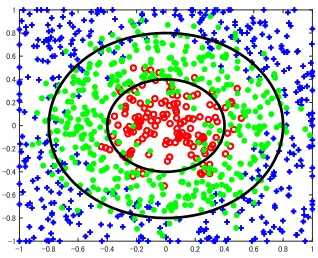
(a) Ground truth (b) Training dataset Figure 1: Ground truth and training dataset for the artificial problem.
we setΩto include nonzero`smallest or largest eigenval-ues, then the proposed method withµ = 0andf(λ) = λ
orf(λ) = 1/λare mathematically equivalent to the corre-sponding dimensionality reduction methods. Also, if we set
Ωto include all eigenvalues and ignore the orthogonal con-straint in (6), then the proposed method withf(λ) = 1 is mathematically equivalent to ridge regression.
Numerical experiments
The main aspects of the proposed method for achieving high recognition performance are (i) a complex moment-based subspace including multiple eigenvectors, (ii) a novel ob-jective function that combines a matrix trace and a squared error and (iii) an efficient and parallel implementation based on techniques used for complex moment-based parallel eigensolvers. To evaluate the effect of these aspects of the proposed method on recognition performance, here we com-pare the performance of the kernel version of the proposed method (complex moment-based supervised eigenmap, K– CMSE) with the performance of Kernel LPP (K–LPP), Ker-nel LFDA (K–LFDA) and KerKer-nel ridge regression (K–RR).
We use the Gaussian kernel as the kernel function. The di-mension size`is set as the number of classes for each prob-lem. The similarity matrix is sparsified with thek-nearest neighbor approach (k= 7). For each problem, a line search tunes the regularization parameter of K–RR.
For K–CMSE, we use the same matrices A1 and A2
as those used for K–LPP. We also use (M, N, δ) = (8,32,10−15), which are the default parameters for com-plex moment-based eigensolvers. The input matrix V is a random matrix generated by the Mersenne Twister. We set
Ω = [0, b] and the quadrature points as on an ellipse with centerγ=b/2, major axisρ=b/2and aspect ratioα= 0.1
as follows:
zj =γ+ρ(cos(θj) +αi sin(θj)), θj =
2π N
j−1
2
forj= 1,2, . . . , N/2. The corresponding weights are set as
ωj =
ρ
N (αcos(θj) + i sin(θj))
for j = 1,2, . . . , N/2. The nonlinear functionf(·) is de-fined asf(λ) = 1/(b−λ)2. We solve the UOP problem (8)
using an iterative method (Zhao, Wang, and Nie 2016). In the training phase, we use the ground truthZ as a bi-nary matrix whose(i, j)entry is 1 if the training dataxjis
in class i. This type of ground truth Z is used for several classification algorithms including the ridge regression and deep neural networks (Bishop 2006). Then, in the prediction phase, we firstly apply the trained dimensionality reduction and apply thek-nearest neighbors (Altman 1992) for classi-fication to the obtained low dimensional data.
Numerical experiments I and II were performed using MATLAB2017b, and numerical experiment III was per-formed using Fortran 90 and MPI.
Experiment I: artificial data
In this experiment, we compare the recognition performance of the dimensionality reduction methods for the three-class classification of 10-dimensional artificial data. The first two dimensions of the ground truth are shown in Figure 1(a). In Figure 1(b), we show 1000 training data points of the first two dimensions with the corresponding labels: ◦,•and+. As shown in Figure 1, the training dataset has noise and de-viates from the ground truth to evaluate the overfitting of the methods due to the noise. For the test dataset, we use
201×201data points whose first two dimensions are square grid points in[−1,1]×[−1,1]. The other eight dimensions of the training and test dataset are random values in[−0.1,0.1]
generated by the Mersenne Twister in MATLAB.
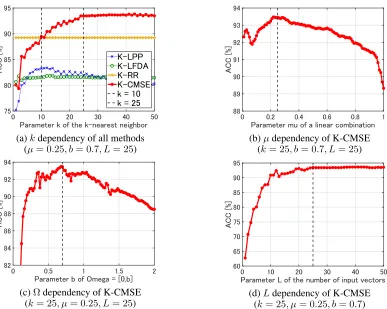
Firstly, we evaluate the parameter dependency of the recognition performance, accuracy (ACC) defined by the rate of correct predictions to the number of test data points, for k = 1,2, . . . ,50 of the k-nearest neighbors,
µ = 0.01,0.02, . . . ,1.00 of a linear combination, b = 0.02,0.04, . . . ,2.00ofΩandL = 1,2, . . . ,50of the num-ber of input vectors.
Figure 2 (a) shows thekdependency of the performance of all methods, and Figures 2 (b), (c) and (d) show theµ,Ω
(a)kdependency of all methods (µ= 0.25, b= 0.7, L= 25)
(c)Ωdependency of K-CMSE (k= 25, µ= 0.25, L= 25)
(b)µdependency of K-CMSE (k= 25, b= 0.7, L= 25)
(d)Ldependency of K-CMSE (k= 25, µ= 0.25, b= 0.7)
Figure 2: Parameter dependency of accuracy (ACC) for the artificial problem. For each figure, one parameter is changed and the other parameters are fixed atk= 25, µ= 0.25, b= 0.7andL= 25. Vertical dashed lines denote the fixed parameters.
although the performance of K–LPP and K–CMSE are de-pendent on k. Figure 2 (b) demonstrates that the perfor-mance of K–CMSE withµ≈1is relatively low. Note that
µ is the weight for a linear combination of two objective functions and K–CMSE withµ= 0is strongly related to K-LPP. Therefore, the result in Figure 2 (b) indicates that the combination of objective functions gives a better recognition performance than using each objective function alone. Fig-ure 2 (c) and (d) also show that the complex moment-based subspace with wide regionΩand largeL, which include a larger number of eigenvectors, improves recognition perfor-mance, although an overlargeΩleads to limited recognition performance.
The classification results of the existing methods and K– CMSE are shown in Figure 3. At first glance, the existing methods give good classification results; however, the pre-dicted boundary of each class is not sharp, which indicates that is overfitting due to the noise in the training dataset. In contrast, in comparison with the existing methods, the pro-posed method (K–CMSE) gives a better and sharper classi-fication result and less overfitting.
Experiment II: real-world data
Here, we evaluate the performance of the dimensionality re-duction methods on normalized mutual information (NMI) (Strehl and Ghosh 2002), accuracy (ACC) and Rand index
(RI) (Rand 1971). As test problems, we treat the binary and multiclass classification problems obtained from (Le-Cun 1998; Samaria and Harter 1994) and feature selection datasets which is available at http://featureselection.asu.edu/ datasets.php.
In these numerical experiments,kof thek-nearest neigh-bor, the regularization parameter of K–RR and(µ, b, L)of K–CMSE are tuned by applying a line search to each param-eter sequentially and by a 10-fold cross-validation until con-vergence. Then, the performance of each method with the tuned parameters is evaluated by a 10-fold cross-validation using a different validation set from that used for parameter tuning.
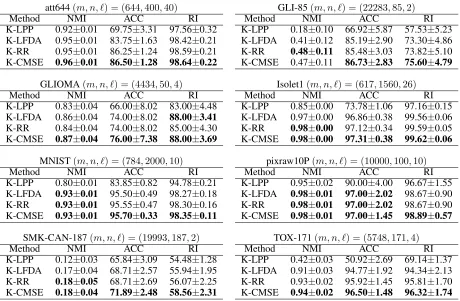
The numerical results (average±standard error) are sum-marised in Table 1. We can observe from Table 1 that the proposed method (K–CMSE) has a recognition performance higher than those of existing methods for binary and multi-class multi-classifications.
Experiment III: scalability
In this experiment, we evaluate the strong scalability of the main parts of K–CMSE which construct the matrices A1
(a) K–LPP
(c) K–RR
(b) K–LFDA
(d) K–CMSE
Figure 3: Classification results of the existing methods (k = 10) and K–CMSE (k = 25, µ= 0.25, b = 0.7, L= 25) for the artificial problem.
0 100 200 300 400 500 600 700 800 900
P=1 P=2 P=4 P=8 P=16 P=32
Elapsed time [sec.]
Number of MPI process MISC Solve UOP (Step 4) low-rank appl. (Step 3) Compute S (Step 2) Set A1 and A2 (Step 1)
(a) elapsed time
1 2 4 8 16 32
1 2 4 8 16 32
Scalability
Number of MPI processes Ideal Proposed method
(b) scalability
Figure 4: Elapsed time and strong scalability of the main part of K–CMSE for MNIST with 60,000 training data points.
The numerical experiments were conducted on COMA at the Center for Computational Sciences, University of Tsukuba, Japan. COMA has two Intel Xeon E5-2670v2 (2.5 GHz) processors and two Intel Xeon Phi 7110P (61 cores) processors per node. In this numerical experiment, we use only the CPU. The algorithms are implemented in Fortran 90 and MPI and executed with 1 to 32 nodes (one MPI process per node). The sparse linear systems (9) are solved using “cluster sparse solver” in Intel MKL.
Figure 4 shows the elapsed time and the strong scalability of the main parts of the proposed method. We observe from Figure 4 that the most time-consuming part of the proposed
method is computing the complex moment matrixSb, which is scaled well by parallelization. As a result, the proposed method exhibits good strong scalability.
Remarks on numerical results
Table 1: Recognition performance (average± standard error) for real-world problems. The parameters m, n, `denote the number of the features, samples and classes. The bold fonts denote the best method(s) for each evaluation index.
att644(m, n, `) = (644,400,40) GLI-85(m, n, `) = (22283,85,2)
Method NMI ACC RI Method NMI ACC RI
K-LPP 0.92±0.01 69.75±3.31 97.56±0.32 K-LPP 0.18±0.10 66.92±5.87 57.53±5.23 K-LFDA 0.95±0.01 83.75±1.63 98.42±0.21 K-LFDA 0.41±0.12 85.19±2.90 73.30±4.86 K-RR 0.95±0.01 86.25±1.24 98.59±0.21 K-RR 0.48±0.11 85.48±3.03 73.82±5.10 K-CMSE 0.96±0.01 86.50±1.28 98.64±0.22 K-CMSE 0.47±0.11 86.73±2.83 75.60±4.79
GLIOMA(m, n, `) = (4434,50,4) Isolet1(m, n, `) = (617,1560,26)
Method NMI ACC RI Method NMI ACC RI
K-LPP 0.83±0.04 66.00±8.02 83.00±4.48 K-LPP 0.85±0.00 73.78±1.06 97.16±0.15 K-LFDA 0.86±0.04 74.00±8.02 88.00±3.41 K-LFDA 0.97±0.00 96.86±0.38 99.56±0.06 K-RR 0.84±0.04 74.00±8.02 85.00±4.30 K-RR 0.98±0.00 97.12±0.34 99.59±0.05 K-CMSE 0.87±0.04 76.00±7.38 88.00±3.69 K-CMSE 0.98±0.00 97.31±0.38 99.62±0.06
MNIST(m, n, `) = (784,2000,10) pixraw10P(m, n, `) = (10000,100,10)
Method NMI ACC RI Method NMI ACC RI
K-LPP 0.80±0.01 83.85±0.82 94.78±0.21 K-LPP 0.95±0.02 90.00±4.00 96.67±1.55 K-LFDA 0.93±0.01 95.50±0.49 98.27±0.18 K-LFDA 0.98±0.01 97.00±2.02 98.67±0.90 K-RR 0.93±0.01 95.55±0.47 98.30±0.16 K-RR 0.98±0.01 97.00±2.02 98.67±0.90 K-CMSE 0.93±0.01 95.70±0.33 98.35±0.11 K-CMSE 0.98±0.01 97.00±1.45 98.89±0.57
SMK-CAN-187(m, n, `) = (19993,187,2) TOX-171(m, n, `) = (5748,171,4)
Method NMI ACC RI Method NMI ACC RI
K-LPP 0.12±0.03 65.84±3.09 54.48±1.28 K-LPP 0.42±0.03 50.92±2.69 69.14±1.37 K-LFDA 0.17±0.04 68.71±2.57 55.94±1.95 K-LFDA 0.91±0.03 94.77±1.92 94.34±2.13 K-RR 0.18±0.05 68.71±2.69 56.07±2.25 K-RR 0.93±0.02 95.92±1.45 95.81±1.70 K-CMSE 0.18±0.04 71.89±2.48 58.56±2.31 K-CMSE 0.94±0.02 96.50±1.48 96.32±1.74
Therefore, we conclude that these numerical experiments confirm the efficiency of the main aspects of the proposed method.
Conclusions
Here, we proposed a novel complex moment-based super-vised dimensionality reduction method, which achieves high recognition performance by extending the existing dimen-sionality reduction methods using a complex moment-based subspace. The main aspects of the proposed method are (i) a complex moment-based subspace including multiple eigen-vectors, (ii) a novel objective function that combines a ma-trix trace and a squared error and (iii) an efficient and par-allel implementation based on techniques used for the com-plex moment-based parallel eigensolvers. The numerical re-sults confirm that these aspects help to achieve high recog-nition performance and high parallel efficiency.
Note that we also tested the proposed method with a ma-trix pencil(A1, A2)derived from K–LFDA and obtained
al-most the same good results as demonstrated in this paper. In the future, we will evaluate the performance of the proposed method based on other dimensionality reduction methods and compared it with those of existing methods when solving large real-world problems in parallel environ-ments. We will also investigate tuning strategies for the hy-perparameters of the proposed method.
Acknowledgments
The authors would like to thank the anonymous reviewers for their helpful and constructive comments. The present study is supported in part by the Japan Science and Tech-nology Agency (JST), ACT-I (No. JPMJPR16U6), the New Energy and Industrial Technology Development Organi-zation (NEDO) and the Japan Society for the Promotion of Science (JSPS), Grants-in-Aid for Scientific Research (Nos. 17K12690, 18H03250).
References
Altman, N. S. 1992. An introduction to kernel and nearest-neighbor nonparametric regression. The American Statisti-cian46(3):175–185.
Bishop, C. M. 2006. Pattern Recognition and Machine
Learning (Information Science and Statistics).
Springer-Verlag Berlin, Heidelberg.
Eld´en, L., and Park, H. 1999. A procrustes problem on the Stiefel manifold. Numerische Mathematik82(4):599–619. Fisher, R. A. 1936. The use of multiple measurements in taxonomic problems. Annals of human genetics7(2):179– 188.
Fukunaga, K. 2013.Introduction to statistical pattern
G¨uttel, S.; Polizzi, E.; Tang, P. T. P.; and Viaud, G. 2015. Zolotarev quadrature rules and load balancing for the FEAST eigensolver.SIAM Journal on Scientific Computing
37(4):A2100–A2122.
He, X., and Niyogi, P. 2004. Locality preserving projections.
InAdvances in neural information processing systems, 153–
160.
Higham, N. J. 2008. Functions of matrices: theory and
computation, volume 104. Siam.
Ikegami, T., and Sakurai, T. 2010. Contour integral eigen-solver for non-Hermitian systems: a Rayleigh-Ritz-type ap-proach. Taiwanese Journal of Mathematics825–837. Ikegami, T.; Sakurai, T.; and Nagashima, U. 2010. A filter diagonalization for generalized eigenvalue problems based on the Sakurai–Sugiura projection method.Journal of
Com-putational and Applied Mathematics233(8):1927–1936.
Imakura, A., and Sakurai, T. 2017. Block Krylov-type com-plex moment-based eigensolvers for solving generalized eigenvalue problems.Numerical Algorithms75(2):413–433. Imakura, A.; Du, L.; and Sakurai, T. 2014. A block Arnoldi-type contour integral spectral projection method for solving generalized eigenvalue problems.Applied Mathematics Let-ters32:22–27.
Imakura, A.; Du, L.; and Sakurai, T. 2016. Relationships among contour integral-based methods for solving general-ized eigenvalue problems. Japan Journal of Industrial and
Applied Mathematics33(3):721–750.
Imakura, A.; Futamura, Y.; and Sakurai, T. 2017. Structure-preserving technique in the block SS–Hankel method for solving Hermitian generalized eigenvalue problems. In In-ternational Conference on Parallel Processing and Applied
Mathematics, 600–611. Springer.
Iwase, S.; Futamura, Y.; Imakura, A.; Sakurai, T.; and Ono, T. 2017. Efficient and scalable calculation of complex band structure using Sakurai-Sugiura method. InProceedings of the International Conference for High Performance
Com-puting, Networking, Storage and Analysis, 40. ACM.
Jolliffe, I. T. 1986. Principal component analysis and factor analysis. InPrincipal component analysis. Springer. 115– 128.
Kestyn, J.; Kalantzis, V.; Polizzi, E.; and Saad, Y. 2016. PFEAST: a high performance sparse eigenvalue solver us-ing distributed-memory linear solvers. InHigh Performance Computing, Networking, Storage and Analysis, SC16:
Inter-national Conference for, 178–189. IEEE.
LeCun, Y. 1998. The MNIST database of handwritten digits.
http://yann. lecun. com/exdb/mnist/.
Li, X.; Chen, M.; Nie, F.; and Wang, Q. 2017. Locality adap-tive discriminant analysis. InProceedings of the 26th
Inter-national Joint Conference on Artificial Intelligence, 2201–
2207. AAAI Press.
Park, H. 1991. A parallel algorithm for the unbal-anced orthogonal Procrustes problem. Parallel Computing
17(8):913–923.
Pearson, K. 1901. Liii. on lines and planes of closest fit to systems of points in space. The London, Edinburgh,
and Dublin Philosophical Magazine and Journal of Science
2(11):559–572.
Polizzi, E. 2009. A density matrix-based algorithm for solv-ing eigenvalue problems.Phys. Rev. B79:115112.
Rand, W. M. 1971. Objective criteria for the evaluation of clustering methods. Journal of the American Statistical
association66(336):846–850.
Sakurai, T., and Sugiura, H. 2003. A projection method for generalized eigenvalue problems using numerical inte-gration. Journal of computational and applied mathematics
159(1):119–128.
Sakurai, T., and Tadano, H. 2007. CIRR: a Rayleigh-Ritz type method with counter integral for generalized eigenvalue problems. Hokkaido Math. J.36:745–757.
Samaria, F., and Harter, A. 1994. Parameterisation of a stochastic model for human face identification. In
Proceed-ing of IEEE Workshop on Applications of Computer Vision.
Saunders, C.; Gammerman, A.; and Vovk, V. 1998. Ridge regression learning algorithm in dual variables.
Sch¨olkopf, B.; Smola, A.; and M¨uller, K.-R. 1998. Non-linear component analysis as a kernel eigenvalue problem.
Neural computation10(5):1299–1319.
Strehl, A., and Ghosh, J. 2002. Cluster ensembles—a knowledge reuse framework for combining multiple parti-tions. Journal of machine learning research3(Dec):583– 617.
Sugiyama, M.; Id´e, T.; Nakajima, S.; and Sese, J. 2010. Semi-supervised local Fisher discriminant analysis for di-mensionality reduction. Machine learning78(1-2):35. Sugiyama, M. 2007. Dimensionality reduction of multi-modal labeled data by local Fisher discriminant analysis.
Journal of machine learning research8(May):1027–1061.
Tang, P. T. P., and Polizzi, E. 2014. FEAST as a subspace it-eration eigensolver accelerated by approximate spectral pro-jection. SIAM Journal on Matrix Analysis and Applications
35(2):354–390.
Zhao, H.; Wang, Z.; and Nie, F. 2016. Orthogonal least squares regression for feature extraction. Neurocomputing