Performance of Spark Ignition Engine using Gasoline-91
and Gasoline-95
Dahiru U. Lawal
1, Binash A. Imteyaz
2, Antar M. Abdelkarim
3, Atia E. Khalifa
41234 Department of Mechanical Engineering, King Fahd University of Petroleum & Minerals, Dhahran 31261 Saudi Arabia.
[email protected], [email protected], [email protected], [email protected]
Abstract
Octane rating is used as a standard measure for evaluating the performance of spark ignition engines fuel. Premature ignition causes engine knock: a sharp sound of detonation occurring outside the domain of flame front. This may be due to auto-ignition which causes inefficiencies or even engine damage if the ignition takes place before the designed position of the piston. In this study, we experimentally investigate the performance of a SI engine (Armfield CM11) using two commercially available fuels in the kingdom of Saudi Arabia: 91 and gasoline-95. Open literatures show that no such investigation has been done so far. Since the difference in octane number between the two fuels is small, and knowing that the addition of oxygenates such as methyl tertiary butyl ether (MTBE) increases the octane number of SI engines fuel, yet, it is not clear whether the increase in octane number is due to original fuel quality or to the addition of MTBE and therefore it needs further investigation. A variable speed test was performed for a spark ignition engine using both fuels at two different throttle openings. Results revealed that both power & torque at various speeds are lower for Gasoline-95 than for Gasoline-91.
.
Keywords:
Spark Ignition engine, Gasoline, MTBE, Knock, Octane number.Introduction
Petrol or Gasoline is a transparent liquid obtained from petroleum and it’s extensively used as fuel in internal combustion engines. Basically, it is a carbon compound obtained from the fractional distillation of petroleum. Sometimes ethanol is also mixed with gasoline as an alternative fuel. Unlike liquefied petroleum gas or natural gas, it is in the liquid state under normal conditions. To extract the mechanical work from gasoline, spark engine has been designed which burns gasoline in a controlled process known as deflagration. If the unburned mixture auto-ignites, it causes rapid release of heat which can damage engine and this phenomenon is known as knock or end-gas knock. One way to prevent this is to somehow reduce the tendency of gasoline to auto-ignite, which can be measured in term of octane number.
Principles
Octanes belong to the hydrocarbon family and are a classic
component of gasoline. Its boiling point is around 125oC.
Isooctane, a member of octane family, is used as standard of reference to benchmark the tendency of gasoline to get
auto-ignited. If auto-ignition occurs during the
compression stroke before the designed piston position in the engine cylinder, the efficiency of the IC engine reduces and sometimes even cause damage to the engine. Octane rating represents the affinity of a gasoline to get self-ignited. Iso-octane is given a value of 100 octane number. The higher the octane number the better the quality of fuel. These days, the IC engines come with a management system which uses sensor to monitor the knock during the combustion cycle. Modern automobiles come with a computer system that automatically controls the injection timing using the fuel management system to avoid pre-ignition to an acceptable level.
To measure the octane number of the gasoline, the sample is compared in a test engine with a mixture of 2,2,4-trimethylpentane (iso-octane) and heptane in such proportion that would give the same anti-knocking properties as that of the gasoline. Then the percentage of isooctane in the mixture is the attributed octane number of the gasoline. Octane rating is not the indicator of the energy content of the fuel. It is just the measure of the tendency of fuel by which it resists auto-ignition and burn in a controlled manner. When octane number of a fuel is increased by blending it with ethanol or MTBE, energy content of the fuel is reduced.
Effects of Octane Ratings
Octane number of a fuel corresponds to its activation energy, so higher octane number means large amount of energy is required to induce the ignition for combustion. Thus, higher octane fuels are more likely to sustain controlled combustion at higher compression and resist auto-ignition or detonation.
Higher compression ratio sweeps more areas under the Otto-cycle curve, which means for a given amount of fuel more energy is released. So, higher compression ratio corresponds to higher power and better thermodynamic efficiency. But higher octane number fuel can sustain greater rise in temperature during compression stroke of and IC engine as it can resist auto-ignition. So, a higher power can be extracted from the Otto-Cycle.
Engines that operate at a high compression and required fuels of higher octane are designed for high performance. The common misunderstanding here is that efficiency and output power can be increase when we burn fuel at higher octane rate than its design specification by engine manufacturer. The fact is that energy density of the burnt fuel play the key role in determining the output power of an engine. The same densities are obtained for fuel of different octane rating. Because increasing the fuel octane rating will not increase the content of oxygen or hydrocarbon in the fuel and as such the output power of the engine will remain the same.
There will be decreases in efficiency and the power output of an engine when fuel is burnt at lesser octane rating than that of which the engine is design for. Many modern engines are equipped with a knock sensors which may include but not limited to piezoelectric microphone, the sensor send signal to the engine control unit when there is any occurrence of detonation. When the ignition timing is retarded, then there will be reduction in the detonation of mixture of fuel-air and also the fuel efficiency and output power decreases as well.
Literature Review
Wei-Dong Hsieh et al. [1] investigate experimentally using gasoline-ethanol blended fuels at different blending ratio the pollution emission and the engine performance of a spark ignition engine. Results revealed that the heating value of blended fuel decreases as the ethanol content increases. They also showed that as the ethanol contents increases, the octane number of the blended fuels increases. However, there was slight increment in fuel consumption and output torque of the engine when ethano-gasoline blended fuel was used.
T. Korakianitis et al. [2] study the performance and emissions of CI and SI engines fueled with natural gas.
17.2% higher (F/A) and the 2.2% lower LHVf of natural
gas compared to gasoline affects the engine power. Natural gas induction in the intake manifold seriously
affects volumetric efficiency ηv. All the three factors affect
power output which leads to about 10-15% reduction in power in comparison with gasoline-fueled engines. Erjiang Hu et al. [3] experimentally investigate the influence of different EGR rates and hydrogen fractions on the performance and emissions of a SI engine. The results shows that the introduction of large EGR decreases the engine output power. However, hydrogen addition increases the output power at huge EGR. At low EGR rate, the thermal efficiency decreases with decreases in hydrogen fraction. Whereas at high EGR rate, there is a decreasing trend in both thermal efficiency with increment in hydrogen fraction.
Mustafa Koç et al. [4] studied the effects of unleaded
gasoline (E0) and unleaded gasoline–ethanol
experimentally on engine emissions and performance. The engine test result indicated that ethanol addition to unleaded gasoline will without occurrence of knock increases the compression ratio and also increase the engine fuel consumption, power and engine torque and decreases the emission of NOx, HC and CO.
D. Bradley et al. [5] studied the thermodynamic performance and Combustion of SI engines. The results showed that too lean a mixture and too high a speed can lead, as a result of excessive fame stretch, to partial flame quenching, excessive cyclic dispersion, hydrocarbon emissions, misfire and loss of power. Theoretical
approaches revealed how flame instabilities can increased burning rates of gaseous flames and how this becomes more important as the pressure increases. Additional instabilities were shown experimentally and theoretically to occur in spray flames, owing to the heat loss from the gases in evaporating droplets. As a result, the burning velocity of such flames can be higher than the corresponding completely gaseous mixtures.
Shane Curtis et al. [6] studied the effect of blends of Ethanol on a SI, IC Engine. Results shows that without causing any problem to the IC engine, the blends of ethanol can be increased up to 10%. The carbon monoxide emissions decreases when the fuel conversion efficiency is kept constant. 20% ethanol blends reduces the brake power and fuel conversion efficiency of the IC engine, but decrease emissions of CO.
Atilla Bilgin et al. [7] experimentally investigated the spark ignition (SI) engine fuel cost and its performance based on the blending of gasoline with methanol. Result showed that the M5 blend yields the best engine performance in terms of the brake mean effective pressure (bmep), while M20 blend suggests best performance in terms of brake thermal efficiency.
I˙smet Sezer et al. [8] conducted an experimental study on the effects of blends of gasoline with MTBE on the CO emissions and performance of a SI engine. It was found that MTBE-gasoline blends give higher bmep values compared to those of base, leaded, and unleaded gasolines, especially at lower engine speeds. The maximum improvement in bmep is obtained with addition of 10% MTBE to base gasoline for a CR of 8 and an ST of 10° BTDC at a 1400 rpm engine speed. MTBE addition to base gasoline improves bte up to a 15% blending ratio, but further addition of MTBE results in slight decreases in bte. Thus, in the present study, the maximum bte is obtained with a 15% addition of MTBE for all tested conditions among the blended fuels. The best performer among the pure fuels and blends is unleaded gasoline.
Experimental Setup
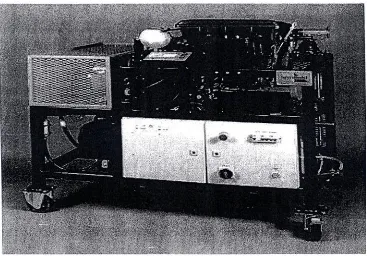
The apparatus used in this experiment includes two major systems (engine system and the power measurement system). A laboratory scale engine, arm field CM 11 Gasoline Engine which is design to allow the study of the basic operating characteristics of a modern four stroke spark ignition engine was used. The unit consists of engine coupled to eddy current dynamometer which act as a brake. This assembly is mounted on a painted steel framework. The fuel tanks, batteries, and the electric are all mounted under the engine. The engine has the following specification: the product is of Volkswagen
with the identification number of AER/ATE 111/66. It has the capacity of 999cm3 with four cylinders, the bore size is 67.10mm and a stroke length of 70.60mm. It has a compression ratio of 10.5:1. The Nominal output is 37kW at 5000rpm and maximum torque of 86Nm at 3400rpm. The fuel type used is -95 RON. The control system is Bosch Motronic TM MP9.0. The oil capacity is 3.5 litres and coolant capacity of 4.2 litres. The engine has the overall dimension of 1250mm height, length 0f 2200mm and the width of 850mm.
Figure 1. Coupling the Assembly
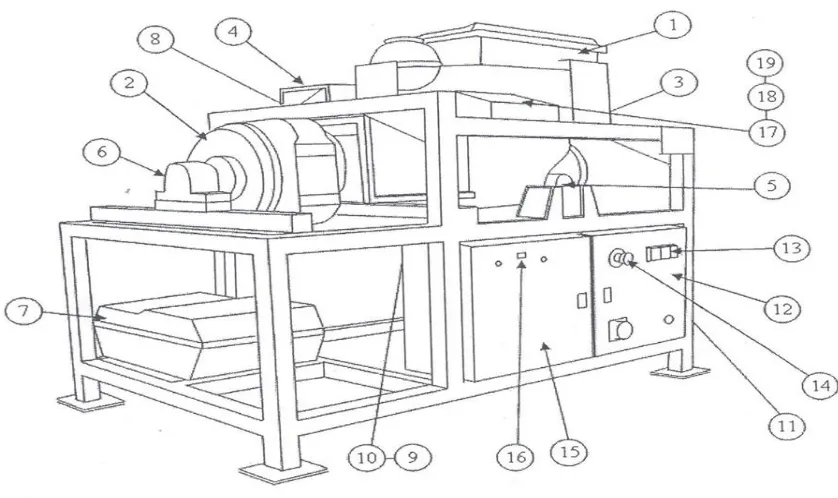
Figure 3. The schematic diagram of the experimental set up. 1. The engine, 2. Eddy current dynamometer brake, 3. Front Sturdy painted steel framework, 4. Rear Sturdy painted steel framework, 5. A stabiliser bar, 6. Bearing unit, 7. Fuel system including tank, 8. Heat exchanger, 9 and 10. Exhaust silencers, 11. The battery, 12. First enclosure, 13. Circuit breakers, 14. An emergency stop button, 15. Second
enclosure, 16. PCB and USB interface, 17. Programmable Logic Controller (PLC), 18 and 19. Potentiometers.
The engine used a programmable ECU which allows the user to configure the fuel injection and ignition properties. The CM 11 is supplied with electronic sensors to monitor key parameters and the USB interface card which allows direct connection to a PC. The control functions can be performed from both local control panel and remotely from the computer. Data logging and the control software is supplied which allowed operator to control the engine, view and record real time sensor outputs.
Results and Discussions
Figure 4. Power Comparison between Gasoline-91 and Gasoline-95 @ WOT
It was observed from the Fig. 4 that the power output is higher for Gasoline-91 when compared to that of Gasoline-95 at wide open throttle (WOT). Maximum power for Gasoline-91 was found to be 33.38 kW at 4000 rpm and for Gasoline-95 was found to be 22.85kW at 4000 rpm. All petrol grades contain the same quantity of heat energy, but their combustion level differs. To raise the octane number of gasoline, oxygenates such as alcohol, MTBE, MMT, etc is added to the gasoline. The addition of these oxygenates however decreases the heating value of gasoline there by reducing the engine performance in the form of power output, torque, etc.
Hence, lower power output is obtained for gasoline -95 (higher octane number) when compared to that of gasoline -91(lesser octane number).
Figure 5. Torque Comparison between Gasoline-91 and Gasoline-95 at WOT
0 5 10 15 20 25 30 35 40
1500 2000 2500 3000 3500 4000 4500
P
o
w
er
(k
W
)
Engine Speed (rpm) Gasoline 91 @ WOT
30 40 50 60 70 80 90 100
1500 2000 2500 3000 3500 4000 4500
T
o
rq
u
e
(N
/m
)
It can be observed from the Fig.5 that the brake torque at wide open throttle is higher for Gasoline-91 compared to that of Gasoline-95. Maximum torque for Gasoline-91 was found to be 81.6 Nm at 3000 rpm and for Gasoline-95 is 57.5kW at 3500 rpm. Engine torque tends to drop after reaching its peak point with the increasing of engine speeds for both gasoline -91 and gasoline -95.
Figure 6. Power Comparison between Gasoline-91 and Gasoline-95 @ 50% Throttle
It is observed from the Fig.6 that the power output is higher for Gasoline-91 compared to that of Gasoline-95 at 50% throttle. Maximum power for Gasoline-91 is found to be 17.11 kW at 4000 rpm and for Gasoline-95 is 11.72kW at 4000 rpm. The reason is similar to the explanations gives to the case in figure 4.
Figure 7. Power Comparison between Gasoline-91 and Gasoline-95 at 50% Throttle
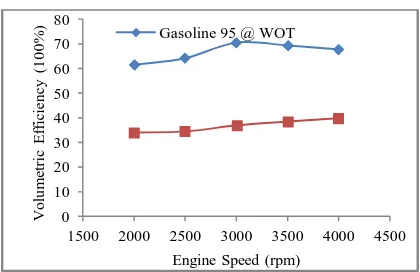
Figure 8. Volumetric Efficiency
It can be noticed from Fig.7 that the brake torque, at 50% open throttle is higher for Gasoline-91 compared to that of Gasoline-95. Maximum torque for Gasoline-91 was found to be 43.8 Nm at 3000 rpm and for Gasoline-95 is 29.8kW at 3500 rpm.
Depicted in Fig. 8 is the volumetric efficiency. It was found to be higher at WOT with the maximum value of 70.47 % while at 50 % throttle, its maximum value is
39.77%. For both gasoline-91 and gasoline-95,
volumetric efficiency increased with engine speed and it does not depends on the type of gasoline used as the volumetric efficiency obtained for both gasoline -91 and gasoline -95 is the same. Nevertheless, it's slightly increases with increases in engine speed for both gasoline -91 and gasoline -95.
Figure 9. Fuel Flow rate for Gasoline-91 and Gasoline-95 at WOT
Figure 10. Fuel Flow rate for Gasoline-91 and Gasoline-95 at 50% Throttle
It is observed from the Fig.9 and Fig.10 that the Volumetric Fuel Consumption is invariant with the change of fuels. Fig. 10 shows slight difference between the two fuels. This may be a result of experimental errors. However, it can be seen that volumetric flow rate increases with increases in engine speed for both gasoline -91 and gasoline -95.
Findings
It was found that the gasoline-91 has better performance in comparison to gasoline 95, in terms of power and torque. No appreciable knocking effect was observed for the experimental SI engine for both the fuels.
0 10 20 30 40 50 60 70 80
1500 2000 2500 3000 3500 4000 4500
V
o
lu
m
et
ri
c
Ef
fi
ci
e
n
c
y
(1
0
0
%
)
Engine Speed (rpm) Gasoline 95 @ WOT
90 120 150 180 210
1500 2000 2500 3000 3500 4000 4500
F
u
el
F
lo
w
(m
l/
m
in
)
Engine Speed (rpm) Gasoline 91 @ WOT Gasoline 95 @ WOT
20 40 60 80 100 120 140
1500 2000 2500 3000 3500 4000 4500
F
u
el
F
lo
w
(m
l/
m
in
)
Engine Speed (rpm)
Conclusion
The performance of the S.I. engine was found to be lower for Gasoline-95 when compared to Gasoline-91. This shows that the effect of knock is not significant for the engine in consideration. Also, specific fuel consumption is found to be higher in case of Gasoline-95. Since addition of oxygenates such as methyl tertiary butyl ether (MTBE) increases the octane number but reduces the heat content of the SI engines fuel, it is not clear whether the increase in octane number is due to original fuel quality or to the addition of MTBE. The experimental data questions the quality of gasoline-95 and suggests the presence of a decent amount oxygenate content in the fuel and therefore it needs investigation.
REFERENCES
[1] W. D. Hsieha, R. H. Chenb, T. L. Wub, T. H. Lin,
“Engine performance and pollutant emission of an SI engine using ethanol-gasoline blended fuels”, Atmospheric Environment 36 (2002) 403-410.
[2] T. Korakianitis, A. M. Namasivayam, R. J. Crookes,
“Natural-gas fueled spark-ignition (SI) and compression-ignition (CI) engine performance and emissions”, Progress in Energy and Combustion Science 37 (2011) 89-112.
[3] E. Hu, Z. Huang, B. Liu, J. Zheng, X. Gu, B. Huang,
“Experimental investigation on performance and emissions of a spark-ignition engine fuelled with natural gas–hydrogen blends combined with EGR”, International journal of hydrogen energy 34 (2009) 528 – 539.
[4] M. Koç, Y. Sekmen, T. Topgul, H. S. Yucesu, “The
effects of ethanol–unleaded gasoline blends on engine performance and exhaust emissions in a spark-ignition engine” Renewable Energy 34 (2009) 2101–2106.
[5] D. Bradley, M. Lawes, C. G. W. Sheppard,
“Combustion and the thermodynamic performance of spark ignition engines”, Proc Instn Mech Engrs Vol 214 Part C.
[6] S. Curtis, M. Owen, T. Hess, S. Egan, “Effect of
Ethanol Blends on a Spark Ignition, 4-Stroke, Internal Combustion Engine”.
[7] A. Bilgin, I. Sezer, “Effects of Methanol Addition to
Gasoline on the Performance and Fuel Cost of a Spark Ignition Engine”, Energy and Fuels 22 (2008) 2782–2788
[8] I. Sezer, A. Bilgin, “Effects of Methyl tert-Butyl
Ether Addition to Base Gasoline on the Performance and CO Emissions of a Spark Ignition Engine”, Energy and Fuels 22 (2008) 1341–1348.
[9] X. Gu, Z. Huang, J. Cai, J. Gong, X. Wua, C. Lee,
“Emission characteristics of a spark-ignition engine
fuelled with gasoline-n-butanol blends in
combination with EGR”, Fuel 93 (2012) 611–617. [10] M. B. Celik, “Experimental determination of suitable
ethanol–gasoline blend rate at high compression ratio for gasoline engine”, Applied Thermal Engineering 28 (2008) 396– 404.