The Thirty-Third AAAI Conference on Artificial Intelligence (AAAI-19)
Transfer Learning for Sequence Labeling Using Source Model and Target Data
Lingzhen Chen
University of TrentoPovo, Italy [email protected]
Alessandro Moschitti
* AmazonManhattan Beach, CA, USA [email protected]
Abstract
In this paper, we propose an approach for transferring the knowledge of a neural model for sequence labeling, learned from the source domain, to a new model trained on a tar-get domain, where new label categories appear. Our transfer learning (TL) techniques enable to adapt the source model using the target data and new categories, without accessing to the source data. Our solution consists in adding new neu-rons in the output layer of the target model and transferring parameters from the source model, which are then fine-tuned with the target data. Additionally, we propose a neural adapter to learn the difference between the source and the target la-bel distribution, which provides additional important infor-mation to the target model. Our experiments on Named En-tity Recognition show that (i) the learned knowledge in the source model can be effectively transferred when the target data contains new categories and (ii) our neural adapter fur-ther improves such transfer.
Introduction
One important challenge of sequence labeling tasks con-cerns dealing with the change of the application domain during time. For example, in standard concept segmentation and labeling (Wang, Deng, and Acero 2005), semantic cat-egories, e.g.,departure or arrivalcities, vary according to new scenarios, e.g.,low-cost flightorbudget terminalwere not available when the Automatic Terminal Information Ser-vice (ATIS) corpus was compiled (Hemphill, Godfrey, and Doddington 1990). Similar rationale applies to another very important sequence labeling task, Named Entity Recogni-tion (NER), where entities in a domain are continuously evolving, e.g., see thesmart phonedomain.
Standard models for sequence labeling are supposed to be trained and applied to the data with the same set of categories, which may limit the reuse of previous models. As an example for NER, users interested in finance would probably target entities such as Companies or Banks while other users interested in politics want to recognize Senators, Bills, Ministries, etc. Besides these domain-specific NEs, there may be common categories, such as Location or Date.
*The main part of this work was carried out when the author
was at the Unviversity of Trento.
Copyright © 2019, Association for the Advancement of Artificial Intelligence (www.aaai.org). All rights reserved.
Hence, if there are models pretrained on data with these common NEs, it would be useful to have some methods that modify them to serve customized NER purposes. Even in the same application domains, NE categories can vary over time due to, for example, the introduction of new products.
In these cases, a typical sequence labeling approach would be to (i) build a new dataset including the annotation of the new categories; and (ii) retrain a model from scratch. However, in addition to the disadvantage of retraining mod-els and re-annotating all the documents, some industrial sce-narios prevent the release of training data (e.g., for copyright or privacy concerns) to rebuild the models.
Motivated by the problems described above, in this work, we define a new paradigm for a progressive learning of se-quence labeling tasks. To simplify our study, without loss of generality, we define a setting consisting of two aspects: (i) a source model,MS, already trained to recognize a certain
number of categories on the source data,DS; and (ii) a TL task consisting in training a new model,MT, on the target
data,DT, where new categories appear, in addition to those of the DS (note thatDS is no longer available to perform TL).DT is typically much smaller in size compared toDS. These kinds of problems regard leveraging knowledge about a model learned on a source domain, to improve learning a model for another task on a target domain (Pan and Yang 2010). One variation of TL is a setting where the target do-main does not change while the output space of the target task changes. This corresponds to our described progressive sequence labeling setting.
To tackle the problem, we propose two neural methods of TL for progressive labelling. Firstly, given an initial neural model MS trained on source dataDS, we modify its out-put layer to include new neurons for learning the new cat-egories and then we continue to train onDT. More specifi-cally, we implement a Bidirectional LSTM (BLSTM) with Conditional Random Fields (CRF) as MS. In the transfer
learning step, we modify such architecture to build MT, reuse previous weights and fine-tuning them onDT, where
again the assumption is thatDTcontains both seen and un-seen categories.
activations in MS as an additional input toMT. Besides better utilizing the learned knowledge, the aim of the neural adapter is to mitigate the effect of label disagreement, e.g., in some cases, the surface form of a new category type has already appeared in theDS, but they are not annotated as
a label. Because it is not yet considered as a concept to be recognized. Note that the parameters ofMSis not updated
during trainingMT.
Our models and procedures apply to any sequence label-ing task, however, to effectively demonstrate the impact of our approach, also considering the space available in this pa-per, we focus on NER. We analyze the performance of both our methods by testing the transfer of different categories. Our main contribution is therefore twofold: firstly, we show that our pre-training and fine-tuning method can utilize well the learned knowledge for the target labeling task while be-ing able to learn new knowledge.
Secondly, we show that our proposed neural adapter has the ability to mitigate the forgetting of previously learned knowledge, to combat the annotation disagreement, and to further improve the transferred model performance.
Finally, to claim that our approach works for general se-quence labeling would require testing it on different tasks and domains. However, we observe that our approach only exploits the concept of category sequence, where the words compounding such sequences (boundaries) are annotated with a standard BIO (Begin, In, Other) tagging. Thus, there is no apparent reason to prevent the use of our approach with different tasks and domains. We made our source code and the exact partition of our dataset available for further research.1
Related Work
Named Entity Recognition In the earlier years of NER, most work approached the task by engineering linguistic features (Chieu and Ng 2003; Carreras, M`arquez, and Padr´o 2003). Machine learning algorithms such as Maximum En-tropy, Perceptron and CRFs were typically applied (Florian et al. 2003; Chieu and Ng 2003; Diesner and Carley 2008; He and Kayaalp 2008).
Recent work mainly includes neural models, where the current state of the art is given by Recurrent Neural Network models, which incorporate word and character level embed-dings and/or additional morphological features. Huang, Xu, and Yu, (2015) uses BLSTM combined with CRF to estab-lished the state-of-the-art performance on NER (90.10 in terms of test F1 on CONLL 2003 NER dataset). Later, Lam-ple et al., (2016) imLam-plemented the same CRF over BLSTM model without using any handcraft features. They reported 90.94 of test F1 on the same dataset. Chiu and Nichols, (2016) also implemented a similar BLSTM model with Con-volutional filters as character feature extractor, achieving 91.62 in the F1 score (BLSTM+CNN+lexical features).
In this work, we opt to use the BLSTM and BLSTM + CRF for NER with Transfer Learning, in order to test whether our proposed methods can be applied on the state-of-the-art models.
1
https://github.com/liah-chan/transferNER
Transfer Learning Neural networks based TL has proven to be very effective for image recognition (Donahue et al. 2014; Razavian et al. 2014). As for NLP, Mou et al., (2016) showed that TL can also be successfully applied on semanti-cally equivalent NLP tasks. Researches were carried out on NER related TL too. Qu et al., (2016) explored TL for NER with different NE categories (different output spaces). They pre-train a linear-chain CRF on large amount annotated data in the source domain. A two linear layer neural network to learn the discrepancy between the source and target la-bel distributions. Finally, they initialize another CRF with learned weight parameters in linear layers for the target do-main. Kim et al., (2015) experimented with transferring fea-tures and model parameters between similar domains, where the label types are different but may have semantic similar-ity. Their main approach is to construct label embeddings to automatically map the source and target label types to help improve the transfer.
In our work, we aim to transfer knowledge in an incre-mental, progressive way within the same domain, rather than to other domains. We assume that the target output space in-cludes the source output space. In terms of mitigating the discrepancies between the source and target label distribu-tion, we propose a neural adapter to learn them.
In Rusu et al.,(2016) also used an adapter to help transfer. They proposed progressive networks that solve sequence of reinforcement learning tasks while being immune to param-eter forgetting. The networks leverage knowledge learned with an adapter, which is an additional connection between new model and learned models. This connection is realized by a feed-forward neural layer with non-linear activation. Due to the characteristics of sequence labeling tasks, we pro-posed to use BLSTM in a sequence-to-sequence way that learns to map the output sequence in the source space to the output sequence in the target space.
State-of-the-art in Neural Sequence Labeling
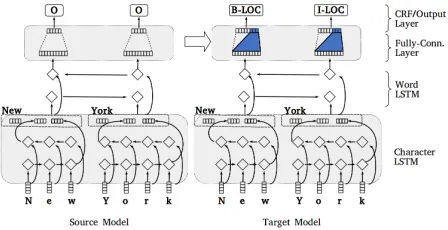
A standard sequence labeing problem can be defined as fol-low: given an input sequenceX =x1, x2, ..., xn(xi ∈ X), predict the output sequenceY =y1, y2, ..., yn (yi ∈ Y).X andYrepresent the input and output space respectively. Typ-ically, the model learns to maximize the conditional proba-bilityP(Y|X).In this section, we introduce two state-of-the-art neu-ral models for learning P(Y|X), i.e., BLSTM and BLSTM+CRF, which are also the base models we use to progressively learn Named Entities. Note that such ap-proaches are the state of the art in case of NER, thus we study the effectiveness of our proposed transfer learning method in a state-of-the-art setting. The general architecture is described on the left side of Figure 1. This is composed of: a BLSTM at character level, followed by a BLSTM at word level, a fully connected layer and a CRF/output layer. The individual components are described in the next sections.
Word & Character Embeddings
the input wordx(represented by an integer index) to a vec-torw. A character-level representation is typically used be-cause the NER task is sensitive to the morphological traits of a word such as capitalization. They were shown to provide useful information for NER (Lample et al. 2016). We use a randomly initialized character embedding lookup table and then pass the embeddings to a BLSTM to obtain character level embeddingeforx(the details are described in the fol-lowing section). The final representation of thetth wordxt in the input sequence is the concatenation of its word-level embeddingwtand character-level embeddinget.
Bidirectional LSTM
BLSTM is composed of a forward LSTM (−LSTM) and a−−−→ backward LSTM (←LSTM), which read the input sequence−−−− (represented as word vectors described in the previous sub-section) in both left-to-right and reverse order. The output of the BLSTMht is obtained by the concatenation of for-ward and backfor-ward output: ht = [
− → ht;
←− ht], where
− → ht =
−−−−→
LSTM(xt,
− →
ht−1)and ←− ht=
←−−−−
LSTM(xt,
←−
ht+1).htcaptures the left and right context forxtand is then passed to a fully-connected layer,pt. The final predictionytis obtained ap-plying a softmax over the output layer, i.e.,
P(yt=c|pt) =
eWO,c·pt P
c0∈CeWO,c0·pt
,
whereWOare parameters to be learned on the output layer andCrepresents the set of all the possible output labels.
In the case of the character-level BSLTM, the forward and backward LSTMs take the sequence of character vectors
[z1,z2, ...,zk]as input, wherekis the number of characters in a word. The final character level embeddingetfor word xtis obtained by concatenating−→etand←e−t.
CRF Tagging
We implement a Linear Chain CRF (Lafferty, McCallum, and Pereira 2001) model over BLSTM to improve the diction ability of the model, by taking the neighboring pre-diction into account while making the current prepre-diction. Here, P(Y|X)is computed by P(Y|X) = P es(X,Y)
Y0 ∈Yes(X,Y0),
whereY is all possible label sequences ands(·,·)is calcu-lated by adding up the transition and emission scores for a label sequence. To be more specific, the emission score is the probability of predicting the labelytfortth word in the sequence. The transition score is the probability of transiting from previously predicted labelyt−1to current labelyt. The outputs of fully-connected layerpt at time stept provides the emission scores for all possible value ofy. A square ma-trixPof sizeC+ 2is used to store transitional probabilities amongC output labels, as well as astartlabel and anend label. Hence,
s(X, Y) =X
t
pt[yt] +Pyt,yt−1
Our Progressive Adaptation Models
In this section, we formalize our progressive learning prob-lem and describe our proposed TL method in detail.Figure 1: Source and target model architecture
Problem Formalization
In the initial phase, a sequence labeling model, MS, is
trained on a source dataset,DS, which hasEclasses. Then, in the next phase, a new model,MT, needs to be learned on
target dataset,DT, which contains new input examples and E+M classes, whereM is the number of new classes.DS
cannot be used for trainingMT.
Our Transfer Learning Approach
Given pre-trainedMSmodel, our first proposed method to progressively recognize new categories consists in transfer-ring parameters toMTand then fine-tuning it.
Algorithm 1Source Model Training
Require: {(X(n)
, Y(n))}NS
n=1: source training data.
{(X(n)
, Y(n))}NV
n=NS+1: validation data.
L: loss function.
tp= 0: temporary variable (best valid. F1).
F: evaluation function.
Ensure: {y(n)}NS
n=1: predictions for training data
{y(n)}NV
n=NS+1: predictions for validation data
ˆ
θS: Optimal parameters for source model 1: Randomly initializeθS
2: fore= 1→n epochsdo
3: forn= 1→NSdo .training step
4: y(n)=M(X(n)
)
5: θS:=θS−α∆θSL[y(n), θS;X(n), Y(n)]
6: forn=NS+ 1→NVdo.predictions over the valid. set
7: y(n)=M(X(n)
)
8: if F({y(n)}NV
n=NS+1)> tpthen .F1 over the valid. set
9: θˆS:=θS;tp=F({y(n)}NV n=NS+1)
10: SaveθˆS
Training of a source model We supposed that a sequence labeling model is trained on source data until the optimal pa-rametersθˆSare obtained. These will be saved and reused for
transfer learning. The details of such training are illustrated by Algorithm 1. This takes (i)NStraining examples in the
by forward propagation through the modelM. The param-eters are updated by a learning rateα. The final model cor-responds to the highest evaluation metricF({y(n)}NV
n=NS+1) computed on the validation set inn epochs.
Parameter Transfer To enable the recognition of a new category, we modify the fully-connected layer after BLSTM and the output layer of the network. The right side of Fig-ure 1 shows the difference between the source model (on the left side) and our transferred model in blue color. In more de-tail, the fully-connected layer after the word BLSTM maps the outputhto a vectorpof sizenE.nis a factor depend-ing on the taggdepend-ing format of the dataset (e.g.,n = 2if the dataset is in BIO format, since for each NE category, there would be two output labelsB-NEandI-NE). Therefore, we extend the output layer by sizenM, whereM is the number of new categories.
Algorithm 2Parameter Transfer
Require: θˆS: optimal parameters for the source model
Ensure: θT: initial parameters of the target model
1: forθOinWOdo .parameters in the output layer
2: θO:= ReInit() .draw from normal distribution
3: forθO¯inWO¯do .parameters in other layers
4: θO¯:= ˆθOS¯ .copy from trained parameter
5: θT= (θ
O, θO¯)
6: returnθT
The extended part above, i.e., parameters in the output layer, θO, is initialized with weights drawn from the nor-mal distribution, X ∼ N(µ, σ2), where µ andσ are the
mean and standard deviation of the pre-trained weights in the same layer. This is denoted by ReInit() in Algorithm 2 of the Parameter Transfer step.
In contrast, all the other parameters,θO¯, i.e, those not in
the output layer, are initialized with the corresponding pa-rameters from the source model, i.e.,θˆS
¯
O. This way, the asso-ciated weight matrix of the fully-connected layerWsO also updates from the original shapenC×pto a new matrixW0Os of shape(nC+nM)×p. Note that the parametersθˆS
Oand all the other parameters,θˆS
¯
O, are essentially the weights in the matrixWsOand the weights in the other layers.
Algorithm 3Target Model Training
Require: {(X(n), Y(n))}NT
n=1: target training data. L: loss function.
F: evaluation function θT: transferred parameters
Ensure: {y(n)}NT
n=1: predictions
1: fore= 1→n epochsdo
2: forn= 1→NT do
3: y(n)=M(X(n))
4: θT:=θT−α∆
θTL[y(n), θT;X(n), Y(n)]
Figure 2: Our Proposed Neural Adapter
Training the target model In Algorithm 3, the new pa-rameters are updated as a standard training cycle (we use a validation set and early stopping as in the source model training, for brevity we did not put this step in the Algo-rithm 3). To update the BLSTM+CRF model, we also mod-ify the transitional matrix to include the transition probabil-ity among new labels and other previously seen labels.
Transfer Learning using neural adapters
It should be noted that many word sequences corresponding to new NE categories can already appear in the source data, but they are annotated asnullsince their label is not part of the source data annotation yet. This is a critical aspect to solve as otherwise the target model with transferred param-eters would treat the word sequence corresponding to a new NE category as a null category.
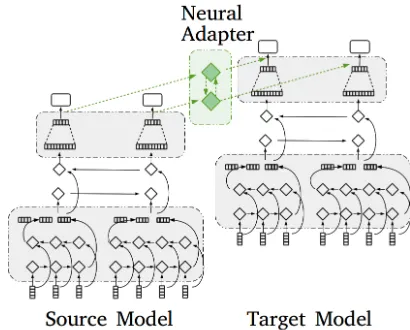
We design a neural adapter, shown in Fig. 2, to solve the problem of disagreement in annotations between the source and target data. This is essentially a component that helps to map the predictions from the output space of the source do-main into that of the target dodo-main. The figure shows that the target modelMTgets the hidden activation of the last layer inMSas an additional input. Basically, the neural adapter connects each output of the fully-connected layer inMSto the corresponding output ofMT.
More precisely, we use−→A and←A to denote the forward− and backward adapter (i.e., a BLSTM). It takes the output of the fully-connected layerpS
tas input at each time stept. The output of−→A and←A are computed as− −→at =
− →
A(pS
t,
− →a
t−1)
and ←a−t =
←−
A(pSt,←−at+1), respectively. The output of the
target model consists in a softmax over the output of the fully-connected layerpT0
t obtained bypT
0
t =at⊕pTt, where
at= [−→at⊕ ←a−t]and⊕is the element-wise summation. The parameters of the adapter are jointly learned in the subse-quent step with the rest of the target model parameters. The parameters of the source model is, however, not updated.
CONLL 03 LOC PER ORG MISC
Train DS 0 8948 8100 3686
DT 1637 2180 1925 907
Valid (DS/DT) 0/2094 3146 2092 1268
Test (DS/DT) 0/1925 2773 2496 918
I-CAB GPE LOC PER ORG
Train DS 0 247 2540 2471
DT 310 78 676 621
Valid (DS/DT) 0/626 174 1282 1302 Test (DS/DT) 0/1234 216 2503 1919
Table 1: Number of entities in CONLL dataset (in English) and I-CAB dataset (in Italian).
Experiments
Although our approach is generally valid for any sequence labeling task, in these experiments, we focus on NER. We test our basic transfer approach, then we show the impact of our proposed neural adapter, testing several transfer learning options on just one category, i.e., LOC. Finally, we provide more general results of the best model, applying it to differ-ent settings/data obtained by selecting one category as the new target category (among to the available ones).
Datasets
We primarily used CONLL 2003 NER2dataset for our ex-periments. We modified it to simulate our progressive learn-ing task. The original dataset includes news articles with four types of named entities – organization, person, loca-tion and miscellaneous (represented byORG,PER,LOC, and MISC, respectively). For the purpose of our experiment, we divide the CONLL train set in 80%/20% asDSandDT, for
the initial and subsequent steps of the experiments. Please note that in the subsequent step,DSis no longer available.
We makeLOC the new label to be detected in the subse-quent step. Hence we replace all theLOClabel annotations withnull, when they appear inDS(the validation and test
subsets). Instead, we keepLOCas it is inDT. We repeat this process for all four categories to obtain four datasets for our TL setting.
To demonstrate that our method can be applied indepen-dently of the language, we also carry out experiments on I-CAB (Italian Content Annotation Bank).3 It does not come with a test set, hence we held out 30% of training set as the officialtest set and then carry out the same pre-processing as that for CONLL dataset. Hence, we obtain another four datasets for our setting. A summary of label statistics of these two datasets is shown in Table 1.
Model selection and hyperparameters
Apart from dividing the dataset into two sets as described in the previous section, we do not perform any specific pre-processing except for replacing all digits with 0 to reduce the
2
https://www.clips.uantwerpen.be/conll2003/ner/
3
http://ontotext.fbk.eu/icab.html, used for EVALITA 2007 NER shared task
size of the vocabulary. We use 100 dimension GLOVE pre-trained embedding for English4and Italian5to initialize the
weights of the embedding layer. Since we do not lowercase the tokens in the input sequence, we map the words hav-ing no direct mapphav-ing to the pretrained word embeddhav-ings to their lowercased counterpart, if one is found in the pretrained word embeddings.
We map the infrequent words (words that appear in the dataset for less than two) to <UNK> as well as the un-known words appearing in the test set. The word embed-ding for<UNK>is drawn from a uniform distribution be-tween[−0.25,0.25]. The character embedding lookup table is randomly initialized with embedding size of 25. The hid-den size of the character-level BLSTM is 25 while the word level one is 128.
We apply a dropout regularization on the word embed-dings with a rate of 0.5. All models are implemented in TensorFlow (Abadi et al. 2015), as an extension of Neu-roNER (Dernoncourt, Lee, and Szolovits 2017). We use Adam (Kingma and Ba 2014) optimizer with a learning rate of 0.001, gradient clipping of 50.0 to minimize the categor-ical cross entropy, and a maximum epoch number of 100 at each step. The models are evaluated with the F1 score as in the official CONLL 2003 shared task (Sang and Meulder 2003).
Results on CoNLL and I-CAB datasets
As a first step, we verified that our implementations are at the state of the art by testing them on traditional NER settings (i.e., the original CoNLL setting). Our BLSTM+CRF model achieved 91.26 and 80.59 (on I-CAB) in F1 without hand-craft features. These results are comparable to the state-of-the-art performance on both dataset (Chiu and Nichols 2016; Magnini et al. 2008).
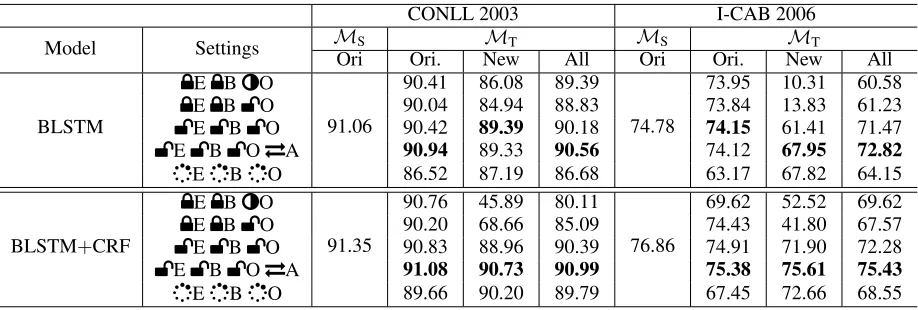
Secondly, we explored several settings of updating the model weights in the subsequent step. The performance are shown in Table 2: E, B, O represent the weight parameters in the Embedding, the Bidirectional LSTM, and the Output layers, respectively. The parameters associated with CRF are included in the notation of “O”. Our settings include: (1) the weights of layers before the output layer are fixed, and the weights of the output layer are updated (µEµBbO); (2) the weights of layers before the output layer are fixed, the trans-ferred part of the output layer is fixed too, while the rest is updated (µEµBèO); (3) none of the weights in the model is fixed (bEbBbO); (4) as a baseline, all the weights are not transferred but randomly initialized (EBO). Note that in the setting (1), (2) and (3), the model weights are ini-tialized with those from the source model.
Performance of Transferring weights Compared to ran-domly initializing the model weights (settingEBO), in the transfer learning step, we find out that regardless of whether the weights are fixed or not, transferring weights from the initial model always boosts the performance. On CONLL dataset, transferring model weights improves the
4
http://nlp.stanford.edu/data/glove.6B.zip
5
CONLL 2003 I-CAB 2006
Model Settings MS MT MS MT
Ori Ori. New All Ori Ori. New All
BLSTM
µEµBèO
91.06
90.41 86.08 89.39
74.78
73.95 10.31 60.58
µEµBbO 90.04 84.94 88.83 73.84 13.83 61.23
bEbBbO 90.42 89.39 90.18 74.15 61.41 71.47
bEbBbOTA 90.94 89.33 90.56 74.12 67.95 72.82
EBO 86.52 87.19 86.68 63.17 67.82 64.15
BLSTM+CRF
µEµBèO
91.35
90.76 45.89 80.11
76.86
69.62 52.52 69.62
µEµBbO 90.20 68.66 85.09 74.43 41.80 67.57
bEbBbO 90.83 88.96 90.39 74.91 71.90 72.28
bEbBbOTA 91.08 90.73 90.99 75.38 75.61 75.43
EBO 89.66 90.20 89.79 67.45 72.66 68.55
Table 2: Performance of the source model (MS) and the target model (MT), according to different settings. The reported performance is the F1 score on the test set. Ori. indicates the original 3 NE categories in the source data, while New indicates the new NE categories in the target data. All is the overall test F1 in the subsequent step (for all 4 NE categories).
performance ranging from 0.60 to 3.50 points, while on I-CAB dataset, it gives 7.32 points of increment in F1. In or-der to verify that the model with transferred parameters is indeed better on the target task (not just because it has faster convergence rate), we further carried out additional training using a larger number of epochs for the baseline models with randomly initialized parameters. Even in this condition, the baseline models still did not produce a better performance than what is reported in the table. This suggests that the bet-ter results come from the transferred paramebet-ters.
Update of Model Parameters Though transferring learned weights is helpful in reaching a better performance, keeping the learned weights fixed produces worse results, especially for the new NE category. On both datasets, the
µEµBbO andµEµBèO settings perform poorly in recog-nizing the new NEs. The results are also worse than setting
bEbBbO for both BLSTM and BLSTM+CRF model. In the standard pre-training and fine-tuning TL paradigm, usually only the output layer is fine-tuned on the target data. We argue this is not the best setting for our experiment be-cause of two reasons: firstly, in our target data, there are still NEs that appeared in the source data, hence there is infor-mation to be used to further train parameters in the model with regard to these NE entities. Secondly, the knowledge learned about thenulllabel is adverse to the recognition of new NE labels. The progressive NER is a TL scenario with-out crossing domain. The source and target domains share a high similarity. The source and target tasks differ only in the output space. Hence updating all the model parameters pro-vides more benefits rather than causing catastrophic forget-ting. It also helps the model to recover from the labeling dis-agreement of new NE in the source and target data. In fact,
bEbBbO, which can fine-tune all the weights, achieved the best performance, for both models on both datasets, com-pared to other parameter update settings.
Improvement by Using the Adapter We further analyze the results with regard to using the adapter. The overall F1 score of both BLSTM and BLSTM+CRF models (with
set-tingbEbBbO) suffers from a certain amount of degrada-tion on the target domain. This happens for both the original three NE categories and the new NE category.
The comparison between the results of the transferred models with adapter (bEbBbOTA) and those without adapter (bEbBbO) shows a consistent improvement on F1 score over the original NE categories. In some cases, for example, while using the adapter on the I-CAB dataset, the transfer model performance of the original NE categories even surpasses the F1 of the source model. It suggests that the adapter manages to mitigate the knowledge forgetting, and enabling the model to fine-tune on these original NEs.
As for the new NE category, in almost all cases, transfer-ring with adapter helps to better recognize them. We show in detail the improvement obtained by using the adapter in Fig-ure 4. It is worth noting that on I-CAB, the adapter produces an improvement of F1 on the new NE for both BLSTM and BLSTM+CRF models (6.54 and 3.71 points respectively). The improvement is also observed in the results of CONLL dataset. This indicates that the adapter is able to help in resolving the annotation disagreement between the source and the target data. The improvement is less obvious on the CONLL dataset because the NEs are fairly easy to learn for both BLSTM and BLSTM+CRF model. Indeed, with a small amount of training data (e.g., the baseline setting), the F1 is already rather good. Instead, on I-CAB, there is more headroom, thus the adapter can have a larger impact.
(a) 10 % (b) 25 % (c) 50 % (d) 100%
Figure 3: Model F1s evaluated on the test set varying the size of the available training target domain data
(a) New category (LOC), CONLL’03
(b) Overall, CONLL’03
(c) New category (GPE), I-CAB
(d) Overall, I-CAB
Figure 4: Overall and single category Test F1 of baseline model (EBO), fine-tuned model (bEbBbO), and model with adapter (bEbBbOTA) on CONLL and I-CAB
models both show difficulties in learning the new NE cat-egory. The plots also show that the adapter makes learning smoother.
We finally observe that the transferred models with neu-ral adapter converge faster during the subsequent training (around 20 epochs) in comparison to other models. This fur-ther suggests that the transferred models are able to learn to predict new categories rapidly in a shorter time.
Results of all NE categories
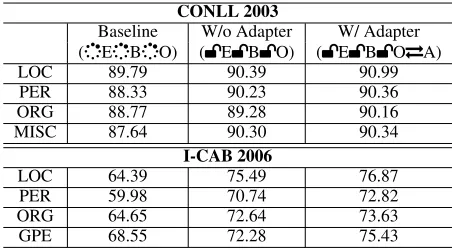
It is important to ensure that the improvement in the per-formance is not specific to a target NE category. Thus, we performed additional experiments on CONLL and I-CAB dataset, using other NEs as the target in the subsequent step. In Table 3, we present the overall F1 scores obtained by BLSTM+CRF model while recognizing different new NE categories. The first column in the table identifies different target NE categories. The other three columns present the re-sults of the models without any TL method (Baseline), with the transferred parameters (W/o Adapter), and with the neu-ral adapter (W/ Adapter), respectively. The results indicate a consistent improvement in the F1 score using transferred parameters and especially using the neural adapter. On
aver-CONLL 2003
Baseline W/o Adapter W/ Adapter (EBO) (bEbBbO) (bEbBbOTA)
LOC 89.79 90.39 90.99
PER 88.33 90.23 90.36
ORG 88.77 89.28 90.16
MISC 87.64 90.30 90.34
I-CAB 2006
LOC 64.39 75.49 76.87
PER 59.98 70.74 72.82
ORG 64.65 72.64 73.63
GPE 68.55 72.28 75.43
Table 3: Overall F1 score in recognizing different target NE categories of the test set of the subsequent step
age, our best TL model with neural adapter gains 1.83 points of improvement in F1 score on CONLL dataset, and 10.30 points on I-CAB, compared to that obtained by the baseline model. It is evident that our proposed methods are able to improve the performance of recognizing NEs in the target data, regardless of dataset or target NE types.
Conclusion
In this paper, we have studies TL for sequence labeling tasks. In particular, we experiment with a progressive NER set-ting, simulating real-world applications of NER. We verified that our methods can be applied to current state-of-the-art neural models for NER. We proposed a neural adapter for connecting the target and the source models to mitigate the forgetting of learned knowledge. We carried out extensive experiments to analyze (i) the effect on the performance of the transfer approach, (ii) how the parameters in the trans-ferred model should be initialized and (iii) how the param-eters should be updated. The empirical results show the ef-fectiveness of the proposed methods and techniques. We will make data and models available to support this new line of research. In future work, we would like to test our approach to several different sequence labeling tasks to fully demon-strate the generality of our approach.
Acknowledgements
References
Abadi, M.; Agarwal, A.; Barham, P.; Brevdo, E.; Chen, Z.; Citro, C.; Corrado, G. S.; Davis, A.; Dean, J.; Devin, M.; Ghemawat, S.; Goodfellow, I.; Harp, A.; Irving, G.; Isard, M.; Jia, Y.; Jozefowicz, R.; Kaiser, L.; Kudlur, M.; Leven-berg, J.; Man´e, D.; Monga, R.; Moore, S.; Murray, D.; Olah, C.; Schuster, M.; Shlens, J.; Steiner, B.; Sutskever, I.; Tal-war, K.; Tucker, P.; Vanhoucke, V.; Vasudevan, V.; Vi´egas, F.; Vinyals, O.; Warden, P.; Wattenberg, M.; Wicke, M.; Yu, Y.; and Zheng, X. 2015. TensorFlow: Large-scale machine learning on heterogeneous systems. Software available from tensorflow.org.
Carreras, X.; M`arquez, L.; and Padr´o, L. 2003. Learning a perceptron-based named entity chunker via online recogni-tion feedback. InProceedings of the Seventh Conference on Natural Language Learning, CoNLL 2003, Held in cooperation with HLTNAACL 2003, Edmonton, Canada, May 31 -June 1, 2003, 156–159.
Chieu, H. L., and Ng, H. T. 2003. Named entity recognition with a maximum entropy approach. InProceedings of the Seventh Conference on Natural Language Learning, CoNLL 2003, Held in cooperation with HLT-NAACL 2003, Edmon-ton, Canada, May 31 - June 1, 2003, 160–163.
Chiu, J., and Nichols, E. 2016. Named entity recognition with bidirectional lstm-cnns. Transactions of the Associa-tion for ComputaAssocia-tional Linguistics4:357–370.
Dernoncourt, F.; Lee, J. Y.; and Szolovits, P. 2017. Neu-roner: an easy-to-use program for named-entity recognition based on neural networks. InProceedings of the 2017 Con-ference on Empirical Methods in Natural Language Pro-cessing, EMNLP 2017, Copenhagen, Denmark, September 9-11, 2017 - System Demonstrations, 97–102.
Diesner, J., and Carley, K. M. 2008. Conditional ran-dom fields for entity extraction and ontological text cod-ing. Computational & Mathematical Organization Theory 14(3):248–262.
Donahue, J.; Jia, Y.; Vinyals, O.; Hoffman, J.; Zhang, N.; Tzeng, E.; and Darrell, T. 2014. Decaf: A deep convolu-tional activation feature for generic visual recognition. In Proceedings of the 31th International Conference on Ma-chine Learning, ICML 2014, Beijing, China, 21-26 June 2014, 647–655.
Florian, R.; Ittycheriah, A.; Jing, H.; and Zhang, T. 2003. Named entity recognition through classifier combination. InProceedings of the Seventh Conference on Natural Lan-guage Learning, CoNLL 2003, Held in cooperation with HLT-NAACL 2003, Edmonton, Canada, May 31 - June 1, 2003, 168–171.
He, Y., and Kayaalp, M. 2008. Biological entity recognition with conditional random fields. In AMIA 2008, American Medical Informatics Association Annual Symposium, Wash-ington, DC, USA, November 8-12, 2008.
Hemphill, C. T.; Godfrey, J. J.; and Doddington, G. R. 1990. The atis spoken language systems pilot corpus. In Proceed-ings of the Workshop on Speech and Natural Language, HLT ’90, 96–101. Stroudsburg, PA, USA: Association for Com-putational Linguistics.
Huang, Z.; Xu, W.; and Yu, K. 2015. Bidirectional LSTM-CRF models for sequence tagging. CoRRabs/1508.01991. Kim, Y.; Stratos, K.; Sarikaya, R.; and Jeong, M. 2015. New transfer learning techniques for disparate label sets. In Proceedings of ACL 2015, July 26-31, 2015, Beijing, China, Volume 1: Long Papers, 473–482.
Kingma, D. P., and Ba, J. 2014. Adam: A method for stochastic optimization. CoRRabs/1412.6980.
Lafferty, J. D.; McCallum, A.; and Pereira, F. C. N. 2001. Conditional random fields: Probabilistic models for seg-menting and labeling sequence data. InProceedings of the Eighteenth International Conference on Machine Learning (ICML 2001), Williams College, Williamstown, MA, USA, June 28 - July 1, 2001, 282–289.
Lample, G.; Ballesteros, M.; Subramanian, S.; Kawakami, K.; and Dyer, C. 2016. Neural architectures for named en-tity recognition. InNAACL HLT 2016, The 2016 Conference of the North American Chapter of the Association for Com-putational Linguistics: Human Language Technologies, San Diego California, USA, June 12-17, 2016, 260–270. Magnini, B.; Cappelli, A.; Tamburini, F.; Bosco, C.; Mazzei, A.; Lombardo, V.; Bertagna, F.; Calzolari, N.; Toral, A.; Lenzi, V. B.; Sprugnoli, R.; and Speranza, M. 2008. Evalua-tion of natural language tools for italian: EVALITA 2007. In Proceedings of the International Conference on Language Resources and Evaluation, LREC 2008, 26 May - 1 June 2008, Marrakech, Morocco.
Mou, L.; Meng, Z.; Yan, R.; Li, G.; Xu, Y.; Zhang, L.; and Jin, Z. 2016. How transferable are neural networks in NLP applications? InProceedings of the 2016 Conference on Em-pirical Methods in Natural Language Processing, EMNLP 2016, Austin, Texas, USA, November 1-4, 2016, 479–489. Pan, S. J., and Yang, Q. 2010. A survey on transfer learning. IEEE Trans. Knowl. Data Eng.22(10):1345–1359.
Qu, L.; Ferraro, G.; Zhou, L.; Hou, W.; and Baldwin, T. 2016. Named entity recognition for novel types by transfer learning. InProceedings of the 2016 Conference on Em-pirical Methods in Natural Language Processing, EMNLP 2016, Austin, Texas, USA, November 1-4, 2016, 899–905. Razavian, A. S.; Azizpour, H.; Sullivan, J.; and Carlsson, S. 2014. CNN features off-the-shelf: An astounding baseline for recognition. In IEEE Conference on Computer Vision and Pattern Recognition, CVPR Workshops 2014, Colum-bus, OH, USA, June 23-28, 2014, 512–519.
Rusu, A. A.; Rabinowitz, N. C.; Desjardins, G.; Soyer, H.; Kirkpatrick, J.; Kavukcuoglu, K.; Pascanu, R.; and Had-sell, R. 2016. Progressive neural networks. CoRR abs/1606.04671.
Sang, E. F. T. K., and Meulder, F. D. 2003. Introduction to the conll-2003 shared task: Language-independent named entity recognition. InProceedings of CoNLL 2003, Edmon-ton, Canada, May 31 - June 1, 2003, 142–147.