An Analog Circuit Diagnosis Method Based on
Adaptive-Kernel ICA
Yongpan Jing
Institute of Physics and Information, Hunan Normal University, Changsha, China Email: [email protected]
Lifen Yuan and Yigang He
Institute of Electrical and Automation Engineering, Hefei University of Technology, Hefei, China Email: {6007542, 495067459}@qq.com
Abstract—An analog circuit fault diagnosis method based on an adaptive kernel function is presented. The adaptive kernel function is built by using the linear properties of the kernel functions. There are three steps for analog circuit diagnosis: preprocessing, feature extraction and faults classifying. The data is de-noised and centralized by preprocessing step firstly. Then a feature extraction method based on AMK-ICA technology is presented to lower the dimension of the data. Finally, the support vector machine is used to identify the fault mode of the circuit under test. Experimental study shows that the method can effectively improve the samples training time, test time and identification precision compared with the main reference cited in this paper.
Index Terms—analog circuit, fault diagnosis, independent component analysis, support vector machine
I. INTRODUCTION
With the rapid development of modern electronic industry, the analog and digital hybrid integrated circuit develops very fast. Eighty percent of the faults are the analog circuit faults, so the reliability of the analog circuit almost decides the reliability of the whole electronic systems [1], [2]. Analog circuit fault diagnosis has decades of research background. In 1985, J. W. Bandler and A. E. Salama illustrated the diagnosis of analog circuit fault in detail [3], henceforward the diagnosis of analog circuit is more popular. Now the research achievements of analog circuit fault diagnosis is fruitful [4]-[7]. There are many circuit fault diagnosis methods [4]-[7]. But these methods need to be improved before they can take into practice for the complexity and high computational time [4], without considering the fault tolerance [5], the need of exploring high performance algorithm [6], [7].
Independent component analysis (ICA) has attracted much attention since it proposed [8]-[10], and it has been applied in many fields, such as voice recognition field [8], [11], image recognition field [9] and data extraction field [10]. Feature extraction is of great importance in analog circuit diagnosis. The documents [12], [13] verified that
Manuscript received February 25, 2015; revised July 23, 2015.
kernel function can be used to extract data feature, but a single kernel function can’t adjust the feature extraction strategy self-adaptively according to the system requirements [14]. Considering the need of analog circuit diagnosis, an adaptive kernel independent component analysis (AMK-ICA) is presented and it is verified by support vector machine.
The material in this paper is arranged in the following order: In Section 2, we briefly discuss the basic theory of kernel and mixed kernel function. Section 3 studies the system of analog fault diagnosis and procedure based on AMK-ICA-SVM. Section 4 discusses example circuits and application of the proposed method. Section 5 gives the analysis and summary of the system.
II. THE ADAPTIVE KERNEL FUNCTION THEORY
There are 3 popular kernel functions [15]: Polynomial kernel function
( , ) (1 ( )) ,d 1, 2...
K x y x y d n (1)
Gauss RBF nuclear function
2 2
1
( , ) exp( )
K x y x y
(2)
Perceptron kernel function
( , ) tanh( ( ) )
K x y v x y c (3)
d, σ, v, c: real constant parameters
-1 -0.8 -0.6 -0.4 -0.2 0 0.2 0.4 0.6 0.8 1
0 0.1 0.2 0.3 0.4 0.5 0.6 0.7 0.8 0.9 1
x
y
RBF kernel function
=0.1 =0.2 =0.3 =0.4 =0.5
-1 -0.8 -0.6 -0.4 -0.2 0 0.2 0.4 0.6 0.8 1 0.4
0.5 0.6 0.7 0.8 0.9 1
x
y
Perceptron kernel function
c=1 c=2 c=2.5 c=3 c=3.5 c=4
Figure 2. Perceptron kernel function
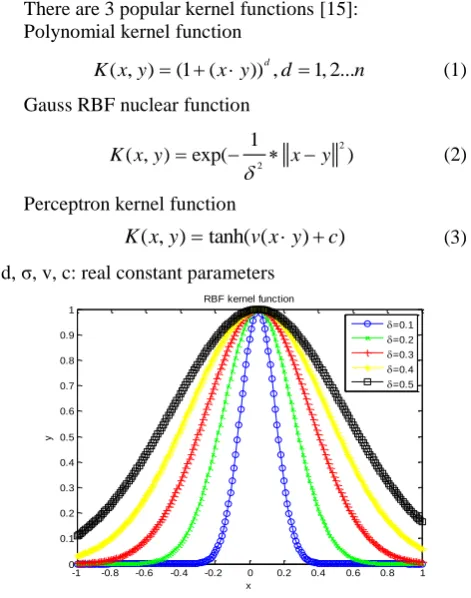
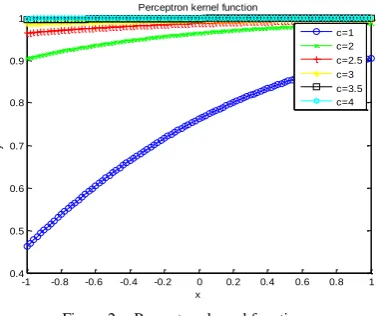
Fig. 1 and Fig. 2 represent Gauss RBF nuclear function and Perceptron kernel function respectively. The figures show that when σ is smaller, the curve is shaper and the function’s learning ability is better. Comparing Gaussian RBF with Perceptron kernel function, we discover that Gaussian RBF kernel function has a stronger learning ability and weaker generalization. On the contrary, the perceptron kernel function has stronger generalization and weaker learning ability.
The kernel functions have the following properties:
1
( , ) ( , )
1, 1, 2...
n
n i i
n
n i
K x y m K x y
m i n
(4)
( , )
i
K x y : the i-th a kernel function
where mi is an adjust parameter to combine hybrid
kernel function and K x yi( , ) is used to construct the
hybrid kernel function. Considering the requirements of generalization and learning abilities in the system, we select Gaussian kernel function with Perceptron kernel function to construct an adaptive hybrid kernel function.
)) ( tanh( ) 1 ( ) exp(
) ,
( 2
2
y x v y
x y
x
K
(5)where the parameters of combination of hybrid kernel function , the steep coefficient of kernel function
, and v is a constant coefficient. When takes large values and
takes small values, learning ability is stronger and generalization is weaker; and vice versa. In general for the greater change of the data we demand that learning ability is stronger in the system and for the flat change of the data we demand that generalization is stronger.The Euclidean distance [16] reflects the true distance between two vectors and also the similarity between the two signals. Therefore, this article considers the sample Euclidean distance as the basis of adaptive adjusting the combining parameters. Suppose there are M test vector samples, zij is the Euclidean distance between vector xi
and vector x xj( j) . Let zmax max( )zij ,
min min( )ij
z z , z
z12,z13...z(M1)M
,i
j
. theparameters of combination of hybrid kernel function
is determined by the following equation:
max min E z
z z
(6)
where E
represents the expectation value of vectorz
. So hybrid kernel function according to the data fluctuation in the samples adjusts adaptively the complex coefficient of hybrid kernel function.III. ANALOG CIRCUIT FAULT DIAGNOSIS BASED ON THE MIXED KERNEL FUNCTION
The basic principle of AMK-ICA is shown in the
following Fig. 3. S
s t s t1( ), 2( )...sm( )t
is the unknown source signals of the m-dimensional that the respective components of S are mutually independent, and only have a component is Gaussian distribution. A is the unknown hybrid matrix, X is the observed signals, W is the demixing matrix and Y is the demixing signals.A X=AS W Y=WX
S
Adaptive algorithm
Figure 3. The principle of AMK-ICA
The basic idea of AMK-ICA is to build the adaptive kernel function K(x, y) by using demixing Y and the observed signal X, so as to realize the adjustment of the demixing matrix W. That is to say:
Y WX (7) And
X AS (8)
Demixing matrix W and the unknown hybrid matrix satisfy WA=I, which I is the unit matrix.
This means that we must firstly solve the demixing matrix W. Research in the document [17], [18] shows that the key of AMK-ICA is to find a direction
( )
T T
W X YW X so as to acquire the greatest
nongaussian direction. As is concluded in the information theory: in all the variance of random variables, the Gaussian variable has a maximum entropy, and thus the
maximizing the negative entropy N W Xg( T ) can be used as a search for the direction of the maximum noggaussian objective function [18].
The detailed algorithms are given below:
1. Centralize the observation data, make its mean value be zero.
2. Whiten the data, X Z Z, is for whiten vector. 3. Choose an initial vector randomly.
4. Build the Newton iterative equation based on
'
( T ) ( T )
p p p
W E ZK W Z E ZK W Z W ,
K
( )
is the constructed adaptive hybrid function in Section 2.5. The iterative equation:
1
1
p T
p p p j j
j
W W W W W
.6. Normalize: Wp Wp/ Wp .
7. If Wp is not converged, return to step 5. Until
1
1
p T
p j j
j
W W W
is near zero, the Wp gets a final value.IV. EXPERIMENTAL RESEARCH
A. The Model of Measured Circuit and Flow Chart of AMK-ICA-SVM Experiment
Considering one typical diagnosis circuits: the Salley-Key linear band-pass filter. The data acquisition process is shown in Fig. 4.
Computer
Oscilloscope and experiment box The chip of data acquisition
Figure 4. The model of testing circuit diagnosis
The measured circuit diagnosis model is consist of oscilloscope (DS1102E), experiment box (ZXEET232), the chip of data acquisition (JCJ716AI) and computer (Lenovo s525).
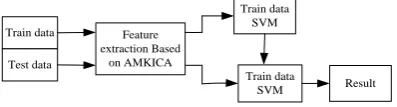
After using data acquisition chip to get the original data, then we use the AMK-ICA-SVM method to process them. The specific process is shown in the below Fig. 5.
Train data Test data
Feature extraction Based
on AMKICA
Train data SVM
Train data
SVM Result
Figure 5. The experiment flow chart of AMK-ICA-SVM
The AMK-ICA-SVM in the Fig. 5 is divided into four modules, namely the original data classification module, AMK-ICA feature extraction module, training SVM module and the out module. Firstly we divide the original data into two categories—the training sample and testing samples. Then we give the data to training and testing
SVM after AMK-ICA processing, and the resulting data is the accuracy classification at last.
B. Linear Circuit Diagnosis—Salley-Key Band-Pass Filter
We use the above method to test Salley-key band-pass filter, which are shown in Fig. 6.
R5
4k
Vout
R4 4k
3
2
8
4
1 +
-V+
V-OUT +12V C1
5nF
C2
5nF -12V
R1
1k
R2
3k
R3 2k V4
10Vac 0Vdc
Figure 6. Salley-Key band-pass filter circuit
The components on the target value in the Fig. 6 are standard under the parameter of normal working state, and the center frequency of the circuit is 25KHZ. The experimental part of analog circuit soft fault in the literature [19] proposes the method of the minimum detectable fault size (MDFS). Based on the comprehensive consideration of MDFS method according to the specific circuit, we suppose the circuit occurs to soft fault that the values of the circuit components deviate 10% from the normal value. The types of soft fault are shown in below Table I.
TABLEI. THE TYPES OF SOFT FAULT (R:K;C: NF)
The type of fault
The code of fault
The value of soft fault
R1↓ F1 0.9 0.81 0.73K
R1↑ F2 1.1 1.21 1.33K
R2↓ F3 2.7 2.43 2.18K
R2↑ F4 3.3 3.36 3.99K
R3↓ F5 1.8 1.62 1.45K
R3↑ F6 2.2 2.42 2.66K
R4↓ F7 3.6 3.24 2.91K
R4↑ F8 4.4 4.84 5.32K
R5↓ F9 3.6 3.24 2.91K
R5↑ F10 4.4 4.84 5.32K
C1↓ F11 4.5 4.05 3.64K
C1↑ F12 5.5 6.05 6.65K
C2↓ F13 4.5 4.05 3.64K
C2↑ F14 5.5 6.05 6.65K
The Salley-key band-pass filter circuit is constructed with experiment box, and the test is done under various kinds of soft faults of the circuit, then some data is obtained by data acquisition chip; finally we use the method of AMK-ICA-SVM to extract 200 characteristics of the samples in the original data, which can be divided into two parts, 110 samples are used as training SVM, the other 90 samples are used as test SVM.
TABLEII. THE FAULT DATA BASED ON SALLEY-KEY FILTER CIRCUIT OF AMK-ICA
F1 0.44 0.78 1.00 1.23 1.40 1.46 1.32 F2 0.34 0.61 0.78 0.93 0.99 0.80 0.63 F3 0.35 0.61 0.83 1.12 1.14 1.27 0.97 F4 0.71 0.89 1.04 1.12 1.00 0.84 0.50 F5 0.35 0.46 0.58 0.68 0.74 0.68 0.45 F6 1.24 1.43 1.49 1.18 0.93 0.51 0.36 F7 1.48 1.95 2.20 1.81 1.38 0.72 0.49 F8 0.71 0.84 0.93 0.84 0.71 0.42 0.30 F9 0.54 0.62 0.74 0.80 0.74 0.63 0.38 F10 0.89 1.17 1.45 1.63 1.42 1.12 0.62 F11 0.32 0.40 0.46 0.50 0.46 0.40 0.25 F12 0.19 0.37 0.49 0.65 0.80 0.91 0.81 F13 0.56 0.95 1.14 1.29 1.33 1.09 0.89 F14 0.38 0.70 1.11 0.90 1.29 1.38 1.27
The Gaussian kernel function, multi-layer perceptron kernel function and adaptive hybrid kernel function are shown respectively in the following Table III, which adopt the SVM of the one-against-one training and multiple classification in the fault diagnosis of analog circuit.
TABLEIII. THE RESULTS OF DIAGNOSIS OF KERNEL FUNCTION
The kinds of kernel function
The number of traning
samples
The training
time(s)
The testing time(s)
The accuracy of classification
The
gaussian 110 2.51 0.83 96.29%
The
perceptron 110 5.21 1.65 95.41%
Adaptive
hybrid 110 1.51 0.67 97.75%
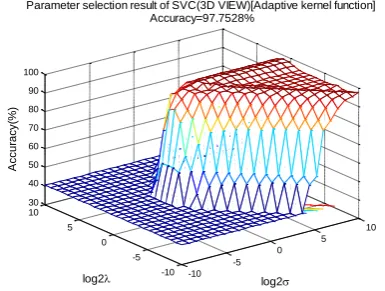
The result of classification in the Salley-key filter circuit based on the SVM of adaptive hybrid kernel function in the following Fig. 7, which the one horizontal axis represents the combination of the kernel function parameters
, the another horizontal axis represents the steep coefficient
, and the vertical axis represents the classification accuracy.Figure 7. Salley-Key filter circuit based on adaptive hybrid kernel function of SVM classification figure
V. THE ANALYSIS AND SUMMARY OF THE SYSTEM
This paper puts forward a method based on an independent component analysis and support vector of the adaptive hybrid kernel function for analog fault
diagnosis and analyzes three types of kernel function used to constructs an adaptive hybrid kernel function. In order to verify the effectiveness of the method, in this paper, we studied the linear Salley-key band-pass filter though an experiment. The experimental results show that comparing to ICA and SVM of the traditional single kernel function, the training time, test time and the accuracy of classification are improved obviously.
ACKNOWLEDGEMENTS
Science Foundation of China (NO.61102035), the Fundamental Research Funds for the Central Universities, China Postdoctoral Science Foundation, Excellent Talents in Hunan Normal University (2012).
REFERENCES
[1] A. Aoy, S. Sunter, A. Fudoli, and D. Appello, “High accuracy stimulus generation for A/D converter BIST,” in Proc. Proc. International Conference on Test, 2002, pp. 1031-1039.
[2] H. T. Han, M. A. Hong-Guang, L. N. Tan, and J. L. Zhang, “Fault diagnosis of nonlinear analog circuits based on sensitivity analysis
17-22, 2013.
[3] J. W. Bandler and A. E. Salama, “Fault diagnosis of analog circuits,” Proceedings of the IEEE, vol. 73, no. 8, pp. 1279-1325, 1985.
[4] P. Cunningham, “A case study on the UBC of model-based systems for electronic fault diagnosis,” Artificial Intelligence in Engineering, vol. 12, no. 3, pp. 283-295, 1998.
[5] J. A. Starzyk, D. Liu, et al., “Entropy-Based optimum test points selection for analog fault dictionary techniques,” IEEE Transactions on Instrumentation and Measurement, vol. 53, no. 3, pp. 355-364, 2004.
[6] Y. Sun and Y. He, “Neural-Network based approaches for analogue circuit fault diagnosis,” in Test and Diagnosis of Analogue, Mixed-Signal and RF Integrated Circuits—The Systems on Chip Approach, London, U.K.: Inst. Eng. Technol, 2008, ch. 3. [7] F. Aminian, et al., “Analog fault diagnosis of actual circuits using
neural networks,” IEEE Transactions on Instrumentation and Measurement, vol. 51, no. 3, pp. 544-550, 2002.
[8] Y. Dekiura, N. Kitaoka, and K. Takeda. “Generative approach for robust acoustic model training for blindly separated speech recognition,” in Proc. Meetings on Acoustics, 2013, pp. 1-5. [9] D. M. Tsai, S. C. Wu, and W. Y. Chiu, “Defect detection in solar
modules using ICA basis images,” IEEE Transactions on Industrial Informatics, vol. 9, no. 1, pp. 122-131, 2013..
[10] C. Li, J. Yin, and J. Zhao, “Using improved ICA method for hyperspectral data classification,” Arab. J. Sci. Eng., vol. 39, no. 21, pp. 181-189, 2014.
[11] J. Xu, J. Zhao, B. Ma, and S. Hu, “Fault diagnosis of complex industrial process using KICA and sparse SVM,” Mathematical Problems in Engineering, vol. 13, no. 51, pp. 1-6, 2013.
[12] L. Jiang, B. Zeng, F. R. Jordan, and A. Chen, “Kernel function and parameters optimization in KICA for rolling bearing fault diagnosis,” Journal of Networks, vol. 8, no. 8, 2013.
[13] A Subasi and M. I Gursoy, “EEG signal classification using PCA, ICA, LDA and support vector machines,” Expert Systems with Applications, vol. 37, pp. 8659-8666, 2010.
[14] X. Qin, B, Han, and L. Cui, “A kind integrated adaptive fuzzy neural network tolerance analog circuit fault diagnosis method,” in
Proc. IEEE Int. Conf. Comput. Control Industr. Eng., 2011, pp. 180-183.
[15] H. Z. Wang and J. S. Yu, “Study on the kernel-based methods and its model selection,” Journal of Southern Yangtze University (Natural Science Edition), vol. 5, no. 4, pp. 1671-7147, 2006. [16] X. Zhang, X. L. Xiao, and G. Y. Xu, “A new method for
determining the parameter of gaussian kernel,” Computer Engineering, vol. 33, no. 12, pp. 52-54, 2007.
The research work is supported by National Natural
and Volterra series,”Journal of Circuits and Systems, vol. 18, pp.
-10 -5
0 5
10
-10 -5 0 5 10 30 40 50 60 70 80 90 100
log2
Parameter selection result of SVC(3D VIEW)[Adaptive kernel function] Accuracy=97.7528%
log2
A
ccur
a
cy(
%
[17] C. C. Hsu, and M. C. Chen, “Adaptive kernel principal component analysis (KPCA) for monitoring small disturbances of nonlinear processes,” Ind. Eng. Chem. Res., vol. 49, no. 12, pp. 2254-2262, 2010.
[18] X. M. Wang, “Supervised manifold learning and kernel independent component analysis applied to the face image recognition,” in Proc. IEEE Fifth International Conference on Intelligent Computation Technology and Automation, 2012, pp. 600-603.
[19] A. S. S. Vasan, B. Long, and M. Pecht, “Diagnostics and prognostics method for analog electronic circuits,” IEEE Transactions on Industrial Electronics, vol. 60, no. 11, pp. 5277-5291, 2013.
Yongpan Jing received the B.Sc. degree in communication engineering
from Hunan University of Technology, Zhuzhou, China, in 2012. He is currently working toward the M.S. degree at the circuit and system, Hunan Normal University. His current interests include the research of signal processing, neural networks and its application, and pattern recognition.
Lifen Yuan received the B.Sc. degree in communication engineering
from Changsha Railway University, Changsha, China, in 1999, and the
M.S. degree in circuit and system from Hunan University, Changsha, in 2003, and the Ph.D. degree at the College of Electrical and Information Engineering, Hunan University in 2010. Since 2003, she has been a Lecturer of Communication with Hunan Normal University, Changsha. Her current interests include the research of signal processing, neural networks and its application, and pattern recognition.
Yigang He received the M.Sc. degree in electrical engineering from Hunan University, Changsha, China, in 1992 and the Ph.D. degree in electrical engineering from Xi’an Jiaotong University, Xi’an, China, in 1996.
Since 1999, he has been a Full Professor of electrical engineering with the College of Electrical and Information Engineering, Hunan University. He was a Senior Visiting Scholar with the University of Hertfordshire, Hatfield, U.K., in 2002. He is currently the Director of the Institute of Testing Technology for Circuits and Systems, Hunan University. He is the author of a great number of papers on his research results. His teaching and research interests are in the areas of circuit theory and its applications, testing and fault diagnosis of analog and mixed-signal circuits, RFID, and intelligent signal processing. Dr. He has been on the Technical Program Committees of a number of international conferences.