VOLUME NO. 8 (2018), ISSUE NO. 09 (SEPTEMBER)
ISSN
2231-5756
A Monthly Double-Blind Peer Reviewed (Refereed/Juried) Open Access International e-Journal - Included in the International Serial Directories Indexed & Listed at:
Ulrich's Periodicals Directory ©, ProQuest, U.S.A., EBSCO Publishing, U.S.A., Cabell’s Directories of Publishing Opportunities, U.S.A., Google Scholar, Indian Citation Index (ICI), J-Gage, India [link of the same is duly available at Inflibnet of University Grants Commission (U.G.C.)],
Index Copernicus Publishers Panel, Poland with IC Value of 5.09 (2012) & number of libraries all around the world.
VOLUME NO. 8 (2018), ISSUE NO. 09 (SEPTEMBER)
ISSN
2231-5756
CONTENTS
Sr.
No.
TITLE & NAME OF THE AUTHOR (S)
Page
No.
1. IMPACT OF MAHATMA GANDHI NATIONAL RURAL EMPLOYMENT
GUARANTEE SCHEME (MGNREGS) ON INCOME, SAVINGS AND EXPENDITURE
PATTERN OF BENEFICIARIES AT CUDDALORE DISTRICT
T. VALLI & Dr. K. RAMAKRISHNAN
1
2. A STUDY ON WELFARE FACILITIES PROVIDED IN PRIVATE SECTOR BANKS
SENTHURIYA.R & Dr. ILANGOVAN
3
3. FORECASTING NATURAL GAS SPOT PRICES USING TIME SERIES SEASONAL
AUTOREGRESSIVE INTEGRATED MOVING AVERAGE MODEL
Dr. K. NIRMALA, SWARNA C & SINDHU J
8
4. A STUDY ON CUSTOMER SATISFACTION TOWARDS SHAKTHI SUPER MARKET
IN ERODE
S. SELVAMOORTHY & Dr. K. RAJINI
16
5. BLOCKCHAIN TECHNOLOGY - ROLE IN OIL AND GAS INDUSTRY
Dr. S. RAJARAJESWARI & K. SRINIVASAN
19
6. BANK EMPLOYEES’ PERCEPTION TOWARDS CRM PRACTICES IN BANKS: A
STUDY IN ERODE DISTRICT
Dr. T. KOKILAPRIYA
23
VOLUME NO. 8 (2018), ISSUE NO. 09 (SEPTEMBER)
ISSN
2231-5756
CHIEF PATRON
Prof. (Dr.) K. K. AGGARWAL
Chairman, Malaviya National Institute of Technology, Jaipur
(An institute of National Importance & fully funded by Ministry of Human Resource Development, Government of India)
Chancellor, K. R. Mangalam University, Gurgaon
Chancellor, Lingaya’s University, Faridabad
Founder Vice-Chancellor (1998-2008), Guru Gobind Singh Indraprastha University, Delhi
Ex. Pro Vice-Chancellor, Guru Jambheshwar University, Hisar
FOUNDER PATRON
Late Sh. RAM BHAJAN AGGARWAL
Former State Minister for Home & Tourism, Government of Haryana
Former Vice-President, Dadri Education Society, Charkhi Dadri
Former President, Chinar Syntex Ltd. (Textile Mills), Bhiwani
CO-ORDINATOR
Dr. BHAVET
Former Faculty, Shree Ram Institute of Engineering & Technology, Urjani
ADVISOR
Prof. S. L. MAHANDRU
Principal (Retd.), Maharaja Agrasen College, Jagadhri
EDITOR
Dr. PARVEEN KUMAR
Professor, Department of Computer Science, NIMS University, Jaipur
CO-EDITOR
Dr. A. SASI KUMAR
Professor, Vels Institute of Science, Technology & Advanced Studies (Deemed to be University), Pallavaram
EDITORIAL ADVISORY BOARD
Dr. S. P. TIWARI
Head, Department of Economics & Rural Development, Dr. Ram Manohar Lohia Avadh University, Faizabad
Dr. CHRISTIAN EHIOBUCHE
Professor of Global Business/Management, Larry L Luing School of Business, Berkeley College, USA
Dr. SIKANDER KUMAR
Chairman, Department of Economics, Himachal Pradesh University, Shimla, Himachal Pradesh
Dr. JOSÉ G. VARGAS-HERNÁNDEZ
Research Professor, University Center for Economic & Managerial Sciences, University of Guadalajara,
Guadala-jara, Mexico
Dr. M. N. SHARMA
Chairman, M.B.A., Haryana College of Technology & Management, Kaithal
Dr. TEGUH WIDODO
Dean, Faculty of Applied Science, Telkom University, Bandung Technoplex, Jl. Telekomunikasi, Indonesia
Dr. M. S. SENAM RAJU
Professor, School of Management Studies, I.G.N.O.U., New Delhi
Dr. A SAJEEVAN RAO
Professor & Director, Accurate Institute of Advanced Management, Greater Noida
Dr. D. S. CHAUBEY
Professor & Dean (Research & Studies), Uttaranchal University, Dehradun
Dr. CLIFFORD OBIYO OFURUM
VOLUME NO. 8 (2018), ISSUE NO. 09 (SEPTEMBER)
ISSN
2231-5756
Dr. KAUP MOHAMED
Dean & Managing Director, London American City College/ICBEST, United Arab Emirates
Dr. VIRENDRA KUMAR SHRIVASTAVA
Director, Asia Pacific Institute of Information Technology, Panipat
SUNIL KUMAR KARWASRA
Principal, Aakash College of Education, ChanderKalan, Tohana, Fatehabad
Dr. MIKE AMUHAYA IRAVO
Principal, Jomo Kenyatta University of Agriculture & Tech., Westlands Campus, Nairobi-Kenya
Dr. SYED TABASSUM SULTANA
Principal, Matrusri Institute of Post Graduate Studies, Hyderabad
Dr. BOYINA RUPINI
Director, School of ITS, Indira Gandhi National Open University, New Delhi
Dr. NEPOMUCENO TIU
Chief Librarian & Professor, Lyceum of the Philippines University, Laguna, Philippines
Dr. SANJIV MITTAL
Professor & Dean, University School of Management Studies, GGS Indraprastha University, Delhi
Dr. RAJENDER GUPTA
Convener, Board of Studies in Economics, University of Jammu, Jammu
Dr. SHIB SHANKAR ROY
Professor, Department of Marketing, University of Rajshahi, Rajshahi, Bangladesh
Dr. ANIL K. SAINI
Professor, Guru Gobind Singh Indraprastha University, Delhi
Dr. SRINIVAS MADISHETTI
Professor, School of Business, Mzumbe University, Tanzania
Dr. NAWAB ALI KHAN
Professor & Dean, Faculty of Commerce, Aligarh Muslim University, Aligarh, U.P.
MUDENDA COLLINS
Head, Operations & Supply Chain, School of Business, The Copperbelt University, Zambia
Dr. EGWAKHE A. JOHNSON
Professor & Director, Babcock Centre for Executive Development, Babcock University, Nigeria
Dr. A. SURYANARAYANA
Professor, Department of Business Management, Osmania University, Hyderabad
P. SARVAHARANA
Asst. Registrar, Indian Institute of Technology (IIT), Madras
Dr. MURAT DARÇIN
Associate Dean, Gendarmerie and Coast Guard Academy, Ankara, Turkey
Dr. ABHAY BANSAL
Head, Department of Information Technology, Amity School of Engg. & Tech., Amity University, Noida
Dr. YOUNOS VAKIL ALROAIA
Head of International Center, DOS in Management, Semnan Branch, Islamic Azad University, Semnan, Iran
WILLIAM NKOMO
Asst. Head of the Department, Faculty of Computing, Botho University, Francistown, Botswana
Dr. JAYASHREE SHANTARAM PATIL (DAKE)
Faculty in Economics, KPB Hinduja College of Commerce, Mumbai
SHASHI KHURANA
Associate Professor, S. M. S. Khalsa Lubana Girls College, Barara, Ambala
Dr. SEOW TA WEEA
Associate Professor, Universiti Tun Hussein Onn Malaysia, Parit Raja, Malaysia
Dr. OKAN VELI ŞAFAKLI
Professor & Dean, European University of Lefke, Lefke, Cyprus
Dr. MOHENDER KUMAR GUPTA
VOLUME NO. 8 (2018), ISSUE NO. 09 (SEPTEMBER)
ISSN
2231-5756
Dr. BORIS MILOVIC
Associate Professor, Faculty of Sport, Union Nikola Tesla University, Belgrade, Serbia
Dr. LALIT KUMAR
Faculty, Haryana Institute of Public Administration, Gurugram
Dr. MOHAMMAD TALHA
Associate Professor, Department of Accounting & MIS, College of Industrial Management, King Fahd University
of Petroleum & Minerals, Dhahran, Saudi Arabia
Dr. V. SELVAM
Associate Professor, SSL, VIT University, Vellore
Dr. IQBAL THONSE HAWALDAR
Associate Professor, College of Business Administration, Kingdom University, Bahrain
Dr. PARDEEP AHLAWAT
Associate Professor, Institute of Management Studies & Research, Maharshi Dayanand University, Rohtak
Dr. ALEXANDER MOSESOV
Associate Professor, Kazakh-British Technical University (KBTU), Almaty, Kazakhstan
Dr. ASHOK KUMAR CHAUHAN
Reader, Department of Economics, Kurukshetra University, Kurukshetra
Dr. BHAVET
Former Faculty, Shree Ram Institute of Engineering & Technology, Urjani
YU-BING WANG
Faculty, department of Marketing, Feng Chia University, Taichung, Taiwan
SURJEET SINGH
Faculty, Department of Computer Science, G. M. N. (P.G.) College, Ambala Cantt.
Dr. MELAKE TEWOLDE TECLEGHIORGIS
Faculty, College of Business & Economics, Department of Economics, Asmara, Eritrea
Dr. RAJESH MODI
Faculty, Yanbu Industrial College, Kingdom of Saudi Arabia
Dr. SAMBHAVNA
Faculty, I.I.T.M., Delhi
Dr. THAMPOE MANAGALESWARAN
Faculty, Vavuniya Campus, University of Jaffna, Sri Lanka
Dr. SHIVAKUMAR DEENE
Faculty, Dept. of Commerce, School of Business Studies, Central University of Karnataka, Gulbarga
SURAJ GAUDEL
BBA Program Coordinator, LA GRANDEE International College, Simalchaur - 8, Pokhara, Nepal
FORMER TECHNICAL ADVISOR
AMITA
FINANCIAL ADVISORS
DICKEN GOYAL
Advocate & Tax Adviser, Panchkula
NEENA
Investment Consultant, Chambaghat, Solan, Himachal Pradesh
LEGAL ADVISORS
JITENDER S. CHAHAL
Advocate, Punjab & Haryana High Court, Chandigarh U.T.
CHANDER BHUSHAN SHARMA
Advocate & Consultant, District Courts, Yamunanagar at Jagadhri
SUPERINTENDENT
VOLUME NO. 8 (2018), ISSUE NO. 09 (SEPTEMBER)
ISSN
2231-5756
CALL FOR MANUSCRIPTS
We invite unpublished novel, original, empirical and high quality research work pertaining to the recent developments & practices in the areas of Com-puter Science & Applications; Commerce; Business; Finance; Marketing; Human Resource Management; General Management; Banking; Economics; Tourism Administration & Management; Education; Law; Library & Information Science; Defence & Strategic Studies; Electronic Science; Corporate Gov-ernance; Industrial Relations; and emerging paradigms in allied subjects like Accounting; Accounting Information Systems; Accounting Theory & Practice; Auditing; Behavioral Accounting; Behavioral Economics; Corporate Finance; Cost Accounting; Econometrics; Economic Development; Economic History; Financial Institutions & Markets; Financial Services; Fiscal Policy; Government & Non Profit Accounting; Industrial Organization; International Economics & Trade; International Finance; Macro Economics; Micro Economics; Rural Economics; Co-operation; Demography: Development Planning; Development Studies; Applied Economics; Development Economics; Business Economics; Monetary Policy; Public Policy Economics; Real Estate; Regional Economics; Political Science; Continuing Education; Labour Welfare; Philosophy; Psychology; Sociology; Tax Accounting; Advertising & Promotion Management; Management Information Systems (MIS); Business Law; Public Responsibility & Ethics; Communication; Direct Marketing; E-Commerce; Global Business; Health Care Administration; Labour Relations & Human Resource Management; Marketing Research; Marketing Theory & Applications; Non-Profit Or-ganizations; Office Administration/Management; Operations Research/Statistics; Organizational Behavior & Theory; Organizational Development; Pro-duction/Operations; International Relations; Human Rights & Duties; Public Administration; Population Studies; Purchasing/Materials Management; Re-tailing; Sales/Selling; Services; Small Business Entrepreneurship; Strategic Management Policy; Technology/Innovation; Tourism & Hospitality; Transpor-tation Distribution; Algorithms; Artificial Intelligence; Compilers & Translation; Computer Aided Design (CAD); Computer Aided Manufacturing; Computer Graphics; Computer Organization & Architecture; Database Structures & Systems; Discrete Structures; Internet; Management Information Systems; Mod-eling & Simulation; Neural Systems/Neural Networks; Numerical Analysis/Scientific Computing; Object Oriented Programming; Operating Systems; Pro-gramming Languages; Robotics; Symbolic & Formal Logic; Web Design and emerging paradigms in allied subjects.
Anybody can submit the soft copy of unpublished novel; original; empirical and high quality research work/manuscript anytime in M.S. Word format after preparing the same as per our GUIDELINES FOR SUBMISSION; at our email address i.e. [email protected] or online by clicking the link online
submission as given on our website (FOR ONLINE SUBMISSION, CLICK HERE).
GUIDELINES FOR SUBMISSION OF MANUSCRIPT
1. COVERING LETTER FOR SUBMISSION:
DATED: _____________
THE EDITOR
IJRCM
Subject: SUBMISSION OF MANUSCRIPT IN THE AREA OF______________________________________________________________.
(e.g. Finance/Mkt./HRM/General Mgt./Engineering/Economics/Computer/IT/ Education/Psychology/Law/Math/other, please specify)
DEAR SIR/MADAM
Please find my submission of manuscript titled ‘___________________________________________’ for likely publication in one of your journals.
I hereby affirm that the contents of this manuscript are original. Furthermore, it has neither been published anywhere in any language fully or partly, nor it is under review for publication elsewhere.
I affirm that all the co-authors of this manuscript have seen the submitted version of the manuscript and have agreed to inclusion of their names as co-authors.
Also, if my/our manuscript is accepted, I agree to comply with the formalities as given on the website of the journal. The Journal has discretion to publish our contribution in any of its journals.
NAME OF CORRESPONDING AUTHOR :
Designation/Post* :
Institution/College/University with full address & Pin Code :
Residential address with Pin Code :
Mobile Number (s) with country ISD code :
Is WhatsApp or Viber active on your above noted Mobile Number (Yes/No) :
Landline Number (s) with country ISD code :
E-mail Address :
Alternate E-mail Address :
Nationality :
VOLUME NO. 8 (2018), ISSUE NO. 09 (SEPTEMBER)
ISSN
2231-5756
NOTES:
a) The whole manuscript has to be in ONE MS WORD FILE only, which will start from the covering letter, inside the manuscript. pdf.
version is liable to be rejected without any consideration.
b) The sender is required to mention the following in the SUBJECT COLUMN of the mail:
New Manuscript for Review in the area of (e.g. Finance/Marketing/HRM/General Mgt./Engineering/Economics/Computer/IT/
Education/Psychology/Law/Math/other, please specify)
c) There is no need to give any text in the body of the mail, except the cases where the author wishes to give any specific message w.r.t. to the manuscript.
d) The total size of the file containing the manuscript is expected to be below 1000 KB.
e) Only the Abstract will not be considered for review and the author is required to submit the complete manuscript in the first instance.
f) The journal gives acknowledgement w.r.t. the receipt of every email within twenty-four hours and in case of non-receipt of
acknowledgment from the journal, w.r.t. the submission of the manuscript, within two days of its submission, the corresponding author is required to demand for the same by sending a separate mail to the journal.
g) The author (s) name or details should not appear anywhere on the body of the manuscript, except on the covering letter and the cover page of the manuscript, in the manner as mentioned in the guidelines.
2. MANUSCRIPT TITLE: The title of the paper should be typed in bold letters, centeredand fully capitalised.
3. AUTHOR NAME (S) & AFFILIATIONS: Author (s) name, designation, affiliation (s), address, mobile/landline number (s), and email/al-ternate email address should be given underneath the title.
4. ACKNOWLEDGMENTS: Acknowledgements can be given to reviewers, guides, funding institutions, etc., if any.
5. ABSTRACT: Abstract should be in fully Italic printing, ranging between 150 to 300 words. The abstract must be informative and
eluci-dating the background, aims, methods, results & conclusion in a SINGLE PARA. Abbreviations must be mentioned in full.
6. KEYWORDS: Abstract must be followed by a list of keywords, subject to the maximum of five. These should be arranged in alphabetic
order separated by commas and full stop at the end. All words of the keywords, including the first one should be in small letters, except special words e.g. name of the Countries, abbreviations etc.
7. JEL CODE: Provide the appropriate Journal of Economic Literature Classification System code (s). JEL codes are available at
www.aea-web.org/econlit/jelCodes.php. However, mentioning of JEL Code is not mandatory.
8. MANUSCRIPT: Manuscript must be in BRITISH ENGLISH prepared on a standard A4 size PORTRAIT SETTING PAPER. It should be free
from any errors i.e. grammatical, spelling or punctuation. It must be thoroughly edited at your end.
9. HEADINGS: All the headings must be bold-faced, aligned left and fully capitalised. Leave a blank line before each heading.
10. SUB-HEADINGS: All the sub-headings must be bold-faced, aligned left and fully capitalised.
11. MAIN TEXT:
THE MAIN TEXT SHOULD FOLLOW THE FOLLOWING SEQUENCE:
INTRODUCTION REVIEW OF LITERATURE
NEED/IMPORTANCE OF THE STUDY STATEMENT OF THE PROBLEM OBJECTIVES
HYPOTHESIS (ES)
RESEARCH METHODOLOGY RESULTS & DISCUSSION FINDINGS
RECOMMENDATIONS/SUGGESTIONS CONCLUSIONS
LIMITATIONS
SCOPE FOR FURTHER RESEARCH REFERENCES
APPENDIX/ANNEXURE
VOLUME NO. 8 (2018), ISSUE NO. 09 (SEPTEMBER)
ISSN
2231-5756
12. FIGURES & TABLES: These should be simple, crystal CLEAR, centered, separately numbered & self-explained, and the titles must be above the table/figure. Sources of data should be mentioned below the table/figure. It should be ensured that the tables/figures are
referred to from the main text.
13. EQUATIONS/FORMULAE: These should be consecutively numbered in parenthesis, left aligned with equation/formulae number placed
at the right. The equation editor provided with standard versions of Microsoft Word may be utilised. If any other equation editor is utilised, author must confirm that these equations may be viewed and edited in versions of Microsoft Office that does not have the editor.
14. ACRONYMS: These should not be used in the abstract. The use of acronyms is elsewhere is acceptable. Acronyms should be defined
on its first use in each section e.g. Reserve Bank of India (RBI). Acronyms should be redefined on first use in subsequent sections.
15. REFERENCES: The list of all references should be alphabetically arranged. The author (s) should mention only the actually utilised
references in the preparation of manuscript and they may follow Harvard Style of Referencing. Also check to ensure that everything
that you are including in the reference section is duly cited in the paper. The author (s) are supposed to follow the references as per
the following:
All works cited in the text (including sources for tables and figures) should be listed alphabetically.
Use (ed.) for one editor, and (ed.s) for multiple editors.
When listing two or more works by one author, use --- (20xx), such as after Kohl (1997), use --- (2001), etc., in chronologically ascending order.
Indicate (opening and closing) page numbers for articles in journals and for chapters in books.
The title of books and journals should be in italic printing. Double quotation marks are used for titles of journal articles, book chapters, dissertations, reports, working papers, unpublished material, etc.
For titles in a language other than English, provide an English translation in parenthesis.
Headers, footers, endnotes and footnotes should not be used in the document. However, you can mention short notes to elucidate
some specific point, which may be placed in number orders before the references.
PLEASE USE THE FOLLOWING FOR STYLE AND PUNCTUATION IN REFERENCES: BOOKS
Bowersox, Donald J., Closs, David J., (1996), "Logistical Management." Tata McGraw, Hill, New Delhi.
Hunker, H.L. and A.J. Wright (1963), "Factors of Industrial Location in Ohio" Ohio State University, Nigeria.
CONTRIBUTIONS TO BOOKS
Sharma T., Kwatra, G. (2008) Effectiveness of Social Advertising: A Study of Selected Campaigns, Corporate Social Responsibility, Edited by David Crowther & Nicholas Capaldi, Ashgate Research Companion to Corporate Social Responsibility, Chapter 15, pp 287-303.
JOURNAL AND OTHER ARTICLES
Schemenner, R.W., Huber, J.C. and Cook, R.L. (1987), "Geographic Differences and the Location of New Manufacturing Facilities," Jour-nal of Urban Economics, Vol. 21, No. 1, pp. 83-104.
CONFERENCE PAPERS
Garg, Sambhav (2011): "Business Ethics" Paper presented at the Annual International Conference for the All India Management Asso-ciation, New Delhi, India, 19–23
UNPUBLISHED DISSERTATIONS
Kumar S. (2011): "Customer Value: A Comparative Study of Rural and Urban Customers," Thesis, Kurukshetra University, Kurukshetra.
ONLINE RESOURCES
Always indicate the date that the source was accessed, as online resources are frequently updated or removed.
WEBSITES
VOLUME NO. 8 (2018), ISSUE NO. 09 (SEPTEMBER)
ISSN
2231-5756
IMPACT OF MAHATMA GANDHI NATIONAL RURAL EMPLOYMENT GUARANTEE SCHEME (MGNREGS) ON
INCOME, SAVINGS AND EXPENDITURE PATTERN OF BENEFICIARIES AT CUDDALORE DISTRICT
T. VALLI
ASST. PROFESSOR
DEPARTMENT OF COMMERCE
PERIYAR MANIAMMAI INSTITUTE OF SCIENCE & TECHNOLOGY
VALLAM
Dr. K. RAMAKRISHNAN
PRINCIPAL
VIVEKANANDA COLLEGE OF ARTS & SCIENCE FOR WOMEN
SIRKALI
ABSTRACT
Poverty is a great sin. Human birth and death are no matter but the way in which they led their lives. Major portion of Indian civilisation are continuing the journey of poverty. Peoples in rural areas struggling to fulfil their own basic needs. They fight, fight and fight against poverty until they were buried. Very few could successfully come up from the situation. Remaining never or ever come forward to find solution to their ultimate livelihood. As a matter of survival of rural masses government passed many anti-poverty schemes but which serves unveil. While Mahatma Gandhi National Rural Employment Guarantee Act (MGNREGA) was passed with unique features as 100 days of assured wage employment to unskilled manual labour of rural households, equal wage for male and female and so on.
KEYWORDS
poverty, rural development, government scheme, wellbeing.
JEL CODES
D31, E21, E22, E24.I. INTRODUCTION
GNREGS is unique scheme which enables inclusion of women, equal wages to men and women, three fourth of the participants could be women, unem-ployment allowances, 100 days of emunem-ployment, inclusion of worksite facilities, worksite should be within 5 km, or provision of extra wages for extra distances, participation of state as well as central Governments and so on. It has scope for reducing migration and could solve the problem of poverty and unemployment problem which will leads to sustainable economic development.
II. STATEMENT OF THE PROBLEM
As mentioned, MGNREGS is unique in its way which is very broad in scope and in other words it possesses the power of changing fate of poor India. Hence it should be free or at least in its dark side. Stake holders are at all levels; end users could be benefited at the multi-layered programme. Starting from policy making up to policy execution there are more chances and channels to be mishandled. If so the entire dream of crossing or giving helping hands to cross the rural people from poverty or poverty line could not be achieved. This implies significance of the scheme. This study aims at assessing whether the remedy is driven towards the problem or not.
III. OBJECTIVES OF THE STUDY
General objective of the study includes assessing whether the MGNREGS is striving its need of being vanishing rural poverty. Specific objectives of the study are,
1. Impact of MGNREGS on income, savings and expenditure pattern of beneficiaries. 2. Assessing the life upliftment of beneficiaries.
IV. METHODOLOGY
The respondents selected for the study were beneficiaries of MGNREGS from Cuddalore district of Tamilnadu. The universe is defined with 2,605,914 as per the senses report 2011 and the population size is 764,385. The sample size was taken according to Margan sampling method. Hence the total number of responses collected from beneficiaries was 384.
DATA COLLECTION
This study uses both primary and secondary data. Primary data is collected from beneficiaries in the form of interview schedule. Secondary data are collected from books, magazines, journals and from web sources of Government (MHRD) and private.
V. ANALYSIS
IMPACT OF (MGNREGS) ON INCOME, SAVINGS AND EXPENDITURE PATTERN
TABLE 1: INCOME LEVEL OF RESPONDENTS
N Mean SD SS DF MS Statistical inference Income level
Between Groups 11.532 4 2.883
F=3.088 .016>0.05 Significant
Below Rs. 12000 89 3.02 .853
Rs. 12001 to 24000 163 2.87 1.013
Rs. 24001 to 36000 59 2.59 1.002
Rs. 36001 to 48000 63 3.14 .913
Above Rs. 48000 10 3.20 1.229
Within Groups 353.801 379 .934
Source: primary data
VOLUME NO. 8 (2018), ISSUE NO. 09 (SEPTEMBER)
ISSN
2231-5756
Null Hypothesis (H0): There is no significant impact of MGNREGS on income of the households.
Research Hypothesis (H1): There is significant impact of MGNREGS on income of the households.
Therefore, Null Hypothesis (H0) accepted. Research Hypothesis (H1) rejected.
TABLE 2: SAVINGS PATTERN OF BENEFICIARIES
Savings N Mean SD SS DF MS Statistical inference
Between Groups 7.120 4 1.780
F=1.262 .284<0.05 Not Significant
Below Rs. 12000 89 2.33 1.146
Rs. 12001 to 24000 163 2.34 1.228
Rs. 24001 to 36000 59 2.00 1.099
Rs. 36001 to 48000 63 2.27 1.221
Above Rs. 48000 10 2.70 1.160
Within Groups 534.505 379 1.410
Source: primary data
Null Hypothesis (H0): There is no significant impact of MGNREGS on savings pattern of the households.
Research Hypothesis (H1): There is significant impact of MGNREGS on savings pattern of the households.
Therefore, Null Hypothesis (H0) rejected. Research Hypothesis (H1) accepted.
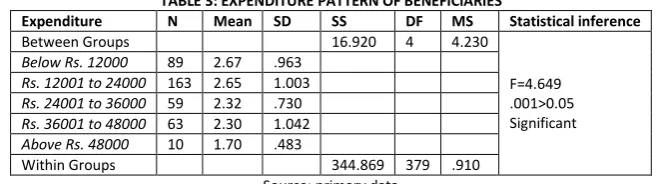
TABLE 3: EXPENDITURE PATTERN OF BENEFICIARIES
Expenditure N Mean SD SS DF MS Statistical inference
Between Groups 16.920 4 4.230
F=4.649 .001>0.05 Significant
Below Rs. 12000 89 2.67 .963
Rs. 12001 to 24000 163 2.65 1.003
Rs. 24001 to 36000 59 2.32 .730
Rs. 36001 to 48000 63 2.30 1.042
Above Rs. 48000 10 1.70 .483
Within Groups 344.869 379 .910
Source: primary data
Null Hypothesis (H0): There is no significant impact of MGNREGS on expenditure pattern of the households.
Research Hypothesis (H1): There is significant impact of MGNREGS on expenditure pattern of the households.
Therefore, Null Hypothesis (H0) accepted. Research Hypothesis (H1) rejected.
VI. DISCUSSION
Analysing about the impact of MGNREGS on Income, Savings, Expenditure pattern of beneficiaries at Cuddalore district, the income level of the respondents are taken under five categories ranging from Rs. 12,000 per annum to Rs. 48,000 and above. Observing the beneficiary category whose annual income is up to Rs. 12,000, N value is 89, Mean value is 3.02, income, savings and expenditure pattern are 3.02, 2.33 and 2.67 respectively. It despites they are striving hard for their day to day living or to fulfil their basic amenities.
When comparing the second category whose annual income lies between up to Rs. 12,001 to 24,000 the N value is 163, Mean value of income is 2.87, savings pattern of the beneficiaries is 2.34 and the expenditure is 2.65. It underlies the truth of even though the income level has improved than the first category, but neither savings nor expenditure pattern does not have considerable variations rather it is equal to of the first category. This MGNREGS helps in fulfilling their needs.
The third category beneficiaries whose annual income is between Rs. 24,001 to 36,000 the N value is 59, Mean value of income is 2.59 savings level is 2.00 which is lowest of all other category, and the expenditure pattern is 2.32 which is more than the saving level. Thus, it can be interpreted that they are spending for their life needs or sophistication rather for other purposes, other groups are having a fluctuation in income, savings and expenditure, but this category of people is comparatively fall on average of income, savings and expenditure.
Fourth category whose annual income is between Rs. 36,001 to 48,000, the N value is 63, Mean value of income, savings, expenditure is 3.14, 2.27 and 2.30 respectively. Hence it can be interpreted that savings and expenditure are considerably similar which represent the expenditure is floating purposes and the savings does not be the real saving rather it is for near future consumption purposes. The income has increased at a level, but the savings pattern of this income group is spotted to be very low from all the other category, but expenditure is averagely distributed as other group.
The fifth category whose annual income is above Rs. 48,000 the N value is 10, Mean value of income, savings and expenditure pattern is 3.20, 2.70 and 1.70 respectively. Even though the annual income increases their expenditure is comparatively less than of others. This could imply exception to the ‘law of demand’ when there is increase in income it should results in increase in expenditure. It may channelize to savings or sometime useful investment too.
VII. CONCLUSION
It can be concluded from the above study that MGNREGS have considerable impact on income, savings and expenditure pattern of beneficiaries. Income of the households have slightly improved after registering into the scheme, rather it enables the beneficiaries to earn decently than before in terms of improvement in wage, level of work, claiming of unemployment allowance, equal wage to male and female and so on. However, the income is mostly spent on floating expenditure of the households, like improving standard of living or improved access to the basic amenities of life than for savings or investment. Anyhow “something is better than nothing”. A Proper implementation of the scheme brings laurels to the life of rural poor thus in turn uplifts the socio-economic development of the rural masses as the whole. Moreover, it aids sustainable development and make true the dream of Dr. APJ Abdul Kalam’s vision of “India 2020” at least by 2025 where a nation’s poverty has been totally eradicated, illiteracy removed, crime against women and children is absent, and no one in the society feels alienated. A nation that is prosperous, healthy, secure, devoid of terrorism, peaceful and happy, and continues a sustainable growth path.
REFERENCES
1. Hajra, Jayanta & Hajara, Chandrasekha (2015) "Analysing Impact of NREGA in the Keynesian Theoretical Framework" International Journal of Novel Research in Humanity and Social Sciences
2. Jyoti Pooniya. Critical Study of MGNREGA: Impact and women’s participation. International Journal of Human, Development and Management Sciences 3. Srivastava, N and Srivasatava, R. 2010. Women, Work and Employment outcomes in Rural India. Economic and Political Weekly.
4. Swaminathan, M.S. 2012. Rural transformation and sustained growth of agriculture. Yojana. 5. Thomas Solinski, NREGA and Labour migration in India: Is village life what the 'rural' poor want?
VOLUME NO. 8 (2018), ISSUE NO. 09 (SEPTEMBER)
ISSN
2231-5756
A STUDY ON WELFARE FACILITIES PROVIDED IN PRIVATE SECTOR BANKS
SENTHURIYA.R
M. Phil. RESEARCH SCHOLAR
PRIST (DEEMED TO BE UNIVERSITY)
PUDUCHERRY CAMPUS, PUDUCHERRY
Dr. ILANGOVAN
ASSOCIATE PROFESSOR
PRIST (DEEMED TO BE UNIVERSITY)
PUDUCHERRY CAMPUS, PUDUCHERRY
ABSTRACT
The present study aims at analyzing the welfare facilities provided for employees in private sector banks. This gives a clear note on how the facilities are provided in private banks where every bank provide equal welfare facilities for men and women. The study and a survey was conducted among 100 employees of 5 private banks in Puducherry, and the data were collected using a 5 point scale questionnaire. Private bank officers have higher levels of work or target which has to be attained in the prior month, where public sectors banks enjoy better facilities and supportive work environment. Work experience is first most important factor in private sector banks. The overall work experience of the bank officers is at the positive level. It also investigates the impacts of bank type, work experience, age, and sex differences on the attitudes toward their job. The result shows that salary, efficiency in work, fringe supervision, and co-worker relation are the most important factors contributing towards their work. The workers have great opportunity to upgrade their knowledge and rich exposure towards technology. In a certain bank there is a difference in performance level between men and women. The study is based on the information collected from respondent through ques-tionnaire. The data analysed is presented in the form of graphs and on the basis of that conclusion are made.
KEYWORDS
Private sector banks, welfare facilities.
JEL CODE
I31INTRODUCTION
EMPLOYEE WELFARE DEFINITION
mployee welfare means “the effort to make life worth living for workmen”. When all basic facilities are provided and employees obtain satisfaction then the productivity can be increased and development of the organization will be possible. Labour welfare refers to the facilities provided to workers in and outside the banks like canteen facilities, compensation facilities, housing loan, insurance facilities etc. Welfare means faring or doing well. It is a compre-hensive term, and the physical, mental, moral and emotion wellbeing of an emotion. The term welfare refers to a relative concept, relative in time and space. It therefore, varies from time to time, region to region and from country to country. Welfare is a comprehensive term including various services, benefits and facilities offered by the employees thought such a generous fringe benefits the employees make life worth living for employees the welfare amenities extend in addition to normal wages and economic rewards available to employees as per the legal provision.
REVIEW OF LITERATURE
LABOUR WELFARE
Labour welfare has been defined in various ways, though no single definition has found universal acceptance. The Oxford dictionary defines Labour welfare as "Efforts to make life worth living for workmen. “The Report of the Committee on employee welfare (1969) includes under it "such services, facilities and amenities as adequate canteens, rest and recreation facilities, sanitary and medical facilities, arrangements for travel to and from work and for the accommodation of workers employed at a distance from their homes and such other services, amenities and facilities including social security measures as contribute to improve the conditions under which worker are employer."
LABOUR WELFARE ACTIVITIES
Labour welfare Activities is combinations of various steps, the cumulative effect of which is to grease the wheels of industry and society. Sound industrial relations can only be based on human relations and good human relations dictate that Labour being, human being should be treated humanely which includes respect for Labour dignity, fair dealing and concern for the human beings physical and social needs. In 2011, Allender Colquhoun, and Kelley found that the Employee welfare schemes leads to the job motivation and satisfaction.
An environment where he is contended with his job, assured of a bright future and provided with his basic needs in life means an atmosphere of good working condition and satisfaction to labour welfare activities are based on the plea that higher productivity requires more than modern machinery and hard work. It requires co-operative endeavour of the parties, Labour and management. This is possible only when labour is given due importance and human element is taken into account at every stage.
The object of welfare activities is to promote economic development by increasing production and productivity. The underlying principle is to make the workers given their loyal services ungrudgingly in genuine spirit of co-operation, in return for obligations, voluntary and compulsory, accepted by the employee towards the general well-being of the employees.
Trevor Marshall, in his article explains about “how an employee welfare schemes plays a vital role in increasing the employee satisfaction”. Good managers know from their own observations that employee attitude affects their work and eventually the company’s output. It is essential that your welfare scheme will actually inspire and motivate them to work efficiently and not just be competitive with each other. Healthy competition among the company’s employees is good but too much of it may also cause the company to disintegrate. The company should still be very much hands-on with the whole employee incentive program to ensure that the outcome of the employee incentive program will be good.
David, A Decenzo (2001) and Stephen P. Robbinsin their book, “Personnel / Human Resource Management explained the various benefits and services provided by the companies to their employees. According to them, the legally required benefits and services include social security premiums, unemployment compensa-tion, workers compensation and state disability programs. Michael (2001) in his book, “Human Resource Management and Human Relations” said that the provi-sion of intra-mural and extra-mural welfare facilities help in improving the quality of work life of employee’s thereby good human relations will develop among different cadres of employees. Punekar, Deodhar and Sankaran (2004) in their book, “Labour Welfare, Trade Unionism and Industrial Relations” stated that labour welfare is anything done for the comfort and improvement, intellectual and social-wellbeing of the employees over and above the wages paid which is not a necessity of the industry.
VOLUME NO. 8 (2018), ISSUE NO. 09 (SEPTEMBER)
ISSN
2231-5756
Regina Barr, stated that Employee Welfare program is based on the management policy which is aimed shaping perfect employees. Therefore the concept of employee welfare includes two aspects namely physical and mental welfares Applications of merit system or work performance system as the basis for employee rewarding. Providing the retired employees with the old age allowance. Employee insurance program to provide the employee with better security. Improvement in health security for the employees and their families so that they can work confidently and productively. Increase in basic salaries and pension as adjustment to the needs providing all work units and their officials with vehicles to help support smooth mobility.
Workers are essential to the means of production (Drucker, 2010); they deserve to be treated with respect and given proper welfare packages and incentives (Noguera, 2005). These will improve their sense of worth, boost their self- esteem, financial status and act as, a sort of motivation to drive them to have more passion for their job, increasing their productivity (Thorsen, 2006). This is what is expected to be pursued by employers who look beyond instant profit making as opposed to enduring sustainable business earning of profits in perpetuity (Deeprose, 2006).
Lack or inadequate welfare packages and other incentives leads to poor worker’s motivation which greatly affect their outcomes and productivity hence, there is need for employers to give staff welfare package and other incentives for the benefits of the employees, employers and the organization (Okereke and Daniel 2010). There has been a lot of concerted efforts at national and international levels to set standards with minimal government interference and free market forces that would serve as framework to guide labour relations between employees and employers and thus confer on workers certain rights once there is an established contract of employment (Oginni and Adesanya, 2013) With regard to how workers welfare is advanced and the most important instrument which provide ample protection and entitlement to the workers is the Constitution which prescribes for rights, obligations, duties and responsibilities of the corporate and non-corpo-rate entities (Okene, 2009) “labour, including trade unions, industrial relations; conditions, safety and welfare of labour industrial disputes; prescribes a national minimum wage for the federation on any part thereof, and industrial arbitrations.”
Thus, all labour statues apply throughout the country unless a particular labour statute provides otherwise. Workers all over the world deserve recognition, good salaries, wages and great improvements in the terms and conditions of work (Narasimhan et al. 2004), thus workers have formed associations for realizing their main objectives dignify and sustainable welfare packages in the workplace (Aldrich, 2008) and to realize improvements in their working conditions (Schneider and Bowen, 2010).
It is against the backdrop of this gap in oversight that Adewunmi and Adenugba (2010) point out that employers in an organization are taking advantage of the weak institutional and regulatory framework to the detriment of their employees (Okene, 2006). As long as this situation persists, workers’ right to collective bargaining especially for essential welfare package would continue to be abridged (Adenugba, 2010). The truth is that, employers do not want to share the control of employment relations with their employees (Whitener, 1998). That is why they are coming up with a new managerial ideologies and philosophies to justify their position (Marcuse, 2013).
In employee relations, since there is no union and union leaders, opinion leaders are invited to participate in Joint Consultative Council. This new trend in industrial relations is nothing other than the situation that has been promoted by the ascendancy of neo-liberalism as the framework of global trends (Terry, 2003).The issues surrounding welfare and good quality of life for workers who are used in productive activities but denied basic social economics incentives to improve their quality of life are becoming more challenging and controversial these days (Bowen, 2013).
These issues often result into conflicts leading to union members declaring dispute which may culminate to strike actions or lock-outs (Stiglitz et al. 2009). Although there are ample laws that have been put in place to compel employers to provide welfare packages to the employees, implementation and enforcement are the major impediments to the realisation of the provisions of the laws (Weiler, 2009). Most times, employees renege in their promises to provide welfare knowing very well that employees are vulnerable and would rather keep silence in the face of blatant violation of their rights to welfare than face the reprisal (Little, 2001). Lack of or inadequate welfare package to the employees limits the social and organizational conditions of workers and impact on their productivity (Elson and Pearson, 1981). It could impact also on the team spirit which according to Valla’s (2003) limits “the firm's ability to provide an overarching normative or moral framework within which workplace change might unfold, leaving team systems vulnerable to anomic tendencies, to status distinctions among hourly employees, and to other sources of instability”
A full time employee is supposed to be entitled to a living wage, good working conditions, leave allowance benefits and vacations. The extent to which these are actually made available and beneficial to the employees in the workplace however leaves much to be desired (Becker and Huselid, 2006). In order to promote sustainable output in the workplace, apart from what the law prescribed to be given as welfare to employees, employers should also be more innovative when it comes to dealing with welfare (Nativel, 2006). Undoubtedly, this will serve as incentive and motivate workers to go the extra mile by working harder. The im-portance of upgrading skills is also vital as part of welfare in the workplace. Against this backdrop, Vallas (2003:34) points out that “the governments of OECD member countries have begun to acknowledge the importance of upgrading the human capital of those workers trapped in low-skilled, low-paid and often insecure jobs.
Okereke et al. (2010) examined “staff welfare and organization’s productivity, Data revealed general awareness about staff welfare among the employees and ability to identify the elements of welfare. There was absence of staff welfare in the council. The working environment was poor, in terms of office accommodation and furniture, paucity of working materials, scarcely available monetary incentives and unreliable health and safety facilities, which altogether reduce morale (job satisfaction) and efficiency in job performance.” One of the notable recommendations from the work of Okereke and Daniel (2010) is that “pragmatic efforts should be made to enhance employee’s job capabilities through training; to improve working conditions of the employees and their general welfare in order to elicit job satisfaction and motivation for increased productivity.”
The study of Chirda et al. (2009) showed that workers will be more motivated to do their work if salaries are competitive and market related, if the management supports staff welfare and encourage “managerial support for staff career development, availability of tools and consumables in the workplace and progress towards personal professional goals appears play a role in worker motivation.” With regard to the issue of realization of the incentives and welfare suggested by Chirda et al. (2009), there is need to be administrative will on the part of the employers to implement and also political will on the part of the regulator to compel and enforce compliance and performance.
Akintayo (2012:251) investigated “the relationship among working environment, workers’ morale and perceived productivity in industrial organizations. Studies have also shown that the issues of welfare and incentives in the workplace are now becoming global phenomenon and there is increase in welfare-related activism to ensure that workers welfare is taking more seriously by the employers. (Daly, 2002). In spite of this, there have long been conflicting expectations of the nature of companies’ responsibilities to the employees and the society (Eichhorst and Hemerijck, 2008). Employers are therefore enjoined to do this in order to motivate their employees (Moir, 2001).
In the employment sphere, according to Griffin (1986) "Well-being," welfare, utility," and quality of life are all closely related concepts. They are also at the center of morality, politics, law, and economics (Griffin, 1986). Nadler and Lawler (1983) indicated that “the real thrust of quality-of-work-life programs-improving organ-izational life and behavior and the fundamental health of the organization-should result in a higher level of organorgan-izational performance and a better work envi-ronment.”
Hollar (2003) has warned that “assessing the human impact of policy change requires more than evaluating economic outcomes; it requires knowing the resources of beneficiaries of social services and their conditions of life from various perspectives. Thus, we must strive for greater understanding about the socio cultural aspects of people’s lives that create the whole person-aspects such as health, family and friendship networks, housing situations, public and private support service and program use, conditions of work, and so forth. This is how we come to understand one’s quality of life. The present research creates a conceptual model of quality of life and illustrates the model using data from a follow– up study of former welfare recipients in a county in northern Virginia. Evaluation activities that are premised on a quality– of–life model will help policy actors understand the impact of policies and how public institutions can be managed strategically within their very complex contexts, especially in an era of welfare reform.”
VOLUME NO. 8 (2018), ISSUE NO. 09 (SEPTEMBER)
ISSN
2231-5756
behavioural scientists in the measurement and assessment of the quality of work life are presented in an effort to stimulate further research in the development of standardized measures and in the preparation of independent reports on the quality of work life in organizations.”
The concept of ‘Employee welfare’ is flexible and differs widely with times, regions, industry, country, social values and customs, the degree of industrialization, the general social economic development of people and political ideologies prevailing at particular moments.
According to the Labour welfare Committee on Labour Welfare (1969) defined as “Such facilities and amenities as adequate canteens, rest and recreation facilities, sanitary and medical facilities arrangements for travel to and from and for accommodation of workers employed at a distance from their homes, and such other services, amenities and facilities including social security measures as contribute to conditions under which workers are employed.
The term welfare refers to an act of seeking physical, mental, moral and emotional well-being of an individual. According to the traditional economic theory labour can be defined as, "A factor of production which consists of manual and mental exertion and receives some return in form of wages, salaries or professional fees" (Railkar, 1990). The Committee of experts on welfare facilities for employees constituted by the International Labour Organization (ILO) in 1963 has divided the welfare measures in to intramural and extramural schemes. The Intramural welfare amenities are those provided within the premises of the establishments such as sanitary facilities, crèches, rest shelters and canteens, drinking water, prevention of fatigue, health services including occupational safety, administrative ar-rangements, uniforms and protective clothing, shift allowance, etc. Employer secures the benefits of high efficiency and low employee absenteeism and minimum employee turnover. Facilities like housing, medical benefits and education facilities help to increase productivity of workers.
NEED FOR THE STUDY
To know that whether welfare facilities play an important role on the working of employees.
STATEMENT OF THE PROBLEM
To assess whether the employee welfare from banks is given properly to the employees or not.
OBJECTIVE OF THE STUDY
To analyse regarding the procedure for leave fare concession and home travel concession.
HYPOTHESIS
H1 There is a significant difference between GENDER AND STUDY VARIABLE.
H2 There is a significant difference between AGE AND STUDY VARIABLE.
H3 There is a significant difference between EXPERIENCE AND STUDY VARIANCE.
H4 There is a significant difference between SALARY AND STUDY VARIABLE.
H0 There is no significant difference between STUDY VARIABLE AND DEMOGRAPHIC VARIABLE.
RESEARCH METHODOLOGY
The data collected regarding leave fare concession and home travel concession is primary data. This shows percentage analysis of the data.
RESULTS AND DISCUSSION
TABLE 1
VARIANCE MALE PERCENTAGE FEMALE PERCENTAGE
GENDER 79 7.9 21 2.1
AGE: 20 - 30 31 - 40 41 - 50 51 - 60
39 28 6 5 3.9 2.8 0.6 0.5.
21 2.1
EXPERIENCE: 0 - 5 6 - 10 ABOVE 11 39 25 15 3.9 2.5 1.5 5 16 0.5 1.6 SALARY: 15 - 25 26 - 30 ABOVE 30 48 22 9 4.8 2.2 0.9
21 2.1
INFERENCE
From this table we come to know that the leave fare concession and the home fare concession is much useful only for men not for women. Men are much satisfied with the leave facilities and when they are need of any travel concession they are very much satisfied with their facilities in banks. At age 20 - 30 39% of male employees are much satisfied with the leave fare facilities women are not much satisfied with the leave fare where only 21% at the age of 20 - 30 are only satisfied, where we found that 0 -5 yrs of experienced employees are also much satisfied and women employees are not much satisfied only 16% of women having 6 – 10 yrs of experience are much satisfied with the leave facilities. The employees are given a good pay of Rs. 15,000 - 25,000 where 48% of employees are well satisfied with the leave fare and travel facilities women employees who are getting Rs. 15000 - 25,000 salary are 21% satisfied with these facilities.
FINDINGS
Therefore we found that women employees are not much satisfied with the facilities provided in provided in private sector banks. Men employees are much satisfied with the leave facilities and travel concessions. Women employees are not much satisfied with the facilities where women also has to be given a prefer-ence and they are also employees in a banks.
SUGGESTIONS
VOLUME NO. 8 (2018), ISSUE NO. 09 (SEPTEMBER)
ISSN
2231-5756
CONCLUSION
This study has made a methodological research of employee welfare practices and its availability for employees of Private Banks. This study gives the following conclusions. Banks are providing superior employee welfare facilities to its employees in private sector banks. Employees of private sector banks are satisfied as far as welfare practices are concerned. A direct and positive correlation has been observed in the study of employee welfare facilities.
Tools and techniques used in the present study include Primary data, Secondary data. The chapter on Data Analysis & Interpretation puts forth the most important and detailed aspect of the study. Percentage analysis is used to know regarding the welfare facilities provided in private banks. Banks has to provide facilities also for women employees.
LIMITATIONS
Sample taken is of 100 and the study can be carried out by taking a large number in the sample.
REFERENCES
1. Ahuja, K.K. "Labour Welfare and Social Security” in Personnel Management, Kalyani publishers, New Delhi, 1988 pp. 935-947 2. Aquinas P.G, "Human Resource Management”, Vikas Publishing House Pvt. Ltd, New Delhi, 2007, pp. 184-191
3. Aswathappa, K. "Human Resource Management”, Tata McGraw Hill Education Private Limited, New Delhi, 2010, pp. 378-392
4. David A. Decenzo and Stephen P. Robbins, "Benefits and Services” Personnel / Human Management, Prentice Hall of India Private Limited, New Delhi, 2001, pp. 451-475
5. David A. Decenzo and Stephen P. Robbins, “Benefits and Services” Personnel / Human Management, Prentice Hall of India Private Limited, New Delhi, 2001, pp. 451-475
6. Deepika, M.G. "A Relook into the Measurement of Human Welfare and Happiness”, HRM Review, Hyderabad, November 2008, pp.42-44. 7. Garry Dessler and BijuVarkkey, "Human Resource Management,” Dorling Kindersley (India) Pvt Ltd., New Delhi, 2009, pp.513-546 8. K.N. Vaid, Labour Welfare in India, Shri Ram Centre for Industrial Relations, New Delhi, 1970, p.27
9. Kudchelkar, D.L.S. "Aspects of Personnel Management and Industrial Relations”, Excel Books, New Delhi, 1979, p.10
10. Labour Welfare, Trade Unionism and Industrial Relations",Punekar, Deodhar and Sankaran (2004)," Himalaya Publishing House, Mumbai, p.24. 11. Mathis L. Robert and Jackson H. John, Personnel, Human Resource of Management, Tata Mc Graw Hill Publishing Company Ltd., New Delhi 12. N. K Joshi, "Labour welfare - concept, meaning and scope", Indian Labour Journal, V. 9 (10) October 1968, p. 280
VOLUME NO. 8 (2018), ISSUE NO. 09 (SEPTEMBER)
ISSN
2231-5756
APPENDIX
QUESTIONNAIRE
The survey is purely based for research purpose. All information given by you will be kept confidential and will be used for our research purpose. Your cooperation will be highly appreciated. Please give your assessment of these employee welfare variables in the bank and tick the appropriate answer in terms of EXCELLENT,
ABOVE AVERAGE, AVERAGE, BELOW AVERAGE AND UNSATISFACTORY.
1. NAME :
2. GENDER :
3. AGE
a) 20-30 b) 31-40 c) 41-50 d) 51-60
4. MARITAL STATUS
a) SINGLE b) MARRIED
5. DEPARTMENT :
6. EDUCATIONAL QUALIFICATION
a) DIPLOMA b) ENGINEERING c) UG d) PG
7. YOU’RE EXPERIENCE AT THIS CONCERN
a) 0-5 YEARS b) 6-10 YEARS c) ABOVE 11 YEARS 8. SALARY RANGE (IN TERMS OF THOUSANDS)
a) 15-25 b) 26-35 c) 36 and above 9. Table for Reply
Sl.no Statements Excellent Above Average
Average Below Average
Unsatisfactory
1 You are satisfied with the drinking water facility 2 Employees are satisfied with canteen facility 3 You are satisfied with the medical and first aid facility
4 You are satisfied with non-statutory welfare scheme provided by the bank like transportation facility
5 You are satisfied with education welfare scheme provided The bank 6 The cordial relationship with the supervisor and the other worker is good. 7 The settlement of grievances and complains of employees with regard to
service condition is satisfied
8 You are satisfied with the supporting environment at the workplace. 9 You are satisfied with the improvement in living condition of the employees. 10 The extra-mural facility like social insurance provided The bank.
11 The recreation facility provided The bank
12 Your satisfaction level with regard to the welfare measure like earned leave. 13 Employee’s satisfaction level with regard to sick leave.
14 You are satisfied with casual leave welfare measure. 15 The medical benefits welfare provided The bank
16 You are satisfied with leave travel allowance welfare measure.
17 The employee welfare facility like library/lounge is provided to you at your work place.
18 The bank is providing games and sports facility
19 The employee’s welfare facility like gymnasium is provided to you at your work place
20 You are satisfied with yoga center welfare facility 21 You are satisfied with cultural facility
22 You are satisfied with training provided to you in your work 23 The relation between employees and management are harmonious 24 The unions playing an important role for welfare of the employees. 25 Employees are participated in decision making in the work place
26 You are happy with the hygiene factor like personal life relating to welfare of employees.
27 The hygiene factor like working conditions are provided to you in your work place.
28 The interpersonal relationship with subordinates is good
29 You are satisfied with interpersonal relationship with the supervisors 30 The interpersonal relationship with peers is good
31 You are satisfied with the motivational factor like achievement relating to welfare of employees.
32 You are satisfied with the motivational factor like recognition. 33 You are happy with the factor like advancement.
VOLUME NO. 8 (2018), ISSUE NO. 09 (SEPTEMBER)
ISSN
2231-5756
FORECASTING NATURAL GAS SPOT PRICES USING TIME SERIES SEASONAL AUTOREGRESSIVE INTEGRATED
MOVING AVERAGE MODEL
Dr. K. NIRMALA
ASSOCIATE PROFESSOR
DEPARTMENT OF COMMERCE
BANGALORE UNIVERSITY
BANGALORE
SWARNA C
RESEARCH SCHOLAR
DEPARTMENT OF COMMERCE
BANGALORE UNIVERSITY
BANGALORE
SINDHU J
STUDENT
DEPARTMENT OF STATISTICS
BANGALORE UNIVERSITY
BANGALORE
ABSTRACT
Natural gas is a flammable gas, consisting mainly of methane (CH4), occurring in underground reservoirs often with oil. Natural gas is mostly used for domestic or industrial heating and to generate electricity, a spot price is the current price in the market place at which a given asset such as a security, commodity or currency can be bought or sold for immediate delivery Spot prices tend to be subject to extreme volatility. While the spot price of security, commodity or currency is important in terms of immediate buy and sells transactions, it perhaps has more importance in regard to the multi-trillion-dollar derivatives markets. Hence, forecasting spot price of a natural gas is focused in this paper.
KEYWORDS
SARIMA, natural gas, forecasting.
JEL CODES
C50, C53.INTRODUCTION
ommodity refers to any good that possesses a physical attribute. It is a thing of value, with uniform quality, produced by different producers, but will be considered equivalent. The commodity can be produced by different producers, but will still be considered equivalent. Commodities are frequently used as inputs in the production of the other goods or services.
Natural gas is a flammable gas, consisting mainly of methane (CH4), occurring in underground reservoirs often with oil. It was formed millions of years ago when dead marine organisms sunk to the bottom of the ocean and were buried under deposits of sedimentary rock. Subject to intense heat and pressure, these organ-isms underwent a transformation in which they were converted to a gas over millions of years.
Natural gas is found in underground rocks called reserviors. The rocks have tiny spaces in them (called pores)that allow them to hold water, natural gas and oil. The natural gas is trapped underground by impermeable rock (called caprock), and stays there until it is extracted.
Conventional natural gas can be extracted through drilling wells. Unconventional forms of natural gas like shale gas, tight gas, sour gas, coalbed methane and gas hydrates have specific extraction techniques.
Natural gas can also be found in reservoirs with oil and is extracted alongside oil, and this is called associated gas. In the past, this gas was commonly flared or burned as a waste product but in most places today it is captured and used.
There are two general types of natural gas, defined by their methane content, that reflect differences in the formation processes:
Biogenic gas
Thermo genic gas
Biogenic gas, or ‘dry’ gas, which was formed by bacterial decay at shallow depth.
Thermo genic gas, or ‘wet’ gas, which is a lower quality gas formed at high temperatures. Wet gas on the other hand contains compounds such as ethane and
butane, in addition to methane.
These natural gas liquids can be separated and sold individually for various uses, such as refrigerants and to produce petrochemical products, like plastic. Natural gas is mostly used for domestic or industrial heating and to generate electricity. It can also be compressed and used to fuel vehicles and as a feedstock for fertilizers, hydrogen fuel cells and other chemical processes
SPOT PRICE
A spot price is the current price in the market place at which a given asset such as a security, commodity or currency can be bought or sold for immediate delivery. While spot prices are specific to both time and place, in a global economy the spot price of most securities or commodities tends to be fairly uniform worldwide. In contrast to spot price, a security, commodity or currency’s futures price is its expected value at a specified future time and place.
BREAKING DOWN SPOT PRICE
In financial markets, spot prices are most frequently referenced in relation to the price of commodity futures contracts, such as contracts for oil, wheat or gold. A futures contract price is commonly determined using the spot price of a commodity, expected changes in supply and demand, the risk-free rate of return for the holder of the commodity, and the costs of transportation or storage in relation to the maturity date of the contract. Futures contracts with longer times to maturity