Vol.8 (2018) No. 5
ISSN: 2088-5334
Opinion Mining Summarization and Automation Process: A Survey
Sundas Naqeeb Khan
#, Nazri Mohd Nawi
#, Mahmud Imrona
*, Asim Shahzad
#, Arif Ullah
#,
Atta-ur-Rahman
$ #Faculty of Computer Science and Information Technology,UniversitiTun Hussein Onn Malaysia, 86400, Johor, Malaysia E-mail: [email protected]
*
School of Computing, Telkom University, 40257 Bandung, West Java, Indonesia
$
Department of Computer Science, College of Computer Science and Information Technology, Imam Abdulrahman Bin Faisal University, P.O. Box 1982, Dammam, Kingdom of Saudi Arabia
E-mail: [email protected]
Abstract—In this modern age, the internet is a powerful source of information. Roughly, one-third of the world population spends a significant amount of their time and money on surfing the internet. In every field of life, people are gaining vast information from it such as learning, amusement, communication, shopping, etc. For this purpose, users tend to exploit websites and provide their remarks or views on any product, service, event, etc. based on their experience that might be useful for other users. In this manner, a huge amount of feedback in the form of textual data is composed of those webs, and this data can be explored, evaluated and controlled for the decision-making process. Opinion Mining (OM) is a type of Natural Language Processing (NLP) and extraction of the theme or idea from the user's opinions in the form of positive, negative and neutral comments. Therefore, researchers try to present information in the form of a summary that would be useful for different users. Hence, the research community has generated automatic summaries from the 1950s until now, and these automation processes are divided into two categories, which is abstractive and extractive methods. This paper presents an overview of the useful methods in OM and explains the idea about OM regarding summarization and its automation process.
Keywords— opinion mining; natural language processing; automation summaries; summarization; decision making.
I.
I
NTRODUCTIONThe concept of data mining is drawing popularity in the
world of computer science with the passage of time. It is the
incorporation of quantitative methods, which are called
mathematical methods used in the process of mining the
usage patterns and trends in the historical and temporal data.
These mathematical methods may include some of the
mathematical equations, algorithms, prime methodologies,
traditional logistical regression and neural networks
[1].
Data mining is the procedure of categorization of the large
set of data. It is to classify the trends and solve the problems
of the data according to the data analysis [2]. Four stages of
data mining are shown in Fig. 1.
Fig. 1 Different levels of data mining
A method in which a statement is divided into small parts
and learns from those parts perform and communicate to one
another known as analysis [3]. Analysis of human behavior
according to their textual contents is called Opinion Mining
(OM). It is a type of Natural Language Processing (NLP)
to
examine the temper of the public about a product or a
service [4], [5]. OM sometimes is called Sentiment Analysis
(SA), which involves building a system to collect and
categorize opinions about a product or a service. SA is a
predecessor to the field of OM in which it examines how
people feel about a given topic (positive, negative, and
neutral). SA aims to determine the attitude of a speaker,
writer, or another subject concerning some topic or the
overall textual polarity or emotional reaction to a document,
interaction or event.
for research. Therefore, the data collection process is more
comfortable due to different available sources such as blogs,
web forums, discussion platforms, comment boxes, etc.
Information and knowledge discovery extraction is the key
area of research. Web data has the dynamic nature due to
this reason, and the extraction of that type of data is a
difficult task.
With the passage of time, according to the updating
processes, data is a change for every new transaction and
web usage for every field of applications. Therefore, one of
the significant web applications is to collect user opinions
from different sources, and after this extraction process,
presentation of performance is useful for information. Over
75,000 blogs build up on a daily basis with approximately
1.2 million new upcoming posts. In the modern world, the
40% population believes in opinions, reviews, and
recommendations collected from diverse sources [6].
In textual format data, the automatic recognition process
plays an important rule. Different organizations and
companies are paying attention to this issue on how to know
about the public demand. This is the focal point and that
point related to the opinions. So, available sources used for
regular compilation of customer reviews regarding a product
or service. According to these reviews, companies make sure
that the public opinions about their product or service in
term of good or bad aspects. In business aptitude,
classification of every opinion according to the features of
the product play significant rule like the quality of a product,
the order of a product, and the integrity of the product [7].
Summarization is entirely different from the classical text. In
contrast, OM relies on the aspects of a product while the
reviewers give their opinions in the positive or negative
sense [8].
OM used in every field of life such as government matters,
recommendation policies, citation criteria, human behavior
with machines and inspiration of computer behavior [9]. In
the same way, extraction of information is a useful process
to search the different levels of exactness and exclusiveness
[10]. This paper presents a review of different methods and
approaches used in the process of OM and opinion
summarization.
The remaining part of this paper organized as follows.
Firstly, the literature review will explain briefly on text
classification. Secondly, we give the evaluation process of
this research. Finally, we sum up experimental results base
of discussion and conclusion. These parts are discussed
subsequently.
II.
M
ATERIAL ANDM
ETHODThis section describes a brief overview of OM that had
been discussed by different researchers. OM keeps four
types of issues, which are shown in Fig. 2. These issues
related to dimensions of the words or sentences, sources like
where the researchers get the data for their experiments, set
the record as target and summary of the data.
Fig. 2 Opinion mining tasks
Previously, many OM techniques proposed by different
researchers with multilingual based work. Table 1 describes
the degree of automation regarding automatic and
semi-automatic with some
supervised, unsupervised and
semi-supervised classifiers in
which
heterogonous form
highlighted.
TABLE1 OPINION MINING SYSTEMS
Degree of automation Opinion classification approaches Objectives Domain Language
Automatic
Support Vector Machine [11] Term weighting Movies English Neural Networks & Support Vector
Machine [12]
Sentiment words and microblogging lexicon
Music English
Support Vector Machine [13] Term weighting Products & Movies English Ontology-based & dictionary-based
[14]
Sentiment words Independent English & Spanish
Semi-automatic
Conditional Random Fields (CRFs) [15]
Combination of manual and self-tagging
Products English
Different opinion classifiers [16] Sentiment words Products English Dictionary-based [17] Sentiment adjectives Products English Third party sentiment analysis
service [18]
Sentiment words Products English
Support Vector Machine & Unsupervised based [19]
Sentiment words Movies English & Spanish
Stepwise rules, Decision Tree & Support Vector Machine [20]
Sentiment words and microblogging lexicon
Products English
Support Vector Machine [21] Sentiment words, n-gram, term weighting
Text summarization has divided into two types such as
single-document and multi-document summarization
[22]-[23]. Due to the redundancy problem, multi-document
summarization is a very complicated task as compare to
single-document
summarization.
Therefore,
Carbonell
reduces the redundancy issue with Maximal Marginal
Relevance (MMR) approach [24]. Another researcher works
on this problem and gives the solid solution with the help of
similarity measures [25].
Numerous
researchers
work
on
multi-document
summarization and try to improve the accuracy rate
regarding automatic summarization process [26]–[31].
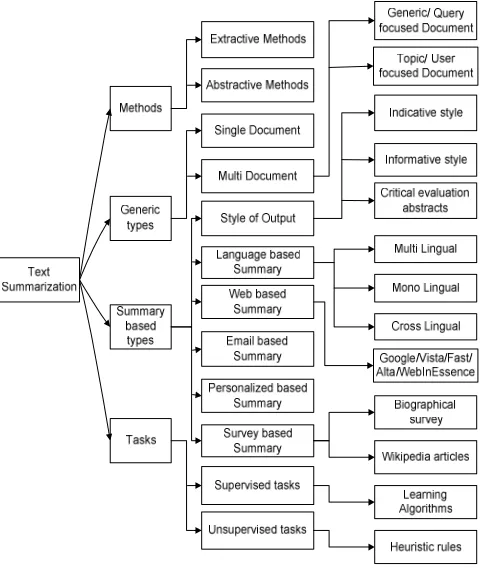
Previously, a variety of approaches provides the solutions to
text summarization problems on different levels as
mentioned in Fig. 3. These text summarization problems are
further divided into four main types and so on. Fig. 3 shows
the hierarchical structure of the text summarization problem
solution methods, tasks, generic and specific types.
Fig. 3 Taxonomy of text summarization
III.
R
ESULTS ANDD
ISCUSSIONThe focus of this research is to review the previous
process of text classification regarding extractive and
abstractive forms in which study the existing and developed
approaches with their datasets and performing measures.
Text classification is divided into two parts extractive and
abstractive levels. In the evaluation process, the abstractive
level keeps the initial understanding on the subject of the
notion about any data and generates the abstract summary of
the text, which is extensive level NLP. On the other hand,
extractive level obtains the relevancy between the selected
sentences and the original documents with learning
algorithms that used for the training of different classifiers.
This research will focus on the area research on OM
approaches and describe the summarization of documental
opinions from users. The focus of this summarization has
mined ideas from the reviews along resultant opinion
directions. Intensity features dig out the entities and work on
the dimensions. With the help of opinion strength,
dimensions give a summary through ranking [32]-[33].
Table 2 shows the process of evaluation which researchers
used for opinion summarization.
TABLEII
LEVELS OF EVALUATION PROCESS
Levels Explanation
A
b
st
ra
ct
iv
e
For opinion summarization, Carenini [34] present and compare two traditional techniques. Because of MEAD, researchers [35] give a sentence extraction method for multi-documental summarization, and it cannot provide quantitative measurement. Based on aspect level sentiment analysis, the performance of language generation method is better and find out the aggregate. Lastly, a generator of evaluative arguments provides the summary [36]. Researchers [37] examined the outcomes of human evaluation for summarizers, and they present an improved idea of multiple summarizers. Gerani [38] considered speech configuration and present a method for product reviews. First parsing performs than after that changing in trees, and each leaf keeps feature words, those trees generate a directed graph. In that graph, every node indicates a feature; each edge indicates a relation and that relation show the variation of selection by PageRank algorithm. Based on features and relations, a framework is present for summaries.
Ex
tr
a
ct
iv
e
Nishikawa et al. [39] present optimization issue in the graph. According to a graph, every node indicates a sentence while the proposed algorithm builds a route that routes touch every node. Objective function represents the summation of text scores that calculate the rationality among sentences with their features.
Fig. 4 Different stages of extractive approaches
and they present their importance for the specific tasks. Next
section will discuss further on these categories together with
their working style.
A.
Category-1: Statistical based Approaches
The
nature
of statistical approaches is independent in
which concerning area of the extraction are sentences and
words of the original document. These techniques are
independent so that is why they do not require any
supplementary or multifarious information associated to the
language regarding statistical aspects such as sentence
location, optimistic and non-optimistic reserved words,
sentence similarity, comparative sentence length, numerical
data and appropriate noun in the sentence, sentences thick
pathway, aggregated similarity, etc. After this, high acquire
commutated, and the calculated sentence is helping to
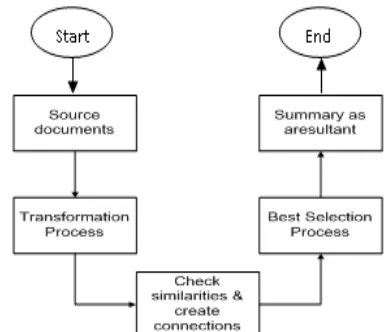
generate a good summary [23], [40]. Fig. 5 shows multiple
steps of statistical approaches used for the extractive process
of text summarization.
Fig. 5 Automatic extractive process by using statistical methods
B.
Category-2: Topic-based Approaches
The
document
area under discussion is known as the topic
in which all the written material shows the description of the
manuscript. Establishment of topic design is the main idea
related to procedures, which appear recurrently [41].
Representation
of the topic is further divided into five
sections, which are shown in Fig. 6. Where input firstly was
selected as text content than extract topics from that contents
where an enhanced feature are important for topic signatures.
Then next step shows the thematic signature extraction
where the thematic signature is detected in contents and it
help the researcher to design the model easily. Finally, the
process
produces
the
templates
related
to
topic
representation. Once the process completes, it then produces
a full-enhanced topic representation about text contents.
Fig. 6 Classification of topic representation
C.
Category-3: Graph-based Approaches
In
these
approaches, sentences or words show in nodes
form while semantics representation is in edges form. Fig. 7
shows multiple levels of graphical approaches used for an
extractive process of text summarization.
Fig. 7 The automatic extractive process by using graphical methods
D.
Category-4: Discourse-based Approaches
Fig. 8 Rhetorical Structure Theory in discourse method
E.
Category-5: Machine Learning based Approaches
This approach used machine learning in the tracking of
words while divided them into three broad categories such as
supervised, unsupervised and semi-supervised approaches.
Under these categories, Fattah and Ren used regression [23],
Decision Trees (DTs), Multi-Layer Perceptron (MLP), and
after this, they extend their work according to the Support
Vector Machine (SVM) and Naïve Bayes (NB) classifiers
for this purpose [43]. Here we show the hierarchy of
machine learning approaches in Fig. 9.
Fig. 9 Approaches used for the extractive process based on machine learning
Among
compressive methods, numerous researchers had
focused their work on extractive text summarization. The
primary purpose of these methods is to transform a
significant sentence into a small one, which is grammatically
correct while this sentence keeps the main part of the text.
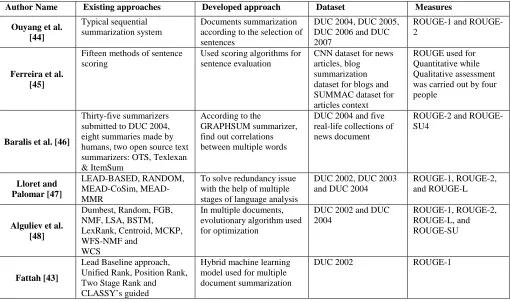
In
this section, this research compares between yearly
approaches and then sum up with their needs. Table 3 shows
the
classification
results
regarding
extractive
text
summarization approaches.
TABLEIII
RECENT AUTOMATIC EXTRACTIVE TEXT SUMMARIZATION APPROACHES
Author Name Existing approaches Developed approach Dataset Measures
Ouyang et al. [44]
Typical sequential summarization system
Documents summarization according to the selection of sentences
DUC 2004, DUC 2005, DUC 2006 and DUC 2007
1 and ROUGE-2
Ferreira et al. [45]
Fifteen methods of sentence scoring
Used scoring algorithms for sentence evaluation
CNN dataset for news articles, blog summarization dataset for blogs and SUMMAC dataset for articles context
ROUGE used for Quantitative while Qualitative assessment was carried out by four people
Baralis et al. [46]
Thirty-five summarizers submitted to DUC 2004, eight summaries made by humans, two open source text summarizers: OTS, Texlexan & ItemSum
According to the
GRAPHSUM summarizer, find out correlations between multiple words
DUC 2004 and five real-life collections of news document
2 and ROUGE-SU4
Lloret and Palomar [47]
LEAD-BASED, RANDOM, CoSim, MEAD-MMR
To solve redundancy issue with the help of multiple stages of language analysis
DUC 2002, DUC 2003 and DUC 2004
ROUGE-1, ROUGE-2, and ROUGE-L
Alguliev et al. [48]
Dumbest, Random, FGB, NMF, LSA, BSTM, LexRank, Centroid, MCKP, WFS-NMF and
WCS
In multiple documents, evolutionary algorithm used for optimization
DUC 2002 and DUC 2004
ROUGE-1, ROUGE-2, ROUGE-L, and ROUGE-SU
Fattah [43]
Lead Baseline approach, Unified Rank, Position Rank, Two Stage Rank and
Hybrid machine learning model used for multiple document summarization
summarization
Yang et al. [49]
Interactive, Integrated, Context-based, LSA-based, WordNet-based and Word-based summarization model
For theme-based summarization, ranking algorithm used to get better clustering method by using sentences
DUC 2004 and DUC 2007
Modularity measure, ROUGE-1, ROUGE-2 and ROUGE–SU4
Ferreira et al. [50]
DUC 2002 systems (System 24, System 19, System 20, System 29, System 28) with 200word summary
For multiple documents, summarization performed by statistical and linguistic based methods
DUC 2002 F-measure
Glavaš and Šnajder [51]
For IR, TF–IDF Vector Space Model, Hiemstra Language Model and two probabilistic models: DRF_BM25 and In_expC2 used. For summarization, best and median performing Models used.
For multiple documents, Information Retrieval (IR) process through event graphs
Mixed queries about topic & its specific collection for IR while for summarization, DUC 2002 and DUC 2004 used
Mean Average Precision (MAP) for IR. For summarization, ROUGE-1, and ROUGE-2
Mendoza et al. [52]
Unified Rank, DE, FEOM, NetSum, CRF, QCS, SVM and Manifold Ranking
For single document, genetic operators used with guided local search
DUC 2001 and DUC 2002
1 and ROUGE-2
Tzouridis et al. [53]
Random, Shortest, Yen, Filippova, Boudin and Morin
Learning approach used for related sentences
RSS feeds of 6 major news sites and news headlines in sports, technology and business
ROUGE-1, ROUGE-2, ROUGE-W, BLEU-1, BLEU-2, and BLEU-3
Kaljahi et al. [54]
Classic1K, 5K, 1K+5K, and SelfT
Semantic Role Labelling (SRL) among nominal resources
A datasets and delivery report of Classic project
Precision, Recall andF1-measure
\Kikuchi et al. [55]
Sentence selection, EDU selection, LEADED and LEADsnt
Nested tree structure used for single document summarization
RST Discourse Treebank
ROUGE-1
Fang et al. [56]
For text summarization, DSDR, Bud-sub and Sub-SVM. For image
summarization, unsupervised methods like
AP, k-medoids and DL
Topic-aspect summarization by selection of groups
For text summarization, DUC 2003 and DUC 2004. For image summarization, NUS-Wide dataset
1 and ROUGE-L for text summarization and
Jensen-Shannon Divergence for image summarization
Heu et al. [57]
System-NIST, Doc HITS, Cluster HITS, System-can List1, System-LIPN1 and System-VenessTeam1
For multiple documents, social Folksonomy performed through semantic analysis
TAC 2008 and TAC 2009
2 and ROUGE-SU4
Liu et al. [58]
Random, Lead LSA and DSDR
For multiple documents, two-level sparse representation model used
DUC 2006 and DUC 2007
ROUGE-1, ROUGE-2, and ROUGE-SU4
Li et al. [59,60]
Random, Lead, MEAD,
DSDR-non,
MDS-Sparse+div, and MDS-Sparse-div
Sparse coding-based reader aware system used for multiple documents
Own created dataset having 37 topics and DUC 2006 and DUC 2007
ROUGE-1, ROUGE-2 and ROUGE-SU4
Parveen and Strube [61]
Lead, Random, MMR and Text Rank
Non-redundant and local coherent issues solved by graph-based methods
PLOS Medicine dataset and DUC 2002
Human judgments for coherence, ROUGE-SU4, ROUGE-1and ROUGE-2
Yao et al. [62]
Lead, MatrixFacto., DsRQ, BI-PLSA, Multi Modal., DSDR, Sparse model, PEER 24 and PEER 15, CLASSY04
Compressive document summarization with the help of sparse optimization
DUC 2006 and DUC 2007
ROUGE-1, ROUGE-2 and ROUGE-SU4
Bairi et al. [63]
Amdocs KMed docs, KMed topics
and LDA docs
Sub modular Mixtures used for multi-document of topics
About 8000 Wikipedia disambiguation pages
Jaccard Index, F1-measure and NMI
Kedzie et al. [64]
Clustering baselines like Affinity Propagation, Hierarchical Agglomerative and Rank
by Salience
Disaster Summarization through prediction of salient updates
2014 TREC KBA Stream
Corpus, 2013 and 2014 TREC Temporal Summarization Track data
Hong et al. [65]
ICSISumm, DPP, RegSum, R2N2_ILP, Prorsum, Cluster CMRW
Summarizing multiple documents by joining the systems
DUC 2001, DUC 2002, DUC 2003, DUC 2004 and TAC 2008, 2009
1 and ROUGE-2
Yao et al. [66]
PBES, Baseline (EN), Baseline (CN), CoRank and Baseline (comp)
Phrase-based compressive cross-language
summarization
DUC 2001 with manual translation of reference summaries into Chinese
ROUGE-1, ROUGE-2, ROUGE-W, ROUGE-L and ROUGE-SU4
With
the
help of source document, abstractive text
summarization generates a summary like abstract while the
base of this abstract is opinions or concepts, which are
present in another form. This process includes the
requirement of NLP and it is more difficult as compare to
extractive process. While Table 4 provides an overview
related to abstractive text summarization approaches.
TABLEIV
RECENT AUTOMATIC ABSTRACTIVE TEXT SUMMARIZATION APPROACHES
Author Name Existing approaches Developed approach Dataset Measures
Lloret and Palomar [47]
Human perspective medicine journals
COMPENDIUM, a text summarizer for generation of abstracts of research papers
Biomedical field papers dataset
ROUGE-1
Gupta [67]
Machine learning based mathematical regression
A hybrid algorithm for multi lingual text documents
Select nine features with numerical data
Compression rate, F-measure
Khan et al. [68]
Genetic and ranking algorithm,
Semantic Role Labelling (SRL) based abstractive summarization of multiple documents
DUC 2002 Mean Coverage Score
and Average Precision
Banerjee et al. [69]
Word graph structure and K-nearest path
Integer Linear Programming (ILP) based multi sentence compression
DUC 2004 and DUC 2005
2, ROUGE-SU4 and ROUGE-L
Bing et al. [70] Integer linear optimization model
Phrase selection for multi documents
TAC 2011 dataset Automated pyramid
evaluation metric
Rush et al. [71] Contextual input encoder Neural attention model Giga word Dataset,
with DUC 2004
ROUGE
Ouida et al. [72]
mRMR approach and k-Medoids algorithm
A proposed sentence extraction algorithm proposed
TAC Multiling 2011 dataset
ROUGE and MeMoG
Automatic summarization is a necessary step for summary
assessment because besides generating a summary of the
input document, the system can also evaluate that summary,
due to certain reasons such as limitation and association. It is
a demanding assignment for human to recognize the correct
information provided in summary from the original text.
Knowledge keeps modifications concerning their rationale
behavior, so automatic summary generation is very tricky.
Fig. 10 shows the hierarchy about the summary generation
through extractive or abstractive levels and some
arrangement that has been kept for summary assessment
measures.
There are two possible options for examining this
question in term of extrinsic assessment and intrinsic
assessment. First is the extrinsic assessment for generation
of summary, where the quality of the generated summary is
determined and its effects on other jobs like text
categorization, retrieval of important text and a list of
question answers, etc. These assessments are divided into
two further parts such as relevance assessment and reading
comprehension. On the other hand, in intrinsic assessment,
the quality check is a comparison between the
machine-generated summary with the human-machine-generated summary.
The main issue that always been asked by most researchers
is choosing the best way to examine the performance of text
summarization. In which many criteria need to consider and
Fig. 10 Classification of summary assessment measures
IV.
C
ONCLUSIONbaseline approaches, datasets, calculated methods, and
measures in detail, is presented.
Based on this study, text summarization still need many
studies and more enhancements in the current approaches to
addressing new features like semantics (related to words and
sentences), modification in the categories of the summaries
generation, linguistic methods, improvement in coherent
summary contents, advancements in summary assessment
processes and so on. Hopefully, this paper will help
researchers in improving those limitations, and m
ore future
research could be dedicated to these problems.
A
CKNOWLEDGMENTSThe
authors
would like to thank Universiti Tun Hussein
Onn Malaysia (UTHM) Ministry of Higher Education
(MOHE) Malaysia for financially supporting this Research
under Trans-Disciplinary Research Grant Scheme (TRGS)
vote no. T003.
R
EFERENCES[1] Aggarwal, C. C. (2015). Data mining: the textbook. Springer. [2] Wu, X., Zhu, X., Wu, G. Q., & Ding, W. (2014). Data mining with
big data. IEEE transactions on knowledge and data engineering, 26(1), 97-107.
[3] Khan, S. N., Nawi, N. M., Shahzad, A., Ullah, A., Mushtaq, M. F., Mir, J., & Aamir, M. (2017). Comparative Analysis of Heart Disease Prediction. JOIV: International Journal of Informatics Visualization, 1(4-2), 227-231.
[4] Pang, B., & Lee, L. (2008). Opinion mining and sentiment analysis. Foundations and Trends® in Information Retrieval, 2(1–2), 1-135.
[5] Liu, B. (2012). Sentiment analysis and opinion mining. Synthesis lectures on human language technologies, 5(1), 1-167.
[6] [6] Pang, B., & Lee, L. (2008). Opinion mining and sentiment analysis. Foundations and Trends® in Information Retrieval, 2(1–2), 1-135.
[7] Hu, M., & Liu, B. (2004, July). Mining opinion features in customer reviews. In AAAI (Vol. 4, No. 4, pp. 755-760).
[8] Mali, K., & Mitra, S. (2003). Clustering and its validation in a symbolic framework. Pattern Recognition Letters, 24(14), 2367-2376. [9] Liu, B. (2007). Web data mining: exploring hyperlinks, contents, and
usage data. Springer Science & Business Media.
[10] Grimes, S. (2008). Sentiment Analysis: Opportunities and Challenges. Beye Network.
[11] Deng, Z. H., Luo, K. H., & Yu, H. L. (2014). A study of supervised term weighting scheme for sentiment analysis. Expert Systems with Applications, 41(7), 3506-3513.
[12] Ghiassi, M., Skinner, J., & Zimbra, D. (2013). Twitter brand sentiment analysis: A hybrid system using n-gram analysis and dynamic artificial neural network. Expert Systems with Applications, 40(16), 6266-6282.
[13] Saleh, M. R., Martín-Valdivia, M. T., Montejo-Ráez, A., & Ureña-López, L. A. (2011). Experiments with SVM to classify opinions in different domains. Expert Systems with Applications, 38(12), 14799-14804.
[14] Penalver-Martinez, I., Garcia-Sanchez, F., Valencia-Garcia, R., Rodriguez-Garcia, M. A., Moreno, V., Fraga, A., & Sanchez-Cervantes, J. L. (2014). Feature-based opinion mining through ontologies. Expert Systems with Applications, 41(13), 5995-6008. [15] Chen, L., Qi, L., & Wang, F. (2012). Comparison of feature-level
learning methods for mining online consumer reviews. Expert Systems with Applications, 39(10), 9588-9601.
[16] Cruz, F. L., Troyano, J. A., Enríquez, F., Ortega, F. J., & Vallejo, C. G. (2013). ‘Long autonomy or long delay?’The importance of domain in opinion mining. Expert Systems with Applications, 40(8), 3174-3184.
[17] Eirinaki, M., Pisal, S., & Singh, J. (2012). Feature-based opinion mining and ranking. Journal of Computer and System Sciences, 78(4), 1175-1184.
[18] Kontopoulos, E., Berberidis, C., Dergiades, T., & Bassiliades, N. (2013). Ontology-based sentiment analysis of twitter posts. Expert systems with applications, 40(10), 4065-4074.
[19] MartíN-Valdivia, M. T., MartíNez-CáMara, E., Perea-Ortega, J. M., & UreñA-LóPez, L. A. (2013). Sentiment polarity detection in Spanish reviews combining supervised and unsupervised approaches. Expert Systems with Applications, 40(10), 3934-3942. [20] Min, H. J., & Park, J. C. (2012). Identifying helpful reviews based on
customer’s mentions about experiences. Expert Systems with Applications, 39(15), 11830-11838.
[21] Zhai, Z., Xu, H., Kang, B., & Jia, P. (2011). Exploiting effective features for Chinese sentiment classification. Expert Systems with Applications, 38(8), 9139-9146.
[22] Zajic, D. M., Dorr, B. J., & Lin, J. (2008). Single-document and multi-document summarization techniques for email threads using sentence compression. Information Processing & Management, 44(4), 1600-1610.
[23] Fattah, M. A., & Ren, F. (2009). GA, MR, FFNN, PNN and GMM based models for automatic text summarization. Computer Speech & Language, 23(1), 126-144.
[24] Carbonell, J., & Goldstein, J. (1998, August). The use of MMR, diversity-based reranking for reordering documents and producing summaries. In Proceedings of the 21st annual international ACM SIGIR conference on Research and development in information retrieval (pp. 335-336). ACM.
[25] Sarkar, K. (2010). Syntactic trimming of extracted sentences for improving extractive multi-document summarization. J. Comput, 2, 177-184.
[26] Tao, Y., Zhou, S., Lam, W., & Guan, J. (2008, December). Towards more effective text summarization based on textual association networks. In Semantics, Knowledge, and Grid, 2008. SKG'08. Fourth International Conference on (pp. 235-240). IEEE.
[27] Wan, X. (2008). Using only cross-document relationships for both generic and topic-focused multi-document summarizations. Information Retrieval, 11(1), 25-49.
[28] Wang, D., Zhu, S., Li, T., Chi, Y., & Gong, Y. (2011). Integrating document clustering and multi-document summarization. ACM Transactions on Knowledge Discovery from Data (TKDD), 5(3), 14. [29] Wang, C., Long, L., & Li, L. (2008a, October). HowNet based
evaluation for Chinese text summarization. In Natural Language Processing and Knowledge Engineering, 2008. NLP-KE'08. International Conference on (pp. 1-6). IEEE.
[30] Wang, D., Li, T., Zhu, S., & Ding, C. (2008b, July). Multi-document summarization via sentence-level semantic analysis and symmetric matrix factorization. In Proceedings of the 31st annual international ACM SIGIR conference on Research and development in information retrieval (pp. 307-314). ACM.
[31] Wang, D., Zhu, S., Li, T., & Gong, Y. (2009, August). Multi-document summarization using sentence-based topic models. In Proceedings of the ACL-IJCNLP 2009 Conference Short Papers (pp. 297-300). Association for Computational Linguistics. [32] Hu, M., & Liu, B. (2004, August). Mining and summarizing
customer reviews. In Proceedings of the tenth ACM SIGKDD international conference on Knowledge discovery and data mining (pp. 168-177). ACM.
[33] Hu, M., & Liu, B. (2006, July). Opinion extraction and summarization on the web. In AAAI (Vol. 7, pp. 1621-1624). [34] Carenini, G., Cheung, J. C. K., & Pauls, A. (2013). Multi‐
Document Summarization Of Evaluative Text. Computational Intelligence, 29(4), 545-576.
[35] Radev, D. R., Teufel, S., Saggion, H., Lam, W., Blitzer, J., Qi, H. ... & Drabek, E. (2003, July). Evaluation challenges in large-scale document summarization. In Proceedings of the 41st Annual Meeting of Association for Computational Linguistics-Volume 1 (pp. 375-382). Association for Computational Linguistics.
[36] Carenini, G., & Moore, J. D. (2006). Generating and evaluating evaluative arguments. Artificial Intelligence, 170(11), 925-952. [37] Lerman, K., Blair-Goldensohn, S., & McDonald, R. (2009, March).
Sentiment summarization: evaluating and learning user preferences. In Proceedings of the 12th Conference of the European Chapter of the Association for Computational Linguistics (pp. 514-522). Association for Computational Linguistics.
[39] Nishikawa, H., Hasegawa, T., Matsuo, Y., & Kikui, G. (2010, August). Opinion summarization with integer linear programming formulation for sentence extraction and ordering. In Proceedings of the 23rd International Conference on Computational Linguistics: Posters (pp. 910-918). Association for Computational Linguistics. [40] Ko, Y., & Seo, J. (2008). An effective sentence-extraction technique
using contextual information and statistical approaches for text summarization. Pattern Recognition Letters, 29(9), 1366-1371. [41] Harabagiu, S., & Lacatusu, F. (2005, August). Topic themes for
multi-document summarization. In Proceedings of the 28th annual international ACM SIGIR conference on Research and development in information retrieval (pp. 202-209). ACM.
[42] Mann, W. C., & Thompson, S. A. (1988). Rhetorical structure theory: Toward a functional theory of text organization. Text-Interdisciplinary Journal for the Study of Discourse, 8(3), 243-281. [43] Fattah, M. A. (2014). A hybrid machine learning model for
multi-document summarization. Applied Intelligence, 40(4), 592-600. [44] Ouyang, Y., Li, W., Zhang, R., Li, S., & Lu, Q. (2013). A
progressive sentence selection strategy for document summarization. Information Processing & Management, 49(1), 213-221.
[45] Ferreira, R., de Souza Cabral, L., Lins, R. D., e Silva, G. P., Freitas, F., Cavalcanti, G. D., ... & Favaro, L. (2013). Assessing sentence scoring techniques for extractive text summarization. Expert systems with applications, 40(14), 5755-5764.
[46] Baralis, E., Cagliero, L., Mahoto, N., & Fiori, A. (2013). GRAPHSUM: Discovering correlations among multiple terms for graph-based summarization. Information Sciences, 249, 96-109. [47] Lloret, E., & Palomar, M. (2013). Tackling redundancy in text
summarization through different levels of language analysis. Computer Standards & Interfaces, 35(5), 507-518. [48] Alguliev, R. M., Aliguliyev, R. M., & Isazade, N. R. (2013). Multiple
documents summarization based on evolutionary optimization algorithm. Expert Systems with Applications, 40(5), 1675-1689. [49] Yang, L., Cai, X., Zhang, Y., & Shi, P. (2014). Enhancing
sentence-level clustering with ranking-based clustering framework for theme-based summarization. Information sciences, 260, 37-50.
[50] Ferreira, R., de Souza Cabral, L., Freitas, F., Lins, R. D., de França Silva, G., Simske, S. J., & Favaro, L. (2014). A multi-document summarization system based on statistics and linguistic treatment. Expert Systems with Applications, 41(13), 5780-5787. [51] Glavaš, G., & Šnajder, J. (2014). Event graphs for information
retrieval and multi-document summarization. Expert systems with applications, 41(15), 6904-6916.
[52] Mendoza, M., Bonilla, S., Noguera, C., Cobos, C., & León, E. (2014). Extractive single-document summarization based on genetic operators and guided local search. Expert Systems with Applications, 41(9), 4158-4169.
[53] Tzouridis, E., Nasir, J., & Brefeld, U. (2014). Learning to summarise related sentences. In Proceedings of COLING 2014, the 25th International Conference on Computational Linguistics: Technical Papers (pp. 1636-1647).
[54] Kaljahi, R., Foster, J., & Roturier, J. (2014, August). Semantic Role Labelling with minimal resources: Experiments with French. In * SEM@ COLING (pp. 87-92).
[55] Kikuchi, Y., Hirao, T., Takamura, H., Okumura, M., & Nagata, M. (2014). Single Document Summarization based on Nested Tree Structure. In ACL (2) (pp. 315-320).
[56] Fang, H., Lu, W., Wu, F., Zhang, Y., Shang, X., Shao, J., & Zhuang, Y. (2015). Topic aspect-oriented summarization via group selection. Neurocomputing, 149, 1613-1619.
[57] Heu, J. U., Qasim, I., & Lee, D. H. (2015). FoDoSu: multi-document summarization exploiting semantic analysis based on social Folksonomy. Information Processing & Management, 51(1), 212-225. [58] Liu, H., Yu, H., & Deng, Z. H. (2015, January). Multi-Document
Summarization Based on Two-Level Sparse Representation Model. In AAAI (pp. 196-202).
[59] Li, C., Liu, Y., & Zhao, L. (2015a). Using External Resources and Joint Learning for Bigram Weighting in ILP-Based Multi-Document Summarization. In HLT-NAACL (pp. 778-787).
[60] Li, P., Bing, L., Lam, W., Li, H., & Liao, Y. (2015b, April). Reader-Aware Multi-Document Summarization via Sparse Coding. In IJCAI (pp. 1270-1276).
[61] Parveen, D., & Strube, M. (2015, July). Integrating Importance, Non-Redundancy, and Coherence in Graph-Based Extractive Summarization. In IJCAI (pp. 1298-1304).
[62] Yao, J. G., Wan, X., & Xiao, J. (2015, June). Compressive Document Summarization via Sparse Optimization. In IJCAI(pp. 1376-1382). [63] Bairi, R., Iyer, R. K., Ramakrishnan, G., & Bilmes, J. A. (2015).
Summarization of Multi-Document Topic Hierarchies using Submodular Mixtures. In ACL (1) (pp. 553-563).
[64] Kedzie, C., McKeown, K., & Diaz, F. (2015). Predicting Salient Updates for Disaster Summarization. In ACL (1) (pp. 1608-1617). [65] Hong, K., Marcus, M., & Nenkova, A. (2015). System Combination
for Multi-document Summarization. In EMNLP(pp. 107-117). [66] Yao, J. G., Wan, X., & Xiao, J. (2015). Phrase-based Compressive
Cross-Language Summarization. In EMNLP (pp. 118-127). [67] Gupta, V. (2013). The hybrid algorithm for multilingual
summarization of Hindi and Punjabi documents. In Mining Intelligence and Knowledge Exploration (pp. 717-727). Springer, Cham.
[68] Khan, A., Salim, N., & Kumar, Y. J. (2015). A framework for multi-document abstractive summarization based on semantic role labeling. Applied Soft Computing, 30, 737-747.
[69] Banerjee, S., Mitra, P., & Sugiyama, K. (2015, July). Document Abstractive Summarization Using ILP Based Multi-Sentence Compression. In IJCAI (pp. 1208-1214).
[70] Bing, L., Li, P., Liao, Y., Lam, W., Guo, W., & Passonneau, R. J. (2015). Abstractive multi-document summarization via phrase selection and merging. arXiv preprint arXiv:1506.01597.
[71] Rush, A. M., Chopra, S., & Weston, J. (2015). A neural attention model for abstractive sentence summarization. arXiv preprint arXiv:1509.00685.