Inzinerine Ekonomika-Engineering Economics, 2013, 24(3), 254-266
Applications of Stakeholder Theory in Information Systems and Technology
Alok Mishra, Deepti Mishra
Atilim University
U21 Global, Singapore, Ankara, Turkey
e-mail: [email protected], [email protected]
http://dx.doi.org/10.5755/j01.ee.24.3.4618
Abstract. Stakeholder theory has its origins in management literature. Preston (1999) traces the notion of stakeholders back to the great depression in the United States (1929-1941), when the General Electric company defined four major stakeholder groups - shareholders, employees, customers, and the general public. Stakeholder management has become an important tool to transfer ethics to management practice and strategy. Few management topics have generated more debate in recent decades than the underlying notion, the model and the theories surrounding stakeholders (Donaldson and Preston, 1995; Gibson, 2000; Wolfe and Putler, 2002; Friedman and Miles, 2006). The visual power of the stakeholder model and its high simplicity are seen as contributors to the success of the stakeholder concept (Fassin, 2008). An increas-ing interrelation is observed between the concepts of stakeholder theory, corporate responsibility, and business ethics (Valor, 2005; Garriga et al., 2004). The stakeholder approach in the organization integrates stakeholder relationships within a company’s resource base, industry setting, and socio-political arena into a single analytical framework (Susniene & Sargunas, 2009).
Mumford (1979) is one of the early researchers in supporting the involvement of end-users as a component of effective in-formation systems development and implementation, using essentially the stakeholder concept in this domain. It has been proved that end-users and managers are very important towards successful system implementation. As more interorgani-zational information systems are developed which usually involve strategic decisions, a yet wider range of stakeholders needs to be involved (Pouloudi, 1999). In these systems the attention may switch from end-users and focus on those parties that are external to the organization, but who can also be associated in decision making at a managerial or strategic level (Pouloudi & Whitely, 1997). One of the most thorough investigations of the stakeholder concept in information systems research that relates information systems stakeholders with implementation failure was made as an early work by Lyytinen and Hirschheim (1987, 1988). They argue that failure is conditional on the capability of information system to meet the expectations of different stakeholders - i.e. to say an information system may be considered successful by some stakeholder but a failure by others. The concept of stakeholder represents a progression from developer – and user – centered prob-lems to organization-wide and inter organizational information system probprob-lems. This is a sign of maturity of information systems research to show how holistic representation of the parties involved in the more complex systems currently devel-oped (Pouloudi, 1999). Stakeholder theory proposes an ethical use of stakeholder concept in Information systems as ethi-cal considerations and professional conduct is a significant issue in information system.
The stakeholder theory is extensively used in management in investigating organizational ambiance, strategic manage-ment, ethical concerns, business planning process, e-governmanage-ment, project managemanage-ment, environment managemanage-ment, etc. Recently stakeholders are also seen as means to more successful information and communication technologies and infor-mation system development and implementation issues. The paper presents stakeholder theory, its origin and applications in Information Systems (IS) field in the literature. The main objective of this research is to build up the knowledge body of stakeholder applications in information systems and technology areas.
Keywords: stakeholder theory, stakeholder model, stakeholder, information systems, management.
Introduction
Nowadays, stakeholder management has become an important tool to transfer ethics to management practice and strategy. Few management topics have generated more debate in recent decades than this underlying notion, the model and the theories surrounding stakeholders (Don-aldson & Preston, 1995; Gibson, 2000; Wolfe & Putler, 2002; Friedman & Miles, 2006). The visual power of the stakeholder model and its simplicity are regarded as driv-ing forces for the success of the stakeholder concept (Fas-sin, 2008). There ıs considerable interconnectedness be-tween the concepts of stakeholder theory, corporate
responsibility, and business ethics (Valor, 2005; Garriga et al., 2004). The stakeholder approach in an organization inte-grates stakeholder relationships within the company’s re-source base, industry setting, and socio-political arena into a single analytical framework (Susniene & Sargunas, 2009).
responsibility, organization theory (Pouloudi, 1999), and later on integrated with strategic management and ap-proaches to help managers in improving their organiza-tion’s strategic position (Eden & van der Heijden, 1993; Flood & Jackson 1991; Gilbert et al., 1988). Different re-searchers have defined the concept of stakeholder differ-ently with their own perspectives depending on different views of their roles. For instance, stakeholders have been defined as differently as “groups of constituents who have a legitimate claim on the firm” (Hill & Jones, 1992), “par-ticipants in corporate affairs” (Ackoff, 1974), those that “will be directly impacted by the decisions” (Friend & Hickling, 1987), and those who “hold a stake” about the decisions made by the organization (Eden & van der Heijden, 1993; Wagner, 1993). In general the most widely known definition has been proposed by Freeman (1984) which states “A stakeholder in an organization is (by defi-nition) any group or individual who can affect, or is affect-ed by, the achievement of the organization’s objectives.” In all cases, stakeholders are an inseparable part of the management strategy, and this concept helps people and organizations to agree upon joint goals, participation, boundaries and benefit, i.e. flexibly to plan activity (Susniene & Sargunas, 2009). They further argue that or-ganization - stakeholder relations lead to new ideas about the responsibilities of organizations, the role of managers, and the most appropriate management style.
Freeman (1984) divided his broad stakeholder groups into internal (customers, employees, suppliers, owners) and external (governments, competitiors, special interest groups, etc.). Although the internal groups are seen as “key”, in some situations the external stakeholders are more important and they cannot a priori be relegated to a subsidiary position (Bailur, 2007). There is further division between primary and secondary stakeholders. Clarkson (1995) defines prima-ry stakeholders as those “without whose continuing partici-pation the corporation cannot survive as a going concern”. If these primary stakeholders withdraw or become dissatis-fied with the system, “the corporation will be seriously damaged or unable to continue”. He further argues that support of primary stakeholders can be lost if the organiza-tion is either unable to create and distribute sufficient wealth or value to satisfy them, or if more wealth or value is given to one primary stakeholder group at the expense of another group, which would cause them to withdraw from the system. On the other hand, secondary stakeholder groups are those who have the “capacity to mobilize the public opinion in favor of, or in opposition to, a corpora-tion’s performance. Pouloudi (1999) argued that stake-holders are not passive environmental elements, but act ac-cording to their interests and use their power to influence the organization in the direction they desire, and in this context, the word “or” is significant as, according to Free-man, it indicates two directions of influence (between or-ganization and stakeholder) along with provision of future stakeholders. The more dynamic perspective of organization - stakeholder relations acknowledges the interdependence that prevails between companies and their stakeholders, and asserts that stakeholder relationships can be a source of opportunity and competitive advantage rather than simply a threat or drain on organizational resources (Susniene & Sargunas, 2009).
The present article reviews stakeholder theory and its various applications in the IS and ICT (Information Com-munication Technology) in organizations. Recently, stake-holders are also seen as the means to more successful infor-mation and communication technologies, and inforinfor-mation system development and implementation issues. The paper presents stakeholder theory, its origin, and finally applica-tions in Information Systems (IS) field in the literature.
The research objective: To identify and review Stakeholder theory application in information system and technology.
The research problem: To introduce stakeholder the-ory and identify its applications in the information system and information technology.
The research methods: The methods used logical and comparative analysis of literature; synthesis, review and deduction.
First, this paper introduces stakeholder theory from its inception. Second, the applications of stakeholder theory in information system and information technology towards organizational, strategic, ethical, cultural and other related issues will be presented. Finally, stakeholder theory appli-cations in Information system and technology perspectives by different researchers are discussed. The available studies have generally and merely focused on stakeholder theory and its single application in specific areas of information system or information technology. This paper provides a rather comprehensive review in this regard which hopefully ease the task of researchers working in this significant interdisciplinary area.
The research is formed by: The research is formed by a systemic and comparative literature analysis of scientific publications with the intention to idenify stakeholder theory applications in information systems and technology.
Stakeholder Theories of Management
Origin of Stakeholder Theory
Stakeholder theory has its origins in management liter-ature. Preston (1999) traces the notion of stakeholders back to the Great Depression in the United States (1929-1941), when the General Electric Company defined four major stakeholder groups - shareholders, employees, customers, and the general public. Freeman (1984) indicated its origin linked to the research conducted by the Stanford Research Institute, which defined it in 1963 as “those groups without whose support the organization would cease to exist” (Freeman, 1984). Freeman (1984) recommended a manage-rial perspective, which identifies four key stakeholders being the firm-owners, customers, employees, and suppliers and also found that during late Twentieth Century, the owners of corporation were no longer focusing on just their returns on investment, but were also interested in “shareholder activ-ism” and promoting social justice.
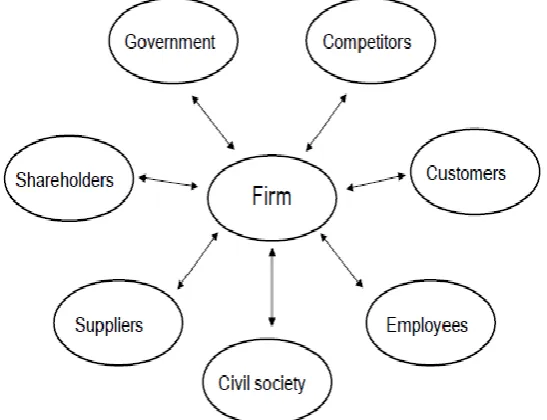
the organization is the hub of a wheel and stakeholders are at the ends of spokes around the rim (Freeman, 1999). It consisted of one central circle, or oval, representing the firm, surrounded by a variable number of other circles or ovals with bi-directional arrows toward and from the
cen-tral oval, each oval representing a group of stakeholders. Freeman’s original framework included eleven stakehold-ers on a non-exhaustive basis (Freeman, 1984). The most common version of the model (Figure 1) includes seven stakeholders.
Figure 1. The original stakeholder model (Freeman, 1984)
Descriptive, Instrumental, and Normative
Views of Stakeholder Theory
Donaldson and Preston (1995) described the descriptive, instrumental, and normative views of stakeholder theory to facilitate in understanding different features of this theory as follows:
a) Stakeholder theory is descriptive in the sense that “it describes the corporation as a constellation of cooperative and competitive interests possessing intrinsic value”.
b) Stakeholder theory is instrumental because “it
establishes a framework for examining the connections, if any, between the practice of stakeholder management and the achievement of various corporate performance goals”.
c) Finally, “the fundamental basis” of stakeholder theory is normative and involves acceptance of the fol-lowing ideas: stakeholders are persons or groups with le-gitimate interests in procedural and /or substantive aspects of corporate activity” and “the interests of all stakeholders are of intrinsic value”.
d) Further, Donaldson and Preston (1995) justify their claim that the normative aspect is at the core of the stakeholder theory by exemplifying how the justifications for favoring stakeholder theory over other management theories ultimately rely upon normative arguments. They suggest that these three aspects can be viewed as nested circles (Figure 2).
Donaldson and Preston (1995) also suggested four central theses related to stakeholder theory.
a) Stakeholder theory is descriptive because it offers a model of the corporation.
b) Stakeholder theory is instrumental in offering a framework for investigating the links between conventional firm performance and the practice of stakeholder manage-ment.
c) Although Stakeholder theory is descriptive and in-strumental, it is more fundamentally normative. Stakehold-ers are identified by their interests, and all stakeholder inter-ests are considered to be intrinsically valuable.
d) Stakeholder theory is managerial because it rec-ommends attitudes, structures, and practices and requires that simultaneous attention should be given to the interests of all legitimate stakeholders.
Stakeholder Theories in Information Systems
Most references to stakeholders in the information sys-tems literature refer primarily to individuals or groups within the organization and contrary to the stakeholder lit-erature in strategic management (Pouloudi, 1999). Mum-ford (1979) is one of the early researchers in supporting the involvement of end-users as a component of effective in-formation systems development and implementation, using essentially the stakeholder concept in this domain. It has been proved that end-users and managers are very im-portant towards successful system implementation. As more inter-organizational information systems are devel-oped which usually involve a strategic decisions, a yet wider range of stakeholders needs to be involved (Pou-loudi, 1999). In these systems the attention may switch from end-users and focus on those parties that are external to the organization, but which can be associated in deci-sion-making at managerial or strategic level (Pouloudi & Whitely, 1997). According to Pouloudi, (1999) it is im-portant to note there is some confusion in information sys-tems research about the notion of stakeholders, and re-searchers do not offer a specific definition (Benjamin & Levinson, 1993; Eden & Ackermann, 1994; Galliers, 1994; Lee & Gough, 1993). For instance, Boddy and Buchanan (1986) explained that “organizations can be viewed as comprising different ‘stakeholder’ groups, whose interests in promoting or resisting change, or apathy to innovation, may be explained by identifying their respective perceived interests and by examining how they will be affected by
new technology”. Willcocks and Mason (1987) define the stakeholders of a computer system similar to Freeman as “people who will be affected in a significant way by, or have material interests in the nature and running, of the new computerized system”.
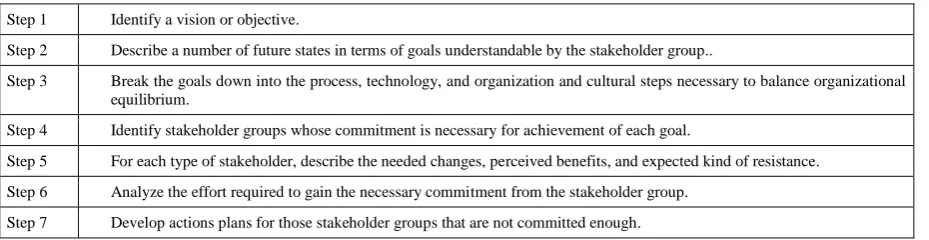
Ahn and Skudlark (1997) have provided an extended definition of the stakeholder in this way: “the stakeholders are a group of people sharing a pool of values that define what the desirable features of an information system are and how they should be obtained”. Lederer and Mendelow (1990) observed the ‘environment’ of the information sys-tem department, and included the host organization’s envi-ronment as “everything within the organization that lies beyond the borders of the IS department”. Checkland in the soft systems methodology mentioned the requirement for stakeholder identification and the significance of under-lining different stakeholder’s perspectives, mainly by using the ‘CATWOE’ elements (customer, actor, transformation process, Weltanschauung, system owner, environmental constraints) (Checkland, 1981; Checkland & Scholes, 1990). This approach has the advantage that it can be used to provide a holistic representation of the information sys-tem, be it a part of whether an organization or an inter-organizational system in as broad an aspect as the “human activity system”. One of the most common instrumental approaches to the stakeholder analysis in the information systems field addresses one key issues in information sys-tems practice (Brancheau et al., 1996; Galliers & Baker, 1994; Knights et al., 1997), that is the development of the information systems strategy and its alignment with com-pany’s business strategy (Pouloudi, 1999). According to Lacity and Hirschheim (1995), a major obstacle for the alignment of information systems and business strategies is the conflicting expectations and perceptions of information systems that different organizational stakeholders hold. The senior management is mostly concerned with the cost, whereas the end-users are mostly concerned with the ser-vice. Information system managers are ‘caught in the mid-dle’ of a hostile environment and find that they need to jus-tify the agreement made with these groups. Benjamin and Levinson (1993) proposed a 7- step stakeholder analysis approach (Table 1) that will support the management of change enabled by IT. These steps have been expected to help the organization to determine whether the change is feasible, and also what modified in strategy can bring about better results.
Table 1
Stakeholder analysis (Benjamin & Levinson, 1993)
Step 1 Identify a vision or objective.
Step 2 Describe a number of future states in terms of goals understandable by the stakeholder group..
Step 3 Break the goals down into the process, technology, and organization and cultural steps necessary to balance organizational
equilibrium.
Step 4 Identify stakeholder groups whose commitment is necessary for achievement of each goal.
Step 5 For each type of stakeholder, describe the needed changes, perceived benefits, and expected kind of resistance.
Step 6 Analyze the effort required to gain the necessary commitment from the stakeholder group.
One of the most thorough investigations of the stake-holder concept in information systems research that relates information systems stakeholders with implementation failure has been made in early work by Lyytinen and Hirschheim (1988, 1987). They argue that failure is condi-tional on the capability of the information system to meet the expectations of different stakeholders (information
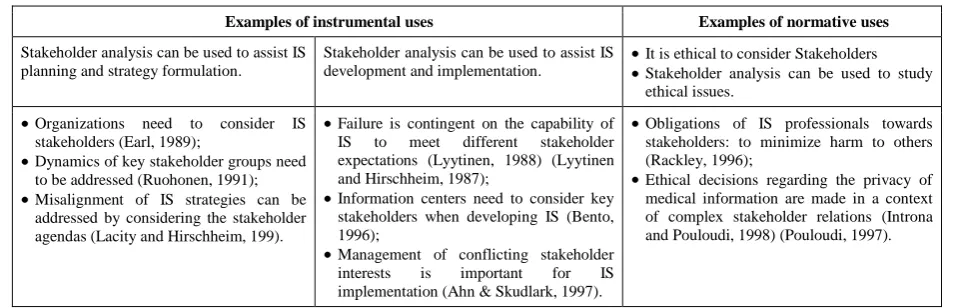
sys-tem may be considered successful by some stakeholders, but a failure by others). Whilst the stakeholder manage-ment literature concentrates on debating the normative use of the stakeholder concept, the information system litera-ture has remained focused on the instrumental perspective of stakeholder theory (Pouloudi, 1999), which has been summarized in Table 2.
Table 2
The use of stakeholder concept in information systems research (Pouloudi, 1999)
Examples of instrumental uses Examples of normative uses
Stakeholder analysis can be used to assist IS planning and strategy formulation.
Stakeholder analysis can be used to assist IS development and implementation.
It is ethical to consider Stakeholders Stakeholder analysis can be used to study ethical issues.
Organizations need to consider IS stakeholders (Earl, 1989);
Dynamics of key stakeholder groups need to be addressed (Ruohonen, 1991); Misalignment of IS strategies can be addressed by considering the stakeholder agendas (Lacity and Hirschheim, 199).
Failure is contingent on the capability of
IS to meet different stakeholder
expectations (Lyytinen, 1988) (Lyytinen and Hirschheim, 1987);
Information centers need to consider key stakeholders when developing IS (Bento, 1996);
Management of conflicting stakeholder
interests is important for IS
implementation (Ahn & Skudlark, 1997).
Obligations of IS professionals towards stakeholders: to minimize harm to others (Rackley, 1996);
Ethical decisions regarding the privacy of medical information are made in a context of complex stakeholder relations (Introna and Pouloudi, 1998) (Pouloudi, 1997).
Application of Stakeholder Theory in
Infor-mation Systems
Boddy and Buschanan (1986) define organizational in-formation system stakeholders as “all those who have a practical concern for the effective application of new tech-nologies, and who are in a position to take or to influence
decisions about why and how they are used”. There is a number of applications for stakeholder theory in the mation and Communication Technology (ICT) and Infor-mation Systems (IS) related areas. The stakeholder theory and its applications in IS and the allied areas along with the main results are summarized in Table 3.
Table 3
Applications of Stakeholder Theories in IS
Study Area Purpose Main Results
Fedoro-wicz et al..
(2010)
E-government By identifing legitimate
stakehol-ders and their concerns prior to the implementation, data controllers can reduce adoption and implemen-tation barriers in e-government data mining applications.
Drawing on stakeholder theory, a typology of four stakeholder groups (data con-trollers, data subjects, data providers, and secondary stakeholders) is proposed to address the privacy concerns, and further argue that by ensuring procedural fair-ness for the data subjects, agencies can reduce some barriers that impede suc-cessful adoption of e-government applications and policies.
Kamal et
al., (2011)
E-government To study the role of stakeholders
and the surrounding challenges when implementing TIS in LGAs as the TIS adoption process in-volves several stakeholders, each with their own specific domain knowledge and expertise that are crucial to the success of TIS pro-jects.
Proposed the concept of stakeholder theory to analyze the role of stakeholders during the Technology Integration Solutions (TIS) adoption process with regards to their perceptions on the factors influencing TIS adoption in Local Government Authorities (LGAs) and their involvement on the adoption lifecycle phases.
Lapointe et
al.,(2011)
Health
Infor-mation Tech-nology
Framework proposed to assess the actual impacts of health infor-mation technology (HIT) imple-mentation.
1.An assessment framework was developed to provide general guidance on how
to assess HIT impacts.
2.The proposed framework will be useful for researchers and practitioners as it
takes into account the underlying reasons for the HIT productivity paradox and identifies the salient outcomes of interests associated with HIT implementa-tion.
Yuthas & Dillard (1999)
Business Eth-ics
Based on stakeholder theory, the ethical development of advanced technology.
1.Proposed a stakeholder theory of enabling as one way to make the risks and
moral concerns associated with business AIT (Advanced Information Tech-nology) systems more visible.
2.Applying the principles of affirmative post-modern ethics through a
Study Area Purpose Main Results
Rowley (2010)
E-government Development of tools and
ap-proaches for understanding the benefits sought by a wide range of stakeholder groups in
e-government.
1.Successful e-government requires engagement of all stakeholders, and
prelim-inary to that engagement is a shared understanding of the interests, perspec-tives, value dimensions, and benefits sought from e-government by the various stakeholders roles.
2.Study proposed typologies of stakeholders roles, and stakeholder benefits, and
embedding these in the stakeholder benefits analysis tool (SBAT). This is de-signed to be used to support:
(i) The identification of stakeholders;
(ii) The recognition of differing interests amongst stakeholders; and (iii) The development of strategies to align stakeholder interests so that par-ticipation in e-government can be self-governing.
Chung, Chen & Reid (2009)
Business
Intel-ligence
Sys-tems
Proposes a framework for design-ing Business Intelligence (BI) sys-tems to identify and classify stake-holders on the Web.
1.Framework proposed for designing Business Intelligence Systems to identify
and classify stakeholders on the Web, incorporating human knowledge and machine-learned information from web pages.
2. Based on their framework a prototype called ‘Business Stakeholder
Analyz-er’ (BSA) is developed which helps managers and analysts to identify and classify their stakeholders on the Web.
3. Research results provide a better understanding of how to integrate
infor-mation technology (IT) with stakeholder theory towards enriching the knowledge base of business intelligence system design.
Islam & Gronlund (2007)
E-government To assesses an e-government
pro-ject using design-reality gap analy-sis and stakeholder theory.
1. It used stakeholder analysis and a gap analysis technique to assess an
e-Government project crucial for almost all developing countries – providing information to the Agriculture Market Information System.
2.The research suggests the use of mobile technologies in combination with call
centres and locally available human resources as the most important factors for e-government success.
Bailur, (2007)
Telecenter Pro-jects
Applying stakeholder theory to
analyze telecenter projects.
1.Analyze the applicability of a stakeholder perspective in development
infor-matics.
2.Provides preliminary framework for identification and management of
stake-holders.
3.Involving stakeholder is a much more complex activity than many of the
tele-center analysts cited earlier.
Lim, Ahn & Lee (2005)
Strategies for Stakeholders management
Proposes a methodology for formu-lating strategies for stakeholder management by the use of these RDAP (reactive, defensive, ac-commodative, or proactive) strate-gies.
1.Authors present a holistic way to integrate the most critical tasks surrounding
stakeholder management.
2.It employs a Case-Based Reasoning (CBR) technique and proposes a
methodology to help formulating stakeholder management strategies.
3.A system called the ‘Stakeholder Management Strategy Support System’
(SMSSS) is implemented to put the proposed methodology to work.
Chua et
al.,(2005)
E-commerce The Evolution of E-commerce
re-search : A stakeholder perspective.
1.This work surveys seven of the top nine e-Commerce journals to test the
prop-osition that stakeholder theory suggests that, as an emerging research disci-pline, e-Commerce research is likely to focus primarily on specific stakehold-ers and ignore othstakehold-ers.
2.Academic e-commerce researchers concentrate their attentions on two
stake-holder groups, specifically customers and internal organization (i.e., managers and employees) of the Net-Enhanced Organization (NEO).
Flak & Rose (2005)
E-government Adapting stakeholder theory to
e-government.
1.Apart from its original profit focus, there is no serious conceptual mismatch
between stakeholder theory and the government's objective of providing poli-cy and services for citizens and organizations - society's stakeholders.
2.The article discusses how information technology impacts a stakeholder model
of governance.
Dimovski & Skerlav-aj (2005)
Effect of ICT
on
organiza-tions
A Stakeholder theory approach to the organisational performance and influence of ICT.
1.Higher-level organizational learning leads to improved organizational
perfor-mance from the employee’s perspective.
2.Companies which focus their efforts into a systematic approach to
organiza-tional learning profit in terms of an augmented level of employee trust in the leadership, improved efficiency of work organization, a more committed workforce, reduced costs per employee, increased employee satisfaction, and increased employee flexibility.
Zhang, Dawes & Sarkis (2005)
E-government Exploring stakeholders’
expecta-tions of the benefits and barriers of e-government knowledge sharing.
1.There are significant differences among stakeholders groups based on the
types of organizational membership.
2.Local government stakeholders are considerably less optimistic in achieving
goals, and more concerned about a variety of organizational, technological, and financial barriers.
3.Research results indicated that key participants' expectations were similar to
those of general participants/users.
Study Area Purpose Main Results
Golden & Hughes (2004)
government: A stakeholder analysis approach.
implementation process, and implementation strategies often require particular attention to the social and political elements inherent in organisational change.
2.In e-government implementation, the main barriers are not technical but rather
social and cultural. Implementation strategies should, therefore, support the process of managing stakeholder relations in order to reduce the risk of stakeholder conflict and ensure the success of e-government initiatives.
Pouloudi et
al,. (1999)
Information System
Aspects of the stakeholder concept and their implication in IS.
1.The study investigated different perspectives of the stakeholder concept that
have been discussed in the literature along with shortcomings.
2.Stakeholder analysis can provide multiple and mutually supportive approaches
to the study and practice of information systems development, particularly if descriptive, instrumental and normative aspects are taken into account.
Smith & Hasnas (1999)
Information Systems
Study of the relationship between Ethics and Information Systems.
1.Information system had made great use of technology in the past two decades
but the growing number of ethical dilemmas also grew during the same time frame without receiving proper attention.
2.Future research should clarify obligations for individuals in non-profit or
pub-lic-sector organizations with a similar context.
Vidgen (1997)
Information System
Stakeholders, soft systems, and technology in the analysis of in-formation system requirements.
1.The application of stakeholder analysis and soft systems thinking for an
investigation of information system requirements.
2.A framework for investigating IS requirements is proposed that contrasts the
current situation with the future ones and the real world, specifically with conceptual thinking about the latter.
Cheng & Wang (2009)
Corporate Governance
To study the significance of establishing an independent director system.
1. As a system arrangement in corporate governance, designation of an
independent manager (director) will help to improve the structure of corporate governance, maintain interests of all stockholders, and protect rights and interests of small-and-medium size of investors.
2.There is a need to strengthen and optimize the independent director system
with a Chinese characteristic.
Ruohonen (1991)
Strategic
In-formation Sys-tem
To examine intra-group and inter-group relationships in the context of Strategic information systems planning (SISP)
1.Strategic information systems planning (SISP) requires the participation and
involvement of different managerial groups, and the key stakeholder groups in this process are the top management, user management, and IT/IS manage-ment.
2. Management education is needed to integrate the different views of managers
concerning the use of IT.
3.Successful SISP requires sound communication and the interpretation of these
different views. Lacity & Hirsch-heim (1995) Information System
Presented framework to understand the context of misalignment which can assist stakeholders clear out their differences to reach a general strategy.
1.Presented framework to understand the context of misalignment, which can
help stakeholders to resolve their differences to arrive at a common strategy for the portfolio of IS activities.
2.In the context of a shared strategy, the benchmarks targeted at performance
improvement — rather than turf- protection — can be achieved.
Bento (1993)
Information Centres
Analysis of Information Centres from major stakeholders’ perspec-tive.
1. A conceptual model, based on the role theory, is presented to explore the
special challenges of “life in the middle”, such as different expectations about the roles that should be performed by Information Centers (IC) professionals, different criteria for evaluating their performance, and different perceptions of their success.
2.These special challenges were empirically studied through in-depth interviews
with users, IS Managers and IC Managers, in a random national sample of forty-seven Fortune 500 companies.
3.The results indicate that, given the multiple expectations surrounding
Information Centers, IC professionals need to be flexible in adopting different roles, skilled in coping with different sets of performance criteria, and keenly aware of the highly subjective nature of the evaluations received from their diverse constituents.
Benjamin & Levin-son (1995)
Managing IT-Enabled Changes.
Framework for managing IT-enabled changes.
1. Develop a framework for managing IT-enabled changes.
2. The proposed framework provides a common language for managers
imple-menting IT-based modifications and showed how technology, business pro-cess, and organization must be adapted to each other for such changes to be ef-fective. Boonstra (2006) ERP- implementa-tion
ERP implementation effects on stakeholders.
1. Different stakeholders can view ERP-systems in different ways, according to
their own histories, interests, self-images, prospects, and views.
2.ERP-implementation is a dynamic process and therefore, the views held by
Discussion
Stakeholder theory provides the benefit of determining who is key in a project, and if and how they can be man-aged. Bailur (2006) has observed that the stakeholders analysis involves the use of categorization that is quite sub-jective as it matters who conducts the analysis and makes the distinction between “important and/or influential” or “primary or secondary” in her project case. She argues that it is difficult to know how to identify stakeholders, whether they are primary or secondary, what their interests might be, how they might work together, and if and how they can be managed. In addition, stakeholders involved in a project change all the time which makes difficult to label them. Freeman (1984) explained this through what he calls the “snail darter fallacy”. Chung et al., (2009) also acknowledge that stakeholder - type classifications as a limitation of their study and include this in their future work plan to automate such analysis in business stakehold-er analyzstakehold-er prototypes. The management of competing stakeholders has emerged as an important weapon for stra-tegic management, and stakeholders need to be categorized for the better utilization of rules for generating appropriate strategies (Lim et al., 2005). Rowley (2010) stressed that there is a need to do more work towards the understanding of government stakeholder roles and benefits in e-government with the help of stakeholder benefits analysis tools. Flaks and Rose (2005) observed that there is no seri-ous conceptual mismatch between stakeholder theory and a government's objective of providing policy and services for citizens and organizations - a society's stakeholders. Islam and Gronlund (2007) have found stakeholder theory useful to understand e-services but state that it lacks in adaptation to stakeholder preferences, needs, capabilities, as well as in project resources including staff supply and qualifications. Over time, stakeholder preferences evolve and their stakes change based upon the strategic issues considered relevant at a particular point in time (Freeman, 1984). Post et al., (2002) also supported that successful stakeholder management also involves learning, because stakeholder characteristics and interests change over time. The five stakeholder groups identified in management theory (Friedman & Miles, 2002; Argandona, 1998) are the firm’s suppliers, consumers, employees, competitiors and government/regulatory agencies. Freeman et al., (2004) suggested that “business is about putting together a deal so that the suppliers, customers, managers and shareholders all win continuously in the course of time. Stakeholder satisfaction is critical for organizations in order to obtain a license to operate and produce output, and to gain resources and trust and, therefore, to be competitive and successful in the long run (Susniene & Vanagas, 2007). Strengthened cross-border co-operation between all stake-holders is necessary to reach the goal of trust infrastructure in the organizations (Gatautis & Vitkauskaite, 2009).
It has been observed in our rigorous literature review that stakeholder theory has been applied to different domains in the following order: Government (8), E-Commerce and Information System (9), Business Ethics (1), Health Information Technology (1), Business Intelligence Systems (1), Strategies for stakeholder management (1).
Stakeholder theory has become sıgnificant in the present context due to its application not only in these contexts but also implications in ethical, policy and startegic dimensions. In E-government and ınformation projects and implementation stakeholders contribution is very significant and without this it will be impossible to accomplish projects objectives. It is also interesting to note the observation by Roberts and Mahoney (2004) who have examined 125 accounting studies that used the stakeholder language and found that nearly 65 percent “use the term stakeholder without reference to any version of stakeholder theory”. The important thing is that writers use the same label to refer to a lot different concepts. This of course can have great consequences on ethical, policy, and strategic conclusions. Although there are limitations of stakeholder theory still it is significant as it is related with organiza-tional management, business ethics, cultural and other re-lated issues that address values and morals in managing an organization.
Vidgen (1997) proposed future work in terms of IS requirements framework in the context of the wider IS development process based on stakeholder analysis. The stakeholder theory claims that managers should resolve ethical quandaries by balancing stakeholder interests with-out violating the rights of any stakeholder (Smith & Hasnas, 1999). Whereas stakeholders are more broadly and emotionally involved in the system development process, they may be more likely to embrace the outcomes of these systems when end-users are involved in the development. Whats more, such these systems are more likely to meet better the needs and concerns of the stakeholders (Yuthas & Dillard, 1999). Chua et al., (2005) argued that at least four stakeholder groups, namely investors, suppliers, regulators, and indirect stakeholders, will increasingly demand the at-tention of NEOs, and, therefore, should be the focus of ex-pansion and research among IS and e-Commerce specialist. Boonstra (2006) illustrated that ERP-implementation can have an influence on the interests of stakeholders, and be perceived as a negotiation process where various parties try to use the ERP project to defend or to advance their individ-ual or group interests. According to him, there are some di-rections for future research to turn the stakeholder approach into a comprehensive ERP/ICT project analysis. Also, cul-ture affects the use of ICT in significant ways (Akman & Mishra, 2010). Therefore, it will be interesting to study how culture and ICT contribute to stakeholder manage-ment with different information system applications.
Conclusions
Upon the literature review and examination of prevail-ing viewpoints in the respect, it becomes apparent that stakeholder theory can have an impact in different stages of IS and technology. Stakeholder analysis is a very effec-tive mechanism for carrying needs and interest into the planning process and, from there, into the organization’s performance. Also, a more thorough understanding of the stakeholder’s interests and their alliance into the organiza-tions operational plans is also detrimental important in this process. It is evident from literature review and analysis that majority of stakeholder theory applications in information systems are related to government, E-commerce and information systems domains. Business ethics, health information technology, and business intelligence systems are other areas of stakeholder theory applications.
Therefore, from the IS perspective, stakeholder theory provides insights on the organizational, strategic, ethical, cultural and at project levels for:
Managers in understanding multilateral stake-holder relationships in organizations. Stakestake-holder analysis will help in study of inter-organizational systems and in-formation system planning and strategy formulation.
Service Providers in identification of stakeholders and development of stakeholder typologies.
Users where they can understand managerial atti-tudes, structures, and practices adopted in information sys-tem development and implementation.
Developers, in choosing the early correct perspec-tives on stakeholder management to ensure success of a project. Good stakeholder management can also lead to the higher project performance.
Acknowledgement
The authors gratefully acknowledge editor, reviewers and Dr. Yogesh K. Dwivedi of Swansea University, U.K. for his in-sightful feedback towards improvement of the paper.
References
Ackoff, R. L. (1974). Redesigning the future. New York: Wiley.
Ahn, J. H., & Skudlark, A. E. (1997). Resolving Conflict of Interests in the Process of an Information System Implementation for Advanced Telecommunication Services. Journal of Information Technology, 12, 3-13. http://dx.doi.org/10.1080/026839697345170
Akman, I., & Mishra, A. (2010). Predictive Effect of Gender and Sector Differences on Internet Usage among Employees.
Inzinerine Ekonomika-Engineering Economics, 21(3), 295-305.
Argandona, A. (1998). The Stakeholder Theory and the Common Good. Journal of Business Ethics, 17(9/10), 1093-1102. http://dx.doi.org/10.1023/A:1006075517423
Bailur, S. (2007). Using Stakeholder Theory to Analyze Telecenter Projects. Information Technologies and International Development, 3(3), 61-80. http://dx.doi.org/10.1162/itid.2007.3.3.61
Bento, R. F. (1996). Life in the Middle: an Analysis of Information Centers From the Perspective of Their Major Stakeholders. Information & Management, 30, 101-109. http://dx.doi.org/10.1016/0378-7206(95)00051-8
Benjamin, R. I., & Levinson, E. (1993). A Framework for Managing IT-Enabled Change. Sloan Management Review, Summer 1993, 23-33.
Boddy, D., & Buchanan, D. A. (1986). Managing New Technology. Oxford: Basil Blackwell.
Boonstra, A. (2006). Interpreting an ERP Implementation from a Stakeholder Perspective. International Journal of Project Management, 24(1), 38-52. http://dx.doi.org/10.1016/j.ijproman.2005.06.003
Brancheau, J. C., Janz, B. D., & Wetherbe, J. C. (1996). Key Issues in Information Systems Management: 1994-95 SIM Delphi Results. MIS Quarterly, 20 (2), 225-242. http://dx.doi.org/10.2307/249479
Checkland, P. (1981). Systems Thinking, Systems Practice. Chichester: Wiley.
Checkland, P., & Scholes, J. (1990). Soft Systems Methodology in Action. Chichester: John Wiley and Son.
Chung, W., Chen, H., & Reid, E. (2009). Business Stakeholder Analyzer: An Experiment of Classifying Stakeholders on the Web, Journal of the American Society for Information science and Technology, 60(1), 59-74. http://dx.doi.org/10.1002/asi.20948
Chua, C. E. H., Straub, D. W., Khoo, H. M., Kadiyala, S., & Kuechler, D. (2005). The Evolution of E-Commerce Research: A Stakeholder Perspective. Journal of Electronic Commerce Research, 6(4), 262-279.
Cheng and Wang (2009). Study of Independent Director System in Corporate Governance. Asian Social Science, 5(7), 65-69.
Dimovski, V., & Skerlavaj, M. (2004) A Stakeholder theory Approach to the Organisational Performance and Influence of Information-Communication Technology: Model Conceptualisation and Testing. Economic and Business Review for Central and South - Eastern Europe, 6(3), 245-265.
Donaldson, T., & Preston, L. (1995). The Stakeholder Theory of the Modern Corporation: Concepts, Evidence and Implications. Academy of Management Review, 20, 65-91.
Earl, M. J. (1989). Management Strategies for Information Technology. London: Prentice-Hall.
Eden, C., & van der Heijden, K. (1993). The Relationship between Stakeholder Analysis and Scenario Planning (Paper Presented in the Strategy Seminar, at the London School of Economics), Strathclyde Business School.
Eden, C., & Ackermann, F. (1994). Horses for Courses - a Stakeholder view of the Evaluation of GDSS’s (Paper presented to the TIMS/ORSA Conference).
Fassin, Y. (2008). Imperfections and Shortcomings of the Stakeholder Model's Graphical Representation. Journal of Business Ethics, 80(4), 879-888.
Fedorowicz, J., Gogan, J. L., & Culnan, M. J. (2010). Barriers to Interorganizational Information Sharing in E-Government: A Stakeholder Analysis. The Information Society 26(5), 315-329. http://dx.doi.org/10.1080/01972243. 2010.511556
Flak, L. S., & Rose, J. (2005). Stakeholder Governance: Adapting Stakeholder theory to E-Government. Communications of the Association for Information Systems, 16(31), 1-46.
Flood, R. L., & Jackson, M. C. (1991). Creative Problem Solving: Total Systems Intervention. Chichester: Wiley.
Freeman, R. E., Wicks, A. C., & Parmar, B. (2004). Stakeholder theory and “the Corporate Objective Revisited”. Organization Science, 15(3), 364-369. http://dx.doi.org/10.1287/orsc.1040.0066
Freeman, R. E. (1984). Strategic Management : A Stakeholder Approach. Boston: Pitman.
Friedman, A., & Miles, S. (2006). Stakeholders: Theory and Practice, Oxford University Press, Oxford.
Friedman, A. L., & Miles, S. (2002). Developing Stakeholder Theory. Journal of Management Studies, 39(1), 1-21. http://dx.doi.org/10.1111/1467-6486.00280
Friend, J., & Hickling, A. (1987). Planning Under Pressure: the Strategic Choice Approach. Oxford: Pergamon Press. Frooman, J. (1999). Stakeholder Influence Strategies. Academy of Management Review, 24(2), 191-205.
Galliers, B. (1994). Information and IT strategy. In J. Keen (Eds.). Information Management in Health Services (pp. 147-170). Buckingham: Open University Press.
Galliers, R. D., & Baker, B. S. H. (Ed.). (1994). Strategic Information Management: Challenges and strategies in Managing Information Systems. Oxford: Butterworth Heinemann.
Garriga, E., & Mele, D. (2004). Corporate Social Responsibility Theories: Mapping the Theory. Journal of Business Ethics, 53(1/2), 51-71. http://dx.doi.org/10.1023/B:BUSI.0000039399.90587.34
Gatautis, R., & Vitkauskaite, E. (2009). eBusiness Policy Support Framework. Inzinerine Ekonomika-Engineering Economics(5), 35-47.
Gibson, K. (2000). The Moral Basis of Stakeholder Theory. Journal of Business Ethics, 26(3), 245-257. http://dx.doi.org/10.1023/A:1006110106408
Gilbert, D. R., Hartman, E., Mauriel, J. J., & Freeman, R. E. (1988). A Logic for Strategy. Cambridge, Mass.: Ballinger Publishing Co.
Hill, C. W. L., & Jones, T. M. (1992). Stakeholder-Agency Theory. Journal of Management Studies, 29(2), 131-154. http://dx.doi.org/10.1111/j.1467-6486.1992.tb00657.x
Introna, L., & Pouloudi, A. (1998). Privacy in the Information Age: Stakeholders, Interests and Values. In J. Van den Hoven, S. Rogerson, T. W. Bynum, & D. Gotterbarn (Ed.), ETHICOMP98 - The Fourth International Conference on Ethical Issues of Information Technology, (pp. 340-352). Erasmus University, Rotterdam, The Netherlands.
Islam, S., & Gronlund, A. (2007). Agriculture Market Information E-Service in Bangladesh: A Stakeholder-Oriented Case Analysis. In Wimmer, M., Scholl, H.J., Grönlund, A. (2007) (Eds) EGOV 07. 6th International Conference EGOV 07, Regensburg, Germany, September 3-6, 2007, Proceedings. Springer Lecture Notes in Computer Science #4656. Jawahar, I. M., & McLaughlin, G. L. (2001). Toward a Descriptive Stakeholder Theory: An Organizational Life Cycle
Approach. Academy of Management Review, 26(3), 397-414.
Jones, T. M. (1995). Instrumental Stakeholder Theory: A Synthesis of Ethics and Economics. Academy of Management Review, 20(2), 404-437.
Kamal, M. M, Weerakkody, V., & Irani, Z. (2011). Analysing the Role of Stakeholders in the Adoption of Technology Integration Solutions in UK Local Government: An Exploratory Study. Government Information Quarterly, 28 (2), 200- 210. http://dx.doi.org/10.1016/j.giq.2010.08.003
Knights, D., Noble, F., & Willmott, H. (1997). We Should be Total Slaves to the Business: Aligning Information Technology and Strategy - Issues and Evidence. In B. P. Bloomfield, R. Coombs, D. Knights, & D. Littler (Eds.), Information Technology and Organizations: Strategies, Networks, and Integration (pp. 13-35). Oxford: Oxford University Press. http://dx.doi.org/10.1093/acprof:oso/9780198289395.003.0002
Lacity, M. C., & Hirschheim, R. (1995). Benchmarking as a Strategy for Managing Conflicting Stakeholder Perceptions of Information Systems. Journal of Strategic Information Systems, 4(2), 165-185. http://dx.doi.org/10.1016/0963-8687(95)80023-J
Lapointe, L., Mignerat, M., & I. Vedel. (2011). The IT Productivity Paradox in Health: A Stakeholder's Perspective. Inter-national Journal of Medical Informatics, 80(2), 102-115. http://dx.doi.org/10.1016/j.ijmedinf.2010.11.004
Lederer, A. L., & Mendelow, A. L. (1990). The Impact of the Environment on the Management of Information Systems. Information Systems Research, 1 (2), 205-222. http://dx.doi.org/10.1287/isre.1.2.205
Lee, G., & Gough, T. (1993). An integrated framework for information systems planning and its initial application. Journal of Information Technology, 8, 227-240.
Lim, G., Ahn, H., & Lee, H. (2005). Formulating Strategies for Stakeholder Management: a Case-Based Reasoning Approach. Expert System Applications, 28(4). 831-840. http://dx.doi.org/10.1016/j.eswa.2004.12.038
Lyytinen, K., & Hirschheim, R. (1987). Information Systems Failures - a Survey and Classification of the Empirical Literature. In Oxford Surveys in Information Technology. Oxford: Oxford University Press, 257-309.
Lyytinen, K. (1988). Stakeholders, IS failures and soft systems methodology: an assessment. Journal of Applied Systems Analysis, 15, 61-81.
Mitchell, R. K., & Agle, B. R. (1997). Toward a Theory of Stakeholder Identification and Salience: Defining the Principle of Who and What Really Counts. Academy of Management Review, 22(4), 853-886.
Post, J. E., Preston, L. E., & Sachs, S. (2002). Managing the Extended Enterprise: The New Stakeholder View. California Management Review, 45(1), 6-28. http://dx.doi.org/10.2307/41166151
Pouloudi, A. (1999). Aspects of the Stakeholder Concept and their Implication for Information Systems Development. Proceedings of the 32nd Hawaii International Conference on System Sciences, Maui, Hawaii, 7030-7046.
Pouloudi, A. (1997). Conflicting Concerns Over the Privacy of Electronic Medical Records in the NHSnet. Business Ethics: A European Review, 6 (2), 94-101. http://dx.doi.org/10.1111/1467-8608.00056
Pouloudi, A., & Whitley, E. A. (1997). Stakeholder Identification in Interorganizational Systems: Gaining Insights for Drug use Management Systems. European Journal of Information Systems, 6(1), 1-14. http://dx.doi.org/10.1057/ palgrave.ejis.3000252
Rackley, L., Betts, J., & Webb, J. (1996). Conflicts of Loyalty - the Client Versus the User and the Stakeholder. In P. Barroso, T. W. Bynum, S. Rogerson, & L. Joyanes (Ed.), ETHICOMP96 - III International Conference: Values and Social Responsibilities of the Computer Science, (pp. 351- 363). Pontificial University of Salamanca in Madrid, Spain.
Rowley, J. (2010). E-Government Stakeholders—Who are they and what do they want?, International Journal of Information Management; doi:10.1016/j.ijinfomgt.2010.05.005 http://dx.doi.org/10.1016/j.ijinfomgt.2010.05.005 Ruohonen, M. (1991). Stakeholders of Strategic Information Systems Planning: Theoretical Concepts and Empirical
Examples. Journal of Strategic Information Systems, 1(1), 15-28. http://dx.doi.org/10.1016/0963-8687(91)90004-3 Scott, M., Golden, W., & Hughes, M. (2004). Implementation Strategies for E-Government: A Stakeholder Analysis
Approach. Proceedings of the Twelfth European Conference on Information Systems, Turku, Finland.
Smith, H. J., & Hasnas, J. (1999). Ethics and Information Systems: The Corporate Domain. MIS Quarterly, 23(1), 109-128. http://dx.doi.org/10.2307/249412
Susniene, D., & Sargunas, G. (2009). Prerequisites of Stakeholder Management in an Organization. Inzinerine Ekonomika-Engineering Economics (2), 58-64.
Susniene, D., & Vanagas, P. (2007). Means for Satisfaction of Stakeholders’ Needs and Interests. Inzinerine Ekonomika-Engineering Economics (5) 24-28.
Valor, C. (2005). Corporate Social Responsibility and Corporate Citizenship: Towards Corporate Accountability. Business & Society Review, 110(2): 191-212. http://dx.doi.org/10.1111/j.0045-3609.2005.00011.x
Wagner, I. (1993). A Web of Fuzzy Problems: Confronting the Ethical Issues. Communications of the ACM, 36 (4), 94-101. http://dx.doi.org/10.1145/153571.163290
Willcocks, L., & Mason, D. (1987). Computerising Work:People, Systems Design and Workplace Relations. London: Paradigm.
Willetts, D. (1997). The Poverty of Stakeholding. In G. Kelly, D. Kelly, & A. Gamble (Eds.), Stakeholder Capitalism (20-28). Basingstoke: Macmillan.
Wolfe R. A., & Putler, D. S. (2002). How Tight are the Ties That Bind Stakeholder Groups? Organizational Science, 13 (1): 64-82. http://dx.doi.org/10.1287/orsc.13.1.64.544
Yuthas, K., & Dillard, J. F. (1999). Ethical Development of Advanced Technology: A Postmodern Stakeholder Perspective. Journal of Business Ethics. 19(1), 35-49. http://dx.doi.org/10.1023/A:1006145805087
Zhang, J., Dawes, S. S., & Sarkis, J. (2005). Exploring Stakeholders' Expectations of the Benefits and Barriers of E-Government Knowledge Sharing. Journal of Enterprise Information Management, 18(5/6), 548-567. http://dx.doi.org/10.1108/17410390510624007
Alok Mishra, Deepti Mishra
Suinteresuotųjų šalių teorijos pritaikymai informacinėse sistemose ir technologijose
Santrauka
Suinteresuotųjų šalių teorijos sąvoka minima jau literatūroje apie valdymą. Preston (1999) teigia, kad Jungtinėse Valstijose (1929-1941), General
Electrical Company nustatė keturias svarbiausias suinteresuotųjų šalių grupes: akcininkai, darbuotojai, vartotojai ir plačioji visuomenė. Suinteresuotųjų
šalių valdymas tapo svarbiu įrankiu kalbant apie etiką ir valdymą. Keletas valdymo klausimų sukėlė daugiau diskusijų, nei sąvokos reikšmė, modelis ir teorijos ( Donaldson ir Preston, 1995; Gibson, 2000; Wolfe ir Putler, 2002; Friedman ir Miles, 2006). Akivaizdi suinteresuotųjų šalių modelio galia ir jo paprastumas vertinami kaip įnašas suinteresuotųjų šalių koncepcijos sėkmei (Fassin, 2008). Pastebėtas didėjantis tarpusavio ryšys tarp suinteresuotųjų ša-lių teorijos, bendrosios atsakomybės ir verslo etikos sąvokų (Valor, 2005; Garriga ir kt., 2004). Suinteresuotųjų šaša-lių sąvoka rodo progresą, atsiribojimą nuo problemų, sutelktų į kūrėją ir vartotoją. Tai informacinių sistemų tyrimo brandos ženklas norint parodyti, kaip išsivystė dabartinis holistinis šalių, da-lyvaujančių daug sudėtingesnėse sistemose, vaizdas (Pouloudi, 1999). Suinteresuotųjų šalių teorijoje yra siūlomas etinis suinteresuotųjų šalių sąvokos naudojimas informacinėse sistemose, nes etiniai svarstymai ir profesionalus elgesys yra svarbi informacinių sistemų tema.
Freeman (1984) savo dideles suinteresuotųjų šalių grupes padalino į dvi grupes: į vidaus (vartotojai, darbuotojai, tiekėjai, savininkai) ir išorės (vy-riausybės, konkurentai, tam tikro suinteresuotumo grupės ir t.t.). Nors vidaus grupės vertinamos kaip „pagrindinės“, kai kuriose situacijose išorės suinte-resuotosios šalys yra svarbesnės ir jos negali būti iš anksto nukreiptos į pagalbinę poziciją ( Bailur, 2007). Toliau skirstoma į pradines ir antrines suintere-suotąsias šalis. Clarkson (1995) apibrėžia pradines suinteresuintere-suotąsias šalis kaip šalis „be kurių tęstinio dalyvavimo koorporacija negali išgyventi kaip veikianti įmonė“. Jei šios pradinės suinteresuotosios šalys pasitraukia arba jų netenkina sistema, „koorporacija bus rimtai pažeista arba nebegalės tęsti veiklos “. Jis įrodinėjo, kad pradinių suinteresuotųjų šalių parama gali būti prarasta, jei organizacija negali kurti ir skirstyti pakankamai turto ir vertės, kad jas patenkintų, arba jei daugiau turto ar vertės yra duodama vienai pradinei suinteresuotųjų šalių grupei kitos grupės sąskaita. Tai priverstų jas pasitraukti iš sistemos. Iš kitos pusės, antrinės suinteresuotųjų šalių grupės yra tos, kurios turi „pajėgumų mobilizuoti visuomenės nuomonę koorporacijos veiklos naudai arba priešingai“.
Suinteresuotųjų šalių teorija yra plačiai taikoma valdyme nagrinėjant organizacijos aplinką, strateginį valdymą, etinius klausimus, verslo planavimo procesą, e-valdymą, projekto valdymą, aplinkos valdymą ir t.t. Pastaruoju metu suinteresuotosios šalys taip pat yra vertinamos ir kaip dar sėkmingesnio informacinių ir komunikacinių technologijų tobulinimo ir įdiegimo priemonė. Šiame darbe analizuojama suinteresuotųjų šalių teorija, jos kilmė ir pritai-kymas Informacinės sistemos (IS) srityje.
Dauguma nuorodų į suinteresuotąsias šalis mokslinėje literatūroje, kurioje analizuojamos informacinės sistemos, pirmiausia nurodo asmenis arba grupes organizacijos viduje, o strateginio valdymo literatūroje priešingai (Pouloudi, 1999). Mumford (1979) yra vienas iš tyrinėtojų, kuris remia vartotojų įtraukimą, laikydamas tai efektyvios informacinės sistemos plėtros ir diegimo dalimi. Buvo įrodyta, kad galutiniai vartotojai ir vadovai yra labai svarbūs sėkmingam sistemos diegimui. Kadangi plėtojama daugiau tarporganizacinių informacinių sistemų, kurios dažniausiai apima strateginius sprendimus, reikia įtraukti dar didesnę suinteresuotųjų šalių grupę (Pouloudi, 1999). Šiose sistemose, dėmesys gali būti perkeltas nuo galutinių vartotojų ir sutelktas į tas dalis, kurios organizacijai yra išorės, tačiau gali bendradarbiauti priimant sprendimus vadovavimo arba strateginiu lygiu (Pouloudi ir Whitely, 1997). Anot Pouloudi, (1999) svarbu pabrėžti, kad tiriant informacines sistemas yra tam tikros maišaties dėl suinteresuotųjų šalių sąvokos. Kai kurie tyrėjai ne-siūlo tikslaus apibrėžimo (Benjamin ir Levinson, 1993; Eden ir Ackermann, 1994; Galliers, 1994; Lee ir Gough, 1993). Boddy ir Buchanan (1986)
aiški-na, kad „organizacijas galima vertinti kaip apimančias skirtingas suinteresuotųjų šalių grupes, kurių interesai, remiant pokyčius ar jiems priešinantis, gali
būti paaiškinti nustatant atitinkamai suvokiamus jų interesus ir išnagrinėjant kaip juos paveiks nauja technologija “. Willcocks ir Mason (1987) apibrėžia kompiuterinės sistemos suinteresuotąsias šalis panašiai kaip Freeman, kaip „žmones, kuriuos labai paveiks, arba kurie turės materialinės naudos iš naujos kompiuterinės sistemos ir veiklos ”.
Ahn ir Skudlark (1997) pateikė išplėstinį suinteresuotųjų šalių apibrėžimą taip „suinteresuotosios šalys yra grupė žmonių, kurie dalinasi bendromis vertybėmis, kurios parodo, kokios informacinės sistemos savybės yra pageidaujamos ir kaip jos turėtų būti įgytos”. Lederer ir Mendelow (1990) stebėjo
informacinės sistemos skyriaus aplinką ir įtraukė organizacijos šeimininkės aplinką kaip ir „viską esantį organizacijos viduje, kas yra už IS skyriaus ribų
”. Checkland metodologijoje paminėjo reikalavimą nustatyti suinteresuotąją šalį ir svarbą pabrėžti skirtingų suinteresuotųjų šalių perspektyvą,
daugiau-siai naudojant CATWOE (plg. angl. customer – vartotojas, actor – veikėjas, transformation process – transformacijos procesas, Weltanschauung –
pasau-lio požiūris, system owner – sistemos savininkas, environmental constraints – aplinkos suvaržymai) elementus (Checkland, 1981, Checkland ir Scholes, 1990). Šio metodo privalumas yra tas, kad jį galima panaudoti norint pateikti holistinį informacinės sistemos vaizdą jei ji kaip žmogiškos veiklos sistema „būtų organizacijos arba tarporganizacinės sistemos dalis platesniu aspektu. Vienas iš įprasčiausių pagalbinių būdų suinteresuotųjų šalių analizei infor-macinių sistemų srityje atkreipia dėmesį į vieną iš pagrindinių inforinfor-macinių sistemų praktikos temų (Brancheau ir kt., 1996; Galliers ir Baker, 1994; Knights ir kt., 1997), tai yra į informacinių sistemų strategijos plėtrą ir jos sureguliavimą su verslo strategija (Pouloudi, 1999). Anot Lacity ir Hirschheim (1995), svarbiausia kliūtis informacinių sistemų ir verslo strategijų sureguliavimui yra susikertantys informacinių sistemų lūkesčiai ir suvokimas, kurie skiriasi nuo tų, kuriuos turi įvairios organizacinės suinteresuotosios šalys. Aukštesnė vadovybė labiausiai rūpinasi išlaidomis, o vartotojams labiausiai rū-pi paslaugos. Informacinių sistemų vadovai patenka į priešišką aplinką ir supranta, kad jie turi pateisinti su šiomis grupėmis sudarytą susitarimą. Benja-min ir Levinson (1993) pasiūlė 7 žingsnių suinteresuotųjų šalių analizės metodą, kuris paremtų valdymą pokyčių, kuriems atsirasti leido informacinės te-chnologijos. Jie tikisi, kad šie žingsniai padės organizacijai nustatyti ar pokytis yra galimas ir kokia pokyčių strategija duos geresnių rezultatų.
ją nesėkminga). Boddy ir Buschanan (1986) organizacinės informacinės sistemos suinteresuotąsias šalis apibrėžia kaip „visus tuos, kurie praktiškai rūpi-nasi efektyviu naujų technologijų pritaikymu, ir kurie gali priimti sprendimus, arba daryti jiems įtaką, dėl to kodėl ir kaip jos yra panaudojamos“.
Suinteresuotųjų šalių teorija yra naudinga, kai norima išskirti kas yra svarbu projekte ir ar jis gali būti valdomas ir kaip. Bailur (2006) savo projekte teigė, kad suinteresuotųjų šalių analizė yra subjektyvi. Ji įrodinėjo, kad sunku žinoti kaip nustatyti suinteresuotąsias šalis: ar jos yra pradinės ar antrinės ir kokie galėtų būti jų interesai, kaip jos galėtų dirbti kartu, bei ar jos gali būti valdomos. Suinteresuotosios šalys keičiasi viso projekto laikotarpiu, tai sun-kina jų vertinimą. Chung ir kt. (2009) taip pat manė, kad suinteresuotųjų šalių tipų klasifikacijos riboja jų tyrimą ir įtraukė tai į savo būsimųjų darbų pla-ną. Konkuruojančių suinteresuotųjų šalių valdymas atsirado kaip svarbus ginklas strateginiam valdymui ir suinteresuotųjų šalių poreikiui būti suskirsty-toms į kategorijas norint geriau panaudoti atitinkamų strategijų kūrimo taisykles (Lim ir kt., 2005). Rowley (2010) pabrėžė, kad reikia atlikti daugiau tyrimų, norint suprasti e-valdymo suinteresuotųjų šalių vaidmenis ir naudą e-valdyme su suinteresuotųjų šalių naudos analizės įrankiais. Flaks ir Rose (2005) pastebėjo, kad nėra rimto konceptualaus neatitikimo tarp suinteresuotųjų šalių teorijos ir valdymo tikslo, pateikiant politiką ir paslaugas gyvento-jams ir organizacijoms – visuomenės suinteresuotosioms šalims. Islam ir Gronlund (2007) mano, kad suinteresuotųjų šalių teorija yra naudinga, norint suprasti e-paslaugas, bet ji neprisitaiko prie suinteresuotųjų šalių teikiamų pirmenybių, poreikių, gebėjimų, taip pat ir tokių projekto resursų kaip
aprūpinimas personalu ir kvalifikacija. Bėgant laikui suinteresuotosios šalies pirmenybės tobulėja, todėl kinta jų gairės. Post ir kt. (2002) manė, kad
sėkmingas suinteresuotųjų šalių valdymas apima ir mokymąsi, nes suinteresuotujų šalių interesai keičiasi laikui bėgant. Valdymo teorijoje nustatytos penkios suinteresuotųjų šalių grupės (Friedman ir Miles, 2002; Argandona, 1998). Tai įmonės tiekėjai, vartotojai, darbuotojai, konkurentai ir vyriausybė/reguliuojančios įstaigos. Freeman ir kt. (2004) manė, kad „verslas yra veikimas kartu taip, kad tiekėjai, vartotojai, vadovai ir akcininkai, laikui bėgant laimėtų“. Vidgen (1997) pasiūlė būsimojo darbo temą apie IS reikalavimų struktūrą platesnio IS plėtojimosi proceso mastu, pagrįstą suinteresuotųjų šalių analize. Suinteresuotųjų šalių teorijoje tvirtinama, kad vadovai turėtų išspręsti etines dvejones keliančius klausimus, kartu suderindami suinteresuotųjų šalių interesus, nepažeisdami nė vienos pusės interesų (Smith ir Hasnas, 1999). Suinteresuotosios šalys yra daug daugiau įtrauktos į sistemų plėtros procesą. Jos gali pasinaudoti šių sistemų rezultatais. Chua ir kt. (2005) teigė, kad mažiausiai keturios suinteresuotųjų šalių grupės, būtent investuotojai, tiekėjai, kontoliuotojai ir netiesioginės suinteresuotosios šalys, reikalauja vis didesnio NEO dėmesio ir todėl turėtų patraukti IS ir e-komercijos sričių mokslininkų dėmesį. Boonsra (2006) pailiustravo, kad ERP-įdiegimas daro įtaką suinteresuotųjų šalių interesams ir gali būti ver-tinamas kaip derybų procesas, kuriame įvairios šalys bando panaudoti ERP projektą, norėdamos apginti arba paskubinti savo individualius arba grupės interesus. Anot jo, egzistuoja tam tikros būsimųjų tyrimų kryptys norint paversti suinteresuotųjų šalių metodą išsamia ERP/ICT projekto analize.
Raktažodžiai: suinteresuotųjų šalių teorija, suinteresuotųjų šalių modelis, suinteresuotosios šalys, informacinės sistemos, valdymas.
The article has been reviewed.