https://doi.org/10.5194/jm-37-249-2018
© Author(s) 2018. This work is distributed under the Creative Commons Attribution 4.0 License.
Modified cleaning method for biomineralized
components
Hideto Tsutsui1,aand Richard W. Jordan1
1Department of Earth & Environmental Sciences, Faculty of Science,
Yamagata University, 1-4-12 Kojirakawa-machi, Yamagata 990-8560, Japan acurrent address: Marine Microorganism Ecology, Division of Marine Biology & Dynamics,
Department of Fisheries, Faculty of Fisheries, Nagasaki University, Bunkyo-cho 1-14, Nagasaki 852-8521, Japan
Correspondence:Hideto Tsutsui ([email protected])
Published: 5 February 2018
Abstract. The extraction and concentration of biomineralized components from sediment or living materials is time consuming and laborious and often involves steps that remove either the calcareous or siliceous part, in addition to organic matter. However, a relatively quick and easy method using a commercial cleaning fluid for kitchen drains, sometimes combined with a kerosene soaking step, can produce remarkable results. In this study, the method is applied to sediments and living materials bearing calcareous (e.g., coccoliths, foraminiferal tests, holothurian ossicles, ichthyoliths, and fish otoliths) and siliceous (e.g., diatom valves, silicoflagellate skeletons, and sponge spicules) components. The method preserves both components in the same sample, without etching or partial dissolution, but is not applicable to unmineralized components such as dinoflagellate thecae, tintinnid loricae, pollen, or plant fragments.
1 Introduction
Extracting and cleaning microfossils from sediments or meralized components from living materials is often labor in-tensive and time consuming, and microscopic observation at each step is sometimes impractical, or in the case of danger-ous chemicals, not advisable. Science often requires speed or efficient recovery, but usually it is difficult to combine both in a single method. Hence, a variety of methods have been developed to satisfy one or the other requirement. These in-clude the use of sodium sulfate, sodium hydroxide, boron, hydrochloric acid, zinc chloride, hydrogen fluoride, hydro-gen peroxide, acetone, ethanol, liquid nitrohydro-gen, potassium permanganate, hot water, and naphtha (e.g., Franke, 1922; Bourdon, 1962; Nishida, 1969; Hanken, 1979; Faegri et al., 1989; Shiono and Jordan, 1995; Lirer, 2000; Nielsen and Jakobsen, 2004; Abrantes et al., 2005; Remin et al., 2012; Jarochowska et al., 2013; Ikeya and Chinzei, 2007; Oda and Sato, 2013). Some extraction methods may require particu-lar pieces of equipment, e.g., a sand bath, water bath, ultra-sonic bath, dry oven, refrigerator, stirrer, settling chamber,
250 H. Tsutsui and R. W. Jordan: Modified cleaning method for biomineralized components
biogenic silica (e.g., radiolarians, diatoms, sponge spicules) in their samples, although hydrogen fluoride is known to dissolve both crystalline and amorphous silica (Liang and Readey, 1987).
Nishida (1969) has already documented a separation and enrichment method for coccoliths and silicoflagellates in the Houjyuji diatomites of Noto Peninsula, Japan, using a cen-trifuge and showed that no damage occurred to the calcare-ous nannofossils using this sodium hypochlorite extraction method.
Nagumo (1995) reported a preparation method for diatoms using a kitchen drain cleaning fluid (Pipe Unish produced by SC Johnson). This method dissolves the conjugated proteins of diatoms and can reduce and easily control the cleaning process time without any special chemicals (Nagumo, 1995). Similarly, Yoshida et al. (2006) extracted holothurian ossi-cles using a household bleaching agent (Haiter produced by Kao), which contains sodium hydroxide, sodium hypochlo-rite, and a polyoxyethylene alkyl ether sulfate sodium salt. Sodium hydroxide dissolves the proteins in the holothurian skin.
Oda and Sato (2013) summarized a useful extraction method for siliceous (e.g., radiolarians, diatoms) and calcare-ous (e.g., coccoliths, foraminifers) microfossils in sediments using sodium sulfate with naphtha. The advantage of this method is the rapid separation of the microfossils from the sediments. However, naphtha is difficult to purchase because it is registered as a category 4, class 1 oil in hazardous ma-terials under the Fire Service Act in Japan (2008). Also, this method has some possibility of damaging the coccoliths dur-ing the cooldur-ing tension of sodium sulfate.
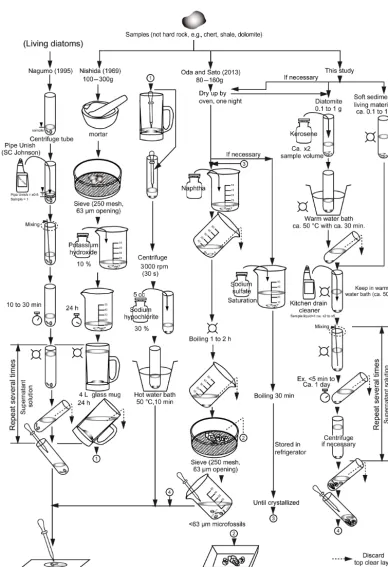
In summary, these three methods (Nishida, 1969; Nagumo, 1995; Yoshida et al., 2006; see Fig. 1), as well as the one using acetic acid (Jarochowska et al., 2013), are useful for the preliminary extraction of the sample from the sediment.
Therefore, in this study, the methods of Nishida (1969) and Nagumo (1995) were modified and improved in order to (1) provide a faster, easier, and simpler process; (2) reduce the quantity of chemicals needed for extraction and avoid the use of hazardous chemicals; and (3) reduce the damage to calcareous microfossils (e.g., coccoliths) during the chemical extraction.
2 Materials and methods
2.1 Materials
In this study, a wide range of materials were collected from various places, including diatom-bearing sediments (Sup-plement Fig. S1a–b), living holothurians (Fig. S1c, e), fish otoliths (Fig. S1d), and marine lake sediments (Fig. S1e). A diatomite sample of early Eocene age from Mors, Denmark (e.g., Chambers et al., 2003; Collins et al., 2005; Jørgensen et al., 2005), and a diatom-bearing sample of late Eocene–
1997; Novitski and Kociolek, 2005), were obtained from out-crops. Of the living holothurians from nearshore environ-ments, one was collected from Peyrefite Bay in France, oth-ers were from Yaese-cho, Shimajiri, and Taketomi Island in Okinawa; Guam; or Bohol in the Philippines. The samples from the French coast and from Bohol were dried in nat-ural sunlight, while those from Okinawa and Guam were soaked in 95 % ethyl alcohol. The sailfin sandfish ( Arctosco-pus japonicus) were caught in two places: off Shonai, Yam-agata, and Karo, Tottori, Japan. The marine lake sediments from Jellyfish Lake (JFL) on Mecherchar Island (also known as Eil Malk Island) in the Republic of Palau were obtained by a diver from <10 m water depth in October 2001 (Kawagata et al., 2005a, b). The East China Sea sediment was obtained in August 2016 during the NS16-442 cruise of the T/S Na-gasaki Maru.
2.2 Extraction method
The method for extracting calcareous and siliceous compo-nents from diatom-bearing outcrop sediments, a calcareous layer from a marine lake core, and living materials is basi-cally the same, although in the case of the latter, the kerosene step (2) is omitted. Kerosene is used to infiltrate the gaps in-side diatomite or other older sediments; however, most mod-ern sediment samples are still wet, so the kerosene step is not appropriate because kerosene is immiscible in water. The method described below can be seen in the flow chart pre-sented in Fig. 1.
1. Approximately 1 g of sample is placed in a 50 cc screw-cap centrifuge tube (as it is easier to concentrate the ma-terial at the bottom of the tube) and the mama-terial is al-lowed to dry at 50◦C for about 2 h. If the sediment or sample is still hard, it is recommended to crush it using a mortar and pestle (e.g., Nishida, 1969).
2. An equal volume of kerosene is then added and allowed to soak into the sample for about 2 h. The kerosene is then removed and can be recycled if the kerosene is fil-tered using a 0.2 µm pore size filter paper.
252 H. Tsutsui and R. W. Jordan: Modified cleaning method for biomineralized components
4. The centrifuge tube is then placed in a warm water bath maintained at 50◦C because the warm temperature ac-celerates the chemical reaction and helps to reduce the amount of chemicals and processing time.
5. After the particles have settled to the bottom of the cen-trifuge tube, the clear fluid at the top of the tube can be discarded and replaced by the same volume of dis-tilled water. This washing step is repeated a minimum of five times. The whole process is finished when no more bubbles appear after shaking the tube. Sometimes the supernatant develops very slowly; thus, it may be nec-essary to use a centrifuge to reduce the working time.
The pellet at the bottom of the centrifuge tube may in-clude both calcareous and siliceous components, as well as clay minerals and volcanic ash particles. However, centrifu-gation is often the best way to remove clays (Lentfer and Boyd, 1999), although use of detergents is another well-known method (e.g., sodium pyrophosphate in Bates et al., 1978) – here, both centrifugation and detergent (a constituent of Look Pipeman) are used. If the extraction process goes smoothly, then the total time for this procedure is about 5– 12 h. Living materials can be extracted much more quickly (i.e., no kerosene step) and sometimes a smaller amount of sample can be used. For instance, if<0.2 g of holothurian skin is placed in the centrifuge tube, the mean extraction time will be<1 min. However, in general, it takes a minimum of 5 min to a maximum of 1 day.
2.3 Sample observation
After the extraction, permanent mounts using Mountmedia (Wako Pure Chemical Industries, Ltd.) or temporary mounts using microscopic immersion oil (IMMOIL-50CC, Olym-pus) were prepared and the samples were checked with a phase contrast objective lens on an Olympus BX40 light microscope, and photographed using an NY-1S relay lens (Micronet, Co., Ltd.) and a Canon EOS Kiss X6i camera. When necessary, samples were also observed in a JEOL JSM-6510LV scanning electron microscope (SEM).
3 Results
3.1 Observations on treated and untreated fossil materials
Plate S1 in the Supplement shows the condition of the un-treated samples in water; see Pl. S1, figs. 1a–b and 2a–b for the results from the diatom-bearing sediments of Mors and Oamaru, respectively, and fig. 3a–b for the JFL sediments.
The treated material from the Mors diatomite (see Pl. 1, fig. 1, and figs. 2 and 3 for open and polarized light mi-crographs, respectively) revealed the presence of both cal-careous (coccoliths) and siliceous (diatom and
silicoflagel-the diatom-bearing sediment from Oamaru (see Pl. 1, fig. 4) possessed diatoms and silicoflagellates. The microfossils in the JFL sediment are shown in Pl. 1, figs. 5–8: several foraminifera (Pl. 1, figs. 5–6), an ichthyolith (Pl. 1, fig. 7), and an unidentified calcareous microfossil, probably a juve-nile foraminifer (Pl. 1, fig. 8).
3.2 Extraction from living material
The diatoms in Pl. 1, figs. 9–16, taken with a SEM, were ex-tracted from the intestine of the holothurianHolothuria atra from Okinawa. In addition, the diatoms from Pl. 2, figs. 1– 3 were found in the intestine of the holothurianH. forskali from the Mediterranean Sea. The coccoliths from Pl. 2, figs. 4–10 were also found in theH. atraintestine. Otoliths of the sailfin sandfish (Arctoscopus japonicus), caught off the Shonai and Karo coasts, are shown in Pl. 2, fig. 11a– b, respectively. Plate 2, figs. 12–17 are modern holothurian ossicles, sampled from Bohol, the Mediterranean Sea, and Guam. The mineralized components shown in Pl. 2, figs. 18– 22 were found in the intestine of the holothurianH. forskali, and include silicoflagellates (Pl. 2, figs. 18–19) and sponge spicules (Pl. 2, figs. 20–22).
Plate S2 shows the step-by-step situation during the wash-ing process of East China Sea sediment (Pl. S2, figs. 1a–f) and Holothuria leucospilota ossicles from an animal col-lected at Taketomi Island (Pl. S2, fig. 2a–f). Plate S2 also includes the photomicrographs taken of the discarded super-natant part (Pl. S2, fig. 1b0–e0 for the sediment and Pl. S2, fig. 2b0–e0 for the ossicles) and the remaining pellet (Pl. S2, fig. 1f0for the sediment and Pl. S2, fig. 2f0 for the ossicles). The supernatant did not contain any microfossils or ossicles. This is likely due to the difference in specific weight between the kitchen drain cleaner and the microfossils and ossicles, with the kitchen drain cleaner being the lighter one. In the case of the sediment, the supernatant part can be seen in Pl. S2, fig. 1c–e, first reaching the>20 mL mark (Pl. S2, fig. 1c) and finally the>30 mL mark (Pl. S2, fig. 1e) of the centrifuge tube. Plate S2, fig. 1e represents a time close to the termination of the washing process. In the case of the holothurian, the skin is removed during the washing process between the stages shown in Pl. S2, fig. 2c and d after termi-nation of the bubbling.
4 Discussion
ex-Plate 1.Photomicrographs of the water mounts of the treated material.(1, 3)Mors diatomite, open nicols.(2)Mors diatomite, cross nicols. Many coccoliths were observed in cross nicols.(4)Oamaru diatom-bearing sediment. A centric diatom (Stephanopyxissp.) and silicoflagel-late (Naviculopsissp.) can be seen in(4).(5–8)JFL sediments.(5)Ammoniasp. (foraminifer).(6)Biserial type of foraminifer.(7)Ichthyolith.
(8)Presumably a juvenile foraminifer.(9–16)Diatoms found in the intestine ofHolothuria atrafrom Okinawa.(9)Lyrellasp.(10)Paralia
254 H. Tsutsui and R. W. Jordan: Modified cleaning method for biomineralized components
Plate 2.Observations on smear slides of treated living material.(1–3)Diatoms in the intestine ofH. forskalifrom the western Mediterranean
Sea.(1)Diploneis sp.(2)Surirellasp. (3)Unidentified centric. (4, 6–8)Coccoliths in the intestine ofH. atrafrom Okinawa.(4) Cal-cidiscus tropicus.(6)Reticulofenestra pseudoumbilicus.(7)Braarudosphaera bigelowii.(8)Coccolithus pelagicus.(5, 9–10)Coccoliths in the intestine ofH. forskalifrom the western Mediterranean Sea.(5)Reticulofenestra perplexa.(9)Watznaueriacf.biporta.(10) Eifel-lithuscf.turriseifellii.(11a–b)Otoliths of the sailfin sandfish (Arctoscopus japonicus) from Japanese waters.(12–17)Holothurian ossicles.
processing of a wide range of materials, both living and fos-sil. It involves two main chemicals, kerosene and kitchen drain cleaner fluid, both of which are cheap, easy to obtain, and easy to discard afterwards. Kerosene, used here as a sub-stitute for naphtha in the Oda and Sato method (2013), is a familiar fuel oil for room heaters or hot water supply systems in Japan, while the kitchen drain cleaning fluid can be bought at a reasonable cost at supermarkets, drug stores, or do-it-yourself or daily grocery shops in Japan. Similar nonacidic products are also available in other countries. However, if acidic products are used the calcareous microfossils includ-ing coccoliths will be dissolved, so care must be taken when choosing the kitchen drain cleaner fluid.
5 Conclusions
1. The improved method using kerosene and/or kitchen drain cleaner liquid is a useful procedure for study-ing biogenic siliceous and calcareous materials (e.g., coccoliths, silicoflagellates, diatoms, sponge spicules, holothurian ossicles, foraminifers, and fish otoliths) in various types of sample.
2. The advantage of this method is that both the calcareous and siliceous components can be cleaned up at the same time, without noticeable dissolution or etching.
3. This method can reduce the total cleaning time to min-utes or hours instead of days, seemingly without any de-merit, and involves neither any dangerous or expensive chemicals nor the need for special safety measures for discarding waste chemicals. The sample and chemical volumes can also be reduced.
Data availability. All the data in this project are shown herein or
in the Supplement.
Supplement. The supplement related to this article is available
online at: https://doi.org/10.5194/jm-37-249-2018-supplement.
Competing interests. The authors declare that they have no
con-flict of interest.
Acknowledgements. We would like to thank the following
peo-ple for providing the material used in this study. The holothurian samples from the Mediterranean Sea and Guam were sent to us by Catherine Riaux-Gobin and Guillerme Iwankow (University of Perpignan/CNRS, France) and by Alex Kerr (University of Guam), respectively. The diatom-bearing samples from Mors and Oamaru were provided by Emma Sheldon (Geological Survey of Denmark and Greenland) and Jakub Witkowski (Natural Sciences Education and Research Centre, University of Szczecin), respectively. The sediment sample of East China Sea was taken by Yasuhiro Morii
(ship captain) and associate Nobuhiro Yamawaki (chief officer) of the T/SNagasaki Maru, which belongs to the Faculty of Fisheries, Nagasaki University. The holothurian sampling in Okinawa was coordinated by Ikuko Uezato and Yuki Uezato. Hisako Kudo and Hiroko Tsutsui acquired the sailfin sandfish from Shonai and Karo, respectively. The SEM microphotographs were taken by Ryohei Fujita, a past master course student in our laboratory. The paper benefited from the constructive comments of the two reviewers, Xavier Crosta and Jakub Witkowski, as well as of the journal editor, Taniel Danelian.
Edited by: Taniel Danelian
Reviewed by: Xavier Crosta and Jakub Witkowski
References
Abrantes, F., Gil, I., Lopes, C., and Castro, M.: Quantitative diatom analyses – a faster cleaning procedure, Deep-Sea Res. Pt. I, 52, 189–198, 2005.
Bates, C. D., Coxon, P., and Gibbard, P. L.: A new method for the preparation of clay-rich sediment samples for palynological in-vestigation, New Phytol., 81, 459–463, 1978.
Bourdon, M.: Méthode de dégagement des microfossiles par acétol-yse à chaud, Compte rendu sommaire des séances de la Société géologique de France, 267–268, 1962.
Chambers, L. M., Pringle, M., Fitton, G., Larsen, L. M., Pedersen, A. K., and Parrish, R.: Recalibration of the Paleocene-Eocene boundary (P-E) using high precision U-Pb and Ar-Ar isotopic dating, Abstract, EGS-AGU-EUG Joint Assembly Nice, 2003. Collins, J. S. H., Schulz, B. P., and Jabosen, S. L.: First record of
brachyuran decapods (Crustacea, Decapoda) from Fur Formation (early Eocene) of Mors and Fur Island, Denmark, Bulletin of the Mizunami Fossil Museum, 32, 17–22, 2005.
Faegri, K., Kaland, P. E., and Krzywinski, K.: Textbook of pollen analysis, IV Edn., Botanical Institute, University of Bergen, Nor-way, John Wiley and Sons, Co., Ltd., 1989.
Fire Service Act: Act No. 186 of 1948, amendment in Act 41 of 2008, translated into English on the Ministry of Justice, Japan, available at: http://www.japaneselawtranslation.go.jp/law/ detail/?printID=&re=02&id=1994&lvm=01&vm=02 (last ac-cess: 31 January 2018), 2008.
Franke, A.: Die Präparation von Foraminiferen und anderen mikroskopischen Tierresten, in: Lehrbuch der praktischen Ge-ologie, Mineralogie, und PalaeontGe-ologie, edited by: Keilhack, K., 4th Edn., Enke-Verlag, Stuttgart, 509–533, 1922.
Hanken, N. M.: The use of sodium tetraphenylborate and sodium chloride in the extraction of fossils from shales, J. Paleontol., 53, 738–740, 1979.
Ikeya, N. and Chinzei, K.: Microfossils, 2nd Edn., translated by: Armstrong, H. A. and Brasier, M. D., Asakura Publishing Co., Ltd., 276 pp., 2007 (in Japanese).
Jarochowska, E., Tonarová, P., Munnecke, A., Ferrová, L., Sklenˇr, J., and Vodrážková, S.: An acid-free method of microfossil ex-traction from clay-rich lithologies using the surfactant Rewoquat, Palaeontol. Electron., 16, 16 pp., 2013.
256 H. Tsutsui and R. W. Jordan: Modified cleaning method for biomineralized components
Kawagata, S., Yamasaki, M., and Jordan, R. W.: Acarotrochus lobulatus, a new genus and species of shallow water benthic foraminifer from Mecherchar Jellyfish Lake, Palau, NW Equa-torial Pacific Ocean, J. Foram. Res., 35, 44–49, 2005a.
Kawagata, S., Yamasaki, M., Genka, R., and Jordan, R. W.: Shallow-water benthic foraminifers from Mecherchar Jellyfish Lake (Ongerul Tketau Uet), Palau, Micronesica, 37, 215–233, 2005b.
Lee, D. E., Scholz, J., and Gordon, D. P.: Paleoecology of a late Eocene mobile rockground biota from North Otago, New Zealand, Palaios, 12, 568–571, 1997.
Lentfer, C. J. and Boyd, W. E.: An assessment of techniques for the deflocculation and removal of clays from sediments used in phytolith analysis, J. Archaeol. Sci., 26, 31–44, 1999.
Liang, D. and Readey, D. W.: Dissolution of crystalline and amor-phous silica in hydrofluoric-hydrochloric acid mixtures, J. Am. Ceram. Soc., 70, 570–577, 1987.
Lirer, F.: A new technique for retrieving calcareous microfossils from lithified lime deposits, Micropaleontology, 46, 365–369, 2000.
Nagumo, T.: Simple and safe cleaning methods for diatom samples, Diatom, 10, 88, 1995 (in Japanese).
Nielsen, J. K. and Jakobsen, S. L.: Extraction of calcareous macro-fossils from the upper Cretaceous white chalk and other sedi-mentary carbonates in Denmark and Sweden: The acid-hot water method and the water blasting technique, Palaeontol. Electron., 7, 11 pp., 2004.
Nishida, S.: Some observations on the microfossils by a new tech-nique, Bulletin of the Nara University of Education, 17, 89–102, 1969 (in Japanese with English abstract).
Novitski, L. and Kociolek, P.: Preliminary light and scanning elec-tron microscope observations of marine fossilEunotiaspecies with comments on the evolution of the genusEunotia, Diatom Res., 20, 137–143, 2005.
Oda, M. and Sato, T.: New edition of the manual for microfos-sil researches, Asakura Publishing Co., Ltd., 110 pp., 2013 (in Japanese).
Remin, Z., Dubicka, Z., Kozlowska, A., and Kuchta, B.: A new method of rock disintegration and foraminiferal extraction with the use of liquid nitrogen [LN2]. Do conventional methods lead to biased paleoecological and paleoenvironmental interpreta-tions?, Mar. Micropaleontol., 86–87, 11–14, 2012.
Shiono, M. and Jordan, R. W.: Recent diatoms of Lake Hibara, Fukushima Prefecture, Diatom, 11, 31–63, 1995.
World Health Organization: Essential medicines WHO model list, 19th Edn., 51 pp., 2015.