COMPRESSIVE STRENGTH AND WORKABILITY OF
LATERIZED QUARRY SAND CONCRETE
E. E. Ambrose
1,*, D. U. Ekpo
2, I. M. Umoren
3and U. S. Ekwere
41,2,3,4,
DEPARTMENT OF CIVIL ENGINEERING, AKWA IBOM STATE UNIVERSITY, AKWA IBOM STATE, NIGERIA.
Email addresses:
1[email protected]
,
2[email protected],
3[email protected],
4[email protected]
ABSTRACT
This paper presents an experimental study on workability and compressive strength of concrete using various combinations of lateritic sand and quarry sand as complete replacement for conventional river sand fine aggregate. Quantity of lateritic sand varied from 0 to 50% against quarry dust at interval of 10%. Concrete cubes were prepared for two mix ratios: 1:1.5:3 and 1:2:4 and three water/cement ratios: 0.5, 0.6 and 0.7 and were cured and tested in the laboratory for compressive strength. Slump tests were also carried out for each mix. For each mix and water/cement ratios, control samples were also prepared using river sand as fine aggregate. The resulting concrete cubes fall within the range for normal weight concrete and although laterized quarry dust concrete had poorer workability, their compressive strength compare favourably with those of conventional concrete. The use of laterized quarry sand concrete for structural members is therefore recommended when laterite content is not more than 50%.
Keywords: Compressive Strength, Concrete, Lateritic Sand, Quarry Sand, Workability
1. INTRODUCTION
As the world population increases, with a continuous and rapid increase in urbanization, so does the demand for housing and other infrastructures and hence the demand for concrete and its constituents. It is estimated that 33 billion tonnes of concrete are manufactured globally on a yearly basis and this makes concrete the second most consumed material after water [1]. Basically, concrete is a series of aggregates bonded together by a binder which is usually hardened cement paste formed by hydration of Portland cement [2]. In Nigeria and most other countries, river sand is traditionally used as fine aggregate in concrete production. The continuous mining of sand from our rivers has led to environmental degradation and unchecked depletion in its natural reserve [3]. Hence, many sand mining sites have been closed because of the damage they cause to the environment and these have led to scarcity of the product. Moreover, because of scarcity of the product, it is often transported from relatively distance places at high cost. The need for an economic alternative fine aggregate material is therefore obvious.
To solve this problem, several attempts have been made to either partially or completely replace river
sand with other materials in concrete production. Such materials have included laterite and quarry dust. Formed as a result of weathering of basalt under humid, tropic condition; laterite is a mixture of clayey iron and aluminum oxides and hydroxides [4] and it is abundantly available in tropical regions including Nigeria. Concrete containing laterites are termed laterized concrete [5]. Research on properties of laterized concrete has yielded positive results. Udoeyo et al [6] investigated properties of concrete with partial and complete replacement of sand with laterite and observed that the workability of the resulting concrete was directly proportional to the percentage of laterite while compressive strength, split tensile strength, flexural strength and water absorption were inversely proportional to the level of sand replacement with laterite. It was however concluded that laterized concrete with 0 to 40% laterite content produces compressive strength of up to 20MPa. Ettu et al [7] studied the suitability of using laterite as the sole fine aggregate in concrete production using several mix proportions. It was reported that a reasonable number of mix compositions produced laterized concrete that met the minimum compressive strength of 25MPa for reinforced concrete as specified by BS 8110: 1997. It
Vol. 37, No. 3, July 2018, pp.
605 – 610
Copyright© Faculty of Engineering, University of Nigeria, Nsukka,Print ISSN: 0331-8443, Electronic ISSN: 2467-8821
www.nijotech.com
was also observed that the resulting concrete had an average density of 22.81kN/m3 which was lower than 24kN/m3, an average value for traditional concrete. Similar improved results were also obtained by Osadebe and Nwakonobi [8] on density, flexural strength, compressive strength and modulus of elasticity
Quarry dusts on the other hand are quarry fines generated during crushed rock aggregate quarrying. The particle sizes are usually less than 5mm, with rough texture and sharp and angular shapes – properties suitable for enhanced aggregate-cement paste bonding. Therefore, incorporation of quarry dust in concrete production will not only conserve the scarcely available river sand, but will reduce the requirement of landfill area around quarry sites and solves the associated environmental problems. In a study by Prakash and Rao [9] on compressive strength of quarry dust concrete, it was observed that concrete with partial replacement of river sand with quarry dust produced better compressive strength than conventional concrete up to 40% replacement level – a report in line with that of Sukesh et al [10]. Author therefore discouraged replacement of up to 50% with quarry dust. However, Ilangovana et al [11] had reported that concrete with 100% quarry dust as fine aggregate produced compressive strength and flexural strength of nearly 10% higher than those of conventional concrete. Similar work by Sivarkumar and Prakash [12] on concrete with 100% replacement of river sand with quarry dust shows that the resulting concrete samples out-performed the reference concrete samples in terms of compressive strength, split tensile strength and modulus of elasticity. However, the said concrete required more superplasticizer content than conventional concrete to produce workable mix.
In an experiment with replacement of river sand with waste marble dust – a byproduct of marble production – at 0, 25, 50 and 100% by weight [13], compressive strength, unit weight and ultrasonic pulse velocity increased as the percentage of marble dust addition increased while porosity decreased as the percentage of marble dust addition increased. These improved properties were attributed to the filler effect of waste marble dust (because of its finer particle size compared to river sand) which produce more compact microstructure and plays noticeable role in hydration process. Moreover, marble dust possess pozolanic property [14].
Studies have also been carried out on a combination of more than one material to replace river sand. Hameed
and Sekar [14] reported an experiment on concretes with complete replacement of river sand with equal proportions of quarry dust and marble sludge powder. From the report, chemical compositions of the replacement materials were comparable to that of cement and the resulting concrete performed excellently and better than reference concrete in terms of compressive strength, split tensile strength, permeability and resistance to sulfate attack. Jayaraman et al [15] investigated the compressive and tensile strength of concrete with varying combinations of lateritic sand and limestone filler as fine aggregate. The result showed that concrete with 0 to 50% of laterite content possessed improved or similar compressive and tensile strengths compared to conventional concrete. The optimum combination was 25% laterite: 75% limestone filler. Similar studies have also been carried out by [4] and [16] but both used quarry dust in place of limestone filler. Ukpata et al [4] investigated the workability and compressive strength of concrete using varying combinations of lateritic sand and quarry dust as complete replacement for river sand. The study used mix compositions of 1:1:2, 1:1.5:3 and 1:2:4 with water/cement ratios of 0.5. 0.6 and 0.7. The results compared favourably with those of conventional concrete. Samples with 0 to 50% laterite content outperformed samples with either 100% laterite or 100% quarry dust. The optimum composition was 25% laterite: 75% quarry dust. The results of [16] were also in the same trend but the optimum combination was 30% laterite: 70% quarry dust. It therefore seems that for laterized quarry dust concrete, the best results – especially in terms of compressive strength – are obtained between 0 to 50% of lateritic sand content.
The use of laterite and quarry dust as fine aggregate in concrete production has still not been generally accepted in design and construction despite the potential economic and sustainability benefits. This is obviously because of the lack of standard specifications for these materials as constructions materials. This study aims at generating additional data on the workability and compressive strength of laterized quarry dust concrete with concentration on 0 to 50% laterite content. This is to support the specification of laterite and quarry dust as concreting materials.
2. MATERIALS AND METHODS 2.1 Materials
2.1.1 Binder
cement was manufactured by Dangote Cement and was purchased at Mkpat Enin Local Government Area of Akwa Ibom State in 50kg bags. Potable water was used, as supplied within the main campus of Akwa Ibom State University.
2.1.2 Aggregates
The fine aggregates used were lateritic sand (LS), quarry dust (QD) and river sand (RS) while crushed granite chippings was used as coarse aggregate (CA). Size separation of fine and coarse aggregates was in accordance with BS EN 206:2013 [17]. The laterite was obtained from a borrow pit site at Ekim in Mkpat Enin Local Government Area of Akwa Ibom State. Quarry dust and granite chippings were acquired from a dealer in Uyo who gets the products from Akamkpa Quarry Site in Cross River State. The river sand used was obtained from a river sand mining site at Ikot Ekong, Mkpat Enin Local Government Area of Akwa Ibom State. The materials were air dried in the labouratory before use. Particle size distributions of fine aggregates and coarse aggregate are shown in Table 1 and Table 2 respectively while specific gravities and bulk densities of all the aggregates are shown in Table 3.
2.2 Preparation of Samples
Concrete batching was carried out by weight based on two prescribe mix ratios (1:1.5:3 and 1:2:4). The fine aggregate portions of the mixes were obtained by combining laterite and quarry dust, with laterite content ranging from 0 to 50% with a step of 10%. For 1:1.5:3 mix, this was carried out for each of 0.5, 0.6 and 0.7 water/cement ratios (w/c) while for 1:2:4 mix, it was carried out for only 0.6 w/c. Preparation and curing of concrete specimens were in accordance with BS EN 12390-2:2009 [18]. Mixing was carried out manually in the laboratory and the fresh concrete was
filled in layers into 100x100x100 mm3 moulds with each layer manually compacted with a tampering rod. Concrete samples were left in the moulds for 24 hours before de-moulding and were cured by immersion in water. For each of the mix ratios and their respective water/cement ratios, control samples were also prepared with river sand as the sole fine aggregate.
2.3 Test Methods 2.3.1 Workability Test
Consistency of each mix was measured using slump test in accordance with BS EN 12350-2:2009 [19].
2.3.2 Compressive Strength Test
Specimens for compressive strength tests were 100x100x100 mm3 concrete cubes and the tests were carried out in accordance with BS EN 12390-3:2009 [20]. For 1:1.5:3 mix and 0.6 w/c, samples were tested on the 7th, 14th, 21st and 28th day while for 0.5, 0.7 water/cement ratios and 1:2:4 mix, tests were carried out on only the 28th day. For each test, 3 samples were tested and the average results were as presented in Section 3.
3. RESULTS AND DISCUSSIONS
3.1 Physical Properties of Materials and Concrete The results of physical properties of LS, QD, RS and CA used for this study are presented in Tables 1 to 3. The specific gravity and bulk density values are similar to the results of Ukpata et al. [4] except for the bulk density of LS which was 1226 kg/m3 against the result of [4] that was 1460 kg/m3. This is obviously due to the fact that bulk density of soils depends greatly on mineral compositions of the soil and the degree of compaction and these varies with location. Results of particle size distributions of the four materials are presented in Tables 1 and 2.
Table 1: Particle Size Distributions of LS, QD and RS
Sieve Size (mm) 3.35 2.00 1.70 0.85 0.425 0.300 0.212 0.075 Receiver
%Passing
LS 100 99.87 99.75 97.98 86.66 75.61 55.18 23.47 0
QS 100 88.34 83.36 67.52 53.57 45.22 33.71 16.29 0
RS 100 97.45 95.79 84.65 53.88 27.54 9.84 2.24 0
Table 2: Particle Size Distributions of CA
Sieve Size (mm) 28 20 13.20 13 10 8 6.75
% Passing 100 98.02 93.56 90.57 43.54 18.41 0
Table 3: Physical Properties of Aggregates
LS QD RS CA
Specific gravity 2.61 2.67 2.65 2.87
a) 0.6 w/c b) 0.7 w/c Figure 1: Effect of Replacement on Workability (1:1.5:3 mix)
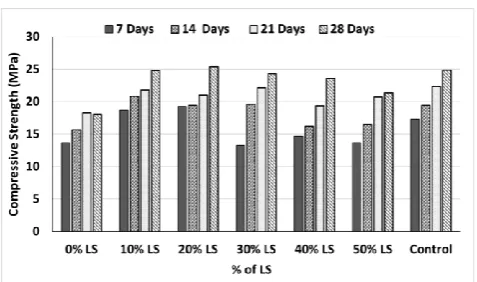
Figure 2: Variation of Compressive Strength with Age at Different % of LS (1:1.5:3 mix and 0.6 w/c)
Figure 3: Variation of Compressive Strength with Age at Different % of LS (1:2:4 mix and 0.6 w/c)
Particle size of LS, QD and RS all fall within the specified range for fine aggregate materials [21]. Saturated Surface Dry densities of the laterized concretes ranges from 2388 to 2559 kg/m3. This is within the range for normal weight concrete as specified in BS EN 206:2013 [17]. That is 2000 to 2600kg/m3.
3.2 Effect of Replacement on Workability of Concrete For 1:1.5:3 mix with 0.5 w/c, the slump height was 0 for all the laterite contents. Same was the case for 1:2:4 mix with 0.6 w/c. However, their control mixes had
slump heights of 23mm and 25mm respectively. The slump test results of 0.6 and 0.7 w/c (1:1.5:3) were as shown in Figure 1. The results show that the laterized concrete is not workable at 0.5 w/c (1:1.5:3) and 1:2:4 mix (0.6 w/c) given the fact the control mixes for both cases were workable. This is in line with the reports of past researchers [4, 22]. It has been recommended that the most suitable mix composition for structural laterized concrete is 1:1.5:3 with 0.65 w/c, provided that the percentage of fine aggregate replacement by laterite was less than 50 [22]. This fact is obviously supported by the results in Figure 1, considering the slump heights for the 0.6 and 0.7 w/c mixes. It is well known that aggregate size, shape and texture affect the consistency of concrete. A close look and hand feel on quarry dust show that its particles are sharp, angular in shape and rough textured. These properties although enhance aggregate-cement paste bonding, may reduce workability of fresh concrete. Moreover, laterite has high water absorption [4]; meaning much mixing water is first absorbed by the laterite. A combination of these factors could therefore be the explanation for the poor workability of laterized quarry sand concrete.
3.3 Effect of Replacement on Compressive Strength 3.3.1 Variation of Compressive Strength with Age The variation of compressive strength of concrete with curing age at different levels of LS contents are as shown in Figures 2 and 3 using mix proportions of 1:1.5:3 and 1:2:4 respectively at a constant w/c of 0.6. As expected, compressive strength increases with curing age at both mixes with their various LS contents. The result shows that compressive strengths of the laterized quarry dust concrete samples compare favourably with those of control samples at both 1:1.5:3 and 1:2:4 mixes. For 1:1.5:3 mix, all 28-day compressive strengths were either equal to or higher than that of control sample. There is no particular 0
20 40 60 80 100 120 140 160
0 10 20 30 40 50 Control
S
lum
p He
igh
t
(m
m
)
% of LS
0 50 100 150 200
0 10 20 30 40 50 Control
S
lum
p He
igh
t
(m
m
)
pattern of variation but the optimum LS content is at 10%. However, for 1:2:4 mix, compressive strengths of samples with more than 20% LS content were slightly less than that of control samples and the optimum LS content was somewhat around 20%. These results compare well with findings in literatures. It has been recommended that laterized concretes produce their best results when percentage of laterite is less than 50 [4, 6, 22]; and 1:1.5:3 mix with w/c of 0.65 has been recommended as the most suitable mix for laterized concrete [22].
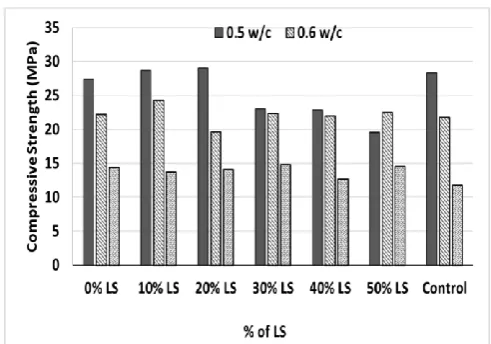
One interesting observation is when comparing results of Figures 2 and 3. Several compressive strength values in Figure 3 (with 1:2:4 mix) were slightly higher than their corresponding values in Figure 2 (with 1:1.5:3). This was not expected as one would expect a mix with more cement content to produce better strength, although this pattern has been observed elsewhere [4]. However, the following should be noted. At constant w/c, more cement content means more volume of water in the mix and as observed in Figure 4, laterized concrete seems to be very sensitive to change in mixing water. It is therefore possible that increase in strength due to less volume of mixing water might be greater than increase due to increase in cement content.
3.3.2 Variation of Compressive Strength with Water/cement Ratio
The variation of compressive strengths of laterized quarry dust concrete with w/c using 1:1.5:3 mix is shown in Figure 4. As expected, the compressive strength was inversely proportional to w/c and the variations in laterized concrete samples were very similar to that of control samples. This confirms that laterized quarry dust concrete are also as sensitive to change in w/c as conventional concretes. At all w/c, compressive strength of laterized concrete samples compared favourably with those of reference samples. It is interesting that although mixes with 0.5 w/c (1:1.5:3) had 0 slump heights and were not workable unlike 0.6 and 0.7 w/c (as presented in 3.2); they produced the best sets of compressive strength results with the highest values produced by mixes between 0 to 20% LS contents. Therefore the highest compressive strength results within the scope of this study were produced with a mix of 1:1.5:3 at 0.5 w/c and LS contents of 0, 10 and 20% and the values were 27.38N/mm2, 28.68 N/mm2and 29.06 N/mm2 respectively. It therefore seems that the optimum w/c for 1:1.5:3 mix is somewhat between 0.5 and 0.6 while the recommended percentage of laterite in laterized quarry dust concrete is 20%.
Figure 4: Variation of 28th Day Compressive Strength with Water/Cement Ratio at Different % of LS (1:1.5:3
mix)
4. CONCLUSION
The aim of this study was to investigate the workability and compressive strength of concrete with complete replacement of river sand with various combinations of quarry dust and lateritic sand as fine aggregate. This was achieved by carrying out slump tests on fresh concrete and cube compressive strength tests on concrete cubes. Saturated Surface Dry (SSD) densities of the resulting hardened concrete ranged from 2388 to 2559 kg/m3; meaning the concretes fall within the specification for normal weight concrete. Although laterized quarry dust concretes had poorer workability than conventional concretes, their compressive strength compared favourably with those of conventional concretes at 1:1.5:3 and 1:2:4 mix proportions. The most suitable mix is 1:1.5:3 with w/c between 0.5 and 0.6 and the recommended proportion of quarry dust to lateritic sand is 80%:20%. However, other proportions where percentage of lateritic sand is not more than 50 is still okay – but not optimum. Authors therefore strongly recommend the use of laterized quarry dust concrete as structural concrete especially whenever there is economic advantage.
5. REFERENCES
[1] Ikponmwosa, E. E. and Ehikhuenmen, S. O. “The Effect of Ceramic Waste as Coarse Aggregate on Strength Properties of Concrete”, Nigerian Journal of Technology, Vol. 36, No. 3, pp 691-696, 2017.
[3] Anya, U. C. Models for Predicting the Structural Characteristics of Sand-quarry Dust Block, Ph.D Thesis, Department of Civil Engineering, University of Nigeria, Nsukka, 2015.
[4] Ukpata, J. O. et al. “Compressive Strength of Concrete Using Lateritic Sand and Quarry Dust as Fine Aggregate”, ARPN Journal of Engineering and Applied Science, Vol. 7, No. 1, 2012, pp. 81-93.
[5] Osunade J. A. “Effect of Replacement of Lateritic Soil with Granite Fines on the Compressive and Tensile Strengths of Laterized Concrete”, Building and Environment, Vol. 37, No. 5, pp. 491-496, 2002.
[6] Udoeyo, F. F. et al. “Strength Performance of Laterized Concrete”, Construction and Building Materials, Vol. 20, pp. 1057-1062, 2006.
[7] Ettu, L. O. et al. “The Suitability of Using Laterite as Sole Fine Aggregate in Structural Concrete”, International Journal of Scientific & Engineering Research, Vol. 4, No. 5, pp. 502-507, 2013.
[8] Osadebe, N. N. and Nwakonobi, T. U. “Structural Characteristics of Laterized Concrete at Optimum Mix Proportion”, Nigerian Journal of Technology, Vol. 26, No. 1, pp. 12-17, 2007.
[9] Prakash, K. S. and Rao, H. C. “Study on Compressive Strength of Quarry Dust as Fine Aggregate in Concrete”, Advances in Civil
Engineering, 2016:
http://dx.doi.org/10.1155/2016/1742769
[10] Sukesh, C. et al. “Partial Replacement of Sand with Quarry Dust in Concrete”, International Journal of Innovative Technology and Exploring Engineering, Vol. 2, No. 6, pp. 254-258, 2013.
[11] Ilangovana, R. et al. “Strength and Durability Properties of Concrete Containing Quarry Dust Rock as Fine Aggregate”, ARPN Journal of Engineering and Applied Science, Vol. 3, No. 5, pp. 20-26, 2008.
[12] Sivakumar, A. and Prakash, M. “Characteristics Studies on the Mechanical Properties of Quarry
Dust Addition in Conventional Concrete”, Journal of Civil Engineering and Construction Technology, Vol. 2, No. 10, pp. 218-235, 2011.
[13] Demirel, B. “The Effect of Using Waste Marble Dust as Fine Sand on the Mechanical Properties of Concrete”, International Journal of the Physical Science, Vol. 5, No. 9, pp. 1372-1380, 2010.
[14] Hameed, M. S. and Sekar, A. S. “Properties of Green Concrete Containing Quarry Rock Dust and Marble Sludge Powder as Fine Aggregate”, ARPN journal of Engineering and Applied Science”, Vol. 4, No. 4, pp. 83-89, 2009.
[15] Jayaraman, A. et al. “Compressive and Tensile Strength of Concrete Using Lateritic Sand and Limestone Filler as Fine Aggregate”, International Journal of Research in Engineering and technology, Vol. 3, No. 1, pp. 79-84, 2014.
[16] Dongapure, A. R. and Mangalgi, S. S. “Study on Strength of Concrete Using Lateritic Sand and Quarry Dust as Fine Aggregate”, International Journal of Engineering Research & Technology, Vol. 3, No. 12, pp. 126-130, 2014.
[17] BS EN 206. Concrete – Specification, Performance, Production and Conformity, British Standard Institute, Brussels, 2013.
[18] BS EN 12390 Part 2. Making and Curing Specimens for Strength Tests, British Standard Institute, Brussels, 2009.
[19] BS EN 12350 Part 2. Testing Fresh Concrete – Slump Test, British Standard Institute, Brussels, 2009.
[20] BS EN 12390 Part 3. Compressive Strength of Test Specimens, British Standard Institute, Brussels, 2009.
[21] BS EN 12620. Aggregates for Concrete, British Standard Institute, Brussels, 2002.