I
I
n
n
t
t
e
e
r
r
n
n
a
a
t
t
i
i
o
o
n
n
a
a
l
l
J
J
o
o
u
u
r
r
n
n
a
a
l
l
o
o
f
f
P
P
h
h
a
a
r
r
m
m
a
a
S
S
c
c
i
i
e
e
n
n
c
c
e
e
s
s
Vol. 5, No. 4 (2015): 1167-1173Research Article Open Access
I
ISSSSNN::22332200--66881100
Design, Development and Evaluation of Controlled
Release Floating Drug Delivery Systems of Verapamil
HCl
GSN Koteswara Rao
1*, KV Ramana Murthy
2, B Raj Kumar
3and B Roja Rani
11
Viswanadha Institute of Pharmaceutical Sciences, Anandapuram, Visakhapatnam, A.P. 2
AU College of Pharmaceutical Sciences, Andhra University, Visakhapatnam, A.P. 3
Aizant Drug Research Solutions Pvt. Ltd., Hyderabad, Telangana.
* Corresponding author: GSN Koteswara Rao, e-mail: [email protected]
ABSTRACT
The aim of the present study is to develop controlled release floating drug delivery system of verapamil hydrochloride that can control the release of drug for a period of 12 hours, using “Modified pulsincap” technique. The capsules of size “1” were used in which the body is hardened (water insoluble) by exposing to formaldehyde vapors for various time periods of 1 h and 2 h, whereas the cap was left untreated and hence water soluble. Formulation mixtures with varying ratios of drug and polymer (sodium carboxy methyl cellulose (SCMC)) with other excipients were prepared and hand filled into the treated capsule body and locked with soluble cap. The capsules were investigated for floating lag time, floating time, weight variation, drug content and drug release. Compatibility studies were conducted by FTIR and DSC. Among all, the formulation, F2.3 which contains drug:polymer 1:0.75 and exposure time of 2 h has shown the drug release control for 12 h and satisfied all the evaluation parameters.
Keywords:
floating, verapamil HCl, SCMC, modified Pulsincap.1. INTRODUCTION
Pulsincap technique was developed by RP Scherer and British technology group and was patented in 1994. It contains insoluble body in which the formulation mixture is filled and sealed with molded hydrogel plug and locked with soluble cap. The whole gelatin capsule is coated with ethyl cellulose. When the capsule come in contact with gastrointestinal fluid, the ethyl cellulose coating gets dissolved, soluble cap also gets dissolved and allows the hydrogel plug to get swollen. The swollen hydrogel plug gets expelled out and the drug mixture is released out [1-3].
In the present investigation we used modified pulsincap technique, which involves formaldehyde vapor treated gelatin capsule body (hardened due to complexation between gelatin molecules and
formaldehyde) and untreated cap
(unhardened/soluble). Drug mixed with various polymer combinations will be filled into this modified
pulsincap. On exposure to the gastric fluid, the cap readily dissolves whereas body remains intact and the polymer gets swollen forming mesh like structure within the intact body thereby resulting in controlled release of drug within the gastric environment. Due to the entrapped air during swelling, the system acquired buoyant nature and floats over the gastric fluid [4-6].
Verapamil hydrochloride is a calcium channel blocker used as an anti-hypertensive agent, anti-anginal agent and anti-arrhythmic agent. This is used as model drug in our research [7].
2. MATERIALS AND METHODS:
2.1 Materials:
Verapamil HCl and sodium carboxy methyl cellulose were purchased from Yarrow chemicals, Mumbai. Lactose was purchased from Loba Chemie Pvt. Ltd., whereas formaldehyde A.R., magnesium stearate and
hydrochloric acid were purchased from Qualigens Fine Chemicals Pvt. Ltd.
2.2 Methods:
2.2.1 Preparation of cross linked empty gelatin capsules [8,9]:
In our research, hard gelatin capsule bodies (capsules of size “1”) were exposed to formaldehyde vapors generated by adding potassium permanganate in a desiccator for varying time periods of 1 and 2 h. They are dried in hot air oven at 50oC for 30 min to ensure completion of reaction between gelatin and formaldehyde vapors and air dried to ensure removal
of residual formaldehyde. The residual formaldehyde content in 1 or 2 h exposed gelatin shells with post treatment is found to be within the limits of FDA.
2.2.2 Formulation:
Varying ratios of drug and polymer were used for the preparation of modified pulsincaps of verapamil HCl as given in tables-1 & 2. All the ingredients were accurately weighed, mixed uniformly and hand filled into the hardened capsule bodies, locked with soluble cap. Thus prepared controlled release floating systems of verapamil HCl prepared by modified Pulsincap technique were used for further evaluation.
Table 1: Formula of verapamil HCl modified pulsincaps (1 h exposed)
S.No. Ingredient Name (in mg) F1.1 F1.2 F1.3 F1.4
1. Verapamil HCl 120 120 120 120
2. SCMC 30 60 90 120
3. Lactose 144 114 84 54
4. Magnesium stearate 6 6 6 6
Total 300 300 300 300
Table 2: Formula of verapamil HCl modified pulsincaps (2 h exposed)
S.No. Ingredient Name (in mg) F2.1 F2.2 F2.3 F2.4
1. Verapamil HCl 120 120 120 120
2. SCMC 30 60 90 120
3. Lactose 144 114 84 54
4. Magnesium stearate 6 6 6 6
Total 300 300 300 300
2.3 Evaluation tests
Both the treated and untreated capsules were tested and compared for weight variation, lockability, stickiness, color, shape and solubility (in distilled water and 0.1 N HCl) by randomly selecting ten capsules from each section.
2.3.1 Calibration curve of verapamil HCl
Dilutions for stock solution (1 mg/ml) were made to obtain concentrations of 10, 20, 30, 40 and 50 mcg/ml in 0.1 N HCl and the absorbance was estimated at 279 nm. The calibration curve was developed based on the absorbance values as shown in fig. 1.
2.3.2 Evaluation of verapamil HCl modified pulsincaps The formulated controlled release floating capsules were evaluated for in-vitro buoyancy studies like floating lag time and total floating time, weight variation, estimation of drug content and in-vitro dissolution studies.
2.3.3 In-vitro buoyancy studies
Controlled release floating capsules of verapamil HCl prepared using modified pulsincap technique following the formulae as per tables-1 & 2 were subjected to in-vitro buoyancy test. The time at which floating was started and the duration of time the dosage form constantly remained on the surface of medium were determined as floating lag time and floating time. The floating lag time and the floating time were determined in 1 litre glass beaker containing 900 ml of 0.1 N HCl.
Right from zero time, the formulations shown floating and hence floating lag time is said to be zero. Floating time results were given in table 3.
2.3.4 Weight variation test
Individual weight of 20 formulated capsules was estimated by using digital balance and the average capsule weight was determined. Based on the average weight, percentage deviation allowed is calculated and verified whether all the capsules are within in those limits or not.
2.3.5 Estimation of drug content
From each batch, 5 capsules were randomly collected and the formulation mixture was separated. The powder mixture equivalent to 100 mg of verapamil HCl was weighed and transferred to 100 ml volumetric flask. It was dissolved in small quantity of methanol with vigorous shaking on a mechanical shaker and filtered into a 50 ml volumetric flask through 0.45 m millipore nylon filter disc and the filtrate was made up to the mark with 0.1N HCl. Further appropriate dilutions were made and the absorbance was measured at 279 nm against blank (0.1N HCl). Results were given in table-3.
2.3.6 In-vitro dissolution studies
dissolution medium used was 900 ml of 0.1N HCl maintained at a temperature of 37±0.5º C and the paddle was rotated at 50 rpm. The dissolution studies were conducted for a period of 12 hrs. At 0.5 h and later on at each interval of 1 hour, 5 ml samples were withdrawn by means of a syringe fitted with a prefilter and immediately replaced with 5 ml of fresh medium. The absorbances of the samples were measured at 279 nm after suitable dilution with the medium using Elico SL-159 UV Spectrophotometer, drug release calculated based on calibration curve and results were shown in fig. 2 & 3. Dissolution studies were conducted for marketed product of verapamil HCl sustained release capsule, CALAPTIN 120SR (Mfg by: Abbott Health Care Pvt. Ltd.) using the same parameters and comparative dissolution profiles were shown in fig. 4.
2.3.7 Drug release kinetics
As a model-dependent approach, the dissolution data was fitted to five popular release models such as zero-order, first-zero-order, Higuchi, Hixson-Crowell erosionand Korsmeyer-Peppas equations. The order of drug release was described by using zero-order or first-orders kinetics. The mechanism of drug release was studied by using Higuchi diffusion, Hixson-Crowell erosion and Korsmeyer-Peppas equations. The correlation coefficient values for best formulations and marketed product were given in table-4.
2.3.8 Fourier Transform Infrared (FTIR) Spectroscopy Drug-polymer interactions were studied by FTIR spectroscopy. FTIR studies were carried out for pure drug (verapamil HCl), pure polymer (SCMC) and
drug-polymer mixture. A potassium bromide (KBr) disc was prepared by mixing the sample with dry KBr using an agate mortar and then compressing it into a disc in a hydraulic press at a pressure of 10,000 psi. The characteristic peaks were recorded. The positions of FTIR bands of important functional groups of pure drug and pure polymer were identified and observed for their existence in obtained spectra of drug-polymer mixture. FTIR spectra were shown in fig. 5.
2.3.9 Differential Scanning Calorimetry (DSC)
The possibility of any interaction between verapamil HCl and SCMC in the formulation were further verified by carrying out thermal analysis. Samples were crimped in a standard aluminium pan and treated thermally from 50 to 300 °C at a heating rate of 10 °C/min under constant purging of dry nitrogen using an empty aluminium pan as reference. DSC thermograms were shown in fig. 6.
3. RESULTS AND DISCUSSION
3.1 Estimation of free formaldehyde content
The limit for residual formaldehyde according to FDA is 0.002% and the formaldehyde exposed hard gelatin capsule bodies for a period of 1 h and 2 h passed the chromotropic acid test as the value obtained is less than the standard limit.
3.2 Calibration curve of verapamil HCl
The calibration curve of verapamil HCl was developed and shown in fig. 1.
Figure 1: Calibration curve of verapamil HCl
3.3 Evaluation tests for empty gelatin capsules
All the empty capsules were lockable type, odourless, soft and sticky when touched with finger. After formaldehyde vapour treatment, there were no significant changes in the capsules except for the stickiness. The body of the capsule was hard and non-sticking even when touched with wet finger. There was no significant change in colour and shape after formaldehyde vapour treatment. The individual weights of each capsule were quite uniform and cross linking did not show any significant change in weight.
Untreated bodies dissolved in 15 min whereas treated bodies remained intact even after 14 hrs. However untreated cap was dissolved in 15 min.
3.4 Evaluation of verapamil HCl formulations
3.4.1 In-vitro buoyancy studies
drug enabling its slow release. This also provided buoyancy to the capsule.
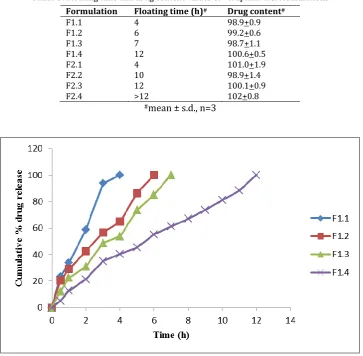
All the prepared pulsincaps floated on the surface immediately upon their addition to the 0.1N HCl indicating no floating lag time to the prepared modified pulsincaps. The floating time of the prepared modified pulsincaps was found to be in the range of 4-12 h as given in table-2. The results indicated that floating time was increased with increase in the polymer concentration.
3.4.2 Weight variation test
All the prepared modified pulsincap formulations complied with the compendial (+7.5%) standards for uniformity of weight.
3.4.3 Estimation of drug content
The drug content estimated was found to be in the range of +5% of the stated amount of verapamil HCl and hence within the limit of allowed % variation. The results are shown in table-3.
Thus, the verapamil HCl gastric floating modified pulsincap controlled release formulations prepared with SCMC were found to be of good quality fulfilling all the official and other requirements.
3.4.4 In-vitro dissolution studies
(a) Effect of polymer concentration
The release profiles of verapamil HCl from 1 h exposed modified pulsincaps are shown in fig. 2. More than 99.99% of the drug was released from F1.1, F1.2, F1.3 and F1.4 in 4, 6, 10 and 12 h respectively.
The release profiles of verapamil HCl from 2 h exposed modified pulsincaps were shown in fig. 3. Formulations F2.1, F2.2 and F2.3 have shown 100% drug release in 4, 10 and 12 h respectively, whereas formulation F2.4 has not shown complete drug release in 12 h. In both the cases the drug release was decreased with increasing concentrations of SCMC polymer.
Table 3: Floating time and drug content values of verapamil HCl formulations
Formulation Floating time (h)# Drug content#
F1.1 4 98.9+0.9
F1.2 6 99.2+0.6
F1.3 7 98.7+1.1
F1.4 12 100.6+0.5
F2.1 4 101.0+1.9
F2.2 10 98.9+1.4
F2.3 12 100.1+0.9
F2.4 >12 102+0.8
#mean ± s.d., n=3
Figure 3: Dissolution plots of verapamil HCl floating capsules (2 hr exposed): F2.1 to F2.4
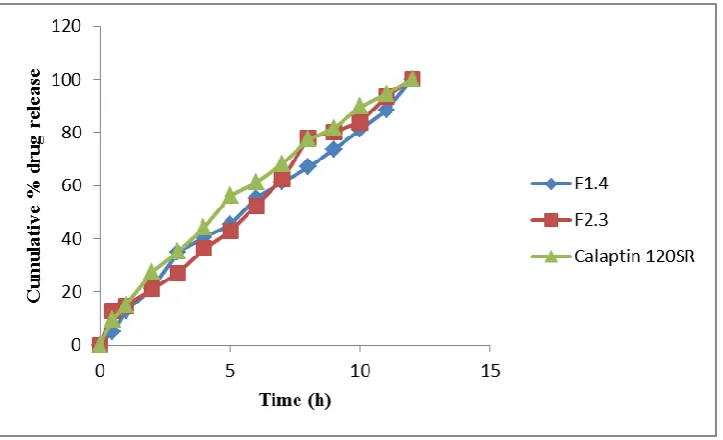
Dissolution studies were conducted for marketed product of verapamil HCl sustained release capsule, CALAPTIN 120SR (Mfg by: Abbott Health Care Pvt.
Ltd.). It has shown 100% drug release in 12 h. The dissolution profile in comparison with the two optimized formulations was shown in fig. 4.
Figure 4: Comparative dissolution profiles of formulations: F1.4, F2.3 and marketed product
(b) Effect of exposure time to formaldehyde vapours on drug release
The studies indicated that 2 h exposed capsules retarded and extended the drug release more than that compared to 1 h exposed capsules. Among all the formulations investigated, F1.4 and F2.3 released the drug over a period of 12 h with good buoyancy characteristics. The objective of the present investigation is to extend the release of the drug over a period of 12 h and hence these two formulations satisfied the objectives.
3.4.5 Drug release kinetics
The formulations F1.4 with drug: polymer ratio 1:1 of 1 h formaldehyde vapour exposure time and F2.3 with
Table 4: Correlation coefficient (r) values and release kinetics of best formulations of verapamil HCl
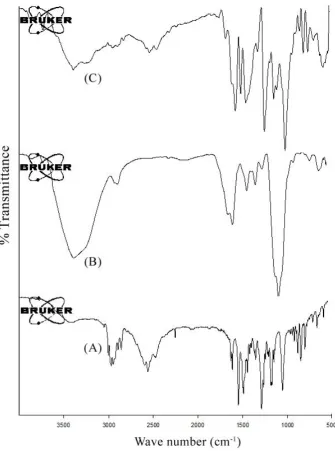
3.4.6 Fourier Transform Infrared (FTIR) Spectroscopy Verapamil pure drug, SCMC pure polymer and its formulation mixture were subjected to FTIR spectroscopic analysis. The obtained spectra were shown in fig. 5. The FTIR spectra of pure verapamil HCl showed characteristic peaks at wave numbers of 2990.31 cm-1 (C-H stretching of methyl and methylene group), 2957.15 cm-1, 2936.77 cm-1 (C-H stretching), 2840.33 cm-1 (C-H stretching of methoxy group), 2541.48 cm-1, 2452.76 cm-1 (N-H stretching of protonated amine), 2236.56 cm-1 (CN stretching of alkyl nitrile group), 1608.20 cm-1, 1592.05 cm-1, 1518.69 cm-1 (stretching due to skeletal vibrations of
the benzene ring), 1461.49 cm-1 (C=C stretching due to aromatic ring), 1259.94 cm-1 1142.80 cm-1 (C-O stretching), 1026.84 cm-1 (C-N stretching) and 816.64 (meta substituted benzene). The FTIR spectra of pure SCMC showed characteristic peaks at wave numbers of 3384.02 cm-1 (O-H stretching), 1584.00 cm-1 (C=C stretching) and 1057.91 cm-1 (C-O stretching). The spectra of optimized formulation mixture of drug and polymer exhibited all the principle peaks present in the pure drug, verapamil HCl and pure polymer, SCMC. The results revealed that there were no interactions between drug and polymer used in the formulation.
Figure 5: FTIR spectra of (A) verapamil HCl, (B) SCMC and (S) drug-polymer mixture.
Best Formulation r-value n-value
Zero order First order Higuchi Erosion Peppas
F1.4 0.989 0.950 0.922 0.812 0.599
F2.3 0.990 0.899 0.898 0.825 0.547
3.4.7 Differential Scanning Calorimetry (DSC)
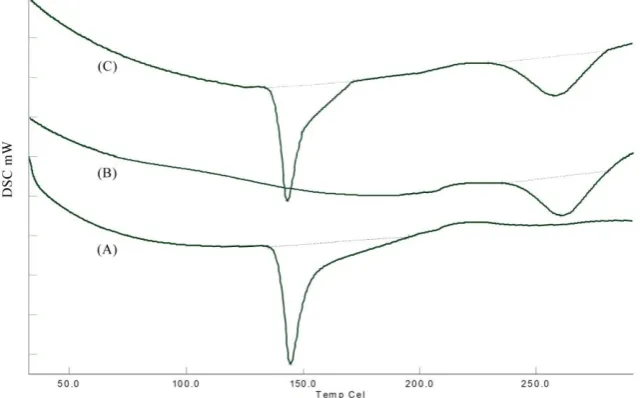
DSC studies were carried out for pure drug (verapamil HCl), pure polymer (SCMC) and drug-polymer mixture. DSC thermograms were shown in fig. 6. The DSC thermogram of verapamil HCl showed an endothermic peak at 144.7 °C corresponding to its melting point and
thermogram of SCMC showed an endothermic peak at 258.3 °C. Both the characteristic peaks of drug and polymer were also detected in the thermogram of formulation mixture, signifying no change in crystal form and hence no interaction between the drug and polymer used in the formulation.
Figure 6: DSC thermograms of (A) verapamil HCl, (B) SCMC and (S) drug-polymer mixture.
4. CONCLUSION
The present investigation revealed that SCMC can be successfully used in the prepared of oral controlled release gastric floating drug delivery systems of verapamil HCl using modified pulsincap technique. No work has been reported till date on the design of floating modified pulsincaps of verapamil HCl using the said polymer. Hence this makes a significant contribution for the development of controlled verapamil HCl floating modified pulsincaps.
5. ACKNOWLEDGEMENTS
The authors acknowledge Andhra University College of Pharmaceutical Sciences, Visakhapatnam and Viswanadha Institute of Pharmaceutical Sciences, Visakhapatnam for providing necessary facilities to conduct the research work.
6. REFERENCES
1. McNeil ME, Rashid A, Stevens HNE. Drug dispensing device, US Patent 5342624, 1994.
2. Howard NE Stevens. Pulsincap and hydrophilic sandwich (HS) capsules: Innovative time-delayed oral drug delivery technologies. In: Michael J Rathbone, Jonathan Hadgraft, Michael S Roberts (eds). Modified release drug delivery technology, 1st edition, Marcel Dekker, New York, 2002,
257-262.
3. Howard NE Stevens, Clive G Wilson, Peter G Welling et al.
(2002). Evaluation of Pulsincap™ to provide regional delivery of dofetilide to the human GI tract. Int. J. Pharm., 236: 27–34. 4. L. Srinivas, D. Lohithasu, D. Madhupriya et al. (2013).
Formulation and evaluation of ibuprofen pulsincap technique for controlled release. Der Pharmacia Lettre, 5(1):60-68.
5. Sindhu Abraham, MS Srinath. (2007). Development of modified pulsincap drug delivery system of metronidazole for drug targeting. Indian J Pharm Sci. 69(1):24-27.
6. Swati C Jagdale, Pravin S Phule, Gajanan J Chavan. (2014). Formulation and evaluation of modified pulsincap drug delivery system of rizatriptan benzoate. Int. J. Pharm. Pharm. Sci., 6(5):48-52.
7. www.drugs.com/verapamil.html
8. Sharma GS, Srikanth MV, Sunil S et al. (2012). Application of modified pulsincap technique for oral controlled drug delivery of gliclazide. Int. J. Pharm. Pharm. Sci.,4(3):618-624. 9. GSN Koteswara Rao, KV Ramana Murthy, Aayisha Begum et
al. (2014). Formulation and Evaluation of Floating Drug Delivery Systems of Propranolol HCl using Modified Pulsincap Technique. Int. J. Pharm. Res. Rev., 2014; 3(9):15-22.
10.D. A. MacFadyen. (1945). Estimation of formaldehyde in biological mixtures. J. Bio. Chem., 158(1):107–133.
11.Wagner JG. (1967). Interpretation of percent dissolved-time plots derived from in-vitro testing of conventional tablets and capsules. J. Pharm. Sci., 58:1253-1257.
12.Higuchi T. (1963). Mechanism of sustained action medication: theoretical analysis of rate of release of solid drugs dispersed in solid matrices. J. Pharm. Sci., 52:1145-1149.
13.Korsmeyer RW, Gurney R, Doelker E et al. (1983). Mechanism of solute release from porous hydrophilic polymer. J. Pharm. Sci., 15:25-35.
14.Ritger P L, Peppas N A. (1987). A simple equation for description of solute release II. fickian and anomalous release from swellable devices. J. Control. Release, 5:37-42.
*****
© 2015; AIZEON Publishers; All Rights Reserved