A Simple Control Variate Method for Options
Pricing with Stochastic Volatility Models
Guo Liu, Qiang Zhao, and Guiding Gu
Abstract—In this paper we present a simple control variate method, for options pricing under stochastic volatility models by the risk-neutral pricing formula, which is based on the order moment of the stochastic factor Yt of the stochastic volatility
for choosing a non-random factor Y(t) with the same order moment. We construct the control variate using a stochastic differential equation with a deterministic diffusion coefficient as the price process of the underlying asset. Numerical experiment results show that our method achieves better variance reduction efficiency, than that of the constant volatility control variate method, and simpler computation, than that of the martingale control variate method[4], and it has a promising wider-range application than the previous method proposed by Ma and Xu(2010)[10], and Du et al.(2013)[2].
Index Terms—control variates, Monte Carlo method, options pricing, stochastic volatility.
I. INTRODUCTION
O
PTIONS pricing has been being a topic in the field of mathematical finance since Black and Scholes(1973)[1] gave the Black-Scholes formula for the European option under some perfect assumptions. However, these assumptions are not perfect suitable for the real market data. Numerous works have been carried out on relaxing the assumptions of the Black-Scholes model. For example, Merton(1973)[11], Roll(1977)[12], Geske(1979)[5], Whaley(1981)[15] priced the options with the stock paying dividend. Hull and White(1987)[8], Scott(1987)[13], Stein and Stein(1991)[14], Heston(1993)[7] priced the options with stochastic volatility models.The increasing complexity of the models of the underlying asset renders the option valuation very difficult. In fact, there are few options which can be priced analytically. Then the numerical method is a wiser choice in options pricing. The classical numerical methods, like the lattice method (including binary tree method and ternary tree method), the finite difference method, are limited to the problems in which the number of state variables are less than there (or including three). Because the computation grows exponentially as the number of state variables increases. Monte Carlo method, for its easy and flexible computation, is suitable for the complex problems with over three state variables. But its convergence rate is slow. So Monte Carlo method is usually needed to be accelerated when it is applied to options valuation, where variance reduction method is the principle one used to
Manuscript received Apr. 13, 2014; revised Feb. 2, 2015. This work is partly supported by NSFC(11371105), Shanghai Colleges Outstanding Young Teachers Scientific Research Project(ZZCD12007), Research Inno-vation Foundation of Shanghai University of Finance and Economics(CXJJ-2013-323).
Guo Liu, and Qiang Zhao are with School of Finance, Shanghai Univer-sity of Finance and Economics, Shanghai, SH, 200433 CH e-mail: (Email: [email protected], [email protected]).
Guiding Gu is with the Department of Applied Mathematics, Shanghai University of Finance and Economics.
accelerate Monte Carlo method, usually including antithetic method, control variate method and important sampling method.
In this paper we consider the control variate method for accelerating the Monte Carlo method to price options under stochastic volatility models. There are four kinds of control variate methods, appeared in the previous works, including: (a) the control variate method constructed by the constant volatility model, like Hull and White(1987)[8], John and Shanno(1987)[9], (b) the martingale control variate method proposed by Fouque and Han(2007)[4], (c) the control variate method combining the first and second order moment of the underlying asset proposed by Ma and Xu(2010)[10], and (d) the control variate method constructed with the order moment of the stochastic volatility proposed by Du, Liu and Gu(2013)[2]. The first method is the simplest one but with low variance reduction efficiency. The martingale method is difficult for the computation of the invariant distribution of the stochastic volatility, while the last two methods are more efficient in variance reduction and simpler than the martin-gale method. Here we propose a new control variate method, which is more efficient than the constant volatility method, much simpler than the martingale control variate method, and has a wider-range application than those proposed by Ma and Xu(2010), and Du et al.(2013), respectively. The idea of the new control variate method is that we derive an auxiliary process with a non-stochastic volatility which is constructed by a non-stochastic factor having the same order moment to the stochastic factor. Then we construct an instrument option by an auxiliary process with the non-stochastic volatility above as the new control variate. We deduct the new control variate method in European options and Asian options pricing with Hull-White model.
The rest of this paper is organized as follows. First we provide the new control variate method in the general options pricing under the stochastic volatility model, especially for Hull-White model(1987), Heston model(1993) and Stein-Stein model(1991). Then we compare our new control variate method with other two methods by Ma and Xu(2010), and Du et al.(2013). In Section IV we present the numerical experiences for pricing European options and Asian options with the new control variate method. Finally we give some conclusions in Section V.
II. NEW CONTROL VARIATE METHOD
In this section we present the new control variate method in the general case.
Suppose with the probability space (Ω,F, P), the un-derlying asset price processes of the option satisfy the following stochastic differential equations (here we suppose the probabilityP is the risk-neutral probability measure, and
IAENG International Journal of Applied Mathematics, 45:1, IJAM_45_1_07
ignore the market price of the volatility risk)
dSt=St(rdt+σtdW1t),
σt=f(Yt),
dYt=α(Yt)dt+β(Yt)dW2t, (1)
where S0 = s0, Y0 = y0, r is a constant, both W1t
and W2t are standard Brownian motions, which satisfy
cov(dW1t, dW2t) = ρdt, that means we can get W2t =
ρW1t + p
1−ρ2W
t, where Wt is a standard Brownian
motion and it is independent withW2t.
The new control variate method is presented as follows. First we construct an auxiliary processS(t) satisfying
dS(t) =S(t)(rdt+σ(t)dW1t),
S(0) =s0, (2)
where r, W1t, and s0 are the same as (1). σ(t) is a non-stochastic and square-integrable function, which is different withσt.A good control variate for an option pricing must be
as close as possible to the option. Here the problem becomes how we can chooseσ(t)as close as possible toσt,to make
S(t) be closer to St. Here we first choose the non-random
factorY(t)such that
Ym(t) =E[Ytm],
wherem∈R, R is the real number set. Then replacingYt
withY(t)in the σt, we have
σ(t) =f(Y(t)), (3)
The auxiliary process becomes
dS(t) =S(t)(rdt+f(Y(t))dW1t). (4)
Finally the option based on the underlying asset with the auxiliary process is the new control variate, which can be priced analytically.
Several popular stochastic volatility models are collected as follows.
TABLE I
MODELS OF STOCHASTIC VOLATILITY
Model f(y) Yt process correlation
Hull-White(1987) √y lognormal ρ=0
Scott(1987) ey Mean-reverting O-U ρ=0 Stein-Stein(1991) |y| Mean-reverting O-U ρ=0
Ball-Roma(1994) √y CIR process ρ=0
Heston(1993) √y CIR process ρ6=0
It is worthy to be mentioned that the stochastic fac-tors in all stochastic volatility models satisfy only three kinds of processes as listed in Table I(some multi-factors stochastic volatility models are also driven by these pro-cesses). Their expectations for these stochastic factors can be easily obtained. Here, we apply our aforementioned method, for options pricing with these stochastic volatility models, which can achieve more variance reduction ratios than the control variate method of constant volatility, and can have a potentially wider application due to its simpler implementation compared with the methods proposed by Ma and Xu(2010), Du et al.(2013), Fouque and Han(2007). Therefore, this aforementioned control variate method will be applied to pricing European options and Asian options
with the most typical stochastic volatility model including Hull-White model, Heston model and Stein-Stein model in the following subsections.
A. Hull-White model
The Hull-White stochastic volatility model is first pro-posed by Hull and White(1987), which provides the closed form price formula of European option with the Hull-White stochastic volatility, just when the correlation coefficient between the underlying asset price and the stochastic factor of the volatility is zero. The model is
σt= p
Yt,
dYt=Yt(µdt+σdW2t), (5)
whereµ andσare constant. Then we can easily derive
E[Ytm] =y0mexp{mt(µ+1
2(m−1)σ
2)
}. (6) According to the new control variate method, we chooseY(t)
such that
E[Ym(t)] =E[Ytm], that is
Y(t) = (E[Ytm]) 1
m =y0exp{t(µ+1
2(m−1)σ
2)}. (7) Then we derive the deterministic volatility
σ(t) =pY(t) =y12
0 exp{
1 2t(µ+
1
2(m−1)σ
2)}. (8)
B. Heston model
The Heston stochastic volatility model is first presented by Heston(1993), which prices the European option analyti-cally. But the representation is very difficult to calculate the accurate price. Then accelerated Monte Carlo method is the most useful one to price options. The model is
σt= p
Yt, (9)
dYt=k(θ−Yt)dt+σ p
YtdW2t, (10)
where k, θ, and σ are constant. It is difficult to derive the closed formula solution for Yt, but we can derive its
expectation, that is the first order moment
E[Yt] =e−kty0+θ(1−e−kt), (11) and them-th order momentE[Ym
t ]by them−1, m−2,...,1
-th order moment. We omit -them here for simplicity. Then we have
σ(t) =pE[Yt] = q
e−kty
0+θ(1−e−kt). (12)
C. Stein-Stein model
The Stein-Stein model is proposed by Stein and Stein(1991). The model is
σt=|Yt|,
dYt=α(β−Yt)dt+σdW2t, (13)
whereα,β andσ are constant. Then we can easily have
E[Yt] =e−αty0+β(1−e−αt).
IAENG International Journal of Applied Mathematics, 45:1, IJAM_45_1_07
By the new control variate method, we chooseY(t)as
E[Y(t)] =E[Yt],
that is
σ(t) =|Y(t)|=|e−αty0+β(1−e−αt)|. (14)
Theorem 1. Suppose that the stochastic volatility σt in (1)
is replaced by a deterministic square-integrable volatility
σ(t) = f(Y(t)), there is an analytic solution for European put option,
Xp|t=0=e−rTE[(K−S(T))+]
=e−rTKN(d1)−s0N(d1−b), (15)
where
d1=
lnK−a
b , (16)
a= lns0+rT−
1 2
Z T
0
σ2(t)dt, b= s
Z T
0
σ2(t)dt.
(17)
For the Hull-White model, the non-random volatility is (8), and the value of the European put option as the control variate is as follows
Vp|t=0=Ke−rTN(d1)−s0N(d1−b), where
d1=
lnk−a
√
b , (18)
a= lns0+rT +b, b=y0 ect−1
c , (19)
c=µ+1
2(m−1)σ
2.
(20)
For the Heston model, the non-random volatility is (12), and the value of the European option as the control variate is as follows
Vp|t=0=Ke−rTN(d1)−s0N(d1−b), where
d1=
lnk−a
√
b , (21)
a= lns0+rT − b
2, (22)
b=θT +1
k(y0−θ)(1−e
−kT). (23)
For the Stein-Stein model, the non-random volatility is (14), and the value of the European option as the control variate is as follows
Vp|t=0=Ke−rTN(d1)−s0N(d1−b), (24) where
d1=
lnK−a
√
b ,
b=β2+ 2β(y0−β)2
e−αT−1
−α + (y0−β) 2e−
2αT−1
−2α , a= lns0+rT−
b
2.
III. COMPARING WITH OTHER TWO CONTROL VARIATE METHODS
In this section we will compare the new control variate method with other two control variate methods, includ-ing the control variate constructed from the m-th order moment(m∈R ) of the stochastic volatility σt by Du, Liu
and Gu(2013), and the control variate constructed from the second order moment of the underlying asset priceStby Ma
and Xu(2010), which are called as Method 1 and Method 2, respectively.
A. Method 1
This method is presented by Du, Liu and Gu(2013), which gives a class of control variates for Asian options with fixed strike price and floating strike price. They also used this method for multi-asset options pricing[3]. Here for comparing it with our new method, we price the European option with stochastic volatility models using Method 1.
First we chooseσ(t)such that
σm(t) =E[σtm],
where m ∈ R. The the control variate is the option that based on the underlying asset price satisfyingS(t)with the non-random volatilityσ(t).
For the Hull-White stochastic volatility model, we have
E[σtm] =E[Ym2 t ] =E[Y
m
2
0 exp{ mt
2 (µ− 1 2σ
2) +1
2mσW2t}] =Ym2
0 exp{ m
2t(µ+ 1
4(m−2)σ
2)}. Then we can chooseσ(t)such that
E[σm(t)] =E[σtm] =E[Ym2 t ],
σ(t) =Y12
0 exp{
1 2t(µ+
1
4(m−2)σ
2)}. (25) This is similar to our new control variate method for calculatingE[Y
m
2
t ] first. It is easy to see that for European
options with the Hull-White model, the non-random volatility constructed from2m-order moment of the stochastic volatil-ity using Method 1 is equal to that constructed fromm-order moment of the stochastic factor by our new control variate method.
For the Heston model, we cannot derive the first order moment of the stochastic volatilityσt, but the second order
moment.
E[σt2] =E[Yt] =e−kty0+θ(1−e−kt). (26) Then we chooseσ(t)such that E[σ2(t)] =E[σ2
t],that is
E[σ2(t)] =E[σt2], σ(t) =
q
e−kty
0+θ(1−e−kt). (27) This is the same as that by the first order moment of the stochastic factor with our new method. It is easy to get the
2n-th order moment ofσt,wherenis any non-zero positive
integer. We know that they are the same as that by then-th order moment ofYt with our new method.
IAENG International Journal of Applied Mathematics, 45:1, IJAM_45_1_07
For the Stein-Stein model, we can calculate the first moment of the stochastic volatility,
E[|Yt|] = 2%
√
2πexp{− ν2
2%2}+ν−2νΦ(− ν %),
where
ν=β+ (y0−β)e−αt, %2= 1−e
−2αt
2α β
2.
Then we chooseσ(t) =E[|Yt|].Unfortunately, we cannot
price the European option price analytically with the un-derlying asset price S(t), with this deterministic volatility σ(t). That is to say we cannot use Method 1 to accelerate Monte Carlo method for pricing the option with the Stein-Stein model.
B. Method 2
This method is proposed by Ma and Xu(2010) when they priced variance swaps by control variate Monte Carlo method. However, they just considered the first two order moments for choosing a control variate. Here, we extend it to ∀m∈ R, and apply it to pricing European option under stochastic volatility models.
First we calculate
S(t) =E[St], (28)
S2(t) =E[S2t]. (29) Then we chooseσ(t)such that S(t) =E[St], andS2(t) =
E[St2].Finally the auxiliary processS(t)is obtained for the underlying asset of the control variate option.
For the Hull-White model, we can derive the m-th order of the underlying asset priceStwith the stochastic volatility
σt.
E[Stm]
=E[sm0 exp{mrt− m
2 Z t
0
σ2sds+m Z t
0
σsdW1s}] =E[sm0emrtexp{−m
2 Z t
0
Ysds+m Z t
0
√
YsdW1s}]
≈E[sm0emrtexp{−m
2 Z t
0
Ysds+m2 Z t
0 Ysds}]
(30)
where the first≈ is obtained byR0tσsdW1s≈ Rt
0σ 2
sds, the
second one by Yt≈E[Yt].
We do the same to the auxiliary process S(t) with non-random volatilityσ(t),
E[Sm(t)]
=E[sm0 exp{mrt−m
2 Z t
0
σ2(s)ds+m
Z t
0
σ(s)dW1s}] =sm0emrtE[exp{−m
2 Z t
0
σ2(s)ds+m
Z t
0
σ(s)dW1s}] =sm0e
mrt
E[exp{−m
2 Z t
0
σ2(s)ds+m2
Z t
0
σ2(s)ds}]
(31)
Then we derive
σ(t) =Y
1 2
0 exp{
1 2t(µ−
1 4σ
2)}, (32) byE[Sm(t)] =E[Stm].This is the case whenm= 1as that
by Method 1.
For the Heston model, we know that
E[St] =s0exp{rt}, E[St2] =E[s
2
0exp{2rt−
Z t
0
σ2sds+ 2 Z t
0
σsdW1s}] =S02e2rtE[exp{−
Z t
0
σs2ds+ 2 Z t
0
σtdW1s}] =s20e2rtE[exp{−
Z t
0
Ysds+ 2 Z t
0
p
YsdW1s}]
≈s20e2rtE[exp{−
Z t
0
E[Ys]ds+ 2 Z t
0 Ysds}]
≈s20e2rtE[exp{−
Z t
0
E[Ys]ds+ 2 Z t
0
E[Ys]ds}] =s20e2rtE[exp{
Z t
0
E[Ys]}]ds,
and
E[S(t)] =E[s0exp{rt−
1 2
Z t
0
σ2(s)ds+ Z t
0
σ(s)dW1s}] =s0ert,
E[S2(t)] =E[s20exp{2rt−
Z t
0
σ2(s)ds+ 2 Z t
0
σ(s)dW1s}] =s20e2rtE[exp{−
Z t
0
σ2(s)ds+ 2 Z t
0
σ(s)dW1s}] =s20e2rtexp{
Z t
0
σ2(s)ds}. (33) Then we can have
σ(t) =pE[Yt] (34)
byE[S2(t)] =E[S2
t].
From the above analysis, we can see that the final step in Method 1 is to get non-random volatilityσ(t)by calculating E[Yt], which is the only one step in our new method.
For Stein-Stein model, we can derive the same determin-istic volatility as that by Method 1, with Method 2, then we cannot apply Method 2 to price options with the Stein-Stein model.
We can see that it is difficult to derive the exact expression of the m-th order moment for the underlying asset price process even with non-random volatility. Just as mentioned by Ma and Xu(2010), we get the auxiliary underlying asset price process by some approximations. The control variate by Method 2 with the Hull-White model, or the Heston model, is the special case as that by our new method and Method 1.
IV. NUMERICALEXPERIMENT
In last section, the control variate constructed by Method 1 and Method 2 can also be derived by our new control variate method, which is much simpler than any one of them. Then we just give the experiments of our new control variate method to show the variance reduction efficiency in options pricing, including European put option and Asian option.
IAENG International Journal of Applied Mathematics, 45:1, IJAM_45_1_07
From Glasserman(2004)[6] we know that the variance reduction ratio(the variance by the ordinary Monte Carlo method to that by control variate Monte Carlo method) is used to illustrate the accelerating efficiency of our new method. The greater the variance reduction ratio is, the faster convergence rate for Monte Carlo method in options pricing is. Just as done in Ma and Xu(2010), we ignore the simulation time of the control variate, because it is neglectable comparing with that by the ordinary Monte Carlo method.
A. European option pricing
This experiment gives the variance reduction ratios which the ratios are between the variance of the European put option price by the new control variate Monte Carlo method and that by ordinary Monte Carlo method. In the following numerical experiment results, CV is the option price of the control variate chosen with our new method, MC is the price of European option with ordinary Monte Carlo method, the standard deviation of the estimator is denoted as STD1. MC+CV is the option price with new control variate Monte Carlo method, the standard deviation of the estimator is STD2. The variance reduction ratio denoted by R, whichˆ is the square of the ratio of STD1 to STD2, SteinNew is the option price given by Stein and Stein(1991).
1) Hull-White model: The parameters in the model are set as follows, r = 0.05, y0 = 0.02, µ = 0.02, K = 40, N Sim= 105, s
0∈[34,50], ρ∈[−1,1], m∈[−75,75].In Table II, ρ= 0, m= 1; in Table III, s0 = 40, m= 1; in Table IV,s0= 40, ρ= 0.
TABLE II
VARIANCE REDUCTION RATIO BY NEW CONTROL VARIATE METHOD WITH DIFFERENTs0
s0 CV MC STD1 MC+CV STD2 Rˆ
34 4.6344 4.6684 0.0122 4.6417 0.0003 2224.63 36 3.2329 3.2812 0.0109 3.2421 0.0003 1769.87 40 1.3263 1.3802 0.0076 1.3360 0.0003 709.40 44 0.4368 0.4735 0.0044 0.4436 0.0003 268.38 46 0.2326 0.2601 0.0032 0.2375 0.0002 172.30 50 0.0579 0.0704 0.0016 0.0601 0.0002 79.75
TABLE III
VARIANCE REDUCTION RATIO BY NEW CONTROL VARIATE METHOD WITH DIFFERENTρ
ρ CV MC STD1 MC+CV STD2 Rˆ
-1 1.3263 1.4431 0.0079 1.3966 0.0001 8634.39 -0.6 1.3263 1.4179 0.0078 1.3724 0.0002 1092.58 -0.1 1.3263 1.3865 0.0076 1.3421 0.0003 720.26
0 1.3263 1.3802 0.0076 1.3360 0.0003 709.40 0.1 1.3263 1.3739 0.0075 1.3300 0.0003 711.43 0.6 1.3263 1.3426 0.0073 1.2998 0.0002 1005.99
1 1.3263 1.3175 0.0072 1.2756 0.0001 5846.07
The results in Table II-IV show that our new control variate method has good variance reduction efficiency for European options pricing under the Hull-White model. The variance ratios vary as different parameters change. For European put option, the greater initial price of the stock is, the greater the variance reduction ratio is. The absolute of the relative coefficient between the stock and the stochastic volatility
TABLE IV
VARIANCE REDUCTION RATIO BY NEW CONTROL VARIATE METHOD WITH DIFFERENTm
m CV MC STD1 MC+CV STD2 Rˆ
-75 1.1555 1.3786 0.0076 1.3465 0.0006 145.50 -50 1.2088 1.3786 0.0076 1.3415 0.0006 161.35 -10 1.2999 1.3786 0.0076 1.3357 0.0006 176.99 0 1.3239 1.3786 0.0076 1.3346 0.0006 178.19 1 1.3263 1.3786 0.0076 1.3345 0.0006 178.24 2 1.3287 1.3786 0.0076 1.3344 0.0006 178.28 5 1.3361 1.3786 0.0076 1.3341 0.0006 178.33 10 1.3484 1.3786 0.0076 1.3337 0.0006 178.17 75 1.5204 1.3786 0.0076 1.3311 0.0006 153.39
increase, the ratio increases. The smaller the order number mis, the greater the variance reduction ratio is.
2) Heston Model: Just as Heston(1993) and Knoch(1992), we set the parameters in the model as follows, K = 100, r= 0, y0= 0.01, k= 2, θ= 0.01, M = 105, M = 50. In Table V: ρ= 0, σ= 0.1, T = 0.5; in Table VI: s0 = 100, σ= 0.1,T = 0.5; in Table VII:s0= 100,ρ= 0,T = 0.5; in Table VIII:s0= 100,ρ= 0,σ= 0.1.
TABLE V
VARIANCE REDUCTION RATIO BY NEW METHOD WITH DIFFERENT INITIAL STOCK PRICESs0
s0 CV MC STD1 MC+CV STD2 Rˆ
90 10.2010 10.2206 0.0187 10.2227 0.0038 569.63 100 2.8204 2.7903 0.0126 2.8065 0.0032 252.49 110 0.3046 0.3139 0.0042 0.3227 0.0020 21.89
TABLE VI
VARIANCE REDUCTION RATIO BY NEW METHOD WITH DIFFERENTρ
ρ CV MC STD1 MC+CV STD2 Rˆ
-1 2.8204 4.0099 0.0163 4.0314 0.0024 44.98 -0.6 2.8204 3.5161 0.0149 3.5355 0.0030 24.76 -0.1 2.8204 2.9098 0.0130 2.9265 0.0032 16.71 0 2.8204 2.7903 0.0126 2.8065 0.0032 15.89 0.1 2.8204 2.6713 0.0122 2.6869 0.0031 15.25 0.6 2.8204 2.0840 0.0099 2.0968 0.0026 14.73 1 2.8204 1.6214 0.0079 1.6318 0.0015 26.48
TABLE VII
VARIANCE REDUCTION RATIO BY NEW METHOD WITH DIFFERENTσ
σ CV MC STD1 MC+CV STD2 Rˆ
0.01 2.8204 2.8171 0.0125 2.8336 0.0015 68.24 0.05 2.8204 2.8111 0.0125 2.8276 0.0020 37.84 0.1 2.8204 2.7903 0.0126 2.8065 0.0032 15.89 0.15 2.8204 2.7557 0.0126 2.7715 0.0044 8.21
0.2 2.8204 2.7101 0.0127 2.7253 0.0057 5.03 0.25 2.8204 2.6559 0.0128 2.6703 0.0069 3.50
TABLE VIII
VARIANCE REDUCTION RATIO BY NEW METHOD WITH DIFFERENTT
T CV MC STD1 MC+CV STD2 Rˆ
0.25 1.9945 1.9797 0.0090 1.9911 0.0019 21.68 0.5 2.8204 2.7903 0.0126 2.8065 0.0032 15.89 0.75 3.4539 3.4124 0.0153 3.4323 0.0041 15.82 1 3.9878 3.9383 0.0175 3.9615 0.0049 12.80 1.5 4.8830 4.8243 0.0211 4.8531 0.0061 11.83
IAENG International Journal of Applied Mathematics, 45:1, IJAM_45_1_07
TABLE IX
VARIANCE REDUCTION RATIO BY NEW METHOD WITH DIFFERENTk
k CV MC STD1 MC+CV STD2 Rˆ
1 2.8204 2.7797 0.0126 2.7958 0.0035 12.88 2 2.8204 2.7903 0.0126 2.8065 0.0032 15.89 4 2.8204 2.8019 0.0125 2.8182 0.0027 21.39 8 2.8204 2.8107 0.0125 2.8270 0.0023 30.00 14 2.8204 2.8145 0.0125 2.8309 0.0020 38.42
The results in Table V-IX show that our new control variate method has good variance reduction efficiency for European options pricing with the Heston model. The vari-ance reduction ratios vary as different parameters changes, which is the same as that under Hull-White model.
3) Stein-Stein Model: The parameters in the model are set as Stein and Stein(1989), r= 0.095, s0 = 100, y0 = 0.1, K = 100, N Sim= 105, N = 50. ρ∈[−1,1]; α∈[4,20], β ∈[0.20,0.35],σ∈[0.15,0.40].
[image:6.595.300.542.256.429.2]In Table X, α= 4,β = 0.2,ρ= 0,σ= 0.1,T = 0.5; in Table XI, α= 4,β = 0.2,σ= 0.1, T = 0.5,K = 100; in Table XII, α= 4,β = 0.2,ρ= 0, T = 0.5ρ= 0; in Table XIII, α= 4, β = 0.2, σ= 0.1,ρ= 0, K = 100; in Table XIV, β= 0.2,σ= 0.1ρ= 0,T = 0.5,K= 100.
TABLE XI
VARIANCE REDUCTION RATIO BY NEW CONTROL VARIATE METHOD WITH DIFFERENTρ
ρ CV MC STD1 MC+CV STD2 Rˆ
-1 8.1417 5.2407 0.0232 5.3362 0.0035 44.43 -0.6 8.1417 6.3112 0.0272 6.4230 0.0047 33.37 -0.1 8.1417 7.7414 0.0321 7.8733 0.0055 34.18 0 8.1417 8.0401 0.0331 8.1761 0.0056 35.21 0.1 8.1417 8.3434 0.0340 8.4833 0.0056 36.53 0.6 8.1417 9.9258 0.0388 10.0859 0.0056 48.75 1 8.1417 11.2699 0.0425 11.4459 0.0049 74.72
TABLE XII
VARIANCE REDUCTION RATIO BY NEW CONTROL VARIATE METHOD WITH DIFFERENTσ
σ CV MC STD1 MC+CV STD2 Rˆ
0.01 8.1417 8.0061 0.0326 8.1421 0.0006 3403.46 0.1 8.1417 8.0401 0.0331 8.1761 0.0056 35.21 0.15 8.1417 8.0844 0.0336 8.2201 0.0083 16.21 0.2 8.1417 8.1468 0.0343 8.2824 0.0111 9.58
TABLE XIII
VARIANCE REDUCTION RATIO BY NEW CONTROL VARIATE METHOD WITH DIFFERENTT
T CV MC STD1 MC+CV STD2 Rˆ
1/12 2.7110 2.6765 0.0118 2.7152 0.0012 90.80 0.25 5.2292 5.1642 0.0219 5.2453 0.0033 45.54 0.5 8.1417 8.0401 0.0331 8.1761 0.0056 35.21 0.75 10.6700 10.5332 0.0423 10.7208 0.0075 32.20 1 12.9921 12.8188 0.0505 13.0568 0.0091 30.83
The results in Table X-XIII show that our new control variate method has good variance reduction for European option pricing with Stein-Stein model. The smaller the initial stock price, smaller σ is, and the smaller life time of the option is, the greater the variance reduction ratio is. The greater the absolute of the coefficient ρ is, the greater the ratio is.
TABLE XIV
VARIANCE REDUCTION RATIO BY NEW CONTROL VARIATE METHOD WITH DIFFERENTα
α CV MC STD1 MC+CV STD2 Rˆ
4 8.1417 8.0401 0.0331 8.1761 0.0056 35.21 8 8.1417 8.0287 0.0329 8.1646 0.0043 58.86 14 8.1417 8.0205 0.0327 8.1563 0.0034 94.82 16 8.1417 8.0188 0.0327 8.1546 0.0032 106.82 20 8.1417 8.0162 0.0327 8.1520 0.0029 130.78 100 8.1417 8.0065 0.0326 8.1424 0.0013 608.63
B. Asian option pricing
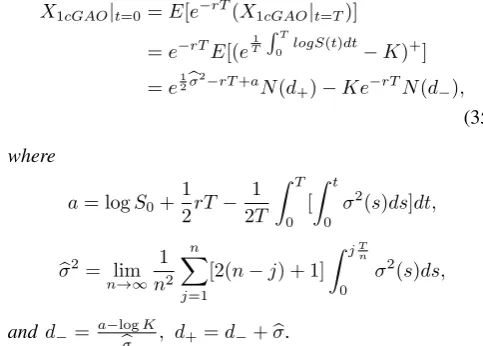
Theorem 2.Suppose that the stochastic volatilityσtin (1) is
replaced by a deterministic square-integrable volatilityσ(t),
there is an analytic solution for the fixed-strike continuous sampling geometric average Asian (call) option,
X1cGAO|t=0=E[e−rT(X1cGAO|t=T)] =e−rTE[(eT1
RT
0 logS(t)dt−K)+] =e12bσ
2−rT+a
N(d+)−Ke−rTN(d−),
(35)
where
a= logS0+
1 2rT−
1 2T
Z T
0
[ Z t
0
σ2(s)ds]dt,
b
σ2= lim n→∞
1
n2
n X
j=1
[2(n−j) + 1] Z jT
n
0
σ2(s)ds,
and d−=a−logK bσ
, d+=d−+bσ.
For Hull-White model, the option value as the control variate is as follows
a=
logS0+12rT −41σ20T, ifam= 0 logS0+12rT
− σ20
2T am[
1
am(e
amT −1)−T], ifa
m6= 0
(36)
b
σ2= ( 1
3σ 2
0T, if am= 0
2σ2 0 T2a3
m(e
amT −1)− 2σ
2 0 T a2
m −
σ2 0
am, if am6= 0
(37)
wheream=µ+12(m−1)σ2.
This experiment gives the standard deviation reduction ratios, which square are variance reduction ratios, when X1cGAO is used as the control variate for continuous
sam-pling Arithmetic average or Geometric average Asian option. The parameters in the model are set as follows: T = 1, n= 100,N = 50,r= 0.05,µ= 0.05,s0= 100,σ= 0.01, y0=σ02= 0.152,p= 10000.We give the standard deviation reduction ratios whenm, ρ, K vary.
The data in Table XV show that our new control variate method has good variance reduction efficiency for Asian options pricing, and X1cGAO has better variance reduction
ratios for V1cGAO than that for V1cAAO. For both options,
the greater strike prices(call options), the greater variance reduction ratios. When m= 0, the variance reduction ratio is greater than that in any other cases. The greater the order numbermis, the less the variance reduction ratio is. When m= 1−2σµ2,that is the case for Method 2, which the variance
ratio is the least one.
IAENG International Journal of Applied Mathematics, 45:1, IJAM_45_1_07
TABLE X
VARIANCE REDUCTION RATIO BY NEW CONTROL VARIATE METHOD WITH DIFFERENTK
K CV MC STD1 MC+CV STD2 Rˆ SteinNew
90 15.1179 15.0109 0.0406 15.1587 0.0062 42.95 15.16 95 11.3422 11.2373 0.0373 11.3813 0.0059 40.18 11.38 100 8.1417 8.0401 0.0331 8.1761 0.0056 35.21 8.18 105 5.5836 5.4965 0.0282 5.6187 0.0053 28.70 5.62 110 3.6583 3.5886 0.0233 3.6981 0.0050 20.07 3.69
TABLE XV
THE STANDARD DEVIATION REDUCTION RATIO BY USINGX1cGAOAS THE CONTROL VARIATE FORV1cGAOANDV1cAAO
m=-25 m=0 m=1 m=2 m=50 m=1−2µ
σ2
V1cGAO K=90 425.0241 422.7731 422.6536 422.5319 414.2153 174.1980 K=100 379.4825 376.7030 376.5696 376.4345 368.1058 167.0983 K=110 247.2158 247.3690 247.3625 247.3551 245.8597 112.1999
V1cAAO K=90 52.6871 52.8379 52.8439 52.8499 53.1350 46.1588 K=100 46.4262 46.6143 46.6218 46.6294 46.9910 39.4808 K=110 26.1005 26.2199 26.2247 26.2295 26.4615 22.1204
V. CONCLUSIONS
In this paper, we present a new simple control variate method for instruments pricing with stochastic volatility models. Our idea is using a deterministic volatility σ(t) to replace the stochastic volatility σt by choosing the factor
Y(t) with the same order moment as that of the stochastic factorYt.Numerical experiments report that our new control
variate works quite well in that the variance reduction ratio
ˆ
R and the ratio is obviously better than one formed by the constant volatility whichm= 1−2µ
σ2.This method is much
easier in computing than that of Method 1, Method 2, and the martingale control variate method. In addition, our new con-trol variate method has a promising wider-range application and can be extended to any other stochastic volatility models in options pricing, or other financial instruments pricing.
ACKNOWLEDGMENT
The author would like to thank the anonymous reviewers very much for their valuable suggestions on improving this paper.
REFERENCES
[1] F. Black and M. Scholes, ”The Valuation of Options and Corporate Liabilities,”Journal of Political Economy, 637-654, 1973.
[2] K. Du, G. Liu and G. Gu, ”A Class of Control Variates for Pricing Asian Options under Stochastic Volatility Models,”IAENG International Jour-nal of Applied Mathematics, 43(2), 45-53, 2013.
[3] K. Du, G. Liu and G. Gu, ”Accelerating Monte Carlo Method for Pricing Multi-asset Options under Stochastic Volatility Models,”IAENG International Journal of Applied Mathematics, 44(2), 62-70, 2014. [4] J.P. Fouque and C.H. Han, ”A Martingale Control Variate Method for
Option Pricing with Stochastic Volatility,” Probability and Statistics, 2007.
[5] R. Geske, ”The Valuation of Compound Options,”Journal of Financial Economics, 7, 63-81, 1979.
[6] P. Glasserman, Monte Carlo Methods in Financial Engineering, Springer, New York, 2004.
[7] S.L. Heston, ”A Closed-Form Solution for Options with Stochastic Volatility with Applications to Bond and Currency Options,”The Review of Financial Studies, 6, 327-343, 1993.
[8] J. Hull and A. White, ”The Pricing of Options on Assets with Stochastic Volatilities,”Journal of Finance, 42, 281-300, 1987.
[9] H. Johnson and D. Shanno, ”Option pricing when volatility is chang-ing,”Journal of Financial and Quantitative Analysis, 22, 143-152, 1987. [10] J.M. Ma, and C.L. Xu, ”An Efficient Control Variate Method for Pricing Variance Derivatives,”Journal of Computational and Applied Mathematic, 235, 108-119, 2010.
[11] R. Merton, ”The theory of rational option pricing,”Journal of Eco-nomics and Management Science, 4, 141-183, 1973.
[12] R. Roll, ”An Analytical Valuation Formula for Unprotected American Call Options on Stocks with Known Dividends,”Journal of Financial Economics, 5, 251-258, 1977.
[13] L.O. Scott, ”Option Pricing when the Variance Change Randomly: Theory, Estimation, and an Application,” Journal of Financial and Quantitative Analysis, 22, 419-438, 1987.
[14] E.M. Stein, and J.C. Stein, ”Stock Price Distributions with Stochastic Volatility: an Analytic Approach,”Review of Finance Studies, 4, 727-752, 1991.
[15] R.E. Whaley, ”On the Valuation of American Call Options on Stocks with Known Dividends,”Journal of Financial Economics, 9, 207-211, 1981.