Account and Financial Management Journal ISSN: 2456-3374
401
A Study on the Usage of Arabic E-Commerce Websites Services
among Uae Citizens
Mohammad Issa Saleem Al-Zoubi
Irbid National University, Jordan
ARTICLE INFO ABSTRACT
corresponding Author:
Mohammad Issa Saleem Al-Zoubi
Irbid National University, Jordan
As an e-commerce domain, online shopping is now in its golden era. It is now a potential contributor in e-commerce. E-commerce success has been documented by numerous countries and it contributed to these countries’ economic growth. The UAE is witnessing growth of e-commerce at a yearly rate exceeding 20%. In this region, the majority of the population (>80%) use Internet. Within this portion, 15% do online shopping and approximately 10% use mobile devices for shopping online. 250 respondents in the United Arab Emirates were selected in this study and data were gathered from online questionnaires. In short, the predictive model demonstrates 60.1% of the variance in behavioral intention (BI). This is directly clarified by performance expectancy, effort expectancy, social influence, cost, awareness. Also, the model represents 54.2% of the variance in Use Behavior. This is directly clarified by behavioral intention and Facilitating Conditions. As such, it is expected that the increase in online Arab websites will shift the online purchasing intentions of the customer to the local Arab websites. This will enhance the Arab countries’ microeconomics. Online shopping or e-commerce adoption differs based on countries because of different affecting factors. Thus, factors that affect, inhibit, and encourage e-commerce that are unique to each country should be considered in order to increase online shopping.
KEYWORDS: E-Commerce, Technology acceptance model, UTAUT, Performance Expectancy, Effort Expectancy.
Introduction
Numerous countries as well as the developing countries including the Arab and Asian countries have experienced the rapid growth of electronic commerce (E-Commerce).E-Commerce comprises business transactions via electronic means where the delivery of services or goods is electronically done or in the tangible form (Kotler, Keller et al.,
dynamic young population with one of the highest global per capita internet penetration levels. As Internet is fast growing globally, it enables high-speed, low-energy, almost free infrastructure, global, instant, online everything, unrestricted by borders. All these impact both the society and the economies worldwide. Globally, there has been an increase in the utilization of advanced technology in learning, living, working, socializing, and entertainment via online services’ devices including PCs, Tablets, Smartphones and Smart TVs.
Problem Statement
The Arab nations appear to be the slowest online shopping adopter (Rambo & Liu, 2010) where almost half (48%) of the Internet users in this region have never engaged in online transaction. Risk issue appears to be the reason why Arab consumers were reluctant to engage in online shopping (al-Smadi, 2013). In support to this notion, Megdadi and Nusair (2011) indicated the necessity of online retailer in increasing the trust perception and site quality so that users would be motivated to shop online. In short, the Arab consumers were majorly concerned with the issue of trust and websites quality when doing online shopping. In fact, Faqih (2011) reported lack of trust in the online transactions as a hindrance in online shopping acceptance.
Electronic Commerce allows the transactions of business to be electronically performed and such move has generated substantial operational and strategic benefits. As reported by Hasan et al. (2012), developed countries have aggressively implemented Commerce and in fact, e-Commerce has become an essential part of business activities in these countries. E-commerce could reduce the economic and digital gap between the developed and the developing countries. However, the developing countries are still lagging in the adoption of e-Commerce. Also,
there remains a lack of research on e-Commerce readiness research in the developing countries and so, the relevance of e-Commerce in these countries is not yet fully understood. As such, this study aims to explore the readiness of e-Commerce in UAE. In order to achieve this aim, this study will evaluate the aspects of technology, legality and the environment of these countries in relation to the use of e-commerce.
E-Commerce is expected to become a megatrend among businesses in the UAE. In fact by 2018, e-commerce in this region was forecasted to worth $10 billion (Dh36.7 billion). Such statement was articulated by Frost & Sullivan’s senior partner and head of visionary innovation group Mr. Sarwant Singh. Mr. Singh further remarked that albeit having the lowest percentage of online purchase in comparison to other countries worldwide, UAE will see e-Commerce expanding as a major megatrend its businesses (Alhassan, 2009). At the current time, it has been estimated that the overall value of e-commerce in the UAE is at $2.5 billion (Dh9.2 billion) and the amount is expected to grow and generate fresh businesses and job openings. As Mr. Singh had remarked, e-commerce appears to be the fastest expanding business in the UAE. A megatrend is a global trend and carries transformative change to businesses, culture as well as society. The market will also be impacted by this transformation via the generation of business models such as the “break and click, click and collect, click and deliver, click and fit” model.
403
that could potentially influence users’ intention to engage in online transaction is examined in this study.
Theoretical Background and Current Research
In understanding what determines user acceptance of e-commerce, this study first elaborates the Unified Theory of Acceptance and Use of Technology (UTAUT) Model as below:
Unified Theory of Acceptance and Use of Technology (UTAUT) Model
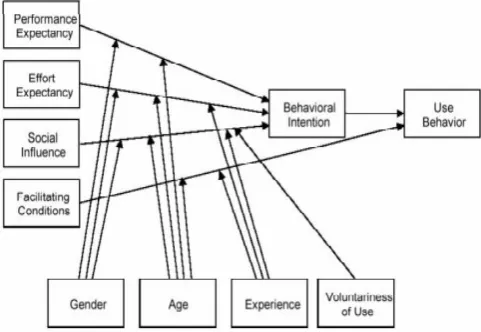
The Unified Theory of Acceptance and Use of Technology (UTAUT) Model was developed by Venkatesh et al. (2003). The UTAUT model consolidates the past researches that are linked with TAM. The UTAUT describes the intentions of user to utilise an Information system (IS) and user’s ensuing usage behavior. As proposed by the theory, four (4) key constructs directly determine of usage intention and behaviour of user. As presented by Venkatesh et al. (2003), these determinants are: performance expectancy, effort expectancy, social influence, and facilitating conditions. Further, the factors of age, gender, experience, as well as use voluntariness are theorised as the mediators to the impact of the aforementioned four key constructs (Venkatesh et al., 2003). The theory establishment was based on a review and consolidation of the constructs from eight models used by the past researches on IS usage behaviour. Figure 1 illustrates the UTAUT.
Fig. 1: Unified Theory of Acceptance and Use of Technology (UTAUT) Model Source: (Venkatesh
et al., 2003)
Research Model Factors
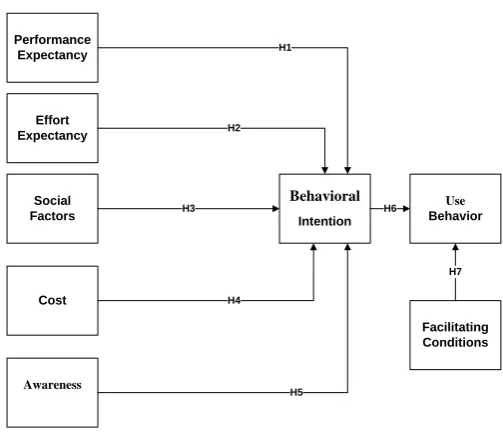
Thus study proposes a research model based on Venkatesh et al.’s (2003) Unified Theory of Acceptance and Use of Technology Model (UTAUT) with two more factors added. This model will be used to examine the factors that impact users’ acceptance of e-commerce in United Arab Emirates. The constructs of the proposed model are discussed as below:
Cost
(or should not) make purchase and utilise m-commerce. For instance, Sathye (1999) pointed out how important the factors of cost are, particularly with respect to innovation adoption. According to the author, cost is one of the major factors that prevent users in Singapore and Australia from using Internet banking. (Anil, Ting, Moe, & Jonathan, 2003).
In Malaysia, behavioural intention is found to considerably be affected by cost and also other factors (Wu & Wang, 2005). Also in Malaysia, Wei et al. (2009) reported the factor of perceived cost as one of the major obstacles that prevent m-commerce use among Malaysians. Also, in Finland, Carlsson, Walden and Bouwman (2006) stated the factor of cost as significantly impacting users’ implementation of 3G (third generation) services and in fact, in this country, the factor of cost is more important than the factors of privacy and security.
Awareness
Awareness is about familiarization of consumers by way of advertising and marketing of the brand, product and services of the company, and also making the consumers aware of the special features and benefits of the products and services in a manner that is distinctive from the competitors particularly with respect to function or style. Martins et al. (2014) stated that consumers who obtain information by way of mass media or word of mouth will have knowledge of the products and services. Thus, promotion can generate awareness towards online services. In relation to this, Nuseir and Al-Masri (2010) reported that consumer purchase decisions are linked with e-promotions. Further, Darby et al. (2003) added that site awareness has substantial impact on consumer’s site commitment. As such, a positive relationship is hypothesised in this study as will be elaborated in the ensuing section.
Research Framework and Hypothesis
Taking in to account the factors that have the potential to impact users’ acceptance of m-learning, three new constructs are added into TAM2 and IDT so that the factors that might impact the acceptance of university student towards m-learning can be scrutinised. These factors are: service quality, student readiness and trust. The condensed model can fully clarify m-Learning user.
Performance Expectancy
Effort Expectancy
Social Factors
Facilitating Conditions Cost
Awareness
Use Behavior
Behavioral
Intention
H1
H2
H3
H4
H5
H6
H7
Figure 2: Research Framework
Research Hypothesis
H1: Performance Expectancy has a significant positive relationship with behavioral intention to use E-commerce.
H2: Effort Expectancy has a significant positive relationship with behavioral intention to use E-commerce.
H3: Social Factors has a significant positive relationship with behavioral intention to use E-commerce.
405
H5: Awareness has a significant positive relationship with behavioral intention to use E-commerce.
H6: Behavioral Intention has a significant positive relationship with Use Behavior to use E-commerce.
H7: Facilitating Conditions have a significant positive relationship with Use Behavior to use E-commerce.
Research Methodology
A total of 250 people in the United Arab Emirates were chosen as respondents in this study while data were gathered online (online questionnaires at www.surveyshare.com).The questionnaire has only one part and there are seven (7) key constructs that are linked with behavioral intention to use E-commerce to assess the likelihood of level of acceptance. Each construct is covered by a number of items. The 5-point scale is used to gauge user’s degree of acceptance. The regression analysis is used to gauge the linkage between the seven key factors and behavioral intention to use E-commerce.
Data Analysis and Results
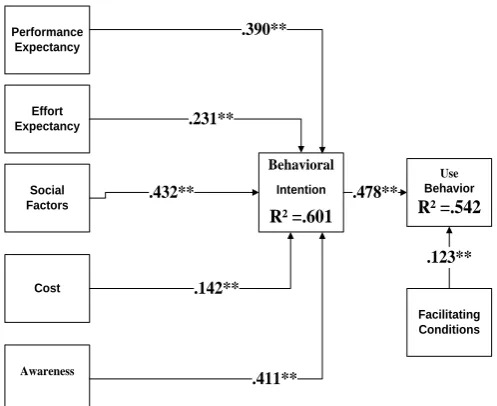
Based on the outcomes, each hypothesis shows significance based on the zero-order correlation test. Thus, at this level, the hypotheses are all supported. Further, the predictive model comprises 60.1% of the variance in behavioral intention (BI) and this is directly justified by performance expectancy, effort expectancy, social influence, cost as well as awareness. Also, the model entails 54.2% of the variance in Use Behaviour. This result is directly explained by behavioral intention and Facilitating Conditions. Figure 3 represents the predictive models with R² as well as path coefficients in the research model.
Performance Expectancy
Effort Expectancy
Social Factors
Facilitating Conditions Cost
Awareness
Use Behavior
R² =.542 Behavioral
Intention
R² =.601 .390**
.231**
.432**
.142**
.411**
.478**
.123**
Figure 3: Predictive Model with R² and Path Coefficients
Conclusion
main guideline to the academia and practitioners as well in their business development practices.
References
1. Alhassan, K. A. (2009). Consumer Confidence in E-commerce: The Need for Reform in the UAE (Doctoral dissertation, University of Aberdeen).
2. Al-Smadi, S. (2013). Consumers Attitudes towards Online Shopping in Jordan: Opportunities and Challenges.
3. Anil, S., Ting, L. T., Moe, L. H., & Jonathan, G. P. G. (2003). Overcoming barriers to the successful adoption of mobile commerce in Singapore. International Journal of Mobile Communications, 1(1), 194-231.
4. Carlsson, C., Walden, P., & Bouwman, H. (2006). Adoption of 3G services in Finland. International Journal of Mobile Communications, 4(4), 369-385.
5. Constantinides, E. (2002). The 4S web-marketing mix model. Electronic Commerce Research and Applications, 1(1), 57-76.
6. Darby,R.,Jones,J.,& Al Madani, G. (2003). E-commerce marketing: fad or fiction? Management competency in mastering emerging technology. An international case analysis in the UAE. Logistics Information Management, 16(2), 106-113. 7. Faqih, K. 2011. Integrating perceived risk
and trust with technology acceptance model: An empirical assessment of customers' acceptance of online shopping in Jordan. Research and Innovation in Information Systems (ICRIIS), 2011. 8. Hasan,L.,Morris, A., & Probets, S. (2012).
A comparison of usability evaluation methods for evaluating e-commerce websites.
Behaviour & Information Technology , 31 (7), 707-737.
9. Hong, S. J., Thong, J. Y., Moon, J. Y., & Tam, K. Y. (2008). Understanding the behaviour of mobile data services consumers. Information Systems Frontiers, 10(4), 431-445.
10.International Conference on, hlm. 1-5. 11.Kalakota, R. and Whinston, A. B. 1997.
Readings in electronic commerce. Ed. Addison-Wesley Longman Publishing Co., Inc.
12.Kotler, P., Keller, K. L., Ancarani, F., & Costabile, M. (2014). Marketing management 14/e. Pearson.
13.Martins, C., Oliveira, T., & Popovič, A. (2014). Understanding the Internet banking adoption: A unified theory of acceptance and use of technology and perceived risk application. International Journal of Information Management, 34(1), 1-13.
14.Megdadi, Y. A. and Nusair, T. T. 2011. Shopping consumer attitudes toward mobile marketing: a case study among Jordanian user's. International Journal of Marketing Studies 3(2): 53.
15.Nuseir, M. T., Arora, N., Al-Masri, M. M., & Gharaibeh, M. (2010). Evidence of Online Shopping: A Consumer Perspective. International Review of Business Research Papers, 6(5), 90-106. 16.Rambo, K., & Liu, K. (2010).
407
17.Sathye, M. (1999). Adoption of internet banking by Australian consumers: An empirical investigation. International Journal of Bank Marketing, 17(7), 324-334. 18.Venkatesh, V., Morris, M. G., Davis, G.
B., & Davis, F. D. (2003). User acceptance of information technology: Toward a unified view. MIS quarterly, 425-478. 19.Wei, T. T., Marthandan, G., Chong, A. Y.
L., Ooi, K. B., & Arumugam, S. (2009). What drives Malaysian m-commerce adoption? An empirical analysis. Industrial
Management & Data Systems, 109(3), 370-388.
20.Wind, M. G. (1977). Consumer response to price: An attitudinal, information processing perspective (Moving Ahead with Attitude Research ed.). Chicago: American Marketing Association.