Open Access
R E S E A R C H
© 2010 Heesch et al; licensee BioMed Central Ltd. This is an Open Access article distributed under the terms of the Creative Commons Attribution License (http://creativecommons.org/licenses/by/2.0), which permits unrestricted use, distribution, and reproduction in any medium, provided the original work is properly cited.
Research
What do IPAQ questions mean to older adults?
Lessons from cognitive interviews
Kristiann C Heesch*
1, Jannique GZ van Uffelen
2, Robert L Hill
2and Wendy J Brown
2Abstract
Background: Most questionnaires used for physical activity (PA) surveillance have been developed for adults aged ≤65
years. Given the health benefits of PA for older adults and the aging of the population, it is important to include adults aged 65+ years in PA surveillance. However, few studies have examined how well older adults understand PA
surveillance questionnaires. This study aimed to document older adults' understanding of questions from the International PA Questionnaire (IPAQ), which is used worldwide for PA surveillance.
Methods: Participants were 41 community-dwelling adults aged 65-89 years. They each completed IPAQ in a
face-to-face semi-structured interview, using the "think-aloud" method, in which they expressed their thoughts out loud as they answered IPAQ questions. Interviews were transcribed and coded according to a three-stage model:
understanding the intent of the question; performing the primary task (conducting the mental operations required to formulate a response); and response formatting (mapping the response into pre-specified response options).
Results: Most difficulties occurred during the understanding and performing the primary task stages. Errors included
recalling PA in an "average" week, not in the previous 7 days; including PA lasting <10 minutes/session; reporting the same PA twice or thrice; and including the total time of an activity for which only a part of that time was at the intensity specified in the question. Participants were unclear what activities fitted within a question's scope and used a variety of strategies for determining the frequency and duration of their activities. Participants experienced more difficulties with the moderate-intensity PA and walking questions than with the vigorous-intensity PA questions. The sitting time question, particularly difficult for many participants, required the use of an answer strategy different from that used to answer questions about PA.
Conclusions: These findings indicate a need for caution in administering IPAQ to adults aged ≥65 years. Most errors
resulted in over-reporting, although errors resulting in under-reporting were also noted. Given the nature of the errors made by participants, it is possible that similar errors occur when IPAQ is used in younger populations and that the errors identified could be minimized with small modifications to IPAQ.
Background
Older adults who are physically active have a reduced risk of developing cardiovascular diseases, type 2 diabetes, depression and anxiety, some cancers, musculoskeletal conditions, and mobility problems [1,2]. However, older adults are typically less physically active than younger adults [1]. The burden of disease attributable to physical
inactivity increases with age, with the greatest burden being found in the oldest populations [3].
Knowledge about physical activity (PA) patterns of older adults is largely based on self-report data gathered for surveillance, mostly through the use of question-naires. Little research, however, has been conducted to examine how older adults respond to PA questionnaires developed for surveillance. Because the ability to use the same measure for surveillance in all adults, regardless of age, is critical for determining population-wide PA pat-terns and trends, it is important to determine whether
* Correspondence: [email protected]
1 Queensland University of Technology, Institute of Health & Biomedical Innovation and the School of Public Health, Brisbane, Queensland 4059, Australia
these questionnaires are appropriate to use with older adults.
Some evidence indicates that declines in PA among older adults may be attributable to measurement errors in completing PA questionnaires [4]. Older adults may find such questionnaires challenging because they partic-ipate more in lower-intensity PA than younger adults, and lower-intensity PA is more difficult to recall than higher-intensity PA [5,6]. Older adults also tend to include unstructured PA in their daily lives, such as housework and gardening, which is difficult to recall [5,6]. Some studies suggest that older adults find it difficult to report the duration of their activities using open-ended response formats [5,7]. Errors may also arise from misin-terpretation of the questions asked and/or misunder-standing of the terminology being used in these questionnaires [8].
To uncover sources of error, cognitive interviewing methods have gained in popularity over the last two decades as questionnaires have begun to be evaluated more systematically [9]. These methods can be used to ascertain whether older adults understand questions as intended by questionnaire developers and whether older adults interpret the questions in similar ways [9]. By revealing potential sources of error, cognitive interview-ing methods can be used to improve the credibility of data gathered from questionnaires; therefore, they com-plement quantitative methods that assess the reliability and validity of questionnaires [8].
We used cognitive interviews to gain insight into how a sample of older Australian adults understood and inter-preted questions from four PA surveillance question-naires. The aim of the present study was to document participants' understanding and interpretations of ques-tions from one of these questionnaires, the International PA Questionnaire (IPAQ). IPAQ has been used in many countries, including Australia, to assess prevalence of PA in adults aged 65 years [10,11] and in adults aged 18-69 years [12]. The self-report short form of IPAQ that asks participants to recall activities of the previous 7 days was used in the current study. This form of IPAQ has been recommended for international prevalence studies of adults aged ≤65 years [11]. Although it is recom-mended that testing of IPAQ be carried out with older adults [11], little testing of the credibility of IPAQ data has been done with this population [13,14]. Some qualita-tive feedback was gathered from data collectors during initial validity testing with adults aged ≤65 years [11], and qualitative data were collected from adults of all ages, 20% of whom were aged ≥65 years (n = 20), as part of an examination of over-reporting of PA on the short tele-phone IPAQ form [14]. However, we are unaware of any systematic collection of qualitative data to uncover
cogni-tive problems that older adults may have with responding to IPAQ questions. This study aims to fill that gap.
Methods
Study participants and recruitment
Participants were community-dwelling adults, aged ≥65 years, who lived in the greater Brisbane area of Australia. To be eligible, they had to report an ability to walk >100 metres without aid, so that the sample included only peo-ple who were able to report at least some PA participa-tion. Participants were purposively selected to ensure representation of men and women of different age groups, levels of physical activity, and education levels, since these factors have been shown to influence compre-hension of PA questionnaires [15]. They were recruited via flyers displayed at voluntary organisations with large numbers of older adult members, including bridge clubs, senior centres, and exercise centres for older adults. Additionally, a recruitment notice with a request to pass study information to eligible friends and relatives was cir-culated through emails and e-newsletters to university staff. The study protocol was approved by the University of Queensland Medical Research Ethics Committee.
Cognitive interviews
Cognitive interviewing typically uses as its theoretical framework the and-answer model of question-naire response [16-18]. One framework is Conrad's three-stage model [19]. Conrad proposes that participants move through three stages to respond to a question: 1) understanding the intent of the question (including com-prehension of what information is requested and what process should be used to retrieve that information); 2) performing the primary task (conducting the mental operations required to formulate a response, including information retrieval, mental arithmetic and evaluation of a response); and 3) response formatting (mapping a response to pre-specified response options). This classifi-cation of problems allows for a more reliable and objec-tive interpretation of the data than when qualitaobjec-tive data arising from cognitive interviewing are coded without criteria [19]. The interview protocol of this study was developed to document participants' process through these three stages. Cognitive interviewing techniques that were used included 1) "concurrent think-aloud," in which respondents were asked to "think aloud" when answering questions and 2) probing, using structured and unstructured questions [16,20].
Data collection protocol
inter-views, face-to-face and semi-structured, were conducted in participants' homes or at other convenient locations, in accordance with participants' wishes. Two members of the research team with doctoral degrees in physical activ-ity and health-related fields and with experience in quali-tative interviewing (KH, JvU) alternated in serving as the primary interviewer. KH, JvU, and RLH, a graduate stu-dent in physical activity and health, alternated in serving as a second interviewer. The second interviewer was responsible for operating a voice recorder, observing and noting non-verbal signals from participants, taking notes useful for tape transcriptions, and conducting additional probing as warranted. During the interview, participants responded to questions from four PA questionnaires: the Behavioral Risk Factor Surveillance System (BRFSS) [21], Active Australia [22], the Physical Activity Scale for the Elderly (PASE) [7], as well as IPAQ [11]. A computer-based random order generator was used to assign the order in which the four questionnaires were presented. This allowed us to guarantee that similar numbers of par-ticipants would receive each of the 24 possible combina-tions of questionnaire order. In order to decrease any bias resulting from the order of questionnaires, participants were instructed, before the start of each new question-naire after the first one, to respond as if they had not already responded to similar questions.
The interview began with a general introduction to the interview process and the building of rapport with partic-ipants. The primary interviewer then posed as an inter-viewee to demonstrate the "think aloud" process by reading out loud an example question about diet and then formulating an answer, speaking aloud her thoughts as she did so. Participants then were asked to use this tech-nique to answer questions from the PA questionnaires. When participants did not adequately explain how they developed a response about a PA domain, the primary interviewer asked follow-up questions to probe for more information. These included comprehension-type ques-tions (What activities are you including in your answer?) and questions to ascertain how the primary task was being performed (How did you decide on your answer?). Unscripted probing to clarify participants' responses was also used. Participants completed their response to each question by writing their answers on questionnaire answer sheets. Any problems they had with using the response format were noted.
During a refreshment break, the second interviewer measured participants' height and weight, using standard procedures. These measures were used to compute body mass index as kg/m2. The interview ended with the
distri-bution of a $20 gift voucher. As soon as possible after the interview, the two interviewers, together, made field notes to begin the analysis process.
International Physical Activity Questionnaire (IPAQ)
The self-report short form of IPAQ is a 7-item measure of four domains of activity: vigorous-intensity PA (defined as activities that make you breathe much harder than nor-mal), moderate-intensity PA (defined as activities that make you breathe somewhat harder than normal), walk-ing and sittwalk-ing. For each activity domain, examples are provided to indicate that participants are to report activi-ties of work, leisure-time, house and garden work, and transportation. Participants report frequency (days dur-ing the last 7 days) and duration (minutes/hours usually spent on one of those days) of their vigorous-intensity PA (VPA), moderate-intensity PA (MPA), and walking. Only sessions of activity lasting at least 10 minutes are to be reported. Participants also report the total time that they spend sitting on a week day, during the last 7 days.
IPAQ was initially developed and validated in adults aged 18-65 years from 12 countries [11], although two subsequent studies, one in Belgium [14] and one in South Africa [13], included adults over aged 65 years in their validity and reliability analyses. Validity testing has included common quantitative methods, most notably concurrent comparisons with objective measures and with other questionnaires [11,13,23-29]. In the initial 12-country validation study, the self-report short forms of IPAQ were found to have acceptable one-week test-retest reliability for PA (pooled Spearman's ρ = .75) [11]. Crite-rion validity for PA items on the short forms, as measured against an accelerometer, was also acceptable (pooled Spearman's ρ = .30), as it was similar to that reported for other self-report measures [11]. Estimates for sitting time on a weekday were examined with a subsample from the 12 countries [27]. Time spent sitting on a weekday had acceptable test-retest reliability (Spearman's ρ range: .62-.96), and criterion validity, as measured against an accel-erometer, was also acceptable (pooled Spearman's ρ = .34). Single-country studies, however, indicate that IPAQ may result in over-reporting of PA [14,23-25,28]. The one study exclusively of older adults, a South African study of adults aged 62-70 years [13], found the specific PA domains measured in IPAQ to have adequate criterion validity when tested against an accelerometer, although total energy expenditure did not. Moreover, test-retest reliability was found to be low (Spearman's ρ = .54 in men and .60 in women) compared with estimates found in the initial 12-country study.
Data management and analysis
Interna-tional, Melbourne, Australia). Data within each domain were next coded into the understanding, performing the primary task, and response formatting stages. In light of suggestions by Conrad [19], data for each activity domain were coded to reveal problems within each of these stages.
For the current study, only IPAQ data were analyzed. The data from the 15 participants who completed the IPAQ as the first questionnaire during the interview were coded first. Three researchers (KH, JvU, RLH) jointly developed initial themes identified within each stage, using these data. Next, data from the 26 participants who completed IPAQ as the second (n = 14) or third (n = 12) questionnaire were coded, using the initial themes and developing additional themes as they unfolded. To ensure replicability of findings across these 26 transcripts, initial coding of each transcript's data was performed by two members of the research team (KH, JvU, RLH). Discrep-ancies between coders were discussed in team meetings, and consensus was used to determine the final coding. The team concluded that saturation within themes had been reached after transcripts from these 26 participants had been coded, and thus the coding process ended after the coding of 41 transcripts. Next, KH reviewed all themes, merged those which overlapped, and then marized the findings. JvU and RLH reviewed the sum-mary and confirmed that it represented the data. For the final step, a researcher who was not included in the data collection or analysis procedures (WJB) reviewed the coding, themes, and summary report to confirm the trustworthiness of the conclusions drawn about the data collected.
Results and Discussion
Table 1 presents sample characteristics. Both men and women were well-represented in the sample. They ranged in age from 65-89 years (mean = 72.9 years, SD = 5.9), and both low and high levels of education were rep-resented. Also of note is that 80% of participants reported good/very good health, and the remaining 20% reported excellent health. Participants also had good physical functioning (median score on SF-36 physical function scale score = 90.0, range = 40-100) although 7% reported an inability to do exercise other than walking; 12% reported a limited ability to walk 500 meters; and 20% reported a limited ability to walk 1 km.
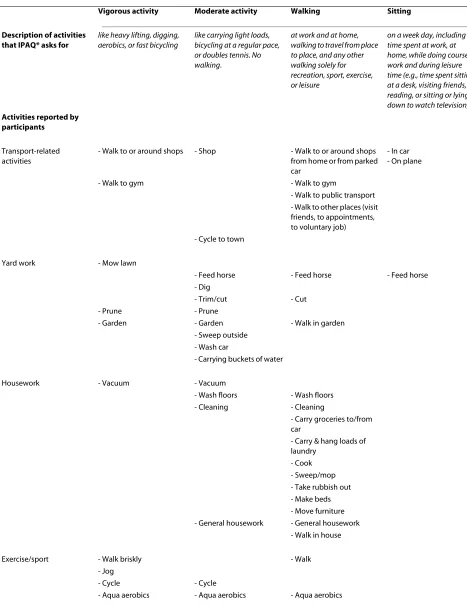
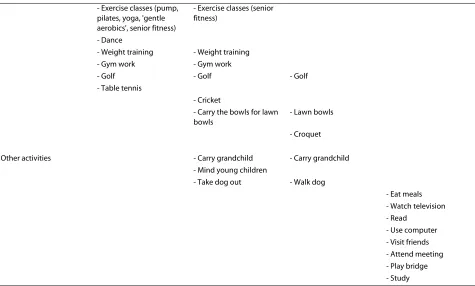
Participants reported a variety of physical activities, with some reporting only light activities, like "casual" walking, and others reporting vigorous sports as well (Table 2). For VPA, MPA and walking, participants reported transportation activities, house and garden work, and leisure-time activities, namely exercise or sports activities. For MPA and walking, some also
reported caring responsibilities, including caring for chil-dren or a dog. For sitting activities, all reported leisure-time activities, mostly reading, watching television, and eating meals. Few participants reported any work activi-ties because most were retired.
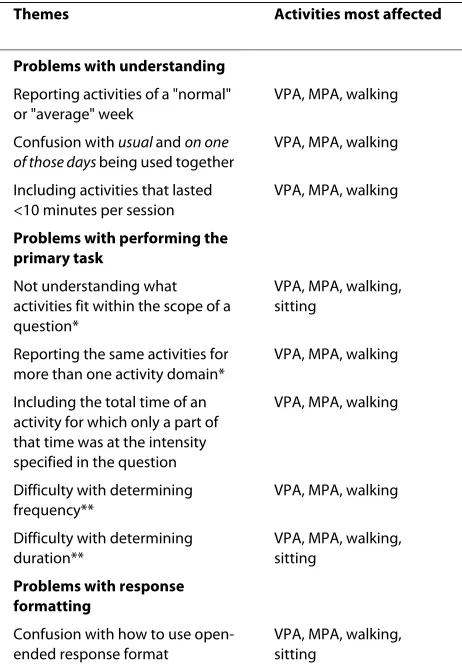
Most of the problems with responding to IPAQ ques-tions were issues with understanding and performing the primary task. Only a few participants did not accurately record their responses as part of the third stage, response formatting. The cognitive problems encountered during each of these stages are described in Table 3 and dis-cussed in detail below.
Problems with understanding
Reporting activities of a "normal" or "average" week
Before questions about each activity domain, IPAQ instructs participants to recall activities from the previ-ous 7 days. However, some participants failed to under-stand that they were to report activities only of the previous week. Rather, they reported activities that were normally a part of their routine. One man, for example, said that his strategy for remembering the frequency of his MPA was to "just think back over an average week." This error could not be explained by questionnaire order. It was present in participants who completed the IPAQ first, in those who completed it after answering another questionnaire that asked about the previous 7 days, and in those who completed it after a questionnaire that had asked for activities of a usual week. Participants may have found recalling physical activity habits to be easier than recalling specific events of the previous week. Durante and Ainsworth [15] have suggested that general memo-ries of physical activity habits can cloud memomemo-ries of spe-cific physical activity sessions.
In the original IPAQ validation study of adults aged 18-65 years [11], some participants were asked about activi-ties during the last 7 days while others were asked about activities during a usual week. Data collectors reported that participants in some countries who were asked about activities in a usual week opted to report on activities in the last 7 days, because they had difficulties understand-ing what was meant by a usual week. Based on our results, it would appear that some older people have the opposite problem; they reported on a usual week, even though they were asked about the last 7 days.
For questions about the duration of activities, the recalling of activities of an "average" week in this study may further be explained by the questionnaire's instruc-tions. Participants were asked to recall activities done during the previous 7 days in questions about activity fre-quency, but not explicitly in the follow-up questions about duration. In addition, the term usually spend
partic-Table 1: Demographic characteristics of participants
Men (n = 19) Women (n = 22) Total (N = 41)
% n % n % n
Age, years
65-69 21.1 4 36.4 8 29.3 12
70-74 42.1 8 36.4 8 39.0 16
≥75 36.8 7 27.3 6 31.7 13
Country of birth
Australia 68.4 13 50.0 11 58.5 24
Other English-speaking country 26.3 5 36.4 8 31.7 13
Non-English-speaking country 5.3 1 13.6 3 9.8 4
Education
No tertiary education 10.5 2 13.6 3 12.2 5
Certificate or trade 36.8 7 31.8 7 34.1 14
University degree or high 52.6 10 54.5 12 53.7 22
Employment
Employed 5.3 1 13.6 3 9.8 4
Retired/not employed 94.7 18 86.4 19 90.2 37
Income management
Easy 52.6 10 27.3 6 39.0 16
Not too bad 42.1 8 45.5 10 43.9 18
Difficult/impossible 5.3 1 27.3 6 17.1 7
Marital status
Married/common-law marriage 73.7 14 50.0 11 61.0 25
Not married 26.3 5 50.0 11 39.0 16
Body mass index (kg/m2)
18.5 to <25 (healthy weight) 42.1 8 40.9 9 41.5 17
25 to <30 (overweight) 47.4 9 40.9 9 43.9 18
≥30 (obese) 10.5 2 18.2 4 14.6 6
ipants may not have understood that the previous 7 days
criterion applied to the duration questions. In discussing the duration of her MPA, one woman said, "Probably half an hour per day, I'd say. It depends on different weeks."
Confusion with usually and on one of those days being used
together
Another source of confusion for participants was the cou-pling of the terms usually and on one of those days in the duration questions. This coupling created cognitive dis-sonance in the minds of some participants. One of the women, for example, summed up her confusion by say-ing:
'Usually' is something that I understand to be 'every-day,' but how can you be usually 'on one those days'? So you have to pick one day. So that is a bit contradic-tory to me. No, I can't answer that.
Including activities that lasted less than 10 minutes per session
In the introductory instructions, IPAQ asked participants to report activities lasting ≥10 minutes per session. Because this instruction immediately precedes the fre-quency questions and there is no similar instruction just before subsequent duration questions, participants may have perceived that the 10-minute criterion pertained only to the frequency questions. When asked for duration of activities, participants often included activities lasting less than 10 minutes per session. For example, one man, in considering the minutes he spent walking on a normal day, commented:
a lot of shorter than 10-minute walks. I don't know if you're after the 10 minutes, or longer walks. Who on earth would make such a questionnaire?
Participants such as this one, who did not apply the 10-minute criterion to the duration questions, had many more activities to include in their calculations of dura-tion, so the task became more difficult, particularly for calculating the duration of MPA and walking. Similarly, in a Belgian sample of adults of all ages (20% aged 65+ years), Rzewnicki et al. [14] found that participants who completed the self-report previous 7 days telephone form of IPAQ often did not consider the 10-minute criterion as an absolute cut-off, particularly when asked about MPA or walking.
Problems with performing the primary task
Not understanding what activities fitted within the scope of a question
A problem for most participants was deciding which of their activities fell within the scope of an activity domain. Some participants were unsure what to include in ques-tions about VPA and MPA because they could not judge the intensity of their activities (see Table 2 for activities included as VPA and as MPA). One woman said, "What I'm not sure about is whether pilates is considered mod-erate or, uh, vigorous." Other women questioned whether certain household activities were vigorous (e.g., "what about the vacuuming or washing the floor?") or moderate (e.g., "like sweeping?"). A few participants stated that they had not done any VPA but chose to report as VPA, never-theless, activities that they did do. For example, one woman explained the response she gave to questions about VPA duration by saying, "I'd just say for physical activities I'd do about 2 hours a day. Okay, well, I did physical activities, but not the type you're referring to."
Another difficulty concerned how participants assessed the intensity of activities given as examples of VPA and MPA. Some participants perceived that some of the examples were not consistently performed at the intensity described in the question, or that the levels of intensity required by some examples differed from the levels of intensity required for other examples. Some participants who perceived these difficulties opted to report on all activities they did that were listed as examples; others did not. The most problematic MPA example perceived by participants was carrying light loads. Often, participants questioned whether carrying groceries counted. One woman wondered aloud whether she should include "car-rying shopping out from the garage" because "it doesn't always make me breather harder." One man said he did not know whether he should include carrying "my [lawn] bowls container, that's got four heavy bowls in it, and I carry that for 100 yards" because "what I do with my
bowls is nothing like playing doubles tennis, " which was one of the other MPA examples.
A related issue was that a few participants understood the examples to be the only activities about which they were to report. One man said that he did not do any MPA because he did not do any of the activities offered as examples: "I don't play tennis anymore. The last time I played tennis I finished up in hospital...and so tennis is out. Bicycling, I don't ride bikes. Light loads, not really." One woman, in addressing the sitting question, excluded mealtimes from her answer because "it doesn't say sitting down over a meal."
Some of these difficulties with the VPA and MPA ques-tions were also revealed in reliability and validity testing of the IPAQ in younger adults in 12 countries [11]. As part of that study, qualitative data revealed that partici-pants had difficulty in distinguishing between VPA and MPA and in understanding the relevance of examples provided for these activity domains [11]. In the Belgian sample of adults of all ages, problems with the evaluation of intensity were also identified [14]. Thus, these prob-lems do not seem to be age related.
Evaluating which activities fell within the scope of the walking and sitting domains was also problematic (see Table 2 for activities included as walking and as sitting). Some participants reported "casual" start-and-stop walk-ing around the house or garden for the walkwalk-ing domain, and some included all activities that required movement. One woman wondered aloud whether to include her aqua-aerobics class as walking. She decided to include it. Another woman questioned whether she should only report "fast walking." Concluding that all walking should be included, she reported walking in shops and around her office at work as well as her walking for exercise. Oth-ers, however, reported only purposeful walking for exer-cise or for transport. Data gathered about the sitting question revealed that some participants were unclear which activities not listed as examples of sitting were to be included. Some participants reasoned that lying down activities should not be included while others concluded that naps and lying down while not reading or watching television should be counted as sitting. One woman asked, "I mean, is sitting down not standing up?"
Reporting the same activity for more than one activity domain
Table 2: Activities asked for and activities reported by participants (n = 41)
Vigorous activity Moderate activity Walking Sitting
Description of activities that IPAQ* asks for
like heavy lifting, digging, aerobics, or fast bicycling
like carrying light loads, bicycling at a regular pace, or doubles tennis. No walking.
at work and at home, walking to travel from place to place, and any other walking solely for recreation, sport, exercise, or leisure
on a week day, including time spent at work, at home, while doing course work and during leisure time (e.g., time spent sitting at a desk, visiting friends, reading, or sitting or lying down to watch television) Activities reported by
participants
Transport-related activities
- Walk to or around shops - Shop - Walk to or around shops from home or from parked car
- In car - On plane
- Walk to gym - Walk to gym
- Walk to public transport - Walk to other places (visit friends, to appointments, to voluntary job) - Cycle to town
Yard work - Mow lawn
- Feed horse - Feed horse - Feed horse - Dig
- Trim/cut - Cut
- Prune - Prune
- Garden - Garden - Walk in garden
- Sweep outside - Wash car
- Carrying buckets of water
Housework - Vacuum - Vacuum
- Wash floors - Wash floors - Cleaning - Cleaning
- Carry groceries to/from car
- Carry & hang loads of laundry
- Cook - Sweep/mop - Take rubbish out - Make beds - Move furniture - General housework - General housework
- Walk in house
Exercise/sport - Walk briskly - Walk
- Jog
- Cycle - Cycle
were sometimes counted as VPA and/or MPA, and also walking. Activities that included both VPA and MPA components (e.g., cycling up and down hills, exercise classes, house and garden work) were sometimes counted within both the VPA and MPA domains.
Including the entire time of an activity for which only a part of that time was at the intensity specified in the question
The time from the beginning of an activity until its con-clusion was usually reported, even when the level of intensity specified in the question was not present throughout the entire time period. For example, a 1-hour exercise class that included periods of stretching, aerobic exercise, weight training, and warm up and cool down periods was often counted as one hour of VPA and/or MPA. Participants who walked for exercise or transport often included the total time of the walks, not accounting for breaks to sit down or to stand. One man reported a 3-hour "shopping expedition" for the MPA domain because it required carrying light loads. When probed about the expedition, he explained that the start time of the 3-hour expedition was "about when we leave here [home]...by car."
Difficulty with determining frequency
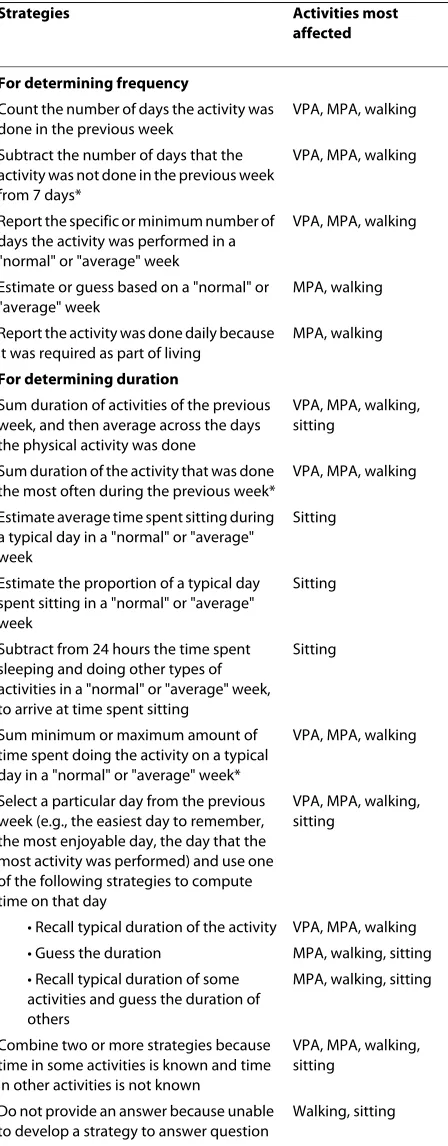
Experiencing difficulty in recalling how often they had done some activities, participants enlisted various strate-gies for calculating or estimating the number of days that
an activity was done (Table 4). Our qualitative data indi-cated that VPA was the easiest for participants to recall, particularly when the activities were exercise or sporting activities performed regularly. Recall of the frequency of MPA and walking activities was often more challenging. Some participants had to use "guess work" or use "a little bit of an estimate" to respond to the questions about these domains. One strategy used for recalling MPA and walking was assuming that these activities were a require-ment of daily living. One man said about walking, "It would have to be 7 days; otherwise, you'd be dead, wouldn't you?" A woman reported she did MPA every day because "I'm always moving and active and walking: I can't sit still very long." Only two strategies acknowledged that the question asked for activities performed in the previous 7 days: 1) counting the number of days that an activity was done in the last 7 days (the method likely intended by IPAQ developers) and 2) counting the num-ber of days that the activity was not done and subtracting that number from seven.
Difficulty with determining duration
Calculating the duration of activities within each domain was more challenging than recalling their frequency. Likewise, Rzewnicki et al. [14] identified difficulties in summing minutes or hours over a day, particularly for walking and MPA, in adults of all ages. Table 4 lists the - Exercise classes (pump,
pilates, yoga, 'gentle aerobics', senior fitness)
- Exercise classes (senior fitness)
- Dance
- Weight training - Weight training - Gym work - Gym work
- Golf - Golf - Golf
- Table tennis
- Cricket
- Carry the bowls for lawn bowls
- Lawn bowls
- Croquet
Other activities - Carry grandchild - Carry grandchild - Mind young children
- Take dog out - Walk dog
- Eat meals - Watch television - Read
- Use computer - Visit friends - Attend meeting - Play bridge - Study *IPAQ questions are available from the IPAQ website [32].
strategies that participants used for formulating a response to duration questions. Taking an average was a method used across all domains. Doing so required a number of calculations, and errors in calculations were sometimes made. For example, one woman averaged her time spent sitting on a weekday as follows:
It'd be about 8 hours in front of the TV almost three nights...and then it's only another half hour the other four nights, that's 2 hours. So that's about 8 and 4 are 12 hours, plus I suppose sitting...eating tea, eating your meals. I suppose you've got to take another hour a day [for those activities] there, 7 days. What are we up to? That's about 12 and 7 [hours], 19 and then at the computer a couple of hours I suppose, 21 [hours]...So if we round it up to 22 that'd be about all. So I'd put down 22 hours. How much time? Per day? Am I going to divide it by seven? Three hours a day, okay?
A few participants interpreted the duration question to refer to the activity done on the greatest number of days
of the previous week. Giving a carefully thought-out response, one man reported 20 minutes of weight lifting for MPA because he did weight lifting more days the pre-vious week (3 days) than his other activity (1 day).
To calculate sitting time, participants developed strate-gies not used for the other domains (Table 4). It was com-mon for participants to make an estimation of the time spent sitting on a typical day of a "normal" or "average" week. Some participants estimated the proportion of such a day spent sitting. One woman reported, "I've worked out that I'm up [out of bed] for 15 hours most days; two thirds [of that time] is 10 [hours spent sitting]." Others subtracted (accurately or not) the time doing other things during a typical day to arrive at the time spent sitting. One man said, "24 hours in a day. I am sleeping from about 11 to about 5, so that's about 6 hours gone, 18 hours left of the day. I am doing about 3 [hours] of exercise. Would you believe...I spend 12 hours a day sitting down?"
The phrase on one of those days in the previous 7 days led some participants to understand that they were to pick a particular day. They selected the day in which they did the most activity that fitted within the domain of the question. Once they had selected the day, they developed a strategy for calculating the duration of the activity per-formed on that day. The most common strategies used for calculating the duration of activities done on that day were 1) recalling the typical duration of the activities (e.g., sports or exercise with pre-set durations like exercise classes or regularly scheduled walks); 2) guessing (e.g., house or garden work; walking casually around the house); and 3) estimating based on a recall of the typical duration of some activities and then guessing the dura-tion of other activities. In recalling his walking, one man used the third strategy. He reported, "On ONE of those days, oh crikey.... I know I walk for an hour a day at least. I just would have to have a guestimate there and say another 2 hours fiddling around."
Some participants could not come up with a strategy for reporting duration. They found the task too difficult because, they said, they did not know how much time they did activities within the domain or, because the activities varied between days, they did not know what to report for time usually spent on one of those days. This was mainly a problem with the walking and sitting ques-tions. In trying to respond to the walking question, one man said, "I don't know how to answer it. I really don't. I could put 10 minutes. I could put 45 minutes. I could put 30 minutes. It just depends which day I pick." The walk-ing and sittwalk-ing questions were particularly difficult for people who reported that they did these activities throughout the day. After reading the sitting question, one woman said,
Table 3: Cognitive problems with responding to IPAQ identified during the cognitive interviews (n = 41)
Themes Activities most affected
Problems with understanding
Reporting activities of a "normal" or "average" week
VPA, MPA, walking
Confusion with usual and on one of those days being used together
VPA, MPA, walking
Including activities that lasted <10 minutes per session
VPA, MPA, walking
Problems with performing the primary task
Not understanding what activities fit within the scope of a question*
VPA, MPA, walking, sitting
Reporting the same activities for more than one activity domain*
VPA, MPA, walking
Including the total time of an activity for which only a part of that time was at the intensity specified in the question
VPA, MPA, walking
Difficulty with determining frequency**
VPA, MPA, walking
Difficulty with determining duration**
VPA, MPA, walking, sitting
Problems with response formatting
Confusion with how to use open-ended response format
VPA, MPA, walking, sitting
You've got to sorta think...you sit down and have your meals and you don't necessarily sit down for the same amount of time...It's not like when you're at work and you have a half hour for lunch and so you sit down and you know that's a half an hour...You can sit down to have a cup of coffee and you can spend 5 or 10 min-utes having a cup of coffee...You can pick up a book and get engrossed with the book and, you know, the time goes. It's very, very hard to answer....That is in the 'too hard' basket.
Response formatting
Only a few participants had difficulty fitting their responses into the response formats presented. One par-ticipant, reporting an hour's activity, wrote the same answer in minutes (60) and then again in hours (1). Another reported the weekly duration of an activity as one day's amount. A third wanted to describe how long he had spent on an activity with a range of times.
Recommendations
Recognizing the value of IPAQ for international PA sur-veillance, in Table 5 we make recommendations to increase its usefulness for surveillance of PA in older adults aged ≥65 years. We note that previous findings indicate that some younger adults have difficulties in understanding IPAQ questions [10,11,14] or over-report their activities on IPAQ [10,14,23-25,28], findings consis-tent with those presented here. We acknowledge that any modifications would need to be included in versions used for younger adults also, for consistency across age groups, and that any modifications would need to be further tested before being used. We are also aware that making any changes to IPAQ may mean that the ability to track changes in PA over time may be lost, because the modifi-cations may decrease the amount of PA reported.
We suggest that the order of the questions stay the same. Ainsworth et al. [23] have suggested that the place-ment of the VPA questions before the MPA questions may be responsible for the higher amounts of PA reported in the IPAQ. However, in a comparison of four PA questionnaires, Brown et al. [30] attributed the higher levels of PA found for IPAQ, in comparison to the other questionnaires, to the fact that the IPAQ examples encourage people to think about PA more broadly (i.e., PA at work, leisure, and transport) than do the other questionnaires. In the study by Brown et al., there was no indication that the order of the questions made a differ-ence in the amount of PA reported. However, respon-dents did find it easier to recall more structured or routine activities, which are typically associated with sport or recreation, or walking specifically for exercise, rather than transport to and from places [31]. It might Table 4: Strategies participants used for determining
frequency and duration of their activities
Strategies Activities most
affected
For determining frequency
Count the number of days the activity was done in the previous week
VPA, MPA, walking
Subtract the number of days that the activity was not done in the previous week from 7 days*
VPA, MPA, walking
Report the specific or minimum number of days the activity was performed in a "normal" or "average" week
VPA, MPA, walking
Estimate or guess based on a "normal" or "average" week
MPA, walking
Report the activity was done daily because it was required as part of living
MPA, walking
For determining duration
Sum duration of activities of the previous week, and then average across the days the physical activity was done
VPA, MPA, walking, sitting
Sum duration of the activity that was done the most often during the previous week*
VPA, MPA, walking
Estimate average time spent sitting during a typical day in a "normal" or "average" week
Sitting
Estimate the proportion of a typical day spent sitting in a "normal" or "average" week
Sitting
Subtract from 24 hours the time spent sleeping and doing other types of activities in a "normal" or "average" week, to arrive at time spent sitting
Sitting
Sum minimum or maximum amount of time spent doing the activity on a typical day in a "normal" or "average" week*
VPA, MPA, walking
Select a particular day from the previous week (e.g., the easiest day to remember, the most enjoyable day, the day that the most activity was performed) and use one of the following strategies to compute time on that day
VPA, MPA, walking, sitting
• Recall typical duration of the activity VPA, MPA, walking
• Guess the duration MPA, walking, sitting
• Recall typical duration of some activities and guess the duration of others
MPA, walking, sitting
Combine two or more strategies because time in some activities is known and time in other activities is not known
VPA, MPA, walking, sitting
Do not provide an answer because unable to develop a strategy to answer question
Walking, sitting
therefore be better to ask the VPA questions first, as these activities may be easiest to recall. We recommend, how-ever, that participants be instructed at the beginning of the questionnaire that they will be asked separately about VPA, MPA, walking and sitting activities to reduce the tendency to report activities early in the questionnaires (e.g., VPA) when they should only be reported later (e.g., MPA or walking).
Other recommendations for correcting over-reporting are to clarify in the instructions at the beginning and for each activity domain that activities already reported for one domain should not be reported again for another and to state in the instructions at the beginning and for the duration questions that only activities lasting at least 10 minutes during the previous 7 days should be included. For VPA and MPA, participants could also be instructed to include only the amount of time spent at the specified intensity and to treat the examples as indicators of activ-ity types only, not choice-limiting checklists. To augment older adults' understanding of IPAQ questions, we rec-ommended adding examples of activities relevant to older adults (e.g., those in Table 2 for Australian older adults), and clarifying activities mentioned in the questionnaire, such as carrying light loads for MPA and lying down watching TV for sitting (e.g., is other lying down not to be included?). To decrease the reporting of short-duration, start-and-stop walking, clarification of the types of walk-ing to report should be included, and to further decrease reporting of walking more than once, the instructions for the VPA domain should tell participants to exclude walk-ing.
We also suggest that, in order to create more consis-tency across participants in how calculations are made, participants be given guidance on determining the fre-quency and duration of their activities. Given that most of our participants over-reported activities but that some under-reported, such guidance could reduce recall bias or, failing that, at least make this bias go in one direction so that compensating adjustments might be easier. Durante [15] suggested that for questionnaires with short referent periods, like IPAQ, questions may be more effec-tive if they use episode enumeration techniques for gath-ering data. Applying this to IPAQ, participants could be told to count up their days of PA over the previous 7 days, preferably starting with the previous day and working backwards, to compute frequency, and to sum their min-utes of PA over a specific day to calculate duration. More-over, participants could be given a strategy to use for selecting the specific day. Instructing participants to recall a specific day (e.g., the last weekday prior to ques-tionnaire completion) could help in recall of activities and result in a more consistent method of calculation. Such instruction, by drawing attention to a particular day of
the past week, may also decrease some participants' ten-dency to recall activities of a "normal or "average" week
Limitations
The findings of this study would likely have been different if other forms of IPAQ had been administered or other modes of administering IPAQ had been used. Also, the study created an artificial testing environment and partic-ipants may have responded differently if they had com-pleted the questionnaires on their own. To decrease this possibility, participants were told to answer each question as they perceived it should be answered, with no guidance from the interviewers. Probing only occurred after par-ticipants had completed questions about an activity domain, and any changes participants made to their answers in response to the probing were not included in our analyses. It should also be noted that participants who completed IPAQ as the second or third question-naire during their interview could have been influenced by questions asked in questionnaires they completed before completing IPAQ. However, this is not likely as review of the transcripts from participants who com-pleted IPAQ as the first questionnaire revealed that all themes discussed in this paper were present in these par-ticipants' transcripts. It should also be noted that although participants represented a full range of educa-tional levels, they were, on average, fairly well educated. It is likely that a less well educated sample would have had even more problems understanding IPAQ questionnaires than our participants.
Conclusions
errors occur when IPAQ is used in other populations (e.g., younger age groups and less educated older adults), and to test whether these changes result in improvements to the accuracy of the data collected with IPAQ from both older adults and younger adults.
Competing interests
The authors declare that they have no competing interests.
Authors' contributions
KCH and JvU developed the study design, interviewed the participants, and analyzed and interpreted the data. KCH developed the data coding and analy-sis process and drafted the manuscript. JvU and WJB conceived the study, and WJB also participated in the analysis and interpretation of the data. RLH partici-pated in conducting the interviews and analyzing and interpreting the data. All authors participated in revising manuscript drafts and in reading and approv-ing the final manuscript.
Acknowledgements
We would like to thank the volunteers who provided the data for this study. KCH and JvU were supported by a NHMRC program grant in physical activity and health (ID#301200) at The University of Queensland, School of Human Movement Studies.
Author Details
1Queensland University of Technology, Institute of Health & Biomedical Innovation and the School of Public Health, Brisbane, Queensland 4059, Australia and 2The University of Queensland, School of Human Movement Studies, Brisbane, Queensland 4072, Australia
References
1. Chodzko-Zajko WJ, Proctor DN, Fiatarone Singh MA, Minson CT, Nigg CR, Salem GJ, Skinner JS: American College of Sports Medicine position stand. Exercise and physical activity for older adults. Med Sci Sports Exerc 2009, 41:1510-1530.
2. Nelson ME, Rejeski WJ, Blair SN, Duncan PW, Judge JO, King AC, Macera CA, Castaneda-Sceppa C: Physical activity and public health in older adults: recommendation from the American College of Sports Medicine and the American Heart Association. Med Sci Sports Exerc
2007, 39:1435-1445.
3. Begg S, Vos T, Barker B, Stevenson C, Stanley L, Lopez AD: The Burden of Disease and Injury in Australia 2003. PHE 82 Canberra: Australian Institute of Health and Welfare; 2007.
4. DiPietro L, Caspersen CJ, Ostfeld AM, Nadel ER: A survey for assessing physical activity among older adults. Med Sci Sports Exerc 1993, 25:628-642.
5. Harada ND, Chiu V, King AC, Stewart AL: An evaluation of three self-report physical activity instruments for older adults. Med Sci Sports Exerc 2001, 33:962-970.
6. Stewart AL, Mills KM, King AC, Haskell WL, Gillis D, Ritter PL: CHAMPS physical activity questionnaire for older adults: outcomes for interventions. Med Sci Sports Exerc 2001, 33:1126-1141.
7. Washburn RA, Smith KW, Jette AM, Janney CA: The Physical Activity Scale for the Elderly (PASE): development and evaluation. J Clin Epidemiol
1993, 46:153-162.
8. Jobe JB: Cognitive psychology and self-reports: models and methods.
Qual Life Res 2003, 12:219-227.
9. Collins D: Pretesting survey instruments: an overview of cognitive methods. Qual Life Res 2003, 12:229-238.
10. Bauman A, Bull F, Chey T, Craig CL, Ainsworth BE, Sallis JF, Bowles HR, Hagstromer M, Sjostrom M, Pratt M, the IPS Group: The International Prevalence Study on Physical Activity: results from 20 countries. Int J Behav Nutr Phys Act 2009, 6:21.
11. Craig CL, Marshall AL, Sjostrom M, Bauman AE, Booth ML, Ainsworth BE, Pratt M, Ekelund U, Yngve A, Sallis JF, Oja P: International Physical Activity Questionnaire: 12-country reliability and validity. Med Sci Sports Exerc
2003, 35:1381-1395.
12. Guthold R, Ono T, Strong KL, Chatterji S, Morabia A: Worldwide variability in physical inactivity a 51-country survey. Am J Prev Med 2008, 34:486-494.
13. Kolbe-Alexander TL, Lambert EV, Harkins JB, Ekelund U: Comparison of two methods of measuring physical activity in South African older adults. J Aging Phys Act 2006, 14:98-114.
14. Rzewnicki R, Auweele Y Van den, De Bourdeaudhuij I: Addressing overreporting on the International Physical Activity Questionnaire (IPAQ) telephone survey with a population sample. Public Health Nutr
2003, 6:299-305.
15. Durante R, Ainsworth BE: The recall of physical activity: using a cognitive model of the question-answering process. Med Sci Sports Exerc 1996, 28:1282-1291.
16. Drennan J: Cognitive interviewing: verbal data in the design and pretesting of questionnaires. J Adv Nurs 2003, 42:57-63.
17. Tourangeau R: Cognitive science and survey methods. In Cognitive Aspects of Survey Methodology: Building Bridges Between Disciplines Edited by: Jabine T, Straf ML, Tanur JM, Tournangeau R. Washington, DC: National Academy Press; 1984:73-100.
Received: 15 December 2009 Accepted: 11 May 2010 Published: 11 May 2010
This article is available from: http://www.ijbnpa.org/content/7/1/35 © 2010 Heesch et al; licensee BioMed Central Ltd.
This is an Open Access article distributed under the terms of the Creative Commons Attribution License (http://creativecommons.org/licenses/by/2.0), which permits unrestricted use, distribution, and reproduction in any medium, provided the original work is properly cited.
International Journal of Behavioral Nutrition and Physical Activity 2010, 7:35
Table 5: Authors' recommendations for improving IPAQ for older adults
1 List in the instructions at the beginning the activities that will be asked for in the questionnaire (i.e., VPA, MPA, walking, sitting).
2 State in the instructions at the beginning and for each activity domain that activities already reported for one domain should not be reported again for another.
3 State in the instructions at the beginning and for the duration questions that only activities lasting at least 10 minutes during the previous 7 days should be included.
4 For VPA and MPA, state in the instructions to include only the amount of time spent at the specified intensity.
5 For VPA and MPA, state in the instructions that the examples given are only indicators of activities which might be done at the specified intensity and that the examples are not to be used as choice-limiting checklists.
6 Add examples of activities relevant to older adults and clarify activities mentioned as examples in the questionnaire.
7 Provide instructions for the walking activities to report.
8 Offer strategies for determining the frequency and duration of activities.
9 For duration questions, clarify or revise the phrase
18. Willis GB, Royston P, Bercini D: The use of verbal report methods in the development and testing of survey questionnaires. Appl Cogn Psychol
1991, 5:251-267.
19. Conrad F, Blair J: From impressions to data: increasing the objectivity of cognitive interviews. In Proceedings of the Survey Research Methods Section of the American Statistical Association: 4 August 1996; Alexandria, VA
American Statistical Association; 1996:1-10.
20. Jobe JB, Mingay DJ: Cognitive research improves questionnaires. Am J Public Health 1989, 79:1053-1055.
21. Behavioral Risk Factor Surveillance System: Questionnaires [http:// www.cdc.gov/brfss/questionnaires/english.htm]
22. Australian Institute of Health and Welfare: The Active Australia Survey: A guide and Manual for Implementation, Analysis and Reporting Canberra: Australian Institute of Health and Welfare; 2003.
23. Ainsworth BE, Macera CA, Jones DA, Reis JP, Addy CL, Bowles HR, Kohl HW III: Comparison of the 2001 BRFSS and the IPAQ physical activity questionnaires. Med Sci Sports Exerc 2006, 38:1584-1592.
24. Brown W, Bauman A, Chey T, Trost S, Mummery K: Comparison of surveys used to measure physical activity. Aust N Z J Public Health 2004, 28:128-134.
25. Fogelholm M, Malmberg J, Suni J, Santtila M, Kyrolainen H, Mantysaari M, Oja P: International Physical Activity Questionnaire: validity against fitness. Med Sci Sports Exerc 2006, 38:753-760.
26. Maddison R, Ni MC, Jiang Y, Vander HS, Rodgers A, Lawes CM, Rush E: International Physical Activity Questionnaire (IPAQ) and New Zealand Physical Activity Questionnaire (NZPAQ): a doubly labelled water validation. Int J Behav Nutr Phys Act 2007, 4:62.
27. Rosenberg DE, Bull FC, Marshall AL, Sallis JF, Bauman AE: Assessment of sedentary behavior with the International Physical Activity Questionnaire. J Phys Act Health 2008, 5(Suppl 1):S30-S44.
28. Timperio A, Salmon J, Crawford D: Validity and reliability of a physical activity recall instrument among overweight and non-overweight men and women. J Sci Med Sport 2003, 6:477-491.
29. Timperio A, Salmon J, Rosenberg M, Bull FC: Do logbooks influence recall of physical activity in validation studies? Med Sci Sports Exerc 2004, 36:1181-1186.
30. Brown WJ, Bauman A, Chey T, Trost S, Mummery K: Comparison of surveys used to measure physical activity. Aust N Z J Public Health 2004, 28:128-134.
31. Brown WJ, Trost SG, Bauman A, Mummery K, Owen N: Test-retest reliability of four physical activity measures used in population surveys. J Sci Med Sport 2004, 7:205-215.
32. International Physical Activity Questionnaire [http://www.ipaq.ki.se/ ipaq.htm]
doi: 10.1186/1479-5868-7-35
Cite this article as: Heesch et al., What do IPAQ questions mean to older adults? Lessons from cognitive interviews International Journal of Behavioral