An inventory of invasive alien species in China
Haigen Xu
1, Sheng Qiang
2, Piero Genovesi
3, Hui Ding
1, Jun Wu
1, Ling Meng
2,
Zhengmin Han
4, Jinlai Miao
5, Baishi Hu
2, Jiangying Guo
6, Hongying Sun
7,
Cheng Huang
8, Juncheng Lei
1, Zhifang Le
1, Xiaoping Zhang
9, Shunping He
10,
Yi Wu
1, Zhou Zheng
5, Lian Chen
1, Vojtěch Jarošík
11, 12, Petr Pyšek
12, 111 Nanjing Institute of Environmental Sciences (NIES), Ministry of Environmental Protection, Nanjing, China 2 Nanjing Agricultural University, Nanjing, China 3 ISPRA – Institute for Environmental Protection and Re-search, Italy and Chair IUCN Invasive Species Specialist Group 4 College of Forest and Environment, Nanjing Forestry University, Nanjing, China 5 The First Institute of Oceanography, State Oceanic Administration, Qingdao, China 6 Institute of Plant Protection, Chinese Academy of Agricultural Sciences, Beijing, China 7 College of Life Science, Nanjing Normal University, Nanjing, China 8 College of Life Science, Nanjing University, Nanjing, China 9 College of Life Science, Anhui Normal University, Hefei, China 10 Institute of Hydrobiology, Chinese Academy of Sciences, Wuhan, China 11 Department of Ecology, Faculty of Science, Charles University in Prague, CZ 12844 Viničná 7, Czech Republic 12 Institute of Botany, Academy of Sciences of the Czech Republic, CZ 25243 Průhonice, Czech Republic
Corresponding author:Haigen Xu ([email protected])
Academic editor:Jianghua Sun | Received 23 June 2012 | Accepted 20 August 2012 | Published 14 December 2012
Citation: Xu H, Qiang S, Genovesi P, Ding H, Wu J, Meng L, Han Z, Miao J, Hu B, Guo J, Sun H, Huang C, Lei J, Le Z, Zhang X, He S, Wu Y, Zheng Z, Chen L, Jarošík V, Pyšek P (2012) An inventory of invasive alien species in China. NeoBiota 15: 1–26. doi: 10.3897/neobiota.15.3575
Abstract
Invasive alien species (IAS) are a major global challenge requiring urgent action, and the Strategic Plan for Biodiversity (2011–2020) of the Convention on Biological Diversity (CBD) includes a target on the issue. Meeting the target requires an understanding of invasion patterns. However, national or regional analyses of invasions are limited to developed countries. We identified 488 IAS in China’s terrestrial habitats, inland waters and marine ecosystems based on available literature and field work, including 171 animals, 265 plants, 26 fungi, 3 protists, 11 procaryots, and 12 viruses. Terrestrial plants account for 51.6% of the total number of IAS, and terrestrial invertebrates (104 species) for 21.3%. Of the total numbers, 67.9% of plant IAS and 34.8% of animal IAS were introduced intentionally. All other taxa were introduced unintentionally despite very few animal and plant species that invaded naturally. In terms of habitats, 64.3% of IAS occur on farmlands, 13.9% in forests, 8.4% in marine ecosystems, 7.3% in inland waters, and 6.1% in residential areas. Half of all IAS (51.1%) originate from North and South America, 18.3% from Europe, 17.3% from Asia not including China, 7.2% from Africa, 1.8% from Oceania, and the origin of the remaining 4.3% IAS is unknown. The distribution of IAS can be divided into three zones. Most IAS are distributed in coastal
Copyright Haigen Xu et al. This is an open access article distributed under the terms of the Creative Commons Attribution License 3.0 (CC-BY), which permits unrestricted use, distribution, and reproduction in any medium, provided the original author and source are credited.
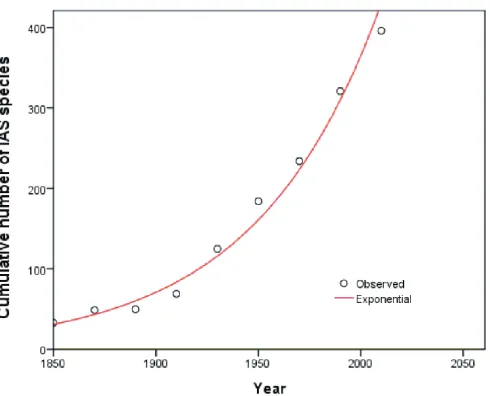
provinces and the Yunnan province; provinces in Middle China have fewer IAS, and most provinces in West China have the least number of IAS. Sites where IAS were first detected are mainly distributed in the coastal region, the Yunnan Province and the Xinjiang Uyghur Autonomous Region. The number of newly emerged IAS has been increasing since 1850. The cumulative number of firstly detected IAS grew exponentially.
Keywords
Invasive plants and animals, distribution, origin, pathway, rate of introduction
introduction
Invasive alien species (IAS) are considered one of the key pressures on world’s
biodi-versity (Leprieur et al. 2008; Butchart et al. 2010; Rands et al. 2010), alter ecosystem
services and processes (Hulme et al. 2009; Vilà et al. 2010, 2011), reduce native species
abundance and richness (Cohen and Carlton 1998; Blackburn et al. 2004; Gaertner
et al. 2009; Hejda et al. 2009), decrease genetic diversity of resident species (Ellstrand
and Schierenbeck 2000; Daehler and Carino 2001), and cause substantial economic
losses (Pimentel et al. 2005; Xu et al.
2006a; Kettunen et al. 2009). Responding to
this threat is therefore particularly urgent (Lambertini et al. 2011). In October 2010,
world leaders adopted the Strategic Plan for Biodiversity (2011-2020) under the
Con-vention on Biological Diversity (CBD), including the Aichi Target 9 (Secretariat of
the Convention on Biological Diversity 2010) calling to identify IAS and pathways,
control and eradicate priority species, and to manage pathways in order to prevent
further invasions. In order to evaluate achievements of the Aichi Targets, baseline data
are needed. However, a global baseline of IAS is unavailable (Butchart et al. 2010;
McGeoch et al.
2010), and national/regional data sets suitable for analysis of temporal
patterns of biological invasions are rare for developing countries of the world, resulting
a pattern that reflects geographical biases in information on invasion patterns (Pyšek et
al. 2008; Nuñez and Pauchard 2010).
China is the world’s most populous country with 1.34 billion people and one of
the largest territories (Liu and Diamond 2005). China is also one of the mega-diversity
countries, with half of its species found nowhere else (Liu et al. 2003; Xu et al. 2008).
Its economy, ranked second, is growing at a very fast rate. The extraordinary
biogeo-graphic and economic characteristics of China make it ideal for understanding how
biological invasions currently affect, and will affect in the future, the fastest growing
economies in the world. Here, we present a comprehensive inventory of IAS in China,
and analyze the temporal trends of biological invasions in the country in order to
iden-tify priority responses to the growing threat from biological invasions.
Methods
an agent of change, and threaten native biological diversity (IUCN 2000; Shine et al.
2000; McNeely et al.
2001). Alien species refers to a species, subspecies or lower taxon
occurring outside its natural, past or present range and dispersal potential (i.e. outside
the range it occupies naturally or in a range it could not occupy without direct or
in-direct introduction by humans) and includes any part, gametes, or propagules (IUCN
2000). Only species with evidence of their impact on biodiversity, human activities or
economy were considered in the present assessment. We included IAS that established
populations in terrestrial habitats, inland waters or marine ecosystems of China.
We identified IAS and pathways of their introductions based on available
litera-ture (Ding and Wang 1998; Xie et al. 2000; Li and Xie 2002; Xiang et al. 2002; Xu
and Qiang 2004; Liu et al. 2005; Wan et al. 2005, 2008, 2009; Weber et al. 2008;
Xie 2008 ; Zhang et al. 2008; Wu et al. 2010; Huang et al. 2012; see Liu et al. 2012
for an overview of research in plant invasions in China), including Flora of China
(126 volumes edited by the Editoral Committee of Flora Sinica, Chinese Academy
of Sciences and published by Science Press in Beijing, China), and Fauna of China
(100 volumes edited by the Editoral Committee of Fauna Sinica, Chinese Academy of
Sciences, and published by Science Press in Beijing, China), and on field work carried
out in most provinces of China. All recorded IAS with evidence of negative impacts on
biodiversity, human livelihood or economy were included in the inventory, with
infor-mation on their presence or absence in particular provinces or autonomous regions. A
preliminary inventory of IAS was first drafted, and subsequently verified through many
internal reviews and field surveys. The year or period of the first detection of a species
in China was recorded, providing information on the minimum residence time
(Re-jmánek 2000; Pyšek and Jarošík 2005); this information was available for 396 species.
results
The inventory included 488 IAS in China’s terrestrial habitats, inland waters and marine
ecosystems. Of particular taxa, there are 171 animals, 265 plants, 26 fungi, 3 protists, 11
procaryots, and 12 viruses (Appendix). Terrestrial plants account for 51.6% of the total
number of IAS, and terrestrial invertebrates (104 species) for 21.3% (Table 1).
Inten-tional introductions accounted for 67.9% of plant IAS and 34.8% of animal IAS (Table
2), such as tropic ageratum (
Ageratum conyzoides
), common pokeweed (
Phytolacca
amer-icana
), and red-eared slider (
Trachemys scripta elegans
) introduced as ornamental species.
Very few animal and plant species invaded via natural spread (such as
Ageratina
adenop-hora
and
Ondatra zibethicus
). All other taxa were introduced unintentionally (Table
2), such as the oriental wood borer (
Heterobostrychus aequalis
), and the tropical fire ant
(
Solenopsis geminate
) that invaded with trade products. In terms of habitats, 64.3% of
The distribution of IAS can be divided into three zones. Most IAS are
distribut-ed in coastal provinces and the Yunnan province; provinces in Middle China have
fewer IAS, and most provinces in West China have the least number of IAS (Fig.
1). Jimsonweed (
Datura stramonium
), cotton whitefly (
Bemisia tabaci
),
two-spot-ted spider mite (
Tetranychus urticae
), American cockroach (
Periplaneta americana
),
house mouse (
Mus musculus
), and brown rat (
Rattus norvegicus norvegicus
) occur in
all provinces. Seventy IAS are distributed in more than half the number of
prov-inces, and 105 IAS in more than one third of the provinces. Sites where IAS were
first detected are mainly distributed in the coastal region, the Yunnan Province and
the Xinjiang Uyghur Autonomous Region (Fig. 2), but there was a shift towards
northern areas that became the main points of entry of IAS into China during the
last two decades (Table 3).
Only 33 IAS invaded China before 1850, including spiny amaranth (
Amaran-thus spinosus
), wattle (
Acacia farnesiana
) and common lantana (
Lantana camara
).
The number of newly emerged IAS has been increasing since 1850 (Fig. 3). Two
hundred and twelve new IAS (53.5% of IAS with known year or period of first
detection) occurred since 1950, for example pine bast scale (
Matsucoccus
matsumu-rae
), common cordgrass (
Spartina anglica
), and erythrina gall wasp (
Quadrastichus
erythrinae
). The cumulative number of IAS grew exponentially (Fig. 3). It could be
partially due to increased surveillance, but our figure is based on best estimates of
species arrival dates.
table 1. Invasive alien species in China classified according to the taxonomic group and environment where they invade.
Taxonomic group Terrestrial Freshwater Marine Total
Plants 252 7 6 265
Vertebrates 15 16 15 46
Invertebrates 104 4 17 125
Others 52
Total 371 27 38 488
table 2. Pathways of introduction of IAS to China
Plants Animals Others (Fungi, Protista, Procaryotae, Vira)
Pathways No. of species % No. of species % No. of species %
Unintentional introduction 84 31.7 110 64.0 52 100
Intentional introduction 180 67.9 60 34.8 0
Natural spread 1 0.4 2 1.2 0
Figure 1. Regional distribution of IAS in China.Note that most IAS are distributed in coastal provinces and the Yunnan province.
Discussion
The present study is, to our knowledge, the most up-to-date dataset of invasive species
for China. However, we have to acknowledge biases that are inherent in the making of
the inventory. For example, there are more plants than any other taxa, probably because
plants are most numerous and easier to record. There may be biases in the timing of IAS
discovery, as changes in resource allocation over time resulted in increasing
opportuni-ties for a more rigorous scientific research. It is likely that the survey pressure is not the
same in all parts of China, depending on the staff numbers, among other parameters.
table 3.Temporal trends in the regions where invasive alien species were first detected in China. For each of the three periods since the 1950s, six top provinces or autonomous regions in which the most IAS were recorded are shown. The numbers are percentages of IAS that were firstly detected in the province, of the total number of species detected in China in the given period. Note that while southern areas were the most important points of entry in the first period, in the last two decades more invasions started in northern areas.
Province /
region 1950–1969 Province /region 1970–1989 Province /region 1990–2009
Yunnan+ 12.5 Taiwan+ 21.8 Liaoning* 12.5
Taiwan+ 12.5 Guangdong+ 12.8 Shandong* 10.0
Guangdong+ 12.5 Liaoning* 10.3 Taiwan+ 10.0
Guangxi+ 10.0 Shandong* 7.7 Hainan+ 7.5
Xinjiang* 7.5 Beijing* 6.4 Guangdong+ 7.5
Liaoning* 7.5 Yunnan+ 6.4 Guangxi+ 6.3
* northern provinces or autonomous regions; + southern provinces or autonomous regions
Figure 3. Temporal trends of invasions. Cumulative numbers of firstly detected IAS in China (exponen-tial growth: R2=0.981, P<0.001; N=396 IAS with known year or period of first detection in China) were
The cumulative number of IAS grew exponentially in China. Similar trends in
historical accumulation of invasive forest insect pests and diseases have recently been
reported from the United States (Aukema et al. 2010). An analysis of alien species in
Europe has shown that human activity plays a key role in biological invasions (Pyšek
et al. 2010, Jeschke and Genovesi 2011) and that the full effects of current
socioeco-nomic patterns on the numbers of alien species can be delayed by several decades,
re-sulting in what has been called an “invasion debt” (Essl et al. 2010). Our result shows
that China is severely affected by invasions, with a pace of increase higher than that
recorded in Europe (DAISIE 2009). Considering the fast economic growth of China,
and the rapidly increasing levels of trade, tourism and transport, it is very likely that
the country will face huge problems from invasive species in the future, and has already
accumulated an invasion debt. For example, Europe – with a total surface similar to
that of China (10 vs. 9.6 million km
2), but with about half the population of China
(750 vs. 1340 million inhabitants) – hosts almost three times more IAS with
ecologi-cal and/or economic impact than China (1347 species [Vilà et al
.
2010] compared
to the 488 reported in this paper). However, the number of IAS in China could be
an underestimate due to the lower research intensity and limited monitoring
activi-ties. Nevertheless, the data from Europe and China, and taking into account China’s
rapidly increasing economy suggest that the same trends will occur in other countries
with fast growing economies where the levels of invasions are likely to increase as a
result of economic activities. This imposes severe threats to global biodiversity and the
ecosystem services of the concerned countries.
Acknowledgments
We thank Laura Meyerson for improving our English. Funding was provided by the
National Key Technologies Research and Development Program (grants 2008BAC
39B06 and 2008BAC39B01) and the R & D Program for Public Interests on
Envi-ronmental Protection (200709017). V.J. and P.P. were funded by long-term research
development project no. RVO 67985939 (Academy of Sciences of the Czech
Repub-lic), and institutional resources of the Ministry of Education, Youth and Sports of the
Czech Republic. P.P. acknowledges support by Praemium Academiae award from the
Academy of Sciences of the Czech Republic.
references
Aukema JE, McCullough DG, Von Holle B, Liebhold A, Britton K, Frankel SJ (2010)
Histori-cal accumulation of non-indigenous forest pests in the continental United States.
BioSci-ence 60: 886–897. doi: 10.1525/bio.2010.60.11.5
J, Davidson NC, Dentener F, Foster M, Galli A, Galloway JN, Genovesi P, Gregory RD,
Hockings M, Kapos V, Lamarque JF, Leverington F, Loh J, McGeoch MA, McRae L,
Minasyan A, Hernández Morcillo M, Oldfield TE, Pauly D, Quader S, Revenga C, Sauer
JR, Skolnik B, Spear D, Stanwell-Smith D, Stuart SN, Symes A, Tierney M, Tyrrell TD,
Vié JC, Watson R (2010) Global biodiversity: Indicators of recent declines. Science 328:
1164–1168. doi: 10.1126/science.1187512
Cohen N, Carlton JT (1998) Accelerating invasion rate in a highly invaded estuary. Science
279: 555–558. doi: 10.1126/science.279.5350.555
Daehler CC, Carino D (2001) Hybridization between native and alien plants and its
conse-quences. In: Lockwood JL, McKinney M (Eds) Biotic homogenization. Kluwer Academic/
Plenum Publishing, New York, 81–102. doi: 10.1007/978-1-4615-1261-5_5
DAISIE (2009) Handbook of alien species in Europe. Springer, 400 pp.
Ding JQ, Wang R (1998) Invasive alien species and their impact on biodiversity in China.
In: Zhang W (Eds) China’s biodiversity: a country study. China Environmental Science
Press, Beijing, 58–63.
Ellstrand NC, Schierenbeck KA (2000) Hybridization as a stimulus for the evolution of
inva-siveness in plants? Proceedings of the National Academy of Sciences of the United States of
America 97:7043–7050. doi: 10.1073/pnas.97.13.7043
Essl F, Dullinger S, Rabitsch W, Hulme PE, Hülber K, Jarošík V, Kleinbauer I, Krausmann F,
Kühn I, Nentwig W, Vilà M, Genovesi P, Gherardi F, Desprez-Loustau M-L, Roques A, Pyšek
P(2010) Socioeconomic legacy yields an invasion debt. Proceedings of the National Academy
of Sciences of the United States of America 108: 203–207. doi: 10.1073/pnas.1011728108
Gaertner M, Breeyen AD, Hui C, Richardson DM (2009) Impacts of alien plant invasions on
species richness in Mediterranean-type ecosystems: a meta-analysis. Progress in Physical
Geography 33: 319–338. doi: 10.1177/0309133309341607
Hejda M, Pyšek P, Jarošík V (2009) Impact of invasive plants on the species richness,
diver-sity and composition of invaded communities. Journal of Ecology 97: 393–403. doi:
10.1111/j.1365-2745.2009.01480.x
Huang D, Zhang R, Kim KC, Suarez AV (2012) Spatial pattern and determinants of the first
detection locations of invasive alien species in Mainland China. PLoS ONE 7: e31734.
doi: 10.1371/journal.pone.0031734
Hulme PE, Pyšek P, Nentwig W, Vilà M (2009) Will threat of biological invasions unite the
European Union? Science 324: 40–41. doi: 10.1126/science.1171111
IUCN (2000) IUCN Guidelines for the prevention of biodiversity loss caused by alien invasive
species. IUCN, Gland, Switzerland.
Jeschke JM, Genovesi P (2011) Do biodiversity and human impact influence the
intro-duction or establishment of alien mammals? Oikos 120: 57–64. doi:
10.1111/j.1600-0706.2010.18621.x
Lambertini M, Leape J, Marton-Lefèvre J, Mittermeier RA, Rose M, Robinson JG, Stuart
SN, Waldman B, Genovesi P (2011) Invasives: a major conservation threat. Science 333:
404–405. doi: 10.1126/science.333.6041.404-b
Leprieur F, Beauchard O, Blanchet S, Oberdorff T, Brosse S (2008) Fish invasions in the
world’s river systems: When natural processes are blurred by human activities. PLoS
Biol-ogy 6: 404–410.
Li ZY, Xie Y (2002) Invasive alien species in China. China Forestry Publishing House, Beijing
Liu J, Chen H, Kowarik I, Zhang Y, Wang R (2012) Plant invasions in China: an emerging hot
topic in invasion science. NeoBiota 15: 27–51. doi: 10.3897/neobiota.15.3751
Liu J, Liang SC, Liu FH, Wang RQ, Dong M (2005) Invasive alien plant species in
Chi-na: regional distribution patterns. Diversity and Distributions 11: 341–347. doi:
10.1111/j.1366-9516.2005.00162.x
Liu JG, Diamond J (2005) China’s environment in a globalizing world. Nature 435: 1179–1186.
doi: 10.1038/4351179a
Liu JG, Ouyang Z, Pimm SL, Raven PH, Wang XK, Miao H, Han N (2003) Protecting
China’s biodiversity. Science 300: 1240–1241. doi: 10.1126/science.1078868
McGeoch MA, Butchart SHM, Spear D, Marais E, Kleynhans EJ, Symes A, Chanson J, Hoffmann M
(2010) Global indicators of biological invasion: species numbers, biodiversity impact and policy
responses. Diversity and Distributions 16: 95–108. doi: 10.1111/j.1472-4642.2009.00633.x
McNeely JA, Mooney HA, Neville LE, Schei P, Waage JK (2001) A global strategy on invasive
alien species. IUCN, Gland, Switzerland, and Cambridge, UK.
Nuñez M, Pauchard A (2010) Biological invasions in developing and developed countries: does
one model fit all? Biological Invasions 12: 707–714. doi: 10.1007/s10530-009-9517-1
Pimentel D, Zuniga R, Morrison D (2005) Update on the environmental and economic costs
as-sociated with alien-invasive species in the United States. Ecological Economics 52: 273–288.
doi: 10.1016/j.ecolecon.2004.10.002
Pyšek P, Jarošík V (2005) Residence time determines the distribution of alien plants. In: Inderjit S
(Ed.) Invasive plants: ecological and agricultural aspects. Birkhäuser Verlag-AG, Basel, 77–96.
Pyšek P, Jarošík V, Hulme PE, Kühn I, Wild J, Arianoutsou M, Bacher S, Chiron F, Didžiulis
V, Essl F, Genovesi P, Gherardi F, Hejda M, Kark S, Lambdon PW, Desprez-Loustau M-L,
Nentwig W, Pergl J, Poboljšaj K, Rabitsch W, Roques A, Roy DB, Shirley S, Solarz W, Vilà
M, Winter M (2010) Disentangling the role of environmental and human pressures on
biological invasions across Europe. Proceedings of the National Academy of Sciences of the
United States of America 107: 12157–12162. doi: 10.1073/pnas.1002314107
Pyšek P, Richardson DM, Pergl J, Jarošík V, Sixtová Z, Weber E (2008) Geographical and
taxonomic biases in invasion ecology. Trends in Ecology and Evolution 23: 237–244. doi:
10.1016/j.tree.2008.02.002
Rands MRW, Adams WM, Bennun L, Butchart SHM, Clements A, Coomes D, Entwistle A,
Hodge I, Kapos V, Scharlemann JPW, Sutherland WJ, Vira B (2010) Biodiversity
conser-vation: Challenges beyond 2010. Science 329: 1298–1303. doi: 10.1126/science.1189138
Rejmánek M (2000) Invasive plants: approaches and predictions. Austral Ecology 25: 497–506.
Secretariat of the Convention on Biological Diversity (SCBD) (2010) Decision adopted by the
Conference of the Parties to the Convention on Biological Diversity at its Tenth Meeting.
SCBD, UNEP/CBD/COP/DEC/X/2.
Shine C, Williams N, Gundling L (2000) A guide to designing legal and institutional
frame-works on alien invasive species. IUCN, Gland, Switzerland & Cambridge, UK, and IUCN
Environmental Law Centre, Bonn, Germany.
Vilà M, Basnou C, Pyšek P, Josefsson M, Genovesi P, Gollasch S, Nentwig W, Olenin S, Roques
A, Roy D, Hulme PE, DAISIE partners (2010) How well do we understand the impacts
of alien species on ecosystem services? A pan-European, cross-taxa assessment. Frontiers in
Ecology and the Environment 8: 135–144. doi: 10.1890/080083
Vilà M, Espinar JL,
Hejda M, Hulme PE, Jarošík V, Maron JL, Pergl J, Schaffner U, Sun Y,
Pyšek P (2011) Ecological impacts of invasive alien plants: a meta-analysis of their effects on
species, communities and ecosystems. Ecology Letters 14: 702–708. doi:
10.1111/j.1461-0248.2011.01628.x
Wan FH, Zheng XB, Guo JY (2005) Biology and management of invasive alien species in
ag-riculture and forestry. Science Press, Beijing.
Wan F, Guo J, Zhang F (2009) Research on biological invasions in china. Beijing: Science
Press, 302 pp.
Wan F, Xie B, Chu D (2008) Biological invasions, legislations and management strategies.
Sci-ence Press, Beijing, 316 pp.
Weber E, Sun S, Li B (2008) Invasive alien plants in China: diversity and ecological insights.
Biological Invasions 10:1411–1429. doi: 10.1007/s10530-008-9216-3
Wu S, Sun H, Teng Y, Rejmánek M, Chaw S, Aleck Yang T-Y, Hsieh C-F (2010) Patterns of
plant invasions in China: Taxonomic, biogeographic, climatic approaches and
anthropo-genic effects. Biological Invasions 12: 2179–2206. doi: 10.1007/s10530-009-9620-3
Xiang YC, Peng SL, Zhou HC, Cai XA (2002) The impacts of non-native species on
biodiver-sity and its control. Guihaia 22: 425–432.
Xie Y, Li ZY, William PG, Li D (2000) Invasive species in China “an overview”. Biodiversity
and Conservation 10:1317–1341.
Xie Y (2008) Bioinvasion and ecological security in China. Hebei Science and Technology
Publishing House, Shijiazhuang, 696 pp.
Xu HG, Qiang S (2004) Inventory of invasive alien species of China. China Environmental
Science Press, Beijing.
Xu H, Ding H, Li M, Qiang S, Guo J, Han Z, Huang Z, Sun H, He S, Wu H(2006) The
distribution and economic losses of alien species invasion to China. Biological Invasions
8:1495–1500. doi: 10.1007/s10530-005-5841-2
Xu HG, Wu J, Liu Y, Ding H, Zhang M, Wu Y, Xi Q, Wang L (2008) Biodiversity congruence
and conservation strategies: a national test. BioScience 58: 632–639. 10.1641/B580710
Zhang R, Zhang Y, Jiang Y (2008) Threats of global invasive alien insects to China. Science in
Appendix
Brief information of IAS in China
No. Taxon
Year when IAS
was first detected
Places where IAS was first
detected
Path
ways Habitats
No. provinces /
regions where IAS distributed Vira
1 Baculovirus midgut gland necrosis virus
(BMNV) ? ? UI OC 3
2 Beet necrotic yellow vein virus (BNYVV) 1978 Inner
Mongolia UI FM 10
3 Broad bean strain virus (BBSV) 1998 Sichuan, Hubei, Jiangsu
UI FM 5
4 Cucumber green mottle mosaic virus
(CGMMV) 2005 Liaoning UI FM, 4
5 Impatiens necrotic spot virus (INSV) 2008 Yunnan UI FM 1 6 Infectious hematopoietic necrosis virus
(IHNV) 1990 Liaoning UI OC 1
7 Infectious pancreatic necrosis virus (IPNV) 1980s Liaoning,
Shandong UI OC 5
8 Lymphocystis disease virus (LCDV) 1995 Shandong UI OC 14
9 Poplar mosaic virus (PMV) 1970s Beijing UI FR 5
10 Prunus necrotic ringspot ilarvirus (PNRSV) 1999 Shaanxi UI FM 4
11 Taura syndrome virus,TSV 2000 Guangdong UI OC 3
12 Tomato ringspot virus,ToRSV 1986 Taiwan UI FM 1
Procaryotae Scotobacteria
13 Acidovorax avenae subsp. avenae (Manns)
Willems et al. 2003 Jiangsu UI FM 1
14 Acidovorax avenae subsp. citrulli (Schaad)
Willems et al. 1986 ? UI FM 8
15 Pseudomonas savastanoi (E.F.Smith)
Stevens 1949 Guangxi UI FR 1
16 Pseudomonas solanacearum E.F.Smith 1982 Guangxi UI FR 3 17 Pseudomonas syringae pv. actinidae
Takikawa et al. 1986 Hunan UI FR 11
18 Pseudomonas syringae pv. tomato (Okabe)
Young, Dye & Wilkie 1998 Jilin UI FM 7
19 Xanthomonas oryzae pv. oryzae Swings et al. 1950 Jiangsu UI FM 21 20 Xanthomonas oryzae pv. oryzicola (Fang
et al.) Swings et al. 1953 Guangdong UI FM 11
21 Xanthomonas vesicatoria Vauterin et al. 1991 ? UI FM 7 Firmibacteria
22 Clavibater michiganensis (Smith) Davis et al.
subsp. michiganensis (Smith) Davis et al. 1981 Beijing UI FM 5
23 Clavibacter michiganense subsp.
sepedonicum Davis et al. 1996 Heilongjiang UI FM 15
Protista Centricae
No. Taxon
Year when IAS
was first detected
Places where IAS was first
detected
Path
ways Habitats
No. provinces /
regions where IAS distributed Pennatae
25 Pinnularia viridis Nitzsch 1996 Hongkong UI OC 1
Dinophyceae
26 Alexandrium minutum Halim 1990s Taiwan UI OC 2
Fungi
Chytridiomycetes
27 Synchytrium endobioticum (Schilbersky)
Percival 1975 Yunnan UI FM 3
Oomycetes
28 Albugo tragopogonis (Pers.) S.F.Gray 2001 Xinjiang UI FM 1 29 Peronosclerospora maydis (Racib.) Shaw 1974 Shandong UI FM 6 30 Peronosclerospora sorghi (Weston & Uppal)
Shaw 1974 Shandong UI FM 6
31 Peronosclerospora philipinensis (Weston)
Shaw 1974 Shandong UI FM 6
32 Peronosclerospora sacchari (Miyake) Shirai
& Hara 1974 Shandong UI FM 6
33 Phytophthora parasitica var. nicotianae
(Breda de Haan) Tucker 1950 ? UI FM 10
34 Phytophthora sojae Kaufm. & Gerd 1991 Heilongjiang UI FM 5 Pyrenomycetes
35 Cryptodiaporthe populea (Sacc.) Butinm,
Dothichiza populea Sacc. & Br 1978 Jiangsu UI FR 6 Loculoascomycetes
36 Botryosphaeria laricina (Sawada) Shang 1970 Heilongjiang UI FR 8
37 Mycosphaerella fijiensis Morelet ? ? UI FM 1
38 Venturia inaequalis (Cooke)Wint,
Fusicladium dendriticum (Wallr) 1927 Hebei UI FM 11
Discomycetes
39 Lachnellula willkommii (Hart.) Dennis 1975 Heilongjiang UI FR 5 Teliomycetes
40 Cronartium ribicola J.C.Fischer ex
Rabenhorst 1958 Liaoning UI FR 15
Hyphomycetes
41 Cephalosporium maydis Samra, Sabet &
Hingorani 1999 Taiwan UI FM 1
42 Cylindrocladium scoparium Morgan
Hodges 1992 Guangxi UI FR 3
43 Verticillium albo-atrum Reinke & Berthold 1996 Xinjiang UI FM 1 44 Fusarium oxysporum Schlecht. f.
sp. asparagi Cohen & Heald 1990 Taiwan UI FM 1 45 Spilocaea oleaginea (Cast.) Hugh 1964 Yunnan UI FR 7
46 Verticillium dahliae Kleb. 1935 ? UI FM 20
47 Fusarium oxysporum f. sp. cubense Snyder
& Hansen 1960 Guangxi UI FM 4
48 Fusarium oxysporum f. sp. dianthi (Prill. &
No. Taxon
Year when IAS
was first detected
Places where IAS was first
detected
Path
ways Habitats
No. provinces /
regions where IAS distributed 49 Fusarium oxysporium Schl. f. sp.
vasinfectum (Atk) Snyder & Hanson 1931 ? UI FM 15 Coelomycetes
50 Mycosphaerella pini E.Rostrup 1982 Heilongjiang UI FR 5
51 Phoma macdonaldii Boerma 2008 Xinjiang UI FM 1
52 Phomopsis asparagi (Sacc.) Bubak 1993 Jiangsu UI FM 11 Plantae
Rhodophyceae
53 Eucheuma striatum Schmitz 1985 Hainan II OC 2
Phaeophyta
54 Laminaria japonica Aresch 1927 Liaoning II OC 8
55 Macrocystis pyrifera Agardh 1978 ? II OC 2
56 Undaria pinnatifida Suringar 1984 ? II OC 4
57 Desmarestia ligulata Lamouroux 2000 Liaoning UI OC 2 Leptosporangiopsida
58 Salvinia molesta D. S. Mitchell ? Taiwan UI IW, OC 1 Dicotyledoneae
Nymphaeales
59 Cabomba caroliniana A. Gray 1993 Zhejiang II IW 3
Ranunculales
60 Ranunculus arvensis L. Modern
Times Anhui UI FM 3
Piperales
61 Peperomia pellucida (L.) Kunth Beginning of 20th century
Hongkong UI FR, FM 9
Leguminosales
62 Acacia farnesiana (L.) Willd. 1645 Taiwan II FM 9
63 Chamaecrista minosoides (L.) Green Ming
Dynasty ? II FM 8
64 Crotalaria incana L. 1953 Guangxi II FM 7
65 Crotalaria juncea L. End
of 19th century
Taiwan II FM, FR 8
66 Crotalaria lanceolata E. Mey. Middle 20th century
? II FM 3
67 Crotalaria mincans L. 1910 Taiwan II FM 7
68 Crotalaria ochroleuca G. Don 1955 Guangxi II FM 4
69 Crotalaria trichotoma Bojer 1931 Taiwan II FM 8
70 Desmodium tortuosum (Sw.) DC. 1963 Hongkong II FM 2 71 Indigofera suffruticosa Mill. 1861 Hongkong II FM, FR 0 72 Leucaena leucocephala (Lam.) de Wit 1945 Taiwan II FM, FR 11 73 Macroptilium atropurpureum (Moc. &
Sessé ex DC.) Urb. 1969 Guangdong II FM 3
74 Medicago minima Lam. 1910 Jiangxi UI FM 11
No. Taxon
Year when IAS
was first detected
Places where IAS was first
detected
Path
ways Habitats
No. provinces /
regions where IAS distributed
76 Medicago sativa L. 100 B.C Shaanxi II FM 26
77 Melilotus albus Desr. 1918 Shandong II FM 17
78 Melilotus indicus ( L. ) All. 1918 Shandong II FM 18 79 Mimosa bimucronata (DC.) Kuntze 1950s Guangdong II FM 3 80 Mimosa invisa Mart. ex Colla 1950 Guangdong II FM 3
81 Mimosa pudica L. Ming
Dynasty ? II FM, FR 9
82 Neptunia plena (L.) Benth. 1963 Guangdong II FM 1
83 Robinia pseudoacacia L. 1903 Shandong II FM 20
84 Senna alata (L.) Roxb. 1909 Taiwan II FM, FR 4
85 Senna hirsuta (L.) H. S. Irwin & Barneby 1927 Guangdong II FM 5 86 Senna occidentalis (L.) Link 16th
century ? II FM, FR 10
87 Senna tora (L.) Roxb. 16th
century Shaanxi II FM 12
88 Sesbania cannabina (Retz.) Pers. 1910 Jiangsu II IW 10
89 Trifolium fragiferum L. 1931 Xinjiang II FM 1
90 Trifolium hybridum L. 1930 Shanghai II FM 6
91 Trifolium incarnatum L. 1950s ? II FM 15
92 Trifolium pratense L. 19th
century II FM 15
93 Trifolium repens L. 19th
century II FM 27
94 Ulex europaeus L. 1862 Sichuan II FM 1
95 Vicia sativa L. 1940s Gansu,
Jiangsu II FM 30
96 Vicia villosa Roth 1932 Shandong II FM 22
Urticales
97 Cannabis sativa L. ? ? II FM 28
98 Pilea microphylla (L.) Liebm. 1928 Taiwan UI FM 11
Capparales
99 Cleome rutidosperma DC. 1958 Yunnan II FM, FR 7
100 Reseda lutea L. 1974 Liaoning II FM 1
Passiflorales
101 Passiflora foetida L. 1861 Hongkong II FM 7
102 Passiflora suberosa L. 1907 Taiwan II FM 3
Cucurbitales
103 Sicyos angulatus L. 1999 Taiwan II FM, FR 4
Cactales
104 Opuntia ficus-indica (L.) Mill. 1945 Taiwan II FM 5 105 Opuntia monacantha (Willd.) Haw. 1625 Yunnan II FM 6 106 Opuntia stricta (Haw.) Haw. var. dillenii
(Ker Gawl.) L. D. Benson 1702 Guangdong II FM, FR 5
Tiliales
107 Waltheria indica L. 1861 Hongkong UI FM 7
Malvales
No. Taxon
Year when IAS
was first detected
Places where IAS was first
detected
Path
ways Habitats
No. provinces /
regions where IAS distributed
109 Hibiscus trionum L. ? ? UI FM 29
110 Malvastrum coromandelianum (L.) Garcke 19th
century Hongkong UI FM 8
Euphorbiales
111 Euphorbia dentata Michx. 1976 Beijing II FM 6
112 Euphorbia hirta L. 1820 Macco UI FM 14
113 Euphorbia maculata L. 1940s Shanghai UI FM 12
114 Euphorbia marginata Pursh 1935 Beijing II FM 3
115 Euphorbia nutans (Lag.) Small 20th
century Liaoning, Jiangsu, Anhui
UI FM 5
116 Jatropha curcas L. 300 year
ago ? II FM 8
117 Ricinus communis L. ? ? II FM 18
Myrtales
118 Eucalyptus robusta Sm. 1890 Guangdong II FM 5
119 Syzygium jambos (L.) Alston Before 17th
century ? II FM 6
120 Clarkia pulchella Pursh. 1965 Tibet II FM 1
121 Gaura parviflora Douglas ex Lehm. 1930 Shandong II FM, FR 7
122 Oenothera biennis L. 1918 Shandong II FM, FR 10
123 Oenothera drummondii Hook. 1930 Fujian II FM 4
124 Oenothera glazioviana Micheli 17th
century Yunnan, Jiangsu II FM 20
125 Oenothera laciniata Hill. 1985 Taiwan II FM 3
126 Oenothera oakesiana (A. Gray) J. W.
Robbins ex S. Watson & J. M. Coult. 20 th
century Fujian II FM 1
127 Oenothera parviflora L. 1951 Liaoning II FM 1
128 Oenothera rosea L’Hér. ex Ait. 1957 Jiangsu II FM 5 129 Oenothera stricta Ledeb. & Link 1917 Zhejiang II FM 9
130 Oenothera tetraptera Cav. 1935 Guizhou II FM 3
131 Oenothera villosa Thunb. 1959 Heilongjiang II FM 7
Rhamnales
132 Parthenocissus quinquefolia (L.) Planch. 1951 Liaoning II FM, FR 7 Apocynales
133 Catharanthus roseus (L.) G.Don 1661 ? II FM 9
134 Asclepias curassavica L. 1928 Guangdong II FM 10
Rubiales
135 Borreria latifolia (Aubl.) K. Schum 1937 Guangdong II FM 7 Verbenales
136 Duranta erecta L. Ming
Dynasty Taiwan II FM 6
137 Lantana camara L. 1645 Taiwan II FM 9
138 Lantana montevidensis (Spreng.) Briq. 1928 Taiwan II FM 5 139 Stachytarpheta jamaicensis (L.) Vahl Beginning
of 19th century
No. Taxon
Year when IAS
was first detected
Places where IAS was first
detected
Path
ways Habitats
No. provinces /
regions where IAS distributed Cruciales
140 Armoracia rusticana (Lam.) Gaertn., B.
Mey. & Scherb. Beginning of 20th
century
Shanghai II FM 4
141 Coronopus didymus (L.) Sm. 1930s Jiangsu UI FM 13
142 Diplotaxis muralis (L.) DC 1907 ? UI FM 1
143 Lepidium campestre (L.) R.Br. 1925 Liaoning UI FM 8
144 Lepidium densiflorum Schrad 1931 Liaoning UI FM 2
145 Lepidium virginicum L. 1933 Hubei UI FM 23
146 Raphanus raphanistrum L. 1959 Sichuan UI FM 2
147 Sinapis alba L. ? ? II FM 6
148 Sinapis arvensis L. ? ? II FM 24
Caryophyllales
149 Agrostemma githago L. 19th
century ? UI FM 6
150 Saponaria officinalis L. 1928 Liaoning II FM, FR 3
151 Stellaria pallida (Dumort.) Crép. 1949 Shanghai UI FM 5
152 Vaccaria hispanica (Mill.) Rauschert ? ? UI FM 15
153 Portulaca pilosa L. 1929 Taiwan II FM 6
154 Talinum paniculatum (Jacq.) Gaertn. 16th
century Jiangsu II FM 4
155 Mirabilis jalapa L. 16th
century Zhejiang II FM 14
156 Anredera cordifolia (Ten.) Steenis 1976 Taiwan II FM 11 Chenopodiales
157 Phytolacca americana L. 1935 Zhejiang II FM 21
158 Chenopodium ambrosioides L. 1864 Taiwan UI FM 11
159 Chenopodium hybridum L. 1864 Hebei UI FM 19
160 Salicornia bigelovii Torr. 2001 Guangxi II FM 5
161 Alternanthera paronychioides A.St.-Hil. 1969 Taiwan II FM 4 162 Alternanthera philoxeroides (Mart.) Griseb. 1930s Shanghai II FM, IW 20
163 Alternanthera pungens Kunth 1950s Fujian UI FM 5
164 Amaranthus albus L. 1929 Tianjin UI FM 5
165 Amaranthus blitoides S. Watson 1857 Liaoning UI FM 6 166 Amaranthus caudatus L. Qing
Dynasty Heilongjiang II FM 29
167 Amaranthus cruentus L. 1848 ? II FM 0
168 Amaranthus hybridus L. 1848 ? UI FM 10
169 Amaranthus palmeri S. Watson 1985 Beijing UI FM, FR 4
170 Amaranthus polygonoides L. 1979 Shandong UI FM 4
171 Amaranthus retroflexus L. Middle of 19th century
Hebei,
Shandong II FM 28
172 Amaranthus spinosus L. 1836 Macco UI FM 24
173 Amaranthus tricolor L. 10th
century ? II FM 29
No. Taxon
Year when IAS
was first detected
Places where IAS was first
detected
Path
ways Habitats
No. provinces /
regions where IAS distributed
175 Gomphrena celosioides Mart. 1968 Hongkong II FM 4
Lythrales
176 Cuphea carthagenensis (Jacq.) J. F. Macbr. 1960 Taiwan II FM 2 Plantaginales
177 Plantago aristata Michx. 1929 Shandong UI FM 2
178 Plantago virginica L. 1951 Jiangxi UI FM, FR 10
Saxifragales
179 Bryophyllum pinnatum (Lam.) Oken 1861 Hongkong II FM 7 Umbelliflorae
180 Coriandrum sativum L. ? ? II FM 8
181 Cyclospermum leptophyllum (Pers.) Sprague Beginning of 20th century
Hongkong UI FM 11
182 Daucus carota L. ? ? UI FM 30
183 Eryngium foetidum L. 1897 Yunnan II FM, FR 4
Campanulales
184 Triodanis biflora (Ruiz & Pav.) Greene 1981 Anhui UI FM 4 185 Triodanis perfoliata (L.) Nieuwl. 1974 Fujian UI FM 3
Asterales
186 Acanthospermum australe (Loefl.) Kuntze 1936 Yunnan UI FM 2
187 Achillea millefolium L. 1918 Shandong II FM 7
188 Ageratina adenophora (Spreng.) R.M.King
& H. Rob. 1940s Yunnan NS FM, FR 5
189 Ageratum conyzoides L. 19th
century Hongkong II FM, FR 16
190 Ageratum houstonianum Mill. 1911 Taiwan II FM 11
191 Ambrosia artemisiifolia L. 1930s Zhejiang UI FM 18
192 Ambrosia trifida L. 1930s Liaoning UI FM 5
193 Anthemis arvensis L. 1918 Shandong II FM 2
194 Aster subulatus Michx. 1947 Hubei UI FM 9
195 Bidens frondosa L. 1926 Jiangsu UI FM 6
196 Bidens pilosa L. 1857 Hongkong UI FM 13
197 Centaurea cyanus L. 1918 Shandong II FM 2
198 Chromolaena odorata (L.) R.M.King &
H. Rob. 1936 Yunnan II FM 4
199 Chrysanthemum carinatum Schousb. 1914 Hunan II FM 6
200 Chrysanthemum coronarium L. ? ? II FM 8
201 Cichorium intybus L. 1918 Shandong II FM 6
202 Conyza bonariensis (L.) Cronquist 1857 Hongkong UI FM 10 203 Conyza canadensis (L.) Cronquist 1860 Shandong UI FM 21 204 Conyza sumatrensis (Retz.) E.Walker Middle
of 19th century
? UI FM, FR 18
205 Coreopsis grandiflora Hogg ex Sweet 1932 Shandong II FM 2
206 Coreopsis lanceolata L. 1911 Taiwan II FM 8
No. Taxon
Year when IAS
was first detected
Places where IAS was first
detected
Path
ways Habitats
No. provinces /
regions where IAS distributed
208 Cosmos bipinnatus Cav. 1911 Taiwan II FM 8
209 Cosmos sulphureus Cav. 1938 Taiwan II FM 8
210 Crassocephalum crepidioides (Benth.) S.
Moore 1930s ? UI FM 19
211 Crassocephalum rubens (Juss. ex Jacq.) S.
Moore 2008 Yunnan II FM 1
212 Erechtites hieracifolia (L.) Raf. ex DC. 1933 Hainan II FM, FR 8 213 Erechtites valerianifolia (Wolf) DC. 1920s Taiwan II FM 4
214 Erigeron annuus (L.) Pers. 1886 Shanghai UI FM 20
215 Erigeron philadelphicus L. End of 19th century
UI FM, FR 4
216 Eupatorium catarium Veldkamp 1980s Hongkong UI FM, FR 8 217 Flaveria bidentis (L.) Kuntze 1980s
-1990s Tianjin II FM, FR 3
218 Galinsoga parviflora Cav. 1915 Yunan,
Sichuan UI FM 21
219 Galinsoga quadriradiata Ruiz & Pav. 1943 Sichuan II FM, FR 10 220 Gnaphalium pensylvanicum (Willd.)
Cabrera 1932 Hainan UI FM 11
221 Gymnocoronis spilanthoides (D. Don ex
Hook. & Arn.) DC. 2006 Guangxi II FM 1
222 Halianthus tuberosus L. 1918 Shandong II FM 20
223 Helenium autumnale L. Morden
Times ? II FM 9
224 Leucanthemum vulgare Lam. 1910 Jiangxi II FM 5
225 Mikania micrantha Kunth 1919 Hongkong II FM 5
226 Parthenium hysterophorus L. 1926 Yunnan II FM 8
227 Pluchea sagittalis (Lam.) Cabrera End of 20th
century Taiwan UI FM 2
228 Pseudelephantopus spicatus (B. Juss. ex
Aubl.) C.F. Baker 1932 Taiwan UI FM 2
229 Pyrethrum parthenifolium Willd. 1933 Yunnan II FM 1 230 Senecio vulgaris L. 19th
century UI FM 14
231 Silybum marianum (L.) Gaertn. 1941 Yunnan II FM 3
232 Solidago canadensis L. 1935 Shanghai II FM, FR 9
233 Soliva anthemifolia (Juss.) R.Br. 1912 Hongkong UI FM 5
234 Sonchus asper (L.) Hill. ? ? UI FM 30
235 Sonchus oleraceus L. ? ? UI FM 31
236 Synedrella nodiflora (L.) Gaertn. 1912 Hongkong UI FM 9
237 Tagetes erecta L. ? Yunnan II FM 5
238 Tagetes patula L. 1931 Guangdong II FM 3
239 Tithonia diversifolia (Hemsl.) A. Gray 1910 Taiwan II FM 6 240 Tridax procumbens L. 1947 Hainan,
Guangdong UI FM 8
241 Wedelia trilobata (L.) Hitchc. 1970s ? II FM 7
No. Taxon
Year when IAS
was first detected
Places where IAS was first
detected
Path
ways Habitats
No. provinces /
regions where IAS distributed
243 Xanthium spinosum L. 1974 Beijing UI FM 5
244 Zinnia peruviana (L.) L. 1919 II FM 8
Solanales
245 Datura innoxia Mill. 1905 Beijing II FM 10
246 Datura metel L. ? ? II FM 17
247 Datura stramonium L. ? ? II FM 34
248 Nicandra physalodes (L.) Gaertn. 1840s Hongkong II FM 14 249 Physalis angulata L. Middle
of 19th century
Hongkong UI FM 19
250 Solanum aculeatissimum Jacq. end of 19th
century Guizhou UI FM 11
251 Solanum capsicoides All. 1895 Hongkong UI FM, FR 11
252 Solanum erianthum D. Don 1857 Fujian UI FM, FR 10
253 Solanum rostratum Dunal 1895 Hongkong UI FM 5
254 Solanum sisymbriifolium Lam. 1980s Yunnan II FM 1
255 Solanum torvum Sw. 1827 Macco II FM, FR 10
256 Ipomoea cairica (L.) Sweet 1912 Hongkong II FM, FR 8 257 Ipomoea indica (Burm.) Merr. 1942 Taiwan II FM, FR 2 258 Ipomoea nil (L.) Roth Ming
Dynasty Zhejiang II FM 23
259 Ipomoea purpurea (L.) Roth 1890 ? II FM, FR 9
260 Ipomoea triloba L. 1970s Taiwan II FM, FR 5
261 Jacquemontia tamnifolia (L.) Griseb. End of 20th
century Guangdong II FM 2
Scrophulariales
262 Scoparia dulcis L. Middle
of 19th century
Hongkong II FM 8
263 Veronica arvensis L. 1910 Jiangxi UI FM 9
264 Veronica hederifolia L. 1980s Jiangsu UI FM, FR 2
265 Veronica peregrina L. ? ? UI FM 15
266 Veronica persica Poir. 1933 Hubei UI FM 12
267 Veronica polita Fr. ? ? UI FM 2
268 Justicia adhatoda L. 1850 Hongkong II FM 6
269 Orobanche brassicae Novopokr. 1977 Fujian UI FM 1
270 Martynia annua L. 1964 Yunnan II FM 1
271 Macfadyena unguis-cati ( L. ) A.H.Gentry 1840 Fujian II FR 2 Geraniales
272 Geranium carolinianum L. 1926 Jiangsu II FM 15
273 Oxalis corymbosa DC. Middle of 19th century
Hongkong II FM 31
Boraginales
274 Heliotropium europaeum L. 1934 Shanxi UI FM 6
Lamiales
No. Taxon
Year when IAS
was first detected
Places where IAS was first
detected
Path
ways Habitats
No. provinces /
regions where IAS distributed 276 Hyptis rhomboidea Mart. & Galeotti 1992 Hainan II FM 3 277 Hyptis suaveolens (L.) Poit. End of 19th
century Taiwan II FM, FR 7
278 Stachys arvensis L. 1864 Taiwan II FM 6
Monocotyledoneae Alismatales
279 Limnocharis flava (L.) Buchenau Modern
Times ? II IW 3
Liliflorae
280 Eichhornia crassipes (Mart.) Solms Beginning of 20th century
Taiwan II IW 16
Arales
281 Pistia stratiotes L. Ming
Dynasty ? II IW 18
Graminales
282 Aegilops tauschii Coss. ? ? II FM 6
283 Avena fatua L. Middle
of 19th century
Hongkong,
Fujian UI FM 30
284 Axonopus compressus (Sw.) P. Beauv. 1940 Taiwan II FM, FR 7 285 Brachiaria mutica (Forsk.) Stapf 1930s Taiwan II FM 2 286 Bromus catharticus Vahl Middle
of 20th century
Jiangsu,
Yunnan II FM 2
287 Buchloe dactyloides (Nutt.) Engelm. 1950s Beijing II FM 2
288 Cenchrus echinatus L. 1934 Taiwan UI FM 7
289 Cenchrus incertus M. A. Curtis Beginning of 20th century
Taiwan UI FM 10
290 Ehrharta erecta Lam. 1998 Yunnan II FM 1
291 Hordeum jubatum L. ? ? II FM 3
292 Lolium multiflorum Lam. 18th
century ? II FM 20
293 Lolium perenne L. 1918 Shandong II FM 20
294 Lolium persicum Boiss. & Hohen. ex Boiss. 1958 Xinjiang II FM 2
295 Lolium temulentum L. 1940s UI FM 17
296 Lolium temulentum L. var. arvense (With.)
Lilj. Modern Times II FM 6
297 Lolium temulentum L. var. longiaristatum
Parnell 1940s Qinghai UI FM 6
298 Panicum dichotomiflorum Michx. 1908 Taiwan UI FM 3
299 Panicum maximum Jacq. 1908 Taiwan II FM, FR 7
300 Panicum repens L. 1857 Hongkong II FM 6
301 Paspalum conjugatum P. J. Bergius 1912 Hongkong II FM 12
302 Paspalum dilatatum Poir. 1953 II FM 7
303 Paspalum fimbriatum Kunth 1971 Taiwan II FM 1
304 Pennisetum clandestinum Hochst.ex
No. Taxon
Year when IAS
was first detected
Places where IAS was first
detected
Path
ways Habitats
No. provinces /
regions where IAS distributed 305 Pennisetum polystachyon (L.) Schult. 1961 Taiwan II FM 3 306 Pennisetum purpureum Schumach. 1930s Guangdong,
Sichuan II FM 9
307 Phalaris minor Retz. 1958 Beijing II FM 1
308 Phalaris paradoxa L. 1958 Beijing II FM 1
309 Phleum pratense L. 1925 Henan II FM 8
310 Poa compressa L. 1914 Hebei II FM 5
311 Rhynchelytrum repens (Willd.) C.E.Hubb. 1950s ? II FM 5
312 Sorghum almum Parodi 2009 Guangxi UI FM 1
313 Sorghum halepense (L.) Pers. Beginning of 20th century
Taiwan UI FM 17
314 Sorghum sudanense (Piper) Stapf 1922 Jiangxi II FM 16
315 Spartina alterniflora Loisel. 1979 Fujian II OC 7
316 Spartina anglica C.E. Hubb. 1964 Jiangsu II OC 9
317 Vetiveria zizanioides L. 1936 Hainan II FM 3
Animalia Nematoda Aphelenchida
318 Aphelenchoides besseyiChristie ? ? UI FM 13
319 Aphelenchoides ritzema-bosi (Schwartz)
Steiner 1970s Jiangsu UI FM 9
320 Bursaphelenchus xylophilus (Steiner &
Buhrer) Nickle 1982 Jiangsu UI FR 9
321 Anguina agrostis (Steinbuch) Filipjev 1987 Inner
Mongolia UI FM 3
322 Ditylenchus dispaci (Khn) Filipjev ? ? UI FM 4
323 Radopholus similes (Cobb) Thorne ? ? UI FM 1
324 Heterodera glycines Ichinohe 1899 ? UI FM 12
325 Meloidogyne hispanica Hirschmann 2007 Hainan UI FM 1 Gastropoda
Archaeogastropoda
326 Haliotis laevigata Donovan 1998 Guangdong II OC 1
327 Haliotis discus discus Reeve 1986 Guangdong II OC 3
328 Haliotis gigantea Gmelin 1997 Liaoning II OC 2
329 Haliotis rufescens Swainson 1985 Liaoning II OC 2
330 Haliotis fulgens Philippi 1985 Liaoning II OC 3
Mesogastropoda
331 Crepidula onyx Sowerby 1979 Hongkong UI OC 2
332 Pomacea canaliculata Lamark ? Taiwan II IW 13
Stylomnatophora
333 Achatina fulica Bowdich 1920s Fujian II FM 6
334 Lehmannia valentiana (Férussac) ? ? UI FM 5
Bivalvia Pterioida
335 Argopecten irradians Lamarck 1982 ? II OC 3
No. Taxon
Year when IAS
was first detected
Places where IAS was first
detected
Path
ways Habitats
No. provinces /
regions where IAS distributed Ostreoida
337 Crassostrea gigas Thunberg 1979 Zhejiang II OC 14
Veneroida
338 Mercenaria mercenaria L. 1997 Shandong II OC 2
339 Mytilopsis sallei Recluz 1977 Taiwan UI OC 5
Myoida
340 Panopea abrupta Conrad 1998 Shandong II OC 1
Malacostraca
341 Litopenaeus stylirostris Stimpson 2000 Shandong, Jiangsu, Zhejiang
II OC 3
342 Litopenaeus vannamei Boone 1988 ? II OC 9
343 Marsupenaeus japonicus Bate ? ? II OC
344 Procambarus clarkii Girard 1929 Jiangsu UI IW 10
345 Cherax quadricainatus Von Martens 1980s Jiangxi II IW 2 Arachnida
346 Aculops lycopersici (Maass) 1980 Guangxi UI FM 5
347 Tetranychus urticae Koch 1978 Taiwan UI FM 34
Insecta Blattodea
348 Blattella germanica (L.) 1935 ? UI RS 28
349 Periplaneta americana (L.) ? ? UI RS 34
350 Periplaneta australasiae Fabricius ? ? UI RS 10
Isoptera
351 Cryptotermes domesticus (Haviland) 1917 Taiwan UI FR, RS 5
352 Incisitermes minor (Hagen) 1937 HongKong UI RS 3
Thysanoptera
353 Frankliniella occidentalis (Pergande) 2000 Taiwan UI FM 6 354 Taeniothrips simplex (Morison) 1987 Taiwan UI FM 11
Hemiptera
355 Eurygaster integriceps Puton ? ? UI FM 4
356 Corythucha ciliata Say 2006 Hubei UI FR 7
357 Heterosylla cubana Crauford 1985 Taiwan UI FR 5
358 Aleurodicus dispersus Russell 1988 Taiwan UI FM 2
359 Bemisia tabaci (Gennadius) 1949 Taiwan,
Yunnan UI FM 34
360 Trialeurodes vaporariorum (Westwood) ? ? UI FM 25
361 Aphanostigma piri Cholodkovsky 1979 Taiwan UI FM 1 362 Moritziella castaneivora Miyazaki 1997 Shandong UI FR 3
363 Viteus vitifoliae (Fiech) 1892 Shandong UI FM 5
364 Eriosoma lanigerum (Hausmann) 1914 Shandong UI FM 10
365 Icerya purchasi Maskell 1904 Taiwan UI FM 18
366 Dysmicoccus brevipes Cockerell 1921 Taiwan UI FM 7
367 Dysmicoccus neobrevipes (Beardsley) 1998 Hainan UI FM 3
No. Taxon
Year when IAS
was first detected
Places where IAS was first
detected
Path
ways Habitats
No. provinces /
regions where IAS distributed 369 Phenacoccus solenopsis Tinsley 2008 Guangdong UI FM 2
370 Parasaissetia nigra Nietner 1989 Yunnan UI FM 6
371 Matsucoccus matsumurae (Kuwana.) 1950 Shandong UI FR 7 372 Hemiberlesia pitysophila Takagi 1982 Guangdong UI FR 4
Coleoptera
373 Agrilus mali Matsumura 1934 Liaoning UI FM 13
374 Anthrenus verbasci L. ? ? UI RS 23
375 Trogoderma granarium Everts 1962 ? UI RS, FM 1
376 Lasioderma serricorne (Faericus) 1931 Taiwan UI RS 32 377 Heterobostrychus aequalis (Waterhouse) 1988 Guangdong UI RS 6
378 Rhyzopertha dominica (Fabricius) ? ? UI RS 31
379 Necrobia ruficollis (Fabricius) ? ? UI RS 9
380 Necrobia rufipes Degcer ? ? UI RS 18
381 Cathartus advena Walterl ? ? UI RS 32
382 Tribolium confusum Jacquelin du Val ? ? UI RS 19
383 Pharaxonotha kirschii Reitter 1987 Yunnan UI RS 2
384 Xylotrechus rusticus L. 1970s Liaoning UI FR 5
385 Acanthoscelides macrophthalmus Schaeffer 1999 Hainan UI FR 7 386 Acanthoscelides obtectus Say 1990 Jilin UI RS, FM 2 387 Acanthoscelides pallidipennis Motschulsky 1980 Hebei UI FR 11
388 Bruchidius dorsalis Fabricius ? ? UI RS, FR 16
389 Bruchus pisorum (L.) ? ? UI RS, FM 32
390 Bruchus rufimanus Boheman 1930s –
1940s ? UI RS, FM 7
391 Callosobruchus analis (Fabricius) ? ? UI RS, FM 1
392 Callosobruchus maculatus (Fabricius) ? Hongkong UI RS 12 393 Callosobruchus phaseoli (Chevrolate) 1998 Zhejiang UI RS 2 394 Zabrotes subfasciatus (Boheman) 1987 Chongqing UI RS 2
395 Araecerus fasciculatus (Degeer) ? ? UI RS 18
396 Leptinotarsa decemlineata (Say) 1993 Xinjiang UI FM 1
397 Brontispa longissima (Gestro) 1975 Taiwan UI FM 7
398 Octodonta nipae (Maulik) 2001 Hainan UI FM 1
399 Cosmopolites sordidus Germar 1909 Taiwan UI FM 6
400 Cryptorhynchus lapathi L. 1953 Jilin UI FR 9
401 Diocalandra frumenti (Fabricius) 1977 Taiwan UI FM 2
402 Hypera postica (Gyllenhal) 1950s Xinjiang UI FM 2
403 Lissorhoptrus oryzophilus Kuschel 1988 Hebei UI FM 8 404 Rhabdoscelus lineaticollis (Heller) 1986 Taiwan UI FM 3 405 Rhynchophorus ferrugineus (Oliver) ? Hainan UI FM 9
406 Sitophilus granarius (L.) ? Xinjiang UI RS, FM 5
407 Sternochetus frigidus Fabricius ? ? UI FM 4
408 Sternochetus mangiferae Fabricius ? ? UI FM 2
409 Sternochetus olivieri (Faust) 1914 Yunnan UI FM 3
410 Cylas formicarius (Summers) 1965 Zhejiang UI FM 10
No. Taxon
Year when IAS
was first detected
Places where IAS was first
detected
Path
ways Habitats
No. provinces /
regions where IAS distributed Diptera
412 Contarinia sorghicola (Coquillett) ? ? UI FM 13
413 Mayetiola destructor (Say) 1960 –
1970 Xinjiang UI FM 1
414 Obolodiplosis robiniae Haldemann 2005 Liaoning UI FR 5 415 Liriomyza bryoniae (Kaltenbach) 1984 Taiwan UI FM 10 416 Liriomyza huidobrensis (Blanchard) 1993 Yunnan UI FM 21
417 Liriomyza sativae Blanchard 1993 Hainan UI FM 33
418 Liriomyza trifolii (Burgess) 1988 Taiwan UI FM 3
419 Bactrocera correcta (Bezzi) 1989 Yunnan UI FM 2
420 Bactrocera (Zeugodacus) cucuribitae
(Coquillett) ? ? UI FM 10
421 Bactrocera dorsalis (Hendel) 1911 Taiwan UI FM 15
422 Bactrocera tsuneonis Miy 1956 Guangxi UI FM 19
423 Carpomya vesuviana Costa 2007 Xinjiang UI FM 1
Lepidoptera
424 Anarsia lineatella Zeller ? ? UI FM 3
425 Pectinophora gossypiella (Saunders) 1988 Hebei UI FM 18 426 Phthorimaea operculella (Zeller) 1937 Guangxi UI FM, RS 14
427 Sitotroga cerealella Olivier ? ? UI FM, RS 32
428 Opogona sacchari (Bojer) 1987 Guangdong UI FR, FM 10
429 Laspeyresia pomonella (L.) ? Xinjiang UI FM 2
430 Corcyra cephalonica Stainton ? ? UI RS 8
431 Paralipsa gularis (Zeller) ? ? UI RS 30
432 Plodia interpunctella (Zeller) ? ? UI RS, FM 33
433 Hyphantria cunea (Drury) 1979 Liaoning UI FR, FM 6
434 Erionota torus Evans 1940s Fujian UI FM 8
Hymenoptera
435 Leptocybe invasa Fisher & LaSalle 2007 Guangxi NS/UI FR 3 436 Quadrastichus erythrinae Kim 2003 Taiwan UI FR, FM 4
437 Bruchophagus gibbus Boheman ? Xinjiang UI FM 4
438 Urocerus gigas taiganus Benson 1984 Xinjiang UI FR 9 439 Solenopsis geminate Fabricius 1920 Guangdong UI FR, FM 4
440 Solenopsis invicta Buren 2003 Taiwan UI FR, FM 7
Echinoidea
441 Strongylocentrotus intermedius A. Agassiz 1989 Liaoning II FM 1 Ascidiacea
442 Halocynthia roretzi Drasche 2006 Liaoning,
Shandong II OC 2
Pisces Salmoniformes
443 Oncorhynchus Kisutch Walbaum 1982 Liaoning II IW 1
444 Oncorhynchus mykiss Walbaum 1959 Heilongjiang II IW, OC 2
445 Salmo salar L. 2004 Liaoning II IW, OC 1
Cyprinodontiformes
No. Taxon
Year when IAS
was first detected
Places where IAS was first
detected
Path
ways Habitats
No. provinces /
regions where IAS distributed Cypriniformes
447 Carassius cuvieri Temminck & Schlegel 1959 Taiwan II IW 34 448 Cirrhina mrigala Hamilton 1982 Guangdong II IW
449 Labeo rohita Hamilton 1971 II IW
450 Tinca tinca L. 1998 Hubei II IW 5
451 Ictiobus cypinellus Valenciennes ? ? II IW
Characiformes
452 Colossoma brachypomum Cuvier 1982 Taiwan II IW
453 Serrasalmus nattereri Kner 2002 ? II IW
Siluriformes
454 Clarias batrachus L. 1978 Guangdong II IW
455 Clarias lazera Valenciennes 1981 ? II IW 34
456 Hypostomus plecostomus Walbaum ? ? II IW
Pleuronectiformes
457 Paralichthys dentatus L. 2002 Shandong II OC 1
458 Paralichthys lethostigma Jordan & Gilbert 2001 Shandong II OC 14
459 Scophthatmus maximus L. 1992 ? II OC 3
460 Verasper moseri Jordan 2004 ? II OC 5
461 Solea senegalensis Kaup 2001 Shandong II OC 1
462 Solea solea L. 2003 ? II OC 2
Anguilliformes
463 Anguilla anguilla L. 1991 Jiangsu,
Fujian II IW, OC 4
464 Anguilla rostrata Lesueur 1995 ? II OC 4
Perciformes
465 Oreochromis aureus Steindachner Taiwan II IW, OC 3
466 Oreochromis nilotica L. 1978 ? II IW
467 Perca fluviatilis L. 1960s Xinjiang II IW 1
468 Micropterus salmoides Lacépède 1970s Taiwan II IW 4
469 Lepomis macrohirus Rafinesqus 1987 Hubei II IW 0
470 Morone saxatilis Walbaum 1997 ? II IW, OC 1
471 Lates calcarifer Bloch ? ? II OC
472 Sciaenops ocellatus L. 1991 ? II OC 1
473 Sparus aurata L. 2001 Tianjin II IW, OC 4
Amphibia
474 Lithobates catesbeiana (Shaw) 1959 Beijing II IW 10 475 Lithobates grylio (Stejneger) 1987 Guangdong II IW 1 476 Lithobates heckscheri (Wright) 1987 Guangdong II IW 1
Reptilia
477 Trachemys scripta elegans Wied-Neuwied ? Hongkong II IW 17
478 Trachemys scripta scripta Wied-Neuwied ? ? II IW 5
479 Chelydra serpentina L. 1997 ? II IW 14
480 Macroclemys temminckii Troost 1988 ? II IW 11
481 Apalone ferox Schneider 1993 Fujian II IW 11
Aves
No. Taxon
Year when IAS
was first detected
Places where IAS was first
detected
Path
ways Habitats
No. provinces /
regions where IAS distributed
483 Cacatua sulphurea Gmelin ? ? II FM 1
Mammalia
484 Mus musculus L. ? ? UI FR, FM,
RS 34
485 Rattus norvegicus norvegicus Berkenhout ? ? UI FR, FM,
RS 34
486 Rattus rattus rattus Lineaus ? ? UI FR, FM,
RS 4
487 Ondatra zibethicus L. 1950 Xinjiang NS FM, RS 13
488 Myocastor coypus Molina 1953 ? II FR, FM 6